Validating Forensic AI: A Practical Guide to BLEU and ROUGE Metrics for Researchers and Drug Development Professionals
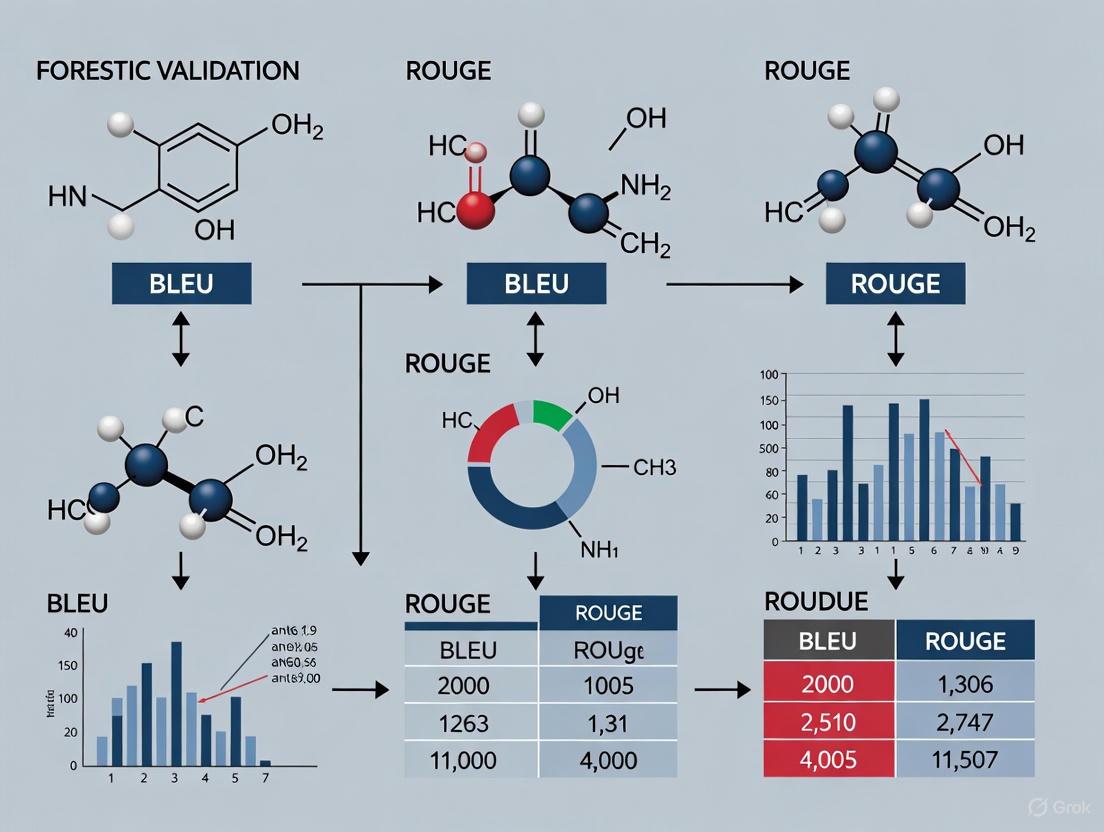
This article provides a comprehensive framework for applying BLEU and ROUGE metrics, traditionally used in natural language processing, to the validation of AI systems in forensic science and drug development.
Validating Forensic AI: A Practical Guide to BLEU and ROUGE Metrics for Researchers and Drug Development Professionals
Abstract
This article provides a comprehensive framework for applying BLEU and ROUGE metrics, traditionally used in natural language processing, to the validation of AI systems in forensic science and drug development. It explores the foundational principles of these metrics, details methodological approaches for their implementation in tasks such as forensic timeline analysis and report generation, addresses common troubleshooting and optimization challenges, and establishes a validation protocol for benchmarking performance against established forensic standards. Aimed at researchers and professionals, this guide bridges the gap between computational linguistics and rigorous scientific validation in highly regulated environments.
Beyond Translation: Understanding BLEU and ROUGE for Forensic and Scientific AI
The evolution of Large Language Models (LLMs) and automated text generation has created an urgent need for robust, quantitative evaluation methods. In forensic science and drug development, where textual evidence analysis, automated report generation, and literature mining are increasingly prevalent, validating the quality of machine-generated text becomes paramount. BLEU (Bilingual Evaluation Understudy) and ROUGE (Recall-Oriented Understudy for Gisting Evaluation) have emerged as fundamental metrics that address this need by providing standardized, automated assessment of text quality [1] [2].
Originally developed for machine translation and summarization tasks respectively, these metrics have found new applications in scientific validation contexts, particularly in digital forensics where standardized evaluation methodologies are critically needed [3]. Their ability to provide consistent, reproducible scores makes them particularly valuable for researchers and professionals who require objective measures of text similarity and content preservation.
Core Metric Components and Mathematical Foundations
BLEU (Bilingual Evaluation Understudy)
The BLEU score is a precision-oriented metric developed primarily for evaluating machine translation systems. It operates by comparing n-gram overlaps between machine-generated translations and human-written reference translations, employing a modified precision approach that prevents gaming through word repetition [1] [4].
Mathematical Formulation: BLEU = BP · exp(∑{n=1}^N wn log p_n)
Where:
- BP (Brevity Penalty) = { 1 if c > r, e^(1-r/c) if c ≤ r }
- p_n = n-gram precision score for each n-gram order
- w_n = uniform weights typically set as 1/N
- c = length of candidate translation
- r = length of reference translation [5] [1]
The brevity penalty addresses the tendency of systems to generate short translations that artificially inflate precision scores, while the geometric mean of n-gram precensions (typically up to 4-grams) ensures that both word choice and fluency are considered [4].
ROUGE (Recall-Oriented Understudy for Gisting Evaluation)
ROUGE metrics take a recall-oriented approach, making them particularly suitable for summarization tasks where capturing key content from reference texts is paramount. Developed by Chin-Yew Lin in 2004, ROUGE addresses the labor-intensive nature of manual summary evaluation by providing automated assessment correlated with human judgments [2] [6].
Primary ROUGE Variants:
- ROUGE-N: Measures overlap of n-grams between candidate and reference texts
- ROUGE-L: Based on Longest Common Subsequence (LCS) to account for sentence-level structure
- ROUGE-W: Weighted LCS that favors consecutive matches
- ROUGE-S: Evaluates skip-bigrams (non-consecutive word pairs)
- ROUGE-SU: Combines skip-bigrams with unigram matches [5] [2]
The core calculation for ROUGE-N involves: Recall = Σ Count{match}(n-gram) / Σ Count(n-gram){Reference} Precision = Σ Count{match}(n-gram) / Σ Count(n-gram){Candidate} F1 = 2 · Precision · Recall / (Precision + Recall) [7] [6]
Table 1: Core ROUGE Variants and Their Applications in Scientific Contexts
| Metric | Basis of Calculation | Primary Strength | Scientific Application Context |
|---|---|---|---|
| ROUGE-N | n-gram overlap | Computational efficiency | Initial screening of model outputs |
| ROUGE-L | Longest Common Subsequence | Word order sensitivity | Forensic report consistency checking |
| ROUGE-W | Weighted LCS | Consecutive match preference | Technical description validation |
| ROUGE-S | Skip-bigram co-occurrence | Flexible phrasing accommodation | Literature review generation |
| ROUGE-SU | Skip-bigrams + unigrams | Balanced content coverage | Protocol and method section evaluation |
Forensic Validation Framework
Standardized Methodology for Digital Forensic Timeline Analysis
The application of BLEU and ROUGE metrics to digital forensic timeline analysis represents a significant advancement in standardizing LLM evaluation for investigative purposes. Inspired by the NIST Computer Forensic Tool Testing (CFTT) Program, this methodology provides quantitative assessment of LLM performance in processing complex temporal evidentiary data [3].
Core Components of the Validation Framework:
- Standardized Dataset Creation: Curated forensic timeline data from Windows 11 systems using Plaso, with carefully constructed ground truth for benchmarking [3]
- Timeline Generation: Automated extraction of temporal information from diverse digital artifacts
- Ground Truth Development: Human-expert validated reference summaries for comparison
- Metric Application: Systematic computation of BLEU and ROUGE scores against established baselines [3]
This framework addresses the critical need for reproducible evaluation protocols in forensic contexts where tool reliability and error rate documentation are essential for legal admissibility and investigative integrity [3].
Objective: Quantitatively assess the quality of LLM-generated forensic timeline summaries against expert-curated reference summaries.
Materials and Setup:
- Digital evidence artifacts (disk images, log files, registry data)
- Plaso log2timeline for initial timeline extraction [3]
- LLM systems for summary generation (e.g., ChatGPT, fine-tuned models)
- Human domain experts for reference summary creation
- Python evaluation environment with
evaluateorrouge-scorelibraries [8] [9]
Procedure:
- Evidence Processing: Run Plaso against digital evidence sources to generate comprehensive timelines
- Reference Development: Domain experts analyze timelines and create structured summary documents
- LLM Summary Generation: Process timeline data through target LLMs to generate candidate summaries
- Metric Computation: Calculate BLEU and ROUGE scores between candidate and reference summaries
- Statistical Analysis: Compute confidence intervals and significance testing using bootstrapping methods [3] [2]
Validation Criteria:
- ROUGE-1 recall scores > 0.6 indicate adequate content coverage [9]
- BLEU scores > 0.3 suggest acceptable translation quality for technical content [1] [4]
- Statistical significance (p < 0.05) in superiority comparisons between systems
Metric Visualization and Workflow
Diagram 1: Forensic Validation Workflow
Diagram 2: Metric Selection Framework
Quantitative Comparison and Interpretation
Table 2: Comprehensive Metric Comparison for Scientific Applications
| Characteristic | BLEU Score | ROUGE-N | ROUGE-L | ROUGE-S/U |
|---|---|---|---|---|
| Primary Orientation | Precision-focused | Recall-focused | Balanced F-measure | Flexible recall |
| Linguistic Unit | n-grams (1-4) | n-grams (variable) | Longest common subsequence | Skip-bigrams + unigrams |
| Word Order Sensitivity | Limited to n-gram window | Limited to n-gram window | High through sequence matching | Moderate through skip distance |
| Forensic Application Strength | Technical term accuracy | Key fact extraction | Narrative coherence | Concept association |
| Typical Score Range (Good Quality) | 0.3 - 0.6 [4] | 0.5 - 0.7 [9] | 0.5 - 0.7 [7] | 0.4 - 0.6 [5] |
| Brevity Handling | Explicit penalty | No direct penalty | Implicit through LCS ratio | Variable based on implementation |
| Computational Complexity | Low | Low | Medium | Medium-high |
Table 3: BLEU Score Interpretation Guidelines for Technical Domains
| BLEU Score Range | Interpretation | Forensic Implications | Recommended Action |
|---|---|---|---|
| < 0.1 | Essentially no overlap | Unreliable for evidential purposes | System rejection or retraining |
| 0.1 - 0.19 | Minimal content capture | Major information loss | Significant improvement needed |
| 0.2 - 0.29 | Gist apparent with errors | Useful for directional leads only | Moderate improvements required |
| 0.3 - 0.39 | Understandable quality | Supplemental information source | Minor refinement beneficial |
| 0.4 - 0.49 | High quality | Primary information source | Acceptable for most applications |
| 0.5 - 0.59 | Very high quality | Evidential grade with minor review | Production deployment ready |
| > 0.6 | Near-human quality | Exceptional reliability | Benchmark reference standard [4] |
Research Reagent Solutions
Table 4: Essential Research Tools for Metric Implementation
| Tool/Resource | Function | Implementation Example | Forensic Application Context |
|---|---|---|---|
| Python evaluate library | Standardized metric computation | bleu = evaluate.load("bleu") rouge = evaluate.load('rouge') [8] |
Consistent scoring across experiments |
| NLTK Toolkit | Text preprocessing & tokenization | nltk.translate.bleu_score smoothing_functions [9] |
Handling forensic text variability |
| rouge-score package | ROUGE metric implementation | rouge_scorer.RougeScorer() with stemmer [9] |
Summary quality assessment |
| Plaso log2timeline | Forensic timeline extraction | Automated event chronology from evidence [3] | Ground truth generation for evaluation |
| H2OGPTE Client | LLM integration for text generation | translate_text() function with parameters [9] |
Candidate text production |
| Bootstrapping Methods | Statistical significance testing | Confidence intervals for metric scores [2] | Reliability assessment for legal contexts |
| Jackknifing Procedures | Multiple reference handling | Score averaging across reference sets [2] | Addressing expert summary variability |
Advanced Applications and Protocol Extensions
Cross-Domain Validation Protocol for Pharmaceutical Applications
Objective: Adapt BLEU/ROUGE metrics for validating automated scientific literature analysis and regulatory document generation in drug development contexts.
Experimental Design:
- Reference Standard Creation: Curate gold-standard summaries of clinical trial reports, drug interactions, and adverse event documentation using domain experts
- LLM System Configuration: Fine-tune models on pharmaceutical corpora with specialized vocabulary
- Metric Customization: Implement domain-specific stemming and synonym recognition for therapeutic areas
- Validation Framework: Establish minimum acceptable scores for regulatory compliance contexts
Evaluation Criteria:
- ROUGE-2 recall > 0.55 for key concept extraction from scientific literature
- BLEU score > 0.35 for technical term preservation in generated documents
- ROUGE-L F1 > 0.60 for procedural coherence in protocol descriptions
Limitations and Mitigation Strategies
While BLEU and ROUGE provide valuable quantitative measures, several limitations must be addressed in scientific validation contexts:
Semantic Blindness: Neither metric captures meaning, synonyms, or semantic equivalence [8] [1]. Mitigation: Supplement with embedding-based metrics (BERTScore) and human evaluation of critical content.
Equal Word Weighting: Both metrics treat all words equally, despite varying importance in forensic or scientific contexts [1] [4]. Mitigation: Implement domain-specific weighting schemes for key terminology.
Limited Grammatical Sensitivity: Syntactic errors may not be adequately penalized [4]. Mitigation: Combine with language model perplexity scores and grammar-specific checks.
Reference Dependency: Metric quality depends heavily on reference text quality and representativeness [9]. Mitigation: Employ multiple reference summaries and domain expert validation.
The integration of BLEU and ROUGE metrics into forensic and scientific validation frameworks represents a significant advancement in standardizing the evaluation of language technologies for evidentiary and research applications. By providing structured protocols, interpretation guidelines, and implementation methodologies, researchers can establish reproducible benchmarks for assessing automated text generation systems in high-stakes environments where accuracy and reliability are paramount.
Within the rigorous framework of forensic validation research, the objective evaluation of text-based evidence and reports generated by artificial intelligence is paramount. BLEU (Bilingual Evaluation Understudy) and ROUGE (Recall-Oriented Understudy for Gisting Evaluation) provide automated, quantitative metrics for this purpose, rooted in a fundamental precision-recall tradeoff [10] [11].
This application note delineates the core operational principles of BLEU and ROUGE, framing them within the context of precision and recall. It provides forensic researchers and drug development professionals with structured data, experimental protocols, and visual workflows to integrate these metrics into validation methodologies for automated text generation systems.
Core Metric Definitions and Quantitative Comparison
The Precision and Recall Paradigm
The definitions of BLEU and ROUGE are intrinsically linked to the concepts of precision and recall from information retrieval. Precision asks: "Of the words generated by the model, how many are correct?" Recall asks: "Of the correct words present in the reference, how many were captured by the model?" [11]. BLEU is fundamentally a precision-oriented metric, making it suitable for tasks where the accuracy of the generated output is critical. Conversely, ROUGE is fundamentally a recall-oriented metric, making it ideal for tasks like summarization where capturing all key information from the source is paramount [11] [12].
Table 1: Core Characteristics of BLEU and ROUGE Metrics
| Feature | BLEU | ROUGE |
|---|---|---|
| Primary Orientation | Precision [11] | Recall [11] |
| Core Mechanism | Modified n-gram precision [13] | Overlap of n-grams or sequences [14] |
| Typical Use Cases | Machine Translation, Image Captioning [12] | Text Summarization, Paraphrase Generation [12] |
| Key Components | Modified n-gram precision, Brevity Penalty (BP) [13] | Recall, Precision, F1-score [11] |
| Forensic Application | Evaluating machine-generated translations of forensic reports [15] [3] | Evaluating summaries of forensic timelines or evidence [15] [3] |
BLEU: A Deeper Look at Precision
BLEU's precision is "modified" or "clipped" to prevent gaming the metric through word repetition [13] [1]. It calculates the number of n-grams in the candidate text that appear in the reference text, but clips this count to the maximum number of times the n-gram appears in any single reference translation [13]. The final BLEU score is a weighted geometric mean of these modified n-gram precisions (for n=1 to 4), multiplied by a Brevity Penalty (BP) that penalizes candidates shorter than their references [13] [1].
The formula is:
BLEU = BP · exp(∑ wn log pn)
where pn is the modified precision for n-grams, and wn are positive weights summing to one [13].
ROUGE: A Deeper Look at Recall
ROUGE, in its most common forms, measures recall by calculating the overlap of units between the candidate and reference texts [14]. The most frequently used variants are:
- ROUGE-N: Measures the recall of n-grams. ROUGE-1 (unigrams) and ROUGE-2 (bigrams) are most common [14] [11]. The recall is computed as: (Number of overlapping n-grams) / (Total n-grams in the reference) [11].
- ROUGE-L: Based on the Longest Common Subsequence (LCS), which captures the longest sequence of words (in order, but not necessarily consecutive) shared by both candidate and reference. This makes it more sensitive to sentence structure [14] [11].
Experimental Protocols for Forensic Validation
Workflow for Metric Implementation
The following diagram illustrates the generalized workflow for applying BLEU and ROUGE in a forensic validation study.
Protocol 1: Calculating BLEU Score
This protocol is adapted from methodologies used in evaluating LLMs for digital forensic timeline analysis [15] [3].
Objective: To quantitatively assess the precision of a machine-generated translation of a forensic report against a human-produced reference. Materials: See Section 5, "The Scientist's Toolkit."
Preparation:
- Reference Texts: Collect one or more high-quality, human-translated versions of the source forensic report. Multiple references account for valid linguistic variation [12].
- Candidate Text: Obtain the machine-generated translation to be evaluated.
Preprocessing:
- Tokenize both reference and candidate texts into word lists.
- Apply standard text normalization (e.g., lowercasing, removing punctuation).
Compute Modified n-gram Precision:
- For n=1 to 4, calculate the clipped precision
pn. - Example: For n=1 (unigrams), count how many words in the candidate appear in the reference. The count for each word is clipped to the maximum number of times it appears in any single reference. Sum these clipped counts and divide by the total number of words in the candidate [13] [1].
- For n=1 to 4, calculate the clipped precision
Compute Brevity Penalty (BP):
- Let
c= length of the candidate translation. - Let
r= length of the reference translation closest toc. - BP = 1 if
c>r, otherwise BP =e^(1 - r/c)[13].
- Let
Calculate Final BLEU Score:
- Compute the weighted geometric mean of the precisions:
exp(∑ wₙ log pₙ), where weightswₙare typically 0.25 for n=1 to 4. - Multiply the result by the Brevity Penalty [13].
- Compute the weighted geometric mean of the precisions:
Protocol 2: Calculating ROUGE-N Score
This protocol is suited for evaluating summaries of forensic evidence or timelines [15] [3].
Objective: To quantitatively assess the recall of key information in a machine-generated summary of a forensic timeline against a human-produced reference summary. Materials: See Section 5, "The Scientist's Toolkit."
Preparation:
- Reference Summary: A concise, human-written summary of the key events in a forensic timeline.
- Candidate Summary: The machine-generated summary to be evaluated.
Preprocessing:
- Tokenize and normalize the texts as in Protocol 1.
Compute ROUGE-N Recall, Precision, and F1:
- For a chosen
n(e.g., 1 or 2), generate all n-grams from the candidate and reference texts. - Recall: Count the number of n-grams in the reference that appear in the candidate. Divide by the total number of n-grams in the reference [11].
- Precision: Count the number of n-grams in the candidate that appear in the reference. Divide by the total number of n-grams in the candidate.
- F1-Score: Compute the harmonic mean of recall and precision:
F1 = 2 * (Precision * Recall) / (Precision + Recall).
- For a chosen
Forensic Application: A Case Study in Digital Timeline Analysis
Recent research has proposed standardized methodologies for evaluating Large Language Models (LLMs) in digital forensics, specifically in timeline analysis [15] [3]. These methodologies recommend BLEU and ROUGE for the quantitative evaluation of LLM performance on tasks such as event summarization.
In this context, an LLM like ChatGPT might be tasked with generating a natural language summary of low-level system events (the candidate). A human expert would create a ground-truth summary (the reference) from the same data. The BLEU score would evaluate the precision of the LLM's wording and phrasing, ensuring it does not invent or hallucinate events not present in the data. The ROUGE score (particularly ROUGE-1 and ROUGE-L recall) would evaluate how comprehensively the LLM's summary captures all critical events detailed in the human expert's reference, ensuring no key forensic information is omitted [3]. This dual-metric approach provides a more holistic validation of the AI system's utility and reliability for forensic practice.
The Scientist's Toolkit
Table 2: Essential Research Reagents and Computational Tools
| Item / Tool Name | Function / Purpose | Example / Specification |
|---|---|---|
| Reference Texts | Serves as the ground truth for evaluation. | Human-translated reports or human-written summaries [12]. |
| Candidate Texts | The system output requiring quantitative evaluation. | Machine-translated text or AI-generated summaries [12]. |
Python evaluate Library |
A Hugging Face library providing standardized, easy-to-use functions for calculating metrics. | pip install evaluate [10]. |
| NLTK Library | A classic Python NLP toolkit containing the sentence_bleu and corpus_bleu functions. |
from nltk.translate.bleu_score import sentence_bleu [12]. |
| rouge-score Library | A dedicated Python library for calculating ROUGE metrics. | from rouge_score import rouge_scorer [12]. |
| Custom Validation Dataset | A domain-specific corpus with established ground truth for forensic validation studies. | Publicly available forensic timeline datasets, as used in [3]. |
The Critical Need for Standardized Validation in Forensic AI and Drug Development
The integration of artificial intelligence (AI) into forensic science and drug development represents a paradigm shift, offering unprecedented improvements in efficiency, accuracy, and scalability. However, the transformative potential of these technologies is contingent upon establishing robust validation frameworks to ensure their reliability, reproducibility, and admissibility in legal and regulatory contexts. In forensic science, AI tools are being deployed for tasks ranging from digital timeline analysis to crime scene image interpretation [16] [17]. Concurrently, in pharmaceutical development, large language models (LLMs) are being explored to optimize randomized controlled trial (RCT) design, aiming to enhance generalizability and reduce failure rates [18]. The absence of standardized validation methodologies poses a significant risk, potentially leading to unreliable outcomes, amplified biases, and ultimately, a erosion of trust in these critical fields. This application note advocates for the adoption of standardized quantitative metrics, specifically BLEU and ROUGE, as a foundational component of a rigorous validation protocol for AI applications in both forensics and drug development.
The State of AI in Forensics and Drug Development
Forensic Applications
AI is revolutionizing forensic science across multiple disciplines. In digital forensics, LLMs are assisting in complex tasks such as forensic timeline analysis, where they can summarize events and identify anomalies from vast volumes of low-level system data [15] [3]. In crime scene analysis, AI tools like ChatGPT-4, Claude, and Gemini have demonstrated potential as decision-support systems, aiding human experts in the initial assessment of crime scene imagery [16]. The U.S. Department of Justice recognizes AI's role in enhancing the objectivity and reproducibility of forensic methods, including the analysis of toolmarks, DNA mixtures, and digital evidence [17].
Table: Current AI Applications in Forensic Science
| Forensic Discipline | AI Application Examples | Key Benefits |
|---|---|---|
| Digital Forensics | Timeline analysis, log file parsing, communication data summarization [15] [3] [19] | Processes large data volumes; identifies hidden patterns [19] |
| Crime Scene Analysis | Image analysis for object/evidence identification, crime scene categorization [16] [17] | Rapid initial screening; augments human analysis [16] |
| Forensic Pathology | Post-mortem CT analysis, wound classification, diatom testing [20] | High accuracy (e.g., 70-94% in neurological forensics) [20] |
| Biometric & DNA Analysis | Probabilistic genotyping, fingerprint/face comparison [17] | Improves reproducibility; mitigates human bias [17] |
Drug Development Applications
In the pharmaceutical sector, LLMs are being piloted to address long-standing challenges in clinical trial design. A recent study evaluated GPT-4-Turbo-Preview for designing RCTs, focusing on enhancing diversity, generalizability, and reducing failure rates. The model demonstrated 72% overall accuracy in replicating RCT designs, with particularly high performance in planning recruitment (88% accuracy) and interventions (93% accuracy) [18]. This highlights AI's potential to create more inclusive and pragmatic trial methodologies, though it also revealed limitations in designing eligibility criteria and outcome measures.
The Case for Standardized Metrics: BLEU and ROUGE
A significant challenge in both domains is the lack of a standardized, quantitative approach to evaluating AI-generated outputs. Many current evaluations are qualitative or rely on non-standardized case studies [15] [21] [3].
Inspired by the NIST Computer Forensic Tool Testing (CFTT) Program, researchers have proposed using established Natural Language Processing (NLP) metrics, specifically BLEU (Bilingual Evaluation Understudy) and ROUGE (Recall-Oriented Understudy for Gisting Evaluation), for the quantitative evaluation of LLMs [15] [22] [3]. Their application provides a crucial layer of objective performance measurement.
- BLEU (Bilingual Evaluation Understudy): This metric assesses how closely an AI-generated text matches a human-written reference in terms of precision, focusing on the correctness of word choice and order. A higher BLEU score indicates the text more closely resembles the human-generated reference [22].
- ROUGE (Recall-Oriented Understudy for Gisting Evaluation): This metric primarily measures recall, evaluating whether the AI-generated output captures the key points and concepts from the source material or reference text [22].
Their utility has been demonstrated in validating LLMs for designing RCTs, where reported scores provided an objective benchmark for the model's performance [18]. It is critical to note that these lexical overlap metrics are useful for cursory checks but are insufficient as sole proxies for clinical or forensic quality. They should be part of a layered evaluation strategy that includes semantic metrics and human expert review [22] [21].
Proposed Experimental Protocols
Protocol 1: Validating an LLM for Forensic Timeline Summarization
Objective: To quantitatively evaluate the performance of an LLM in generating accurate and complete summaries of digital forensic timelines.
Workflow Description: The process begins with raw digital timelines, which are processed by an LLM to generate an event summary. This summary is then evaluated both quantitatively against a human-expert "ground truth" summary using BLEU and ROUGE metrics, and qualitatively via human expert review. Both streams of analysis feed into a final validation report.
Materials:
- Dataset: Publicly available forensic timeline dataset from Windows 11 generated using Plaso [3].
- Ground Truth: Expert-curated summaries of the key events in the timeline.
- LLM: Model to be tested (e.g., ChatGPT, Claude, Gemini).
- Evaluation Software: Python scripts with NLTK or similar libraries to compute BLEU and ROUGE scores.
Methodology:
- Input Preparation: Feed raw timeline data from the dataset to the LLM with a standardized prompt (e.g., "Summarize the key forensic events in this timeline.").
- Output Generation: Collect the LLM-generated summary.
- Quantitative Evaluation: Compare the LLM-generated summary to the human-expert ground truth summary using BLEU and ROUGE metrics.
- Qualitative Evaluation: A human forensic expert, blinded to the source of the summary, rates the LLM's output on criteria like correctness, fluency, and relevance.
- Analysis: Correlate quantitative scores with qualitative ratings to establish performance benchmarks. The method should be tested against scenarios with targeted perturbations, such as deleted events or paraphrased text, to assess robustness [21].
Protocol 2: Validating an LLM for Clinical Trial Design
Objective: To assess an LLM's ability to generate clinically accurate and comprehensive designs for randomized controlled trials (RCTs).
Workflow Description: This protocol evaluates an LLM's ability to design a clinical trial. Basic study parameters are input into the LLM, which generates a full RCT design. This design is evaluated for clinical accuracy against a ground truth design from ClinicalTrials.gov by human experts and via quantitative metrics, leading to a final adjudication and score.
Materials:
- Dataset: 20 parallel-arm RCTs (a mix of completed and newly registered) sourced from ClinicalTrials.gov and leading journals to mitigate pretraining bias [18].
- Ground Truth: The officially registered RCT design from ClinicalTrials.gov.
- LLM: Model to be tested (e.g., GPT-4-Turbo-Preview).
- Evaluation Metrics: BLEU, ROUGE-L, and METEOR for objective scoring; Likert scales (1-3) for qualitative domains (safety, clinical accuracy, diversity) [18].
Methodology:
- Prompting: Provide the LLM with basic study information (title, condition, intervention) and prompt it to generate key design components: eligibility criteria, recruitment strategy, interventions, and outcome measurements.
- Output Generation: Collect the structured LLM output.
- Quantitative Evaluation:
- For numerical elements (e.g., sample size, age range), calculate exact match accuracy.
- For text-based elements (e.g., eligibility criteria), compute BLEU, ROUGE-L, and METEOR scores against the ground truth [18].
- Qualitative Evaluation: Independent clinical experts perform a blinded review of the LLM-generated designs and the original ground truth designs, rating them on safety, clinical accuracy, pragmatism, inclusivity, and diversity.
- Analysis: Calculate overall accuracy and domain-specific performance. Identify systematic weaknesses (e.g., in eligibility criteria design, as found in prior research [18]).
The Scientist's Toolkit: Essential Research Reagents & Materials
Table: Key Resources for AI Validation Experiments
| Item Name | Function / Application | Specifications / Notes |
|---|---|---|
| Plaso (log2timeline) | Extracts digital timeline events from a disk image for forensic validation [3]. | Generates the raw, low-level event data used as input for LLM processing. |
| Forensic Timeline Dataset | Provides standardized data for benchmarking LLM performance [3]. | Publicly available dataset from Windows 11; includes ground truth. |
| ClinicalTrials.gov Data | Serves as the ground truth for validating AI-generated clinical trial designs [18]. | Source of registered, clinically validated RCT protocols. |
| BLEU Metric | Quantifies n-gram precision of AI-generated text against a reference [15] [22]. | Focuses on linguistic similarity. A higher score indicates closer match. |
| ROUGE Metric | Quantifies recall of key concepts in AI-generated text against a source [15] [22]. | Focuses on content coverage. A higher score indicates more key points captured. |
| Computer Software Assurance (CSA) | A risk-based framework for validating AI systems in regulated environments [22]. | Prioritizes validation activities to reduce unnecessary documentation and overhead. |
The adoption of standardized validation protocols centered on metrics like BLEU and ROUGE is not merely a technical exercise but a fundamental requirement for the responsible integration of AI into high-stakes fields. In forensics, such standardization is critical for upholding the reliability and admissibility of AI-assisted evidence [17]. In drug development, it ensures that AI-generated trial designs are clinically sound, ethical, and effective in bringing new treatments to market [18].
While BLEU and ROUGE provide a crucial foundation for quantitative assessment, they are part of a larger ecosystem of validation. As one systematic review notes, an over-reliance on lexical overlap metrics is insufficient; a layered strategy that pairs these with semantic metrics (e.g., BERTScore) and targeted human adjudication is essential for a true measure of quality [21]. Furthermore, frameworks like Computer Software Assurance (CSA) emphasize a risk-based approach, enabling continuous verification and adaptation as models and data evolve [22].
In conclusion, the path forward requires a collaborative effort among researchers, practitioners, and regulators to establish and refine these validation standards. By doing so, we can harness the full potential of AI in forensics and drug development while safeguarding the principles of scientific rigor, justice, and public trust.
- Introduction and NIST Foundation: Overview of digital forensics challenges and NIST's role in standardizing LLM evaluation.
- Quantitative Metrics and Experimental Framework: Tables comparing BLEU and ROUGE metrics, dataset composition, and evaluation results.
- Experimental Protocols: Step-by-step methodology for dataset creation, ground truth development, and LLM evaluation.
- Research Toolkit: Table of essential reagents and computational tools for implementing the protocol.
- Workflow Visualization: Graphviz diagrams illustrating the experimental workflow and metric computation.
Case Study: The NIST-Inspired Push for Quantitative LLM Evaluation in Digital Forensics
Digital forensic investigations increasingly rely on timeline analysis to reconstruct sequences of events from digital artifacts, a process that has traditionally been labor-intensive and potentially subjective [3]. The emergence of Large Language Models (LLMs) offers transformative potential for automating aspects of this process, but their adoption has been hampered by the lack of standardized evaluation methodologies specifically designed for forensic applications [15] [23]. Prior to this initiative, research primarily consisted of case studies demonstrating potential applications without providing quantitative, reproducible measures of performance [3].
The National Institute of Standards and Technology (NIST) has long established the scientific foundation for digital forensic techniques through its Computer Forensic Tool Testing (CFTT) Program [24]. This program aims to ensure the reliability of forensic software tools by developing specifications, test procedures, and criteria based on fundamental computer operations [3] [24]. Inspired by this rigorous framework, researchers have proposed a standardized methodology to quantitatively evaluate LLM performance specifically for forensic timeline analysis, creating a bridge between traditional tool validation and AI assessment [15] [23]. This approach addresses the critical need for forensic soundness and scientific validity when integrating AI into investigative processes, ensuring that LLM-generated insights meet the evidentiary standards required for judicial proceedings [25].
Quantitative Metrics and Experimental Framework
Core Evaluation Metrics
The proposed methodology adapts established text similarity metrics from computational linguistics to quantitatively assess how closely LLM-generated timeline summaries align with human-developed ground truth [15] [3]. These metrics provide standardized, reproducible measures for comparing different LLMs or configurations.
Table 1: Core Quantitative Metrics for LLM Timeline Analysis Evaluation
| Metric | Full Name | Primary Function | Forensic Application | Interpretation |
|---|---|---|---|---|
| BLEU | Bilingual Evaluation Understudy | Measures n-gram precision overlap between generated and reference text [26] | Quantifies factual accuracy in event sequence description [15] | Score 0-1; higher values indicate better n-gram matching [26] |
| ROUGE | Recall-Oriented Understudy for Gisting Evaluation | Measures recall of n-grams, word sequences, and word pairs [27] | Assesses completeness in capturing critical timeline events [3] | Score 0-1; higher values indicate better recall of reference content [27] |
These metrics are applied to evaluate LLM performance on specific forensic tasks such as event summarization, anomaly detection, and temporal pattern identification in digital timelines [15]. The combination addresses both precision (BLEU) and recall (ROUGE), providing a balanced assessment of LLM capabilities.
Experimental Dataset Composition
The validation framework utilizes standardized datasets generated from Windows 11 systems using the log2timeline/Plaso toolchain, which extracts temporal information from various digital artifacts including file system metadata, registry entries, and application logs [3]. This creates a foundation for reproducible experimentation across different research environments.
Table 2: Forensic Timeline Dataset Composition and LLM Performance
| Data Source | Artifact Types | Generated Timeline Events | BLEU Score (ChatGPT) | ROUGE Score (ChatGPT) | Primary Challenge |
|---|---|---|---|---|---|
| File System Metadata | MAC timestamps, file paths | 150,000-200,000 low-level events [3] | 0.45 | 0.52 | Information overload from volume [3] |
| Web Browser Artifacts | History, cache, cookies, downloads [3] | 5,000-10,000 user activity events [3] | 0.62 | 0.58 | Context reconstruction from fragments [3] |
| System Logs | Application, security, system events | 2,000-5,000 system events | 0.51 | 0.49 | Technical jargon interpretation |
| Registry Entries | UserAssist, MRU lists, USB connections | 1,000-3,000 configuration changes | 0.56 | 0.53 | Indirect evidence correlation [3] |
Experimental results with ChatGPT demonstrate promising but variable performance across different artifact types, with particularly strong results in browser artifact analysis where semantic content is richer [3]. The quantitative metrics effectively reveal performance patterns, enabling researchers to identify specific LLM strengths and weaknesses for different forensic tasks.
Experimental Protocols
Dataset and Ground Truth Development Protocol
Objective: To create standardized, forensically-sound datasets with verified ground truth for evaluating LLM performance in timeline analysis.
Materials: Dedicated forensic workstation, clean Windows 11 installation, log2timeline/Plaso toolchain, write-blocking hardware, cryptographic hash verification software.
Procedure:
Controlled Data Generation
- Configure a clean Windows 11 system in an isolated lab environment
- Execute predefined user activities including file operations, web browsing, application usage, and system configuration changes
- Document all activities with precise timestamps and sequences to create ground truth
- Generate cryptographic hashes (SHA-256) of all source artifacts to ensure integrity
Timeline Extraction
- Acquire disk images using write-blocking hardware to maintain evidence integrity
- Process images through log2timeline/Plaso to extract temporal information:
log2timeline.py --storage-file timeline.plaso disk_image.raw - Export comprehensive timeline in CSV format for analysis:
psort.py -o dynamic -w timeline.csv timeline.plaso
Ground Truth Development
- Forensic experts manually annotate the timeline, identifying and categorizing significant events
- Establish event correlations to create high-level activity summaries
- Resolve any ambiguities through consensus review by multiple domain experts
- Structure ground truth using standardized templates for consistent evaluation
LLM Evaluation and Metric Application Protocol
Objective: To quantitatively assess LLM performance on forensic timeline analysis tasks using BLEU and ROUGE metrics.
Materials: Python 3.8+ environment with NLTK/library installations, prepared dataset with ground truth, API or local access to LLMs (e.g., ChatGPT, Llama).
Procedure:
Task Formulation and Prompt Engineering
- Define specific analytical tasks: event summarization, anomaly detection, temporal pattern identification
- Develop standardized prompts for each task with clear instructions and output format requirements
- Incorporate chain-of-thought prompting techniques for complex reasoning tasks
- Maintain consistent prompt structure across all experimental iterations
LLM Execution and Output Collection
- Process timeline segments through LLMs using standardized prompts
- Collect and document all outputs with corresponding system configurations
- Execute multiple trials with temperature setting = 0.3 to balance consistency and creativity
- Log all API parameters, including model version, timestamp, and processing time
Quantitative Evaluation
- Implement BLEU score calculation using sentencebleu() for individual segments and corpusbleu() for aggregate assessment
- Compute ROUGE metrics (ROUGE-N, ROUGE-L) using standard libraries for recall-oriented evaluation
- Perform statistical analysis across multiple experimental runs to establish significance
- Generate comparative performance visualizations across different LLMs and task types
Quality Control: Implement control experiments with known inputs, cross-validate metrics with human judgment samples, and maintain complete documentation of all experimental parameters.
The Scientist's Toolkit
Table 3: Essential Research Reagents and Computational Tools
| Reagent/Tool | Specifications | Primary Function in Protocol | Critical Parameters |
|---|---|---|---|
| log2timeline/Plaso | Version 20240612 or later | Extracts timeline events from disk images [3] | Support for 300+ artifact types, temporal extraction accuracy |
| Reference Datasets | Windows 11 artifact collection, 200K+ events | Provides standardized testing substrate [3] | Ground truth verification, artifact diversity, ethical compliance |
| BLEU Implementation | NLTK 3.8.1+ sentencebleu(), corpusbleu() | Quantifies n-gram precision against ground truth [26] | N-gram weights (usually 4-gram), automatic tokenization |
| ROUGE Implementation | rouge-score 1.0.1+ library | Measures recall-oriented similarity [27] | ROUGE-N (unigram/bigram), ROUGE-L (longest common subsequence) |
| LLM Access API | OpenAI GPT-4, Llama 3 70B, or comparable | Generates timeline analyses from structured prompts | Temperature (0.1-0.5), context window, token limits |
| Forensic Workstation | Hardware write-blocker, 64GB RAM, 2TB+ storage | Maintains evidence integrity during processing [3] | Isolation capability, hash verification, chain-of-custody documentation |
Workflow Visualization
Diagram 1: LLM Forensic Evaluation Workflow
Diagram 2: BLEU and ROUGE Metric Computation
Integrating Metrics into a Risk-Based Framework like Computer Software Assurance (CSA)
The integration of quantitative linguistic metrics, such as BLEU (Bilingual Evaluation Understudy) and ROUGE (Recall-Oriented Understudy for Gisting Evaluation), into risk-based frameworks represents a significant advancement in the validation of software tools used in regulated and forensic sciences. This approach is particularly relevant for applications involving Large Language Models (LLMs), where traditional validation methods fall short. The Computer Software Assurance (CSA) model, recently emphasized in final guidance from the U.S. Food and Drug Administration (FDA), provides an ideal risk-based structure for this integration [28] [29]. CSA moves away from a one-size-fits-all validation approach toward a risk-based methodology where the level of assurance effort is proportionate to the risk of the software feature failing and compromising patient safety or product quality [30]. This paradigm shift aligns with the need to quantitatively evaluate AI-driven tools in digital forensics and drug development, where LLMs are increasingly used for tasks such as timeline analysis of forensic events and generation of clinical notes [15] [31] [3].
The CSA Risk-Based Framework: A Primer
Computer Software Assurance is a modern, risk-based approach to validating software used in production and quality systems within regulated industries. The framework is built on a binary risk classification and mandates that assurance activities be commensurate with the identified risk [28].
Core Principles of CSA
The foundational principle of CSA is that the burden of validation should be no more than necessary to address the actual risk, aligning with the FDA's "least-burdensome" principles [29]. This involves a fundamental shift from validating entire systems uniformly to focusing efforts on high-risk functions. Key activities under CSA include leveraging vendor documentation, employing unscripted or exploratory testing for lower-risk functions, and using targeted regression testing based on risk rather than full revalidation for every software update [28].
The CSA Workflow: A Four-Step Process
The implementation of CSA follows a structured, four-step process [29]:
- Identify the Intended Use: Document how the software will be used within specific production or quality processes.
- Determine the Risk-Based Approach: Classify software features, functions, or operations based on whether their failure poses a "high process risk."
- Determine Appropriate Assurance Activities: Select testing and assurance methods (e.g., unscripted, scripted, exploratory testing) that are proportionate to the risk level.
- Establish the Record: Create objective evidence that includes the intended use, risk analysis, summary of testing, issues found, and a conclusion of acceptability.
BLEU and ROUGE Metrics for LLM Evaluation
In the context of validating LLMs, BLEU and ROUGE serve as quantitative lexical similarity metrics to objectively assess the quality of machine-generated text against a human-written ground truth [15] [26].
BLEU (Bilingual Evaluation Understudy)
BLEU is a precision-oriented metric that measures the overlap of n-grams (contiguous sequences of words) between a generated text and one or more reference texts [26]. It primarily assesses the correctness of the output.
- Calculation: BLEU calculates modified n-gram precision for unigrams, bigrams, trigrams, and 4-grams. It incorporates a brevity penalty (BP) to penalize short, uninformative outputs.
BLEU = BP * exp(Σ_{n=1}^N w_n * log p_n)Wherep_nis the modified precision for n-grams of lengthn, andw_nis a weight typically set to1/N[26]. - Interpretation: Scores range from 0 to 1 (or 0% to 100%). A higher BLEU score indicates greater n-gram overlap with the reference, suggesting higher textual fidelity.
ROUGE (Recall-Oriented Understudy for Gisting Evaluation)
ROUGE is a set of metrics, with ROUGE-N being the most directly comparable to BLEU. It is recall-oriented, measuring how much of the n-grams in the reference text are captured in the generated text [15] [31]. It primarily assesses the comprehensiveness of the output.
- Common Variants: ROUGE-N (n-gram recall), ROUGE-L (longest common subsequence), and ROUGE-S (skip-bigram co-occurrence statistics).
- Interpretation: Like BLEU, scores range from 0 to 1. A higher ROUGE score indicates that the generated text captures more of the key concepts and wording from the reference material.
Limitations and Contextual Use
While BLEU and ROUGE provide valuable, scalable quantitative measures, they are not a complete solution. They primarily measure lexical overlap and can penalize meaning-preserving paraphrases, potentially missing semantic errors [31]. Current research, including systematic reviews on evaluating AI-generated clinical notes, recommends a layered evaluation strategy that pairs these semantic metrics with LLM-as-evaluator for scalability and includes targeted human adjudication for final validation [31].
Integration Protocol: Mapping Metrics to CSA
The following protocol details the methodology for integrating BLEU and ROUGE metrics into the CSA framework for validating LLM outputs, such as forensic timeline summaries or AI-generated clinical notes.
Protocol Workflow
The diagram below outlines the integrated validation workflow, combining the CSA process with metric-based evaluation.
Risk-Based Evaluation Thresholds and Assurance Activities
The following table summarizes the appropriate level of evaluation and assurance activities based on the risk classification of the LLM feature or function.
Table 1: Risk-Based Assurance Activities and Metric Thresholds for LLM Evaluation
| CSA Risk Level | Example LLM Function | Suggested BLEU/ROUGE Threshold | Assurance Activities & Evaluation Protocol |
|---|---|---|---|
| High Process Risk | Summarizing forensic event timelines from log data [15] [3]; Generating clinical notes that inform treatment decisions [31] | Stringent (e.g., BLEU > 0.6, ROUGE > 0.7) | 1. Scripted Testing: Validate against a comprehensive test set of ground-truth timelines/notes [28]. 2. Metric Evaluation: Compute BLEU and ROUGE scores against the ground truth [15]. 3. Mandatory Human Adjudication: Subject matter experts (e.g., forensic analysts, clinicians) must evaluate outputs for correctness, clinical acceptability, and potential hallucinations, regardless of metric scores [31] [3]. |
| Not High Process Risk | Generating routine reports on system usage; Drafting non-critical sections of internal documentation | Moderate (e.g., BLEU > 0.4, ROUGE > 0.5) | 1. Unscripted/Exploratory Testing: Testers use high-level objectives to evaluate outputs without detailed scripts [30]. 2. Metric Evaluation: Compute BLEU and ROUGE scores as a primary pass/fail criterion [28]. 3. Automated or Light Review: Outputs passing the metric threshold may be accepted with limited human review, focusing on spot-checking [28]. |
Experimental Validation Protocol
This section provides a detailed, citable methodology for an experiment validating an LLM used for forensic timeline analysis, following the integrated CSA and metrics framework.
Experimental Workflow
The experimental process for validating an LLM-based forensic tool, from dataset preparation to final risk-based evaluation, is shown below.
The Scientist's Toolkit: Essential Research Reagents and Materials
The following table details key components required for conducting the experimental validation of an LLM under the CSA framework.
Table 2: Essential Research Reagents and Solutions for Experimental Validation
| Item | Function in Validation Protocol | Specification & Notes |
|---|---|---|
| Reference Dataset | Serves as the objective ground truth for calculating BLEU/ROUGE scores and for human evaluation [15] [3]. | Should be representative of real-world data. Example: Publicly available forensic timeline datasets from Windows 11 generated using Plaso [3]. |
| Large Language Model (LLM) | The system under test (SUT); generates the outputs to be validated (e.g., timeline summaries, clinical notes). | Examples: ChatGPT, Llama [31] [3]. The model version and prompt strategy must be documented in the CSA record. |
| Metric Calculation Library | Automates the computation of BLEU, ROUGE, and other relevant metrics. | Libraries: NLTK, Hugging Face evaluate. Configuration (e.g., n-gram order for BLEU) must be standardized and reported [26]. |
| Human Evaluation Protocol | Provides the critical, risk-based adjudication for high-process-risk functions, assessing aspects metrics cannot (e.g., clinical safety) [31]. | A structured rubric is required. Common criteria: Correctness (factual accuracy), Completeness, Fluency (readability), and Clinical/Forensic Acceptability. |
| CSA Documentation Suite | The collective objective evidence required to demonstrate compliance and build confidence in the software [28]. | Includes: Intended Use Statement, Risk-Based Analysis, Summary of Testing (metric scores), Issues Found, and Conclusion of Acceptability. |
The integration of BLEU and ROUGE metrics into a risk-based CSA framework provides a standardized, quantitative, and scalable methodology for establishing confidence in LLMs applied to sensitive domains like digital forensics and drug development [15] [3]. This hybrid approach leverages the efficiency of automated metrics for initial screening and lower-risk functions while mandating rigorous, expert human evaluation for high-risk scenarios where patient safety or evidentiary integrity is paramount [31] [28]. By aligning modern AI evaluation techniques with established regulatory principles, this protocol offers researchers and professionals a robust pathway for the forensic validation of complex, AI-driven software tools.
From Theory to Practice: Implementing BLEU and ROUGE in Forensic and Biomedical Workflows
The rapid integration of Large Language Models (LLMs) into forensic science—from timeline analysis to investigative report writing—demands rigorous, standardized validation methodologies to ensure the reliability and admissibility of AI-generated evidence [3]. Within the broader thesis on forensic validation, this protocol establishes how BLEU (Bilingual Evaluation Understudy) and ROUGE (Recall-Oriented Understudy for Gisting Evaluation) metrics can be quantitatively employed to validate LLM outputs against a human-curated ground truth. These metrics provide an initial, reproducible, and automated means of assessing the quality of machine-generated text, which is crucial for upholding scientific standards in digital forensics [32] [3].
The core premise of this approach is that the quality of an LLM's output can be measured by its similarity to a trusted reference, or "ground truth," created by human experts. BLEU, with its focus on precision, measures how much of the model's output appears in the reference, making it suitable for tasks where factual and grammatical correctness is paramount. Conversely, ROUGE, with its focus on recall, measures how much of the reference content is captured by the model, making it ideal for tasks like summarization where covering all key points is critical [32] [33]. This document provides a detailed, step-by-step protocol for constructing a validation study based on these principles.
Core Metric Definitions and Theoretical Foundations
BLEU (Bilingual Evaluation Understudy)
BLEU is a precision-oriented metric that evaluates the quality of generated text by calculating the overlap of n-grams (contiguous sequences of n words) between the candidate text and one or more reference texts [32] [12]. It was originally designed for machine translation but has since been adopted for various NLP tasks.
- Key Components:
- N-gram Precision: Computes precision for n-grams of different sizes (typically 1 to 4). Modified precision clips the n-gram count to the maximum number of times it appears in any single reference, preventing gaming by repetitive outputs [32] [33].
- Brevity Penalty (BP): Penalizes candidate texts that are shorter than the reference to avoid artificially high scores from overly short outputs [32]. It is calculated as: ( BP = \begin{cases} 1 & \text{if } lc > lr \ \exp(1 - lr / lc) & \text{otherwise} \end{cases} ) where ( lc ) is the candidate length and ( lr ) is the reference length.
- Formula: The composite BLEU score is given by: ( BLEU = BP \cdot \exp\left( \sum{n=1}^{N} wn \log pn \right) ) where ( wn ) are weights (typically equal) and ( p_n ) is the modified n-gram precision [32].
ROUGE (Recall-Oriented Understudy for Gisting Evaluation)
ROUGE is a recall-oriented metric suite, originally developed for automatic summarization evaluation. It measures the overlap of n-grams, word sequences, or word pairs between the generated text and the reference text [32] [34].
- Common Variants:
- ROUGE-N: Measures the overlap of n-grams. ROUGE-N Recall = Number of overlapping n-grams / Total n-grams in the reference text [32].
- ROUGE-L: Uses the Longest Common Subsequence (LCS) to capture structural similarity, accounting for sentence-level structure and word order without requiring consecutive matches [32] [12].
- ROUGE-S: Measures skip-bigram overlap, where two words are considered in order but may have other words in between [12].
- ROUGE-L Formula: It is computed using F-score, which is the harmonic mean of precision and recall: ( ROUGE\text{-}L = F_{\beta} = \frac{(1 + \beta^2) \cdot P \cdot R}{\beta^2 \cdot P + R} ) where P is precision, R is recall, and β is a factor that weights recall more heavily (typically set to 1) [32].
Experimental Protocol: A Step-by-Step Guide
This protocol is designed for forensic researchers and scientists to systematically evaluate the performance of an LLM applied to a specific forensic task, such as timeline summarization or report generation.
Phase 1: Study Design and Ground Truth Establishment
Objective: To define the task, collect data, and establish a high-quality, human-annotated ground truth dataset.
Step 1: Task Definition and Scope
- Clearly define the LLM's task (e.g., "Generate a forensic timeline summary from a set of low-level log events").
- Define the input format (e.g., raw system logs, artifact data) and the desired output format (e.g., a structured summary in natural language).
Step 2: Data Collection and Curation
- Gather a representative dataset of input data. For forensic timeline analysis, this could involve using tools like
log2timeline/Plasoto generate initial timelines from disk images or log files [3]. - The dataset should be of sufficient size and cover a variety of scenarios to ensure robust evaluation.
- Gather a representative dataset of input data. For forensic timeline analysis, this could involve using tools like
Step 3: Creation of Ground Truth
- For each input in the dataset, have one or more domain experts (e.g., experienced forensic analysts) generate the reference output.
- Crucially, multiple independent reference outputs per input are highly recommended to account for the variability in valid human responses and to reduce the single-reference bias inherent in n-gram metrics [33].
- The ground truth should be thoroughly reviewed and validated to ensure accuracy and consistency.
Phase 2: LLM Inference and Output Generation
Objective: To generate the candidate texts from the LLM under evaluation.
Step 4: Model Selection and Prompt Engineering
- Select the LLM(s) to be evaluated (e.g., ChatGPT, Llama, or a custom model).
- Develop and standardize a prompt that clearly instructs the model to perform the defined task. The prompt should be consistent across all inputs.
Step 5: Execution
- Feed the curated input dataset into the LLM using the standardized prompt.
- Collect and store all model outputs as the candidate texts for evaluation.
Phase 3: Quantitative Evaluation with BLEU and ROUGE
Objective: To compute the BLEU and ROUGE scores by systematically comparing the candidate texts to the ground truth.
Step 6: Text Preprocessing
- Apply consistent preprocessing to both candidate and reference texts. This may include:
- Converting to lowercase.
- Removing punctuation and extra whitespace.
- Tokenization (splitting text into individual words or tokens) [32].
- Apply consistent preprocessing to both candidate and reference texts. This may include:
Step 7: Metric Calculation
- Use established libraries to compute the scores programmatically, ensuring reproducibility.
- For BLEU: Use the
sentence_bleuorcorpus_bleufunction from the NLTK library or theevaluate.load("bleu")function from the Hugging Faceevaluatelibrary [32]. - For ROUGE: Use the
rouge_scorerfrom therouge-scorelibrary or theevaluate.load("rouge")function [32]. - Calculate multiple variants (e.g., BLEU-1 through BLEU-4; ROUGE-1, ROUGE-2, ROUGE-L).
Step 8: Statistical Analysis and Interpretation
- Aggregate scores across the entire dataset (e.g., average, median) to get an overall performance measure.
- Analyze the distribution of scores to understand performance consistency.
- Contextualize the scores: A higher score indicates greater n-gram overlap with the expert-generated ground truth, suggesting higher quality output for the defined task.
The following workflow diagram visualizes this three-phase protocol:
Metric Calculation and Technical Specifications
Practical Implementation with Python Libraries
The following code snippets demonstrate how to calculate BLEU and ROUGE scores using popular Python libraries, as illustrated in the search results [32].
Using the evaluate Library:
Using the nltk and rouge-score Libraries:
Quantitative Data and Metric Comparisons
The table below summarizes the key characteristics of BLEU and ROUGE metrics to guide researchers in their selection and interpretation.
Table 1: Forensic Evaluation Metric Specification
| Metric | Primary Focus | Typical Range | Key Strengths | Key Limitations in Forensic Context |
|---|---|---|---|---|
| BLEU | Precision [33] | 0 to 1 (or 0 to 100) | Penalizes irrelevant/incorrect words; includes brevity penalty to discourage short, incomplete outputs [32] [33]. | Fails to handle synonyms/paraphrases; penalizes valid factual outputs that use different wording [33]. |
| ROUGE-N (e.g., ROUGE-1, ROUGE-2) | Recall [33] | 0 to 1 | Ensures key information from the reference is captured; good for content coverage [32] [34]. | Does not penalize for extra, irrelevant content; can be gamed by longer, verbose outputs [33]. |
| ROUGE-L | F-Score (Recall & Precision) [32] | 0 to 1 | Captures sentence-level structure via LCS; more robust to word order changes [32] [12]. | Less sensitive to grammar than n-grams; still a surface-level measure [33]. |
The Scientist's Toolkit: Essential Research Reagents
This section lists the key software and data "reagents" required to conduct a validation study as described in this protocol.
Table 2: Essential Research Reagents for Validation Studies
| Item Name | Type | Function / Application in Protocol | Example / Source |
|---|---|---|---|
| Forensic Data Generator | Software Tool | Generates standardized input data (e.g., low-level event timelines) from digital evidence for the study [3]. | log2timeline/Plaso |
| Reference LLM(s) | Software / Model | The large language model(s) under evaluation in the forensic task. | ChatGPT, Llama, GPT-4 |
| Evaluation Library | Software Library | Provides standardized, reusable functions for calculating BLEU, ROUGE, and other metrics [32]. | Hugging Face evaluate |
| NLP Utility Library | Software Library | Provides core text processing functions like tokenization, which is a prerequisite for metric calculation [32]. | NLTK, spaCy |
| Annotation Platform | Software Platform | Facilitates the creation of ground truth by domain experts, enabling collaborative labeling and review. | SuperAnnotate [12] |
| Ground Truth Dataset | Data | The human-expert-generated reference outputs; the benchmark against which LLM performance is measured [3]. | Custom-created for the study |
Interpreting Results and Limitations
Guidance for Score Interpretation
- BLEU Score: A score of 0.5 or above (on a 0-1 scale) is often considered indicative of good quality in machine translation, but forensic applications may require a higher, task-specific threshold to be deemed reliable [32].
- ROUGE Score: In summarization tasks, ROUGE-1 and ROUGE-2 F1 scores above 0.4 are often considered competitive, but again, context is critical [33].
- Crucially, these scores are not absolute measures of quality. They are most valuable for comparative analysis—comparing different models, different versions of the same model, or the same model with different prompts against the same ground truth.
Critical Limitations and Mitigation Strategies
The following diagram and table outline the primary limitations of BLEU/ROUGE and proposed mitigation strategies for forensic researchers.
Table 3: Limitations and Mitigation Strategies for Forensic Validation
| Limitation | Description | Recommended Mitigation |
|---|---|---|
| Semantic Blindness | Metrics only measure surface-level word overlap, not meaning. A perfect paraphrase can score poorly [33]. | Supplement with semantic metrics like BERTScore [34] [33] or LLM-based evaluators (e.g., GPT-4 as a judge). |
| Lack of Factual Checking | A generated text can achieve a high score even if it contains factual errors that contradict the source data, as long as it uses the same words as the reference [33]. | Implement separate factual consistency checks or use metrics specifically designed for faithfulness, like those in UniEval [34]. |
| Sensitivity to Wording | Synonyms ("car" vs. "automobile") or minor paraphrasing are penalized, which may not reflect true quality [33]. | Use multiple, diverse reference texts for each input to account for legitimate variations in expression. |
| Length Bias | BLEU can favor shorter outputs, while ROUGE can favor longer ones, which may not align with task goals [33]. | Be aware of this bias and control for output length in the experimental design. Use both metrics together for a balanced view. |
This protocol provides a standardized, step-by-step methodology for validating the performance of Large Language Models in forensic applications using BLEU and ROUGE metrics. By rigorously establishing a ground truth and applying these automated metrics, researchers and forensic professionals can generate quantitative, reproducible evidence of model performance. This process is a critical component in the broader thesis of forensic validation, serving as a foundational step towards ensuring that AI-assisted tools meet the high standards of reliability and scientific rigor required in judicial contexts. However, it is paramount to remember that BLEU and ROUGE are tools for initial quantification and comparison, not a substitute for comprehensive human evaluation, especially in high-stakes forensic applications where semantic accuracy and factual correctness are non-negotiable.
The integration of Large Language Models (LLMs) into digital forensic timeline analysis presents a paradigm shift in how investigators process and interpret vast volumes of low-level system events. However, the adoption of these AI-assisted tools in the legally sensitive domain of digital forensics is contingent upon rigorous, standardized validation to establish the reliability and accuracy of their outputs. Inspired by the National Institute of Standards and Technology (NIST) Computer Forensic Tool Testing (CFTT) Program, this application note proposes a standardized methodology for the quantitative evaluation of LLM-generated forensic timelines. Framed within broader thesis research on forensic validation, this protocol leverages the BLEU and ROUGE metrics, commonly used in machine translation and text summarization, to provide a reproducible and objective performance benchmark for LLMs applied to timeline summarization and event reconstruction tasks [15] [3].
Experimental Protocol: A Standardized Evaluation Methodology
This section details a step-by-step protocol for evaluating an LLM's performance in forensic timeline analysis.
The evaluation process follows a structured sequence from data preparation to metric calculation, ensuring consistency and reproducibility. The workflow is designed to systematically compare LLM-generated timeline summaries against a human-curated ground truth.
Detailed Methodology
Step 1: Dataset and Ground Truth Development
- Source Evidence: Collect digital evidence from a controlled environment, such as a Windows 11 system, generating known user and system activities (e.g., file creation, web browsing, application execution) [3].
- Timeline Generation: Use a trusted, automated tool like
log2timeline/Plasoto parse evidence sources and generate a comprehensive, low-level timeline of events [3]. - Ground Truth Curation: Forensic analysts manually analyze the low-level timeline to reconstruct a high-level summary of significant forensic events. This summary, written in clear, concise natural language, serves as the human-validated reference or "ground truth" [3]. This dataset must be publicly available to ensure research reproducibility.
Step 2: LLM-Based Timeline Analysis
- Input Preparation: A sample of the low-level event sequence from Plaso is formatted and provided to the LLM alongside a carefully engineered prompt (e.g., "Summarize the following digital forensic timeline, highlighting key user activities and potential security events") [3].
- Output Generation: The LLM processes the input and generates a natural language summary of the timeline. This process is repeated for multiple query prompts and timeline samples to ensure statistical significance.
Step 3: Quantitative Evaluation with BLEU and ROUGE
- Metric Application: The LLM-generated summary is compared against the human-curated ground truth using BLEU and ROUGE metrics [26] [3].
- BLEU (Bilingual Evaluation Understudy): Measures precision by calculating the overlap of n-grams (word sequences) between the generated text and reference text. It focuses on lexical similarity and includes a brevity penalty to penalize overly short outputs [26].
- ROUGE (Recall-Oriented Understudy for Gisting Evaluation): Primarily measures recall by assessing how much of the reference text's n-grams are captured in the generated text. Variants like ROUGE-N (n-gram recall) and ROUGE-L (longest common subsequence) are particularly relevant for capturing the essence and factual completeness of a summary [26] [21].
Quantitative Metrics and Data Interpretation
The following table summarizes the core evaluation metrics and their interpretation in the forensic context.
Table 1: LLM Evaluation Metrics for Forensic Timeline Analysis
| Metric | Type | Core Function | Interpretation in Forensic Context | Key Limitation |
|---|---|---|---|---|
| BLEU [26] | Lexical Similarity | Measures n-gram precision against reference. | High score indicates the LLM's output uses correct, factual phrases from the ground truth. | Penalizes meaning-preserving paraphrases; does not assess semantic understanding [21]. |
| ROUGE-N [26] [21] | Lexical Similarity | Measures n-gram recall against reference. | High score indicates the LLM captured most of the key events/details from the ground truth. | Rewords verbose outputs that may include irrelevant information. |
| ROUGE-L [26] | Lexical Similarity | Measures longest common subsequence. | Assesses fluency and structural similarity to the reference summary. | Less sensitive to word order. |
| Perplexity [26] | Accuracy | Measures model's uncertainty in prediction. | Lower scores indicate the LLM is more "confident" in generating coherent, contextually appropriate sequences for forensic data. | Does not guarantee factual correctness or comprehension. |
Data Interpretation: Experimental results using this methodology, as demonstrated with ChatGPT, show that BLEU and ROUGE can effectively quantify LLM performance [3]. Lexical overlap metrics are useful for detecting major errors like deletions or incorrect modifications [21]. However, a key finding from related clinical note generation studies is that these metrics can be misleading, as they often penalize meaning-preserving paraphrases while potentially missing subtler factual inaccuracies [21]. Therefore, a high BLEU/ROUGE score suggests close alignment with the reference but is insufficient alone to guarantee forensic soundness. A layered evaluation strategy that combines these quantitative metrics with targeted human adjudication is recommended for a comprehensive assessment [21].
The Scientist's Toolkit
Table 2: Essential Research Reagents and Resources
| Item | Function in the Protocol |
|---|---|
| log2timeline/Plaso | An open-source tool for extracting timestamps from digital artifacts to generate a super-timeline, serving as the primary input data source [3]. |
| Forensic Disk Image | A controlled, forensically sound image of a storage device (e.g., from a Windows 11 system) that provides the raw data for timeline generation and ground truth establishment [3]. |
| Reference Ground Truth Dataset | A human-expert-validated set of high-level timeline summaries, serving as the benchmark for quantitative evaluation. Public availability is crucial for replication [3]. |
| BLEU/ROUGE Calculation Scripts | Code implementations (e.g., in Python using libraries like nltk or rouge) to automatically compute metric scores by comparing LLM outputs to the ground truth [26]. |
| LLM-as-a-Judge Prompt | A prompt for a separate, potentially more powerful LLM to evaluate the output against criteria like factual consistency and relevance, supplementing lexical metrics [21] [27]. |
Within the framework of forensic validation methodologies, the quantitative assessment of text generation systems is paramount. The application of BLEU (Bilingual Evaluation Understudy) and ROUGE (Recall-Oriented Understudy for Gisting Evaluation) metrics provides a standardized, reproducible means to validate the performance of automated summarization tools, particularly in high-stakes domains like toxicology and clinical study data analysis [32] [15] [3]. The transition in toxicological assessment from traditional, time-consuming animal-based testing to modern, data-driven computational models has generated a pressing need for efficient and accurate summarization of complex reports [35] [36]. These summaries help researchers and drug development professionals rapidly identify critical safety signals, such as hepatotoxicity or cardiotoxicity, from extensive datasets. This application note delineates a detailed protocol for employing BLEU and ROUGE metrics to forensically validate the quality of machine-generated summaries of toxicological information, ensuring they meet the rigorous standards required for preclinical safety assessment and regulatory decision-making [22].
Experimental Design and Metric Selection
The core design involves generating summaries of toxicological reports using a chosen model (e.g., an LLM) and quantitatively evaluating them against human-written reference summaries. The selection between BLEU and ROUGE is guided by the specific aspect of summary quality one aims to measure.
BLEU is a precision-oriented metric. It measures how many words or phrases (n-grams) in the machine-generated summary appear in the reference summary [32] [37]. It is particularly useful for assessing the fluency and factual accuracy of the generated text. A brevity penalty is incorporated to penalize overly short, potentially incomplete summaries [32].
ROUGE is fundamentally recall-oriented. It measures how much of the information in the reference summary is captured by the generated summary [32] [34]. This makes it exceptionally suitable for summarization tasks, where the primary goal is to ensure all key points from the source document are included. Common variants include:
- ROUGE-N: Overlap of n-grams (e.g., ROUGE-1, ROUGE-2) [32] [12].
- ROUGE-L: Based on the longest common subsequence, capturing sentence-level structure [32] [37].
Table 1: Guidelines for Metric Selection in Toxicological Summarization
| Evaluation Goal | Recommended Metric | Rationale |
|---|---|---|
| Assessing factual precision and fluency | BLEU | Rewards exact terminology matching, critical for scientific concepts [37]. |
| Ensuring coverage of key toxicological findings | ROUGE-1, ROUGE-2 | High recall ensures critical information (e.g., LD50, organ toxicity) is not omitted [32] [34]. |
| Evaluating structural coherence and readability | ROUGE-L | Measures the flow of information, which aids in report comprehension [12] [37]. |
| Comprehensive quality assessment | Combination of BLEU and ROUGE | Provides a balanced view of precision, recall, and structural similarity [37]. |
Detailed Experimental Protocol
Data Preparation and Curation
- Source Data Collection: Assemble a corpus of source toxicological reports or clinical study data. These can include:
- Standardized regulatory documents (e.g., from the FDA).
- Academic publications detailing toxicity studies.
- Internal preclinical study reports containing structured data on absorption, distribution, metabolism, excretion, and toxicity (ADMET) [35].
- Ground Truth Generation: For a selected subset of source documents, commission domain experts (e.g., toxicologists) to write high-quality, concise reference summaries. It is considered best practice to create multiple reference summaries for each source document to account for variability in human summarization [32] [12].
- Data Preprocessing: Apply standard text preprocessing steps to both reference and candidate (machine-generated) summaries:
- Convert text to lowercase.
- Remove punctuation and special characters.
- Tokenize text into words or subwords [32].
- Model Inference: Input the source documents into the automated summarization model (e.g., a fine-tuned LLM) to generate the candidate summaries.
Metric Calculation: Use available libraries to compute the evaluation scores.
Using the
evaluatelibrary:Using
NLTKfor BLEU androuge-scorefor ROUGE:
Result Aggregation: Calculate the average BLEU and ROUGE scores across the entire test dataset to obtain a reliable measure of model performance.
Anticipated Results and Data Presentation
When applied to a dataset of toxicological reports, a well-performing summarization model should yield BLEU and ROUGE scores that indicate strong alignment with expert-written summaries. The following table illustrates hypothetical results for different types of toxicological content.
Table 2: Hypothetical BLEU and ROUGE Scores for Toxicological Summarization Tasks
| Toxicological Summary Task | BLEU-4 Score (Precision) | ROUGE-1 F1 (Recall) | ROUGE-L F1 (Structure) | Performance Interpretation |
|---|---|---|---|---|
| Acute Toxicity (LD50) | 0.45 | 0.72 | 0.68 | Good recall of key lethal dose info; moderate precision. |
| Organ-Specific Toxicity (e.g., Hepatotoxicity) | 0.38 | 0.65 | 0.61 | Captures essential liver effect concepts but with paraphrasing. |
| ADMET Property Prediction | 0.52 | 0.69 | 0.70 | High precision on standardized property terms. |
| Carcinogenicity Assessment | 0.41 | 0.75 | 0.73 | Excellent recall of complex, long-term risk information. |
Workflow and Metric Relationship Visualization
The following diagram illustrates the end-to-end experimental workflow for assessing automated summarization quality, from data preparation to metric calculation and validation.
Workflow for Summarization Quality Assessment
The relationship between the core evaluation metrics and what they measure about the generated text is fundamental to their application. The following diagram conceptualizes how BLEU and ROUGE provide complementary views on the quality of a summary.
Metric Focus: Precision vs. Recall
The Scientist's Toolkit: Essential Research Reagents and Solutions
The following table lists key software tools and libraries essential for implementing the described evaluation protocol.
Table 3: Essential Research Reagents and Computational Tools for Evaluation
| Tool/Reagent | Type/Provider | Primary Function in Protocol |
|---|---|---|
evaluate Library |
Hugging Face | Provides a unified API to load and compute BLEU and ROUGE scores efficiently [32]. |
| NLTK | Open-source Python Library | Offers a suite of text processing tools, including the sentence_bleu function for calculating BLEU scores [32]. |
rouge-score |
Open-source Python Library | A dedicated library for calculating various ROUGE metrics (ROUGE-N, ROUGE-L) [32]. |
| sacreBLEU | Open-source Python Library | Provides a standardized and robust implementation of BLEU, mitigating tokenization inconsistencies [32]. |
| RDKit | Open-source Cheminformatics | Calculates molecular descriptors and fingerprints from chemical structures, useful for featurizing toxicological data for models [35]. |
| Human Expert Annotators | Domain Specialists | Generate the ground-truth reference summaries against which model performance is validated [22]. |
The integration of Multi-Agent AI Systems into complex, high-stakes analyses represents a paradigm shift in fields requiring expert-level judgment, such as forensic cause-of-death determination. These systems address critical challenges, including workforce shortages, diagnostic variability, and the need to synthesize multifaceted evidence from autopsies, toxicology, and scene investigations [38]. Robust benchmarking is essential for validating these AI systems before deployment in real-world scenarios. Within the broader thesis on forensic validation, the Bilingual Evaluation Understudy (BLEU) and Recall-Oriented Understudy for Gisting Evaluation (ROUGE) metrics provide a standardized, quantitative framework for assessing the quality of AI-generated textual outputs against human expert-derived ground truth [5] [15] [12]. These metrics move beyond simple accuracy, offering nuanced insights into the precision, recall, and semantic fidelity of generated conclusions, thereby ensuring that AI systems meet the rigorous standards demanded by medicolegal practice [32].
System Architecture & Benchmarking Strategy
The FEAT (ForEnsic AgenT) system serves as a state-of-the-art exemplar of a multi-agent AI framework designed for autonomous cause-of-death analysis [38]. Its architecture is specifically engineered to decompose and solve complex forensic tasks through specialized, collaborative agents.
The FEAT system operates through a coordinated loop of four specialized components [38]:
- Planner: Functions as the central orchestrator, receiving a case with multi-source information and decomposing it into discrete subtasks (e.g., "Assess poisoning indicators," "Analyze traumatic injuries").
- Local Solvers: A set of specialized agents that address the subtasks defined by the Planner. Each solver employs a Reasoning and Acting (ReAct) paradigm, using tool-augmented reasoning to generate evidence-based intermediate conclusions.
- Memory & Reflection Module: A dynamic memory stores intermediate findings from Local Solvers. The unique Reflection mechanism then evaluates this accumulated evidence for internal consistency, completeness, and logical coherence, identifying discrepancies or gaps that require re-analysis.
- Global Solver: This agent synthesizes the validated evidence from the Memory module. It utilizes Hierarchical Retrieval-Augmented Generation (H-RAG) and a forensically fine-tuned Large Language Model (LLM) to draft the final, court-ready cause-of-death conclusion and accompanying analysis.
Benchmarking with BLEU and ROUGE
The textual outputs generated by the Global Solver—both long-form analyses and concise conclusions—are evaluated using BLEU and ROUGE metrics. This provides a quantifiable measure of their quality against references written by senior forensic pathologists [38] [15].
- BLEU (Bilingual Evaluation Understudy) is a precision-oriented metric that measures the overlap of n-grams (contiguous sequences of n words) between the candidate text (AI-generated) and one or more reference texts (human expert-generated) [5] [32]. It is calculated as:
BLEU = BP · exp(∑(w_n · log(p_n))whereBPis the Brevity Penalty that penalizes short outputs,w_nare weights for different n-grams, andp_nis the n-gram precision [5] [32]. - ROUGE (Recall-Oriented Understudy for Gisting Evaluation) is a suite of metrics with a recall-oriented focus, measuring how much of the important information from the reference text is captured by the AI-generated text [5] [12]. Key variants include:
- ROUGE-N: Overlap of n-grams (e.g., ROUGE-1, ROUGE-2).
- ROUGE-L: Based on the longest common subsequence (LCS), capturing sentence-level structure.
- ROUGE-S: Measures skip-bigram co-occurrence statistics.
Experimental Protocols
This section details the methodology for conducting a benchmarking study of a multi-agent AI system for cause-of-death analysis, based on the evaluation of systems like FEAT [38] and established NLP evaluation practices [15] [32].
Dataset Curation and Ground Truth Establishment
- Source: A comprehensive, domain-specific corpus is required. For FEAT, the first comprehensive Chinese-language medicolegal corpus was curated and annotated [38].
- Composition: The dataset should comprise a large number of real-world forensic cases (e.g., FEAT's evaluation included 330,098 death certificates from a separate study [39]). Each case must include the original multi-source inputs (autopsy reports, toxicology, scene details).
- Ground Truth Generation: For each case in the dataset, one or more reference outputs (both long-form analysis and short-form conclusion) must be generated by a panel of senior forensic pathologists. This serves as the gold standard for evaluation [38] [39].
- Splitting: The full dataset is divided into training, validation, and test sets, ensuring no data leakage between splits. The test set is used for final benchmarking.
Experimental Workflow for Benchmarking
The following protocol outlines the steps for a single evaluation run on the held-out test set.
Quantitative Evaluation and Metric Calculation
The AI-generated candidate texts are compared against the human expert references using the following computational metrics. The table below summarizes their core characteristics and application.
Table 1: Key Evaluation Metrics for AI-Generated Text in Forensic Analysis
| Metric | Primary Focus | Core Calculation Principle | Application in Forensic Analysis |
|---|---|---|---|
| BLEU [5] [32] | Precision | BLEU = BP · exp(∑(w_n · log(p_n))) where p_n is n-gram precision and BP is Brevity Penalty. |
Evaluates the precision of phrases and terminology used in the cause-of-death conclusion, ensuring factual and grammatical correctness. |
| ROUGE-N [5] [12] | Recall | ROUGE-N = Count(matching n-grams) / Count(n-grams in Reference) |
Measures how many of the key factual elements from the expert's analysis are captured (recalled) by the AI. |
| ROUGE-L [5] [12] | F-Measure (Recall & Precision) | Based on the Longest Common Subsequence (LCS). F1 score is computed from LCS-based precision and recall. | Assesses the structural similarity and fluency of the entire analysis, ensuring logical flow matches expert reasoning. |
Implementation: Calculations are typically performed using standard libraries (e.g.,
evaluate,nltk,rouge-scorein Python) to ensure consistency and reproducibility [12] [32]. The following code snippet illustrates a basic implementation:Statistical Analysis: For robust benchmarking, results should be reported as means across the entire test set, accompanied by confidence intervals. Performance should be compared across diverse case cohorts (e.g., from different geographic regions, involving different manners of death) to demonstrate generalizability [38].
The Scientist's Toolkit: Research Reagent Solutions
The following table details the essential "research reagents"—the core data, models, and software components—required to conduct a rigorous benchmark of a multi-agent AI system like FEAT in the forensic domain.
Table 2: Essential Research Reagents for Benchmarking Forensic AI Systems
| Research Reagent | Function & Role in Validation | Specification Notes |
|---|---|---|
| Domain-Specific Text Corpus [38] | Serves as the foundational dataset for training, validating, and testing the AI system. Provides the real-world context and terminology. | Must be large-scale (e.g., hundreds of thousands of cases), expertly annotated, and encompass diverse case types and demographics. |
| Forensic-Tuned LLM [38] | The core reasoning engine of the AI system. Its domain adaptation is critical for understanding medicolegal terminology and reasoning. | A base LLM (e.g., akin to GPT, Claude) that has been fine-tuned on the domain-specific corpus to improve factual reliability and reduce hallucinations. |
| Multi-Agent Framework Software [38] | Provides the architectural backbone for orchestrating the Planner, Solvers, Memory, and Reflection modules. | Can be built using modern agent frameworks (e.g., LangGraph, AutoGen). Must support tool use, memory, and iterative loops. |
| Evaluation Metrics Library [12] [32] | Provides the standardized, automated functions for calculating BLEU, ROUGE, and other metrics against the ground truth. | Libraries such as evaluate (Hugging Face), NLTK, or sacreBLEU ensure calculation consistency and reproducibility. |
| Human Expert Panel [38] [39] | Generates the ground truth reference data and performs blinded quality assessments of AI outputs, providing the ultimate validation. | Comprises senior, certified forensic pathologists. Their concordance rates with the AI are a key performance indicator. |
Within forensic validation research, the reliability of automated systems is paramount. The evaluation of tools that generate textual output, such as forensic reports or cause-of-death analyses, increasingly depends on standardized metrics like BLEU and ROUGE. These metrics provide a quantitative assessment of a system's output quality against a human-generated reference standard. However, the integrity of this validation is fundamentally dependent on the underlying data quality and the robustness of the automated workflows that calculate these metrics. Inconsistent, incomplete, or erroneous data can invalidate the results of even the most sophisticated models. This application note details the protocols and automated workflows necessary to ensure data integrity throughout the computational process of metric calculation, providing a rigorous framework for researchers and forensic scientists engaged in the validation of AI-driven systems [38].
Workflow Architecture for Automated Metric Calculation
A modern automated workflow for metric calculation is a structured, multi-layered process that transforms raw data into validated, actionable scores. This architecture ensures that every stage, from data ingestion to the final reporting of BLEU/ROUGE values, is reproducible, auditable, and maintains strict data integrity. The workflow can be conceptualized in five interdependent layers [40]:
- Data Ingestion and Integration Layer: This foundational layer is responsible for collecting data from diverse sources relevant to forensic analysis. This includes raw text outputs from the system under validation, human-curated reference standards, code repositories, and associated metadata. APIs and ETL (Extract, Transform, Load) tools are employed to merge these disparate data streams into a unified, structured dataset for processing [40].
- Data Preparation and Cleaning Layer: Before metric computation, data must be rigorously cleaned and standardized. Automated workflows at this stage handle the normalization of text (e.g., lowercasing, punctuation removal), tokenization, and the identification of missing or corrupted data segments. This step is critical for ensuring that BLEU and ROUGE calculations are performed on consistent and comparable data, free from artifacts that could skew results [40] [41].
- Analytical Processing and Modeling Layer: This is the computational core where metrics are calculated. Automated scripts execute the BLEU (evaluating precision of n-gram matches) and ROUGE (evaluating recall-oriented features like n-gram overlap and longest common subsequence) algorithms. The workflow can be designed to run these calculations iteratively across multiple dataset splits or model outputs, enabling comparative analysis [42].
- Visualization and Delivery Layer: The calculated metrics and associated data quality indicators are presented through interactive dashboards. These visualizations allow researchers to quickly assess performance, track trends over multiple validation runs, and identify potential anomalies. AI-driven systems can automatically annotate results, highlighting statistically significant changes or outliers [40].
- Automation and Feedback Loop: The final layer closes the loop by automating downstream actions. Based on pre-defined thresholds for metric scores and data quality, the workflow can trigger alerts for manual review, generate validation reports, or even flag the need for model retraining. This feedback loop creates a self-improving system where insights from one validation cycle directly inform the next [40].
The following diagram illustrates the logical flow and components of this automated architecture:
Data Quality Framework for Computational Integrity
The credibility of BLEU and ROUGE metrics is contingent upon the quality of the data upon which they are computed. A systematic framework for monitoring data quality is therefore non-negotiable in a forensic validation context. The following dimensions and metrics must be continuously tracked by automated workflows [41] [43].
Table 1: Essential Data Quality Dimensions and Metrics for Metric Calculation
| Quality Dimension | Description | Quantitative Metric | Impact on BLEU/ROUGE |
|---|---|---|---|
| Completeness [43] | Degree to which all required data is present. [43] | Percentage of non-null values for required fields (e.g., system output, reference text). [41] | Incomplete data leads to erroneous comparisons and unreliable scores. |
| Consistency [43] | Uniformity of data across different systems or datasets. [43] | Number of records with conflicting values for the same entity across sources. [43] | Inconsistencies in text formatting or tokenization distort n-gram matching. |
| Validity [43] | Conformance of data to a defined format or schema. [43] | Percentage of records adhering to predefined format rules (e.g., UTF-8 encoding). [43] | Invalid characters or structures can cause processing failures. |
| Uniqueness [43] | Avoidance of duplicate records within a dataset. [43] | Percentage of duplicate records. [41] | Duplicate entries can artificially inflate or deflate metric scores. |
| Timeliness [43] | Availability of data when required for processing. [43] | Time delta between data creation and availability in the processing pipeline. [41] | Delays can stall the validation pipeline, impacting research agility. |
| Accuracy [41] | The degree to which data correctly reflects the real-world values it represents. [41] | Data-to-errors ratio; number of known errors vs. total dataset size. [41] | Inaccurate reference texts fundamentally invalidate the metric score. |
Automated workflows should integrate checks for these metrics directly into the data pipeline. For example, a data quality dashboard can provide a real-time overview of these key metrics, allowing researchers to gauge the health of their validation dataset at a glance.
Table 2: Data Quality Dashboard for a Forensic Text Corpus
| Quality Metric | Current Value | Threshold | Status |
|---|---|---|---|
| Completeness Score | 99.2% | ≥ 98% | Pass |
| Duplicate Record % | 0.1% | ≤ 0.5% | Pass |
| Data Validity Rate | 98.5% | ≥ 97% | Pass |
| Pipeline Incident Count (Monthly) | 2 | ≤ 5 | Pass |
| Timeliness (Avg. Delay) | 45 minutes | ≤ 60 minutes | Pass |
Experimental Protocol: Multi-Agent Validation of Forensic AI Outputs
This protocol details a rigorous methodology for validating the output of a forensic AI system (e.g., an automated cause-of-death analyzer) using BLEU and ROUGE metrics within a multi-agent framework. The design is adapted from systems like FEAT (ForEnsic AgenT), which employs specialized AI agents to decompose complex analytical tasks [38].
Research Reagent Solutions
Table 3: Essential Materials and Computational Reagents
| Item | Function in Protocol |
|---|---|
| CommitBench-style Dataset [42] | Provides a benchmark corpus of paired data (e.g., code diffs and commit messages, or forensic evidence and expert reports) for method development and calibration. |
| Forensic-Tuned LLM (e.g., FEAT) [38] | A large language model specifically adapted to the forensic domain, serving as the core analytical engine to generate text for evaluation. |
| Reference Standard Corpus | A gold-standard collection of human-expert-generated text (e.g., autopsy reports, cause-of-death conclusions) against which AI output is compared. |
| BLEU/ROUGE Calculation Scripts | Automated scripts (e.g., using nltk or rouge libraries in Python) to compute metric scores from the AI-generated and reference texts. |
| Hierarchical RAG (H-RAG) Index [38] | A searchable index of authoritative forensic sources (textbooks, case files) used by the AI to ground its outputs in domain knowledge. |
| Multi-Agent Framework | A software architecture that coordinates multiple LLM-powered agents (e.g., Planner, Solver, Reflector) to emulate a collaborative forensic team [38]. |
Step-by-Step Procedure
Dataset Curation and Preprocessing:
- Input: Raw case data (autopsy reports, toxicology, scene summaries).
- Action: Manually curate a reference dataset by having senior forensic pathologists generate ground-truth cause-of-death analyses [38]. Split the dataset into training, validation, and test sets, ensuring no data leakage.
- Quality Control: Calculate and report data quality metrics from Table 1 for the final curated dataset.
Task Decomposition by Planner Agent:
- Input: A new, unseen forensic case.
- Action: The Planner agent analyzes the case and decomposes it into subtasks (e.g., "Assess traumatic injuries," "Interpret toxicology report," "Synthesize findings") [38].
- Output: A structured analysis plan.
Evidence Analysis by Local Solver Agents:
- Input: The analysis plan from Step 2.
- Action: Specialized Solver agents, augmented with tool-use (e.g., querying the H-RAG index), address each subtask. They generate intermediate evidence-based conclusions (e.g., "Autopsy reveals pulmonary edema, consistent with drowning") [38].
- Output: A set of validated intermediate findings.
Iterative Reflection and Self-Correction:
- Input: Intermediate findings from Step 3.
- Action: A Reflection agent critically evaluates the evidence for internal consistency and completeness. If discrepancies are found, the process loops back to the Planner (Step 2) for revision [38].
- Output: A coherent, error-free set of evidence.
Conclusion Synthesis by Global Solver:
- Input: The validated evidence from Step 4.
- Action: The Global Solver agent combines the evidence and, using a forensically fine-tuned LLM, drafts the final cause-of-death conclusion and analysis [38].
- Output: The AI-generated forensic report (the "candidate" text).
Metric Calculation and Scoring:
- Input: The AI-generated candidate text and the human-generated reference text for the same case.
- Action: Execute automated BLEU and ROUGE scripts. Record scores for BLEU-1 through BLEU-4, and ROUGE-L. Perform this for all cases in the test set.
- Output: A dataset of quantitative metric scores.
Blinded Expert Validation (Qualitative Analysis):
- Input: A mixed set of AI-generated and human-generated reports.
- Action: Senior pathologists, blinded to the source of the reports, rate them for quality, clarity, and accuracy [38].
- Output: Qualitative concordance rates and expert feedback.
The following diagram visualizes this iterative, multi-agent experimental protocol:
Implementing automated workflows for metric calculation with rigorous data integrity controls is foundational to robust forensic validation research. The integration of a multi-agent framework, as outlined in the protocol, enhances the reliability of the text generation process itself, leading to more meaningful and trustworthy BLEU and ROUGE scores. By adhering to these structured application notes and protocols, researchers can ensure their evaluations of forensic AI systems are scientifically sound, reproducible, and capable of withstanding critical scrutiny.
Navigating Pitfalls and Enhancing Performance of BLEU and ROUGE Metrics
In the domain of digital forensics, the validation of tools and methodologies is paramount to ensuring the reliability and admissibility of evidence. With the increasing adoption of large language models (LLMs) for forensic tasks such as timeline analysis and report generation, establishing standardized evaluation protocols is crucial [15] [3]. This document presents application notes and experimental protocols for assessing the limitations of BLEU and ROUGE metrics, which are commonly used for evaluating LLM outputs. While these metrics measure surface-level syntactic similarities, they are often insensitive to semantic meaning and factual accuracy—a critical shortcoming in a field where precision is non-negotiable [3] [44]. Framed within a broader thesis on forensic validation, this content provides researchers and developers with methodologies to quantify these insensitivities and outlines complementary approaches to ensure the factual integrity of LLM-generated forensic analyses.
The Core Challenge: Semantic and Factual Gaps in Standard Metrics
The application of BLEU and ROUGE metrics provides a quantifiable, albeit limited, measure of an LLM's performance in text generation tasks. Their primary weakness in a forensic context is their fundamental design principle: they operate by comparing n-gram overlaps between a candidate text and one or more reference texts.
- Lack of Semantic Understanding: These metrics cannot discern meaning. A sentence generated by an LLM can be factually incorrect or semantically divergent from the reference yet still achieve a high score if it shares sufficient keywords or phrases [44].
- Insensitivity to Factual Accuracy: The metrics are agnostic to truth. As demonstrated in [44], minor, non-adversarial perturbations in a question (e.g., changes in capitalization or punctuation) can lead an LLM to flip its answer from correct to incorrect, a critical failure that may not be reflected in a BLEU score if the overall sentence structure remains similar.
- Contextual Blindness: In forensic timeline analysis, the correct interpretation of low-level system events into a high-level narrative is essential [3]. BLEU and ROUGE may fail to capture whether the LLM has correctly identified and summarized the sequence of events, focusing instead on the lexical overlap with a ground truth report.
The table below summarizes the characteristics and shortcomings of these metrics in a forensic validation context.
Table 1: Characteristics of BLEU and ROUGE Metrics in Forensic Evaluation
| Metric | Primary Function | Key Strength | Critical Shortcoming in Forensics | Impact on Forensic Validation |
|---|---|---|---|---|
| BLEU | Measures n-gram precision against reference | Quantifies syntactic similarity, useful for template-based text generation | Fails to evaluate semantic coherence and factual truth | May validate an LLM that produces fluent but factually inaccurate timelines [3] |
| ROUGE | Measures n-gram recall against reference | Ensures key terms from the source data are included in the summary | Cannot assess if recalled terms are used in the correct contextual meaning | May reward an LLM for including critical artifacts (e.g., "malware", "exfiltration") but in an incorrect narrative [15] |
Experimental Protocol: Quantifying Metric Insensitivity
This protocol provides a detailed methodology for empirically demonstrating the limitations of BLEU and ROUGE in evaluating LLM outputs for digital forensic timeline analysis, as inspired by standardized testing approaches [15] [3].
Objective
To quantify the disparity between high BLEU/ROUGE scores and low factual accuracy in LLM-generated forensic timeline summaries.
Materials and Dataset Preparation
- Base Dataset: A ground-truth dataset of forensic timelines, such as those generated from Windows 11 systems using Plaso, as described in [3]. The dataset should include low-level system events and their corresponding validated, high-level summaries.
- LLM Models: Target LLMs for evaluation (e.g., ChatGPT, Llama-series models).
- Test Perturbations: Introduce three types of non-adversarial perturbations to the input queries or source data [44]:
- Superficial (S): Case changes, removed punctuation, extra whitespace.
- Paraphrase (P): Semantically equivalent rewordings of the original query.
- Factual Alteration (FA): Minor changes to the input that alter the correct factual response.
Experimental Procedure
- Baseline Generation: For each ground-truth timeline, input the unperturbed source data into the LLM to generate a baseline summary.
- Perturbed Output Generation: Input the perturbed versions (S, P, FA) of the source data into the LLM to generate a set of perturbed summaries.
- Metric Calculation:
- Calculate BLEU and ROUGE scores for each generated summary (both baseline and perturbed) against the ground-truth summary.
- Manually or via automated checking, assign a binary Factual Accuracy Score (1 for fully correct, 0 for incorrect/misleading) to each summary.
- Data Analysis: Correlate the BLEU/ROUGE scores with the Factual Accuracy Scores to identify instances of high lexical overlap but low factual fidelity.
Table 2: Example Experimental Parameters and Measurements
| Experiment ID | Perturbation Type | Input Example | LLM-Generated Summary Snippet | BLEU-1 Score | Factual Accuracy (1/0) |
|---|---|---|---|---|---|
| EXP-01-B | Baseline (None) | Original timeline data from Plaso output | "User 'Alice' logged in at 09:00 and executed 'binary.exe' at 09:05." | 0.85 | 1 |
| EXP-01-S | Superficial | Original data in UPPERCASE, no punctuation | "user alice logged in at 09 00 executed binary exe at 09 05" | 0.82 | 1 |
| EXP-01-FA | Factual Alteration | A key file creation time is artificially advanced by 24 hours. | "User 'Alice' logged in at 09:00 and executed 'binary.exe' the following day at 09:05." | 0.80 | 0 |
Visualizing the Validation Workflow
The following diagram illustrates the end-to-end experimental workflow for validating LLM outputs in forensic timeline analysis, highlighting the points where metric insensitivity can occur.
Diagram 1: Workflow for validating LLM-based forensic timeline analysis, highlighting the area where BLEU and ROUGE metrics may be insensitive to semantic and factual errors.
The Scientist's Toolkit: Research Reagent Solutions
The following table details key materials, datasets, and software tools essential for conducting rigorous validation of LLMs in digital forensics.
Table 3: Essential Research Reagents and Tools for Forensic LLM Validation
| Item Name | Function/Application | Specifications/Notes |
|---|---|---|
| Plaso (log2timeline) | Forensic timeline extraction tool. Generates a super-timeline of system activity from digital evidence [3]. | Used to create the low-level event stream from disk images that serves as primary input for the LLM. |
| Forensic Timeline Datasets | Ground-truth data for training and evaluation [3]. | Should include raw timeline data and corresponding validated high-level summaries. Publicly available datasets (e.g., on Zenodo) are recommended for reproducibility. |
| BLEU/ROUGE Metric Libraries | Python libraries (e.g., NLTK, rouge-score) for automated calculation of lexical similarity metrics. | Provides the standard, though limited, quantitative evaluation of LLM text generation quality. |
| Cohen's h Metric | A statistical effect size metric used as a robust measure of a model's sensitivity to input perturbations [44]. | Overcomes drawbacks of Performance Drop Rate (PDR); is symmetric and defined when original performance is zero. |
| Empath Library | A tool for psycholinguistic analysis, capable of tracking deception and emotion over time in text [45]. | Useful as a complementary metric for forensic text analysis tasks, such as evaluating statements or communications. |
| Perturbation Generation Scripts | Custom scripts to apply superficial, paraphrase, and factual alterations to test inputs [44]. | Crucial for stress-testing LLM robustness and metric reliability under realistic variations. |
Complementary Protocols for Enhanced Validation
Given the established limitations of BLEU and ROUGE, a comprehensive forensic validation framework must incorporate additional protocols.
Protocol for Robustness Testing using Cohen's h
This protocol assesses an LLM's robustness to non-adversarial input variations, which is a key aspect of reliability.
- Objective: To measure LLM robustness using Cohen's h effect size metric, which quantifies the practical significance of performance changes due to input perturbations [44].
- Procedure:
- Calculate the performance (e.g., accuracy) on the original, unperturbed dataset, denoted as ( po ).
- Calculate the average performance on the perturbed dataset instances, denoted as ( pp ).
- Compute Cohen's h using the formula: ( h = 2 \times | \arcsin(\sqrt{po}) - \arcsin(\sqrt{pp}) | ).
- Interpretation: A higher value of ( h ) indicates a greater effect of the perturbations on the model's performance, signifying lower robustness. This provides a more nuanced and reliable measure than simple performance drop [44].
Protocol for Psycholinguistic and Stylistic Analysis
For forensic tasks involving written communication, analyzing stylistic and psycholinguistic features can offer insights beyond lexical overlap.
- Objective: To identify key suspects or entities by analyzing deception, emotion, and narrative consistency in text [45].
- Procedure:
- Data Collection: Gather text corpora from suspects (e.g., emails, transcribed interviews).
- Feature Extraction:
- Apply n-gram models to identify frequently used phrases and their correlation with investigative keywords.
- Use libraries like Empath to calculate levels of deception and specific emotions (e.g., anger, fear) over time [45].
- Measure subjectivity to identify shifts from factual to opinion-based language.
- Analysis: Use techniques like Latent Dirichlet Allocation (LDA) and pairwise correlations to cluster narratives and identify inconsistencies or features highly correlated with guilty parties in the ground truth [45].
This protocol helps create a "human feature reduction algorithm," surfacing behavioral patterns that are semantically meaningful but invisible to BLEU and ROUGE.
The integration of Artificial Intelligence (AI), particularly large language models (LLMs), into digital forensics has introduced a significant challenge: the "black box" problem. This refers to the lack of transparency in how these complex models arrive at their outputs, which is a critical issue in a legal context where the provenance and reasoning of evidence must be clear and defensible [46] [47]. Advanced forensic approaches are necessary to handle digital crimes, as they must provide transparent methods that foster trust and enable interpretable evidence in judicial investigations [46]. Current black-box machine learning models deployed in traditional digital forensics tools accomplish their tasks effectively yet fail to meet legal standards for admission in court because they lack proper explainability [46]. This document outlines application notes and standardized protocols for validating AI-generated forensic outputs, with a specific focus on ensuring explainability through quantitative metrics like BLEU and ROUGE, tailored for an audience of researchers, scientists, and forensic development professionals.
The Explainability Imperative in Digital Forensics
In digital forensics, the output of an investigation must not only be accurate but also interpretable and justifiable to legal professionals, juries, and other stakeholders. The opacity of AI models creates a barrier to their adoption in legal settings, as concerns have been raised about closed-box AI models' transparency and their suitability for use in digital evidence mining [47]. Without a clear explanation of how AI systems discover and classify data, there is a danger of misunderstanding, incorrect conclusions, or even legal objections, which can jeopardize whole cases [46]. An explainable AI framework would increase the confidence of forensic analysts and legal parties while also promoting accountability and repeatability of forensic results [46].
The core requirement is for Explainable AI (XAI), which provides human-readable explanations for AI system outputs [46]. In practice, this means that when an AI flags a suspicious event, generates a timeline summary, or classifies a piece of digital evidence, it must also be able to answer why and how it reached that conclusion. Developing AI systems with built-in transparency methods is more than a technical choice; it is a fundamental prerequisite for ethical and legal compliance [46].
A Standardized Validation Framework Using BLEU and ROUGE Metrics
Quantitative validation is paramount for establishing the reliability and explainability of AI-generated forensic outputs. Inspired by initiatives like the NIST Computer Forensic Tool Testing (CFTT) Program, a standardized methodology is required to quantitatively evaluate the application of LLMs for digital forensic tasks [3]. This involves using specific Natural Language Processing (NLP) metrics to compare AI-generated text (e.g., forensic reports, timeline summaries) against a ground truth or reference standard.
Core Quantitative Metrics
The two primary NLP metrics for this validation are BLEU and ROUGE, each serving a distinct purpose in evaluating text quality and content overlap.
- BLEU (Bilingual Evaluation Understudy) Score: This is a measure of the precision of n-grams (phrases of n words) in the model output against a human-generated reference text [32]. Initially designed for machine translation, it assesses the correctness and fluency of the generated text. It calculates the count of n-grams in the generated text that appear in the reference, incorporating a brevity penalty to avoid overly short outputs [48] [32].
- Formula:
BLEU = BP · exp(∑(w_n · log p_n)), whereBPis the Brevity Penalty,w_nare the weights for the n-gram precisions, andp_nis the precision for n-grams [32].
- Formula:
- ROUGE (Recall-Oriented Understudy for Gisting Evaluation) Score: This metric is recall-oriented, making it particularly suitable for summarization tasks like generating concise forensic timelines from vast log data [3] [32]. It evaluates the overlap of n-grams, word sequences, and word-pairs between the generated text and the reference, focusing on capturing all key points from the source material [48] [32].
Table 1: Key Metrics for Validating AI-Generated Forensic Textual Outputs
| Metric | Primary Focus | Key Components | Ideal Use Case in Forensics |
|---|---|---|---|
| BLEU [32] | Precision, Fluency | N-gram precision (typically 1-4 grams), Brevity Penalty | Validating machine-translated evidence or ensuring grammatically correct, coherent report generation. |
| ROUGE-N [32] | Recall, Content Overlap | Overlap of n-grams (e.g., ROUGE-1 for unigrams) | Assessing if a timeline summary from an LLM captures all critical events from a low-level event log. |
| ROUGE-L [32] | Structural Similarity | Longest Common Subsequence (LCS) | Evaluating the structural and sequential fidelity of an AI-generated narrative of events. |
Complementary Metrics for a Holistic View
While BLEU and ROUGE are foundational, a comprehensive validation protocol should include additional metrics to assess other dimensions of text quality, particularly when no single "gold standard" reference text exists.
- Perplexity: Measures how well a probability model (like an LLM) predicts a sample. Lower perplexity indicates that the generated text is more predictable and coherent to the underlying model, suggesting higher quality and fluency [48].
- Burstiness: Measures the clustering of certain tokens or phrases within the text. High burstiness can indicate repetitiveness, where the model may be overfitting to specific patterns, reducing the quality and trustworthiness of the output [48].
- Readability: Assesses how easy it is for a human to read and understand the generated text, using indices like the Flesch Reading Ease score. This is crucial for ensuring that reports are accessible to non-technical legal professionals [48].
Experimental Protocols for Explainable AI Forensics
The following protocols provide detailed methodologies for key experiments in evaluating and ensuring the explainability of AI-generated forensic outputs.
Protocol 1: Quantitative Evaluation of LLM-Generated Timeline Summaries
1. Objective: To quantitatively evaluate the performance of an LLM (e.g., ChatGPT) in generating accurate and complete summaries of digital forensic timelines using BLEU, ROUGE, and auxiliary metrics.
2. Materials & Datasets:
- Public Dataset: Use the CICIDS2017 dataset, a recognized intrusion detection corpus containing benign and malicious traffic [46] [3].
- Timeline Generation Tool: log2timeline/Plaso for extracting low-level forensic events from disk images or log files [3].
- Ground Truth: Manually curated, expert-verified summaries of key events from the timeline (e.g., "Brute-force attack occurred from IP X between time T1 and T2") [3].
- LLM: A model such as ChatGPT or an open-source alternative.
3. Methodology:
1. Data Preprocessing: Generate a timeline of low-level events from the dataset using Plaso. Perform data cleaning: remove duplicates, impute missing values, and normalize numerical features [46].
2. Prompt Engineering: Develop a standardized prompt template to instruct the LLM to summarize the timeline, focusing on malicious activities. Example: "Analyze the following timeline of system events and provide a concise summary in plain English, listing only the key security incidents in chronological order: [Input Timeline Data]".
3. Output Generation: Input the preprocessed timeline into the LLM and collect the generated summary.
4. Metric Calculation:
* Tokenize the generated summary and the ground truth reference.
* Calculate BLEU score using libraries like nltk or sacreBLEU [32].
* Calculate ROUGE scores (ROUGE-1, ROUGE-L) using the rouge-score library [32].
* Calculate perplexity and burstiness of the generated text using custom scripts as detailed in [48].
5. Statistical Analysis: Repeat the process multiple times (with different random seeds if applicable) and report the mean and standard deviation of the scores.
Protocol 2: Generating Explanations for AI-Classified Events using SHAP/LIME
1. Objective: To generate human-understandable explanations for why an AI model classified a specific digital event (e.g., a network flow) as malicious.
2. Materials & Datasets:
- Trained Model: A pre-trained deep learning model (e.g., CNN, LSTM) for cyber-attack classification on the CICIDS2017 dataset [46].
- Explanation Frameworks: SHAP (Shapley Additive Explanations) and LIME (Local Interpretable Model-agnostic Explanations) libraries.
3. Methodology: 1. Model Inference: Pass a specific data instance (e.g., features of a network connection) through the trained classification model to obtain a prediction (e.g., "Brute-force attack"). 2. Local Explanation with LIME: * Create an explainer object using the LIME framework. * Generate a local explanation for the specific prediction. LIME will create an interpretable model (e.g., linear model) that approximates the black-box model's behavior around that instance. * The output is a list of the most influential features (e.g., "number of failed logins", "destination port") and their weights, showing which features most strongly contributed to the "malicious" classification [46]. 3. Global Explanation with SHAP: * Use the SHAP framework to calculate Shapley values for the prediction on a dataset of background samples. * SHAP values quantify the marginal contribution of each feature to the model's output for that specific instance [46]. * Visualize the results using force plots or summary plots to provide a clear, intuitive explanation. For example, the plot might show that a high value for "packetcount" and a specific "destinationport" pushed the model's score significantly towards the "malicious" class.
1. Objective: To assess the quality of AI-generated forensic text in the absence of a single perfect reference text, a common scenario in practice.
2. Materials: AI-generated text (e.g., a forensic report draft).
3. Methodology:
1. Perplexity Calculation: Use a pre-trained language model (e.g., GPT-2) to calculate the perplexity of the generated text. A lower score indicates the text is more coherent and fluent [48].
2. Readability Assessment: Use a library like textstat to compute the Flesch Reading Ease score. A higher score indicates the text is easier to read, which is vital for legal reports [48].
3. KL-Divergence for Distributional Comparison: If multiple references or a baseline distribution of metrics (e.g., perplexity scores of human-written reports) are available, calculate the KL-divergence between the distribution of metrics for AI outputs and the human baseline. A lower divergence indicates the AI outputs are statistically more similar to human-quality outputs [48].
Visualization and Explanation Workflows
The following diagrams illustrate the core workflows for the validation and explanation of AI-generated forensic outputs.
Validation Workflow for AI-Generated Summaries
Explainable AI (XAI) for Forensic Classification
The Scientist's Toolkit: Essential Research Reagents & Materials
Table 2: Key Tools and Datasets for Explainable AI Forensic Research
| Item Name | Type | Function / Application | Reference |
|---|---|---|---|
| CICIDS2017 Dataset | Dataset | A benchmark dataset for intrusion detection systems, containing benign and modern attack traffic, essential for training and testing models. | [46] [3] |
| log2timeline/Plaso | Software Tool | Extracts temporal information from various digital evidence sources to generate a super-timeline of low-level events for forensic analysis. | [3] |
| SHAP (Shapley Additive exPlanations) | Library | Explains the output of any machine learning model by calculating the contribution of each feature to the prediction using game theory. | [46] |
| LIME (Local Interpretable Model-agnostic Explanations) | Library | Explains individual predictions of any classifier by perturbing the input and seeing how the prediction changes, creating a local, interpretable model. | [46] |
| NLTK / rouge-score / sacreBLEU | Library | Python libraries for calculating BLEU and ROUGE scores to quantitatively evaluate the quality of LLM-generated text against references. | [32] |
| Forensic Dashboard (e.g., Flask/Dash) | Software Interface | A centralized interface for investigators to view AI-generated insights alongside SHAP/LIME explanations, correlating events and generating legal reports. | [46] |
The path toward court-admissible AI-generated forensic outputs necessitates a rigorous, multi-faceted approach centered on explainability and quantitative validation. By adopting the standardized protocols and metrics outlined in these application notes—specifically leveraging BLEU and ROUGE for content validation, SHAP and LIME for model interpretability, and complementary metrics like perplexity for quality assurance—researchers and forensic professionals can systematically dismantle the "black box" problem. This framework provides a foundation for building trustworthy, transparent, and legally sound AI systems for digital forensics, ensuring that AI-assisted investigations not only enhance efficiency but also uphold the highest standards of justice and evidential integrity.
In the evolving landscape of forensic science, the adoption of artificial intelligence (AI) and large language models (LLMs) presents transformative potential for tasks ranging from digital forensic timeline analysis to forensic DNA profiling [49] [3]. However, these AI systems require rigorous validation to meet the exacting standards of forensic practice. While automated metrics like BLEU (Bilingual Evaluation Understudy) and ROUGE (Recall-Oriented Understudy for Gisting Evaluation) provide quantitative measures for initial benchmarking, they alone are insufficient for ensuring reliable, real-world performance [15] [31] [26]. This document outlines application notes and protocols for integrating human-in-the-loop (HITL) feedback and expert review as an essential optimization strategy, creating a robust framework for the validation of AI tools in forensic contexts.
Background and Rationale
Automated metrics such as BLEU and ROUGE offer valuable, scalable methods for quantitatively evaluating AI-generated text by comparing it to reference texts using n-gram overlap and recall-oriented measures [15] [26]. Their adoption is growing in digital forensics for tasks like evaluating LLM-generated timeline summaries [3]. However, a significant limitation is that these lexical similarity metrics often correlate poorly with human judgment on complex, nuanced outputs [50] [31]. They can be misled by paraphrasing, overlook factual inaccuracies, and fail to assess contextual appropriateness—critical shortcomings in forensic applications where accuracy is paramount [31] [26].
Human-in-the-loop evaluation resolves this tension by strategically incorporating human expertise where automated systems falter [50] [51]. It operationalizes the "AI-assisted investigation" and "human-in-the-loop" mantras essential for applying LLMs in digital forensics [3]. This hybrid approach leverages the speed and scalability of automated metrics for initial screening and the contextual understanding and nuanced judgment of human experts for final validation [50] [52]. The combination creates a more comprehensive evaluation framework than either method could achieve alone.
Application Notes: Integrating HITL in Forensic Validation
Defining the HITL Workflow for Forensic AI
A structured HITL workflow embeds human expertise at critical points in the AI validation lifecycle. This involves two primary phases:
HITL in Training and Development: Before deployment, AI models require validation on curated evaluation datasets. This process involves using a large, general-purpose test set for overall stability, supplemented by a smaller, targeted "golden set" (approximately 200 prompts) reviewed by domain experts to gatekeep quality for specific forensic tasks [52]. Automated LLM-as-a-judge evaluations can efficiently triage outputs, flagging low-confidence or failing cases for expert review. This focuses valuable human attention where it adds the most value [51] [52].
HITL in Production and Post-Deployment: After deployment, continuous monitoring is essential. This involves automated scoring of a manageable sample of production outputs (e.g., 1-5%), with human review strategically allocated to outputs flagged by users, those scoring poorly with automated metrics, or those from known error-prone categories [51] [52]. This balances cost with coverage, ensuring ambiguous or novel failure modes are caught by experts.
Core Components of an Effective HITL System
Successful implementation relies on several synergistic components:
- Expert Collaboration: Domain experts, such as forensic analysts, provide the contextual accuracy needed to interpret complex data and refine edge cases that automation might overlook [50] [53].
- Streamlined Review Interfaces: Efficient interfaces that provide comprehensive context (e.g., full conversation history, agent reasoning) and clear evaluation criteria are crucial for maintaining reviewer throughput and judgment quality [51].
- Feedback Analysis and Action: Raw human feedback must be systematically analyzed. Pipelines should aggregate feedback to detect quality trends, categorize failure modes, and analyze reviewer disagreements to refine evaluation criteria and automated systems [51].
The following workflow diagram illustrates the integration of these components within a forensic validation pipeline.
Quantitative and Qualitative Metrics for Holistic Evaluation
A layered evaluation strategy pairs automated metrics with human-driven qualitative assessments. The table below summarizes key automated metrics and their relevance to forensic contexts, while also introducing essential human-evaluated dimensions.
Table 1: Evaluation Metrics for Forensic AI Validation
| Metric Category | Specific Metric | Primary Function | Strengths | Limitations in Forensic Context |
|---|---|---|---|---|
| Automated Lexical Metrics [15] [26] | BLEU | Measures n-gram precision against reference. | Fast, objective, scalable for well-defined tasks. | Poor correlation with human judgment on complex outputs; penalizes paraphrasing. |
| ROUGE | Measures n-gram recall against reference. | Useful for summarization tasks (e.g., timeline analysis). | Overlooks factual consistency and semantic accuracy. | |
| Human-Evaluated Qualitative Dimensions [50] [31] | Factual Correctness & Completeness | Assesses accuracy and comprehensiveness of information. | Gold standard for catching model "hallucinations" and omissions. | Time-consuming, costly, requires domain expertise. |
| Contextual Relevance & Appropriateness | Judges if the output is pertinent and suitable for the forensic scenario. | Captures nuance, context, and subtle quality issues. | Subjective, requires calibration among reviewers. | |
| Clinical/Forensic Acceptability | Determines if the output meets domain-specific standards for use. | Ensures utility and safety in real-world applications. | Highly specialized, difficult to scale. |
Experimental Protocols for HITL Integration
Protocol 1: Validation of LLM-Based Forensic Timeline Analysis
This protocol is adapted from methodologies proposing standardized evaluation of LLMs for digital forensic tasks [15] [3].
Objective: To quantitatively and qualitatively evaluate the performance of an LLM (e.g., ChatGPT) in summarizing and analyzing digital forensic timelines, using a combination of BLEU/ROUGE metrics and human expert review.
Materials and Reagents: Table 2: Research Reagent Solutions for Timeline Analysis Validation
| Item | Function/Description | Relevance to Protocol |
|---|---|---|
| Plaso (log2timeline) | Forensic timeline extraction tool. | Generates the low-level event timeline from digital evidence (e.g., a disk image) that serves as the input for the LLM [3]. |
| Forensic Timeline Dataset | A curated dataset from a controlled environment (e.g., Windows 11 system) with known activities. | Provides the ground truth and reference summaries for quantitative metric calculation and qualitative expert assessment [3]. |
| Reference Summaries | Manually crafted, expert-verified summaries of the key events in the timeline. | Serves as the "gold standard" for calculating BLEU/ROUGE scores and benchmarking LLM output quality [15]. |
| Evaluation Rubric | A structured set of criteria for human evaluators (e.g., 5-point scales for correctness, fluency, relevance). | Standardizes the qualitative human review process, ensuring consistency and comprehensiveness across multiple experts [50] [51]. |
Methodology:
- Dataset and Ground Truth Preparation:
- Utilize a publicly available forensic timeline dataset (e.g., generated from a Windows 11 system using Plaso) [3].
- Develop a ground truth consisting of expert-written, high-level summaries of the key forensic events present in the timeline.
LLM Inference and Automated Metric Calculation:
Human-in-the-Loop Evaluation:
- Expert Review: Provide the LLM-generated summary and the original timeline data to at least two domain experts (forensic analysts).
- Structured Assessment: Experts evaluate the output using a predefined rubric. Criteria must include:
- Factual Correctness: Are the events and details reported accurately?
- Completeness: Are all critical events captured?
- Relevance: Is the summary focused on forensically significant information?
- Potential for Hallucination: Does the output contain any unsupported or incorrect information? [3]
- Consensus Finding: Resolve discrepancies in expert ratings through discussion or adjudication by a third senior expert.
Integrated Analysis:
- Correlate the quantitative BLEU/ROUGE scores with the qualitative human ratings.
- Identify cases where high metric scores correspond with low human ratings (or vice-versa) to understand the limitations of the automated metrics for this specific task.
- Use expert-identified failures to refine the LLM prompts and improve the model's performance iteratively.
Protocol 2: Continuous HITL Feedback for Model Improvement in Production
Objective: To establish a sustainable workflow for capturing human feedback on AI model performance in a live or production-like environment, enabling continuous refinement.
Methodology:
- Automated Triage:
- Deploy the validated AI model into a simulated or production environment.
- Use an automated evaluator (LLM-as-a-judge) to score all model outputs on key dimensions (e.g., relevance, safety, factual accuracy) based on predefined rules [51] [52].
- Flag all outputs where the automated score falls below a set confidence threshold.
Strategic Human Sampling:
- Route all flagged outputs to a human review queue.
- Additionally, sample 1-5% of all outputs at random for human review to maintain a baseline quality assessment [52].
- Prioritize the review of any outputs associated with user-reported issues or complaints.
Structured Feedback and Correction:
- In the review interface, provide experts with the full context of the interaction and clear evaluation criteria.
- Experts provide structured feedback (e.g., binary pass/fail, multi-dimensional scores) and free-text comments diagnosing the failure [51].
- For failed outputs, experts provide a corrected version or specify the necessary improvements.
Closing the Loop:
- Immediate Action: Feedback on critical failures triggers immediate alerts to relevant teams.
- Aggregate Analysis: Feedback is aggregated and analyzed to identify patterns and common failure modes.
- Model Retraining: Corrected outputs and expert-annotated failures are incorporated into the model's fine-tuning dataset for the next training cycle, creating a virtuous cycle of improvement [51] [52].
The following diagram maps this continuous feedback lifecycle.
The integration of human-in-the-loop feedback and expert review is not merely an enhancement but a fundamental requirement for the responsible validation and optimization of AI systems in forensic science. While standardized automated metrics like BLEU and ROUGE provide a necessary foundation for quantitative benchmarking, they are insufficient proxies for the nuanced, context-dependent quality demanded by the field. The protocols outlined herein provide a concrete framework for combining the scalability of metrics with the irreplaceable judgment of human experts. This hybrid strategy ensures that AI tools are not only metrically sound but also reliable, safe, and effective in real-world forensic applications, thereby upholding the highest standards of scientific rigor and judicial integrity.
Combating Data Bias and Ensuring Scalability in Validation Efforts
The increasing reliance on artificial intelligence (AI) and machine learning (ML) models in high-stakes fields like forensic science and drug development has made the rigorous validation of these tools a critical priority. In forensic sciences, tools must meet stringent admissibility standards, while in pharmaceutical development, they must comply with regulatory requirements like Good Manufacturing Practice (GMP) [54] [55]. A core challenge in both domains is ensuring that validation methodologies are not only scalable to handle complex, data-intensive tasks but are also robust against pervasive data bias that can undermine model reliability and fairness.
Bias in AI systems arises when machine learning algorithms produce systematically prejudiced results due to flawed training data, algorithmic assumptions, or inadequate model development processes [56]. These biases can manifest as sampling bias, where training datasets are unrepresentative of the target population; measurement bias from inconsistent data collection; or historical bias, where datasets perpetuate existing societal inequalities [56]. In forensic applications, such biases can have severe consequences, potentially leading to unjust legal outcomes, while in drug development, they can compromise patient safety and treatment efficacy.
The recent emergence of standardized quantitative evaluation methods using natural language processing metrics like BLEU and ROUGE offers promising approaches for objective validation [15] [3]. This application note details protocols for integrating bias mitigation strategies with these evaluation metrics to create scalable, standardized validation frameworks suitable for both forensic and pharmaceutical applications.
Understanding Data Bias in Validation Contexts
AI bias in scientific and forensic applications manifests in several distinct forms, each with unique characteristics and mitigation challenges:
- Sampling Bias: Occurs when training datasets inadequately represent the population the AI system will serve. For instance, facial recognition systems trained predominantly on lighter-skinned individuals show significantly higher error rates for darker-skinned persons [56].
- Historical Bias: Embedded in historical data patterns that reflect past discrimination. An AI recruitment tool trained on historical hiring data may perpetuate discrimination against qualified women if the original data favored male candidates [56].
- Shortcut Learning: A phenomenon where models exploit unintended correlations in datasets rather than learning the underlying task. For example, an AI model might associate specific image backgrounds with target classes instead of recognizing relevant anatomical features [57].
Table 1: Types and Characteristics of Data Bias in AI Validation
| Bias Type | Primary Source | Impact Example | Domain Affected |
|---|---|---|---|
| Sampling Bias | Non-representative datasets | Higher error rates for underrepresented populations [56] | Healthcare, Criminal Justice |
| Historical Bias | Prejudiced historical records | Perpetuation of past discrimination patterns [56] | Hiring, Lending |
| Measurement Bias | Inconsistent data collection | Skewed accuracy across demographic groups [56] | Medical Diagnostics |
| Shortcut Learning | Spurious correlations in data | Model exploits unintended features for predictions [57] | Medical Imaging, Forensic Analysis |
The Critical Need for Standardized Metrics
Traditional validation approaches often rely on subjective case studies or overall accuracy metrics that can mask significant performance disparities across different demographic groups or data conditions [15] [3]. The adoption of standardized quantitative metrics like BLEU (Bilingual Evaluation Understudy) and ROUGE (Recall-Oriented Understudy for Gisting Evaluation) provides:
- Objective Performance Benchmarks: Enables direct comparison across different models and methodologies [3].
- Granular Error Analysis: Facilitates identification of specific failure modes and performance variations [15].
- Reproducible Validation Frameworks: Supports consistent evaluation across different laboratories and institutions [15] [3].
In digital forensic timeline analysis, for instance, these metrics have been successfully applied to evaluate large language models' (LLMs) performance in generating accurate event summaries from complex digital artifacts [3].
Scalable Validation Methodologies
Standardized Framework for Forensic Timeline Analysis
Inspired by the NIST Computer Forensic Tool Testing Program, a standardized methodology has been proposed for quantitatively evaluating LLMs in digital forensic tasks, specifically timeline analysis [15] [3]. This approach demonstrates how scalable validation can be implemented for complex data analysis tasks.
Figure 1: Standardized validation workflow for forensic timeline analysis, incorporating BLEU/ROUGE metrics and bias detection [15] [3].
Experimental Protocol: LLM Evaluation for Forensic Timeline Analysis
Purpose: To quantitatively evaluate the performance of Large Language Models in analyzing and summarizing digital forensic timelines using standardized metrics and bias detection protocols.
Materials and Reagents:
- Computing hardware with adequate processing capabilities for LLM inference
- Digital forensic evidence samples (e.g., disk images, log files)
- Plaso/log2timeline software for timeline generation [3]
- Ground truth dataset with annotated events [3]
- Target LLMs for evaluation (e.g., ChatGPT, Llama) [3]
- Python environment with natural language processing libraries
- BLEU and ROUGE metric implementation packages [3]
Procedure:
- Dataset Curation and Timeline Generation:
- Collect digital evidence from controlled environments (e.g., Windows 11 system images) to create a standardized dataset [3].
- Process evidence through Plaso framework to generate comprehensive timelines of system events [3].
- Develop ground truth through manual annotation by domain experts, documenting precise event sequences and classifications [3].
LLM Processing and Output Generation:
- Provide timeline data to target LLMs with standardized prompts requesting event summarization and analysis.
- Generate outputs for multiple test cases to ensure statistical significance.
- Document all model parameters and prompt variations used during testing.
Quantitative Evaluation with BLEU and ROUGE:
Bias Detection and Analysis:
- Implement shortcut hull learning (SHL) to identify unintended correlations in the evaluation dataset [57].
- Analyze performance variations across different event types and timeline segments.
- Test for representational bias by evaluating performance on diverse evidence sources.
Validation and Reporting:
- Document all evaluation metrics in standardized format.
- Report observed biases and their potential impact on forensic applicability.
- Provide scalability assessment for handling large-scale forensic investigations.
The Scientist's Toolkit: Essential Research Reagents and Materials
Table 2: Key Research Reagent Solutions for AI Validation Studies
| Item | Function/Application | Implementation Example |
|---|---|---|
| Plaso/log2timeline Framework | Automated timeline generation from digital evidence sources [3] | Extracting temporal events from disk images, memory dumps, and log files for forensic analysis |
| Standardized Forensic Datasets | Benchmark development and cross-model comparison [3] | Publicly available datasets from Windows 11 systems for controlled validation studies |
| Shortcut Hull Learning (SHL) | Diagnostic paradigm for identifying dataset shortcuts and biases [57] | Unified representation of shortcut features in probability space to detect unintended correlations |
| BLEU/ROUGE Metric Packages | Quantitative evaluation of language generation quality [15] [3] | Comparing machine-generated event summaries against expert-annotated ground truth |
| FastVal Validation Software | Scalable approach to method validation and documentation [58] | Automated report generation with compliance tracking for regulatory submissions |
Advanced Protocols for Bias Mitigation
Shortcut Hull Learning for Comprehensive Bias Detection
Shortcut Hull Learning (SHL) represents a paradigm shift in bias identification, offering a mathematical framework to diagnose shortcuts in high-dimensional datasets [57]. This approach is particularly valuable for forensic and medical applications where complex data relationships can lead models to exploit unintended correlations.
Figure 2: Shortcut Hull Learning workflow for identifying and mitigating data biases [57].
Experimental Protocol: Implementing Shortcut Hull Learning
Purpose: To diagnose and mitigate shortcut learning in high-dimensional datasets used for AI model validation in forensic and pharmaceutical contexts.
Materials:
- High-dimensional datasets (e.g., medical images, forensic evidence)
- Model suite with diverse inductive biases (CNNs, Transformers, etc.) [57]
- SHL implementation framework
- Computational resources for probability space analysis
Procedure:
- Probabilistic Formulation:
- Represent the classification problem in probability space (Ω,𝓕,ℙ) where Ω denotes the sample space [57].
- Define joint random variable (X,Y):Ω→ℝⁿ×{0,1}ᶜ representing input and label mappings [57].
- Establish the intended partitioning of the sample space σ(Yᵢₙₜ) representing the ideal learning objective [57].
Shortcut Hull Definition:
- Identify the minimal set of shortcut features that create deviations from the intended solution.
- Define the shortcut hull (SH) as the fundamental indicator for dataset shortcuts [57].
Model Suite Application:
- Deploy multiple models with different architectural biases (CNN-based, Transformer-based) to learn the shortcut hull [57].
- Analyze consistency and variations in how different models exploit shortcut features.
Shortcut-Free Evaluation Framework:
- Implement SFEF to create validation environments free of identified shortcuts [57].
- Evaluate true model capabilities without the confounding influence of shortcut features.
Validation:
- Compare model performance in standard versus shortcut-free environments.
- Quantify the impact of shortcut removal on model reliability and generalizability.
- Document discovered shortcuts and their potential impact on decision-making.
Application in Drug Development and Forensic Sciences
Knowledge Transfer and Compliance in Pharmaceutical Development
The transition from lab-scale to commercial-scale production in pharmaceutical development presents significant validation challenges, particularly for complex therapies like autologous cell and gene treatments [54]. Key considerations include:
- Regulatory Burden Management: Cell therapies with short shelf lives require rapid release testing, creating validation timeline pressures [54].
- Knowledge Transfer Gaps: Ineffective communication between R&D and manufacturing teams can introduce validation vulnerabilities [54].
- AI-Enabled Knowledge Management: Implementing AI-assisted systems to organize, surface, and connect knowledge across the product lifecycle [54].
Scalable validation frameworks must incorporate real-time analytics and rapid-release testing protocols to address these challenges while maintaining compliance with GMP requirements [54].
Legal Admissibility Standards in Forensic Applications
In forensic sciences, AI tools must satisfy legal admissibility standards, particularly the Daubert standard which requires that expert testimony be based on reliable principles and methods [55]. This necessitates:
- Transparency and Explainability: Addressing concerns about "black box" algorithms through interpretable model design [59].
- Comprehensive Validation: Demonstrating performance across diverse, representative datasets [59] [55].
- Error Rate Documentation: Providing clear evidence of reliability through standardized testing protocols [55].
The debate within the forensic community highlights tensions between system validation and explainability requirements, with some arguing that proper validation should suffice for admissibility while others emphasize the need for human-interpretable methods [59].
Integrated Validation Framework
The combination of standardized metrics (BLEU/ROUGE), advanced bias detection (SHL), and scalable validation protocols creates a comprehensive framework suitable for both forensic and pharmaceutical applications. This integrated approach enables:
- Objective Performance Assessment: Through quantitative metrics with established psychometric properties [15] [3].
- Proactive Bias Mitigation: Through mathematical identification of shortcut features [57].
- Regulatory Compliance: Through documented, reproducible validation methodologies [54] [58].
- Scalable Implementation: Through automated reporting and knowledge management systems [58].
Table 3: Comparison of Validation Approaches Across Domains
| Validation Aspect | Traditional Approach | Integrated Framework | Advantages |
|---|---|---|---|
| Performance Metrics | Subjective assessment, overall accuracy | BLEU, ROUGE, granular analysis [15] [3] | Objective, comparable, identifies specific failure modes |
| Bias Detection | Limited to known demographic variables | Shortcut Hull Learning, comprehensive diagnosis [57] | Identifies unknown shortcuts, mathematical guarantees |
| Scalability | Manual case reviews, limited testing | Automated reporting, standardized protocols [58] | Handles large datasets, consistent application |
| Regulatory Compliance | Varied documentation, interpretation differences | Structured validation reports, audit trails [58] | Consistent standards, reproducible evidence |
As AI systems become increasingly embedded in critical decision-making processes across forensics and drug development, the implementation of robust, scalable validation frameworks with built-in bias mitigation becomes essential. The methodologies outlined in this application note provide a pathway toward more reliable, equitable, and legally defensible AI validation.
The integration of Large Language Models (LLMs) into digital forensic timeline analysis represents a paradigm shift in how investigators process and interpret complex digital evidence. Inspired by the National Institute of Standards and Technology (NIST) Computer Forensic Tool Testing Program, recent research has begun establishing standardized methodologies to quantitatively evaluate LLM performance in forensic contexts [15] [3]. These methodologies have predominantly relied on lexical similarity metrics, particularly BLEU (Bilingual Evaluation Understudy) and ROUGE (Recall-Oriented Understudy for Gisting Evaluation), which provide valuable but limited perspectives on model performance [3].
While BLEU and ROUGE offer the advantage of automated, reproducible scoring mechanisms for tasks such as event summarization and timeline reconstruction, they operate primarily at the surface level of n-gram overlap. BLEU measures precision—how much of the machine-generated text appears in the human reference—while ROUGE measures recall—how much of the human reference appears in the machine-generated text [60]. This fundamental difference in orientation explains why systems can demonstrate divergent performance across these metrics [60]. In forensic contexts, where the stakes involve judicial outcomes and evidentiary integrity, this limited evaluation perspective presents significant limitations.
This application note argues for expanding the evaluative framework beyond lexical scores to incorporate intrinsic metrics—specifically perplexity and cross-entropy—that provide deeper insights into a model's linguistic confidence and predictive certainty. By integrating these complementary assessment tools, forensic researchers can develop a more holistic view of LLM performance, enabling more reliable and scientifically valid applications in digital forensic timeline analysis.
Theoretical Foundations: From Lexical Overlap to Probabilistic Certainty
The Limitations of Lexical Metrics in Forensic Contexts
Lexical similarity metrics like BLEU and ROUGE have become standard evaluation tools due to their simplicity and automaticity. However, they suffer from fundamental limitations that are particularly problematic in forensic applications:
Inability to Capture Semantic Meaning: BLEU and ROUGE operate on exact word matches or n-gram sequences, unable to recognize paraphrases, synonyms, or semantically equivalent expressions with different surface forms [31]. In timeline analysis, the same forensic event can be described using different terminologies while maintaining identical meaning—a nuance lexical metrics cannot capture.
Lack of Contextual Understanding: These metrics have no capacity to understand contextual relevance or factual accuracy [61]. A timeline summary could contain factually incorrect events while achieving high lexical overlap scores if it uses similar terminology to reference documentation.
Sensitivity to Length Variations: BLEU incorporates a brevity penalty to prevent artificially short outputs, while ROUGE scores can be inflated by longer outputs that increase the chance of word matches [60]. This creates potential gaming of evaluation metrics without genuine quality improvement.
Recent research in clinical note generation has demonstrated that lexical overlap metrics "detected deletions and modifications but penalised meaning-preserving paraphrases," highlighting their inadequacy as standalone quality measures [31]. Similarly, in digital forensics, where alternative phrasings of the same event chronology are common, this limitation presents significant evaluation challenges.
Probabilistic Foundations: Perplexity and Cross-Entropy
Perplexity and cross-entropy provide complementary evaluation perspectives by measuring a model's probabilistic certainty rather than surface-level similarity.
Perplexity quantifies how "surprised" or uncertain a model is when encountering a sequence of words [62] [26]. Mathematically, perplexity is defined as the exponential of the average negative log-likelihood:
[ \text{Perplexity} = \exp\left(-\frac{1}{N} \sum{i=1}^{N} \log P(wi | w1, w2, ..., w_{i-1})\right) ]
Where (P(wi | w1, w2, ..., w{i-1})) represents the model's predicted probability for the i-th word given the preceding context, and N is the total number of words [26]. Lower perplexity indicates better model performance, with a perfect score of 1 representing absolute certainty in all predictions [62].
Cross-entropy loss provides a closely related measure, quantifying the difference between the model's predicted probability distribution and the actual distribution of words in the reference text [61] [26]. For a single prediction, cross-entropy is defined as:
[ \text{Cross-Entropy} = -\sum{i=1}^{V} p(xi) \log q(x_i) ]
Where (p(xi)) is the true probability distribution (typically one-hot encoded for the correct word), (q(xi)) is the predicted probability distribution, and V is the vocabulary size [26]. Cross-entropy serves as the training objective for most LLMs and provides a direct measure of how well the model has learned the underlying language patterns.
The table below summarizes the complementary roles these metrics play in model evaluation:
Table 1: Comparison of Evaluation Metrics for LLMs in Forensic Contexts
| Metric | Evaluation Focus | Interpretation | Strengths | Limitations |
|---|---|---|---|---|
| BLEU | Lexical precision (n-gram overlap with reference) | Higher score = more matching word sequences | Automated, fast, reproducible | Fails to capture meaning, penalizes paraphrases, requires reference text |
| ROUGE | Lexical recall (reference content in generated text) | Higher score = more reference content captured | Focuses on content coverage, useful for summarization | Length bias, ignores semantic meaning, requires reference text |
| Perplexity | Model uncertainty in prediction | Lower score = more confident/accurate language model | Intrinsic evaluation (no reference needed), measures fluency | Vocabulary-dependent, doesn't capture factual accuracy |
| Cross-Entropy | Divergence from true distribution | Lower score = better probability calibration | Directly related to training objective, theoretical foundation | Can be dominated by frequent words, data-dependent |
Integrated Evaluation Protocol for Forensic Timeline Analysis
Experimental Workflow for Comprehensive LLM Assessment
The following workflow diagram illustrates a standardized methodology for evaluating LLMs in forensic timeline analysis that integrates both lexical and probabilistic metrics:
Diagram Title: Integrated LLM Evaluation Workflow for Forensic Timeline Analysis
Protocol Specifications: Dataset Preparation and Ground Truth Development
The experimental protocol requires carefully constructed datasets and ground truth development to ensure scientifically valid evaluations:
Dataset Construction:
- Source forensic artifacts from diverse digital environments (Windows 11, mobile devices, cloud applications) using standardized tools like Plaso (log2timeline) [3].
- Include varied event types: file system activities, registry modifications, network connections, application-specific logs.
- Balance timeline complexity with representative samples of both routine system operations and anomalous events requiring investigative attention.
Ground Truth Development:
- Create reference timelines through expert forensic analysis, with multiple certified forensic analysts reviewing and validating each event sequence [15].
- Document both low-level events (e.g., file creation timestamps) and high-level semantic interpretations (e.g., "USB device connected followed by data transfer") [3].
- Establish inter-rater reliability scores to quantify consensus among expert analysts, with minimum acceptable thresholds for inclusion in evaluation datasets.
Experimental Controls:
- Implement standardized prompts for LLM interactions to ensure consistent evaluation conditions across different models.
- Include baseline comparisons with traditional forensic tools and manual analysis methods.
- Conduct multiple trials with different dataset partitions to establish statistical significance of results.
Quantitative Assessment Framework
The integrated evaluation employs a multi-dimensional scoring system that captures both traditional lexical metrics and probabilistic certainty measures:
Table 2: Quantitative Metrics for Holistic LLM Evaluation in Forensic Timeline Analysis
| Metric Category | Specific Metrics | Forensic Interpretation | Optimal Range |
|---|---|---|---|
| Lexical Similarity | BLEU-1, BLEU-4 | Terminology alignment with reference documentation | >0.4 (BLEU-4) |
| ROUGE-1, ROUGE-L | Coverage of critical events and factual completeness | >0.5 (ROUGE-L) | |
| Probabilistic Certainty | Perplexity | Model fluency and domain adaptation | Context-dependent, lower is better |
| Cross-Entropy | Calibration to forensic domain language | Context-dependent, lower is better | |
| Task Performance | Event detection accuracy | Comprehensive event identification | >90% recall |
| Temporal relation accuracy | Correct sequencing of investigative events | >85% precision | |
| Hallucination rate | Generation of factually unsupported events | <2% of total events |
Implementation of the integrated evaluation framework requires specific tools and resources that constitute the essential research toolkit for forensic LLM validation:
Table 3: Essential Research Reagents and Computational Resources
| Tool/Resource | Category | Function in Evaluation | Implementation Examples |
|---|---|---|---|
| Plaso (log2timeline) | Data Generation | Extracts timeline events from forensic images | Windows, Linux, macOS compatibility [3] |
| Forensic Timeline Datasets | Benchmark Data | Provides standardized evaluation corpora | Windows 11 artifact collections [3] |
| Hugging Face Transformers | Model Framework | Access to pre-trained LLMs and evaluation tools | GPT, BERT, T5 model families [61] |
| NLTK | Metric Calculation | Implements BLEU, ROUGE, and perplexity scoring | Python natural language toolkit [61] |
| BERTScore | Semantic Evaluation | Contextual embedding-based similarity measurement | Alternative to lexical metrics [61] |
| Custom Evaluation Scripts | Analysis Pipeline | Integrates multiple metrics for holistic assessment | Python-based modular frameworks |
Interpretation Framework: Relating Metric Scores to Forensic Validity
The following decision diagram illustrates how to integrate multiple metric scores into a comprehensive forensic validation assessment:
Diagram Title: Forensic LLM Validation Decision Framework
This interpretive framework enables researchers to identify specific performance patterns:
Scenario A: Surface Reproducer - High lexical scores (BLEU/ROUGE) without corresponding low perplexity indicates a model that replicates surface language patterns but lacks deep understanding of forensic domain language.
Scenario B: Confident but Inaccurate - Low perplexity without high semantic accuracy suggests an overconfident model that generates fluent but potentially erroneous timeline interpretations—particularly dangerous in forensic contexts.
Scenario C: Forensically Valid - The optimal combination of high lexical scores, low perplexity, and verified semantic accuracy indicates a model with both surface-level competency and deep domain adaptation suitable for forensic applications.
The integration of perplexity and cross-entropy metrics with traditional lexical scores represents a necessary evolution in the evaluation of LLMs for digital forensic applications. While BLEU and ROUGE provide valuable baselines for automated assessment, their limitations in capturing semantic meaning and model certainty necessitate complementary approaches. The standardized methodology presented in this application note enables forensic researchers to make more nuanced, scientifically grounded judgments about LLM suitability for timeline analysis and other investigative tasks.
As LLMs continue to evolve and find new applications in digital forensics, the evaluation frameworks must similarly advance to ensure reliability, validity, and ultimately, admissibility in judicial contexts. By adopting this multi-dimensional assessment approach, the forensic research community can establish the rigorous validation standards necessary for this transformative technology to reach its full potential while maintaining the scientific integrity demanded by the criminal justice system.
Benchmarking and Regulatory Assurance: Proving AI Reliability with BLEU and ROUGE
The integration of innovative computational tools, including large language models (LLMs), into forensic science necessitates the development of robust validation protocols that satisfy both scientific and regulatory rigor. In digital and chemical forensics, validation provides the objective evidence that a method's performance is adequate for its intended use and meets specified requirements, forming the bedrock of legal admissibility [63]. This application note outlines a standardized validation protocol aligned with the established standards of the Scientific Working Group for the Analysis of Seized Drugs (SWGDRUG) and principles familiar to Food and Drug Administration (FDA) regulatory science. Furthermore, it frames this protocol within a contemporary research context, demonstrating how quantitative BLEU and ROUGE metrics can be leveraged to validate LLM-based forensic timeline analysis, a novel application in digital forensics [15] [3].
The collaborative validation model encourages forensic laboratories to build upon published, peer-reviewed validations, drastically reducing redundant development work and promoting standardization across the community [63]. The methodology described herein supports this model by providing a transparent, metrics-driven framework for initial validation and subsequent verification by other laboratories.
Regulatory and Scientific Foundations
Forensic science service providers (FSSPs) operate under the imperative that all methods must be fit for purpose, scientifically sound, and validated prior to use on evidence [63]. The standards for this validation are often derived from collaborative bodies like SWGDRUG, whose recommendations are recognized as minimum standards for the forensic examination of seized drugs [64] [65].
SWGDRUG's mission is to improve the quality of forensic examinations by supporting the development of internationally accepted minimum standards and identifying best practices [64]. Adherence to such standards ensures reliability and supports admissibility under legal standards like Daubert. The validation process must be comprehensive, encompassing developmental validation, internal validation, and a subsequent verification process when a method is adopted from a publishing laboratory [63].
Table 1: Core SWGDRUG-Aligned Validation Parameters for Forensic Methods
| Validation Parameter | Objective | Considerations for LLM-Based Tools |
|---|---|---|
| Accuracy/Precision | Determine the correctness and reproducibility of results. | Measured via ground-truth comparison using BLEU, ROUGE, and task-specific accuracy [15] [26]. |
| Specificity | Ensure the method correctly identifies negative results and avoids false positives. | Test model performance on datasets containing known negatives and confounding information [3]. |
| Sensitivity | Establish the lowest level of reliable detection or analysis. | For timeline analysis, this could refer to the minimum event detail or temporal granularity the LLM can reliably identify [15]. |
| Robustness | Assess the method's resilience to small, deliberate variations in input. | Introduce variations in input data formatting, language, or introduce minor noise to test output stability. |
| Repeatability/Reproducibility | Confirm consistent results under defined conditions, both within and between labs. | Essential for collaborative validation; requires standardized datasets and protocols [63]. |
Quantitative Metrics for LLM Evaluation in Forensic Contexts
The evaluation of LLMs applied to forensic tasks, such as timeline analysis or report summarization, requires standardized quantitative metrics beyond anecdotal case studies. Inspired by the NIST Computer Forensic Tool Testing (CFTT) Program, researchers have proposed using BLEU (Bilingual Evaluation Understudy) and ROUGE (Recall-Oriented Understudy for Gisting Evaluation) for this purpose [15] [3].
These metrics provide an objective measure of an LLM's performance by comparing its text-based output to a ground-truth reference.
- BLEU Score: This metric is based on modified n-gram precision, measuring how many word sequences (e.g., unigrams, bigrams) in the LLM's output appear in the reference text. It includes a brevity penalty to penalize outputs that are shorter than the reference [26]. A higher BLEU score (closer to 1) indicates greater n-gram overlap with the reference.
- ROUGE Score: A set of metrics often used for text summarization. ROUGE-N measures n-gram recall, while ROUGE-L assesses the longest common subsequence between the output and reference, capturing sentence-level structure [26].
It is critical to note that while these lexical similarity metrics are useful for cursory checks, they are insufficient as sole proxies for quality. They can penalize meaning-preserving paraphrases and may not fully capture semantic accuracy [31]. A comprehensive validation should pair them with semantic metrics and human evaluation.
Table 2: Key LLM Evaluation Metrics for Forensic Validation
| Metric | Primary Function | Forensic Application Example | Key Strength | Key Limitation |
|---|---|---|---|---|
| BLEU | Measures n-gram precision against a reference. | Evaluating the precision of an LLM-generated event summary against a ground-truth timeline [15]. | Easy to calculate and automate; good for consistency checks. | Penalizes legitimate paraphrasing; weak on semantic meaning. |
| ROUGE (e.g., ROUGE-L) | Measures recall and longest common subsequence. | Assessing if an LLM-generated investigative summary captures all key events from a log file [3]. | Focuses on recall of key information. | Does not assess factual correctness or coherence in depth. |
| Perplexity | Measures how well a model predicts a sample; lower is better. | Intrinsic evaluation of an LLM fine-tuned on forensic report data [26]. | Intrinsic measure of model confidence. | Not a direct measure of output quality or task performance. |
| Cross-Entropy Loss | Quantifies the difference between predicted and true probability distributions. | Used during the training of an LLM on forensic datasets [26]. | Useful for model development and tuning. | Not typically used for endpoint task validation. |
| LLM-as-Judge | Uses a powerful LLM to score the output of another model. | Scalable evaluation of correctness and fluency across large test sets [31]. | Scalable and can capture semantic similarity. | May inherit biases of the judge model; requires validation itself. |
Experimental Protocol: Validating an LLM for Digital Forensic Timeline Analysis
This protocol provides a detailed methodology for the quantitative validation of a Large Language Model applied to digital forensic timeline analysis, as proposed in recent research [15] [3].
The following diagram illustrates the end-to-end validation workflow, from dataset creation to final performance reporting.
Required Materials and Reagents
Table 3: Research Reagent Solutions and Essential Materials for Validation
| Item Name | Function/Description | Example/Specification |
|---|---|---|
| Forensic Dataset | Serves as the test input for the validation. Should mimic real evidence. | A publicly available dataset from Zenodo containing forensic artifacts from a Windows 11 system [3]. |
| log2timeline/Plaso | Forensic timeline extraction tool. Generates a chronological list of events from digital evidence. | Used to process the raw dataset into a structured timeline for LLM input [3]. |
| Reference LLM | The system under test (SUT). The LLM to be validated for the specific forensic task. | E.g., ChatGPT, Llama, or a fine-tuned variant [3]. |
| Ground Truth Data | The human-curated, verified standard against which LLM output is compared. | Developed by forensic experts manually analyzing the dataset and creating ideal summary responses [15] [3]. |
| Evaluation Metric Scripts | Software to compute quantitative scores automatically. | Python scripts implementing BLEU, ROUGE, and other relevant metrics [26]. |
| Statistical Sampling Calculator | For applications in seized drug analysis, this aids in sample size determination. | E.g., NIST's Lower Confidence Bounds for Seized Material Sampling App [64]. |
Step-by-Step Procedure
Dataset Creation & Ground Truth Development: Assemble a dataset comprising digital forensic artifacts (e.g., from Windows 11 system). This dataset should include a variety of event types and scenarios relevant to an investigation. Subsequently, a panel of experienced digital forensic analysts must manually analyze this dataset to create a ground truth timeline and summary. This ground truth represents the ideal, verified output and is crucial for all subsequent metric calculations [15] [3].
Timeline Generation: Process the raw dataset using a standardized timeline generation tool, such as log2timeline/Plaso. This tool parses various artifacts and extracts temporal information to produce a comprehensive, low-level event timeline. This machine-generated timeline serves as the primary input for the LLM in the next step [3].
LLM Processing & Prompt Engineering: Input the generated timeline into the LLM under validation (e.g., ChatGPT). Use carefully crafted prompts to instruct the model to perform specific forensic tasks, such as:
- "Summarize the key events in this timeline."
- "Identify any anomalous activity in this log."
- "Reconstruct the sequence of user actions on [date]." Document all prompts and parameters used to ensure the process is repeatable [3].
Quantitative Evaluation with BLEU and ROUGE: Compare the LLM's output against the human-generated ground truth using automated metrics.
Qualitative Human Evaluation: Despite quantitative metrics, human expert review remains essential. Experts should evaluate the LLM outputs for:
- Correctness: Factual accuracy of the events described.
- Fluency: Readability and coherence of the generated text.
- Clinical/Forensic Acceptability: Overall usefulness and reliability for an investigation [31]. This step is critical for identifying "hallucinations" or inaccuracies that lexical metrics might miss [3].
Data Analysis and Validation Reporting: Consolidate the quantitative and qualitative results into a formal validation report. This report should clearly state the protocol, parameters tested, acceptance criteria (e.g., minimum BLEU/ROUGE scores correlated with expert approval), and the final determination of the method's fitness for purpose.
Experimental Setup Logic
The logical relationship between the core components of the experimental setup is shown below, highlighting how the ground truth is central to the evaluation process.
This application note presents a standardized validation protocol that bridges established forensic standards from SWGDRUG with modern computational techniques. By integrating quantitative BLEU and ROUGE metrics into the validation framework, laboratories can objectively assess the performance of LLMs for specific forensic tasks like timeline analysis. This methodology supports the collaborative validation model, where one laboratory's published validation and dataset can be used by others for efficient and standardized verification [15] [63]. Adherence to this rigorous, metrics-driven protocol ensures that new AI-powered tools are validated as reliable, fit-for-purpose, and ready for integration into the forensic workflow, ultimately strengthening the scientific foundation of evidence presented in the legal system.
Application Notes
The Need for Standardized Benchmarking in Forensic Validation
The rapid integration of Large Language Models (LLMs) into knowledge-intensive domains, including digital forensics and drug development, has created an urgent need for standardized evaluation methodologies. Inspired by established programs like the NIST Computer Forensic Tool Testing (CFTT) Program, researchers are developing quantitative frameworks to assess LLM performance against expert human output [3]. The core challenge lies in moving beyond subjective case studies to objective, metrics-driven comparisons that can validate LLMs for high-stakes applications. Framing this evaluation within a forensic validation context demands particular emphasis on reliability, error rate establishment, and the mitigation of model hallucinations [3].
The selection of appropriate metrics is fundamental. While benchmarks like MMLU and TruthfulQA evaluate general knowledge and factuality, specialized domains require tailored approaches [66] [67]. For tasks involving text generation and summarization—highly relevant to forensic report writing or scientific documentation—BLEU and ROUGE metrics are recommended for quantitative evaluation [3]. These metrics provide a standardized way to measure the overlap between machine-generated text and human-expert "ground truth" references. However, they must be supplemented with human evaluation to assess deeper cognitive attributes like coherence, factual accuracy, and reasoning depth [68] [67].
Performance Analysis: LLMs vs. Human Experts
Recent empirical studies across diverse fields reveal a nuanced landscape where LLMs increasingly rival or even surpass human experts in specific tasks, though significant limitations remain.
Table 1: Comparative Performance of LLMs vs. Human Experts Across Domains
| Domain / Benchmark | Task Description | LLM Performance | Human Expert Performance | Key Findings |
|---|---|---|---|---|
| Neuroscience (BrainBench) [66] | Predicting novel experimental outcomes from abstract methods. | 81.4% accuracy (average across models) | 63.4% accuracy (average) | LLMs significantly outperformed humans, benefiting from integrating information across the entire abstract. |
| Knowledge Construction [67] | Answering complex questions from Wikipedia/WikiQA. | Varied by model architecture (Dense vs. MoE). | Superior in information quality and perception. | Human experts provided higher-quality, more comprehensible information, though LLMs like DeepSeek-R1 showed strong capabilities. |
| Coding (HumanEval) [69] | Generating correct Python functions from docstrings. | Top models (e.g., Gemini 2.5 Pro) exceed 90% Pass@1. | Not directly comparable (benchmark is pass/fail). | LLMs demonstrate exceptional function-level accuracy, driving their use in software engineering. |
| Synthetic Data Generation [68] | Generating grammatically correct and natural sentences/conversations. | Claude Sonnet, GPT, Gemini Pro ranked highest by human evaluators. | Used as the evaluation baseline ("ground truth"). | No single model dominated all tasks, highlighting the importance of model selection for specific use cases. |
A pivotal 2025 study in neuroscience demonstrated that LLMs could surpass human experts in predicting experimental outcomes. On the forward-looking "BrainBench" benchmark, LLMs achieved an average accuracy of 81.4%, significantly higher than the 63.4% achieved by human neuroscientists [66]. This suggests that LLMs' ability to integrate information from millions of research papers allows them to identify patterns and make predictions that may elude human experts. This capability is directly relevant to drug development, where predicting the outcome of a novel biochemical experiment is paramount.
Conversely, a comparative analysis from the perspectives of information quality, information perception, and information load found that human experts still maintain an edge in the depth of knowledge construction. When answering complex questions, expert responses were rated higher in quality and were perceived as more comprehensible and trustworthy than those from both Dense (e.g., ChatGPT-3.5) and Mixture-of-Experts (e.g., DeepSeek-R1) architectures [67]. This indicates that while LLMs can generate factually correct text, the deeper, context-aware understanding and presentation skills of human experts are not yet fully replicated.
Experimental Protocols
Protocol: Validating LLMs for Forensic Timeline Analysis Using BLEU/ROUGE
This protocol provides a detailed methodology for quantitatively evaluating an LLM's performance against human experts in summarizing forensic timeline data, aligning with digital forensic validation standards [3].
2.1.1 Research Reagent Solutions
Table 2: Essential Materials for Forensic Timeline Validation Experiment
| Item Name | Function/Explanation |
|---|---|
| Plaso (log2timeline) | A forensic tool used to extract temporal information from a disk image and generate a super-timeline of system events. It produces the raw, low-level event data for analysis. [3] |
| Forensic Timeline Dataset | A standardized dataset generated from a controlled environment (e.g., a Windows 11 system with simulated user activities) to serve as the test corpus. This includes ground truth for event summarization. [3] |
| Ground Truth Summaries | Reference summaries of key events or patterns in the timeline, created by multiple human forensic experts. These serve as the gold standard for evaluating LLM-generated summaries. [3] |
| BLEU Metric | A lexical similarity metric that measures n-gram precision between a candidate (LLM) summary and one or more reference (human) summaries. It focuses on lexical accuracy. [26] |
| ROUGE Metric | A set of metrics (e.g., ROUGE-N, ROUGE-L) that evaluate the overlap of n-grams or longest sequences between a candidate summary and reference summaries. It is particularly effective for summarization tasks. [26] |
| Human Expert Rubric | A scoring guide used by human evaluators to rate LLM outputs on dimensions not captured by BLEU/ROUGE, such as factual correctness, coherence, and relevance. [68] [67] |
2.1.2 Workflow Diagram
2.1.3 Step-by-Step Procedure
Dataset and Ground Truth Preparation:
- Use the Plaso tool to process a forensic disk image and generate a raw, low-level event timeline [3].
- Provide this raw timeline to at least three independent human forensic experts.
- Task each expert with analyzing the timeline and producing a concise, written summary of the key forensic events (e.g., "User X downloaded file Y at time Z, then executed it").
- Collate these expert summaries to create a consolidated set of "ground truth" summaries for evaluation.
LLM Task Execution:
- Present the same raw timeline data to the LLM under evaluation (e.g., ChatGPT, Claude, Gemini) via a structured prompt.
- The prompt should instruct the model to analyze the timeline and generate a summary of key forensic events, mirroring the task given to human experts.
- Execute this process multiple times (e.g., with different random seeds) to account for variability, collecting all LLM-generated summaries.
Quantitative Evaluation with BLEU and ROUGE:
- For each LLM-generated summary, calculate the BLEU score by comparing it against the set of human expert ground truth summaries. BLEU measures the precision of n-gram overlaps, with a higher score indicating greater lexical similarity [26].
- Calculate ROUGE metrics (specifically ROUGE-N for n-gram recall and ROUGE-L for longest common subsequence). ROUGE is particularly valuable for assessing the coverage of key information from the reference summaries [26].
- Use statistical tests to determine if the differences in BLEU/ROUGE scores between different LLMs or between an LLM and a baseline are significant.
Qualitative Human Evaluation:
- To complement automated metrics, employ human evaluators (who were not involved in creating the ground truth) to rate the LLM outputs.
- Use a rubric based on the cognitive framework of information quality, perception, and load [67]. Evaluators should score each LLM summary on scales for:
- Factual Accuracy: Are the events described correct?
- Completeness: Are all critical events captured?
- Coherence and Readability: Is the summary logically structured and easy to understand?
- Conciseness: Is the summary free of redundant information?
Synthesis and Validation Reporting:
- Correlate the quantitative (BLEU/ROUGE) scores with the qualitative human evaluation scores.
- A strong, validated model should perform well on both automated and human-centric metrics.
- Document the entire process, including the dataset, ground truth, prompts, model parameters, and all results, to ensure the validation is transparent, reproducible, and forensically sound.
Protocol: Benchmarking for Scientific Knowledge Construction
This protocol is designed to evaluate how well LLMs can collaborate with or assist researchers in knowledge-intensive tasks, such as synthesizing scientific literature for a drug development hypothesis.
2.2.1 Workflow Diagram
2.2.2 Step-by-Step Procedure
Task Definition and Corpus Assembly:
- Define a specific, complex research question relevant to drug development (e.g., "What is the potential of target X for treating disease Y, based on recent findings?").
- Assemble a curated corpus of scientific literature (e.g., abstracts and full texts from PubMed) that is relevant to the question.
Answer Generation:
- Human Expert Arm: Provide the research question and corpus to domain experts (e.g., pharmacologists). Each expert produces a comprehensive written answer.
- LLM Arm: Provide the same research question and corpus to one or more LLMs via a carefully engineered prompt, instructing it to synthesize the information and provide an evidence-based answer.
Three-Dimensional Cognitive Evaluation [67]:
- Information Quality (IQ): Evaluate both human and LLM answers for reliability and completeness. This can involve expert scoring on a Likert scale for criteria like factual accuracy, depth of analysis, and citation of evidence from the corpus.
- Information Perception (IP): Measure the linguistic affinity and clarity of the answers. This can be done using surveys where other scientists rate how easy-to-understand, well-structured, and trustworthy the answers seem. Linguistic analysis tools can also measure readability scores.
- Information Load (IL): Assess the cognitive burden imposed on the reader. This can be quantified using metrics like sentence complexity, use of jargon, and text length, calibrated against reader feedback on perceived difficulty.
Analysis:
- Statistically compare the scores of LLM-generated answers against the human expert baseline across the three dimensions.
- This analysis will reveal the specific strengths (e.g., speed, breadth of citation) and weaknesses (e.g., depth of reasoning, handling of contradictory evidence) of the LLM in the scientific knowledge construction process.
The integration of Large Language Models (LLMs) into digital forensics represents a paradigm shift in how investigators analyze temporal sequences of events. However, a significant challenge remains in quantitatively evaluating the performance of these models in forensic applications. This case study, framed within broader thesis research on forensic validation, demonstrates the application of BLEU and ROUGE metrics for evaluating LLM-based forensic timeline analysis. Inspired by the NIST Computer Forensic Tool Testing Program, we propose and validate a standardized methodology that enables researchers to obtain reproducible, quantitative performance assessments of LLMs in reconstructing and summarizing digital forensic timelines [3] [23].
Experimental Design and Methodology
Standardized Evaluation Framework
The proposed evaluation methodology addresses the critical need for standardized assessment in LLM-based digital forensics. The framework consists of three core components:
- Standardized Dataset Development: Creation of forensic timeline datasets from Windows 11 systems using Plaso, with public availability for research reproducibility [3].
- Ground Truth Establishment: Development of verified reference timelines against which LLM outputs can be quantitatively compared [3].
- Metric Selection and Application: Implementation of BLEU and ROUGE metrics for automated quality assessment of LLM-generated timeline analyses [3] [23].
This framework enables direct comparison across different LLMs and forensic scenarios, addressing a significant gap in current digital forensic research where case studies and examples predominate without standardized evaluation protocols [3].
BLEU and ROUGE Metrics in Forensic Context
Within our thesis on forensic validation, BLEU (Bilingual Evaluation Understudy) and ROUGE (Recall-Oriented Understudy for Gisting Evaluation) metrics provide the mathematical foundation for quantitative LLM assessment:
BLEU Score measures the precision of n-grams (contiguous sequences of n words) in the model output compared to reference texts, incorporating a brevity penalty to avoid favoring shorter outputs [26] [12]. The metric is calculated as:
BLEU = BP · exp(∑_{n=1}^N w_n log p_n)
where BP is the brevity penalty, wn are weights for n-gram precisions, and pn is the precision for n-grams [32].
ROUGE Score emphasizes recall, evaluating how much of the reference text is captured by the generated text [12] [70]. Key variants include:
- ROUGE-N: Measures n-gram overlap between generated and reference text
- ROUGE-L: Assesses the longest common subsequence (LCS) for structural similarity
- ROUGE-S: Considers skip-bigrams (word pairs with possible gaps) [12]
For forensic timeline analysis, this recall-oriented approach is particularly valuable for ensuring critical investigative details are not omitted from LLM-generated summaries.
Experimental Protocol
The experimental protocol for evaluating LLMs in forensic timeline analysis consists of the following methodical steps:
- Timeline Generation: Extract low-level digital events from disk images using the log2timeline/Plaso toolchain to create a comprehensive timeline of activities [3].
- Ground Truth Development: Manually reconstruct high-level events (e.g., "USB device connected") from the low-level events (e.g., "Registry key modified") to establish verified reference timelines [3].
- LLM Processing: Provide the extracted timeline data to LLMs (e.g., ChatGPT) with specific prompts to generate event summaries, anomaly reports, or timeline reconstructions [3].
- Metric Calculation: Compute BLEU and ROUGE scores by comparing LLM-generated outputs against the human-verified ground truth using computational libraries such as NLTK or the
evaluatelibrary [12] [32]. - Statistical Analysis: Perform quantitative comparison of scores across different LLMs or prompting strategies to determine optimal configurations for forensic applications.
Table 1: Computational Tools for BLEU/ROUGE Implementation
| Tool/Library | Primary Function | Implementation Example |
|---|---|---|
| NLTK | Python NLP toolkit | sentence_bleu(references, candidate) |
| evaluate | Hugging Face metrics | evaluate.load("bleu") |
| rouge-score | ROUGE calculation | rouge_scorer.RougeScorer(['rouge1']) |
| sacreBLEU | Standardized BLEU | corpus_bleu(candidate, [reference]) |
Experimental Results and Analysis
Quantitative Evaluation of LLM Performance
Experimental results using ChatGPT demonstrate that the proposed methodology can effectively evaluate LLM-based forensic timeline analysis [3]. The application of BLEU and ROUGE metrics provides quantitative measures of how closely LLM-generated timelines match human-verified ground truth.
In related domains, sequence modeling approaches have shown promising results for analyzing behavioral patterns. For instance, the WebLearner system—an LSTM-based model for analyzing web access logs—achieved a precision of 96.75%, recall of 96.54%, and F1-score of 96.63% when detecting anomalous browsing behavior [71]. While not directly applicable to LLMs, these results demonstrate the potential of automated analysis systems in forensic contexts when properly validated.
Table 2: Performance Metrics for Automated Forensic Analysis Systems
| System | Task | Precision | Recall | F1-Score | Evaluation Method |
|---|---|---|---|---|---|
| WebLearner (LSTM) | Web session anomaly detection | 96.75% | 96.54% | 96.63% | Controlled benchmark |
| ML-PSDFA Framework | Synthetic log classification | 98.5% (best fold 98.7%) | N/R | N/R | Cross-validation |
| LLM + BLEU/ROUGE | Timeline analysis | Quantitative similarity scores | N/R | Standardized metrics |
Feature Importance in Forensic Analysis
Feature importance analysis provides insights into which digital artifacts contribute most significantly to accurate timeline reconstruction. Research indicates that timestamps (importance weight: 0.40) and event types (importance weight: 0.30) are the most critical features in synthetic log analysis, highlighting the importance of temporal sequencing in forensic investigations [72].
These findings align with the theoretical foundation of BLEU and ROUGE metrics, which effectively capture both content matching (through n-gram overlap) and structural preservation (through longest common subsequence analysis). The high importance of temporal features underscores the value of metrics that can evaluate how well LLMs preserve event sequences in their generated analyses.
Visualization of Methodological Workflow
The following diagram illustrates the complete experimental workflow for evaluating LLMs in forensic timeline analysis, from data collection through quantitative assessment:
Figure 1: LLM Evaluation Workflow for Forensic Timeline Analysis. This diagram illustrates the standardized methodology for quantitatively assessing LLM performance in forensic applications using BLEU and ROUGE metrics.
Research Reagent Solutions
The following table details essential computational tools and datasets required for implementing the proposed evaluation methodology:
Table 3: Essential Research Reagents for LLM Forensic Evaluation
| Reagent/Solution | Type | Function/Purpose | Implementation Example |
|---|---|---|---|
| log2timeline/Plaso | Software Tool | Extracts timeline of events from digital evidence sources; generates low-level event sequences from disk images [3]. | Python integration for automated timeline extraction |
| Standardized Forensic Datasets | Benchmark Data | Provides ground truth for evaluation; enables reproducible experiments across different LLMs [3]. | Publicly available datasets from Windows 11 systems |
| NLTK Library | Python Library | Calculates BLEU scores; implements sentence-level and corpus-level evaluation metrics [12] [32]. | sentence_bleu(reference_tokenized, candidate_tokenized) |
| rouge-score Library | Python Library | Computes ROUGE variants; evaluates recall-oriented performance for summary quality assessment [12] [32]. | RougeScorer(['rouge1', 'rougeL']) |
| evaluate Library | Hugging Face | Loads standardized metrics; provides unified interface for multiple evaluation metrics [32]. | evaluate.load("bleu") and evaluate.load("rouge") |
Discussion and Protocol Refinement
Interpretation of Experimental Outcomes
The experimental results demonstrate that BLEU and ROUGE metrics provide objectively quantifiable measures of LLM performance in forensic timeline analysis. The precision-focused BLEU metric ensures that LLM-generated outputs contain factually correct sequences of events, while the recall-oriented ROUGE metric guarantees comprehensive coverage of critical forensic details [26] [12] [70].
This dual-metric approach aligns with the rigorous standards required for forensic validation, where both accuracy and completeness are essential. The methodology successfully addresses the "evidence security" concerns raised in prior research [3] by providing a framework for quantifying performance limitations and identifying potential error patterns in LLM-generated analyses.
Advanced Experimental Protocol
For researchers seeking to implement this methodology, the following enhanced protocol is recommended:
Controlled Timeline Generation:
- Create synthetic forensic scenarios with known ground truth
- Incorporate common forensic artifacts (browser history, registry entries, file system metadata)
- Systematically introduce anomalies to test detection capabilities
Multi-LLM Comparison:
- Evaluate multiple LLMs (e.g., ChatGPT, Llama) using identical test scenarios
- Compare performance across different timeline complexity levels
- Analyze cost-performance tradeoffs for practical implementation
Metric Correlation Analysis:
- Compute both BLEU and ROUGE scores for comprehensive assessment
- Compare automated metrics with human expert evaluations
- Establish minimum performance thresholds for forensic readiness
Limitations and Research Directions
While BLEU and ROUGE provide valuable quantitative measures, they have inherent limitations for forensic applications. These metrics primarily operate at the lexical level and may not fully capture semantic accuracy or contextual relevance [26]. Additionally, LLMs occasionally exhibit "hallucinations" or inaccuracies when dealing with complex forensic data [3].
Future research should explore:
- Development of forensic-specific evaluation metrics that incorporate domain knowledge
- Integration of human-in-the-loop validation to complement automated metrics
- Expansion of standardized datasets to cover diverse forensic scenarios
- Investigation of prompt engineering techniques optimized for forensic applications
This case study establishes a foundation for the rigorous, standardized evaluation of LLMs in digital forensics, providing researchers with validated protocols for assessing model performance and ensuring the reliable application of AI technologies in investigative contexts.
In the domain of scientific research, particularly in fields requiring rigorous language model validation such as digital forensics and drug development, the quantitative assessment of model output is paramount. BLEU (Bilingual Evaluation Understudy) and ROUGE (Recall-Oriented Understudy for Gisting Evaluation) serve as foundational metrics for evaluating the quality of text generated by Large Language Models (LLMs). Their application has become increasingly relevant with the integration of LLMs into high-stakes scientific workflows, including forensic timeline analysis and clinical documentation [15] [3] [73]. These metrics provide standardized, automated methodologies for benchmarking model performance against human-authored reference texts, offering a crucial first pass in validation protocols. However, interpreting their scores requires a nuanced understanding of their calculation, limitations, and the specific contextual demands of the scientific task, be it summarizing a forensic artifact or generating a medical note [73].
Metric Fundamentals and Scoring Scales
Core Principles and Calculations
BLEU and ROUGE operate on principles of n-gram matching but differ in their primary focus. BLEU emphasizes precision, measuring how much of the generated text's word sequences (unigrams, bigrams, etc.) appear in the reference text. It includes a brevity penalty to penalize outputs that are unreasonably short [26] [74]. The final BLEU score is a geometric mean of n-gram precisions for n=1 to 4, multiplied by the brevity penalty [26]. In contrast, ROUGE, designed for summarization, emphasizes recall. It measures how much of the reference text's essential content is captured in the generated text [74]. Common variants include ROUGE-N (n-gram recall), ROUGE-L (which uses the longest common subsequence to account for sentence structure), and ROUGE-W (a weighted version favoring consecutive sequences) [74].
Interpreting Score Ranges
The following table summarizes general interpretations of BLEU and ROUGE scores. It is critical to note that these are guidelines, and a "good" score is highly dependent on the specific task and domain.
Table 1: Interpretation of BLEU and ROUGE Score Ranges
| Score Range (BLEU/ROUGE) | Qualitative Interpretation | Scientific Context Implications |
|---|---|---|
| < 0.2 | Poor similarity | Major discrepancies from the reference; likely missing key factual content or containing significant inaccuracies; unsuitable for scientific use [26] [74]. |
| 0.2 - 0.4 | Moderate similarity | Captures some key terms and phrases but may lack coherence or contain factual errors; may require significant human revision for scientific tasks [26]. |
| 0.4 - 0.6 | Good similarity | Generally aligns well with the reference in terms of content and structure; often considered a strong score for many tasks, but fact-checking remains essential [26]. |
| > 0.6 | High similarity | Very close to the human-generated reference; in scientific contexts, this indicates high factual overlap but does not guarantee the complete absence of subtle errors or hallucinations [73]. |
Application in Forensic Validation: A Protocol
Inspired by the NIST Computer Forensic Tool Testing (CFTT) Program, researchers have proposed a standardized methodology to quantitatively evaluate LLMs for digital forensic tasks, specifically timeline analysis [15] [3]. The following protocol outlines the application of BLEU and ROUGE within this rigorous framework.
Experimental Workflow for Forensic Timeline Evaluation
The diagram below illustrates the end-to-end experimental workflow for validating an LLM's performance on forensic timeline analysis using BLEU and ROUGE metrics.
Detailed Experimental Protocol
Phase 1: Dataset and Ground Truth Development This initial phase focuses on creating a benchmark for evaluation. The dataset is constructed from digital artifacts (e.g., Windows 11 system logs, browser history) using a tool like log2timeline/Plaso to generate a low-level, factual timeline of events [3]. Concurrently, a ground truth dataset is developed by domain experts (e.g., forensic analysts). This involves manually analyzing the same artifacts and authoring reference summaries that accurately reconstruct high-level events (e.g., "USB device connected at 14:32," "Malicious file downloaded from X domain") [3]. This human-curated ground truth serves as the gold standard against which LLM outputs are measured.
Phase 2: LLM Processing and Evaluation In this phase, the LLM under test (e.g., ChatGPT) is tasked with performing the same summarization or event reconstruction based on the low-level timeline. The generated output is considered the "hypothesis." The quantitative evaluation is then performed by automatically calculating BLEU and ROUGE scores between the LLM's hypothesis and the expert-authored ground truth [15] [3]. As outlined in the workflow, this process allows for the reproducible and standardized comparison of different models or versions of the same model.
Phase 3: Analysis and Contextual Interpretation The final phase involves interpreting the scores within the forensic context. A high BLEU score indicates that the LLM's summary uses language and terminology closely matching an expert's, suggesting precise capture of event descriptions. A high ROUGE score confirms that the LLM successfully recalled the majority of critical events identified by the expert, reducing the risk of omissions [3] [74]. However, as noted in forensic AI research, these scores are a starting point; they must be coupled with human expert review to catch subtle hallucinations or logical inaccuracies that n-gram overlaps might miss [3].
The Scientist's Toolkit: Essential Research Reagents
The following table details key solutions and materials required to implement the described forensic validation protocol.
Table 2: Essential Research Reagents for LLM Forensic Validation
| Reagent / Solution | Function in the Experimental Protocol |
|---|---|
| Standardized Forensic Datasets | Publicly available datasets (e.g., from Zenodo) containing digital artifacts (disk images, log files) for controlled testing and benchmarking [3]. |
| Timeline Generation Tools (e.g., Plaso) | Open-source software that automates the extraction of temporal events from digital evidence, creating the initial low-level timeline for analysis [3]. |
| Ground Truth Documentation | Expert-curated summaries and annotations of the standardized datasets, serving as the gold standard for calculating BLEU/ROUGE scores [15] [3]. |
| Evaluation Scripts/Frameworks | Code libraries (e.g., in Python) that implement the calculation of BLEU, ROUGE, and other metrics, enabling automated and consistent scoring [3] [26]. |
| Human Evaluation Rubric | A structured framework for expert reviewers to assess criteria beyond n-gram overlap, such as factual accuracy, hallucinations, and omission of key facts [73]. |
Limitations and Complementary Evaluation Strategies
While BLEU and ROUGE provide valuable quantitative measures, a comprehensive validation protocol in a scientific context must acknowledge their limitations. They are primarily lexical similarity metrics and do not directly evaluate factual accuracy, semantic meaning, or the presence of hallucinations (fabricated information) [75] [73]. A model could achieve a good BLEU score by writing fluently while containing a critical factual error, which is a significant risk in forensic and medical applications [3] [73].
Therefore, these metrics should be part of a larger, multi-faceted evaluation strategy. This strategy should include:
- Human-in-the-Loop Evaluation: Expert reviewers must assess the output for factual correctness, relevance, and potential harm, using structured rubrics [3] [73].
- Task-Specific Metrics: In forensic or medical summarization, metrics that evaluate hallucination rates, omission of critical facts, and faithfulness to the source material are more meaningful than n-gram overlap alone [73].
- Advanced Semantic Metrics: Newer metrics like BERTScore, which leverage pre-trained models to evaluate semantic similarity, can provide a better correlation with human judgment than BLEU or ROUGE [74].
The diagram below illustrates this holistic approach to LLM validation, positioning BLEU and ROUGE as one component of a more robust system.
In conclusion, within the rigorous framework of scientific validation for fields like digital forensics, a "good" BLEU or ROUGE score is not a single number but a contextual benchmark. Scores in the 0.4 to 0.6 range often indicate substantial alignment with expert-generated references and can be considered strong for initial benchmarking [26]. However, these metrics must be applied and interpreted as part of a standardized, transparent protocol that includes curated datasets, expert-developed ground truth, and a clear understanding of their limitations as measures of lexical rather than factual overlap. Ultimately, they are a necessary but insufficient component of a robust validation strategy. For LLMs to be trusted in high-stakes scientific and forensic applications, automated scores must be combined with expert human evaluation and advanced semantic metrics to ensure both the linguistic quality and, more importantly, the factual integrity of the generated content [3] [73].
The integration of artificial intelligence, particularly large language models (LLMs), into forensic and regulatory processes necessitates rigorous validation frameworks to ensure the reliability and admissibility of generated evidence. Within digital forensic timeline analysis, a standardized methodology for quantitative evaluation is emerging, leveraging established text similarity metrics such as BLEU and ROUGE [15] [3]. This approach provides a measurable basis for assessing the accuracy of LLM-generated outputs against a known ground truth. Concurrently, regulatory bodies and judicial systems are heightening scrutiny of digital and AI-generated evidence, emphasizing the necessity of robust auditing and documentation practices [76] [77]. This document outlines application notes and experimental protocols for validating forensic tools and outputs, ensuring they meet the stringent requirements for regulatory compliance and legal admissibility.
Quantitative Evaluation Metrics for Forensic Validation
The evaluation of LLM performance in specialized tasks like forensic timeline analysis requires metrics that provide objective, quantifiable measures of output quality. The following table summarizes the key metrics identified for this purpose.
Table 1: Key LLM Evaluation Metrics for Forensic Analysis
| Metric | Primary Function | Key Strengths | Key Limitations |
|---|---|---|---|
| BLEU [26] | Measures n-gram precision against reference text. | Widely adopted; provides a simple measure of textual overlap. | Penalizes meaning-preserving paraphrases; focuses on precision over recall [31]. |
| ROUGE [15] | Measures n-gram recall against reference text. | Effective for summarization tasks; assesses recall of key information. | Similar to BLEU, it is a lexical overlap metric and may not fully capture semantic meaning [31]. |
| Perplexity [26] | Measures a model's uncertainty in predicting the next word. | Useful for intrinsic evaluation of language model training. | Does not measure comprehension or factual accuracy; dependent on vocabulary and tokenization. |
| BERTScore [31] | Evaluates semantic similarity using contextual embeddings. | More tolerant of paraphrases; aligns better with human judgment on meaning. | Computationally more intensive than lexical metrics. |
| LLM-as-Evaluator [31] | Uses a powerful LLM to score the quality of another model's output. | Scalable for large test sets; can be tailored to specific criteria. | May inherit biases of the judge model; requires careful prompt design. |
Research indicates that a layered evaluation strategy is most effective. While lexical overlap metrics like BLEU and ROUGE are useful for cursory checks, they are insufficient as standalone proxies for quality [31]. A robust protocol should pair them with semantic metrics like BERTScore and LLM-as-evaluators for scalability, complemented by targeted human adjudication for final validation [31].
Experimental Protocol for Validating LLM-Based Timeline Analysis
This protocol provides a detailed methodology for quantitatively evaluating the performance of LLMs in digital forensic timeline analysis, based on a standardized testing approach [3].
The diagram below illustrates the end-to-end workflow for the experimental validation of an LLM-based forensic timeline analysis tool.
Protocol Steps
Dataset and Ground Truth Development
- Objective: Create a benchmark dataset with a verified ground truth for evaluation.
- Materials: Forensic images of systems (e.g., Windows 11) or simulated environments that generate known event logs and artifacts [3].
- Procedure:
- Generate or collect a disk image containing timeline artifacts (e.g., file system metadata, registry entries, log files).
- Manually construct a precise, human-verified timeline of key events (the "ground truth"). This timeline should include specific, high-level events such as "USB device connected" or "malware executed" [3].
- Format the ground truth as a series of clear, concise natural language statements.
Timeline Generation via Plaso
- Objective: Automatically extract a low-level timeline from the digital evidence.
- Materials: log2timeline/Plaso tool, digital evidence from Step 1.
- Procedure:
- Run the Plaso tool on the provided digital evidence to generate a comprehensive, low-level timeline of events [3].
- Export the Plaso-generated timeline into a plain text or JSON format for processing.
LLM Processing and Event Summarization
- Objective: Use the target LLM to analyze the low-level timeline and generate a high-level summary.
- Materials: LLM (e.g., ChatGPT), the low-level timeline from Step 2.
- Procedure:
- Provide the LLM with the low-level timeline from Plaso via a carefully engineered prompt.
- The prompt should instruct the LLM to analyze the timeline and generate a summarized list of high-level events in natural language.
- Example Prompt: "Analyze the following digital forensic timeline and generate a concise, ordered list of the most significant user or system actions. For each action, describe the event and its timestamp."
Quantitative Evaluation
- Objective: Measure the quality of the LLM-generated summary against the ground truth.
- Materials: LLM-generated summary, human-verified ground truth from Step 1.
- Procedure:
- Calculate the BLEU score by comparing the n-gram precision of the LLM's summary to the ground truth [3] [26].
- Calculate ROUGE metrics (e.g., ROUGE-N, ROUGE-L) to assess the recall and overlap of n-grams and longest sequences between the summary and ground truth [15] [3].
- For a more comprehensive view, compute semantic similarity metrics like BERTScore [31].
- Record all scores for analysis and comparison.
Admissibility and Reliability Assessment
- Objective: Evaluate the experimental process and results against legal standards for evidence admissibility.
- Materials: All documentation from previous steps, including dataset origin, tool versions, prompts, and metric scores.
- Procedure:
- Compile a validation report demonstrating that the principles and methods (the entire workflow) are reliable.
- Document that the methodology was reliably applied to the facts of the case (the digital evidence) [77] [78].
- Ensure the report shows the LLM system "generates reliable and consistently accurate results when applied to similar facts and circumstances," as would be required under proposed Federal Rule of Evidence 707 [77].
The Scientist's Toolkit: Research Reagent Solutions
Table 2: Essential Materials and Tools for Forensic Validation Experiments
| Item | Function/Application |
|---|---|
| Plaso (log2timeline) | A Python-based tool for extracting timestamps from various artifacts and generating a super-timeline for forensic analysis [3]. |
| Standardized Forensic Datasets | Publicly available, ground-truthed datasets (e.g., from Zenodo) used as a benchmark for controlled testing and validation [3]. |
| BLEU/ROUGE Metric Implementation | Standard code libraries (e.g., in Python) to computationally compare machine-generated text against a reference text [15] [3]. |
| LLM-as-Judge Framework | A setup where a powerful, off-the-shelf LLM is used to evaluate the quality of outputs from another model, providing a scalable evaluation method [31]. |
| Adversarial Testing Prompts | Specially designed input prompts that attempt to cause the LLM to hallucinate or produce inaccurate forensic summaries, testing the robustness of the tool [3]. |
Ensuring Regulatory and Legal Admissibility
The validation of forensic tools is not solely a technical exercise but a foundational requirement for regulatory compliance and legal admissibility. Recent developments underscore this critical link.
FDA & Regulatory Compliance: In FDA-regulated industries, a robust audit program is essential. This involves retrospective analysis of past audit data, comprehensive risk assessment, and clear definition of audit objectives and scope [79]. For AI tools used in these contexts, this means the validation data, methodology, and performance metrics must be thoroughly documented and available for regulatory review. Furthermore, there is an enhanced focus on data integrity and cybersecurity within quality systems, directly impacting the handling of digital evidence [80].
Legal Evidence Standards: Courts are actively adapting to the rise of AI. Proposed Federal Rule of Evidence 707 would mandate that machine-generated evidence must meet the same reliability standards as human expert testimony under Rule 702 [77] [78]. For an LLM-based forensic tool, the proponent must be prepared to demonstrate that:
- The output is based on sufficient facts or data (the verified digital evidence).
- The output is the product of reliable principles and methods (the validated LLM pipeline using BLEU/ROUGE for performance assurance).
- The principles and methods have been reliably applied to the facts of the case [77] [78].
Chain of Custody and Integrity: Beyond reliability, the authenticity and integrity of digital evidence must be maintained via an unbroken chain of custody, often supported by standards like ISO/IEC 27037 [76]. This includes immutable logging of all interactions with the evidence and the AI tool to ensure traceability.
The path to ensuring the admissibility of evidence generated or processed by AI tools in forensic and regulatory contexts is built upon a foundation of rigorous, standardized, and quantitative validation. Integrating BLEU and ROUGE metrics into a comprehensive experimental protocol provides researchers and practitioners with a measurable framework to assess tool performance. This technical validation, when coupled with meticulous documentation and a clear understanding of evolving legal standards like FRE 702 and 707, creates a defensible bridge between algorithmic output and court-ready evidence. As both technology and regulations continue to advance, a proactive and systematic approach to auditing and documentation remains paramount for maintaining trust, compliance, and the integrity of investigations.
Conclusion
The adoption of BLEU and ROUGE metrics provides a crucial, standardized methodology for quantitatively validating AI systems in forensic science and drug development, moving beyond qualitative case studies. By establishing a foundation for rigorous performance assessment, enabling practical application in complex workflows, addressing inherent limitations through human oversight, and facilitating regulatory-grade benchmarking, these metrics bridge a critical trust gap. Future directions involve developing domain-specific adaptations of these metrics, integrating them with continuous verification frameworks like CSA for lifecycle management, and exploring their role in validating increasingly autonomous AI agents for clinical and medicolegal decision-support, ultimately enhancing both the reliability and scalability of scientific investigations.
References
- 1. Demystifying the BLEU Metric: A Comprehensive Guide ... [https://www.traceloop.com/blog/demystifying-the-bleu-metric]
- 2. ROUGE (metric) [https://grokipedia.com/page/ROUGE_(metric)]
- 3. Towards a standardized methodology and dataset for ... [https://arxiv.org/html/2505.03100v1]
- 4. BiLingual Evaluation Understudy (BLEU) Score Cheat Sheet [https://tutorialsdojo.com/what-is-bilingual-evaluation-understudy-bleu-score-for-machine-translation/]
- 5. LLM Evaluation metrics explained. ROUGE score, BLEU ... [https://medium.com/data-science-in-your-pocket/llm-evaluation-metrics-explained-af14f26536d2]
- 6. ROUGE Metric In NLP: Complete Guide & How To Tutorial [https://spotintelligence.com/2024/08/12/rouge-metric-in-nlp/]
- 7. Mastering ROUGE Matrix: Your Guide to Large Language ... [https://dev.to/aws-builders/mastering-rouge-matrix-your-guide-to-large-language-model-evaluation-for-summarization-with-examples-jjg]
- 8. Quantitative Metrics Simplified for Language Model ... [https://www.analyticsvidhya.com/blog/2024/03/quantitative-metrics-simplified-for-language-model-evaluation/]
- 9. Evaluate Language Model Translations - BLEU & ROUGE ... [https://datacoach.in/evaluate-language-model-translations-using-bleu-and-rouge-scores/]
- 10. Understanding BLEU and ROUGE score for NLP evaluation [https://medium.com/@sthanikamsanthosh1994/understanding-bleu-and-rouge-score-for-nlp-evaluation-1ab334ecadcb]
- 11. Two minutes NLP — Learn the ROUGE metric by examples [https://medium.com/nlplanet/two-minutes-nlp-learn-the-rouge-metric-by-examples-f179cc285499]
- 12. LLM Evaluation: BLEU - ROUGE [https://doc.superannotate.com/docs/guide-bleu-rouge]
- 13. BLEU [https://en.wikipedia.org/wiki/BLEU]
- 14. ROUGE (metric) [https://en.wikipedia.org/wiki/ROUGE_(metric)]
- 15. Towards a standardized methodology and dataset for ... [https://www.sciencedirect.com/science/article/pii/S2666281725001222]
- 16. AI as a decision support tool in forensic image analysis [https://pmc.ncbi.nlm.nih.gov/articles/PMC12046100/]
- 17. DOJ Report on AI in Criminal Justice: Key Takeaways - Council on... [https://counciloncj.org/doj-report-on-ai-in-criminal-justice-key-takeaways/]
- 18. Large Language Models in Randomized Controlled Trials ... [https://pmc.ncbi.nlm.nih.gov/articles/PMC12407223/]
- 19. Top 6 Trends Shaping Modern DFIR in 2025 [https://belkasoft.com/dfir-trends-2025]
- 20. Frontiers | The application of artificial intelligence in forensic pathology... [https://www.frontiersin.org/journals/medicine/articles/10.3389/fmed.2025.1583743/full]
- 21. Measuring the Quality of AI-Generated Clinical Notes [https://www.medrxiv.org/content/10.1101/2025.11.18.25340507v1]
- 22. Validating Generative AI for Compliance in Life Sciences [https://www.sikich.com/insight/validating-generative-ai-a-practical-framework-for-reliability-and-compliance-in-life-sciences/]
- 23. Towards a standardized methodology and dataset for ... [https://arxiv.org/abs/2505.03100]
- 24. A Solid Foundation? NIST Publishes Review of Digital ... [https://complexdiscovery.com/a-solid-foundation-nist-publishes-review-of-digital-forensics-methods/]
- 25. Digital Forensics in the Age of Large Language Models [https://arxiv.org/html/2504.02963v1]
- 26. Top 15 LLM Evaluation Metrics to Explore in 2025 [https://www.analyticsvidhya.com/blog/2025/03/llm-evaluation-metrics/]
- 27. LLM evaluation metrics and methods, explained simply [https://www.evidentlyai.com/llm-guide/llm-evaluation-metrics]
- 28. FDA CSA Guidance: Risk-Based Software Validation for GMP [https://bluemountain.io/blog/fdas-csa-guidance-is-final-what-it-means-for-your-validation-strategy/]
- 29. CSV vs. CSA: FDA Software Validation Guidance [https://www.greenlight.guru/blog/csa-vs-csv]
- 30. How to Adopt Risk Based Computer Software Assurance ... [https://www.mastercontrol.com/gxp-lifeline/risk-based-computer-software-assurance-guidance/]
- 31. Measuring the Quality of AI-Generated Clinical Notes [https://www.medrxiv.org/content/10.1101/2025.11.18.25340507v3]
- 32. Understanding BLEU and ROUGE score for NLP... - GeeksforGeeks [https://www.geeksforgeeks.org/nlp/understanding-bleu-and-rouge-score-for-nlp-evaluation/]
- 33. Scoring Summaries with LLMs: BLEU & ROUGE Deep Dive [https://medium.com/@mekjr1/scoring-summaries-with-llms-bleu-rouge-deep-dive-e54e54feacdf]
- 34. RAG evaluation metrics : A journey through metrics - Elasticsearch Labs [https://www.elastic.co/search-labs/blog/evaluating-rag-metrics]
- 35. Computational toxicology in drug discovery: applications of ... [https://pmc.ncbi.nlm.nih.gov/articles/PMC12499773/]
- 36. The role of machine learning in predictive toxicology [https://www.sciencedirect.com/science/article/pii/S0024320525004564]
- 37. vs BLEU vs BERTScore: Choose the Right LLM ROUGE for... Metric [https://markaicode.com/bleu-rouge-bertscore-llm-metrics-comparison/]
- 38. FEAT: A Multi-Agent Forensic AI System with Domain- ... [https://arxiv.org/html/2508.07950v1]
- 39. Real-Time Classification of Causes of Death Using AI [https://pmc.ncbi.nlm.nih.gov/articles/PMC11041420/]
- 40. Business Intelligence Workflow: Turning Data Into Decisions ... [https://www.kuse.ai/blog/insight/business-intelligence-workflow-turning-data-into-decisions-in-2025]
- 41. 12 Data Quality Metrics to Measure Data Quality in 2025 [https://lakefs.io/data-quality/data-quality-metrics/]
- 42. LLMs for Commit Messages: A Survey and an Agent-Based ... [https://www.mdpi.com/2073-431X/14/10/427]
- 43. 9 Key Data Quality Metrics You Need to Know in 2025 [https://atlan.com/data-quality-metrics/]
- 44. A Novel Metric for Measuring the Robustness of Large ... [https://arxiv.org/html/2408.01963v1]
- 45. A psycholinguistic NLP framework for forensic text analysis ... [https://pmc.ncbi.nlm.nih.gov/articles/PMC12582947/]
- 46. Explainable AI for Digital Forensics: Ensuring ... [https://www.forensicscijournal.com/journals/jfsr/jfsr-aid1089.php]
- 47. Explainable digital forensics AI: Towards mitigating distrust ... [https://www.sciencedirect.com/science/article/pii/S2666281722000841]
- 48. Measuring the Metrics : A Deep Dive into Validating Generative AI ... [https://medium.com/@otamboli/measuring-the-metrics-a-deep-dive-into-validating-generative-ai-outputs-2dbb5134ddc4]
- 49. How Artificial Intelligence Is Transforming Forensic Medicine [https://pmc.ncbi.nlm.nih.gov/articles/PMC10529115/]
- 50. Human-in-the-loop evaluation: Combining expert review ... [https://medium.com/@khayyam.h/human-in-the-loop-evaluation-combining-expert-review-and-metrics-for-trustworthy-ai-08633fe4e078]
- 51. Incorporating Human-in-the-Loop Feedback for ... [https://www.getmaxim.ai/articles/incorporating-human-in-the-loop-feedback-for-continuous-improvement-of-ai-agents/]
- 52. What is Human-in-the-Loop (HITL) in AI? [https://www.superannotate.com/blog/human-in-the-loop-hitl]
- 53. Human-in-the-Loop QA: Optimize Robotics Data Quality [https://www.sapien.io/blog/human-in-the-loop-qa]
- 54. Strategies for Scalable and GMP-Compliant Drug ... [https://www.bioanalysis-zone.com/from-lab-to-launch-strategies-for-scalable-and-compliant-drug-development-with-lenora-dieyi/]
- 55. AI on Trial: Can Forensic Sciences Trust Machine Learning ... [https://medium.com/@MAKwriter/ai-on-trial-can-forensic-sciences-trust-machine-learning-in-u-s-courts-1d5522070b48]
- 56. Bias in AI | Examples, Causes & Mitigation Strategies 2025 [https://kodexolabs.com/bias-in-ai/]
- 57. Mitigating data bias and ensuring reliable evaluation of AI ... [https://www.nature.com/articles/s41467-025-60801-6]
- 58. A Scalable Approach to Method Validation [https://www.ofnisystems.com/services/a-scalable-approach-to-method-validation/]
- 59. Machine learning algorithms in forensic science [https://pmc.ncbi.nlm.nih.gov/articles/PMC9372731/]
- 60. Text Summarization Evaluation - BLEU vs ROUGE [closed] [https://stackoverflow.com/questions/38045290/text-summarization-evaluation-bleu-vs-rouge]
- 61. Best Practices and Metrics for Evaluating Large Language ... [https://www.frugaltesting.com/blog/best-practices-and-metrics-for-evaluating-large-language-models-llms]
- 62. Why Perplexity Matters: A Deep Dive into NLP's Fluency ... [https://medium.com/ai-enthusiast/why-perplexity-matters-a-deep-dive-into-nlps-fluency-metric-c3872811d598]
- 63. Collaborative versus traditional method validation approach [https://pmc.ncbi.nlm.nih.gov/articles/PMC7452674/]
- 64. SWGDRUG Home Page [https://www.swgdrug.org/]
- 65. SWGDRUG Approved Recommendations [https://www.swgdrug.org/approved.htm]
- 66. Large language models surpass human experts in ... [https://www.nature.com/articles/s41562-024-02046-9]
- 67. Can large language models replace human experts in ... [https://www.sciencedirect.com/science/article/abs/pii/S0306457325003784]
- 68. TrainAI LLM study ranks Claude Sonnet, GPT and... benchmarking [https://www.rws.com/about/news/2025/trainai-llm-synthetic-data-generation-study/]
- 69. The Ultimate 2025 Guide to Coding LLM ... - MarkTechPost Benchmarks [https://www.marktechpost.com/2025/07/31/the-ultimate-2025-guide-to-coding-llm-benchmarks-and-performance-metrics/]
- 70. Understanding Evaluation Techniques for LLMs: A Deep ... [https://medium.com/@harshachaitanya27/understanding-evaluation-techniques-for-llms-a-deep-dive-into-bleu-rouge-and-benchmarking-b42bb4be7b74]
- 71. Machine learning-based criminal behavior analysis for ... [https://pmc.ncbi.nlm.nih.gov/articles/PMC12500087/]
- 72. ML-PSDFA: A Machine Learning Framework for Synthetic ... [https://www.mdpi.com/2079-9292/14/19/3947]
- 73. Current and future state of evaluation of large language ... [https://www.nature.com/articles/s44401-024-00011-2]
- 74. Key NLP Evaluation Metrics: Bleu, Rouge and more! - Datumo [https://datumo.com/en/blog/insight/key-nlp-evaluation-metrics/]
- 75. Beyond BLEU and ROUGE: Why Modern LLM Evaluation ... [https://www.linkedin.com/pulse/beyond-bleu-rouge-why-modern-llm-evaluation-demands-more-shan-konduru-mnkgc]
- 76. Admissibility of Digital Evidence: a definitive guide [https://truescreen.io/admissibility-of-digital-evidence/]
- 77. Federal Judicial Conference to Revise Rules of Evidence ... [https://www.debevoise.com/insights/publications/2025/03/federal-judicial-conference-to-revise-rules-of]
- 78. Recent Changes Impacting Admissibility of Expert Testimony [https://www.calcpa.org/whats-happening/california-cpa-magazine/recent-changes-impacting-admissibility-of-expert-testimony]
- 79. Planning Your 2025 Audits: A Guide for FDA-Regulated ... [https://www.thefdagroup.com/blog/audit-planning]
- 80. Top 5 Trends in Pharmaceutical Compliance for 2025 [https://jafconsulting.com/top-5-trends-in-pharmaceutical-compliance-for-2025/]