Non-Destructive Textile Fiber Identification Using Reflectance FT-IR: A Comprehensive Methodology for Research and Analysis
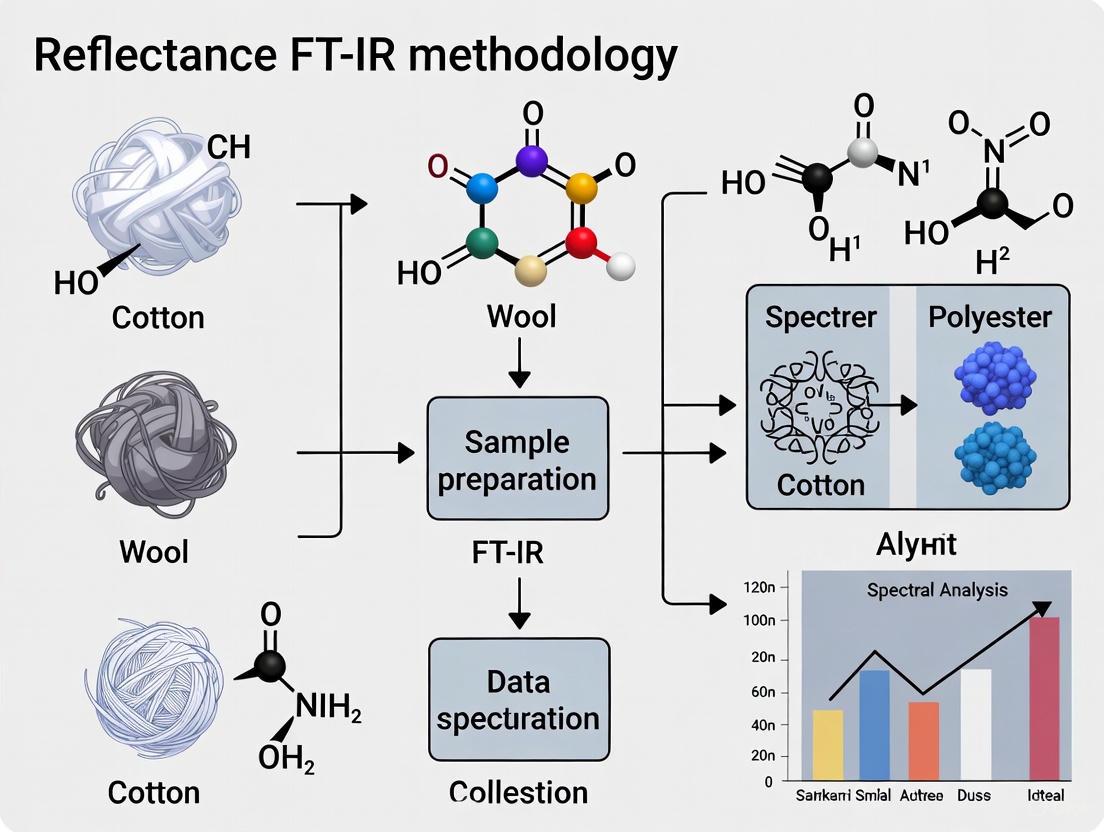
This article provides a comprehensive overview of Reflectance Fourier-Transform Infrared (FT-IR) spectroscopy as a powerful, non-destructive methodology for textile fiber identification.
Non-Destructive Textile Fiber Identification Using Reflectance FT-IR: A Comprehensive Methodology for Research and Analysis
Abstract
This article provides a comprehensive overview of Reflectance Fourier-Transform Infrared (FT-IR) spectroscopy as a powerful, non-destructive methodology for textile fiber identification. Tailored for researchers and scientists, we explore the fundamental principles distinguishing reflectance from traditional ATR-FT-IR, particularly its advantage for analyzing valuable or fragile samples where contact is undesirable. The content details practical methodologies and applications across diverse fields, from forensic science to cultural heritage preservation. We address common troubleshooting and optimization strategies to ensure data reliability and present a rigorous validation of reflectance FT-IR against other analytical techniques, supported by multivariate classification and machine learning models. This resource aims to equip professionals with the knowledge to implement this non-invasive technique effectively in their analytical workflows.
Principles and Advantages of Reflectance FT-IR for Non-Destructive Fiber Analysis
Fourier Transform Infrared (FT-IR) spectroscopy is a powerful analytical technique that measures the absorption of infrared light by molecules, causing them to undergo vibrational transitions between quantized energy states [1]. When applied to textile fiber identification, reflectance FT-IR (r-FT-IR) spectroscopy has emerged as a particularly viable option, especially for analyzing valuable, delicate, or unique textile samples where non-invasive analysis is paramount [2]. Unlike traditional absorption-based techniques, reflectance FT-IR detects the light that is reflected off the sample surface, making it excellent for investigating samples that are difficult or impossible to analyze with transmission or ATR [3]. This non-destructive characteristic is especially valuable in fields such as cultural heritage conservation, forensic science, and textile archaeology, where preserving the integrity of original materials is essential [2] [4].
The fundamental principle underlying FT-IR spectroscopy involves the interaction between IR light and matter, specifically how different chemical bonds in molecules absorb specific frequencies of infrared radiation corresponding to their vibrational energies [1]. In a typical FT-IR instrument, a broadband IR source passes through an interferometer, most commonly of the Michelson design, where a moving mirror produces a series of constructive and destructive interference patterns—an interferogram—that encodes all spectral frequencies simultaneously [5]. The interferogram is then mathematically transformed by a fast Fourier transform (FFT) algorithm into an intensity-versus-wavenumber spectrum [1]. This Fourier transform approach provides significant advantages including Fellgett's (multiplex) advantage through simultaneous measurement of all wavelengths, Jacquinot's (throughput) advantage with higher energy throughput due to fewer optical slits, and Connes' advantage with high precision wavelength calibration from an internal laser reference [1].
Core Principles of Reflectance FT-IR
Fundamental Measurement Principles
Reflectance FT-IR spectroscopy operates on the principle that when IR light is shined on a sample, some of the IR light will be absorbed by the sample while some will be reflected off the sample surface [3]. In reflectance measurements, unlike transmission or ATR measurements where the light passing through the sample is detected, the light reflected off the sample surface is captured and analyzed [3]. This fundamental difference makes reflectance FT-IR particularly suitable for analyzing textile fibers that cannot tolerate pressure or contact required by other sampling techniques.
Infrared absorption in FT-IR spectroscopy depends on a change in dipole moment when molecules interact with IR radiation [1]. Consequently, polar bonds (C=O, O–H, N–H) are typically strong IR absorbers, while homonuclear diatomic molecules (N₂, O₂) do not absorb IR radiation and are therefore IR-inactive [1]. For textile fibers, which primarily consist of complex polymers containing various functional groups, this molecular vibration information provides distinctive spectral fingerprints that enable identification and characterization.
Types of Reflectance Measurements
Three primary types of reflectance measurements can be performed in FT-IR spectroscopy, each with distinct mechanisms and applications for textile analysis:
Reflection-Absorption (Transflectance): In this technique, IR light passes through the sample and is then reflected off a reflective substrate [3]. The sample needs to be very thin for this technique so the IR light can pass through properly without being totally absorbed [3]. Reflection-absorption is well-suited for studying very thin samples like tissues and coatings, and can be used for characterizing surface materials [3]. The resulting spectra resemble transmission spectra and require no further data processing to be compared with transmission measurements [3].
Specular Reflection: This approach involves IR light being simply reflected off the sample surface, requiring the sample to be smooth and reflective [3]. Specular reflectance is valuable for analyzing reflective materials such as metal coatings, plastics, glass, and can be used as a no-contact method for rapid material identification and analyzing pieces of art [3]. A significant challenge with specular reflection is that the obtained spectra appear quite different than those from absorption measurements, largely due to wavelength-dependent reflection differences [3]. These spectral distortions can be corrected using the Kramers-Kronig Transformation (KKT), provided the measurement is performed with the IR beam perpendicular to the sample and the sample shows only specularly reflected light without scattering or diffuse reflection [3].
Diffuse Reflectance (DRIFTS): Diffuse Reflectance Infrared Fourier Transform Spectroscopy (DRIFTS) measures the diffuse reflection that occurs when IR light interacts with the sample and scatters off particles in all directions [3]. The amount of diffusely reflected light depends heavily on sample characteristics such as particle shape, size, compactness, and refractive index [3]. Proper sample preparation is crucial for DRIFTS, typically requiring samples to be ground to small, uniform particles and often diluted with a non-absorbing material like KBr to ensure deep IR light penetration [3]. While DRIFTS spectra resemble transmission spectra, the intensities and shapes of signals don't match exactly, and the relationship between signal intensity and sample concentration present in transmission measurements is absent [3]. These differences can be corrected using the Kubelka-Munk function, producing spectra comparable to transmission measurements [3].
Table 1: Comparison of Reflectance FT-IR Techniques for Textile Analysis
| Technique | Mechanism | Sample Requirements | Textile Applications | Data Processing |
|---|---|---|---|---|
| Reflection-Absorption | Light passes through sample, reflects from substrate | Very thin samples | Thin fabrics, coatings | Minimal; similar to transmission spectra |
| Specular Reflection | Light reflects directly from sample surface | Smooth, reflective surfaces | Synthetic fibers, coated textiles | Kramers-Kronig Transformation |
| Diffuse Reflection (DRIFTS) | Light penetrates and scatters from sample | Powdered or rough surfaces; particle size control needed | Ground fibers, non-woven textiles | Kubelka-Munk function |
Experimental Protocols for Textile Fiber Analysis
Sample Preparation Methods
Proper sample preparation is critical for obtaining high-quality reflectance FT-IR spectra of textile fibers. For routine analysis of textile samples, the following protocols are recommended:
Intact Fabric Samples: For non-destructive analysis of valuable textiles, samples should be cleaned of surface contaminants using gentle air flow or soft brushes if necessary [2]. The fabric should be placed flat on the sampling stage, ensuring good contact with the substrate without stretching or distorting the material. For specular reflectance measurements, smooth and uniform areas of the textile should be selected to minimize scattering effects [3].
Fiber Bundles and Yarns: Individual yarns or small fiber bundles can be arranged parallel to each other on the reflectance accessory to create a uniform surface [2]. Care should be taken to minimize gaps between fibers while maintaining their natural configuration. This approach is particularly useful for archaeological textiles where minimal sampling is allowed [4].
Powdered Samples for DRIFTS: For diffuse reflectance measurements, textile fibers can be cut into small segments (approximately 1-2 mm) and ground with potassium bromide (KBr) in a typical ratio of 1:10 to 1:100 (sample:KBr) depending on the desired spectral intensity [3]. The mixture should be finely ground using an agate mortar and pestle to achieve uniform particle size, then transferred to a DRIFTS sample cup for analysis [3].
Microspectroscopy Sampling: When using FT-IR microspectrometers in reflectance mode, individual fibers can be analyzed directly without extensive preparation [2]. The measurement area is adjustable with apertures typically ranging from 150×150 μm down to 25×25 μm, enabling analysis of miniature objects or small parts of larger objects without sample removal [2].
Instrumentation Parameters and Configuration
Optimized instrument parameters are essential for obtaining high-quality reflectance FT-IR spectra of textile fibers. Based on established methodologies [2], the following configuration is recommended:
- Spectral Range: 4000-600 cm⁻¹ to capture the full mid-IR region relevant for textile fiber identification [2].
- Resolution: 4 cm⁻¹ provides sufficient detail for fiber discrimination while maintaining adequate signal-to-noise ratio [2] [1].
- Number of Scans: 64-128 scans offer a good balance between acquisition time and spectral quality [2].
- Detector: Mercury Cadmium Telluride (MCT) detector cooled with liquid nitrogen provides high sensitivity for reflectance measurements [2].
- Background Measurement: Gold plate background is recommended for reflectance mode measurements as it provides a highly reflective, spectrally featureless reference [2].
- Apodization Function: Happ-Genzel apodization window minimizes sidelobes and artifacts in the transformed spectrum [2].
Table 2: Optimal Instrument Parameters for Reflectance FT-IR of Textiles
| Parameter | Recommended Setting | Purpose |
|---|---|---|
| Spectral Range | 4000-600 cm⁻¹ | Captures fundamental molecular vibrations |
| Resolution | 4 cm⁻¹ | Balances detail and signal-to-noise |
| Number of Scans | 64-128 | Improves signal-to-noise ratio |
| Detector | MCT (liquid nitrogen cooled) | High sensitivity for reflectance measurements |
| Aperture Size | 25×25 μm to 150×150 μm | Controls measurement area for microspectroscopy |
| Background Reference | Gold plate | Featureless reflective background |
Spectral Acquisition Workflow
The following workflow outlines the standard procedure for acquiring reflectance FT-IR spectra from textile fibers:
Instrument Preparation: Allow the spectrometer to warm up and stabilize for at least 30 minutes. Purge the instrument with dry nitrogen to reduce atmospheric water vapor and CO₂ interference [6].
Background Collection: Place a clean gold plate in the sample chamber and collect a background spectrum using the same parameters that will be used for sample measurement [2].
Sample Placement: Position the textile sample to ensure a flat, uniform surface for analysis. For microspectroscopy, use the video camera to select specific areas of interest on individual fibers [2].
Spectral Acquisition: Collect multiple spectra from different areas of the sample to account for potential heterogeneity. For textiles, a minimum of 5-10 spectra from different locations is recommended [2].
Quality Assessment: Verify spectral quality by checking for absence of saturation (absorbance < 2.0), low noise levels, flat baseline, and minimal atmospheric artifacts [6].
Data Storage: Save spectra in appropriate formats (typically .SPA or .CSV) with descriptive filenames that include sample information and measurement conditions.
Data Interpretation and Analysis for Textile Fibers
Characteristic Spectral Features of Textile Fibers
Interpretation of reflectance FT-IR spectra for textile fiber identification requires knowledge of characteristic absorption bands associated with different fiber types. The table below summarizes key spectral features for major textile fiber categories:
Table 3: Characteristic FT-IR Absorption Bands for Major Textile Fibers
| Fiber Type | Chemical Composition | Key Absorption Bands (cm⁻¹) | Spectral Assignment |
|---|---|---|---|
| Cotton | Cellulose | 3340, 2900, 1430, 1370, 1160, 1050, 1030 | O-H stretching, C-H stretching, CH₂ bending, C-O-C stretching [7] |
| Wool | Protein (Keratin) | 3280, 3060, 2920, 2850, 1630 (Amide I), 1530 (Amide II), 1230 | N-H stretching, C-H stretching, amide bands [2] |
| Silk | Protein (Fibroin) | 3280, 3060, 2920, 2850, 1620 (Amide I), 1510 (Amide II), 1220 | N-H stretching, C-H stretching, amide bands [2] |
| Polyester | Polyethylene Terephthalate | 1710, 1240, 1090, 870, 720 | C=O stretching, C-O-C stretching, aromatic C-H bending [7] |
| Polyamide | Nylon | 3290, 3060, 2930, 2860, 1630 (Amide I), 1530 (Amide II), 1260 | N-H stretching, C-H stretching, amide bands [2] |
| Polyacrylic | Polyacrylonitrile | 2242, 1730, 1450, 1070 | C≡N stretching, ester C=O stretching, CH₂ bending [2] |
Systematic Spectral Interpretation Protocol
Successful interpretation of textile fiber spectra requires a systematic approach [6]:
Verify Spectral Quality: Ensure the spectrum has low noise, minimal baseline offset, a flat baseline, peaks on scale (absorbance between 0-2), and no significant spectral artifacts before interpretation [6].
Identify Artifacts: Recognize and disregard common spectral artifacts, particularly atmospheric water vapor (around 3900-3500 cm⁻¹ and 1900-1300 cm⁻¹) and CO₂ (2349 cm⁻¹ and 667 cm⁻¹) [6].
Read Left to Right: Systematically examine the spectrum from high to low wavenumbers, noting the presence or absence of key group wavenumbers [6]:
- 3600-2700 cm⁻¹: O-H and N-H stretching regions
- 3100-2800 cm⁻¹: C-H stretching region
- 2400-2100 cm⁻¹: Triple bond region (C≡N, C≡C)
- 1850-1550 cm⁻¹: Carbonyl stretching region (C=O)
- 1500-400 cm⁻¹: Fingerprint region for specific compound identification
Assign Intense Bands First: Focus initially on the most intense absorption bands as they are typically the most diagnostically useful [6].
Identify Secondary Bands: Track down secondary bands of functional groups already identified to confirm assignments [6].
Consult Reference Spectra: Compare unknown spectra with reference spectral libraries of known textile fibers for verification [2].
Chemometric Analysis for Fiber Identification
For complex textile samples, particularly blended fibers, advanced chemometric techniques enhance identification accuracy:
Principal Component Analysis (PCA): Unsupervised pattern recognition method that reduces spectral dimensionality and identifies natural clustering of similar fiber types [8].
Partial Least Squares Discriminant Analysis (PLS-DA): Supervised classification technique that builds predictive models for fiber categorization based on spectral features [8].
Support Vector Machine (SVM): Nonlinear discrimination method particularly effective for classifying fibers with similar spectral characteristics [8].
Random Forest Classification: Ensemble learning method that constructs multiple decision trees for improved classification accuracy, successfully applied to differentiate amide-based fibers like wool, silk, and polyamide [2].
Studies have demonstrated that reflectance FT-IR coupled with appropriate chemometric analysis can achieve high classification accuracy for textile fibers. For blended natural fibers like jute and sisal, support vector machine discriminant analysis (SVM-DA) models have achieved 100% overall classification accuracy using standard normal variate (SNV) pre-treated spectra [8].
The Scientist's Toolkit: Essential Materials for Reflectance FT-IR Analysis
Table 4: Essential Research Reagent Solutions for Reflectance FT-IR Textile Analysis
| Item | Function/Application | Specifications |
|---|---|---|
| Gold Plates | Background reference for reflectance measurements | High-purity gold, polished surface [2] |
| Potassium Bromide (KBr) | Diluent for DRIFTS measurements | IR-grade, dry, for sample dilution [3] |
| Liquid Nitrogen | Coolant for MCT detectors | High-purity, ensures detector sensitivity [2] |
| Standard Reference Materials | Instrument validation and calibration | Polystyrene films, known textile fibers [6] |
| Nitrogen Purge Gas | Atmospheric interference reduction | Dry, high-purity nitrogen gas [6] |
| Microscalpels and Tweezers | Sample handling and preparation | Fine-tipped, anti-magnetic [2] |
| Cleaning Solvents | Optics and sample surface cleaning | HPLC-grade methanol, ethanol [6] |
Advantages and Limitations in Textile Applications
Comparative Analysis of Sampling Techniques
Reflectance FT-IR offers distinct advantages for textile analysis compared to other sampling techniques:
Non-Invasive Analysis: Unlike ATR-FT-IR which requires significant pressure that can damage delicate or unique textiles, reflectance FT-IR enables completely non-contact analysis, making it ideal for cultural heritage artifacts and forensic evidence [2].
Spatial Resolution: FT-IR microspectrometry in reflectance mode allows analysis of miniature objects or small parts of larger objects without sample removal, enabling spectral mapping to assess sample homogeneity [2].
Minimal Sample Preparation: Reflectance measurements typically require little to no sample preparation compared to transmission techniques that may require KBr pellets or thin sections [3].
However, limitations exist that researchers must consider:
Spectral Distortion: Reflectance spectra, particularly from specular reflection, can appear different from absorption spectra and may require mathematical corrections like Kramers-Kronig Transformation [3].
Surface Sensitivity: Reflectance measurements primarily probe the sample surface, which may not be representative of the bulk material, especially for coated or finished textiles [9].
Substrate Effects: The choice of substrate for reflection-absorption measurements can influence spectral appearance and must be carefully selected [3].
Application-Specific Considerations
Different textile analysis scenarios require specific methodological considerations:
Archaeological Textiles: Degradation processes significantly influence IR spectra of archaeological fibers, often altering spectral features to the point of making different fiber types spectrally indistinguishable [4]. Comparative analysis with artificially aged reference materials is essential for proper identification [4].
Blended Fibers: For blended textiles, reflectance FT-IR coupled with chemometric analysis has proven effective for identification and quantification of fiber components [8]. Partial least squares regression (PLSR) models pre-processed by orthogonal signal correction (OSC) with second derivative treatment have demonstrated superior predictive capability for classifying blended fibers [8].
Microplastic Analysis: In environmental applications involving textile microfibers, combining FT-IR and ATR-FT-IR provides complementary information, with ATR-FT-IR more effective for monitoring functional groups of original plastics, while both techniques together offer comprehensive characterization of complex environmental samples [9].
Reflectance FT-IR spectroscopy represents a powerful analytical tool for textile fiber identification, combining non-destructive analysis with detailed molecular information. The technique's ability to provide contactless measurement makes it particularly valuable for analyzing delicate, valuable, or unique textiles in fields ranging from cultural heritage conservation to forensic science. When coupled with appropriate chemometric analysis, reflectance FT-IR can achieve high classification accuracy even for challenging samples like blended fibers or archaeologically degraded materials. As spectroscopic technology continues to advance, with improvements in detector sensitivity, spatial resolution, and computational analysis, reflectance FT-IR methodology is poised to remain an essential technique in the textile scientist's analytical arsenal, providing crucial insights into fiber composition, structure, and degradation processes without compromising sample integrity.
Fourier-Transform Infrared (FT-IR) spectroscopy has established itself as a cornerstone analytical technique for material identification across scientific disciplines. Within this framework, reflectance FT-IR spectroscopy has emerged as a particularly transformative methodology for analyzing valuable samples where material integrity is paramount. This application note details the specific advantages, protocols, and applications of reflectance FT-IR, contextualized within a broader thesis on its utility for textile fiber identification research. The technique's fundamental strength lies in its non-invasive nature, eliminating the need for physical contact or pressure on delicate samples [2] [10]. This makes it uniquely suited for investigating irreplaceable materials in cultural heritage and forensic evidence, where sampling is often restricted due to an object's value, fragility, or legal significance [10].
The non-invasive paradigm is a critical response to the limitations of traditional methods. While Attenuated Total Reflectance (ATR) FT-IR is a widely acknowledged technique for fiber identification, its primary drawback is the "need to apply significant pressure to the textile, which in cases of e.g., unique artifacts can be unacceptable as they can break under ATR pressure" [2]. In forensic contexts, evidence must remain unaltered for subsequent analyses. Reflectance FT-IR fulfills this requirement by enabling analysis without physical sampling or contact, thereby preserving the sample for further examination or future technological advancements [10].
Comparative Technical Analysis of FT-IR Techniques
The following table summarizes the key characteristics of the primary FT-IR sampling techniques, highlighting the distinct advantages of non-invasive approaches.
Table 1: Comparison of FT-IR Sampling Techniques for Valuable Samples
| Technique | Contact Required? | Pressure Applied? | Sample Preparation | Primary Risk to Sample | Ideal Use Case |
|---|---|---|---|---|---|
| Reflectance FT-IR (r-FT-IR) | No | No | Minimal to none | Minimal risk of physical damage | Unique heritage artifacts, fragile forensic evidence [2] [10] |
| External Reflection (ER) FT-IR | No | No | Minimal to none | None | Three-dimensional objects, samurai armours, leather components [10] |
| ATR-FT-IR | Yes | Yes (Significant) | Direct contact with crystal | Surface damage, fiber fracture [2] | Robust, modern materials where invasiveness is not a concern [2] [11] |
| FT-IR Microspectroscopy (Reflectance) | No | No | Placement on gold plate | Minimal risk | Miniature objects, localized analysis, spectral mapping [2] |
| Transmission FT-IR | N/A | N/A | Extensive (e.g., pressing, grinding) | Complete destruction of sample [12] | Not recommended for valuable samples |
Beyond the fundamental distinction of non-invasiveness, reflectance FT-IR offers specific analytical benefits. Research demonstrates that External Reflection (ER) FT-IR spectra "frequently exhibit an amplification of certain diagnostic bands, facilitating the identification of the various fibres" [10]. Furthermore, the extended spectral range provided by some ER-FT-IR spectrometers contains extra bands in the near-infrared region, which can provide key information for discrimination [10]. Studies have shown that the performance of reflectance FT-IR is generally comparable to ATR-FT-IR, and it can be even more successful in differentiating between amide-based fibers like wool, silk, and polyamide [2].
Experimental Protocols for Non-Invasive Analysis
Protocol A: Reflectance FT-IR Microspectroscopy for Textile Fibers
This protocol is adapted from methodologies used for the non-invasive analysis of mineralized archaeological textiles and reference fiber collections [2] [12].
Instrument Setup:
- Utilize an FT-IR microspectrometer equipped with a reflectance mode accessory.
- Cool the MCT detector with liquid nitrogen.
- Set the spectral range to 600–4000 cm⁻¹ with a resolution of 4 cm⁻¹.
- Adjust the microscope aperture to a suitable size (e.g., 150 x 150 µm for standard analysis, down to 25 x 25 µm for minute samples) [2].
Sample Presentation:
Data Acquisition:
- Collect a minimum of 64 scans per spectrum to ensure a good signal-to-noise ratio [2].
- Acquire multiple spectra from different parts of the sample to assess homogeneity.
Data Processing (for classification):
- Process spectra using the instrument's native software or specialized chemometric tools.
- For statistical classification, apply Standard Normal Variate (SNV) correction to minimize scattering effects due to differences in particle size or surface texture [2].
- Use a spectral range of 600–3700 cm⁻¹ for analysis.
Protocol B: External Reflection (ER) FT-IR for Composite Objects
This protocol is optimized for the analysis of three-dimensional historical objects, such as those found in museum collections, including textiles and leather [10] [13].
Instrument Setup:
- Use a portable or benchtop FT-IR spectrometer with an external reflection module.
- Set a spectral resolution of 4 cm⁻¹ and collect 128 co-added scans to maximize the signal-to-noise ratio without excessively prolonging measurement time [13].
- Select an aperture size appropriate for the object's surface; a spot diameter of 3 mm is suitable for curved surfaces [13].
Sample Presentation:
- Position the object in front of the ER aperture, ensuring no physical contact.
- For transparent or translucent materials, place an aluminum-covered microscope slide behind the sample to reflect the signal back to the detector (transflectance mode) [13].
Data Acquisition:
- Record spectra in reflectance mode.
- Perform an equivalent number of background scans before measurement.
Data Processing:
- Convert the collected reflectance spectra to absorbance using the Kramers-Kronig Transformation (KKT) available in the instrument software [13].
- Compare the processed spectra against commercial or in-house reference spectral libraries for polymer and fiber identification.
Workflow Diagram: Non-Invasive Fiber Identification Pathway
The following diagram illustrates the logical decision-making and analytical workflow for applying non-invasive FT-IR to valuable samples, from initial assessment to final identification.
The Scientist's Toolkit: Essential Research Reagents & Materials
Successful non-invasive analysis requires a curated set of tools and reference materials. The following table details key solutions and equipment for a research laboratory specializing in this methodology.
Table 2: Key Research Reagent Solutions and Essential Materials
| Item Name | Function/Application | Technical Notes |
|---|---|---|
| Gold-Coated Reflection Plate | Provides an ideal background for collecting reflectance FT-IR spectra from fragile samples without interference [2] [12]. | Inert and highly reflective surface minimizes spectral artifacts. |
| Validated Reference Fiber Collection | Essential for building in-house spectral libraries for identification; acts as a calibration standard for chemometric models [2] [11]. | Should include single-component textiles (e.g., cotton, wool, silk, polyester, polyamide). |
| Standard Normal Variate (SNV) Algorithm | A data preprocessing technique used to correct for scatter effects in reflectance spectra, improving the performance of classification models [2]. | Typically implemented within chemometric software packages. |
| Portable ER-FT-IR Module | Enables in-situ, non-contact analysis of large or immovable objects in museums or crime labs [10] [13]. | Aperture sizes should be selectable to accommodate different sample areas. |
| Chemometric Software Package | Employs algorithms (e.g., Random Forest, PCA-LDA) to classify fiber types based on spectral features, automating and objectifying identification [2] [14]. | Python with sklearn library offers a flexible, open-source platform [2]. |
Application Case Studies in Heritage and Forensics
Cultural Heritage: Analysis of Traditional Japanese Samurai Armors
A seminal application of non-invasive ER-FT-IR was the study of 10 traditional Japanese samurai armors from the 16th to the 20th century. The technique provided a comprehensive overview of textiles used across different historical periods without any sampling [10]. Key findings included:
- Identification of Diverse Materials: Successful differentiation of plant-based fibers (cotton, hemp), animal-based fibers (silk, wool, leather), and synthetic fibers (polyamide, acrylic, polyester).
- Detection of Modern Interventions: The non-invasive survey easily detected the presence of synthetic and semi-synthetic materials, revealing past conservation treatments or the early adoption of modern man-made materials in traditional object manufacturing [10].
Forensic & Archaeological Contexts: Mineralized Excavated Textiles
Reflectance FT-IR microspectroscopy has proven critical for analyzing mineralized textiles from archaeological excavations. These samples are often too brittle to withstand any contact or pressure. The method was applied to 5th c. BCE funerary textiles preserved in copper alloy urns, enabling:
- Fiber Identification: Determination of fiber type (e.g., cellulosic vs. proteinaceous) even in partially mineralized states [12].
- Condition Assessment: Identification of active biodeterioration within the fibers, directly informing the subsequent conservation strategy [12]. This purely non-invasive approach ensures that these rare and fragmentary finds are preserved intact for future study while still yielding critical historical and material data.
Reflectance FT-IR spectroscopy stands as a powerful and versatile methodology that aligns with the evolving ethical and practical demands of modern research. Its capacity for non-invasive analysis ensures the preservation of material integrity for valuable and unique samples in both cultural heritage and forensic science. As demonstrated through standardized protocols and real-world case studies, this technique provides reliable data for material identification and condition assessment. When combined with chemometric analysis, it forms a robust framework for objective decision-making, solidifying its role as an indispensable tool in the researcher's arsenal for textile fiber identification and beyond.
Fourier-Transform Infrared (FT-IR) spectroscopy is a fundamental analytical technique used for the identification and characterization of materials based on their molecular vibrations. The core principle involves passing infrared light through a sample and detecting which wavelengths are absorbed, creating a unique "chemical fingerprint" for the material [15]. Within FT-IR spectroscopy, three primary sampling techniques exist: Transmission, Attenuated Total Reflectance (ATR), and Reflectance. The choice of technique significantly impacts sample preparation requirements, data quality, and suitability for specific applications such as textile fiber identification in forensic and cultural heritage contexts [2] [15]. This application note provides a comparative overview of these techniques, with a specific focus on their application in reflectance FT-IR methodology for textile fiber identification research.
Core Principles and Comparative Analysis
Fundamental Operational Mechanisms
- Transmission FT-IR: This is the classical technique where IR light passes directly through a prepared sample. The detected light reveals which energies were absorbed by the sample as it transmitted through. This method requires the sample to be thin enough (typically <15 µm) to avoid total absorption of the IR beam, which leads to poor spectral quality [16] [15].
- ATR-FT-IR: ATR operates by directing IR light through a high-refractive-index crystal (e.g., diamond, germanium) in contact with the sample. The light undergoes total internal reflection, generating an evanescent wave that penetrates a few microns into the sample. This evanescent field is absorbed by the sample, generating the spectrum. This method requires minimal sample preparation as the light does not need to pass completely through the material [17] [15].
- Reflectance FT-IR (r-FT-IR): This technique detects IR light that is reflected off the surface of the sample. Unlike ATR, it is a truly non-contact method. It is particularly useful for analyzing large, opaque, or fragile objects that cannot be touched or compressed [2] [15]. For textile analysis, it serves as a completely non-invasive alternative [2].
The following table summarizes the key characteristics, advantages, and limitations of each FT-IR sampling mode.
Table 1: Comprehensive comparison of Transmission, ATR, and Reflectance FT-IR techniques.
| Feature | Transmission FT-IR | ATR-FT-IR | Reflectance FT-IR (r-FT-IR) |
|---|---|---|---|
| Basic Principle | IR light passes through the sample [15]. | IR light interacts with the sample via an evanescent wave [17]. | IR light is reflected from the sample surface [15]. |
| Sample Preparation | Extensive; requires dilution in KBr or slicing to <15 µm [16] [15]. | Minimal; sample is placed in direct contact with the crystal [18] [17]. | Minimal to none; non-contact or simple placement [2]. |
| Destructive Nature | Often destructive due to preparation (grinding, pressing) [15]. | Virtually non-destructive, though pressure may damage fragile samples [2] [17]. | Non-invasive and non-destructive [2]. |
| Depth of Analysis | Bulk analysis (micrometers to millimeters) [18]. | Surface-sensitive (typically 0.5-2 µm, depends on crystal) [18] [17]. | Surface-sensitive; depth depends on sample and mode. |
| Ideal Sample Types | KBr pellets, thin polymer films, gases, liquids [15]. | Solids, pastes, powders, liquids; robust and versatile [17] [15]. | Large objects, fragile artifacts, coatings, textiles [2] [15]. |
| Key Advantage | Considered the "standard" for spectral libraries. | Ease of use, minimal preparation, high-quality spectra [17]. | Complete non-invasiveness, suitable for unique samples [2]. |
| Key Limitation | Time-consuming, destructive sample preparation [15]. | Pressure application can damage soft or fragile samples [2]. | Can be susceptible to spectral distortions; may require specific corrections [2]. |
| Textile Analysis | Possible but requires destructive sampling. | Most common method; fast and easy, but pressure may be unsuitable for precious textiles [2] [19]. | Viable non-invasive alternative for cultural heritage and forensics [2]. |
Quantitative Performance in Textile Fiber Identification
A 2019 study directly compared the performance of r-FT-IR and ATR-FT-IR for identifying 16 different types of textile fibers. The following table summarizes key quantitative findings from this research.
Table 2: Performance data of r-FT-IR and ATR-FT-IR for textile fiber identification, adapted from Peets et al. (2019) [2].
| Parameter | r-FT-IR (Microspectrometer) | ATR-FT-IR (Microspectrometer) | ATR-FT-IR (Benchtop Spectrometer) |
|---|---|---|---|
| Number of Spectra Recorded | 1,677 | 2,068 | 614 |
| Spectral Range | 600–4000 cm⁻¹ | 600–4000 cm⁻¹ | 225–4000 cm⁻¹ |
| Differentiation of Amide Fibers | More successful for wool, silk, and polyamide [2]. | Less successful for amide-based fibers compared to r-FT-IR [2]. | Not specifically reported. |
| General Performance Conclusion | Comparable to ATR-FT-IR for general identification [2]. | Comparable to r-FT-IR for general identification [2]. | N/A |
| Data Analysis Pathlength Correction | Standard Normal Variate (SNV) [2]. | Multiplicative Signal Correction (MSC) [2]. | N/A |
Experimental Protocols for Textile Fiber Analysis
Protocol 1: Non-Invasive Analysis by Reflectance FT-IR (r-FT-IR)
This protocol is optimized for the analysis of precious, fragile, or forensic textile samples where no damage is permissible [2].
- Step 1: Instrument Setup. Use an FT-IR microspectrometer equipped with a reflectance accessory. Configure the instrument with a liquid nitrogen-cooled MCT detector. Set the parameters to: spectral range of 600–4000 cm⁻¹, resolution of 4 cm⁻¹, and 64 scans [2].
- Step 2: Background Measurement. Place a gold plate or another spectroscopically clean, reflective substrate in the instrument and collect a background spectrum [2].
- Step 3: Sample Positioning. Place the textile sample on the gold plate. For microspectroscopy, select a representative single fiber or area. Adjust the aperture to define the measurement area (e.g., 150 x 150 µm for standard analysis, down to 25 x 25 µm for very small samples) [2].
- Step 4: Data Collection. Collect multiple spectra (e.g., 5-10) from different parts of the textile sample to assess homogeneity and ensure representative sampling.
- Step 5: Data Preprocessing. Process the spectra using chemometric software. Apply Standard Normal Variate (SNV) correction to minimize scattering effects caused by the textile's physical structure [2].
Protocol 2: Routine Analysis by ATR-FT-IR
This protocol is suitable for routine identification of textile fibers where the sample is not considered unique or highly valuable [2] [19].
- Step 1: Instrument Setup. Use either a benchtop FT-IR spectrometer with an ATR accessory or an FT-IR microspectrometer with an ATR objective. A diamond crystal is recommended for its durability. Set the resolution to 4 cm⁻¹ and accumulate 64-128 scans [2] [19].
- Step 2: Background Measurement. Collect a background spectrum with no sample in contact with the crystal.
- Step 3: Sample Placement. Place a single fiber or a small bundle of fibers directly onto the ATR crystal.
- Step 4: Apply Pressure. Engage the pressure clamp to ensure firm, uniform contact between the sample and the crystal. For a micro-ATR objective, apply 60-75% of the maximum pressure strength [2]. Caution: Excessive pressure can crush and damage delicate fibers.
- Step 5: Data Collection. Scan the sample. Collect spectra from multiple fibers if possible.
- Step 6: Data Preprocessing. Process the spectra using chemometric software. Apply Multiplicative Signal Correction (MSC) for pathlength correction [2].
- Step 7: Cleaning. Clean the ATR crystal thoroughly with ethanol after each analysis to prevent cross-contamination [19].
Workflow Diagram for FT-IR Textile Analysis
The following diagram illustrates the decision-making workflow and logical relationships for selecting and applying the appropriate FT-IR technique to textile analysis.
The Scientist's Toolkit: Essential Research Reagents and Materials
The following table details key materials and reagents essential for conducting FT-IR analysis of textile fibers.
Table 3: Essential research reagents and materials for FT-IR analysis of textile fibers.
| Item | Function/Application | Notes |
|---|---|---|
| FT-IR Microspectrometer | Enables analysis of single fibers or small sample areas in both reflectance and ATR modes [2]. | Critical for forensic and heritage science where sample size is minimal. |
| Diamond ATR Crystal | A durable, chemically inert crystal for ATR analysis suitable for a wide range of samples, including hard fibers [17]. | The high hardness prevents damage from most samples. |
| Germanium ATR Crystal | A high-refractive-index crystal used in micro-ATR objectives; provides high spatial resolution [2] [17]. | Ideal for analyzing very small areas due to the immersion lens effect. |
| Gold Plate | A highly reflective substrate used for collecting background and sample spectra in reflectance FT-IR measurements [2]. | Provides a clean, non-reactive surface. |
| Potassium Bromide (KBr) | Used in transmission FT-IR as a diluting medium to create pellets that are transparent to IR light [16] [15]. | Requires careful handling due to hygroscopicity. |
| Ethanol (≥70%) | Used for cleaning ATR crystals and other accessories between samples to prevent cross-contamination [19]. | Essential for maintaining data integrity. |
| Chemometrics Software | Software equipped with algorithms like SNV, MSC, PCA, and Random Forest for spectral preprocessing and classification [2] [19]. | Vital for correcting spectral artifacts and building identification models. |
The selection of an appropriate FT-IR sampling technique is paramount for successful textile fiber identification. While ATR-FT-IR remains the most convenient and widely used method for routine analysis, Reflectance FT-IR (r-FT-IR) has been demonstrated as a viable and comparable alternative, particularly distinguished by its completely non-invasive nature [2]. This makes r-FT-IR the indispensable method for analyzing valuable cultural heritage artifacts or forensic evidence where sample preservation is critical. The choice between transmission, ATR, and reflectance should be guided by a careful consideration of the sample's value, physical properties, and the specific analytical requirements of the research.
Fourier Transform Infrared (FT-IR) spectroscopy has become an indispensable technique for the identification of textile fibers, proving particularly valuable in fields such as forensics, cultural heritage preservation, and quality control in manufacturing. The application of reflectance FT-IR (r-FT-IR) methodology offers a significant advantage for analyzing valuable or fragile historical textiles and forensic evidence where non-invasive analysis is paramount [2]. Unlike traditional methods that may require sampling, reflectance techniques enable direct examination of materials without physical contact or alteration [10]. This application note establishes detailed protocols and interpretive frameworks for identifying characteristic spectral patterns of both natural and synthetic fibers using reflectance FT-IR spectroscopy, supporting a broader thesis on advancing non-invasive analytical methods for textile identification.
Experimental Protocols
Reflectance FT-IR Spectroscopy for Fiber Analysis
The following protocol outlines the standardized procedure for analyzing textile fibers using reflectance FT-IR spectroscopy, optimized for non-invasive characterization [2] [10].
Materials and Equipment:
- FT-IR spectrometer with reflectance capability
- Gold plate for background measurements
- Microspectrometer for localized analysis (optional)
- Liquid nitrogen-cooled MCT detector
Procedure:
- Sample Preparation: Place the textile sample directly on the gold plate without any pretreatment. For heterogeneous samples, visually identify regions of interest for analysis [2].
- Instrument Setup: Configure the spectrometer with the following parameters:
- Spectral range: 600–4000 cm⁻¹
- Resolution: 4 cm⁻¹
- Number of scans: 64
- Aperture size: Adjust according to sample size (typically 150 × 150 μm, reducible to 25 × 25 μm for minute samples) [2].
- Background Collection: Collect background spectrum from the gold plate.
- Spectral Acquisition: Position the sample to ensure optimal focus and collect reflectance spectra from multiple areas to assess homogeneity.
- Quality Control: Verify spectrum quality by checking for:
- Absence of water vapor peaks (around 1650 cm⁻¹ and 3400 cm⁻¹)
- Appropriate signal-to-noise ratio
- Straight baseline in the 2400-2000 cm⁻¹ region [20].
Data Processing:
- Apply Standard Normal Variate (SNV) correction to minimize scattering effects [2].
- Use vector normalization to compensate for variations in sample thickness.
- Employ baseline correction to address sloping baselines when necessary.
Comparative Analysis with ATR-FT-IR
For validation purposes, parallel analysis using Attenuated Total Reflectance (ATR)-FT-IR can be performed:
Procedure:
- Place sample directly on the ATR crystal.
- Apply consistent pressure (60-75% strength for germanium crystals).
- Use identical spectral parameters as reflectance mode.
- Apply Multiplicative Signal Correction (MSC) during data processing [2].
Diagnostic Spectral Bands for Textile Fibers
The identification of textile fibers relies on recognizing characteristic absorption patterns in the mid-infrared region. The table below summarizes diagnostic bands for major fiber categories:
Table 1: Diagnostic FT-IR Bands for Natural and Synthetic Textile Fibers
| Fiber Type | Subcategory | Key Diagnostic Bands (cm⁻¹) | Functional Group Assignments |
|---|---|---|---|
| Natural - Protein | Wool | 3280, 3060, 2960, 2930, 2875, 1645 (amide I), 1535 (amide II), 1165 [2] | N-H stretch, C-H stretch, amide carbonyl, C-N-H bend |
| Silk | 3280, 3060, 2960, 2930, 2880, 1655 (amide I), 1530 (amide II), 1445, 1230, 1165 [2] | N-H stretch, C-H stretch, amide carbonyl, C-N-H bend | |
| Natural - Cellulosic | Cotton | 3340, 2900, 1640, 1430, 1370, 1285, 1165, 1115, 1065, 1035, 1015 [8] | O-H stretch, C-H stretch, O-H bend, C-O-C stretch |
| Linen | Similar to cotton with variations in 1429, 1317, 1105, 1055, 1033 cm⁻¹ band intensities [10] | O-H stretch, C-H stretch, O-H bend, C-O-C stretch | |
| Jute | 3340, 2910, 1735, 1650, 1430, 1375, 1325, 1165, 1060, 1035 [8] | O-H stretch, C-H stretch, ester C=O, O-H bend | |
| Sisal | 3340, 2910, 1735, 1650, 1430, 1375, 1325, 1165, 1060, 1035 [8] | O-H stretch, C-H stretch, ester C=O, O-H bend | |
| Regenerated | Viscose | 3340, 2900, 1660, 1430, 1370, 1285, 1165, 1115, 1065, 1035, 1015 [2] | O-H stretch, C-H stretch, O-H bend, C-O-C stretch |
| Cellulose Acetate | 1745, 1435, 1375, 1235, 1175, 1120, 1065, 1045, 950, 905 [2] | Ester C=O, C-H bend, C-O stretch | |
| Synthetic | Polyester | 3050, 2950, 2905, 2875, 1950, 1720, 1595, 1575, 1470, 1450, 1340, 1240, 1125, 1100, 1020, 875, 725 [2] | C-H stretch, ester C=O, C-O stretch |
| Polyamide | 3300, 3075, 2935, 2860, 1635 (amide I), 1540 (amide II), 1470, 1370, 1270, 1200, 690 [2] | N-H stretch, C-H stretch, amide carbonyl | |
| Polyacrylic | 2940, 2245, 1735, 1450, 1355, 1245, 1170, 1070, 850, 750 [2] | C-H stretch, C≡N nitrile, ester C=O | |
| Elastane | 2950, 2850, 1725, 1595, 1525, 1415, 1300, 1220, 1150, 1050, 940, 765 [2] | C-H stretch, urethane/ester C=O, C-O-C |
Special Considerations for Reflectance Spectra
Reflectance FT-IR spectra may exhibit band distortions compared to transmission or ATR spectra, primarily due to the Kramers-Kronig transformation effects [10]. However, these spectra often show enhanced diagnostic bands in certain regions, facilitating differentiation between fiber types:
- Amide-based fibers: Reflectance spectra frequently show improved resolution between wool, silk, and polyamide fibers compared to ATR-FT-IR [2].
- Cellulosic fibers: The extended spectral range (7500-375 cm⁻¹) available in some ER-FT-IR systems provides additional bands in the near-infrared region that aid discrimination [10].
- Synthetic polymers: Carbonyl stretching regions (1800-1650 cm⁻¹) often show distinctive patterns enhanced in reflectance mode.
Data Analysis and Chemometric Approaches
Advanced data analysis techniques are essential for robust fiber identification, particularly for blended materials or subtle differentiations.
Spectral Preprocessing
Prior to analysis, implement the following preprocessing steps:
- Standard Normal Variate (SNV): Corrects for scattering effects, particularly useful for reflectance spectra [2] [19].
- Savitzky-Golay Derivative: First or second derivatives enhance spectral features and remove baseline offsets [8] [19].
- Normalization: Vector normalization standardizes spectral intensity for comparison.
Machine Learning Classification
Table 2: Performance of Classification Algorithms for Fiber Identification
| Classification Method | Accuracy (%) | Optimal Preprocessing | Application Scope |
|---|---|---|---|
| Random Forest | >97% [2] | SNV or MSC | Broad fiber classification |
| SVM-DA | 100% (blended fibers) [8] | SNV | Binary/multiclass discrimination |
| SIMCA | 97.1% [19] | Savitzky-Golay + SNV | Synthetic fiber classification |
| PLS-DA | High (exact % not specified) [8] | OSC + 2nd derivative | Quantitative blending ratios |
| PCA-LDA | Effective for clustering [19] | Normalization + derivatives | Exploratory data analysis |
Implementation Protocol:
- Data Preparation: Compile reference spectra from known fibers (minimum 50-100 spectra per class).
- Model Training: Utilize 70-80% of data for training classification models.
- Validation: Employ k-fold cross-validation (typically k=5-10) to assess model performance.
- Unknown Identification: Apply trained models to classify unknown spectra with probability estimates.
For blended fibers, Partial Least Squares Regression (PLSR) preprocessed with Orthogonal Signal Correction (OSC) and second derivative has demonstrated superior predictive capability (R²P = 0.953) for quantifying component ratios [8].
Workflow Visualization
The following diagram illustrates the complete analytical workflow from sample preparation to fiber identification:
The Scientist's Toolkit: Essential Research Reagents and Materials
Table 3: Essential Materials for Reflectance FT-IR Fiber Analysis
| Item | Specifications | Application Purpose |
|---|---|---|
| Gold Plates | High-purity, polished surface | Background reference and sample substrate [2] |
| ATR Crystals | Germanium or diamond | Comparative analysis with ATR-FT-IR [2] |
| Standard Reference Fibers | Certified natural/synthetic fibers | Method validation and calibration [2] |
| Hydraulic Press | 5-ton capacity | KBr pellet preparation (for transmission comparison) [21] |
| KBr Powder | IR-grade, dry | Preparation of pellets for transmission analysis [21] |
| Liquid Nitrogen | High-purity | MCT detector cooling [2] |
| Microscope Slides | Standard or IR-transparent | Sample mounting and positioning [20] |
Reflectance FT-IR spectroscopy represents a powerful, non-invasive methodology for textile fiber identification that is particularly suited to valuable cultural heritage objects and forensic evidence. The diagnostic bands and analytical protocols outlined in this application note provide researchers with a comprehensive framework for accurate fiber characterization. When combined with appropriate chemometric analysis, this approach achieves classification accuracies exceeding 97%, establishing reflectance FT-IR as a viable and often superior alternative to traditional ATR-FT-IR for fiber identification, especially for amide-based fibers [2]. The continued expansion of reference spectral libraries and refinement of machine learning algorithms will further enhance the capability of this technique to address increasingly complex analytical challenges in textile science.
Fourier Transform Infrared (FT-IR) microspectrometry combines microscopy with IR spectroscopy, enabling the chemical analysis of microscopic sample areas. When operated in reflectance mode (r-FT-IR), this technique becomes a powerful, non-invasive tool ideal for analyzing valuable or irreplaceable specimens, such as historical textiles and forensic evidence, where preserving the sample's integrity is paramount [2]. Reflectance FT-IR operates by directing IR light onto a sample surface and collecting the reflected light, as opposed to the attenuated total reflectance (ATR) mode, which requires direct contact and pressure application that can potentially damage fragile materials [2] [1]. This article details the application of reflectance FT-IR microspectrometry within the broader context of methodological research for textile fiber identification.
Principles and Instrumentation
Core Principles of FT-IR Spectroscopy
FT-IR spectroscopy measures the absorption of infrared light by molecules, inducing vibrational transitions between quantized energy states. The resulting absorption spectrum provides a molecular fingerprint based on the specific stretching, bending, and twisting motions of chemical bonds [1]. Modern FT-IR instruments leverage a Michelson interferometer, where a moving mirror creates an interference pattern (an interferogram) that encodes all spectral frequencies simultaneously. A Fast Fourier Transform (FFT) algorithm then deconvolutes this interferogram into a recognizable intensity-versus-wavenumber spectrum [1]. The key advantages of the FT approach include:
- Fellgett’s (multiplex) advantage: Simultaneous measurement of all wavelengths improves the signal-to-noise ratio.
- Jacquinot’s (throughput) advantage: The absence of narrow slits allows more energy to reach the detector.
- Connes’ advantage: An internal laser provides highly precise wavelength calibration [1].
Reflectance Mode Specifics
In reflectance microspectrometry, the IR beam is focused onto the sample, and the reflected energy is collected and directed to the detector. Unlike transmission mode, it does not require the sample to be transparent or thinly sectioned. A critical operational consideration is the placement of the sample on a reflective substrate, such as a gold plate, which is also used for collecting the background spectrum [2]. The measurement area (e.g., adjustable via apertures from 25 × 25 μm to 150 × 150 μm) allows for the analysis of minute features and spectral mapping to assess sample homogeneity [2].
The following workflow outlines the key steps for operating an FT-IR microspectrometer in reflectance mode:
Application Note: Textile Fiber Identification
Experimental Protocol for Textile Analysis
The following detailed methodology is adapted from established research protocols for the reflectance FT-IR analysis of textile fibers [2].
- Instrumentation: Utilize an FT-IR microspectrometer (e.g., Thermo Scientific Nicolet iN10 MX) equipped with a liquid nitrogen-cooled MCT detector.
- Sample Preparation: For standard reference materials, cut a piece of fabric a few cm² in size or use individual yarns/threads. For case-study samples (e.g., small textile pieces or threads), analyze directly without cutting or altering the sample. Mount the sample on a gold plate.
- Data Acquisition Parameters:
- Spectral Range: 600–4000 cm⁻¹
- Resolution: 4 cm⁻¹
- Number of Scans: 64
- Aperture Size: Adjust according to sample size (e.g., 150 × 150 μm for larger areas, down to 25 × 25 μm for minute features).
- Data Collection: Collect multiple spectra (e.g., 10-20) from different parts of each sample piece to account for heterogeneity and ensure representativeness.
- Data Pre-processing: Apply pre-processing techniques to mitigate scattering effects and pathlength differences. Standard Normal Variate (SNV) correction is recommended for reflectance spectra [2].
Key Research Reagent Solutions and Materials
The table below lists essential materials and their functions for conducting reflectance FT-IR analysis of textiles.
| Item | Function/Description |
|---|---|
| FT-IR Microspectrometer | Core instrument enabling spectroscopic analysis of micro-samples. Requires reflectance capability and MCT detector [2]. |
| Gold Substrate Plate | Highly reflective, inert background for mounting samples during reflectance measurements [2]. |
| Single-Component Textile Standards | Reference materials (e.g., wool, silk, cotton, polyester) for building spectral libraries and classification models [2]. |
| Liquid Nitrogen | Coolant required for operating MCT detectors to achieve optimal signal-to-noise ratio [2]. |
Data Analysis and Chemometrics
The analysis of reflectance FT-IR spectral data for fiber identification relies heavily on chemometric techniques.
- Spectral Libraries: A foundational step is compiling a library of reference r-FT-IR spectra from known, single-component textile fibers [2].
- Classification Models: Supervised machine learning models are trained on the pre-processed spectral data. Research demonstrates the successful use of:
- Model Performance: Studies comparing r-FT-IR with ATR-FT-IR have shown that the performance of r-FT-IR is generally comparable and can be more successful in differentiating between amide-based fibers like wool, silk, and polyamide [2]. Research on blended fibers using ATR-FT-IR has also achieved 100% classification accuracy with Support Vector Machine Discriminant Analysis (SVM-DA) models, highlighting the power of coupling FT-IR with multivariate analysis [8].
The following diagram illustrates the logical sequence of data analysis from acquisition to identification:
Comparative Data and Performance
The table below summarizes key quantitative data and performance metrics from relevant FT-IR studies on textile fibers.
| Analysis Aspect | Reflectance FT-IR (r-FT-IR) [2] | ATR-FT-IR (Microspectrometer) [2] | ATR-FT-IR with Chemometrics [8] |
|---|---|---|---|
| General Performance | Comparable to ATR-FT-IR; superior for amide-based fibers. | Standard method; potential sample damage from pressure. | Highly effective for identification and classification. |
| Classification Accuracy | High accuracy achieved with Random Forest and Discriminant Analysis. | High accuracy achieved with Random Forest and Discriminant Analysis. | 100% overall classification accuracy for blended fibers using SVM-DA. |
| Key Data Pre-processing | Standard Normal Variate (SNV) correction. | Multiplicative Signal Correction (MSC). | SNV, Orthogonal Signal Correction (OSC) + 2nd derivative. |
| Spectral Range Used | 600–3700 cm⁻¹ | 600–3700 cm⁻¹ | 4000–750 cm⁻¹ |
Advantages, Limitations, and Best Practices
Advantages of Reflectance FT-IR Microspectrometry
- Non-Invasiveness: The technique is contactless and does not require pressure, making it suitable for delicate, valuable, or forensic samples [2].
- Spatial Resolution: The adjustable aperture allows for the analysis of very small sample areas (down to 25 μm) and enables spectral mapping to assess homogeneity [2].
- Material Versatility: Suitable for analyzing solids, rough surfaces, and samples that are difficult to prepare for transmission mode.
Limitations and Considerations
- Spectral Effects: Reflectance spectra can be influenced by specular reflection and scattering effects, which require correction using algorithms like SNV [2] [1].
- Pathlength: Unlike transmission mode, the pathlength (penetration depth) is not uniform and cannot be easily adjusted or equalized for different samples [2].
- Substrate: Requires a reflective backing, such as a gold plate, for optimal performance.
Best Practices and Common Pitfalls
- Background Collection: Always collect a fresh background spectrum from the clean gold substrate immediately before sample analysis to correct for atmospheric interference [1].
- Sample Homogeneity: Collect multiple spectra from different areas of the sample to ensure the results are representative.
- Data Pre-processing: Apply appropriate pre-processing techniques, such as SNV, to correct for scattering and improve the performance of subsequent classification models [2] [8].
- Model Validation: Always validate classification models using independent test sets or cross-validation to ensure reliability and avoid overfitting [2] [8].
Practical Protocols and Cross-Disciplinary Applications of Reflectance FT-IR
Within the broader scope of a thesis on Reflectance Fourier Transform Infrared (FT-IR) methodology, this protocol details the application of this non-invasive technique for textile fiber identification. Reflectance FT-IR spectroscopy is particularly suitable for analyzing unique, valuable, or fragile textile samples from fields such as cultural heritage and forensics, where contact-based methods like Attenuated Total Reflectance (ATR) are undesirable as they can damage the specimen [2]. This guide provides a standardized procedure for obtaining high-quality chemical fingerprints of textile fibers.
Principles of Reflectance FT-IR
In reflectance FT-IR measurements, the infrared light is shined on the sample, and the light reflected off the sample surface is detected, unlike transmission or ATR techniques where the light passing through the sample is measured [3]. This makes it an excellent choice for analyzing samples that are difficult to handle with other techniques [3].
For textile analysis, which typically involves flat, woven surfaces, the most relevant reflectance type is specular reflection [2]. This occurs when light reflects off a smooth surface at an angle equal to the angle of incidence. While spectra obtained via specular reflection can appear different from transmission spectra, these distortions can be corrected mathematically to produce readily interpretable data [3].
Materials and Equipment
Essential Research Reagent Solutions
Table 1: Key Materials and Equipment for Reflectance FT-IR Analysis of Textiles
| Item | Function/Description | Notes for Textile Analysis |
|---|---|---|
| FT-IR Microspectrometer | Combines an FT-IR spectrometer with a microscope for analyzing small sample areas. | Essential for targeting single fibers or specific regions on a textile sample without physical removal [2] [22]. |
| Liquid Nitrogen-Cooled MCT Detector | A highly sensitive detector cooled by liquid nitrogen. | Recommended for analyzing very small samples (down to 5 µm), such as single fibers, due to its superior sensitivity [22]. |
| Gold Plate Substrate | A highly reflective background on which the sample is placed. | The background spectrum is collected from this plate. The sample should be placed flat on its surface [2]. |
| Knife-Edge Apertures | Adjustable rectangular openings within the microscope. | Allow for precise selection of the region of interest (e.g., a single fiber) by blocking stray light from surrounding areas [22]. |
Instrument Parameters Configuration
The following quantitative parameters provide a benchmark for setting up the instrument. These are based on established research methodologies for textile fiber identification [2].
Table 2: Typical Instrument Parameters for Reflectance FT-IR Analysis of Textiles
| Parameter | Recommended Setting | Justification |
|---|---|---|
| Spectral Range | 600 - 4000 cm-1 | Covers the fundamental molecular vibration region for organic materials [2]. |
| Resolution | 4 cm-1 | Provides a good balance between spectral detail and signal-to-noise ratio for fiber identification [2]. |
| Number of Scans | 64 | Adequate for averaging out random noise and obtaining a high-quality spectrum [2]. |
| Aperture Size | 150 x 150 µm (adjustable down to 25 x 25 µm) | Ensures the IR beam interacts only with the target fiber, minimizing background interference [2]. |
Step-by-Step Experimental Protocol
Pre-Measurement: Sample Preparation and Setup
- Sample Stabilization: Place the textile sample flat on the gold plate substrate. Ensure the area of analysis is facing up and is as flat as possible to maximize the quality of the specular reflection signal [2].
- Microscope Alignment: Using the visible light on the FT-IR microspectrometer, locate the specific fiber or region of the textile to be analyzed.
- Aperture Configuration: Use the knife-edge apertures to precisely define the measurement area. Adjust the blades to match the dimensions of the fiber or region of interest, ensuring that no extraneous material is included in the field of view [22].
- Background Collection: Collect a background single-beam spectrum with the gold plate in place and no sample in the measurement path. This will be used to ratio against the sample spectrum and correct for instrumental and environmental effects.
Workflow Diagram
The following diagram outlines the core experimental workflow from sample preparation to data acquisition.
Data Acquisition
- Spectral Collection: Acquire the reflectance spectrum from the sample using the pre-configured parameters (see Table 2). The instrument software will generate an interferogram, which is then Fourier-transformed into a single-beam spectrum.
- Replication: Collect multiple spectra (e.g., 3-5) from different spots on the same fiber or from different fibers in the sample to assess homogeneity and ensure representative sampling [2].
- Data Conversion: The software automatically ratios the sample single-beam spectrum against the background single-beam spectrum to produce a reflectance spectrum.
Post-Measurement: Data Preprocessing
- Spectral Correction: Reflectance spectra from textiles can be affected by scattering due to the physical structure of the fibers. Apply Standard Normal Variate (SNV) correction to minimize these scattering effects and enhance the spectral features related to chemical composition [2].
- Data Export: Export the corrected spectra in a standard format (e.g., .CSV or .SPA) for subsequent analysis in multivariate classification software.
Data Analysis and Fiber Identification
The identification of textile fibers is achieved by comparing the unknown sample's corrected reflectance spectrum against a validated spectral library. Research demonstrates that statistical classification methods are highly effective for this purpose [2].
- Random Forest Classification: An in-house Python script utilizing the
sklearnlibrary can be implemented. This algorithm builds multiple decision trees to create a robust model that can accurately classify fiber types based on their spectral features [2]. - Principal Component based Discriminant Analysis: This method can be performed using the instrument's native software (e.g., TQ Analyst). It reduces the spectral data to its most significant components before performing classification, which is particularly successful for differentiating between amide-based fibers like wool, silk, and polyamide [2].
Advantages and Limitations
Advantages
- Non-Invasive Analysis: The technique requires no physical contact with the sample, making it ideal for valuable or fragile historical and forensic textiles [2].
- Spatial Resolution: The use of a microscope allows for the analysis of single fibers or even specific regions within a fiber [2] [22].
- Differentiation Power: It has been shown to be highly successful, and in some cases superior to ATR-FT-IR, for distinguishing between chemically similar fibers such as wool, silk, and polyamide [2].
Limitations
- Spectral Quality on Rough Surfaces: For very rough or uneven textile surfaces, the specular reflection signal may be weak, and spectral distortions can be more pronounced.
- Data Processing: Reflectance spectra often require mathematical corrections (like SNV) before they can be compared to transmission or ATR spectral libraries [2] [3].
Fourier Transform Infrared (FT-IR) spectroscopy has established itself as a critical analytical technique in the field of cultural heritage science. Its ability to provide molecular-level information non-invasively makes it particularly valuable for studying unique and invaluable historical objects. This application note focuses on the specific use of Reflectance FT-IR spectroscopy for identifying textile fibers, with a detailed case study on its application to a collection of traditional Japanese samurai armours. The content is framed within a broader research thesis on advancing reflectance FT-IR methodology for textile fiber identification, highlighting its advantages over traditional techniques and providing detailed protocols for researchers.
Technical Background: Reflectance FT-IR vs. Traditional Methods
The identification of textile fibers in cultural heritage objects has traditionally relied on microscopic examination or Attenuated Total Reflectance (ATR)-FT-IR spectroscopy, which often requires sampling [10]. While these methods provide valuable data, they present significant limitations when analyzing historical objects where sampling is restricted due to the object's value, good condition, or significance [10] [23].
Reflectance FT-IR spectroscopy offers a compelling alternative that addresses these limitations. The technique is non-invasive, requiring no physical sampling, and enables comprehensive investigation without compromising the integrity of the object [2] [10]. Unlike ATR-FT-IR, which requires significant pressure that can damage fragile historical fibers, reflectance FT-IR eliminates this risk entirely [2]. Furthermore, research has demonstrated that External Reflection (ER) FT-IR spectra frequently exhibit amplification of certain diagnostic bands compared to ATR-FT-IR spectra, facilitating easier identification of various fiber types [10] [23].
Table 1: Comparison of FT-IR Techniques for Textile Fiber Analysis
| Technique | Sample Contact | Sample Preparation | Advantages | Limitations |
|---|---|---|---|---|
| Reflectance FT-IR | Non-contact | None | Completely non-invasive; suitable for valuable objects; enables mapping | Spectral interpretation can be complex |
| ATR-FT-IR | Direct contact with pressure | May require flattening | High-quality spectra; extensive reference libraries | Risk of damaging fragile samples |
| Transmission FT-IR | Requires sampling | Extensive preparation | Excellent spectral quality | Destructive; requires sample removal |
Experimental Protocols
Reflectance FT-IR Analysis of Historical Textiles
Principle: This non-invasive method identifies textile fibers based on their infrared reflectance spectra without any physical contact with the artifact [2] [10].
Materials and Equipment:
- FT-IR spectrometer with reflectance capability
- Gold plate as background and sample substrate
- Liquid nitrogen-cooled MCT detector
- Software for spectral collection and processing (e.g., OMNIC PICTA)
Procedure:
- Background Collection: Place the gold reference plate in the spectrometer and collect a background spectrum [2].
- Sample Placement: Position the textile artifact on the gold plate, ensuring the area of interest is accessible for analysis.
- Instrument Parameters: Set the spectral range to 600-4000 cm⁻¹, resolution to 4 cm⁻¹, and number of scans to 64 [2].
- Aperture Selection: Adjust the measurement aperture according to sample size (typically 150 × 150 μm, reducible to 25 × 25 μm for smaller samples) [2].
- Spectral Collection: Collect multiple spectra from different areas of the sample to assess homogeneity and ensure representative sampling.
- Data Processing: Apply Standard Normal Variate (SNV) correction to minimize scattering effects and enhance spectral features for analysis [2].
Multivariate Classification for Fiber Identification
Principle: Chemometric methods enable objective classification of fiber types based on their spectral fingerprints [2] [19].
Materials and Equipment:
- Computer with multivariate analysis software (e.g., Python with scikit-learn, TQ Analyst, or Unscrambler)
- Pre-processed spectral data
Procedure:
- Spectral Pre-processing: Normalize all spectra by subtracting the mean and dividing by standard deviation [2].
- Data Reduction: Focus analysis on key spectral regions (600-1800 cm⁻¹, 2700-3700 cm⁻¹) to optimize computation [2].
- Model Selection: Choose appropriate classification algorithms:
- Model Training: Use reference spectra from known fiber types to train the classification model.
- Validation: Test model performance with independent validation samples to ensure accuracy.
- Application: Apply the trained model to identify unknown fibers in historical textiles.
Case Study: Analysis of Japanese Samurai Armours
Background and Historical Significance
A comprehensive investigation was conducted on a collection of 10 traditional Japanese samurai armours from the Museo delle Culture in Lugano, Switzerland, spanning from the 16th to the 20th century [10]. This research aimed to provide unprecedented insights into the textiles utilized in these armours across various historical periods, revealing the evolution of armour-making techniques and the influence of socio-cultural factors throughout Japanese history [10] [23].
Analytical Approach and Workflow
The analysis followed a systematic non-invasive approach to ensure the preservation of these significant historical artifacts while obtaining comprehensive material information.
Key Findings and Historical Implications
The reflectance FT-IR analysis yielded significant insights into the materials used in samurai armours across different historical periods:
Table 2: Fiber Types Identified in Samurai Armour Study
| Fiber Type | Historical Period | Significance | Key Spectral Markers |
|---|---|---|---|
| Silk | 16th-19th century | Traditional material for lightweight, strong lacing | Amide I (1660 cm⁻¹) and Amide II (1530 cm⁻¹) bands [24] |
| Cotton | 19th-20th century | Increased availability in later periods | Cellulose O-H stretch (3300 cm⁻¹), C-O-C stretches (1085 cm⁻¹) |
| Wool | Various periods | Imported material, limited use | Amide A (3300 cm⁻¹), Amide I (1650 cm⁻¹) |
| Synthetic (Polyamide) | 20th century | Modern conservation or early synthetic adoption | Characteristic amide bands distinct from protein fibers |
The detection of synthetic and semi-synthetic materials in some armours was particularly significant, as it revealed either the occurrence of past conservation treatments or the early adoption of modern man-made materials in traditional armour manufacturing [10] [23]. This finding demonstrates how material choices in samurai armours reflect technological changes and cultural influences throughout Japanese history.
The Scientist's Toolkit: Essential Research Reagents and Materials
Table 3: Essential Materials for Reflectance FT-IR Analysis of Historical Textiles
| Item | Function | Specifications |
|---|---|---|
| FT-IR Spectrometer with Reflectance Accessory | Primary analytical instrument | Spectral range 600-4000 cm⁻¹ or broader (7500-375 cm⁻¹ for extended range); 4 cm⁻¹ resolution [2] [10] |
| MCT Detector | Infrared detection | Liquid nitrogen-cooled for enhanced sensitivity [2] |
| Gold Reference Plate | Background and sample substrate | High reflectivity standard for background collection [2] |
| Reference Fiber Collection | Spectral libraries and model training | 16+ fiber types including natural, regenerated, and synthetic [2] |
| Multivariate Analysis Software | Data processing and classification | Python with scikit-learn, TQ Analyst, or Unscrambler [2] [19] |
Analytical Workflow and Data Interpretation
The process of analyzing historical textiles via reflectance FT-IR involves a systematic workflow from initial setup through data interpretation, with particular considerations for historical materials.
Key Advantages in Heritage Science
The reflectance FT-IR methodology offers several distinct advantages for cultural heritage research:
- Non-invasive Analysis: The technique requires no sampling, making it ideal for valuable, unique, or fragile historical objects where even minimal damage is unacceptable [2] [10].
- Enhanced Diagnostic Bands: ER-FT-IR spectra frequently exhibit amplification of certain diagnostic bands compared to ATR-FT-IR spectra, facilitating easier identification of fiber types [10] [23].
- Extended Spectral Range: The broad spectral range (7500-375 cm⁻¹) available with ER-FT-IR provides extra bands in the near-infrared region that can offer key information for discrimination due to the lack of distortion phenomena [10].
- Spatial Mapping: The ability to collect multiple spectra across a surface enables spectral mapping and assessment of sample homogeneity without destructive sampling [2].
Reflectance FT-IR spectroscopy represents a significant advancement in the non-invasive analysis of historical textiles, as demonstrated by its successful application to the study of Japanese samurai armours. The methodology provides heritage scientists with a powerful tool for identifying fiber materials, detecting non-original components, and understanding the material evolution of cultural artifacts across historical periods. The integration of multivariate classification techniques with reflectance FT-IR spectroscopy offers a robust framework for fiber identification that preserves the integrity of valuable historical objects while providing comprehensive material characterization. This approach can be applied to textile collections of various kinds, offering a reliable means to discern yarn composition and inform conservation strategies, contributing significantly to the preservation and understanding of our cultural heritage.
Within forensic trace evidence analysis, the identification of synthetic textile fibers plays a pivotal role in connecting suspects, victims, and crime scenes through the Locard exchange principle. This document outlines detailed application notes and protocols for the analysis of synthetic fibers, framed within broader research on reflectance Fourier Transform Infrared (FT-IR) spectroscopy methodology. While Attenuated Total Reflectance (ATR) FT-IR is a well-established technique in forensic laboratories [19], reflectance FT-IR (r-FT-IR) presents a powerful, non-invasive alternative for analyzing delicate or valuable evidence without applying pressure or causing damage [2]. These protocols are designed for researchers and forensic science professionals, providing a standardized approach for the effective implementation of reflectance FT-IR spectroscopy.
Experimental Protocols
Sample Collection and Preparation
Proper sample handling is critical for maintaining the integrity of trace evidence.
- Collection: Fibers should be collected from items of clothing, carpets, or other textiles using clean tweezers, and placed in sealed paper envelopes or glass vials to avoid electrostatic loss and contamination [19].
- Cleaning: If necessary, fibers can be gently cleaned with a solvent such as hexane to remove surface contaminants like oils, followed by air-drying in a dust-free environment [25].
- Mounting: For reflectance FT-IR analysis, the fiber should be laid flat on a gold-coated slide or another suitable reflective substrate. Gold is preferred due to its high reflectivity and chemical inertness. The sample should be arranged to ensure a flat, stable surface for measurement [2].
Instrumental Analysis: Reflectance FT-IR
The following table summarizes the key instrumental parameters for reflectance FT-IR analysis of single fibers, based on established methodologies [2].
Table 1: Standard Instrumental Parameters for Reflectance FT-IR Analysis of Single Fibers
| Parameter | Specification | Rationale |
|---|---|---|
| Instrument | FT-IR Microspectrometer | Allows for analysis of single fibers or small sample areas. |
| Mode | Reflectance (r-FT-IR) | Non-invasive; no pressure applied to the sample. |
| Detector | MCT (Mercury Cadmium Telluride) cooled with liquid nitrogen | Provides high sensitivity required for small samples. |
| Spectral Range | 4000 - 600 cm⁻¹ | Captures the full mid-IR "fingerprint" region. |
| Resolution | 4 cm⁻¹ | Optimal balance between spectral detail and signal-to-noise ratio. |
| Number of Scans | 64 - 128 | Improves the signal-to-noise ratio for weak signals. |
| Aperture Size | Adjustable, down to 25 x 25 μm | Isolates and targets a single fiber. |
The experimental workflow for the entire analysis process is outlined below.
Data Analysis and Chemometrics
Raw spectral data requires pre-processing and multivariate analysis for robust identification and classification.
- Spectral Pre-processing: Apply algorithms to minimize physical artifacts and enhance chemical information.
- Standard Normal Variate (SNV): Corrects for scattering effects due to variations in particle size or surface topography, and is particularly useful for reflectance spectra [2] [19].
- Savitzky-Golay Derivative: Applying a first or second derivative helps to resolve overlapping peaks, remove baseline offsets, and improve spectral resolution [19].
- Chemometric Analysis: Use multivariate statistical methods to classify fiber types.
- Principal Component Analysis (PCA): An unsupervised method used to explore data, reduce its dimensionality, and identify natural clustering of samples based on their spectral profiles [19] [8].
- Soft Independent Modelling by Class Analogy (SIMCA): A supervised classification method that builds a principal component model for each known class of fibers (e.g., nylon, polyester). Unknown samples are then assigned to a class based on their similarity to these models. Studies have demonstrated a 97.1% correct classification rate for synthetic fibers using SIMCA [19].
- Random Forest: A machine learning algorithm that constructs multiple decision trees to achieve high classification accuracy. It has been shown to perform comparably to traditional discriminant analysis for fiber identification [2].
The Scientist's Toolkit: Essential Research Reagents and Materials
The following table details key materials and software required for the analysis.
Table 2: Essential Materials and Software for Reflectance FT-IR Fiber Analysis
| Item | Function/Application |
|---|---|
| FT-IR Microspectrometer | Core instrument for obtaining chemical spectra from microscopic samples. |
| Reflective Substrates (Gold-coated slides) | Provides an inert, highly reflective surface for mounting samples in r-FT-IR mode. |
| Clean Tweezers & Micro-tools | For handling and positioning single fibers without contamination. |
| Solvents (e.g., Hexane, Ethanol) | For gentle cleaning of fibers to remove surface contaminants. |
| ATR Accessory (diamond crystal) | For comparative analysis using the ATR-FT-IR technique [2]. |
| Spectroscopic Software (e.g., OPUS, OMNIC) | For instrument control, spectral acquisition, and basic data processing. |
| Chemometrics Software (e.g., Unscrambler, Python with scikit-learn) | For advanced multivariate statistical analysis, classification, and model building [2] [19]. |
Implementation and Workflow
The logical relationship between the key analytical techniques and their outputs is visualized in the following diagram.
Validation and Quality Control
To ensure reliable and admissible results, the following quality control measures must be implemented:
- Background Scans: Always acquire a background spectrum of the clean reflective substrate immediately before analyzing the sample to correct for atmospheric interference [1].
- Reference Materials: Analyze known reference fibers of nylon, polyester, acrylic, and rayon to validate instrument performance and build the classification model [19].
- Replicate Measurements: Collect multiple spectra from different points on a single fiber or from multiple fibers from the same source to account for sample heterogeneity.
- Database Comparison: Compare unknown spectra against commercial or in-house spectral libraries of known polymers and fibers [25].
Reflectance FT-IR spectroscopy, supported by the detailed protocols and application notes provided, establishes itself as a viable and non-invasive methodology for the forensic analysis of synthetic textile fibers. Its performance in identifying and classifying common synthetic fibers like nylon, polyester, acrylic, and rayon is comparable to, and in some cases (such as distinguishing amide-based fibers) superior to, traditional ATR-FT-IR [2]. The integration of chemometric models such as SIMCA and Random Forest provides a robust, statistical framework for objective fiber identification, achieving high classification accuracy. This standardized approach enhances the evidential value of synthetic fiber trace evidence, strengthening the linkages it can provide in criminal investigations.
The accurate and rapid identification of textile raw materials is a cornerstone of industrial manufacturing and quality control (QC). It is essential for verifying material composition, ensuring product quality, detecting adulteration, and facilitating textile recycling [7] [26]. Fourier Transform Infrared (FT-IR) spectroscopy has emerged as a powerful analytical technique for this purpose. This Application Note details the use of reflectance FT-IR (r-FT-IR) spectroscopy, a non-invasive and rapid methodology, for the identification of textile fibers. The content is framed within a broader research thesis advocating for the adoption of r-FT-IR as a primary tool for fiber analysis in industrial and QC settings, highlighting its advantages over traditional methods like attenuated total reflectance (ATR) FT-IR, especially for valuable or delicate samples [2].
The Principle of Reflectance FT-IR Spectroscopy for Textile Analysis
FT-IR spectroscopy operates by measuring the absorption of infrared light by a material, resulting in a spectrum that serves as a molecular fingerprint. While ATR-FT-IR is a common technique, it requires direct pressure on the sample, which can damage delicate textiles [2].
Reflectance FT-IR (r-FT-IR) is a non-contact measurement mode where infrared light is directed onto the sample surface and the reflected light is collected and analyzed. This approach is virtually non-destructive, making it ideally suited for analyzing pristine products, historical fabrics, or any material where preservation is critical [2]. Recent studies have demonstrated that the performance of r-FT-IR is comparable to, and in some cases superior to, ATR-FT-IR, particularly in differentiating between amide-based fibers like wool, silk, and polyamide [2]. When coupled with a microscope (microspectrometer), r-FT-IR enables the analysis of miniature objects or specific areas of larger textiles without any sample removal, allowing for spectral mapping to assess material homogeneity [2].
Experimental Protocol for Reflectance FT-IR Analysis of Textiles
Research Reagent Solutions and Essential Materials
Table 1: Key Materials and Equipment for r-FT-IR Analysis
| Item Name | Function/Description |
|---|---|
| FT-IR Microspectrometer | Core instrument for analysis. Must be equipped with a reflectance mode and a microscope [2]. |
| MCT Detector | Mercury Cadmium Telluride detector, cooled with liquid nitrogen, provides high sensitivity in the mid-IR range [2]. |
| Motorized Microscope Stage | Allows for precise positioning of the sample and automated mapping of larger areas [2]. |
| Gold Plate (substrate) | An inert, highly reflective background on which samples are placed for r-FT-IR measurement [2]. |
| Reference Textile Fibers | A curated collection of single-component fibers (e.g., cotton, wool, silk, polyester) used for building classification models [2] [26]. |
| Software for Chemometrics | Software packages (e.g., Thermo TQ Analyst, Unscrambler, Python with sklearn) for multivariate statistical analysis and machine learning [27] [2] [28]. |
Sample Preparation and Measurement Workflow
The following workflow outlines the standard operating procedure for the r-FT-IR analysis of textile fibers.
Figure 1: Experimental workflow for reflectance FT-IR analysis of textiles.
Detailed Steps:
- Sample Preparation: Place the textile sample (a single thread or a small piece of fabric) on a gold plate substrate. No other preparation is required, underscoring the method's simplicity and non-destructive nature [2].
- Instrument Setup: Configure the FT-IR microspectrometer to operate in reflectance mode. Select an appropriate aperture size to define the measurement area; a 150 x 150 µm aperture is typical, but it can be reduced to 25 x 25 µm for very small samples [2].
- Background Collection: Collect a background spectrum from the clean gold plate to correct for environmental contributions [2].
- Sample Measurement: Collect multiple spectra (e.g., 64 co-added scans) from different parts of the sample to account for potential heterogeneity. The standard spectral range is 600–4000 cm⁻¹ at a resolution of 4 cm⁻¹ [2].
- Data Preprocessing: Process the raw spectra to enhance spectral features and minimize scattering effects. The application of the second derivative (e.g., using the Savitzky-Golay algorithm) helps resolve overlapping bands [27]. Standard Normal Variate (SNV) correction is particularly effective for r-FT-IR data to reduce scattering due to differences in particle size or surface texture [2].
Data Analysis and Chemometric Modeling
Raw spectral data is information-rich but complex. Chemometrics uses mathematical and statistical methods to extract meaningful information from the spectra.
Exploratory Analysis with Principal Component Analysis (PCA)
PCA is an unsupervised technique that reduces the dimensionality of the spectral data. It helps visualize natural clustering within the data and identifies the most significant variances between different fiber types. For instance, PCA can effectively distinguish silk from wool fibers based on their protein structure differences, revealing greater homogeneity in wool [27]. It has also been successfully used to differentiate between cotton and polyester by projecting samples into a latent variable space that captures over 94% of spectral variability [7].
Supervised Classification with Machine Learning
For precise automated identification, supervised machine learning models are trained on pre-classified spectral data.
Table 2: Performance of Machine Learning Models for Fiber Classification
| Model | Function | Reported Performance |
|---|---|---|
| Multi-Layer Perceptron (MLP) | A neural network model that handles complex, non-linear patterns in spectral data. | Achieved the highest accuracy in classifying historical wool and silk fibers, including their colors [27]. |
| Soft Independent Modeling by Class Analogy (SIMCA) | A PCA-based method that creates a model for each class and tests new sample fit. | Correctly classified 97.1% of synthetic fiber test samples (nylon, polyester, acrylic, rayon) at a 5% significance level [28]. |
| Random Forest | An ensemble learning method that operates by constructing multiple decision trees. | Demonstrated high reliability for fiber identification and was comparable to the performance of r-FT-IR and ATR-FT-IR [2]. |
| Partial Least Squares Discriminant Analysis (PLS-DA) | A technique that combines dimensionality reduction with discriminant analysis. | Enabled 100% correct discrimination between cotton and polyester samples using both NIR and MIR spectra [7]. |
The choice of model depends on the specific application. For complex classification tasks involving subtle spectral differences, such as identifying dye colors in protein fibers, advanced models like MLP are superior [27]. For robust discrimination of major synthetic fiber classes, SIMCA and PLS-DA are highly effective [28] [7].
Figure 2: Chemometric analysis pathway for fiber identification.
Application in Quality Control: Case Example
Scenario: A QC laboratory receives a fabric swatch labeled as "100% scoured cotton" and needs to verify its composition and detect any potential synthetic fiber contamination.
Procedure:
- The fabric swatch is analyzed directly using r-FT-IR microspectroscopy, with spectra collected from several points.
- The acquired spectra are preprocessed (SNV, second derivative).
- The processed spectra are input into a pre-validated SIMCA classification model trained on reference spectra of cotton, polyester, polyamide, and other common fibers.
- The model successfully identifies the primary material as cotton. Furthermore, one spectrum from the set is classified as polyester, indicating a contaminating thread or blend that was not declared.
Outcome: The non-invasive r-FT-IR analysis, combined with a robust chemometric model, rapidly confirmed the primary material and detected adulteration, preventing a non-conforming product from proceeding in the supply chain.
Reflectance FT-IR spectroscopy, particularly when integrated with chemometric modeling, represents a rapid, non-destructive, and highly accurate solution for the identification of textile raw materials. Its suitability for analyzing materials without applying pressure makes it indispensable for quality control of delicate fabrics and for verifying high-value products. The implementation of the protocols and data analysis frameworks outlined in this Application Note provides industrial researchers and QC professionals with a powerful methodology to ensure material integrity, combat fraud, and advance sustainable practices in the textile industry.
Fourier Transform Infrared (FT-IR) spectroscopy measures molecular vibrations, providing characteristic qualitative and quantitative data through the absorption of IR light by chemical bonds within a sample [1]. The reflectance FT-IR (r-FT-IR) technique is a particularly powerful, non-invasive analytical method that is gaining prominence for the identification of textile fibers and the assessment of sample homogeneity. Within the broader thesis context of advancing reflectance FT-IR methodology for textile fiber identification, this document details specific application notes and protocols for mapping sample homogeneity and determining the composition of blended fibers. This non-destructive approach is especially critical for analyzing unique or valuable textile samples, such as cultural heritage artifacts or forensic evidence, where preservation of the original material is paramount [2].
The fundamental principle of FT-IR spectroscopy involves irradiating a sample with a broad spectrum of infrared light. The resulting spectrum acts as a molecular fingerprint because the specific frequencies absorbed correspond to the vibrational energies of the chemical bonds (e.g., C=O, O-H, N-H) present in the material [25] [1]. In reflectance FT-IR, the infrared beam is directed onto the sample surface, and the reflected light is collected and analyzed. This eliminates the need for direct contact or pressure on the sample, a significant advantage over other techniques like Attenuated Total Reflectance (ATR)-FT-IR, which can potentially damage fragile textiles [2].
Principles and Comparative Advantages of FT-IR Techniques
FT-IR spectroscopy can be configured in several operational modes, each with distinct advantages and applications. The table below summarizes the key techniques relevant to textile fiber analysis.
Table 1: Comparison of FT-IR Techniques for Textile Analysis
| Technique | Acronym | Principle | Key Advantages | Primary Textile Applications |
|---|---|---|---|---|
| Reflectance FT-IR [2] | r-FT-IR | Measures light reflected from the sample surface. | Non-invasive, non-contact; suitable for local analysis and mapping of fragile/valuable textiles. | Homogeneity assessment, cultural heritage artifacts, forensic evidence. |
| Attenuated Total Reflectance FT-IR [2] [1] | ATR-FT-IR | Measures interaction of IR beam with sample in contact with an internal reflection element (crystal). | Minimal sample preparation, high signal-to-noise ratio, suitable for a wide range of materials. | General fiber identification, quality control, analysis of blended fabrics. |
| FT-IR Microspectroscopy [2] [1] | μ-FT-IR | Combines FT-IR with microscopy for high spatial resolution. | Analysis of miniature objects or small parts (e.g., single fibers); enables spectral mapping. | Contamination identification, single-fiber analysis, detailed homogeneity studies. |
For the assessment of homogeneity and blended fibers, r-FT-IR and μ-FT-IR are particularly powerful. The microspectrometer allows for the analysis of miniature objects or small parts of larger objects without sample removal, facilitating local analysis and the collection of numerous spectra across a surface for spectral mapping [2]. This is essential for objectively evaluating the uniformity of a textile sample or the distribution of different fibers within a blend.
Experimental Protocols
Protocol 1: Mapping of Textile Homogeneity Using Reflectance FT-IR Microspectroscopy
Objective: To non-invasively assess the chemical homogeneity of a textile sample by collecting and comparing reflectance FT-IR spectra from multiple points on its surface.
Materials and Equipment:
- FT-IR microspectrometer (e.g., Thermo Scientific Nicolet iN10 MX) equipped with an MCT detector cooled with liquid nitrogen [2].
- Gold plate for use as a reflective background [2].
- Software for data collection and processing (e.g., OMNIC PICTA) [2].
Procedure:
- Instrument Setup:
- Place the gold plate in the microspectrometer and collect a background spectrum.
- Set the instrument parameters as follows [2]:
- Spectral range: 600–4000 cm⁻¹
- Resolution: 4 cm⁻¹
- Number of scans: 64
- Select an appropriate aperture size to define the measurement area. For general mapping, an aperture of 150 x 150 μm is recommended, which can be reduced to 25 x 25 μm for smaller features [2].
Sample Mounting:
- Place the textile sample flat on the gold plate, ensuring the area of interest is accessible and properly oriented under the microscope.
Spectral Collection:
- Using the microscope camera, identify and select multiple points across the surface of the textile sample for analysis. The number of points should be statistically relevant (e.g., 30+ spectra per sample) [2].
- At each pre-defined point, collect an r-FT-IR spectrum using the established instrument parameters.
- Save all spectra in a dedicated library for subsequent analysis.
Data Pre-processing:
- Apply Standard Normal Variate (SNV) correction to the collected spectra. This correction is suggested for reflectance data to reduce scattering due to differences in particle size and pathlength, which produces significant variation in the spectra [2].
Protocol 2: Identification and Quantification of Fibers in Blended Textiles
Objective: To identify the component fibers within a blended textile and quantify their relative proportions using ATR-FT-IR spectroscopy coupled with chemometric analysis.
Materials and Equipment:
- FT-IR spectrometer with ATR accessory (e.g., single-bounce diamond crystal) [2] [8].
- Conditioning chamber (27 ± 2 °C and 65 ± 2 % RH) [8].
Procedure:
- Sample Preparation:
Spectral Acquisition:
- Set the FT-IR spectrometer parameters to a resolution of 4 cm⁻¹ and collect spectra in the range of 4000 to 750 cm⁻¹ [8].
- Place the prepared sample on the ATR crystal and apply firm, consistent pressure to ensure good contact.
- Collect a minimum of three spectra from different areas of the blended sample to account for inherent heterogeneity.
Chemometric Analysis for Identification and Quantification:
- Identification: Use a supervised machine learning algorithm, such as Support Vector Machine Discriminant Analysis (SVM-DA), to build a classification model. This model can discriminate between different types of blended fibers with high accuracy based on their spectral fingerprints [8].
- Quantification: Use Partial Least Squares Regression (PLSR) to build a calibration model that correlates spectral data with the known concentration of fiber components. For optimal predictive capability, pre-process the spectra with Orthogonal Signal Correction (OSC) followed by a 2nd derivative transformation [8].
Data Analysis and Chemometrics
The interpretation of complex spectral data from homogeneity mapping or blended fabrics requires robust chemometric tools. The raw spectra contain a wealth of information that can be obscured by noise, baseline drift, and overlapping bands.
Table 2: Key Chemometric Techniques for Spectral Data Analysis
| Technique | Type | Function | Application Example |
|---|---|---|---|
| Standard Normal Variate (SNV) [2] [8] | Pre-processing | Reduces scattering effects and pathlength differences. | Correcting r-FT-IR spectra for homogeneity studies [2]. |
| Principal Component Analysis (PCA) [2] | Unsupervised | Reduces data dimensionality; identifies patterns and outliers. | Initial exploration of spectral data to assess natural clustering. |
| Support Vector Machine Discriminant Analysis (SVM-DA) [8] | Supervised (Non-linear) | Creates a classification model for categorical identification. | Discriminating between jute and sisal in blended fibres with 100% accuracy [8]. |
| Partial Least Squares Regression (PLSR) [8] | Supervised | Builds a quantitative model to predict continuous variables. | Predicting the percentage of specific fibers in a blend [8]. |
| Random Forest Classification [2] | Supervised (Ensemble) | Creates multiple decision trees for robust classification. | Differentiating between amide-based fibers like wool, silk, and polyamide [2]. |
The workflow for data analysis typically progresses from pre-processing to application-specific modeling, as illustrated below.
Essential Research Reagent Solutions
Successful implementation of the aforementioned protocols relies on a set of key materials and analytical tools.
Table 3: Essential Research Reagents and Materials
| Item | Function/Description | Application Note |
|---|---|---|
| FT-IR Microspectrometer [2] | Integrated microscope and spectrometer for analyzing miniature objects. | Enables local analysis and mapping with adjustable aperture (e.g., 25x25 μm to 150x150 μm). |
| ATR Accessory [2] [25] | Allows direct analysis of solids with minimal preparation via internal reflectance. | A diamond crystal is durable, while Germanium (Ge) is used for high-depth resolution in micro-ATR. |
| Gold Plates [2] | Provides a highly reflective, inert background for reflectance FT-IR measurements. | Essential for acquiring clean background spectra in r-FT-IR mode. |
| Liquid Nitrogen [2] | Cools the Mercury Cadmium Telluride (MCT) detector for enhanced sensitivity. | Required for operation of the MCT detector in the microspectrometer. |
| Chemometric Software [2] [8] | Software packages (e.g., Python with sklearn, TQ Analyst) for multivariate data analysis. | Used for building classification (SVM-DA) and regression (PLSR) models. |
| Conditioning Chamber [8] | Provides a controlled atmosphere for standardizing sample moisture content before analysis. | Critical for obtaining reproducible results, especially for hygroscopic natural fibers. |
Visualizing the Experimental Workflow
The entire process, from sample preparation to final interpretation, can be summarized in the following comprehensive workflow. This diagram outlines the critical steps for both key protocols described in this document.
Solving Common Problems and Optimizing Reflectance FT-IR Data Quality
Reflectance Fourier-Transform Infrared (r-FT-IR) spectroscopy has emerged as a premier non-invasive technique for textile fiber identification, proving particularly valuable for analyzing unique cultural heritage artifacts and forensic evidence where sample preservation is paramount [2]. Unlike Attenuated Total Reflection (ATR) FT-IR, which requires direct contact and pressure that may damage fragile textiles, r-FT-IR enables contactless analysis of miniature objects or specific regions of larger textiles without physical sampling [2]. However, researchers often encounter analytical challenges with noisy spectra and distorted baselines that can compromise data reliability. This guide addresses these common issues within the context of textile fiber research, providing practical troubleshooting protocols to ensure spectral data integrity.
Common Problems and Systematic Solutions
Noisy Spectra: Identification and Resolution
Noisy spectra manifest as excessive signal variance that obscures genuine spectral features, complicating fiber identification and classification.
Primary Causes and Corrective Actions:
Instrument Vibration: FT-IR spectrometers are highly sensitive to physical disturbances from nearby equipment or laboratory activity, which introduce false spectral features [29].
- Solution: Install the instrument on a vibration-damping optical table or isolated bench. Ensure no pumps, compressors, or heavy machinery are operating nearby during measurement.
Insufficient Signal Averaging: Low signal-to-noise ratios often result from inadequate scanning repetitions.
Detector Issues: Compromised detector performance significantly increases noise.
- Solution: For MCT detectors, verify liquid nitrogen levels are adequate. Ensure detector alignment is optimized and consider detector replacement if aging or damaged.
Baseline distortions—including sloping, curving, or offset baselines—distort absorbance measurements and hinder quantitative analysis and chemometric processing.
Primary Causes and Corrective Actions:
Incorrect Data Processing Mode: Using absorbance units for diffuse reflection data can create distorted spectra [29].
- Solution: Convert reflectance data to Kubelka-Munk units for more accurate representation, particularly when comparing against transmission spectral libraries.
Light Scattering Effects: Textile fiber morphology and surface irregularities cause scattering effects that distort baselines.
Background Contamination: Dirty accessories or environmental contaminants affect background measurements.
- Solution: Regularly clean reflectance accessories and gold reference plates. Collect fresh background scans frequently, especially after changing measurement parameters or when environmental conditions fluctuate.
Experimental Protocols for Reliable Textile Analysis
Standardized r-FT-IR Analysis of Textile Fibers
Materials and Equipment:
- FT-IR microscope with reflectance capability (e.g., Thermo Scientific Nicolet iN10 MX)
- Gold plate background reference
- Textile samples (minimum few mm² for analysis)
- Vibration-isolated optical table
Procedure:
- Instrument Preparation:
- Allow spectrometer to warm up for at least 30 minutes
- Clean gold reference plate with methanol and lint-free cloth
- Collect background spectrum on gold plate using identical parameters for sample analysis
Sample Positioning:
- Place textile sample flat on microscope stage
- For small fibers, use adjustable apertures (down to 25×25 μm) to isolate region of interest [2]
- Ensure sample is in focus and properly positioned in the measurement area
Spectral Acquisition:
- Set spectral range to 600-4000 cm⁻¹
- Use 4 cm⁻¹ resolution
- Employ 64 scans minimum
- Collect multiple spectra from different sample areas (minimum 3-5 positions) to assess homogeneity [2]
Data Quality Assessment:
- Inspect spectra for excessive noise (signal variance >2% in flat regions)
- Check baseline shape for abnormal curvature
- Verify key textile fiber absorption bands are clearly resolved
Figure 1: r-FT-IR Spectral Acquisition and Quality Control Workflow
Data Processing and Chemometric Analysis
Preprocessing for Textile Fiber Classification
Effective data preprocessing is essential for accurate textile fiber identification using chemometric models:
Smoothing: Apply Savitzky-Golay derivative method (e.g., first derivative with 5-9 point window) to reduce high-frequency noise while preserving spectral features [19].
Scattering Correction: Use Standard Normal Variate (SNV) normalization to minimize scattering effects from textile surface variations, particularly effective for natural fibers like wool and cotton [2] [19].
Baseline Correction: Implement asymmetric least squares or polynomial fitting to remove baseline offsets without distorting absorption bands.
Spectral Range Selection: Focus analysis on the 1800-600 cm⁻¹ fingerprint region, which contains the most discriminative features for fiber classification [2].
Research Reagent Solutions for Textile Fiber Analysis
Table 1: Essential Materials for Reflectance FT-IR Textile Analysis
| Item | Function | Application Notes |
|---|---|---|
| Gold-coated reflective plates | Background reference material | Provides non-reactive, highly reflective surface for background collection [2] |
| PTFE diffuse reflection standard | Instrument calibration | WS-1 model for validation of reflectance measurements [30] |
| Methanol (ACS grade) | Accessory cleaning | Effectively removes contaminants without residue |
| Lint-free wipes | Surface cleaning | Prevents fiber contamination during cleaning procedures |
| Polystyrene film | Wavelength validation | Verifies instrument performance and calibration [19] |
| Vibration isolation table | Environmental control | Minimizes mechanical vibration interference [29] |
Advanced Troubleshooting Protocols
Systematic Approach to Persistent Issues
Table 2: Comprehensive Troubleshooting Guide for r-FT-IR Textile Analysis
| Problem | Possible Causes | Diagnostic Steps | Solution |
|---|---|---|---|
| Consistently noisy spectra | 1. Insufficient scans2. Detector malfunction3. Vibration interference | 1. Compare noise levels at different scan counts2. Check detector performance metrics3. Monitor environmental vibrations | 1. Increase to 64-128 scans2. Service or replace detector3. Implement vibration isolation [29] |
| Severe baseline curvature | 1. Scattering effects2. Background contamination3. Incorrect processing mode | 1. Examine sample surface morphology2. Verify background quality3. Review data processing workflow | 1. Apply SNV correction [2]2. Clean accessories, refresh background3. Use Kubelka-Munk for diffuse reflection [29] |
| Negative absorbance peaks | 1. Dirty ATR crystal (if used)2. Background collection error | 1. Inspect accessory cleanliness2. Review background collection protocol | 1. Clean crystal with ethanol [19]2. Collect fresh background with clean reference |
| Poor discrimination in chemometric models | 1. Inadequate preprocessing2. Spectral artifacts3. Sample heterogeneity | 1. Evaluate preprocessing steps2. Check for residual artifacts3. Assess spectral variance across sample | 1. Apply Savitzky-Golay + SNV [19]2. Reprocess with optimized parameters3. Increase sampling positions [2] |
Implementing these systematic troubleshooting protocols enables researchers to effectively address noisy spectra and baseline distortions in reflectance FT-IR analysis of textile fibers. Proper instrument maintenance, appropriate measurement parameters, and strategic data processing form the foundation of reliable spectral data. Through methodical application of these practices, scientists can enhance the quality of their r-FT-IR data, leading to more accurate textile fiber identification and classification—particularly crucial for forensic evidence and cultural heritage artifacts where non-invasive analysis is essential.
Within the framework of reflectance Fourier-Transform Infrared (FT-IR) methodology for textile fiber identification, the precise optimization of instrumental parameters is paramount to achieving reliable, reproducible, and high-quality spectral data. Unlike transmission techniques, reflectance measurements on textile surfaces present unique challenges, including variable light scattering and potential sample inhomogeneity. This document provides detailed application notes and protocols for researchers and scientists on optimizing three critical settings—aperture, scan number, and resolution—to enhance the efficacy of reflectance FT-IR in textile analysis, thereby supporting advanced research and development activities.
The Scientist's Toolkit: Essential Research Reagents and Materials
The following table details key materials and instrumental components essential for conducting reflectance FT-IR analysis in textile research.
Table 1: Essential Materials for Reflectance FT-IR Analysis of Textiles
| Item | Function/Description |
|---|---|
| Single-Component Textile Samples | Pure fiber samples (e.g., wool, silk, cotton, polyester, polyamide) used for building spectral libraries and classification models [2]. |
| Gold Plate Substrate | A highly reflective, inert surface on which textile samples are placed for non-invasive reflectance measurements [2]. |
| FT-IR Microspectrometer | An instrument combining microscopy and FT-IR, enabling analysis of miniature objects or specific areas of a textile sample without physical removal [2]. |
| Liquid Nitrogen-Cooled MCT Detector | A high-sensitivity detector essential for measuring the weak signals often encountered in reflectance mode and micro-spectroscopy [2]. |
| Chemometric Software | Software packages (e.g., equipped with discriminant analysis, Python with Scikit-learn) for multivariate analysis and classification of spectral data [2]. |
Parameter Optimization: Quantitative Data and Strategic Analysis
Optimizing FT-IR parameters involves balancing spectral quality, data acquisition time, and instrumental resource usage. The following table summarizes recommended settings and their impacts.
Table 2: Optimization Parameters for Reflectance FT-IR in Textile Analysis
| Parameter | Recommended Setting for Textiles | Impact on Spectral Data & Measurement |
|---|---|---|
| Resolution | 4 cm⁻¹ [2] [31] | Provides a optimal balance of sharp spectral features and sufficient light throughput for solid samples like textiles; higher resolutions significantly reduce light intensity and increase noise [32]. |
| Number of Scans | 50-64 scans [2] [31] | Averages multiple acquisitions to reduce random noise; studies show spectral stability and model prediction improve significantly up to ~50 scans [31]. Reflectance studies on textiles have successfully used 64 scans [2]. |
| Aperture Size | Adjustable (e.g., 25x25 μm to 150x150 μm) [2] | Defines the measurement area. A smaller aperture enables targeting single fibers but reduces light intensity, potentially increasing noise. The aperture should be set automatically or manually based on the required resolution [32]. |
| Spectral Range | 600–4000 cm⁻¹ [2] | Covers the fundamental molecular vibration region, allowing for comprehensive identification of organic materials like textile fibers [2]. |
Detailed Experimental Protocols
Protocol for Method Development and Optimization
This protocol outlines the systematic process for establishing and validating a reflectance FT-IR method for textile identification.
Sample Preparation
- Materials: Single- or multi-component textile samples (pieces of yarn or fabric), gold-coated substrate.
- Procedure:
- For non-invasive analysis, place the textile sample directly onto the gold plate without any chemical or physical alteration [2].
- Ensure the sample lies flat to maximize and standardize reflectance.
- For micro-spectroscopy, carefully position a single fiber or a specific region of interest within the view of the microscope.
Instrument Setup and Data Acquisition
- Instrument: FT-IR Microspectrometer with reflectance capability and MCT detector [2].
- Initial Parameters:
- Background Measurement: Collect a background spectrum from the clean gold plate (without the sample) using the identical instrumental settings.
- Sample Measurement: Collect spectra from multiple (e.g., 5-10) different spots on each textile sample to account for inherent heterogeneity [2].
Optimization of Scan Number
- Concept: The optimal scan number balances acceptable signal-to-noise ratio with reasonable acquisition time.
- Procedure:
- Collect a series of spectra from the same sample spot while incrementally increasing the number of scans (e.g., 10, 20, 40, 60, 80) [31].
- Use a metric like the Standardized Moment Distance Index (SMDI) to quantify the spectral stability and resemblance between repeated acquisitions [31].
- The point at which the SMDI values plateau indicates the scan number beyond which further averaging yields diminishing returns. Research suggests this occurs around 50 scans for stable spectral fingerprints [31].
- Final Recommendation: For reflectance FT-IR of textiles, 64 scans is a validated and effective setting [2].
Protocol for Data Analysis and Classification
Spectral Preprocessing
- Software: Use chemometric software (e.g., TQ Analyst, Python with sklearn).
- Preprocessing for Reflectance Data: Apply Standard Normal Variate (SNV) correction to minimize the scattering effects caused by the physical structure of textiles [2].
Building a Classification Model
- Procedure:
- Compile a Library: Build a library of preprocessed reflectance spectra from known, single-component textile fibers (e.g., cotton, wool, polyester, polyamide) [2].
- Dimensionality Reduction: Use Principal Component Analysis (PCA) to reduce the number of variables and visualize natural clustering of different fiber types [26].
- Train a Classifier: Employ supervised classification methods such as Random Forest or Discriminant Analysis on the principal components to create a predictive model [2].
- Validation: Validate the model's performance by identifying blinded case-study samples or using cross-validation techniques [2].
Technical Interrelationships and Strategic Considerations
The parameters of resolution, aperture, and scan number are physically interconnected within the FT-IR instrument. Understanding these relationships is key to strategic optimization.
- Differentiating Similar Fibers: Reflectance FT-IR has proven particularly successful in differentiating between amide-based fibers like wool, silk, and polyamide, a task where ATR-FT-IR can struggle [2]. Optimal parameters are crucial for resolving the subtle spectral differences in these cases.
- Data Acquisition Strategy: For high-resolution mapping of a single fiber, where a small aperture is necessary, a higher number of scans will be required to counteract the low light throughput. For a broader survey of a fabric, a larger aperture and fewer scans may be sufficient, speeding up analysis [2] [32].
In reflectance Fourier Transform-Infrared (FT-IR) spectroscopy, a methodology gaining traction for the non-invasive identification of textile fibers, the analytical pathway is often obstructed by unwanted scattering effects. These effects, which can manifest as both additive and multiplicative spectral variations, are not related to the sample's chemical composition but rather to its physical properties and the measurement geometry. Key distorting factors include sample heterogeneity, surface roughness, particle size differences, and path length variations [33] [34]. If left uncorrected, these scattering effects can obscure the genuine molecular absorption bands, compromising the accuracy of both qualitative identification and quantitative models. For valuable or unique textile samples, such as those encountered in forensic investigations or studies of cultural heritage, where non-invasive analysis is paramount, effectively managing these distortions is not just beneficial but essential [2] [19].
This Application Note details the use of two cornerstone scatter-correction techniques—Standard Normal Variate (SNV) and Multiplicative Scatter Correction (MSC). Within the context of a broader research thesis on reflectance FT-IR methodology for textile fiber identification, this document provides detailed protocols, validated application data, and practical workflows to enable researchers to effectively clean their spectral data, thereby revealing the chemically meaningful information beneath.
Theoretical Foundations of SNV and MSC
The Need for Scatter Correction
In reflectance FT-IR spectroscopy of textile fibers, light interacts with a complex, often irregular surface. This interaction leads to two primary types of spectral distortions:
- Multiplicative Effects: These effects alter the baseline's slope and are primarily caused by differences in particle size and scattering coefficients. They effectively multiply the absorbance spectrum by a scaling factor [33].
- Additive Effects: These effects cause a baseline shift and are often due to variations in path length or stray light [33].
The goal of scatter correction is to mathematically separate these physical scattering effects from the chemical absorbance information, leading to spectra that are more comparable and directly related to the sample's composition.
Algorithmic Principles
Standard Normal Variate (SNV) is a row-oriented transformation that corrects each individual spectrum independently. It operates under the assumption that scattering effects can be normalized by centering and scaling the spectral values [33]. The mathematical procedure for a single spectrum ( X_i ) is a two-step process:
- Mean Centering: Subtract the mean value of the spectrum ( \bar{X}_i ) from every absorbance value.
- Scaling: Divide each mean-centered value by the standard deviation ( \sigma_i ) of the entire spectrum.
The corrected spectrum ( X^{\mathrm{snv}}{i} ) is thus given by ( X^{\mathrm{snv}}{i} = (X{i} - \bar{X}{i}) / \sigma_{i} ) [33]. This process effectively removes both baseline shifts and slope variations relative to the individual spectrum's own properties.
Multiplicative Scatter Correction (MSC), in contrast, is a column-oriented technique that corrects all spectra in a dataset relative to a common reference spectrum, ideally one that is free of scattering effects. In practice, the mean spectrum of the dataset is often used as this reference [33]. The correction for each spectrum ( X_i ) involves:
- Linear Regression: Regressing the spectrum ( Xi ) against the reference mean spectrum ( Xm ) using ordinary least squares: ( Xi \approx ai + bi Xm ). Here, the additive term ( ai ) estimates the baseline shift, and the multiplicative coefficient ( bi ) estimates the scatter-induced slope.
- Correction Application: The corrected spectrum ( X^{\mathrm{msc}}{i} ) is calculated as ( X^{\mathrm{msc}}{i} = (X{i} - a{i}) / b_{i} ) [33].
MSC successfully disentangles the additive and multiplicative components of scattering, aligning all spectra with the reference.
Experimental Protocols for Textile Fiber Analysis
Sample Preparation and Spectral Acquisition
The foundation of any reliable spectroscopic analysis is consistent sample handling and data collection.
- Textile Samples: Utilize single-component textile fibers (e.g., wool, silk, cotton, polyester, polyamide). For reference databases, ensure samples are verified and homogeneous. Samples can be small pieces of fabric or individual threads [2].
- FT-IR Instrumentation: A Fourier Transform Infrared spectrometer equipped with a reflectance accessory or microscope is required. For microspectroscopy, ensure the aperture is adjusted to the sample size (e.g., 150 x 150 μm for larger pieces, down to 25 x 25 μm for minute samples) [2].
- Acquisition Parameters: Standard parameters for textile analysis include [2] [19]:
- Spectral Range: 4000–600 cm⁻¹ (mid-infrared)
- Resolution: 4 cm⁻¹
- Number of Scans: 64–128 per spectrum to ensure a good signal-to-noise ratio.
- Background Measurement: Collect a background spectrum (e.g., from a gold plate or in air) regularly to account for instrument and environmental effects [2].
- Data Collection Strategy: Collect multiple spectra from different areas of each textile sample to account for intrinsic heterogeneity. This is crucial for building robust classification models later [2].
Data Pre-processing Workflow
The following workflow outlines the steps from raw spectral acquisition to a dataset ready for chemometric analysis. The scatter correction steps (SNV or MSC) are embedded within a broader pre-processing sequence to achieve optimal results.
Protocol 1: Implementing Standard Normal Variate (SNV)
SNV is particularly effective when analyzing individual textile spectra without a stable reference set, or when the dataset may contain outliers.
Step-by-Step Procedure:
- Data Input: Begin with a matrix of raw absorbance spectra, where rows represent individual spectra from different textile samples or spots, and columns represent wavenumbers.
- Iterative Spectrum Processing: For each spectrum ( Xi ) in the data matrix: a. Calculate the mean absorbance ( \bar{X}i ) for that spectrum. b. Calculate the standard deviation ( \sigmai ) of the absorbance values for that spectrum. c. Apply the correction: ( X^{\mathrm{snv}}{i} = (X{i} - \bar{X}{i}) / \sigma_i ) [33].
- Output: The result is a matrix of SNV-corrected spectra, now largely free from scatter-induced baseline shifts and variations in scale.
Python Code Snippet:
Source: Adapted from [33]
Protocol 2: Implementing Multiplicative Scatter Correction (MSC)
MSC is advantageous when all samples in a dataset are related and a common reference spectrum is meaningful, such as when building a classification model for a specific set of textile fibers.
Step-by-Step Procedure:
- Data Input and Mean Centering: Begin with the raw spectral matrix. It is good practice to mean-center each spectrum first by subtracting its own mean [33].
- Calculate Reference Spectrum: Compute the average spectrum across all samples in the dataset to serve as the reference spectrum ( X_m ).
- Iterative Regression and Correction: For each mean-centered spectrum ( Xi ): a. Perform a linear regression of ( Xi ) onto the reference ( Xm ), yielding coefficients ( ai ) (intercept) and ( bi ) (slope). b. Apply the correction: ( X^{\mathrm{msc}}{i} = (X{i} - a{i}) / b_{i} ) [33].
- Output: The result is a matrix of MSC-corrected spectra, which are aligned with the reference spectrum.
Python Code Snippet:
Source: Adapted from [33]
Application in Textile Fiber Identification: Data & Case Studies
The efficacy of SNV and MSC is best demonstrated through their application in real-world textile identification research, where they are often combined with chemometric models for classification.
The table below summarizes key findings from studies that employed SNV and MSC in the context of fiber analysis using IR spectroscopy.
Table 1: Performance of SNV and MSC in Textile and Fiber Analysis Studies
| Study Context | Pre-processing Method(s) | Classification Model | Key Outcome | Reference |
|---|---|---|---|---|
| Reflectance FT-IR on 61 textile fibers | MSC for ATR-FT-IR; SNV for r-FT-IR | Discriminant Analysis & Random Forest | Successfully differentiated amide-based fibers (wool, silk, polyamide). Performance of r-FT-IR was comparable to ATR-FT-IR. | [2] |
| ATR-FT-IR on 138 synthetic fibers | SNV + Savitzky–Golay 1st Derivative | SIMCA | 97.1% of test samples were correctly classified at a 5% significance level. | [19] |
| NIR Spectroscopy on cashmere/wool textiles | MSC, SNV, and Derivatives | SIMCA, SVM, and a novel method | MSC and SNV were used to remove baseline shift and light scattering effects, though with limitations for highly similar spectra. | [35] |
Case Study: Forensic Analysis of Synthetic Fibers
A 2022 study exemplifies the practical application of scatter correction in a forensic context. The researchers analyzed 138 synthetic fiber samples (nylon, polyester, acrylic, rayon) using ATR-FT-IR spectroscopy. The raw spectra were first pre-processed with a combination of the Savitzky-Golay first derivative and SNV to smooth the spectra and minimize scattering effects. This pre-processing pipeline was crucial for enhancing the spectral features relevant to classification. A PCA model was then built, which showed clear clustering of the different fiber types. Finally, a Soft Independent Modeling by Class Analogy (SIMCA) classification model was developed. The model achieved an impressive 97.1% correct classification rate for the test set, underscoring the critical role of scatter correction in building highly discriminative and reliable models for forensic trace evidence [19].
The Scientist's Toolkit: Essential Research Reagents & Materials
Table 2: Key Materials and Software for Reflectance FT-IR Textile Analysis with Scatter Correction
| Item / Reagent | Function / Purpose | Example & Notes |
|---|---|---|
| Reference Textile Fibers | To build a spectral library and train classification models. | Certified single-component fibers (e.g., wool, cotton, polyester, polyamide). Homogeneity is key [2]. |
| Gold-Coated Substrate | A highly reflective, chemically inert background for non-invasive reflectance measurements. | Used as a background and for placing samples in reflectance microspectroscopy [2]. |
| FT-IR Microspectrometer | Allows for analysis of miniature objects or small parts of larger objects without sampling. | Instruments like the Thermo Scientific Nicolet iN10 MX enable mapping and analysis of single threads [2]. |
| ATR Accessory (Diamond/Ge) | Provides a fast, easy comparison method for fiber identification, though is contact-based. | Diamond ATR is common. Germanium crystals offer a smaller sampling area for micro-samples [2] [19]. |
| Chemometric Software | To perform SNV, MSC, and other pre-processing steps, and to build multivariate classification models. | Python (with scikit-learn, NumPy), TQ Analyst, The Unscrambler, OPUS [2] [33] [19]. |
| Ethanol (≥70%) | For cleaning the ATR crystal between measurements to prevent cross-contamination. | Applied with a lint-free wipe [19]. |
Within a rigorous reflectance FT-IR methodology for textile fiber identification, the implementation of robust scatter correction protocols is not an optional step but a fundamental one. As demonstrated in forensic and heritage science applications, Standard Normal Variate (SNV) and Multiplicative Scatter Correction (MSC) are powerful, mathematically defined techniques that effectively mitigate the confounding effects of light scattering. By adhering to the detailed experimental protocols and data processing workflows outlined in this document, researchers can significantly enhance the quality of their spectral data. This, in turn, unlocks the full potential of chemometric models, leading to more accurate, reliable, and defensible identification and classification of textile fibers—a critical capability from the crime lab to the conservation studio.
Fourier-transform infrared (FT-IR) spectroscopy has become an indispensable technique for the non-destructive analysis of textile fibers, with reflectance modes (r-FT-IR) offering particular utility for forensic and cultural heritage applications where sample preservation is paramount [2]. However, the reproducibility of r-FT-IR methodologies faces significant challenges from two often-overlooked factors: environmental instrument vibration and sample surface contamination. These factors introduce spectral variances that can compromise the reliability of fiber identification, particularly when differentiating between chemically similar substrates like natural and synthetic textiles [2] [19].
This application note establishes detailed protocols for managing these confounding variables within the context of textile fiber identification research. We provide quantitative assessments of vibrational and contamination effects alongside standardized experimental procedures to enhance methodological rigor and inter-laboratory reproducibility.
The Impact of Vibration and Contamination on Spectral Data
Effects of Instrument Vibration
Instrument vibration interferes with the precise optical alignment of the FT-IR interferometer, a system whose accuracy depends on maintaining a stable mirror position to within a fraction of the wavelength of light [5]. In reflectance FT-IR, vibrations manifest in spectra as increased baseline noise and reduced signal-to-noise ratio (SNR), directly impacting the detection of subtle spectral features crucial for differentiating textile fibers, such as the amide I and II bands in protein-based fibers like silk and wool [2].
Table 1: Quantitative Impact of Environmental Factors on Spectral Quality in Textile Analysis
| Environmental Factor | Measurable Impact on Spectrum | Effect on Textile Fiber Discrimination |
|---|---|---|
| Mechanical Vibration | Increased noise (baseline instability); SNR decrease of up to 30% [5] | Reduced detection of low-intensity peaks; impaired differentiation of amide-based fibers (wool, silk, polyamide) [2] |
| Surface Contamination (e.g., oils, dust) | Introduction of extraneous peaks (e.g., C-H stretches ~2920, 2850 cm⁻¹); altered reflectance properties [36] | False functional group assignment; misidentification of fiber polymer class [2] [19] |
| Variable Pressure (in micro-ATR) | Peak shifts and intensity changes due to altered crystal contact [2] | Inconsistent quantification of crystallinity in polymers like polyester [1] |
Effects of Surface Contamination
Textile fibers are prone to retaining surface contaminants, including skin oils, dust, and processing residues. In r-FT-IR, where the signal originates from the top few microns of the fiber surface, these contaminants can dominate the acquired spectrum [2] [37]. The presence of contaminating films or particles can obscure characteristic polymer bands, leading to erroneous identification. For instance, hydrocarbon contaminants can mimic polyolefinic fibers like polyethylene or polypropylene, while silicate dust can interfere with the identification of fiberglass [2]. Furthermore, surface contamination alters the reflectance properties of the fiber, potentially distorting band intensities and shapes, which are critical for multivariate classification models [19].
Experimental Protocols
Protocol for Vibration Isolation and Monitoring
Objective: To acquire r-FT-IR spectra of textile fibers with minimal acoustic and mechanical interference.
Materials:
- FT-IR spectrometer with reflectance microscope accessory
- Commercially available vibration isolation optical table or passive isolation platform
- Acoustic enclosure (optional)
- Standard reference textile sample (e.g., 100% polyester film)
Procedure:
- Instrument Siting: Place the FT-IR spectrometer and optical table in a location away from obvious vibration sources (e.g., heavy machinery, ventilation ducts, frequent doorways).
- Isolation: Situate the instrument on a vibration isolation table. Ensure the table's isolation mechanism is engaged and properly leveled.
- Background Acquisition: Collect a background spectrum (e.g., using a gold plate) immediately before sample analysis to account for atmospheric conditions [2].
- Performance Verification:
- Using the standard reference sample, acquire 10 sequential r-FT-IR spectra without moving the sample.
- Calculate the Signal-to-Noise Ratio (SNR) for a characteristic, stable peak (e.g., the C=O stretch at ~1710 cm⁻¹ for polyester).
- Acceptance Criterion: The relative standard deviation (RSD) of the SNR across the 10 measurements should be ≤5%. A higher RSD indicates persistent vibrational interference that must be addressed before proceeding with sample analysis.
Protocol for Surface Decontamination and Validation
Objective: To remove superficial contaminants from textile fibers without altering the underlying polymer chemistry.
Materials:
- Analytical-grade n-hexane or petroleum ether
- HPLC-grade methanol
- Ultrasonic cleaning bath (optional)
- Inert gas stream (ultra-pure nitrogen)
- Low-lint wipes or swabs
- Sterile tweezers
Procedure:
- Visual Inspection: Examine the fiber under the microscope of the FT-IR system to identify areas with visible soil or debris.
- Solvent Cleaning:
- Using tweezers, gently manipulate the fiber.
- For most synthetic fibers (polyester, polyamide, acrylic), begin by rinsing with n-hexane to remove non-polar contaminants like oils.
- Follow with a rinse of methanol to remove polar residues.
- Caution: For natural fibers (cotton, wool, silk), test solvent compatibility on a spare sample first, as some solvents may cause swelling or structural damage. A gentle stream of nitrogen may be preferable for delicate samples.
- Drying: Allow the solvent to evaporate completely at room temperature. An optional, brief (a few seconds) and gentle stream of nitrogen can be used to accelerate drying.
- Decontamination Validation:
- Acquire an r-FT-IR spectrum of the cleaned fiber.
- Inspect the spectrum for signature contaminant peaks, specifically in the C-H stretching region (~2920, 2850 cm⁻¹) and the fingerprint region.
- Acceptance Criterion: The cleaned spectrum should not show significant, sharp peaks in the C-H stretching region that are absent from the reference spectrum of the pure polymer. The baseline should be flat and free of anomalous slopes indicative of scattering from particulate matter.
The Scientist's Toolkit
Table 2: Essential Research Reagent Solutions for Reflectance FT-IR Fiber Analysis
| Item | Function/Application | Justification |
|---|---|---|
| Vibration Isolation Table | Dampens low-frequency floor vibrations | Protects interferometer mirror alignment, which is critical for the Connes' advantage (wavelength precision) in FT-IR [1] [5]. |
| Gold-coated Reflectance Plate | Provides a non-reactive, highly reflective background | Gold is chemically inert and provides a consistent, high-reflectance background for r-FT-IR measurements, simplifying data processing [2]. |
| Analytical Grade Solvents (n-Hexane, Methanol) | Sequential cleaning of fiber surfaces | Effectively removes a wide range of organic contaminants without dissolving or swelling most common textile polymers [19]. |
| Nitrogen Gas (Purge Grade) | Purging optics and drying samples | Eliminates spectral interference from atmospheric water vapor and CO₂; allows for gentle, non-contact drying of cleaned fibers [1]. |
| Standard Reference Materials (e.g., Polystyrene, Polyester Film) | Instrument performance validation and day-to-day qualification | Provides a known spectral profile to verify wavelength accuracy, resolution, and SNR, ensuring data integrity over time [19]. |
Workflow for Reproducible Textile Fiber Analysis
The following workflow integrates the protocols for vibration management and surface decontamination into a single, reproducible process for textile fiber identification using reflectance FT-IR.
Integrated Workflow for Textile Fiber Analysis
Managing instrument vibration and surface contamination is not merely a procedural formality but a fundamental requirement for generating reproducible and reliable reflectance FT-IR data for textile fiber identification. The protocols outlined herein provide a systematic approach to mitigate these variables, thereby strengthening the evidential value of fiber comparisons in forensic science and ensuring the accurate characterization of valuable textiles in cultural heritage. By integrating vibration control, rigorous cleaning, and validation steps into the standard analytical workflow, researchers can significantly enhance the robustness of their methodological contributions to the broader field of reflectance FT-IR spectroscopy.
In reflectance FT-IR methodology for textile fiber identification, achieving high-quality, reproducible spectra is paramount. Two of the most pervasive challenges that can compromise data integrity are atmospheric interference and baseline drift. These phenomena introduce non-sample-specific spectral artifacts, leading to inaccurate functional group identification, faulty qualitative analysis, and erroneous quantitative results. Atmospheric interference, primarily from water vapor and carbon dioxide, manifests as sharp, overlapping absorption bands that can obscure critical spectral regions. Baseline drift, a gradual deviation from the ideal zero-absorbance baseline, can arise from instrumental instabilities or environmental factors, distorting band intensities and shapes. Within the context of textile analysis—where fibers, dyes, and finishes must be accurately characterized—mastering the correction of these artifacts is not merely beneficial but essential for reliable research outcomes. This application note provides detailed protocols and structured data to enable researchers to proactively identify and correct these issues, ensuring the fidelity of reflectance FT-IR data in textile fiber identification research.
Principles and Common Pitfalls
Fourier Transform Infrared (FT-IR) spectroscopy measures the absorption of infrared light by molecules, resulting in vibrational transitions that provide a molecular fingerprint. In reflectance modes such as Attenuated Total Reflectance (ATR) and Diffuse Reflectance (DRIFTS), which are particularly useful for direct textile fiber analysis, the interaction between the IR light and the sample is influenced by surface properties and contact quality [1]. The core advantages of FT-IR—speed, sensitivity, and high signal-to-noise ratio—can be negated if atmospheric gases or baseline anomalies are not properly managed.
Atmospheric Interference is predominantly caused by the rotational-vibrational absorption bands of gaseous water vapor (H₂O) and carbon dioxide (CO₂) present in the optical path of the spectrometer. These absorptions are intense and can severely overlap with important spectral regions for textiles, such as the amide I and II bands of protein-based fibers (e.g., silk and wool) or the hydroxyl and carbonyl stretches of cellulosic and synthetic fibers [1] [38].
Baseline Drift and Distortion can originate from several physical and instrumental factors. Key origins include:
- Light Source Temperature Change: A variation in the light source temperature between the collection of the background and sample spectra can induce a linear baseline drift [39].
- Moving Mirror Tilt: Imperfect alignment in the interferometer's moving mirror can lead to baseline distortion and reduced energy throughput [39].
- Sample Artifacts: In reflectance spectroscopy, poor contact between the sample and the ATR crystal, or inhomogeneous sample surfaces, can cause scattering effects and baseline shifts [1] [38].
- Environmental Factors: External vibrations or electromagnetic interference can also introduce spectral noise and distortion [38].
The table below summarizes the primary characteristics of these pitfalls for easy identification.
Table 1: Key Characteristics of Common FT-IR Pitfalls
| Pitfall Type | Spectral Manifestation | Primary Spectral Regions (cm⁻¹) | Main Causes |
|---|---|---|---|
| Atmospheric Interference | Sharp, narrow absorption bands | H₂O: ~3900-3500 & ~1900-1300 | Inadequate purging; improper background collection |
| CO₂: ~2400-2300 & ~670 | |||
| Baseline Drift | Broad, sloping baseline | Entire spectral range | Light source temp. change; mirror tilt; poor sample contact |
| Baseline Distortion | Sinusoidal or erratic baseline shape | Entire spectral range, often more pronounced at high/low wavenumbers | Temporary source fluctuation; strong environmental vibration |
Methodologies and Protocols
Systematic Workflow for Pitfall Avoidance
A proactive, systematic approach is the most effective strategy for mitigating these issues. The following workflow outlines the key steps from instrument preparation to data validation.
Detailed Experimental Protocols
Protocol for Minimizing Atmospheric Interference
Principle: To reduce the absorption of IR radiation by atmospheric H₂O and CO₂ through effective purging and proper background collection.
Materials:
- FT-IR spectrometer equipped with a reflectance accessory (e.g., ATR)
- Source of dry, compressed nitrogen gas or purified air
- Flow regulator and tubing for the spectrometer purge system
Procedure:
- System Purging: Connect the dry nitrogen gas to the spectrometer's purge port. Initiate a continuous purge of the instrument's optical compartment at least 15 minutes before data collection and maintain it throughout the analysis. Verify the purge is effective by monitoring the real-time interferogram or single-beam spectrum for a reduction in the sharp H₂O and CO₂ peaks [1] [38].
- Accessory Preparation: For ATR measurements, thoroughly clean the internal reflection element (IRE) with a suitable solvent (e.g., methanol followed by acetone) and a lint-free cloth. Ensure the IRE is completely dry before proceeding [38].
- Background Collection: With the clean, empty ATR crystal in place, collect a new background spectrum. This single-beam spectrum will capture the residual atmospheric and instrumental signature. Critical: The background must be collected immediately before the sample measurement under identical environmental and instrumental conditions (e.g., resolution, number of scans) [1].
- Sample Measurement: Place the textile fiber sample on the ATR crystal. Apply consistent, firm pressure using the instrument's anvil to ensure uniform and intimate contact between the sample and the IRE.
- Post-Collection Verification: After collecting the sample absorbance spectrum, visually inspect the regions around 3700-3500 cm⁻¹ and 2400-2300 cm⁻¹. The absence of sharp, negative-going or positive-going peaks indicates successful atmospheric correction. Residual features may necessitate repeating steps 1-3 with a longer purge time.
Protocol for Correcting Baseline Drift
Principle: To identify the source of and correct for a non-flat baseline using instrumental checks and mathematical processing.
Materials:
- FT-IR spectrometer
- Stable reference material for instrument validation (e.g., polystyrene film)
Procedure: A. Diagnosis: 1. Collect a spectrum of a known reference material (e.g., polystyrene) using a well-established protocol. 2. Compare the acquired spectrum to a library reference. A sloping or distorted baseline in the reference material spectrum indicates an instrumental issue rather than a sample-specific problem [39]. 3. Investigate common causes: * Light Source: Allow sufficient time for the source to thermally stabilize after ignition (typically 30 minutes). * Mirror Alignment: Run the instrument's automatic alignment routine if available. * Sample Contact: For ATR, re-compress the sample to ensure uniform contact, as poor contact is a common cause of baseline shift [38].
B. Mathematical Correction (for Residual Drift): 1. After data collection, apply a linear or polynomial baseline correction routine available in the instrument's software. 2. Define anchor points for the baseline in regions where the sample has no absorption bands (e.g., near 4000 cm⁻¹, below 500 cm⁻¹, or in transparent regions specific to textiles). 3. Select the lowest-order function (e.g., linear) that effectively flattens the baseline. Avoid over-fitting with high-order polynomials, which can distort true absorption bands [1]. 4. Apply the correction and verify that the baseline is now flat and close to zero absorbance, without introducing new artifacts.
Table 2: Troubleshooting Guide for Baseline Anomalies
| Observed Issue | Potential Root Cause | Corrective Action |
|---|---|---|
| Linear upward/downward slope | Temperature change in IR source between background and sample scans [39]. | Ensure instrument warm-up time; re-collect background and sample under stable conditions. |
| Sinusoidal baseline distortion | Temporary fluctuation in light source voltage or movement near zero optical path difference (OPD) [39]. | Check power supply; ensure instrument is on a stable bench free from vibrations. |
| Sharp dips (negative peaks) | Dirty ATR crystal during background collection [38]. | Clean ATR crystal thoroughly and collect a new background spectrum. |
| Broad upward bend at low wavenumbers | Scattering from uneven sample surface or poor ATR contact [1]. | Improve sample preparation, ensure uniform pressure on ATR crystal. |
The Scientist's Toolkit
Successful implementation of these protocols relies on key reagents and materials. The following table details essential items for reliable reflectance FT-IR analysis of textiles.
Table 3: Essential Research Reagent Solutions and Materials
| Item | Function/Application | Usage Notes |
|---|---|---|
| Compressed Nitrogen Gas (≥99.998%) | Purging the optical compartment to remove atmospheric H₂O and CO₂. | Essential for quantitative work; use a consistent flow rate for reproducible results. |
| HPLC-Grade Solvents (e.g., Methanol, Acetone) | Cleaning the Internal Reflection Element (IRE) of ATR accessories. | Ensures no residual contamination from previous samples; use lint-free wipes. |
| Polystyrene Reference Film | Instrument performance validation and wavelength calibration. | Provides a known spectral signature to diagnose baseline and resolution issues. |
| Background Reference Material (e.g., clean KBr crystal, empty ATR) | Generating the background (single-beam) spectrum for ratioing. | Must be pristine and measured under identical conditions to the sample. |
| ATR Accessory with Diamond Crystal | Direct analysis of solid textile fibers via attenuated total reflectance. | Diamond is durable for hard fibers; ZnSe or Ge may be used for softer materials. |
Vigilance against atmospheric interference and baseline drift is a critical component of robust reflectance FT-IR methodology in textile research. By understanding the origins of these pitfalls and adhering to the detailed protocols outlined herein—including rigorous instrument purging, consistent background collection, and systematic diagnosis of baseline anomalies—researchers can ensure the generation of high-fidelity spectral data. The implementation of these practices, supported by the provided troubleshooting guide and toolkit, will significantly enhance the reliability of fiber identification, characterization of finishes, and any subsequent quantitative analysis, thereby strengthening the overall validity of research findings.
Validation Frameworks and Comparative Analysis with Complementary Techniques
Within the broader scope of thesis research dedicated to advancing reflectance FT-IR methodology for textile fiber identification, this application note provides a critical performance validation against established techniques. The identification of textile fibers is crucial in fields ranging from forensic science to cultural heritage conservation [2] [19]. While optical microscopy is a common initial tool and Attenuated Total Reflectance Fourier Transform Infrared (ATR-FT-IR) spectroscopy is a well-established molecular identification method, Reflectance FT-IR (r-FT-IR) presents a compelling alternative for non-invasive analysis [2]. This document summarizes a systematic comparison of these techniques, providing structured quantitative data, detailed experimental protocols, and decision-support tools for researchers.
A direct comparison of r-FT-IR against micro-ATR-FT-IR and conventional ATR-FT-IR reveals a performance profile that positions r-FT-IR as a highly viable, and in some cases superior, technique for non-invasive fiber identification.
Table 1: Comparative Analysis of FT-IR Techniques for Textile Fiber Identification
| Feature | Reflectance FT-IR (r-FT-IR) | Micro-ATR-FT-IR (mATR-FT-IR) | ATR-FT-IR Spectrometer |
|---|---|---|---|
| Sample Contact | Non-contact | Direct pressure required | Direct pressure required |
| Invasiveness | Non-invasive; ideal for valuable samples [2] | Invasive; risk of damaging fragile samples [2] | Invasive; risk of damaging fragile samples |
| Spatial Resolution | Adjustable aperture (e.g., down to 25x25 μm) [2] | High (e.g., ~3 μm tip) [2] | Low (e.g., 1.5 mm crystal) [2] |
| Key Differentiating Performance | Superior for amide-based fibers (wool, silk, polyamide) [2] | High success for general fiber classification [2] | Standard for general fiber classification |
| Typical Spectral Range | 600–4000 cm⁻¹ [2] | 600–4000 cm⁻¹ [2] | 225–4000 cm⁻¹ [2] |
Table 2: Quantitative Classification Performance of Reflectance vs. Micro-ATR-FT-IR
| Classification Method | r-FT-IR Performance | mATR-FT-IR Performance | Notes |
|---|---|---|---|
| Discriminant Analysis | Comparable to ATR-FT-IR overall [2] | Comparable to r-FT-IR overall [2] | Based on analysis of 1600 (r-FT-IR) and 2022 (mATR) spectra |
| Random Forest Classification | Successful identification [2] | Successful identification [2] | Based on analysis of 1589 (r-FT-IR) and 2010 (mATR) spectra |
| SIMCA (Forensic Focus) | Not reported | 97.1% correct classification at 5% significance [19] | Tested on 138 synthetic fibers |
Experimental Protocols
Protocol A: Reflectance FT-IR Microspectroscopy for Textile Fibers
This protocol is optimized for the non-invasive analysis of textile fibers, particularly suitable for fragile or valuable samples where contact must be avoided [2].
1. Sample Preparation:
- Mount the textile sample on a stable, flat surface. A gold-coated plate is recommended as it provides an excellent background for reflectance measurements and is chemically inert [2].
- Ensure the sample area of interest is facing the infrared beam. For small threads or fragments, use a holding fixture that does not interfere with the measurement area.
2. Instrument Setup:
- Use an FT-IR microscope equipped with a reflectance objective, such as a Thermo Scientific Nicolet iN10 MX [2].
- Select a liquid nitrogen-cooled MCT detector for high sensitivity.
- Set the instrument parameters as follows [2]:
- Spectral Range: 600–4000 cm⁻¹
- Resolution: 4 cm⁻¹
- Number of Scans: 64
- Aperture Size: Adjust according to sample size (e.g., 150 x 150 μm for standard analysis, down to 25 x 25 μm for minute samples).
3. Data Collection:
- Collect a background spectrum from the clean gold plate.
- Position the sample to ensure the measurement area is within the aperture.
- Collect multiple spectra (e.g., 5-10) from different areas of the sample to account for potential heterogeneity and ensure representative data.
4. Data Analysis:
- Process spectra using standard normal variate (SNV) correction to minimize scattering effects due to sample topography [2].
- For fiber identification, employ multivariate classification methods such as Discriminant Analysis or Random Forest using the pre-processed spectral data [2].
Protocol B: ATR-FT-IR Spectroscopy for Textile Fibers
This protocol details the standard method for fiber identification using ATR mode, which requires direct contact with the sample [2] [26].
1. Sample Preparation:
- No specific preparation is needed. A small snippet of the textile fiber or a direct piece of fabric can be placed on the ATR crystal.
2. Instrument Setup:
- Use a spectrometer such as a Thermo Scientific Nicolet 6700 with a Smart Orbit micro-ATR accessory (diamond crystal) [2].
- Set the instrument parameters as follows [2] [19]:
- Spectral Range: 4000–400 cm⁻¹
- Resolution: 4 cm⁻¹
- Number of Scans: 128
3. Data Collection:
- Collect a background spectrum with the crystal clean and free.
- Place the textile sample on the ATR crystal and apply firm, consistent pressure to ensure good contact.
- Acquire the spectrum.
- Clean the crystal thoroughly with ethanol between samples to prevent cross-contamination [19].
4. Data Analysis:
- Apply Multiplicative Signal Correction (MSC) to correct for pathlength differences [2].
- Analyze the spectrum by comparing it to reference spectral libraries or using chemometric models like Principal Component Analysis (PCA) or Soft Independent Modelling of Class Analogy (SIMCA) for classification [19] [26].
Protocol C: Complementary Optical Microscopy
Used for initial morphological assessment, this protocol supports spectroscopic data [26] [4].
1. Sample Preparation:
- Place a single fiber or a small bundle of fibers on a microscope slide.
2. Instrument Setup:
- Use a stereomicroscope (e.g., Leica M165 FC) for general observation or a polarized light microscope for more detailed analysis [26] [4].
3. Data Collection:
- Observe under various magnifications and lighting conditions (e.g., brightfield, polarized light).
- For bast fibers (flax, hemp), use polarized light with a compensator ("modified Herzog test") to determine microfibril orientation (s-twist or z-twist) as a diagnostic feature [4].
- Document observations with digital imaging.
Workflow & Decision Pathways
The following diagram illustrates the logical workflow for selecting and applying the appropriate analytical technique based on sample characteristics and research goals.
The Scientist's Toolkit: Research Reagent Solutions
Table 3: Essential Materials and Equipment for Textile Fiber Analysis by FT-IR
| Item | Function/Application | Specific Examples & Notes |
|---|---|---|
| FT-IR Microspectrometer | Enables both reflectance and micro-ATR measurements from microscopic sample areas. | Thermo Scientific Nicolet iN10 MX; equipped with MCT detector and reflectance/ATR objectives [2]. |
| ATR-FT-IR Spectrometer | Standard benchtop analysis for textile fibers where minimal invasiveness is acceptable. | Thermo Scientific Nicolet 6700 with Smart Orbit (diamond crystal) ATR accessory [2]. |
| Gold-Coated Substrate | Optimal background for non-invasive reflectance FT-IR measurements. | Provides high reflectivity and is chemically inert, minimizing spectral interference [2]. |
| Reference Fiber Collection | Essential for building spectral libraries and training classification models. | A set of single-component textiles (e.g., wool, silk, cotton, polyester, polyamide) [2] [26]. |
| Chemometrics Software | Critical for robust data processing, pattern recognition, and classification of complex spectral data. | Tools like TQ Analyst, Python with sklearn, or Unscrambler for PCA, SIMCA, and Random Forest analysis [2] [19]. |
| Ethanol (70% or higher) | For cleaning ATR crystals between samples to prevent cross-contamination. | Applied with a lint-free wipe [19]. |
| Polarized Light Microscope | For initial morphological examination and supplemental identification of natural fibers. | Can implement the "modified Herzog test" for bast fiber discrimination [4]. |
This systematic performance validation solidifies Reflectance FT-IR as a powerful and often indispensable methodology within the researcher's toolkit. Its non-invasive nature preserves sample integrity, while its analytical performance is demonstrably comparable to, and in specific cases superior to, contact ATR methods. The detailed protocols and decision pathways provided herein empower scientists to implement these techniques effectively, driving forward research in textile identification across forensic, cultural heritage, and industrial applications.
The identification of textile fibers is a critical procedure in numerous fields, including forensic science, cultural heritage preservation, and quality control in the textile industry. The need for accurate, non-destructive, and rapid analytical techniques has led to the adoption of Fourier Transform Infrared (FT-IR) spectroscopy, particularly in reflectance mode (r-FT-IR), which allows for the analysis of valuable or fragile samples without causing damage [2]. However, the interpretation of complex spectral data generated by these techniques requires sophisticated statistical tools. This application note details the integration of Principal Component Analysis (PCA) and Random Forest (RF) classification within a reflectance FT-IR methodology, providing researchers with a robust framework for fiber identification and classification, complete with experimental protocols and performance data.
Theoretical Background
Reflectance FT-IR Spectroscopy for Fibers
Fourier Transform Infrared spectroscopy probes the vibrational modes of molecules, providing a chemical fingerprint of the sample. While Attenuated Total Reflectance (ATR-FT-IR) is a common method for fiber analysis, it requires contact with the sample, which can be undesirable for unique artifacts or forensic evidence [2]. Reflectance FT-IR (r-FT-IR) offers a non-invasive alternative, enabling analysis without physical contact or pressure. Studies have demonstrated that r-FT-IR performance is comparable to, and in some cases superior to, ATR-FT-IR, particularly for differentiating between amide-based fibers like wool, silk, and polyamide [2]. A key advantage of using a microspectrometer in reflectance mode is the ability to perform local analysis and spectral mapping across a sample's surface to assess homogeneity [2].
Chemometrics for Spectral Analysis
The spectral data from FT-IR is high-dimensional, necessitating chemometric techniques to extract meaningful information.
- Principal Component Analysis (PCA) is an unsupervised dimensionality reduction technique. It transforms the original spectral variables into a new set of uncorrelated variables called Principal Components (PCs), which capture the maximum variance in the data. PCA is invaluable for exploring data structure, identifying outliers, and visualizing natural clustering of samples without prior class labels [19].
- Random Forest (RF) is a supervised ensemble learning algorithm. It operates by constructing a multitude of decision trees during training and outputting the mode of the classes for classification tasks. RF is robust against overfitting and can handle high-dimensional data efficiently, making it ideal for classifying spectral data into predefined fiber types [2].
The synergy of PCA and RF offers a powerful approach: PCA can be used as a pre-processing step to reduce data dimensionality before building the RF model, potentially improving computational efficiency and model performance.
Experimental Protocols
Sample Preparation and Spectral Acquisition
Materials & Equipment:
- FT-IR Microspectrometer (e.g., Thermo Scientific Nicolet iN10 MX)
- Gold plate for background measurement in reflectance mode
- Single-component textile fiber samples (e.g., cotton, wool, silk, polyester, polyamide, acrylic) [2]
Procedure:
- Conditioning: Condition fiber samples in a controlled atmosphere (e.g., 27 ± 2 °C and 65 ± 2 % relative humidity) for at least 48 hours to ensure uniform moisture distribution [8].
- Mounting: Place the textile sample on the gold plate for r-FT-IR analysis. For small threads or fragments, ensure the sample is flat and covers the measurement aperture.
- Background Measurement: Collect a background spectrum from the gold plate.
- Spectral Acquisition:
- Data Export: Export all spectra for subsequent multivariate analysis.
Data Pre-processing and Model Workflow
The following workflow outlines the key steps from raw spectral data to final classification.
Data Pre-processing Steps:
- Data Cleaning: Check spectra for anomalies or instrumental errors.
- Smoothing: Apply the Savitzky-Golay derivative method to reduce high-frequency noise [19].
- Scattering Correction: Use Standard Normal Variate (SNV) or Multiplicative Signal Correction (MSC) to minimize the effects of light scattering due to differences in particle size or surface topography [8] [2] [19].
- Data Splitting: Divide the pre-processed dataset into a training set (e.g., 70-80%) for model building and a test set (e.g., 20-30%) for validation.
Building and Validating the Classification Model
Software: Analysis can be performed using specialized software (e.g., Thermo Scientific TQ Analyst, Aspen Unscrambler) or programming languages like Python with libraries such as scikit-learn [2] [19].
Procedure:
- PCA: Perform PCA on the training set spectra. The objective is to reduce the number of variables. Determine the number of principal components (PCs) to retain based on the cumulative explained variance (e.g., >95%). These PCs will serve as the new feature set for the Random Forest model.
- Random Forest Training:
- Train the RF classifier using the PCs from the training set.
- Optimize key hyperparameters (e.g., number of trees, maximum depth of trees) typically via cross-validation on the training set.
- Model Validation:
- Apply the trained PCA + RF model to the held-out test set.
- Predict the fiber types and evaluate performance using a confusion matrix to calculate metrics such as accuracy, precision, and recall [40].
Table 1: Performance of Machine Learning Models in Textile Fiber Classification from Literature
| Model | Application | Performance | Reference |
|---|---|---|---|
| Random Forest | Identification of 16 textile fiber types via r-FT-IR | Comparable/Better performance than ATR-FT-IR for amide fibers | [2] |
| Random Forest | Predicting natural aging of polymer textiles | R² = 0.92 for predicting aging time | [41] |
| LightGBM | Geo-traceability of raw cotton | 100% accuracy, precision, and recall on test set | [40] |
| SVM-DA | Classification of jute/sisal blends via ATR-FT-IR | 100% overall classification accuracy | [8] |
| SIMCA | Classification of 138 synthetic fibers | 97.1% correct classification at 5% significance | [19] |
The Scientist's Toolkit: Essential Research Reagents and Materials
Table 2: Key Materials and Reagents for Reflectance FT-IR Fiber Analysis
| Item | Function / Description | Example / Specification |
|---|---|---|
| FT-IR Microspectrometer | Core instrument for non-invasive spectral acquisition in reflectance mode. | Thermo Scientific Nicolet iN10 MX with MCT detector [2] |
| Gold Substrate/Plate | A highly reflective, chemically inert background for collecting reference and sample spectra. | - |
| Single-Component Fiber Standards | Reference materials for building and validating classification models. | Pure cotton, wool, silk, polyester, etc. [2] |
| Software with Chemometric Capabilities | For spectral pre-processing, PCA, and machine learning model development. | Python (scikit-learn), Thermo TQ Analyst, Aspen Unscrambler [2] [19] |
| Conditioning Chamber | To standardize sample moisture content before analysis, minimizing spectral variance. | Controlled atmosphere (e.g., 27°C, 65% RH) [8] |
Results and Discussion
Interpreting the Model Output
The combination of PCA and RF provides both insight and predictive power.
- PCA Visualization: The score plot (e.g., PC1 vs. PC2) allows for visual assessment of natural clustering. Distinct, tight clusters for each fiber type indicate good separability based on chemical composition.
- Random Forest Performance: A well-trained model will show high accuracy, precision, and recall on the test set, as demonstrated in Table 1. The model can also provide feature importance, indicating which spectral regions (or PCs derived from them) are most discriminative.
The following diagram conceptualizes how the Random Forest algorithm operates on the principal components derived from the spectral data.
Advantages and Considerations
The statistical power of the PCA-RF pipeline lies in its robustness and non-invasive nature. This methodology has been successfully applied to classify a wide range of fibers, from natural ones like cotton and wool to synthetics like polyester and polyamide, with high accuracy [2] [19]. The non-destructive aspect of r-FT-IR is crucial for analyzing historical textiles in cultural heritage or unique evidence in forensics [10].
A key consideration is model generalizability. Models trained on pure, single-fiber spectra may perform less effectively on blended fabrics or samples with unknown finishes. Including a diverse set of samples and potential interferents in the training data is essential for developing a robust real-world application. Furthermore, proper pre-processing is critical; suboptimal scattering correction or smoothing can introduce artifacts and degrade model performance.
The integration of reflectance FT-IR spectroscopy with a PCA and Random Forest classification pipeline provides a powerful, non-destructive solution for robust textile fiber identification. The detailed protocols and performance benchmarks outlined in this application note offer researchers a clear roadmap for implementing this methodology. As the field progresses, the fusion of spectroscopic data with explainable machine learning models will further enhance the precision, reliability, and applicability of fiber classification across scientific and industrial disciplines.
Within the broader scope of research on reflectance FT-IR methodology for textile identification, the differentiation of amide-based fibers presents a significant analytical challenge. Wool, silk, and polyamide are proteinaceous or polyamide fibers fundamental to both modern textiles and cultural heritage artifacts. Their chemical similarity, stemming from the presence of amide bonds, often complicates identification using traditional microscopic methods [2]. While Attenuated Total Reflectance (ATR) FT-IR is a well-established technique for fiber analysis, its requirement for direct contact and applied pressure can pose risks to delicate or unique samples, potentially inducing spectral artifacts [2] [42]. This case study demonstrates how reflectance FT-IR (r-FT-IR) spectroscopy emerges as a viable, non-invasive alternative, successfully differentiating between these amide-based fibers while preserving sample integrity—a critical consideration for forensic evidence and invaluable historical objects [2] [10].
Experimental Protocol
Materials and Instrumentation
Research Reagent Solutions and Essential Materials
The following table details the key materials and instrumentation required for the replication of this fiber identification protocol.
Table 1: Essential Research Reagents and Instrumentation
| Item Name | Function/Description | Critical Parameters/Specifications |
|---|---|---|
| FT-IR Microspectrometer | Enables analysis of miniature objects or small parts without sample removal. | MCT detector; spectral range 600–4000 cm⁻¹; resolution 4 cm⁻¹; adjustable aperture (e.g., 150 x 150 μm) [2]. |
| Gold-Plated Reflective Surface | Substrate for reflectance measurements. | Provides a non-reactive, highly reflective background for collecting reference and sample spectra [2] [42]. |
| Ge ATR Crystal | Optional for comparative ATR measurements. | Conical crystal for micro-ATR mode; enables analysis of spots as small as 3 microns [2]. |
| Single-Component Textile Samples | Reference materials for spectral library and model training. | 61 single-component textiles from 16 types, including wool, silk, and polyamide [2]. |
| Multivariate Analysis Software | For statistical classification of spectral data. | Utilized for Principal Component Analysis (PCA) and Random Forest classification [2]. |
Sample Preparation and Measurement Workflow
The non-invasive analysis of textile fibers requires careful handling and a systematic approach to ensure data reliability. The workflow below outlines the key steps from sample preparation to data analysis.
Diagram 1: Experimental workflow for the non-invasive identification of amide-based fibers using reflectance FT-IR spectroscopy.
The experimental workflow involves the following critical stages:
- Sample Stabilization: Individual fibers or textile pieces are placed on a gold-plated reflective surface without any chemical or physical pre-treatment. For very small samples, the measurement aperture can be reduced to 25 x 25 μm [2].
- Background and Spectral Acquisition: A background spectrum is collected from the gold substrate. Sample spectra are then acquired from multiple spots to assess homogeneity, using standard instrumental parameters of 4 cm⁻¹ resolution and 64 scans [2].
- Data Processing and Analysis: Acquired spectra undergo pre-processing, which may include Standard Normal Variate (SNV) correction to mitigate scattering effects from fiber morphology [2]. The processed spectra are then analyzed using multivariate classification methods.
Data Analysis and Classification Strategy
The differentiation of wool, silk, and polyamide relies on interpreting the subtle spectral differences in their amide bands and employing statistical classification. The following diagram illustrates the data analysis pathway.
Diagram 2: Data analysis workflow for fiber classification, showing the progression from raw spectra to identification result through feature extraction and multivariate modeling.
Two primary multivariate analysis techniques are employed:
- Discriminant Analysis: This method is implemented using instrumental software suites (e.g., TQ Analyst) and is effective for classifying fibers based on their spectral fingerprints [2].
- Random Forest Classification: An in-house Python script utilizing the
sklearnlibrary provides a flexible and independent method for reliable identification, creating a model from a training set of over 1500 reflectance spectra [2].
Results and Data Presentation
Spectral Interpretation and Key Differentiating Features
The successful differentiation of wool, silk, and polyamide by r-FT-IR is based on characteristic absorption bands. The following table summarizes the defining spectral features for each fiber type.
Table 2: Characteristic Reflectance FT-IR Spectral Features of Amide-Based Fibers
| Fiber Type | Amide I (cm⁻¹) | Amide II (cm⁻¹) | Other Diagnostic Bands (cm⁻¹) | Spectral Interpretation and Notes |
|---|---|---|---|---|
| Wool | 1640-1650 | 1510-1520 | ~3060 (N-H stretch), 2930 & 2850 (C-H stretch) [43] | A keratin protein. The Amide I and II bands are highly characteristic. The presence of S-H stretches (not always visible) can further confirm identification. |
| Silk | 1620-1640 (Major) 1695-1715 (Shoulder) | 1515-1525 | 1440-1455 (C-H bending), 1220-1240 (Amide III) [44] [42] | A fibroin protein. The Amide I band is typically sharper and located at a lower wavenumber than wool. A weak shoulder at ~1695-1715 cm⁻¹ can indicate β-sheet structure [44]. |
| Polyamide (Nylon) | 1630-1641 | 1530-1542 | 1274 (C-N stretch for Nylon 6,6), 1171 & 1262 (for Nylon 6) [45] [46] | A synthetic polymer. Spectra are dominated by intense Amide I and II peaks. Specific C-N stretch frequencies can distinguish between nylon types (e.g., Nylon 6 vs. Nylon 6,6) [45]. |
Comparative Performance of r-FT-IR versus ATR-FT-IR
The application of r-FT-IR demonstrates distinct advantages and limitations when compared to the traditional ATR approach.
Table 3: Comparison of r-FT-IR and ATR-FT-IR for Amide-Based Fiber Analysis
| Analytical Aspect | r-FT-IR | ATR-FT-IR |
|---|---|---|
| Sample Integrity | Fully non-invasive; no pressure applied, ideal for fragile historical or forensic samples [2] [10]. | Potentially invasive; requires significant pressure, risk of damaging delicate fibers [2]. |
| Spectral Quality | High signal-to-noise achievable with FPA detectors; may require SNV correction for scattering [2] [42]. | Generally high signal-to-noise; may require MSC pathlength correction [2]. |
| Differentiation Performance | More successful in differentiating between amide-based fibers (wool, silk, polyamide) [2]. | Effective for general fiber identification but less successful for specific amide-fiber differentiation [2]. |
| Spatial Resolution | Excellent with microscope; aperture down to 25 x 25 μm for minute samples [2]. | Excellent with micro-ATR objective; can analyze spots as small as 3 μm [2]. |
| Risk of Artifacts | Avoids pressure-induced conformational changes in protein structure [42]. | Applied pressure can potentially alter secondary structure, masking degradation in aged silk [42]. |
Discussion
Implications for Non-Invasive Analysis
The findings of this case study underscore the significant value of reflectance FT-IR spectroscopy as a primary methodology for non-destructive analysis. The ability of r-FT-IR to differentiate amide-based fibers more successfully than ATR-FT-IR is a key advancement [2]. This is particularly critical for the analysis of historical textiles, where ATR's contact pressure can not only cause physical damage but also may induce reversible changes in the protein's secondary structure, thereby masking the true spectral signatures of degradation in aged silk [42]. The non-contact nature of r-FT-IR preserves the sample for future study and ensures that the collected data accurately reflects the material's inherent chemical state.
Application in Broader Research Context
This protocol aligns with the growing demand for non-invasive analytical techniques in cultural heritage science and forensic analysis. The study successfully frames r-FT-IR within a broader thesis on methodological development for textile identification, demonstrating its application on real-world case studies, such as the characterization of traditional Japanese samurai armours and South American historical silks [10] [42]. The combination of r-FT-IR with multivariate analysis (PCA and Random Forest) creates a robust framework that can be extended to identify a wider range of natural, regenerated, and synthetic fibers, thereby building comprehensive spectral libraries for the scientific community [2].
This application note provides a detailed protocol for the successful differentiation of wool, silk, and polyamide fibers using reflectance FT-IR spectroscopy. The experimental workflow, from non-invasive sampling on a gold substrate to multivariate analysis of spectral data, offers a reliable and reproducible method. The data presented confirms that r-FT-IR is not only a viable non-invasive alternative to ATR-FT-IR but can, in certain cases, offer superior performance for distinguishing between chemically similar amide-based fibers. This methodology establishes a standard for future research in the field, enabling precise fiber identification while upholding the paramount principle of sample preservation.
Vibrational spectroscopy techniques provide powerful analytical capabilities for material characterization across scientific disciplines. This application note provides a detailed comparison of Reflectance Fourier-Transform Infrared (FT-IR), Raman, and Near-Infrared (NIR) spectroscopy, with specific focus on textile fiber identification research. We present experimental protocols, comparative performance data, and practical implementation guidelines to assist researchers in selecting appropriate methodologies for their specific analytical requirements. The data demonstrate that reflectance FT-IR offers particular advantages for analyzing dyed textiles and culturally sensitive materials where non-invasive analysis is paramount.
Textile fiber identification is crucial in multiple fields including forensics, cultural heritage conservation, and quality control in manufacturing. Vibrational spectroscopy techniques have emerged as preferred analytical methods due to their molecular specificity, minimal sample preparation requirements, and non-destructive nature. Each technique—Reflectance FT-IR, Raman, and NIR spectroscopy—exploits different light-matter interactions to generate unique molecular fingerprints, resulting in complementary strengths and limitations [2] [47].
Within textile research, reflectance FT-IR has recently gained recognition as a viable non-invasive alternative to traditional attenuated total reflectance (ATR) FT-IR, especially for valuable or fragile samples where contact must be avoided [2]. This application note systematically compares these three spectroscopic techniques within the context of a broader research thesis on reflectance FT-IR methodology, providing both theoretical background and practical implementation protocols.
Technical Principles and Comparative Strengths
Fundamental Mechanisms
Each spectroscopic technique operates on distinct physical principles:
- Reflectance FT-IR measures infrared light absorption from molecular bonds that vibrate with a change in dipole moment, with reflectance collection enabling non-contact analysis of surfaces [2].
- Raman Spectroscopy detects inelastically scattered light resulting from molecular vibrations that cause a change in polarizability, typically using laser excitation sources [48] [49].
- NIR Spectroscopy utilizes overtone and combination bands of fundamental molecular vibrations (particularly C-H, O-H, and N-H bonds) in the near-infrared region (750-2500 nm) [50] [30].
Comparative Performance for Textile Analysis
Table 1: Comparative analysis of spectroscopic techniques for textile fiber identification
| Parameter | Reflectance FT-IR | Raman Spectroscopy | NIR Spectroscopy |
|---|---|---|---|
| Spatial Resolution | ~150 μm with microscope accessories [2] | ~1 μm with confocal microscopy [48] | Typically >1 mm due to scattering [30] |
| Sample Preparation | Minimal; non-contact [2] | Minimal; may require mounting [48] | Minimal; direct measurement [30] |
| Analysis Time | Minutes (including mapping) [2] | Minutes to hours for mapping [48] | Seconds to minutes [50] |
| Dye Interference | Minimal; measures bulk fiber [2] | Significant; dyes can dominate signal [2] [48] | Moderate; overlapping overtone bands [30] |
| Penetration Depth | Surface and subsurface (μm range) [2] | Surface-focused (μm range) [48] | Deep penetration (mm range) [30] |
| Water Sensitivity | High absorption interferes [50] | Low sensitivity to water [50] | High sensitivity to water [50] |
| Quantitative Accuracy | Good with chemometrics [19] | Moderate; fluorescence interference [49] | Excellent with multivariate calibration [50] |
Table 2: Fiber type differentiation capabilities
| Fiber Category | Reflectance FT-IR | Raman Spectroscopy | NIR Spectroscopy |
|---|---|---|---|
| Natural (cotton, wool) | Excellent differentiation [2] | Good; characteristic bands [48] | Good; classification possible [30] |
| Synthetic (polyester, nylon) | Excellent [2] [19] | Excellent; strong polymer bands [48] | Moderate; overlapping bands [30] |
| Regenerated (viscose, acetate) | Good [2] | Moderate [48] | Good [30] |
| Amide-based (wool, silk) | Superior differentiation [2] | Good with disulfide bond detection [48] | Moderate [30] |
The fundamental distinction in sensitivity makes FT-IR and Raman complementary: FT-IR excels at detecting polar functional groups and amorphous regions in polymers, while Raman is more sensitive to symmetric bonds and carbon backbone structures [50]. For textile analysis, reflectance FT-IR has demonstrated particular success in differentiating amide-based fibers like wool, silk, and polyamide, outperforming even ATR-FT-IR in some classifications [2].
A significant challenge in Raman analysis of textiles is dye interference, where most Raman bands may originate from dyes rather than the fiber substrate itself [2] [48]. This limitation substantially hinders Raman's utility for dyed textile analysis, giving reflectance FT-IR a distinct advantage for colored samples.
Experimental Protocols
Reflectance FT-IR Protocol for Textile Fiber Identification
Equipment and Reagents
Table 3: Research reagent solutions for reflectance FT-IR
| Item | Specification | Function |
|---|---|---|
| FT-IR Microspectrometer | Thermo Scientific Nicolet iN10 MX or equivalent with reflectance capability [2] | Spectral acquisition |
| Gold substrate | Polished gold plate [2] | High-reflectance background |
| Reference standard | Polystyrene film [19] | Instrument validation |
| Cleaning solvent | Ethanol (≥99%) [19] | Substrate cleaning |
| Spectral library | Custom textile fiber database [2] | Reference for identification |
Sample Preparation
- Mounting: Secure textile sample on gold plate without tension. For small fibers, use minimal adhesive if necessary [2].
- Positioning: Ensure sample lies flat on reflective substrate. For microscopic analysis, focus on representative areas.
- Background collection: Collect background spectrum from clean gold substrate prior to sample measurement [2].
Instrument Configuration
- Spectral range: Set to 600-4000 cm⁻¹ for comprehensive fiber characterization [2].
- Resolution: Configure to 4 cm⁻¹ for optimal detail and signal-to-noise balance [2] [19].
- Aperture setting: Adjust to 150×150 μm for standard analysis; reduce to 25×25 μm for single-fiber examination [2].
- Scan accumulation: Collect 64 scans per spectrum to enhance signal-to-noise ratio [2].
Data Acquisition
- Spectral collection: Acquire spectra from multiple sample areas (minimum 3-5 locations) to assess homogeneity [2].
- Quality assessment: Verify absorbance values fall within linear instrument response range (typically 0.1-1.0 AU).
- Data preprocessing: Apply Standard Normal Variate (SNV) correction to minimize scattering effects [2].
Raman Spectroscopy Protocol for Textile Analysis
Equipment Setup
- Instrument selection: Confocal Raman microscope (e.g., Horiba XploRA PLUS) with multiple laser wavelengths (532 nm, 785 nm) [48].
- Laser selection: Use 532 nm for undyed fibers; 785 nm for dyed samples to minimize fluorescence [48] [49].
- Laser power: Optimize to 7-10% of maximum (typically <5 mW) to prevent sample damage [48].
Data Collection Parameters
- Spectral range: 200-3000 cm⁻¹ to capture fingerprint and CH/OH regions [48].
- Grating density: 1200 grooves/mm for optimal resolution [48].
- Acquisition time: 30 seconds to 3 minutes per spectrum, depending on signal quality [49].
NIR Spectroscopy Protocol for Textile Identification
Instrument Configuration
- Equipment: FT-NIR spectrometer with reflectance probe (e.g., Ocean Insight NanoQuest) [30].
- Spectral range: 1350-2500 nm for extended NIR characterization [30].
- Reference standard: WS-1 PTFE diffuse reflection standard for background correction [30].
Data Processing
- Pretreatment: Apply 2nd derivative with smoothing and SNV correction to enhance spectral features [30].
- Multivariate analysis: Utilize Principal Component Analysis (PCA) for pattern recognition and classification [30].
Data Analysis and Chemometric Approaches
Spectral Preprocessing
Effective spectral analysis requires appropriate preprocessing to extract meaningful information:
- Reflectance FT-IR: Standard Normal Variate (SNV) correction is recommended to address pathlength differences and scattering effects [2].
- Raman spectroscopy: Fluorescence background subtraction using adaptive iteratively reweighted penalized least squares (airPLS) or similar algorithms [48] [50].
- NIR spectroscopy: Second derivative transformation with Savitzky-Golay smoothing to resolve overlapping overtone bands [50] [30].
Classification Models
Textile fiber identification benefits from multivariate classification approaches:
- Discriminant Analysis: Effective for fiber type classification using spectral libraries [2].
- Random Forests: Provides flexible classification with high accuracy for synthetic fiber differentiation [2] [19].
- SIMCA (Soft Independent Modeling by Class Analogy): Achieves 97.1% correct classification of synthetic fibers at 5% significance level [19].
- PLS-DA (Partial Least Squares Discriminant Analysis): Suitable for NIR spectral classification of textile materials [30].
Quantitative Analysis
For conversion rate analysis of poly alpha oil (PAO) as a model system, FT-IR with second derivative preprocessing demonstrated superior prediction accuracy (RMSEP = 0.54) and excellent repeatability compared to NIR (RMSEP = 1.02) and Raman techniques [50]. This performance advantage extends to textile fiber analysis, particularly for synthetic polymer characterization.
Application-Specific Recommendations
Textile Fiber Identification Selection Guide
- Cultural heritage artifacts: Reflectance FT-IR is recommended due to strictly non-invasive requirements and minimal dye interference [2].
- Forensic fiber analysis: ATR-FT-IR provides excellent discrimination for synthetic fibers, with classification models achieving 97.1% accuracy [19].
- Dyed textile characterization: Reflectance FT-IR is preferred over Raman due to minimal dye interference [2] [49].
- Rapid quality control: NIR spectroscopy offers fast analysis suitable for high-throughput environments [30].
- Single-fiber analysis: Raman microspectroscopy provides highest spatial resolution for microscopic samples [48].
Practical Implementation Considerations
- Sample preservation: For valuable or irreplaceable textiles, reflectance FT-IR ensures complete non-invasiveness [2].
- Database development: Build comprehensive spectral libraries using known standards for reliable classification [2].
- Multi-technique approach: Combine reflectance FT-IR for bulk fiber identification with Raman for dye characterization when necessary [49].
- Validation: Always validate classification models with independent test sets and cross-validation [2] [19].
Reflectance FT-IR spectroscopy establishes itself as a superior technique for textile fiber identification in applications requiring non-invasive analysis, particularly for dyed samples and culturally significant materials. While Raman spectroscopy offers excellent spatial resolution and NIR provides rapid analysis, reflectance FT-IR balances analytical depth with practical sample preservation needs. The integration of chemometric approaches significantly enhances the discrimination power of all vibrational spectroscopy techniques, enabling reliable fiber classification and supporting their application in forensic, heritage science, and industrial contexts.
Within forensic science and cultural heritage analysis, the identification of textile fibers represents a critical evidentiary and conservation step. Reflectance Fourier-Transform Infrared (r-FT-IR) spectroscopy has emerged as a powerful, non-invasive methodology for fiber analysis, particularly valuable when sample preservation is paramount [2]. Unlike Attenuated Total Reflectance (ATR) techniques that require direct contact and pressure—potentially damaging delicate samples—r-FT-IR enables analysis without physical contact to the specimen [2] [10]. This Application Note establishes formal protocols for employing r-FT-IR spectroscopy and defines the accuracy and precision metrics essential for validating its results within a rigorous research framework.
Quantitative Performance Metrics of r-FT-IR
The reliability of r-FT-IR for fiber identification has been quantitatively demonstrated through extensive studies employing multivariate classification models. The following tables summarize key performance metrics.
Table 1: Classification Accuracy of r-FT-IR for Textile Fibers (Principal Component-Based Discriminant Analysis) [2]
| Fiber Category | Number of Fiber Types | Number of Spectra | Reported Classification Accuracy |
|---|---|---|---|
| Natural Fibers (e.g., Wool, Silk) | 2+ | Part of 1677-spectra dataset | "More successful than ATR-FT-IR" in differentiation |
| Cellulose-Based Fibers (e.g., Cotton, Linen) | 3+ | Part of 1677-spectra dataset | Successful, though differentiation can be challenging |
| Synthetic & Regenerated Fibers | 11+ | Part of 1677-spectra dataset | "Performance... comparable with ATR-FT-IR" |
Table 2: Performance of Chemometric Models in FT-IR Fiber Identification [2] [19] [28]
| Classification Model | Spectroscopic Technique | Fiber Types Analyzed | Reported Classification Performance |
|---|---|---|---|
| Random Forest | r-FT-IR | 16 types from 61 textiles | Performance comparable to ATR-FT-IR [2] |
| Soft Independent Modelling of Class Analogy (SIMCA) | ATR-FT-IR | 4 synthetic fibers (Nylon, Polyester, Acrylic, Rayon) | 97.1% of test samples correctly classified (5% significance level) [19] [28] |
| Principal Component-Based Discriminant Analysis | r-FT-IR | 16 types from 61 textiles | General performance comparable to ATR-FT-IR [2] |
Experimental Protocol: r-FT-IR Fiber Identification
Sample Preparation and Instrumentation
Essential Research Reagent Solutions:
Table 3: Key Materials and Equipment for r-FT-IR Analysis
| Item | Specification/Function |
|---|---|
| FT-IR Microspectrometer | Must include a reflectance mode objective, e.g., Thermo Scientific Nicolet iN10 MX. MCT detector cooled with liquid nitrogen is recommended [2]. |
| Gold Substrate/Background | A polished gold plate is used as a non-reactive, highly reflective background for sample placement and background collection [2]. |
| Microscope Slides & Aluminum Foil | For mounting and securing fiber samples. Aluminum foil provides a reflective background that can reduce spectral interference from glass [48]. |
| Reference Materials | A collection of known, single-component textile fibers (e.g., wool, silk, cotton, polyester, polyamide) for building spectral libraries and validating classification models [2] [26]. |
Sample Preparation Workflow:
- Mounting: For a non-invasive analysis, place the textile sample or a single fiber directly on the gold substrate. For micro-spectroscopic analysis, secure a small bundle of fibers on a glass slide or on the reflective side of aluminum foil to minimize background interference [2] [48].
- Positioning: Place the sample under the microscope objective. For a microspectrometer, adjust the stage to focus on a representative, clean area of the fiber.
- Aperture Setting: Select an appropriate aperture size to define the measurement area. For single fibers, an aperture as small as 25 x 25 μm can be used, while larger areas (e.g., 150 x 150 μm) can be analyzed for homogeneity assessment [2].
Data Acquisition and Spectral Processing
The workflow for data acquisition and analysis is systematic, as illustrated below.
Data Acquisition Parameters: [2]
- Spectral Range: 600–4000 cm⁻¹
- Resolution: 4 cm⁻¹
- Number of Scans: 64 (to improve signal-to-noise ratio)
- Background Measurement: Collect a background spectrum from the clean gold substrate before measuring the sample.
Spectral Preprocessing: [19] [28] Preprocessing is critical for enhancing the analytical signal and ensuring robust model performance.
- Smoothing: Apply the Savitzky-Golay derivative method to reduce high-frequency noise.
- Scattering Correction: Use Standard Normal Variate (SNV) correction to minimize the effects of light scattering due to differences in particle size and surface texture.
- Pathlength Correction: Multiplicative Signal Correction (MSC) can also be employed to compensate for pathlength differences [2].
Chemometric Analysis and Model Validation
- Model Building: Use the preprocessed spectra from your reference collection to build a classification model. Common and effective algorithms include:
- Random Forest: An ensemble learning method that operates by constructing multiple decision trees. It provides high flexibility and can be implemented using Python with the
sklearnlibrary [2]. - Soft Independent Modelling of Class Analogy (SIMCA): A class-modeling technique that creates a principal component analysis (PCA) model for each individual class of fibers. It is highly effective for confirming the identity of an unknown sample against a known class [19] [28].
- Random Forest: An ensemble learning method that operates by constructing multiple decision trees. It provides high flexibility and can be implemented using Python with the
- Validation: The model's performance must be validated. Standard practice involves splitting the reference spectral dataset into a training set (e.g., ~70%) for model building and a test set (e.g., ~30%) for evaluating the model's predictive accuracy [19] [28]. The reported 97.1% correct classification rate for synthetic fibers was achieved using this validation approach [28].
Discussion
The quantitative data confirms that r-FT-IR spectroscopy, when coupled with robust chemometric models, is a highly reliable technique for textile fiber identification. Its non-invasive nature makes it uniquely suited for analyzing fragile historical artifacts or critical forensic evidence where sample integrity is non-negotiable [2] [10]. A key strength of r-FT-IR is its enhanced ability to differentiate between amide-based fibers like wool, silk, and polyamide, a task where it can outperform traditional ATR-FT-IR [2].
The high accuracy (e.g., 97.1% with SIMCA) reported in studies demonstrates a level of precision that meets the stringent requirements of both forensic science and academic research [19] [28]. The implementation of standardized protocols—covering sample preparation, consistent instrumental parameters, and rigorous spectral preprocessing—is fundamental to achieving these high levels of accuracy and ensuring the reproducibility of results across different laboratories.
Conclusion
Reflectance FT-IR spectroscopy stands as a validated, powerful, and non-destructive methodology for textile fiber identification, proving particularly indispensable for analyzing fragile, valuable, or unique samples in cultural heritage and forensic science. Its performance is comparable to, and in specific cases such as differentiating amide-based fibers, superior to traditional ATR-FT-IR. The successful application of this technique is underpinned by robust troubleshooting protocols and enhanced by multivariate classification models like PCA and Random Forest, which significantly improve accuracy and reliability. Future directions point toward the deeper integration of machine learning and artificial intelligence for automated spectral analysis, the expansion of comprehensive digital spectral libraries, and the development of standardized, non-invasive protocols for biomedical material analysis, including the characterization of surgical textiles and drug-delivery scaffolds. The continued advancement of reflectance FT-IR solidifies its role as a critical tool in the modern analytical scientist's arsenal.
References
- 1. FT-IR Spectroscopy Mini-Tutorial: Principles, Practice, and ... [https://www.spectroscopyonline.com/view/ft-ir-spectroscopy-mini-tutorial-principles-practice-and-applications-across-disciplines]
- 2. Reflectance FT-IR spectroscopy as a viable option for ... [https://www.nature.com/articles/s40494-019-0337-z]
- 3. Reflectance Infrared (FT-IR) Spectroscopy [https://www.bruker.com/en/products-and-solutions/infrared-and-raman/ft-ir-routine-spectrometer/what-is-ft-ir-spectroscopy/reflectance-infrared-spectroscopy.html]
- 4. Evaluation of microscopy techniques and ATR-FTIR ... [https://www.sciencedirect.com/science/article/abs/pii/S2352409X21000067]
- 5. Fourier-transform infrared spectroscopy [https://en.wikipedia.org/wiki/Fourier-transform_infrared_spectroscopy]
- 6. A Process for Successful Infrared Spectral Interpretation [https://www.spectroscopyonline.com/view/process-successful-infrared-spectral-interpretation]
- 7. Discrimination and Quantification of Cotton and Polyester ... [https://pmc.ncbi.nlm.nih.gov/articles/PMC11313922/]
- 8. Identification and classification of blended fibres using ... [https://www.sciencedirect.com/science/article/abs/pii/S0026265X25020673]
- 9. Comparison on the effectiveness of Fourier transform ... [https://www.sciencedirect.com/science/article/abs/pii/S0048969722033861]
- 10. Non-invasive identification of historical textiles and leather ... [https://www.sciencedirect.com/science/article/pii/S1386142524013507]
- 11. Identification and classification of textile fibres using ATR ... [https://www.sciencedirect.com/science/article/pii/S1386142516305236]
- 12. The application of FTIR microspectroscopy in a non- ... [https://www.nature.com/articles/s40494-019-0304-8]
- 13. Non-invasive identification of polymers in cultural heritage ... [https://www.nature.com/articles/s40494-019-0336-0]
- 14. Non-invasive identification of textile fibres using near- ... [https://link.springer.com/article/10.1140/epjp/s13360-021-02267-1]
- 15. Guide to FT-IR Spectroscopy [https://www.bruker.com/en/products-and-solutions/infrared-and-raman/ft-ir-routine-spectrometer/what-is-ft-ir-spectroscopy.html]
- 16. FT-IR Microscopy: Sampling by Transmission [https://www.spectroscopyonline.com/view/ft-ir-microscopy-sampling-by-transmission]
- 17. Attenuated Total Reflectance (ATR) [https://www.bruker.com/en/products-and-solutions/infrared-and-raman/ft-ir-routine-spectrometer/what-is-ft-ir-spectroscopy/atr-attenuated-total-reflectance.html]
- 18. Difference between FTIR and ATR spectroscopy? [https://rockymountainlabs.com/difference-between-ftir-and-atr-spectroscopy/]
- 19. Forensic Analysis of Textile Synthetic Fibers Using a FT-IR ... [https://pmc.ncbi.nlm.nih.gov/articles/PMC9268719/]
- 20. Exploring Fourier Transform Infrared (FTIR) spectroscopy ... [https://pmc.ncbi.nlm.nih.gov/articles/PMC11182784/]
- 21. Quantitative analysis of doxorubicin hydrochloride and ... [https://pmc.ncbi.nlm.nih.gov/articles/PMC8070331/]
- 22. Guide to FT-IR Microscopy [https://www.bruker.com/en/products-and-solutions/infrared-and-raman/ft-ir-microscopes/what-is-ft-ir-microscopy.html]
- 23. Non-invasive identification of historical textiles and leather ... [https://pubmed.ncbi.nlm.nih.gov/39332177/]
- 24. Historical silks: a novel method to evaluate their condition ... [https://www.sciencedirect.com/science/article/pii/S1296207424000153]
- 25. FTIR Analysis [https://rtilab.com/techniques/ftir-analysis/]
- 26. Identification and classification of textile fibres using ATR ... [https://www.sciencedirect.com/science/article/abs/pii/S1386142516305236]
- 27. Machine learning-assisted vibrational spectroscopy for ... [https://www.sciencedirect.com/science/article/abs/pii/S1296207425000913]
- 28. Forensic Analysis of Textile Synthetic Fibers Using a FT-IR ... [https://www.mdpi.com/1420-3049/27/13/4281]
- 29. FT-IR Troubleshooting Guide: How to Solve Common ... [https://www.spectroscopyonline.com/view/ftir-troubleshooting-guide-how-to-solve-common-problems-in-infrared-spectroscopy]
- 30. Identifying Textiles with Extended-range FT-NIR ... [https://www.oceanoptics.com/blog/identifying-textiles-with-extended-range-ft-nir-spectroscopy/]
- 31. Optimizing setup of scan number in FTIR spectroscopy ... [https://www.nature.com/articles/s41598-021-92858-w]
- 32. Resolution and Aperture [https://www.shimadzu.com/an/service-support/technical-support/ftir/tips_and_tricks/aperture.html]
- 33. Two scatter correction techniques for NIR spectroscopy in ... [https://nirpyresearch.com/two-scatter-correction-techniques-nir-spectroscopy-python/]
- 34. Mini-Tutorial: Cleaning Up the Spectrum Using ... [https://www.spectroscopyonline.com/view/mini-tutorial-cleaning-up-the-spectrum-using-preprocessing-strategies-for-ft-ir-atr-analysis]
- 35. A novel drying-free identification method of cashmere ... [https://www.sciencedirect.com/science/article/abs/pii/S0026265X19308896]
- 36. Identifying pharmaceutical manufacturing equipment's ... [https://www.sciencedirect.com/science/article/pii/S2666831922000479]
- 37. Detecting Blood on Fabrics: Infrared Diffuse Reflectance ... [https://www.spectroscopyonline.com/view/detecting-blood-fabrics-infrared-diffuse-reflectance-versus-attenuated-total-reflectance-ft-ir-1]
- 38. Common Problems with FT-IR Instruments and How to ... [https://www.spectroscopyonline.com/view/common-problems-with-ft-ir-instruments-and-how-to-avoid-them]
- 39. Origins of Baseline Drift and Distortion in Fourier Transform ... [https://www.mdpi.com/1420-3049/27/13/4287]
- 40. Machine learning improve the discrimination of raw cotton ... [https://jcottonres.biomedcentral.com/articles/10.1186/s42397-025-00231-3]
- 41. Machine Learning in Polymeric Technical Textiles: A Review [https://pmc.ncbi.nlm.nih.gov/articles/PMC12073533/]
- 42. A Focal Plane Array (FPA) FTIR and multivariate analysis [https://www.nature.com/articles/s41598-019-53763-5]
- 43. Wool [https://spectra.chem.ut.ee/textile-fibres/wool/]
- 44. Identification and classification of silks using infrared ... [https://pmc.ncbi.nlm.nih.gov/articles/PMC4631776/]
- 45. Introduction to Organic Nitrogen Polymers [https://www.spectroscopyonline.com/view/infrared-spectroscopy-of-polymers-xi-introduction-to-organic-nitrogen-polymers]
- 46. Configuration of a Simple Method for Different Polyamides ... [https://pmc.ncbi.nlm.nih.gov/articles/PMC10420875/]
- 47. A Review of the Latest Research Applications Using FT-IR ... [https://www.spectroscopyonline.com/view/a-review-of-the-latest-research-applications-using-ft-ir-spectroscopy]
- 48. Identification and Visualization Textile Fibers by Raman ... [https://pmc.ncbi.nlm.nih.gov/articles/PMC11990539/]
- 49. Characterizing Colored Fibers by FT-IR and Raman ... [https://www.spectroscopyonline.com/view/characterizing-colored-fibers-ft-ir-and-raman-spectroscopy]
- 50. Comparison between NIR, FT-IR and Raman for ... [https://www.sciencedirect.com/science/article/abs/pii/S0924203122001199]