Navigating Daubert: A Strategic Guide to Validating Novel Forensic Methods for Biomedical Research
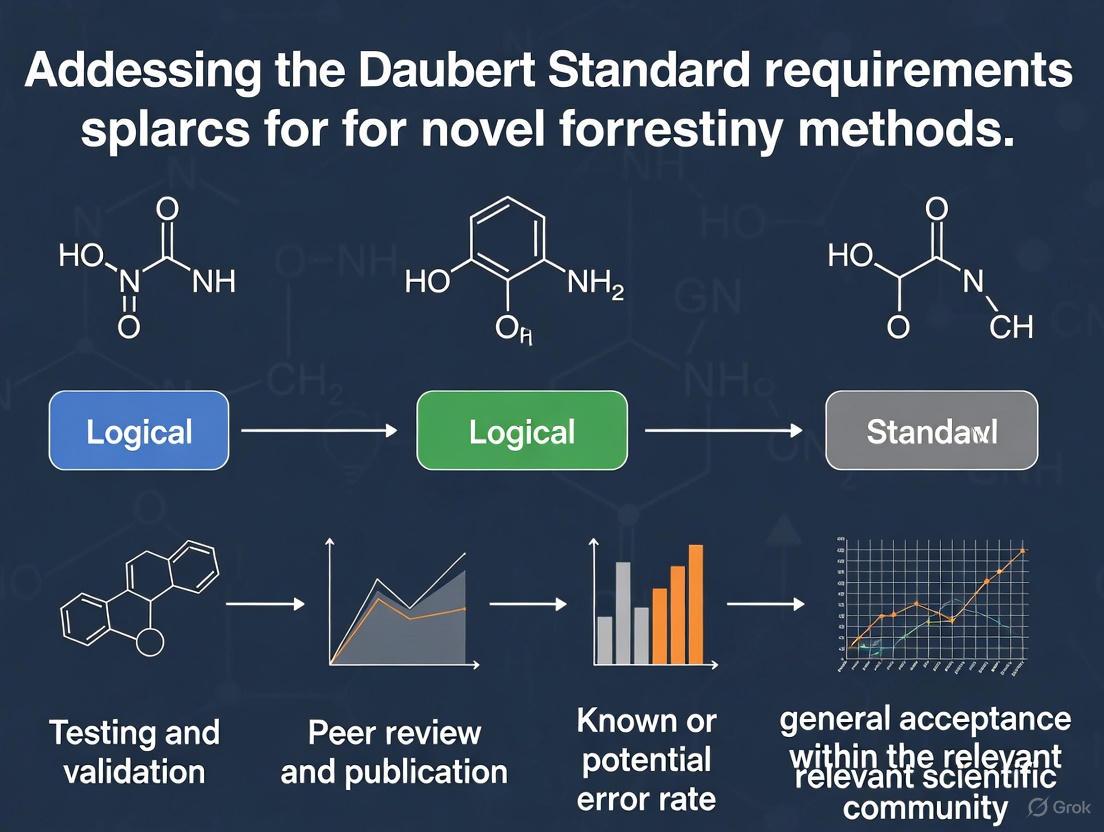
This article provides researchers, scientists, and drug development professionals with a comprehensive framework for developing and presenting novel forensic methods that meet the stringent admissibility requirements of the Daubert standard.
Navigating Daubert: A Strategic Guide to Validating Novel Forensic Methods for Biomedical Research
Abstract
This article provides researchers, scientists, and drug development professionals with a comprehensive framework for developing and presenting novel forensic methods that meet the stringent admissibility requirements of the Daubert standard. Covering foundational legal principles, methodological rigor, troubleshooting common pitfalls, and validation strategies, it synthesizes current legal trends, including the updated Federal Rule of Evidence 702, to equip scientific experts with the knowledge to bridge the gap between laboratory innovation and courtroom acceptance.
The Daubert Standard Demystified: Legal Foundations for Scientific Experts
FAQs: Addressing Daubert Standard Requirements for Novel Forensic Methods
What is the fundamental difference between the Frye and Daubert standards?
The Frye Standard (from Frye v. United States, 1923) focuses on a single criterion: whether the scientific technique is "generally accepted" by the relevant scientific community [1]. The Daubert Standard (from Daubert v. Merrell Dow Pharmaceuticals, Inc., 1993) provides a broader, multi-factor test for judges to assess the reliability and relevance of expert testimony [2] [1]. While Frye asks "Is the method generally accepted?", Daubert asks "Is the method scientifically reliable?" [3].
How did the Daubert standard evolve after the 1993 ruling?
The Daubert standard was clarified and expanded by two subsequent Supreme Court cases, often called the "Daubert Trilogy" [2]:
- General Electric Co. v. Joiner (1997): Held that appellate courts should review a trial judge's decision to admit or exclude expert testimony under an "abuse of discretion" standard [2] [3].
- Kumho Tire Co. v. Carmichael (1999): Expanded the Daubert standard to apply to all expert testimony, not just scientific testimony. This includes testimony based on technical or other specialized knowledge [2] [1].
What are the five primary factors courts consider under Daubert?
When evaluating expert testimony, judges consider these non-exhaustive factors [2] [4]:
- Testing: Whether the expert’s technique or theory can be or has been tested.
- Peer Review: Whether the technique or theory has been subjected to peer review and publication.
- Error Rate: The known or potential rate of error of the technique.
- Standards: The existence and maintenance of standards controlling the technique's operation.
- General Acceptance: Whether the technique is generally accepted in the relevant scientific community.
How does the 2023 Amendment to Federal Rule of Evidence 702 affect my research?
The December 2023 amendment to Rule 702 emphasizes that the proponent of expert testimony must demonstrate its admissibility by a "preponderance of the evidence" [5]. The key clarification was in subsection (d), which now states that "the expert’s opinion reflects a reliable application of the principles and methods to the facts of the case" [5]. For researchers, this underscores the necessity to not only develop reliable methods but also to meticulously document their reliable application to specific case facts.
What is a "Daubert Challenge" and how can I prepare for one?
A Daubert Challenge is a motion by opposing counsel to exclude an expert’s testimony on the basis that it is not reliable or relevant under Rule 702 [2]. To prepare your research and methodology:
- Ensure your techniques can be empirically tested and validated.
- Document error rates and standards controlling your methods.
- Seek peer review and publication of your underlying research.
- Be prepared to show how your opinion reflects a reliable application of your methods to the specific facts [2] [5].
Experimental Protocols for Validating Novel Forensic Methods Under Daubert
Protocol 1: Establishing Empirical Testability and Error Rates
This protocol provides a framework for validating a novel analytical method, such as the HS-FET-GC/MS technique for terpene profiling in cannabis, to satisfy Daubert's testing and error rate factors [6].
1. Objective: To demonstrate that the analytical method is based on a testable hypothesis and has a known or potential rate of error.
2. Methodology:
- Hypothesis Testing: Formulate a testable hypothesis (e.g., "This HS-FET-GC/MS method can reliably identify and quantify 45 target terpenes in cannabis plant material").
- Calibration and Linearity: Validate the method's response over a defined concentration range (e.g., 10–2000 μg/g). Establish a calibration curve for each analyte and calculate the coefficient of determination (r²) to demonstrate linearity [6].
- Accuracy and Precision: Assess intra-day and inter-day precision by repeatedly analyzing quality control samples at multiple concentrations. Report accuracy as percent bias and precision as relative standard deviation (RSD) [6].
- Analytical Limits: Determine the limit of detection (LOD) and limit of quantification (LOQ) for each analyte to define the method's operational boundaries [6].
3. Data Analysis:
- Quantify the method's error rate through rigorous validation of its accuracy (bias) and precision.
- Document all procedures, raw data, and statistical analyses to provide a transparent record of the empirical testing.
Protocol 2: Demonstrating Adherence to Standards and Peer Review
This protocol focuses on the Daubert factors of peer review, publication, and the existence of maintained standards.
1. Objective: To establish that the method has been scrutinized by the scientific community and is performed under controlled standards.
2. Methodology:
- Standards and Controls: Implement and document standard operating procedures (SOPs) for the method. This includes sample preparation, instrument operation, and data interpretation criteria [6] [7].
- Independent Verification: Submit the methodology and validation data to a peer-reviewed scientific journal for publication [6].
- Proficiency Testing: Engage in inter-laboratory comparisons or proficiency testing programs to demonstrate that the method produces consistent and reproducible results across different operators and laboratories.
3. Data Analysis:
- Maintain detailed records of all standards, controls, and SOPs.
- Upon publication, the peer review process itself serves as evidence of scientific scrutiny. The published paper becomes a citable source for the method's validity [6].
Workflow Diagram: Daubert Compliance Pathway for Novel Methods
Daubert Compliance Pathway
Table 1: Key Quantitative Metrics for Analytical Method Validation as Required by Daubert
| Validation Parameter | Target Value | Experimental Measure | Forensic Application Example |
|---|---|---|---|
| Calibration Linear Range | Defined for each analyte | Coefficient of determination (r²) | Terpene profiling: 10–2000 μg/g for 45 terpenes [6] |
| Accuracy (Bias) | Minimized and quantified | Percent bias from known value | Reported as part of method validation [6] |
| Precision | Minimized and quantified | Relative Standard Deviation (RSD) | Intra-day and inter-day precision assessed [6] |
| Limit of Detection (LOD) | As low as practicable | Concentration (e.g., μg/g) | At least 6 μg/g for terpenes in cannabis [6] |
| Limit of Quantification (LOQ) | As low as practicable | Concentration (e.g., μg/g) | Defined for each analyte during validation [6] |
| Known/Potential Error Rate | Quantified and monitored | Percentage or rate | Determined through validation and proficiency testing [4] [7] |
Table 2: Daubert Factor Alignment with Documentation Requirements
| Daubert Factor | Required Documentation for Researchers | Example from HS-FET-GC/MS Method [6] |
|---|---|---|
| Empirical Testability | Detailed validation protocols, raw data, calibration curves, results from robustness testing. | Linearity tested across a defined range; accuracy and precision data reported. |
| Peer Review | Copies of published articles in reputable journals, documentation of the peer review process. | Publication in Drug Test Anal., a peer-reviewed journal. |
| Known Error Rate | Statistical analysis of accuracy/precision data, results from inter-laboratory comparisons. | Reported bias and intraday/interday precision. |
| Maintained Standards | Standard Operating Procedures (SOPs), quality control records, instrument maintenance logs. | Method validated according to forensic guidelines; use of internal standards. |
| General Acceptance | Literature reviews citing the method, adoption by other labs, presentations at scientific conferences. | Creating a tool for comprehensive profiling in forensics, implying relevance and utility. |
The Scientist's Toolkit: Essential Research Reagents & Materials
Table 3: Key Reagent Solutions for Novel Forensic Method Development
| Item | Function / Role in Validation | Specific Example |
|---|---|---|
| Certified Reference Materials | Provides ground truth for method calibration, accuracy determination, and quantification. | Certified terpene standards for creating calibration curves in HS-FET-GC/MS [6]. |
| Internal Standards | Corrects for analytical variability, losses during sample preparation, and instrument drift. | Retention time index mixture used in terpene analysis [6]. |
| Quality Control Samples | Monitors method performance over time, essential for establishing precision and ongoing reliability. | Prepared samples at low, mid, and high concentrations analyzed with each batch. |
| Peer-Reviewed Protocol | The documented method itself; serves as the foundational standard and is critical for peer review. | The published HS-FET-GC/MS methodology for 45 terpenes [6]. |
The Daubert Standard is the evidence rule governing the admissibility of expert witness testimony in United States federal courts and many state jurisdictions [8]. Established by the 1993 U.S. Supreme Court case Daubert v. Merrell Dow Pharmaceuticals, Inc., it assigns trial judges the role of "gatekeepers" who must assess whether an expert's testimony is both relevant and reliable before it can be presented to a jury [9]. This standard replaced the earlier Frye standard's sole focus on "general acceptance" with a more flexible, multi-factor analysis [10].
For researchers and forensic scientists developing novel analytical methods, understanding and addressing the five Daubert factors is essential for ensuring that their techniques and expert conclusions will be admissible in court. The framework provides a systematic approach for validating new forensic methods and demonstrating their scientific rigor.
The Five Pillars: Framework for Scientific Admissibility
Testability and Falsifiability
Core Principle: The expert's methodology must be grounded in the scientific method, meaning it can be (and has been) tested and is potentially falsifiable [9] [2].
Technical Guidance for Researchers:
- Hypothesis Formulation: Clearly state the hypothesis your method is designed to test. For a novel forensic method, this might be: "Technique X can reliably distinguish between source A and source B."
- Experimental Design: Develop protocols that can produce results that could potentially prove the hypothesis false. A method that only produces confirmatory results is not scientifically valid.
- Validation Studies: Conduct studies under controlled conditions that systematically challenge the method's capabilities. Document all results, including those that may indicate limitations.
Peer Review and Publication
Core Principle: The technique or theory should have been subjected to peer review and publication, which helps identify methodological flaws and ensures the research meets disciplinary standards [9] [2].
Technical Guidance for Researchers:
- Journal Selection: Submit validation studies to reputable, peer-reviewed journals in your specific forensic discipline. Avoid "predatory" journals with minimal review standards.
- Transparency: Provide sufficient methodological detail in publications to allow for replication. Withhold only information that would genuinely compromise ongoing law enforcement operations.
- Response to Critique: Document how you have addressed reviewer comments and critiques, as this demonstrates a commitment to scientific dialogue and improvement.
Known or Potential Error Rate
Core Principle: The known or potential error rate of the technique must be established and considered [9] [2]. This is particularly challenging for many forensic disciplines, as error rate studies have often excluded inconclusive decisions, potentially understating true error rates [11].
Technical Guidance for Researchers:
- Comprehensive Error Calculation: Include all decision types (identification, exclusion, and inconclusive) in error rate calculations. An inconclusive decision on evidence that contains sufficient information for a definitive conclusion constitutes an error [11].
- Blind Proficiency Testing: Implement blind testing programs where analysts process mock evidence samples mixed into their regular workflow without their knowledge. This provides realistic performance data [12].
- Contextual Reporting: Report error rates specific to different evidence quality tiers (e.g., high-quality prints vs. partial/trace samples), as performance varies significantly with evidence difficulty.
Table: Error Rate Calculation Framework for Forensic Methods
| Decision Type | Ground Truth: Match | Ground Truth: Non-Match | Ground Truth: Inconclusive |
|---|---|---|---|
| Identification | True Positive | False Positive | Error |
| Exclusion | False Negative | True Negative | Error |
| Inconclusive | Error (if sufficient info exists) | Error (if sufficient info exists) | True Inconclusive |
Existence of Standards and Controls
Core Principle: The existence and maintenance of standards controlling the technique's operation must be evaluated [9] [2].
Technical Guidance for Researchers:
- Protocol Documentation: Develop and maintain detailed, written protocols for all analytical procedures. These should be specific enough that a trained analyst could reproduce the method.
- Quality Assurance: Implement a robust quality assurance program including equipment calibration records, reagent qualification, and environmental monitoring where appropriate.
- Certification and Training: Establish certification requirements and ongoing proficiency testing for analysts. Document all training completions and competency assessments.
General Acceptance
Core Principle: While no longer the sole determinant, general acceptance within the relevant scientific community remains an important factor [9] [10].
Technical Guidance for Researchers:
- Community Engagement: Present validation research at professional conferences and seek feedback from the broader scientific community, not just those in your immediate institution.
- Independent Validation: Encourage other laboratories to test and validate your method. Successful independent replication is strong evidence of general acceptance.
- Survey Research: For truly novel methods, consider conducting surveys of relevant scientific communities to demonstrate acceptance levels quantitatively.
Table: Research Reagent Solutions for Forensic Method Validation
| Resource Category | Specific Examples | Function in Daubert Compliance |
|---|---|---|
| Proficiency Testing Programs | Blind testing systems, Mock evidence kits | Provides empirical data on method reliability and error rates [12] |
| Statistical Analysis Software | R, Python with scikit-learn, specialized forensic statistics packages | Enables rigorous error rate calculation and uncertainty quantification |
| Reference Materials | Certified reference materials, Standard operating procedure templates | Ensures methodological consistency and standardization across analyses |
| Documentation Systems | Electronic lab notebooks, Quality management software | Creates auditable trail of method development and validation activities |
| Peer Review Platforms | Scientific journals, Professional conference proceedings | Provides independent validation of methodological soundness [9] |
Frequently Asked Questions: Technical Troubleshooting for Daubert Compliance
Q1: Our novel forensic method has a higher error rate with low-quality samples. How should we present this in court?
A: Transparency is critical. Develop and present error rates stratified by sample quality. A method that performs well with high-quality samples but poorly with low-quality samples can still be admissible if these limitations are properly documented and disclosed. The alternative—claiming uniform reliability—can lead to exclusion and ethical concerns.
Q2: How can we address the challenge of "general acceptance" for a truly novel technique?
A: Pursue a multi-pronged strategy:
- Publish validation studies in high-quality, peer-reviewed journals
- Present your methods at professional conferences for broader exposure
- Develop training programs to allow other laboratories to adopt your methods
- Commission surveys of the relevant scientific community to quantitatively measure acceptance
Q3: Our error rate study revealed different types of errors. How should we categorize them for Daubert purposes?
A: Implement a nuanced error classification system:
Table: Forensic Decision Error Matrix
| Error Category | Definition | Impact on Reliability Assessment |
|---|---|---|
| False Positive | Incorrect association between non-matching samples | High concern - can lead to wrongful incrimination |
| False Negative | Failure to associate matching samples | Concerning - may impede justice but less dire consequences |
| Inappropriate Inconclusive | Declaring inconclusive when sufficient information exists for definitive conclusion | Moderate concern - reflects methodological uncertainty [11] |
Q4: What is the minimum sample size for establishing a statistically valid error rate?
A: There is no universal minimum, as it depends on the expected error rate and desired confidence level. However, the Houston Forensic Science Center's blind testing program provides a practical model. Use statistical power analysis during study design to determine appropriate sample sizes. Generally, several hundred tests provide more reliable estimates, particularly for detecting low-frequency errors.
Q5: How do the Daubert standards apply to non-scientific technical experts?
A: The Supreme Court's Kumho Tire decision extended Daubert's gatekeeping function to all expert testimony, including technical and experience-based expertise [8] [2]. While the factors may be applied flexibly, the fundamental requirements of reliability and relevance remain. For technical experts, focus on demonstrating standardized procedures, documentation of training and experience, and consistent application of methods.
Troubleshooting Common Daubert Challenges
| Challenge | Root Cause | Solution | Key Case/Rule Reference |
|---|---|---|---|
| Testimony not based on sufficient facts/data | Expert relied on unsupported assertions or data contradicted by evidence. | Ensure expert's opinion is grounded in evidence reviewed, not speculation. | EcoFactor, Inc. v. Google LLC [13] |
| Unreliable application of methods | Expert uses reliable method but applies it unreliably to case facts. | Demonstrate expert applied principles with same rigor as in professional work. | Fed. R. Evid. 702(d) [5] [14] |
| Unknown or high potential error rate | Forensic method lacks foundational validation and error rate quantification. | Conduct blind proficiency testing to establish empirical error rates. | Daubert Factor [12] |
| Judicial gatekeeping not properly exercised | Court fails to create record for admissibility decision or defers issues to jury. | Proponent must affirmatively prove admissibility by preponderance of evidence. | Fed. R. Evid. 702 (2023) [5] |
Frequently Asked Questions (FAQs)
What is the judge's "gatekeeping" role under Daubert?
Trial judges act as gatekeepers to ensure all expert testimony is not only relevant but also reliable [14]. This duty requires a preliminary assessment of whether the expert's reasoning or methodology is scientifically valid and can be properly applied to the facts at issue [9]. The gatekeeper role applies to all expert testimony, whether based on scientific, technical, or other specialized knowledge [14].
What is the difference between the Frye and Daubert standards?
The Frye Standard, from Frye v. United States, focuses on whether the scientific evidence has gained "general acceptance" in the relevant scientific community [15] [9]. The Daubert Standard, from Daubert v. Merrell Dow Pharmaceuticals, Inc., provides a broader, more flexible set of factors for judges to assess reliability, including testing, peer review, error rates, and standards [15] [9]. While some state courts still use Frye, Daubert governs all federal courts [9].
What must the proponent of expert testimony prove after the 2023 Amendment to Rule 702?
The proponent must demonstrate by a preponderance of the evidence that the testimony satisfies all parts of Rule 702 [5] [14]. The amended rule emphasizes that the proponent's burden applies to showing that:
- The testimony is based on sufficient facts or data.
- The testimony is the product of reliable principles and methods.
- The expert's opinion reflects a reliable application of those principles and methods to the facts of the case [5].
How can a researcher establish the "known or potential error rate" for a novel forensic method?
The most effective method is through blind proficiency testing, where mock evidence samples are introduced into the ordinary workflow without analysts' knowledge [12]. This approach, pioneered by the Houston Forensic Science Center, generates empirical data on a method's performance in real-world conditions, providing the statistical foundation needed to quantify error rates [12].
What is the relationship between a court's reliability assessment and the jury's role?
The court determines whether expert testimony is reliable enough to be admitted; this is a question of admissibility [5]. The jury then decides what weight to give the admitted testimony and whether it is correct [5]. Attacks on the sufficiency of the expert's basis often become questions of weight for the jury, so long as the court finds a minimally sufficient factual basis for the opinion [5].
Experimental Protocols for Establishing Foundational Validity
Protocol for Blind Proficiency Testing
Objective: To integrate blind testing into a laboratory's quality assurance program to generate empirical data on error rates and validate forensic disciplines [12].
Methodology:
- Program Design: A dedicated quality team, separate from the analysts, designs the program. For a large laboratory, a case management system where case managers act as a buffer between requestors and analysts is a necessary predicate [12].
- Sample Creation: The team creates mock evidence samples that reflect a range of complexities and scenarios encountered in casework.
- Blind Introduction: These mock samples are submitted to the laboratory through standard channels and enter the normal workflow. Analysts have no knowledge they are being tested.
- Processing & Analysis: Analysts process the samples according to the laboratory's established protocols and issue reports.
- Data Collection: The quality team collects the results and compares them to the known "ground truth" of the mock samples.
- Data Analysis: Calculate error rates (both false positives and false negatives) and other performance metrics. The data allows for refined assessments for evidence of various difficulty levels [12].
Challenges and Solutions:
- Cost: The Houston Forensic Science Center established its program without a substantial budget increase by leveraging existing resources [12].
- Implementation: Smaller labs may struggle without a dedicated quality division. A potential solution is regional collaboration or making blind testing a feature of accreditation programs [12].
The Admissibility Pathway for Novel Scientific Evidence
The following diagram visualizes the judicial gatekeeping process a trial judge employs when determining the admissibility of expert testimony under the Daubert standard and Federal Rule of Evidence 702.
Research Reagent Solutions: A Toolkit for Daubert Compliance
| Essential Material/Data | Function in Validating Novel Methods |
|---|---|
| Blind Proficiency Test Samples | Generates empirical data on error rates under real-world laboratory conditions; essential for demonstrating foundational validity [12]. |
| Validation Study Literature | Peer-reviewed publications demonstrating the scientific validity and reliability of the underlying principles and methods [9] [14]. |
| Standard Operating Procedures (SOPs) | Documents the existence and maintenance of standards and controls governing the method's operation [9] [14]. |
| Proficiency Test Results | Provides evidence of the laboratory's and individual analyst's competency in applying the method correctly ("validity as applied") [12]. |
| Data on Known/Potential Error Rate | Quantifies the uncertainty of the method's results; a key Daubert factor that courts must consider [9] [12]. |
| Documented Licenses & Agreements | Provides an objective, sufficient factual basis for an expert's opinions, particularly in damages calculations, preventing exclusion for speculation [13]. |
For researchers and scientists developing novel forensic methods, the admissibility of expert testimony in court is a critical final step in the translational research pathway. The Daubert standard, established by the Supreme Court in 1993, requires trial judges to act as "gatekeepers" to ensure that all expert testimony is not only relevant but also reliable [14] [8]. This standard applies to scientific, technical, and other specialized knowledge, encompassing the very types of novel forensic methods developed in research settings [2].
The recent December 1, 2023, amendment to Federal Rule of Evidence 702 clarifies and emphasizes two foundational requirements for proponents of expert testimony [16] [17]:
- The proponent must demonstrate to the court that it is more likely than not (the preponderance of the evidence standard) that the admissibility requirements are met.
- The expert's opinion must reflect a reliable application of principles and methods to the facts of the case [16].
For the scientific community, this amendment reinforces the necessity of building a robust, well-documented foundation for any novel method long before it reaches the courtroom. This guide provides a technical framework to troubleshoot your research and validation processes against these legal requirements.
FAQs: Addressing Core Methodological Requirements
What is the practical significance of the "preponderance of the evidence" burden clarification?
The amendment explicitly places the burden of proof on the proponent of the expert testimony (typically the party offering the expert) to demonstrate admissibility by a preponderance of the evidence [16] [17]. This is not a new standard, but a clarification aimed at correcting misapplication by some courts that had treated insufficient factual bases or unreliable applications of methodology as "weight" issues for the jury, rather than admissibility issues for the judge [17].
Troubleshooting Guide:
- Problem: A judge excludes your expert testimony because your validation study had a small sample size, and you argued this was a question of "weight" for the jury to consider.
- Solution: The court must now find it more likely than not that your testimony is "based on sufficient facts or data" before it reaches the jury. Ensure your research design and validation studies are statistically powered to meet this threshold of sufficiency at the admissibility stage.
How does the change from "the expert has reliably applied" to "the expert’s opinion reflects a reliable application" affect my research?
This wording change emphasizes objective reliability over subjective assurance [16] [17]. It is no longer sufficient for an expert to state that they reliably applied a method. The final opinion itself must be shown to be the product of that reliable application. This targets the problem of an expert using a reliable method but then offering an conclusion that extrapolates beyond what the data and method can objectively support [17].
Troubleshooting Guide:
- Problem: Your novel chemical analysis technique is reliable for identifying the presence of Substance A, but your expert's opinion states with certainty the exact time of exposure based on that presence.
- Solution: Scrutinize the chain of reasoning from your data, through your method, to your final opinion. Ensure there is a direct and validated connection at each step. Avoid overstating conclusions beyond what your methodology can support.
What are the key Daubert factors I must design my research to address?
The Daubert standard provides a non-exclusive checklist of factors for courts to consider. Your experimental design should proactively address these five core areas [14] [8] [2]:
- Empirical Testability: Whether the theory or technique can be (and has been) tested.
- Peer Review: Whether the method has been subjected to peer review and publication.
- Error Rate: The known or potential error rate of the technique.
- Standards: The existence and maintenance of standards controlling the technique's operation.
- General Acceptance: The degree to which the technique is accepted within the relevant scientific community.
Experimental Protocols for Validating Novel Forensic Methods
To withstand a Daubert challenge under the amended rule, your research and validation protocols must be meticulously documented. The following workflows provide a roadmap.
Protocol: Foundational Validation Study
This protocol outlines the core workflow for establishing the basic validity and reliability of a novel forensic method, directly addressing Daubert factors of testability, error rate, and standards.
Table: Foundational Validation Study - Key Reagents & Materials
| Research Reagent Solution | Function in Protocol |
|---|---|
| Reference Standard Materials | Provides a ground truth baseline for testing method accuracy and precision. |
| Blinded Sample Sets | Used to test the method objectively and calculate error rates without examiner bias. |
| Positive & Negative Controls | Ensures the method functions correctly in each run and can detect true negatives. |
| Calibration Instruments | Maintains measurement traceability to international standards, ensuring data integrity. |
| Statistical Analysis Software | Calculates key metrics such as false positive/negative rates, confidence intervals, and reproducibility statistics. |
Protocol: Independent Proficiency Testing
This protocol is critical for demonstrating that the method can be reliably operated by other trained examiners, strengthening claims of objectivity and general acceptance.
The Scientist's Toolkit: Essential Materials for Daubert Compliance
Table: Key Reagent Solutions for Forensic Method Development & Validation
| Essential Material | Critical Function for Daubert Compliance |
|---|---|
| Certified Reference Materials | Provides an objective, traceable baseline for validating the accuracy of a method, addressing "testability" and "standards." |
| Blinded Proficiency Test Kits | Allows for the objective calculation of a known error rate and assessment of examiner competence, a core Daubert factor. |
| Standard Operating Procedure (SOP) Documentation | Details the "maintenance of standards and controls" for the method, ensuring consistency and repeatability across users and labs. |
| Raw, Machine-Generated Data | Serves as the foundational "sufficient facts or data" required by Rule 702(b), allowing for independent verification of conclusions. |
| Peer-Reviewed Publication | Subjects the method to scrutiny by the broader scientific community, fulfilling the "peer review" factor and building toward "general acceptance." |
Troubleshooting Common Daubert Challenges
Even with a scientifically sound method, presentation and application issues can lead to exclusion. The following table summarizes common pitfalls and solutions in the context of the 2023 amendment.
Table: Troubleshooting Common Daubert Challenges
| Challenge Scenario | Legal & Scientific Principle | Proactive Solution |
|---|---|---|
| Stating a conclusion (e.g., "a match") with 100% certainty. | The amendment requires the opinion to reflect a reliable application. Courts view categorical claims for pattern-matching disciplines with skepticism as they may overstate what the methodology can support [15] [7]. | Use likelihood ratios or other statistical frameworks to express the strength of the evidence objectively. Train experts to communicate conclusions within the limits of the underlying data. |
| No documented, known error rate for the method. | A known or potential error rate is a key Daubert factor. Its absence makes it difficult for a court to assess reliability [2] [4]. | Conduct validation studies using blinded samples to quantify false positive and false negative rates. Publish these findings. |
| The expert's report is vague on how the method was applied to the case facts. | The proponent must show the reliable application to the case facts [16]. Vague descriptions invite challenges that the opinion is subjective. | Maintain detailed, case-specific documentation in the expert's report, explicitly linking data, the steps of the SOP, and the final opinion. |
| The method is novel and not yet "generally accepted." | "General acceptance" is only one factor and is not dispositive under Daubert. A well-validated but novel method can still be admissible [14] [8]. | Build a strong record on the other Daubert factors: testing, peer review, and error rates. Demonstrate that the method is based on sound scientific principles. |
Building a Daubert-Resilient Methodology: From Lab Bench to Courtroom
Designing Testable Hypotheses and Falsifiable Scientific Techniques
Frequently Asked Questions: Daubert & Scientific Rigor
What is the Daubert Standard, and why is it important for my research? The Daubert Standard is a rule of evidence used in U.S. federal courts to assess the admissibility of expert witness testimony. It requires that the trial judge act as a "gatekeeper" to ensure that any proffered expert testimony is both relevant and reliable [18] [8]. For researchers, especially those developing novel forensic or diagnostic methods, designing studies with Daubert in mind is crucial for ensuring that your work can withstand legal scrutiny and be utilized in court. The court looks at whether the theory or technique can be and has been tested, its error rate, and whether it has been subjected to peer review [8].
What does it mean for a hypothesis to be "falsifiable"? A hypothesis is falsifiable if it is possible to conceive of an experimental observation that could disprove it [19]. In other words, a well-designed experiment must have a possible outcome that would show the idea to be false. A hypothesis that is structured so that no experiment can ever contradict it lies outside the realm of science [20] [19].
My experiment failed. How can I systematically troubleshoot it? A structured approach to troubleshooting is key. Start by simply repeating the experiment to rule out simple human error [21]. Then, consider whether a negative result is a true failure or a valid, unexpected finding by checking the scientific literature [21]. Ensure you have the appropriate positive and negative controls to validate your experimental setup [21]. Finally, methodically change one variable at a time (e.g., antibody concentration, incubation time) to isolate the root cause, and document every change meticulously [21].
What are the different types of experimental outcomes? Experiments can be categorized based on the power of their potential outcomes [19]:
| Type | Description | Power |
|---|---|---|
| Type 1 | The experiment is designed so that a negative outcome would falsify the working hypothesis. | Most powerful |
| Type 2 | A positive result is consistent with the hypothesis, but a negative result does not invalidate it. | Less powerful / Inconclusive |
| Type 3 | The findings are consistent with your hypothesis but also with other models, providing no useful information. | Useless |
Troubleshooting Guide: Weak Signal in Immunohistochemistry (IHC)
Problem: The fluorescence signal in your IHC experiment is much dimmer than expected.
Expected Workflow: The diagram below outlines the standard IHC protocol, which serves as a reference for identifying where issues may arise.
Solution: A Step-by-Step Diagnostic Path Follow this logical troubleshooting path to efficiently identify and resolve the issue.
Specific Variables to Test: If you reach Step 4, here are key variables to investigate, one by one [21]:
- Concentration of primary and secondary antibodies: The concentration may be too low.
- Fixation time: The tissue may not have been fixed long enough.
- Number of washing steps: Excess washing may have rinsed away the signal.
- Microscope light settings: The settings on the microscope may be incorrect.
The Scientist's Toolkit: Key Research Reagent Solutions
The following table details essential materials used in biochemical assays, such as the cytochrome c release assay, which is crucial for studying mitochondrial pathways in apoptosis and drug mechanisms [22].
| Reagent / Assay | Function / Explanation |
|---|---|
| Caspase Activity Assays | Measure the activity of caspase enzymes, which are key executioners of apoptosis. Used to determine if an experimental treatment induces programmed cell death [22]. |
| Cytochrome c Release Assays | Assess the integrity of the mitochondrial membrane. Release of cytochrome c from the mitochondria into the cytoplasm is a pivotal event in the intrinsic apoptosis pathway [22]. |
| Recombinant Proteins (e.g., Bcl-2, BID) | Purified versions of pro- and anti-apoptotic proteins. Used to manipulate apoptotic pathways in vitro to establish mechanism of action [22]. |
| ELISA Kits | Used for the sensitive and quantitative detection of specific proteins (e.g., cytochrome c) in cell lysates or culture supernatants [22]. |
| Flow Cytometry Antibodies | Antibodies conjugated to fluorescent dyes enable the detection of cell surface and intracellular markers, allowing for the analysis of heterogeneous cell populations [22]. |
Core Daubert Factors for Experimental Design
To ensure your research meets the reliability criteria of the Daubert Standard, design your studies to address the following factors [18] [8]. These should be considered when drafting the methods and discussion sections of your publications.
| Daubert Factor | Application in Research Design | Quantifiable Metric (Example) |
|---|---|---|
| Testing & Falsifiability | Formulate a hypothesis that can be proven false by a conceivable experiment. | Use of positive and negative controls in every experiment. |
| Peer Review | Disseminate findings through publication in reputable scientific journals. | Number of peer-reviewed publications citing the method. |
| Error Rate | Establish the known or potential rate of error for the technique. | Statistical measures (e.g., p-values, confidence intervals, false positive/negative rates). |
| Standards & Controls | Implement and document standard operating procedures (SOPs) for the technique. | Adherence to established industry or internal SOPs; results from control experiments. |
| General Acceptance | Demonstrate that the technique is widely accepted in the relevant scientific field. | Citations by independent research groups; adoption in clinical or industry guidelines. |
Experimental Protocol: Cytochrome c Release Assay
This protocol provides a detailed methodology for a Recombinant Human Bcl-2 Cytochrome c Release Assay, a key experiment for studying the regulation of apoptosis, a critical process in drug development [22].
Objective: To test the hypothesis that recombinant human Bcl-2 protein inhibits the release of cytochrome c from mitochondria, thereby suppressing apoptosis. This hypothesis is falsifiable because the experiment can be designed to show that Bcl-2 has no significant inhibitory effect.
Materials:
- Isolation Kit for Mitochondria
- Recombinant Human Bcl-2 Protein
- Buffer for Assay
- Anti-cytochrome c Antibodies
- ELISA Kit for Cytochrome c
Methodology:
- Mitochondria Isolation: Isolate intact mitochondria from human cell lines using a standardized centrifugation protocol.
- Experimental Setup:
- Test Group: Incubate isolated mitochondria with recombinant human Bcl-2 protein.
- Positive Control: Incubate mitochondria with a known inducer of cytochrome c release (e.g., recombinant BID protein) [22].
- Negative Control: Incubate mitochondria with assay buffer only.
- Incubation: Allow the reactions to proceed for a defined period at 37°C.
- Separation: Centrifuge the samples to pellet the mitochondria.
- Quantification: Transfer the supernatant to a new tube and use a cytochrome c-specific ELISA to quantify the amount of cytochrome c released into the supernatant [22].
Interpretation & Falsifiability: The hypothesis that "Bcl-2 inhibits cytochrome c release" would be falsified if the concentration of cytochrome c in the supernatant of the Test Group is statistically indistinguishable from the Positive Control. A result supporting the hypothesis would show cytochrome c levels in the Test Group are significantly lower than the Positive Control and similar to the Negative Control.
Integrating Peer-Review and Publication into Your Development Workflow
Technical Support Center: Troubleshooting Guides and FAQs
This technical support center provides targeted guidance for researchers integrating robust peer-review and publication strategies into their development workflows, with a specific focus on meeting the Daubert Standard for novel forensic methods. The following FAQs and troubleshooting guides address common experimental and procedural challenges.
Frequently Asked Questions (FAQs)
1. Why is peer-review integration critical for novel forensic method development? A rigorous peer-review process is a core component of the Daubert guidelines, which courts use to assess the admissibility of scientific evidence [2]. It demonstrates that your methodology has been subjected to scrutiny by the scientific community, which is one of the five Daubert factors for establishing reliability [4]. Integrating peer-review throughout development, rather than just at the end, creates a documented record of validation and refinement.
2. What are the most common Daubert challenges to novel forensic techniques? Challenges often focus on a method's scientific foundation. Common issues include [2] [4]:
- Unknown or potential error rate: The method has not undergone testing to establish its reliability and error boundaries.
- Lack of standards and controls: No standard operating procedures or controls exist to ensure the method is consistently applied.
- Insufficient peer-review: The underlying theory or technique has not been published in peer-reviewed literature.
3. How can I proactively design experiments to withstand a Daubert challenge? Design your experimental plan with the five Daubert factors in mind from the outset [2] [4]. Ensure your work includes:
- Testable Hypotheses: Frame your research around hypotheses that can be and have been tested.
- Appropriate Controls: Include positive and negative controls in your experimental design to validate results.
- Error Analysis: Quantify the error rate of your technique through repeated testing and validation studies.
- Detailed Documentation: Meticulously record all protocols, results, and deviations.
4. Our team struggles with reviewer diversity, leading to narrow feedback. How can AI assist? AI tools can systematically process large databases to identify qualified reviewers based on expertise, thereby expanding beyond familiar networks [23]. These systems can enhance reviewer diversity by identifying experts across different demographics, geographic locations, and career stages, which helps to reduce unconscious bias and provides a broader range of scientific perspectives [23].
Troubleshooting Common Experimental Scenarios
Scenario 1: Unexpected Experimental Results During Validation You are developing a new assay and initial results are inconsistent or do not match expected outcomes.
| Troubleshooting Step | Actions & Considerations | Daubert Relevance |
|---|---|---|
| Repeat the Experiment | Repeat unless cost/time prohibitive; check for simple human error in protocol execution [21]. | Establishes reliability and helps determine the potential error rate [2]. |
| Validate Controls | Run a positive control to confirm the experimental system is functioning correctly [21]. | Demonstrates use of standards and controls, a key Daubert factor [2]. |
| Check Reagents & Equipment | Verify storage conditions and expiration dates; inspect for contamination or degradation [21]. | Ensures the methodology is applied reliably, supporting the maintenance of standards [2]. |
| Systematically Change Variables | Alter one variable at a time (e.g., concentration, incubation time) to isolate the issue [24] [21]. | The systematic approach is a hallmark of the scientific method, showing the technique can be tested [4]. |
Scenario 2: Peer-Review Feedback Identifies a Methodological Flaw A reviewer of your submitted manuscript points out a critical flaw in your experimental design or data interpretation.
| Troubleshooting Step | Actions & Considerations | Daubert Relevance |
|---|---|---|
| Objectively Evaluate the Critique | Do not become defensive. Assess whether the flaw invalidates the conclusions or can be addressed with new experiments. | Engaging with peer-review directly satisfies a primary Daubert factor [2] [4]. |
| Design a New Experiment | Develop a new experimental plan to specifically address the flaw identified by the reviewer. | This process strengthens the validity of your methodology and its error rate assessment [2]. |
| Document the Entire Process | Keep detailed records of the original critique, your planned response, and all new results [21]. | Creates a transparent audit trail showing how criticism was incorporated, bolstering methodological rigor [4]. |
| Publish the Corrected Study | Submit a revised manuscript, which may include the new data and an explanation of how the flaw was corrected. | The final published paper serves as documented evidence of peer-review and general acceptance [4]. |
Essential Research Reagent Solutions
The following materials are critical for developing and validating robust methods.
| Reagent / Material | Function in Development & Validation |
|---|---|
| Positive Control Samples | Provides a known reference signal to verify the experimental protocol is functioning correctly on each run [21]. |
| Negative Control Samples | Identifies background signal or contamination, ensuring specific detection of the target analyte [21]. |
| Reference Standard Materials | Allows for calibration of instruments and methods, ensuring consistency and accuracy across experiments. |
| Blinded Validation Samples | Used during final validation to objectively assess the method's accuracy and error rate without experimenter bias. |
Experimental Workflow for Daubert-Compliant Method Development
The diagram below outlines a development workflow that incorporates peer-review and validation checkpoints designed to satisfy Daubert criteria.
Peer-Review Integration and Daubert Factor Mapping
The following workflow specifically illustrates how to integrate peer-review at multiple stages to directly address the five Daubert factors.
Establishing Known or Potential Error Rates and Statistical Confidence
Frequently Asked Questions (FAQs) on Error Rates and Confidence
Q1: Why are error rates and statistical confidence critical for novel forensic methods? A1: Legal standards for admitting scientific evidence, such as the Daubert Standard, require courts to consider the known or potential error rate of a technique and its application [25] [26]. Establishing these metrics is fundamental to demonstrating that a method is scientifically valid and reliable, thereby ensuring its admissibility in court [15]. Without a known error rate and a measure of statistical confidence, the reliability of a forensic method can be successfully challenged.
Q2: What is the difference between a confidence interval and a confidence level? A2: A confidence interval is the range of values within which you expect your estimate (e.g., a mean measurement) to fall if you repeat your experiment. The confidence level is the percentage of times you expect the true value to lie within that confidence interval if you were to repeat the sampling process multiple times [27]. For example, a 95% confidence level means that if you were to take 100 random samples, the true population parameter would fall within the calculated confidence interval in 95 of those samples [28].
Q3: How can I estimate an error rate for a novel method that has no historical data? A3: For novel methods, you must conduct developmental validation studies [29]. This involves designing experiments that robustly stress-test the method using representative data that challenges its limits [29]. The observed error rate from these controlled studies provides the initial, potential error rate. This process must be thoroughly documented, including the study design, data used, and the resulting error rate calculations, to satisfy legal and accreditation requirements [29] [25].
Q4: A common misinterpretation is that a 95% confidence interval means there's a 95% chance the true value is in the interval. Is this correct? A4: No, this is a common misunderstanding. The correct interpretation is that 95% of the confidence intervals calculated from many repeated random samples will contain the true population parameter [28] [27]. For any single, specific calculated interval, the true value is either in it or not; there is no probability attached to a single, realized interval [28].
Q5: What are the key legal benchmarks for scientific evidence in the United States? A5: The primary benchmarks are the Daubert Standard and Federal Rule of Evidence 702 [25] [5]. As clarified in a 2023 amendment to Rule 702, the proponent of the expert testimony must demonstrate by a preponderance of the evidence that the testimony is based on sufficient facts or data, is the product of reliable principles and methods, and that the expert has reliably applied those principles and methods to the case [5] [30]. Known or potential error rates are a key factor under Daubert [25].
Table 1: Common Critical Values for Confidence Intervals
| Confidence Level | Alpha (α) for two-tailed CI | Z Statistic (Normal Distribution) | T Statistic (approx., for n=20) |
|---|---|---|---|
| 90% | 0.10 | 1.64 | 1.73 |
| 95% | 0.05 | 1.96 | 2.09 |
| 99% | 0.01 | 2.57 | 2.86 |
Data adapted from statistical resources [27].
Table 2: Forensic Analyst Perceptions of Error Rates (Survey Data)
| Error Type | Perceived Rarity | Analyst Preference for Minimization |
|---|---|---|
| False Positive (e.g., incorrect match) | Perceived as "even more rare" than false negatives | Most analysts prefer to minimize false positive risk |
| False Negative (e.g., missing a match) | Perceived as "rare" | Less of a priority compared to false positives |
Summary of survey results from practicing forensic analysts [26].
Experimental Protocols
Protocol 1: Method Validation for a Novel Digital Forensic Technique
This protocol is aligned with the guidance from the Forensic Science Regulator [29].
1. Determination of End-User Requirements:
- Define the specific purpose of the method. What question is it meant to answer?
- Document the inputs, constraints, and desired outputs from the perspective of the investigator and the court.
2. Risk Assessment & Acceptance Criteria:
- Identify potential points of failure or error in the proposed method.
- Set quantitative acceptance criteria for the method's performance (e.g., "must correctly extract data with ≥99% accuracy on a standardized test set").
3. Validation Plan & Testing:
- Create a detailed plan for testing the method against the acceptance criteria.
- Select or create test data that is representative of real-case scenarios and includes challenges to stress-test the method [29].
- Execute the plan, running the method multiple times under varying conditions to gather performance data.
4. Data Analysis and Reporting:
- Calculate the observed error rates (false positives, false negatives) and establish statistical confidence intervals for key measurements.
- Compile a validation report that documents the entire process, the data collected, and the degree to which the method met the acceptance criteria. This report is the objective evidence of fitness for purpose [29].
Protocol 2: Calculating a Confidence Interval for a Population Mean
This protocol uses the common formula for data that is approximately normally distributed [28] [27].
1. Calculate the Point Estimate:
- Compute the sample mean (x̄). For example, the mean measurement result from 25 experimental runs.
2. Find the Critical Value:
- Choose your confidence level (e.g., 95%) and determine the corresponding alpha (α = 0.05 for two-tailed).
- Based on your sample size and distribution, find the correct critical value (e.g., z* = 1.96 for a z-distribution at 95% confidence, or a t* value from the t-distribution table for small samples).
3. Calculate the Standard Error:
- Compute the sample standard deviation (s).
- Calculate the standard error as: SE = s / √n, where n is the sample size.
4. Compute the Confidence Interval:
- Use the formula: CI = x̄ ± (z* × SE) or CI = x̄ ± (t* × SE).
- The result is the lower and upper bound of your confidence interval.
Method Validation and Statistical Workflows
Diagram 1: Method validation workflow for novel techniques.
Diagram 2: Confidence interval calculation process.
The Scientist's Toolkit: Essential Research Reagents & Materials
Table 3: Key Reagents and Materials for Forensic Method Validation
| Item Name | Category | Function/Brief Explanation |
|---|---|---|
| Representative Test Datasets | Data | Authentic or simulated data that mirrors real-case evidence; used to stress-test methods and establish baseline error rates [29]. |
| Standard Operating Procedure (SOP) Template | Documentation | A pre-defined framework for documenting the logical sequence of procedures, ensuring consistency and reliability during validation [29]. |
| Statistical Analysis Software (e.g., R, Python with SciPy) | Software | Used to calculate descriptive statistics, confidence intervals, and error rates from experimental validation data. |
| Accredited Reference Materials | Standards | Certified materials with known properties used to calibrate instruments and verify the accuracy of measurements within a method. |
| Validation Report Template | Documentation | A standardized format for reporting the objective evidence that a method is fit for its intended purpose, as required by accrediting bodies [29]. |
Implementing Rigorous Standards, Controls, and Operational Protocols
Troubleshooting Common Experimental & Technical Issues
Q1: Our novel assay is producing inconsistent results between different operators. What steps should we take to isolate the cause?
A: Inconsistent results often stem from procedural variations or environmental factors. Follow this structured approach to isolate the cause [31] [32]:
- Understand the Problem Fully: Have each operator document their exact protocol, including specific equipment used, reagent lot numbers, incubation timings, and environmental conditions (e.g., room temperature) [31].
- Remove Complexity and Isolate Variables: Simplify the experiment to its core components. Then, change only one variable at a time to pinpoint the source of discrepancy [31]. Key areas to test:
- Reagent Consistency: Use a single, common batch of reagents and consumables across all operators [31].
- Instrument Calibration: Verify that all instruments (pipettes, centrifuges, scanners) are properly calibrated and maintained.
- Protocol Adherence: Observe operators to ensure no unintended deviations from the written method exist.
- Sample Quality: Use a common, well-characterized sample or control material for all tests [12].
- Compare to a Baseline: If possible, compare results against a known validated method or a certified reference material to establish a baseline for expected performance [31].
Q2: How can we systematically document our troubleshooting process to satisfy rigorous scientific and legal scrutiny?
A: Meticulous documentation is critical for demonstrating the reliability of your method under standards like Daubert [15] [13]. Your records must prove that any issues were investigated and resolved using a scientifically sound approach.
- Create a Standardized Log: Document every action taken during troubleshooting, including the hypothesis, the test performed, all results (positive and negative), and the final conclusion [33].
- Record All Data: Preserve raw data, instrument printouts, and detailed observations. This provides the "sufficient facts or data" required for expert testimony [13] [5].
- Version Control Protocols: Any change to the experimental protocol must be documented in a revised, version-controlled Standard Operating Procedure (SOP). The rationale for the change must be explicitly stated, linking it to the troubleshooting investigation [34] [33].
Q3: What foundational validity measures must we establish for a novel forensic method before it can be considered for use in court?
A: Courts assess the reliability of scientific evidence by examining its foundational validity. For a novel method, you must proactively generate and document evidence addressing these core areas [15] [12]:
- Error Rate Estimation: Conduct blind proficiency testing to empirically measure the method's rate of false positives and false negatives [12]. This is a cornerstone of the Daubert standard.
- Scientific Validation: The method must be grounded in established scientific principles and tested using the scientific method. This involves publishing results in peer-reviewed literature [15] [12].
- Standardized Protocols & Controls: The method must be governed by clear, written procedures and include appropriate positive and negative controls to ensure results are reproducible and specific [34].
- Operator Proficiency: Demonstrate that trained analysts can consistently and reliably execute the method through rigorous training records and ongoing proficiency testing [33].
Foundational Validity & Error Rate Requirements for Novel Methods
The table below summarizes key quantitative and procedural benchmarks necessary to establish the foundational validity of a novel forensic method, directly addressing criteria from the Daubert standard and the PCAST report [15] [12].
| Requirement | Description | Target Benchmark / Data to Record |
|---|---|---|
| Empirical Error Rate | The rate of false positives and false negatives, determined through blind testing [12]. | Conduct studies to establish a statistically valid point estimate and confidence interval for each error type. The acceptable benchmark is discipline-specific. |
| Protocol Standardization | The existence and quality of detailed, step-by-step documented procedures [34]. | A version-controlled SOP that has been validated. All deviations must be documented and justified. |
| Within-Lab Repeatability | The precision of results when the method is repeated within the same laboratory under identical conditions. | Calculate the standard deviation or coefficient of variation for repeated measurements of a reference material. |
| Between-Lab Reproducibility | The precision of results when the method is reproduced across different laboratories. | Data from a collaborative trial or inter-laboratory study, showing consistent results across multiple sites. |
| Proficiency Testing | Ongoing, blind tests to monitor analyst and laboratory performance [12]. | A documented program with a >95% pass rate for analysts. Tests should be integrated into the normal workflow. |
| Limit of Detection (LOD) / Quantification (LOQ) | The lowest amount of analyte that can be reliably detected or quantified. | Empirically determined values specific to your assay, documented with the methodology used for determination. |
Experimental Protocol: Blind Proficiency Testing for Error Rate Estimation
This protocol is designed to integrate blind proficiency testing into your laboratory's workflow, providing the empirical data on error rates required by the Daubert standard [12].
1.0 Objective: To determine the false positive and false negative rates of a novel analytical method by introducing mock evidence samples into the routine casework flow without analysts' knowledge.
2.0 Scope: Applicable to any forensic discipline where samples can be prepared and introduced without distinguishing them from real casework (e.g., toxicology, latent prints, firearms comparison) [12].
3.0 Materials:
- Characterized reference materials or mock samples
- Standard laboratory equipment and reagents
- Case Management System (CMS)
4.0 Procedure: 4.1 Sample Preparation & Introduction:
- The quality assurance unit prepares mock samples that are forensically realistic.
- These samples are assigned a fictitious case number and submitted to the laboratory through the standard intake process by a dedicated case manager, ensuring the analysts are blinded [12]. 4.2 Analysis:
- Analysts process the blind proficiency test samples alongside genuine casework, following all standard operating procedures.
- No special handling or heightened scrutiny is applied to these samples. 4.3 Data Collection & Analysis:
- The results from the blind test are recorded in the CMS.
- The results are compared against the known ground truth.
- The number of correct results, false positives, and false negatives are tallied to calculate the observed error rates [12]. 4.4 Documentation:
- The entire process, from sample preparation to final result comparison, is documented in a final report. This report serves as direct evidence of the method's reliability and the laboratory's competency [12].
The Scientist's Toolkit: Essential Research Reagent Solutions
| Item | Function in Research |
|---|---|
| Certified Reference Materials (CRMs) | Provides a known, standardized material with a certified value for a specific property. Used for method validation, calibration, and quality control to ensure accuracy and traceability. |
| Standard Operating Procedures (SOPs) | Mandatory, documented procedures that ensure consistency, reproducibility, and compliance with regulatory standards. They are the foundation of reliable and defensible scientific work [34]. |
| Positive & Negative Controls | Essential for verifying that an assay is functioning correctly. Positive controls confirm a positive result is detectable, while negative controls rule out contamination or non-specific signals. |
| Blind Proficiency Test Samples | Mock samples of known composition introduced into the testing workflow to objectively assess analyst and method performance without their knowledge, crucial for error rate estimation [12]. |
| Electronic Lab Notebook (ELN) | A system for recording research data and procedures digitally. Enhances data integrity, security, and traceability compared to paper notebooks, supporting robust documentation practices. |
| Quality Management System (QMS) | A formalized system that documents processes, procedures, and responsibilities for achieving quality policies and objectives. It is the overarching framework for laboratory accreditation [33]. |
Technical Support Workflow for Daubert-Compliant Methods
Path to Foundational Validity for Novel Methods
Demonstrating Reliable Application to the Specific Facts of the Case
This technical support center provides resources for researchers and scientists to ensure novel forensic methods meet the rigorous admissibility standards of the Daubert Standard. The framework established by Daubert v. Merrell Dow Pharmaceuticals, Inc. requires that expert testimony be based on reliable methodology that is reliably applied to the facts of the case [2]. The following guides and FAQs are designed to help you document and implement your protocols in a manner that withstands this legal scrutiny.
Troubleshooting Guides
Guide 1: Addressing Challenges to the Testability of Your Method
Problem: A peer review or legal challenge claims your novel forensic technique is not empirically testable or falsifiable.
Symptoms:
- The underlying principle of your method cannot be independently verified by other researchers.
- Your study design lacks controlled experiments to validate the method's core assertions.
- The methodology is described in vague terms that prevent replication.
Root Cause: The foundational theory or technique has not been, or cannot be, subjected to objective validation through testing, a key factor in the Daubert standard [2] [35].
Step-by-Step Solution:
- Formulate a Falsifiable Hypothesis: Clearly state what your method aims to prove and, crucially, what observable result would prove it false.
- Design a Controlled Experiment: Create a protocol that isolates the variable being measured. Use appropriate positive and negative controls.
- Document the Protocol for Replication: Record every detail—equipment settings, reagent lot numbers, environmental conditions, and data processing algorithms—so an independent lab can reproduce your work.
- Pre-register Your Study: Submit your hypothesis and experimental design to a repository before conducting the experiment to demonstrate commitment to scientific rigor.
- Share Raw Data and Code: Where possible, make de-identified raw data and analytical code available to allow for independent re-analysis.
Guide 2: Establishing a Known or Potential Error Rate
Problem: Your novel method lacks a defined error rate, making its reliability difficult to assess for the court.
Symptoms:
- Inability to quantify the method's accuracy or precision.
- No data exists on how the method performs with ambiguous or borderline samples.
- Challenges from opposing counsel regarding the method's potential for false positives or false negatives.
Root Cause: The methodology's performance characteristics have not been systematically evaluated against a known ground truth.
Step-by-Step Solution:
- Identify a Ground Truth Dataset: Obtain or create a set of samples where the outcome is definitively known (e.g., samples of verified origin or composition).
- Conduct a Blind Validation Study: Have analysts apply your method to the ground truth dataset without knowing the expected outcomes to prevent bias.
- Calculate Performance Metrics: Quantify the results to establish:
- False Positive Rate: The proportion of true negatives incorrectly identified as positives.
- False Negative Rate: The proportion of true positives incorrectly identified as negatives.
- Overall Accuracy: The proportion of true results (both true positive and true negative) in the population.
- Document and Report Confidence Intervals: Present error rates with their statistical confidence intervals to provide a range of reliability.
Frequently Asked Questions (FAQs)
Q: How does the Daubert Standard differ from the older Frye Standard? A: The Frye Standard relies solely on whether a method is "generally accepted" by the relevant scientific community [35]. The Daubert Standard is broader and more flexible, making the judge a "gatekeeper" who considers testing, peer review, error rates, and standards, in addition to general acceptance [2] [35].
Q: What specific information should I include when documenting a novel method to satisfy Daubert's "reliability" factors? A: Your documentation should be comprehensive and include:
- For Testability: The initial hypothesis and all experimental protocols [2].
- For Peer Review: Copies of submitted manuscripts, reviewer comments, and publication details [2].
- For Error Rate: The full dataset and statistical analysis from your validation studies [2].
- For Standards & Controls: The standard operating procedures (SOPs) and quality control measures used in every experiment [2].
- For General Acceptance: Citations of independent studies that have used or validated your method.
Q: Our research involves proprietary algorithms. How can we demonstrate reliability without revealing intellectual property? A: While full transparency is ideal, you can:
- Use a trusted third-party auditor to validate the code and methodology without public disclosure.
- Publish detailed results from "black-box" testing, where independent researchers can input data and verify outputs without seeing the underlying algorithm.
- Disclose the algorithm's validation performance (e.g., error rates) on standard benchmark datasets.
Experimental Protocols for Key Daubert-Centric Experiments
Protocol: Blind Validation Study for Error Rate Determination
Objective: To empirically determine the false positive and false negative rates of a novel forensic identification method.
Methodology:
- Sample Preparation: Curate a set of at least 200 samples with a confirmed ground truth. Ensure a mix of positive and negative samples relevant to the method's application.
- Blinding: Assign a random, non-identifying code to each sample. Do not provide the ground truth information to the analysts performing the test.
- Analysis: Analysts apply the novel method according to the established SOP and record the result for each sample.
- Unblinding and Analysis: Compare the method's results against the ground truth. Calculate the performance metrics listed in the troubleshooting guide above.
Quantitative Data Summary:
| Performance Metric | Result (Example) | 95% Confidence Interval |
|---|---|---|
| False Positive Rate | 2.1% | (1.0% - 3.9%) |
| False Negative Rate | 1.5% | (0.6% - 3.1%) |
| Overall Accuracy | 98.2% | (96.5% - 99.2%) |
| Number of Samples (n) | 200 | - |
Diagram: Experimental Workflow for Method Validation
The Scientist's Toolkit: Research Reagent Solutions
| Item | Function in Novel Method Development |
|---|---|
| Certified Reference Materials (CRMs) | Provides a ground truth with known properties for calibrating instruments and validating method accuracy and precision. |
| Synthetic Controls (Positive/Negative) | Essential for establishing the method's specificity and sensitivity, and for calculating false positive/negative rates during validation. |
| High-Fidelity Enzymes/Polymerases | Critical for DNA-based methods to ensure minimal introduction of errors during amplification, supporting the reliability of the results. |
| Blocking Agents (e.g., BSA, Non-Fat Milk) | Reduces non-specific binding in assay-based methods, lowering background noise and improving the signal-to-noise ratio. |
| Stable Isotope-Labeled Analytes | Serves as internal standards in mass spectrometry to correct for sample loss and matrix effects, ensuring quantitative accuracy. |
Diagram: Daubert Standard Admissibility Pathway
Anticipating the Daubert Challenge: Strategies to Overcome Common Objections
A technical support center for researchers and scientists
For researchers and scientists developing novel forensic methods, the scientific soundness of your work is paramount. In the legal landscape, this soundness is formally tested by the Daubert Standard, which governs the admissibility of expert testimony in federal courts and many state jurisdictions. A core requirement of Daubert and Federal Rule of Evidence 702 is that an expert’s opinion must be the product of reliable principles and methods that have been reliably applied to the facts of the case [1].
A critical failure point in this process is the "analytical gap"—a disconnect between the data an expert relies on and the final conclusions they draw. This gap can render otherwise valid research and testimony inadmissible in court. This technical support center provides troubleshooting guides and FAQs to help you design, execute, and document your research to avoid this pitfall, ensuring your scientific work meets the rigorous demands of the legal system.
Understanding the Legal Framework: Daubert and Rule 702
Frequently Asked Questions
What is the "analytical gap"?
An "analytical gap" is a flaw in reasoning where an expert's conclusion does not logically follow from the data and methodology used. It occurs when there is an unjustified leap from the evidence to the opinion. Courts have excluded expert testimony where the expert failed to "account for . . . reasonable alternative explanations," leaving an unacceptable analytical gap between their basis and their opinions [30].
What are the key legal standards my research must satisfy?
Your work must be designed to satisfy Federal Rule of 702, which was amended in 2023 to clarify the court's gatekeeping role [5]. The rule states that expert testimony is admissible only if the proponent demonstrates to the court that it is more likely than not that [30]:
- The testimony is based on sufficient facts or data.
- The testimony is the product of reliable principles and methods.
- The expert’s opinion reflects a reliable application of those principles and methods to the case's facts.
The 2023 amendment emphasizes that the proponent of the testimony bears the burden of proving admissibility by a preponderance of the evidence and that these are threshold issues of admissibility for the judge, not just weight for the jury [5] [30].
My method is novel and not yet "generally accepted." Is it automatically inadmissible?
No. While the Frye standard relies on "general acceptance" in the relevant scientific community, the Daubert standard used in federal courts is more flexible [1]. It considers factors like:
- Whether the theory or technique can be (and has been) tested.
- Whether it has been subjected to peer review and publication.
- The known or potential error rate.
- The existence and maintenance of standards controlling the technique's operation.
- "General acceptance" is still a factor, but it is not the sole determinant [1].
Troubleshooting Guide: Bridging the Analytical Gap
This guide addresses common scenarios where analytical gaps can form and provides protocols to mitigate them.
Problem Statement: An expert draws a broad conclusion about, for instance, an industry-wide royalty rate, but relies on a small number of license agreements whose plain language contradicts the expert's interpretation [13].
Case Example: In EcoFactor, Inc. v. Google LLC, the Federal Circuit ordered a new trial on damages because an expert's testimony about a per-unit royalty rate was not based on sufficient facts or data. The court found the expert's opinion was "undoubtedly contrary to a critical fact upon which the expert relie[d]"—specifically, the language of the license agreements themselves [13].
Experimental Protocol to Avoid This Issue:
- Data Triangulation: Do not rely on a single data source. Actively seek out multiple, independent data streams that can corroborate your hypothesis.
- Documentary Audit: When relying on documents (e.g., contracts, study results, lab notes), conduct a thorough review to ensure their explicit content supports your premise. Do not rely on assumptions about what the documents say.
- Source Verification: For any factual claim that forms a basis of your opinion, verify the primary source. Avoid building conclusions on unsupported assertions or hearsay [13].
Issue 2: Failure to "Rule In" and "Rule Out" Causes
Problem Statement: In causation analysis, an expert identifies a potential cause but fails to systematically evaluate and eliminate other plausible explanations, leading to a speculative conclusion.
Case Example: In Jensen v. Camco Mfg., LLC, the court excluded engineering opinions that used a "differential diagnosis" methodology to determine if a product defect caused an accident. The court held this analysis "is reliable only if the expert first ‘ruled in’ only those potential causes that could have produced the injury in question." The expert's failure to do so resulted in an unreliable, speculative opinion [30].
Experimental Protocol to Avoid This Issue:
- Establish a Causal Checklist: Before testing, identify a comprehensive list of all plausible causes for the observed effect.
- Apply Valid Screening Criteria: Develop and document objective criteria for "ruling in" a potential cause. This often requires showing the cause is capable of producing the effect.
- Systematic Elimination: Design experiments or analyses specifically to test and eliminate other causes on your checklist. Document each step and its outcome.
Issue 3: Overreliance on Experience Without Objective Support
Problem Statement: An expert justifies a conclusion primarily on their personal experience without explaining how that experience leads to the specific conclusion or providing objective data to support it.
Case Example: In Brashevitzky v. Reworld Holding Corp., the court excluded an expert's opinions where the witness did not explain how his experience allowed him to identify specific contaminated areas. The court found "too great of an analytical gap between [the expert’s] incomplete analysis in his declaration and his opinion to be admissible" [30].
Experimental Protocol to Avoid This Issue:
- Explicitly Link Experience to Data: When using experience, document exactly which data points or patterns your experience is interpreting.
- Blind Analysis: Where possible, incorporate blind testing procedures to prevent unconscious bias from influencing results.
- Calibration and Proficiency Testing: Regularly participate in proficiency tests to provide objective, documented evidence of the reliability of your methods and interpretations.
Issue 4: Methodological Flaws in Novel Forensic Applications
Problem Statement: Research involving the characterization of complex materials (e.g., paper, inks, fibers) for forensic discrimination fails to account for real-world variability, degradation, and statistical power, limiting its applicability in casework [36].
Research Context: A critical review of forensic paper analysis techniques noted that a "persistent gulf exists between the analytical potential demonstrated in research settings and the reliable application... in routine forensic casework." [36] Common flaws include using geographically limited sample sets and pristine lab specimens that don't reflect realistic, degraded forensic exhibits [36].
Experimental Protocol to Avoid This Issue:
- Robust Sample Selection: Build sample sets that are geographically diverse, statistically sufficient, and represent the natural variability of the material.
- Simulated Forensic Conditions: Include samples subjected to accelerated aging, UV exposure, humidity, and handling to test the method's robustness under realistic conditions [36].
- Validate with Casework-Like Samples: Blind-test your validated method using samples that mimic real evidence before applying it to casework.
- Establish Error Rates: Quantify the method's performance by calculating its false positive and false negative rates through rigorous validation studies.
Core Methodological Workflow
The following diagram visualizes a reliable experimental workflow designed to minimize analytical gaps from initial data collection to final conclusions.
The Scientist's Toolkit: Essential Research Reagent Solutions
The following table details key analytical techniques and their functions, particularly relevant for forensic materials characterization, as cited in recent scientific literature.
| Technique | Primary Function / What It Measures | Key Consideration for Daubert & Reliability |
|---|---|---|
| Fourier-Transform Infrared (FTIR) Spectroscopy [36] | Probes molecular structure and chemical functional groups in a sample (e.g., cellulose, fillers, sizing agents). | Requires robust spectral libraries and validation using forensically realistic, degraded samples to prove discriminatory power [36]. |
| Laser-Induced Breakdown Spectroscopy (LIBS) [36] | Provides elemental composition by creating a micro-plasma and analyzing the emitted light. | Must demonstrate consistency and a low false-positive rate when analyzing heterogeneous materials like paper [36]. |
| Chromatography & Mass Spectrometry [36] | Separates and identifies complex organic components (e.g., sizing agents, dyes, polymers). | Method development must account for potential interfering substances and establish detection limits [36]. |
| Isotope Ratio Mass Spectrometry (IRMS) [36] | Measures stable isotope ratios (e.g., 13C/12C) to trace geographical or batch origin. | Relies on comprehensive reference databases to provide statistical weight to findings; lack thereof is a major limitation [36]. |
| Chemometrics & Machine Learning [36] | Uses statistical models to extract patterns and classify data from complex analytical outputs. | The "black box" nature must be mitigated by using validated models, transparent algorithms, and explaining the applied logic in the specific case [36]. |
Key Takeaways for Researchers
- Burden of Proof is on You: The proponent of the expert testimony must be prepared to demonstrate, point by point, how the research satisfies each prong of Rule 702 [5] [30].
- Document Relentlessly: Your research notebook and validation studies are your first line of defense. They provide the evidence that your application of a method was reliable.
- Embrace the Gap, Then Bridge It: Actively look for weaknesses and alternative explanations in your own reasoning. A strong methodology directly addresses and rules them out.
- Preempt the Challenge: When designing your study, imagine the most rigorous cross-examination. Build your protocol to withstand those questions.
Troubleshooting Guide: Common Issues in Validating Novel Forensic Methods
This guide addresses frequent challenges researchers face when developing and validating novel forensic methods to meet legal admissibility standards.
Q: My method's validation study produced inconsistent results. How can I systematically identify the problem?
A: Inconsistent results often stem from undefined variables or improper controls. Follow this structured troubleshooting protocol [21]:
- Repeat the Experiment: Unless cost or time-prohibitive, first repeat the experiment to rule out simple human error.
- Verify the Expected Outcome: Critically review scientific literature to confirm your expected result is plausible. A negative or weak result may be scientifically correct, not a protocol failure.
- Validate Your Controls: Ensure you have appropriate positive and negative controls. If a known positive control also fails, the issue likely lies with your protocol or reagents.
- Audit Equipment and Reagents: Check that all equipment is calibrated and reagents have been stored correctly and are not expired.
- Change One Variable at a Time: Systematically test variables. Isolate and adjust one parameter per experiment (e.g., antibody concentration, incubation time, sample preparation method) to identify the root cause.
Q: What foundational research is required to demonstrate my method is not "junk science"?
A: To build a foundation of validity, focus on research that assesses the fundamental scientific basis of your discipline. The National Institute of Justice (NIJ) prioritizes research that provides [37]:
- Foundational Validity and Reliability: Understanding the fundamental scientific principles of the method and quantifying measurement uncertainty.
- Decision Analysis: Measuring the accuracy and reliability of forensic examinations through studies (e.g., black box studies) and identifying sources of error (e.g., human factors research).
- Understanding Evidence Limitations: Researching the value of evidence beyond simple identification, such as evaluating activity-level propositions.
Q: How can I effectively present statistical data to express the "weight of evidence"?
A: The standard for expressing statistical conclusions is evolving. Research and evaluate different frameworks to ensure your testimony is both accurate and understandable. Key approaches include [37]:
- Likelihood Ratios: A quantitative measure of the strength of evidence.
- Verbal Scales: A qualitative description of the evidence strength, which must be backed by statistical data.
- Expanded Conclusion Scales: Moving beyond simple "match/no-match" conclusions to a more nuanced reporting scale. Research is needed to evaluate the effectiveness of these different methods of communication.
Q: A court has challenged my expert testimony under Federal Rule of Evidence 702. What are the core admissibility requirements?
A: The 2023 amendment to Rule 702 emphasizes the court's role as a gatekeeper. You must be prepared to demonstrate the following by a preponderance of the evidence [5]:
- Helpfulness: Your specialized knowledge will help the trier of fact understand the evidence or determine a fact.
- Sufficient Basis: Your testimony is based on sufficient facts or data.
- Reliable Principles: Your testimony is the product of reliable principles and methods.
- Reliable Application: Your opinion reflects a reliable application of those principles and methods to the case's facts. Ensure your testimony stays within the bounds of what your data and methodology can support [13].
Experimental Protocol for Establishing Foundational Validity
This protocol provides a framework for conducting foundational validation studies for a novel analytical method, such as a new assay for body fluid identification.
Objective: To determine the accuracy, reliability, and limitations of a novel analytical method under controlled conditions.
Methodology:
Sample Preparation:
- Prepare a sample set with known ground truth. This should include true positives, true negatives, and, if applicable, challenging samples (e.g., complex mixtures, degraded samples).
- Use a minimum of three replicates per sample type to assess repeatability.
Blinded Analysis:
- The analyst conducting the test should be blinded to the expected outcome of each sample to prevent confirmation bias.
- This setup mimics a "black-box study," which is critical for measuring the real-world accuracy of a method [37].
Data Collection & Interpretation:
- Record all raw data and the steps taken to interpret it.
- If the method involves subjective interpretation, have multiple qualified examiners analyze the same set of data independently to measure inter-examiner reliability.
Data Analysis:
- Calculate key metrics for validity and reliability using the following table.
| Metric | Formula/Description | Purpose |
|---|---|---|
| Accuracy | (True Positives + True Negatives) / Total Samples | Measures the overall correctness of the method. |
| Sensitivity | True Positives / (True Positives + False Negatives) | Measures the ability to correctly identify positives. |
| Specificity | True Negatives / (True Negatives + False Positives) | Measures the ability to correctly identify negatives. |
| Precision | True Positives / (True Positives + False Positives) | Measures the reproducibility of positive results. |
| Measurement Uncertainty | A quantitative indication of the doubt surrounding the measurement result. | Essential for understanding the limitations of quantitative methods [37]. |
The Scientist's Toolkit: Key Research Reagent Solutions
This table details essential materials and their functions in developing and validating novel forensic methods, particularly in toxicology or seized drug analysis [37].
| Item | Function |
|---|---|
| Reference Materials | Certified materials used to calibrate instruments and validate methods, ensuring analytical accuracy. |
| Proteomic/Kinase Assay Kits | Tools for body fluid identification and differentiation based on protein signatures. |
| Mass Spectrometry Reference Libraries | Curated databases (e.g., from NIST) for identifying unknown compounds by comparing mass spectra [38]. |
| Positive & Negative Controls | Samples with known outcomes used to verify that an experiment is working correctly and to detect contamination. |
| Stable Isotope-Labeled Internal Standards | Used in quantitative mass spectrometry to correct for sample loss and matrix effects, improving accuracy. |
Workflow Diagram: Path to Daubert-Admissible Evidence
The following diagram visualizes the logical pathway and critical steps for transitioning a novel forensic method from research to court-admissible evidence.
Workflow Diagram: Forensic Method Troubleshooting Protocol
This diagram outlines a systematic, iterative workflow for troubleshooting failed experiments or unexpected results during method validation.
Frequently Asked Questions (FAQs)
Q: What is the foundational validity requirement highlighted in the PCAST Report, and how does it relate to my novel method? The PCAST Report defines foundational validity as the requirement that a forensic method must be shown, based on empirical studies, to be repeatable, reproducible, and accurate with a low error rate [39]. For your novel method, this means you must conduct scientifically rigorous validation studies, such as black-box studies, to demonstrate that it reliably produces valid results before it can be presented in court [39].
Q: Which specific forensic disciplines did the PCAST Report find lacking in foundational validity, and why? The PCAST Report concluded that several established disciplines lacked sufficient foundational validity at the time of its publication [39]. These include:
- Bitemark analysis: Deemed to be subjective and lacking validity [39].
- Firearms and Toolmark (FTM) Analysis: Found to be subjective and to have an insufficient number of black-box studies establishing its validity [39].
- Complex DNA Mixtures: Specifically, probabilistic genotyping software for samples with more than three contributors was questioned for its reliability and accuracy without further validation [39].
Q: What is the most effective way to structure an expert's testimony to satisfy a Daubert challenge? The most effective strategy is to limit the scope of the expert's claims to what the underlying data and validation studies can reliably support. For example, rather than stating a 100% match, testimony should be framed in a way that acknowledges the limitations of the method. Courts frequently require experts to avoid assertions of absolute certainty [39]. Adhering to established standards like the Department of Justice's Uniform Language for Testimony and Reports (ULTR) is a proven way to structure admissible testimony [39].
Q: My research involves a novel software-based comparison technique. What are the key validation steps? You should treat your software as a scientific instrument and validate it accordingly. Key steps include [39]:
- Define Performance Parameters: Determine the number of contributors the software can accurately handle and the minimum amount of intact DNA required (if applicable).
- Conduct Empirical Studies: Perform black-box studies that test the software's false positive and false negative rates across a wide range of samples.
- Publish and Peer-Review: Subject your validation methodology and results to peer review.
- Establish an Error Rate: Document a known or potential error rate based on your empirical testing, as this is a key Daubert factor [9] [2].
Troubleshooting Common Experimental & Admissibility Hurdles
Problem: A judge excludes our novel forensic evidence, citing a lack of peer-reviewed publication.
- Solution: While peer-reviewed publication is a key Daubert factor, it is not the only one [9] [2]. You can:
- Document Pre-Publication Peer Review: Present documentation of a rigorous peer-review process from a reputable scientific conference where the methodology was presented and critiqued.
- Highlight Other Daubert Factors: Emphasize that the method has been empirically tested, has a known error rate, and that standards and controls are maintained during its operation [2].
- Secure Conditional Admission: Request that the evidence be admitted conditionally pending the outcome of a soon-to-be-completed publication.
Problem: Our validation study for a DNA probabilistic genotyping system yields a higher-than-expected error rate with four contributors.
- Solution: This directly mirrors the limitations discussed in the PCAST Report [39]. Your action plan should be:
- Contextualize the Error Rate: Be transparent about the conditions under which the error rate increases. Clearly state in your report and testimony that the method is empirically validated for mixtures of up to three contributors.
- Limit Testimony: Do not offer conclusions on samples with four or more contributors until further validation is conducted. Propose a scope limitation for the expert testimony to exclude such complex mixtures.
- Design a Follow-Up Study: Conduct a "PCAST Response Study" as was done with STRmix, specifically designed to demonstrate the software's reliability at the higher contributor level and to refine the understanding of its error rate [39].
Problem: A Daubert challenge argues that our firearms analysis technique is subjective and not generally accepted.
- Solution: Since the PCAST Report, courts have admitted firearms analysis testimony when supported by modern black-box studies [39]. To counter the challenge:
- Present New Empirical Evidence: Cite and present data from recent, properly designed black-box studies that demonstrate the foundational validity of the specific methodology you used.
- Propose Limited Testimony: Offer to have the expert testify to conclusions in a more limited manner, avoiding claims of absolute certainty. For example, the expert may state that two toolmarks "match to a high degree of certainty" but not that they unequivocally came from the same source [39].
- Rely on Rigorous Cross-Examination: Argue that the potential subjectivity of the method goes to the weight of the evidence, not its admissibility, and can be explored through vigorous cross-examination at trial [39].
Experimental Protocols for Foundational Validity
Protocol 1: Conducting a Black-Box Study to Establish Error Rates Objective: To empirically determine the false positive and false negative rates of a novel feature-comparison method.
- Sample Preparation: Create a set of known ground-truth samples, including matching and non-matching pairs. The samples should cover a range of qualities and complexities.
- Blinded Administration: Provide the samples to trained examiners without revealing the ground truth. Examiners should use the standard operating procedure for the method.
- Data Collection: Record all conclusions, typically as categorical decisions (e.g., identification, exclusion, inconclusive).
- Data Analysis: Calculate the method's sensitivity, specificity, and overall error rates by comparing the examiners' conclusions to the known ground truth.
- Documentation: The study protocol, raw data, and statistical analysis must be thoroughly documented for peer review and court disclosure.
Protocol 2: Validating Probabilistic Genotyping Software for DNA Mixtures Objective: To define the limits of reliability for a probabilistic genotyping system.
- Define Parameters: Establish the variables to be tested, including the number of contributors (3, 4, 5+), DNA quantity (varying concentrations down to the stochastic threshold), and mixture ratios.
- Create Reference Datasets: Use laboratory-generated or synthetic DNA mixtures where the ground truth is known.
- Batch Processing: Run the datasets through the software (e.g., STRmix, TrueAllele) using standardized settings.
- Output Analysis: Assess the software's accuracy in deconvoluting the mixture and assigning correct likelihood ratios (LR). Identify the point at which LRs become unreliable or the error rate exceeds a pre-defined acceptable threshold.
- Reporting: Publish results that clearly state the software's validated scope, for example: "This software has been empirically validated to provide reliable results for mixtures of up to four contributors, where the minor contributor constitutes at least 10% of the sample."
Quantitative Data on Forensic Discipline Admissibility
The following tables summarize key data on the admissibility and reliability of forensic disciplines as discussed in post-PCAST court decisions [39].
Table 1: Post-PCAST Court Treatment of Forensic Disciplines
| Discipline | PCAST Assessment (2016) | Common Court Ruling Post-PCAST | Typical Limitations Imposed |
|---|---|---|---|
| Bitemark Analysis | Lacks foundational validity | Often excluded; or subject to admissibility hearing | If admitted, strong limitations on testimony; cannot claim absolute certainty. |
| Firearms/Toolmarks | Lacked foundational validity | Admitted with limitations; exclusion less common | Expert may not testify with "100% certainty"; must acknowledge subjectivity. |
| DNA (Single Source/Simple Mix) | Foundational validity | Routinely admitted | Typically none. |
| DNA (Complex Mixtures) | Valid only for ≤3 contributors under specific conditions | Admitted with limitations based on validation | Testimony limited to the number of contributors and sample quality for which the software is validated. |
| Latent Fingerprints | Foundational validity | Routinely admitted | Typically none. |
Table 2: Key Daubert Factors and Corresponding Evidence
| Daubert Factor | Supporting Evidence for Novel Methods |
|---|---|
| Empirical Testing | Results from black-box studies and internal validation experiments. |
| Peer Review & Publication | Published articles in scientific journals or presentations at peer-reviewed conferences. |
| Known Error Rate | Calculated false positive and false negative rates from validation studies. |
| Standards & Controls | Existence of a documented Standard Operating Procedure (SOP) and quality control measures. |
| General Acceptance | Adoption of the method by other labs or citations in growing scientific literature. |
Visualizing the Path to Admissibility
The following diagram illustrates the logical workflow for validating a novel forensic method to meet Daubert and PCAST requirements.
The Scientist's Toolkit: Research Reagent Solutions
Table 3: Essential Materials for Forensic Method Validation
| Item | Function in Research |
|---|---|
| Probabilistic Genotyping Software (e.g., STRmix, TrueAllele) | Analyzes complex DNA mixtures to calculate likelihood ratios for contributor profiles; requires extensive internal validation [39]. |
| Black-Box Study Kit | A pre-prepared set of samples with known ground truth, used to empirically test examiner reliability and establish method error rates [39]. |
| Standard Operating Procedure (SOP) Document | Defines the controlled standards for the method's operation, a key factor for demonstrating reliability under Daubert [2]. |
| Uniform Language for Testimony and Reports (ULTR) | Templates provided by the Department of Justice to ensure expert testimony is presented in a scientifically sound and legally admissible manner [39]. |
| Reference DNA Profiles & Mixtures | Laboratory-created samples with known contributors, essential for validating the accuracy of probabilistic genotyping software [39]. |
FAQs: Core Principles and Documentation
Q1: Why is documenting my analytical process specifically important for meeting Daubert standards? The Daubert standard requires that an expert's testimony be based on reliable principles and methods, applied reliably to the facts of the case [2]. Meticulous documentation demonstrates that your methodology is sound, consistent, and testable—key factors courts consider during a Daubert challenge [2] [4]. It provides the evidence that your technique has been subjected to peer review, has known standards and controls, and is not merely a subjective opinion [8].
Q2: What are the most common lines of attack during cross-examination of a novel forensic method? An opposing attorney will often attempt to [40]:
- Attack the fact basis: Show that your investigation was inadequate, you are unfamiliar with the scene, or you relied on inappropriate second-hand information.
- Challenge your qualifications: Establish gaps in your professional résumé or training specific to the method used.
- Expose bias: Give reasons why your testimony might be slanted (e.g., financial incentives, affiliation with the prosecuting party).
- Impeach with learned treatises: Use authoritative texts or prior statements you have made that contradict your current testimony.
- Attack the field itself: Argue that your professional field or the specific method lacks general acceptance and recognition [4].
Q3: What key elements should my experimental protocols contain to withstand scrutiny? Your protocols should be detailed enough for another competent scientist to replicate your work. Essential elements include:
- A clear, testable hypothesis.
- Detailed descriptions of equipment, reagents, and sample preparation.
- Step-by-step procedures for testing and data collection.
- Defined standards, controls, and calibration procedures.
- The methodology for data analysis, including any statistical models or software used.
- Documentation of all results, including raw data and observations.
Q4: How can I establish a known or potential rate of error for a novel technique? A known error rate is a key Daubert factor [2] [8]. For novel methods, this can be established through:
- Proficiency testing: Conducting repeated tests on samples with known origins.
- Validation studies: Designing studies to identify and quantify sources of error and uncertainty.
- Blinded testing: Participating in inter-laboratory comparisons to objectively assess performance.
- Documenting results: Maintaining records of all tests, including false positives and negatives, to calculate an empirical error rate.
Q5: What is the significance of "general acceptance" in the scientific community, and how can I demonstrate it for a new method? While "general acceptance" is no longer the sole standard for admissibility, it remains one important factor under Daubert [2] [8]. You can demonstrate it by showing that your method has been:
- Published in peer-reviewed scientific journals.
- Presented at scientific conferences.
- Adopted or recognized by other laboratories or standard-setting bodies in your field.
- Subjected to and withstood critical review by the broader scientific community [4].
Troubleshooting Guides: Methodological Challenges
Issue 1: Inconsistent or Unreproducible Results
- Problem: The analytical method yields different outcomes when the same sample is tested repeatedly.
- Investigation:
- Review Instrument Calibration: Verify that all equipment is properly calibrated and maintenance logs are up to date.
- Check Reagent Quality: Confirm that all reagents are within their expiration dates and have been stored correctly.
- Audit Procedural Execution: Watch a trained technician perform the method to identify any deviations from the established protocol.
- Control Sample Analysis: Re-test known control samples to determine if the inconsistency is isolated to the test sample or is a broader methodological issue.
- Solution: Identify the root cause (e.g., a faulty reagent, an uncalibrated instrument, or a protocol ambiguity) and document the corrective action taken. Update the standard operating procedure (SOP) to prevent recurrence and record all data from the inconsistent runs to help establish a more accurate error rate.
Issue 2: High Background Noise or Low Signal-to-Noise Ratio
- Problem: The data output has significant interference, obscuring the target signal and complicating interpretation.
- Investigation:
- Isolate the Source: Systematically vary one parameter at a time (e.g., sample purification method, antibody concentration, wash buffer stringency) to pinpoint the source of the noise [31].
- Compare to Baseline: Run a negative control and compare its output to the test sample to quantify background levels.
- Environmental Review: Check for environmental contaminants in the lab or sample preparation area.
- Solution: Based on the investigation, refine the method. This may involve optimizing sample cleanup procedures, adjusting detection parameters, or improving laboratory hygiene. Document the optimization process and the final, improved protocol.
Issue 3: Method is Challenged as "Novel" and Lacking General Acceptance
- Problem: Opposing counsel argues that your technique is experimental and not generally accepted in the relevant scientific community.
- Investigation:
- Literature Review: Conduct a thorough review of scientific literature to identify and cite published studies that use or validate similar methodological principles.
- Document Precedent: Research whether similar methods have been admitted in other court cases and under what reasoning.
- Solution: Defend the method by emphasizing its foundation in established scientific principles, even if its specific application is novel. Be prepared to explain how it meets the other Daubert factors, such as testability, peer review, and the existence of standards [2] [4]. Clearly articulate the logical connection between the underlying science and the conclusions drawn.
Table 1: Daubert Factor Compliance Checklist for Analytical Methods
| Daubert Factor | Documentation & Evidence Required | Compliance Status (Yes/Partial/No) |
|---|---|---|
| Testability of Hypothesis | Protocol demonstrating a falsifiable hypothesis; records of experiments designed to test it. | |
| Peer Review & Publication | Copies of peer-reviewed articles, conference presentations, or technical reports detailing the method. | |
| Known/Potential Error Rate | Data from validation studies, proficiency tests, and internal quality control showing calculated error rates. | |
| Existence of Standards & Controls | Written standard operating procedures (SOPs); records of control samples run with each analysis. | |
| General Acceptance | Citations from authoritative texts; evidence of use in other labs; testimony from other experts in the field. |
Table 2: Common Forensic Method Validation Metrics
| Validation Metric | Description | Target for Novel Methods |
|---|---|---|
| Accuracy | The closeness of agreement between a test result and an accepted reference value. | > 95% or statistically equivalent to a gold-standard method. |
| Precision | The closeness of agreement between independent test results obtained under stipulated conditions. | Coefficient of variation (CV) < 5-10%, depending on the method. |
| Sensitivity | The proportion of true positives that are correctly identified by the test. | Method-dependent, but must be defined and documented. |
| Specificity | The proportion of true negatives that are correctly identified by the test. | Method-dependent, but must be defined and documented. |
| Robustness | The capacity of a method to remain unaffected by small, deliberate variations in method parameters. | The method should perform reliably under minor, expected changes in conditions. |
Experimental Protocol: Method Validation for Daubert
Objective: To systematically validate a novel analytical method to establish its reliability and admissibility under the Daubert standard.
Materials:
- See "Research Reagent Solutions" table below.
- Instrumentation specific to the method (e.g., HPLC, MS, PCR machine).
- Set of well-characterized reference materials and samples.
Procedure:
- Define Performance Parameters: Determine which metrics (e.g., accuracy, precision, limit of detection) will be used to validate the method.
- Design Experiments: Create a study plan to measure each performance parameter. This includes:
- Repeatability: Analyze the same sample multiple times (n≥10) within a single run by the same analyst.
- Reproducibility: Analyze the same sample across different days, by different analysts, or on different instruments.
- Accuracy/Recovery: Spike a known quantity of analyte into a sample matrix and measure the recovery percentage.
- Linearity and Range: Analyze samples with analyte concentrations across the expected range to ensure the response is linear.
- Execute and Document: Run all experiments as per the study plan. Record all raw data, instrument outputs, and observations in a bound notebook or electronic laboratory notebook (ELN).
- Analyze Data: Calculate the defined metrics (e.g., mean, standard deviation, CV, recovery %).
- Establish SOP: Based on the validation results, formalize the final method into a detailed SOP that any trained technician can follow.
- Report: Compile all data, calculations, and the final SOP into a validation report. This report is a key document for defending the method.
Workflow and Signaling Diagrams
Method Validation Workflow
Daubert Admissibility Pathway
The Scientist's Toolkit: Research Reagent Solutions
Table 3: Essential Materials for Robust Method Development
| Item/Category | Function in Analytical Process | Considerations for Documentation |
|---|---|---|
| Certified Reference Materials | Provides a standardized baseline for calibrating instruments and verifying method accuracy. | Record source, certification, purity, lot number, and expiration date. Essential for proving traceability. |
| High-Purity Solvents & Reagents | Ensure reactions are consistent and free from interference that could skew results. | Document supplier, grade, lot number, and preparation logs. Changes in supplier can be a source of error. |
| Internal Standards | A known quantity of a similar substance added to samples to correct for loss and variability during analysis. | Justify the choice of standard. Document its properties and concentration in every sample run. |
| Quality Control Samples | Samples with known values analyzed alongside unknown samples to monitor the method's ongoing performance. | Establish acceptance criteria for QC results. Document every QC run to demonstrate continuous method control. |
| Calibration Standards | A series of samples with known analyte concentrations used to create the calibration curve for quantitative analysis. | Document the preparation process meticulously. The curve's linearity and range are key metrics of reliability. |
Benchmarking and Validation: Proving Reliability Against Established Norms
Technical Support Center
Frequently Asked Questions (FAQs)
Q1: What are the core Daubert Standard requirements for validating a new forensic method? The Daubert Standard, based on the 1993 Supreme Court case Daubert v. Merrell Dow Pharmaceuticals, provides a framework for judges to assess the admissibility of expert testimony. For a novel forensic method to meet these requirements, its proponent must demonstrate by a preponderance of the evidence that it is both reliable and relevant. The court's assessment is based on five primary factors [2]:
- Testability: Whether the expert's technique or theory can be (and has been) tested.
- Peer Review: Whether the method has been subjected to peer review and publication.
- Error Rate: The known or potential rate of error of the technique.
- Standards: The existence and maintenance of standards controlling the technique's operation.
- General Acceptance: The degree to which the technique is generally accepted within the relevant scientific community.
It is critical to note that a 2023 amendment to Federal Rule of Evidence 702 has intensified the judge's role as a gatekeeper. The proponent must now explicitly show that the testimony is the product of reliable principles and methods and that the expert's opinion reflects a reliable application of those principles to the case facts [41].
Q2: How can I design a validation study to establish an error rate for a novel method? Establishing a credible error rate is a cornerstone of Daubert compliance. Your study design should mirror real-world conditions as closely as possible and involve a large number of independent examiners. A key model is the "black box" study design used to assess latent fingerprint analysis.
- Protocol: Provide participating examiners with a set of sample pairs. These should include both "mated" pairs (samples from the same source) and "nonmated" pairs (samples from different sources). The examiners should be unaware of the expected outcomes for each pair.
- Data Collection: Record all examiner decisions: Identifications (IDs), Exclusions, Inconclusive, or No Value.
- Calculation: Calculate the False Positive Rate (erroneous IDs on nonmated pairs) and the False Negative Rate (erroneous exclusions on mated pairs). A 2025 study on latent print decisions, for example, found a very low false positive rate of 0.2% but noted that a single participant can account for the majority of such errors, highlighting the need for large sample sizes [42].
Q3: What are the common pitfalls in demonstrating "general acceptance" for a new technique? "General acceptance" does not require unanimity, but it does extend beyond your own laboratory or institution. Common pitfalls include:
- Reliance on Precedent Alone: Arguing that a method is accepted because it has been used for a long time is insufficient. The Daubert Standard specifically moved beyond the old Frye standard's sole focus on general acceptance [2].
- Lack of Independent Adoption: If only your research group uses the method, it will not be considered generally accepted. Publish your methods and results in peer-reviewed journals and present at scientific conferences to build recognition and credibility within the broader community [2].
- Overstating Conclusions: Ensure your expert witnesses do not claim "absolute certainty" where the science inherently involves probabilistic outcomes. This was a critical weakness in traditional fingerprint testimony that drew judicial skepticism [43].
Q4: My novel DNA methylation method works well in cell lines but performs poorly on degraded clinical samples. How can I troubleshoot this? This is a common issue when moving from controlled environments to complex real-world samples. You should:
- Re-evaluate DNA Extraction: The extraction method critically impacts DNA yield and quality for downstream applications. For challenging samples like dried blood spots (DBS), physical methods like a Chelex-100 resin boiling method have been shown to yield significantly higher DNA concentrations compared to many column-based kits, though with lower purity [44].
- Optimize Input Material: For methods like Chelex, reducing the elution volume can significantly increase the final DNA concentration without requiring more starting material [44].
- Consider Alternative Chemistry: If bisulfite conversion is causing excessive DNA fragmentation, consider enzymatic conversion methods like Enzymatic Methyl-seq (EM-seq), which preserves DNA integrity better and improves coverage in challenging genomic regions [45].
Troubleshooting Guides
Issue: High Inconclusive Rates in Pattern Comparison Studies Problem: A high rate of inconclusive decisions in a novel pattern-matching method (e.g., a new fingerprint powder) suggests the method lacks sensitivity or the decision criteria are poorly defined. Solution:
- Refine Visualization Protocol: Ensure the development technique is optimized for the substrate. For instance, a novel Silica Gel G powder might require a specific particle size and application method for optimal contrast on different surfaces [46].
- Establish Objective Criteria: Develop and document clear, objective thresholds for what constitutes a sufficient agreement of features for an identification or exclusion. The historical lack of such uniform standards has been a major criticism of fingerprint analysis [43].
- Conduct Proficiency Testing: Implement regular, realistic proficiency tests within your team to ensure consistent application of the developed standards and to monitor individual and group performance [42].
Issue: Low Concordance with Established "Gold Standard" Methods Problem: When validating a new DNA methylation detection method like Oxford Nanopore Technologies (ONT) sequencing, your results show low agreement with established methods like Whole-Genome Bisulfite Sequencing (WGBS). Solution:
- Analyze Discrepancies: Don't assume the gold standard is always correct. Investigate the specific genomic regions where discrepancies occur. ONT sequencing, for example, may uniquely capture methylation patterns in regions that are difficult for WGBS or EM-seq to access [45].
- Validate with Orthogonal Methods: Use a third, orthogonal method (e.g., pyrosequencing for specific CpG sites) to verify the methylation status in regions of disagreement.
- Benchmark Performance Metrics: Systematically compare your method against the gold standard across multiple parameters, as shown in Table 2. This will help you characterize the new method's specific strengths and limitations rather than just its overall concordance.
Structured Data Summaries
Table 1: Performance Data from a 2025 Latent Print Examiner Black Box Study [42] This table provides quantitative error rates essential for a Daubert analysis of forensic fingerprint comparison.
| Decision | Mated Pairs (True Positives) | Nonmated Pairs (True Negatives) |
|---|---|---|
| Identification (ID) | 62.6% (True Positive) | 0.2% (False Positive) |
| Exclusion | 4.2% (False Negative) | 69.8% (True Negative) |
| Inconclusive | 17.5% | 12.9% |
| No Value | 15.8% | 17.2% |
Table 2: Comparative Analysis of DNA Methylation Detection Methods [45] This table helps researchers select the appropriate method based on technical and practical requirements for their validation studies.
| Method | Resolution | Key Strengths | Key Limitations | Practical Considerations |
|---|---|---|---|---|
| WGBS | Single-base | Considered the gold standard; comprehensive genome-wide coverage. | DNA degradation from bisulfite treatment; sequencing bias. | High cost; complex data analysis. |
| EPIC Array | Single-base | Low cost; easy, standardized data processing. | Limited to pre-defined CpG sites (~935,000). | Inability to detect novel methylation sites. |
| EM-seq | Single-base | Superior to WGBS; preserves DNA integrity; more uniform coverage. | Relatively new method; less established than WGBS. | Emerging robust alternative to WGBS. |
| ONT Sequencing | Single-base | Long-reads; detects methylation in challenging regions; no conversion needed. | Lower agreement with WGBS/EM-seq; requires high DNA input. | Ideal for long-range methylation profiling. |
Experimental Protocols
Protocol 1: Chelex-100 DNA Extraction from Dried Blood Spots (DBS) [44] This cost-effective and efficient protocol is suitable for preparing DNA from limited samples for validation studies.
- Soaking: Place one 6 mm DBS punch in 1 mL of Tween20 solution (0.5% in PBS). Incubate overnight at 4°C.
- Washing: Remove the Tween20 solution. Add 1 mL of PBS to the punch and incubate for 30 minutes at 4°C.
- Chelex Boiling: Remove the PBS. Add 50 µL of pre-heated 5% (m/v) Chelex-100 solution. Pulse-vortex for 30 seconds.
- Incubation: Incubate at 95°C for 15 minutes, with brief pulse-vortexing every 5 minutes.
- Pelletting: Centrifuge for 3 minutes at 11,000 rcf to pellet Chelex beads and paper debris.
- Collection: Carefully transfer the supernatant containing the DNA to a new tube. Centrifuge again and perform a final transfer for precision.
- Storage: Store extracted DNA at -20°C.
Protocol 2: Latent Print Development using Silica Gel G Powder [46] A protocol for developing latent fingerprints on non-porous surfaces, representative of novel forensic visualization techniques.
- Preparation: Silica Gel G powder (white) is used as the developing agent.
- Application: The powder is gently applied over the surface bearing the latent fingerprint using a soft brush.
- Development: The powder adheres to the moisture and oils (eccrine, sebaceous, and apocrine secretions) in the latent fingerprint residue.
- Visualization: The developed fingerprint ridge pattern becomes visible as the powder contrasts with the underlying surface.
- Preservation: The developed print can be lifted using fingerprint lifting tape and preserved on a backing card.
The Scientist's Toolkit: Research Reagent Solutions
Table 3: Essential Materials for Featured Experiments
| Item | Function | Example Application |
|---|---|---|
| Chelex-100 Resin | Chelating agent that binds metal ions; protects DNA from degradation during boiling. | Rapid, low-cost DNA extraction from DBS samples [44]. |
| Silica Gel G Powder | Adsorbs moisture and oils from fingerprint residues, providing visual contrast. | Developing latent fingerprints on various substrates [46]. |
| TET2 Enzyme (in EM-seq) | Oxidizes 5-methylcytosine (5mC) to 5-carboxylcytosine (5caC), protecting it from deamination. | Enzymatic conversion of methylated cytosines for sequencing, avoiding DNA fragmentation [45]. |
| APOBEC Enzyme (in EM-seq) | Deaminates unmodified cytosines to uracils, while leaving enzymatically modified cytosines intact. | Works with TET2 to distinguish methylated from unmethylated cytosines [45]. |
Experimental Workflow and Daubert Compliance Diagrams
Diagram 1: Method Validation Path to Daubert Compliance
Diagram 2: DNA Methylation Analysis Method Workflows
The Role of Proficiency Testing, Accreditation, and Inter-Laboratory Validation
Technical Support Center: FAQs & Troubleshooting Guides
This technical support center provides resources for researchers, scientists, and drug development professionals implementing novel forensic methods. The guidance herein is specifically framed within the context of meeting Daubert Standard requirements, which mandate that expert testimony be based on reliable foundations established through scientific testing, peer review, known error rates, adherence to standards, and widespread acceptance in the relevant scientific community [9] [47]. Proficiency Testing (PT), accreditation, and inter-laboratory comparison (ILC) form the tripartite foundation for demonstrating methodological reliability under Daubert.
Frequently Asked Questions (FAQs)
Proficiency Testing (PT) and Interlaboratory Comparisons (ILC)
What is a Proficiency Testing (PT) or Interlaboratory Comparison (ILC)? A Proficiency Testing Program (PTP) or Interlaboratory Comparison (ILC) involves multiple laboratories testing the same samples and comparing their results to evaluate a product, a method, or their own testing capabilities [48]. These programs are critical for assessing the reliability of a laboratory's test results.
Why is participation in a PT/ILC required for accreditation? Accreditation bodies, like A2LA, require participation in proficiency testing as it provides objective evidence that a laboratory can competently perform specific tests or measurements [48] [49]. It is a key tool for the accreditation body to verify continued competence.
What is the main goal of enrolling in a proficiency test? The primary goal is to compare your laboratory's measurements and processes against a reference value and evaluate your results against peer organizations [50]. This process helps identify any systematic biases or deficiencies in your methods.
How does PT/ILC directly support a Daubert defense? PT results provide direct evidence for several Daubert factors:
- Known or Potential Error Rate: PT schemes establish a laboratory's measurement performance against a reference value, providing a documented, empirical error rate [9] [50].
- Reliability and Standards: Successful participation demonstrates that the laboratory operates its methods under controlled conditions and achieves reliable results, a cornerstone of Daubert's reliability inquiry [51].
Laboratory Accreditation
What is the significance of using an ILAC MRA signatory accreditation body? Accreditation by a body that is a signatory to the International Laboratory Accreditation Cooperation (ILAC) Mutual Recognition Arrangement (MRA) ensures global acceptance of your data [49]. These signatories are rigorously peer-reviewed to ensure they operate competently and consistently worldwide. For Daubert, accreditation by an ILAC MRA signatory provides strong evidence of operating under widely accepted standards [49].
What does the accreditation process typically involve? The process involves a detailed assessment of the laboratory's management system and technical competence. For A2LA, this includes a review of your application, an on-site assessment by technical experts, and a final decision by an impartial accreditation council. The timeline can be 3-6 months for a well-prepared applicant [49].
How does accreditation satisfy Daubert factors?
- Existence and Maintenance of Standards: Accreditation verifies that the laboratory's operations are controlled by international standards (e.g., ISO/IEC 17025) [49].
- Widespread Acceptance: ILAC MRA signatory status demonstrates that the laboratory's accreditation is recognized as equivalent across over 70 economies, indicating widespread acceptance of its operational framework [49].
Legal Standards and Method Validation
What is the Daubert Standard? Established in the 1993 U.S. Supreme Court case Daubert v. Merrell Dow Pharmaceuticals, this standard provides a systematic framework for a trial judge to assess the reliability and relevance of expert witness testimony before presenting it to a jury [9]. Judges act as "gatekeepers" and must evaluate the methodology and reasoning behind an expert's opinions [9] [47].
What are the specific factors a judge considers under Daubert? The trial court considers several factors to determine if an expert's methodology is valid [9] [51]:
- Whether the theory or technique can be and has been tested.
- Whether it has been subjected to peer review and publication.
- Its known or potential error rate.
- The existence and maintenance of standards controlling its operation.
- Whether it has attracted widespread acceptance within a relevant scientific community.
How do PT, Accreditation, and ILC collectively address the Daubert factors? The table below maps these quality assurance activities directly to the Daubert criteria.
| Daubert Factor | How PT/ILC Addresses It | How Accreditation Addresses It |
|---|---|---|
| Testing of Theory/Technique | ILCs can validate a test method by applying it across multiple laboratories [48]. | Assesses the validated scope of a laboratory's methods. |
| Peer Review & Publication | PT scheme design and statistical analysis are often peer-reviewed; ILCs are a form of collaborative review [50]. | The accreditation process itself is a rigorous peer review of systems and technical competence [49]. |
| Known/Potential Error Rate | PT provides a direct, quantitative measure of a lab's performance and error for a specific test [50]. | Requires labs to establish and monitor measurement uncertainty for all accredited methods [49]. |
| Existence of Standards | PT providers are accredited to ISO/IEC 17043, a controlling international standard [50]. | The lab is assessed against international standards (e.g., ISO/IEC 17025), proving standardised operation [49]. |
| Widespread Acceptance | Participation in widely recognized PT schemes demonstrates engagement with the community [48]. | ILAC MRA signatory status proves acceptance across international borders and scientific communities [49]. |
Troubleshooting Guides
Guide 1: Troubleshooting an Experimental Protocol with Unexpected Results
This guide outlines a systematic approach to diagnosing problems in a novel method, which is essential for understanding its limitations and establishing its known error rates.
Workflow for Troubleshooting Experimental Protocols
The following diagram outlines a logical, step-by-step workflow for addressing failed experiments or unexpected results.
Detailed Steps:
Repeat the Experiment [21]
- Action: Unless cost or time-prohibitive, repeat the experiment exactly.
- Rationale: Rules out simple human error (e.g., incorrect pipetting, forgotten steps).
- Daubert Link: Establishes the repeatability of the protocol, a fundamental aspect of the scientific method.
Consider Scientific Plausibility [21]
- Action: Return to the scientific literature. Is there another plausible explanation for the unexpected result?
- Example: In a forensic assay, a weak signal could indicate a protocol problem, or it could mean the target analyte is genuinely present in low concentrations in that specific sample type.
- Daubert Link: Demonstrates that conclusions are based on sufficient facts and data, not just the immediate experimental output.
Verify the Use of Appropriate Controls [24] [21]
- Action: Ensure you have included both positive and negative controls.
- Positive Control: Validates that the protocol can work under ideal conditions.
- Negative Control: Confirms the assay's specificity and helps identify contamination.
- Daubert Link: The consistent use of proper controls is a key standard controlling the operation of a reliable method.
Check Equipment and Materials [21]
- Action: Systematically inspect all reagents and equipment.
- Reagents: Check expiration dates, storage conditions (e.g., -20°C), and visual appearance (e.g., cloudiness in a clear solution). Verify antibody compatibilities.
- Equipment: Ensure proper calibration and function (e.g., spectrophotometer wavelength accuracy, centrifuge speed).
- Daubert Link: Maintains standards controlling the method's operation and ensures data integrity.
Change One Variable at a Time [21]
- Action: Generate a list of potential problem variables (e.g., incubation time, temperature, reagent concentration). Methodically test them one by one.
- Rationale: Isolating variables is the only way to definitively identify the root cause. Changing multiple variables simultaneously can lead to incorrect conclusions.
- Daubert Link: This systematic approach is a hallmark of a reliable scientific methodology.
Document Everything [21]
- Action: Meticulously record all actions, observations, and changes in a permanent lab notebook.
- Rationale: Creates an audit trail for your troubleshooting process. This is invaluable for your own reference, for colleagues, and for demonstrating a rigorous process.
- Daubert Link: Comprehensive documentation is critical for demonstrating the reliable application of principles and methods to the facts of a case.
Guide 2: Troubleshooting a Poor Proficiency Testing Result
An unsatisfactory PT result indicates a potential problem with your measurement process. The following guide helps diagnose and correct the issue.
FAQs for Poor PT Performance
What is the first step after an unsatisfactory PT result? Initiate a formal corrective action investigation. This is a requirement of accreditation standards. The goal is to find the root cause, not just to fix the single result [50].
Can the PT provider tell us what went wrong? No. Accredited PT providers like NAPT operate as independent third parties and cannot provide consulting on root cause analysis or uncertainty budgets, as this would jeopardize their independence [50]. The investigation is the responsibility of your laboratory.
Our result was an outlier. What are common causes? Common causes include [50]:
- Measurement Procedure: Incorrect technique or methodology.
- Equipment Calibration: Equipment that is out-of-calibration or malfunctioning.
- Reagent/Standard Issues: Degraded or contaminated reagents, or miscalculated standard concentrations.
- Environmental Conditions: Uncontrolled temperature or humidity.
- Data Handling: Errors in calculation or transcription.
Corrective Action Workflow for a Failed PT
The following diagram maps the logical process for responding to and resolving a failed proficiency test.
Troubleshooting Steps:
- Confirm the Result: Verify that the PT sample was handled correctly and that all data was reported and transmitted without error.
- Investigate the Root Cause: This is the most critical step. The investigation should be thorough and may involve:
- Re-testing any retained PT sample.
- Reviewing raw data and calculations.
- Checking equipment calibration and maintenance records.
- Reviewing analyst training and qualification records.
- Using control charts to check the stability of the method over time.
- Implement and Verify Corrective Actions: Once the root cause is identified, take action to fix it. This could involve re-training staff, repairing equipment, or revising the standard operating procedure. The effectiveness of the action must be verified, for example, by successfully analyzing a control material or a subsequent PT sample.
- Document the Entire Process: The investigation, root cause, actions taken, and verification of effectiveness must be fully documented. This record is crucial for your accreditation body and serves as evidence of your commitment to quality and reliability.
The Scientist's Toolkit: Research Reagent Solutions
The following table details key materials and their functions, which are critical for robust and reliable experimental protocols.
| Item | Function in Experiment |
|---|---|
| Primary Antibody | Binds specifically to the protein or antigen of interest for detection [21]. |
| Secondary Antibody | Conjugated to a marker (e.g., fluorophore); binds to the primary antibody to enable visualization [21]. |
| Blocking Buffer | Reduces non-specific binding of antibodies to the sample surface, minimizing background noise [21]. |
| Fixation Solution | Preserves tissue architecture and prevents degradation of the sample [21]. |
| Positive Control Sample | A known sample that will produce a positive result; verifies the entire experimental protocol is working correctly [21]. |
| Negative Control Sample | A known sample that will produce a negative result; confirms the specificity of the assay and detects contamination [21]. |
FAQs on Daubert Standard and Reliability Quantification
What is the Daubert Standard and why is it critical for my research?
The Daubert Standard is a rule of evidence regarding the admissibility of expert witness testimony in United States federal law. Established in the 1993 Supreme Court case Daubert v. Merrell Dow Pharmaceuticals, Inc., it requires trial judges to act as "gatekeepers" to ensure that any expert testimony presented to the jury is both relevant and reliable [8] [9].
For researchers developing novel forensic methods, this means your methodology must withstand judicial scrutiny against specific factors before its results can be admitted as evidence. The standard applies not only to scientific testimony but to all expert testimony, including that from engineers and other non-scientific experts [8] [52].
How can I transform qualitative analysis into quantitatively reliable evidence?
You can demonstrate the reliability of your qualitative analysis by implementing intercoder reliability (ICR) assessments. ICR is a measure of the agreement between different coders regarding how the same qualitative data should be coded [53].
A robust ICR process provides confidence that your analysis is a credible and accurate representation of the data, transcends the imagination of a single individual, and is sufficiently well-specified to be communicable across persons [53]. This systematic approach directly supports the Daubert requirement for a reliably applied methodology [52].
What are the most defensible quantitative metrics for intercoder reliability?
The most defensible metrics are those that account for chance agreement. The following table summarizes key quantitative measures:
| Metric | Calculation Method | Key characteristic | Best Used For |
|---|---|---|---|
| Cohen's Kappa | Uses a formula to parse out the influence of chance agreement [54]. | Always lower than percent agreement as it accounts for chance [54]. | Dichotomous or nominal-scale data where chance agreement is a concern [55] [54]. |
| Percent Agreement | Simple percentage of coding instances where raters assign the same code [54]. | Intuitive but can be inflated by random chance [54]. | Initial, quick checks of coder alignment. |
| Intraclass Correlation Coefficients (ICC) | Analysis of variance (ANOVA) framework to assess consistency [55]. | Suitable for interval or ordinal data and multiple raters [55]. | Continuous or ordinal-scale data and when more than two coders are involved. |
My research is interpretative. Must I use statistical measures for reliability?
No. There is a recognized alternative that uses qualitative-based measures to achieve consistency without relying solely on statistics. This approach is compatible with an interpretivist epistemological paradigm [53]. The core of this method is a consensus process, where multiple researchers code data independently and then engage in dialogue to discuss overlaps and divergences until a consensus on the codes and their meanings is reached [53]. This process emphasizes achieving a shared understanding of the data rather than just a numerical score of agreement.
Troubleshooting Guides
Issue: Low Intercoder Reliability Scores
Problem: Your coders are not achieving strong agreement, as measured by Cohen's Kappa or percent agreement.
Solution: Follow this workflow to diagnose and resolve the issue.
Steps:
- Review and Refine the Codebook: Low agreement often stems from vague, overlapping, or ambiguous code definitions [54]. Clarify the codebook by providing clear, distinct definitions and concrete inclusion/exclusion criteria for each code.
- Conduct Additional Coder Training: Retrain your coders using the refined codebook. Use a practice dataset and have coders apply the codes independently, then discuss their reasoning until their understanding aligns [53] [54].
- Implement a Consensus Process: If discrepancies persist, adopt a consensus coding model. Independent coding is followed by a group discussion where coders resolve their differences through dialogue to achieve a final, agreed-upon set of codes for the data [53].
Issue: Preparing for a Daubert Challenge
Problem: You need to proactively prepare your novel forensic method to withstand a Daubert motion, which could exclude your expert testimony.
Solution: Systematically build your methodology against the five Daubert factors. The following diagram outlines the key assessment areas.
Steps:
- Testability: Document how your method has been tested. This includes any experiments designed to validate its accuracy and the results of those tests [8] [9].
- Peer Review: Submit your methodology and findings for publication in reputable, peer-reviewed scientific journals. This process is a key Daubert factor and demonstrates scrutiny by the scientific community [8] [9].
- Error Rate: Quantify your method's reliability. For qualitative analysis, this means calculating and reporting intercoder reliability metrics like Cohen's Kappa. A known error rate is a powerful piece of evidence for the court [8] [9] [54].
- Standards: Develop and document standard operating procedures (SOPs) for your method. This shows that its operation is controlled by maintained standards, which enhances its reliability [8] [9].
- General Acceptance: While not an absolute requirement, being able to show that your method is grounded in principles accepted by the relevant scientific community strengthens its admissibility [8] [9].
The Scientist's Toolkit: Research Reagent Solutions
The following table details key resources for establishing a rigorous and defensible qualitative research process.
| Item | Function |
|---|---|
| Codebook | A central document defining each code, its meaning, and criteria for application. It is the primary tool for ensuring consistency and training coders [53] [54]. |
| Qualitative Data Analysis Software (e.g., NVivo) | Software that helps manage, code, and analyze qualitative data. Many packages can calculate intercoder reliability metrics like percent agreement and Cohen's Kappa automatically [54]. |
| Cohen's Kappa Statistic | A quantitative metric that assesses the agreement between two coders while accounting for the agreement expected by chance. It is a more defensible measure than simple percent agreement [55] [54]. |
| Consensus Protocol | A defined process for resolving coding discrepancies through team discussion and negotiated agreement, which enhances the trustworthiness of the final analysis [53]. |
| Audit Trail | Detailed documentation of all analytical decisions, including how codes were developed, refined, and applied. This provides transparency and supports the dependability of your research [54]. |
Navigating the Admissibility Landscape in Daubert vs. Frye Jurisdictions
For researchers and scientists developing novel forensic methods, the ultimate validation of your work occurs not only in the laboratory but also in the courtroom. The admissibility of scientific evidence is governed by distinct legal standards that vary across the United States, primarily the Daubert and Frye standards. [1] Understanding these frameworks is not a mere legal formality; it is a critical component of experimental design that ensures your findings can withstand judicial scrutiny. The transition from pure scientific inquiry to legally robust evidence requires a proactive approach, integrating these admissibility criteria directly into your research lifecycle. This guide provides the necessary troubleshooting and protocols to navigate this complex landscape, helping you build a foundation of reliability and acceptance for your novel techniques. [56]
Understanding the Governing Standards: Daubert and Frye
The two primary standards for determining the admissibility of expert testimony are derived from seminal court cases: Frye v. United States (1923) and Daubert v. Merrell Dow Pharmaceuticals, Inc. (1993). [1] [57] While all federal courts follow the Daubert standard, state courts are divided between the two, with some states adopting their own modified versions. [58] [1] The core difference lies in their focus: Frye asks a single, fundamental question about the technique's acceptance, whereas Daubert requires a multi-factor analysis of the methodology's reliability. [10]
The Frye Standard: "General Acceptance"
The Frye standard dictates that an expert opinion is admissible only if the scientific technique on which it is based is "generally accepted" as reliable within the relevant scientific community. [57] This "general acceptance test" focuses narrowly on the consensus within the field, rather than the court's independent assessment of the methodology's validity. [58] [10]
- Core Question: Has the scientific principle or discovery upon which the expert's deduction is made "gained general acceptance in the particular field in which it belongs"? [57]
- Practical Application: Under Frye, the scientific community acts as the primary gatekeeper. If the method is generally accepted, the court will typically admit the evidence. [58] This standard is often applied to novel scientific techniques. [10]
The Daubert Standard: A "Gatekeeping" Function
In Daubert, the U.S. Supreme Court held that the Federal Rules of Evidence, particularly Rule 702, superseded the Frye standard. [9] [10] This ruling cast the trial judge in the role of a "gatekeeper" responsible for ensuring that all expert testimony rests on a reliable foundation and is relevant to the case. [9] [1] The Court provided a non-exhaustive list of factors for judges to consider:
- Testing and Falsifiability: Can the theory or technique be tested, and has it been tested? [9] [1]
- Peer Review: Has the method been subjected to peer review and publication? [9] [1]
- Error Rate: What is the known or potential error rate of the technique? [9] [1]
- Standards and Controls: Are there standards and controls governing the technique's operation? [9] [1]
- General Acceptance: Has the technique gained widespread acceptance within a relevant scientific community? (This incorporates the Frye test as one factor among several.) [9] [1]
Subsequent cases, General Electric Co. v. Joiner (1997) and Kumho Tire Co. v. Carmichael (1999), clarified that the judge's gatekeeping role applies to all expert testimony, not just scientific testimony, and that appellate courts should review these decisions under an "abuse of discretion" standard. [9] [1] [8] These three cases are collectively known as the "Daubert Trilogy." [8]
Table 1: Core Differences Between the Daubert and Frye Standards
| Feature | Daubert Standard | Frye Standard |
|---|---|---|
| Originating Case | Daubert v. Merrell Dow Pharmaceuticals, Inc. (1993) [1] | Frye v. United States (1923) [57] |
| Core Question | Is the testimony based on a reliable methodology and relevant to the case? [9] [10] | Is the methodology "generally accepted" in the relevant scientific community? [57] [10] |
| Role of the Judge | Active "gatekeeper" who assesses reliability. [9] [1] | Interpreter of consensus within the scientific community. [58] |
| Scope of Application | Applies to all expert testimony (scientific, technical, specialized). [1] [8] | Primarily applied to novel scientific evidence. [57] [10] |
| Key Factors | Testing, peer review, error rate, standards, general acceptance. [9] [1] | Solely "general acceptance." [57] [10] |
Experimental Design and Troubleshooting for Admissibility
Navigating the admissibility landscape requires building your research protocol with the relevant legal standard in mind. The following troubleshooting guide addresses common pitfalls in the context of developing novel forensic methods.
Troubleshooting Guide: Common Experimental Pitfalls and Solutions
Table 2: Troubleshooting Admissibility Challenges in Novel Research
| Problem Statement | Underlying Issue | Corrective Protocol & Solution |
|---|---|---|
| How can I prove my novel method is "reliable" under Daubert? | The foundational principles of the technique have not been sufficiently validated. | Protocol: Design experiments specifically to test your method's falsifiable hypotheses. Document all procedures, controls, and results meticulously. Calculate the method's potential error rate through repeated trials and validation studies. [9] [1] |
| My technique is new, so it lacks "general acceptance" under Frye. | The relevant scientific community is unaware of or has not endorsed the method. | Protocol: Submit your research for peer review and publication in reputable scientific journals. Present your findings at major conferences to demonstrate the technique is gaining traction and acceptance within the field. [57] |
| The judge questions the "fit" between my data and my conclusion. | An analytical gap exists between the data you collected and the opinion you are offering. | Protocol: Ensure your conclusions are a logical and direct extrapolation from your data. Avoid unjustified leaps in logic. Use the same level of intellectual rigor in your litigation preparation as you would in your regular professional research. [14] [59] |
| My expertise is challenged because I lack specific credentials. | Your knowledge, skill, experience, training, or education does not align perfectly with the subject matter of the testimony. | Protocol: Clearly document all qualifications, including non-traditional experience. For novel fields, articulate precisely how your background provides a unique foundation for your expertise. Tailor your testimony to areas where your qualifications are strongest. [59] |
| The methodology exists, but my application is called "bad science." | You may have failed to properly apply a reliable method to the facts of the case. | Protocol: Meticulously document how the principles and methods were applied to the specific data set or evidence. Maintain detailed lab notes and quality control records to show a reliable application. [58] [14] |
The Researcher's Reagent Kit: Building a Foundation for Admissibility
Think of the following elements as essential "reagents" in your experimental workflow for ensuring admissibility. Each plays a critical role in reacting with legal standards to produce a successful outcome.
Table 3: Essential "Research Reagents" for Admissibility
| Reagent Solution | Function in Experimental Design | Legal Relevance & Utility |
|---|---|---|
| Validation Study Protocols | Establishes the accuracy, precision, and limitations of a novel method through controlled testing. | Directly addresses Daubert factors of testing and error rate. Provides foundational data for demonstrating reliability. [9] [51] |
| Peer-Reviewed Publication | Subjects research methodology, data, and conclusions to scrutiny by independent experts in the field. | Satisfies the Daubert factor of peer review and is the primary mechanism for establishing Frye's "general acceptance." [9] [57] |
| Standard Operating Procedures (SOPs) | Documents the precise, step-by-step controls for operating a technique to ensure consistency and repeatability. | Demonstrates the existence of "standards controlling its operation," a key Daubert factor. Mitigates claims of unreliability. [9] [51] |
| Proficiency Test Results | Provides an objective measure of an individual's or laboratory's ability to perform a method correctly. | Offers tangible evidence of the reliable application of a method, bolstering the expert's qualifications and the methodology's real-world performance. [59] |
| Comprehensive Data Archive | The complete record of all raw data, processed data, and analytical outputs generated during research. | Allows for the re-analysis and verification of results, which is critical for overcoming challenges to the sufficiency of the data and the application of the methodology. [14] |
Decision Pathway for Novel Method Admissibility
The following diagram maps the logical workflow a researcher should follow when preparing a novel forensic method for courtroom admissibility, integrating both scientific and legal considerations.
Frequently Asked Questions (FAQs)
1. Our research is in a Frye jurisdiction. If we haven't yet achieved "general acceptance," is there any value in publishing our validation studies and error rates?
Yes, absolutely. While the Frye standard's central test is "general acceptance," many jurisdictions described as "Frye-plus" consider a broader range of reliability factors. [51] Furthermore, presenting robust data on validation and error rates powerfully demonstrates why your method should be considered reliable and accelerates its journey toward general acceptance by persuading peers in your field. This evidence is also crucial if the law in your jurisdiction evolves toward a Daubert-like standard.
2. How can I, as a researcher, best demonstrate the "reliable application" of a method to the facts of a case, as required by Rule 702?
The key is meticulous documentation and transparent methodology. [14] [59] You must be prepared to show:
- Chain of Custody: How the evidence was handled and preserved.
- Strict Adherence to SOPs: Exactly how you followed established protocols for the specific case.
- Data Integrity: Complete records of all raw data, calibration logs, and quality control checks.
- Clear Rationale: A well-documented explanation of how you applied your general methodology to the unique data set of the case, justifying any analytical choices.
3. What is the practical difference between a Daubert hearing and a Frye hearing?
A Daubert hearing is typically broader and more complex. The judge acts as an active gatekeeper, examining multiple factors related to the reliability and relevance of the expert's entire methodology and its application. [9] [1] A Frye hearing is generally more limited. The sole inquiry for the court is whether the principles and methodology used by the expert are generally accepted as reliable within the relevant scientific community. [57] [10] Issues regarding whether the expert's conclusions are correct are considered matters of weight for the jury, not admissibility.
4. If a novel method is admitted under Daubert in one federal court, is it automatically admissible in all others?
No. A decision on admissibility by one federal court is not binding on other federal courts. [8] However, a positive ruling, especially from a respected court, can be highly persuasive precedent. Subsequent challenges will be easier to overcome if you can point to a prior court's detailed finding that the methodology is reliable. Each court retains its independent gatekeeping responsibility. [8]
5. How do the 2023 amendments to Federal Rule of Evidence 702 impact my work as a researcher?
The amendments clarify that the proponent of the expert testimony must demonstrate its admissibility by a "preponderance of the evidence" standard. [59] This means the burden is on you and the legal team to actively prove the testimony is more likely than not reliable. It is no longer sufficient to assume admissibility. Furthermore, the change from "the expert has reliably applied" to "the expert's opinion reflects a reliable application" emphasizes that the court must scrutinize the conclusion itself, not just the expert's self-assessment. [59] Your documentation must therefore clearly connect your reliable methodology to the specific opinion you are offering.
Conclusion
Successfully navigating Daubert requirements for novel forensic methods demands a proactive, scientifically rigorous approach that is integrated from the earliest stages of research and development. The key takeaway is a paradigm shift from 'trusting the examiner' to 'trusting the scientific method,' underscored by transparent, testable, and statistically sound practices. For the future of biomedical and clinical research, this means building collaborative bridges between the scientific and legal communities, advocating for robust internal validation protocols, and continuously adapting to the evolving standards of legal admissibility to ensure that innovative science can reliably inform justice.
References
- 1. Daubert vs. Frye: Standards of Admissibility for ... [https://www.expertinstitute.com/resources/insights/daubert-vs-frye-navigating-the-standards-of-admissibility-for-expert-testimony/]
- 2. The Daubert Standard | Expert Testimony, Admissibility ... [https://www.expertinstitute.com/resources/insights/the-daubert-standard-a-guide-to-motions-hearings-and-rulings/]
- 3. Daubert & The Admissibility Of Expert Witness Testimony [https://www.leesfield.com/articles/the-evolution-of-daubert-the-admissibility-of-expert-witness-tes/]
- 4. Assessing Forensic Science [https://issues.org/kennedy-2/]
- 5. Unpacking Rule Changes on Expert Testimony [https://dicellolevitt.com/unpacking-rule-changes-on-expert-testimony/]
- 6. HS-FET-GC/MS-Method Development and Validation for ... [https://pubmed.ncbi.nlm.nih.gov/41265476/]
- 7. Daubert Challenges to Fingerprint Evidence | Nikoui & Assoc. [https://www.nikouiandassociates.com/daubert-challenges-to-fingerprint-evidence/]
- 8. Daubert standard [https://en.wikipedia.org/wiki/Daubert_standard]
- 9. Daubert Standard | Wex | LII / Legal Information Institute [https://www.law.cornell.edu/wex/daubert_standard]
- 10. The Differences Between the Frye & the Daubert Standards [https://burnswhite.com/differences-between-frye-daubert/]
- 11. (Mis)use of scientific measurements in forensic science - PMC [https://pmc.ncbi.nlm.nih.gov/articles/PMC7770438/]
- 12. Solving Daubert's Dilemma for the Forensic Sciences ... [https://houstonlawreview.org/article/12199-solving-_daubert_-s-dilemma-for-the-forensic-sciences-through-blind-testing]
- 13. Federal Circuit Tightens Standard for Patent Damages ... [https://www.whitecase.com/insight-alert/federal-circuit-tightens-standard-patent-damages-experts]
- 14. Rule 702. Testimony by Expert Witnesses - Cornell Law School [https://www.law.cornell.edu/rules/fre/rule_702]
- 15. The admissibility of forensic evidence in US courts and ... [https://www.sciencedirect.com/science/article/abs/pii/S135503062500139X]
- 16. An Amendment to Federal Rule of Evidence 702 Has Gone ... [https://www.sidley.com/en/insights/newsupdates/2023/12/an-amendment-to-federal-rule-of-evidence-702]
- 17. Federal Rule of Evidence 702 [https://harvardlawreview.org/print/vol-138/federal-rule-of-evidence-702/]
- 18. Forensic Evidence Admissibility & Expert Witnesses: Daubert Standard [https://www.forensicsciencesimplified.org/legal/daubert.html]
- 19. A hypothesis can't be right unless it can be proven wrong [https://www.stjude.org/research/progress/2018/hypothesis-must-be-falsifiable.html]
- 20. Falsifiability [https://en.wikipedia.org/wiki/Falsifiability]
- 21. Troubleshooting Protocols - Biological Sciences: Summer ... [https://guides.library.cmu.edu/biologicalsciencesSRI/troubleshooting]
- 22. Protocols & Troubleshooting Guides [https://www.rndsystems.com/resources/protocols-troubleshooting-guides]
- 23. Practical AI in Peer Review Implementation Guide [https://blog.prophy.ai/practical-ai-in-peer-review-implementation-guide-from-organizational-readiness-to-workflow-integration]
- 24. Teaching troubleshooting skills to graduate students - PMC [https://pmc.ncbi.nlm.nih.gov/articles/PMC11407763/]
- 25. Are We Ready for It? A Review of Forensic Applications and ... [https://pmc.ncbi.nlm.nih.gov/articles/PMC12012292/]
- 26. Perceptions and estimates of error rates in forensic science [https://forensicstats.org/blog/portfolio/perceptions-and-estimates-of-error-rates-in-forensic-science-a-survey-of-forensic-analysts-2/]
- 27. Understanding Confidence Intervals | Easy Examples & ... [https://www.scribbr.com/statistics/confidence-interval/]
- 28. Confidence interval [https://en.wikipedia.org/wiki/Confidence_interval]
- 29. Method validation in digital forensics (accessible) [https://www.gov.uk/government/publications/method-validation-in-digital-forensics/method-validation-in-digital-forensics-accessible]
- 30. Recent Applications of FRE 702 [https://dontsaydaubert.com/recent-applications-of-fre-702/]
- 31. The Art of Troubleshooting for Customer Support ... [https://www.helpscout.com/helpu/art-of-troubleshooting-support/]
- 32. The complete guide to customer service troubleshooting [https://devrev.ai/blog/customer-service-troubleshooting]
- 33. What is Operational Compliance and How to Improve It [https://www.activtrak.com/blog/operational-compliance/]
- 34. Policies vs Standards vs Controls vs Procedures [https://complianceforge.com/grc/policy-vs-standard-vs-control-vs-procedure]
- 35. Understanding the Daubert Standard vs. Frye ... [https://intellex.com/expert-insights/daubert-vs-frye-standard/]
- 36. Analytical approaches for forensic paper comparison and ... [https://www.sciencedirect.com/science/article/abs/pii/S0379073825001288]
- 37. Forensic Science Strategic Research Plan, 2022-2026 ... [https://nij.ojp.gov/topics/articles/forensic-sciences-strategic-research-plan-2022-2026]
- 38. NIST & OSAC at AAFS 2025 [https://www.nist.gov/organization-scientific-area-committees-forensic-science/nist-osac-aafs-2025]
- 39. National Center on Forensics | Post-PCAST Court Decisions ... [https://nij.ojp.gov/program/national-center-forensics/post-pcast-court-decisions-assessing-admissibility-forensic-science-evidence]
- 40. Law 101: Legal Guide for the Forensic Expert [https://nij.ojp.gov/nij-hosted-online-training-courses/law-101-legal-guide-forensic-expert/trial/cross-examination/preparation-cross-examination]
- 41. IS DAUBERT GATEKEEPING MORE STRINGENT THAN ... [https://law.temple.edu/aer/2025/02/16/is-daubert-gatekeeping-more-stringent-than-ever/]
- 42. Accuracy and Reproducibility of Latent Print Decisions on ... [https://nij.ojp.gov/library/publications/accuracy-and-reproducibility-latent-print-decisions-comparisons-searches]
- 43. Fingerprints Are Not a Gold Standard [https://issues.org/mnookin-fingerprints-evidence/]
- 44. Comparison and Optimization of DNA Extraction Methods ... [https://www.mdpi.com/2036-7503/17/2/30]
- 45. Comparison of current methods for genome-wide DNA ... [https://pmc.ncbi.nlm.nih.gov/articles/PMC12376410/]
- 46. A Comparative Analysis of Traditional Latent Fingerprint ... [https://www.forensicscijournal.com/index.php/jfsr/article/view/jfsr-aid1063]
- 47. Law 101: Legal Guide for the Forensic Expert | Daubert and ... [https://nij.ojp.gov/nij-hosted-online-training-courses/law-101-legal-guide-forensic-expert/pretrial/pretrial-rules-evidence/daubert-and-kumho-decisions]
- 48. What is a proficiency (PTP) / interlaboratory comparison (ILC) ? testing [https://www.compalab.org/pages/what-is-an-ilc/]
- 49. A2LA FAQs [https://a2la.org/faq/]
- 50. FAQs - National Association for Proficiency Testing (NAPT) [https://www.proficiency.org/support/faqs/]
- 51. Daubert in Detail: How the Admissibility Standard for ... [https://www.faro.com/en/Resource-Library/Article/Daubert-in-Detail]
- 52. Reliability, Admissibility, and Daubert | NC PRO [https://ncpro.sog.unc.edu/manual/601-1]
- 53. Eight ways to get a grip on intercoder reliability using ... [https://pmc.ncbi.nlm.nih.gov/articles/PMC9099179/]
- 54. Validity and Reliability in Qualitative Research [https://csedresearch.org/validity-and-reliability-in-qualitative-research/]
- 55. Quantitative Methods for Estimating the Reliability of ... [https://journals.sfu.ca/jmde/index.php/jmde_1/article/view/266]
- 56. Admissibility of scientific evidence post-Daubert [https://pubmed.ncbi.nlm.nih.gov/11725886/]
- 57. The Frye Standard | Expert Testimony, Admissibility, History [https://www.expertinstitute.com/resources/insights/admitting-expert-testimony-under-the-frye-standard-the-ultimate-guide/]
- 58. Daubert vs. Frye: A State-by-State Comparison [https://www.expertinstitute.com/resources/insights/daubert-versus-frye-a-national-look-at-expert-evidentiary-standards/]
- 59. Daubert Challenges Based on Expert's Lack of Qualifications [https://phillipslytle.com/daubert-challenges-based-on-an-experts-lack-of-qualifications/]