Identifying Organic Pigments in Paint with FTIR: A Comprehensive Guide for Materials Researchers
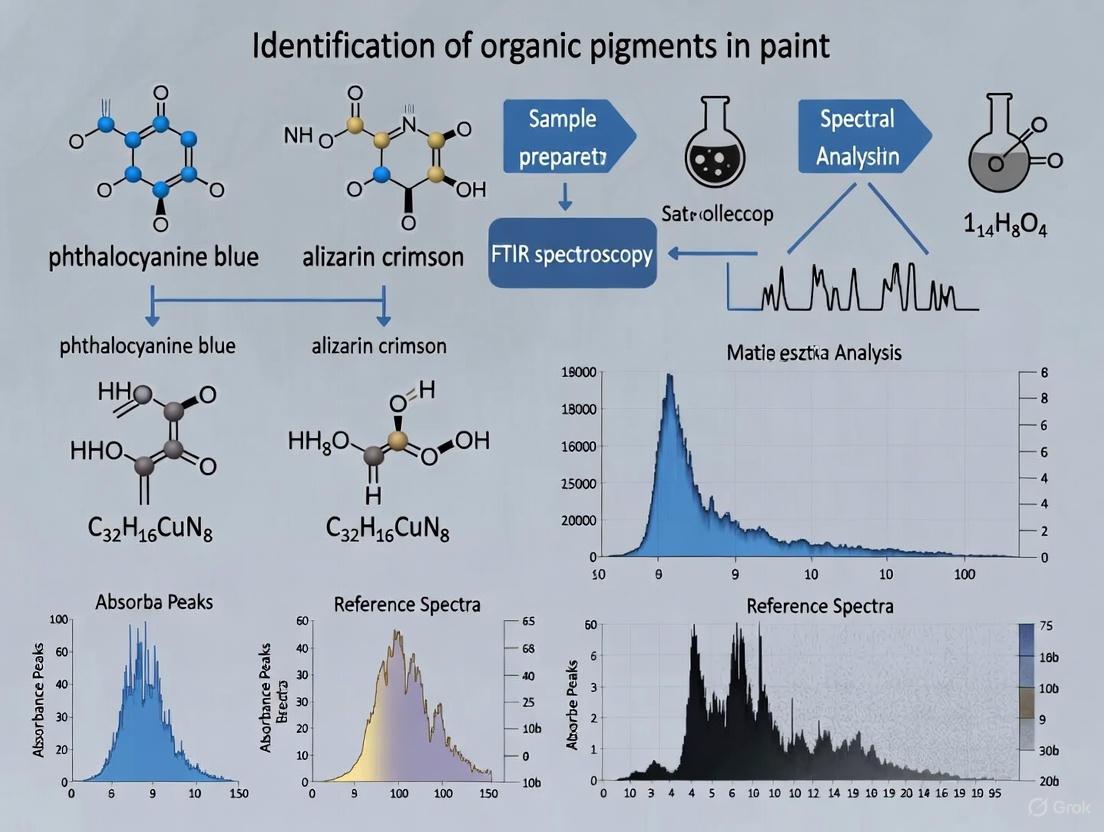
Fourier Transform Infrared (FTIR) spectroscopy is a powerful analytical technique for identifying organic pigments in paints, crucial for authenticity studies, conservation, and material science.
Identifying Organic Pigments in Paint with FTIR: A Comprehensive Guide for Materials Researchers
Abstract
Fourier Transform Infrared (FTIR) spectroscopy is a powerful analytical technique for identifying organic pigments in paints, crucial for authenticity studies, conservation, and material science. This article provides a comprehensive guide for researchers, detailing the fundamental principles of FTIR, practical methodologies for pigment analysis, strategies to overcome common challenges like signal interference from binders, and a comparative analysis with complementary techniques such as Raman spectroscopy and XRD. By synthesizing foundational knowledge with advanced application strategies, this review serves as an essential resource for the effective use of FTIR in characterizing complex pigmented systems.
The Fundamentals of FTIR for Organic Pigment Analysis
Fourier Transform Infrared (FT-IR) spectroscopy is a powerful analytical technique that leverages the fundamental vibrational properties of molecules to create unique chemical fingerprints for material identification. This principle is particularly vital for identifying organic pigments in paints, where non-destructive, precise characterization is essential for applications ranging from cultural heritage conservation to industrial quality control. Infrared spectroscopy operates on the principle that molecules absorb specific frequencies of infrared light that correspond to the natural vibrational frequencies of their chemical bonds [1]. When IR light interacts with a sample, covalent bonds within the molecules undergo vibrational excitations, including stretching and bending motions, when the energy of the incoming infrared photons matches the energy required to vibrate the bond [2].
The resulting IR absorption spectrum provides a characteristic molecular fingerprint that is unique to the chemical structure of the compound being analyzed [1]. For researchers investigating organic pigments in paint formulations, this molecular fingerprinting capability allows for precise identification of pigment composition without damaging samples. The modern implementation of this technique through FT-IR instrumentation has revolutionized the field by providing superior speed, accuracy, and signal-to-noise ratio compared to traditional dispersive IR instruments [1] [3]. This technical guide explores the core principles of molecular vibrations in FT-IR spectroscopy, with specific application to the identification of organic pigments in paint systems, providing researchers with both theoretical foundations and practical methodological frameworks.
Fundamental Principles of Molecular Vibrations
The Physics of Molecular Vibrations
At the heart of FT-IR spectroscopy lies the interaction between infrared electromagnetic radiation and the vibrational modes of molecules. Infrared light encompasses the portion of the electromagnetic spectrum between visible light and microwaves, with wavelengths ranging from 780 nm to 1 mm [1]. However, in spectroscopic practice, IR light is typically discussed in terms of wavenumbers (cm⁻¹), which represent the number of wavelengths per unit distance [1]. The mid-infrared region (MIR, approximately 4000-400 cm⁻¹) is particularly useful for chemical analysis as it coincides with the fundamental vibrational frequencies of most chemical bonds [1].
The energy of infrared photons (1-15 kcal/mole) is insufficient to excite electrons to higher energy states but is perfectly suited to induce vibrational excitation in covalently bonded atoms and groups [2]. These covalent bonds are not static connections but behave more like stiff springs that can be stretched and bent [2]. A molecule composed of n-atoms possesses 3n degrees of freedom, with 3n-6 fundamental vibrational modes for non-linear molecules (3n-5 for linear molecules) [2]. These vibrational modes include both stretching vibrations (where bond lengths change) and bending vibrations (where bond angles change), with specific descriptive names such as symmetric stretching, antisymmetric stretching, scissoring, rocking, wagging, and twisting [1] [2].
Table 1: Fundamental Types of Molecular Vibrations in IR Spectroscopy
| Vibration Type | Category | Description | Energy Requirement |
|---|---|---|---|
| Stretching | Bond Length Change | Symmetric: Bonds lengthen/shorten simultaneously | Higher energy |
| Antisymmetric: Bonds alternate lengthening/shortening | |||
| Bending | Bond Angle Change | Scissoring: Two atoms move toward/away from each other | Lower energy |
| Rocking: Atoms move in same direction in plane | |||
| Wagging: Atoms move up/down out of plane | |||
| Twisting: Atoms move in opposite directions out of plane |
Infrared Absorption and Dipole Moment Changes
For a molecular vibration to be IR-active and appear in an infrared spectrum, it must involve a change in the dipole moment of the molecule [2] [3]. When a bond vibrates in a way that alters the molecular dipole moment, it creates an oscillating electromagnetic field that can interact with the electric field component of the incoming infrared radiation. This interaction leads to energy transfer from the photon to the molecule, resulting in absorption of that specific frequency of IR light [2].
The frequency at which a given vibration occurs is determined by two key factors: the strength of the chemical bond (represented by the force constant) and the masses of the atoms involved in the bond [2]. This relationship follows Hooke's Law for molecular vibrations, where stronger bonds and lighter atoms result in higher frequency vibrations (higher wavenumbers in the IR spectrum) [2]. For example, bonds to hydrogen (a light atom) typically appear at higher wavenumbers (e.g., O-H stretches around 3200-3600 cm⁻¹), while single bonds between heavier atoms appear at lower wavenumbers (e.g., C-C stretches around 1000-1200 cm⁻¹) [2].
Figure 1: Fundamental Process of Infrared Absorption Leading to Spectral Formation
FT-IR Spectroscopy: From Theory to Practice
The Fourier Transform Advantage
While the fundamental principles of infrared spectroscopy have been known for over a century, the implementation through Fourier Transform methods has dramatically enhanced the technique's capabilities. Historically, IR spectroscopy was performed by individually checking each frequency of IR light to see if it was absorbed by the sample—a painstakingly slow process [1]. FT-IR superseded this approach by using an interferometer to simultaneously measure all wavelengths of IR light, then applying a mathematical Fourier transform to convert the raw data (interferogram) into a conventional IR spectrum [1].
This FT approach provides three significant advantages known as Fellgett's advantage (multiplex advantage), Jacquinot's advantage (throughput advantage), and Connes' advantage (wavelength precision) [3]. These advantages collectively result in spectra with excellent signal-to-noise ratios, rapid acquisition times, and high wavenumber accuracy and precision, with modern instruments achieving wavenumber accuracy within 1.1 cm⁻¹ at standard resolutions of 4 cm⁻¹ [4]. For pigment researchers, this precision is crucial for distinguishing between chemically similar compounds that may have only subtle spectral differences.
Measurement Techniques in FT-IR
FT-IR spectroscopy offers several measurement techniques tailored to different sample types and analytical requirements. The three primary measurement techniques are:
Transmission: The "original" technique where IR light passes directly through the sample [1]. This method often requires specific sample preparation, such as diluting solid samples in KBr pellets or liquid samples in solvent cells, to avoid total absorbance and ensure optimal spectral quality [1].
Attenuated Total Reflection (ATR): Now the primary measurement technique for most applications, ATR requires minimal sample preparation and is non-destructive [1]. The sample is placed on a crystal (typically diamond, germanium, or zinc selenide), and IR light is directed through the crystal where it interacts with the sample through an evanescent wave that typically penetrates 1-2 microns into the material [1] [3]. This shallow penetration depth makes ATR ideal for analyzing surface layers such as paint pigments.
Reflection: This technique detects IR light reflected off the surface of the sample rather than transmitted through it [1]. Various reflection methods exist, including specular reflection, reflection-absorption (transflectance), and diffuse reflection (DRIFTS), each suited to different sample types such as smooth surfaces, thin films on reflective substrates, or powdered solids [1].
Table 2: Comparison of Primary FT-IR Measurement Techniques
| Technique | Sample Preparation | Destructive? | Information Depth | Ideal for Pigment Analysis? |
|---|---|---|---|---|
| Transmission | Extensive (dilution, pelleting) | Often yes | Entire sample thickness | Limited (requires dilution) |
| ATR | Minimal (placement on crystal) | No | ~1-2 microns | Excellent (surface analysis) |
| Diffuse Reflection (DRIFTS) | Moderate (powder placement) | No | Several microns | Good (powdered samples) |
| External Reflection | Minimal | No | Sub-micron to several microns | Excellent (non-invasive) |
Experimental Protocols for Pigment Identification
Non-Invasive Analysis of Artwork and Cultural Heritage
The identification of organic pigments in painted surfaces, particularly in culturally significant objects where sampling is prohibited, requires carefully optimized non-invasive methodologies. The following protocol, adapted from studies on mural paintings and historical artworks, outlines a systematic approach for pigment identification using portable FT-IR instrumentation [5] [6].
Instrumentation and Materials:
- Portable FT-IR spectrometer with reflection capabilities (e.g., Bruker ALPHA-R)
- Universal ATR sampling module with diamond crystal
- External reflection module with ~20° incidence angle
- Spectral libraries for pigment identification
- Certified reference materials for validation
Methodology:
- Instrument Calibration: Perform daily wavelength calibration using a polystyrene standard film according to manufacturer specifications. Verify wavenumber accuracy to within ±1 cm⁻¹ for critical peaks [4].
Background Collection: Collect background spectra using a gold mirror surface for reflection measurements, or a clean ATR crystal for ATR measurements. Ensure environmental conditions (humidity, temperature) are stable to minimize atmospheric interference, particularly from water vapor and CO₂ [5].
Spectral Acquisition Parameters:
Data Collection:
- For ATR measurements: Apply gentle pressure to ensure good contact between pigment surface and ATR crystal
- For external reflection measurements: Maintain consistent angle of incidence (typically 20-30°) and working distance
- Collect multiple spectra from different areas of the pigment to assess homogeneity
Data Processing:
- Convert reflection data to pseudo-absorbance units [log(1/R)] [5]
- Apply atmospheric compensation to remove water vapor and CO₂ contributions
- Perform baseline correction to eliminate scattering effects
- Use second derivative spectroscopy to resolve overlapping bands when necessary
Figure 2: Experimental Workflow for Non-Invasive Pigment Identification
Micro-Destructive Analysis for Challenging Samples
For cases where minimal sampling is permissible, or for heterogeneous samples requiring higher spatial resolution, micro-destructive analysis using FT-IR microscopy provides enhanced capabilities. The following protocol is adapted from forensic paint analysis and cultural heritage studies involving multi-layered pigment systems [7] [8].
Instrumentation and Materials:
- FT-IR microscope with motorized stage
- Diamond compression cell for micro-sampling
- KBr powder for pellet preparation (for transmission mode)
- Tungsten needle for micro-manipulation
- Low-pressure micro-sampling device
Methodology:
- Micro-Sample Collection:
- Using a tungsten needle under microscopic observation, collect minute pigment samples (10-50 µg) from representative areas
- For cross-sectional analysis of layered paints, carefully excise a small fragment containing all layers
Sample Preparation:
- For transmission measurements: Mix micro-sample with KBr powder (approximately 0.4% concentration) and compress into a 1 mm diameter pellet under high pressure [4]
- For ATR microscopy: Place micro-sample directly on diamond crystal of microscope ATR objective and apply gentle pressure
Spectral Acquisition:
- Set spatial aperture to 50×50 μm or smaller to isolate individual pigment particles
- Use 8 cm⁻¹ resolution with 128-256 scans to optimize signal-to-noise for small samples
- Collect background spectra from clean KBr pellet or ATR crystal immediately before sample measurement
Data Analysis:
- Compare acquired spectra to specialized pigment libraries (e.g., IRUG, Getty Conservation Institute)
- Use chemometric methods (PCA, PLS-DA) for complex mixtures and degradation product identification [9]
The Scientist's Toolkit: Essential Reagents and Materials
Table 3: Essential Research Reagents and Materials for FT-IR Pigment Analysis
| Item | Function | Application Notes |
|---|---|---|
| Potassium Bromide (KBr) | Matrix for transmission measurements; IR-transparent | Must be anhydrous; pressed into pellets with 0.1-1% sample concentration [1] |
| Diamond ATR Crystal | Internal reflection element for ATR measurements | Chemically inert, durable; provides ~1-2 μm penetration depth [1] [3] |
| Polystyrene Standard Film | Wavelength calibration and instrument validation | NIST-traceable; verifies wavenumber accuracy to ±1 cm⁻¹ [4] |
| Carbon Tetrachloride (CCl₄) | Non-polar solvent for sample preparation | IR-transparent in many regions; useful for liquid samples [1] |
| Reference Pigment Materials | Spectral validation and method development | Certified standards for calibration transfer and quantitative work |
| Gold Mirror | Background reference for reflection measurements | Provides high reflectivity across IR spectrum [5] |
Data Interpretation and Spectral Analysis of Organic Pigments
Characteristic Spectral Features of Pigment Classes
The identification of organic pigments in paint relies on recognizing characteristic absorption patterns in the IR spectrum. The following table summarizes key spectral features for major pigment classes:
Table 4: Characteristic IR Absorptions of Major Organic Pigment Classes
| Pigment Class | Key Functional Groups | Characteristic Bands (cm⁻¹) | Assignment |
|---|---|---|---|
| Alizarin Crimson | C=O, O-H, C=C | 1620-1670, 3400-3600, 1500-1600 | Carbonyl stretch, hydroxyl stretch, aromatic C=C |
| Phthalocyanine Blue | C=N, C-N, C-H | 1600-1650, 1300-1350, 700-900 | C=N stretch, C-N stretch, aromatic C-H bend |
| Quinacridone | N-H, C=O, C=C | 3300-3400, 1650-1680, 1550-1620 | N-H stretch, carbonyl stretch, conjugated C=C |
| Hans Yellow | C=O, N-H, C-N | 1650-1680, 3200-3350, 1250-1350 | Amide I band, N-H stretch, C-N stretch |
| Bone Black | (PO₄)³⁻, CO₃²⁻ | 2013, 1038, 1087, 630, 604, 567 | Phosphate vibrations (ν₃, ν₄), sharp band at 2013 cm⁻¹ [5] |
Case Study: Bone Black Identification in Historical Paintings
The identification of bone black pigment exemplifies the power of FT-IR spectroscopy in cultural heritage research. Bone black, an animal-derived pigment consisting primarily of carbonated hydroxyapatite, displays a distinctive sharp weak band at 2013 cm⁻¹ that serves as a diagnostic marker for its identification [5]. This specific absorption band has been successfully detected non-invasively using portable FT-IR reflection spectroscopy on both oil paintings on woven paper and mural paintings from the 16th century [5].
In a study of an oil painting on woven paper attributable to French caricaturist Honoré Daumier, reflection FT-IR spectra recorded from blue and brown areas revealed the diagnostic 2013 cm⁻¹ band, enabling unambiguous identification of bone black pigment even when mixed with other pigments such as Prussian blue (identified by its characteristic CN stretching at 2094 cm⁻¹) [5]. The detection remained possible despite the presence of additional materials such as lead white preparation layers and barium sulfate, demonstrating the specificity and robustness of this spectral marker for animal carbon-based black pigments [5].
Advanced Applications and Future Directions
The application of FT-IR spectroscopy to organic pigment identification continues to evolve with technological advancements. The integration of chemometric methods such as Principal Component Analysis (PCA) and Partial Least Squares (PLS) modeling has enhanced the ability to extract meaningful information from complex spectral data, allowing for accurate classification and quantitative analysis of pigment mixtures [9]. These multivariate statistical approaches are particularly valuable for analyzing degraded historical pigments where chemical changes may have altered the original spectral profiles.
Emerging directions in the field include the development of portable FT-IR devices for in-situ analysis of immovable cultural heritage [9] [8], the integration of FT-IR with complementary techniques such as Raman spectroscopy and SEM-EDS for comprehensive material characterization [5] [7] [10], and the application of micro-FT-IR mapping to visualize pigment distribution in complex layered structures [8]. For pharmaceutical researchers and drug development professionals, these advanced FT-IR applications provide valuable paradigms for material characterization that can be adapted to the analysis of polymorphic forms, drug-excipient interactions, and formulation homogeneity.
The continued refinement of FT-IR instrumentation, with improved spectral resolution, spatial resolution, and detection sensitivity, promises to further enhance its capabilities for organic pigment identification. As spectral libraries expand and data analysis algorithms become more sophisticated, FT-IR spectroscopy will maintain its position as an indispensable technique for the non-destructive chemical analysis of paints and pigments across diverse research and industrial applications.
Fourier-transform infrared (FTIR) spectroscopy is an indispensable analytical technique for identifying organic and polymeric materials across diverse fields, from pharmaceutical development to cultural heritage preservation. For researchers focusing on the identification of synthetic organic pigments (SOPs) in paints, FTIR offers a powerful tool for unraveling the complex chemical composition of historical and modern artworks. This technical guide details the complete FTIR workflow, framed within the specific context of paint pigment analysis, providing scientists and drug development professionals with the methodologies to obtain high-fidelity spectral data crucial for accurate material identification.
Core Components of an FTIR Spectrometer
The fundamental operation of an FTIR spectrometer relies on the interference of infrared light to simultaneously collect high-resolution spectral data over a wide wavelength range. The system comprises several key components that work in concert, from the infrared source to the final spectrum generation [11].
The Essential Subsystems
- Infrared Source: A glowing black-body emitter (e.g., silicon carbide globar) that generates a broad spectrum of mid-infrared radiation.
- Interferometer: The heart of the system, typically a Michelson interferometer, containing a beamsplitter and fixed and moving mirrors. It divides the source radiation, creates a path difference, and recombines the beams to produce an interferogram.
- Sample Compartment: The area where the sample is placed and interacts with the infrared beam. For paint analysis, Attenuated Total Reflection (ATR) accessories with diamond crystals are prevalent for their minimal sample preparation requirements.
- Detector: Transduces the infrared signal after sample interaction into an electrical signal. Different detectors (e.g., DTGS, MCT) are selected based on required sensitivity and speed.
The FTIR Workflow: A Step-by-Step Guide
The process of transforming a raw sample into an interpretable spectrum involves a series of critical, interconnected steps. The following diagram illustrates this complete workflow, with particular emphasis on its application for paint pigment identification.
Detailed Experimental Protocols
Sample Preparation for Paint Analysis
The analysis of synthetic organic pigments in paint samples demands specialized, minimally invasive preparation techniques to preserve valuable cultural heritage materials [12].
- Micro-sampling: Using a fine needle or scalpel, extract a sub-milligram sample from a discreet area (e.g., paint crack or edge). This minimal intervention is crucial for preserving artwork integrity.
- ATR Crystal Contact: For ATR-FTIR, carefully press the micro-sample onto the diamond crystal element using the instrument's anvil to ensure optimal optical contact. Sufficient pressure is achieved when a visible optical contact circle is formed.
- Metal Underlayer ATR (MU-ATR): For highly absorbing pigments, deposit the sample onto a reflective metal surface (e.g., gold-coated slide). This enhances the signal by reflecting the evanescent wave back through the sample [12].
Data Acquisition Parameters
Standard acquisition parameters for paint pigment analysis on a modern FTIR spectrometer (e.g., Bruker Invenio-R) include [13] [12]:
- Spectral Range: 4000 - 600 cm⁻¹ to capture the fingerprint region
- Resolution: 4 cm⁻¹ for optimal signal-to-noise ratio and feature identification
- Scans: 64 - 128 scans per spectrum to adequately average random noise
- Atmosphere Control: Continuous purging with dry nitrogen (generated by systems like NiGen LCMS 40-1) to minimize spectral interference from atmospheric CO₂ and H₂O [13]
Advanced Data Processing for Pigment Identification
Raw FTIR spectra require specialized processing to extract meaningful chemical information, particularly for complex paint matrices containing multiple pigments, fillers, and binders.
Atmospheric Correction Protocol
A critical preprocessing step involves removing spectral contributions from residual atmospheric water vapor and CO₂, which can obscure subtle pigment absorption bands. The VaporFit algorithm provides an advanced, open-source solution for this challenge [13].
The correction is based on an iterative least-squares minimization of the residual function: [ r\nu = \left[ \left( Y\nu - \sum{n=1}^N an \cdot \text{atm}{\nu,n} \right) - \bar{Y}\nu \right]^2 ] where (Y\nu) is the measured spectrum, (\text{atm}{\nu,n}) are recorded atmospheric spectra, (an) are optimized subtraction coefficients, and (\bar{Y}\nu) is the estimated ideal spectrum obtained through Savitzky-Golay smoothing [13].
Implementation Steps:
- Record Background Spectra: Collect multiple atmospheric reference spectra ((\text{atm}_{\nu,n})) throughout the experiment to account for variability.
- Parameter Optimization: Set Savitzky-Golay smoothing parameters (typical defaults: polynomial order 3, window size 11).
- Iterative Correction: Execute the VaporFit algorithm to determine optimal coefficients (a_n) that minimize atmospheric features while preserving sample spectral bands.
- Quality Assessment: Use built-in Principal Component Analysis (PCA) modules to visually evaluate correction effectiveness [13].
Spectral Interpretation and Library Matching
Processed spectra are compared against reference libraries for pigment identification. The diagram below outlines this spectral analysis workflow.
Advanced software solutions like LabSolutions IR facilitate this process with comprehensive spectral libraries (approximately 12,000 spectra) and multiple search algorithms (spectral, text, compound, and peak search) for high hit quality [14].
FTIR in Practice: Identifying Synthetic Organic Pigments
Application to Historical Paint Analysis
The analysis of synthetic organic pigments in historical paints presents particular challenges due to complex mixtures, degradation products, and the need for minimal sampling. A recent study of colour charts from Das Deutsche Farbenbuch (1925) successfully identified 18 different organic colourants in watercolours, tempera, and oil paints using a multi-technique vibrational spectroscopy approach that included ATR-FTIR [12].
Identified Chemical Classes Included:
- Traditional natural organic colourants (dark and rose madder lake, cochineal lake)
- Synthetic organic pigments and dyes (indigo, anthraquinone, monoazo, β-naphthol, xanthene, triarylcarbonium, nitroso, and azine compounds)
This research demonstrates FTIR's critical role in documenting the "pigment turn" toward coal-tar derived colourants in the early 20th century, with significant implications for dating, authenticating, and preserving modern artworks [12].
Quantitative Data for Pigment Analysis
Table 1: Key FTIR Absorption Bands for Common Pigment Chemical Classes
| Chemical Class | Key FTIR Absorptions (cm⁻¹) | Representative Pigments | Spectral Characteristics |
|---|---|---|---|
| Anthraquinone | 1665-1675 (C=O stretch), 1570-1580 (C=C aromatic) | Alizarin, Madder lakes | Strong carbonyl stretching, sharp aromatic bands |
| Monoazo | 1590-1600 (N=N stretch), 1490-1520 (aromatic C=C) | β-Naphthol pigments | Medium-intensity azo stretching, multiple aromatic bands |
| Triarylcarbonium | 1500-1520 (C-C aromatic), 1350-1380 (C-N stretch) | Triphenylmethane dyes | Broad, intense aromatic absorption patterns |
| Xanthene | 1600-1615 (C=C aromatic), 1250-1280 (C-O-C stretch) | Eosin, Rhodamine | Characteristic ether linkage and aromatic vibrations |
Table 2: Performance Metrics of FTIR Spectroscopy for Pigment Identification
| Parameter | Typical Performance | Influence Factors | Optimization Strategies |
|---|---|---|---|
| Spectral Resolution | 2-8 cm⁻¹ | Signal-to-noise ratio, measurement time | 4 cm⁻¹ optimal balance for most pigment analyses |
| Identification Confidence | >90% with library matching | Library completeness, sample purity | Use specialized art material spectral libraries |
| Sample Requirement | <1 mg (micro-sampling) | Sampling technique, homogeneity | ATR accessory with pressure control |
| Analysis Time | 5-15 minutes per sample | Number of scans, resolution | 64 scans at 4 cm⁻¹ resolution provides optimal efficiency |
The Scientist's Toolkit: Essential Research Reagents and Materials
Table 3: Essential Research Reagents and Materials for FTIR Pigment Analysis
| Item | Function/Application | Technical Specifications | Example Sources |
|---|---|---|---|
| ATR Crystals | Internal reflection element for sample measurement | Diamond (durability), Germanium (high refractive index) | Bruker, Shimadzu, Pike Technologies |
| Nitrogen Purge Gas | Minimize atmospheric vapor interference | High purity (≥99.998%), generated by nitrogen generators | Claind NiGen LCMS 40-1 [13] |
| Reference Libraries | Spectral matching for pigment identification | Comprehensive SOP databases (12,000+ spectra) | LabSolutions IR [14] |
| Calibration Standards | Instrument performance verification | Polystyrene films, rare-earth oxides | NIST-traceable standards |
| Micro-sampling Tools | Minimally invasive sample collection | Fine needles, micro-scalpels, tungsten carbide blades | Conservation supply specialists |
| VaporFit Software | Atmospheric correction algorithm | Open-source Python-based with GUI | Zenodo/GitHub [13] |
The FTIR instrumentation workflow, from source to spectrum, provides an powerful analytical framework for identifying synthetic organic pigments in paint materials. Through meticulous sample preparation, optimized data acquisition, advanced processing techniques like atmospheric correction, and comprehensive spectral interpretation, researchers can reliably characterize complex pigment mixtures. The ongoing development of specialized methodologies such as MU-ATR and open-source analysis tools continues to expand FTIR's applications in cultural heritage science, offering increasingly sophisticated solutions for unraveling the material history of artworks. For conservation scientists and researchers, mastering this complete workflow is essential for generating reliable, reproducible data that informs both art historical scholarship and preservation practice.
Characteristic Absorptions of Key Organic Pigment Classes
Within the context of identifying organic pigments in paint using Fourier Transform Infrared (FTIR) research, understanding the characteristic absorption bands of key organic pigment classes is paramount. FTIR spectroscopy serves as a powerful analytical technique for this purpose, enabling the identification of both organic and inorganic materials in cultural heritage objects, such as paintings, by their unique molecular fingerprints [15] [16]. The resulting IR spectrum provides a vibrational map of the molecular bonds present, and the absorption bands act as direct indicators of specific functional groups within a pigment molecule [17] [16]. For researchers in drug development and other scientific fields, this non-destructive technique is also valuable for material verification and the analysis of complex mixtures [16]. The identification of these characteristic absorptions is crucial for authenticating artworks, informing restoration strategies, and understanding historical manufacturing techniques [15].
Fundamental Principles of FTIR Spectroscopy
Fourier Transform Infrared (FTIR) spectroscopy operates by passing a broad spectrum of infrared light through a sample and measuring the wavelengths of light that are absorbed [16]. This absorption occurs when the energy of the infrared radiation matches the energy required to excite specific vibrational modes of the chemical bonds in the molecule. The instrument uses an interferometer to process the signal, which is then transformed via a Fourier Transform algorithm into a spectrum plotting absorbance (or transmittance) against wavenumber (cm⁻¹) [16] [18].
The resulting spectrum is a chemical fingerprint of the sample. The position of absorption bands reveals the types of bonds present, while the intensity of the bands relates to the bond's polarity and the concentration of the species [17]. In pigment analysis, the goal is to correlate the observed absorption bands in a sample's spectrum with the known characteristic absorptions of reference pigments.
Characteristic Absorptions of Organic Pigment Classes
The following tables summarize the characteristic IR absorption bands for major classes of organic pigments, providing a reference for identification. The absorption ranges are primarily derived from fundamental stretching and bending vibrations [17].
Table 1: Characteristic IR Absorptions for Common Organic Pigment Functional Groups
| Functional Group | Bond | Characteristic Absorption Frequency Range (cm⁻¹) | Band Intensity and Notes |
|---|---|---|---|
| Hydroxyl (e.g., in alizarin) | O-H stretching | 3200 – 3600 | Broad, strong (due to hydrogen bonding) [17] |
| Carbonyl | C=O stretching | 1650 – 1750 | Strong, sharp; precise position helps distinguish between amides (lower end), ketones, and aldehydes (higher end) [17] |
| Aromatic Ring | C=C stretching | 1450 – 1600 | Medium, often multiple bands [17] |
| Aromatic Ring | =C-H stretching | 3000 – 3100 | Medium [17] |
| Alkyl Group | C-H stretching | 2850 – 2960 | Medium to strong [17] |
| Nitro Group | N=O stretching | 1500 – 1600 & 1300 – 1400 | Two strong bands [17] |
| Azo Group | N=N stretching | 1630 – 1680 (for C-N=N-C) | Weak, often obscured; identification relies more on other structural features [17] |
Table 2: Characteristic Absorptions of Specific Historical Organic Pigments
| Pigment Name | Material Class | Key Chemical Information | Characteristic FTIR Absorptions (cm⁻¹) and Notes |
|---|---|---|---|
| Alizarin | Organic dyes and pigments, synthetic | 1,2-Dihydroxyanthraquinone (C₁₄H₈O₄) [19] | O-H stretch (~3200-3600, broad), C=O stretch (~1670), C=C aromatic stretches (1450-1600) [17] |
| Alizarin Carmine | Organic dyes and pigments, synthetic | Sodium alizarine sulfate (C₁₄H₇NaO₇S) [19] | Similar to alizarin with additional S=O stretches (~1050-1200) |
| Alizarin Crimson (light) | Organic dyes and pigments, synthetic | Monoazo; Naphthol (C₂₄H₁₆Cl₃N₃O₂) [19] | N=N stretch (weak, ~1630-1680), C=O stretch, C-H stretches |
| Alkanna roots | Natural organic dyes and pigments | Obtained from Alkanna tinctoria roots [19] | Complex pattern from natural dye components; O-H and C=O stretches expected |
| Aloe | Natural organic dyes and pigments | Contains anthraquinone pigment aloin [19] | O-H stretch (broad), C=O stretch (anthraquinone), C=C stretches |
| Indigo | Organic dyes and pigments, synthetic | Indigotin (C₁₆H₁₀N₂O₂) | N-H stretches (~3300), C=O stretch (~1620), C=C stretches |
Experimental Protocols for Pigment Identification
Sample Preparation and FTIR Modalities
The choice of FTIR modality depends on the nature of the sample and the requirement for destructiveness.
- Transmission FTIR: Considered the gold standard for high spectral resolution. The sample is typically ground and mixed with an IR-transparent salt like potassium bromide (KBr) and pressed into a pellet. This method is considered destructive and is best for pure, homogenous samples where sampling is permissible [15].
- Attenuated Total Reflection (ATR-FTIR): A versatile and commonly used technique where the sample is pressed against a high-refractive-index crystal (e.g., diamond). The IR light interacts only with the first few microns of the sample surface. While minimal, some pressure is applied, making it micro-destructive. ATR spectra are generally comparable to transmission spectra [15].
- Diffuse Reflectance (DRIFT): A non-destructive modality ideal for in-situ analysis of rough or matte surfaces, such as paintings. It is highly suitable for cultural heritage applications where sampling is not allowed. However, DRIFT spectra can exhibit distortions like Reststrahlen bands for inorganic materials, making interpretation challenging [15].
Spectral Subtraction for Mixture Analysis
Paints are often complex mixtures of pigments and binders. Spectral subtraction is a critical data processing technique to isolate the spectrum of an unknown component [20].
Protocol:
- Acquire Spectra: Obtain the FTIR spectrum of the mixture (the "sample spectrum") and the spectrum of a known or suspected component, such as a binder (the "reference spectrum") [20].
- Apply Subtraction Factor: Use the formula:
Result Spectrum = Sample Spectrum - (Subtraction Factor × Reference Spectrum). The subtraction factor is a scaling factor applied to the reference spectrum to match its contribution in the sample spectrum [20]. - Optimize Factor: Adjust the subtraction factor interactively. The optimal value is achieved when bands from the reference material in the result spectrum become flat with the baseline. A factor near 1 is ideal; extreme values may indicate the reference spectrum needs to be re-measured [20].
- Validate Result: The resulting spectrum should be examined for the removal of the reference bands and the clear presence of the remaining components, such as the target organic pigment [20].
Essential Data Processing Algorithms
Several data processing algorithms are employed to enhance spectral quality and interpretation.
- Smoothing: Applied to reduce high-frequency noise. Algorithms like the Savitzky-Golay smoothing filter replace the intensity at each data point with a weighted average of itself and its neighbors, improving the signal-to-noise ratio without severely distorting the spectral shape [18].
- Baseline Correction: Removes slow, curved background signals caused by light scattering or instrument effects. Techniques like Asymmetric Least Squares (ALS) are highly effective. ALS fits a smooth baseline by heavily penalizing positive deviations (the peaks), allowing the fit to follow the baseline points in the spectrum closely [21].
- Peak Detection: Automated algorithms identify true absorption peaks by calculating the first- and second-derivatives of the spectrum. Peaks are confirmed where the first-derivative changes from positive to negative and the second-derivative is negative, with the peak's absorbance and area exceeding user-defined thresholds for noise and minimum area [18].
The Scientist's Toolkit: Essential Research Reagents and Materials
Table 3: Key Research Reagents and Materials for FTIR Analysis of Pigments
| Item | Function in Experiment |
|---|---|
| Potassium Bromide (KBr) | An IR-transparent salt used for preparing pellets in transmission FTIR spectroscopy [15]. |
| ATR Crystals (Diamond, Germanium) | Durable crystals used in ATR-FTIR accessories that allow for minimal sample preparation and direct measurement [15]. |
| High-Purity Reference Pigments | Certified standard materials used to build or validate spectral libraries, essential for accurate pigment identification via library searching [19] [15]. |
| Spectral Subtraction Software | Algorithmic tools within FTIR software packages that allow for the mathematical separation of mixed spectra to isolate individual components [20]. |
| Smoothing & Baseline Correction Algorithms | Digital processing tools (e.g., Savitzky-Golay, Asymmetric Least Squares) used to enhance spectral quality by reducing noise and removing background interference [18] [21]. |
| Historical Pigment Database | A curated collection of reference spectra (e.g., INFRAART, Kremer Pigments) specific to cultural heritage materials, crucial for accurate library matching [19] [15]. |
Advantages of FTIR for Complex Organic Molecule Identification
Fourier-Transform Infrared (FTIR) spectroscopy has emerged as a powerful analytical technique for identifying complex organic molecules across diverse fields, from pharmaceutical development to cultural heritage conservation. This technical guide examines the fundamental principles underpinning FTIR's effectiveness, with particular focus on its application in identifying synthetic organic pigments in artists' paints—a challenging domain requiring non-destructive analysis of complex molecular mixtures. We explore FTIR's operational advantages, present detailed experimental protocols for pigment analysis, and demonstrate how complementary data analysis techniques transform spectral data into meaningful molecular fingerprints. The comprehensive information provided herein positions FTIR as an indispensable tool for researchers confronting complex organic molecule identification challenges where minimal sample perturbation is critical.
Fourier-Transform Infrared (FTIR) spectroscopy is concerned with the vibration of molecules, making it a powerful tool for identifying chemical substances through their unique molecular signatures [22]. Each functional group within a molecule possesses discrete vibrational energies that manifest as characteristic absorption bands in the infrared spectrum [23]. When combined, these vibrational patterns create a unique "molecular fingerprint" that enables precise identification of organic compounds, even within complex mixtures [24]. This capability is particularly valuable for analyzing synthetic organic pigments in commercial paints, where identification is often complicated by the presence of binders, fillers, and extenders that can mask diagnostic features [25].
The application of FTIR spectroscopy to organic pigment analysis represents a significant advancement in conservation science and materials characterization. Unlike traditional inorganic pigments, synthetic organic pigments are carbon-based compounds containing carbocyclic ring systems, often aromatic and sometimes coupled with metal ions [25]. Their analysis presents unique challenges because they cannot be effectively characterized using elemental techniques alone. FTIR bridges this analytical gap by providing information about molecular structure, functional groups, and chemical environments that is essential for accurate pigment identification [25] [26]. Furthermore, technological advancements have enabled non-contact, non-destructive FTIR analysis approaches that are ideally suited for investigating irreplaceable artworks and cultural heritage objects without compromising their integrity [26].
Fundamental Principles and Advantages of FTIR
Theoretical Basis of FTIR Spectroscopy
At its core, FTIR spectroscopy operates on the principle that chemical bonds in molecules vibrate at specific frequencies when exposed to infrared radiation [23]. These vibrations are directly related to molecular structure, with different functional groups exhibiting characteristic absorption patterns [22]. A chemical bond can be conceptually modeled as a spring connecting atoms; when infrared light energy matches the natural vibrational frequency of this spring system, absorption occurs, resulting in transitions between vibrational energy states [23].
The fundamental vibrational frequencies depend primarily on two factors: the reduced mass (μ) of the atoms forming the bond and the bond strength (spring constant, k) [22]. This relationship explains why different functional groups absorb at predictable wavenumbers in the infrared spectrum. For example, C-C, C=C, and C≡C bonds show progressively higher absorption frequencies (approximately 800 cm⁻¹ increments) due to increasing bond strength, while atom substitution (e.g., carbon with nitrogen or oxygen) causes smaller shifts (approximately 100 cm⁻¹) due to mass differences [22]. These predictable patterns form the basis for molecular identification through FTIR spectroscopy.
Key Technical Advantages for Organic Molecule Analysis
FTIR spectroscopy offers several distinct advantages for analyzing complex organic molecules:
Comprehensive Molecular Fingerprinting: Each molecule produces a unique infrared spectrum arising from combinations of vibrational energy levels of its atomic bonds and their intra- and intermolecular interactions [24]. Even structurally similar molecules (isomers, conformers, enantiomers) exhibit discernible spectral differences due to variations in bond geometries, strengths, distances, and couplings [24].
High Sensitivity to Functional Groups: FTIR is exceptionally well-suited for identifying specific functional groups in organic molecules. The technique can distinguish between different carbonyl environments (esters, ketones, acids, amides), hydroxyl groups (free vs. hydrogen-bonded), and carbon-carbon multiple bonds with high specificity [27].
Minimal Sample Preparation: Unlike techniques requiring extensive sample workup (e.g., chromatography), FTIR often requires minimal preparation, especially when using attenuated total reflectance (ATR) accessories [22]. This reduces analysis time and minimizes potential sample alteration.
Versatile Sampling Options: FTIR supports multiple sampling techniques including transmission, reflectance, ATR, and microscopy, enabling analysis of various sample forms (solids, liquids, gases) with little to no modification [22] [26].
Non-destructive Capabilities: Particularly valuable for art conservation and precious samples, FTIR reflectance spectroscopy offers non-contact, non-destructive analysis without requiring sample removal [26]. The ConservatIR FTIR External Reflection Accessory, for example, allows characterization of artists' paints without direct contact with the artwork [26].
Table 1: FTIR Advantages Over Other Analytical Techniques for Organic Molecule Identification
| Advantage | Technical Basis | Application Benefit |
|---|---|---|
| Fellgett's Advantage | Full spectrum measured simultaneously rather than individual wavelengths [22] | Faster data acquisition; improved signal-to-noise ratio |
| Jaquinot's Advantage | Higher light throughput due to fewer optics and no slits [22] | Enhanced sensitivity for low-concentration components |
| Conne's Advantage | Superior wavelength accuracy and resolution [22] | Better spectral subtraction, library matching, and quantification |
| Non-destructive Operation | External reflectance measurements without sample contact [26] | Ideal for analyzing valuable or irreplaceable objects |
| Complementary Data | Molecular structure information rather than just elemental composition [25] | Better differentiation of structurally similar compounds |
FTIR Analysis of Organic Pigments in Paints
Analytical Challenges for Synthetic Organic Pigments
The identification of synthetic organic pigments in artists' paints presents unique challenges that make FTIR particularly valuable. These pigments, developed extensively since the discovery of mauveine in 1856, now span the entire color range and are prized for their brightness, heat stability, and high tinting strength [25]. However, their identification is complicated by several factors:
Complex Composition: Commercial paints contain pigments in relatively small amounts mixed with significant volumes of binders, fillers, and extenders [25]. The strong absorptions from these additional components often mask the weaker bands from pigments in traditional analysis.
Structural Complexity: Synthetic organic pigments belong to diverse chemical classes including arylide, benzimidazolone, diketo-pyrrolo pyrrole, naphthol, quinacridone, perylene, and phthalocyanine compounds [25]. These complex structures require techniques capable of discerning subtle molecular differences.
Sample Preservation Concerns: For valuable artworks, minimally invasive or completely non-destructive analysis is essential, limiting the applicability of techniques requiring sample removal [25] [26].
FTIR spectroscopy addresses these challenges through its sensitivity to molecular structure, ability to analyze samples in situ, and compatibility with advanced statistical analysis methods that can deconvolute complex spectral data [25] [24].
Experimental Protocol for Pigment Identification
The following detailed protocol outlines a standardized approach for identifying organic pigments in paint samples using FTIR spectroscopy:
Sample Preparation Methods:
- For micro-sampling approaches: Remove a microscopic paint sample (approximately 0.1-0.5 mm) using a sterile scalpel under microscopic observation [25].
- Prepare reference samples by applying pure pigment powders onto canvas using appropriate binders (oil or acrylic) or using commercial paints spread on canvas [25].
- For non-destructive analysis: Position the artwork for direct reflectance measurement without any sample removal [26].
Instrumental Parameters:
- Utilize an FTIR spectrometer equipped with a reflectance accessory (e.g., ConservatIR External Reflection Accessory) [26].
- Configure the instrument to collect data in both mid-IR (4000-400 cm⁻¹) and far-IR (700-10 cm⁻¹) regions [26].
- Employ a polarized IR beam using a precision automated polarizer (e.g., KRS-5) for oriented samples [28].
- Set resolution to 4 cm⁻¹ with at least 64 scans to ensure adequate signal-to-noise ratio [25] [24].
Data Collection Procedure:
- Position the sample for analysis, ensuring proper alignment with the IR beam.
- Collect background spectrum before sample measurement.
- Acquire sample spectra from multiple locations if heterogeneity is suspected.
- For reference materials, collect spectra using identical parameters.
Spectral Interpretation:
- Identify key functional group absorptions using standard correlation tables [27].
- Compare unknown spectra with reference spectral libraries using appropriate search algorithms.
- Apply multivariate statistical analysis (PCA, PLS-DA) to classify pigments based on spectral patterns [25] [29].
Diagram 1: FTIR Analysis Workflow for Pigment Identification
Critical Data Interpretation and Analysis
FTIR Spectral Database for Functional Groups
Successful identification of organic molecules via FTIR requires comprehensive knowledge of characteristic functional group frequencies. The following table summarizes key absorption ranges for functional groups commonly encountered in synthetic organic pigments:
Table 2: Characteristic FTIR Absorption Frequencies for Organic Functional Groups
| Peak Position (cm⁻¹) | Functional Group | Class of Compounds | Peak Characteristics |
|---|---|---|---|
| 3200-3550 | O-H stretching (hydrogen-bonded) | Alcohols | Strong, broad |
| 2500-3300 | O-H stretching | Carboxylic acids | Very strong, very broad |
| 2222-2260 | C≡N stretching | Nitriles | Weak to medium, sharp |
| 1818 | C=O stretching | Anhydrides | Strong, sharp |
| 1760 | C=O stretching | Carboxylic acids | Strong, sharp |
| 1735-1750 | C=O stretching | Esters, δ-lactones | Strong, sharp |
| 1720-1740 | C=O stretching | Aldehydes | Strong, sharp |
| 1705-1725 | C=O stretching | Aliphatic ketones | Strong, sharp |
| 1680-1710 | C=O stretching | Conjugated acids | Strong |
| 1666-1685 | C=O stretching | Conjugated ketones | Strong, sharp |
| 1640-1690 | C=N stretching | Imines/oximes | Strong |
| 1668-1678 | C=C stretching | Alkenes | Weak |
| 1580-1650 | N-H bending | Amines | Medium |
| 1500-1550 | N-O stretching | Nitro compounds | Strong |
| 1335-1372 | S=O stretching | Sulfonates | Strong, sharp |
| 1085-1150 | C-O stretching | Aliphatic ethers | Strong, sharp |
| 650-900 | C-H out-of-plane bending | Aromatic substitution | Pattern analysis, medium to strong |
Data compiled from InstaNANO FTIR Functional Group Database [27]
Multivariate Analysis for Spectral Interpretation
For complex organic mixtures like synthetic pigments in paint binders, advanced statistical methods are often required to extract meaningful information from FTIR spectra:
Principal Component Analysis (PCA): This unsupervised pattern recognition technique reduces spectral data dimensionality, allowing visualization of natural clustering between different pigment classes [25]. PCA has been successfully applied to distinguish between organic pigments belonging to different chemical classes based on their reflectance and fluorescence spectra [25].
Partial Least Squares Discriminant Analysis (PLS-DA): A supervised method that builds models to classify samples into predefined categories [29]. In antibiotic mechanism studies, PLS-DA could clearly distinguish between metabolic fingerprints induced by 15 different antibiotics on Escherichia coli metabolism [29], demonstrating the approach's utility for complex organic molecule classification.
Hierarchical Cluster Analysis (HCA): This technique groups samples based on spectral similarity, creating dendrograms that visualize relationships between different pigments [24]. HCA has successfully classified proteins and could be similarly applied to pigment identification.
Support Vector Machine (SVM) Classification: Advanced machine learning approach that finds optimal boundaries between different classes in high-dimensional space [24]. SVM has accurately identified proteins including Bovine Serum Albumin, Leptin, Osteopontin, and insulin-growth factor based on their infrared spectra [24].
Diagram 2: Multivariate Analysis Workflow for Spectral Data
Complementary Techniques for Enhanced Identification
While FTIR provides exceptional molecular structure information, its combination with complementary techniques often delivers more comprehensive characterization:
Visible Reflectance Spectroscopy: Provides color information that complements molecular data from FTIR, particularly useful for classifying pigments of similar hue [25].
Spectrofluorimetry: Exploits the fluorescence properties of synthetic organic pigments rich in multiple bonds and aromatic rings, providing additional discrimination power [25].
Raman Spectroscopy: Offers complementary vibrational information, though it can be limited by fluorescence interference from pigments or binding materials [25].
X-ray Diffraction (XRD): Identifies crystalline structures and complements FTIR when analyzing pigments with both organic and inorganic components [25].
The combination of FTIR with these complementary methods creates a powerful analytical platform for comprehensive organic pigment characterization, especially when augmented with multivariate statistical analysis of the combined data [25].
Essential Research Reagents and Materials
Successful FTIR analysis of organic pigments requires specific reagents and reference materials to ensure accurate identification:
Table 3: Essential Research Materials for FTIR Analysis of Organic Pigments
| Material/Reagent | Specification | Application Purpose |
|---|---|---|
| Reference Pigments | Pure powders from major manufacturers (e.g., Sigma-Aldrich) [25] | Create spectral library for comparison with unknown samples |
| Binding Media | Oil, acrylic, or alkyd-based binders [25] | Prepare reference samples that mimic actual paint formulations |
| FTIR Transparent Windows | ZnSe windows for transmission measurements [28] | Sample presentation for simultaneous FTIR and other analyses |
| Polarizer | KRS-5 automated polarizer [28] | Produce polarized IR beams for oriented samples |
| Deuterated Solvents | dTHF, D₂O (99.9% D) [28] | Solvent for sample preparation, particularly for SANS complementarity |
| Calibration Standards | Polystyrene films [22] | Instrument wavelength and intensity calibration |
| Background Materials | Mirror, KBr pellets [30] | Collect background reference spectra |
FTIR spectroscopy stands as an indispensable technique for identifying complex organic molecules, particularly challenging materials like synthetic organic pigments in artists' paints. Its unique combination of molecular specificity, minimal sample requirements, and compatibility with non-destructive analysis addresses critical needs in conservation science and materials characterization. The technique's effectiveness is significantly enhanced when combined with multivariate statistical analysis and complementary methods such as visible reflectance spectroscopy and spectrofluorimetry.
For researchers investigating organic pigments in paints, FTIR provides a powerful tool for authentication, conservation planning, and historical research. The continued development of FTIR instrumentation, including non-contact reflectance accessories and advanced spectral libraries, promises even greater capabilities for analyzing these complex materials. As the field advances, FTIR will undoubtedly remain a cornerstone technique for organic molecule identification across diverse scientific disciplines.
Practical FTIR Methodologies for Pigment Characterization
Fourier Transform Infrared (FTIR) spectroscopy is a cornerstone technique for identifying synthetic organic pigments (SOPs) in paints, crucial for authentication, dating, and conservation strategies in cultural heritage science [31] [26]. The analysis of SOPs presents specific challenges, including their complex chemical structures, low concentrations in paint matrices, and frequent mixing with binders, fillers, and other pigments, which can lead to spectral interferences [31]. The choice of FTIR sampling modality—Attenuated Total Reflection (ATR), Diffuse Reflectance (DRIFT), or Transmission—profoundly influences the analytical outcome, required sample preparation, and feasibility for in-situ analysis. This guide provides an in-depth technical comparison of these modalities to enable researchers to select the optimal approach for their specific FTIR research on organic pigments.
Core Principles and Technical Comparison of FTIR Modalities
FTIR spectroscopy functions by measuring the absorption of infrared light at specific wavelengths, which correspond to the vibrational energies of molecular bonds in the sample. Each modality employs a distinct physical mechanism for light-sample interaction. The table below summarizes the fundamental characteristics, advantages, and limitations of each technique.
Table 1: Technical Comparison of ATR-FTIR, DRIFT, and Transmission FTIR Modalities
| Feature | ATR-FTIR | DRIFT | Transmission FTIR |
|---|---|---|---|
| Basic Principle | Measures the evanescent wave generated when IR light undergoes total internal reflection in a crystal placed in contact with the sample [15]. | Measures IR light that is diffusely scattered by a rough, non-reflective sample surface [15] [32]. | Measures IR light that passes directly through a semi-transparent sample [15]. |
| Sample Preparation | Requires direct pressure for crystal contact; can be destructive for fragile surfaces [15] [33]. | Minimal preparation; often none for in-situ measurements. Ideal for powders and rough surfaces [15] [32]. | Extensive preparation required (e.g., grinding and pelletizing with KBr or microtoming) [15]. Considered destructive [15] [33]. |
| Spectral Quality | High signal-to-noise; similar to transmission spectra but with intensity distortion at lower wavenumbers [33]. | Can exhibit Reststrahlen bands (inverted bands) and derivative-like features for inorganics; requires Kramers-Kronig transformation for interpretation [15] [31] [33]. | High spectral resolution and quality; considered the gold standard for library references [15]. |
| Spatial Resolution | Excellent for micro-sampling; probes the first few microns of the sample surface [15]. | Lower spatial resolution; analyzes a larger surface area, which can be advantageous for heterogeneous samples [32]. | Good for homogeneous prepared samples. |
| Primary Use Case | Laboratory analysis of small samples or micro-fragments where contact is permissible [15]. | In-situ, non-invasive analysis of artworks; characterization of powders and rough surfaces [15] [32] [34]. | Laboratory analysis of prepared samples when highest spectral quality is required [15]. |
Experimental Protocols for Pigment Analysis
Protocol for Non-Invasive In-Situ Analysis Using Portable DRIFTS
This protocol is designed for the direct analysis of artworks, such as paintings or historical manuscripts, without sampling.
- Step 1: Preliminary Examination and Area Selection. Use surface microscopy and multispectral imaging (e.g., UV-induced fluorescence, infrared reflectography) to map the artwork surface and select representative areas for DRIFTS analysis [34].
- Step 2: Instrument Setup. Configure a portable FTIR (pFTIR) spectrometer equipped with a diffuse reflectance accessory. The spectrometer should be calibrated according to manufacturer specifications.
- Step 3: Data Acquisition. Position the spectrometer probe head perpendicularly and close to the surface (typically 1-2 mm) without making contact. Collect spectra over the mid-infrared range (e.g., 4000–650 cm⁻¹) at a resolution of 4-8 cm⁻¹ with an adequate number of scans to ensure a good signal-to-noise ratio [32] [34].
- Step 4: Spectral Processing. Apply the Kramers-Kronig transformation (KKT) to the raw reflectance spectra to correct for Reststrahlen effects and derivative-like shapes, producing absorption-like spectra that can be compared to standard libraries [33].
- Step 5: Data Interpretation. Compare the processed spectra to a validated DRIFTS spectral database of reference pigments and binders. The complementary use of portable X-ray fluorescence (pXRF) can provide elemental data to support pigment identification [31] [34].
Protocol for Micro-Sample Analysis Using ATR-FTIR
This protocol is used when a micro-sample (e.g., a paint fragment) is available for laboratory analysis.
- Step 1: Sample Collection. A micro-sample is carefully removed from the artwork using a scalpel under microscopic control, typically from a damaged area or the edge of the painting [34].
- Step 2: Sample Preparation. The sample may be compressed using a diamond anvil cell or directly placed on the stage. For ATR analysis, no further preparation is usually needed [15] [33].
- Step 3: Data Acquisition. Mount the sample on the ATR stage. Engage the pressure tower to ensure firm contact between the sample and the ATR crystal (e.g., diamond). Collect spectra over the mid-infrared range at 4 cm⁻¹ resolution [33].
- Step 4: Spectral Processing. Apply an ATR correction algorithm (which accounts for the depth of penetration variation with wavelength) to the collected spectrum to make it comparable to transmission spectral libraries [33].
- Step 5: Data Interpretation. Identify the organic pigment, binder, and filler by matching the corrected spectrum against commercial and custom ATR/transmission spectral libraries.
Workflow and Decision Pathway for Modality Selection
The following diagram illustrates the logical decision-making process for selecting the most appropriate FTIR modality based on research constraints and goals.
The Scientist's Toolkit: Essential Reagents and Materials
Successful identification of organic pigments relies on both instrumentation and specialized materials. The following table details key reagents and their functions in FTIR-based research.
Table 2: Key Research Reagents and Materials for FTIR Pigment Analysis
| Material/Reagent | Function in Analysis | Example Use Case |
|---|---|---|
| Kremer Pigments Reference Materials | Provides historically accurate reference pigments for creating spectral databases [15] [35] [32]. | Used to build in-house DRIFTS and ATR spectral libraries for pigment identification [32] [31]. |
| Potassium Bromide (KBr) | Infrared-transparent matrix used for preparing pellets for transmission FTIR measurements [15]. | Grinding and homogenizing a micro-sample with KBr to create a pellet for high-resolution transmission analysis. |
| Diamond ATR Crystal | Hard, chemically inert internal reflection element in ATR accessories, allowing for analysis of a wide range of materials [33]. | Micro-sampling analysis of a paint fragment; the diamond crystal provides durability and a broad spectral range. |
| Gum Arabic / Egg Glair | Historical binding media used to create painting mock-ups that replicate original art techniques [32]. | Preparing laboratory mock-ups of historical paints to study pigment-binder interactions and degradation [32]. |
| Laropal K 80 (MS2A) | Synthetic low-molecular-weight varnish resin (polycyclohexanone) used in conservation [34]. | Studying the effects of non-original varnish coatings on painting surfaces using non-invasive DRIFTS [34]. |
The strategic selection of FTIR modality is paramount for the effective identification of synthetic organic pigments in paint. Transmission FTIR remains the benchmark for high-resolution analysis of prepared samples. ATR-FTIR is the predominant method for the rapid and sensitive analysis of micro-samples in a laboratory setting. DRIFTS, particularly with portable instrumentation, has emerged as a powerful and non-invasive alternative for in-situ analysis, overcoming the ethical and practical limitations of sampling. A complementary approach, often combining DRIFTS with other non-invasive techniques like Raman spectroscopy or pXRF, provides the most robust strategy for material identification, advancing both art historical research and the development of targeted conservation protocols.
Sample Preparation Techniques for Paints and Cultural Objects
The accurate identification of organic pigments and binders in cultural heritage objects is a critical component of art conservation, authentication, and preservation science. Fourier Transform Infrared (FTIR) spectroscopy has emerged as a fundamental analytical technique for material identification in this field, capable of characterizing molecular structures present in paints, resins, and other artistic materials. The reliability of FTIR analysis is profoundly influenced by sample preparation methodologies, which must balance analytical requirements with the imperative of preserving irreplaceable cultural artifacts. This technical guide examines current sample preparation techniques and analytical approaches for FTIR analysis of paints and cultural objects, with particular emphasis on their application within broader research on organic pigment identification.
The selection of an appropriate FTIR sampling technique involves careful consideration of multiple factors, including the value and fragility of the object, analytical requirements for spatial resolution and spectral quality, and the necessity for further analysis. Approaches range from micro-invasive methods requiring physical sampling to completely non-invasive approaches that preserve the integrity of the object, each with distinct advantages and limitations for the analysis of organic pigments in paint matrices.
FTIR Sampling Techniques: Comparative Analysis
Table 1: Comparison of FTIR Sampling Techniques for Cultural Heritage Analysis
| Technique | Sample Preparation Requirements | Spatial Resolution | Analytical Depth | Best Suited Applications |
|---|---|---|---|---|
| Transmission FTIR | Extensive preparation; thin sections (3-10 μm) required; sampling mandatory | High with microscope | Full sample thickness | Laboratory analysis of cross-sections; detailed molecular characterization |
| ATR-FTIR | Minimal preparation; intimate crystal contact required; possible micro-sampling | High (0.3-3 μm penetration) | 0.2-5 μm | Identification of organic binders, synthetic polymers; surface analysis |
| External Reflection FTIR | No preparation; no contact required; non-invasive | Limited by aperture size | Surface and near-surface | Analysis of fragile, valuable, or large objects where sampling is prohibited |
| FTIR Spectroscopic Imaging | Varies with mode (ATR or transmission); may require cross-sections | Microscopic (can achieve few micrometers) | 2D chemical distribution | Mapping heterogeneous samples; stratigraphic analysis of paint cross-sections |
Sample Preparation Methodologies
Micro-Invasive Sampling Techniques
Transmission FTIR Sampling
Transmission FTIR represents the traditional approach for obtaining high-quality spectra but requires significant sample preparation. Samples must be thin enough (typically 3-10 μm) to avoid complete absorption of the infrared radiation [36]. For paint cross-sections, this typically involves embedding a sample in resin and preparing thin sections using microtomy. Although this method provides excellent spectral quality, it is destructive and may preclude further analysis if the sample is consumed in the process.
ATR-FTIR Sampling
Attenuated Total Reflection (ATR)-FTIR has become one of the most prevalent techniques in conservation science due to its minimal sample preparation requirements and high-quality spectral output. This technique employs an Internal Reflection Element (IRE)—typically diamond, zinc selenide, or germanium—with a high refractive index that is brought into direct contact with the sample [36].
The critical technical requirement for ATR-FTIR is achieving intimate contact between the sample and the IRE crystal. For robust, flat samples, this is typically accomplished using a clamping mechanism. However, for three-dimensional cultural heritage objects, clamping may be impossible due to object geometry or potentially damaging to fragile surfaces. In such cases, practitioners may manually hold the object against the crystal, applying gentle pressure to ensure sufficient contact [37]. The penetration depth of the evanescent wave in ATR-FTIR is typically 0.2-5 μm, making it highly suitable for surface analysis of paint layers [36].
A specialized preparation technique for minute paint samples involves pressing the sample into a block with powdered silver chloride, then cutting or microtoming the block while working in subdued light. The sample remains in the block and can be removed cleanly for further analysis by complementary techniques such as gas chromatography [38].
Non-Invasive and Minimal-Contact Techniques
External Reflection FTIR
External Reflection (ER)-FTIR has gained prominence as a completely non-invasive alternative that requires no physical contact with the object being analyzed. This approach is particularly valuable for high-value artworks, fragile surfaces, or when analyzing large objects that cannot be transported or sampled [26]. The technique involves directing infrared radiation at the sample surface and collecting the reflected radiation, without the need for any sample preparation or direct contact.
A significant challenge with ER-FTIR is the distinctive spectral distortion that frequently occurs, resulting in derivative-like bands or inverted reststrahlen bands that differ markedly from standard transmission or ATR spectra [39]. These distortions arise from the combination of surface reflection (specular reflection) and volume reflection (diffuse reflection). The Kramers-Krönig transformation can be applied mathematically to correct for these distortions and convert reflection spectra to more familiar absorption-like spectra for easier interpretation and library matching [39].
FTIR Spectroscopic Imaging
ATR-FTIR spectroscopic imaging represents an advanced approach that combines the benefits of ATR-FTIR with spatial mapping capabilities. This technique enables the simultaneous collection of infrared spectra and spatial information across a defined area, generating two-dimensional chemical images that visualize the distribution of specific molecular structures within a sample [36]. While this method can be applied with minimal sample preparation, it typically requires access to the analyzed surface and may involve contact with an ATR crystal.
Experimental Protocols
Micro-Invasive ATR-FTIR Analysis of Paint Samples
Protocol Objective: To identify organic binders and pigments in paint samples using ATR-FTIR spectroscopy.
Materials and Equipment:
- FTIR spectrometer with ATR accessory (diamond crystal recommended)
- Microsampling tools (fine needles, scalpels)
- Stereomicroscope
- Compression device for creating sample-crystal contact
- Reference materials for validation
Procedure:
- Sample Collection: Using a fine needle or scalpel under microscopic guidance, remove a minute paint sample (approximately 0.5 mm across) from an inconspicuous area or existing damage [40].
- Sample Placement: Position the sample on the diamond ATR crystal, ensuring it covers the measurement area.
- Compression: Apply firm, even pressure using the instrument's clamping mechanism or manually to ensure optimal contact between the sample and crystal.
- Spectral Acquisition: Collect spectra in the range of 4000-375 cm⁻¹ with a spectral resolution of 4 cm⁻¹. Typically, 32-128 co-added scans provide sufficient signal-to-noise ratio while maintaining reasonable acquisition time [37].
- Reference Comparison: Compare acquired spectra with reference libraries or authenticated samples for material identification.
- Crystal Cleaning: Clean the ATR crystal thoroughly with isopropanol and lint-free wipes between samples to prevent cross-contamination.
Non-Invasive ER-FTIR Analysis of Artwork Surfaces
Protocol Objective: To characterize painting materials without physical contact with the artwork.
Materials and Equipment:
- Portable FTIR spectrometer with external reflectance accessory
- Integrated camera for sample positioning
- Vibration-isolated platform
Procedure:
- Instrument Positioning: Position the portable FTIR spectrometer perpendicular to the painting surface, maintaining a consistent working distance as specified by the manufacturer.
- Area Selection: Use the integrated camera to select specific areas for analysis, targeting individual paint strokes or regions of interest.
- Background Collection: Collect background spectra from a gold standard or reference material.
- Spectral Acquisition: Acquire spectra from the artwork surface using parameters similar to ATR-FTIR (typically 4000-375 cm⁻¹, 4 cm⁻¹ resolution, 32-128 scans).
- Spectral Processing: Apply Kramers-Krönig transformation to correct for spectral distortions caused by the reflection geometry [39].
- Material Identification: Compare processed spectra with reflection spectral libraries or converted transmission libraries for identification.
Complex Sample Workflow for Multi-Technique Analysis
Figure 1: Decision workflow for selecting appropriate FTIR sampling techniques in cultural heritage analysis.
Research Reagent Solutions and Essential Materials
Table 2: Essential Materials for FTIR Analysis of Cultural Heritage Objects
| Material/Reagent | Technical Function | Application Context |
|---|---|---|
| Silver Chloride Powder | Matrix for embedding micro-samples; IR transparent | Preparation of paint samples for microtoning while preserving sample for further analysis [38] |
| Diamond ATR Crystal | Internal Reflection Element (IRE) for ATR-FTIR; high refractive index | Primary interface for micro-invasive ATR-FTIR analysis of minute samples |
| Zinc Selenide (ZnSe) Crystal | Alternative IRE with lower refractive index than diamond | ATR-FTIR analysis with greater penetration depth for specific applications |
| Isopropanol | Solvent for crystal cleaning between measurements | Prevents cross-contamination between successive FTIR measurements |
| Reference Polymer Sheets | Authentic materials for spectral validation and library development | Creation of in-house spectral libraries for specific polymer identification [37] |
| Embedding Resins | Support matrix for fragile samples prior to microtomy | Preparation of cross-sections for transmission FTIR or imaging |
| Microsampling Tools | Precision instruments for minimal sample removal | Extraction of sub-millimeter samples from inconspicuous areas |
Advanced Methodological Considerations
Spectral Interpretation Challenges
The analysis of organic pigments in paint matrices presents specific challenges for FTIR spectroscopy. Carbon-based black pigments, widely used throughout art history, are particularly difficult to characterize with conventional FTIR approaches. Their spectra are often dominated by signals from either the ground layer or resin varnish, with any features indicating carbon-based pigments being overpowered by other materials present [41]. In some cases, identification relies on detecting associated compounds like hydroxyapatite in bone black or ivory black [41].
Emerging nonlinear optical techniques such as pump-probe microscopy offer promising alternatives for these challenging materials. When coupled with support vector machine algorithms, these techniques can distinguish between common carbon-based black pigments as pure pigments, in two-component black pigment mixtures, and in mixtures of black and colorful pigments [41].
Multi-Technique Approaches
Given the limitations of individual FTIR approaches, a multi-technique methodology is often necessary for comprehensive characterization of complex cultural heritage materials. The integration of FTIR with gas chromatography has proven particularly valuable for the analysis of paint binders, as demonstrated in studies of oil paint over egg tempera underpaint [38]. This combination provides complementary molecular information that enables more confident material identification.
Recent advances in ATR-FTIR spectroscopic imaging further enhance these capabilities by enabling chemical visualization of multi-layered structures in cultural objects [36]. This approach is especially beneficial for characterizing complex stratigraphy in cross-sections of oil paintings, where different layers may contain distinct organic pigments and binders.
The selection of appropriate sample preparation techniques for FTIR analysis of paints and cultural objects requires careful consideration of analytical objectives alongside ethical preservation principles. While micro-invasive approaches like ATR-FTIR provide high-quality spectral data with minimal sampling, non-invasive techniques such as ER-FTIR offer completely contact-free alternatives suitable for the most sensitive artifacts. The ongoing development of advanced spectroscopic imaging and computational correction methods continues to expand the capabilities of FTIR spectroscopy for organic pigment identification. A strategic approach that combines multiple analytical techniques and adapts sampling methodologies to the specific requirements of each artwork provides the most comprehensive understanding of material composition, supporting essential conservation, authentication, and art historical research.
Spectral Interpretation and Database Matching for Pigment ID
Fourier Transform Infrared (FTIR) spectroscopy is an indispensable analytical technique for the molecular analysis of materials, based on the principle that chemical bonds within molecules vibrate at specific frequencies when exposed to infrared light [42]. These vibrational frequencies are unique to different functional groups and chemical structures, creating a spectral "fingerprint" that enables researchers to identify unknown substances [42]. For cultural heritage scientists and conservation specialists, FTIR provides a powerful tool for identifying both organic and inorganic materials in historical artifacts through non-invasive analysis [32] [43]. The technique is particularly valuable for analyzing pigments and dyes in illuminated manuscripts, where sampling limitations and material fragility often restrict analytical options [32]. Recent advances in diffuse reflectance infrared Fourier transform spectroscopy (DRIFTS) and hyperspectral imaging (HSI) have further expanded FTIR's applicability to the study of historical paints, enabling comprehensive characterization of complex mixtures while preserving the integrity of valuable cultural artifacts [32] [43].
Current Spectral Databases for Pigment Analysis
The effectiveness of FTIR spectroscopy for pigment identification depends heavily on access to comprehensive, well-characterized spectral databases. Several significant databases have been developed specifically for cultural heritage applications, with the most recent representing substantial advances in scope and methodology.
Table 1: Current Spectral Databases for Historical Pigments
| Database Name | Publication Year | Analytical Techniques | Number of Samples | Key Features | Access |
|---|---|---|---|---|---|
| Combined DRIFTS & HSI Database | 2025 | DRIFTS, HSI, XRD, µ-Raman, Laser Granulometry | 156 painting mock-ups | Covers 18 pigments & 5 dyes with variations in binders, supports, particle sizes | Open access [32] |
| CHSOS Pigments Checker | Not specified | FTIR Diffuse Reflectance | Historical pigments from antiquity to 1950s | Includes pure powder pigments & painted swatches with acrylic binder | Free download [44] |
| Diffuse Reflection FTIR Database | 2006 | Diffuse-reflectance FTIR, Absorption FTIR | 24 artistic pigments | First application of diffuse-reflectance FTIR in conservation science | Foundational study [44] |
The 2025 database represents the most comprehensive resource to date, specifically designed for analyzing historical manuscripts [32]. It includes painting mock-ups created using traditional techniques with variations in binders (egg glair and gum Arabic), pigment particle sizes, support types (paper and parchment), and application methods [43]. The database encompasses DRIFTS spectra in the mid-infrared region (4000–650 cm⁻¹) and HSI spectra in both visible-near infrared (VNIR, 400–1000 nm) and short-wave infrared (SWIR, 900–1700 nm) ranges [32]. This multi-technique approach facilitates pigment and dye identification through direct spectral comparison or advanced methods including machine learning and spectral unmixing [43].
Experimental Protocols for Pigment Analysis
Reference Sample Preparation
The creation of reliable reference materials is fundamental to accurate pigment identification. The 2025 database study employed meticulously controlled preparation methodologies [32] [43]:
Material Selection: Eighteen historically documented pigments and five dyes were sourced from Kremer Pigmente GmbH & Co. KG, including azurite, cinnabar, vermilion, lead white, lapis lazuli, indigo, and carmine [43]. Materials were characterized using laser granulometry, X-ray diffraction (XRD), micro-Raman (µ-Raman), and DRIFTS prior to mock-up creation [43].
Binder Preparation: Gum Arabic was prepared at 20% concentration in water (20:100 w/v), while egg glair was obtained by beating egg white, removing surface foam, and adding water to achieve a 1:1 volume ratio [32]. These binders were selected for their historical prevalence in Western manuscript illumination [43].
Support Preparation: Handmade paper (1:1 cotton-linen mixture) and parchment were used as supports. The parchment underwent a historical "degreasing" process where calcium carbonate (CaCO₃) was homogeneously applied with a linen cloth, with excess removed using a soft brush [32].
Mock-up Application: Paints were applied to paper and parchment in 2 × 2 cm squares and as written text using a brush. To evaluate application method variations, pigments were either mixed homogeneously and applied in a single layer or applied as separate superimposed layers using the same components [32]. The database includes monophasic, biphasic, triphasic, and quadriphasic mixtures with carefully controlled pigment-to-binder ratios [43].
Spectral Acquisition Parameters
Standardized acquisition parameters ensure reproducibility and database compatibility:
DRIFTS Analysis: Spectra were collected in the middle wave infrared (MWIR) region covering 4000–650 cm⁻¹. Both contact and non-contact measurements were tested to evaluate methodological variations [32].
HSI Analysis: Hyperspectral imaging was performed in the visible and near infrared (VNIR: 400–1000 nm) and short-wave infrared (SWIR: 900–1700 nm) regions [32]. Proper data acquisition conditions were maintained to prevent heating and bleaching caused by infrared and ultraviolet radiation [43].
Complementary Techniques: Additional characterization included X-ray diffraction (XRD) using a PANalytical X'PertPRO diffractometer with Cu-Kα radiation, and laser granulometry using a Mastersizer 2000LF with Hydro 2000G accessory [32].
Diagram 1: Integrated workflow for pigment analysis combining DRIFTS and HSI techniques
Technical Considerations for DRIFTS Methodology
DRIFTS presents unique interpretive challenges compared to standard FTIR techniques. In diffuse reflectance, spectral features arise from a combination of absorption and scattering phenomena, leading to significant differences from transmission or ATR-FTIR spectra [44]. The resulting spectra can exhibit derivative-like bands and significant baseline shifts, complicating direct comparison with standard spectral libraries [44].
Critical considerations for DRIFTS analysis include:
Binder Interference: The FTIR-DR spectrum of a pigment reflects contributions not only from the pigment itself but also from the binder and support materials [44]. For example, comparison of pure azurite powder with an azurite swatch from the Pigments Checker demonstrates how binder interference can obscure characteristic pigment absorbance bands [44].
Particle Size Effects: Scattering intensity varies significantly with particle size, even between samples of the same material [44]. The 2025 database specifically addresses this variable by including azurite samples with four distinct particle size distributions (<38 μm, 38-63 μm, 63-80 μm, and 80-100 μm) [43].
Pure Reference Spectra: The availability of pure pigment spectra is essential for correct interpretation of DRIFTS data from complex mixtures [44]. Case studies on 16th-century antiphonary manuscripts demonstrate how pure azurite reference spectra enable correct identification of blue pigments in historical contexts [44].
Spectral Interpretation and Key Band Identification
Accurate interpretation of FTIR spectra requires understanding characteristic absorption bands for different functional groups and pigment classes. The following table summarizes key infrared absorption ranges for materials commonly encountered in historical pigments:
Table 2: Key Infrared Absorption Bands for Pigment Analysis [45]
| Frequency Range (cm⁻¹) | Strength | Width | Functional Group | Vibration Mode | Compound Class |
|---|---|---|---|---|---|
| 3700-3584 | medium | sharp | O-H | stretching | alcohol (free) |
| 3550-3200 | strong | broad | O-H | stretching | alcohol (intermolecular bonded) |
| 2349 | strong | - | O=C=O | stretching | carbon dioxide |
| 1815-1785 | strong | - | C=O | stretching | acid halide |
| 1760 | strong | - | C=O | stretching | carboxylic acid (monomer) |
| 1750-1735 | strong | - | C=O | stretching | esters, δ-lactone |
| 1740-1720 | strong | - | C=O | stretching | aldehyde |
| 1720-1706 | strong | - | C=O | stretching | carboxylic acid (dimer) |
| 1690 | strong | - | C=O | stretching | primary amide (free) |
| 1690-1640 | medium | - | C=O | stretching | conjugated systems |
For historical pigment analysis, specific inorganic materials exhibit characteristic bands:
- Carbonate pigments (azurite, malachite, calcite): Strong bands in the 1400-1500 cm⁻¹ range (C-O stretching) and around 870 cm⁻¹ (C-O bending) [32] [43]
- Silicate pigments (lapis lazuli, smalt): Characteristic Si-O stretching bands between 1000-1100 cm⁻¹ [32]
- Oxide pigments (hematite, red lead): Metal-oxygen vibrations typically below 700 cm⁻¹ [42]
Organic dyes such as indigo, carmine, and gamboge exhibit complex patterns in the 1800-1000 cm⁻¹ region, with characteristic C=O, C=C, and C-O vibrations that can be identified despite binder interference [43].
Diagram 2: Decision logic for preliminary pigment identification based on key spectral features
The Scientist's Toolkit: Essential Research Materials
Successful pigment identification requires both specialized equipment and carefully characterized reference materials. The following table details essential components for establishing a comprehensive pigment analysis capability:
Table 3: Essential Research Reagents and Materials for Pigment Analysis
| Category | Specific Materials | Function/Application | Example Composition |
|---|---|---|---|
| Reference Pigments | Azurite, Cinnabar, Vermilion, Lead White, Lapis Lazuli | Provide standardized reference spectra for database matching | Azurite: Cu₃(CO₃)₂(OH)₂; Cinnabar: HgS [43] |
| Historical Dyes | Carmine, Gamboge, Saffron, Indigo, Buckthorn | Reference materials for organic colorants | Carmine: aluminum lake of carminic acid (C₂₂H₂₀O₁₃) [43] |
| Binding Media | Gum Arabic, Egg Glair | Historically accurate binders for mock-up creation | Gum Arabic: 20% in water (20:100 w/v) [32] |
| Support Materials | Handmade paper, Parchment | Historically appropriate substrates | Paper: 1:1 cotton-linen mixture [32] |
| Size Standards | Calcium Carbonate (CaCO₃) | Parchment preparation following historical methods | Calcium carbonate for "degreasing" parchment [32] |
| Particle Size Variants | Azurite (four size fractions) | Evaluate particle size effects on spectral features | <38 μm, 38-63 μm, 63-80 μm, 80-100 μm [43] |
The integration of DRIFTS and HSI methodologies, supported by comprehensive spectral databases, represents a significant advancement in non-invasive pigment identification for cultural heritage research. The 2025 database, with its 156 meticulously prepared painting mock-ups and multi-technique approach, provides an unprecedented resource for analyzing complex historical materials [32] [43]. Successful pigment identification requires careful attention to methodological details, including binder interactions, particle size effects, and the unique spectral distortions characteristic of DRIFTS measurements [44]. By leveraging these resources and methodologies, researchers can advance our understanding of historical painting techniques while contributing to the preservation of cultural heritage materials for future study. The continued development of open-access spectral databases and standardized analytical protocols will further enhance the capabilities of FTIR spectroscopy in the nuanced field of pigment identification.
The accurate identification of pigments is a cornerstone of cultural heritage science, essential for authentication, conservation, and historical research. This technical guide focuses on the application of Fourier Transform Infrared (FTIR) spectroscopy and complementary analytical techniques to differentiate between historical and synthetic organic pigments. The research is framed within a broader thesis on identifying organic pigments in paint, detailing specific experimental protocols, data interpretation challenges, and advanced methodological approaches suitable for scientists and researchers. The study underscores that a multi-technique strategy is paramount for confident pigment identification, as the limitations of one method can be effectively compensated by the strengths of another [46].
The scientific analysis of pigments in cultural heritage objects provides critical insights into their provenance, chronology, and the development of conservation strategies. The differentiation between historical pigments, derived from natural sources, and their synthetic counterparts, often produced from the late 19th century onward, is a key diagnostic task [15]. The introduction of synthetic organic pigments (SOPs) revolutionized artists' palettes, but their identification is complicated by complex molecular structures and frequent use in mixtures [46]. While FTIR spectroscopy is a powerful tool for characterizing both organic and inorganic materials, its application alone can be insufficient [46]. This case study explores the integration of FTIR with other analytical techniques to build a robust framework for pigment identification, addressing the challenges of mixture analysis, low concentrations, and database limitations.
Methodological Approaches in Pigment Analysis
A combination of non-invasive, micro-destructive, and destructive techniques is typically employed to achieve comprehensive pigment characterization. The choice of technique depends on the sample's nature, the required information, and the allowable degree of invasiveness.
FTIR Spectroscopy Modalities
FTIR spectroscopy is highly valued for its ability to identify functional groups and provide a molecular fingerprint of materials. Its application in cultural heritage commonly involves several modalities [15] [36]:
- ATR-FTIR (Attenuated Total Reflection): This modality requires direct contact between the sample and an Internal Reflection Element (IRE), such as diamond or zinc selenide. It offers high spectral resolution with minimal sample preparation and is suitable for analyzing small samples or surface layers. However, it can be considered micro-destructive as pressure must be applied to ensure adequate contact [15] [36].
- DRIFT (Diffuse Reflectance Infrared Fourier Transform): DRIFT is a non-invasive reflectance technique ideal for in-situ analysis of rough and matte surfaces, such as paintings and stones. Its portability makes it highly valuable for field studies. A significant challenge in interpreting DRIFT spectra is the potential presence of Reststrahlen bands, which are strong reflection bands that appear for many inorganic materials and can distort the spectrum [15].
- ATR-FTIR Spectroscopic Imaging: This advanced technique combines ATR-FTIR with an array detector to simultaneously collect spatial and spectral information. It generates two-dimensional chemical maps, which are particularly beneficial for visualizing the distribution of materials in complex, multi-layered cross-sections [36].
Complementary Analytical Techniques
Other techniques are frequently used alongside FTIR to provide corroborating evidence and different types of information [46] [41]:
- Chromatography (HPLC/UPLC): Liquid chromatography coupled with photodiode array or mass spectrometry detection (e.g., UPLC-PDA-HRMS) is highly effective for separating and identifying specific dye molecules in complex mixtures. It is particularly useful for SOPs and organic dyes, offering high sensitivity and the ability to elucidate unknown structures [47] [46].
- Raman Spectroscopy: Raman spectroscopy provides complementary molecular information to FTIR and is especially powerful for identifying inorganic pigments. However, its effectiveness for SOPs can be limited by fluorescence and requires comprehensive databases [46].
- X-ray Diffraction (XRD): XRD is used for mineralogical characterization, identifying crystalline phases in pigments. It is crucial for detecting impurities in natural pigments or manufacture-related compounds in synthetic ones [15].
- Pump-Probe Microscopy: This emerging nonlinear optical technique has shown remarkable potential for the noninvasive identification of carbon-based black pigments (e.g., charcoal, bone black, lamp black), which are notoriously difficult to distinguish with conventional linear reflectance techniques [41].
- Scanning Electron Microscopy with Energy-Dispersive X-ray analysis (SEM-EDX): SEM-EDX provides high-resolution imaging and elemental composition, which can help characterize pigment morphology and identify associated elements [47].
The workflow for integrating these techniques typically begins with non-invasive methods (e.g., DRIFT, XRF) followed by micro-destructive analyses (e.g., ATR-FTIR, Raman) on minute samples, with chromatography reserved for specific questions about organic components.
Experimental Protocols
This section provides detailed methodologies for key experiments cited in contemporary research.
Protocol: Comparative ATR-FTIR and DRIFT Analysis of Pigments
This protocol is adapted from a study characterizing nineteen historical pigments, including silicates, oxides, carbonates, and sulphides [15].
Sample Preparation:
- Reference Pigments: Obtain pure historical and synthetic pigment samples.
- XRD Analysis: Prior to FTIR analysis, characterize all pigments using X-ray diffraction to identify crystalline phases, impurities, and additives.
- ATR-FTIR: Place a small amount of powdered pigment directly onto the crystal of the ATR accessory. Apply consistent pressure with the instrument's plunger to ensure good contact.
- DRIFT: For benchtop instruments, the powdered pigment can be analyzed directly in a diffuse reflectance cup. For in-situ measurements, a portable DRIFT spectrometer is directed at the surface of the artwork or sample.
Instrumental Parameters (Typical):
- Spectral Range: 4000–450 cm⁻¹ (Mid-IR).
- Resolution: 4 cm⁻¹.
- Number of Scans: 32–64 per spectrum to ensure a good signal-to-noise ratio.
Data Interpretation:
- Compare ATR and DRIFT spectra of the same pigment to identify characteristic vibrational bands and note distortions (e.g., Reststrahlen bands) in the DRIFT spectra.
- Differentiate natural from synthetic pigments by identifying the presence of impurity-related bands in natural pigments or additives in synthetic ones, as previously indicated by XRD.
Protocol: ATR-FTIR with Chemometrics for Synthetic Dyes
This protocol is derived from research on identifying early synthetic dyes on wool fibers [48].
Sample Preparation:
- Analyze wool fibers dyed with early synthetic dyes (e.g., azo, triphenylmethane, xanthene) without any pretreatment or sampling.
- Perform multiple ATR-FTIR acquisitions on different areas of each dyed fiber sample to account for heterogeneity.
Instrumental Parameters: Similar to Section 3.1.
Chemometric Analysis:
- Principal Component Analysis (PCA): Use PCA as an exploratory analysis on the spectral dataset to visualize natural clustering and groupings of the samples based on their dye class.
- Multivariate Curve Resolution–Alternating Least Squares (MCR-ALS): Apply MCR-ALS to resolve the pure spectral profiles of the different dye components and their concentration profiles in the mixed or complex samples. Constraints such as non-negativity are applied to the concentration profiles.
Protocol: Identification of Organic Lake Pigments
This protocol is based on a multidisciplinary study of fibrous red and blue lake pigments in 15th-century Swedish wall paintings [47].
- Micro-sampling: Extract minute samples from the painted area under microscopic control.
- Microscopic Analysis: Examine samples using optical microscopy and UV fluorescence microscopy to observe physical structure and fluorescence characteristics.
- Elemental and Molecular Analysis:
- SEM-EDX: Analyze cross-sections to determine elemental composition and map distribution.
- ATR-FTIR: Identify functional groups of the binding media and pigment substrate.
- HPLC-DAD: For red lakes (e.g., madder), analyze extracts to identify specific anthraquinone dye components (e.g., alizarin, purpurin).
- Raman Micro-spectroscopy: Analyze blue pigments (e.g., indigo) directly on the sample.
- Binding Media Analysis: Use nano-Liquid Chromatography Electrospray Ionization Quadrupole Time-of-Flight Mass Spectrometry (nano-LC-ESI-Q-TOF) to identify protein-based binders like animal glue from samples taken from the painted area.
Data Presentation and Analysis
The following tables summarize key quantitative data and findings from relevant studies for easy comparison.
Table 1: Key FTIR Spectral Features for Different Pigment Classes [15]
| Pigment Class | Example Pigments | Key FTIR Vibrational Bands (cm⁻¹) | Notes on Differentiation |
|---|---|---|---|
| Silicates | Egyptian Blue, Ultramarine | Si-O stretching (~1000-1100 cm⁻¹) | DRIFT may show Reststrahlen bands. |
| Carbonates | Azurite, Malachite | CO₃²⁻ stretching (~1400-1500, ~850 cm⁻¹) | Natural samples may show impurity bands. |
| Oxides | Hematite, Ochres | Fe-O vibrations (<600 cm⁻¹) | |
| Sulphides | Cinnabar, Orpiment | S-H, As-S vibrations | |
| Acetates | Verdigris | COO⁻ stretching (~1500-1650 cm⁻¹) |
Table 2: Comparison of Analytical Techniques for Synthetic Organic Pigments (SOPs) [46]
| Technique | Key Strengths | Key Limitations | Ideal Use Case |
|---|---|---|---|
| Micro-Raman Spectroscopy | Accurate; independent of sample solubility. | Relies on database completeness; poor with mixtures. | Identification of pure, known SOPs. |
| UPLC-PDA | Effective for mixtures; good sensitivity. | Requires solubility; can be destructive. | Separation and identification of SOPs in complex mixtures. |
| UPLC-HRMS | Can elucidate unknown structures; high specificity. | Destructive; complex data interpretation. | Identifying unknown SOPs or degradation products. |
| ATR-FTIR Spectroscopy | Fast; minimal sample prep; identifies functional groups. | Can be insensitive to mixtures; complex spectra. | Initial screening and characterization of binder/pigment. |
The Scientist's Toolkit: Research Reagent Solutions
This table details key materials and reagents used in the experimental protocols for pigment analysis.
Table 3: Essential Research Reagents and Materials for Pigment Analysis
| Item | Function / Application | Example Use Case |
|---|---|---|
| Kremer Historical Pigments | Reference materials for spectral database creation. | Used as pure standards for ATR-FTIR and DRIFT analysis [15]. |
| ATR Crystals (Diamond, ZnSe) | Internal Reflection Elements for ATR-FTIR spectroscopy. | Diamond is robust for hard powders; ZnSe offers a broader spectral range [36]. |
| Potassium Bromide (KBr) | Matrix for transmission FTIR pellet preparation. | A traditional, sometimes destructive, method for analyzing powdered samples [15]. |
| Alum (Potassium Aluminum Sulphate) | Substrate (source of hydrated alumina) for lake pigment preparation. | Used in historical recipes to precipitate dyes onto an inert substrate [47]. |
| Solvents (e.g., Pyridine, DMF) | Extraction of dyes and SOPs from paint samples for chromatographic analysis. | Required for UPLC-PDA and UPLC-HRMS analysis to dissolve organic components [46]. |
| Deuterated Solvents | Mobile phase for LC-MS analysis. | Used in UPLC-HRMS for optimal separation and mass spectrometric detection [46]. |
| Madder Root (Rubia tinctorum) | Source of red anthraquinone dyes (e.g., alizarin, purpurin). | Used for creating reference lake pigments and identifying historical red lakes [47]. |
| Woad / Indigo | Source of blue indigotin dye. | Used for creating reference blue lake pigments and identifying historical blue paints [47]. |
The differentiation of historical and synthetic pigments is a complex analytical challenge that necessitates a multifaceted approach. While FTIR spectroscopy, in its various modalities, is an indispensable tool in the heritage scientist's arsenal, this case study demonstrates that its full potential is realized when used in conjunction with complementary techniques. The synergy of ATR-FTIR/DRIFT with XRD, Raman spectroscopy, and particularly with chromatographic and mass spectrometric methods, provides a powerful framework for unambiguous pigment identification. Furthermore, the integration of chemometrics with spectroscopic data and the emergence of advanced techniques like pump-probe microscopy are pushing the boundaries of non-invasive analysis. For researchers, the critical takeaway is that a single analytical technique is rarely sufficient; a carefully selected combination of methods is required to generate robust, defensible data for the conservation and authentication of our cultural patrimony.
Overcoming Challenges in FTIR Analysis of Paints
Addressing Signal Masking from Binders and Additives
Fourier-transform infrared (FTIR) spectroscopy is a powerful, label-free, and non-destructive analytical technique widely used for the identification of organic pigments in paint, crucial for art authentication, conservation, and restoration [26] [49]. However, a significant analytical challenge in this field is signal masking, where the strong infrared absorption signals from paint binders and additives obscure the weaker, often more specific, signals from pigments [26] [33]. This guide details advanced methodologies and experimental protocols to overcome this limitation, enabling accurate pigment identification. The strategies discussed are framed within the context of a broader thesis on the application of FTIR for complex organic material analysis.
Core Challenge: Signal Masking in Complex Paint Matrices
Artists' paints are complex heterogeneous mixtures consisting of pigments (providing color), binders (forming the film, e.g., oils, acrylics), and fillers (modifying texture and properties) [26] [33]. During FTIR analysis, the binder, typically present in a higher concentration than the pigment, can dominate the mid-IR spectrum. Its broad, intense absorption bands can completely overshadow the characteristic peaks of the target organic pigments [33]. Furthermore, some inorganic pigments exhibit only weak or no spectral features in the mid-IR range, making them particularly susceptible to being masked [26] [33]. This signal masking complicates or prevents the definitive identification of pigments, which is essential for dating artwork and planning conservation treatments.
Methodological Approaches to Overcome Signal Masking
Non-Destructive Sampling and Multi-Range Analysis
Traditional FTIR techniques like transmission and Attenuated Total Reflectance (ATR) often require physical sampling, which is undesirable for valuable artwork. FTIR reflectance spectroscopy with an external reflection accessory offers a non-contact, non-destructive alternative [26] [33].
- Experimental Protocol: The artwork is placed 1-2 mm from the sampling aperture of the accessory (e.g., ConservatIR). Reflectance spectra are collected in both the mid-IR (4000–400 cm⁻¹) and far-IR (1800–100 cm⁻¹) ranges at a resolution of 4 cm⁻¹. The raw reflectance spectra, which have a derivative-like shape due to specular reflection, are transformed into more conventional absorbance-like spectra using the Kramers-Kronig (KK) transformation [33].
- Rationale: This approach allows for the analysis of artworks without damage. Crucially, while the mid-IR spectrum is often dominated by the binder, the far-IR region contains unique signatures of inorganic pigments, providing a complementary data stream that is not masked by the binder [33]. For example, Zinc White and Titanium White acrylic paints, whose mid-IR spectra are nearly identical due to the acrylic binder, can be readily distinguished by their distinct far-IR spectra [33].
Advanced Spectral Pre-Processing Techniques
Raw FTIR spectra are affected by scattering, baseline drift, and noise, which exacerbate signal masking. Advanced pre-processing is essential to enhance spectral quality and resolve overlapping peaks [50] [49].
- Fourier Self-Deconvolution (FSD): This technique narrows the width of absorption bands, thereby enhancing the apparent resolution and helping to separate overlapping peaks contributed by different paint components [50] [49].
- Savitzky-Golay Smoothing and Derivation (SGSD): This filter performs smoothing and calculates derivatives of the spectrum. It is highly effective for removing baseline effects and further resolving overlapping peaks, though it requires careful selection of parameters like window size and polynomial order to avoid excessive signal loss or distortion [50] [49].
- Novel Combined Methods: Recent research proposes combining the strengths of different algorithms. The Fourier Self-Deconvolution Differentiation (FSDD) method integrates FSD with Fourier filtering and differentiation, offering superior resolution enhancement with good robustness to noise and baseline drift [50].
Table 1: Key Spectral Pre-Processing Methods and Their Functions
| Method | Primary Function | Key Parameters | Considerations |
|---|---|---|---|
| Kramers-Kronig Transformation | Converts raw reflectance data to absorbance-like spectra | Refractive index of the material | Critical for interpreting non-contact reflectance data [33] |
| Fourier Self-Deconvolution (FSD) | Sharpens peaks to resolve overlapped bands | Apodization function, half-width, enhancement factor | Improves resolution but may create "ringing" artifacts [50] |
| Savitzky-Golay Derivative | Eliminates baseline drift & enhances small spectral features | Window size, polynomial order, derivative order | Simple but sensitive to noise at high derivative orders [50] [49] |
| Standard Normal Variate (SNV) | Normalizes spectra to correct for scaling effects | - | Often used with derivation; helpful before multivariate analysis [51] |
Spectral Subtraction and Multivariate Analysis
When the binder spectrum is known, spectral subtraction is a powerful method to isolate the pigment signal.
- Experimental Protocol: A reference spectrum of the pure binder (e.g., acrylic medium) is collected under identical instrumental conditions. This reference spectrum is then digitally subtracted from the spectrum of the paint sample. The subtraction factor is adjusted until the characteristic peaks of the binder (e.g., 1730, 1450, and 1180 cm⁻¹ for acrylics) are minimized, revealing the underlying pigment spectrum [33].
- Example: This method successfully isolated the spectrum of Benzimidazolone Yellow, a synthetic organic pigment, from an acrylic paint film, yielding an excellent match to a library spectrum of the pure pigment [33].
For complex or unknown mixtures, multivariate analysis methods can identify and quantify components based on subtle spectral patterns.
- Experimental Protocol: A library of spectra from known binders and pigments is first established. Techniques like Factor Analysis (FA) are used for data reduction, describing the spectral data with a small number of superordinate factors. Subsequently, Linear Discriminant Analysis (LDA) is used to develop a classification model that can identify additives or pigments even when they do not produce visually distinct new peaks in the spectrum [51]. For quantification, Partial Least Squares Regression (PLSR) can be used to build a model that predicts the concentration of a specific component from its spectral features [51].
Machine Learning for Resolution Enhancement
Machine learning algorithms are increasingly used to enhance the quality of FTIR data, particularly in spectral imaging.
- Experimental Protocol: A single-scanned FTIR spectral image data set is represented as a matrix. Dimensionality reduction algorithms like Singular Value Decomposition (SVD) and Non-Negative Matrix Factorization (NMF) are applied to this matrix. SVD helps determine the number of principal components (chemical features) to retain, while NMF decomposes the data into two matrices representing the spectral profiles and their spatial distributions, effectively denoising the data [52]. This process can achieve a spatial resolution and signal-to-noise ratio comparable to data from dozens of repeated scans, drastically improving efficiency [52].
- Gaussian Model Fitting: Following machine learning processing, Gaussian model fitting at specific peak positions can be used to calculate relative intensities, further refining the visualization of pigment distribution in mapping images [52].
The Scientist's Toolkit: Essential Research Reagents and Materials
Table 2: Key Reagents and Materials for FTIR Analysis of Paints
| Item | Function/Application |
|---|---|
| Nicolet iS50 FTIR Spectrometer | High-performance instrument for collecting mid-IR and far-IR spectra with high sensitivity [33]. |
| ConservatIR External Reflection Accessory | Enables non-contact, non-destructive reflectance measurements of artwork surfaces [26] [33]. |
| ATR Accessory (Diamond crystal) | Allows for high-throughput measurement of tiny samples with minimal preparation, providing high-quality reference spectra [53] [33] [51]. |
| OMNIC Software | Commercial software for operating the spectrometer, collecting spectra, and performing KK transformations, baseline corrections, and spectral subtraction [33]. |
| Reference Binder Materials | Pure samples of linseed oil, acrylic medium, etc., essential for creating spectral libraries and for use in spectral subtraction [33]. |
| Organic Pigment Library | A curated collection of FTIR spectra from known organic pigments, crucial for definitive identification of unknown samples [33] [51]. |
Visualizing Workflows for Pigment Identification
The following diagrams illustrate the core workflows for addressing signal masking, integrating the methodologies described above.
Workflow for Pigment Identification
This diagram outlines the logical pathway for identifying pigments in the presence of masking binders, highlighting the decision points between different analytical techniques.
Signal Masking and Resolution Pathways
This diagram conceptualizes the core problem of signal masking and the two primary pathways to its resolution, emphasizing the complementary nature of multi-range analysis and computational separation.
Diffuse Reflectance Infrared Fourier Transform Spectroscopy (DRIFTS) is a powerful technique for the non-destructive analysis of materials, including historical organic pigments in paint. However, its effectiveness is often compromised by spectral distortions, particularly Reststrahlen bands, which can obscure molecular vibrational information. This technical guide examines the origins of these artifacts and provides evidence-based protocols for their mitigation, focusing on applications within cultural heritage science. By implementing optimized sample preparation, instrumental configurations, and data processing techniques, researchers can significantly improve the reliability of DRIFTS for characterizing complex artistic materials.
Diffuse Reflectance Infrared Fourier Transform Spectroscopy (DRIFTS) has become an indispensable analytical tool in the field of cultural heritage science, particularly for the identification of historical organic pigments in paint [15]. Unlike transmission FTIR techniques that often require sample removal and preparation, DRIFTS enables non-destructive, in-situ analysis of powdered and rough surface materials, making it ideally suited for investigating precious artworks [54] [55]. The technique operates by collecting and measuring infrared radiation that has been diffusely scattered from a sample surface, capturing both surface and bulk molecular vibrational information without the need for optical contact [56].
Despite its advantages, DRIFTS analysis is frequently plagued by spectral distortions that complicate interpretation. The Reststrahlen effect (from the German for "residual rays") presents a particularly challenging phenomenon for conservation scientists [15]. This effect occurs when highly absorbing materials, including many inorganic pigments and mineral extenders, exhibit strongly reflective properties at specific wavelengths corresponding to their fundamental vibrational modes [54] [57]. Rather than displaying conventional absorption peaks, these materials produce derivative-like bands or complete signal saturation in DRIFTS spectra, potentially obscuring critical diagnostic information for pigment identification [33]. For researchers focused on identifying organic pigments in paint within the context of FTIR research, understanding and mitigating these artifacts is essential for obtaining reliable data that can inform authentication, dating, and conservation treatment decisions.
Understanding Reststrahlen Bands: Origins and Manifestations in DRIFTS
Physical Mechanisms Behind the Reststrahlen Effect
The Reststrahlen effect is fundamentally an optical phenomenon that occurs in materials with high absorption coefficients in specific infrared regions. When the absorption index (k) of a material becomes significantly greater than 1, the material's refractive index (n) undergoes rapid changes at wavelengths corresponding to fundamental molecular vibrations [15] [54]. This anomalous dispersion leads to strong specular reflection rather than diffuse scattering or absorption of the incident infrared radiation [55]. Essentially, the sample behaves as a mirror at these specific wavelengths, reflecting rather than absorbing the infrared light.
This phenomenon is particularly pronounced for inorganic materials with strong ionic bonding characteristics, including many historical pigments based on carbonates, sulfates, silicates, and oxides [15]. The strong dipole moments associated with these materials result in intense infrared absorption, creating the conditions necessary for Reststrahlen band formation. In DRIFTS measurements, this manifests as distorted bands with derivative-like lineshapes or complete saturation, rather than the conventional absorption peaks typically observed in transmission or ATR-FTIR spectroscopy [33].
Impact on Cultural Heritage Materials Analysis
The interpretation of DRIFTS spectra for historical pigments is particularly challenging due to the complex nature of artistic materials. Paint samples typically consist of multiple components, including pigments, fillers, extenders, and binders, each contributing to the overall spectral signature [15]. The presence of Reststrahlen bands from inorganic components can obscure vital information about organic pigments and binding media, potentially leading to misidentification or incomplete characterization.
Table 1: Common Pigment Classes Affected by Reststrahlen Bands
| Pigment Class | Example Pigments | Spectral Region Affected (cm⁻¹) | Primary Vibrational Mode |
|---|---|---|---|
| Silicates | Egyptian blue, ultramarine, green earth | 1000-1100 | Si-O stretching |
| Carbonates | Azurite, malachite, white lead | 1400-1500, ~850 | C-O asymmetric stretching, bending |
| Sulfates | Gypsum | 1100-1200 | S-O stretching |
| Oxides | Hematite, ochres | Below 800 | Lattice vibrations |
| Sulfides | Cinnabar, orpiment | 300-400 | Metal-S stretching |
The identification of organic pigments in paint is further complicated when these materials are mixed with inorganic compounds that exhibit strong Reststrahlen effects. For instance, the spectrum of benzimidazolone yellow (an organic pigment) can be obscured when mixed with fillers such as alumina trihydrate, which exhibits strong Reststrahlen effects in the 1000-500 cm⁻¹ region [33]. Similarly, the ability to differentiate between zinc white and titanium white pigments in an acrylic binder relies on far-IR measurements, as their mid-IR spectra are often dominated by binder features and potential Reststrahlen distortions [33].
Experimental Protocols for Artifact Mitigation
Sample Preparation Strategies
Proper sample preparation represents the first and most crucial line of defense against Reststrahlen artifacts in DRIFTS analysis. The following evidence-based protocols have demonstrated effectiveness in minimizing spectral distortions:
Sample Dilution with Non-Absorbing Matrices: Dilute the pigment sample in an appropriate non-absorbing reference material to reduce the absorption coefficient and mitigate Reststrahlen effects [54] [56] [57]. For mid-IR measurements, potassium bromide (KBr) or KCl are standard matrices. For applications requiring extreme robustness or when analyzing highly abrasive samples, diamond powder offers superior performance. Aim for sample concentrations between 2-15% in the reference matrix, adjusting based on absorption strength [54] [56].
Particle Size Optimization: Grind samples to achieve uniform particle sizes below 40 μm, ideally in the 5-10 μm range, to ensure a consistent scattering environment and improve spectral reproducibility [54] [56]. Use a Wig-L-Bug grinder or mortar and pestle for comminution, but avoid excessive grinding that may alter sample properties or introduce additional artifacts [54].
Moisture Control: Dry reference materials (e.g., KBr) in an oven before use and store samples in a desiccator prior to measurement to prevent spectral interference from water absorption bands [54] [56].
Consistent Packing Density: Ensure uniform sample packing in the DRIFTS cup by lightly tapping to remove air pockets without applying excessive pressure, which can promote specular reflection artifacts [54] [56].
For in-situ analysis of artworks where physical sampling is not permitted, these preparation methods may require adaptation. In such cases, spectral correction algorithms applied during data processing become increasingly important [55].
Instrument Optimization and Data Acquisition
Proper instrument configuration is essential for obtaining high-quality DRIFTS spectra with minimal artifacts:
Optical Accessory Selection: Employ a well-designed DRIFTS accessory with an ellipsoidal mirror configuration that enhances diffuse signal collection while deflecting specular components away from the detector [54] [56]. The Praying Mantis accessory from Harrick Scientific, for instance, utilizes this design principle to improve spectral quality.
Background Measurement Protocol: Collect background spectra using a well-packed non-absorbing reference matrix (e.g., pure KBr) that matches the particle size and packing characteristics of your samples [54]. Ensure the background and sample measurements are performed at identical temperatures, particularly for variable-temperature studies [57].
Spectral Acquisition Parameters: Use an appropriate resolution (typically 4 cm⁻¹) with sufficient signal averaging to improve the signal-to-noise ratio [54] [33]. For mid-IR DRIFTS of weakly absorbing species, a liquid nitrogen-cooled mercury-cadmium-telluride (MCT) detector provides superior sensitivity, while a standard DTGS detector may suffice for routine applications [54] [56].
Variable Temperature Considerations: For VT-DRIFTS studies, compensate for thermal expansion effects by precisely controlling sample height to maintain optimal focal position. Use appropriate shielding to prevent sample self-emission at elevated temperatures [57].
Diagram 1: Comprehensive workflow for mitigating Reststrahlen bands and DRIFTS artifacts, integrating sample preparation, instrument configuration, and data processing strategies.
Data Processing and Spectral Transformation
Advanced data processing techniques can effectively correct residual spectral distortions following optimized data acquisition:
Kramers-Kronig Transformation: Apply the Kramers-Kronig (KK) transformation to correct derivative-like band shapes caused by specular reflection components in raw reflectance spectra [33]. This mathematical transformation converts the distorted reflectance spectrum into a more conventional absorption-like spectrum that can be directly compared to transmission or ATR-FTIR reference libraries. Most modern FTIR software packages include built-in KK transformation algorithms.
Kubelka-Munk Transformation: For quantitative analysis, apply the Kubelka-Munk transformation to relate diffuse reflectance measurements to concentration [54] [56]. The Kubelka-Munk function, f(R∞) = (1-R∞)²/2R∞ = k/s, where R∞ is the reflectance of an infinitely thick layer, k is the molar absorption coefficient, and s is the scattering coefficient, provides a linear relationship between band intensity and analyte concentration for quantitative work, particularly valuable for measuring surface species concentrations in catalytic or adsorption studies [54].
Spectral Subtraction Techniques: Employ spectral subtraction to isolate specific component signals in complex mixtures [54] [33] [57]. For pigment analysis, this might involve subtracting reference spectra of binders (e.g., acrylic medium) to highlight pigment features, or subtracting mineral component spectra to resolve organic pigment signals. This approach is particularly valuable for interpreting VT-DRIFTS data, where difference spectra can reveal temperature-dependent interactions [57].
Table 2: Data Processing Techniques for Artifact Mitigation
| Technique | Primary Application | Key Parameters | Limitations |
|---|---|---|---|
| Kramers-Kronig Transformation | Correction of derivative-like band shapes from specular reflection | Phase correction parameters, entire spectral range required | Assumptions about sample homogeneity and optical constants |
| Kubelka-Munk Transformation | Quantitative analysis of DRIFTS data | Scattering coefficient estimation, reference sample requirements | Linearity depends on consistent scattering properties |
| Spectral Subtraction | Isolation of specific components in mixtures | Subtraction factor optimization, reference spectrum quality | Risk of over-subtraction, requires high-quality reference spectra |
| Baseline Correction | Removal of sloping baselines from scattering effects | Polynomial order, anchor point selection | Potential distortion of broad spectral features |
Research Reagent Solutions for DRIFTS Analysis
Table 3: Essential Materials for Reliable DRIFTS Experiments
| Reagent/Material | Function | Application Notes |
|---|---|---|
| Potassium Bromide (KBr) | Non-absorbing dilution matrix for mid-IR measurements | Oven-dry before use; store in desiccator; hygroscopic [54] [56] |
| Diamond Powder | Robust dilution matrix for demanding applications | Chemically inert; suitable for abrasive samples; wider spectral range than KBr [54] |
| Silver Powder | High-reflectivity dilution matrix | Particularly effective for eliminating Reststrahlen artifacts; inert for most applications [57] |
| Potassium Chloride (KCl) | Alternative mid-IR matrix | Less hygroscopic than KBr; useful for samples with OH interactions [56] |
| Wig-L-Bug Grinder | Particle size reduction | Provides consistent, uniform particle size; minimal contamination risk [54] [56] |
Case Study: DRIFTS Analysis of Historical Pigments
A recent comparative study of ATR-FTIR and DRIFTS modalities for analyzing historical pigments illustrates both the challenges and solutions for Reststrahlen mitigation [15]. The research examined nineteen pigments including silicates (Egyptian blue, ultramarine, green earth, chrysocolla), oxides (hematite, ochres, chromium green), carbonates (azurite, malachite, white lead), sulfides (cinnabar, orpiment), and acetates (verdigris).
The study confirmed that DRIFTS effectively differentiates and characterizes historical pigments in the field of cultural heritage, but highlighted significant spectral differences compared to ATR-FTIR, particularly for materials prone to Reststrahlen effects [15]. Natural and synthetic variants of the same pigment were distinguishable through identification of impurities in natural pigments and manufacture-related compounds in synthetic versions, but only when Reststrahlen artifacts were properly managed through sample dilution and optimal instrument parameters.
For example, silicate-based pigments with strong Si-O stretching vibrations in the 1000-1100 cm⁻¹ range exhibited pronounced Reststrahlen bands in undiluted DRIFTS measurements. Through systematic dilution with KBr and application of Kubelka-Munk transformation, researchers obtained high-quality spectra suitable for reliable pigment identification [15]. The study concluded that while DRIFTS serves as a powerful non-destructive technique for in-situ characterization of heritage materials, the complementary use of other analytical techniques is often necessary for definitive pigment identification, particularly when complex mixtures with severe Reststrahlen effects are encountered.
Reststrahlen bands and related DRIFTS artifacts present significant challenges for researchers identifying organic pigments in paint, but these distortions can be effectively mitigated through integrated approaches combining optimized sample preparation, instrumental configuration, and data processing. Sample dilution with appropriate non-absorbing matrices remains the most effective strategy for minimizing Reststrahlen effects, while mathematical transformations such as Kramers-Kronig and Kubelka-Munk enable the conversion of distorted reflectance data into interpretable absorption-like spectra.
For cultural heritage scientists, these mitigation strategies make DRIFTS an increasingly valuable tool for non-destructive pigment analysis, allowing characterization of both organic and inorganic materials without sample removal from precious artworks. As portable DRIFTS instrumentation continues to advance, the implementation of these best practices will become increasingly important for obtaining reliable data that informs art historical research, authentication studies, and conservation treatment decisions. Future developments in computational correction algorithms and miniaturized optics promise to further enhance the capability of DRIFTS for analyzing complex artistic materials while minimizing the spectral distortions that have traditionally complicated interpretation.
Strategies for Analyzing Low-Concentration Pigments
The identification of organic pigments in paint is a significant challenge in industrial and forensic chemistry, art conservation, and materials science. These pigments are often incorporated at low concentrations yet provide intense coloration, making their detection and identification analytically demanding. Within the context of Fourier-transform infrared (FTIR) research, this challenge is amplified by several factors. The strong and broad absorptions of common paint fillers and binders can easily obscure the weaker vibrational bands of the target pigment. Furthermore, the inherently small particle size of many organic pigments means that their concentration within the sample volume analyzed by FTIR can be minimal. This technical guide outlines advanced strategies and complementary methodologies to overcome these hurdles, enabling reliable detection and characterization of low-concentration organic pigments in complex paint matrices. The effectiveness of FTIR in this role is highly dependent on the specific composition of the sample; for instance, one study on artists' paints found that FTIR successfully detected organic pigments in only 18 out of 35 samples where they were present, with failures primarily attributed to strong interference from fillers [58].
Fundamental Principles and Limitations of FTIR
Fourier-transform infrared spectroscopy operates on the principle that chemical bonds in a molecule vibrate at specific frequencies when exposed to infrared light [42]. These vibrations are directly related to the molecular structure, and the resulting absorption spectrum acts as a molecular fingerprint for identification [42]. However, the technique's effectiveness for low-concentration pigments is governed by specific physical and optical constraints.
The primary limitation is sensitivity. In a typical paint sample, the binder (e.g., acrylic emulsion) and fillers (e.g., calcite, baryte) constitute the bulk of the material. The resulting FTIR spectrum is often dominated by the strong, broad absorptions of these major components, which can mask the weaker signals from minor pigment constituents [58]. This is particularly problematic for organic pigments, which are often used in very low concentrations (sometimes below 1%) due to their high tinting strength [59].
Another key consideration is the sampling mode. Standard transmission FTIR often requires pelleting with KBr, which can dilute an already low-concentration component further. Attenuated Total Reflection (ATR-FTIR) improves surface sensitivity, but may still struggle with low-concentration pigments dispersed throughout the bulk. Diffuse Reflectance Infrared Fourier Transform Spectroscopy (DRIFTS) can be effective for rough surfaces but may introduce spectral distortions, such as Reststrahlen bands, especially for inorganic compounds, complicating interpretation [15] [32].
Table 1: Key FTIR Sampling Modes for Pigment Analysis
| Sampling Mode | Principle | Advantages | Disadvantages for Low-Concentration Pigments |
|---|---|---|---|
| Transmission | IR light passes through the sample [15]. | High spectral resolution [15]. | Sample dilution for KBr pelleting reduces pigment signal; binder/filler interference is high. |
| ATR-FTIR | IR light interacts with the first few microns of the sample [15]. | Minimal sample preparation; good for surface analysis. | Pressure contact may be destructive; signal can still be dominated by the binder matrix [15] [58]. |
| DRIFTS | IR light is scattered off a rough sample surface [15]. | Non-destructive; no contact needed; suitable for in-situ analysis [15] [60]. | Spectral distortions (Reststrahlen bands) can occur; interpretation can be complex [15]. |
Complementary Analytical Techniques
Given the limitations of FTIR, a multi-technique approach is essential for confidently identifying low-concentration pigments. The most powerful complement to FTIR is often Raman spectroscopy.
Raman Spectroscopy
Raman spectroscopy often succeeds where FTIR fails because its signal is not as easily swamped by major matrix components. In a direct comparison study, Raman microscopy identified sixteen different organic pigments in 35 paint samples, while FTIR was successful in only 18 of those same samples [58]. The key advantages of Raman for low-concentration pigments include:
- Resonance Enhancement: When the laser excitation wavelength is close to the electronic transition of a colored pigment, the Raman signal for that molecule can be enhanced by a factor of up to 10⁶ [59]. This phenomenon makes Raman exceptionally sensitive to colored pigments, even at trace levels.
- Spectral Complementarity: Raman is often more sensitive to the molecular structures found in pigments, especially symmetric bonds and ring structures, providing clear fingerprints that may be weak or absent in FTIR spectra [58].
- Minimal Sample Preparation: Raman measurements can be performed directly on microscopic paint fragments or fibers without any preparation, preserving the evidence and allowing for spatial resolution of different components [59].
The choice of laser wavelength is critical. Dispersive Raman systems with 785 nm or 633 nm lasers often provide a good balance between resonance enhancement and minimizing fluorescence, which can be a confounding factor [59]. FT-Raman (1064 nm) largely avoids fluorescence but may also reduce resonance enhancement [59].
Other Correlative Techniques
- Pyrolysis Gas Chromatography-Mass Spectrometry (Py-GC/MS): This technique is highly effective for characterizing insoluble polymers and organic pigments, providing molecular information that complements vibrational spectroscopy [46] [61].
- X-ray Diffraction (XRD): XRD is indispensable for identifying crystalline phases within a pigment or for detecting crystalline fillers and extenders that may interfere with FTIR analysis [15] [32].
- Hyperspectral Imaging (HSI): HSI in the visible and short-wave infrared ranges can map pigment distribution across a surface and is emerging as a powerful non-contact, non-destructive tool when combined with spectral libraries [60] [32].
Experimental Protocols for Enhanced FTIR Analysis
Protocol for Multi-Technique Workflow on a Paint Sample
This protocol is designed to maximize the information obtained from a small paint sample for the identification of low-concentration organic pigments.
Initial Examination and Documentation:
- Visually inspect the sample under a stereo-microscope to note layer structure and color.
- Perform a physical match if possible [61].
FTIR Analysis (ATR Mode):
- Sample Preparation: If the sample is layered, use a scalpel to carefully isolate a small fragment from the layer of interest. Flatten the fragment against the ATR crystal to ensure good contact.
- Data Acquisition: Acquire spectra at a resolution of 4 cm⁻¹ with 128 scans to improve the signal-to-noise ratio [59].
- Analysis: Interpret the spectrum to first identify the binder (e.g., acrylic, oil) and major fillers (e.g., calcium carbonate, sulfates). Look for small, sharp peaks that may be indicative of organic pigments.
Raman Microscopy:
- Sample Preparation: Use the same fragment analyzed by ATR-FTIR.
- Data Acquisition:
- Begin with a 785 nm laser to minimize fluorescence.
- Use a 100x long-working-distance objective to focus on individual pigment particles.
- If fluorescence is high or signal is weak, switch to a 633 nm laser to leverage resonance enhancement effects [59].
- Keep laser power low (e.g., below 1 mW) to prevent thermal degradation of the sample [59].
- Analysis: Compare the acquired spectra to reference spectral libraries of historical and modern organic pigments.
Validation with Microspectrophotometry:
- Measure the reflectance spectrum of the pigmented area in the visible range to characterize its color properties, which can support pigment identification [61].
Diagram 1: Multi-technique analytical workflow for pigment identification.
Protocol for Creating and Using a DRIFTS Spectral Database
For non-invasive analysis, such as on artworks or historical documents, DRIFTS is a valuable tool. The following protocol ensures the creation of a reliable reference database.
Mock-up Creation:
- Select historically accurate pigments and dyes (e.g., from Kremer Pigmente) [32].
- Prepare binding media such as gum Arabic (20% w/v in water) or egg glair [32].
- Create paint mock-ups by mixing pigments with binders at different pigment-to-binder ratios (e.g., 1:1). Apply them to relevant supports (e.g., paper, parchment) as 2x2 cm squares [32].
Reference Analysis:
DRIFTS Spectral Acquisition:
- Use a portable FTIR spectrometer with a diffuse reflectance accessory.
- Acquire spectra in the mid-infrared range (4000–650 cm⁻¹).
- For each mock-up, collect multiple spectra from different spots to account for heterogeneity.
- Acquire a background spectrum from the clean support material.
Database Curation and Use:
- Compile spectra with metadata including pigment chemical composition, binder type, support, and application method.
- Use the database for identification by comparing spectra from unknown samples to the reference collection, using methods ranging from direct spectral comparison to advanced spectral unmixing or machine learning [60] [32].
The Scientist's Toolkit: Essential Research Reagents and Materials
Successful analysis requires not just instrumentation but also well-characterized reference materials and consumables.
Table 2: Essential Research Reagents and Materials for Pigment Analysis
| Item | Function / Application | Example / Specification |
|---|---|---|
| Reference Pigments | Creation of in-house spectral libraries for validation. | Historically accurate pure pigments from suppliers like Kremer Pigmente [15] [32]. |
| Binding Media | Preparing realistic paint mock-ups for method development. | Gum Arabic, egg glair, acrylic emulsion [32] [58]. |
| ATR Crystals | Enabling micro-sampling for FTIR analysis. | Diamond, Germanium, or Zinc Selenide crystals [15]. |
| KBr Powder | Sample preparation for transmission FTIR. | High-purity, IR-grade Potassium Bromide for pelleting [15]. |
| XRD Standards | Calibration of X-ray diffractometers. | Silicon powder or other certified standard materials [32]. |
| Microscope Slides & Scalpels | Sample manipulation and preparation under a microscope. | Stainless steel blades, glass slides [61]. |
Data Presentation and Interpretation
Presenting data in a clear, comparative format is crucial for interpretation. The following table summarizes the core capabilities of the main analytical techniques discussed.
Table 3: Quantitative Comparison of Analytical Techniques for Low-Concentration Pigments
| Technique | Effective Pigment Concentration Range | Spatial Resolution | Key Diagnostic Output | Sample Preparation / Destructiveness |
|---|---|---|---|---|
| FTIR (ATR) | Moderate to High (>1-5%) [59] | ~100 µm | Functional group identification; binder characterization [58] | Minimal; can be non-destructive [15] |
| Raman Microscopy | Very Low to High (<0.1%) [58] | ~1 µm | Molecular fingerprint; pigment-specific bands [58] | Virtually none; non-destructive |
| DRIFTS | Moderate (>1%) [32] | ~3-5 mm | Bulk molecular composition [15] | None; completely non-destructive [15] |
| Py-GC/MS | Low to Moderate | ~50-100 µm | Molecular fragments; pigment identification via pyrolysis products [46] | Destructive |
The reliable identification of low-concentration organic pigments in paint via FTIR research is not a task for a single technique. The most robust strategy involves acknowledging the inherent limitations of FTIR and strategically employing Raman spectroscopy as a primary complementary tool. The experimental workflow should begin with non-destructive techniques like DRIFTS where applicable, proceed to micro-sampling with ATR-FTIR to characterize the bulk matrix, and then leverage the high sensitivity and specificity of Raman microscopy, especially under resonant conditions, to pinpoint the organic pigments. The creation of comprehensive, well-curated spectral databases is invaluable for this work. By integrating these strategies, researchers can overcome the challenges of complex matrices and low analyte concentrations, achieving confident and definitive pigment identification.
Optimizing Resolution, Scans, and Data Processing Parameters
Fourier-Transform Infrared (FTIR) spectroscopy has become an indispensable technique for identifying organic pigments in paint, offering a non-destructive method for molecular fingerprinting crucial in cultural heritage and materials science research. The technique's effectiveness hinges on the careful optimization of instrumental parameters and data processing methods to extract high-quality spectral data from complex paint matrices. This technical guide provides a comprehensive framework for optimizing FTIR resolution, scan number, and data processing parameters specifically for the analysis of organic pigments, enabling researchers to achieve maximum analytical precision and reliability in their investigations.
For paint analysis, where samples are often heterogeneous and pigments may be present in low concentrations, achieving optimal spectral quality is paramount. The identification of organic pigments relies on detecting subtle spectral features that can be obscured by noise, atmospheric interference, or suboptimal instrument settings. By systematically addressing these challenges through parameter optimization, researchers can significantly enhance the sensitivity and specificity of their FTIR analyses, leading to more accurate pigment identification and characterization.
Core FTIR Parameters for Pigment Analysis
Spectral Resolution Optimization
Spectral resolution determines the ability to distinguish between closely spaced absorption bands, a critical factor when analyzing complex pigment mixtures where molecular vibrations may produce overlapping spectral features.
Table 1: Resolution Requirements for Different Analytical Scenarios in Pigment Identification
| Application Scenario | Recommended Resolution | Technical Justification | Limitations & Trade-offs |
|---|---|---|---|
| Routine pigment screening | 4 cm⁻¹ | Good balance between spectral detail and analysis time; sufficient for most common pigments | May miss fine structural details in complex pigment mixtures |
| High-resolution analysis of complex mixtures | 0.5-2 cm⁻¹ | Enables differentiation of closely spaced absorption bands; reveals fine spectral structure | Requires longer acquisition times; increased sensitivity to environmental noise |
| Portable/field analysis | 4-8 cm⁻¹ | Compromise between energy throughput and analytical capability in constrained systems | Reduced ability to resolve overlapping pigment signatures |
| Micro-spectroscopy on small samples | 2-4 cm⁻¹ | Optimizes for limited sample area and signal strength | Potential loss of spectral detail compared to laboratory systems |
The fundamental limitation in FTIR resolution is determined by the maximum optical path difference (OPD) achievable by the interferometer [62]. Current commercial instruments typically offer resolutions between 0.1 and 4 cm⁻¹, which must be selected based on the specific analytical requirements of the pigment system under investigation. Higher resolution enables the differentiation of closely spaced absorption bands but comes with the trade-off of reduced energy throughput and increased susceptibility to temporal drift and environmental interference [62].
For organic pigment analysis, a resolution of at least 4 cm⁻¹ is generally acceptable for initial screening, but resolution of 2 cm⁻¹ or better is recommended for detailed characterization of complex mixtures or when distinguishing between structurally similar pigments. The choice of resolution must also consider the physical state of the sample; for instance, thinner samples or transmission measurements may benefit from higher resolution settings compared to thick or highly scattering samples analyzed by ATR [62].
Scan Number Optimization
The number of scans averaged during acquisition directly impacts the signal-to-noise ratio (SNR) of FTIR spectra, a crucial factor for detecting minor pigment components or weak absorption features.
Table 2: Scan Number Optimization Based on Analytical Requirements
| Analytical Goal | Recommended Scan Number | Expected SNR Improvement | Typical Acquisition Time | Application Context in Pigment Analysis |
|---|---|---|---|---|
| Rapid screening | 16-32 | 4-5.7x baseline | 30-60 seconds | Initial assessment of pigment presence; field analysis |
| Quantitative analysis | 50-80 | 7-9x baseline | 2-5 minutes | Accurate measurement of pigment concentrations |
| Reference library quality | 100-256 | 10-16x baseline | 5-15 minutes | Creating definitive spectral references for future studies |
| Trace component detection | 128-512 | 11-23x baseline | 10-30 minutes | Identifying minor pigments or degradation products |
A systematic study on soil spectroscopy (analogous to complex paint matrices) demonstrated that similarity between replicate acquisitions remarkably improved beyond 50 scans, with predictive models showing continued improvement in correlation coefficients (R²) and decreasing cross-validation errors (RMSECV) as scan numbers increased from 10 to 80 [63]. This principle directly translates to pigment analysis, where higher scan numbers enhance the detection of subtle spectral features characteristic of specific organic pigments.
The relationship between scan number and noise reduction follows a square root law, where doubling the number of scans improves SNR by approximately √2 (1.4x). However, practical limitations include increased acquisition time and potential sample stability issues, particularly for light-sensitive pigments or samples susceptible to environmental degradation during extended analysis [63]. The optimal scan number should be determined empirically for each analytical scenario, balancing the need for spectral quality with practical constraints.
Advanced Data Processing Techniques
Atmospheric Interference Correction
Atmospheric contributions from water vapor and CO₂ can obscure critical spectral regions relevant to pigment identification, particularly in the 1800-1300 cm⁻¹ range where many pigment carbonyl and aromatic vibrations occur.
The VaporFit software implements an advanced multispectral least-squares approach that dynamically optimizes subtraction coefficients based on multiple atmospheric measurements recorded throughout the experiment [64] [13]. Unlike traditional single-reference subtraction methods, this approach accounts for temporal variations in atmospheric conditions that commonly occur during extended acquisitions necessary for high-quality pigment analysis.
The algorithm employs an iterative least-squares minimization process defined by the residual function:
Where Yν is the measured spectrum, an are optimized subtraction coefficients for n-th atmospheric spectrum (atmν,n), and Ȳν is the estimated ideal spectrum after correction [13]. This method effectively removes sharp atmospheric features while preserving broad pigment absorption bands, significantly improving the accuracy of subsequent quantitative analysis.
For paint pigment analysis, effective atmospheric correction is essential before applying any multivariate calibration or machine learning techniques, as residual atmospheric features can lead to misinterpretation of spectral data and erroneous pigment identification.
Noise Suppression and Robust Quantification
The Suppression–Adaptation–Optimization (SAO) model provides a framework for enhancing quantification robustness under practical measurement conditions, particularly valuable for analyzing pigment mixtures with overlapping spectral features [65].
This three-stage approach includes:
- Noise suppression using linear or nonlinear filtering to enhance signal quality
- Residual adaptation using a generalized loss function to penalize discrepancies between denoised spectra and physics-based model predictions
- Iterative optimization using the Yogi optimizer to minimize average loss across all data points [65]
The SAO model has demonstrated reductions in standard deviation of retrieved concentrations by at least 15% in simulations and up to 20% in experimental measurements compared to conventional methods like Levenberg-Marquardt [65]. For pigment analysis, this translates to more accurate determination of component ratios in mixtures, essential for understanding historical painting techniques or characterizing modern pigment formulations.
Machine Learning for Spectral Analysis
Machine learning techniques have shown remarkable effectiveness in extracting clinical parameters from FTIR spectroscopic data of biological samples, with methodologies directly transferable to pigment analysis [66].
Comparative studies have evaluated multiple machine learning approaches including:
- Partial Least Squares (PLS) Regression
- Support Vector Regression (SVR)
- Neural Networks
- Decision Trees
- Ensemble methods combining these techniques [66]
For complex pigment mixtures, ensemble regression methods often outperform individual algorithms by reducing overfitting and improving generalization to unknown samples. The optimal machine learning technique depends on specific factors including sample complexity, available training data, and the specific pigment properties being investigated.
Experimental Protocols for Pigment Analysis
Sample Preparation Methodology
Proper sample preparation is critical for obtaining high-quality FTIR spectra of organic pigments in paint. The following protocol is recommended:
Micro-sampling Procedure:
- Using a sterile scalpel, carefully remove a microscopic paint sample (approximately 0.5 mm²) from an inconspicuous area or existing damage
- For layered paint samples, use a fine needle to separate individual layers under a microscope
- Transfer the sample to a diamond compression cell for ATR analysis or between barium fluoride windows for transmission measurements
- Apply gentle pressure to ensure good contact with the ATR crystal or create a consistent pathlength for transmission
Sample Pretreatment Considerations:
- For strongly absorbing pigments, consider dilution in infrared-transparent matrix (KBr) for transmission measurements
- For heterogeneous samples, microtome sectioning may be necessary to create uniform thin sections
- Avoid solvent cleaning unless necessary, as residues may interfere with spectral interpretation
Instrument Calibration and Validation
Regular performance verification ensures consistent analytical results across multiple sessions:
Weekly Calibration Protocol:
- Collect background spectrum using the same parameters as sample analysis
- Acquire spectrum of polystyrene reference standard at recommended resolution (typically 4 cm⁻¹)
- Verify key absorption bands fall within accepted tolerance ranges (e.g., 1601.8 ± 0.5 cm⁻¹)
- Check photometric accuracy using established absorbance values of reference peaks
Resolution Validation:
- Measure the full width at half maximum (FWHM) of isolated atmospheric CO₂ bands around 2350 cm⁻¹
- Ensure measured FWHM matches instrument specification for selected resolution setting
- Document any deviations for consideration during data interpretation
Data Acquisition Workflow
The following workflow diagram outlines the optimized process for FTIR analysis of organic pigments:
Figure 1: Optimized FTIR analysis workflow for organic pigment identification, incorporating parameter optimization and advanced data processing.
The Scientist's Toolkit
Table 3: Essential Research Reagent Solutions for FTIR Analysis of Organic Pigments
| Item | Function | Application Notes |
|---|---|---|
| Polystyrene reference standard | Wavelength calibration and photometric verification | Essential for daily instrument validation; provides known absorption frequencies |
| Diamond ATR accessory | Attenuated total reflectance measurements | Enables non-destructive analysis of minute paint samples without preparation |
| Barium fluoride windows | Transmission measurements for micro-samples | Superior transmission range compared to NaCl; insoluble in water |
| Micro-sampling tools | Scalpels, needles, and fine probes | Enable precise sampling from specific paint layers with minimal damage |
| KBr powder | Matrix for transmission measurements | Creates diluted pellets for strongly absorbing pigments; infrared transparent |
| VaporFit software | Atmospheric correction | Removes variable water vapor and CO₂ interference; open-source solution |
| Nitrogen purge system | Reduces atmospheric interference during acquisition | Minimizes water vapor and CO₂ bands in background and sample spectra |
| Spectral library databases | Reference for pigment identification | Commercial and custom libraries containing authentic pigment spectra |
Optimizing FTIR parameters for organic pigment identification requires a systematic approach balancing resolution, scan number, and advanced data processing techniques. Implementation of the protocols outlined in this guide will significantly enhance the quality and reliability of pigment analysis, enabling more accurate identification and characterization of organic pigments in complex paint matrices. The integration of robust computational methods with carefully optimized instrumental parameters represents the current state-of-the-art in FTIR spectroscopy for cultural heritage and materials science applications.
Validating Results: FTIR vs. Complementary Analytical Techniques
The precise identification of organic pigments in paint is a critical challenge in fields ranging from cultural heritage conservation to industrial coating analysis. These materials, often complex synthetic compounds, require advanced analytical techniques for accurate characterization. Fourier Transform Infrared (FTIR) and Raman spectroscopy have emerged as two of the most powerful molecular analysis techniques, each providing unique but complementary information about chemical composition and molecular structure. When used in combination, they form an exceptionally robust analytical platform that overcomes the limitations of either technique used in isolation [67]. This technical guide explores the fundamental principles, experimental methodologies, and practical applications of this powerful combination, with specific focus on addressing the complex challenges of organic pigment identification in paint matrices.
Fundamental Principles and Complementary Nature
FTIR Spectroscopy Fundamentals
Fourier Transform Infrared spectroscopy operates on the principle that chemical bonds vibrate at specific frequencies when exposed to infrared light. The technique measures the absorption of infrared radiation by a sample, resulting in a spectrum that represents the vibrational modes of molecular bonds. Different functional groups absorb characteristic frequencies of IR radiation, creating a unique molecular "fingerprint" for each compound [42]. In the context of organic pigment analysis, FTIR is particularly valuable for identifying functional groups such as carbonyls, hydroxyls, and amine groups that are often present in these complex molecules [68].
FTIR spectroscopy can be implemented in several modalities, each with specific advantages for pigment analysis. Attenuated Total Reflection (ATR-FTIR) allows direct analysis of minimal sample without extensive preparation, while Diffuse Reflectance Infrared Fourier Transform (DRIFT) spectroscopy offers potential for non-invasive in-situ measurements, crucial for analyzing precious artwork where sampling is restricted [15]. The technique typically covers the mid-infrared region (4000 to 450 cm⁻¹), where most fundamental molecular vibrations occur [15].
Raman Spectroscopy Fundamentals
Raman spectroscopy complements FTIR by measuring inelastic scattering of monochromatic light, usually from a laser source. When photons interact with molecules, most are elastically scattered (Rayleigh scattering), but a small fraction undergoes energy exchange with molecular vibrations (Raman scattering). The resulting energy shifts provide information about vibrational modes in the molecule [69]. Raman spectroscopy excels particularly in detecting symmetric vibrations, carbon-carbon backbone stretching, and ring structures that are prevalent in synthetic organic pigments [67].
Modern Raman systems have evolved significantly in terms of sensitivity, resolution, and ease of use. Key parameters that can be optimized include laser power, aperture size, exposure time, and number of exposures, allowing analysts to balance signal quality against potential sample damage, especially important for light-sensitive organic pigments [70]. The confocal capabilities of Raman microscopes further enable depth profiling and analysis of specific pigment particles within complex paint stratigraphies.
Complementary Information and Selection Guidance
The powerful synergy between FTIR and Raman spectroscopy stems from their different molecular interaction mechanisms and selection rules. FTIR relies on absorption of infrared radiation and requires a change in dipole moment during vibration, while Raman spectroscopy depends on light scattering and requires a change in polarizability. Consequently, some molecular vibrations that are strong in FTIR may be weak in Raman, and vice versa [67].
Table 1: Complementary Strengths of FTIR and Raman Spectroscopy for Organic Pigment Analysis
| Analytical Aspect | FTIR Strengths | Raman Strengths |
|---|---|---|
| Functional Group Detection | Excellent for polar groups (C=O, O-H, N-H) [42] | Excellent for non-polar groups (C=C, C≡C, S-S) [67] |
| Sample Preparation | Minimal for ATR; more complex for transmission | Minimal; often no preparation required |
| Spatial Resolution | Typically ~10 μm with conventional microscopy | Can achieve sub-micron resolution with confocal microscopy |
| Water Compatibility | Strong water absorption interferes with analysis | Minimal interference from water |
| Fluorescence Interference | Generally not affected | Can be significant with visible laser excitation |
| Inorganic Pigments | Can be complicated by Reststrahlen bands [15] | Often provides clear spectra for inorganics [67] |
The combined application of both techniques provides a more complete vibrational profile, significantly enhancing the confidence in pigment identification. For instance, in the analysis of azo pigments (one of the most important classes of synthetic organic pigments), FTIR can identify specific substituents on the aromatic rings, while Raman can provide distinct patterns for the azo group (-N=N-) itself and the skeletal vibrations of the aromatic system [68] [67].
Experimental Protocols for Organic Pigment Analysis
Sample Preparation and Handling
Proper sample preparation is critical for obtaining high-quality spectroscopic data. For micro-samples from paintings or historical artifacts, careful handling preserves material integrity and prevents contamination.
- Micro-Sampling Techniques: For valuable artwork, minimal micro-samples (typically 0.1-0.5 mm) are collected from existing cracks or edges using micro-scalpels under microscopic observation. Samples should be representative of the layer structure and stored in clean glass vials to prevent contamination [67].
- Cross-Section Preparation: For stratigraphic analysis, samples may be embedded in resin and polished to reveal layer structure. Both FTIR and Raman can be performed directly on the cross-section surface, correlating chemical information with layer morphology [71].
- Powder Preparation: For reference pigments, gentle grinding with an agate mortar and pestle creates homogeneous powder. For FTIR transmission analysis, traditional KBr pelleting may be used, though ATR-FTIR now often eliminates this need [15].
- Special Considerations: Some organic pigments, particularly those in acrylic or polymer binders, may require careful removal of binding media for unambiguous identification. Solvent treatments must be selected to avoid dissolving or altering the target pigments [67].
FTIR Analysis Parameters and Methodologies
FTIR analysis of organic pigments requires optimization of several parameters to achieve definitive identification:
- Spectral Range: A standard mid-IR range of 4000-400 cm⁻¹ captures most molecular vibrations relevant to organic pigments. The fingerprint region (1500-500 cm⁻¹) is particularly important for distinguishing between structurally similar pigments [15].
- Resolution: 4 cm⁻¹ resolution is typically sufficient for organic pigment identification, balancing spectral detail with acceptable signal-to-noise ratio. Higher resolution (2 cm⁻¹) may be beneficial for distinguishing subtle differences in crystalline forms [42].
- Scan Accumulation: 32-64 scans provide adequate signal-to-noise for most samples while maintaining reasonable analysis time. More scans may be required for very small samples or weak scatterers [15].
- ATR Considerations: When using ATR-FTIR, consistent pressure must be applied to ensure good contact with the crystal. Diamond ATR crystals offer durability, while germanium provides higher refractive index for better depth resolution [15].
Table 2: Characteristic FTIR Absorption Bands for Major Organic Pigment Classes
| Pigment Class | Key Functional Groups | Characteristic Bands (cm⁻¹) | Representative Pigments |
|---|---|---|---|
| Azo Pigments (Acetoacetarylide) | C=O, N=N, C-N | 1660-1640 (C=O stretch), 1590-1570 (N=N), 1300-1250 (C-N) | Hansa Yellows, Pyrazolone Oranges [68] |
| Phthalocyanines | C=N, C-N, C-H arom | 1610-1520 (C=N stretch), 1330-1310 (C-N), 1090-1070 (C-H) | Phthalocyanine Blues, Greens [68] |
| Quinacridones | C=O, N-H, C-H arom | 1670-1640 (C=O), 3320-3180 (N-H), 1610-1580 (C=C) | Quinacridone Reds, Violets [68] |
| Perylenes | C=O, C-H arom, imide | 1695-1665 (C=O imide), 1610-1580 (C=C), 1340-1300 (C-N) | Perylene Reds, Maroons [68] |
| Diketopyrrolo-Pyrroles (DPP) | C=O, N-H, lactam | 1670-1650 (C=O), 3300-3250 (N-H), 1600-1580 (C=C) | DPP Reds [68] |
Raman Analysis Parameters and Methodologies
Raman analysis requires careful optimization to maximize signal while minimizing fluorescence and potential photodegradation:
- Laser Selection: Visible lasers (514 nm, 532 nm, 633 nm) generally provide stronger Raman scattering but may induce fluorescence in organic pigments. Near-IR lasers (785 nm) significantly reduce fluorescence but with lower scattering efficiency [70].
- Laser Power Management: Initial analysis should use reduced power (0.1-1 mW for visible lasers) to check for photodegradation, particularly with dark-colored or light-sensitive pigments. Power can be gradually increased if no damage is observed [70].
- Spectral Acquisition: For dispersive Raman systems, exposure times of 1-30 seconds with 2-20 accumulations typically provide adequate signal-to-noise. Longer exposure times generally produce better signal-to-noise than multiple short exposures for non-fluorescent samples [70].
- Spatial Resolution: Confocal microscopy capabilities enable analysis of individual pigment particles (typically 1-10 μm in size) within complex mixtures. The confocal pinhole should be optimized to reject out-of-focus signal while maintaining adequate intensity [70].
- Fluorescence Mitigation: When fluorescence obscures Raman signals, approaches include using longer wavelength excitation, photobleaching with preliminary laser exposure, or advanced computational background subtraction [70].
The Scientist's Toolkit: Essential Research Reagents and Materials
Table 3: Essential Research Reagents and Materials for Pigment Analysis
| Item | Function/Application | Technical Considerations |
|---|---|---|
| ATR-FTIR Crystals | Sample contact for minimal preparation analysis | Diamond: durable, broad range; Germanium: higher refractive index [15] |
| KBr (Potassium Bromide) | FTIR transmission pellet preparation | Must be spectroscopic grade, stored dry to prevent moisture absorption [15] |
| Reference Pigment Standards | Spectral database creation and validation | Should include major classes: azo, phthalocyanine, quinacridone, perylene [68] |
| Micro-Embedding Resins | Cross-section preparation for stratigraphic analysis | Should not contain IR-absorbing components that interfere with analysis [71] |
| Solvent Systems | Selective removal of binding media | Acetone, ethanol, toluene for selective extraction without pigment dissolution [67] |
| Spectral Databases | Reference for pigment identification | Should include both FTIR and Raman spectra of pure pigments [68] [69] |
Data Interpretation and Advanced Applications
Integrated Spectral Interpretation
The true power of combining FTIR and Raman spectroscopy emerges during data interpretation, where complementary spectral information resolves ambiguities that might remain using either technique alone. For example, in the analysis of azo pigments, FTIR provides excellent detection of carbonyl and amine functional groups that may be present as substituents on the aromatic rings, while Raman spectroscopy clearly reveals the characteristic vibrations of the azo group (-N=N-) itself around 1400-1600 cm⁻¹, which may be weak or ambiguous in FTIR spectra [68] [67].
Advanced analysis often involves comparing relative band intensities between the two techniques. A vibration that appears strong in Raman but weak in FTIR typically involves a highly symmetric vibration with significant polarizability change, such as symmetric ring breathing modes in phthalocyanine pigments. Conversely, vibrations strong in FTIR but weak in Raman usually involve asymmetric vibrations with significant dipole moment changes, such as carbonyl stretches in quinacridone pigments [68].
Case Study: Analysis of Modern Paint Samples
A study examining pre-mixed paints from artist Sam Francis' studio demonstrated the effectiveness of the combined approach. Researchers analyzed sixty-four paint samples and successfully identified sixteen organic pigments classified into five chemical groups. Raman microscopy provided clearer differentiation between structurally similar pigments, while FTIR contributed to the identification of associated additives and fillers. The study highlighted that while Raman excelled at identifying inorganic extenders and some organic pigments, FTIR was essential for comprehensive characterization of the complete paint system [67].
Advanced Techniques and Future Directions
The field continues to evolve with several advanced applications enhancing the power of combined FTIR-Raman analysis:
- Nanoscale Spectroscopy: Techniques such as Optical Photo Thermal InfraRed (O-PTIR) and Atomic Force Microscopy InfraRed (AFM-IR) now provide infrared characterization at nanoscale resolution (~20 nm), enabling correlation of chemical information with morphological features at the sub-particle level [71].
- Computational Integration: Machine learning algorithms are increasingly applied to fused FTIR-Raman datasets, enabling automated identification of complex pigment mixtures and detection of subtle degradation products. The growing availability of computational spectral databases accelerates this trend [69].
- Time-Resolved Studies: Monitoring pigment degradation under controlled aging conditions provides insights into deterioration mechanisms, informing conservation strategies. FTIR can track formation of oxidation products, while Raman can monitor changes in molecular crystal structure [71].
- 3D Molecular Imaging: Combining confocal Raman mapping with FTIR spectroscopic imaging creates detailed three-dimensional molecular maps of complex paint cross-sections, revealing artist techniques, restoration history, and degradation processes not visible by other means [67] [71].
The combination of FTIR and Raman spectroscopy represents a powerful analytical partnership that significantly advances our ability to identify and characterize organic pigments in paint systems. The complementary nature of these techniques – with FTIR excelling at functional group identification and Raman providing detailed molecular skeleton information – creates a comprehensive analytical platform that overcomes the limitations of either technique used independently. As instrumentation advances, particularly in the realms of portability, spatial resolution, and computational integration, this powerful combination will continue to expand its applications across conservation science, materials characterization, and industrial analysis, providing unprecedented insights into the molecular composition of complex painted surfaces.
The accurate identification of organic pigments in paint represents a significant analytical challenge in heritage science, technical art history, and conservation research. While Fourier Transform Infrared (FTIR) spectroscopy excels at characterizing molecular structures and functional groups, its effectiveness is substantially enhanced through strategic cross-validation with elemental analysis techniques. This technical guide examines the integrated application of Scanning Electron Microscopy with Energy Dispersive X-ray Spectroscopy (SEM/EDS) and X-ray Fluorescence (XRF) spectroscopy to provide complementary elemental data that strengthens organic pigment identification.
Organic pigments often coexist with inorganic extenders, fillers, and additives in complex paint formulations. These inorganic components produce characteristic elemental signatures that can be detected through SEM/EDS and XRF, creating a more comprehensive understanding of the paint system. When FTIR analysis detects organic compounds, elemental techniques can identify associated elements that serve as pigment markers, help distinguish between different pigment formulations, and reveal manufacturing characteristics. This multi-technique approach is particularly valuable for authentication studies, historical material research, and developing appropriate conservation strategies.
The growing recognition of this methodological synergy is evidenced by research trends. A recent topic modeling analysis of 982 scientific articles revealed that studies combining multiple analytical techniques for comprehensive characterization have become increasingly prevalent in heritage science literature [72]. This guide provides detailed methodologies and data interpretation frameworks for researchers implementing this cross-validated approach to organic pigment analysis.
Fundamental Principles of SEM/EDS and XRF
X-ray Fluorescence (XRF) Spectroscopy
XRF operates on the principle of X-ray excitation to determine elemental composition. When a sample is irradiated with high-energy X-rays, inner-shell electrons are ejected from atoms in the sample. As outer-shell electrons transition to fill these vacancies, they emit characteristic fluorescent X-rays with energies specific to each element. By measuring these energies, XRF can qualitatively and quantitatively identify elements present in the analysis area.
A key advantage of XRF for cultural heritage applications is its flexibility in implementation. Portable XRF (pXRF) instruments allow for non-destructive in-situ analysis of artworks that cannot be transported to laboratories [73]. For higher spatial resolution mapping, Macro-XRF (MA-XRF) scanning systems can generate elemental distribution images across entire painted surfaces, revealing underlying compositions and artist modifications not visible to the naked eye [72]. XRF is particularly effective for detecting elements with atomic numbers above magnesium, with detection limits typically in the range of 10-100 parts per million depending on the element and matrix composition [74].
Scanning Electron Microscopy with Energy Dispersive X-ray Spectroscopy (SEM/EDS)
SEM/EDS combines high-resolution electron microscopy with elemental analysis. A focused electron beam scans the sample surface, generating various signals including secondary electrons for topological imaging and backscattered electrons for compositional contrast. Simultaneously, the electron beam excites characteristic X-rays from the sample, which are detected by the EDS system to determine elemental composition.
The technique offers several distinct advantages for paint analysis: exceptional lateral resolution down to the micrometer scale, capability to analyze microscopic samples, and ability to provide elemental composition correlated with morphological features. SEM/EDS typically achieves detection limits of approximately 0.1 weight percent (1000 ppm), making it less sensitive than XRF for trace elements but excellent for major and minor component analysis [74]. The technique requires samples to be carbon-coated to prevent charging effects, which makes it a micro-destructive approach [74].
Comparative Technical Specifications
Table 1: Comparison of key technical characteristics between XRF and SEM/EDS
| Parameter | XRF | SEM/EDS |
|---|---|---|
| Excitation Source | X-rays | Electrons |
| Spatial Resolution | 1-10 mm (pXRF); 30-500 µm (MA-XRF) | 1 µm - 1 nm |
| Detection Limits | 10-100 ppm | ~1000 ppm (0.1 wt%) |
| Elemental Range | Mg-U (typically Na-U with vacuum) | Be-U (with appropriate detectors) |
| Sample Requirements | Typically non-destructive | Requires small samples and carbon coating |
| Analysis Depth | 2 mm depending on matrix and elements [74] | 1-2 µm |
| Primary Applications | In-situ elemental screening, mapping of large areas | High-resolution morphological and compositional correlation |
Experimental Design and Methodologies
Strategic Workflow for Integrated Analysis
The effective cross-validation of organic pigment identification requires a systematic workflow that leverages the complementary strengths of each technique. The following diagram illustrates the recommended analytical sequence:
Sample Preparation Protocols
Non-Destructive XRF Analysis
For portable XRF analysis of paintings or artifacts:
- Stabilize the object to prevent movement during analysis
- Position the instrument head perpendicular to the analysis area
- Use a test stand or positioning frame to maintain consistent working distance
- Apply collimation to restrict analysis area when examining small details
- Acquire spectra for sufficient time (typically 30-60 seconds per point) to ensure adequate counting statistics [75]
- Record multiple measurements from representative areas to account for heterogeneity
For MA-XRF scanning:
- Ensure uniform lighting and focus for the scanning system
- Define scanning area with adequate margins beyond regions of interest
- Select step size appropriate for the features of interest (typically 100-500 µm)
- Optimize dwell time per pixel based on elemental concentrations and desired resolution
Micro-Sampling for SEM/EDS Analysis
When micro-sampling is permissible:
- Document sampling locations with high-resolution photography before and after sampling
- Use a sterile scalpel or micro-drill to extract sub-millimeter samples
- For layered structures, consider embedded cross-sections to preserve stratigraphic information
- Mount samples on appropriate stubs using conductive adhesive
- Apply carbon coating (typically 40-50 nm thickness) using an evaporative coater to prevent charging [74]
- For fragile or non-conductive samples, additional stabilization with conductive media may be required
Instrumental Parameters and Optimization
Table 2: Recommended instrumental parameters for paint analysis
| Technique | Key Parameters | Optimal Settings for Pigment Analysis |
|---|---|---|
| pXRF | Voltage: 15-50 kVCurrent: 100-200 µAFilter selectionAtmosphere: Air/Vacuum/He flush | Two measurement cycles: • 40s at 50 kV (heavy elements)• 20s at 15 kV (light elements) [75] |
| MA-XRF | Step size: 100-500 µmDwell time: 10-100 ms/pxX-ray spot size: 20-100 µm | Rhodium or chromium anodeVoltage: 30-50 kVCurrent: 0.5-1.5 mA [72] |
| SEM/EDS | Accelerating voltage: 10-20 kVWorking distance: 8-12 mmBeam current: 1-10 nADetector: Si(Li) or SDD | Live time: 90-120 secondsAmp time: 51.2 µs [75]Magnification: 100-5000x |
Data Interpretation and Correlation with FTIR Results
Elemental Markers for Organic Pigment Identification
The integration of elemental data with FTIR results enables more confident pigment identification through the detection of characteristic elemental associations:
- Copper (Cu) and sulfur (S) may indicate copper phthalocyanine pigments (e.g., PG7, PB15) when FTIR shows characteristic phthalocyanine ring vibrations
- Calcium (Ca) detected with proteinaceous binders (FTIR amide bands) may suggest the presence of calcium carboxylates from saponification
- Zinc (Zn) can be associated with zinc white (ZnO) that may be mixed with organic pigments or appear in ground layers
- Titanium (Ti) from titanium white (TiO₂) helps establish painting chronology, as its commercial introduction dates to the early 20th century
- Barium (Ba) and sulfur (S) may indicate barium sulfate (extender) in modern organic paint formulations
Case Study: Combined Analysis of a Contemporary Painting
A detailed analysis of a contemporary painting exemplifies the cross-validation approach. Researchers employed XRF, multispectral imaging, and SEM/EDS to characterize materials and techniques. XRF analysis identified cadmium (Cd) and sulfur (S) in yellow and red areas, suggesting cadmium pigments. SEM/EDS examination of micro-samples provided higher sensitivity detection of these elements and revealed the stratigraphy: a preparatory layer containing titanium (Ti), zinc (Zn), and barium (Ba) from titanium white, zinc white, and lithopone, respectively, covered by a cadmium yellow ground layer [75]. This elemental information complemented FTIR analysis of binding media and provided a comprehensive understanding of the painting's construction.
Advanced Correlation Techniques
For complex pigment mixtures, elemental mapping provides spatial distribution data that can be correlated with FTIR spectroscopic imaging:
- Micro-XRF-SEM systems offer superior detection limits (below 100 ppm) compared to conventional SEM-EDS (approximately 1000 ppm), enabling trace element mapping that can distinguish between different pigment batches or origins [74]
- Elemental ratio profiling (e.g., Cd/S ratio for cadmium pigments) can help identify specific pigment formulations
- Multivariate statistical analysis of elemental and FTIR spectral data can reveal correlations between elemental composition and molecular features
Essential Research Reagent Solutions and Materials
Table 3: Essential materials and reagents for cross-validated pigment analysis
| Category | Specific Items | Application and Function |
|---|---|---|
| Sample Preparation | Carbon tapeConductive epoxyPotassium bromide (KBr)Carbon coating rods | Mounting non-conductive samplesPellet preparation for transmission FTIRCreating conductive surface for SEM |
| Calibration Standards | Microanalysis standardsPure element standardsPigment reference materials | Quantitative calibration of EDS/XRFMethod validation and quality control |
| Reference Materials | Historic pigment collectionsModern reference pigmentsCharacterized paint samples | Spectral library developmentMethod validationHistorical context interpretation |
| Conservation Materials | Sterile scalpelsMicro-tweezersSample storage containersDocumentation materials | Ethical sampling of cultural heritageSecure sample storageChain of custody maintenance |
Limitations and Methodological Considerations
Technique-Specific Constraints
Both SEM/EDS and XRF present specific limitations that must be considered in experimental design:
XRF limitations:
- Limited sensitivity for light elements (atomic number < 13)
- Matrix effects can complicate quantitative analysis
- Depth of analysis varies with element and matrix, potentially averaging signals from multiple layers
- Portable systems have larger spot sizes than laboratory instruments
SEM/EDS limitations:
- Requires micro-sampling, making it inappropriate for intact objects
- Limited to surface analysis or cross-sections
- Carbon coating interferes with subsequent carbon-based analysis
- Lower sensitivity for trace elements compared to XRF [74]
Integrated Analysis Challenges
Combining multiple techniques introduces additional methodological considerations:
- Spatial correlation between different analysis areas can be challenging, particularly when comparing in-situ XRF with microscopic SEM/EDS
- Depth profiling limitations make it difficult to correlate surface elemental analysis with subsurface molecular information
- Sample heterogeneity requires careful statistical sampling approaches
- Data fusion from techniques with different resolutions and sensitivities requires specialized multivariate approaches
The cross-validation of SEM/EDS and XRF with FTIR spectroscopy creates a powerful analytical framework for organic pigment identification in complex paint systems. The elemental information provided by these techniques complements molecular characterization by identifying key markers, detecting inorganic components, and providing spatial context. This multi-technique approach enables researchers to overcome the limitations of individual methods and develop more comprehensive understandings of painting materials and techniques.
As analytical technologies continue to advance, the integration of elemental and molecular data will become increasingly sophisticated. Emerging approaches such as MA-XRF scanning, high-resolution SEM/EDS mapping, and correlative microscopy promise to further enhance our ability to characterize and understand organic pigments in cultural heritage contexts. By implementing the methodologies and considerations outlined in this guide, researchers can maximize the analytical value of these complementary techniques and advance the field of heritage materials science.
Correlative Analysis with Chromatography and Mass Spectrometry
Within the scientific analysis of cultural heritage, Fourier Transform Infrared (FTIR) spectroscopy is a cornerstone technique for the initial identification of painting materials, capable of characterizing pigments, fillers, and binders based on their molecular fingerprints [76] [26]. However, for the specific and sensitive identification of organic pigments, FTIR often reaches its limitations, particularly with complex mixtures or at low concentrations. This technical guide details how chromatography and mass spectrometry are employed in a correlative analysis with FTIR to provide unambiguous identification of organic pigments, thereby framing a complete analytical workflow within a broader research thesis on paint analysis.
The Analytical Workflow: Integrating FTIR, GC-MS, and LC-MS
A robust strategy for identifying organic pigments and binders leverages the complementary strengths of multiple techniques. The typical workflow progresses from non-invasive, general characterization to highly specific, sensitive, and invasive methods.
Figure 1. Experimental workflow for the correlative analysis of organic pigments in paints, showing the pathway from initial non-invasive screening to definitive identification.
The Role of FTIR Spectroscopy
FTIR spectroscopy serves as the critical first step. It uses infrared light to excite molecular vibrations, producing a spectrum that acts as a chemical fingerprint for the material [26]. In paint analysis, this can identify:
- Binders: Such as oils, proteins, and resins [77].
- Pigments and Fillers: Both organic and inorganic compounds, including titanium dioxide, kaolin, and chalk [78].
Modern advancements like FTIR reflectance spectroscopy allow for non-contact, non-destructive analysis, which is vital for precious artworks [26]. However, when pigments are mixed or present in low concentrations, their FTIR signals can overlap or be obscured, necessitating more powerful techniques for definitive identification.
Gas Chromatography-Mass Spectrometry (GC-MS)
GC-MS is a powerful tool for analyzing the volatile and semi-volatile components of paint, particularly the binding media. The technique involves separating complex mixtures by gas chromatography and then identifying individual components by mass spectrometry [79] [80].
In the context of a thesis on organic pigments, GC-MS is indispensable for:
- Characterizing Drying Oils: It can identify specific oils like linseed, walnut, or poppy oil by quantifying the ratios of their characteristic fatty acids (e.g., palmitic, stearic, and azelaic acid) [80].
- Analyzing Additives: It can detect other organic materials, such as waxes or resins, that may be part of the paint formulation.
A key application is monitoring the chemical changes in the binding media during ageing. For instance, the ratio of azelaic acid to palmitic acid (A/P) is a recognized marker for the degree of oxidation of a drying oil [80].
Table 1: Key Fatty Acid Ratios Used in GC-MS Analysis of Drying Oils in Paints [80]
| Ratio/Acronym | Full Name | Interpretation |
|---|---|---|
| P/S Ratio | Palmitic to Stearic Acid Ratio | Used to differentiate between types of drying oils (e.g., linseed, walnut, poppy). Its reliability can be influenced by pigment type and ageing. |
| A/P Ratio | Azelaic to Palmitic Acid Ratio | Indicates the degree of oxidation/drying of the oil. A higher value suggests a more oxidized state. |
| ∑D | Sum of Relative Content of Dicarboxylic Acids | Similar to A/P; a higher value (>40%) is characteristic of a drying oil binder. |
Liquid Chromatography-Mass Spectrometry (LC-MS)
While GC-MS requires volatile compounds, LC-MS is ideal for separating and identifying non-volatile and thermally labile compounds, making it the technique of choice for many modern synthetic organic pigments and dyes [77]. These pigments are often too large or polar to be analyzed by GC-MS without complex derivatization.
LC-MS is particularly valuable for:
- High-Specificity Identification: It can distinguish between chemically similar synthetic pigments that are difficult to separate with other methods.
- Analysis of Modern Artworks: It is crucial for studying 20th and 21st-century paintings where the use of synthetic organic pigments is prevalent [77].
- Minimally Invasive Sampling: When combined with advanced sampling protocols, LC-MS can be applied as a "minimally invasive" technique [77].
Detailed Experimental Protocols
This section provides detailed methodologies for the core chromatographic techniques discussed.
Objective: To characterize the lipid profile of a drying oil binder and determine its type and degree of degradation.
Materials and Reagents:
- Solvents: Methanol (≥ 99.9%), hexane (≥ 97.0%), toluene (≥ 99.9%).
- Derivatization Agent: Concentrated sulfuric acid (98%) in methanol.
- Internal Standard: Hexadecane (≥ 99%).
- Reference Standards: Fatty Acid Methyl Ester (FAME) mixture.
Procedure:
- Sampling: A micro-sample (∼100 µg) is taken from the artwork using a scalpel under a microscope.
- Derivatization: The sample is placed in a glass vial. A mixture of methanol, toluene, and sulfuric acid is added to convert fatty acids into their more volatile methyl esters (FAMEs). The vial is heated (e.g., 80°C for 2 hours).
- Extraction: After cooling, the FAMEs are extracted into an organic solvent like hexane.
- GC-MS Analysis:
- Gas Chromatography: The extract is injected into the GC. Separation occurs in a capillary column with a temperature program (e.g., 50°C to 300°C at a controlled rate).
- Mass Spectrometry: Eluting compounds are ionized (e.g., by Electron Impact) and detected. The mass spectrometer is set to scan a defined mass range (e.g., m/z 50-650).
- Data Analysis: Fatty acids are identified by comparing their retention times and mass spectra to those of known standards. Key ratios (P/S, A/P) are calculated from integrated peak areas for identification and ageing assessment [80].
Objective: To identify non-volatile synthetic organic pigments in a paint sample.
Materials and Reagents:
- LC Solvents: High-purity water, acetonitrile, or methanol, often with modifiers like formic acid or ammonium acetate.
- Extraction Solvents: Dimethylformamide (DMF), dimethyl sulfoxide (DMSO), or tetrahydrofuran (THF) for efficient pigment extraction.
Procedure:
- Micro-sampling: A minute paint sample is taken.
- Extraction: The sample is placed in a micro-vial and dissolved/extracted with a suitable solvent (e.g., DMF) using agitation or mild heating.
- LC-MS Analysis:
- Liquid Chromatography: The extract is injected into the LC system. Separation is achieved using a reverse-phase C18 column and a gradient of water and organic solvent.
- Mass Spectrometry: The eluent is introduced into the mass spectrometer via an electrospray ionization (ESI) source. Mass analysis is typically performed using a high-resolution mass analyzer (e.g., Q-TOF or Orbitrap).
- Data Analysis: Pigments are identified based on their retention time and accurate mass measurement, often confirmed against a database of known pigments.
The Scientist's Toolkit: Essential Research Reagents and Materials
Table 2: Key Research Reagent Solutions for Paint Analysis via Chromatography and Mass Spectrometry
| Item | Function in Analysis |
|---|---|
| Fatty Acid Methyl Ester (FAME) Mix | A standard solution of known FAMEs used in GC-MS to calibrate the instrument and identify fatty acids from drying oils by matching retention times and mass spectra [80]. |
| High-Purity Derivatization Reagents | Reagents like methanol and sulfuric acid are used to chemically convert fatty acids into volatile FAMEs, making them suitable for GC-MS analysis [80]. |
| LC-MS Grade Solvents | Ultra-pure solvents (water, acetonitrile, methanol) are essential for the mobile phase in LC-MS to prevent background noise and instrument contamination, ensuring accurate results [77]. |
| Specialized Extraction Solvents | Solvents like DMF and DMSO are used to efficiently dissolve and extract synthetic organic pigments from solid paint samples prior to LC-MS analysis [77]. |
| Internal Standards (e.g., Hexadecane) | A compound of known concentration added to the sample at the start of preparation. It corrects for variability in derivatization efficiency and instrument response, enabling reliable quantification in GC-MS [80]. |
The integration of FTIR spectroscopy with chromatography and mass spectrometry creates a powerful correlative framework for the definitive identification of organic materials in paints. While FTIR provides an initial, often non-destructive overview, GC-MS and LC-MS deliver the specific, compound-level data required for conclusive identification of both binders and pigments. This multi-technique approach, leveraging the specific protocols and reagents outlined, provides a comprehensive solution for researchers addressing complex questions in cultural heritage science, forensic analysis, and material studies.
Determining the Ideal Scenario for Each Analytical Method
The accurate identification of organic pigments in paint is a critical challenge in the fields of heritage science, art conservation, and material characterization. Fourier transform infrared (FT-IR) spectroscopy stands as a cornerstone technique in this analytical endeavor, yet its effective application requires a nuanced understanding of its strengths, limitations, and optimal pairing with complementary methodologies. Within the context of a broader thesis on identifying organic pigments in paint with FT-IR research, this technical guide provides an in-depth examination of current analytical techniques. It frames FT-IR within the modern analytical ecosystem, guiding researchers in selecting the ideal scenario for each method based on specific research questions, sample constraints, and desired data outcomes. The content is structured to serve researchers, scientists, and drug development professionals who require rigorous material characterization, with an emphasis on practical protocols and data-driven decision-making.
Core Analytical Techniques for Organic Pigment Identification
The identification of organic pigments in complex matrices like paint requires a multi-technique approach. No single method provides a complete picture; rather, they offer complementary data that, when synthesized, lead to confident identification. The following table summarizes the primary techniques, their principles, and their ideal application scenarios.
Table 1: Core Analytical Techniques for Organic Pigment Identification
| Analytical Method | Fundamental Principle | Ideal Scenario for Use | Key Advantages | Inherent Limitations |
|---|---|---|---|---|
| Fourier Transform Infrared (FT-IR) Spectroscopy | Measures absorption of infrared light by molecular bonds, providing a characteristic vibrational fingerprint [9]. | Initial, rapid screening of paint samples to determine general chemical class (e.g., proteinaceous, lipid, synthetic polymer) and identify inorganic extenders or fillers [26]. | Minimal sample preparation for ATR mode; non-destructive potential with external reflection accessories [26]; high-throughput capability. | Limited sensitivity to mixtures; difficulty distinguishing between chemically similar pigments; weak spectral signatures for some inorganic pigments [46] [26]. |
| Raman Microscopy | Measures inelastic scattering of monochromatic light, providing information on molecular vibrations and crystal lattice structures. | Identification of specific synthetic organic pigments (SOPs) and inorganic pigments, especially when they are insoluble or have strong Raman signals [46]. | High spatial resolution (<1 µm); excellent for crystalline materials; minimal interference from water. | Fluorescence interference from binders or impurities; relies on database completeness; less sensitive to mixtures [46]. |
| Chromatography (UPLC-PDA, UPLC-HRMS) | Separates complex mixtures into individual components for identification by mass spectrometry and/or UV-Vis detection. | Definitive identification and differentiation of complex mixtures of organic colorants (e.g., anthraquinones in madder) and modern SOPs [47] [46]. | High sensitivity and specificity; can separate and identify multiple components in a mixture; can elucidate unknown structures with HRMS [46]. | Requires significant sample preparation; is a destructive technique; requires solubility of the target analytes [46]. |
| Pyrolysis Gas Chromatography-Mass Spectrometry (Py-GC/MS) | Thermally decomposes non-volatile materials into smaller, volatile fragments that are separated and identified by GC/MS. | Analysis of insoluble modern synthetic polymers and pigments, and characterization of binding media in conjunction with pigments. | Direct analysis of insoluble solids; provides information on both pigment and binder. | Destructive; complex data interpretation; thermal degradation can alter original molecules. |
| Scanning Electron Microscopy with Energy-Dispersive X-Ray Analysis (SEM-EDX) | Uses a focused electron beam to image a sample and generate X-rays characteristic of its elemental composition. | Determining the elemental composition and morphology of pigment particles, and identifying the substrate used in lake pigments. | Provides high-resolution imaging and quantitative elemental data. | Cannot identify organic molecules directly; requires a conductive sample coating. |
Detailed Methodologies and Experimental Protocols
FT-IR Spectroscopy in Practice: Transmission vs. Non-Contact Reflectance
FT-IR analysis can be performed using several sampling techniques, each with a specific protocol tailored to the sample's nature and the requirement for non-invasiveness.
Transmission FT-IR with ATR Accessory: This is a common method for minute samples removed from an artifact.
- Protocol: A tiny paint sample (often sub-milligram) is placed on the diamond crystal of an ATR accessory. Pressure is applied to ensure good contact. The infrared beam is directed through the crystal, where it evanescently interacts with the sample. Spectra are typically collected at 4 cm⁻¹ resolution over 16-32 scans to achieve an adequate signal-to-noise ratio [9] [81].
- Ideal Scenario: This method is ideal for initial characterization of a sample's bulk composition when micro-sampling is permissible.
Non-Contact, Non-Destructive FT-IR Reflectance Spectroscopy: This method is crucial for analyzing priceless artworks where sampling is not an option.
- Protocol: The artwork is placed in front of the spectrometer. An integrated camera in an accessory like the ConservatIR is used to visually select the spot for analysis. The infrared beam is focused onto the paint surface, and the reflected light is collected and analyzed. This method works effectively in both mid-IR and far-IR regions, the latter being particularly useful for inorganic pigments with weak mid-IR signatures [26].
- Ideal Scenario: The definitive choice for in situ analysis of valuable paintings, enabling authentication and restoration without physical contact.
A Synergistic Workflow: The Case of Historical Fibrous Lake Pigments
A multidisciplinary study of 15th-century Swedish wall paintings provides an exemplary protocol for combining multiple techniques to identify challenging organic pigments—fibrous lakes made from dyed wool shearings [47].
Table 2: Research Reagent Solutions for Historical Pigment Analysis
| Reagent/Material | Function in Analysis | Specific Example from Study |
|---|---|---|
| Wool Shearings | The substrate for the lake pigment, providing a proteinaceous matrix. | Used as the base material dyed with madder (red) and woad/indigo (blue) to create the pigment [47]. |
| Madder Root (Rubia tinctorum) | The source of anthraquinone dye molecules (e.g., alizarin, purpurin) for the red pigment. | Identified via HPLC-DAD as the dyestuff used on the wool shearings for the red pigment [47]. |
| Alum (Potassium Aluminum Sulfate) | The mordant used to precipitate the dye onto the substrate, forming the insoluble lake pigment. | Inferred from historical recipes as a key ingredient in the precipitation process to form the pigment [47]. |
| Alkaline Solution (e.g., wood ash lye) | Used to dissolve the dyed wool shearings to create a sticky protein-containing mass for pigment formation. | Based on contemporary German recipes, this was the described method to process the shearings [47]. |
The experimental workflow was as follows:
- Initial Observation & Micro-sampling: The red and blue pigments were first identified using optical microscopy and UV fluorescence microscopy, which revealed their unusual fibrous nature.
- Elemental and Molecular Characterization: Samples were then analyzed with SEM-EDX to determine elemental composition, which ruled out traditional inorganic pigments. ATR-FTIR was used to identify the binding media (e.g., animal glue) and provide general molecular information [47].
- Specific Pigment Identification:
- Red Pigment: High-Performance Liquid Chromatography with Diode-Array Detection (HPLC-DAD) was employed to separate and identify the specific anthraquinone components (e.g., alizarin) of madder, confirming the dyestuff origin [47].
- Blue Pigment: Raman micro-spectroscopy provided a definitive fingerprint for indigotin, the primary colorant in woad/indigo, distinguishing it from other blue pigments like azurite [47].
- Contextualization: The analytical data was interpreted alongside historical technical recipes, which described the production of "Parisrot" (Paris red) and "indich" from textile shearings, thereby confirming the manufacturing process.
This synergistic workflow highlights that while FT-IR is excellent for characterizing the binder and overall organic content, chromatographic and Raman techniques are often required for definitive pigment identification.
Advanced Quantitative and Chemometric Analysis with FT-IR
FT-IR's utility extends beyond qualitative identification into quantitative analysis, powered by advanced chemometric methods.
Protocol for Quantitative Mineral Analysis: While developed for minerals, this protocol is illustrative for any quantitative FT-IR study.
- Sample Preparation: Critical for accuracy. The sample is ground to a particle size of ≤2.5 µm and homogenously mixed with KBr powder at a precise ratio (e.g., 1 mg sample per 900 mg KBr). This ensures spectra lie within the linear range of Beer's Law [81].
- Spectral Processing: An adaptive penalized least squares method is used to correct for baseline drift, a common issue that alters absorbance values and compromises quantification [82].
- Chemometric Modeling: For complex mixtures, a Non-Negative Least-Squares (NNLS) algorithm is applied to deconvolute the spectrum of the unknown mixture into a linear combination of standard mineral spectra, thereby calculating the concentration of each component without unphysical negative coefficients [81].
Ideal Scenario: This quantitative approach is ideal for high-throughput analysis of multi-component systems, such as characterizing the mineral fillers in paint or monitoring chemical changes in materials over time.
Visualizing Analytical Workflows
The following diagrams map the logical decision processes and experimental relationships described in this guide.
FT-IR Analysis Decision Pathway
Multi-Technique Pigment Analysis
Determining the ideal scenario for each analytical method in the identification of organic pigments is not a matter of selecting a single superior technique, but of constructing a logical, evidence-driven analytical strategy. FT-IR spectroscopy serves as an powerful initial tool for classification and screening, with its value significantly enhanced by non-destructive capabilities and quantitative chemometrics. However, as demonstrated by the complex case of historical fibrous lakes, its true potential is realized when integrated with the molecular specificity of Raman spectroscopy and the separation power of chromatographic techniques. The continued evolution of portable instrumentation and sophisticated data processing algorithms will further cement this multi-method approach as the standard for rigorous, conclusive material identification in paint and beyond.
Conclusion
FTIR spectroscopy remains an indispensable tool for the identification of organic pigments in paints, offering direct insight into molecular structure. Its true power is unlocked when used as part of a multi-technique approach, complementing elemental data from XRF/SEM-EDS and molecular specificity from Raman spectroscopy. Future directions point towards the increased use of portable, non-invasive devices like handheld DRIFT spectrometers for in-situ analysis and advanced data processing with multivariate statistics to deconvolute complex signals from mixed materials. For researchers, mastering both the capabilities and limitations of FTIR is fundamental to advancing authentication, conservation science, and the development of new pigment materials.
References
- 1. Guide to FT-IR Spectroscopy [https://www.bruker.com/en/products-and-solutions/infrared-and-raman/ft-ir-routine-spectrometer/what-is-ft-ir-spectroscopy.html]
- 2. Infrared Spectroscopy [https://www2.chemistry.msu.edu/faculty/reusch/virttxtjml/spectrpy/infrared/infrared.htm]
- 3. FT-IR Spectroscopy Mini-Tutorial: Principles, Practice, and ... [https://www.spectroscopyonline.com/view/ft-ir-spectroscopy-mini-tutorial-principles-practice-and-applications-across-disciplines]
- 4. An evaluation of resolution, accuracy, and precision in FT- ... [https://www.sciencedirect.com/science/article/abs/pii/S138614252400711X]
- 5. The Bone Black Pigment Identification by Noninvasive, In Situ ... [https://pmc.ncbi.nlm.nih.gov/articles/PMC5875063/]
- 6. Non-invasive identification of red and yellow oxide and ... [https://www.sciencedirect.com/science/article/pii/S1296207423001425]
- 7. Evaluating the capabilities of DART-MS compared to FTIR ... [https://www.sciencedirect.com/science/article/abs/pii/S037907382500043X]
- 8. Review of in-situ non- and micro-destructive techniques for ... [https://www.nature.com/articles/s40494-025-01675-1]
- 9. A Review of the Latest Research Applications Using FT-IR ... [https://www.spectroscopyonline.com/view/a-review-of-the-latest-research-applications-using-ft-ir-spectroscopy]
- 10. Spectroscopic Techniques for Identifying Pigments in ... [https://www.mdpi.com/2079-6412/15/1/20]
- 11. The Latest Research Using FT-IR Spectroscopy [https://www.spectroscopyonline.com/view/the-latest-research-using-ft-ir-spectroscopy]
- 12. Analytical studies on commercial artists' colour charts from ... [https://www.nature.com/articles/s40494-022-00740-3]
- 13. VaporFit: an open-source software for accurate ... [https://pubs.rsc.org/en/content/articlehtml/2025/cp/d5cp01007a]
- 14. LabSolutions IR Software for FTIR Analysis [https://www.ssi.shimadzu.com/products/ftir/ftir-spectroscopy-software/labsolutions-ir/index.html]
- 15. Fourier Transform Infrared (FTIR) Database of Historical ... [https://www.mdpi.com/2076-3417/15/7/3941]
- 16. Fourier Transform Infrared Spectroscopy (FTIR) [https://www.rjleegroup.com/ftir]
- 17. 6.3: IR Spectrum and Characteristic Absorption Bands [https://chem.libretexts.org/Bookshelves/Organic_Chemistry/Organic_Chemistry_I_(Liu)/06%3A_Structural_Identification_of_Organic_Compounds-_IR_and_NMR_Spectroscopy/6.03%3A_IR_Spectrum_and_Characteristic_Absorption_Bands]
- 18. Algorithms Used for Data Processing in FTIR [https://www.shimadzu.com/an/service-support/technical-support/ftir/tips_and_tricks/algorithms.html]
- 19. Spectral Database Index - INFRAART [https://infraart.inoe.ro/sample/]
- 20. Spectral Subtraction [https://www.spectroscopyonline.com/view/spectral-subtraction]
- 21. Two methods for baseline correction of spectral data [https://nirpyresearch.com/two-methods-baseline-correction-spectral-data/]
- 22. Theory of FTIR Spectroscopy - JASCO Inc [https://jascoinc.com/learning-center/theory/spectroscopy/fundamentals-ftir-spectroscopy/]
- 23. Fourier transform infrared spectroscopic technique for ... [https://pmc.ncbi.nlm.nih.gov/articles/PMC12426772/]
- 24. Identification and classification of proteins by FTIR ... [https://www.sciencedirect.com/science/article/abs/pii/S0304416524001314]
- 25. Non-invasive identification of synthetic organic pigments in ... [https://www.sciencedirect.com/science/article/abs/pii/S1386142519312983]
- 26. Scientific Analysis of Fine Art with FTIR [https://www.thermofisher.com/blog/materials/scientific-analysis-of-fine-art-with-ftir/]
- 27. FTIR Functional Group Database Table with Search [https://instanano.com/all/characterization/ftir/ftir-functional-group-search/]
- 28. In Situ FTIR and DLS Techniques at the High-Intensity and ... [https://www.mdpi.com/2076-3417/11/11/5135]
- 29. Metabolic Fingerprinting with Fourier-Transform Infrared ... [https://pmc.ncbi.nlm.nih.gov/articles/PMC7240953/]
- 30. Quantitative Infrared Database - the NIST WebBook [https://webbook.nist.gov/chemistry/quant-ir/]
- 31. A complementary spectroscopic approach for the non- ... [https://www.sciencedirect.com/science/article/abs/pii/S1296207418307477]
- 32. Database of diffuse reflectance infrared Fourier transform ... [https://link.springer.com/article/10.1007/s00216-025-05948-3]
- 33. Reflectance FTIR for Paint Analysis [https://www.azom.com/article.aspx?ArticleID=21787]
- 34. A non-invasive screening study of varnishes applied to ... [https://www.nature.com/articles/s40494-019-0327-1]
- 35. Effect of volatile organic compounds on the stability of ... [https://www.sciencedirect.com/science/article/abs/pii/S1296207425000548]
- 36. Recent advances and applications to cultural heritage using ... [https://pubs.rsc.org/en/content/articlehtml/2022/an/d2an00005a]
- 37. Non-invasive identification of polymers in cultural heritage ... [https://www.nature.com/articles/s40494-019-0336-0]
- 38. The Application of FTIR-Microscopy to the Analysis of Paint ... [https://www.nationalgallery.org.uk/research/research-resources/technical-bulletin/the-application-of-ftir-microscopy-to-the-analysis-of-paint-binders-in-easel-paintings]
- 39. Material survey in the modern and contemporary ... [https://www.sciencedirect.com/science/article/abs/pii/S1386142525009588]
- 40. Fourier Transform Infrared Spectroscopy (FTIR) [https://www.fieldmuseum.org/science/research/area/conserving-collections/examination-documentation/fourier-transform]
- 41. Noninvasive identification of carbon-based black pigments ... [https://pmc.ncbi.nlm.nih.gov/articles/PMC11633755/]
- 42. Fourier transform infrared spectroscopic technique for analysis ... [https://pubs.rsc.org/en/content/articlehtml/2025/na/d5na00522a]
- 43. Database of diffuse reflectance infrared Fourier transform ... [https://pmc.ncbi.nlm.nih.gov/articles/PMC12283775/]
- 44. FTIR Diffuse Reflectance. Pigments Checker Database [https://chsopensource.org/about-scientific-examination-of-art/chsos-application-notes/chsos-application-note-2-ftir-diffuse-reflectance-pigments-checker-database/]
- 45. Infrared Spectroscopy Absorption Table [https://chem.libretexts.org/Ancillary_Materials/Reference/Reference_Tables/Spectroscopic_Reference_Tables/Infrared_Spectroscopy_Absorption_Table]
- 46. Analytical approaches for the characterization of early ... [https://www.sciencedirect.com/science/article/pii/S0026265X21007943]
- 47. A multidisciplinary study of unusual red and blue lake ... [https://www.nature.com/articles/s40494-025-01928-z]
- 48. Hats off to Modeling! Profiling Early Synthetic Dyes ... [https://pmc.ncbi.nlm.nih.gov/articles/PMC11478277/]
- 49. Exploring the Steps of Infrared (IR) Spectral Analysis [https://www.mdpi.com/1420-3049/28/19/6886]
- 50. A novel infrared spectral preprocessing method based on ... [https://www.sciencedirect.com/science/article/abs/pii/S0924203123000693]
- 51. Identification and quantification of additives in bituminous ... [https://link.springer.com/article/10.1617/s11527-021-01763-1]
- 52. Enhancing spatial resolution in Fourier transform infrared ... [https://www.nature.com/articles/s41598-023-50060-0]
- 53. Utilization of FTIR-ATR for material characterization and ... [https://www.sciencedirect.com/science/article/abs/pii/S0950061825017957]
- 54. Best practice methods for reliable results from your DRIFTS ... [https://specac.com/ftir-applications/best-practice-methods-for-reliable-results-from-your-drifts-setup/]
- 55. Applicability of a Diffuse Reflectance Infrared Fourier ... [https://www.sciencedirect.com/science/article/abs/pii/S1386142514005071]
- 56. Get Accurate Results From Your DRIFTS Experiments [https://www.azom.com/article.aspx?ArticleID=24534]
- 57. VT-DRIFTS Investigations of Interactions Between Benzoic ... [https://www.spectroscopyonline.com/view/vt-drifts-investigations-interactions-between-benzoic-acid-and-montmorillonite-clay]
- 58. Micro-FTIR and Micro-RAMAN Study of Paints Used by ... [https://sites.ucmerced.edu/cmenke/publications/micro-ftir-and-micro-raman-study-paints-used-sam-francis]
- 59. Characterizing Colored Fibers by FT-IR and Raman ... [https://www.spectroscopyonline.com/view/characterizing-colored-fibers-ft-ir-and-raman-spectroscopy]
- 60. Database of diffuse reflectance infrared Fourier transform ... [https://pubmed.ncbi.nlm.nih.gov/40528035/]
- 61. Forensic Paint Analysis and Comparison Guidelines [https://www.ojp.gov/ncjrs/virtual-library/abstracts/forensic-paint-analysis-and-comparison-guidelines]
- 62. Optimize Resolution in FTIR for Clarity in Results [https://eureka.patsnap.com/report-optimize-resolution-in-ftir-for-clarity-in-results]
- 63. Optimizing setup of scan number in FTIR spectroscopy ... [https://www.nature.com/articles/s41598-021-92858-w]
- 64. VaporFit: an open-source software for accurate ... [https://pubs.rsc.org/en/content/articlelanding/2025/cp/d5cp01007a]
- 65. Robust gas quantification in mid-infrared FTIR ... [https://opg.optica.org/oe/abstract.cfm?uri=oe-33-17-35865]
- 66. Optimization of machine learning techniques for the ... [https://www.sciencedirect.com/science/article/abs/pii/S0924203122000753]
- 67. (PDF) micro- ftir and micro- raman study of paints used by sam francis [https://www.academia.edu/14462010/MICRO_FTIR_AND_MICRO_RAMAN_STUDY_OF_PAINTS_USED_BY_SAM_FRANCIS]
- 68. Synthetic organic of the 20th and 21st century relevant to... pigments [https://pubmed.ncbi.nlm.nih.gov/19136293/]
- 69. A Dataset of Raman and Infrared Spectra as an Extension ... [https://www.nature.com/articles/s41597-025-05289-x]
- 70. Understanding Raman Spectrometer Parameters [https://www.spectroscopyonline.com/view/understanding-raman-spectrometer-parameters]
- 71. Nanoscale Morphological and Spectroscopic Mapping of ... [https://www.sciencedirect.com/science/article/abs/pii/S0003267025011341]
- 72. X-ray fluorescence (XRF) on painted heritage objects [https://www.nature.com/articles/s40494-024-01135-2]
- 73. Professional Painting Assessment: Pigment Analysis [https://fineart-restoration.co.uk/news/professional-painting-assessment-pigment-analysis/]
- 74. Comparing the Detection of Iron-Based Pottery Pigment on ... [https://pmc.ncbi.nlm.nih.gov/articles/PMC3941461/]
- 75. Combining XRF, Multispectral Imaging and SEM/EDS to ... [https://www.mdpi.com/2412-382X/7/2/13]
- 76. Research into physicochemical changes in the retouching ... [https://www.nature.com/articles/s40494-025-01720-z]
- 77. Look but don't touch: Non-invasive chemical analysis of ... [https://www.sciencedirect.com/science/article/pii/S0003267024010523]
- 78. Identifying Paint Pigments in Forensic Examinations [https://www.azom.com/article.aspx?ArticleID=18876]
- 79. Gas chromatography-mass spectrometry method for ... [https://pubmed.ncbi.nlm.nih.gov/24777796/]
- 80. Quantitative GC–MS Analysis of Artificially Aged Paints ... [https://pmc.ncbi.nlm.nih.gov/articles/PMC8069651/]
- 81. Quantitative Mineral Analysis by FTIR Spectroscopy [https://www.irdg.org/ijvs/ijvs-volume-5-edition-1/quantitative-mineral-analysis-by-ftir-spectroscopy]
- 82. Research on Quantitative Analysis Method of Infrared ... [https://pmc.ncbi.nlm.nih.gov/articles/PMC12299426/]