HPLC vs GC-MS in Forensic Toxicology: A Comprehensive Guide to Method Selection for Forensic Scientists and Researchers
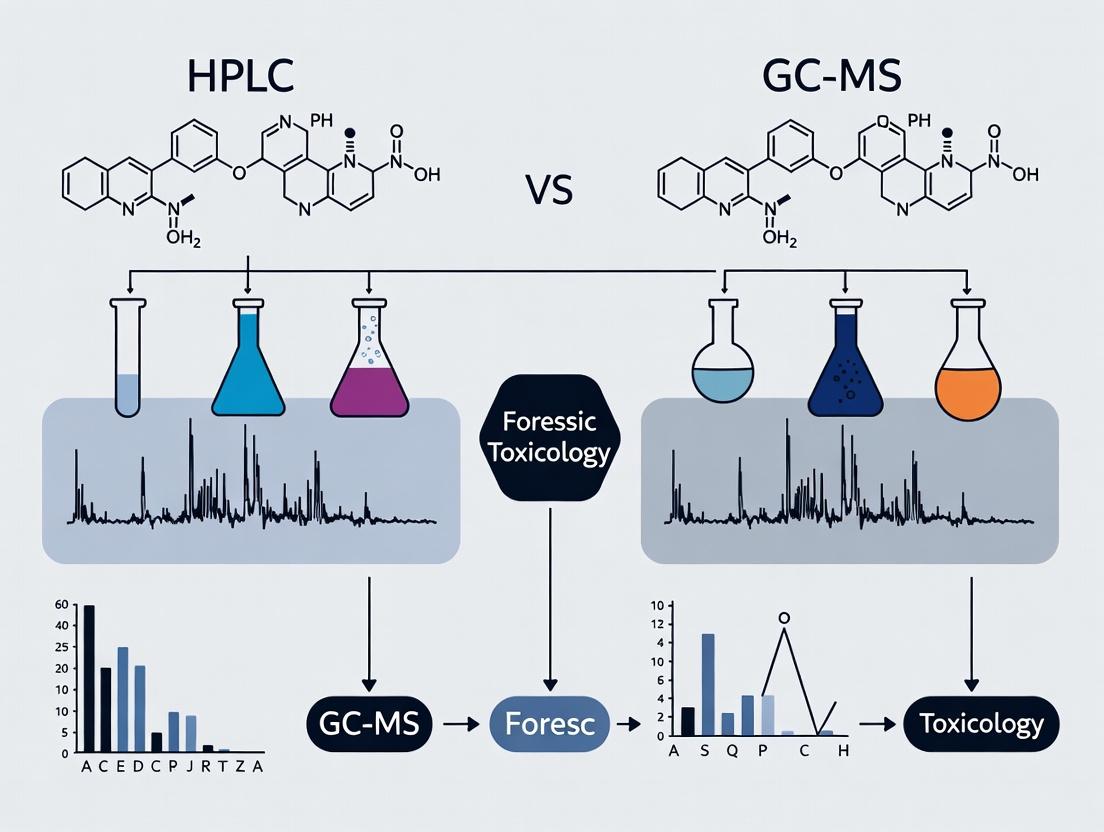
This article provides a comprehensive comparison of High-Performance Liquid Chromatography (HPLC) and Gas Chromatography-Mass Spectrometry (GC-MS) for forensic toxicology applications.
HPLC vs GC-MS in Forensic Toxicology: A Comprehensive Guide to Method Selection for Forensic Scientists and Researchers
Abstract
This article provides a comprehensive comparison of High-Performance Liquid Chromatography (HPLC) and Gas Chromatography-Mass Spectrometry (GC-MS) for forensic toxicology applications. It explores the fundamental principles of each technique and their suitability for analyzing different compound classes, from volatile drugs to large, thermally labile molecules. Detailed methodological workflows for postmortem and ante-mortem sample analysis are presented, alongside common troubleshooting scenarios and optimization strategies for sensitivity and specificity. The article concludes with a critical validation framework and a direct comparative analysis to guide method selection, ensuring reliable and court-defensible results for drug development and forensic research.
Core Principles of HPLC and GC-MS: Understanding the Forensic Analytical Toolkit
In forensic toxicology, the unequivocal identification and quantification of drugs, metabolites, and poisons in complex biological matrices is paramount. Two pillars of this analytical endeavor are High-Performance Liquid Chromatography (HPLC) and Gas Chromatography-Mass Spectrometry (GC-MS). This guide delves into the core separation and detection mechanisms of each technique, framing their comparative utility within the specific demands of forensic research, where sensitivity, specificity, and legal defensibility are non-negotiable.
Core Separation Principles
High-Performance Liquid Chromatography (HPLC)
- Mechanism: Separates compounds based on their differential distribution between a mobile liquid phase and a stationary solid phase packed inside a column.
- Key Variables: Polarity of analyte, mobile phase (solvent) composition, pH, and stationary phase chemistry (e.g., C18 for reverse-phase).
- Forensic Relevance: Ideal for thermally labile, non-volatile, or polar compounds (e.g., benzodiazepines, many opioids, peptides) without derivatization.
Gas Chromatography (GC)
- Mechanism: Separates volatile and thermally stable compounds based on their differential partitioning between an inert gaseous mobile phase and a liquid stationary phase coated on a column wall.
- Key Variables: Analyte volatility and polarity, column temperature (ramp), and stationary phase chemistry.
- Forensic Relevance: Excellent for volatile compounds (e.g., alcohols, inhalants) and many drugs that can withstand vaporization (typically <300–350°C).
Core Detection Principles
HPLC Detection
- Common Detectors:
- Diode Array Detector (DAD/UV-Vis): Measures absorbance of UV/Vis light. Provides spectra for identification.
- Fluorescence (FLD): Excites compounds at specific wavelengths and measures emitted light. Highly sensitive and selective for native fluorophores or derivatized analytes.
- Mass Spectrometry (MS): The gold standard for confirmation. HPLC-MS interfaces (e.g., ESI, APCI) softly ionize molecules for mass analysis.
GC-MS Detection
- Ion Source: The standard is Electron Ionization (EI). High-energy (70 eV) electrons bombard molecules, creating reproducible, fragment-rich spectra ideal for library matching.
- Mass Analyzer: Typically a quadrupole mass filter. Provides high selectivity and sensitivity in Selected Ion Monitoring (SIM) mode for quantification.
- Forensic Relevance: The EI spectrum is a definitive "fingerprint," making GC-MS the historical cornerstone for court-admissible confirmatory analysis.
Quantitative Data Comparison
Table 1: Key Technical Parameters for Forensic Application
| Parameter | HPLC (with MS detection) | GC-MS (with EI source) |
|---|---|---|
| Analyte Suitability | Non-volatile, thermally labile, polar, high molecular weight. | Volatile, thermally stable, typically lower MW. |
| Typical Separation Time | 5 – 30 minutes. | 5 – 60 minutes. |
| Detection Limits | Low pg to ng on-column (MS-dependent). | Low pg to ng on-column. |
| Identification Power | Molecular ion & fragment ions (soft ionization); library searchable. | Reproducible fragment pattern (EI); robust library matching. |
| Quantification Precision | RSD typically 1-5% (MS/MS offers highest precision). | RSD typically 1-5%. |
| Sample Throughput | High (with automation). | High (with automation). |
| Key Forensic Advantage | Broad analyte coverage without derivatization. | Universally accepted, definitive spectral libraries. |
Experimental Protocols in Forensic Toxicology
Protocol A: HPLC-DAD/MS for Basic Drug Screening in Urine
- Sample Prep: 1 mL urine + internal standard (e.g., deuterated analog). Solid-Phase Extraction (SPE) using a mixed-mode cationic cartridge.
- Chromatography:
- Column: C18, 100 x 2.1 mm, 1.8 µm.
- Mobile Phase: (A) 0.1% Formic acid in water; (B) 0.1% Formic acid in acetonitrile.
- Gradient: 5% B to 95% B over 10 min, 2 min hold.
- Flow Rate: 0.4 mL/min.
- Column Temp: 40°C.
- Detection: DAD (200-400 nm) followed by ESI-MS in positive mode. MS scan range: m/z 50-500.
Protocol B: GC-MS for Confirmation of Cannabinoids in Blood
- Sample Prep & Derivatization: 0.5 mL blood + ISTD. Liquid-Liquid Extraction (hexane:ethyl acetate). Dry down and derivatize with 50 µL BSTFA + 1% TMCS at 70°C for 30 min.
- Chromatography:
- Column: 5% Phenyl polysiloxane, 30 m x 0.25 mm, 0.25 µm film.
- Inlet Temp: 250°C (splittless mode).
- Oven Program: 150°C (hold 1 min), ramp 25°C/min to 280°C, hold 5 min.
- Carrier Gas: Helium, constant flow 1.2 mL/min.
- Detection: EI source (70 eV), quadrupole analyzer. Solvent delay: 3 min. Data acquired in SIM mode for target ions (e.g., THC-OH-TMS: m/z 371, 473).
Workflow Diagrams
Diagram Title: HPLC-MS Analytical Workflow
Diagram Title: GC-MS Analytical Workflow
The Scientist's Toolkit: Essential Reagents & Materials
Table 2: Key Research Reagent Solutions for Forensic Method Development
| Item | Function in HPLC | Function in GC-MS |
|---|---|---|
| Internal Standards (ISTD) | Deuterated or isotopically labeled analogs of target analytes. Correct for variability in extraction efficiency, injection volume, and ionization suppression/enhancement in MS. | Deuterated analogs. Correct for variability throughout the analytical process, especially critical for quantitative accuracy. |
| Solid-Phase Extraction (SPE) Cartridges | Mixed-mode (cationic/anionic) or C18 sorbents. Selective clean-up and pre-concentration of analytes from complex biological matrices (blood, urine). | Similar mixed-mode or polymeric sorbents. Used for sample clean-up to protect the GC column and ion source from non-volatile contaminants. |
| Derivatization Reagents | Less common. May be used to add chromophores/fluorophores (e.g., for FLD) or improve ionization (e.g., for ESI-). | Critical for many compounds. BSTFA/TMCS: Adds trimethylsilyl groups to -OH, -COOH, enhancing volatility and thermal stability. PFPA/PFPOH: Used for amines/amphetamines, improving chromatographic and MS properties. |
| LC-MS Grade Solvents | Acetonitrile, Methanol, Water (with volatile additives like formic acid). Minimal ion suppression, low UV cutoff, and free of particulates to protect columns and MS performance. | HPLC/GC Grade Solvents (e.g., Ethyl Acetate, Hexane, Methanol). High purity for extraction and dilution, minimizing background interference in the chromatogram and mass spectrum. |
| GC Inlet Liners | N/A | Deactivated glass wool liners. Provide surface for sample vaporization, trap non-volatile residues, and must be regularly replaced to maintain system performance and quantitative accuracy. |
The choice between HPLC and GC-MS in forensic toxicology is dictated by the physicochemical properties of the target analytes and the required level of confirmatory evidence. HPLC, particularly when coupled with MS, offers a versatile platform for a broad spectrum of compounds with minimal sample preparation. GC-MS, with its robust and reproducible EI spectra, remains the benchmark for definitive confirmation of volatile and derivatizable substances. A modern forensic laboratory strategically employs both techniques in a complementary manner to achieve comprehensive and legally defensible analytical results.
In forensic toxicology research, the accurate identification and quantification of drugs, metabolites, and poisons in complex biological matrices is paramount. The central analytical dilemma often revolves around selecting between High-Performance Liquid Chromatography (HPLC) and Gas Chromatography-Mass Spectrometry (GC-MS). While factors like sensitivity and cost are considerations, the physicochemical properties of the analytes—specifically, polarity and volatility—are the primary, non-negotiable determinants for method selection. This guide delineates how these core properties dictate the analytical workflow, instrumentation, and protocol design.
Polarity and Volatility: Foundational Concepts
- Polarity refers to the uneven distribution of electrical charge within a molecule. It is commonly measured by the log P (partition coefficient), which describes a compound's hydrophobicity. A low (or negative) log P indicates high polarity.
- Volatility is a measure of a compound's tendency to vaporize. It is intrinsically linked to boiling point and intermolecular forces. Highly polar compounds often have low volatility due to strong intermolecular attractions (e.g., hydrogen bonding).
Decision Framework: HPLC vs. GC-MS
The following table summarizes the direct influence of analyte properties on instrument selection.
Table 1: Method Selection Based on Analyte Properties
| Analytic Property | Recommended Technique | Primary Reason | Common Forensic Examples |
|---|---|---|---|
| Non-volatile, Thermally Labile, or Highly Polar (log P < 0, high boiling point) | HPLC-MS/MS (or LC-MS) | GC requires vaporization; high temps cause degradation. HPLC separates in liquid phase at ambient temps. | Benzodiazepines, glucuronidated metabolites, opioids (e.g., morphine), novel psychoactive substances (many cathinones), pesticides (carbamates). |
| Volatile and Thermally Stable (log P > 0, low to moderate boiling point) | GC-MS | Superior peak shape and resolution in the gas phase. Robust, reproducible, and extensive library databases. | Ethanol, THC-COOH (after derivatization), amphetamines, cocaine, many traditional controlled substances. |
| Moderately Polar/Volatile | Derivatization + GC-MS or HPLC-MS | Derivatization (e.g., silylation, acylation) reduces polarity, increases volatility/thermal stability for GC. HPLC can often handle natively. | Carboxylic acids (e.g., free THC-COOH), steroids, some pesticides. |
Experimental Protocols & Methodologies
Protocol A: GC-MS Analysis of Volatile Compounds (e.g., Amphetamines)
- Sample Prep: Liquid-liquid extraction (LLE) at basic pH using organic solvent (e.g., ethyl acetate/hexane).
- Derivatization (if needed): For improved chromatography, add a derivatizing agent like N-Methyl-bis(trifluoroacetamide) (MBTFA) to the dry extract, heat at 70°C for 20 minutes.
- GC-MS Parameters:
- Column: 5% phenyl/95% dimethyl polysiloxane capillary column (30m x 0.25mm ID, 0.25µm film).
- Inlet: Splitless mode at 250°C.
- Oven Program: 70°C (hold 1 min), ramp at 20°C/min to 300°C (hold 5 min).
- Carrier Gas: Helium, constant flow (1.0 mL/min).
- MS Interface: 280°C.
- Detection: Electron Impact (EI) at 70 eV, full scan (m/z 40-500) or Selected Ion Monitoring (SIM).
Protocol B: HPLC-MS/MS Analysis of Polar, Non-volatile Compounds (e.g., Benzodiazepines)
- Sample Prep: Solid-phase extraction (SPE) using mixed-mode sorbents or protein precipitation with acetonitrile.
- HPLC Parameters:
- Column: C18 reversed-phase column (100 x 2.1mm, 1.7µm particle size).
- Mobile Phase A: 0.1% Formic acid in water.
- Mobile Phase B: 0.1% Formic acid in acetonitrile.
- Gradient: 5% B to 95% B over 8 minutes, re-equilibrate.
- Flow Rate: 0.4 mL/min. Column Temp: 40°C.
- MS/MS Parameters:
- Ionization: Electrospray Ionization (ESI), positive mode.
- Source Temp: 150°C. Desolvation Temp: 500°C.
- Detection: Multiple Reaction Monitoring (MRM) using two transitions per analyte for confirmation.
Visualizing the Method Selection Pathway
Title: Forensic Method Selection Based on Analyte Properties
The Scientist's Toolkit: Essential Research Reagents & Materials
Table 2: Key Reagents for Forensic Chromatography
| Item | Function in Protocol | Key Consideration |
|---|---|---|
| Mixed-Mode SPE Cartridges (e.g., C18/SCX) | Isolate a wide range of basic, acidic, and neutral drugs from biological fluids. | Versatility for screening unknown compounds in HPLC-MS. |
| Derivatizing Agents (e.g., BSTFA, MSTFA, PFPA) | Modify polar functional groups (-OH, -COOH, -NH2) for GC-MS analysis. | Increases volatility, improves peak shape, and enhances specificity. |
| Stable Isotope-Labeled Internal Standards (e.g., Cocaine-d3, Morphine-d6) | Compensate for matrix effects and variability in sample prep/injection. | Critical for achieving accurate quantification in both GC-MS and LC-MS. |
| LC-MS Grade Solvents (Methanol, Acetonitrile, Water) | Mobile phase components for HPLC. Minimal ion suppression and background noise. | Essential for maintaining high sensitivity and system cleanliness. |
| Buffers & Modifiers (Ammonium formate, Formic acid) | Control pH and ionic strength of mobile phase to optimize ionization and separation. | Impacts peak shape, retention time, and MS signal intensity. |
| Retention Gap/Guard Column | Protects the analytical column from matrix debris and contaminants. | Extends column life and maintains chromatographic performance. |
Within forensic toxicology research, the selection of an analytical platform is dictated by the physicochemical properties of the target analytes, required sensitivity, and the need for unequivocal identification. The debate between High-Performance Liquid Chromatography (HPLC) coupled with tandem mass spectrometry (MS/MS) and Gas Chromatography-Mass Spectrometry (GC-MS) is central to this field. This guide provides an in-depth technical comparison for the analysis of four critical analyte classes: Opioids, Benzodiazepines, Cannabinoids, and Novel Psychoactive Substances (NPS).
Analytical Techniques: Core Principles and Applicability
Gas Chromatography-Mass Spectrometry (GC-MS)
GC-MS separates volatile and thermally stable compounds. It requires derivatization for polar, non-volatile, or thermally labile analytes. Electron Impact (EI) ionization provides reproducible, library-searchable spectra.
Liquid Chromatography-Tandem Mass Spectrometry (LC-MS/MS)
HPLC (or UHPLC) coupled with electrospray ionization (ESI) or atmospheric pressure chemical ionization (APCI) MS/MS separates a broad range of compounds without the need for volatility. It is ideal for polar, thermally labile, and high-molecular-weight substances.
Analysis by Analyte Class
Opioids
This class includes natural (e.g., morphine, codeine), semi-synthetic (e.g., oxycodone, hydromorphone), and fully synthetic (e.g., fentanyl, tramadol) compounds. They are basic, polar molecules with wide-ranging polarities.
Benzodiazepines
These are weak base, lipophilic compounds. They are often metabolized to active compounds (e.g., nordazepam, oxazepam), requiring methods to detect both parent drugs and metabolites.
Cannabinoids
Δ9-Tetrahydrocannabinol (THC) is the primary psychoactive component. Analysis targets THC, its inactive precursor (THCA), and its major metabolite (11-nor-9-carboxy-THC, THC-COOH). These are highly lipophilic, neutral to acidic compounds.
Novel Psychoactive Substances (NPS)
An ever-evolving class including synthetic cathinones, cannabinoids, opioids, and phenethylamines. They are structurally diverse, often basic, and may be present at very low concentrations with potent activity.
Quantitative Technique Comparison
Table 1: Suitability of GC-MS vs. LC-MS/MS by Analyte Class
| Analyte Class | Ideal Technique | Key Reason | Typical LOD (ng/mL) | Typical Derivatization Needed? |
|---|---|---|---|---|
| Opioids | LC-MS/MS | Superior for polar, non-volatile opioids (e.g., morphine glucuronide) and fentanyl analogs. | 0.01-0.5 | No (for LC); Often for GC |
| Benzodiazepines | LC-MS/MS & GC-MS | GC-MS excellent for classic benzos; LC-MS/MS better for labile metabolites (e.g., 7-aminoclonazepam). | 0.05-1.0 | Often for GC; No for LC |
| Cannabinoids (Blood/Urine) | LC-MS/MS | Direct analysis of acidic THC-COOH without derivatization. Faster turnaround. | 0.1-1.0 (THC-COOH) | Required for GC |
| Novel Psychoactive Substances | LC-MS/MS | Ability to screen for unknown, polar, and thermolabile compounds without reference standards via HRMS. | 0.01-0.5 | Rarely, depends on compound |
Table 2: Performance Metrics in Forensic Method Validation
| Parameter | GC-MS (with Derivatization) | LC-MS/MS (ESI+) |
|---|---|---|
| Linear Range | Typically 2-3 orders of magnitude | 3-4 orders of magnitude |
| Analysis Time | 15-30 min (plus derivatization time) | 5-10 min |
| Sample Prep Complexity | High (often requires hydrolysis & derivatization) | Moderate (protein precipitation, SLE, SPE) |
| Identification Confidence | High (library-matchable EI spectra) | High (MRM transitions, isotopic pattern) |
| Throughput | Lower | Higher |
Detailed Experimental Protocols
Protocol 1: LC-MS/MS Analysis of Synthetic Opioids in Serum
- Sample Preparation: To 100 µL of serum, add 300 µL of cold acetonitrile containing internal standards (e.g., fentanyl-d5). Vortex, centrifuge (13,000 x g, 10 min, 4°C), and transfer supernatant for analysis.
- Chromatography: Column: C18 (50 x 2.1 mm, 1.7 µm). Mobile Phase A: 0.1% Formic acid in water. B: 0.1% Formic acid in methanol. Gradient: 5% B to 95% B over 4 min, hold 1 min. Flow: 0.4 mL/min. Temp: 40°C.
- Mass Spectrometry: ESI+, Multiple Reaction Monitoring (MRM). Example: Fentanyl: Q1 337.2 → Q3 188.1 (quantifier), 105.1 (qualifier). Source Temp: 150°C, Desolvation Temp: 500°C.
Protocol 2: GC-MS Analysis of Benzodiazepines after Derivatization
- Hydrolysis & Extraction: Enzymatic hydrolysis (β-glucuronidase, pH 6.8, 37°C, 2h). Liquid-liquid extraction with tert-butyl methyl ether at alkaline pH (borate buffer, pH 9).
- Derivatization: Dry extract under N2. Add 50 µL of BSTFA with 1% TMCS. Heat at 70°C for 20 min.
- GC-MS Analysis: Column: 5% phenyl methyl polysiloxane (30 m x 0.25 mm, 0.25 µm). Inlet: 250°C, Splitless. Oven: 100°C (hold 1 min) to 300°C at 20°C/min. Transfer line: 280°C. EI source: 70 eV. Scan mode: 50-550 m/z.
Protocol 3: LC-HRMS Screening for Novel Psychoactive Substances
- Sample Prep: Supported Liquid Extraction (SLE) using pH-adjusted (basic) plasma. Elute with dichloromethane:isopropanol (9:1). Evaporate and reconstitute in initial mobile phase.
- Chromatography: HILIC or reversed-phase C18 column. Gradient elution with ammonium formate buffer and acetonitrile.
- Mass Spectrometry: Q-TOF or Orbitrap in data-dependent acquisition (DDA). Full scan (m/z 100-1000) at high resolution (>30,000 FWHM). Top 5 ions selected for MS/MS fragmentation. Identification via accurate mass, isotopic fit, and library MS/MS spectrum match.
Visualizing the Technique Selection Workflow
Title: Forensic Analyte Technique Decision Workflow
The Scientist's Toolkit: Key Research Reagent Solutions
Table 3: Essential Materials for Forensic Toxicology Analysis
| Item | Function & Importance |
|---|---|
| Certified Reference Materials (CRMs) | Primary standards for quantitative method development and calibration. Essential for legal defensibility. |
| Stable Isotope-Labeled Internal Standards (e.g., d3, d5, 13C) | Correct for matrix effects and recovery variability in MS analysis. Critical for accurate quantification. |
| β-Glucuronidase/Arylsulfatase Enzyme | Hydrolyzes phase II drug conjugates (glucuronides, sulfates) to release the parent drug for detection. |
| Derivatization Reagents (e.g., BSTFA, MSTFA, PFPA) | Increase volatility and thermal stability of polar compounds (e.g., cannabinoids, benzodiazepines) for GC-MS. |
| Solid-Phase Extraction (SPE) Cartridges (Mixed-mode C8/SCX, HLB) | Clean-up complex biological matrices (blood, urine), reduce ion suppression, and pre-concentrate analytes. |
| LC-MS Grade Solvents & Additives | Minimize background noise, prevent source contamination, and ensure reproducible chromatographic performance. |
| Quality Control Matrices (Pooled Blank Serum/Plasma) | Used to prepare in-house QC samples for ongoing method validation and batch acceptance. |
For the analysis of opioids, cannabinoids, and NPS, LC-MS/MS is generally the more versatile and efficient choice, handling polar and labile compounds without complex derivatization. GC-MS remains a robust, cost-effective standard for volatile and thermally stable analytes like many classic benzodiazepines. The optimal technique is ultimately determined by the specific analytes, laboratory resources, and the required balance between throughput, sensitivity, and definitive identification.
Within the critical framework of forensic toxicology research, the selection of biological matrix and its subsequent preparation are paramount for generating legally defensible and analytically sound results. The comparative analysis of High-Performance Liquid Chromatography (HPLC) and Gas Chromatography-Mass Spectrometry (GC-MS) is fundamentally dependent on the quality and nature of the prepared sample. This technical guide details the core sample types—blood, urine, hair, and tissue—and their preparation basics, serving as a foundational reference for researchers and scientists whose work culminates in chromatographic or spectrometric separation and detection.
Core Sample Types: Characteristics and Applications
The choice of matrix dictates the analytical window, interpretation, and preparation strategy. Key characteristics are summarized below.
Table 1: Comparative Overview of Primary Forensic Sample Types
| Sample Type | Typical Volume/ Mass | Detection Window | Primary Analytical Information | Key Advantages | Major Challenges |
|---|---|---|---|---|---|
| Blood (Whole/Plasma/Serum) | 1-10 mL | Hours to days (acute exposure) | Current impairment, recent use, quantitative concentration. | Gold standard for impairment assessment; allows for pharmacokinetic modeling. | Invasive collection; unstable matrix; requires stringent preservation. |
| Urine | 10-50 mL | 1-4 days (up to weeks for chronic use) | Recent past use; presence of metabolites. | Non-invasive; large volume; suitable for immunoassay screening. | Easily adulterated; no correlation to impairment; variable dilution. |
| Hair | ~100 strands (pencil width) | Months to years (segmental analysis) | Chronic/long-term exposure history; pattern of use. | Extremely long detection window; stable sample; resistant to adulteration. | Passive contamination issues; complex preparation; low analyte concentration. |
| Tissue (Liver, Brain, etc.) | 1-5 g (postmortem) | Variable, often terminal | Distribution & accumulation; cause of death analysis. | Crucial for postmortem redistribution studies; high drug concentrations. | Homogenization challenges; putrefaction; complex matrix interferences. |
Fundamental Preparation Methodologies
Sample preparation aims to isolate, purify, and concentrate analytes from the biological matrix while removing interfering components. The protocols below are foundational for downstream analysis by either HPLC or GC-MS.
Whole Blood/Plasma Preparation (Protein Precipitation & Liquid-Liquid Extraction)
Objective: Isolate acidic, neutral, and basic drugs from a complex protein-rich matrix.
- Materials: Centrifuge tubes, vortex mixer, centrifuge, micropipettes, pH meter, analytical evaporator (Nitrogen or Air).
- Reagents: Internal Standard (IS) solution, precipitation solvent (e.g., Acetonitrile, Methanol), phosphate buffer (pH 6.0), organic extraction solvent (e.g., Chlorobutane or Ethyl Acetate).
- Protocol:
- Aliquot 1 mL of blood/plasma into a centrifuge tube.
- Spike with appropriate deuterated Internal Standard (e.g., Morphine-d3 for opiate analysis).
- Add 2 mL of cold acetonitrile. Vortex vigorously for 60 seconds to precipitate proteins.
- Centrifuge at 10,000 x g for 10 minutes at 4°C.
- Transfer the clear supernatant to a clean tube.
- Adjust pH to ~6.0 using 1 mL phosphate buffer.
- Add 3 mL of organic extraction solvent (e.g., Chlorobutane). Vortex for 2 minutes.
- Centrifuge for 5 minutes at 5,000 x g to separate phases.
- Transfer the upper organic layer to a clean evaporation tube.
- Evaporate to dryness under a gentle stream of nitrogen at 40°C.
- Reconstitute the dry extract in 100 µL of mobile phase (for HPLC) or derivatizing agent/solvent (for GC-MS). Vortex and transfer to autosampler vial.
Urine Preparation (Hydrolysis & Solid-Phase Extraction)
Objective: Hydrolyze conjugated drug metabolites and extract a broad spectrum of analytes.
- Materials: Heating block, SPE manifold, vacuum source, SPE cartridges (e.g., mixed-mode C8/SCX).
- Reagents: β-Glucuronidase enzyme (from E. coli), acetate buffer (pH 5.0), deionized water, methanol, organic elution solvent (e.g., dichloromethane:isopropanol:ammonium hydroxide, 80:20:2).
- Protocol:
- Aliquot 2 mL of urine into a tube. Add IS and 1 mL of acetate buffer.
- Add ~50 µL of β-glucuronidase. Vortex and incubate at 55°C for 60-90 minutes.
- Cool to room temperature. Centrifuge briefly to settle condensation.
- Condition SPE cartridge with 3 mL methanol, followed by 3 mL deionized water.
- Load the hydrolyzed urine sample onto the cartridge. Apply gentle vacuum.
- Wash sequentially with 3 mL water, 3 mL 0.1M acetic acid, and 3 mL methanol.
- Dry cartridge under full vacuum for 5 minutes.
- Elute analytes into a clean tube with 3 mL of elution solvent.
- Evaporate eluate to dryness under nitrogen at 40°C.
- Reconstitute in 100 µL of appropriate analysis solvent.
Hair Preparation (Decontamination, Pulverization, & Digestion)
Objective: Remove external contamination and liberate incorporated drugs from the keratin matrix.
- Materials: Sonic bath, ball mill or fine scissors, incubator.
- Reagents: Dichloromethane, methanol, phosphate buffer (pH 7.4), enzyme (Proteinase K) or strong acid (e.g., 0.1M HCl).
- Protocol:
- Cut hair strand (3-5 cm, root to tip). Wash twice with 5 mL dichloromethane for 2 minutes in a sonic bath to remove surface contaminants.
- Dry hair. Cut into 1-2 mm segments (for segmental analysis) or pulverize in a ball mill for 5 minutes to increase surface area.
- Weigh 25 mg of pulverized hair into a digestion tube. Add IS.
- For enzymatic digestion: Add 1 mL phosphate buffer and 50 µL Proteinase K. Incubate at 45°C overnight (~18 hours).
- For acid digestion: Add 1 mL of 0.1M HCl. Incubate at 45°C for 2 hours.
- Centrifuge the digestate. The supernatant is then subjected to SPE (as per urine protocol, Section 3.2) prior to analysis.
Tissue Preparation (Homogenization & Extraction)
Objective: Achieve a homogeneous slurry from a solid organ for representative sub-sampling.
- Materials: Mechanical homogenizer (e.g., Polytron), weigh boats, glass homogenizer tubes.
- Reagents: Phosphate buffer or deionized water.
- Protocol:
- Weigh 1 g of tissue (e.g., liver) into a homogenizer tube.
- Add 4 mL of phosphate buffer (1:5 w/v ratio) and the IS.
- Homogenize at high speed on ice for 60-90 seconds until a uniform slurry is achieved.
- Centrifuge the homogenate at 15,000 x g for 15 minutes at 4°C.
- The supernatant is then processed similarly to blood/plasma (Section 3.1, steps 6-11) using LLE or SPE.
The Scientist's Toolkit: Essential Research Reagent Solutions
Table 2: Key Reagents and Materials for Sample Preparation
| Item | Function & Application |
|---|---|
| Deuterated Internal Standards (e.g., Cocaine-d3, THC-COOH-d3, Amphetamine-d5) | Corrects for analyte loss during preparation and instrument variability; essential for accurate quantification by GC-MS or LC-MS. |
| β-Glucuronidase/Arylsulfatase Enzyme | Hydrolyzes Phase II glucuronide and sulfate conjugates in urine and blood, freeing the parent drug or metabolite for detection. |
| Mixed-Mode Solid-Phase Extraction (SPE) Cartridges (C8/SCX or C8/SAX) | Selective extraction of a wide range of acidic, basic, and neutral drugs via reversed-phase and ion-exchange mechanisms from complex matrices. |
| Protein Precipitation Solvents (Acetonitrile, Methanol) | Denatures and precipitates proteins from blood/plasma/tissue homogenates, clarifying the sample for subsequent clean-up. |
| Derivatization Agents (e.g., MSTFA, PFPA, HFBA) | For GC-MS: Increases volatility and thermal stability of polar compounds (e.g., drugs, metabolites); improves chromatographic separation and detection sensitivity. |
| Buffers (Phosphate, Acetate, Ammonium Acetate) | Controls pH during extraction (LLE, SPE) and enzymatic hydrolysis, ensuring optimal recovery of target analytes. |
Workflow and Analytical Decision Pathway
The selection of preparation method and final analytical technique (HPLC vs. GC-MS) is guided by the sample type and target analytes.
Sample Prep to Analysis Decision Pathway
HPLC vs. GC-MS: Implications of Sample Preparation
The choice between HPLC and GC-MS directly influences preparation protocols:
- GC-MS Focus: Sample extracts must be volatile and thermally stable. This often necessitates an additional derivatization step post-extraction for polar compounds (e.g., opioids, benzodiazepines, cannabinoids). Sample clean-up (LLE/SPE) must aggressively remove non-volatile co-extractives (salts, lipids) that could damage the GC column or ion source.
- HPLC/LC-MS Focus: Preparation prioritizes the removal of phospholipids (source of matrix effect in ESI) and particulate matter. Derivatization is rarely needed. For LC-MS/MS, the use of appropriate isotopic internal standards is non-negotiable to compensate for ion suppression/enhancement. The extract must be compatible with the aqueous/organic mobile phase.
In conclusion, meticulous sample preparation, tailored to the biological matrix and the demands of the chosen analytical platform (HPLC or GC-MS), is the critical first step in generating reliable, interpretable, and forensically valid toxicological data.
Step-by-Step Forensic Applications: From Sample Prep to Data Acquisition
GC-MS Protocols for Volatile Drugs and Ethanol Congener Analysis
Forensic toxicology research demands robust analytical methods for the definitive identification and quantification of analytes. While High-Performance Liquid Chromatography (HPLC) excels in separating non-volatile, thermally labile, and polar compounds (e.g., many pharmaceuticals and metabolites), Gas Chromatography-Mass Spectrometry (GC-MS) remains the gold standard for volatile and semi-volatile neutral compounds. This guide details core GC-MS protocols for two critical forensic applications: volatile drugs of abuse (e.g., inhalants, some stimulants) and ethanol congener analysis. The choice of GC-MS over HPLC for these analyses is dictated by the analytes' inherent volatility, thermal stability, and the superior resolving power of capillary GC columns for complex mixtures like beverage spirits.
Part 1: Core Protocol for Volatile Drug Analysis (e.g., Alkyl Nitrites, Toluene, GHB)
Experimental Protocol: Headspace Solid-Phase Microextraction (HS-SPME) GC-MS
Principle: A fiber coated with a stationary phase is exposed to the headspace above a sample, absorbing volatile analytes, which are then thermally desorbed in the GC injector.
Detailed Methodology:
- Sample Preparation: Place 5 mL of liquid sample (e.g., seized liquid) or 100 mg of solid matrix (e.g., cloth) into a 20 mL headspace vial. Add 2 g of sodium chloride (to reduce analyte solubility via salting-out effect) and a magnetic stir bar. Seal with a PTFE/silicone septum cap.
- Internal Standard Addition: Spike with appropriate deuterated internal standards (e.g., d5-toluene, d3-GHB) at a known concentration.
- Equilibration: Heat the vial on a heated agitator at 70°C for 10 minutes with agitation (500 rpm).
- SPME Extraction: Expose a conditioned 85 µm Carboxen/Polydimethylsiloxane (CAR/PDMS) fiber to the sample headspace for 20 minutes at 70°C with continuous agitation.
- Thermal Desorption: Retract the fiber and immediately inject it into the GC inlet, set to 250°C in splitless mode (1 min purge-off time), for 2 minutes to desorb analytes.
- GC-MS Conditions:
- Column: Equity-1 (100% dimethylpolysiloxane), 30 m × 0.25 mm ID × 1.0 µm film thickness.
- Oven Program: 40°C (hold 3 min), ramp at 15°C/min to 240°C (hold 5 min).
- Carrier Gas: Helium, constant flow at 1.2 mL/min.
- MS Interface: 280°C.
- Ion Source: Electron Impact (EI) at 70 eV, 230°C.
- Detection: Full scan mode (m/z 35-300) for screening; Selected Ion Monitoring (SIM) for quantification.
Key Quantitative Data for Common Volatile Drugs
Table 1: GC-MS Parameters for Selected Volatile Drugs
| Analyte | Retention Time (min) | Target Quantifier Ion (m/z) | Qualifier Ions (m/z) | Linear Range (ng/mL) | LOD (ng/mL) |
|---|---|---|---|---|---|
| Toluene | 6.2 | 91 | 65, 92 | 10-5000 | 2.5 |
| Isobutyl Nitrite | 5.8 | 43 | 41, 57 | 5-2000 | 1.0 |
| Gamma-Butyrolactone (GBL) | 10.1 | 42 | 86, 56 | 50-10000 | 10 |
| 1,4-Butanediol | 12.5 (as TMS deriv.) | 147 | 116, 129 | 100-20000 | 25 |
Workflow Diagram: HS-SPME-GC-MS for Volatile Drugs
Diagram 1: Workflow for Volatile Drug Analysis by HS-SPME-GC-MS
Part 2: Core Protocol for Ethanol Congener Analysis
Experimental Protocol: Direct Injection GC-MS with Internal Standardization
Principle: A diluted aqueous sample (e.g., blood, beverage) is directly injected into the GC. Analytes are separated on a polar column ideal for alcohols and separated from the massive ethanol solvent peak.
Detailed Methodology:
- Sample Preparation: Dilute 100 µL of whole blood or distilled beverage 1:10 with deionized water containing internal standards (e.g., 1-Propanol-d7 for alcohols, 4-Methyl-2-pentanol for higher alcohols).
- Derivatization (Optional): For improved peak shape of acids, mix 1 mL of prepared sample with 100 µL of acidic methanol to form methyl esters.
- GC-MS Conditions:
- Column: Stabilwax (polyethylene glycol), 30 m × 0.25 mm ID × 0.25 µm film thickness.
- Oven Program: 40°C (hold 1 min), ramp at 8°C/min to 100°C, then at 15°C/min to 240°C (hold 5 min).
- Inlet: Split mode (20:1 ratio), 220°C. Injection volume: 1 µL.
- Carrier Gas: Helium, constant flow at 1.5 mL/min.
- MS Interface: 250°C.
- Ion Source: EI, 70 eV, 200°C.
- Detection: SIM mode focused on specific ions for each congener class.
Key Quantitative Data for Major Ethanol Congeners
Table 2: GC-MS SIM Parameters for Key Ethanol Congeners
| Congener Class | Example Analytes | Target Ions (m/z) | Typical Concentration in Beverages (mg/L)* |
|---|---|---|---|
| Methanol | Methanol | 31, 32 | 5-150 (Spirits) |
| Higher Alcohols | 2-Propanol, Isobutanol, Isoamyl alcohol | 45, 43, 55, 70 | 50-500 (Whisky) |
| Aldehydes | Acetaldehyde | 29, 44 | 5-100 (Wine) |
| Esters | Ethyl acetate | 43, 61, 70 | 10-200 (Rum) |
| Fusel Oils | 1-Propanol, 1-Butanol | 31, 41, 56 | Varies widely |
*Concentration ranges are illustrative and highly beverage-dependent.
Workflow Diagram: Direct Injection GC-MS for Congeners
Diagram 2: Workflow for Ethanol Congener Profiling by GC-MS
The Scientist's Toolkit: Essential Research Reagent Solutions
Table 3: Key Reagents and Materials for GC-MS Analysis of Volatiles and Congeners
| Item | Function in Protocol | Example/Specification |
|---|---|---|
| Deuterated Internal Standards | Corrects for variability in extraction, injection, and ionization; essential for accurate quantification. | d5-Toluene, d3-GHB, 1-Propanol-d7. Purity >98%. |
| SPME Fibers | Extracts and pre-concentrates volatile analytes from headspace. | 85 µm CAR/PDMS for gases/VOCs; 65 µm PDMS/DVB for polar volatiles. |
| Headspace Vials & Seals | Provides a sealed, temperature-controlled environment for headspace equilibration. | 20 mL glass vials with PTFE/silicone septa and crimp caps. |
| Polar GC Column | Separates polar, volatile compounds (alcohols, aldehydes) with high resolution. | Polyethylene glycol phase (e.g., Stabilwax, ZB-WAX). |
| Non-Polar GC Column | Separates non-polar to mid-polar volatile compounds (hydrocarbons, nitrites). | 100% dimethylpolysiloxane phase (e.g., Equity-1, HP-1). |
| Salting-Out Agent | Increases ionic strength, reducing analyte solubility in aqueous phase and enhancing headspace concentration. | Sodium Chloride (NaCl), ACS grade, anhydrous. |
| Derivatization Reagent | Converts polar, poorly volatile acids (like fatty acids in congener analysis) to volatile esters. | Boron trifluoride in methanol (BF3/MeOH), 14% w/v. |
| Calibration Mixes | Multi-component standard solutions for establishing calibration curves and retention times. | Certified reference materials for volatiles or congener classes in appropriate solvent. |
HPLC (and LC-MS/MS) Methods for Thermolabile and Polar Compounds
This technical guide details the application of High-Performance Liquid Chromatography (HPLC) and liquid chromatography-tandem mass spectrometry (LC-MS/MS) for the analysis of thermolabile and polar compounds. Within the broader thesis context of HPLC vs. GC-MS for forensic toxicology research, it is established that Gas Chromatography-Mass Spectrometry (GC-MS), while robust, requires volatile and thermally stable analytes. Many modern drugs, metabolites, and endogenous compounds are polar, ionic, or degrade under high temperatures, making LC-based techniques the unequivocal choice for their analysis. This document provides methodologies, data, and resources for researchers and drug development professionals.
Thermolabile compounds (e.g., benzodiazepines, many opioids, peptides, and explosives degradation products) decompose in a GC injector or column. Polar compounds (e.g., glucuronide metabolites, catecholamines, glyphosate, and synthetic cathinones) lack sufficient volatility for GC, even with derivatization, which adds time and can introduce error. HPLC and LC-MS/MS operate at ambient temperature and in the liquid phase, making them ideal for these analytes. The core challenge shifts from volatility to achieving sufficient retention, selectivity, and sensitivity for polar molecules on reversed-phase columns.
Core Methodological Strategies
Stationary Phase and Column Chemistry
The primary strategy involves moving beyond traditional C18 columns.
- Hydrophilic Interaction Liquid Chromatography (HILIC): Uses a polar stationary phase (e.g., bare silica, cyano, amide) with a hydrophobic mobile phase (high organic content, e.g., acetonitrile). Polar analytes partition into a water-rich layer on the stationary phase, providing excellent retention for highly polar compounds.
- Polar-Embedded and Polar-Endcapped Phases: Columns like phenyl-hexyl or amide-embedded C18 offer additional polar interactions (π-π, hydrogen bonding) to retain polar analytes under highly aqueous conditions.
- Ion-Exchange Chromatography: For ionic compounds, mixed-mode columns combining reversed-phase and ion-exchange mechanisms provide strong retention and selectivity.
Mobile Phase Optimization
- pH Control: Using volatile buffers (e.g., ammonium formate, ammonium acetate) is critical for LC-MS/MS compatibility. Controlling pH suppresses or neutralizes analyte ionization, modulating retention.
- Ion-Pairing Reagents: Additives like heptafluorobutyric acid (HFBA) or diethylamine can improve peak shape and retention for acids and bases, respectively, but may cause ion suppression in MS and require extensive source cleaning.
- Low Organic to High Organic Gradients: Essential for HILIC methods, starting with high organic (~80-95% ACN) and increasing aqueous content to elute compounds.
LC-MS/MS Considerations
- Ionization Source: Electrospray Ionization (ESI) is the dominant technique for polar and thermolabile compounds, as it facilitates ionization directly from the liquid phase. Atmospheric Pressure Chemical Ionization (APCI) can be useful for less polar, small molecules.
- Source Conditions: Optimize desolvation temperature and gas flows to prevent thermal degradation in the source interface.
- Mass Analysis: Multiple Reaction Monitoring (MRM) provides unparalleled selectivity and sensitivity for target compound analysis in complex matrices like blood or urine.
Experimental Protocols
Protocol 1: HILIC-MS/MS for Polar Synthetic Cathinones and Metabolites
Objective: Simultaneous quantification of methylone, mephedrone, and their polar hydroxy and demethylated metabolites in human urine. Sample Prep: 100 µL urine + 300 µL ice-cold acetonitrile (for protein precipitation). Vortex, centrifuge (13,000 x g, 10 min, 4°C). Transfer supernatant for analysis. Chromatography:
- Column: BEH HILIC (2.1 x 100 mm, 1.7 µm).
- Mobile Phase A: 10 mM ammonium formate in water, pH 3.0 (formic acid).
- Mobile Phase B: Acetonitrile.
- Gradient: 95% B (0-1 min), 95% → 70% B (1-6 min), hold 70% B (6-7 min), re-equilibrate (7-10 min).
- Flow Rate: 0.4 mL/min.
- Column Temp: 35°C.
- Injection Volume: 2 µL. Mass Spectrometry (ESI+):
- Capillary Voltage: 1.0 kV.
- Desolvation Temp: 450°C.
- Source Temp: 150°C.
- Desolvation Gas: 800 L/hr.
- Cone Gas: 50 L/hr.
- MRM Transitions: Optimized for each analyte (e.g., Methylone: m/z 208 > 160, 132).
Protocol 2: Mixed-Mode LC-MS/MS for Ionic Herbicides (Glyphosate and AMPA)
Objective: Quantify the highly polar glyphosate and its metabolite aminomethylphosphonic acid (AMPA) in water samples. Sample Prep: Solid-Phase Extraction (SPE) using a mixed-mode anion-exchange cartridge. Elute with 2% formic acid in methanol. Dry under N2, reconstitute in 100 µL initial mobile phase. Chromatography:
- Column: Scherzo SM-C18 (Mixed-mode, 2.0 x 150 mm, 3 µm).
- Mobile Phase A: 10 mM ammonium acetate in water.
- Mobile Phase B: Methanol.
- Gradient: 5% B (0-2 min), 5% → 50% B (2-10 min), 50% → 90% B (10-11 min), hold, re-equilibrate.
- Flow Rate: 0.2 mL/min.
- Column Temp: 40°C. Mass Spectrometry (ESI-):
- Capillary Voltage: -2.5 kV.
- Desolvation Temp: 350°C.
- MRM: Glyphosate: m/z 168 > 150, 124; AMPA: m/z 110 > 79, 63.
Data Presentation
Table 1: Comparison of Analytical Techniques for Forensically Relevant Compound Classes
| Compound Class (Example) | Property | Suitability GC-MS | Suitability HPLC/LC-MS/MS | Preferred LC Method | Approx. LOD (LC-MS/MS) |
|---|---|---|---|---|---|
| Benzodiazepines (Diazepam) | Thermolabile | Poor (degradation) | Excellent | Reversed-Phase C18 | 0.1 ng/mL |
| Synthetic Cathinones (Mephedrone) | Polar Basic | Moderate (requires derivatization) | Excellent | HILIC or RP with ion-pairing | 0.05 ng/mL |
| Opioid Glucuronides (Morphine-3-G) | Very Polar, Ionic | Very Poor | Excellent | HILIC or Mixed-Mode | 0.5 ng/mL |
| Herbicides (Glyphosate) | Highly Polar, Amphoteric | Very Poor | Excellent | Mixed-Mode Ion-Exchange | 5 ng/mL |
| Explosives (RDX, HMX) | Thermolabile | Poor | Excellent | Reversed-Phase | 1 ng/mL |
Table 2: Key Research Reagent Solutions for LC-MS/MS of Polar/Thermolabile Analytes
| Item | Function | Example (Supplier) |
|---|---|---|
| HILIC Columns | Retain highly polar compounds via partitioning into aqueous layer. | Acquity UPLC BEH HILIC (Waters), Luna HILIC (Phenomenex) |
| Mixed-Mode Columns | Combine RP and ion-exchange for retention of ionic species. | Scherzo SM-C18 (Imtakt), Obelisc R (SIELC) |
| Volatile Buffers | Provide pH control without MS source contamination. | Ammonium Formate, Ammonium Acetate (Sigma-Aldrich) |
| Ion-Pair Reagents | Improve peak shape/retention for ionic analytes (use with caution). | Heptafluorobutyric Acid (HFBA), Trifluoroacetic Acid (TFA) |
| SPE Cartridges (Mixed-Mode) | Selective clean-up and pre-concentration of ionic analytes from complex matrices. | Oasis MCX (Mixed-mode Cation Exchange, Waters) |
| LC Vials/Inserts (Deactivated Glass) | Minimize analyte adsorption for low-level samples. | Certified Clear Glass Vials with Polymer Footed Inserts (Thermo) |
Visualization: Method Selection Workflow
Title: LC Method Selection for Polar Compounds
Title: LC-MS/MS Workflow for Polar Analytics
Within the rigorous demands of forensic toxicology research, the analytical platforms of High-Performance Liquid Chromatography (HPLC) and Gas Chromatography-Mass Spectrometry (GC-MS) present distinct requirements for sample preparation. The choice between Solid-Phase Extraction (SPE) and Liquid-Liquid Extraction (LLE) is not arbitrary; it is a critical determinant of analytical success, influencing recovery, selectivity, and matrix effect. This guide examines the optimization of these cleanup techniques for each chromatographic platform, framed within the comparative context of HPLC and GC-MS methodologies in forensic analysis.
Core Principles and Comparative Mechanisms
Solid-Phase Extraction (SPE) is an adsorption-desorption process utilizing a packed cartridge. The sample is passed through a solid sorbent, where analytes are retained based on chemical interactions (e.g., reverse-phase, ion-exchange). Interferences are washed away, and target analytes are eluted with a selective solvent.
Liquid-Liquid Extraction (LLE) relies on the differential partitioning of analytes between two immiscible liquids, typically an aqueous sample matrix and an organic solvent. Separation is governed by the analyte's partition coefficient.
Platform-Specific Drivers: GC-MS often requires derivatization for polar, non-volatile compounds. Sample cleanup must yield a dry, volatile extract compatible with this step. HPLC, particularly coupled with tandem MS (LC-MS/MS), is more tolerant of aqueous samples and polar analytes but is highly susceptible to ion suppression/enhancement from co-eluting matrix components.
Quantitative Comparison of SPE vs. LLE
The following table summarizes key performance metrics for both techniques, derived from recent methodological studies in forensic toxicology.
Table 1: Comparative Performance Metrics of SPE and LLE
| Parameter | Solid-Phase Extraction (SPE) | Liquid-Liquid Extraction (LLE) |
|---|---|---|
| Typical Recovery (%) | 70-95% (highly method-dependent) | 60-85% (can be lower for very polar analytes) |
| Selectivity | High (can be finely tuned with sorbent chemistry and wash steps) | Moderate (based primarily on solvent polarity and pH) |
| Matrix Removal | Excellent (effective for complex matrices like blood, urine) | Good (may transfer some lipophilic matrix components) |
| Sample Throughput | High (amenable to automation and 96-well formats) | Moderate to Low (manual, prone to emulsion issues) |
| Organic Solvent Volume | 5-20 mL (lower, concentrated elution) | 20-50 mL (higher, requires evaporation) |
| Suitability for GC-MS | Excellent (provides clean, dry extract for derivatization) | Good (but may require extensive drying/evaporation) |
| Suitability for HPLC/LC-MS | Excellent (can be optimized for polar analytes; critical for reducing matrix effects) | Moderate (co-extracted matrix can cause ion suppression) |
| Cost per Sample | Higher (cost of cartridges/plates) | Lower (solvent cost only) |
Optimized Experimental Protocols
Protocol 1: Mixed-Mode Cation Exchange SPE for Basic Drugs (GC-MS Platform)
This protocol is optimized for the extraction of amphetamines, opioids, and other basic drugs from blood serum prior to GC-MS analysis with derivatization.
- Sorbent Conditioning: Activate a 60 mg mixed-mode cation exchange (MCX) cartridge with 3 mL methanol, followed by 3 mL deionized water. Do not let the sorbent dry.
- Sample Loading: Acidify 1 mL of serum or plasma with 2 mL of 0.1 M phosphate buffer (pH 6.0). Apply to the cartridge at a flow rate of ~1-2 mL/min.
- Washing: Rinse with 3 mL of 0.1 M hydrochloric acid, followed by 3 mL methanol. Dry the cartridge under full vacuum for 5 minutes.
- Elution: Elute analytes with 3 mL of a freshly prepared mixture of dichloromethane:isopropanol:ammonium hydroxide (78:20:2, v/v/v). Collect eluate in a glass tube.
- Evaporation & Derivatization: Evaporate the eluate to dryness under a gentle stream of nitrogen at 40°C. Reconstitute in 50 µL of derivatizing agent (e.g., MSTFA) and incubate at 70°C for 30 minutes prior to GC-MS injection.
Protocol 2: Reverse-Phase SPE for Polar Drugs and Metabolites (LC-MS/MS Platform)
Optimized for direct injection into LC-MS/MS systems, focusing on minimizing phospholipid content—a major source of ion suppression.
- Sorbent Conditioning: Condition a 30 mg reverse-phase C18 cartridge with 1 mL methanol and then 1 mL water.
- Sample Loading: Dilute 0.5 mL of urine with 2 mL of 2% formic acid in water. Load onto the cartridge.
- Washing: Wash with 2 mL of 5% methanol in water containing 2% formic acid. This acidic wash removes salts and very polar interferences while retaining most drugs.
- Elution: Elute with 1.5 mL of methanol. A second elution with 1.5 mL of acetonitrile can be added for comprehensive recovery.
- Reconstitution: Combine and evaporate eluates to dryness under nitrogen. Reconstitute in 100 µL of initial LC mobile phase (e.g., 95% water, 5% acetonitrile with 0.1% formic acid). Vortex and centrifuge before LC-MS/MS analysis.
Protocol 3: Classic LLE for Broad-Screen Neutral/Basic Drugs (GC-MS Platform)
A robust, traditional method for a wide drug screen.
- pH Adjustment: To 2 mL of sample (blood, urine), add 2 mL of 0.1 M borate buffer (pH 9.0 ± 0.2).
- Extraction: Add 8 mL of extraction solvent (e.g., n-butyl chloride:ethyl acetate, 9:1 v/v). Cap and mix by rotation for 15 minutes.
- Phase Separation: Centrifuge at 3000 x g for 10 minutes. Carefully transfer the upper organic layer to a clean conical tube.
- Back-Extraction (Optional for Cleanup): Add 2 mL of 0.05 M sulfuric acid to the organic layer, mix, and centrifuge. Transfer the aqueous (acidic) layer, which now contains basic drugs, to a new tube. Re-basify with 0.5 mL of concentrated ammonium hydroxide.
- Final Extraction & Evaporation: Add 5 mL of fresh organic solvent (e.g., chloroform:isopropanol, 9:1), mix, centrifuge, and transfer the organic layer. Evaporate to dryness and reconstitute in 50 µL of ethyl acetate for GC-MS injection.
Visualizing Method Selection and Workflow
The following diagrams illustrate the logical decision-making process for extraction selection and the comparative workflows for each platform.
Decision Logic for Extraction Method Selection
Comparative Workflows: SPE vs. LLE
The Scientist's Toolkit: Essential Research Reagents & Materials
Table 2: Key Reagents and Materials for Forensic Sample Cleanup
| Item | Function & Rationale |
|---|---|
| Mixed-Mode SPE Cartridges (e.g., MCX, WCX) | Combine reverse-phase and ion-exchange mechanisms for superior selectivity of ionizable analytes (acids/bases) from complex matrices. |
| 96-Well SPE Plates | Enable high-throughput, automated sample preparation compatible with robotic liquid handlers. |
| Phosphate & Borate Buffers | For precise pH adjustment during sample loading (SPE) or LLE to ensure analytes are in the correct ionic form for extraction. |
| Methanol, Acetonitrile (HPLC Grade) | Primary elution solvents for SPE; also used in mobile phases. Low UV cutoff and MS compatibility are critical. |
| Dichloromethane, Ethyl Acetate, n-Butyl Chloride | Common organic solvents for LLE. Choice affects selectivity, evaporation time, and tendency to form emulsions. |
| Ammonium Hydroxide, Formic Acid | Used as modifiers in SPE elution solvents or for pH adjustment to control ionization and improve recovery. |
| Derivatization Reagents (e.g., MSTFA, BSTFA, PFPA) | For GC-MS analysis. Increase volatility and thermal stability of polar compounds (e.g., drugs, metabolites). |
| Nitrogen Evaporator | Provides gentle, controlled evaporation of organic extracts to dryness without excessive heating or oxidation. |
| Positive & Negative Control Matrices | Drug-free biological matrices (serum, urine) essential for method validation, calibration, and quality control. |
| Internal Standard Mix (Deuterated Analogs) | Added at the start of extraction to correct for variability in recovery, evaporation, and instrument response. |
The optimization of sample cleanup is a foundational step that dictates the reliability of downstream chromatographic analysis. For GC-MS, where derivatization and volatility are paramount, SPE provides a clean, concentrated dry extract, while LLE remains a robust, cost-effective choice for broad screens. For HPLC/LC-MS/MS, which is exquisitely sensitive to matrix effects, SPE is often indispensable for achieving the requisite selectivity and clean background. The choice is not SPE versus LLE, but rather selecting the right tool—optimized for the analyte, matrix, and platform—to ensure data integrity in forensic toxicology research.
Within the analytical workflow of forensic toxicology research, the choice between High-Performance Liquid Chromatography (HPLC) and Gas Chromatography-Mass Spectrometry (GC-MS) is pivotal. While HPLC excels in separating thermally labile and polar compounds without modification, GC-MS offers superior resolving power and robust, reproducible mass spectral libraries. The critical bridge that often enables the application of GC-MS to a wider range of analytes, particularly those common in toxicology (e.g., drugs, metabolites, poisons), is chemical derivatization. This guide provides an in-depth examination of derivatization strategies, framing their necessity within the comparative context of HPLC and GC-MS methodologies for forensic applications.
The Core Rationale: When and Why to Derivatize
Derivatization is the chemical modification of an analyte to produce a derivative with properties more amenable to GC-MS analysis. The decision to derivatize is not trivial and hinges on the analyte's inherent physicochemical properties.
Primary Reasons for Derivatization:
- Increase Volatility and Thermal Stability: Analytes with polar functional groups (-OH, -COOH, -NH, -SH) exhibit strong intermolecular forces, leading to high boiling points and adsorption onto the GC inlet or column. They may also decompose at temperatures required for vaporization. Derivatization masks these polar groups, lowering the boiling point and preventing decomposition.
- Improve Chromatographic Performance: Derivatives typically yield sharper, more symmetric peaks, reducing tailing and improving resolution and detection limits.
- Enhance Mass Spectrometric Detection: Derivatization can direct fragmentation to produce more abundant, characteristic ions, improving selectivity and sensitivity. It can also shift the molecular ion and key fragments to a higher m/z range, away from matrix interference.
- Introduce Specific Tags: Chiral derivatization agents can separate enantiomers. Derivatization with fluorine-containing reagents can enable highly sensitive detection using negative chemical ionization (NCI).
When to Choose Derivatization for GC-MS vs. HPLC: The following table summarizes the key decision points.
Table 1: Decision Matrix: Derivatization for GC-MS vs. Native Analysis by HPLC in Forensic Toxicology
| Analyte Property | GC-MS Approach | HPLC Approach (Typical) | Rationale |
|---|---|---|---|
| Thermally Labile | Mandatory Derivatization or avoidance of GC-MS | Native analysis | Prevents degradation in hot GC inlet/column. |
| Polar / Non-volatile | Mandatory Derivatization | Native analysis | Increases volatility for elution. |
| Contains Active H (OH, COOH, NH) | Strongly Recommended | Native analysis | Reduces tailing, improves peak shape & sensitivity. |
| Steroids, Bile Acids | Required | Native analysis possible (e.g., LC-MS) | Essential for volatility and detection. |
| Amphetamines, THC-COOH | Standard Practice | Native analysis possible | Improves chromatography, directs fragmentation. |
| Most Drugs of Abuse | Common (silylation, acylation) | Common (no derivatization) | GC-MS: Enhances; HPLC-MS/MS: Often not needed. |
Common Derivatization Chemistries and Protocols
Three primary reaction types dominate forensic toxicology applications.
Silylation
Replaces active hydrogen with an alkylsilyl group (e.g., TMS, TBDMS). Best for alcohols, carboxylic acids, amines, amides.
- Common Reagents: MSTFA (N-Methyl-N-trimethylsilyltrifluoroacetamide), BSTFA (N,O-Bis(trimethylsilyl)trifluoroacetamide) often with 1% TMCS (chlorotrimethylsilane) as catalyst, MTBSTFA (N-tert-Butyldimethylsilyl-N-methyltrifluoroacetamide).
- Detailed Protocol for Trimethylsilylation (using BSTFA + 1% TMCS):
- Transfer the dried sample extract (in a GC vial insert) to a clean, dry reaction vial.
- Evaporate the organic solvent completely under a gentle stream of nitrogen or argon in a heating block (~40-50°C).
- Add 50 µL of pyridine (or another anhydrous solvent) and 50 µL of BSTFA + 1% TMCS reagent.
- Cap the vial tightly, vortex mix for 30 seconds.
- Heat at 60-70°C for 20-30 minutes.
- Allow to cool. The solution is now ready for direct GC-MS injection. Excess reagent does not typically interfere.
Acylation
Replaces active hydrogen with an acyl group (e.g., acetyl, pentafluoropropionyl, heptafluorobutyryl). Used for amines, phenols, alcohols.
- Common Reagents: Acetic anhydride, PFP (Pentafluoropropionic anhydride), HFBA (Heptafluorobutyric anhydride).
- Detailed Protocol for Perfluoroacylation (using HFBA):
- Dry the sample extract as described in 3.1.
- Add 100 µL of ethyl acetate and 50 µL of HFBA.
- Cap and vortex mix.
- Heat at 60°C for 15-20 minutes.
- Cool and evaporate the reaction mixture to dryness under a stream of nitrogen.
- Reconstitute the residue in 100 µL of an appropriate solvent (e.g., ethyl acetate, hexane) for GC-MS analysis. Note: Evaporation is crucial to remove corrosive excess reagent and acid byproducts.
Esterification
Specifically converts carboxylic acids to esters (alkyl or pentafluorobenzyl). Used for fatty acids, organic acids, THC-COOH.
- Common Reagents: BF₃ in methanol (for methylation), PFP-OH/pentafluoropropanol with a coupling agent.
- Detailed Protocol for BF₃/Methanol Methylation:
- To the dried extract, add 1 mL of BF₃-methanol complex (12-14% w/w).
- Cap tightly (reaction produces pressure).
- Heat at 100°C for 30-60 minutes.
- Cool to room temperature.
- Add 2 mL of water and 1 mL of hexane (or suitable organic solvent).
- Vortex and centrifuge to separate layers.
- Transfer the organic (top) layer containing the methyl esters to a GC vial for analysis.
Workflow and Decision Pathway
Decision Pathway for Derivatization in GC-MS Analysis
The Scientist's Toolkit: Key Reagent Solutions
Table 2: Essential Research Reagents for GC-MS Derivatization
| Reagent | Function & Key Use Case |
|---|---|
| BSTFA + 1% TMCS | Trimethylsilyl donor. General-purpose silylation for a wide range of polar compounds (drug metabolites, steroids). TMCS catalyzes difficult reactions. |
| MSTFA | Trimethylsilyl donor. Similar to BSTFA, often preferred for biological samples; less volatile byproducts. |
| MTBSTFA | tert-Butyldimethylsilyl donor. Produces more hydrolytically stable derivatives than TMS, ideal for uronic acids or rigorous cleanup steps. |
| HFBA (Heptafluorobutyric Anhydride) | Perfluoroacylating agent. Excellent for amines (e.g., amphetamines). Imparts high electron-capture and mass spec sensitivity, especially in NCI mode. |
| PFPA (Pentafluoropropionic Anhydride) | Perfluoroacylating agent. Similar to HFBA but yields slightly less massive derivatives. Common in opioid and amphetamine analysis. |
| Acetic Anhydride | Acetylating agent. Used for simple acetylation of amines and phenols. Less sensitive than perfluoroacyl but lower cost. |
| BF₃-Methanol Complex | Methylating agent for carboxylic acids (esterification). Standard for fatty acid methyl ester (FAME) analysis and THC-COOH derivatization. |
| PFB-Br (Pentafluorobenzyl Bromide) | Alkylating agent for acids and phenols. Produces derivatives with exceptional sensitivity in Electron Capture Detection (ECD) and NCI-MS. |
| Pyridine (Anhydrous) | Common basic solvent for derivatization reactions. Scavenges acid produced in acylation/silylation, drives equilibrium. Must be kept dry. |
| N-Methylimidazole | Potent catalyst for silylation reactions, particularly useful for difficult compounds like sugars. |
The quantitative benefits of derivatization are substantial, as shown in the performance comparison below.
Table 3: Quantitative Impact of Derivatization on GC-MS Performance (Representative Data)
| Analyte | Derivatization Method | Improvement vs. Underivatized | Key Metric Change |
|---|---|---|---|
| 11-nor-9-COOH-THC | Methylation (BF₃/MeOH) or Silylation | Peak becomes detectable | LOD: >10 ng/mL → <0.5 ng/mL |
| Amphetamine | Acetylation or PFP | Drastic reduction in peak tailing | Asymmetry factor: >2.5 → ~1.1 |
| Benzoylecgonine | Silylation (MSTFA) | Major sensitivity increase | Peak Area: Increases 5-10 fold |
| Cortisol | Silylation (MSTFA) | Enables elution & detection | No peak → Sharp, quantifiable peak |
| Codeine / Morphine | Silylation or Acylation | Improved chromatography & sensitivity | Signal-to-Noise: Increases 8-20 fold |
In the forensic toxicologist's methodological arsenal, derivatization is not merely an optional sample preparation step but a powerful enabling technology for GC-MS. It expands the scope of compounds accessible to this high-resolution, library-searchable technique, directly addressing its core limitation: analyte volatility and stability. When framed within the HPLC vs. GC-MS debate, derivatization becomes the strategic differentiator that allows GC-MS to compete effectively for polar, thermally labile analytes, often providing superior chromatographic separation and more universally interpretable mass spectra than LC-MS. The choice of strategy—silylation, acylation, or esterification—must be guided by the target functional groups, required sensitivity, and the need for derivative stability. Mastery of these chemical modification techniques remains fundamental to robust and comprehensive forensic toxicology research.
Within the broader thesis on High-Performance Liquid Chromatography (HPLC) versus Gas Chromatography-Mass Spectrometry (GC-MS) for forensic toxicology research, the application of these techniques in real-world casework is paramount. This technical guide examines their complementary roles through case studies in postmortem (PM) toxicology and Driving Under the Influence of Drugs (DUID) investigations. The choice between HPLC (and its cousin, LC-MS/MS) and GC-MS hinges on the analytes' physicochemical properties, required sensitivity, and the matrix complexity.
HPLC (LC-MS/MS): Separates compounds dissolved in a liquid mobile phase via a solid stationary phase. Coupled with tandem mass spectrometry (MS/MS), it excels at analyzing polar, thermally labile, and high-molecular-weight compounds without derivatization. GC-MS: Separates volatilized compounds in an inert gaseous mobile phase. It is the gold standard for volatile, semi-volatile, and non-polar compounds that are thermally stable, often requiring chemical derivatization for polar substances.
Table 1: Core Technical Comparison of HPLC/MS and GC-MS in Forensic Toxicology
| Parameter | GC-MS | HPLC (LC-MS/MS) |
|---|---|---|
| Separation Principle | Volatility & Polarity | Polarity, Size, Affinity |
| Ideal Analyte Properties | Thermally stable, volatile, or derivatizable | Polar, thermally labile, non-volatile, high molecular weight |
| Typical Forensics Use | Ethanol, THC, amphetamines, opioids, synthetic cannabinoids (derivatized) | Benzodiazepines, opioids (glucuronides), novel psychoactive substances (NPS), fentanyl analogs |
| Sample Preparation | Often requires derivatization for polar drugs | Protein precipitation, dilute-and-shoot, SLE, SPE |
| Throughput | Moderate (longer run times common) | High (shorter run times with UPLC) |
| Quantification Precision | Excellent (high-resolution separation) | Excellent (with stable isotope-labeled internal standards) |
| Limitations | Not suitable for non-volatile/thermally labile drugs | Co-elution of matrix components can cause ion suppression/enhancement |
Case Study 1: Postmortem Toxicology – Polypharmacy Investigation
Scenario: A 45-year-old male found deceased with a history of chronic pain and depression. Multiple prescription bottles present.
Experimental Protocol:
- Sample: Femoral blood (2 mL), vitreous humor, liver tissue homogenate.
- Sample Preparation (Blood):
- Protein Precipitation: Add 200 µL sample to 600 µL cold acetonitrile with internal standards (e.g., Diazepam-d5, Morphine-d3).
- Vortex mix (1 min), centrifuge (13,000 x g, 10 min, 4°C).
- Transfer supernatant, evaporate to dryness under nitrogen (40°C).
- Reconstitute in 100 µL initial mobile phase (0.1% formic acid in water), vortex, centrifuge, transfer to vial.
- Screening & Quantification (LC-MS/MS):
- Column: C18 reversed-phase (100 x 2.1 mm, 1.7 µm).
- Mobile Phase: A: 0.1% Formic acid in H2O; B: 0.1% Formic acid in MeOH.
- Gradient: 5% B to 95% B over 12 min.
- MS/MS: ESI+, Multiple Reaction Monitoring (MRM) mode.
- Targets: Opioids (morphine, oxycodone), benzodiazepines (diazepam, nordiazepam), antidepressants (amitriptyline, citalopram).
- Confirmatory Analysis (GC-MS):
- Derivatization (for opioids/benzos): Reconstituted dry extract + 50 µL MSTFA (N-Methyl-N-(trimethylsilyl)trifluoroacetamide). Heat (70°C, 20 min).
- Column: HP-5MS (30 m x 0.25 mm, 0.25 µm).
- Oven Program: 80°C (hold 1 min) to 300°C at 20°C/min.
- MS: Electron Impact (EI) at 70 eV, scan mode (m/z 50-550).
Findings: LC-MS/MS identified and quantified nordiazepam (0.25 mg/L), oxycodone (0.15 mg/L), and amitriptyline (0.40 mg/L). GC-MS confirmation provided unambiguous structural identification via EI library match (>90% fit). The cause of death was attributed to combined drug toxicity (polypharmacy).
Title: Postmortem Toxicology Analytical Workflow
Case Study 2: DUID Investigation – Suspected Impaired Driving
Scenario: Driver exhibiting erratic behavior, negative breath alcohol test. Blood sample collected pursuant to legal statute.
Experimental Protocol:
- Sample: Whole blood (2 x 2 mL gray top tubes with sodium fluoride/potassium oxalate).
- Rapid Screening (HPLC-DAD or LC-TOF-MS):
- Quick Extraction: Solid Phase Extraction (SPE) or dilute-and-shoot.
- LC-TOF-MS: Full-scan high-resolution mass spectrometry for untargeted screening of NPS.
- Column: C18 (50 x 2.1 mm, 1.8 µm) for fast analysis.
- Gradient: Rapid 5-min gradient.
- Quantitative Confirmatory Analysis (GC-MS with Derivatization for Δ9-THC):
- Extraction: Liquid-Liquid Extraction (LLE) with n-hexane/ethyl acetate after alkaline hydrolysis (for total THC).
- Derivatization: Extract + 25 µL BSTFA (N,O-Bis(trimethylsilyl)trifluoroacetamide) + 25 µL TMCS (Chlorotrimethylsilane). Heat (70°C, 30 min).
- GC-MS: As above, with SIM (Selected Ion Monitoring) for sensitivity: THC m/z 386, 371; THC-COOH m/z 371, 473.
- Quantitative Confirmatory Analysis (LC-MS/MS for Benzoylecgonine):
- Extraction: SPE.
- LC-MS/MS: ESI+, MRM. Transitions: Benzoylecgonine 290.0 -> 168.0, 105.0.
Findings: LC-TOF-MS screen indicated presence of cocaine metabolite. GC-MS quantified Δ9-THC at 5 ng/mL (active impairment) and THC-COOH at 80 ng/mL (indicates prior use). LC-MS/MS quantified Benzoylecgonine at 150 ng/mL. Findings supported DUID charge.
Table 2: Quantitative DUID Case Results (Blood)
| Analyte | Analytical Technique | Concentration | Legal Limit (Example Jurisdiction) | Interpretation |
|---|---|---|---|---|
| Δ9-THC (active) | GC-MS (derivatized) | 5 ng/mL | 2 ng/mL (per se) | Exceeds limit, indicates recent use. |
| THC-COOH (inactive) | GC-MS (derivatized) | 80 ng/mL | N/A | Confirms cannabis exposure. |
| Benzoylecgonine | LC-MS/MS | 150 ng/mL | N/A (zero tolerance common) | Confirms cocaine use. |
Title: DUID Case Analytical Decision Path
The Scientist's Toolkit: Essential Research Reagent Solutions
Table 3: Key Reagents & Materials for HPLC/GC-MS in Forensic Toxicology
| Item Name | Function & Brief Explanation | Typical Application |
|---|---|---|
| Internal Standards (IS) | Deuterated or analog compounds added to correct for variability in extraction and ionization. Crucial for accurate quantification. | All quantitative assays (e.g., Morphine-d3, THC-d3). |
| Derivatization Reagents | Modify analyte structure to increase volatility/thermal stability (for GC) or improve fragmentation (for MS). | GC-MS of cannabinoids (BSTFA), opioids (MSTFA, PFPA). |
| Solid Phase Extraction (SPE) Cartridges | Selective stationary phases (C18, Mixed-Mode) to clean-up and concentrate analytes from complex biological matrices. | Extraction of broad panels from blood/urine. |
| LC-MS Grade Solvents | Ultra-pure solvents (MeOH, ACN, Water) with minimal ionizable impurities to reduce background noise and ion suppression. | Mobile phase preparation. |
| Stabilized Blood Tubes | Contain sodium fluoride (enzyme inhibitor) and potassium oxalate (anticoagulant) to preserve drug integrity post-sampling. | DUID and postmortem blood collection. |
| Certified Reference Materials | Calibrators and controls with known, traceable concentrations to ensure method accuracy and legal defensibility. | Calibration curves, QC samples. |
| LC Guard Columns | Short columns placed before the analytical column to trap particulates and contaminants, extending column life. | All routine HPLC/LC-MS analyses. |
| GC Liner (Deactivated) | Glass insert in GC inlet where sample vaporization occurs; deactivated to prevent catalytic decomposition of analytes. | Essential for reliable GC-MS. |
Solving Common Problems: Troubleshooting HPLC and GC-MS in the Forensic Lab
Addressing Peak Tailing, Carryover, and Sensitivity Loss in HPLC
Within the rigorous demands of forensic toxicology research, the choice between High-Performance Liquid Chromatography (HPLC) and Gas Chromatography-Mass Spectrometry (GC-MS) is pivotal. While GC-MS excels in volatility, HPLC is indispensable for thermally labile and non-volatile analytes. However, HPLC method reliability is frequently compromised by three interrelated phenomena: peak tailing, carryover, and sensitivity loss. This guide provides an in-depth technical examination of these issues, framed within the context of optimizing HPLC for forensic applications where reproducibility and quantitative accuracy are paramount.
Core Issues: Definitions and Impact in Forensic Analysis
Peak Tailing: Asymmetric peak shape where the latter half of the peak is broader than the leading edge, quantified by a tailing factor (Tf) > 1.2. In forensic toxicology, this reduces resolution between closely eluting drugs and metabolites, impairs accurate integration, and lowers the signal-to-noise ratio, risking false negatives or inaccurate quantification.
Carryover: The appearance of a previous sample's analyte peak in a subsequent blank injection. This is critically damaging in forensic series where a high-concentration sample (e.g., an opioid overdose) precedes a low or negative one, potentially leading to false positive results.
Sensitivity Loss: A gradual or sudden decrease in detector response for a target analyte. This compromises the detection of low-concentration drugs and their metabolites, directly impacting the limit of detection (LOD) and quantitation (LOQ), essential for reporting thresholds.
Root Cause Analysis and Diagnostic Protocols
A systematic approach is required to diagnose the source of these issues.
Diagnostic Experimental Protocol
- Objective: Isolate the component causing peak tailing, carryover, or sensitivity loss.
- Procedure:
- Baseline Check: Run a blank mobile phase. Any peaks indicate contamination.
- Tubing & Mixer Test: Bypass the autosampler and injector. Use a manual injection valve or connect the pump directly to the detector with a short, clean capillary. Inject a standard. If issues persist, the problem is downstream (column/detector).
- Column Test: Replace the analytical column with a pre-certified guard cartridge or a short, new column of the same phase. Inject standard. Resolution of tailing indicates the original column is degraded.
- Autosampler Test: Perform a series of injections: blank → high-concentration standard → blank → blank. Measure peak area in the first blank after the high standard to quantify carryover percentage.
- Detector Check: For sensitivity loss, ensure lamp hours (UV) are within spec and check for flow cell contamination.
Quantitative Impact Data
Table 1: Common Causes and Quantitative Impact on HPLC Performance
| Issue | Primary Root Cause | Typical Impact on Metric | Forensic Consequence |
|---|---|---|---|
| Peak Tailing | 1. Secondary interactions with active silanols (basic compounds)2. Column overload3. Void at column inlet | Tf > 1.5; Resolution loss of 20-50% | Mis-identification; Inaccurate quantitation of co-eluting peaks |
| Carryover | 1. Adsorption in autosampler needle/seat2. Incomplete flushing of injection loop/valve3. Contaminated flow path | Carryover > 0.1% of original peak area | False positive in subsequent sample |
| Sensitivity Loss | 1. Detector lamp aging (UV)2. Column contamination/adsorption3. Mobile phase degradation | >20% loss in peak area over 100 injections | Failure to detect analytes at reporting limits |
HPLC Problem Isolation Diagnostic Flowchart
Targeted Mitigation Strategies and Protocols
Addressing Peak Tailing
Protocol: Method Optimization for Basic Analytes (e.g., Opioids, Amphetamines)
- Mobile Phase Adjustment: Use a buffered mobile phase (e.g., 10-50 mM ammonium formate or phosphate) at a pH 1.5-3.0 units below the pKa of the basic analyte to ensure protonation and reduce silanol interaction.
- Column Selection: Employ columns with specialized bonding (e.g., bidentate C18), charged surface hybrid (CSH) technology, or extensively endcapped phases (e.g., C18 with double endcapping).
- Additive Use: Add 0.1-0.5% v/v of a competing base like triethylamine (TEA) or use perfluorinated carboxylic acids (e.g., 0.1% TFA) as an ion-pairing agent.
- Validation: Inject a test mix of basic probes (e.g., amitriptyline, nicotine). Target Tf < 1.2 for all peaks.
Eliminating Carryover
Protocol: Autosampler Wash Program Optimization
- Strong Wash Solvent: Program the autosampler's wash port to use a solvent stronger than the mobile phase (e.g., >60% organic for reversed-phase). For stubborn compounds, include 5-10% isopropanol or a dilute acid/base.
- Needle Wash: Implement both an inside and outside needle wash cycle. The inside wash flushes the needle seat and loop; the outside wash cleans the needle exterior.
- Wash Volume & Time: Ensure wash volume is at least 3-5 times the loop volume. For forensic work, a 10-second wash with agitation is standard.
- Validation Protocol: Inject a high-concentration standard (near the upper limit of quantification - ULOQ) followed by 3 blank matrix injections. Calculate % Carryover = (Peak Area in Blank 1 / Peak Area of High Std) x 100%. Accept if <0.02%.
Preventing Sensitivity Loss
Protocol: System Suitability and Preventive Maintenance
- In-Line Filter & Guard Column: Always use a 0.5 µm in-line frit before the column and a guard column with the same phase. Replace guard cartridge after every 200-300 injections of biological extracts.
- Column Cleaning: Weekly, flush the analytical column with 20 column volumes of a strong, compatible solvent (e.g., 95% acetonitrile for reversed-phase, followed by 80% methanol).
- Source Maintenance: For UV detectors, log lamp hours and replace before exceeding rated life. For MS detectors, clean ion source and cones per manufacturer schedule.
- Daily Monitoring: Run a system suitability test (SST) mix at the start of each batch. Track peak area, height, and asymmetry. A >15% decline in area triggers investigative maintenance.
The Scientist's Toolkit: Essential Research Reagent Solutions
Table 2: Key Reagents and Materials for Robust Forensic HPLC
| Item Name | Function & Rationale | Typical Specification/Use Case |
|---|---|---|
| High-Purity Buffering Salts (Ammonium formate, acetate) | Maintains consistent pH, suppressing silanol activity and analyte ionization variability. Essential for reproducibility. | LC-MS grade, ≥99.0%. Used at 2-10 mM in mobile phase. |
| Trifluoroacetic Acid (TFA) / Formic Acid | Acts as an ion-pairing agent (TFA) or modifier for MS ionization. Reduces tailing of basic drugs. | Optima LC-MS grade, 0.05-0.1% v/v in aqueous phase. |
| Triethylamine (TEA) | Competes with basic analytes for active silanol sites on the column, dramatically improving peak shape. | For HPLC, ≥99.5%. Use sparingly (0.1-0.5% v/v). Not for MS. |
| Dedicated Guard Columns | Protects the expensive analytical column from particulates and irreversible contaminants from biological extracts. | Cartridge matching analytical column phase (e.g., C18, 2.1 mm ID). |
| Strong Wash Solvents (e.g., Isopropanol/Water) | Dissolves sticky, non-polar compounds adsorbed to the autosampler needle or injection valve, eliminating carryover. | HPLC grade. Used in autosampler wash bottle at 50-100%. |
| Certified Reference Materials (CRMs) | Provides unambiguous analyte identification and accurate quantification critical for forensic reporting. | From accredited supplier (e.g., Cerilliant), with concentration and uncertainty traceable to SI units. |
Forensic HPLC Analysis and Quality Control Workflow
HPLC in Context: Comparative Data with GC-MS
Table 3: HPLC vs. GC-MS for Forensic Toxicology - Key Performance Considerations
| Parameter | HPLC (with UV/MS detection) | GC-MS | Implication for Method Choice |
|---|---|---|---|
| Analyte Suitability | Thermally labile, non-volatile, polar compounds (e.g., benzodiazepines, glucuronides, opioids). | Volatile, thermally stable compounds (e.g., cannabinoids, amphetamines). | Complementary. HPLC covers gaps in GC-MS capability. |
| Peak Tailing Susceptibility | High for basic drugs due to silanol interaction. Managed with chemistry (buffers, columns). | Less common, but can occur due to active sites in liner/column. Managed by derivatization. | HPLC requires more upfront method optimization to achieve symmetric peaks. |
| Carryover Risk | Primarily in autosampler liquid path. Mitigated by wash protocols. | Primarily in inlet liner/syringe. Mitigated by liner change and syringe washes. | Risk is system-dependent, not inherently higher in either. |
| Sensitivity (LOD) | UV: ~ng-on-column. MS/MS: low pg-on-column. | MS: low pg-on-column. | Comparable for MS detection. HPLC-UV less sensitive than GC-MS for many compounds. |
| Sample Throughput | Typically slower run times (10-30 min). | Can have faster run times (5-15 min). | GC-MS may offer higher throughput for suitable volatiles. |
| Direct Matrix Tolerance | Moderate. Requires guard column and sample cleanup (SPE). | Low. Requires extensive cleanup and derivatization for complex matrices. | HPLC is more forgiving of "dirty" biological extracts with proper guarding. |
For the forensic toxicologist, HPLC is not merely an alternative to GC-MS but a complementary pillar essential for a comprehensive analytical scope. Its vulnerability to peak tailing, carryover, and sensitivity loss is not a fundamental flaw but a manageable aspect of its operation. By implementing the diagnostic protocols, targeted mitigation strategies, and rigorous quality control tools outlined here, researchers can harness the full power of HPLC. This ensures the generation of defensible, high-quality data that meets the exacting standards of forensic science, solidifying its indispensable role alongside GC-MS in modern toxicological research and casework.
Within forensic toxicology research, the choice between HPLC and GC-MS is pivotal. While HPLC excels in analyzing thermally labile and non-volatile compounds, GC-MS remains the gold standard for volatile, non-polar analytes due to its superior resolution and robust spectral libraries. However, the performance of GC-MS is critically dependent on the integrity of its three most vulnerable components: the inlet, the column, and the ion source. This guide provides an in-depth technical examination of identifying, troubleshooting, and resolving issues stemming from these areas.
Inlet Activity: Diagnosis and Deactivation
Inlet activity refers to the adsorption or degradation of analytes on active sites within the liner, seals, and ferrules. This manifests as peak tailing for polar compounds (e.g., drugs, metabolites), ghost peaks, or low response for sensitive analytes.
Experimental Protocol for Diagnosing Inlet Activity
Materials: Test mixture containing 1 µL/mL each of underivatized fatty acids (C12, C16, C20), alcohols (C10, C12), and a drug standard like methamphetamine in a suitable solvent. Method: Inject 1 µL of the test mixture in split mode (split ratio 50:1). Monitor peaks for tailing, particularly for the alcohols and the drug standard. Compare peak areas and shapes to those from a freshly deactivated system or a known-good instrument. Acceptance Criterion: Asymmetric factor (As) should be <1.2 for all test compounds. A progressive increase in tailing with analyte polarity indicates inlet activity.
Table 1: Symptoms and Solutions for Common GC-MS Issues
| Component | Primary Symptoms | Quantitative Diagnostic Test | Corrective Action |
|---|---|---|---|
| Active Inlet | Tailing of polar peaks, response loss for sensitive analytes, ghost peaks. | Asymmetry factor (As) >1.2 for test alcohols/drugs. | Replace/clean liner, use deactivated consumables (silanized), perform inlet bake-out. |
| Degraded Column | Peak broadening, retention time shift (>5%), increased bleed (rising baseline). | Peak width increase >10% from baseline; TCD response for bleed >10% over spec. | Trim column (0.5-1 m), condition, or replace. |
| Contaminated Source | Loss of sensitivity (S/N drop), poor peak shape in MS, unstable tuning, elevated background ions (m/z 207, 281). | Signal-to-Noise for tuning compound (e.g., PFK) drops >30%; RIC shows elevated baseline. | Clean ion source: sonicate in appropriate solvents, replace filaments if pitted. |
The Scientist's Toolkit: Inlet Maintenance
| Research Reagent / Material | Function |
|---|---|
| Deactivated, Single-Taper Inlet Liner (Siltek) | Minimizes surface area and active sites for analyte adsorption. |
| High-Temperature Ferrules (Graphite/Vespel) | Provides inert seal, prevents air ingress and decomposition. |
| Inlet Deactivation Solution (e.g., DMDCS) | Silanizes glass surfaces to deactivate polar silanol groups. |
| Test Mix for Activity (Alkane/Alcohol/Drug) | Diagnostic tool to quantify adsorption and tailing. |
Title: Inlet Activity Troubleshooting Workflow
Column Degradation: Monitoring and Management
Column degradation results from stationary phase damage due to oxygen exposure, temperature excursions, or contamination. It causes increased bleed, loss of resolution, and shifting retention times.
Experimental Protocol for Assessing Column Health
Materials: Standard mixture of n-alkanes (C10, C20, C30); blank solvent. Method:
- Run a temperature program from 50°C to the column's upper temperature limit (e.g., 320°C) at 10°C/min with the MSD scanning a wide range (e.g., m/z 50-550).
- Perform a blank solvent run with the same program.
- Compare the Total Ion Chromatogram (TIC) baseline from the column test to a historical baseline. Measure the peak widths at half height for the alkanes. Acceptance Criterion: Baseline rise at upper temperature should not exceed 10% of the signal for the major alkane peaks. Peak width increase should be <10% from the column's performance benchmark.
Source Contamination: Cleaning and Recovery
Ion source contamination is the leading cause of sensitivity loss in GC-MS. It occurs from non-volatile matrix components entering the source, coating the lenses, repeller, and filaments.
Experimental Protocol for Diagnosing Source Contamination
Materials: Autotune calibration standard (e.g., PFTBA or PFK). Method:
- Perform a standard autotune procedure.
- Record key metrics: absolute abundance of the base peak (e.g., m/z 69 for PFTBA), the 50/502 ratio (for m/z 502 vs 501), and the background noise in the reagent gas region (m/z 28, 32).
- Compare to the instrument's historical tuning values or manufacturer specifications. Acceptance Criterion: A drop in absolute abundance by >30% or a significant deviation in mass peak ratios (>20%) indicates contamination. Visually inspect the source for dark deposits.
Detailed Source Cleaning Protocol
- Cool Down & Vent: Allow the instrument to cool and vent according to manufacturer procedure.
- Disassemble: Remove the ion source carefully. Note the orientation of all components.
- Sonicate: Sonicate the source housing, lenses, and repeller in successive baths of:
- Bath 1: HPLC-grade methanol (10 min).
- Bath 2: 50:50 HPLC-grade acetone/methanol (10 min).
- Bath 3: HPLC-grade dichloromethane (10 min).
- Rinse & Dry: Rinse thoroughly with fresh methanol and dry in a clean, dry nitrogen stream or oven at <100°C.
- Reassemble & Re-tune: Reinstall the source, pump down, and perform a mass calibration and tune.
Title: Source Contamination Pathway Impact
Table 2: Key Tuning Metrics for Source Health Assessment
| Tune Parameter | Ideal Value/Ratio (Example PFTBA) | Indication of Contamination |
|---|---|---|
| Absolute Abundance (m/z 69) | Instrument-specific baseline (e.g., 500,000 counts) | Drop >30% from baseline. |
| Mass Peak Ratio (m/z 502/501) | ~1.0 (for 50/502 test) | Deviation >20% from standard. |
| Background Noise (m/z 28, 32) | Low and stable. | Significant increase. |
| Water (m/z 18) / Air (m/z 28) | Low ratio (<10%) | High ratio indicates vacuum leak or desorption. |
The Scientist's Toolkit: GC-MS Maintenance Essentials
| Research Reagent / Material | Function |
|---|---|
| PFTBA (Perfluorotributylamine) Tuning Standard | Provides calibration ions across mass range for performance verification. |
| Alkane Standard Mix (C8-C40) | Monitors column efficiency, resolution, and retention index stability. |
| Ultrasonic Cleaning Bath & Solvent Set (MeOH, Acetone, DCM) | For effective removal of non-volatile deposits from ion source parts. |
| Deactivated Glass Wool & Inlet Liners | Traps non-volatile residues in the inlet, protecting the column and source. |
| High-Purity Helium Carrier Gas with In-line Moisture/Oxygen Traps | Prevents column stationary phase degradation and oxide formation in the system. |
In the context of forensic toxicology method development, a well-maintained GC-MS system is non-negotiable for achieving the reproducibility, sensitivity, and defensible data required. While HPLC methods are crucial for many modern analytes, GC-MS provides an orthogonal and often legally mandated confirmation. Proactive monitoring using the diagnostic protocols and quantitative benchmarks outlined here allows researchers to preempt catastrophic failure, minimize downtime, and ensure the generation of high-fidelity data critical for both research and courtroom testimony.
1. Introduction Within forensic toxicology research, the choice between High-Performance Liquid Chromatography (HPLC) and Gas Chromatography (GC) coupled with Mass Spectrometry (MS) hinges on analyte polarity, thermal stability, and required sensitivity. GC-MS excels for volatile, non-polar compounds, while HPLC-MS (particularly LC-MS/MS) dominates for thermally labile and polar substances. The analytical power of either platform is ultimately dictated by the precise optimization of MS parameters. This guide details core optimization strategies, focusing on ion source tuning, the critical choice between SCAN and Selected Ion Monitoring (SIM) modes, and methodologies for enhancing the signal-to-noise (S/N) ratio.
2. Ion Source Tuning and Calibration Optimal MS performance begins with proper ion source tuning and mass calibration. This ensures maximum ion transmission, accurate mass assignment, and stable signal intensity.
Experimental Protocol: Automated Tuning and Calibration
- Prepare Calibrant Solution: Introduce a known calibration standard (e.g., perfluorotributylamine for GC-MS, a mixture of caffeine, MRFA, and Ultramark for ESI LC-MS) via infusion or syringe pump at a constant rate.
- Initiate Tuning Software: Launch the instrument's automated tuning procedure.
- Parameter Optimization: The software iteratively adjusts key voltages:
- Ion Source Voltages (e.g., Capillary, Cone): To maximize ion formation and transfer.
- Lens Voltages: To focus the ion beam through the ion path.
- Detector Gain: To optimize signal amplification.
- Mass Calibration: The software correlates detected m/z peaks with known masses of the calibrant, generating a calibration curve to correct mass axis drift.
- Validation: Analyze a verification standard post-tuning to confirm mass accuracy (typically within ±0.1 Da for unit resolution) and peak intensity criteria.
Table 1: Key Tuning Parameters for ESI and EI Sources
| Parameter | ESI (LC-MS) Function | EI (GC-MS) Function | Typical Optimization Goal |
|---|---|---|---|
| Capillary Voltage | Charges droplets; ion formation. | Not applicable. | Maximize precursor ion signal. |
| Cone Voltage | Controls ion transfer to mass analyzer; induces in-source fragmentation. | Similar to "Source" voltage. | Balance between signal intensity and unwanted fragmentation. |
| Source Temperature | Desolvation of charged droplets. | Vaporizes and ionizes neutrals. | Minimize thermal degradation while ensuring desolvation/vaporization. |
| Nebulizer / Sheath Gas | Pneumatic assistance for droplet formation/desolvation. | Not applicable. | Stable, high-intensity signal. |
| Electron Energy | Not applicable. | Energy of ionizing electrons (typically 70 eV). | Standard 70 eV for reproducible library-matchable spectra. |
3. SCAN vs. SIM: A Strategic Choice The selection of acquisition mode fundamentally trades specificity for information.
- Full SCAN Mode: Acquires data across a wide m/z range (e.g., 50-500 Da).
- Advantage: Provides full spectral data for unknown identification, library searching, and retrospective analysis.
- Disadvantage: Lower sensitivity. Dwell time per m/z is short, increasing noise.
- SIM Mode: Monitors only selected, predefined m/z values.
- Advantage: Dramatically increased sensitivity and S/N. Dwell time per ion is longer, improving ion statistics.
- Disadvantage: Target-specific; no data for untargeted ions.
Experimental Protocol: Method Development for SIM
- Identify Target Ions: From a full SCAN analysis of the standard, select 2-3 characteristic ions per analyte (primary quantifier, secondary qualifier).
- Group Analytes by Retention Time: Cluster ions eluting within a similar time window (e.g., 0.5-2 min segments).
- Optimize Dwell Time: Allocate dwell time (typically 10-100 ms per ion) to achieve a minimum of 12-15 data points across the chromatographic peak. Balance the number of ions per segment with total dwell to avoid "time-slicing" the peak.
- Validate Specificity: Analyze matrix-matched blanks to confirm the absence of interferences at the chosen m/z and retention times.
Table 2: Quantitative Comparison of SCAN vs. SIM Performance
| Metric | Full SCAN Mode | SIM Mode | Implication for Forensic Toxicology |
|---|---|---|---|
| Detection Limit | Higher (e.g., 1-10 ng/mL) | 10-100x lower (e.g., 0.01-0.1 ng/mL) | SIM essential for low-abundance drugs/metabolites. |
| Selectivity | Lower (chemical noise across wide range) | Higher (focused on specific ions) | SIM reduces matrix interference in complex samples. |
| Data Informativeness | High (full spectrum) | Low (target ions only) | SCAN preferred for general unknown screening. |
| Dwell Time per Ion | Short (< 1 ms) | Long (10-100 ms) | Longer dwell directly improves S/N in SIM. |
4. Enhancing Signal-to-Noise Ratio S/N optimization is paramount for detecting trace-level analytes.
Experimental Protocols:
- Collision-Induced Dissociation (CID) Optimization (MS/MS):
- Procedure: Infuse pure analyte standard. Ramp collision energy (CE) while monitoring the intensity of a selected product ion.
- Outcome: Generate a "breakdown curve" to identify the CE yielding maximum product ion signal. Apply this in MRM transitions.
Data Acquisition Smoothing:
- Procedure: Apply post-acquisition algorithms (e.g., Savitzky-Golay, moving average) to raw chromatograms.
- Outcome: Reduces high-frequency electronic noise, improving peak shape and S/N for integration. Must be applied judiciously to avoid distorting peak shape.
Background Subtraction:
- Procedure: Acquire data from a matrix blank. Subtract this background chromatogram from the sample chromatogram using instrument software.
- Outcome: Removes constant or systematic chemical noise from the sample matrix (e.g., phospholipids, plasticizers).
5. Visualization of Method Selection Logic
Diagram 1: SCAN vs SIM Selection Logic
6. The Scientist's Toolkit: Key Research Reagent Solutions
Table 3: Essential Materials for MS Parameter Optimization
| Item | Function in Optimization |
|---|---|
| Tuning/Calibration Standard | Provides known m/z ions for automated optimization of ion source voltages and mass axis calibration. |
| Analyte Reference Standard | Pure compound used to optimize compound-specific parameters (e.g., collision energy, SIM dwell windows). |
| Matrix-Matched Blank | Sample prepared from the biological matrix (e.g., drug-free blood, urine) without analyte. Critical for assessing background noise and specificity. |
| Stable Isotope-Labeled Internal Standards | Chemically identical analytes with heavy isotopes (e.g., ²H, ¹³C). Corrects for variability in ionization efficiency and sample preparation. |
| Infusion Syringe Pump | Allows continuous introduction of standard solution for real-time tuning and optimization of MS/MS parameters. |
| Chromatography Column | Provides analyte separation, reducing ion suppression and co-eluting interferences that degrade S/N. |
Mitigating Matrix Effects and Ion Suppression in Complex Biological Samples
Within the central debate of HPLC vs. GC-MS for forensic toxicology research, the paramount challenge remains ensuring analytical specificity and sensitivity in complex matrices such as blood, urine, and tissue. Both techniques are susceptible to matrix effects—unintended alteration of analyte ionization efficiency by co-eluting compounds—which lead to quantitative inaccuracies, ion suppression, or enhancement. This technical guide details systematic strategies to identify, quantify, and mitigate these effects, ensuring reliable data in method development and routine analysis.
Understanding Matrix Effects: Mechanisms and Impact
Matrix effects primarily occur in the ion source of mass spectrometers (ESI being more vulnerable than APCI). In forensic toxicology, endogenous phospholipids, salts, metabolites, and drug conjugates are common interferents. Their co-elution with analytes competes for charge and droplet surface, suppressing or enhancing ionization. The choice between HPLC-MS and GC-MS influences this susceptibility: GC-MS with electron ionization (EI) is generally less prone to such liquid-phase ionization effects but requires derivatization for many polar forensic analytes, introducing its own preparation artifacts.
Quantitative Assessment of Matrix Effects
The extent of matrix effects is quantitatively assessed using the Matrix Factor (MF).
MF = (Peak Response in Presence of Matrix / Peak Response in Pure Solvent)
An MF of 1 indicates no effect, <1 indicates suppression, and >1 indicates enhancement. Acceptance criteria often require an MF of 0.8-1.2 and a CV <15%. Internal standards (IS), especially stable isotope-labeled analogs (SIL-IS), are crucial for correcting these variations.
Table 1: Comparative Susceptibility to Matrix Effects in Common Forensic Techniques
| Technique | Ion Source | Typical MF Range (Forensic Samples) | Key Mitigation Advantage |
|---|---|---|---|
| HPLC-ESI-MS/MS | Electrospray Ionization | 0.3 - 1.7 (High Variability) | Post-column infusion for direct visualization |
| HPLC-APCI-MS/MS | Atmospheric Pressure Chemical Ionization | 0.7 - 1.4 (Moderate Variability) | Less affected by polar phospholipids |
| GC-EI-MS | Electron Ionization (Gas Phase) | 0.9 - 1.1 (Low Variability) | Separation occurs prior to ionization |
Experimental Protocols for Identification and Mitigation
Protocol 1: Post-Column Infusion Analysis for Effect Visualization
Purpose: To identify chromatographic regions of ion suppression/enhanceance.
- Prepare a neat solution of analyte and IS at constant concentration.
- Infuse this solution post-column via a T-connector at a steady rate (e.g., 10 µL/min) into the MS.
- Inject a blank matrix extract (e.g., 5-10 µL of processed plasma).
- Monitor selected reaction monitoring (SRM) transitions for the analyte and IS. The resulting chromatogram shows a steady baseline where ionization is stable. Any dip (suppression) or peak (enhancement) indicates regions affected by co-eluting matrix.
Protocol 2: Calculation of Matrix Factor and IS Normalization
Purpose: To quantitatively measure and correct for matrix effects.
- Prepare three sets of samples in sextuplicate:
- Set A: Analyte/IS in neat solvent.
- Set B: Analyte/IS spiked into blank matrix extract after extraction.
- Set C: Analyte/IS spiked into blank matrix before extraction.
- Process Set C according to the validated sample preparation method.
- Analyze all sets and record peak areas (A).
- Calculate:
- Absolute MF = Mean A (Set B) / Mean A (Set A)
- Relative MF (IS-Normalized) = [Mean A (Analyte) / Mean A (IS)] for Set B / [Mean A (Analyte) / Mean A (IS)] for Set A
- Process Efficiency (PE) = Mean A (Set C) / Mean A (Set A)
- Report Mean MF and %CV across different lots of matrix.
Protocol 3: Standard Addition for Validation in Irreducible Matrix Effects
Purpose: To validate a method when matrix effects are persistent but consistent.
- For each sample, prepare 4-5 aliquots.
- Spike increasing known concentrations of analyte into each aliquot (e.g., +0, +50%, +100%, +150% of expected concentration).
- Spike a constant amount of IS into all aliquots.
- Process and analyze all aliquots.
- Plot the measured analyte/IS response ratio against the added concentration. The slope of the line provides the calibrated response, and the negative x-intercept gives the original endogenous concentration. This confirms linearity and accuracy within the actual matrix.
Strategic Mitigation Approaches
Mitigation is multi-factorial, focusing on sample preparation, chromatography, and instrumentation.
1. Enhanced Sample Preparation:
- Protein Precipitation (PPT): Simple but ineffective, often concentrating phospholipids.
- Liquid-Liquid Extraction (LLE): Effective for removing polar ionic interferents. Use non-polar solvents (e.g., hexane:ethyl acetate) to extract neutral/ basic drugs, leaving phospholipids in the aqueous layer.
- Solid-Phase Extraction (SPE): Most effective. Use mixed-mode sorbents (e.g., Oasis MCX). Cation exchange retains basic drugs, while wash steps (e.g., with 2% formic acid in water/methanol) remove neutral and acidic phospholipids and salts.
2. Chromatographic Resolution:
- Increase Retention: Use smaller particle columns (e.g., sub-2µm), longer columns, or alter the stationary phase (e.g., HILIC for polar compounds) to separate analytes from early-eluting matrix components.
- Gradient Optimization: Implement a "delay window" or "LC divert valve" to send the initial solvent front (0-2 min), rich in salts and polar interferents, to waste.
3. Internal Standard Selection:
- Stable Isotope-Labeled Internal Standards (SIL-IS) are the gold standard. They co-elute with the analyte, experience nearly identical matrix effects, and perfectly correct for them. Use deuterated (d3, d5) or C13-labeled analogs.
4. Instrumental and Data Handling Adjustments:
- Source Optimization: Increase desolvation temperature, optimize nebulizer gas, and regularly clean the source.
- Dilution of Sample Extract: Reduces concentration of interferents, though at the cost of sensitivity.
The Scientist's Toolkit: Key Research Reagent Solutions
Table 2: Essential Materials for Mitigating Matrix Effects
| Item | Function & Rationale |
|---|---|
| Stable Isotope-Labeled Internal Standards (SIL-IS) | Corrects for analyte-specific ion suppression/enhancement and recovery losses; essential for quantitative accuracy. |
| Mixed-Mode SPE Cartridges (e.g., Oasis MCX, WCX) | Selective retention of acidic/basic/neutral analytes with powerful wash steps to remove phospholipids and salts. |
| Phospholipid Removal Cartridges (e.g., HybridSPE-PPT) | Specifically designed to bind and remove phospholipids from biological extracts via zirconia-coated phases. |
| UHPLC Columns (C18, HILIC, PFP) | Provides superior chromatographic resolution to separate analytes from matrix interferents based on hydrophobicity, polarity, or pi-pi interactions. |
| LC-MS Grade Solvents and Additives | Minimizes background noise and ion source contamination that can exacerbate suppression. |
| Post-column Infusion T-connector & Syringe Pump | Enables direct visualization of suppression zones via the post-column infusion experiment. |
| Multiple Lots of Blank Matrix (≥10) | Critical for evaluating the variability and consistency of matrix effects across a population. |
Visualizing Workflows and Relationships
Diagram 1: Analytical Workflow & Matrix Effect Mitigation Points
Diagram 2: Matrix Factor Experiment & Calculations
For the forensic toxicologist deciding between HPLC-MS and GC-MS, understanding and controlling matrix effects is non-negotiable. While GC-MS offers inherent robustness against liquid-phase ionization effects, HPLC-MS/MS provides superior sensitivity and specificity for non-volatile and thermally labile compounds—a common scenario in modern toxicology. The rigorous application of the assessment protocols and mitigation strategies outlined herein, particularly the use of SIL-IS and advanced SPE, forms the bedrock of a defensible quantitative method, ensuring that results stand up to scrutiny in both the laboratory and the courtroom.
Maintenance Schedules and QC Checks to Ensure Instrument Reliability
Within forensic toxicology research, the selection between High-Performance Liquid Chromatography (HPLC) and Gas Chromatography-Mass Spectrometry (GC-MS) hinges on factors like analyte polarity, thermal stability, and required sensitivity. However, irrespective of the platform chosen, data integrity and scientific validity are wholly dependent on instrument reliability. This guide details the rigorous maintenance schedules and quality control (QC) checks required to ensure both HPLC and GC-MS systems perform optimally within a demanding forensic research environment.
Core Maintenance Schedules: HPLC vs. GC-MS
Preventive maintenance prevents catastrophic failure and drift in analytical results. The schedules differ based on the operational principles of each technique.
Table 1: Comparative Preventive Maintenance Schedule
| Component / Task | HPLC | GC-MS | Purpose/Rationale |
|---|---|---|---|
| Daily | System pressure check; Eluent preparation & degassing; Column oven temperature verification. | Check carrier gas pressure & flow; Solvent blanks; Tune status review. | Monitor for blockages, leaks, and consistent starting conditions. |
| Weekly | Purge and prime all lines; Clean inlet frits/seal wash. | Replace/clean liners; Check septum & syringe; Bakeout column (if idle). | Remove particulate buildup, prevent ghost peaks, and ensure proper vaporization. |
| Monthly | Perform pump seal wash; Flush system with strong solvent (e.g., 100% organic). | Clean/replace gold seal; Check rough pump oil; Calibrate mass axis (if required). | Prevent seal failure, remove accumulated salts/contaminants, maintain vacuum integrity. |
| Quarterly | Replace pump seals and check valve balls; Replace detector lamp (UV-Vis). | Clean ion source; Replace diffusion pump oil (if applicable); Perform full autotune. | Maintain flow precision, sensitivity, and mass accuracy. Critical for MS quantification. |
| Annually | Full system performance qualification (PQ); Column replacement as needed. | Replace filaments; Clean mass analyzer (quadrupole); High-vacuum leak check. | Comprehensive validation against manufacturer and user specifications. |
Quality Control Checks and Protocols
QC checks verify that the instrument's performance remains within defined specifications, ensuring data is fit for purpose.
Table 2: Essential QC Checks and Acceptance Criteria
| QC Check | HPLC Protocol | GC-MS Protocol | Typical Acceptance Criteria |
|---|---|---|---|
| System Suitability | Inject a standard mixture of relevant analytes (e.g., forensic drug mix) at beginning of sequence. | Same as HPLC, using a volatile standard mix (e.g., alkaloids in derivatized form). | Retention time RSD < 0.5%; Peak asymmetry 0.8-1.5; Theoretical plates > 2000. |
| Carryover Assessment | Inject blank solvent immediately following the highest calibration standard. | Same as HPLC. | Peak area in blank < 0.1% of the preceding high standard. |
| Mass Accuracy & Resolution | Not applicable for standard HPLC. | Daily tune with reference compound (e.g., PFTBA for EI). | Mass accuracy within ± 0.1 Da; Resolution at specified m/z (e.g., 502) > 10,000 (for high-res). |
| Sensitivity (LOD/LOQ) | Periodic injection of low-concentration standard. | Periodic injection of low-concentration standard. | Signal-to-Noise (S/N) ≥ 3 for LOD, ≥ 10 for LOQ, consistently achieved. |
| Retention Time Stability | Monitor RT of internal standard across a batch. | Monitor RT of internal standard across a batch. | RT shift < ± 0.1 min (GC) / < ± 0.05 min (HPLC) over 24h. |
Experimental Protocol: GC-MS Ion Source Cleaning
- Materials: See "The Scientist's Toolkit" below.
- Method:
- Vent the mass spectrometer according to the manufacturer's procedure.
- Remove the ion source assembly carefully.
- Sonicate the source components in 1:1 methanol:acetone for 15 minutes.
- Rinse thoroughly with fresh HPLC-grade methanol and acetone sequentially.
- Gently polish critical surfaces (e.g., repeller, draw-out plate) with a slurry of aluminum oxide in water on a cotton swab, if heavily contaminated.
- Rinse again with methanol and acetone to remove all polishing residue.
- Dry completely under a stream of dry, hydrocarbon-free nitrogen.
- Reinstall the source, pump down the system, and perform a full mass calibration and autotune.
- Verify performance with a system suitability test.
The Scientist's Toolkit: Key Reagents & Materials
Table 3: Essential Research Reagent Solutions for Maintenance & QC
| Item | Function in HPLC | Function in GC-MS |
|---|---|---|
| HPLC-Grade Water & Organics | Mobile phase preparation; Minimizes baseline noise & ghost peaks. | Solvent for blanks and sample prep; Must be ultra-pure for MS detection. |
| Mobile Phase Additives | Buffers (e.g., ammonium formate) and ion-pair reagents control retention & selectivity. | Limited; Usually derivatization reagents (e.g., BSTFA) for analyte volatility. |
| System Suitability Standard Mix | Validates column performance, pressure, and detector response. | Validates chromatography, sensitivity, mass accuracy, and resolution. |
| Tuning & Calibration Standard | Not typically used (wavelength calibration for detector). | Essential (e.g., PFTBA, FC43); Calibrates m/z axis and optimizes ion optics voltages. |
| Internal Standard (ISTD) | Corrects for injection volume variability and matrix effects. | Corrects for injection variability, matrix effects, and minor RT shifts. |
| Aluminum Oxide Polishing Slurry | Not used. | Gently abrasive agent for manually cleaning metal ion source components. |
| Inert Gas (He, N₂) | For mobile phase degassing and as a nebulizer gas in LC-MS. | Carrier gas (He, H₂) and collision gas (Ar) in GC-MS/MS. |
Visualization of Workflows
Daily HPLC/GC QC & System Suitability Workflow
GC-MS Ion Source Cleaning & Verification Protocol
Validation, Comparison, and Courtroom Defense: Ensuring Forensic Rigor
In forensic toxicology research, the selection of an analytical platform—High-Performance Liquid Chromatography (HPLC) or Gas Chromatography-Mass Spectrometry (GC-MS)—has profound implications for method validation. The Scientific Working Group for Forensic Toxicology (SWGTOX) and ANSI/ASB standards establish a rigorous framework for validation, ensuring data admissibility and scientific defensibility. This guide details the core validation parameters, with comparative insights for HPLC and GC-MS applications in drug development and forensic research.
Core Validation Parameters: Definitions and Protocols
Limit of Detection (LOD) and Limit of Quantification (LOQ)
LOD is the lowest analyte concentration that can be detected but not necessarily quantified. LOQ is the lowest concentration that can be quantified with acceptable accuracy and precision.
Experimental Protocol (Based on Signal-to-Noise):
- Analyze a minimum of 5 replicates of a blank matrix (e.g., drug-free serum).
- Measure the baseline noise (N) over a region adjacent to the analyte's expected retention time.
- Analyze a low-concentration standard.
- Measure the analyte signal (S).
- LOD: Concentration where S/N ≥ 3.
- LOQ: Concentration where S/N ≥ 10 AND meets accuracy (±20%) and precision (≤20% RSD) criteria.
Alternative Protocol (Standard Deviation of Response and Slope):
- Measure the response of 5-7 low-concentration standards near the expected limit.
- Calculate the standard deviation (SD) of the response and the slope (S) of the calibration curve.
- LOD = 3.3 × (SD / S)
- LOQ = 10 × (SD / S)
Linearity
Linearity is the ability of the method to elicit test results directly proportional to analyte concentration within a specified range.
Experimental Protocol:
- Prepare a minimum of 5 calibration standards across the claimed range (e.g., LOQ to 200% of expected maximum).
- Analyze each standard in triplicate.
- Plot mean response (y-axis) versus concentration (x-axis).
- Apply least-squares linear regression: y = mx + b.
- Calculate the correlation coefficient (r) or coefficient of determination (r²). SWGTOX typically requires r² ≥ 0.99.
- Assess residuals; they should be randomly distributed.
Accuracy
Accuracy expresses the closeness of agreement between the measured value and an accepted reference value.
Experimental Protocol (Recovery):
- Prepare quality control (QC) samples at three concentrations (low, mid, high) in the relevant matrix.
- Analyze a minimum of 5 replicates per QC level in a single batch (within-run) or across multiple batches/between-run).
- Calculate mean measured concentration for each QC level.
- Accuracy (% Bias) = [(Mean Measured Concentration - Nominal Concentration) / Nominal Concentration] × 100%.
- SWGTOX acceptance criteria: typically within ±15% (±20% at LOQ).
Precision
Precision expresses the closeness of agreement between a series of measurements from multiple sampling under specified conditions (Repeatability/Within-run and Intermediate Precision/Between-run).
Experimental Protocol:
- Prepare QC samples at three concentrations (low, mid, high).
- Repeatability: Analyze 5 replicates of each QC in one batch, by one analyst, on one instrument.
- Intermediate Precision: Analyze 5 replicates of each QC across multiple days, analysts, or instruments.
- Calculate the standard deviation (SD) and relative standard deviation (%RSD) for each set.
- %RSD = (SD / Mean) × 100%.
- SWGTOX acceptance criteria: %RSD ≤ 15% (≤20% at LOQ).
Comparative Data: HPLC vs. GC-MS for Forensic Toxicology
The following tables summarize typical validation outcomes for a model analyte (e.g., amphetamine) in blood serum.
Table 1: Typical LOD/LOQ Comparison for Amphetamine
| Platform | Sample Prep | Typical LOD (ng/mL) | Typical LOQ (ng/mL) | Primary Determinant |
|---|---|---|---|---|
| GC-MS | Liquid-Liquid Extraction | 0.5 - 2.0 | 2.0 - 5.0 | Derivatization efficiency, MS detector sensitivity |
| HPLC (UV/DAD) | Solid-Phase Extraction | 10.0 - 50.0 | 50.0 - 100.0 | Molar absorptivity, baseline noise |
| HPLC (MS/MS) | Protein Precipitation | 0.1 - 0.5 | 0.5 - 1.0 | Ionization efficiency, SRM specificity |
Table 2: Summary of Core Validation Parameters
| Parameter | Typical GC-MS Performance | Typical HPLC-MS/MS Performance | Common SWGTOX/ANSI Acceptance Criterion |
|---|---|---|---|
| Linearity (r²) | ≥ 0.995 | ≥ 0.990 | ≥ 0.990 |
| Accuracy (% Bias) | ±5 - 10% | ±5 - 15% | ≤ ±15% (≤ ±20% at LOQ) |
| Precision (%RSD) | 3 - 8% | 5 - 12% | ≤ 15% (≤ 20% at LOQ) |
| Key Strength | High specificity, robust libraries | Broad analyte scope, minimal derivatization | -- |
| Key Limitation | Requires volatile/derivatized analytes | Matrix effects (ion suppression/enhancement) | -- |
Method Validation Workflow
Diagram Title: SWGTOX/ANSI Method Validation Sequential Workflow
Instrument Selection Logic for Forensic Analysis
Diagram Title: HPLC vs. GC-MS Selection Logic Tree
The Scientist's Toolkit: Essential Research Reagent Solutions
Table 3: Key Reagents & Materials for Validation Experiments
| Item | Function in Validation | Example (Forensic Toxicology Context) |
|---|---|---|
| Certified Reference Standard | Provides known purity analyte for preparing calibrators and QCs. | Amphetamine HCl, 1.0 mg/mL ± 0.5% in methanol. |
| Stable Isotope-Labeled Internal Standard (IS) | Corrects for variability in extraction and ionization (MS methods). | Amphetamine-D8 for quantifying amphetamine. |
| Drug-Free Matrix | Matches the sample type (e.g., whole blood, urine) for preparing calibration curves and assessing selectivity. | Certified drug-free human serum or bovine blood. |
| Derivatization Reagent | For GC-MS: Increases volatility and stability of polar analytes; improves detection. | N-Methyl-N-(trimethylsilyl)trifluoroacetamide (MSTFA). |
| Solid-Phase Extraction (SPE) Cartridges | Isolates and concentrates analyte from complex biological matrix, reducing interference. | Mixed-mode (cation exchange/reverse phase) for basic drugs. |
| Mobile Phase Additives | Modifies HPLC eluent to control ionization, retention, and peak shape. | Ammonium formate (for MS compatibility), Trifluoroacetic acid. |
| Quality Control (QC) Material | Independent sample of known concentration to monitor method performance during validation runs. | Commercially available assayed toxicology QC pools (low, high). |
This technical guide provides an in-depth comparison of High-Performance Liquid Chromatography (HPLC) and Gas Chromatography-Mass Spectrometry (GC-MS) within forensic toxicology research. The selection of an analytical platform directly impacts the reliability, efficiency, and cost of detecting and quantifying drugs, metabolites, and toxins in biological matrices. This analysis is framed within the broader thesis that while GC-MS has been the historical gold standard, advancements in HPLC, particularly when coupled with tandem mass spectrometry (LC-MS/MS), present a compelling alternative for modern, high-throughput forensic laboratories.
Core Metrics Comparison
Table 1: Performance and Operational Metrics for Forensic Toxicology Applications
| Metric | HPLC (with UV/FLD Detection) | HPLC-MS/MS | GC-MS |
|---|---|---|---|
| Typical Sensitivity (LOD) | 1-10 ng/mL | 0.01-0.1 ng/mL | 0.1-1 ng/mL |
| Specificity | Moderate (co-elution possible) | Very High (mass spec identification) | Very High (mass spec identification) |
| Analyte Scope | Thermolabile, polar, non-volatile, large molecules (e.g., benzodiazepines, opioids, cannabinoids) | Extremely broad, including thermolabile and polar compounds | Volatile, thermally stable, semi-volatile compounds (e.g., alcohols, stimulants) |
| Sample Throughput | High (10-30 samples/day, auto-injector dependent) | High (15-40 samples/day, dependent on cycle time) | Moderate (5-20 samples/day, derivatization can limit) |
| Sample Preparation Complexity | Moderate (often protein precipitation, SPE) | Moderate to High (SPE, often required) | High (often requires extraction + derivatization) |
| Capital Equipment Cost | $20,000 - $50,000 (HPLC-UV) | $150,000 - $300,000+ | $80,000 - $150,000 |
| Cost per Sample (Consumables) | $5 - $15 | $10 - $25 | $15 - $30 (incl. derivatization agents) |
| Method Development & Validation | Relatively Straightforward | Complex but highly specific | Mature, many established protocols |
Table 2: Suitability for Common Forensic Analytes
| Analytic Class | Preferred Technique | Key Reason |
|---|---|---|
| Volatile Organics (Ethanol) | GC-MS or Headspace-GC | Superior separation and detection of volatiles. |
| Stimulants (Amphetamines, Cocaine) | GC-MS or LC-MS/MS | GC-MS traditional; LC-MS/MS avoids derivatization. |
| Opioids (Fentanyl, metabolites) | LC-MS/MS | Superior for polar metabolites and low LODs. |
| Benzodiazepines | LC-MS/MS | Analysis of thermolabile parent drugs and metabolites. |
| Cannabinoids (THC-COOH) | GC-MS (with derivatization) or LC-MS/MS | GC-MS is standard; LC-MS/MS is gaining traction. |
| New Psychoactive Substances (NPS) | LC-MS/MS | Flexibility for unknown/polar compounds without reference. |
Experimental Protocols
Protocol for Multi-Analyte Screening via LC-MS/MS
Title: Solid-Phase Extraction and LC-MS/MS Analysis of Basic Drugs in Urine.
1. Sample Preparation:
- Aliquoting & Internal Standard Addition: Pipette 1 mL of urine sample into a tube. Add 50 µL of a deuterated internal standard mix (e.g., d3-cocaine, d5-amphetamine).
- Buffering: Adjust pH to 6.0 using phosphate buffer.
- Solid-Phase Extraction (SPE):
- Condition a mixed-mode cation-exchange SPE cartridge (60 mg) with 2 mL methanol, followed by 2 mL deionized water, and 1 mL phosphate buffer (pH 6.0).
- Load the buffered sample. Wash with 2 mL deionized water, 2 mL 0.1M acetic acid, and 2 mL methanol.
- Dry cartridge under full vacuum for 5 minutes.
- Elute analytes with 3 mL of a freshly prepared mixture of dichloromethane:isopropanol:ammonium hydroxide (78:20:2, v/v/v).
- Evaporation & Reconstitution: Evaporate the eluent to dryness under a gentle stream of nitrogen at 40°C. Reconstitute the dry residue in 100 µL of mobile phase A (0.1% formic acid in water).
2. Instrumental Analysis (LC-MS/MS):
- Chromatography: Inject 10 µL onto a C18 column (2.1 x 100 mm, 1.7 µm) maintained at 40°C. Use a gradient from 5% to 95% mobile phase B (0.1% formic acid in acetonitrile) over 10 minutes at a flow rate of 0.3 mL/min.
- Mass Spectrometry: Operate a triple quadrupole MS in positive electrospray ionization (ESI+) mode with multiple reaction monitoring (MRM). Use two transitions per analyte for identification (primary quantifier, secondary qualifier). Optimize source parameters: Capillary voltage 3.0 kV, source temperature 150°C, desolvation temperature 500°C, desolvation gas flow 800 L/hr.
3. Data Analysis: Use peak area ratios of analyte to internal standard. Quantify against a 5-point calibration curve (e.g., 1-500 ng/mL).
Protocol for Volatile/Pesticide Analysis via GC-MS
Title: Liquid-Liquid Extraction and GC-MS Analysis of Neutral Drugs in Blood.
1. Sample Preparation:
- Aliquoting & Internal Standard Addition: To 1 mL of whole blood, add 50 µL of a suitable internal standard (e.g., d10-diazepam for benzodiazepines).
- Liquid-Liquid Extraction (LLE): Add 3 mL of n-hexane:ethyl acetate (9:1, v/v). Vortex mix vigorously for 2 minutes. Centrifuge at 3500 rpm for 5 minutes.
- Transfer & Evaporation: Transfer the organic (upper) layer to a clean tube. Repeat extraction once and combine organic layers. Evaporate to dryness under nitrogen at 40°C.
- Derivatization (if required): For compounds with active hydrogens (e.g., cannabinoids, acids), add 50 µL of BSTFA + 1% TMCS. Heat at 70°C for 30 minutes. Cool and reconstitute in 100 µL of ethyl acetate.
2. Instrumental Analysis (GC-MS):
- Chromatography: Inject 1 µL in splitless mode onto a 30m x 0.25mm ID, 0.25µm film thickness 5% phenyl-methyl polysiloxane column. Use helium carrier gas at 1.0 mL/min constant flow. Oven program: 80°C (hold 2 min), ramp at 20°C/min to 300°C (hold 10 min).
- Mass Spectrometry: Operate electron ionization (EI) source at 70 eV. Use selected ion monitoring (SIM) or full scan mode (m/z 40-550). Solvent delay: 3 minutes. Transfer line temperature: 280°C.
3. Data Analysis: Identify analytes by retention time and comparison of ion ratios to a reference library (e.g., NIST). Quantify using peak area ratios relative to the internal standard.
Visualized Workflows and Pathways
Diagram Title: Forensic Toxicology Analysis: LC-MS/MS vs. GC-MS Workflow.
Diagram Title: Platform Selection Logic for Forensic Toxicology.
The Scientist's Toolkit: Key Research Reagent Solutions
Table 3: Essential Materials for Comparative Method Development
| Item | Function | Example/Note |
|---|---|---|
| Deuterated Internal Standards | Correct for sample loss and matrix effects during quantification; essential for MS quantification. | d3-cocaine, d5-methadone, d9-THC-COOH. Must be non-endogenous. |
| Mixed-Mode SPE Cartridges | Extract a broad range of analytes (acidic, basic, neutral) from complex biological matrices. | Oasis MCX (cation exchange) for bases, Oasis MAX (anion exchange) for acids. |
| Derivatization Reagents | Increase volatility and thermal stability of polar compounds for GC-MS analysis. | BSTFA (N,O-bis(trimethylsilyl)trifluoroacetamide), MSTFA (N-methyl-N-trimethylsilyl-trifluoroacetamide), PFPA (Pentafluoropropionic anhydride). |
| LC-MS Grade Solvents | Minimize background noise and ion suppression in the mass spectrometer. | Methanol, Acetonitrile, Water with 0.1% Formic Acid. Low UV cutoff for HPLC-UV. |
| Stable Chromatography Columns | Provide reproducible separation. Column chemistry is critical for resolution. | HPLC: C18 columns (e.g., 2.1mm, 1.7µm). GC-MS: 5% phenyl-polysiloxane columns (e.g., 30m, 0.25mm, 0.25µm). |
| Certified Reference Materials | For accurate calibration and method validation. Provides traceability. | Certified drug and metabolite solutions at precise concentrations (1 mg/mL ± uncertainty). |
| Quality Control Materials | Monitor the precision and accuracy of the analytical run. | Prepared samples at low, medium, and high concentrations within the calibration range. |
Within forensic toxicology research, the analytical dichotomy between High-Performance Liquid Chromatography (HPLC) and Gas Chromatography-Mass Spectrometry (GC-MS) forms a critical methodological frontier. This whitepaper provides a technical evaluation of whether GC-MS retains its premier status in light of advancing HPLC technologies, particularly HPLC coupled with high-resolution tandem mass spectrometry (HPLC-HRMS/MS).
Fundamental Comparison of Analytical Principles
The core separation and detection mechanisms of these techniques dictate their applicability.
Table 1: Core Technical Comparison: GC-MS vs. HPLC-MS
| Parameter | GC-MS | HPLC-MS (including HRMS) |
|---|---|---|
| Separation Principle | Volatility & Gas-Phase Interaction | Polarity, Size, & Liquid-Phase Interaction |
| Analyte Suitability | Volatile, thermally stable, or derivatizable compounds. | Broad, especially non-volatile, polar, or thermally labile compounds (e.g., glucuronides, peptides). |
| Mass Analyzer Typical | Single Quadrupole, Ion Trap | Triple Quadrupole, Q-TOF, Orbitrap |
| Mass Accuracy | Unit mass resolution (Low, ~0.1-0.5 Da) | High Resolution/Accuracy (<5 ppm with Q-TOF/Orbitrap) |
| Primary Strength | Excellent separation efficiency (high plate count), robust libraries, high precision. | Exceptional scope (analyte coverage), minimal sample prep, superior specificity with MS/MS. |
| Key Limitation | Requires volatility, risk of thermal degradation. | Matrix effects, more complex method development. |
Quantitative Performance in Forensic Toxicology
Recent studies provide direct comparative data on key performance metrics.
Table 2: Comparative Quantitative Performance Data (Representative Studies)
| Analytic Class (Example) | Technique | LOD (ng/mL) | LOQ (ng/mL) | Linear Range | Precision (%RSD) | Reference Context |
|---|---|---|---|---|---|---|
| 11-Nor-9-carboxy-Δ9-THC (Urine) | GC-MS (EI) | 0.5 | 2.0 | 2-500 ng/mL | 3.2-8.1 | Traditional confirmatory method (2022 review). |
| 35 Novel Psychoactive Substances (Serum) | LC-QTOF-MS | 0.1-0.5 | 0.5-2.0 | Up to 200 ng/mL | 2.5-9.8 | Broad-spectrum screening (2023 study). |
| Benzodiazepines (Postmortem Blood) | LC-MS/MS (QqQ) | 0.01-0.05 | 0.05-0.1 | 0.1-50 ng/mL | 4.1-12.3 | High sensitivity for low-dose analytes (2024). |
| Volatile Organic Compounds (Blood) | HS-GC-MS | 0.01-0.1 | 0.05-0.5 | Varies | <10 | Unmatched for volatiles (2023). |
Detailed Experimental Protocols
Protocol 1: Standard GC-MS Confirmatory Analysis for Opioids (e.g., Morphine, Codeine)
Sample Preparation (Derivatization):
- Hydrolysis: Add 1 mL of urine/buffer to a hydrolysis tube. Add 50 μL of β-glucuronidase enzyme (from E. coli) in acetate buffer (pH 6.5). Incubate at 55°C for 2 hours.
- Liquid-Liquid Extraction: Adjust pH to 8.5-9.0 with phosphate buffer. Add 5 mL of chloroform:isopropanol (9:1, v/v). Mix for 15 minutes and centrifuge.
- Derivatization: Transfer organic layer and evaporate under nitrogen at 60°C. Add 50 μL of MSTFA (N-Methyl-N-(trimethylsilyl)trifluoroacetamide) with 1% TMCS (trimethylchlorosilane). Cap and heat at 70°C for 30 minutes.
- Analysis: Inject 1-2 μL in splitless mode.
GC-MS Parameters:
- Column: 30m x 0.25mm ID, 0.25μm film thickness, 5% phenyl methyl polysiloxane.
- Oven Program: 100°C (hold 1 min), ramp 25°C/min to 300°C (hold 5 min).
- Ionization: Electron Impact (EI) at 70 eV.
- Detection: Selected Ion Monitoring (SIM) for target ions (e.g., morphine-TMS: 236, 414; codeine-TMS: 282, 371).
Protocol 2: LC-HRMS/MS Screening for Broad-Spectrum Xenobiotics
Sample Preparation (Dilute-and-Shoot):
- Precipitation: Mix 100 μL of serum/plasma with 300 μL of cold acetonitrile containing internal standards (e.g., deuterated analogs).
- Vortex & Centrifuge: Vortex vigorously for 1 minute. Centrifuge at 15,000 x g for 10 minutes at 4°C.
- Dilution: Transfer 100 μL of supernatant to an autosampler vial containing 100 μL of 0.1% formic acid in water. Vortex briefly.
LC-HRMS/MS Parameters:
- Column: C18 column (100 x 2.1mm, 1.7μm).
- Mobile Phase: A: 0.1% Formic acid in water; B: 0.1% Formic acid in acetonitrile.
- Gradient: 5% B to 95% B over 12 minutes.
- MS System: Q-TOF or Orbitrap.
- Ionization: Electrospray Ionization (ESI), positive/negative switching.
- Acquisition: Full-scan MS (m/z 70-1100) at 60,000+ resolution, followed by data-dependent MS/MS on top ions.
Visualized Workflows
Title: GC-MS Confirmatory Analysis Workflow
Title: LC-HRMS/MS Screening Workflow
The Scientist's Toolkit: Key Research Reagent Solutions
Table 3: Essential Materials for Comparative Method Development
| Item | Function in Analysis | Example (GC-MS Focus) | Example (HPLC-MS Focus) |
|---|---|---|---|
| Derivatization Reagents | Increases volatility/thermal stability of polar analytes for GC. | MSTFA, BSTFA, PFPA, MBTFA. | Typically not required. |
| Solid-Phase Extraction (SPE) Cartridges | Isolates and concentrates analytes, removes matrix. | Mixed-mode cation exchange for basic drugs. | Mixed-mode or C18 for broad-spectrum. |
| Isotopically Labeled Internal Standards | Corrects for matrix effects & recovery variability. | Deuterated analogs of target drugs (e.g., Morphine-d3). | Deuterated or 13C-labeled analogs. |
| LC-MS Grade Solvents | Minimizes background noise and ion suppression. | -- | Acetonitrile, Methanol, Water with 0.1% Formic Acid. |
| GC Inlet Liners | Provides clean vaporization chamber, reduces activity. | Deactivated single/gooseneck liner with wool. | -- |
| Reference Spectral Libraries | Provides comparative spectra for confident identification. | NIST, Wiley Registry, In-House. | In-House HRMS MS/MS spectra libraries. |
| Quality Control Materials | Monitors method accuracy, precision, and reproducibility. | Certified reference materials (CRMs) in matrix. | Commercially available QC pools for toxicology. |
GC-MS remains the unquestioned benchmark for specific, volatility-compatible analytes (e.g., ethanol, volatiles) and retains deep institutional trust due to its standardized, library-driven identification. However, for the expansive scope of modern forensic toxicology—encompassing polar, labile, and novel compounds—HPLC-HRMS/MS is now the benchmark for breadth, sensitivity, and investigative flexibility. The field has evolved from a single gold standard to a context-dependent paradigm where GC-MS and HPLC-MS are complementary pillars of a definitive analytical strategy.
1. Introduction Within forensic toxicology research, the core analytical thesis centers on selecting the optimal platform to detect, quantify, and confirm xenobiotics in complex biological matrices. Historically, Gas Chromatography-Mass Spectrometry (GC-MS) has been the gold standard. However, the evolution of Liquid Chromatography-Tandem Mass Spectrometry (LC-MS/MS) has precipitated a paradigm shift. This whitepaper examines whether LC-MS/MS is complementing or replacing GC-MS, framed within the broader HPLC-vs-GC-MS thesis for forensic applications.
2. Technical Comparison: Mechanisms and Capabilities
2.1 Fundamental Principles
- GC-MS: Separates volatile and thermally stable compounds via a gaseous mobile phase and a temperature-controlled column. Detection typically employs electron ionization (EI), producing reproducible, library-searchable spectra.
- LC-MS/MS: Separates a broader range of compounds (non-volatile, polar, thermally labile) via a liquid mobile phase and a stationary phase at ambient temperature. It utilizes soft ionization techniques like Electrospray Ionization (ESI) or Atmospheric Pressure Chemical Ionization (APCI), followed by selective tandem mass analysis (MRM).
2.2 Quantitative Performance Comparison The following table summarizes key performance metrics from recent methodological studies in forensic toxicology.
Table 1: Comparative Analytical Performance of LC-MS/MS vs. GC-MS
| Parameter | LC-MS/MS (Typical Performance) | GC-MS (Typical Performance) | Implication for Forensic Toxicology |
|---|---|---|---|
| Analyte Polarity Range | Wide (Polar to non-polar) | Narrow (Requires non-polar, volatile) | LC-MS/MS excels for modern polar drugs (e.g., benzodiazepines, opioids, cannabinoids) without derivatization. |
| Sample Throughput | High (Fast LC cycles, minimal sample prep) | Moderate to Low (Longer run times, often derivatization) | LC-MS/MS supports high-volume screening (e.g., DUID, postmortem). |
| Sensitivity (LOD) | 0.1 - 1.0 ng/mL (common for ESI in MRM) | 1.0 - 10 ng/mL (common for EI in SIM/Scan) | LC-MS/MS is superior for low-dose substances (e.g., fentanyl analogs, synthetic cannabinoids). |
| Specificity | Very High (MRM transitions) | High (Retention time + EI spectrum) | Both offer definitive confirmation. LC-MS/MS MRM reduces chromatographic interferences. |
| Sample Preparation | Often simpler (protein precipitation, dilute-and-shoot) | Often complex (hydrolysis, derivatization) | LC-MS/MS reduces labor, error potential, and analyte loss. |
| Library Matching | Limited (Soft ionization lacks standard libraries) | Excellent (Robust, reproducible EI spectral libraries) | GC-MS retains an edge in unknown screening; LC-MS/MS relies on targeted methods or HRMS libraries. |
3. Experimental Protocols in Forensic Research
3.1 Protocol for LC-MS/MS Multi-Analyte Screening in Blood
- Sample Prep: 100 µL of blood is mixed with 300 µL of acetonitrile containing internal standards (e.g., deuterated analogs) for protein precipitation. Vortex, centrifuge (13,000 rpm, 10 min), and transfer supernatant for analysis.
- Chromatography: Reversed-phase C18 column (2.1 x 50 mm, 1.7 µm). Mobile Phase A: 0.1% Formic acid in water. B: 0.1% Formic acid in methanol. Gradient: 5% B to 95% B over 8 minutes.
- Mass Spectrometry: ESI positive/negative switching. MRM mode with two transitions per analyte. Dwell times 10-50 ms.
- Data Analysis: Quantification via internal standard method, using analyte-to-IS peak area ratio against a 6-point calibration curve.
3.2 Protocol for GC-MS Confirmation of Ethanol Metabolites
- Sample Prep & Derivatization: 100 µL of urine undergoes enzymatic hydrolysis. Analytes (e.g., ethyl glucuronide, EtG) are extracted via solid-phase extraction. Derivatization with BSTFA (N,O-Bis(trimethylsilyl)trifluoroacetamide) + 1% TMCS at 70°C for 30 minutes.
- Chromatography: Mid-polarity capillary column (e.g., 5% phenyl polysiloxane, 30m x 0.25mm). Temperature program: 60°C (hold 1 min) to 300°C at 20°C/min.
- Mass Spectrometry: EI source at 70 eV. Selected Ion Monitoring (SIM) mode for specific ions (e.g., m/z 160, 261 for EtG-TMS).
- Data Analysis: Identification via retention time match and qualifier/quantifier ion ratios against certified calibrators.
4. Workflow and Decision Pathways
Analytical Workflow Decision Tree
5. The Scientist's Toolkit: Key Research Reagent Solutions
Table 2: Essential Materials for Forensic LC-MS/MS and GC-MS
| Reagent/Material | Function | Primary Platform |
|---|---|---|
| Deuterated Internal Standards (e.g., Morphine-D3, Cocaine-D3) | Corrects for matrix effects and variability in extraction/ionization; essential for accurate quantification. | LC-MS/MS & GC-MS |
| BSTFA with 1% TMCS | Derivatizing agent for GC-MS; adds trimethylsilyl groups to polar functional groups, increasing volatility. | GC-MS |
| Solid-Phase Extraction (SPE) Cartridges (e.g., Mixed-mode C8/SCX) | Selective purification and concentration of analytes from complex biological matrices (blood, urine). | LC-MS/MS & GC-MS |
| LC-MS Grade Solvents (Methanol, Acetonitrile, Formic Acid) | Minimize chemical noise and ion suppression; critical for maintaining LC-MS/MS system performance and sensitivity. | LC-MS/MS |
| Stable EI Tuning Standard (e.g., Perfluorotributylamine - PFTBA) | Used for daily tuning and mass calibration of the GC-MS system, ensuring spectral reproducibility. | GC-MS |
6. Conclusion LC-MS/MS has not rendered GC-MS obsolete but has decisively shifted the center of gravity in modern forensic toxicology labs. It complements GC-MS by addressing its historical limitations regarding analyte polarity and throughput, effectively replacing it as the first-line tool for comprehensive targeted screening and quantification. GC-MS retains critical roles in confirmatory analysis, volatile compound detection (e.g., alcohols), and reliable unknown screening via library matching. The evolving thesis is not a binary replacement but an integration: LC-MS/MS is the workhorse for broad-scale detection, while GC-MS remains a specialized, orthogonal confirmatory tool. The modern laboratory leverages both within a complementary framework to achieve unparalleled analytical coverage and defensible results.
The admissibility of forensic toxicological evidence in a court of law hinges on the demonstrable scientific validity of the analytical techniques employed and the rigorous, defensible documentation of the entire analytical process. Within the field, High-Performance Liquid Chromatography (HPLC) and Gas Chromatography-Mass Spectrometry (GC-MS) represent two foundational pillars. This guide details the protocols, documentation requirements, and defensibility measures for presenting data from these techniques in a legal context, supporting a broader thesis on their complementary roles in modern forensic toxicology research and practice.
Core Analytical Techniques: Methodologies and Legal Defensibility
Gas Chromatography-Mass Spectrometry (GC-MS)
Experimental Protocol: Solid-Phase Extraction (SPE) and GC-MS Analysis for Basic Drugs
- Sample Preparation: To 1 mL of biological fluid (e.g., blood, urine), add 1 mL of phosphate buffer (pH 6.0) and an appropriate internal standard (e.g., deuterated analog of the target analyte).
- Solid-Phase Extraction: Condition a mixed-mode cation-exchange SPE column with 2 mL methanol followed by 2 mL phosphate buffer. Load the prepared sample. Wash with 2 mL deionized water, 2 mL 0.1M acetic acid, and 2 mL methanol. Dry under vacuum for 5 minutes. Elute analytes with 3 mL of a freshly prepared mixture of dichloromethane:isopropanol:ammonium hydroxide (78:20:2, v/v/v).
- Derivatization: Evaporate the eluent under a gentle stream of nitrogen at 40°C. Reconstitute the dry residue with 50 µL of MSTFA (N-Methyl-N-(trimethylsilyl)trifluoroacetamide) and heat at 70°C for 30 minutes.
- GC-MS Analysis: Inject 1 µL in splitless mode.
- GC: Fused-silica capillary column (e.g., HP-5MS, 30m x 0.25mm x 0.25µm). Oven program: 90°C hold 1 min, ramp 30°C/min to 300°C, hold 5 min. Helium carrier gas, constant flow 1.2 mL/min.
- MS: Electron Impact (EI) ionization at 70 eV. Source temperature: 230°C. Quadrupole temperature: 150°C. Data acquisition in Selected Ion Monitoring (SIM) mode for quantification, with a full scan (m/z 40-550) for qualitative confirmation.
- Documentation for Court: The case file must include the raw data files, chromatograms, mass spectra, calibration curves, QC data (below/within/above target), instrument maintenance logs, and the analyst's qualifications and training records for this specific method.
High-Performance Liquid Chromatography (HPLC / LC-MS/MS)
Experimental Protocol: Protein Precipitation and LC-MS/MS Analysis for Polar Drugs and Metabolites
- Sample Preparation: To 100 µL of plasma, add 300 µL of acetonitrile containing isotopically labeled internal standards. Vortex vigorously for 1 minute and centrifuge at 15,000 x g for 10 minutes at 4°C.
- Direct Injection: Transfer 150 µL of the supernatant to a low-volume autosampler vial with insert.
- LC-MS/MS Analysis:
- LC: Reversed-phase C18 column (e.g., 2.1 x 100 mm, 1.7 µm) maintained at 40°C. Mobile phase A: 0.1% formic acid in water. Mobile phase B: 0.1% formic acid in acetonitrile. Gradient elution from 5% B to 95% B over 8 minutes, followed by re-equilibration.
- MS/MS: Electrospray Ionization (ESI) in positive mode. Source parameters: Capillary voltage 3.0 kV, source temperature 150°C, desolvation temperature 500°C. Data acquisition in Multiple Reaction Monitoring (MRM) mode, monitoring at least two precursor-product ion transitions per analyte.
- Documentation for Court: The case file must include the MRM chromatograms, transition ratios, calibration data, QC reports, proof of method validation (specificity, sensitivity, matrix effects, recovery, stability), and SOPs demonstrating the control of critical parameters (e.g., ion suppression/enhancement assessment).
Table 1: Quantitative Comparison of HPLC and GC-MS in Forensic Toxicology
| Aspect | GC-MS (with derivatization) | LC-MS/MS (ESI+) |
|---|---|---|
| Optimal Analyte Class | Volatile, thermally stable, non-polar compounds. | Polar, thermally labile, ionic, and high molecular weight compounds. |
| Typical LOD/LOQ | Low ng/mL range | Sub-ng/mL to low ng/mL range |
| Primary Identification | Retention Time + Full Mass Spectrum (EI library match) | Retention Time + Multiple Reaction Monitoring (MRM) ratios |
| Sample Throughput | Moderate (longer run times, derivatization often needed) | High (faster gradients, minimal preparation) |
| Key Strength in Court | Universally accepted EI libraries provide highly specific, defensible identification. | Unmatched sensitivity and specificity for targeted quantitation of a wide range of drugs. |
| Primary Vulnerability | Inability to analyze non-volatile or thermally labile substances without complex derivatization. | Potential for matrix effects (ion suppression); requires robust internal standardization and method validation. |
Table 2: Essential Documentation for Courtroom Defensibility
| Document Category | Required Contents | Purpose in Court |
|---|---|---|
| Chain of Custody | Log of every person handling the evidence, dates, times, purpose, and signatures. | Establishes evidence integrity and prevents allegations of tampering. |
| Standard Operating Procedure (SOP) | Validated, step-by-step method for analysis, including calibration, QC, and data review criteria. | Demonstrates the use of a scientifically accepted and standardized protocol. |
| Instrument Qualification & Maintenance Logs | Records of installation, operational, performance qualifications (IQ/OQ/PQ), and routine maintenance. | Proves the analytical instrument was functioning correctly at the time of analysis. |
| Calibration & QC Data | Linear/quadratic calibration curves, QC sample results (at minimum low, medium, high concentrations). | Demonstrates the method was accurate and precise for the sample batch in question. |
| Raw and Processed Data | Original chromatograms, mass spectra, integration parameters, and final calculated concentrations. | Provides the primary data for independent review and verification. |
| Method Validation Report | Documented experiments proving specificity, accuracy, precision, LOD, LOQ, linearity, recovery, and stability. | Establishes the scientific validity and reliability of the method itself. |
| Analyst Credentials | CV, training records, and competency test results for the specific method used. | Establishes the analyst's qualification as an expert in performing the technique. |
The Scientist's Toolkit: Research Reagent Solutions
Table 3: Key Reagents and Materials for Forensic Toxicology Analysis
| Item | Function & Importance |
|---|---|
| Deuterated Internal Standards (e.g., Morphine-d3, Cocaine-d3, THC-COOH-d3) | Corrects for variability in sample preparation, injection, and ionization; essential for accurate quantification. |
| Certified Reference Materials | Calibrators of known purity and concentration from an accredited supplier; establishes the analytical measurement traceability. |
| Matrix-Matched Quality Controls | Controls prepared in the same biological matrix as the sample (e.g., drug-free human plasma); monitors method performance. |
| Solid-Phase Extraction (SPE) Columns (Mixed-mode Cation/Anion Exchange) | Selectively isolate and concentrate analytes from complex biological matrices, reducing interference and ion suppression. |
| Derivatization Reagents (e.g., MSTFA, PFPA, HFBA) | For GC-MS: Increase volatility and thermal stability of polar compounds, improve chromatographic separation and sensitivity. |
| LC-MS Grade Solvents & Additives (e.g., Acetonitrile, Methanol, Formic Acid) | Minimize background noise and ion source contamination, ensuring consistent MS response and system longevity. |
| Stable, Characterized Matrix (e.g., Charcoal-Stripped Serum) | Used for preparing calibration standards to closely mimic the sample matrix without endogenous interferences. |
Visualized Workflows and Relationships
Title: Decision Workflow for HPLC vs. GC-MS in Forensic Analysis
Title: Four Technical Pillars Supporting Data Defensibility
Conclusion
Selecting between HPLC and GC-MS is not a matter of declaring one universally superior, but of strategically matching the analytical technique to the physicochemical properties of the target analytes and the demands of the forensic case. GC-MS remains the gold standard for volatile, thermally stable compounds and provides unparalleled spectral libraries for definitive identification. Conversely, HPLC, particularly when coupled with tandem mass spectrometry (LC-MS/MS), is indispensable for polar, non-volatile, or thermolabile substances like modern synthetic drugs and pharmaceuticals. A robust forensic toxicology laboratory will leverage the complementary strengths of both platforms within a rigorous validation framework. Future directions point toward increased reliance on high-resolution accurate mass (HRAM) systems and automated sample preparation to handle the growing complexity of novel psychoactive substances, further blurring the lines between these techniques while demanding even greater expertise from researchers and drug development professionals in method design and data interpretation.