DBS LC-MS vs. LC-SRM-MS in Forensic Toxicology: A Comprehensive Guide to Method Selection, Validation, and Application
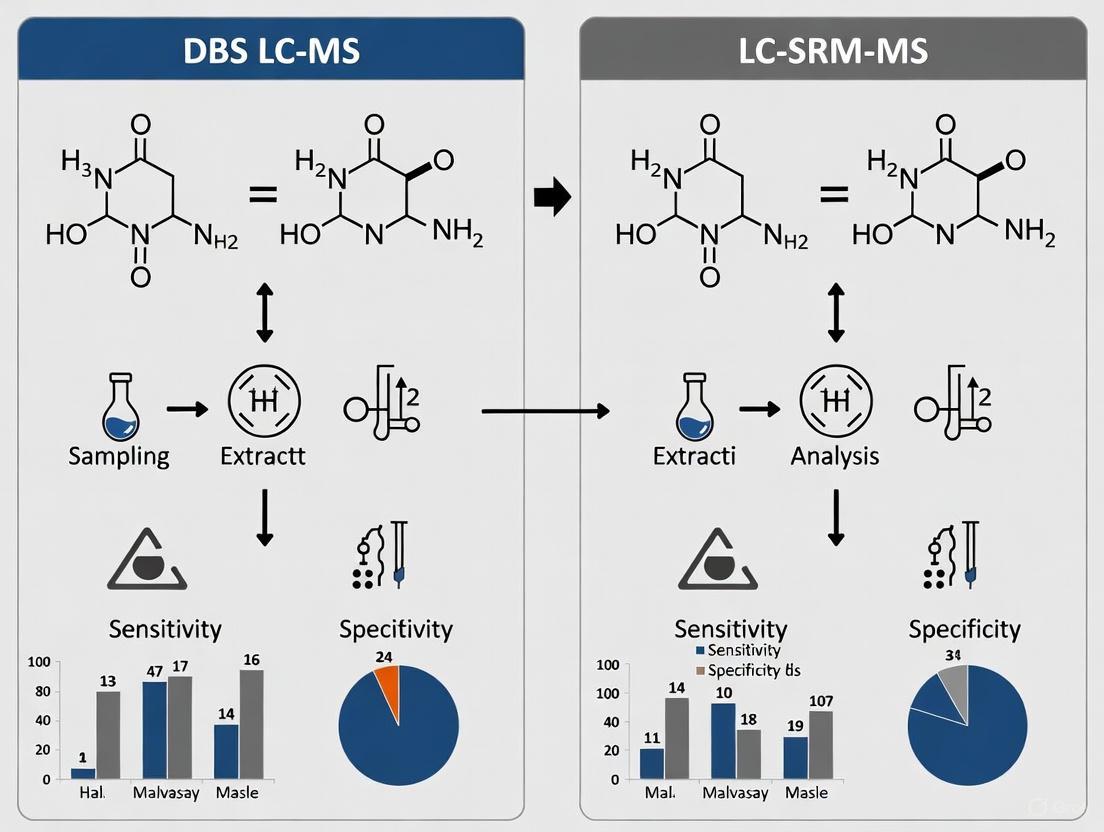
This article provides a comparative analysis of Dried Blood Spot (DBS) sampling coupled with Liquid Chromatography-Mass Spectrometry (LC-MS) versus the established Liquid Chromatography-Selected Reaction Monitoring-Mass Spectrometry (LC-SRM-MS) for forensic toxicology.
DBS LC-MS vs. LC-SRM-MS in Forensic Toxicology: A Comprehensive Guide to Method Selection, Validation, and Application
Abstract
This article provides a comparative analysis of Dried Blood Spot (DBS) sampling coupled with Liquid Chromatography-Mass Spectrometry (LC-MS) versus the established Liquid Chromatography-Selected Reaction Monitoring-Mass Spectrometry (LC-SRM-MS) for forensic toxicology. Aimed at researchers, scientists, and drug development professionals, it explores the foundational principles of both techniques, details methodological workflows for diverse analytes—from synthetic cathinones to antiepileptic drugs—and addresses key troubleshooting challenges such as hematocrit effects and analyte stability. The content synthesizes current validation data and application case studies to guide method selection, ensuring accurate and reliable results in both post-mortem and clinical forensic contexts.
Foundations of DBS LC-MS and LC-SRM-MS: Principles, Evolution, and Scope in Modern Toxicology
Dried Blood Spot (DBS) sampling has undergone a remarkable transformation from its origins in newborn screening to becoming an innovative tool in modern forensic toxicology and bioanalysis. This evolution represents a convergence of microsampling technology, advanced analytical instrumentation, and green chemistry principles. This article examines the technical progression of DBS methodology, with particular focus on its application in conjunction with Liquid Chromatography-Mass Spectrometry (LC-MS) for forensic toxicology research, comparing its performance against conventional Liquid Chromatography-Selected Reaction Monitoring-Mass Spectrometry (LC-SRM-MS) techniques. We provide comprehensive experimental data, methodological protocols, and analytical frameworks to objectively evaluate the capabilities and limitations of DBS-based approaches in forensic science and drug development research.
Historical Evolution and Technical Foundations
The concept of dried blood spot sampling traces back to 1913 when Ivar Bang first demonstrated the determination of glucose from eluates of dried blood spots [1]. However, the technique gained widespread recognition in the 1960s when Robert Guthrie developed a bacterial inhibition assay for phenylketonuria (PKU) screening in newborns, creating what became colloquially known as the "Guthrie card" [2] [3]. For decades thereafter, DBS applications remained primarily focused on newborn screening for metabolic disorders and diagnosis of infectious diseases in resource-limited settings [1].
The integration of DBS with mass spectrometric techniques began in the 1970s, with the first application of MS to DBS analysis reported in 1976 for fatty acid determination using direct chemical ionization [2]. The significant expansion of DBS applications occurred in the 1990s with the commercial availability of electrospray ionization and the incorporation of LC-MS/MS into analytical workflows [2]. This technological advancement enabled researchers to overcome previous sensitivity limitations and explore new applications beyond traditional screening programs.
Today, DBS sampling has gained substantial traction in diverse fields including therapeutic drug monitoring, pharmacokinetic studies, forensic toxicology, metabolic profiling, and environmental contamination control [1]. The technique's renaissance in recent decades is evidenced by an almost exponential increase in scientific publications, growing from approximately 50 annually in 2005 to nearly 450 in recent years [1].
Methodological Comparison: DBS/LC-MS versus LC-SRM-MS
Analytical Performance Characteristics
Table 1: Comparison of Analytical Performance between DBS/LC-MS and Conventional LC-SRM-MS Methods
| Parameter | DBS/LC-MS | Conventional LC-SRM-MS | Remarks |
|---|---|---|---|
| Sample Volume | <100 μL [4] | >0.5 mL [4] | DBS enables microsampling |
| Sensitivity | LLOQ: 0.05-1 ng/mL for CTA metabolites [5] | Comparable to DBS/LC-MS [6] | Method-dependent variability |
| Precision & Accuracy | Meets acceptance criteria for forensic analysis [5] | Established reference method [6] | DBS requires hematocrit correction |
| Storage Requirements | Room temperature (with desiccant) [4] | Frozen (-20°C to -80°C) [4] | DBS offers significant logistical advantages |
| Stability | Weeks to months at room temperature [4] | Requires freezing for long-term storage | DBS stability compound-dependent |
Forensic Application Performance
Table 2: Forensic Toxicological Analysis of Psychotropic Substances Using DBS/LC-MS
| Analyte Category | Specific Compounds | Linear Range (ng/mL) | Recovery (%) | Application Context |
|---|---|---|---|---|
| Benzodiazepines | Alprazolam, Clonazepam, Diazepam, Lorazepam, Nordazepam | 1-500 [6] | 85-115 [6] | Post-mortem analysis, poly-drug intoxication |
| Antidepressants | Citalopram, Fluoxetine, Venlafaxine | 1-500 [6] | 85-115 [6] | Suicide cases, accidental poisoning |
| Z-drugs | Zolpidem | 1-500 [6] | 85-115 [6] | Forensic casework |
| Chemical Threat Agents | PMPA (GD metabolite), EMPA (VX metabolite), SBMSE (sulfur mustard metabolite) | 0.1-50 [5] | Favorable recovery reported [5] | Military and forensic verification of exposure |
| Opioid Metabolites | Norfentanyl, Norcarfentanil, Norsufentanil | 0.05-50 [5] | Favorable recovery reported [5] | Overdose cases, forensic investigations |
Experimental Protocols and Workflows
DBS Sample Collection and Processing Protocol
The following comprehensive protocol for DBS preparation and processing has been validated for immunoassays and molecular techniques [1]:
- Collection of Blood: Blood can be collected via venipuncture (with EDTA anticoagulant) or skin puncture (finger prick). For skin puncture, the first drop should be wiped away with a gauze pad, and subsequent drops collected without excessive "milking" of the finger [1].
- Preparation of Blood Spots: Using a pipette with a disposable tip, transfer 30-50 μL of whole blood to the center of a preprinted circle on filter paper without touching the surface. Alternatively, blood from a finger prick can be applied directly by allowing the drop to touch the paper and be absorbed by capillary action [1].
- Drying of Blood Spots: Place filter cards on a clean paper towel in a biohazard safety cabinet and dry at room temperature for at least 4 hours, preferably overnight. Properly dried spots appear uniformly dark brown without red areas [1].
- Storage and Transportation: After drying, place DBS cards in gas-impermeable bags with desiccant packets and humidity indicator cards. Store at room temperature or lower, depending on analyte stability [1].
- Elution and Analysis: For analysis, punch out a disc from the DBS and transfer to a microtube. Add appropriate extraction solvent, vortex mix, and sonicate to facilitate analyte elution. Centrifuge and transfer the supernatant for LC-MS analysis [6].
DBS Method Validation Protocol
For forensic applications, the DBS/LC-MS method requires comprehensive validation using the following parameters [6]:
- Linearity: Construct 7-point calibration curves using blank blood fortified with analytes of interest. Acceptable linearity typically requires correlation coefficients (r) >0.99 [6].
- Limit of Detection (LOD) and Quantification (LOQ): Determine through successive dilutions of fortified samples. LOD is identified as the lowest concentration with signal-to-noise ratio ≥3:1, while LOQ is the lowest concentration meeting precision (RSD <20%) and accuracy (80-120%) criteria [6].
- Precision and Accuracy: Assess using quality control samples at low, medium, and high concentrations (e.g., 30, 100, 250 ng/mL). Intra-day precision (n=6) and inter-day precision (3 separate days) should demonstrate RSD <15%. Accuracy should be within 85-115% of nominal concentrations [6].
- Recovery and Matrix Effects: Evaluate by comparing analyte responses from extracted DBS samples with those from neat solutions. Matrix effects are assessed by post-extraction addition technique [6].
- Stability Studies: Conduct short-term (room temperature) and long-term (storage conditions) stability assessments, as well as freeze-thaw stability if applicable [6].
Applications in Forensic Toxicology
Case Study: Multi-Analyte Psychotropic Drug Panel
A validated DBS/LC-MS method for the simultaneous determination of 16 psychoactive substances demonstrates the forensic applicability of this technique [6]. The analytes included antidepressants (citalopram, fluoxetine, venlafaxine), benzodiazepines (alprazolam, clonazepam, diazepam), and other psychotropic substances with forensic relevance in cases of suicide, accidental poisoning, and poly-drug intoxication [6].
The method successfully addressed key challenges in post-mortem toxicology, including:
- Complex sample matrix effects through optimized sample preparation
- Variable physicochemical properties of analytes through chromatographic optimization
- Need for sensitive detection of multiple drug classes through selective mass spectrometric detection
The results obtained with DBS/LC-MS showed consistency with those from the routinely used LC-SRM-MS method, confirming its applicability in forensic casework [6].
Chemical Threat Agent Exposure Verification
Recent research has demonstrated the utility of volumetric absorptive microsampling (VAMS) devices for DBS sampling in verifying exposure to chemical threat agents (CTAs) [5]. This approach addressed significant logistical challenges associated with transporting refrigerated or frozen biomedical samples from remote locations to reference laboratories.
Key findings included:
- Sensitive detection of nerve agent metabolites (PMPA, EMPA) at 0.5 ng/mL
- Identification of sulfur mustard metabolite SBMSE at 1 ng/mL
- Detection of synthetic opioid metabolites (norfentanyl, norcarfentanil, norsufentanil, norlofentanil) at 0.05-0.5 ng/mL
- All methods met acceptable precision and accuracy criteria with favorable recovery [5]
The VAMS technology provided additional advantages by minimizing the hematocrit bias associated with conventional filter paper-based DBS sampling, thereby improving quantification reliability [5].
The Scientist's Toolkit: Essential Research Reagents and Materials
Table 3: Essential Materials for DBS/LC-MS Forensic Research
| Item | Specification | Application/Function |
|---|---|---|
| Filter Cards | Whatman 903 or equivalent | Matrix for blood application and storage |
| Microsampling Devices | Mitra VAMS devices (20-30 μL) | Volumetric absorptive microsampling, reduces hematocrit effect [5] |
| Internal Standards | Deuterated analyte analogues (e.g., alprazolam-d5, diazepam-d5) | Correction for extraction efficiency and matrix effects [6] |
| Extraction Solvents | LC-MS grade methanol, acetonitrile, ammonium buffers | Protein precipitation and analyte elution from DBS [6] |
| Chromatography Columns | C18 stationary phase (e.g., 150 × 4.6 mm, 3 μm) | Reversed-phase separation of analytes [6] |
| Mass Spectrometer | LC-MS/MS system with ESI source | Sensitive and selective detection and quantification [6] |
| Storage Materials | Gas-impermeable bags with desiccant | Maintain sample integrity during storage and transport [1] |
Advantages, Challenges, and Future Perspectives
Green Chemistry Aspects
DBS sampling aligns strongly with green chemistry principles, offering significant environmental benefits [7]:
- Reduction of Hazardous Waste: Minimal blood volumes (<100 μL vs. >0.5 mL for conventional sampling) substantially reduce biological waste [4]
- Decreased Solvent Consumption: Microsampling approaches require smaller volumes of organic solvents for extraction
- Energy Efficiency: Elimination of continuous freezing requirements reduces energy consumption
- Simplified Transportation: Room temperature stability removes need for refrigeration during transport, reducing carbon footprint
Current Challenges and Limitations
Despite its advantages, DBS implementation faces several challenges:
- Hematocrit Effect: Variable hematocrit levels can impact blood spread and analyte recovery from filter paper, though VAMS technology mitigates this issue [5]
- Volume Accuracy: Conventional DBS sampling may suffer from volume inaccuracies, addressed by volumetric microsampling devices [5]
- Sensitivity Constraints: Limited sample volume may challenge detection of ultra-trace analytes
- Method Translation: Establishing correlation between DBS and plasma concentrations requires thorough validation [2]
Emerging Trends and Future Directions
The future evolution of DBS technology in forensic science includes:
- Development of Novel Materials: Advanced substrates with improved flow characteristics and reduced hematocrit dependence
- Integrated Sample Preparation: Devices incorporating on-spot extraction or purification
- Automated Processing: High-throughput systems for DBS analysis in mass casualty situations [5]
- Expanded Biomarker Panels: Comprehensive screening for novel psychoactive substances and chemical threat agents
- Point-of-Care Applications: Development of field-deployable DBS systems for rapid screening
DBS sampling has evolved substantially from its origins in newborn screening to become a powerful tool in modern forensic toxicology and pharmaceutical research. The integration of DBS with LC-MS technology offers a compelling alternative to conventional LC-SRM-MS approaches, particularly when considering the green chemistry benefits, operational efficiencies, and analytical performance characteristics. While challenges remain in quantification accuracy and method standardization, ongoing technological innovations continue to address these limitations. The experimental data and methodological frameworks presented herein provide researchers with comprehensive resources for implementing DBS-based approaches in forensic science and drug development contexts. As microsampling technologies continue to advance, DBS methodologies are poised to play an increasingly significant role in forensic toxicology, therapeutic monitoring, and exposure assessment applications.
Liquid Chromatography-Selected Reaction Monitoring-Mass Spectrometry (LC-SRM-MS) represents the established gold standard for confirmatory analysis in forensic toxicology, providing the sensitivity, specificity, and reproducibility required for legal defensibility. This comprehensive guide examines its performance against emerging alternatives including dried blood spot (DBS) sampling and high-resolution mass spectrometry (HRMS) techniques.
In forensic toxicology, where analytical results carry significant legal consequences, confirmatory methods must provide unambiguous compound identification and precise quantification. LC-SRM-MS, typically performed on triple quadrupole instruments, has maintained its status as the gold standard by offering exceptional sensitivity and specificity through the monitoring of predefined precursor-product ion transitions [8] [9]. This targeted approach is particularly valuable in forensic casework, where evidence must withstand rigorous legal scrutiny.
While LC-SRM-MS excels in targeted quantification, forensic laboratories increasingly employ complementary techniques to address diverse analytical challenges. The integration of DBS sampling and high-resolution mass spectrometry represents significant methodological advances, each offering distinct advantages for specific forensic applications.
Experimental Comparison: LC-SRM-MS Versus Emerging Techniques
Quantitative Performance Assessment
Forensic methodologies are evaluated through rigorous validation parameters including sensitivity, precision, accuracy, and reproducibility. The following table summarizes comparative performance data across multiple techniques:
Table 1: Analytical Performance Comparison of Mass Spectrometry Methods in Forensic Toxicology
| Method | Analytes | Key Performance Metrics | Limitations |
|---|---|---|---|
| LC-SRM-MS (Triple Quadrupole) | 48 illicit drugs in whole blood [10] | Two MRM transitions per compound; retention time matching; ion ratio precision ±20% [10] | Limited to targeted compounds; cannot retrospectively screen for untargeted substances |
| DBS/LC-MS | 16 psychoactive substances in post-mortem blood [6] [11] | LOD improvements up to 12-fold after protocol optimization; results consistent with LC-SRM-MS [11] | Hematocrit effect potential; sample volume limitations for multiple analyses |
| LC-HRMS (QTOF) | Broad-spectrum screening [12] [10] | Mass accuracy <5 ppm; capable of discriminating isobaric compounds [10] | Generally lower sensitivity and dynamic range compared to SRM [10] |
| LC-MS/MS (General Screening) | 15% more drugs identified vs. single-stage MS [8] | Tandem MS methods identified 15% more drugs than single stage MS or LC-UV methods [8] | Requires manual data review to eliminate false positives/negatives [8] |
Forensic Application Focus: DBS Methodology
Dried Blood Spot sampling coupled with LC-MS has emerged as a complementary approach to traditional liquid blood analysis, offering distinct advantages for specific forensic scenarios:
Table 2: DBS/LC-MS Forensic Applications and Advantages
| Application Area | Specific Examples | Forensic Advantages |
|---|---|---|
| Drugs of Abuse Detection | Benzodiazepines, amphetamines, cocaine metabolites, opioids, z-drugs [6] | Minimal sample volume (5-10 μL); improved compound stability; reduced infection risk [6] [12] |
| Post-Mortem Toxicology | Antidepressants, benzodiazepines, anticonvulsants, hypnotics [6] [11] | Cost-effective storage; solution for delayed prosecutor testing decisions [6] |
| Method Verification | Comparison of 16 psychoactive substances in post-mortem samples [11] | Results consistent with LC-SRM-MS; demonstrated precision, reproducibility, and sensitivity [11] |
Experimental Protocols: Forensic Methodologies in Practice
Standard LC-SRM-MS Workflow for Blood Analysis
The following protocol represents a validated approach for targeted drug detection in whole blood:
- Sample Preparation: 100 μL whole blood mixed with 200 μL glacial acetonitrile (-20°C) for protein precipitation [10]
- Extraction: Addition of 40 mg QuEChERS salts (4 g MgSO₄/1 g NaCl/1 g sodium citrate dihydrate/0.5 g sodium citrate sesquihydrate); centrifugation; collection of supernatant [10]
- Chromatographic Separation:
- Column: 100 × 2.1 mm, 2.7-μm biphenyl column
- Mobile Phase: (A) 2 mM ammonium formate/0.002% formic acid; (B) methanol with 2 mM ammonium formate/0.002% formic acid
- Gradient: 5-40% B (1-2 min); 40-100% B (2-10.5 min); 100% B (10.5-11 min); re-equilibration [10]
- SRM Detection: Triple quadrupole mass spectrometer monitoring two transitions per compound; identification requires retention time match ±2.5% and ion ratio match ±20% of calibrator [10]
DBS/LC-MS Method for Psychoactive Substances
The DBS methodology has been optimized for forensic applications:
- Sample Collection: 85 μL blood pipetted onto Whatman 903 or FTA cards; dried for 2 hours at room temperature [13]
- Extraction: Entire spot cut out; sonicated for 10 minutes in 1 mL phosphate buffer (pH 6); centrifuged at 4000×g for 5 minutes [13]
- Cleanup: Solid-phase extraction using Bond Elut Certify I cartridges (200 mg); activation with 2 mL methanol; conditioning with 2 mL phosphate buffer (pH 6) [13]
- Analysis: LC-MS/MS with MRM detection; two transitions monitored per substance for identification [13]
Diagram 1: Comparative workflows for traditional LC-SRM-MS and DBS/LC-MS methods
Complementary Techniques: HRMS for Unambiguous Identification
High-Resolution Mass Spectrometry has emerged as a powerful complementary technique to address the limitations of nominal mass instruments:
Case Study: Discrimination of Isobaric Compounds
- Initial Finding: LRMS method identified 2C-B (amphetamine derivative) in DUID case with proper retention time and two transitions (260.10 > 243.05; 260.10 > 228.10) within ±20% ratio tolerance [10]
- HRMS Analysis: Precursor mass measured at 260.16391 m/z (expected 260.0281 m/z for 2C-B); mass error >500 ppm; fragments did not match expected values [10]
- Conclusion: LRMS provided false positive due to isobaric interference; HRMS prevented erroneous identification with mass accuracy requirement of <5 ppm [10]
Method Selection Decision Pathway
Diagram 2: Forensic method selection pathway based on analytical requirements
The Scientist's Toolkit: Essential Research Reagents and Materials
Table 3: Essential Materials for Forensic LC-MS Analysis
| Material/Reagent | Specification | Application in Forensic Analysis |
|---|---|---|
| Chromatography Column | 100 × 2.1 mm, 2.7μm biphenyl column [10] | Separation of diverse drug compounds with varying polarities |
| Extraction Sorbents | QuEChERS salts (MgSO₄/NaCl/sodium citrate) [10] | Efficient sample cleanup and protein precipitation |
| DBS Cards | Whatman 903 or FTA cards [13] | Microsampling; simplified storage and transport |
| Solid Phase Extraction | Bond Elut Certify I cartridges (200 mg) [13] | Purification of extracts prior to analysis |
| Mobile Phase Additives | Ammonium formate, formic acid [10] | Enhanced ionization efficiency and chromatographic resolution |
| Internal Standards | Deuterated drug analogues [6] | Quantification accuracy and compensation for matrix effects |
LC-SRM-MS maintains its position as the gold standard for forensic confirmatory analysis due to its exceptional sensitivity, reproducibility, and robust quantitative capabilities. However, the integration of complementary techniques including DBS sampling and HRMS represents the evolving landscape of forensic toxicology. DBS/LC-MS offers practical solutions for sample collection, storage, and analysis when sample volume is limited, while HRMS provides unambiguous compound identification crucial for challenging cases involving isobaric interferences. The modern forensic laboratory benefits from a strategic combination of these technologies, leveraging the respective strengths of each approach to ensure comprehensive and legally defensible analytical results.
The integration of Dried Blood Spot (DBS) sampling with Liquid Chromatography-Mass Spectrometry (LC-MS) represents a transformative synergy in analytical science, particularly within forensic toxicology and biomedical research. This powerful combination addresses critical challenges in biological sample analysis, enabling minimally invasive collection, enhanced sample stability, and streamlined logistics while maintaining the analytical rigor required for precise quantification. DBS methodology, originally pioneered by Guthrie in the 1960s for newborn screening, has evolved dramatically with advancements in mass spectrometry [2]. The fusion of these technologies has expanded the analytical toolbox, allowing researchers and forensic scientists to overcome traditional limitations associated with conventional venous blood collection, including biohazard risks, cold-chain requirements, and large sample volume necessities.
Within forensic toxicology, the DBS LC-MS method presents a compelling alternative to established techniques such as Liquid Chromatography-Selected Reaction Monitoring Mass Spectrometry (LC-SRM-MS), offering distinct advantages for specific applications while introducing unique considerations that must be addressed for method validation and implementation. This comparison guide objectively examines the performance characteristics of DBS LC-MS alongside conventional approaches, providing researchers and drug development professionals with experimental data to inform their analytical strategies.
Fundamental Principles: DBS Technology and LC-MS Instrumentation
Dried Blood Spot Methodology Essentials
DBS sampling involves the collection of small volumes of peripheral blood (typically 10-50 μL) onto specialized filter paper cards, followed by drying and storage at ambient temperatures [14]. This simple yet innovative approach fundamentally alters the pre-analytical workflow:
- Minimal Invasion: Collection via finger or heel prick eliminates need for venipuncture and clinical expertise
- Sample Stability: Many analytes demonstrate enhanced stability in dried matrix, reducing degradation during storage
- Logistical Simplification: Room temperature storage and shipping eliminates cold-chain requirements
- Biohazard Reduction: Dried samples pose lower infection risk compared to liquid blood
The DBS technique has found applications across diverse fields including therapeutic drug monitoring, toxicology, infectious disease testing, and metabolomic studies [6] [2]. However, analytical challenges persist, particularly regarding hematocrit effects on blood viscosity and spot morphology, analyte distribution homogeneity, and extraction efficiency from cellulose matrices [14].
Liquid Chromatography-Mass Spectrometry Platforms
LC-MS technology has evolved through significant instrumental advancements since its conceptualization in the mid-20th century [15]. Modern LC-MS systems combine the separation power of liquid chromatography with the detection specificity and sensitivity of mass spectrometry:
- Ionization Sources: Electrospray ionization (ESI) and atmospheric pressure chemical ionization (APCI) enable analysis of non-volatile and thermally labile compounds
- Mass Analyzers: Quadrupole, time-of-flight (TOF), Orbitrap, and ion trap systems provide varying resolution, mass accuracy, and dynamic range capabilities
- Hybrid Systems: Tandem configurations (QQQ, Q-TOF, Q-Orbitrap) combine complementary strengths for targeted and untargeted analysis
In forensic toxicology, LC-MS/MS has emerged as the leading technique for routine analysis of biological materials due to its exceptional sensitivity, specificity, and ability to analyze multiple analytes simultaneously [6] [15]. The technology's evolution has directly enabled the application of DBS to quantitative bioanalysis, overcoming limitations associated with small sample volumes and low analyte concentrations.
Experimental Comparison: DBS LC-MS Versus Conventional LC-SRM-MS
Methodological Framework and Validation Protocols
A direct comparative study evaluating DBS/LC-MS against conventional LC-SRM-MS for forensic analysis examined 16 psychotropic substances including benzodiazepines, antidepressants, and z-drugs [6]. The experimental design incorporated:
Sample Preparation Protocols:
- DBS/LC-MS: Blood spots applied to DBS cards, dried, punched, and extracted with appropriate solvents
- LC-SRM-MS: Conventional liquid blood processing using protein precipitation or solid-phase extraction
Chromatographic Conditions:
- Column: Reversed-phase C18 column (150 × 4.6 mm, 3 μ)
- Mobile Phase: Gradient elution with acetonitrile and ammonium acetate buffer
- Flow Rate: 0.4 ml/min with total run time of 11 minutes
Mass Spectrometric Parameters:
- Ionization: Heated electrospray ionization (HESI)
- Polarity: Positive and negative mode switching
- Detection: Multiple Reaction Monitoring (MRM) transitions
Validation Parameters Assessed:
- Linearity across therapeutic and toxicological ranges
- Intra-day and inter-day precision (% RSD)
- Accuracy (% bias)
- Matrix effects and extraction efficiency
- Limit of detection (LOD) and quantification (LOQ)
Table 1: Comparative Analytical Performance of DBS LC-MS vs. LC-SRM-MS for Forensic Toxicology
| Analyte Class | Specific Compounds | Linearity (ng/mL) | Precision (% RSD) | Accuracy (%) | Correlation Between Methods |
|---|---|---|---|---|---|
| Benzodiazepines | Diazepam, Nordazepam, Alprazolam | 1-500 | <10% | 92-108 | R² > 0.98 |
| Antidepressants | Citalopram, Fluoxetine, Venlafaxine | 1-500 | <12% | 90-110 | R² > 0.97 |
| Z-Drugs | Zolpidem | 1-500 | <11% | 94-106 | R² > 0.98 |
| Anticonvulsants | Carbamazepine | 1-500 | <9% | 95-105 | R² > 0.99 |
Performance Data Interpretation
The experimental results demonstrated that the developed DBS/LC-MS method successfully determined concentrations of all 16 psychoactive substances in post-mortem blood samples with performance characteristics equivalent to the established LC-SRM-MS reference method [6]. Quantitative results showed strong correlation between techniques, with accuracy values within ±10% of reference values and precision below 12% RSD across all analytes.
Notably, the DBS approach demonstrated sufficient sensitivity for forensic application, with LOD values adequate for detecting therapeutic and toxic concentrations of the target compounds. Method validation confirmed acceptable selectivity with minimal matrix interference despite the simpler sample preparation protocol employed for DBS extracts.
Comparative Advantages and Limitations in Forensic Applications
Operational and Analytical Benefits of DBS LC-MS
Pre-Analytical Advantages:
- Sample Stability: DBS samples demonstrate improved stability for numerous analytes. One study documented stability of antiepileptic drugs in DBS for at least 30 days at room temperature [14]
- Logistical Simplification: Eliminates cold-chain requirements, reducing storage and transportation costs by up to 70% according to forensic laboratory estimates
- Microsampling Capability: Minimal blood volumes (10-20 μL) enable applications in pediatrics, animal studies respecting 3R principles, and serial sampling scenarios [16]
Analytical Performance Merits:
- Multiplexing Capacity: Simultaneous quantification of multiple drug classes in single extraction, as demonstrated for 11 antiepileptic drugs [14]
- Specificity and Sensitivity: LC-MS/MS detection achieves low ng/mL limits of quantification sufficient for most forensic toxicology applications
- High Throughput Potential: 96-well plate formatted extractions enable automated processing of numerous samples [17]
Technical Challenges and Methodological Constraints
DBS-Specific Limitations:
- Hematocrit Effects: Variable hematocrit impacts blood viscosity, spot morphology, and extraction efficiency, potentially affecting quantitative accuracy [14]
- Volume Accuracy: Manual spotting introduces potential variability, though automated systems mitigate this concern
- Analyte Distribution: Uneven compound distribution within spots may affect punch-to-punch reproducibility
Comparative Performance Considerations:
- Sensitivity Boundaries: While generally sufficient for forensic applications, DBS may show limited sensitivity for ultra-trace analytes compared to conventional extraction from larger plasma volumes
- Method Development Complexity: Requires optimization of additional parameters including punch location, disc size, and extraction solvents
Table 2: Method Selection Guide: DBS LC-MS vs. Conventional LC-MS Approaches
| Parameter | DBS LC-MS | Conventional LC-MS | Application Context |
|---|---|---|---|
| Sample Volume | 10-50 μL | 100-1000 μL | Pediatric, serial sampling |
| Storage Requirements | Room temperature (with desiccant) | -20°C to -80°C | Resource-limited settings |
| Stability Timeline | Weeks to months (analyte dependent) | Variable (often shorter) | Long-term storage needs |
| Extraction Efficiency | 70-95% (method dependent) | 80-98% | Trace analysis requirements |
| Hematocrit Sensitivity | Significant impact | Minimal impact | Populations with hematocrit variability |
| Throughput Potential | High (automation compatible) | Moderate to high | High-volume laboratories |
| Implementation Cost | Lower (storage, shipping) | Higher (cold chain, disposal) | Cost-conscious environments |
Advanced Applications and Implementation Protocols
Forensic Toxicology Workflow Integration
The DBS LC-MS methodology has been successfully implemented in diverse forensic applications, demonstrating particular utility in:
Post-Mortem Investigations: Analysis of 16 psychoactive substances in post-mortem blood demonstrated equivalent performance to conventional methods, with additional advantages in sample storage and re-testing capabilities [6]. The DBS approach enables retrospective analysis when case review necessitates additional testing.
Toxicokinetic Studies: A proof-of-concept study quantified fipronil and its metabolites in rat DBS samples with LLOQ of 0.1 ng/mL, demonstrating application for toxicokinetic assessment while significantly reducing animal blood volumes [16].
Workflow Diagram: DBS LC-MS Forensic Analysis Process
Specialized Research Applications
Therapeutic Drug Monitoring: A validated DBS LC-MS/MS method for 11 antiepileptic drugs demonstrated accuracy and precision within 6% in intra- and inter-day assays, supporting clinical implementation for TDM [14]. The method utilized a 3 mm diameter disc punch from DBS, achieving accurate results for all target drugs.
Biomonitoring of Environmental Toxicants: DBS sampling coupled with LC-MS/MS enabled quantification of fipronil and its metabolites in human blood with LLOQ of 0.1 ng/mL, facilitating population biomonitoring studies with simplified sample collection [16].
Proteomic Applications: Advanced applications extend beyond small molecules to protein quantification. One study developed a highly multiplexed MRM assay quantifying 97 proteins in human DBS samples, demonstrating the technique's versatility [17].
Essential Research Reagent Solutions
Successful implementation of DBS LC-MS methodologies requires specific materials and reagents optimized for the technique:
Table 3: Essential Research Reagents for DBS LC-MS Implementation
| Reagent/Material | Specification | Function | Application Notes |
|---|---|---|---|
| DBS Collection Cards | Whatman 903, FTA, or equivalent | Sample collection medium | Protein saver cards preferred for proteomic applications [17] |
| Extraction Solvents | LC-MS grade ACN, MeOH, buffers | Analyte extraction from matrix | ACN provides efficient protein precipitation and clean extracts [14] [16] |
| Internal Standards | Stable isotope-labeled analogs | Quantification normalization | Essential for correcting extraction variability [6] |
| Mobile Phase Additives | Ammonium acetate/formate, formic acid | LC separation enhancement | Volatile buffers compatible with MS detection [18] |
| Hematocrit Control | Characterized blood samples | Method validation | Critical for assessing hematocrit impact on quantification |
The synergistic combination of DBS sampling with LC-MS analysis represents a significant advancement in the analytical toolbox for forensic toxicology and biomedical research. Experimental comparisons demonstrate that DBS LC-MS methods can achieve performance characteristics equivalent to conventional LC-SRM-MS approaches for numerous applications, while offering distinct advantages in sample collection, storage, and logistics.
The choice between DBS LC-MS and conventional approaches ultimately depends on specific application requirements, with DBS methodology offering compelling benefits for remote sampling, pediatric populations, high-throughput screening, and resource-limited settings. As technological advancements continue to address current limitations—particularly regarding hematocrit effects and sensitivity constraints—the implementation of DBS LC-MS is poised to expand further, potentially establishing it as a gold standard for specific forensic and clinical applications.
Future developments will likely focus on standardized protocols, automated processing systems, and expanded application to emerging analyte classes, further solidifying the role of DBS LC-MS as a versatile and powerful analytical platform.
Forensic toxicology is a discipline that faces the continuous challenge of identifying and quantifying a vast array of substances in complex biological matrices, with applications spanning from post-mortem investigations to clinical overdose cases. The core mission is to detect and measure compounds such as drugs of abuse, pharmaceuticals, and new psychoactive substances (NPS) in samples like blood, urine, and tissues [19] [20]. The analytical landscape in modern toxicology laboratories is dominated by hyphenated mass spectrometry techniques, with Liquid Chromatography-Mass Spectrometry (LC-MS) and its more specific counterpart, Liquid Chromatography-Selected Reaction Monitoring-Mass Spectrometry (LC-SRM-MS), serving as foundational methodologies [6] [19]. This guide provides a comparative analysis of the emerging Dried Blood Spot (DBS) sampling technique coupled with LC-MS against the established standard of LC-SRM-MS, offering objective performance data and detailed protocols to inform researchers and drug development professionals.
Analytical Technique Comparison: DBS/LC-MS vs. LC-SRM-MS
The choice of analytical methodology significantly impacts factors such as workflow efficiency, cost, and the ability to handle diverse case types. The table below summarizes the core characteristics of the DBS/LC-MS method compared to a conventional LC-SRM-MS approach.
Table 1: Core Method Comparison: DBS/LC-MS vs. Conventional LC-SRM-MS
| Feature | DBS/LC-MS Method | Conventional LC-SRM-MS |
|---|---|---|
| Primary Application | Broad-spectrum screening & quantification of drugs in dried blood [6] [2] | Gold-standard quantification for a wide range of analytes in liquid blood [21] [22] |
| Sample Volume | Small (e.g., ~85 µL per spot) [13] | Larger volumes typically required |
| Sample Storage & Transport | Room temperature storage; easy and safe transport [6] | Requires refrigeration/freezer; more complex logistics |
| Inherent Biohazard Risk | Reduced (pathogens inactivated on some cards) [13] | Standard biohazard risk |
| Key Challenge | Potential hematocrit effect (if sub-punching); method harmonization [2] [23] | Complex sample preparation; higher solvent consumption [6] |
Experimental Data and Performance Comparison
Quantitative Analytical Performance
When validated for specific analytes, both techniques can demonstrate excellent analytical performance. The following table compiles key validation data from the literature for the detection of pharmaceuticals and drugs of abuse.
Table 2: Quantitative Performance Data for Forensic Analytes
| Analyte Class | Specific Analytes | Method | Linear Range | Precision (%)(Intra-day) | LOD/LOQ | Reference |
|---|---|---|---|---|---|---|
| Psychoactive Pharmaceuticals | Alprazolam, Citalopram, Zolpidem (16 total) | DBS/LC-MS | Up to 250 ng/mL | <15% | LOD: 0.5-5 ng/mLLOQ: 1-15 ng/mL | [6] |
| Broad-Spectrum Drugs | 100 Analytes (Abuse, NPS, Pharma) | LC-MS/MS (LLE) | - | - | LOD: 0.1-5 ng/mLLOQ: 0.5-15 ng/mL | [21] |
| Drugs of Abuse | Cocaine, Metabolites, Opiates | DBS/LC-MS | - | - | - | [6] [13] |
Comparative Analysis of Real-World Sample Results
Studies directly comparing analyte concentrations measured in real patient or post-mortem samples using different techniques and matrices provide critical insights for method selection.
Table 3: Comparison of Quantitative Results from Authentic Samples
| Study Focus | Sample Type & Scale | Key Finding | Implication | Reference |
|---|---|---|---|---|
| DBS vs. Liquid Blood Correlation | 20 post-mortem blood samples | Good quantitative correlation for most analytes (e.g., drugs of abuse). Lower concentrations for some benzodiazepines/antidepressants on FTA cards. | DBS is generally reliable; substrate choice is critical. | [13] |
| Hematocrit Independence | 91 patient samples (hct: 0.17-0.53) | HemaPEN volumetric DBS: ≤7% concentration change. Conventional 3mm DBS sub-punch: ≥25% change. | Volumetric DBS devices can mitigate hematocrit effect. | [23] |
| Method Agreement | Post-mortem blood for 16 substances | DBS/LC-MS results were consistent with LC-SRM-MS. | DBS/LC-MS is a viable alternative to the standard method. | [6] |
Detailed Experimental Protocols
Protocol 1: DBS/LC-MS Analysis of Psychoactive Substances in Post-Mortem Blood
This protocol is adapted from methodologies used for the analysis of drugs of abuse, benzodiazepines, and antidepressants [6] [13].
Step 1: Sample Preparation and Spotting
- Collect cardiac or peripheral blood using tubes with appropriate anticoagulants.
- Pipette a precise volume (e.g., 85 µL) of homogenized blood onto a DBS card (Whatman 903 or FTA).
- Allow spots to dry for approximately 2 hours at room temperature, protected from light [13].
Step 2: Extraction and Purification
- Punch out the entire blood spot and transfer it to a glass tube.
- Add 1 mL of an internal standard solution in phosphate buffer (pH 6) to the tube.
- Sonicate the mixture for 10 minutes, vortex for 10 seconds, and then centrifuge at 4000 g for 5 minutes.
- Transfer the supernatant and perform a solid-phase extraction (SPE) using a mixed-mode cartridge (e.g., Bond Elut Certify).
- After loading, wash the cartridge, dry it, and elute the analytes with a suitable organic solvent mixture [13].
Step 3: LC-MS/MS Analysis
- Evaporate the eluent under a gentle stream of nitrogen and reconstitute the dry extract in mobile phase.
- Inject the sample into the LC-MS/MS system.
- Chromatography: Use a reverse-phase C18 column (e.g., 100 x 2.1 mm, 2.6 µm) with a gradient elution of 0.1% formic acid in water and 0.1% formic acid in acetonitrile at 35°C [13].
- Mass Spectrometry: Operate the mass spectrometer in positive electrospray ionization (ESI+) mode. Monitor each analyte and its internal standard using two specific Multiple Reaction Monitoring (MRM) transitions for unambiguous identification [6].
The workflow for this protocol is summarized in the following diagram:
Protocol 2: Conventional LC-SRM-MS Broad-Spectrum Screening
This protocol outlines the development and validation of a method for 100 analytes in blood, representing a standard approach in many forensic laboratories [21].
Step 1: Liquid-Liquid Extraction (LLE)
- To 200 µL of whole blood (clinical or autopsy), add deuterated internal standards.
- Add 1 mL of 0.1 M HCl and 1 mL of acidified methyl tert-butyl ether (MTBE).
- Vortex the mixture for 10 minutes and then centrifuge.
- Transfer the organic (upper) layer to a new tube and evaporate to dryness under nitrogen [21].
Step 2: LC-SRM-MS Analysis
- Reconstitute the dry extract in 100 µL of mobile phase.
- Chromatography: Utilize a reverse-phase column (e.g., Phenomenex Kinetex C18, 100 x 2.1 mm, 2.6 µm) with a gradient of ammonium formate buffer and methanol as the mobile phase.
- Mass Spectrometry: Employ electrospray ionization (ESI) in positive mode. The SRM mode is used for detection, monitoring two specific transitions for each analyte to ensure high selectivity and sensitivity as required for forensic confirmation [21].
The Scientist's Toolkit: Essential Research Reagents and Materials
The following table details key consumables and reagents critical for executing the described forensic toxicology analyses.
Table 4: Essential Research Reagents and Materials for Forensic Analysis
| Item | Specification / Example | Primary Function in Analysis |
|---|---|---|
| DBS Cards | Whatman 903, Whatman FTA | Cellulose-based substrate for collection, storage, and analysis of dried blood samples. FTA cards contain chemicals that lyse cells and inactivate pathogens [13]. |
| Internal Standards | Deuterated Analytes (e.g., Alprazolam-d5, Diazepam-d5) | Added to samples prior to processing to correct for analyte loss during extraction and ionization variability in the MS [6] [13]. |
| SPE Cartridges | Mixed-Mode Cation Exchange (e.g., Bond Elut Certify) | Purify sample extracts by retaining basic drugs and metabolites while removing interfering matrix components [13]. |
| LC Column | C18 Reverse-Phase (e.g., 100 x 2.1 mm, 2.6 µm) | Separate the complex mixture of analytes from a biological extract prior to introduction into the mass spectrometer [21] [13]. |
| Mass Spectrometer | Triple Quadrupole (QqQ) | The core analytical instrument, operated in SRM mode for highly specific and sensitive quantification of target analytes [19] [21]. |
The experimental data and protocols presented highlight the complementary strengths of DBS/LC-MS and conventional LC-SRM-MS methods. The DBS approach offers significant advantages in simplifying sample collection, storage, and transport, making it particularly valuable for remote sampling or when storing a large number of samples for potential future analysis is required, such as in forensic casebacks [6] [2]. The demonstrated consistency between DBS/LC-MS results and the gold-standard LC-SRM-MS method supports its reliability for qualitative and quantitative toxicological analysis [6].
Conversely, conventional LC-SRM-MS remains the benchmark for robust, high-throughput quantification of a vast number of analytes in liquid blood, with well-established protocols and a long history of application in both clinical and post-mortem forensic toxicology [21] [22]. The choice between these methods is not necessarily one of superiority but of strategic application. Factors such as the specific analytes of interest, sample volume availability, logistical constraints of sample transport and storage, and the required throughput should guide the selection process. For ongoing challenges like the rapid emergence of new psychoactive substances (NPS), the agility of LC-MS platforms, whether fed by DBS or liquid samples, coupled with ongoing research and reference material development, will be crucial for maintaining the robustness of forensic science [20].
Method Development and Practical Applications: From Sample Collection to Data Acquisition
Dried Blood Spot (DBS) sampling has revolutionized bioanalysis by providing a less invasive, more convenient alternative to traditional venipuncture. This microsampling technique (collecting ≤150 µL of capillary blood) has gained significant traction in diverse fields, including forensic toxicology, therapeutic drug monitoring (TDM), and sports anti-doping testing [24] [25]. The evolution from classical filter paper cards to advanced volumetric devices has been driven by the need to overcome pre-analytical variability, particularly issues related to hematocrit (HCT) effects and inaccurate blood volumes [24] [26]. This guide provides a objective comparison of available DBS collection devices, supported by experimental data, to inform researchers and professionals in selecting the appropriate tool for their LC-MS/MS-based research.
Understanding DBS Technologies and Their Evolution
The fundamental principle of DBS involves collecting a small volume of capillary blood from a finger-prick onto a substrate for drying, subsequent storage, and analysis. The key advantage lies in its simplicity and the logistical benefits of easier storage and transport without stringent temperature constraints [24]. However, not all DBS devices are created equal, and their technology has advanced considerably.
Classical DBS Cards: The pioneering DBS technique, dating back to 1963, uses paper-based filter cards (e.g., Whatman 903). A fixed volume of blood (e.g., 20-80 µL) is applied to the card, forming a spot. For analysis, a fixed-diameter punch (e.g., 6 mm) is taken from the spot [24]. A critical limitation of this method is the hematocrit (HCT) effect. HCT influences blood viscosity, which in turn affects the spot size and the homogeneity of analyte distribution within the spot. Higher HCT values result in smaller spots and can lead to lower extraction recovery, causing underestimation of analytes and introducing significant variability [24].
Volumetric Microsampling Devices: Newer technologies have been engineered to provide volumetric accuracy independent of HCT.
- Volumetric Absorptive Microsampling (VAMS): Devices like the Mitra use a tip that absorbs a fixed volume of blood (e.g., 10, 20 µL) [24] [26].
- Microfluidic Devices: Devices like the Capitainer B use a capillary microchannel to collect a precise volume of blood (e.g., 10 µL) onto a designated spot [24]. These devices are designed to eliminate the HCT-related bias associated with spot size and volume uncertainty in classical DBS, thereby improving the accuracy of quantitative analysis [24] [26].
Comparative Analysis of DBS Collection Devices
The following table summarizes the key characteristics of several commercially available DBS and microsampling devices, highlighting the technological advancements in volumetric control and HCT bias mitigation.
Table 1: Overview of Commercial Microsampling Devices for Blood Collection
| Device Name | Sample Type | Collection Method | Volume per Sample | Volumetric? | Potential HCT Bias? |
|---|---|---|---|---|---|
| Whatman 903 [24] | Dry whole blood | Capillary blood after finger-prick | 20–80 µL | No | Yes |
| Capitainer B (qDBS) [24] | Dry whole blood | Capillary blood after finger-prick | 10 µL | Yes | No |
| Mitra [24] | Dry whole blood | Capillary blood after finger-prick | 10, 20, 30 µL | Yes | No |
| HemaPEN [24] | Dry whole blood | Capillary blood after finger-prick | 2.74 µL (x4 per device) | Yes | No |
| TASSO-M20 [24] | Dry whole blood | Push-button device from upper arm | 17.5 µL | Yes | No |
| hemaPEN [24] | Dry whole blood | Capillary blood after finger-prick | 2.74 µL (x4 per device) | Yes | No |
Experimental Performance Data in Analytical Applications
The theoretical advantages of volumetric devices are borne out in practical, peer-reviewed studies. The data below demonstrates how different devices perform in real-world analytical scenarios relevant to forensic toxicology and TDM.
Comparative Clinical Validation for Immunosuppressant Drugs
A 2021 study directly compared conventional DBS cards (Whatman 903) with Mitra VAMS for the determination of Tacrolimus (TAC) and Mycophenolic Acid (MPA) in hepatic transplant patients [26]. The results underscore the impact of the collection device on analytical performance.
Table 2: Clinical Validation Data for TAC and MPA in DBS vs. VAMS [26]
| Analyte & Device | Correlation with Reference (R²) | Transformation Required? | Met Clinical Agreement Criteria? |
|---|---|---|---|
| TAC in c-DBS | Good | No | Yes |
| TAC in c-VAMS | Good | Yes | Yes |
| MPA in c-DBS | Good | Yes | Yes |
| MPA in c-VAMS | Good | Yes | Yes |
The study concluded that while both methods showed good correlation with reference plasma (PL) or whole blood (WB) methods, concentration transformation was required in all cases except for TAC in conventional DBS [26]. This highlights that even with advanced devices, careful method validation is essential. Both techniques met the acceptance criteria set by regulatory bodies like the EMA and FDA, making them viable for TDM.
Device Performance in Anti-Doping Analysis
A 2025 study evaluated four commercial DBS devices for detecting glucocorticoids using UHPLC–MS/MS, providing a clear comparison of analytical figures of merit [25].
Table 3: Performance Comparison of DBS Devices in Glucocorticoid Analysis [25]
| Performance Metric | Chip Device | Tip Device | Card Device | Strip Device |
|---|---|---|---|---|
| Precision | High | High | Lower | Variable |
| Recovery Rates | Strong | Strong | Weaker | Variable |
| HCT Effect | Lower | Lower | Pronounced | Pronounced |
| Agreement with WB | Better | Better | Weaker | Weaker |
| Usability | Favorable | Favorable | Less Favorable | Less Favorable |
The study identified Chip and Tip-based devices (volumetric microsamplers) as having more favorable overall performance, with higher precision, stronger recovery rates, and better agreement with whole blood values compared to classical Card and Strip devices [25].
Detailed Experimental Protocols
To ensure reproducible and reliable results, standardizing the collection, processing, and analysis protocol is critical. The following workflow details the key steps.
General DBS Collection and Processing Workflow
The diagram below illustrates the core steps for processing DBS samples, from collection to LC-MS/MS analysis.
Key Protocol Steps:
- Sample Collection: Clean the site (typically middle or ring finger) with an alcohol swab and allow to dry. Use a sterile, single-use lancet to perform a finger-prick. Wipe away the first drop of blood and allow a large, free-hanging drop to form [27].
- Blood Application:
- For Cards: Touch the tip of the filter paper to the blood drop, allowing it to soak through and fully saturate a pre-defined circle without smearing. Avoid touching the paper directly to the skin [27].
- For VAMS: Bring the absorptive tip of the device to the blood drop until it is completely filled, as indicated by a color change [26].
- Drying: Place the device on a clean, dry, and level surface. Air-dry at room temperature for a minimum of 3-4 hours, protected from direct sunlight, dust, and moisture. Do not seal samples before they are completely dry [27].
- Storage and Transport: Once dry, place the DBS cards or devices in low gas-permeability re-sealable bags with a desiccant packet and a humidity indicator card. For short-term storage (up to a week), refrigeration is sufficient. For long-term stability (up to a year), store at or below -20°C [27].
- Sample Preparation for LC-MS/MS:
- For Card Punches: Use a calibrated punch to remove a disc (e.g., 6 mm) from the center of the blood spot. Transfer the punch to a microcentrifuge tube [28].
- For VAMS/Microsamplers: Place the entire tip or a portion of it into a microcentrifuge tube.
- Add a measured volume of appropriate extraction buffer (e.g., Tris-buffered saline, methanol/water mixtures with internal standard) to the tube. Incubate with gentle shaking or rotation for a set time (e.g., 2 hours) to elute the analytes. Centrifuge to pellet any debris, and transfer the supernatant for analysis [28] [25].
- LC-MS/MS Analysis: Inject the extracted supernatant into the LC-MS/MS system. The use of a stable isotopically labeled internal standard (IS) is highly recommended to correct for variations in extraction and matrix effects [24] [29].
The Scientist's Toolkit: Essential Research Reagents and Materials
Table 4: Key Materials and Reagents for DBS-based LC-MS/MS Research
| Item | Function/Description | Example Use Case |
|---|---|---|
| DBS Collection Device | Collects a fixed or variable volume of capillary blood. | Whatman 903 card (classical); Mitra VAMS (volumetric) [24] [26]. |
| Blood Lancet | Sterile, single-use device for finger-prick. | Ensures standardized, safe, and minimally invasive sampling [27]. |
| Desiccant | Absorbs moisture in storage bags. | Prevents microbial growth and analyte degradation in stored DBS samples [27]. |
| Low-Gas-Permeability Bags | For storing and shipping dried samples. | Protects samples from environmental humidity and oxygen [27]. |
| Punch Tool | For removing a fixed diameter disc from DBS cards. | Harris Unicore 6 mm punch for reproducible sub-sampling [28]. |
| Internal Standard (IS) | Corrects for analytical variability. | Stable isotopically labeled version of the target analyte added to extraction buffer [24] [29]. |
| Extraction Buffer | Elutes analytes from the DBS matrix. | Tris-buffered saline, methanol/water, or acetonitrile/water mixtures [28] [25]. |
Integration in Forensic Toxicology and Research Context
Within the context of forensic toxicology research, the choice between a classical DBS LC-MS/MS method and other techniques like LC-SRM-MS must be guided by the research question. While LC-SRM-MS (Selected Reaction Monitoring) on triple quadrupole instruments is the gold standard for sensitivity and quantification [29], advanced DBS devices now provide the robust sample quality needed for reliable results.
The primary advantage of DBS in this field is the facilitation of remote sampling and longitudinal studies, which are crucial for monitoring drug adherence, withdrawal, or abuse patterns over time [24]. The logistical simplicity of shipping DBS samples at ambient temperature also makes large-scale population studies more feasible and cost-effective [24] [30]. By mitigating the HCT effect, volumetric microsamplers like VAMS and qDBS provide the data integrity required for definitive forensic analysis.
The landscape of DBS sample collection has expanded beyond traditional filter paper cards to include advanced volumetric devices that significantly improve quantitative accuracy. Evidence from clinical and anti-doping studies consistently shows that volumetric absorptive microsampling (VAMS) and microfluidic quantitative DBS (qDBS) devices outperform classical cards in key areas like precision, recovery, and mitigating the hematocrit effect.
For researchers designing LC-MS/MS-based forensic toxicology studies, the selection of a DBS device is a critical methodological decision. While classical DBS cards remain a viable option for qualitative or semi-quantitative analyses, volumetric microsamplers are strongly recommended for rigorous quantitative applications where accuracy, precision, and reproducibility are paramount. The initial higher cost of these advanced devices is often offset by the increased reliability of the generated data.
In forensic toxicology and bioanalysis, the accuracy of results is profoundly influenced by the initial steps of sample preparation. Effective sample clean-up is crucial for removing proteins and interfering substances from complex biological matrices like blood, plasma, or serum, thereby protecting analytical instrumentation and ensuring reliable quantification. This guide objectively compares the performance of various protein precipitation techniques and solvent systems, framing this essential sample preparation within the context of the broader methodological comparison between Dried Blood Spot sampling coupled with Liquid Chromatography-Mass Spectrometry (DBS/LC-MS) and conventional Liquid Chromatography-Selected Reaction Monitoring-Mass Spectrometry (LC-SRM-MS).
Protein Precipitation Methods: A Comparative Analysis
Protein precipitation (PP) remains one of the most common sample preparation procedures for bioanalytical assays due to its simplicity, low cost, and minimal method development requirements [31]. The fundamental principle involves altering the solvent conditions to decrease protein solubility, leading to their aggregation and subsequent removal by centrifugation.
Core Mechanisms of Protein Precipitation
The solubility of proteins in solution can be disrupted through several physicochemical mechanisms, each leveraged by different classes of precipitating agents [32]:
- Organic Solvents (e.g., Methanol, Acetonitrile, Acetone): These miscible solvents reduce the dielectric constant of the aqueous solution, disrupting the hydration shell surrounding protein molecules and facilitating protein-protein interactions that lead to aggregation and precipitation.
- Acidic Reagents (e.g., Trichloroacetic Acid - TCA, Perchloric Acid): These compounds lower the pH of the solution to the isoelectric point (pI) of most proteins, where their net charge becomes neutral, minimizing electrostatic repulsion and promoting aggregation.
- Salting Out (e.g., Ammonium Sulfate): High concentrations of salts compete with proteins for water molecules, effectively dehydrating the protein molecules and reducing their solubility. The efficiency follows the Hofmeister series.
- Metal Hydroxides (e.g., Zinc Hydroxide): A less common but effective alternative where the formation of insoluble metal hydroxide complexes co-precipitates proteins from solution, offering the advantage of minimal sample dilution and near-neutral pH supernatant [33].
Quantitative Performance Comparison of Precipitation Methods
The efficacy of a precipitation method is judged by its protein removal efficiency, its impact on analyte recovery, and its compatibility with downstream analysis. The table below summarizes experimental data from comparative studies.
Table 1: Quantitative Comparison of Protein Precipitation Methods and Solvents
| Precipitation Method | Protein Recovery/ Removal Efficiency | Key Advantages | Key Limitations | Optimal Use Cases |
|---|---|---|---|---|
| Methanol | 104.2% protein recovery (with ultrasonic bath) [34]; Broad metabolite coverage & outstanding accuracy [35] | Excellent metabolite coverage, high protein recovery, low cost, simple protocol [31] [35] | Evaporation step often needed; can affect reversed-phase chromatography [33] | Preclinical pharmacokinetics, lead optimization [31]; Optimal for untargeted metabolomics [35] |
| Acetonitrile | 98 ± 1% precipitation yield [33] | Effective protein removal, less background interference in MS [31] | Requires medium-to-large sample dilution; can impact polar analyte retention [33] | General bioanalysis where high organic solvent tolerance is possible |
| Acetone | 104.2% protein recovery (with ultrasonic bath) [34] | High protein recovery, effective for proteomic samples | High volatility requires careful handling | Proteomic studies of cell cultures (e.g., CHO cells) [34] |
| Methanol/Acetonitrile (1:1) | High metabolome coverage [35] | Combines strengths of both solvents | Method-specific optimization required | Balanced approach for diverse metabolite classes |
| Trichloroacetic Acid (TCA) | 98 ± 1% precipitation yield [33]; 77.9% protein recovery (difficult solubilization) [34] | Minimal sample dilution, highly effective precipitation [33] | Extreme low pH can degrade analytes and HPLC columns; difficult pellet resolubilization [34] [33] | When minimal sample dilution is critical and analytes are acid-stable |
| Methanol-SPE (Hybrid) | High orthogonality to solvent-only methods [35] | Removes phospholipids, reduces matrix effects, improves repeatability | Lower overall metabolite coverage, more time-consuming, lower reproducibility risk [35] | Targeted analysis where reducing ionization suppression is paramount |
| Zinc Hydroxide | 91 ± 4% precipitation yield [33] | Minimal sample dilution, neutral pH, aqueous supernatant, no evaporation needed [33] | Incomplete protein precipitation versus top methods | Analysis of hydrolytically unstable compounds at neutral pH [33] |
A recent large-scale comparative study investigating five extraction methods in both plasma and serum for metabolomics confirmed the broad specificity and outstanding accuracy of solvent precipitation, particularly with methanol and methanol/acetonitrile mixtures [35]. The study also revealed high orthogonality between methanol-based methods and solid-phase extraction (SPE), suggesting that combining these techniques could increase metabolome coverage, though this must be balanced against increased time, sample consumption, and potential reproducibility issues with SPE [35].
Methodological Context: DBS/LC-MS vs. LC-SRM-MS in Forensic Toxicology
The choice of sample preparation technique is intrinsically linked to the overall analytical strategy. In forensic toxicology, a key methodological consideration is the use of Dried Blood Spot (DBS) sampling coupled with LC-MS versus traditional liquid blood sampling with LC-SRM-MS.
Table 2: DBS/LC-MS vs. LC-SRM-MS in Forensic Toxicological Analysis
| Aspect | DBS/LC-MS Method | Conventional LC-SRM-MS Method |
|---|---|---|
| Sample Collection & Storage | Minimal volume (μL), easy transport/storage, less invasive [2] | Requires venipuncture, larger volumes, cold chain storage |
| Sample Preparation | Simple DBS card punch and extraction (e.g., in methanol) [6] | Often requires more complex PP, SPE, or LLE [31] [6] |
| Analytical Scope | Suitable for targeted analysis of multiple drugs [6] [2] | Gold standard for sensitive, multiplexed quantitation [36] [37] |
| Sensitivity & Precision | Can face challenges with sensitivity & reproducibility; hematocrit effect [2] | Generally superior sensitivity and precision [36] |
| Forensic Application | Analysis of 16 psychoactive substances in post-mortem blood demonstrated [6] | Routinely used for sensitive confirmation and quantitation in forensic labs |
The DBS/LC-MS approach offers significant advantages in sample collection and storage. However, analysts face challenges related to sensitivity, reproducibility, and the impact of hematocrit on spot size and analyte distribution [2]. A 2024 study successfully applied DBS/LC-MS to determine 16 psychoactive substances in post-mortem blood, with results consistent with the leading LC-SRM-MS method, confirming its viability for forensic toxicology [6].
For conventional LC-SRM-MS, which is often considered the gold standard for quantitative bioanalysis, the unparalleled selectivity of SRM transitions can sometimes simplify sample preparation [36]. However, effective protein precipitation remains critical. The move toward faster, high-throughput analyses with ultra-high-pressure LC systems generating very sharp peaks (~1-2 second peak widths) places additional demands on sample preparation to ensure clean extracts and prevent ion suppression [37].
Experimental Protocols for Key Techniques
- Transfer: Pipette 100 µL of serum, plasma, or a DBS punch extract into a microcentrifuge tube.
- Precipitate: Add 300-900 µL of ice-cold HPLC-grade methanol.
- Vortex and Incubate: Vortex mix thoroughly for 30-60 seconds. Optionally, incubate on ice for 10 minutes to enhance precipitation.
- Pellet Proteins: Centrifuge at high speed (e.g., 12,000-14,000 × g) for 10 minutes at 4°C.
- Recover Supernatant: Carefully transfer the clear supernatant to a new, clean tube.
- Analysis: The supernatant can be:
- Mix Reagents: To the sample (e.g., 100 µL), add an equimolar volume of Zinc Sulfate (e.g., 0.1 M) and Sodium Hydroxide (e.g., 0.1 M). The key is to use equimolar amounts of Zn²⁺ and OH⁻ for optimal precipitation yield (~91%).
- Vortex: Vortex mix thoroughly to ensure complete reaction and formation of a white Zn(OH)₂ precipitate.
- Centrifuge: Centrifuge at high speed for 10 minutes to pellet the precipitate, which contains the entrapped proteins.
- Recover Supernatant: Collect the aqueous, nearly neutral pH supernatant for direct injection into the LC-MS system.
Workflow Visualization and Research Toolkit
Experimental Workflow for Method Selection
The following diagram illustrates the logical decision-making process for selecting an appropriate sample preparation method based on analytical goals.
The Scientist's Toolkit: Essential Research Reagents
Table 3: Key Reagents and Materials for Protein Precipitation Protocols
| Reagent/Material | Function in Sample Preparation |
|---|---|
| Methanol (HPLC/MS Grade) | Organic precipitating solvent; provides broad metabolite coverage and high protein recovery [34] [35]. |
| Acetonitrile (HPLC/MS Grade) | Organic precipitating solvent; effective protein removal, often produces cleaner extracts than methanol [31] [33]. |
| Ammonium Sulfate | Salt for "salting out" proteins; used for selective protein fractionation and precipitation [32]. |
| Trichloroacetic Acid (TCA) | Strong acidic precipitating agent; highly effective with minimal sample dilution [33]. |
| Zinc Sulfate & Sodium Hydroxide | Generates zinc hydroxide precipitate for simultaneous protein removal; ideal for minimal dilution and neutral pH requirements [33]. |
| Formic Acid (LC/MS Grade) | Used to acidify solvents, improve ionization efficiency in positive ESI mode, and for isoelectric precipitation [31]. |
| Phospholipid Removal SPE Cartridges | Used in hybrid methods to selectively remove phospholipids from solvent-precipitated samples, reducing matrix effects [35]. |
| DBS Cards (Filter Paper) | Cellulose-based cards for collection, drying, and storage of whole blood samples from a finger prick [6] [2]. |
The selection of an optimal protein precipitation technique is a critical, application-dependent decision. For untargeted metabolomics and broad-scope screening where maximizing metabolome coverage is the priority, methanol-based precipitation demonstrates superior performance [35]. When high analytical sensitivity is required for targeted quantification, as in rigorous forensic toxicology, the unparalleled sensitivity of LC-SRM-MS with well-optimized sample preparation (which may include PP or SPE) remains the benchmark [36] [37]. The emerging DBS/LC-MS methodology offers a compelling alternative when sample volume, simplicity, and logistics are primary concerns, and its performance in determining a wide panel of psychoactive substances has been validated against standard methods [6]. The choice of matrix (plasma vs. serum) and the consideration of novel precipitation agents like zinc hydroxide for specific analyte stability needs further expand the toolkit available to scientists seeking to optimize their extraction techniques for mass spectrometry-based analysis [35] [33].
Chromatographic Separation and Mass Spectrometric Detection Strategies
The selection of appropriate analytical techniques is fundamental to the success of any toxicological investigation. In forensic toxicology research, two liquid chromatography-mass spectrometry approaches have emerged as particularly valuable: dried blood spot analysis coupled with liquid chromatography-mass spectrometry (DBS LC-MS) and liquid chromatography-selected reaction monitoring-mass spectrometry (LC-SRM-MS). This guide provides an objective comparison of these methodologies, focusing on their performance characteristics, applications, and practical implementation within forensic toxicology research.
DBS sampling involves applying small volumes of whole blood onto specialized filter paper cards, which are then dried and stored before analysis [2]. The integration of this sampling technique with LC-MS has expanded its applications beyond newborn screening to include therapeutic drug monitoring, toxicokinetics, and forensic toxicology [2] [6]. In contrast, LC-SRM-MS represents a highly specific mass spectrometric approach typically applied to liquid biological samples such as plasma, serum, or whole blood, utilizing tandem mass spectrometry to monitor predefined precursor-to-product ion transitions for target analytes [6].
Technical Comparison of DBS LC-MS and LC-SRM-MS
Performance Characteristics and Validation Data
The table below summarizes key analytical performance parameters for both techniques based on published methodologies:
Table 1: Performance Comparison of DBS LC-MS and LC-SRM-MS Methods
| Parameter | DBS LC-MS | LC-SRM-MS |
|---|---|---|
| Representative Linear Range | 0.1-10 ng/mL for multi-analyte methods [38] | 30-250 ng/mL for forensic toxicology validation [6] |
| Limit of Detection | 0.1-10 ng/mL for 425-drug panel [38] | Comparable to DBS LC-MS for forensic applications [6] |
| Precision (Intra-day) | <6% for antiepileptic drugs [14] | Similar precision demonstrated for 16 psychotropic substances [6] |
| Precision (Inter-day) | <6% for antiepileptic drugs [14] | Similar precision demonstrated for 16 psychotropic substances [6] |
| Recovery | 40.3-114.9% for broad panel [38] | Not specifically reported in cited studies |
| Matrix Effect | 40.2-118.4% for broad panel [38] | Evaluated for 16 psychotropic substances [6] |
| Carryover | Negligible for validated methods [14] | Not specifically reported in cited studies |
Analytical Scope and Throughput
Table 2: Analytical Scope and Application Characteristics
| Characteristic | DBS LC-MS | LC-SRM-MS |
|---|---|---|
| Multiplexing Capacity | 425 drugs simultaneously [38] | 16 psychotropic substances simultaneously [6] |
| Sample Volume | 20 μL [38] | Typically 50-100 μL for liquid blood [6] |
| Analysis Time | ~3 min for 3-methoxytyramine [39] | Variable based on chromatographic method |
| Stability | 30 days at room temperature for AEDs [14]; 3-5 years for most forensic compounds [38] | Requires frozen storage for liquid samples |
Experimental Protocols
DBS LC-MS Methodology for Antiepileptic Drugs
A validated protocol for simultaneous quantification of 11 antiepileptic drugs demonstrates a standardized DBS LC-MS approach [14]:
Sample Preparation:
- Spot 50 μL of homogenized whole blood onto Whatman 903 filter paper
- Dry overnight at 4°C under low humidity (<30%) in the dark
- Store at -20°C in sealed aluminum bags with desiccants until analysis
- Punch 3 mm diameter disc from DBS and transfer to 1.5 mL tube
- Add 50 μL of internal standard mixture and 250 μL of deionized water
- Extract with 0.7 mL of acetonitrile while shaking at room temperature for 1 hour
- Centrifuge at 16,200 g for 5 minutes
- Evaporate supernatant to dryness using vacuum centrifugal evaporator at 55°C
- Reconstitute in 75 μL methanol followed by 75 μL deionized water
- Filter through 0.22 μm PVDF centrifugal filter at 16,200 g for 20 minutes
LC-MS/MS Conditions:
- Chromatography: Reversed-phase column with mobile phase A (0.1% formic acid in water) and B (0.1% formic acid in acetonitrile) with gradient elution
- Mass Spectrometry: Positive electrospray ionization with multiple reaction monitoring
- Ion Source Parameters: Optimized for maximum sensitivity for target analytes
LC-SRM-MS Methodology for Forensic Toxicology
A comparative protocol for determining 16 psychotropic substances in post-mortem blood demonstrates the LC-SRM-MS approach [6]:
Sample Preparation:
- Perform protein precipitation with acetonitrile or methanol
- Utilize supported liquid extraction or solid-phase extraction for clean-up
- Evaporate extracts under gentle nitrogen stream
- Reconstitute in mobile phase compatible solvent
LC-SRM-MS Conditions:
- Chromatography: Reversed-phase C18 column (e.g., 2.1 × 100 mm, 1.8 μm) maintained at 40°C
- Mobile Phase: A: 0.1% formic acid in water, B: 0.1% formic acid in acetonitrile
- Gradient: 5% B to 95% B over 10 minutes
- Flow Rate: 0.4 mL/min
- Injection Volume: 5 μL
- Mass Spectrometry: Positive electrospray ionization with scheduled SRM
- Source Parameters: Ion spray voltage: 4500V, Source temperature: 500°C
DBS LC-MS vs. LC-SRM-MS Workflow Comparison
The Scientist's Toolkit: Essential Research Reagents and Materials
Table 3: Essential Research Reagents and Materials for DBS LC-MS and LC-SRM-MS
| Category | Specific Items | Function | Application |
|---|---|---|---|
| Chromatography | Atlantis HILIC silica column [40] | Hydrophilic interaction chromatography | Polar analyte separation |
| C18 reversed-phase columns [6] | Reverse-phase separation | Broad compound applications | |
| Sample Preparation | Whatman 903 filter paper [14] | DBS sample collection | DBS LC-MS |
| Solid-phase extraction cartridges [39] [41] | Sample clean-up and concentration | Both techniques | |
| Supported liquid extraction plates [6] | High-throughput sample preparation | LC-SRM-MS | |
| Solvents & Reagents | LC-MS grade methanol, acetonitrile [14] | Mobile phase and extraction | Both techniques |
| Formic acid, ammonium formate [14] [40] | Mobile phase additives | Both techniques | |
| Volatile buffers (ammonium acetate) [42] | MS-compatible buffering | Both techniques | |
| Reference Materials | Deuterated internal standards [14] [40] | Quantification standardization | Both techniques |
| Certified reference materials [14] | Method calibration and validation | Both techniques |
Applications in Forensic Toxicology Research
DBS LC-MS Applications
DBS LC-MS has demonstrated particular utility in several forensic toxicology applications:
- Broad-spectrum drug screening: Simultaneous detection of 425 drugs including benzodiazepines, antipsychotics, antidepressants, and new psychoactive substances [38]
- Long-term stability studies: Successful detection of most drugs after 3-5 years of storage at room temperature [38]
- Post-mortem toxicology: Reliable determination of drug concentrations in complex post-mortem matrices [6]
- Therapeutic drug monitoring: Precise quantification of antiepileptic drugs with minimal sample volume [14]
LC-SRM-MS Applications
LC-SRM-MS remains the gold standard for specific forensic applications:
- High-sensitivity quantification: Measurement of trace-level biomarkers like 3-methoxytyramine (<0.1 nM) for tumor detection [39] [40]
- Targeted compound analysis: Precise quantification of specific drug panels in complex matrices [6]
- Method comparison: Reference method for validating alternative techniques including DBS LC-MS [6]
Application Decision Pathway for Forensic Toxicology Research
Both DBS LC-MS and LC-SRM-MS offer distinct advantages for forensic toxicology research. The selection between these techniques should be guided by specific research requirements:
- DBS LC-MS provides superior benefits for studies requiring minimal sample volume, enhanced sample stability, remote collection capabilities, and broad-spectrum screening of extensive compound panels.
- LC-SRM-MS remains the technique of choice for applications demanding the highest sensitivity for targeted compounds, rigorous method validation, and compliance with established forensic protocols.
The strong correlation demonstrated between drug concentrations measured in DBS and whole blood [6] [14] supports the validity of DBS sampling as a reliable alternative to conventional blood collection methods in forensic research. However, researchers must consider factors such as hematocrit effects, extraction efficiency, and matrix effects during method development and validation. As both technologies continue to evolve, their complementary applications will further enhance the scope and precision of forensic toxicology investigations.
Forensic toxicology and clinical pharmacology face immense challenges due to the rapid emergence of novel psychoactive substances (NPS) and the constant need for therapeutic drug monitoring [43] [44]. These analytical fields require robust, sensitive, and versatile methods to detect and quantify a wide range of analytes in complex biological matrices. Liquid chromatography-tandem mass spectrometry (LC-MS/MS) has emerged as a powerful tool, with dried blood spot (DBS) sampling and selected reaction monitoring (LC-SRM-MS) representing two pivotal technological approaches [45] [46] [44]. This guide objectively compares the performance of DBS LC-MS methods versus conventional LC-SRM-MS techniques, providing supporting experimental data for researchers and drug development professionals navigating the complexities of modern toxicological analysis.
Methodological Principles and Workflows
DBS LC-MS/MS Methodology
Dried Blood Spot (DBS) sampling involves collecting a small volume of blood (typically 10-20 µL) via finger-prick onto a specialized cellulose card, which is then dried, stored, and transported at ambient temperature [45] [46]. For analysis, a disc is punched from the DBS, and analytes are extracted using organic solvents such as methanol (150 µL) in a process that may include a single step or a two-step solvent extraction procedure [45] [46]. The extract is then introduced into the LC-MS/MS system. This approach is particularly noted for its simplicity in sample collection and storage.
LC-SRM-MS Methodology
Liquid Chromatography-Selected Reaction Monitoring Mass Spectrometry (LC-SRM-MS), often used interchangeably with LC-MS/MS employing multiple reaction monitoring (MRM), represents the gold standard for confirmatory quantitative analysis [47] [44]. Sample preparation for liquid matrices like urine or plasma is more extensive, often requiring protein precipitation (PP), salted-out liquid-liquid extraction (LLE) in 96-well format, or other clean-up steps to reduce matrix effects [47] [44]. The core of this technique lies in the MS/MS detection, where precursor ions are selected in the first mass analyzer, fragmented in a collision cell, and then specific product ions are monitored in the second mass analyzer, providing high specificity [47].
The workflows for these methods are fundamentally different, as illustrated below.
Performance Comparison: Experimental Data
The following tables consolidate quantitative performance data from validation studies and application reports for the analysis of the target substance classes.
Table 1: Overall Method Performance Characteristics
| Performance Parameter | DBS LC-MS/MS | Liquid LC-SRM-MS |
|---|---|---|
| Typical Sample Volume | 10-20 µL [45] [46] | 50-500 µL [47] [44] |
| Limit of Detection (LOD) | 0.1-10 ng/mL [46] | ~100 ng/mL (Urine) [45] |
| Reportable Limit | 1 ng/mL (Blood) [45] | 1 ng/mL (Blood) [47] |
| Extraction Recovery | 40.3-114.9% [46] | Method-dependent [44] |
| Matrix Effect | 40.2-118.4% [46] | Can be significant, requires stable isotope internal standards [47] |
| Analysis Runtime | ~13 min for 425 analytes [46] | ~8.2 min for 16 cathinones + metabolites [47] |
| Storage Conditions | Room temperature (stable for 3-5 years for most drugs) [46] | -20°C or lower for long-term storage [44] |
Table 2: Application in Target Substance Classes
| Analyte Class | DBS LC-MS/MS Application & Coverage | Liquid LC-SRM-MS Application & Coverage |
|---|---|---|
| Synthetic Cathinones | Detected within 425-panel screen [46] | Targeted quantification of 16 parent compounds + 10 metabolites; LOD ~1 ng/mL in urine [47] |
| Benzodiazepines | Detected (e.g., Estazolam in 34.2% of cases); stable in DBS [46] | Targeted methods for pharmaceuticals and NPS benzodiazepines; crucial for confirming adulteration [48] [44] |
| Antiepileptics | Included in panel; stable storage proven [46] | Specific TDM methods; e.g., 12 metabolites for 9 epilepsy types [49] |
| Opioids | Detected (e.g., Methadone); suitable for compliance monitoring [45] | Targeted panels for fentanyl, analogs, and other NPS opioids; essential for overdose response [49] |
Detailed Experimental Protocols
Protocol 1: DBS LC-MS/MS for Broad Screening
This protocol is adapted from a validated method for the determination of 425 drugs and poisons in DBS [46].
- Sample Collection: Spot 20 µL of whole blood onto a Whatman FTA classic card. Dry for a minimum of 2 hours at room temperature.
- Storage: Store DBS cards with desiccant in a sealed plastic bag at room temperature (studies show stability for 3-5 years for most compounds).
- Sample Preparation: Punch a 3-6 mm disc from the DBS. Place it in a microcentrifuge tube. Add 150 µL of methanol, optionally containing internal standards. Vortex-mix for 10-20 minutes to extract analytes. Centrifuge and transfer the supernatant to an autosampler vial for analysis.
- LC-MS/MS Analysis:
- Chromatography: Utilize a C18 column (e.g., 2.1 x 100 mm, 1.8 µm) with a mobile phase gradient of water and methanol, both modified with 0.1% formic acid.
- Mass Spectrometry: Operate the tandem mass spectrometer in multiple reaction monitoring (MRM) mode. The method should be programmed with two specific MRM transitions per compound for unambiguous identification and quantification.
Protocol 2: LC-SRM-MS for Synthetic Cathinones in Urine
This protocol is based on a quantitative method for the detection of 16 synthetic cathinones and 10 metabolites in human urine [47].
- Sample Collection: Collect urine samples and store frozen at -20°C or lower until analysis.
- Sample Preparation: Thaw samples and centrifuge. Perform a salted-out liquid/liquid extraction (LLE) in a 96-well plate format for high-throughput processing. This involves adding a saturated salt solution and an organic solvent (e.g., ethyl acetate) to the urine, followed by shaking and centrifugation to separate phases. The organic layer is then transferred, evaporated to dryness under a stream of nitrogen, and reconstituted in a mobile phase compatible with LC-MS injection.
- LC-SRM-MS Analysis:
- Chromatography: Inject the reconstituted extract onto the LC system. A reverse-phase column with a gradient of water and acetonitrile (both with formic acid) is used to separate the analytes within an 8.2-minute runtime.
- Mass Spectrometry: Use scheduled SRM monitoring for optimal data quality. For each analyte, one precursor ion and two characteristic product ions are monitored. For example, for mephedrone, monitor the transition m/z 178 → 145 (quantifier) and m/z 178 → 160 (qualifier). Use stable isotope-labeled internal standards (e.g., mephedrone-d3) for each analyte or its structural analog to ensure accurate quantification.
The Scientist's Toolkit: Essential Research Reagents and Materials
Table 3: Key Reagent Solutions for DBS and LC-SRM-MS Methods
| Item | Function/Application | Example Specifications |
|---|---|---|
| DBS Cards | Sample collection & storage; cellulose-based chemical separation | Whatman FTA Classic Cards [46] |
| Stable Isotope Internal Standards | Quantification accuracy; corrects for matrix effects & recovery | e.g., Mephedrone-d3, Fentanyl-d5; for almost all target analytes [45] [47] |
| LC-MS Grade Solvents | Mobile phase & sample preparation; minimizes background noise | Methanol, Acetonitrile, Water (with 0.1% Formic Acid) [47] [44] |
| Solid Phase Extraction (SPE) Plates | High-throughput sample clean-up (for liquid methods) | 96-well format plates for LLE or SPE [45] [47] |
| Certified Reference Materials | Analytes identification & method calibration | Pure powders or solutions of target drugs & metabolites [47] |
Signaling Pathways and Mechanisms of Action
The analyte classes covered in this guide exert their effects through specific interactions with the central nervous system. The following diagram summarizes their primary molecular targets.
Diagram Explanation: Synthetic cathinones act primarily as reuptake inhibitors for dopamine and serotonin transporters, increasing the concentration of these neurotransmitters in the synaptic cleft and producing stimulant and euphoric effects [43]. Benzodiazepines (both pharmaceutical and NPS) bind allosterically to the GABAA receptor, potentiating the inhibitory effect of the GABA neurotransmitter, leading to sedation and anxiolysis [48]. Opioids, including fentanyl and its analogs, are agonists at the μ-opioid receptor, causing hyperpolarization of neurons and reducing pain perception, but also inducing respiratory depression [49]. Many antiepileptic drugs target voltage-gated sodium channels, stabilizing neuronal membranes and preventing the hyperexcitability that leads to seizures [46] [49].
Navigating Analytical Challenges: Hematocrit Effects, Stability, and Quantitative Bias
The hematocrit (Hct) effect represents one of the most significant analytical challenges in quantitative dried blood spot (DBS) analysis, impacting both spot homogeneity and extraction efficiency [50]. This phenomenon directly affects the accuracy and reliability of DBS-based methods in forensic toxicology and therapeutic drug monitoring (TDM). Hematocrit, the volume percentage of red blood cells in blood, influences blood viscosity, which subsequently determines how a blood spot spreads and dries on filter paper [50]. Understanding and addressing the Hct effect is particularly crucial when comparing DBS LC-MS/MS methods with conventional LC-SRM-MS approaches, as it introduces pre-analytical variables that can compromise data integrity if not properly controlled.
The hematocrit effect manifests through three primary mechanisms: area bias, recovery bias, and matrix effect bias [50]. These biases collectively impact the final analytical result, with the extent of influence varying depending on the analytical technique, target analytes, and sampling methodology. As DBS gains popularity for remote sampling, forensic applications, and pediatric monitoring, developing robust strategies to mitigate the Hct effect becomes increasingly important for method validation and implementation.
Mechanisms of Hematocrit Interference
Area Bias: Impact on Spot Homogeneity and Sampling
The most extensively documented hematocrit effect is area bias, which directly impacts spot homogeneity [50]. Blood viscosity increases proportionally with hematocrit, causing differential spreading behavior on filter paper. As illustrated in Figure 1, blood with high Hct forms smaller, denser spots with concentrated analytes, while blood with low Hct spreads further, creating larger spots with more dispersed analytes [50].
This differential spreading becomes critically important when subsampling DBS using a fixed-size punch. A fixed punch from a high-Hct spot contains a greater blood volume (and thus more analyte) than the same-sized punch from a low-Hct spot, introducing significant quantification errors [50] [51]. Research demonstrates that analyte concentrations can vary depending on punch location within the spot, particularly for samples with hematocrit levels below 40% [51]. The peripheral "coffee ring" effect further complicates spot homogeneity, creating uneven analyte distribution across the DBS [51].
Table 1: Hematocrit Effects on DBS Analysis
| Effect Type | Mechanism | Impact on Analysis |
|---|---|---|
| Area Bias | Differential spreading due to blood viscosity variations | Fixed-size punches contain different blood volumes depending on Hct |
| Recovery Bias | Differential extractability of analytes from the DBS matrix | Inconsistent analyte recovery during sample preparation |
| Matrix Effect Bias | Hct-dependent suppression or enhancement of ionization | Altered MS response, affecting quantification accuracy |
| Distribution Bias | Uneven analyte distribution within the DBS | Concentration varies based on punch location within spot |
Recovery and Matrix Effect Biases
Beyond physical spot characteristics, hematocrit significantly influences extraction efficiency and mass spectrometric response. Recovery bias refers to extractability differences that occur due to varying hematocrit levels, where the efficiency of releasing analytes from the DBS matrix becomes Hct-dependent [50]. Matrix effect bias, particularly relevant in LC-MS/MS analysis, occurs when hematocrit levels cause suppression or enhancement of ionization, directly impacting quantification accuracy [50].
These effects were comprehensively evaluated in a study developing a DBS protocol for voriconazole and posaconazole analysis [52]. The researchers identified that without proper protocol standardization, Hct-related distribution bias significantly affected quantification accuracy. Their findings emphasized that using solid-state analytes for spiking, adding analytes before adjusting Hct levels, and allowing sufficient equilibrium time after spiking provided a more holistic Hct effect evaluation [52].
Experimental Approaches for Investigating Hematocrit Effects
Comprehensive DBS Preparation Protocol
To systematically evaluate hematocrit effects, researchers have developed specialized DBS preparation protocols. A validated approach involves these critical steps [52]:
- Use solid-state analytes rather than stock solutions to prepare calibration standards
- Spike target analytes before preparing different Hct levels to ensure uniform distribution
- Allow sufficient equilibrium time after spiking analytes (typically 2 hours homogenization at 4°C)
- Employ precise spotting techniques using volumetric pipettes applied to the center of printed circles on filter paper
- Control drying conditions (overnight at 4°C under low humidity <30% in the dark)
This protocol was validated using 71 paired DBS and plasma samples, demonstrating that conversion factors calculated from clinical samples aligned with Hct effects observed in manually prepared DBS samples [52].
Extraction Optimization for Hematocrit Independence
Extraction efficiency represents another critical variable affected by hematocrit. Method development must therefore focus on identifying extraction conditions that minimize Hct-dependent recovery variations:
- For 25-hydroxyvitamin D analysis, researchers achieved Hct-independent extraction (across Hct 0.23-0.53 L/L) using thermoshaking in 50/50 acetonitrile/water for 1 hour at 60°C [53].
- For antiepileptic drugs, an acetonitrile-based extraction demonstrated high efficiency for 11 different medications, with accuracy and precision within 6% in both intra- and inter-day assays [14].
- For drugs of abuse, extraction with AcN-MeOH (1:1 v/v) yielded recoveries ranging from 84.6% to 106%, with no significant hematocrit effect observed [54].
Table 2: Hematocrit-Independent Extraction Methods for Different Analyte Classes
| Analyte Class | Optimal Extraction Method | Hct Range Validated | Recovery Efficiency |
|---|---|---|---|
| Antiepileptic Drugs (11 compounds) | Acetonitrile-based extraction | Not specified | Accuracy and precision within 6% |
| Drugs of Abuse (26 compounds) | AcN-MeOH (1:1 v/v) | Not specified | 84.6% - 106% |
| 25-Hydroxyvitamin D | Thermo-shaking in 50/50 ACN/water at 60°C for 1h | 0.23 - 0.53 L/L | Hct-independent recovery |
| Azole Antifungals (Voriconazole, Posaconazole) | Whole spot extraction with optimized pre-treatment | Not specified | Accuracy within 93.5%-111.7% |
Analytical Techniques for Hematocrit Estimation
When direct Hct measurement is impossible, surrogate biomarkers provide estimation strategies:
- Potassium (K+) and hemoglobin (Hb) serve as effective proxies for hematocrit, with concentrations correlating with red blood cell content [50].
- Lipidomics profiling has identified sphingomyelins (SM 44:1, SM 44:2, SM 44:3) as potential Hct estimation markers [50].
- Image-based analysis techniques utilize digital images of DBS to estimate Hct based on spot characteristics [50].
Comparative Analytical Approaches: DBS LC-MS/MS vs. Conventional Methods
Methodological Considerations for Forensic Toxicology
In forensic toxicology research, the choice between DBS LC-MS/MS and conventional LC-SRM-MS involves balancing practical advantages against analytical challenges. DBS sampling offers clear benefits for remote collection, sample stability, and reduced biohazard risk [54]. However, the hematocrit effect introduces quantification uncertainties that must be addressed through rigorous method validation.
A study analyzing 26 drugs of abuse in quantitative DBS (qDBS) demonstrated successful implementation using only 10 μL of capillary blood, achieving limits of quantification of 2.5-5 ng/mL for all analytes [54]. Critically, this method reported no significant hematocrit effect when using volumetric sampling devices, highlighting how technological innovations can mitigate traditional DBS limitations [54].
Strategies for Hematocrit Effect Compensation
Several effective strategies have emerged to compensate for hematocrit effects:
Whole Spot Analysis: Avoiding subsampling by analyzing entire spots eliminates area bias [50].
Volumetric Microsampling Devices: Technologies like volumetric absorptive microsampling (VAMS) collect accurate blood volumes independent of Hct [50] [55].
Hematocrit-Based Correction Factors: For immunosuppressant monitoring, researchers successfully applied Hct correction to estimate plasma-equivalent MPA concentrations from whole blood, achieving strong agreement with reference methods (R² = 0.9888) [55].
Novel Calculation Models: When Hct is unknown, calculating blood volume based on spot diameter and surface area provides an alternative quantification approach [51].
The Scientist's Toolkit: Essential Research Reagents and Materials
Table 3: Essential Materials for DBS Hematocrit Effect Research
| Item | Function/Application | Key Considerations |
|---|---|---|
| Whatman 903 Filter Paper | Standardized DBS collection medium | Consistent flow characteristics crucial for spot homogeneity studies |
| Volumetric Absorptive Microsamplers (VAMS) | Hct-independent blood volume collection | Mitigates area bias by collecting fixed volumes regardless of Hct |
| LC-MS/MS Grade Acetonitrile and Methanol | Extraction solvents for DBS analysis | Purity critical for minimizing matrix effects in mass spectrometry |
| Stable Isotope-Labeled Internal Standards | Compensation for extraction and ionization variability | Should be added before or during extraction to account for recovery differences |
| Hyperspectral Imaging Systems | Evaluation of spot homogeneity and distribution biases | Enables visual assessment of "coffee ring" effect and analyte distribution |
| Controlled Humidity Chambers | Standardized DBS drying conditions | Prevents variable drying times that could exacerbate Hct effects |
The hematocrit effect remains a significant consideration in DBS analysis, particularly for applications requiring high quantitative accuracy such as forensic toxicology and therapeutic drug monitoring. While challenges persist, recent advancements in volumetric sampling, Hct estimation techniques, and optimized extraction protocols have substantially improved our ability to manage these effects.
Future directions include developing more accessible technologies for Hct estimation directly from DBS, standardizing extraction protocols across analyte classes, and establishing universal correction factors for common applications. The continuing evolution of DBS methodologies promises to enhance the reliability of this valuable sampling technique, potentially expanding its applications in clinical and forensic contexts.
For researchers selecting between DBS LC-MS/MS and conventional LC-SRM-MS approaches, the decision should incorporate consideration of hematocrit-related variables specific to their target population and analytes, with appropriate mitigation strategies implemented during method development and validation.
Dried blood spot (DBS) sampling has emerged as a transformative technique in bioanalysis, offering significant advantages over conventional venous blood collection through reduced sample volume, minimal invasiveness, and simplified transport logistics [56]. In forensic toxicology and clinical research, the integration of DBS with highly sensitive detection platforms like liquid chromatography-mass spectrometry (LC-MS) and liquid chromatography-selected reaction monitoring-mass spectrometry (LC-SRM-MS) has enabled sophisticated applications from therapeutic drug monitoring to novel psychoactive substance screening [57] [58]. However, the analytical reliability of these advanced techniques is fundamentally dependent on a critical pre-analytical factor: analyte stability throughout the storage and shipping continuum.
Metabolites and pharmaceuticals are dynamic molecules susceptible to degradation under suboptimal conditions, potentially compromising data integrity and resulting in inaccurate clinical or forensic interpretations [56]. Understanding these stability parameters is particularly crucial when positioning DBS LC-MS methods against traditional LC-SRM-MS approaches in toxicological research, where the former's practical benefits must be balanced against potential vulnerabilities in the pre-analytical phase. This guide systematically evaluates the stability profile of diverse analytes in DBS samples, providing experimental data and protocols to inform method selection and optimization for research and clinical applications.
Experimental Insights into DBS Analyte Stability
Systematic Stability Assessment Under Variable Storage Conditions
A comprehensive investigation into metabolite stability employed a multi-platform untargeted metabolomics approach, analyzing DBS samples stored at different temperatures (4°C, 25°C, and 40°C) over various time points (3, 7, 14, and 21 days) [56]. This experimental design provides critical insights into degradation patterns relevant to real-world shipping and storage scenarios.
Experimental Protocol: Researchers collected all samples from a single individual simultaneously to minimize biological variance. They analyzed metabolite profiles using both gas chromatography-mass spectrometry (GC-MS) and ultra-high performance liquid chromatography-mass spectrometry (UHPLC-MS). They separated compounds through a extraction method partitioning hydrophilic and hydrophobic molecules, ultimately detecting 1,106 metabolic features and identifying 353 metabolites across multiple subclasses [56]. They evaluated stability based on relative standard deviation (RSD), considering metabolites with RSD >15% as unstable.
Data Analysis: Principal component analysis (PCA) revealed that storage temperature significantly differentiated metabolic profiles. Phosphatidylcholines (PCs) and triglycerides (TAGs) served as the primary drivers of separation along the first principal component (PC1). The research identified 69 metabolites that remained stable across all three temperatures over the 21-day period, while 78 metabolites exhibited significant instability [56].
Stability Performance of Analyte Classes
Table 1: Stability Profiles of Major Metabolite Classes in DBS Samples
| Analyte Class | Stability Profile | Key Findings | Impact on Forensic Analysis |
|---|---|---|---|
| Amino Acids | Generally stable at 4°C and 25°C; Instability at 40°C beyond 14 days [56]. | Complex chemical transformations (e.g., oxidation, dehydration) at elevated temperatures [56]. | Reliable for short-term shipping; caution needed in hot climates without cooling. |
| Lipids (PCs, TAGs, PEs) | Pronounced instability, especially at higher temperatures [56]. | Ester/unsaturated bonds susceptible to degradation; intensity decreases with time [56]. | Significant risk for false negatives; stringent cold chain required. |
| LysoPCs | Stable at 4°C; Increased intensity at 25°C & 40°C [56]. | Markedly increased metabolite intensities over time at elevated temperatures [56]. | Potential for artificial concentration elevation; critical to control storage temp. |
| Organic Acids | Significant alterations across temperatures [56]. | Alterations exceeded 4.2% regardless of temperature conditions [56]. | Quantitative results highly dependent on storage conditions. |
| Nucleotides, Peptides, SMs | High stability across temperatures [56]. | Minimal changes (<4%) regardless of storage conditions [56]. | Robust candidates for DBS analysis with less stringent transport needs. |
DBS Versus Alternative Specimens in Forensic Toxicology
Positioning DBS stability within the context of forensic toxicology requires comparison with traditional and emerging specimen types. While DBS offers distinct advantages for sample collection, alternative matrices may provide superior stability for specific analytes.
Table 2: DBS Stability Comparison with Alternative Forensic Specimens
| Specimen Type | Stability Advantages | Stability Limitations | Suitable for LC-MS/MS Analysis |
|---|---|---|---|
| Dried Blood Spots (DBS) | Generally stable at -20°C long-term; good stability for many analytes at 4°C [56] [59]. | Multiple lipid species degrade at elevated temperatures; desiccant required to prevent moisture damage [56] [59]. | Yes - LC-MS/MS and LC-SRM-MS [57] [58]. |
| Whole Blood/Sera | Standardized storage at -80°C provides excellent stability [56]. | Requires continuous frozen chain; special packaging for shipping [58]. | Yes - HPLC-MS/MS common for antidepressants [58]. |
| Saliva | Non-invasive collection; stable when stored at -20°C or lower [59]. | Shorter detection windows; potential contamination issues. | Yes - suitable for therapeutic drug monitoring [58]. |
| Cerebrospinal Fluid (CSF) | Direct reflection of central nervous system exposure [58]. | Invasive collection; not suitable for routine testing [58]. | Yes - provides CNS drug concentration data [58]. |
The stability vulnerabilities of certain drug classes in DBS necessitate careful method selection. For instance, while LC-SRM-MS provides exceptional sensitivity and specificity for targeted compounds like nitazenes [57], its targeted nature may fail to detect unstable degradation products. Conversely, high-resolution LC-MS platforms offer untargeted capabilities but may require more stringent sample preservation to maintain metabolite integrity [56].
Optimized Protocols for DBS Storage and Shipping
Evidence-Based Handling Procedures
Post-Collection Processing: After sample collection, DBS cards must be dried flat in a clean, dry area away from direct sunlight or heat sources for at least 4 hours or overnight. Cards should not be stacked during drying to prevent cross-contamination and ensure proper drying [59].
Storage Conditions: Once completely dry, DBS cards should be stored in sealed Ziploc bags with desiccant packets to prevent moisture absorption, which can accelerate analyte degradation. For short-term storage (up to one week), refrigeration at 4°C is acceptable, but for longer periods, freezing at -20°C is recommended [59]. Research indicates that DBS samples remain highly stable when stored frozen for up to one year [59].
Shipping Protocols: The cold chain must be maintained during shipping through insulated mailers or Styrofoam containers with frozen gel packs. Room temperature shipping is not recommended for sensitive analyses [59]. For legal purposes, shipping documentation should list contents as "Non-Infectious Exempt Human Specimens" with external labeling as "Exempt Human Specimens" [59].
Analytical Workflow for Stability Assessment
The following diagram illustrates a generalized experimental workflow for evaluating analyte stability in DBS samples, incorporating elements from the cited studies:
Diagram Title: DBS Stability Assessment Workflow
Essential Research Reagent Solutions
Successful DBS analysis requires specific materials and reagents to maintain analyte stability and ensure analytical precision. The following table details key components referenced in the experimental protocols:
Table 3: Essential Research Reagents for DBS Analysis
| Reagent/Material | Function | Application Example |
|---|---|---|
| Desiccant Packets | Prevents moisture accumulation in stored DBS cards, protecting humidity-sensitive analytes [59]. | Standard procedure for all DBS storage post-drying [59]. |
| K2 EDTA Vacutainers | Anticoagulant for blood collection; prevents coagulation for consistent spotting [60]. | Plasma preparation for p-tau217 and np-tau217 analysis [60]. |
| Pierce Top 14 Abundant Protein Depletion Spin Column | Removes high-abundance proteins that can interfere with low-abundance analyte detection [61]. | Serum proteomic analysis for PD biomarker discovery [61]. |
| Stable Isotope-Labeled Internal Standards | Corrects for analyte loss during sample preparation and matrix effects during MS analysis [60] [58]. | Quantification of p-tau217 and np-tau217 in plasma [60]. |
| C18 Reverse-Phase LC Columns | Separates complex mixtures of analytes prior to mass spectrometry detection [62] [60]. | Long-gradient LC-MS/MS for deep brain proteome analysis [62]. |
| Tosyl Magnetic Beads with Proprietary Antibodies | Immunocapture of specific protein targets from complex biological samples [60]. | Isolation of tau proteins from plasma for AD biomarker testing [60]. |
The stability of analytes in DBS samples during storage and shipping presents both challenges and opportunities for forensic toxicology research. Experimental evidence clearly demonstrates that while many analyte classes maintain stability under refrigerated or frozen conditions, significant vulnerabilities exist for lipid species and certain metabolites at elevated temperatures. These stability profiles directly impact the selection between comprehensive LC-MS approaches and targeted LC-SRM-MS methods, with the former requiring more stringent environmental control throughout the pre-analytical phase.
Successful implementation of DBS methodologies necessitates strict adherence to documented protocols for sample drying, desiccant use, and cold chain maintenance during transport. By understanding the degradation patterns of specific analyte classes and implementing appropriate countermeasures, researchers can leverage the considerable practical advantages of DBS sampling while ensuring the analytical integrity required for both clinical and forensic applications.
Overcoming Volume and Spot Inhomogeneity Issues for Accurate Quantification
Dried Blood Spot (DBS) sampling coupled with Liquid Chromatography-Mass Spectrometry (LC-MS) presents a transformative approach in bioanalysis, offering significant advantages in forensic toxicology and therapeutic drug monitoring. This technique utilizes whole blood samples collected on filter paper, requiring only a fraction of the volume needed for conventional venipuncture [2] [14]. The inherent simplicity of collection, storage, and transportation positions DBS-LC-MS as a powerful alternative to traditional Liquid Chromatography-Selected Reaction Monitoring-Mass Spectrometry (LC-SRM-MS) for whole blood analysis [6].
However, the transition towards reliable quantification using DBS methodologies is hampered by two persistent technical challenges: the limited volume of blood collected and spot inhomogeneity. Volume inconsistencies, often stemming from variations in hematocrit levels (the volume percentage of red blood cells in blood), can significantly alter blood viscosity and spreadability on filter paper [14]. This effect, in turn, leads to uneven distribution of analytes within the dried spot, a phenomenon known as spot inhomogeneity [63]. Chemical and physical inhomogeneities introduce significant spectral variations and quantitative inaccuracies, complicating calibration model performance and reducing predictive precision [63]. For forensic toxicology, where results must withstand legal scrutiny, and for precision dosing, where patient health depends on accurate measurement, overcoming these hurdles is paramount. This guide provides a comparative evaluation of DBS-LC-MS against LC-SRM-MS, focusing on experimental data and methodologies that address these critical issues to achieve accurate quantification.
Methodological Comparisons: Sample Handling and Analytical Workflow
The fundamental differences between DBS-LC-MS and conventional LC-SRM-MS begin at the point of sample collection and extend through the entire analytical workflow. The table below summarizes the core procedural distinctions:
Table 1: Comparison of Core Analytical Procedures between DBS-LC-MS and LC-SRM-MS
| Analytical Stage | DBS-LC-MS Method | Conventional LC-SRM-MS Method |
|---|---|---|
| Sample Collection | Minimally invasive; capillary blood spotted onto filter paper [14] | Venipuncture; requires clinical expertise [16] |
| Sample Volume | 10-50 μL [14] [16] | Typically > 100 μL (often several mL) [18] |
| Storage & Transport | Stable at room temperature; reduced biohazard risk [2] [14] | Often requires freezing; strict cold chain logistics |
| Sample Preparation | Simple protein precipitation [14] [16] | Often more complex (e.g., SLE, LLE) [6] |
| Analysis | LC-MS/MS (Multiple Reaction Monitoring) [14] | LC-SRM-MS (Selected Reaction Monitoring) [6] |
Detailed DBS-LC-MS Experimental Protocol
A validated protocol for the analysis of 11 antiepileptic drugs (AEDs) illustrates a robust DBS-LC-MS workflow designed to mitigate volume and homogeneity issues [14]:
- Spot Collection: Precisely 50 μL of homogenized, AED-spiked whole blood is dispensed onto the center of a printed circle on Whatman 903 filter paper using a volumetric pipette. Continuous mixing during spotting ensures homogeneity before drying [14].
- Drying and Storage: Spots are dried overnight at 4°C under low humidity (<30%) in the dark. Dried cards are stored at -20°C in sealed aluminum bags with desiccants until analysis [14].
- Sample Extraction (Punching): A 3 mm diameter disc is punched from the center of the DBS. The use of a fixed disc size from a predefined location is a critical strategy to minimize the impact of hematocrit-based spreadability and potential spot inhomogeneity [14].
- Liquid Extraction: The punched disc is placed in a 1.5 mL tube. An internal standard mixture is added, followed by 250 μL of water to reconstitute the blood. Then, 0.7 mL of acetonitrile (ACN) is added to extract the AEDs and precipitate proteins via shaking for 1 hour at room temperature [14].
- Post-Extraction Processing: The extract is centrifuged, and the supernatant is evaporated to dryness. The residue is reconstituted in a methanol/water mixture, filtered, and transferred to an autosampler vial for LC-MS/MS analysis [14].
This workflow highlights how standardized punching and efficient ACN-based extraction provide a time- and cost-effective solution, demonstrating a strong correlation between drug concentrations in DBS and whole blood [14].
Conventional LC-SRM-MS Workflow
In contrast, the LC-SRM-MS method for forensic analysis typically involves the analysis of liquid whole blood [6]. Sample preparation often involves more complex techniques like solid-phase extraction (SPE) or liquid-liquid extraction (LLE) to clean up the sample and concentrate the analytes before injection into the LC-SRM-MS system [6]. This method, while established as a routine practice in many forensic laboratories, is more labor-intensive and requires significantly larger sample volumes from the start [18].
Quantitative Performance Data and Experimental Validation
The ultimate measure of a method's success is its validated analytical performance. The following tables compile key validation parameters from recent studies for both DBS-LC-MS and LC-SRM-MS, providing a direct, data-driven comparison.
Table 2: DBS-LC-MS Method Performance for Various Drug Classes
| Drug Class / Analytes | Linear Range | LLOQ | Accuracy (%) | Precision (% RSD) | Key Sample Prep |
|---|---|---|---|---|---|
| 11 Antiepileptic Drugs [14] | Compound-specific | Compound-specific | 94 - 106 | ≤ 6 (Intra- & Inter-day) | 3 mm punch, ACN extraction |
| Fipronil & Metabolites [16] | 0.1 - 100 ng/mL | 0.1 ng/mL | 87.7 - 110.3 | 1.3 - 13.4 | 10 μL spot, ACN extraction |
| 16 Psychoactive Substances [6] | 1 - 500 ng/mL | 1 - 5 ng/mL | 85 - 115 (at 3 QC levels) | < 15 | DBS card, model-based calculation |
Table 3: Comparative Method Performance: DBS vs. Plasma LC-MS/MS for Antibiotics [18]
| Parameter | Plasma LC-MS/MS Method | DBS LC-MS/MS Method |
|---|---|---|
| Linearity | Achieved for 9 antibiotics | Failed for the selected 9 antibiotics |
| Suitability for PK | Suggested for analysis | Not suggested for analysis |
| Key Challenge | Requires larger volume & complex collection | Inability to establish reliable linearity |
The data in Table 2 demonstrates that well-optimized DBS-LC-MS methods can achieve excellent accuracy, precision, and sensitivity across diverse analytes, meeting rigorous regulatory standards [14] [16]. The successful application to quantify fipronil metabolites with an LLOQ of 0.1 ng/mL in a 2-minute run time further underscores the technique's potential for high-throughput and sensitive toxicokinetic studies [16].
However, Table 3 presents a critical counterpoint, showing that the DBS approach is not universally applicable. A direct comparative study of nine antibiotics in neonates found that while the plasma-based LC-MS/MS method was successful, the DBS method failed to show linearity and was not suitable for analysis [18]. This highlights that factors like the chemical properties of the analytes or their interaction with the DBS matrix can lead to quantification failure, emphasizing the need for thorough, compound-specific validation.
The Scientist's Toolkit: Essential Reagents and Materials
Successful implementation of a quantitative DBS-LC-MS method relies on specific reagents and materials. The following table details key items and their functions in the analytical workflow.
Table 4: Essential Research Reagent Solutions for DBS-LC-MS
| Item | Function / Application | Example from Literature |
|---|---|---|
| Whatman 903 Filter Paper | Standardized cellulose paper for collecting and storing blood spots; ensures consistent wicking and drying. | Used for DBS sampling of AEDs [14] and antibiotics [18]. |
| Acetonitrile (ACN) | Organic solvent for protein precipitation and efficient extraction of a wide range of analytes from the DBS matrix. | Primary extraction solvent for AEDs [14] and fipronil [16]. |
| Deuterated Internal Standards (IS) | Isotopically labeled versions of target analytes; corrects for losses during sample prep and variability in ionization. | Lamotrigine-13C,15N4, Gabapentin-13C3 used for AEDs [14]. |
| Ammonium Acetate/Formate Buffers | Common volatile buffers for mobile phase; compatible with MS detection and essential for controlling chromatographic separation. | Used in chromatographic separation for antibiotics [18] and fipronil [16]. |
| Volumetric Pipettes | Critical for accurate and precise application of a fixed blood volume onto filter paper, mitigating volume-based bias. | 50 μL blood dispensed for AED analysis [14]. |
| Disposable Punch | For obtaining a standardized sub-sample (disc) from the DBS, crucial for combating spot inhomogeneity. | 3 mm punch used for AED analysis [14]. |
The choice between DBS-LC-MS and conventional LC-SRM-MS is not a simple binary decision but a strategic one based on the specific analytical needs. DBS-LC-MS offers an unparalleled advantage in sample logistics, minimal invasiveness, and cost-effectiveness for storage and transport, making it ideal for remote sampling, pediatric populations, and large-scale biomonitoring studies [2] [14] [16]. When validated, it can deliver quantification as accurate and precise as traditional methods for many analytes, as evidenced by data on antiepileptics and environmental toxicants.
However, the challenges of volume variation and spot inhomogeneity remain significant barriers. These can be mitigated through meticulous protocol standardization, including fixed-volume spotting, controlled punching location, and the use of appropriate internal standards. Conversely, LC-SRM-MS with liquid whole blood, despite its more demanding sample collection and storage requirements, remains the gold standard for certain applications and provides a robust, well-established framework for forensic toxicology [6] [64].
The future of accurate quantification in DBS analysis lies in continued methodological refinements, such as the use of volumetric absorptive microsampling (not covered here) to eliminate hematocrit bias, and advanced data processing models to correct for inhomogeneity. Therefore, researchers and forensic scientists must base their method selection on comprehensive, analyte-specific validation data that directly addresses the critical issues of volume and homogeneity.
Mitigating Matrix Effects and Developing Robust Correction Strategies
In liquid chromatography-mass spectrometry (LC-MS) bioanalysis, matrix effects represent a significant challenge to achieving accurate, reproducible, and reliable quantification. These effects occur when co-eluting compounds from the sample matrix interfere with the ionization process of target analytes in the mass spectrometer source, leading to either ion suppression or enhancement [65]. Matrix effects detrimentally impact method accuracy, precision, and sensitivity, potentially compromising data integrity in research, forensic, and clinical settings [66] [65].
The mechanisms behind matrix effects include competition for charge and droplet space during electrospray ionization, disruption of droplet formation efficiency by less-volatile compounds, and alterations in solvent evaporation rates due to matrix-induced changes in surface tension [65]. Compounds with high mass, polarity, and basicity are particularly prone to causing these interferences [65].
This guide provides a comparative evaluation of matrix effect profiles and correction strategies between two established analytical approaches: Dried Blood Spot LC-MS (DBS LC-MS) and conventional Liquid Chromatography-Selected Reaction Monitoring Mass Spectrometry (LC-SRM-MS), with specific application to forensic toxicology research.
Experimental Protocols for Assessing Matrix Effects
Post-Extraction Spiking Method
The post-extraction addition technique is widely employed to quantitatively assess matrix effects [66] [65]. This protocol involves comparing analyte responses in neat solution versus matrix samples to calculate signal suppression/enhancement (SSE).
Procedure:
- Prepare blank matrix samples (e.g., dried blood spots, urine, plasma) from multiple sources (n≥5).
- Process samples according to standard extraction protocols (protein precipitation, solid-phase extraction, liquid-liquid extraction).
- Spike target analytes at known concentrations into the processed (extracted) blank samples.
- Prepare identical concentration standards in neat mobile phase.
- Analyze all samples by LC-MS and compare peak areas.
- Calculate SSE (%) = (Peak area in post-spiked matrix / Peak area in neat solution) × 100% [66].
Interpretation: SSE values <100% indicate ion suppression; >100% indicate ion enhancement. Acceptable limits vary by application, with the German Society of Toxicological and Forensic Chemistry requiring matrix effects <±25% for forensic methods [67].
Post-Column Infusion Method
The post-column infusion technique provides qualitative assessment of matrix effects throughout the chromatographic run, identifying regions of ionization interference [65].
Procedure:
- Connect a syringe pump containing a standard analyte solution to the LC effluent via a T-connector.
- Infuse analyte continuously at a constant rate during chromatographic analysis.
- Inject processed blank matrix extract while monitoring analyte signal.
- Observe signal deviations from the baseline response [65].
Interpretation: Signal dips indicate regions of ion suppression; signal increases indicate enhancement. This method helps optimize chromatographic conditions to shift analyte retention times away from interference regions.
DBS LC-MS: Matrix Effect Profile and Performance Data
Dried Blood Spot sampling involves collecting small volumes of peripheral blood onto filter paper cards, which are then dried, stored, and analyzed [14] [2]. This approach offers advantages of minimal invasiveness, ease of collection and storage, and reduced biohazard risk [14] [68].
Matrix Effect Challenges in DBS
DBS introduces unique matrix considerations beyond those present in liquid blood samples. The filter paper itself can contribute additional matrix components [69]. Treated cards, impregnated with chemicals to inactivate bloodborne pathogens, can introduce compounds that significantly suppress or enhance analyte signals [69]. The hematocrit level (red blood cell concentration) affects blood viscosity and spot morphology, potentially influencing extraction efficiency and matrix composition [70].
Experimental Performance Data
Recent validation studies demonstrate the capability of DBS LC-MS for sensitive and precise analysis despite matrix challenges.
- Antiepileptic Drugs: A 2025 method for 11 antiepileptic drugs achieved accuracy and precision within 6% in both intra- and inter-day assays, with minimal matrix effects and negligible carryover [14]. All drugs exhibited stability in DBS samples for at least 30 days at room temperature [14].
- Forensic Applications: A method for 16 psychoactive substances in post-mortem blood demonstrated high precision, reproducibility, and sensitivity, producing results consistent with LC-SRM-MS with the advantage of lower LOD for certain analytes [71].
Table 1: Quantitative Performance of DBS LC-MS for Various Drug Classes
| Drug Class | Number of Analytes | Accuracy (%) | Precision (%) | Matrix Effect (SSE%) | Stability | Reference |
|---|---|---|---|---|---|---|
| Antiepileptic Drugs | 11 | 94-106 | <6 | Minimal reported | ≥30 days RT | [14] |
| Psychoactive Substances | 16 | High precision | High reproducibility | Lower LOD for some | Not specified | [71] |
| Antibiotics | 9 | Method failed validation | Not applicable | Significant | Not applicable | [18] |
LC-SRM-MS: Matrix Effect Profile and Performance Data
Liquid Chromatography-Selected Reaction Monitoring Mass Spectrometry (LC-SRM-MS) represents the conventional standard for quantitative bioanalysis of small molecules in forensic toxicology and drug development [71]. This technique uses triple quadrupole mass spectrometry to monitor specific precursor-to-product ion transitions for target compounds.
Matrix Effect Challenges in LC-SRM-MS
Matrix effects in LC-SRM-MS primarily originate from endogenous components in biological fluids such as plasma, urine, or whole blood. Phospholipids, salts, metabolites, and proteins can co-extract with target analytes and co-elute during chromatography [66] [65]. The sample preparation approach significantly influences the magnitude of these effects, with simpler methods like protein precipitation typically yielding greater matrix effects compared to more selective techniques like solid-phase extraction [67] [66].
Experimental Performance Data
- Urine Markers: A 2023 study investigated matrix effects from polyethylene glycols (PEGs) in urine drug analysis. Matrix effects were most pronounced for drugs eluting at similar retention times as individual PEGs, with quantification errors <15% for substances with deuterated internal standards and <32% for analytes without specific internal standards [67].
- Compound Feed Analysis: A 2020 study highlighted significant matrix effect variances between single ingredients and complex compound feeds, with apparent recoveries of 60-140% for 51-72% of analytes in complex feed. Signal suppression was identified as the main source of deviation from expected results [66].
Table 2: Quantitative Performance of LC-SRM-MS Across Matrices
| Matrix Type | Number of Analytes | Extraction Efficiency (%) | Matrix Effect (SSE%) | Impact on Quantification | Reference |
|---|---|---|---|---|---|
| Urine (with PEGs) | Multiple drugs of abuse | Not specified | Variable by retention time | <15% error with SIL-IS, <32% without | [67] |
| Compound Feed | 100 | 84-97% within 70-120% | Significant suppression | Main source of recovery deviation | [66] |
| Plasma Antibiotics | 9 | Reproducible recovery | Passed validation criteria | Acceptable for pharmacokinetics | [18] |
Comparative Analysis: DBS LC-MS vs. LC-SRM-MS
Direct Comparison of Matrix Effects
A 2025 study directly compared plasma and DBS-based LC-MS/MS methods for simultaneous analysis of nine antibiotics. The plasma method demonstrated superior performance, passing all validation criteria including matrix effect assessment, while the DBS method "failed to show linearity and is not suggestive for analysis of the selected antibiotics" [18]. This highlights that DBS is not universally applicable and requires compound-specific validation.
Conversely, a forensic toxicology study found DBS LC-MS produced results comparable to LC-SRM-MS, with added advantages of lower LOD for certain analytes and reduced sample volume requirements [71].
Strategic Selection Guide
Table 3: Method Selection Guide Based on Application Requirements
| Parameter | DBS LC-MS | LC-SRM-MS | Application Implications |
|---|---|---|---|
| Sample Volume | Minimal (15-20 μL) [69] | Larger (≥100 μL) | DBS preferred for limited samples or vulnerable populations |
| Storage & Transport | Room temperature stable, low biohazard [14] [68] | Typically requires freezing | DBS offers logistical advantages for field collections |
| Matrix Complexity | Blood + card additives [69] | Primarily endogenous components | LC-SRM-MS matrix may be more predictable |
| Sensitivity | Potentially limited by sample volume | Generally higher sensitivity possible | LC-SRM-MS preferred for trace-level analytes |
| Applicability | Compound-dependent validation required [18] | Broadly applicable across drug classes | LC-SRM-MS offers wider general applicability |
| Forensic Acceptance | Emerging technology [68] | Well-established standard | LC-SRM-MS currently has stronger legal foundation |
Robust Correction Strategies for Matrix Effects
Sample Preparation and Chromatographic Optimization
Effective sample cleanup can significantly reduce matrix effects. Techniques including liquid-liquid extraction (LLE), solid-phase extraction (SPE), and magnetic bead-based cleanup can selectively isolate analytes from interfering matrix components [67]. Chromatographic optimization to separate analytes from matrix interference regions is highly effective. This can be achieved through altered gradient profiles, column chemistry selection, or mobile phase modification [65].
Internal Standardization Approaches
Stable isotope-labeled internal standards (SIL-IS) represent the gold standard for compensating matrix effects [65]. These compounds have nearly identical chemical properties and retention times as their native analogs, undergoing virtually the same matrix effects and effectively normalizing for ionization suppression/enhancement [67]. A study demonstrated that quantification errors were below 15% for substances with deuterated internal standards compared to up to 32% for analytes without specific internal standards [67].
When SIL-IS are unavailable or cost-prohibitive, structural analogues or co-eluting compounds can serve as alternative internal standards, though with potentially reduced correction accuracy [65].
Alternative Calibration Strategies
The standard addition method involves spiking additional known amounts of analyte into sample aliquots. This technique is particularly valuable for endogenous compounds or when blank matrix is unavailable, as it inherently corrects for matrix effects without requiring matrix-matched standards [65].
Matrix-matched calibration uses calibration standards prepared in the same biological matrix as study samples. While conceptually straightforward, this approach requires substantial amounts of blank matrix and cannot perfectly match every individual sample's composition [65].
The Scientist's Toolkit: Essential Research Reagents and Materials
Table 4: Essential Materials for Matrix Effect Mitigation Studies
| Item | Function | Example Applications |
|---|---|---|
| Stable Isotope-Labeled Internal Standards | Correct for matrix effects during ionization; normalize extraction variability | Deuterated drug standards for forensic quantification [67] |
| Selective SPE Sorbents | Remove phospholipids and other matrix interferents prior to analysis | Bond Elute Certify columns for drug extraction [67] |
| Treated & Untreated DBS Cards | Sample collection medium; treated versions inactivate pathogens | Whatman 903 cards for clinical sampling [14] [18] |
| Magnetic Bead Cleanup Kits | Remove salts, creatinine, and proteins while retaining analytes | Magtivio systems for urine and blood samples [67] |
| UHPLC Columns with High Efficiency | Improve chromatographic separation of analytes from matrix interferences | Restek biphenyl columns [67]; BEH C18 columns [69] |
| Post-Column Infusion Apparatus | Qualitative assessment of matrix effects throughout chromatographic run | T-connectors and syringe pumps for diagnostic analysis [65] |
Workflow Visualization: Matrix Effect Assessment and Mitigation
The following diagram illustrates the systematic approach to identifying and correcting for matrix effects in quantitative LC-MS analysis:
Matrix effects present a persistent challenge in quantitative LC-MS bioanalysis, requiring systematic assessment and strategic mitigation regardless of the analytical platform employed. The choice between DBS LC-MS and conventional LC-SRM-MS involves trade-offs between sample volume requirements, logistical handling, analytical sensitivity, and compound-specific applicability.
For forensic toxicology research, DBS LC-MS offers promising advantages in sample collection and storage, particularly for remote sampling or when sample volume is limited. However, LC-SRM-MS maintains advantages in established sensitivity and broader applicability across diverse compound classes. Effective management of matrix effects in either platform requires a multifaceted approach combining optimal sample preparation, chromatographic separation, and appropriate internal standardization to ensure data reliability and analytical accuracy.
Method Validation and Comparative Analysis: Establishing Forensic Credibility
Dried Blood Spot (DBS) sampling coupled with Liquid Chromatography-Mass Spectrometry (LC-MS) presents a transformative approach in bioanalysis, offering distinct advantages in forensic toxicology and therapeutic drug monitoring. This guide objectively compares the quantitative performance of DBS LC-MS methods against traditional liquid blood analysis and other microsampling techniques. Supported by experimental data, we detail critical validation parameters—linearity, limits of detection and quantification, precision, and accuracy—framed within the context of forensic research. The analysis establishes that while DBS methods demonstrate excellent precision and accuracy for numerous drug classes, careful consideration of hematocrit effects and spot volume is essential for reliable quantitative results, particularly in a forensic setting where results must withstand legal scrutiny.
In forensic toxicology, the choice of biological sample and analytical methodology is paramount, as results directly influence legal outcomes. While the gold standard often involves the analysis of liquid blood or plasma using LC-MS, DBS sampling has emerged as a robust alternative [6] [2]. The conventional LC-selected reaction monitoring-mass spectrometry (LC-SRM-MS) method provides high sensitivity and is routinely used for justice system studies [6]. However, DBS LC-MS offers complementary benefits, including simplified sample collection, storage, and transport, which are particularly valuable when biological material is limited or when re-testing is required by prosecutors months after sample collection [6] [2].
The core thesis of this comparison is that DBS LC-MS is a scientifically valid and reliable platform for quantitative toxicological analysis, capable of producing data with precision and accuracy comparable to established methods, provided that a rigorous and comprehensive validation protocol is followed. This guide systematically evaluates the experimental performance data for key validation parameters to provide an objective comparison for researchers and drug development professionals.
Core Validation Parameters: Experimental Data and Comparisons
The validity of any bioanalytical method is established through a rigorous validation process. The following parameters are fundamental for assessing the performance of a DBS LC-MS method in forensic applications.
Linearity
Linearity assesses the method's ability to elicit test results that are directly proportional to the analyte concentration within a given range. Table 1 summarizes linearity data from recent studies.
Table 1: Linearity and Lower Limit of Quantification (LLOQ) Data from Recent DBS LC-MS Studies
| Analytes | Matrix | Linear Range | LLOQ | Correlation Coefficient (r) | Citation |
|---|---|---|---|---|---|
| 11 Antiepileptic Drugs | DBS | Varies by drug | Varies by drug | ≥0.99 | [14] |
| 16 Psychotropic Substances | DBS | Not specified | 0.25-3.57 ng/mL | Not specified | [6] |
| Various Biomarkers & Drugs | DBS | Varies by analyte | 0.1 μmol/L - 50 ng/mL | Not specified | [2] |
| Glucocorticoids | DBS (Card) | 1 - 100 ng/mL | 1 ng/mL | >0.99 | [25] |
| General Protocol | DBS | 0.5 - 200 ng/mL | 0.5 ng/mL | ≥0.99 | [72] |
The data demonstrates that well-optimized DBS LC-MS methods can achieve excellent linearity over concentrations relevant for therapeutic drug monitoring and forensic toxicology.
Limits of Detection (LOD) and Quantification (LOQ)
The LOD and LOQ define the lowest concentration of an analyte that can be reliably detected and quantified, respectively. These are critical for detecting low-dose or low-concentration substances in forensic cases.
- LOD Determination: Typically derived from a signal-to-noise ratio (S/N) of 3:1 based on the signal in the LOQ samples [72].
- LOQ Determination: The lowest concentration on the calibration curve for which the method can determine analyte levels with acceptable accuracy and precision (e.g., within ±20%) [72]. As shown in Table 1, LOQs for various drugs can be in the low ng/mL or even sub-ng/mL range, making DBS sufficiently sensitive for many applications. For example, a method for 16 psychoactive substances achieved LOQs between 0.25 and 3.57 ng/mL [6].
Precision and Accuracy
Precision measures the closeness of repeated individual measurements, while accuracy reflects the closeness of the mean test results to the true value.
- Precision: Reported as relative standard deviation (RSD%). Acceptance criteria are often tiered; for instance, RSD must be <25% for concentrations ≥1 to <10 ng/mL and <15% for concentrations ≥10 to <100 ng/mL for within-day precision [72]. Modern methods frequently exceed these minima. A study on antiepileptic drugs reported intra- and inter-day precision within 6% [14].
- Accuracy: Reported as the percentage deviation of the mean measured value from the nominal concentration. Acceptance criteria are also concentration-dependent (e.g., -20% to +10% for concentrations ≥10 ng/mL) [72]. The antiepileptic drug study reported accuracy within 6% [14].
Table 2: Example Precision and Accuracy Data for a DBS LC-MS Method
| Analyte | Concentration Level | Within-Day Precision (RSD%) | Within-Day Accuracy (%) | Between-Day Precision (RSD%) | Citation |
|---|---|---|---|---|---|
| Model Validation Data | Medium (10 ng/mL) | <15% | -20% to +10% | <22.6%* | [72] |
| High (100 ng/mL) | <15% | -20% to +10% | <32%* | [72] | |
| 11 Antiepileptic Drugs | Multiple levels | ≤6% | ±6% | ≤6% | [14] |
*RSDmax calculated using the Horwitz equation.
Comparative Performance: DBS LC-MS vs. LC-SRM-MS and Other Matrices
Objective comparison with established methods is key to adopting a new technique. A forensic study analyzing 16 psychotropic substances found that results from the developed DBS/LC-MS method were consistent with those obtained using the "leading LC-SRM-MS method, routinely used in studies for the justice system" [6]. This confirms the applicability of DBS LC-MS in a legal context.
Furthermore, when compared to other microsampling techniques, DBS can face challenges. A study comparing DBS with Volumetric Absorptive Microsampling (VAMS) for antibiotic quantification found that the VAMS method was accurate without any hematocrit influence, unlike the DBS-based method [73]. This highlights that while DBS is a powerful tool, the choice of microsampling device can impact quantitative performance.
However, not all comparisons are favorable. A recent study on nine antibiotics in neonates found that while the plasma-based LC-MS/MS method was successfully validated, the "DBS method failed to show linearity and is not suggestive for analysis of the selected antibiotics" [18]. This indicates that the suitability of DBS must be evaluated on a case-by-case basis, depending on the target analytes and the specific methodological challenges they present.
Essential Experimental Protocols for DBS Method Validation
A standardized protocol is vital for generating reliable and reproducible data. The following workflow, based on established guidelines, outlines the key steps for validating a DBS LC-MS method [72].
Detailed Validation Procedures
- Linearity & Calibration: Prepare a minimum of six non-zero calibration standards across the expected range (e.g., 0.5–200 ng/mL) in blank whole blood spotted on the chosen DBS card (e.g., Whatman 903) [72]. Analyze three independent calibration curves. The correlation coefficient (r) should be ≥0.99 [72].
- Precision & Accuracy: Evaluate using quality control (QC) samples at low, medium, and high concentrations. Analyze six replicates at each QC level on the same day (within-day) and on three different days (between-day). Calculate RSD% for precision and percentage deviation from the nominal value for accuracy [72].
- LOD & LOQ: The LOQ is the lowest point on the calibration curve meeting accuracy and precision criteria. The LOD is typically derived from the LOQ sample as the concentration yielding a S/N ratio of 3:1 [72].
- Specificity & Carry-over: Analyze blank samples from at least six different sources to ensure no interference at the retention times of the analyte or internal standard. Inject solvent blanks after the highest calibrator to ensure carry-over is ≤20% of the LOQ response [72].
- Extraction Recovery & Matrix Effect: Calculate using three sets of samples spiked at low and high concentrations [72]:
- Set A (Spiked before extraction): Spiked into blank blood, then spotted and extracted.
- Set B (Spiked after extraction): Blank blood spotted and extracted, then spiked with analyte.
- Set C (Standard): Pure standard solution in reconstitution solvent.
- Recovery (%) = (Peak Area of Set A / Peak Area of Set B) × 100
- Matrix Effect (%) = (Peak Area of Set B / Peak Area of Set C) × 100. A value of 100% indicates no matrix effect.
The Scientist's Toolkit: Essential Research Reagents and Materials
Successful development and validation of a DBS LC-MS method depend on the selection of appropriate materials. The following table details key components.
Table 3: Essential Research Reagent Solutions for DBS LC-MS Method Development
| Item | Function & Importance | Common Examples |
|---|---|---|
| DBS Collection Card | Matrix for blood collection, storage, and shipment. The chemical treatment and porosity can affect analyte stability and recovery. | Whatman 903, Whatman FTA DMPK-A/B/C, Ahlstrom 226 [74]. |
| Internal Standards (IS) | Correct for variability during sample preparation and analysis. Isotopically labeled analogs of the analytes are ideal. | Deuterated drug derivatives (e.g., alprazolam-d5, diazepam-d5) [6] [14]. |
| Extraction Solvent | To precipitate proteins and elute analytes from the DBS punch. Choice impacts extraction efficiency and cleanliness. | Methanol, Acetonitrile, sometimes with a rehydration step [73] [14] [74]. |
| LC-MS/MS System | Core analytical platform for separation (LC) and highly specific, sensitive detection (MS/MS). | UHPLC systems coupled to a triple quadrupole (QqQ) mass spectrometer [73] [25] [75]. |
| Mobile Phase Buffers | Create the chromatographic conditions for analyte separation. Volatile buffers are essential for MS compatibility. | Ammonium acetate or formate, often with acetonitrile/methanol and additives like formic acid [14] [18]. |
The collective experimental data confirms that DBS LC-MS is a quantitatively robust and reliable platform for bioanalysis, capable of meeting the stringent validation requirements of forensic toxicology and therapeutic drug monitoring. When properly validated, it demonstrates linearity, precision, and accuracy comparable to the established LC-SRM-MS methods used in justice systems [6]. However, analysts must be cognizant of its unique challenges, particularly the impact of hematocrit and spot volume on quantitative accuracy. The choice between DBS, plasma, or alternative microsampling techniques like VAMS should be guided by the specific analytes and the intended application, ensuring that the selected method is fully and rigorously validated to support its intended use.
In forensic toxicology and biomedical research, the analysis of blood samples is a cornerstone for determining the presence and concentration of drugs, toxins, and biomarkers. While plasma and serum have traditionally been the matrices of choice for most quantitative assays, and whole blood is essential for certain analytes, Dried Blood Spot (DBS) sampling is increasingly recognized as a powerful alternative [76]. DBS involves collecting a small volume of capillary blood on filter paper, which is then dried and analyzed [77]. This technique offers significant advantages, including minimally invasive collection, simplified storage and transport, and reduced biohazard risk [76]. A critical step in adopting DBS for routine use, particularly in legal and high-precision settings, is establishing a clear and quantitative understanding of how analyte concentrations in DBS correlate with those in traditional matrices like plasma and whole blood. This guide objectively compares these matrices and summarizes the experimental data essential for correlating results.
Quantitative Comparisons Across Blood Matrices
The relationship between analyte concentrations in different blood matrices is not uniform; it depends on the physicochemical properties of the analyte, particularly its partitioning between cellular components and the liquid fraction of blood [78] [79]. The following tables summarize key experimental data from comparative studies.
Table 1: Experimentally Determined Distribution Coefficients for Various Analytes between Plasma, Whole Blood, and DBS
| Analyte Class | Specific Analytes | Plasma : Whole Blood Ratio | Plasma : DBS Ratio | Whole Blood : DBS Ratio | Notes | Source |
|---|---|---|---|---|---|---|
| Perfluorinated Compounds | PFOS, PFOA, PFHS, PFBS | ~2.0 : 1 | - | - | Consistent 1:1 ratio between serum & plasma; whole blood conc. ~50% of serum due to cellular components. | [78] |
| Persistent Organic Pollutants (POPs) | OCPs, PCBs, PBDEs | 1.65 - 2.26 : 1 | - | ~1 : 1 | Concentrations in plasma were highest; whole blood and DBS samples were comparable. | [80] |
| Antibiotic | Ceftriaxone | - | - | ~1 : 1 (after correction) | After adjusting for hematocrit and recovery, DBS-predicted plasma concentrations correlated strongly with measured plasma (r > 0.95). | [77] |
| Psychoactive Drugs | 16 substances (e.g., benzodiazepines, antidepressants) | - | - | ~1 : 1 | Concentrations in DBS determined via a unique calculation model were consistent with results from the standard LC-SRM-MS method. | [6] |
Table 2: Correlation and Conversion Examples for Specific Drugs in DBS vs. Plasma/Serum
| Drug | Correlation (DBS vs. Plasma/Serum) | Conversion Formula / Factor | Notes | Source |
|---|---|---|---|---|
| Carbamazepine | Strong correlation (r² = 0.892) | Plasma Conc. = DBS Conc. × 0.84 | DBS concentrations were 18% higher than plasma. | [76] |
| Carbamazepine | Good correlation (r = 0.958) | Serum Conc. = (DBS Conc. × 0.83) + 1.09 | - | [76] |
| Ceftriaxone | Strong correlation (r > 0.95) | Requires correction for hematocrit and red cell partitioning. | DBS-predicted plasma concentrations showed no significant bias. | [77] |
| Testosterone & 25-OH Vitamin D3 | - | A single conversion factor can be used. | DBS concentrations were independent of hematocrit and spotted volume for these plasma-dominant hormones. | [81] |
Experimental Protocols for Method Comparison
To generate reliable correlative data, robust and validated experimental protocols are essential. The following outlines a general workflow and key methodological considerations.
Sample Collection and Preparation
- Sample Collection: Matched samples are typically collected from a single venipuncture. Whole blood is drawn into anticoagulant-treated tubes (e.g., EDTA, heparin). Plasma is subsequently separated by centrifugation. For DBS, venous or capillary blood is spotted (usually 10-50 µL) onto specialized filter paper cards (e.g., Whatman 903) and dried at room temperature for several hours [77] [80].
- Sample Preparation: Plasma and whole blood often undergo protein precipitation with organic solvents like acetonitrile [77]. For DBS, a disc (or "chad") of a specific size (e.g., 3-6 mm) is punched from the center of the spot and the analyte is extracted using a solvent mixture (e.g., water-acetonitrile) via sonication or vigorous shaking [77] [6].
Instrumental Analysis
Liquid chromatography coupled with tandem mass spectrometry (LC-MS/MS) is the leading technique for these comparisons due to its high sensitivity, specificity, and ability to handle complex matrices [82] [6]. The methodology typically involves:
- Chromatographic Separation: Using reversed-phase C18 columns with a gradient of water and organic modifiers (e.g., methanol, acetonitrile).
- Mass Spectrometric Detection: Operating in multiple reaction monitoring (MRM) mode for high selectivity and sensitivity when quantifying specific analytes [46].
Method Validation
For data to be credible, the analytical method must be rigorously validated. Key parameters include [6] [76]:
- Linearity and Range: Establishing calibration curves over the expected concentration range.
- Precision and Accuracy: Determining intra-day and inter-day variability and the closeness of measured values to true values.
- Limit of Detection (LOD) and Quantification (LOQ): Defining the lowest detectable and quantifiable amounts.
- Matrix Effects and Recovery: Assessing how the sample matrix influences the ionization of the analyte and the efficiency of the extraction process.
- Stability: Confirming the analyte's stability in the matrix under storage and handling conditions. DBS is notable for the stability of many compounds at room temperature, sometimes for years [46].
The Scientist's Toolkit: Essential Research Reagents and Materials
Successful correlation studies require specific materials and reagents. The following table details key items and their functions.
Table 3: Essential Materials for DBS, Plasma, and Whole Blood Correlation Studies
| Item | Function / Purpose | Common Examples |
|---|---|---|
| Blood Collection Tubes | Collecting venous whole blood with anticoagulants to produce plasma and create laboratory DBS samples. | EDTA (lavender top), Heparin (green top) tubes [78] [80]. |
| DBS Filter Paper Cards | Matrix for absorbing and storing dried blood samples. | Whatman 903 Protein Saver Cards, FTA Classic Cards [77] [46]. |
| Automated Lancet | Minimally invasive device for obtaining capillary blood for authentic DBS samples. | Single-use safety lancets for finger/heel prick [76]. |
| Internal Standards | Correct for variability in sample preparation and ionization efficiency in MS; critical for accuracy. | Stable isotope-labeled analogs of target analytes (e.g., Ceftriaxone-d3, Diazepam-d5) [77] [6]. |
| Extraction Solvents | Precipitate proteins and extract analytes from plasma, whole blood, and DBS punches. | Acetonitrile, Methanol, Water-Methanol or Water-Acetonitrile mixtures [77] [80]. |
| LC-MS/MS System | High-sensitivity and specificity instrumentation for separating, detecting, and quantifying analytes. | Systems comprising HPLC (e.g., Nexera UHPLC) and a triple quadrupole mass spectrometer (e.g., LCMS-8030) [77] [6]. |
Critical Considerations for Correlation
- Hematocrit (HCT) Effect: The hematocrit level is a major factor influencing DBS analysis. It affects blood viscosity and spot spread, potentially leading to biased concentration measurements if a fixed punch size is used [76]. For some analytes, like testosterone and Vitamin D, the effect may be negligible, but for others, it must be evaluated and corrected for [81].
- Analyte-Specific Distribution: An analyte's propensity to bind to plasma proteins or cellular components dictates its distribution. For instance, immunosuppressant drugs like cyclosporine partition into red blood cells in a temperature-dependent manner, making whole blood the preferred matrix [79]. Understanding this is key to interpreting correlation data.
The correlation between DBS concentrations and those in plasma or whole blood is analyte-dependent but highly predictable when established through rigorous experimental design. Quantitative conversion factors and models have been successfully developed for a wide range of substances, from drugs of abuse to environmental contaminants [6] [80]. While challenges like the hematocrit effect require careful consideration, the body of evidence supports DBS as a reliable and robust matrix for forensic toxicology and biomedical research. The ability to convert DBS concentrations to standardized plasma or whole blood equivalents facilitates the comparison of data across studies and paves the way for the broader adoption of this minimally invasive sampling technique.
The precise determination of psychotropic drugs is a cornerstone of modern forensic toxicology and therapeutic drug monitoring (TDM). Traditional methods, primarily using liquid chromatography with selected reaction monitoring mass spectrometry (LC-SRM-MS) on plasma or urine samples, have long been the gold standard. However, the emergence of dried blood spot (DBS) sampling coupled with liquid chromatography-mass spectrometry (LC-MS) presents a promising alternative with distinct operational advantages. This case study provides a objective comparison of these two methodological approaches, evaluating their performance characteristics, practical applicability, and analytical concordance within the context of psychotropic drug determination.
DBS sampling involves collecting small volumes of capillary blood (typically 10-20 µL) from a finger prick onto specialized filter paper cards, which are then dried, stored, and transported at ambient temperature [45] [83]. This approach minimizes biohazard risks, simplifies sample collection, and facilitates remote sampling scenarios. When paired with the analytical power of LC-MS, DBS methodology offers a compelling solution for various applications, from clinical TDM to forensic investigations [6].
Experimental Protocols and Methodological Frameworks
DBS/LC-MS Methodology
The development of a robust DBS/LC-MS method requires careful optimization at each stage, from sample collection to data analysis.
Sample Collection and Preparation: Capillary blood is collected via finger prick using a lancet. Volumetric microsampling devices, such as capillary tubes or volumetric absorptive microsampling (VAMS) devices, ensure accurate collection of 10-20 µL of whole blood [70] [83]. The blood is spotted onto specialized filter paper cards (e.g., Whatman 903 protein saver cards). The cards are air-dried for several hours at room temperature and then stored in low-gas permeability bags with desiccant to prevent degradation [6]. For analysis, a disc is punched from the center of the DBS and transferred to a microcentrifuge tube. Analytes are typically extracted using organic solvents such as methanol, acetonitrile, or mixtures thereof, often aided by sonication or vortexing [83]. The extract is then centrifuged, evaporated to dryness under a nitrogen stream, and reconstituted in a mobile phase compatible with LC-MS analysis [45].
LC-MS Analysis: Chromatographic separation is achieved using reversed-phase C18 columns (e.g., Intensity Solo 2 C18, Acquity BEH C18) with gradient elution. The mobile phases commonly consist of aqueous buffers (e.g., 0.01% formic acid, 5mM ammonium acetate) and organic modifiers like methanol or acetonitrile [84] [83]. Mass spectrometric detection employs electrospray ionization (ESI) in positive or negative mode, with multiple reaction monitoring (MRM) for high specificity and sensitivity. Method validation must demonstrate acceptable performance regarding linearity, precision, accuracy, recovery, matrix effects, and stability [70].
LC-SRM-MS Methodology
LC-SRM-MS represents the conventional benchmark for quantitative bioanalysis, characterized by its high specificity and robustness.
Sample Collection and Preparation: Venous blood is the standard sample, collected in vacutainers containing anticoagulants like EDTA or heparin. Samples are centrifuged to separate plasma, which is then aliquoted and stored frozen (-20°C to -80°C) until analysis [85]. Sample preparation techniques vary in complexity, ranging from simple protein precipitation (PPT) with organic solvents to more selective approaches like liquid-liquid extraction (LLE) or solid-phase extraction (SPE) [84]. These methods aim to remove matrix interferences and concentrate the analytes, thereby improving method sensitivity and reducing ion suppression/enhancement effects in the mass spectrometer.
LC-SRM-MS Analysis: The analytical separation utilizes ultra-high-performance liquid chromatography (UHPLC) systems with sub-2µm particle columns to achieve high resolution and fast run times. The SRM mode on a triple quadrupole mass spectrometer is the cornerstone of this technique. It involves selecting a specific precursor ion in the first quadrupole, fragmenting it in the collision cell (second quadrupole), and monitoring one or more characteristic product ions in the third quadrupole. This two-stage mass filtering provides exceptional selectivity and low background noise, making it ideal for quantifying target analytes in complex biological matrices like plasma [85] [86].
The table below summarizes the core procedural differences between the two methodological approaches.
Table 1: Comparison of Experimental Protocols for DBS/LC-MS and LC-SRM-MS
| Protocol Aspect | DBS/LC-MS | LC-SRM-MS (Plasma) |
|---|---|---|
| Sample Type | Capillary whole blood | Venous plasma/serum |
| Collection Volume | Low (10-20 µL) [70] [83] | Higher (100-1000 µL) [84] [87] |
| Invasiveness | Minimally invasive (finger prick) | Invasive (venipuncture) |
| Storage & Transport | Ambient temperature; stable for weeks [83] | Requires freezing chain (-20°C/-80°C) |
| Sample Prep | Relatively simple (solvent extraction from paper) [88] | Can be complex (PPT, LLE, SPE) [84] |
| Biohazard Risk | Reduced | Standard |
Visualizing the Methodological Workflow
The following diagram illustrates the key stages and decision points in the analytical workflows for both DBS/LC-MS and conventional LC-SRM-MS, highlighting their fundamental differences.
Comparative Analytical Performance Data
A direct comparison of validation data from peer-reviewed studies offers the most objective basis for evaluating the two techniques. The following table summarizes key performance metrics for both methodologies applied to psychotropic drugs, as reported in the literature.
Table 2: Quantitative Analytical Performance Comparison
| Performance Metric | DBS/LC-MS | LC-SRM-MS (Plasma/Serum) | Key Findings and Implications |
|---|---|---|---|
| Linearity | R² ≥ 0.99 for 26 drugs of abuse [83] | R² ≥ 0.99 for 20 antidepressants [84] | Both methods demonstrate excellent linearity over their respective ranges. |
| Limit of Quantification (LOQ) | 1-10 ng/mL for NPS [88];2.5-5 ng/mL for 26 drugs [83] | Sub-ng/mL to low ng/mL levels [85] [87] | LC-SRM-MS generally offers superior sensitivity, crucial for low-concentration drugs. |
| Accuracy | 85-115% for antiepileptics [70] | 90.3-114.3% for antidepressants [84] | Both techniques provide accuracy well within accepted bioanalytical limits (±15%). |
| Precision (% CV) | Intra-day & inter-day: <15% [45] [70] | Intra-day: 0.1-12.3% [84];Inter-day: 0.4-12.6% [84] | Both methods show high reproducibility, with LC-SRM-MS potentially having a slight edge. |
| Extraction Recovery | ~84.6% for NPS [88];84.6-106% for 26 drugs [83] | 85.5-114.5% for antidepressants [84] | Recovery is compound-dependent, but both methods achieve acceptable and consistent results. |
| Matrix Effect | Assessed and validated [70] | 85.6-98.7% for antidepressants [84] | A critical validation parameter for both; stable isotope internal standards are essential for compensation. |
Concordance in Clinical and Forensic Applications
The ultimate test for any new methodology is its agreement with the established gold standard. A clinical study on patients in methadone maintenance treatment provided direct comparative data. The study found that findings in urine (analyzed by a standard method) and DBS "generally agreed well but more positives were detected in DBS" [45]. This suggests that DBS/LC-MS is not only comparable but may offer enhanced detection capability for certain substances, possibly due to the whole blood matrix capturing recent use more effectively.
In a forensic context, a study analyzing 16 psychoactive substances in post-mortem blood concluded that results from the DBS/LC-MS method were "consistent with the results obtained using the leading LC-SRM-MS method, routinely used in studies for the justice system" [6]. This demonstrates the high level of concordance achievable between the two techniques, even in complex post-mortem matrices.
The Scientist's Toolkit: Essential Research Reagents and Materials
Successful implementation of either analytical approach relies on a suite of specialized reagents and materials. The following table details key components required for these experiments.
Table 3: Essential Research Reagents and Materials
| Item Name | Function / Application | Specific Examples |
|---|---|---|
| Stable Isotope-Labeled Internal Standards (IS) | Corrects for variability in sample prep, matrix effects, and instrument response; essential for accurate quantification. | Deuterated analogs (e.g., Alprazolam-d5, Diazepam-d5, Fluoxetine-d5) [45] [84] [87] |
| Volumetric Microsampling Devices | Ensures accurate and precise collection of small, defined blood volumes for DBS. | Capillaries; Volumetric Absorptive Microsampling (VAMS) devices [70] |
| DBS Collection Cards | Cellulose-based filter paper cards for sample application, drying, and storage. | Whatman 903 Protein Saver Cards, FTA DMPK-C Cards [83] |
| LC-MS Grade Solvents | High-purity solvents for mobile phase preparation and sample extraction to minimize background noise and contamination. | Methanol, Acetonitrile, Water (e.g., Baker Analyzed LC-MS Grade) [87] |
| Chromatography Columns | High-efficiency columns for separation of analytes from matrix components. | Reversed-phase C18 columns (e.g., Poroshell 120 EC-C18, Intensity Solo 2 C18) [84] [83] |
| Certified Reference Standards | Pure, certified analytes for method development, calibration, and quality control. | Suppliers: Cerilliant Corporation, Lipomed AG, China National Institutes for Food and Drug Control (NIFDC) [6] [87] |
Integrated Discussion
Strategic Selection for Different Application Scenarios
The choice between DBS/LC-MS and LC-SRM-MS is not a matter of declaring one universally superior, but rather of selecting the right tool for the specific research or clinical question, operational context, and resource constraints.
Opting for DBS/LC-MS is advantageous when: The primary needs are logistical simplicity, cost-effectiveness in storage and transport, and minimal invasiveness for subject sampling. This makes it ideal for large-scale epidemiological studies [6], remote patient monitoring [70], pediatric populations, and forensic fieldwork where cold chains are impractical.
LC-SRM-MS remains the preferred choice when: The application demands the ultimate sensitivity for detecting very low drug concentrations, quantifying drugs with narrow therapeutic windows, or when working with traditional plasma/serum samples is mandatory for clinical interpretation [85]. It is the bedrock of regulated bioanalysis and clinical TDM in hospital settings.
Navigating Limitations and Challenges
Each method carries its own set of challenges. For DBS/LC-MS, the hematocrit effect—whereby variations in a patient's red blood cell count can affect blood viscosity and spot morphology, potentially biasing results—is a well-known concern that requires careful mitigation during method development [83]. While analytes in DBS are generally stable, some compounds may require specific storage conditions (e.g., cooling) to prevent degradation [88]. Finally, the smaller sample volume can limit the ability to perform repeat analyses or comprehensive multi-analyte panels from a single spot.
For LC-SRM-MS, the main challenges are the requirement for a cold chain for sample integrity, which increases logistical complexity and cost, and the typically more complex and time-consuming sample preparation protocols compared to DBS extraction [84].
This case study demonstrates a high degree of analytical concordance between DBS/LC-MS and the established LC-SRM-MS methodology for the determination of psychotropic drugs. The data from clinical and forensic studies confirm that DBS/LC-MS provides reliable, complementary quantitative results. DBS/LC-MS offers a transformative approach for scenarios prioritizing minimal invasiveness, simplified logistics, and cost-effectiveness. Conversely, LC-SRM-MS maintains its status as the gold standard for applications requiring maximum sensitivity and where traditional plasma sampling is entrenched. The decision between them should be guided by a clear understanding of the specific analytical requirements, sample availability, and operational context of the intended application. The ongoing advancement and validation of DBS/LC-MS methods promise to further expand its role, making precise toxicological and therapeutic monitoring more accessible and versatile.
Dried Blood Spot sampling combined with Liquid Chromatography-Mass Spectrometry (DBS LC-MS) has emerged as a powerful analytical technique in bioanalysis, particularly gaining traction in forensic toxicology and clinical therapeutic drug monitoring (TDM). This comparison guide objectively evaluates the performance of DBS LC-MS methods against conventional Liquid Chromatography-Selected Reaction Monitoring-Mass Spectrometry (LC-SRM-MS) techniques, focusing on their applications in post-mortem analysis and TDM. As researchers and drug development professionals seek more efficient, cost-effective, and minimally invasive analytical approaches, understanding the comparative strengths and limitations of these methodologies becomes essential for advancing forensic toxicology research and clinical practice.
The fundamental distinction between these approaches lies in their sample handling and processing methodologies. While LC-SRM-MS typically utilizes liquid blood samples requiring venipuncture and cold-chain transportation, DBS LC-MS employs dried blood specimens collected on filter paper, offering simplified storage and shipping conditions [6] [89]. This core difference translates to significant practical implications for real-world applications across diverse settings, from clinical laboratories to forensic investigations.
Technical Comparison of DBS LC-MS Versus LC-SRM-MS
Methodological Fundamentals and Analytical Performance
Table 1: Direct Performance Comparison of DBS LC-MS and LC-SRM-MS
| Parameter | DBS LC-MS | Conventional LC-SRM-MS |
|---|---|---|
| Sample Volume | 10-50 μL [14] [38] | Typically 0.5-1 mL (venous) |
| Sample Collection | Finger prick, minimal training | Venipuncture, requires phlebotomist |
| Storage Requirements | Room temperature stable [2] [38] | Typically requires freezing |
| Storage Duration | Up to 3-5 years for multiple drugs [38] | Variable, often shorter |
| Transportation | Regular mail, non-biohazard [89] | Cold chain, biohazard protocols |
| Analytical Sensitivity | LLOQ: 0.1-10 ng/mL for 425 drugs [38] | Method-dependent, typically similar |
| Extraction Efficiency | 40.3-114.9% recovery for multi-analyte panels [38] | Typically higher and more consistent |
| Matrix Effects | 40.2-118.4% [38] | Can be significant but more characterized |
| Key Limitations | Hematocrit effect, volume control, matrix correlation [89] [14] | Sample stability, logistical complexity |
DBS LC-MS methods demonstrate comparable analytical sensitivity to conventional LC-SRM-MS approaches, with limits of detection reaching 0.1-10 ng/mL for comprehensive drug panels encompassing 425 compounds [38]. This sensitivity adequately supports both therapeutic monitoring and forensic applications. However, the hematocrit effect remains a significant challenge for DBS methods, potentially impacting spot formation, drying characteristics, and analytical homogeneity [89]. Research indicates that variations in hematocrit can cause deviations of up to 15% at low levels (0.35) and +10% at high levels (0.55) compared to normalized hematocrit values [89].
For forensic applications, DBS methods have demonstrated particular utility in comprehensive drug screening. A validated method for 425 drugs and metabolites achieved successful application to 105 human DBS samples from poisoning cases, with 102 samples testing positive for 33 different drugs including benzodiazepines, antipsychotics, antidepressants, and newer psychoactive substances [38]. The approach demonstrated excellent compound stability, with most drugs remaining detectable after 3-5 years of storage at room temperature [38].
Experimental Protocols for DBS LC-MS Analysis
Sample Preparation and Extraction
The DBS sample preparation protocol typically begins with spotting 10-50 μL of capillary blood obtained via finger prick onto specialized filter paper, such as Whatman 903 or FTA cards [14] [38]. The first blood drop is typically discarded to minimize tissue fluid contamination, with subsequent drops collected onto pre-marked circles on the filter paper [89]. Following drying at room temperature for at least 2-4 hours (often overnight), discrete discs are punched from the blood spot using standardized manual or automated systems.
For analytes extraction, a 3-5 mm diameter disc is typically transferred to a suitable container, followed by addition of internal standards and extraction solvents. Methanol and acetonitrile are commonly employed, with acetonitrile-based extraction demonstrating high efficiency for 11 antiepileptic drugs in validation studies [14]. Simplified offline procedures have been developed that reduce sample preparation to passive infusion of a 5-μL DBS directly into 100 μL of methanol in a conventional LC vial [90]. The extraction is typically performed with shaking at room temperature for 15-60 minutes, followed by centrifugation and collection of the supernatant for analysis [14] [91].
LC-MS/MS Analysis Conditions
For quantitative analysis of multiple drug classes, chromatographic separation typically employs reversed-phase C18 columns (e.g., 150 × 2.1 mm, 1.8-μm HSS T3) maintained at 45°C [91]. Mobile phases commonly consist of water with 0.1% formic acid (eluent A) and acetonitrile with 0.1% formic acid (eluent B), with gradient elution from 0% to 100% B over 10-20 minutes [14] [91]. Flow rates typically range from 0.2-0.4 mL/min, with injection volumes of 5-20 μL.
Mass spectrometric detection employs electrospray ionization in positive or negative mode, with multiple reaction monitoring (MRM) transitions optimized for each target analyte. High-resolution mass spectrometry instruments such as Q-Exactive HF Hybrid Quadrupole-Orbitrap systems provide additional specificity for wide-targeted metabolomics applications [91]. Instrument parameters typically include sheath gas flow (30-50 au), auxiliary gas flow (10-15 au), spray voltage (2.5-3.5 kV), and capillary temperature (250-300°C) [14] [91].
Application Performance in Real-World Scenarios
Post-Mortem Forensic Analysis
Table 2: Forensic Application Performance Data
| Analyte Class | Specific Compounds | Linear Range | Precision (%RSD) | Forensic Case Detection Rate |
|---|---|---|---|---|
| Benzodiazepines | Alprazolam, Diazepam, Nordazepam, Lorazepam | 0.1-250 ng/mL [6] | <15% [6] | >34.2% (Estazolam most frequent) [38] |
| Antidepressants | Citalopram, Fluoxetine, Venlafaxine | 30-250 ng/mL [6] | <15% [6] | Commonly detected [38] |
| Z-drugs | Zolpidem, Zopiclone | Therapeutic ranges [90] | <15% [90] | Detected in poisoning cases [38] |
| Antipsychotics | Not specified | LOD 0.1-10 ng/mL [38] | Not specified | Present in multi-drug intoxications [38] |
| New Psychoactive Substances | Various | LOD 0.1-10 ng/mL [38] | Not specified | Detected in 102/105 cases [38] |
In post-mortem toxicology, DBS LC-MS methods address critical challenges related to sample stability and storage constraints. A significant advantage lies in the extended retention of toxicological evidence, as DBS samples maintain analyte stability for 3-5 years at room temperature, unlike conventional blood samples which are typically disposed of after one month in routine casework [6]. This extended stability enables retrospective investigations when toxicological analysis is requested after initial evidence disposal.
The method developed by Wietecha-Posłuszny et al. [6] for 16 psychotropic substances demonstrated excellent correlation with LC-SRM-MS results, achieving accuracy within 15% of conventional methods for compounds including alprazolam, diazepam, citalopram, and venlafaxine. This performance confirms DBS as a viable alternative for quantitative forensic analysis, not merely qualitative screening. The approach proved particularly valuable in complex multi-drug intoxication cases, successfully identifying 33 different drugs in 102 confirmed poisoning cases [38].
Therapeutic Drug Monitoring Applications
Table 3: TDM Application Performance Data
| Drug Category | Specific Drugs | Therapeutic Range | DBS Validation Status | Key Advantages for TDM |
|---|---|---|---|---|
| Antiepileptics | Carbamazepine, Lamotrigine, Levetiracetam, Valproic acid | Drug-specific [14] | Fully validated for 11 AEDs [14] | Home sampling, improved compliance [14] |
| Immunosuppressants | Sirolimus, Everolimus | Therapeutic ranges [89] | Hematocrit effect characterized [89] | Stability at room temperature [89] |
| Antiretrovirals | Not specified | Therapeutic ranges [89] | Methods published [89] | Remote sampling for distributed patients |
| Antibiotics | Linezolid, Moxifloxacin, Metronidazole | 1-100 mg/L [89] | Partial validation [89] | Pediatric dosing optimization |
| Psychoactive drugs | Not specified | Therapeutic ranges [89] | Methods published [89] | Outpatient compliance monitoring |
For therapeutic drug monitoring, DBS LC-MS offers transformative potential through remote sampling capabilities. Patients can perform finger-prick sampling at home after adequate training, enabling TDM for populations with limited healthcare access [89]. This approach is particularly beneficial for chronic conditions requiring frequent monitoring, such as epilepsy, where a validated method for 11 antiepileptic drugs demonstrated accuracy and precision within 6% in both intra- and inter-day assays [14].
The minimal sample volume requirement (5-50 μL) makes DBS LC-MS especially suitable for pediatric TDM, overcoming the challenges of repeated venipuncture in children [89] [14]. Method validation studies confirm that most antiepileptic drugs maintain stability in DBS samples for at least 30 days at room temperature, facilitating simplified logistics for clinical sample transport [14]. However, successful implementation requires addressing correlations between DBS and plasma concentrations through clinical validation studies, as hematocrit effects and blood-to-plasma distribution ratios can introduce variability [89].
Implementation Workflows and Technical Considerations
Experimental Design and Workflow Integration
The implementation of DBS methods requires careful consideration of several technical factors. The hematocrit effect remains a primary challenge, impacting spot size, drying time, homogeneity, and ultimately analytical reproducibility [89]. Mitigation strategies include volumetric absorptive microsampling (VAMS) devices that collect fixed blood volumes regardless of hematocrit, hematocrit measurement through potassium quantification, and computational correction models [89] [91].
Another critical consideration involves the correlation between DBS concentrations and conventional plasma/serum values. Drug distribution between plasma and cellular blood components depends on hematocrit, plasma protein binding, and erythrocyte-to-plasma concentration ratios [89]. Establishing reliable conversion factors requires patient correlation studies, particularly for drugs with high erythrocyte partitioning or variable protein binding [89].
The Scientist's Toolkit: Essential Research Reagents and Materials
Table 4: Essential Research Reagents and Materials for DBS LC-MS
| Category | Specific Products/Techniques | Application Function | Performance Considerations |
|---|---|---|---|
| DBS Cards | Whatman 903, FTA Classic Cards, VAMS Devices | Blood collection medium | Controlled porosity, uniform absorption, minimal chemical interference |
| Extraction Solvents | HPLC-grade Methanol, Acetonitrile | Analyte liberation from matrix | Protein precipitation, efficient recovery (40.3-114.9%) [38] |
| Internal Standards | Deuterated analogs, ¹³C-labeled yeast extract (ISO1) | Quantification normalization | Compensation for extraction variability, matrix effects [14] [91] |
| Chromatography | HILIC, Reversed-phase (C18, HSS T3) | Compound separation | Resolution of complex mixtures, retention of polar metabolites [91] |
| Mass Spectrometry | Triple Quadrupole, Q-Exactive HF Orbitrap | Detection and quantification | Sensitivity (LLOQ 0.1 ng/mL), selectivity via MRM [91] [38] |
| Automation Tools | Automated punchers, Liquid handling robots | High-throughput processing | Reproducible disc punching, reduced manual error [91] |
The selection of appropriate DBS cards represents a critical methodological decision, with Whatman 903 and FTA cards being widely employed in validated methods [14] [38]. Volumetric absorptive microsampling (VAMS) devices address hematocrit-related volume variations by collecting fixed blood volumes (typically 10-20 μL) regardless of blood composition [91]. For comprehensive metabolomic applications, biotechnologically produced fully ¹³C-labeled internal standards derived from yeast extract provide compensation for extraction efficiency and matrix effects across multiple analyte classes [91].
Sample extraction methodologies range from simplified passive infusion approaches, where DBS discs are infused directly into methanol in LC vials [90], to more comprehensive miniaturized liquid-liquid extraction protocols in well plate formats [91]. The development of dual-column liquid chromatography systems enabling simultaneous hydrophilic interaction liquid chromatography (HILIC) and reversed-phase separation significantly expands metabolite coverage in wide-targeted screening applications [91].
DBS LC-MS methodology demonstrates compelling advantages for specific applications in post-mortem analysis and therapeutic drug monitoring when compared to conventional LC-SRM-MS approaches. The minimal invasiveness, simplified storage conditions, and reduced biohazard risk position DBS as particularly valuable for remote sampling, pediatric populations, and large-scale epidemiological studies. For forensic applications, the exceptional stability of DBS specimens enables extended evidence retention and retrospective analysis, addressing critical limitations in traditional toxicological workflows.
While analytical performance metrics including sensitivity, precision, and accuracy are generally comparable between both techniques, DBS methods require careful consideration of hematocrit effects and blood-to-plasma correlations for reliable quantitative implementation. Ongoing methodological refinements in volumetric microsampling, hematocrit correction strategies, and standardized extraction protocols continue to expand the application scope of DBS LC-MS in both clinical and forensic contexts.
For researchers and drug development professionals, DBS LC-MS represents a complementary analytical approach rather than a universal replacement for conventional LC-SRM-MS. Method selection should be guided by specific application requirements, considering sample availability, logistical constraints, and the necessity for historical plasma reference ranges. As validation data continue to accumulate and technical challenges are systematically addressed, DBS LC-MS is positioned to play an increasingly significant role in advancing toxicological research and therapeutic monitoring practices.
Conclusion
The integration of DBS with LC-MS presents a powerful, complementary alternative to traditional LC-SRM-MS in forensic toxicology. While LC-SRM-MS remains the benchmark for high-sensitivity targeted quantification, DBS LC-MS offers unparalleled advantages in sample logistics, minimal invasiveness, and cost-effective storage. Successful implementation hinges on rigorously addressing pre-analytical variables like hematocrit and stability. Future directions include the development of standardized DBS-specific reference intervals, broader adoption of volumetric microsampling, and expanded applications in large-scale biomonitoring and precision dosing. Together, these techniques significantly enhance the capabilities of modern forensic and clinical laboratories.
References
- 1. Dried Blood Spots - Preparing and Processing for Use in ... [https://pmc.ncbi.nlm.nih.gov/articles/PMC4397000/]
- 2. Advantages and Challenges of Dried Blood Spot Analysis ... [https://pmc.ncbi.nlm.nih.gov/articles/PMC5282914/]
- 3. Guthrie test [https://embryology.med.unsw.edu.au/embryology/index.php?title=Guthrie_test]
- 4. Dried Blood Spot Testing - an overview [https://www.sciencedirect.com/topics/nursing-and-health-professions/dried-blood-spot-testing]
- 5. Evaluation of dried blood spot sampling for verification ... [https://link.springer.com/article/10.1007/s11419-025-00721-8]
- 6. Application of the DBS/LC-MS method in the Analysis ... [https://www.sciencedirect.com/science/article/abs/pii/S0379073825003561]
- 7. Will 'green' aspects of dried blood spot sampling accelerate ... [https://www.bioanalysis-zone.com/will-green-aspects-of-dried-blood-spot-sampling-accelerate-its-implementation-and-acceptance-in-the-pharmaceutical-industry/]
- 8. Performance Evaluation of three Liquid Chromatography ... [https://pmc.ncbi.nlm.nih.gov/articles/PMC2914548/]
- 9. Liquid chromatography–mass spectrometry in forensic and ... [https://www.sciencedirect.com/science/article/abs/pii/S0378434797005148]
- 10. Low-Resolution or High-Resolution Mass Spectrometry for ... [https://www.chromatographyonline.com/view/low-resolution-or-high-resolution-mass-spectrometry-for-clinical-and-forensic-toxicology-some-considerations-from-two-real-cases]
- 11. Application of the DBS/LC-MS method in the analysis ... [https://pubmed.ncbi.nlm.nih.gov/41218227/?utm_source=FeedFetcher&utm_medium=rss&utm_campaign=None&utm_content=0MkDbDdwKLEZ14mIYYSfuOgRRd9PF64NeTU6Pf1h_vB&fc=None&ff=20251112005915&v=2.18.0.post22+67771e2]
- 12. Liquid chromatography-high resolution mass spectrometry ... [https://www.sciencedirect.com/science/article/abs/pii/S0003267019301850]
- 13. A comparison between two different dried blood substrates ... [https://link.springer.com/article/10.1007/s11419-020-00567-2]
- 14. Dried Blood Spot Analysis for Simultaneous Quantification of ... [https://pmc.ncbi.nlm.nih.gov/articles/PMC12127245/]
- 15. Recent Advances in Liquid Chromatography–Mass ... [https://pmc.ncbi.nlm.nih.gov/articles/PMC12204688/]
- 16. DBS-platform for biomonitoring and toxicokinetics of toxicants [https://www.nature.com/articles/srep22447]
- 17. Multiple Reaction Monitoring Enables Precise ... [https://pmc.ncbi.nlm.nih.gov/articles/PMC4638049/]
- 18. A comparative evaluation of the plasma and DBS-based ... [https://japsonline.com/abstract.php?article_id=4468&sts=2]
- 19. Mass Spectrometry Applications for Toxicology - PMC [https://pmc.ncbi.nlm.nih.gov/articles/PMC5282913/]
- 20. New psychoactive substances: catalysing a shift in forensic ... [https://pmc.ncbi.nlm.nih.gov/articles/PMC4581009/]
- 21. A broad-spectrum LC-MS/MS method for screening and ... [https://www.sciencedirect.com/science/article/abs/pii/S1570023224003325]
- 22. Comparison of several immunoassays used in drugs ... [https://www.sciencedirect.com/science/article/abs/pii/S1056871919304071]
- 23. Evaluation of the Performance and Hematocrit ... [https://pubmed.ncbi.nlm.nih.gov/31638372/]
- 24. Revolutionizing Blood Collection: Innovations, Applications ... [https://pmc.ncbi.nlm.nih.gov/articles/PMC10818866/]
- 25. Analytical and usability comparison of microsampling dried ... [https://www.sciencedirect.com/science/article/abs/pii/S0003267025011596]
- 26. Comparison of conventional dried blood spots and ... [https://www.sciencedirect.com/science/article/abs/pii/S0731708521005549]
- 27. Dried Blood Spot Collection Handbook [https://salimetrics.com/dried-blood-spot-collection-handbook/]
- 28. Performance of Dried Blood Spots Compared with Serum ... [https://pmc.ncbi.nlm.nih.gov/articles/PMC7790110/]
- 29. Comparison of LC-MS 3 and LC-MRM Methods for ... [https://www.mdpi.com/1420-3049/27/21/7619]
- 30. Performance characteristics of finger-stick dried blood spots ... [https://journals.plos.org/plosone/article?id=10.1371/journal.pone.0181054]
- 31. Comparison of different serum sample extraction methods ... [https://pmc.ncbi.nlm.nih.gov/articles/PMC4669428/]
- 32. Protein precipitation: A comprehensive guide [https://www.abcam.com/en-us/knowledge-center/proteins-and-protein-analysis/protein-precipitation]
- 33. Protein Precipitation by Metal Hydroxides as a Convenient ... [https://pmc.ncbi.nlm.nih.gov/articles/PMC11721841/]
- 34. Comparison of protein precipitation methods for sample ... [https://www.sciencedirect.com/science/article/pii/S0717345820300452]
- 35. Comparison between 5 extractions methods in either plasma ... [https://cmbl.biomedcentral.com/articles/10.1186/s11658-023-00452-x]
- 36. Comparison between liquid chromatography–time-of-flight ... [https://www.sciencedirect.com/science/article/abs/pii/S0378434701001323]
- 37. Time-Resolved SRM Analysis and Highly Multiplexed LC ... [https://www.chromatographyonline.com/view/time-resolved-srm-analysis-and-highly-multiplexed-lcms-ms-quantifying-tryptically-digested-protei-0]
- 38. Development of an Lc-Ms/Ms Method for Determining 425 ... [https://papers.ssrn.com/sol3/papers.cfm?abstract_id=4098498]
- 39. A high sensitivity LC-MS/MS method for measurement of 3- ... [https://pubmed.ncbi.nlm.nih.gov/34820673/]
- 40. A high sensitivity LC-MS/MS method for measurement of 3- ... [https://pmc.ncbi.nlm.nih.gov/articles/PMC8601001/]
- 41. Quantitative determination of dopamine in human plasma ... [https://www.sciencedirect.com/science/article/abs/pii/S0731708515301448]
- 42. Advanced Strategies to Improve Detection Limits in ... [https://www.organomation.com/advanced-strategies-to-improve-detection-limits-in-chromatography-mass-spectrometry]
- 43. New psychoactive substances: a review and updates - PMC [https://pmc.ncbi.nlm.nih.gov/articles/PMC7750892/]
- 44. LC-MS/MS Application in Pharmacotoxicological Field [https://pmc.ncbi.nlm.nih.gov/articles/PMC10004468/]
- 45. A multicomponent LC-MS/MS method for drugs of abuse ... [https://www.sciencedirect.com/science/article/pii/S0731708524001158]
- 46. Liquid chromatography with tandem mass spectrometric ... [https://pubmed.ncbi.nlm.nih.gov/36719526/]
- 47. A Quantitative LC–MS/MS Method for the Detection of 16 ... [https://pmc.ncbi.nlm.nih.gov/articles/PMC9145040/]
- 48. An outbreak of novel psychoactive substance ... [https://www.sciencedirect.com/science/article/abs/pii/S0955395921000670]
- 49. Drug Interactions With New Synthetic Opioids [https://www.frontiersin.org/journals/pharmacology/articles/10.3389/fphar.2018.01145/full]
- 50. Estimation of the hematocrit in dried blood microsamples [https://www.sciencedirect.com/science/article/abs/pii/S0026265X25027560]
- 51. Dried blood spots sampling in case samples deprived of ... [https://www.sciencedirect.com/science/article/abs/pii/S157002321930306X]
- 52. Development of the dried blood spot preparation protocol ... [https://pubmed.ncbi.nlm.nih.gov/36628747/]
- 53. LC-MS/MS-based determination of 25-hydroxyvitamin D in ... [https://pubmed.ncbi.nlm.nih.gov/40610137/]
- 54. Detection of 26 Drugs of Abuse and Metabolites in ... [https://pmc.ncbi.nlm.nih.gov/articles/PMC10934168/]
- 55. Analytical Validation of an LC-MS/MS Method for ... [https://www.mdpi.com/1422-0067/26/13/6358]
- 56. Evaluation of metabolite stability in dried blood spot stored ... [https://www.nature.com/articles/s41598-024-82041-2]
- 57. A novel screening workflow for nitazene analogs using LC ... [https://pubmed.ncbi.nlm.nih.gov/40418229/]
- 58. Frontiers | High-performance liquid –tandem chromatography ... mass [https://www.frontiersin.org/journals/pharmacology/articles/10.3389/fphar.2025.1531496/full]
- 59. Dried Blood Spots FAQs [https://salimetrics.com/dried-blood-spots-faq/]
- 60. PrecivityAD2™ Blood Test: Analytical Validation of an LC- ... [https://www.mdpi.com/2075-4418/14/16/1739]
- 61. Serum BLMH and CKM as Potential Biomarkers for ... [https://www.imrpress.com/journal/JIN/22/6/10.31083/j.jin2206163/htm]
- 62. Systematic optimization of long gradient chromatography ... mass [https://pubmed.ncbi.nlm.nih.gov/25455107/]
- 63. Mastering Spectroscopy of Inhomogeneous Materials [https://www.spectroscopyonline.com/view/mastering-spectroscopy-of-inhomogeneous-materials-advanced-sampling-strategies-to-solve-the-heterogeneity-problem]
- 64. Forensic Toxicology and Mass Spectrometry Techniques [https://www.nature.com/research-intelligence/nri-topic-summaries/forensic-toxicology-and-mass-spectrometry-techniques-micro-56678]
- 65. Strategies for the Detection and Elimination of Matrix ... [https://www.chromatographyonline.com/view/strategies-detection-and-elimination-matrix-effects-quantitative-lc-ms-analysis-0]
- 66. Evaluation of Matrix Effects and Extraction Efficiencies ... [https://pmc.ncbi.nlm.nih.gov/articles/PMC7205385/]
- 67. Matrix Effects of Urine Marker Substances in LC-MS ... [https://pmc.ncbi.nlm.nih.gov/articles/PMC10769167/]
- 68. Dried Blood Spot Analysis as an Emerging Technology for ... [https://nij.ojp.gov/library/publications/dried-blood-spot-analysis-emerging-technology-application-forensic-toxicology]
- 69. Bioanalysis Using Dried Blood Spots: The Biggest ... [https://www.spectroscopyonline.com/view/bioanalysis-using-dried-blood-spots-biggest-advancement-bioanalysis-lc-ms-ms-0]
- 70. Development and application of an LC-MS/MS method for ... [https://pubmed.ncbi.nlm.nih.gov/40668253/]
- 71. Application of the DBS/LC-MS method in the analysis of forensic ... [https://read.qxmd.com/read/41218227/application-of-the-dbs-lc-ms-method-in-the-analysis-of-forensic-samples]
- 72. 4.3. DBS Method Validation [https://bio-protocol.org/exchange/minidetail?id=6658619&type=30]
- 73. Method development, validation and comparison with dried ... [https://pubmed.ncbi.nlm.nih.gov/28806566/]
- 74. Dried spot sample and its drug detection using LC-MS/MS [https://japsonline.com/abstract.php?article_id=3658&sts=2]
- 75. LC/MS Applications in Drug Development [https://www.bioagilytix.com/blog/lc-ms-applications-in-drug-development/]
- 76. Dried Blood Spots—A Platform for Therapeutic Drug ... [https://pmc.ncbi.nlm.nih.gov/articles/PMC10480258/]
- 77. Validation and Application of a Dried Blood Spot Ceftriaxone ... [https://pmc.ncbi.nlm.nih.gov/articles/PMC4704204/]
- 78. Comparison of human whole blood, plasma, and serum ... [https://www.sciencedirect.com/science/article/abs/pii/S0013935106001447]
- 79. Understanding Whole Blood, Serum, and Plasma [https://dcndx.com/insights/understanding-whole-blood-serum-plasma/]
- 80. Measurement and Comparison of Organic Compound ... [https://www.frontiersin.org/journals/genetics/articles/10.3389/fgene.2016.00064/full]
- 81. Hematocrit and standardization in DBS analysis [https://www.sciencedirect.com/science/article/pii/S0009898121002151]
- 82. Applications of Tandem Mass Spectrometry (MS/MS) in ... [https://pmc.ncbi.nlm.nih.gov/articles/PMC9031286/]
- 83. Detection of 26 Drugs of Abuse and Metabolites in ... [https://www.mdpi.com/1420-3049/29/5/975]
- 84. High-performance liquid chromatography-tandem mass ... [https://pmc.ncbi.nlm.nih.gov/articles/PMC11581155/]
- 85. UHPLC-MS/MS for Antipsychotic Drug Monitoring [https://pmc.ncbi.nlm.nih.gov/articles/PMC12608576/]
- 86. Simultaneous quantification of 55 psychotropic drugs and ... [https://www.sciencedirect.com/science/article/pii/S075333222301716X]
- 87. An in-depth analysis of four classes of antidepressants ... [https://www.nature.com/articles/s41598-023-29229-0]
- 88. Rapid and simple LC-MS/MS screening of 64 novel ... [https://pubmed.ncbi.nlm.nih.gov/23868723/]
- 89. Therapeutic Drug Monitoring by Dried Blood Spot [https://pmc.ncbi.nlm.nih.gov/articles/PMC4213377/]
- 90. Rapid LC–MS/MS quantification of the major... : Bioanalysis [https://www.ovid.com/journals/bioana/fulltext/10.4155/bio.12.42~rapid-lcmsms-quantification-of-the-major-benzodiazepines-and]
- 91. Wide-targeted Metabolomics in Dried Blood Spots [https://www.chromatographyonline.com/view/wide-targeted-metabolomics-in-dried-blood-spots]