Carbon Quantum Dots for Advanced Fingerprint Visualization and Drug Detection: Mechanisms, Applications, and Future Directions
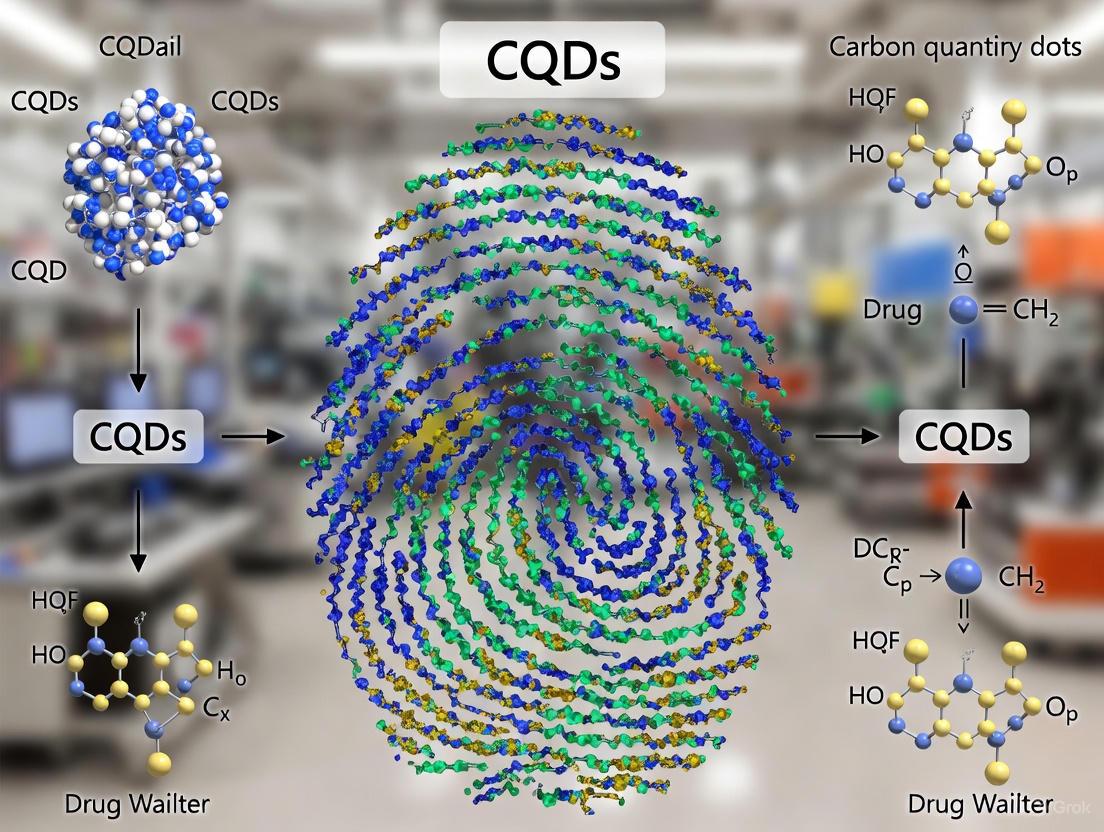
This comprehensive review explores the emerging application of carbon quantum dots (CQDs) in fingerprint visualization and drug detection, addressing a critical need in forensic science and biomedical research.
Carbon Quantum Dots for Advanced Fingerprint Visualization and Drug Detection: Mechanisms, Applications, and Future Directions
Abstract
This comprehensive review explores the emerging application of carbon quantum dots (CQDs) in fingerprint visualization and drug detection, addressing a critical need in forensic science and biomedical research. We examine the fundamental photophysical properties of CQDs that enable enhanced sensitivity and selectivity in latent fingerprint development, particularly for contaminated or complex surfaces. The article details innovative synthesis methodologies, surface functionalization strategies, and practical application protocols that optimize CQDs for dual-purpose forensic tools capable of simultaneous fingerprint visualization and drug residue analysis. Through comparative analysis with traditional methods and validation studies, we demonstrate how CQD-based technologies offer superior performance metrics while addressing current limitations in detection specificity, environmental stability, and biocompatibility. This work provides researchers and forensic professionals with a thorough technical foundation and forward-looking perspective on implementing CQD nanotechnology in next-generation forensic and diagnostic applications.
The Science Behind the Glow: Fundamental Principles of Carbon Quantum Dots for Forensic Applications
Structural and Compositional Characteristics of Carbon Quantum Dots
Carbon Quantum Dots (CQDs) represent a class of zero-dimensional fluorescent carbon nanomaterials that have garnered significant scientific interest since their accidental discovery in 2004 [1]. Their structural and compositional characteristics impart a unique combination of optical, physical, and chemical properties, making them particularly suitable for advanced applications in forensic science, especially in fingerprint visualization and drug detection [2] [3]. This document details the core structural attributes of CQDs, provides standardized protocols for their synthesis and characterization, and frames these aspects within the context of forensic research applications for scientific professionals.
Structural and Compositional Characteristics
The properties of CQDs are fundamentally governed by their structure and composition. A CQD typically features a core-shell architecture, where a carbon-based core is surrounded by a shell rich in functional groups [4].
Core Structure
The inner core of a CQD can exist in two primary states: a graphitic crystalline structure consisting of sp² hybridized carbon atoms, or an amorphous state with a mixture of sp² and sp³ hybridized carbon [5] [4]. The size of CQDs generally falls below 10 nm, with many reported specimens between 2-8 nm [6] [4]. This nanoscale dimension is critical for exhibiting quantum confinement effects, which influence their bandgap and optical properties [7] [1].
Surface Composition and Functionalization
The surface of CQDs is typically passivated with various functional groups, which dictate their reactivity, solubility, and optical behavior [8]. The presence of oxygen-rich groups, such as carboxyl (-COOH) and hydroxyl (-OH), grants CQDs excellent water solubility and facilitates further chemical modification [9] [1]. Surface passivation with polymers or other organic molecules can significantly enhance fluorescence properties and stability [1]. Furthermore, doping the carbon matrix with heteroatoms like nitrogen (N), sulfur (S), or phosphorus (P) is a common strategy to tune optical and electronic characteristics, with nitrogen doping being particularly effective for enhancing photoluminescence quantum yield [7] [2] [1].
Table 1: Core Structural and Compositional Elements of CQDs
| Characteristic | Description | Impact on Properties |
|---|---|---|
| Core Structure | Graphitic (sp²) or amorphous (sp²/sp³ hybridized carbon) [5] | Influences electronic band structure and mechanical stability |
| Particle Size | Typically <10 nm, often 2-8 nm [6] [4] | Governs quantum confinement effect; affects optical properties [7] |
| Surface Functional Groups | Carboxyl (-COOH), hydroxyl (-OH), amine (-NH₂) [9] | Confers water solubility, enables bioconjugation, and provides sites for sensing interactions |
| Doping | Incorporation of heteroatoms (e.g., N, S, P) [2] | Tunes fluorescence emission, improves quantum yield, and enhances selectivity for target analytes [7] |
Diagram 1: CQD structural composition.
Optical Properties and Their Relation to Structure
The fluorescence of CQDs is their most exploited feature for sensing and imaging. The precise photoluminescence mechanism is still debated but is generally attributed to a combination of the following [1] [4]:
- Quantum Confinement Effect: Arising from the conjugated π-domains within the carbon core, leading to size-dependent emission [7].
- Surface State Emission: Related to the energy levels introduced by surface functional groups and defects.
- Molecular State Emission: Resulting from fluorescent molecules bound to or embedded within the carbon structure.
A key characteristic of many CQDs is their excitation-dependent emission, where the emission wavelength shifts with changes in the excitation wavelength. This is often linked to a heterogeneous distribution of particle sizes and surface states [1]. Conversely, some CQDs exhibit excitation-independent emission, which is advantageous for applications requiring specific, stable colors [9].
Table 2: Key Optical Properties of CQDs and Structural Correlations
| Optical Property | Description | Governing Structural/Compositional Factor |
|---|---|---|
| Photoluminescence (PL) | Emission of light upon photoexcitation | Core size (quantum confinement), surface states, and molecular fluorophores [1] |
| Excitation-Dependent PL | Emission wavelength shifts with excitation wavelength | Particle size distribution and heterogeneity of surface energy traps [1] |
| Excitation-Independent PL | Constant emission wavelength regardless of excitation | Uniform surface states or dominant molecular state emission [9] |
| Quantum Yield (QY) | Efficiency of photon emission | Enhanced by surface passivation and heteroatom doping (e.g., N-doping) [1] |
| Up-Conversion PL | Emission of light at shorter wavelength than excitation | Anti-Stokes shift mechanisms related to surface structure [1] |
Synthesis Protocols for Forensic Applications
CQDs can be synthesized via top-down (breaking down larger carbon structures) or bottom-up (building from molecular precursors) approaches [9] [5]. For forensic applications, bottom-up methods are often preferred due to their cost-effectiveness, control over surface chemistry, and potential for "green" synthesis [2] [5].
Protocol: Hydrothermal Synthesis of Nitrogen-Doped CQDs for Fingerprint Enhancement
This bottom-up protocol is adapted for creating CQDs suitable for fingerprint visualization, emphasizing simplicity and control over surface functionality [9] [2].
Principle: Molecular precursors are dehydrated, carbonized, and passivated under high temperature and pressure in an aqueous solution to form fluorescent, N-doped CQDs [2].
Materials:
- Citric Acid (CA) - Carbon source
- Urea or Ethylenediamine (EDA) - Nitrogen source for doping
- Deionized Water - Solvent
- Autoclave with Teflon liner
- Syringe Filter (0.22 μm pore size)
- Dialysis Bag (MWCO: 500-1000 Da) or Ultrafiltration Centrifugal Tubes
Procedure:
- Solution Preparation: Dissolve 1.0 g of citric acid and 2.0 g of urea in 20 mL of deionized water. Stir until a clear solution is obtained.
- Hydrothermal Reaction: Transfer the solution to a Teflon-lined stainless-steel autoclave. Seal the autoclave and heat it in an oven at 180°C for 4-8 hours.
- Cooling: After the reaction, allow the autoclave to cool naturally to room temperature.
- Purification: The resulting brownish-yellow solution contains CQDs.
- Option 1 (Filtration): Filter the solution through a 0.22 μm syringe filter to remove large aggregates.
- Option 2 (Dialysis): Transfer the solution to a dialysis bag and dialyze against deionized water for 24 hours to remove unreacted precursors.
- Option 3 (Ultrafiltration): Use ultrafiltration centrifugal tubes with an appropriate molecular weight cutoff to isolate CQDs of the desired size.
- Storage: Store the purified CQD solution at 4°C in the dark. The solution can be further concentrated by lyophilization (freeze-drying) to obtain a powder if needed.
Diagram 2: Hydrothermal CQD synthesis workflow.
Protocol: Functionalization of CQDs for Drug Sensing
For specific detection of drug molecules, as-needed functionalization of pre-synthesized CQDs is often required to enhance selectivity [10].
Principle: Surface functional groups on CQDs (e.g., -COOH) are used to covalently attach recognition elements (e.g., antibodies, molecularly imprinted polymers) that bind specifically to target analytes like antibiotics or illicit drugs [10].
Materials:
- Pre-synthesized CQD solution (carboxyl-rich)
- N-Hydroxysuccinimide (NHS)
- 1-Ethyl-3-(3-dimethylaminopropyl)carbodiimide (EDC)
- Recognition Element (e.g., antibody, aptamer)
- Phosphate Buffered Saline (PBS), pH 7.4
- Centrifugal Filters
Procedure:
- Activation: Mix the CQD solution with EDC (10 mM final concentration) and NHS (5 mM final concentration) in PBS. Stir gently for 30 minutes at room temperature to activate the carboxyl groups.
- Coupling: Add the recognition element (e.g., antibody) to the activated CQD mixture. The ratio of CQD to antibody should be optimized. Incubate the mixture for 2-4 hours at room temperature with gentle stirring.
- Purification: To remove excess, unbound recognition elements and reaction by-products, purify the conjugate using centrifugal filters or dialysis against PBS.
- Characterization: Confirm successful conjugation using techniques like UV-Vis spectroscopy (to observe characteristic protein peaks) or FTIR (to observe new amide bonds).
- Storage: Store the functionalized CQDs in PBS at 4°C. Avoid repeated freeze-thaw cycles.
The Scientist's Toolkit: Essential Reagents and Materials
Table 3: Key Research Reagent Solutions for CQD-Based Forensic Research
| Reagent/Material | Function/Application | Example Use Case |
|---|---|---|
| Citric Acid | Cheap and common carbon precursor for bottom-up synthesis [5] | Forms the carbon core during hydrothermal synthesis [6] |
| Urea / Ethylenediamine | Nitrogen source for doping | Enhancing quantum yield and tuning fluorescence in fingerprint visualization CQDs [2] |
| EDC / NHS Crosslinkers | Catalyze amide bond formation for bioconjugation [10] | Immobilizing antibodies on CQDs for targeted drug detection |
| PBS Buffer | Provides a stable, physiological pH environment | Medium for bio-conjugation reactions and storage of functionalized CQDs |
| Dialysis Membranes | Separation based on molecular size | Purifying synthesized CQDs from unreacted precursors and salts |
| Syringe Filters | Size-exclusion filtration | Rapid removal of large aggregates from CQD solutions post-synthesis |
Application in Forensic Research: Experimental Workflows
Fingerprint Visualization
The small size and tunable fluorescence of CQDs make them excellent agents for developing latent fingerprints on various surfaces [2] [1].
Workflow:
- CQD Solution Preparation: Prepare a colloidal solution of CQDs (e.g., N-doped CQDs from Protocol 4.1) in deionized water or a mild buffer.
- Sample Treatment: Immerse the substrate bearing the latent fingerprint (e.g., glass, plastic, metal) into the CQD solution for a few minutes, or gently spray the solution onto the surface.
- Rinsing and Drying: Gently rinse the substrate with deionized water to remove excess, unbound CQDs and air-dry.
- Visualization: Examine the sample under a UV or blue light source (wavelength dependent on CQD excitation maximum). The CQDs adsorbed to the fingerprint residue will fluoresce, revealing the ridge pattern.
Diagram 3: Fingerprint visualization workflow.
Drug Detection via Fluorescence Quenching
CQDs can act as fluorescent probes whose emission is quenched in the presence of specific drug molecules, enabling their detection [10].
Workflow:
- Probe Preparation: Use either as-synthesized CQDs with intrinsic selectivity or, more effectively, CQDs functionalized with a specific recognition element (from Protocol 4.2).
- Sample Introduction: Incubate the CQD probe solution with the sample suspected to contain the target drug (e.g., a dissolved powder or extracted biological fluid).
- Interaction and Quenching: The binding event between the drug molecule and the CQD (or its recognition element) leads to a measurable change in fluorescence intensity (quenching or enhancement).
- Detection and Analysis: Measure the fluorescence signal using a spectrofluorometer. The degree of signal change is proportional to the analyte concentration, allowing for quantitative detection.
The photophysical properties of Carbon Quantum Dots (CQDs), particularly their fluorescence mechanisms and quantum yield (QY), form the foundational basis for their effectiveness in advanced forensic applications such as fingerprint visualization and drug detection [2]. Quantum yield, representing the efficiency of photon emission per absorbed photon, directly determines the sensitivity and detection limits achievable in analytical methods [11]. For forensic researchers and drug development professionals, understanding and controlling these properties is crucial for developing reliable, sensitive, and reproducible detection systems that can withstand legal scrutiny [3]. The fluorescence behavior of CQDs originates from a complex interplay between their core structure and surface characteristics, which can be systematically engineered through synthetic control and post-processing techniques [11].
The integration of CQDs into forensic science represents a significant advancement in addressing longstanding analytical challenges, including the detection of trace evidence and the visualization of latent fingerprints with enhanced contrast and specificity [2] [12]. This technical note examines the fundamental photophysical principles governing CQD fluorescence, provides quantitative comparisons of key parameters, and details standardized experimental protocols to ensure reproducible results for forensic applications.
Fluorescence Mechanisms in Carbon Quantum Dots
The luminescence of CQDs arises from multiple mechanisms that can operate independently or synergistically. A comprehensive understanding of these mechanisms is essential for rational design of CQDs tailored for specific forensic applications [11].
Core-Based Emission Mechanisms
Core-related emissions originate from the intrinsic electronic structure of the carbon core [11]. The quantum confinement effect occurs when the sp² carbon domains within the CQD core are sufficiently small to exhibit discrete energy levels, leading to size-dependent fluorescence emission [2]. This effect is prominent in highly crystalline CQDs with well-defined graphitic structures [11]. Additionally, the conjugated π-domain structure, consisting of aromatic carbon clusters, facilitates π-π* transitions that contribute to fluorescence, particularly in the blue to green spectral regions [11]. Free zigzag sites at the edge of the carbon lattice can create localized electronic states that influence emission wavelength and intensity [11].
Surface-State Emission Mechanisms
Surface-related mechanisms often dominate the photophysical behavior of CQDs, especially in heteroatom-doped systems [2]. The crosslink-enhanced emission effect occurs when surface functional groups or polymer chains create rigid structures that reduce non-radiative recombination, thereby enhancing fluorescence [11]. Surface/edge defects, including oxygen-containing functional groups and heteroatom doping sites, create energy traps that result in redshifted emissions [2]. Furthermore, CQDs may possess multiple emission centers from different fluorophores within their structure, leading to complex excitation-dependent behavior [11].
Table 1: Core vs. Surface-State Emission Characteristics in CQDs
| Characteristic | Core-State Emission | Surface-State Emission |
|---|---|---|
| Primary Origin | Quantum confinement in sp² carbon domains [11] | Surface functional groups and defects [2] |
| Spectral Dependence | Size-dependent [2] | Surface chemistry-dependent [11] |
| Emission Wavelength | Typically shorter (blue-green) [11] | Tunable across visible spectrum [2] |
| Quantum Yield Range | Moderate to high [13] | Variable, can be very high with passivation [11] |
| Response to Environment | Less sensitive [11] | Highly sensitive to pH, ions, and analytes [13] |
Quantum Yield Considerations and Enhancement Strategies
Quantum yield is a critical parameter determining the brightness and practical utility of CQDs in forensic applications. It is defined as the ratio of photons emitted to photons absorbed, with higher QY values enabling more sensitive detection limits [11].
Factors Influencing Quantum Yield
Several interconnected factors determine the ultimate quantum yield of CQD materials. Surface functionalization plays a pivotal role, as appropriate surface groups can reduce non-radiative recombination sites and enhance emissive pathways [2]. Heteroatom doping, particularly with nitrogen, sulfur, or phosphorus, can significantly enhance QY by modifying the electronic structure and creating additional emissive centers [2] [14]. The passivation layer formed by polymers, surfactants, or other coating agents protects the CQDs from quenching interactions with their environment, thereby preserving fluorescence intensity [2]. Additionally, the carbon source selection influences the inherent structure and composition of the resulting CQDs, with some precursors naturally containing fluorescence-enhancing heteroatoms [14] [12].
Quantitative Comparison of Quantum Yields
Recent advances in synthesis methodologies have produced CQDs with exceptionally high quantum yields, as demonstrated in recent research:
Table 2: Reported Quantum Yields from Recent CQD Studies
| Carbon Source | Synthesis Method | Doping/Modification | Quantum Yield (%) | Application Context | Reference |
|---|---|---|---|---|---|
| Citric Acid + TREN | Hydrothermal | Nitrogen | 90.0 | Hg²⁺ detection, pH sensing | [13] |
| Apricot Juice | Microwave-assisted | Nitrogen | 37.1 | Drug detection (Lisinopril) | [14] |
| Asparagus Peel | Hydrothermal | Amino-functionalization | 15.9 | Sunset yellow dye detection | [15] |
| Lemon Juice | Hydrothermal | None (natural phytochemicals) | Not specified | Fingerprint visualization | [12] |
The remarkable 90% QY achieved with nitrogen-doped CDs derived from citric acid and tri-(2-aminoethyl)amine represents a significant advancement in the field, making these materials competitive with traditional semiconductor quantum dots while avoiding heavy metal toxicity [13]. For forensic applications, this translates to enhanced detection sensitivity for trace evidence, including latent fingerprints and drug molecules [2].
Experimental Protocols
Standardized protocols are essential for reproducing CQD synthesis and characterization across different laboratories, particularly for forensic applications where evidentiary reliability is paramount.
Protocol 1: Microwave-Assisted Synthesis of Nitrogen-Doped CQDs from Natural Precursors
This protocol describes the green synthesis of high-quantum-yield N@CQDs suitable for drug detection applications [14].
Materials and Reagents:
- Prunus armeniaca (apricot) fruits
- Deionized water
- Methanol (for purification)
- Dialysis membrane (1000 Da MWCO)
Procedure:
- Extract juice from apricot fruits after removing pits, using a mechanical mixer.
- Place 50 mL of the extracted juice in a conical flask.
- Subject the juice to microwave radiation at 900 watts for precisely 5 minutes until a brown solution forms.
- Filter the resulting solution through a 0.45 μm cellulose membrane.
- Sonicate the filtrate for 20 minutes to ensure homogeneity.
- Centrifuge at 4000 rpm for 10 minutes to remove large aggregates.
- Perform a second filtration through a 0.45 μm membrane.
- Purify the N@CQDs using dialysis against deionized water for 24 hours.
- Store the final N@CQD solution at 4°C in amber glass containers to preserve stability.
Protocol 2: Hydrothermal Synthesis of CQDs from Plant Materials for Fingerprint Visualization
This protocol details the synthesis of CQDs from various plant materials for forensic fingerprint development [12].
Materials and Reagents:
- Plant materials (mustard seeds, cumin seeds, mango leaves, or lemon juice)
- Deionized water
- Ethanol (for cleaning)
- Dialysis tubing (1000 Da MWCO)
- Teflon-lined stainless-steel autoclave
Procedure:
- Thoroughly wash plant materials with deionized water.
- Dry materials at 100°C in a hot air oven for 2 hours.
- Grind dried materials into fine powder using an agate mortar and pestle.
- Disperse 0.5 g of the powder in 25 mL of deionized water (for lemon juice, use 25 mL juice mixed with 15 mL water).
- Transfer the mixture to a Teflon-lined autoclave.
- Heat at 140°C for 3 hours in a laboratory furnace.
- Allow the autoclave to cool naturally to room temperature.
- Filter the resulting solution through a 0.22 μm membrane filter.
- Purify via dialysis against deionized water for 48 hours with regular water changes.
- Characterize using TEM, UV-Vis, and fluorescence spectroscopy.
Protocol 3: Quantum Yield Measurement Using Comparative Method
This standardized protocol enables accurate determination of fluorescence quantum yield, a critical parameter for forensic applications [14] [13].
Materials and Reagents:
- CQD sample solution
- Reference standard (quinine sulfate in 0.1 M H₂SO₄ for AP-CDs [14])
- UV-Vis spectrophotometer
- Fluorescence spectrometer
- Cuvettes (1 cm path length)
Procedure:
- Prepare dilute solutions of both the CQD sample and reference standard with absorbance <0.1 at the excitation wavelength to minimize inner filter effects.
- Measure the UV-Vis absorption spectrum of both solutions.
- Record fluorescence emission spectra at the same excitation wavelength for both samples.
- Integrate the area under the fluorescence emission curve for both sample and reference.
- Calculate quantum yield using the formula: Φsample = Φref × (Isample/Iref) × (Aref/Asample) × (ηsample²/ηref²) Where Φ is quantum yield, I is integrated fluorescence intensity, A is absorbance at excitation wavelength, and η is refractive index of the solvent.
- Perform measurements in triplicate to ensure reproducibility.
Visualization of Fluorescence Mechanisms and Synthesis Workflows
The following diagrams illustrate key concepts in CQD fluorescence mechanisms and standard synthesis protocols for forensic applications.
CQD Fluorescence Mechanisms
Diagram 1: CQD Fluorescence Mechanisms. Photoluminescence originates from core-based (green), surface-based (blue), and defect-based (red) mechanisms, each contributing to the overall emission properties.
CQD Synthesis and Application Workflow
Diagram 2: CQD Synthesis and Forensic Application Workflow. The process from precursor selection through characterization to specific forensic applications demonstrates the integrated approach required for developing effective CQD-based detection systems.
The Scientist's Toolkit: Essential Research Reagents and Materials
Table 3: Essential Research Reagents and Materials for CQD Development in Forensic Applications
| Category | Specific Examples | Function/Purpose | Application Context |
|---|---|---|---|
| Carbon Sources | Citric acid [13], Apricot juice [14], Plant materials (mustard seeds, lemon juice) [12], Asparagus peel [15] | Forms the core structure of CQDs; influences inherent fluorescence properties | General CQD synthesis; green synthesis approaches |
| Doping Agents | Nitrogen sources (tri-(2-aminoethyl)amine [13], amino acids), Sulfur, Phosphorus | Enhances quantum yield; modifies electronic structure; creates surface reactive sites | Performance enhancement for sensitive detection |
| Synthesis Equipment | Hydrothermal autoclave [12], Microwave reactor [14], Dialysis membranes [15] | Enables controlled synthesis conditions; purification of final product | Standard CQD preparation and purification |
| Characterization Tools | TEM [14], FTIR [15], UV-Vis spectrophotometer [15], Fluorescence spectrometer [14], XRD [12] | Determines size, morphology, chemical composition, and optical properties | Quality control; structure-property relationships |
| Reference Standards | Quinine sulfate [15], Other fluorophores with known QY | Provides benchmark for quantum yield calculations | Quantitative performance evaluation |
| Detection Substrates | Latent fingerprint samples [12], Drug solutions (e.g., Lisinopril [14]), Metal ion solutions [13] | Serves as analytical targets for method validation | Forensic application testing |
The photophysical properties of carbon quantum dots, governed by complex fluorescence mechanisms and quantifiable through quantum yield measurements, establish the foundation for their emerging applications in forensic science. The high quantum yields achievable through optimized synthesis and doping strategies—reaching up to 90% in recent reports—enable the sensitive detection required for fingerprint visualization, drug identification, and toxicological analysis [13]. The experimental protocols and characterization methodologies detailed in this application note provide forensic researchers with standardized approaches for developing and validating CQD-based detection systems. As research progresses, the integration of these tunable nanomaterials with artificial intelligence and computational simulations presents a promising frontier for advancing forensic methodologies, potentially minimizing human error and ensuring higher throughput and accuracy in investigative processes [2].
The surface functionalization of Carbon Quantum Dots (CQDs) is a cornerstone for enhancing their performance in forensic science applications. By modifying CQDs with carboxyl, hydroxyl, and amino groups, researchers can precisely tailor their physicochemical properties, such as solubility, stability, and optical characteristics, and, most importantly, control their interactions with target analytes like drug molecules or fingerprint residues [2]. These modifications are pivotal for developing highly sensitive and selective sensors and visualization agents, driving innovations in fingerprint visualization and drug detection research [2] [3]. This Application Note provides a detailed examination of the properties of these key functional groups, standardized protocols for their implementation, and their specific roles within the context of a broader thesis on CQDs in forensic investigations.
Functional Group Properties and Forensic Applications
The strategic selection of a functional group is dictated by its inherent chemical properties and the requirements of the intended forensic application. The table below summarizes the core characteristics and roles of carboxyl, hydroxyl, and amino groups in CQD functionalization.
Table 1: Properties and Forensic Applications of Key Functional Groups on CQDs
| Functional Group | Chemical Properties | Role in CQD Surface Chemistry | Impact on Forensic Application |
|---|---|---|---|
| Carboxyl (-COOH) | Weak acid; can be deprotonated to form a negatively charged anion; participates in hydrogen bonding and covalent coupling via EDC/NHS chemistry [16] [17]. | Introduces negative surface charge; provides a site for covalent conjugation to amine-containing molecules [2] [17]. | Enhances selectivity for heavy metal ions in toxicology screens [17]; enables immobilization of biomolecules for specific drug sensing. |
| Hydroxyl (-OH) | Highly polar; participates in strong intermolecular hydrogen bonding; increases hydrophilicity [18] [19]. | Improves dispersibility in aqueous media; provides sites for further modification or adsorption via non-covalent interactions [2]. | Aids in fingerprint residue wetting and adhesion [2]; improves biocompatibility and stability in liquid formulations. |
| Amino (-NH₂) | Basic; can be protonated to form a positively charged cation; acts as an electron donor [20] [21]. | Introduces positive surface charge; enhances interactions with electron-accepting analytes; can be used for covalent coupling [20] [21]. | Increases affinity for acidic drug molecules (e.g., cannabinoids); can reduce inflammatory response, improving biocompatibility [21]. |
Experimental Protocols for CQD Functionalization and Testing
This protocol describes the introduction of carboxyl groups onto the surface of CQDs, which is a fundamental step for creating a reactive platform for further conjugation [17].
- Reagents: Pristine CQDs, Concentrated Nitric Acid (69%, AnalaR grade), Deionized Water.
- Equipment: Round-bottom flask, Reflux condenser, Heating mantle, Vacuum filtration setup, Vacuum oven.
- Procedure:
- Disperse 2 g of pristine CQDs in 300 mL of concentrated nitric acid within a round-bottom flask [17].
- Attach a reflux condenser and heat the mixture to 120°C under continuous stirring for 48 hours [17].
- After cooling to room temperature, dilute the mixture with 500 mL of deionized water.
- Isolate the carboxyl-functionalized CQDs (COOH-CQDs) by vacuum filtration using filter paper (3 μm porosity).
- Wash the solid product repeatedly with deionized water until the filtrate reaches a neutral pH.
- Dry the final COOH-CQDs in a vacuum oven at 100°C for 12 hours [17].
- Characterization:
- Fourier-Transform Infrared (FTIR) Spectroscopy: Confirm successful functionalization by identifying a characteristic peak at ~1736 cm⁻¹, associated with the C=O stretch of carboxylic groups [17].
- X-ray Photoelectron Spectroscopy (XPS): Quantify the atomic percentage of oxygen and confirm the presence of carboxyl carbon.
Protocol: Amine Modification via Silane Chemistry
This protocol outlines the grafting of amine groups onto a CQD surface, which is often performed on a hydroxylated surface to create a positively charged, reactive nanomaterial [21].
- Reagents: Hydroxyl-rich CQDs, 3-aminopropyltriethoxysilane (APTES), Anhydrous Toluene.
- Equipment: Schlenk flask, Magnetic stirrer, Centrifuge, Nitrogen/vacuum line.
- Procedure:
- Disperse 1 g of hydroxyl-rich CQDs in 150 mL of anhydrous toluene in a Schlenk flask under an inert atmosphere (e.g., N₂) [21].
- Add 3 mL of APTES dropwise under continuous stirring.
- Reflux the reaction mixture at 110°C for 24 hours.
- Allow the mixture to cool and then centrifuge at 12,000 rpm for 15 minutes to isolate the solid.
- Wash the amine-functionalized CQDs (NH₂-CQDs) three times with anhydrous toluene to remove any unreacted silane.
- Dry the final NH₂-CQDs under vacuum at 60°C for 6 hours.
- Characterization:
- FTIR Spectroscopy: Look for the appearance of N-H stretching vibrations (~3300 cm⁻¹) and C-N stretching (~1200 cm⁻¹) to confirm amine attachment.
- Zeta Potential Measurement: A shift in zeta potential towards positive values indicates successful introduction of the basic amine group.
Protocol: Evaluating Functionalized CQDs for Drug Molecule Detection
This protocol tests the efficacy of functionalized CQDs as fluorescent probes for the detection of target drug molecules, a key application in forensic toxicology.
- Reagents: Functionalized CQDs (COOH-CQDs, NH₂-CQDs), Drug analyte stock solution (e.g., 1 mM in suitable solvent), Buffer solution (e.g., phosphate buffer saline, PBS).
- Equipment: Fluorescence spectrophotometer, Microcuvettes, Micropipettes, Ultrasonic bath.
- Procedure:
- Prepare a stable dispersion of functionalized CQDs (e.g., 0.1 mg/mL) in PBS using brief sonication.
- Place 2 mL of the CQD dispersion into a quartz microcuvette and record the initial fluorescence emission spectrum (λ_ex = 350 nm).
- Add a small aliquot (e.g., 10 μL) of the drug analyte stock solution to the cuvette, mix thoroughly, and incubate for 2 minutes.
- Record the fluorescence emission spectrum again under identical conditions.
- Repeat steps 3 and 4 with successive additions of the analyte to generate a titration curve.
- Plot the relative fluorescence intensity (F/F₀) against the analyte concentration to determine the sensitivity and quenching efficiency.
- Expected Outcome: The high surface energy and specific acid-base interactions of NH₂-CQDs, for instance, make them particularly effective for sensing electron-accepting drug molecules, leading to a measurable fluorescence quenching [20].
Workflow Visualization: CQD Development for Forensic Analysis
The following diagram illustrates the logical pathway from CQD synthesis and functionalization to their application in key forensic analyses, such as drug detection and fingerprint visualization.
CQD Functionalization and Application Workflow
The Scientist's Toolkit: Essential Research Reagents
Successful research and application of functionalized CQDs require a suite of specific chemical reagents and materials. The following table details key solutions used in the protocols above.
Table 2: Essential Reagent Solutions for CQD Functionalization
| Reagent / Material | Function / Role | Application Example / Rationale |
|---|---|---|
| 3-Aminopropyltriethoxysilane (APTES) | Silane coupling agent that introduces primary amine groups onto surfaces [21]. | Grafting amine functionalities onto CQDs to create a basic surface for interaction with acidic drug molecules [21]. |
| Concentrated Nitric Acid (HNO₃) | Strong oxidizing agent that creates defects and introduces carboxyl groups on carbon surfaces [17]. | Purification and functionalization of pristine CQDs to create COOH-CQDs for subsequent covalent conjugation [17]. |
| EDC / NHS Coupling System | Carbodiimide crosslinkers that catalyze the formation of amide bonds between carboxyl and amine groups. | Conjugating COOH-CQDs to antibodies or other proteins for highly specific immunoassay-based drug detection. |
| Hydroxyl-rich CQD Precursor | Nanoparticles with inherent or pre-formed hydroxyl groups on their surface. | Serves as the substrate for silane-based amine modification and improves aqueous dispersibility for fingerprint powders [2] [21]. |
Electronic Properties and Charge Transfer Mechanisms in CQDs
Carbon Quantum Dots (CQDs) represent a class of zero-dimensional carbon-based nanomaterials that have garnered significant scientific interest due to their exceptional electronic properties and tunable photophysical characteristics. These quasi-spherical carbon nanoparticles, typically smaller than 10 nm, consist of a carbon core with a mixture of sp² and sp³ hybridization and surface functional groups containing oxygen, nitrogen, and other heteroatoms [22] [7]. The unique electronic structure of CQDs confers several advantageous properties, including tunable photoluminescence, exceptional electron donor/acceptor capabilities, and efficient charge transfer mechanisms [23]. These properties make CQDs particularly valuable for a range of applications, with emerging significance in forensic science for fingerprint visualization and drug detection [24] [12].
The electronic properties of CQDs are fundamentally governed by quantum confinement effects and surface defect states [22]. Unlike semiconductor quantum dots (SQDs) that contain toxic heavy metals, CQDs offer superior biocompatibility, low toxicity, and environmental friendliness while maintaining comparable optical and electronic performance [7]. The charge transfer mechanisms in CQDs involve complex interactions at the nanoscale interface, which can be systematically engineered for specific applications, including sensing and detection systems relevant to forensic investigations [25] [26].
Fundamental Electronic Properties and Charge Transfer Mechanisms
Electronic Structure and Energy Levels
The electronic structure of CQDs is characterized by a π-π* transition system arising from the conjugated carbon core and surface functional groups that create various energy states [22]. The band gap between valence and conduction bands can be tuned through size control, heteroatom doping, and surface functionalization, enabling precise manipulation of their optoelectronic properties [27] [7]. This tunability is crucial for designing CQDs with specific charge transfer capabilities for forensic applications.
CQDs exhibit multiple fluorescence mechanisms, including:
- Quantum confinement effect: Size-dependent bandgap tuning in crystalline CQDs with sp² domains
- Surface defect states: Emission from energy traps created by surface functional groups
- Molecular fluorophores: Emission from fluorophore molecules attached to the CQD surface [22]
Charge Transfer Mechanisms
Charge transfer in CQDs involves complex processes that can be harnessed for sensing applications. The fundamental mechanisms include:
Photoinduced Electron Transfer (PET): CQDs can act as either electron donors or acceptors when photoexcited, leading to fluorescence quenching or enhancement upon interaction with target analytes [23]. This mechanism is particularly relevant for drug detection systems.
Energy Transfer Processes: Both Förster Resonance Energy Transfer (FRET) and Dexter electron transfer can occur in CQD systems, though charge transfer often dominates in quenching scenarios [26]. Research on graphene-QD hybrids has demonstrated that charge transfer, rather than resonance energy transfer, is primarily responsible for photoluminescence quenching and recovery [25].
Static Quenching via Charge Transfer: Studies using time-resolved photoluminescence spectroscopy have shown unchanged fluorescence lifetime upon quenching, supporting a charge transfer-induced static quenching mechanism rather than dynamic collision-based quenching [25].
Table 1: Key Electronic Properties of Carbon Quantum Dots
| Property | Description | Impact on Forensic Applications |
|---|---|---|
| Tunable Band Gap | Adjustable through size control, doping, and surface functionalization [27] [7] | Enables design of specific sensors for different drug molecules |
| Electron Donor/Acceptor Capacity | Ability to both donate and accept electrons in redox reactions [23] | Facilitates detection of electron-rich or electron-deficient drug compounds |
| Up-Conversion Photoluminescence | Emission at shorter wavelengths than excitation light (anti-Stokes shift) [27] | Allows use of safer, longer wavelength excitation in forensic analysis |
| Photoinduced Electron Transfer | Electron transfer upon photoexcitation [23] | Forms basis for fluorescence-based sensing mechanisms |
| Surface Defect States | Energy traps created by surface functional groups and heteroatoms [22] | Provides binding sites for specific analytes and enhances selectivity |
Synthesis Protocols for Forensic-Applicable CQDs
Microwave-Assisted Synthesis of Nitrogen-Doped CQDs
Principle: This rapid, efficient method utilizes microwave irradiation to carbonize natural precursors and introduce nitrogen dopants simultaneously, creating CQDs with enhanced electronic properties for sensing applications [14].
Materials:
- Prunus armeniaca (apricot) fruit
- Deionized water
- Methanol (for purification)
- 0.45 μm cellulose membrane filters
- Centrifuge tubes
Experimental Procedure:
- Precursor Preparation: Extract juice from apricot fruit after pit removal using a mechanical mixer [14].
- Microwave Processing: Place 50 mL of juice in a conical flask and irradiate at 900 watts for 5 minutes until a brown solution forms [14].
- Purification: Filter the solution, sonicate for 20 minutes, and centrifuge at 4000 rpm for 10 minutes [14].
- Final Filtration: Pass the supernatant through a 0.45 μm cellulose membrane to obtain purified N@CQDs [14].
- Storage: Store at 4°C for future use; stable for several months [14].
Characterization Data:
- Quantum Yield: 37.1% [14]
- Average Size: 2.6 nm (confirmed by TEM) [14]
- Elemental Composition: Carbon, oxygen, nitrogen (confirmed by EDX) [14]
- Fluorescence Emission: 502 nm under 455 nm excitation [14]
Hydrothermal Synthesis of Plant-Derived CQDs for Fingerprint Visualization
Principle: Hydrothermal carbonization converts plant-based precursors into fluorescent CQDs through dehydration, decarboxylation, and polymerization reactions, creating CQDs with strong adhesion properties for fingerprint development [12].
Materials:
- Plant precursors: mustard seeds (Brassica juncea), cumin seeds (Cuminum cyminum), mango leaves (Mangifera indica), or lemon juice (Citrus limon)
- Deionized water
- Hot air oven
- Teflon-lined autoclave
- Dialysis membrane (1000 Da MWCO)
- Filter paper
Experimental Procedure:
- Precursor Preparation: Wash plant materials thoroughly with deionized water, dry at 100°C, and grind into fine powder [12].
- Solution Preparation: Dissolve 0.5 g of organic extract powder in 25 mL deionized water (for lemon juice, use 25 mL directly mixed with 15 mL water) [12].
- Hydrothermal Reaction: Transfer solution to Teflon-lined autoclave and heat at 140°C for 3 hours [12].
- Purification: Centrifuge at 10,000 rpm for 20 minutes, filter through 0.22 μm membrane, and dialyze for 24 hours [12].
- Characterization: Analyze using TEM, XRD, FTIR, and fluorescence spectroscopy [12].
Diagram 1: Hydrothermal Synthesis Workflow for Plant-Derived CQDs. This process transforms natural precursors into functional CQDs for forensic applications.
Performance Metrics:
- Mustard seed CQDs: Quantum yield = 9.10%, Particle size = 4.2 nm [12]
- Cumin seed CQDs: Quantum yield = 6.20%, Particle size = 6.5 nm [12]
- Mango leaf CQDs: Quantum yield = 5.30%, Particle size = 3.8 nm [12]
- Lemon juice CQDs: Quantum yield = 7.52%, Particle size = 2.9 nm [12]
Table 2: Comparison of CQD Synthesis Methods for Forensic Applications
| Synthesis Method | Advantages | Limitations | Optimal Forensic Application |
|---|---|---|---|
| Microwave-Assisted | Rapid (5-10 min), high quantum yield (up to 37.1%), simple equipment [14] | Limited scale-up potential, possible inhomogeneity | Drug detection sensors requiring high sensitivity |
| Hydrothermal | Green synthesis, uses natural precursors, good size control, low cost [12] | Long reaction time (hours), moderate quantum yield | Fingerprint visualization, bulk production |
| Laser Ablation | High purity CQDs, no chemicals required [22] | Expensive equipment, low yield, poor reproducibility | Research applications requiring high purity |
| Electrochemical | Scalable, controllable size and surface properties [22] | Requires electrolytes, purification challenges | Specialized sensors with specific electronic properties |
Applications in Forensic Science
Fingerprint Visualization Protocols
Principle: CQDs adhere selectively to fingerprint ridges through interactions with lipid and protein components, providing high-contrast visualization due to their strong fluorescence and excellent photostability [12].
Materials:
- Synthetic CQDs solution (any plant-derived CQDs from Section 3.2)
- Latent fingerprints on various surfaces (glass, metal, plastic)
- UV lamp (365 nm)
- Soft brush or spray applicator
- Digital camera for documentation
Experimental Procedure:
- Sample Preparation: Create latent fingerprints on different surfaces by natural deposition [12].
- CQD Application: Apply CQDs solution using gentle brushing or spray method to cover the fingerprint area [12].
- Incubation: Allow 30-second interaction for CQDs adhesion to fingerprint residues [12].
- Rinsing: Gently rinse with deionized water to remove excess CQDs from non-ridge areas [12].
- Visualization: Examine under UV light at 365 nm and capture images [12].
- Analysis: Evaluate ridge clarity, minutiae details, and contrast against background [12].
Performance Metrics:
- Lemon juice CQDs demonstrated superior performance with clear ridge patterns and high contrast [12]
- All plant-derived CQDs successfully developed fingerprints on non-porous surfaces [12]
- CQDs provided excellent photostability, allowing prolonged examination without fluorescence fading [12]
Drug Detection and Sensing Protocols
Principle: CQDs function as fluorescent probes whose electron transfer processes are modulated by specific interactions with drug molecules, resulting in measurable fluorescence changes that enable detection and quantification [14].
Protocol for Lisinopril Detection in Human Plasma:
Materials:
- N@CQDs (from Section 3.1)
- Lisinopril standard solutions (5.0-150.0 ng mL⁻¹)
- Drug-free human plasma
- Methanol (for protein precipitation)
- Phosphate buffered saline (PBS, pH 7.4)
- Fluorescence spectrophotometer
Experimental Procedure:
- Sample Preparation:
Detection Protocol:
Validation Parameters:
Diagram 2: Charge Transfer-Mediated Drug Detection Mechanism. CQD-drug molecule interactions modulate charge transfer processes, producing detectable fluorescence changes.
Characterization and Analytical Techniques
Essential Characterization Methods
Comprehensive characterization is crucial for correlating CQD properties with forensic performance. Key techniques include:
Structural and Morphological Analysis:
- High-Resolution TEM: Determines size, size distribution, and lattice spacing (typically 0.34 nm for graphitic structure) [22] [12]
- XRD: Identifies crystalline structure; CQDs typically show broad peak at ~25° corresponding to (002) graphitic plane [12]
- Raman Spectroscopy: Reveals structural defects through D-band (~1350 cm⁻¹) and G-band (~1580 cm⁻¹) intensity ratio (ID/IG) [12]
Surface and Chemical Analysis:
- FTIR: Identifies functional groups (hydroxyl, carbonyl, carboxyl, amine) enabling fingerprint development [14] [12]
- XPS: Quantifies elemental composition and chemical states, particularly important for doped CQDs [14]
Optical and Electronic Properties:
- UV-Vis Spectroscopy: Detects absorption peaks typically at 260-280 nm (π-π* transition) and 320-360 nm (n-π* transition) [14]
- Photoluminescence Spectroscopy: Characterizes emission properties, quantum yield, and excitation-dependent behavior [14]
- Time-Resolved PL: Distinguishes charge transfer mechanisms from energy transfer processes [25]
Table 3: Key Research Reagent Solutions for CQD-Based Forensic Applications
| Reagent/Material | Function | Application Example | Key Characteristics |
|---|---|---|---|
| Nitrogen-Doped CQDs | Fluorescent probe with enhanced electron transfer capabilities | Lisinopril detection in plasma [14] | High quantum yield (37.1%), selective binding to drug molecules |
| Plant-Derived CQDs | Green-synthesized fluorescent markers | Fingerprint visualization [12] | Biocompatible, strong adhesion to fingerprint residues |
| Citric Acid-Based Precursors | Carbon source for highly fluorescent CQDs | Sensor development [22] | Consistent quality, tunable surface functionality |
| Amino Group Functionalized CQDs | Enhanced binding to specific analytes | Targeted drug detection [24] | Specific molecular recognition, improved selectivity |
| Cross-linking Agents | Surface modification for improved adhesion | Fingerprint development on challenging surfaces [12] | Enhanced binding to fingerprint components |
The electronic properties and charge transfer mechanisms of CQDs provide a robust foundation for developing advanced forensic tools with enhanced sensitivity, selectivity, and reliability. The tunable nature of CQDs enables customization for specific forensic applications, from fingerprint visualization on various surfaces to ultrasensitive drug detection in complex biological matrices. The protocols outlined in this application note provide researchers with standardized methodologies for synthesizing, characterizing, and implementing CQDs in forensic contexts.
Future developments in CQD technology for forensic science will likely focus on enhancing specificity through molecular imprinting, creating multi-analyte detection platforms, and integrating CQD-based sensors with portable reading devices for field applications. The convergence of CQD technology with artificial intelligence and computational simulations presents an exciting frontier for advancing forensic methodologies, minimizing human error, and ensuring high throughput and accuracy in investigative processes [24]. As synthesis methods become more refined and standardized, CQDs are poised to become indispensable tools in the forensic scientist's toolkit, driving significant improvements in analytical precision and efficiency for both crime scene investigation and pharmaceutical analysis.
Carbon Quantum Dots (CQDs) represent an emerging class of nanomaterials that are revolutionizing forensic science, particularly in the analysis of biological matrices such as fingerprint residues and drug molecules. These fluorescent nanoparticles, typically less than 10 nm in size, exhibit exceptional optical properties, including tunable fluorescence and high photostability, making them ideal probes for detecting trace evidence [28]. Their low biotoxicity and excellent biocompatibility further enhance their suitability for forensic applications where preservation of original evidence is critical [29]. This application note details protocols and methodologies for leveraging CQDs in fingerprint visualization and drug detection, framed within the broader context of advancing forensic nanotechnology.
The unique value proposition of CQDs in forensic science stems from their dual functionality - they serve as both visualization agents and molecular sensors. Their surface, rich in functional groups, can be tailored through specific synthesis and functionalization strategies to interact with particular components within fingerprint residues or to recognize specific drug molecules [2] [28]. This tunability enables forensic investigators to obtain not only physical evidence (fingerprint patterns) but also chemical intelligence about a suspect's activities, such as recent drug handling or consumption.
Fundamental Properties of CQDs for Forensic Applications
Optical Characteristics
CQDs possess remarkable fluorescence properties that can be fine-tuned by controlling their size, surface chemistry, and doping elements during synthesis [2]. The quantum confinement effect enables size-dependent photoluminescence, allowing CQDs to emit light across UV, visible, and near-infrared regions [2]. This spectral versatility is crucial for forensic applications, as it permits selection of optimal emission wavelengths to maximize contrast against various backgrounds and minimize interference from substrate autofluorescence.
A particularly valuable property for forensic sensing is the excitation-wavelength-dependent emission exhibited by many CQD formulations [29]. This characteristic enables multicolor imaging from a single nanomaterial simply by varying the excitation source, facilitating the simultaneous detection of multiple analytes or the differentiation between various components within a complex biological matrix like fingerprint residue.
Surface Functionalization Capabilities
The surface of CQDs can be engineered with various functional groups to enhance their performance in forensic applications. Surface functionalization through heteroatom doping (e.g., nitrogen, sulfur, phosphorus) or passivation with polymers and small molecules improves fluorescence intensity, solubility, and stability [2]. More importantly, it enables precise interactions with target molecules in fingerprint residues or drug compounds.
Surface passivation prevents CQD aggregation, maintaining their nanoscale dimensions and optical properties - a critical consideration for developing reliable forensic reagents [2]. This process typically involves coating CQDs with polymers, surfactants, or other small molecules that stabilize the particles in suspension and maintain their functionality across different environmental conditions encountered at crime scenes.
Table 1: Key Properties of CQDs for Forensic Applications
| Property | Forensic Significance | Impact on Evidence Analysis |
|---|---|---|
| Tunable fluorescence | Enables optimization for different substrates and evidence types | Enhanced contrast against multicolored/patterned backgrounds [29] |
| High photostability | Resists degradation during extended analysis | Maintains signal integrity throughout examination [2] |
| Low toxicity | Safe for handling by forensic personnel | Environmentally friendly compared to heavy metal quantum dots [28] |
| Surface functionalizability | Can be tailored to specific target analytes | Enables simultaneous fingerprint visualization and drug detection [2] |
| Excitation-dependent emission | Single probe enables multiple detection channels | Facilitates multiplexed analysis from a single application [29] |
CQD-Based Fingerprint Visualization
Working Principle
The development of latent fingerprints using CQDs capitalizes on their strong adhesion to fingerprint residue and their bright, contrast-enhancing fluorescence [29]. When applied to fingerprint-bearing surfaces, CQDs preferentially adhere to the organic and inorganic components of latent print residues, including sebum, sweat, and environmental contaminants. The subsequent illumination with appropriate excitation sources causes the CQD-treated fingerprints to fluoresce brightly, revealing the ridge patterns with high resolution against the background.
The mechanism is primarily physical adsorption, where CQDs interact with the complex mixture of fatty acids, glycerides, amino acids, and salts present in fingerprint residue [29]. The nanoscale dimensions of CQDs enable them to penetrate and coat the minute details of fingerprint ridges without obscuring critical level 2 (minutiae) and level 3 (pores, edgeoscopy) characteristics, preserving the forensic value of the developed impression.
Synthesis Protocol for Fingerprint-Enhancing CQDs
Materials Required:
- Citric acid (carbon source)
- Polyethylene imine (surface passivating agent)
- Deionized water
- Hydrothermal synthesis reactor or microwave synthesizer
- Dialysis membrane or size exclusion columns for purification
Step-by-Step Procedure:
- Precursor Preparation: Dissolve 1.0 g citric acid and 0.5 g polyethylene imine in 20 mL deionized water with stirring until complete dissolution.
- Hydrothermal Synthesis: Transfer the solution to a Teflon-lined autoclave and heat at 200°C for 4 hours to facilitate carbonization and passivation.
- Purification: Cool the resulting orange-brown solution to room temperature and filter through 0.22 μm membrane to remove large aggregates. Purify further via dialysis against deionized water for 24 hours (MWCO: 1000 Da).
- Characterization: Verify CQD properties using UV-Vis spectroscopy (absorption peak ~350 nm), fluorescence spectroscopy (emission maximum ~450 nm with blue shift upon dilution), and TEM (particle size distribution 2-6 nm).
- Formulation: Concentrate the purified CQD solution to approximately 1 mg/mL using rotary evaporation for use in fingerprint development.
Application Methodology: For latent fingerprint development, apply the CQD solution via spraying or dipping methods. For non-porous surfaces, spraying is preferred using a fine mist aerosolizer. For porous surfaces, dipping may yield better results. Allow 30 seconds for CQD adhesion to fingerprint components, then gently rinse with deionized water to remove excess CQDs from the background. Air dry and visualize under UV light (365 nm) or blue light (450 nm) with appropriate barrier filters.
CQD Fingerprint Development Workflow
CQD-Mediated Drug Detection in Fingerprints
Sensing Mechanisms
CQDs can function as highly sensitive optical nanoprobes for detecting drugs and their metabolites in fingerprint residues through several mechanisms [29]. The primary approach involves fluorescence quenching (turn-off sensors) or fluorescence enhancement (turn-on sensors) when CQDs interact with specific drug molecules. These interactions can occur via charge transfer, energy transfer, or surface complexation mechanisms that alter the electronic structure and thus the fluorescence properties of the CQDs.
For instance, nitrogen-doped CQDs have demonstrated particular efficacy in sensing applications due to their enhanced electron-donating capabilities and surface reactivity [2]. The presence of specific functional groups on the CQD surface can be engineered to recognize particular drug classes, such as illicit substances (cocaine, heroin, cannabinoids), pharmaceutical drugs, or their metabolic byproducts [29]. This molecular recognition capability transforms ordinary fingerprint evidence into a source of chemical intelligence about a subject's drug exposure or handling.
Protocol for Drug-Sensitive CQD Formulation
Materials Required:
- Glutathione (precursor for drug-sensitive CQDs)
- Citric acid (co-precursor)
- Ethanol or methanol for purification
- Target drug molecules for validation (e.g., cocaine, THC, opioids)
- Buffer solutions (pH 4-9) for stability testing
Synthesis Procedure:
- Microwave-Assisted Synthesis: Combine 0.5 g glutathione and 0.5 g citric acid in 10 mL deionized water. Microwave at 600W for 8-10 minutes until the solution darkens and exhibits strong fluorescence.
- Drug-Sensitive Functionalization: For drug-targeting CQDs, incorporate specific recognition elements during synthesis. For opioid detection, include 0.1 g β-cyclodextrin as a host molecule. For cannabinoid detection, include nitrogen and sulfur dopants for enhanced π-π interactions.
- Purification: Precipitate CQDs using ethanol centrifugation (10,000 rpm for 15 minutes) and resuspend in phosphate buffer (pH 7.4).
- Validation: Confirm drug sensitivity using fluorescence spectroscopy with incremental drug additions. Successful formulations should show concentration-dependent fluorescence quenching or enhancement with detection limits below 1 μM for target analytes.
Drug Detection Protocol:
- Develop fingerprints using drug-sensitive CQDs as described in Section 3.2.
- Capture fingerprint images under standardized illumination conditions to document ridge patterns.
- Measure fluorescence intensity at specific wavelengths before and after development.
- Quantify drug presence through:
- Ratiometric measurements comparing intensity at two emission wavelengths
- Time-resolved fluorescence for detecting specific quenching mechanisms
- Spectral mapping across the fingerprint to visualize drug distribution
- Correlate chemical data with fingerprint patterns for comprehensive evidence profiling.
Table 2: CQD Performance in Forensic Applications
| CQD Type | Synthesis Method | Target Application | Detection Limit | Key Advantages |
|---|---|---|---|---|
| Nitrogen-doped CQDs | Hydrothermal | Fingerprint visualization on multicolored surfaces | N/A (visualization) | Excellent contrast, tunable colors [2] |
| Glutathione-based CQDs | Microwave-assisted | Drug detection in fingerprints | < 1 μM for various drugs | High sensitivity to drug molecules [29] |
| Cranberry-bean derived CQDs | Green synthesis | Fingerprint development | N/A (visualization) | Sustainable sourcing, bright emission [29] |
| hydrophobic CQDs | Solvothermal | Complex surface evidence | N/A (visualization) | Adhesion to oily residues [29] |
Integrated Workflow for Simultaneous Fingerprint and Drug Analysis
The true forensic potential of CQDs is realized when fingerprint visualization and drug detection are performed simultaneously. This integrated approach provides both identification evidence (through fingerprint patterns) and activity evidence (through drug detection) from a single sample.
Integrated Fingerprint and Drug Analysis
Protocol for Combined Analysis
Reagent Preparation: Develop a multifunctional CQD formulation by combining the approaches in Sections 3.2 and 4.2. Optimal results are achieved with nitrogen and sulfur co-doped CQDs synthesized from citric acid and glutathione precursors (molar ratio 2:1) via microwave-assisted method, followed by surface passivation with polyethylenimine to enhance adhesion to fingerprint residues.
Analysis Procedure:
- Sample Collection: Apply multifunctional CQD solution to latent fingerprints on representative substrates (glass, plastic, metal, paper).
- Incubation: Allow 60 seconds for CQD adhesion and potential interaction with drug molecules present in the fingerprint residue.
- Imaging Setup: Use a forensic imaging system with multiple excitation wavelengths (365 nm, 450 nm, 530 nm) and appropriate emission filters.
- Sequential Imaging:
- Capture ridge pattern details under blue light (450 nm) excitation
- Acquire drug-sensing signals under UV light (365 nm) excitation
- Document spatial distribution of drug molecules across the fingerprint
- Data Analysis:
- Process fingerprint images using AFIS-compatible software
- Quantify fluorescence signals for drug detection and mapping
- Correlate drug distribution with fingerprint regions of interest (core, delta, minutiae points)
The Scientist's Toolkit: Essential Research Reagents
Table 3: Essential Research Reagents for CQD-Based Forensic Applications
| Reagent/Material | Function | Application Notes |
|---|---|---|
| Citric acid | Carbon precursor for CQD synthesis | Provides carbon source; yields CQDs with carboxyl-rich surfaces [28] |
| Polyethylene imine | Surface passivating agent | Enhances adhesion to fingerprint residues; improves quantum yield [2] |
| Glutathione | Precursor for drug-sensitive CQDs | Implements thiol groups for metal ion/drug detection; enables ratiometric sensing [30] |
| Nitrogen dopants (urea, amines) | Enhances fluorescence and sensing capabilities | Improves electron density; increases interaction with drug molecules [2] |
| Phosphate buffer solutions | Maintains optimal pH for CQD performance | Preserves CQD stability and functionality during application [30] |
| Size exclusion columns | Purifies CQDs by size | Removes aggregates and precursors; ensures uniform optical properties [29] |
Analytical Validation and Quality Control
Performance Metrics
For forensic applications, CQD-based methods must undergo rigorous validation to ensure evidentiary reliability. Key performance parameters include:
Sensitivity: Determine the limit of detection (LOD) for drug sensing applications through serial dilution of standard drug solutions. For fingerprint visualization, establish the minimum development time and oldest usable fingerprint under various environmental conditions.
Specificity: Evaluate cross-reactivity with common interferents present in fingerprint residues, including cosmetics, food residues, soaps, and hand creams. Test against structurally similar compounds to establish discrimination capabilities.
Reproducibility: Assess batch-to-batch consistency in CQD synthesis through quantitative fluorescence measurements, quantum yield calculations, and particle size distribution analysis. Implement quality control checkpoints using standardized reference materials.
Protocol for Method Validation
- Precision Assessment: Prepare five identical batches of CQDs following the same synthesis protocol. Apply to standardized fingerprint samples and measure fluorescence intensity variation (should be <10% RSD).
- Stability Testing: Store CQD solutions at room temperature, 4°C, and -20°C. Monitor optical properties and performance weekly for three months to establish shelf-life.
- Substrate Compatibility: Test CQD performance on common forensic substrates including non-porous (glass, plastic, metal) and porous (paper, cardboard, wood) surfaces.
- Environmental Resilience: Evaluate fingerprint development and drug detection capabilities on samples exposed to various conditions (humidity, temperature, light) to simulate real-world crime scene scenarios.
Carbon Quantum Dots represent a transformative technology in forensic science, particularly for the integrated analysis of fingerprint residues and drug molecules. Their tunable optical properties, surface functionalizability, and dual visualization-sensing capabilities enable a new paradigm in forensic evidence analysis - one that extracts both identification and intelligence data from a single sample.
The protocols outlined in this application note provide researchers with standardized methodologies for developing and applying CQDs in forensic contexts. As the field advances, the integration of CQDs with artificial intelligence for automated pattern recognition and data analysis, and with computational simulations for rational design of drug-targeting CQDs, promises to further enhance their forensic utility [2]. The ongoing challenge of standardization and regulatory compliance must be addressed through collaborative efforts between materials scientists, forensic investigators, and digital engineers to translate these promising laboratory results into robust, courtroom-ready forensic tools.
Theoretical Frameworks for CQD-Target Molecule Recognition
Carbon Quantum Dots (CQDs) have emerged as powerful nanomaterials for molecular recognition in analytical science, particularly in fingerprint visualization and drug detection research. Their unique structural and optical properties enable specific interactions with target molecules through well-defined theoretical frameworks. CQDs are quasi-spherical nanoparticles consisting of sp2 and sp3 hybridized carbon atoms, typically 2-5 nm in size, with surface functional groups such as hydroxyl, carbonyl, and carboxyl groups that facilitate molecular recognition [31]. The core recognition mechanisms leverage the fluorescent properties of CQDs, where interactions with target molecules produce measurable changes in fluorescence emission, including intensity, wavelength, or lifetime modifications [32] [33].
The photoluminescence mechanism in CQDs arises from a combination of quantum confinement effects, surface state emissions, and molecular state emissions [31]. These properties make CQDs particularly valuable for detecting various analytes, including drug molecules, through controlled fluorescence responses. The recognition processes are governed by specific photophysical mechanisms that translate molecular binding events into detectable optical signals, forming the theoretical foundation for CQD-based sensing platforms in drug detection research [33].
Fundamental Photophysical Recognition Mechanisms
Photoinduced Electron Transfer (PET)
Photoinduced Electron Transfer represents a fundamental mechanism in CQD-based molecular recognition. In PET-based systems, the CQD functions as either an electron donor or acceptor when interacting with target molecules. When a recognition event occurs between the CQD and target molecule, electrons are transferred between them, resulting in fluorescence quenching or enhancement [33]. This mechanism is particularly effective for detecting electron-deficient or electron-rich analytes, including various pharmaceutical compounds and metal ions.
The PET process involves the transfer of electrons from the highest occupied molecular orbital (HOMO) of the donor to the lowest unoccupied molecular orbital (LUMO) of the acceptor. For CQDs, this typically occurs when the molecular orbital energy levels of the target analyte align between the HOMO and LUMO of the CQD, creating a pathway for electron transfer that competes with radiative emission [33]. The efficiency of PET depends on several factors, including the distance between the CQD and target molecule, their relative orientation, and the driving force for electron transfer, which is determined by the reorganization energy and the free energy change of the reaction.
Inner Filter Effect (IFE)
The Inner Filter Effect mechanism operates when target molecules absorb either the excitation light or emitted fluorescence from CQDs, resulting in measurable fluorescence attenuation. This recognition framework is particularly valuable for detecting chromophoric analytes that possess inherent absorption characteristics. The IFE mechanism does not require direct chemical bonding between CQDs and target molecules, making it suitable for various drug detection applications where specific binding interactions are challenging to engineer [34].
The efficiency of IFE depends on the spectral overlap between the absorption band of the target analyte and the excitation or emission bands of the CQDs. The quantitative relationship follows the formula: F = F0 × 10^(-εcl), where F and F0 represent the fluorescence intensities with and without the absorber, ε is the molar absorptivity of the analyte, c is its concentration, and l is the optical path length. This straightforward relationship enables quantitative detection of various analytes, including pharmaceutical compounds like colchicine, which has been successfully detected using N-doped carbon dots via the IFE mechanism [34].
Fluorescence Resonance Energy Transfer (FRET)
Fluorescence Resonance Energy Transfer involves non-radiative energy transfer from CQDs (donor) to target molecules (acceptor) when specific spectral overlap conditions are met. This mechanism requires substantial overlap between the emission spectrum of the CQD donor and the absorption spectrum of the analyte acceptor, typically separated by 1-10 nm distances. FRET-based recognition results in decreased donor fluorescence and potentially increased acceptor fluorescence, providing a ratiometric sensing approach [32].
The FRET efficiency (E) depends on the inverse sixth power of the distance between donor and acceptor (E = 1/[1 + (R/R0)⁶]), where R0 is the Förster distance at which energy transfer efficiency is 50%. This strong distance dependence makes FRET particularly sensitive to molecular interactions and conformational changes. In drug detection applications, FRET-based CQD systems can detect molecular binding events through changes in energy transfer efficiency, enabling highly sensitive detection of various pharmaceutical compounds and biomolecules.
Static and Dynamic Quenching
Static quenching occurs when CQDs form non-fluorescent complexes with target molecules in the ground state, while dynamic quenching involves collisional encounters between CQDs and quenchers during the excited state lifetime. These quenching mechanisms follow the Stern-Volmer relationship: F0/F = 1 + KSV[Q], where F0 and F represent fluorescence intensities in the absence and presence of quencher, [Q] is the quencher concentration, and KSV is the Stern-Volmer constant [34].
The differentiation between static and dynamic quenching is crucial for understanding the recognition mechanism. Static quenching typically decreases with increasing temperature due to the reduced stability of the ground-state complex, while dynamic quenching increases with temperature because of enhanced diffusion and collision frequency. Time-resolved fluorescence measurements can directly distinguish these mechanisms, as static quenching reduces the fluorescence lifetime while dynamic quenching does not affect it. These quenching mechanisms have been successfully employed for detecting various metal ions and pharmaceutical compounds using CQDs [34].
Table 1: Comparison of Major Recognition Mechanisms in CQD-Based Detection
| Mechanism | Working Principle | Distance Dependency | Signal Response | Key Applications |
|---|---|---|---|---|
| PET | Electron transfer between CQD and analyte | < 3 nm | Quenching/Enhancement | Ion detection, Small molecule sensing |
| FRET | Non-radiative energy transfer | 1-10 nm | Donor quenching, Acceptor emission | Biomolecular interactions, Conformational changes |
| IFE | Absorption of excitation/emission light | N/A | Signal attenuation | Chromophoric analyte detection |
| Static Quenching | Ground-state complex formation | Atomic scale | Quenching | Molecular complexation studies |
| Dynamic Quenching | Collisional encounters during excited state | Diffusion-limited | Quenching | Solute mobility, Accessibility studies |
Experimental Protocols for CQD-Based Drug Detection
CQD Synthesis and Functionalization
Protocol 1: Hydrothermal Synthesis of Fluorescent CQDs
Reagents and Materials:
- Carbon precursor (glucose, citric acid, or natural materials like corncob)
- Deionized water
- Ethanol (for purification)
- Dialysis bags (MWCO: 1000 Da)
- Centrifuge and filters (0.22 μm)
Procedure:
- Dissolve 2g of carbon precursor in 40mL deionized water under vigorous stirring
- Transfer the solution to a 100mL Teflon-lined autoclave and heat at 180°C for 8 hours
- Cool the reactor to room temperature naturally
- Filter the resulting CQD solution through 0.22 μm membrane to remove large particles
- Purify CQDs by dialysis against deionized water for 24 hours
- Recover CQDs by freeze-drying for long-term storage
Characterization:
- UV-Vis spectroscopy: Confirm absorption peaks at 260-320 nm for π-π* transitions [31]
- Fluorescence spectroscopy: Measure emission spectra under various excitations
- TEM: Verify size distribution (typically 2-5 nm) [31]
- FT-IR: Identify surface functional groups (hydroxyl, carbonyl, carboxyl)
Protocol 2: Surface Functionalization for Enhanced Specificity
Reagents:
- As-synthesized CQDs
- APTES (3-aminopropyltriethoxysilane) for amination
- EDC/NHS coupling agents for carboxyl activation
- Target-specific ligands (antibodies, aptamers, or molecular recognition elements)
Procedure:
- Activate carboxyl groups on CQDs using EDC (50mM) and NHS (25mM) in MES buffer (pH 6.0) for 1 hour
- Purify activated CQDs using gel filtration
- Incubate with amine-containing ligands (10-100 μM) in PBS buffer (pH 7.4) for 4 hours at room temperature
- Remove unreacted ligands by dialysis or centrifugation
- Characterize functionalized CQDs using zeta potential measurements and fluorescence spectroscopy
Drug Detection via Fluorescence Sensing
Protocol 3: Fluorescence Quenching-Based Drug Detection [34]
Reagents and Materials:
- Functionalized CQDs (1 mg/mL in PBS)
- Target drug solutions (varying concentrations)
- Reference compounds for selectivity assessment
- 96-well microplate reader compatible with fluorescence measurements
Procedure:
- Prepare CQD solution in appropriate buffer (typically PBS, pH 7.4)
- Add increasing concentrations of target drug (0.001-0.5 mmol/L) to CQD solution
- Incubate the mixture for 10-15 minutes at room temperature to ensure complete interaction
- Measure fluorescence intensity at optimal excitation/emission wavelengths
- Calculate quenching efficiency using (F0 - F)/F0 × 100%, where F0 and F represent fluorescence intensity before and after addition of quencher
- Generate calibration curve by plotting quenching efficiency versus drug concentration
- Validate method using real samples with standard addition technique
Protocol 4: Dual-Mode Colorimetric/Fluorescent Detection [35]
Reagents:
- CQDs with peroxidase-like activity
- Glucose oxidase (for H2O2 generation)
- ABTS (2,2'-azino-bis(3-ethylbenzothiazoline-6-sulfonic acid)) or TMB (3,3',5,5'-tetramethylbenzidine) substrate
- Target analyte (glucose or analogous compounds)
- Buffer solutions (acetate buffer, pH 4.0)
Procedure:
- Optimize CQD concentration for maximum peroxidase-like activity
- Incubate target analyte with glucose oxidase to generate H2O2
- Add CQDs and chromogenic substrate (ABTS/TMB) to the reaction mixture
- Monitor both color development (UV-Vis spectroscopy) and fluorescence changes
- For colorimetric detection: Measure absorbance at 417 nm (ABTS) or 652 nm (TMB)
- For fluorescence detection: Measure intensity at characteristic emission wavelength
- Construct dual calibration curves for extended dynamic range
Table 2: Performance Comparison of CQD-Based Detection Systems
| Detection Method | Linear Range | Detection Limit | Target Analytes | Recognition Mechanism |
|---|---|---|---|---|
| Fluorescence Quenching | 0.001-0.5 mmol/L | 1.3 μmol/L | Antibacterial drugs, Anti-inflammatory drugs | PET, Static Quenching [34] |
| Dual-Mode Sensing | 0.001-0.1 mmol/L | 9.2 nmol/L | Glucose, Metabolites | Enzyme-mimetic activity [35] |
| FRET-Based Sensing | Variable | nM-pM range | Proteins, Nucleic acids | Energy transfer [32] |
| IFE-Based Detection | Compound-dependent | Low μmol/L | Colchicine, Chromophores | Inner filter effect [34] |
CQD Recognition Mechanisms in Fingerprint Visualization
The application of CQDs in fingerprint visualization for drug detection leverages their unique recognition capabilities to identify molecular traces of illicit substances in latent fingerprints. This approach integrates the physical pattern recognition of traditional fingerprint analysis with chemical specificity for drug molecules.
Protocol 5: Fingerprint Processing for Drug Detection
Reagents and Materials:
- Functionalized CQDs with specificity for target drugs
- Substrate surfaces (glass, metal, plastic)
- Development chamber
- Alternate light source (365 nm, 470 nm)
- Imaging system with fluorescence detection
Procedure:
- Deposit fingerprints contaminated with target drugs on appropriate substrates
- Prepare CQD solution (0.1-1.0 mg/mL) in suitable solvent
- Apply CQD solution to fingerprints using spraying, dipping, or brushing methods
- Incubate for 5-10 minutes to allow interaction between CQDs and drug molecules
- Remove excess CQDs by gentle washing with buffer solution
- Visualize under UV light (365 nm) or appropriate excitation wavelength
- Capture fluorescence images using calibrated imaging systems
- Analyze both ridge pattern (for identification) and fluorescence intensity (for drug detection)
Recognition Mechanism: The CQDs interact with drug molecules present in fingerprint residues through multiple mechanisms, including electrostatic interactions, hydrogen bonding, π-π stacking, and specific molecular recognition for functionalized CQDs. These interactions modify the fluorescence properties of CQDs, creating enhanced contrast between fingerprint ridges and the background substrate. The specific recognition events between CQDs and drug molecules can produce distinctive fluorescence patterns that indicate both the presence of the fingerprint and the contamination with specific substances.
The Scientist's Toolkit: Essential Research Reagents
Table 3: Essential Research Reagents for CQD-Target Molecule Recognition Studies
| Reagent/Material | Function/Application | Examples/Specifications |
|---|---|---|
| Carbon Precursors | CQD synthesis | Citric acid, glucose, natural materials (corncob) [35] |
| Doping Agents | Modify electronic properties | Nitrogen sources (urea, amines), sulfur compounds |
| Surface Modifiers | Enhance specificity & compatibility | APTES, EDC/NHS, PEG, thiols [36] |
| Recognition Elements | Target-specific binding | Aptamers, antibodies, molecular imprinted polymers |
| Chromogenic Substrates | Peroxidase activity detection | ABTS, TMB [35] |
| Reference Standards | Fluorescence quantification | Quinine sulfate, fluorescein, commercial microspheres [32] |
| Polymer Matrices | Composite film formation | Hydrogels, conductive polymers, biodegradable polymers [36] |
Visualization of Recognition Mechanisms and Workflows
CQD-Target Molecule Recognition Mechanisms
Diagram 1: CQD-Target Molecule Recognition Mechanisms - This diagram illustrates the four primary recognition mechanisms governing interactions between carbon quantum dots and target molecules in drug detection applications.
Experimental Workflow for CQD-Based Drug Detection
Diagram 2: Experimental Workflow for CQD-Based Drug Detection - This workflow outlines the comprehensive process from sample collection to drug identification using CQD-based sensing platforms, highlighting key methodological approaches.
The theoretical frameworks for CQD-target molecule recognition provide a solid foundation for developing advanced detection systems in fingerprint visualization and drug analysis. The integration of multiple recognition mechanisms, including PET, FRET, IFE, and various quenching processes, enables highly sensitive and specific detection of target analytes across diverse applications. The experimental protocols outlined in this document offer practical guidance for implementing CQD-based detection systems, with performance parameters suitable for research and potential field applications.
Future developments in CQD-based recognition systems will likely focus on enhancing specificity through advanced functionalization strategies, improving quantum yields for greater sensitivity, and developing multimodal detection platforms that combine multiple recognition mechanisms for increased reliability. The integration of CQDs into smart polymer films and wearable devices represents a promising direction for real-time, non-invasive drug monitoring applications [36]. As fundamental understanding of CQD photophysics and surface chemistry advances, so too will the sophistication and application scope of these versatile nanomaterials in forensic science and pharmaceutical analysis.
From Synthesis to Sensor: Practical Protocols for CQD-Based Fingerprint and Drug Detection
Green synthesis of carbon quantum dots (CQDs) represents an innovative and sustainable approach in nanotechnology, leveraging natural precursors to produce carbon-based nanoparticles with minimal environmental impact [37]. These plant-based precursors offer a rich source of carbon, making the resulting CQDs inherently biocompatible and ideal for sensitive applications ranging from forensic fingerprint visualization to pharmaceutical drug detection [37] [3]. The shift toward environmentally friendly synthesis methods addresses the limitations of conventional top-down and bottom-up approaches, which often require harsh conditions and generate significant waste [38]. This document outlines specific protocols and applications of plant-derived CQDs, providing researchers with practical tools for implementing these sustainable methods in cutting-edge forensic and pharmaceutical research.
Plant-Based Precursors and Synthesis Methods
The synthesis of CQDs from plant-based materials utilizes various green approaches, primarily hydrothermal and microwave-assisted methods. These techniques transform natural carbon-rich precursors into fluorescent nanoparticles through controlled heating and pressure conditions [2].
Table 1: Plant-Based Precursors for CQD Synthesis
| Plant Precursor | Synthesis Method | Reaction Conditions | CQD Characteristics | Quantum Yield |
|---|---|---|---|---|
| Prunus armeniaca (Apricot) juice | Microwave-assisted | 900W for 5 minutes [14] | Nitrogen-doped CQDs (N@CQDs), ~2.6 nm diameter [14] | 37.1% [14] |
| Parthenium hysterophorus leaves | Hydrothermal | 180°C, single-step [39] | Red-emissive, ~4.4 nm diameter, spherical [39] | Information missing |
| Gardenia seeds with genipin | Mild pyrolysis | 220°C for 2 hours [40] | Three CQD variants (CQDs-1,2,3) [40] | Up to 4.0% (CQDs-3) [40] |
The selection of precursor material significantly impacts the final properties of CQDs. For instance, apricot juice provides natural nitrogen sources, enabling the creation of nitrogen-doped CQDs (N@CQDs) without additional chemicals [14]. Similarly, Parthenium hysterophorus, considered a hazardous weed, can be repurposed through hydrothermal synthesis to produce red-emitting CDs, effectively converting an environmental nuisance into a valuable material [39].
Figure 1: Green Synthesis Workflow for Plant-Based CQDs
Experimental Protocols
Protocol 1: Microwave-Assisted Synthesis of Apricot-Derived N@CQDs
Principle: This protocol utilizes microwave irradiation to carbonize nitrogen-containing compounds in apricot juice, producing highly fluorescent nitrogen-doped carbon quantum dots (N@CQDs) with exceptional quantum yield [14].
Materials:
- Fresh Prunus armeniaca (apricot) fruits
- Microwave reactor (900W capacity)
- Conical flask (50-100 mL)
- Centrifuge and filtration setup
- 0.45 μm cellulose membrane filters
- Ultrasonic bath
Procedure:
- Precursor Preparation: Remove pits from fresh apricots and extract juice using a mechanical mixer or mortar and pestle.
- Microwave Processing: Transfer 50 mL of pure apricot juice to a conical flask. Heat in a microwave reactor at 900W for precisely 5 minutes until a brown solution forms.
- Purification: Filter the cooled solution to remove large particulates. Sonicate for 20 minutes, then centrifuge at 4000 rpm for 10 minutes.
- Final Filtration: Pass the supernatant through a 0.45 μm cellulose membrane filter.
- Storage: Store the final N@CQD solution at 4°C for future characterization and applications [14].
Characterization: The resulting N@CQDs exhibit strong fluorescence emission at 502 nm when excited at 455 nm, with a quantum yield reaching 37.1% [14]. Transmission electron microscopy (TEM) typically confirms a particle size of approximately 2.6 nm.
Protocol 2: Hydrothermal Synthesis of Parthenium-Derived CDs
Principle: This method employs hydrothermal carbonization to convert toxic weed biomass into red-emitting carbon dots, particularly valuable for latent fingerprint detection due to their resistance to substrate autofluorescence [39].
Materials:
- Parthenium hysterophorus leaves
- Hydrothermal autoclave/reactor
- H₂SO₄ (as oxidizing and dehydrating agent)
- Filtration equipment
- Dialysis membrane (if needed)
Procedure:
- Biomass Preparation: Wash and dry Parthenium hysterophorus leaves. Grind to a fine powder using a mortar and pestle or mechanical grinder.
- Reaction Mixture: Combine 5g of leaf powder with 50mL of distilled water and 5mL of concentrated H₂SO₄ in the autoclave liner.
- Hydrothermal Treatment: Seal the autoclave and heat at 180°C for 12-24 hours.
- Product Recovery: After cooling to room temperature, filter the resulting solution to remove any unreacted material or large aggregates.
- Purification: Optionally dialyze against distilled water for 24 hours to remove residual salts and acids.
- Storage: Store the final PCD solution in amber glass at 4°C [39].
Characterization: The synthesized PCDs exhibit red fluorescence emission, with an average diameter of 4.4 nm confirmed by TEM. XRD analysis typically shows a broad peak at approximately 24.2° corresponding to the (002) plane of graphitic carbon [39].
Table 2: Key Research Reagent Solutions for CQD Synthesis and Application
| Reagent/Material | Function/Application | Specific Example/Note |
|---|---|---|
| Apricot Juice | Natural carbon and nitrogen precursor | Eliminates need for external doping agents [14] |
| Parthenium hysterophorus Leaves | Carbon source for red-emissive CDs | Converts hazardous weed to valuable nanomaterial [39] |
| Gardenia Seeds with Genipin | Carbon source for pyrolysis-derived CQDs | Enables mild pyrolysis synthesis [40] |
| H₂SO₄ | Oxidizing and dehydrating agent | Facilitates carbonization in hydrothermal synthesis [39] |
| Phosphate Buffer | Medium for drug sensing applications | Maintains pH for consistent fluorescence response [14] |
| Methanol | Protein precipitation agent | Essential for preparing plasma samples in drug detection [14] |
Applications in Fingerprint Visualization and Drug Detection
Latent Fingerprint Enhancement
Plant-derived CQDs offer significant advantages for latent fingerprint (LFP) detection, particularly due to their tunable fluorescence and minimal background interference.
Procedure for LFP Visualization:
- Substrate Preparation: Collect LFPs on various surfaces (glass, plastic, metal, paper) by natural deposition.
- CQD Application: Spray PCD solution evenly across the fingerprint surface using a fine mist spray bottle.
- Incubation: Allow the solution to settle for 30-60 seconds.
- Rinsing: Gently rinse with distilled water to remove excess CQDs.
- Visualization: Examine under UV light (365 nm) or forensic light sources. Red-emitting PCDs particularly enhance contrast on substrates with native blue autofluorescence [39].
Performance Notes: The red emission of Parthenium-derived CDs effectively minimizes interference from substrate autofluorescence common in plastic and paper materials. The spray method offers simplicity, portability, and reduced health risks compared to traditional powder dusting techniques [39].
Pharmaceutical Drug Detection
Green-synthesized CQDs serve as highly sensitive nano-biosensors for drug detection in pharmaceutical formulations and biological samples.
Procedure for Lisinopril Detection:
- Sensor Preparation: Dilute apricot-derived N@CQDs in phosphate buffer (pH 7.4).
- Calibration Curve: Mix fixed volumes of N@CQD solution with known concentrations of lisinopril (5.0-150.0 ng mL⁻¹) and measure fluorescence intensity at 502 nm (excitation at 455 nm).
- Sample Analysis: Prepare tablet formulations or plasma samples spiked with lisinopril. For plasma, precipitate proteins with methanol and centrifuge before analysis.
- Detection: Monitor fluorescence quenching upon lisinopril binding, which is proportional to drug concentration [14].
Performance Characteristics: The N@CQD-based sensor demonstrates a linear range of 5.0-150.0 ng mL⁻¹ with a lower limit of quantitation of 2.2 ng mL⁻¹. The method shows excellent selectivity for lisinopril in both bulk powder and human plasma matrices [14].
Figure 2: CQD Applications in Forensic and Pharmaceutical Fields
Troubleshooting and Optimization
Low Quantum Yield: Ensure precise control of synthesis temperature and time. For microwave synthesis, verify power calibration. Consider post-synthesis purification to remove non-fluorescent byproducts [14] [40].
Fluorescence Quenching in Solid State: For fingerprint applications, optimize the dispersion medium to prevent aggregation-induced quenching. Incorporate polymers like PVA to maintain fluorescence in solid matrices [39].
Batch-to-Batch Variability: Standardize plant precursor collection procedures, including seasonal timing and geographical source. Implement rigorous characterization of each CQD batch using TEM, FTIR, and fluorescence spectroscopy [37] [14].
Background Interference in Sensing: For drug detection applications, optimize surface functionalization to enhance selectivity. Implement control experiments to verify specificity toward target analytes [14].
Green synthesis approaches using plant-based precursors offer sustainable pathways to functional carbon quantum dots with applications spanning forensic science and pharmaceutical research. The protocols outlined herein provide researchers with practical methodologies for synthesizing and applying these nanomaterials, emphasizing reproducibility and performance optimization. As the field advances, the integration of plant-derived CQDs with emerging technologies like artificial intelligence and computational simulations promises to further enhance their capabilities in criminal investigations and therapeutic monitoring [3] [2].
Carbon quantum dots (CQDs) have emerged as a cornerstone nanomaterial in sensing and bioimaging research due to their excellent water solubility, biocompatibility, and tunable photoluminescence. Within the specific context of fingerprint visualization and drug detection, the need for materials with high quantum yield, specific wavelength emission, and surface functionality for targeted interaction is paramount. Heteroatom doping, particularly with boron (B) and nitrogen (N), represents a powerful strategy to engineer the intrinsic electronic structure and surface chemistry of CQDs, thereby tailoring their optical properties for enhanced performance in detection applications [41] [42]. Nitrogen doping introduces electron-rich states that can narrow the bandgap and enhance fluorescence intensity, while boron doping creates electron-deficient sites that can alter charge transfer dynamics. The co-doping of boron and nitrogen can create a synergistic effect, leading to significant improvements in quantum yield, tunability of emission wavelengths, and the creation of specific binding sites for analytes, making them exceptionally suitable for sensitive detection platforms in forensic and pharmaceutical analysis [43] [42] [44].
Impact of Doping on CQD Optical Properties
The incorporation of boron and nitrogen atoms into the carbon lattice fundamentally alters the electronic and surface states of CQDs, which directly translates to enhanced and tunable optical performance. The following table summarizes the key optical property changes induced by various doping strategies.
Table 1: Summary of Optical Property Enhancements through B and N Doping
| Doping Strategy | Quantum Yield (QY) | Emission Wavelength | Key Optical Outcomes | Primary Role in Doping |
|---|---|---|---|---|
| Nitrogen (N) Doping [45] [42] | 9.6% to 20.67% | Typically Blue | • Enhanced fluorescence intensity• Improved stability across pH 2-11• Introduces new energy states | Acts as an electron-donor, narrowing the bandgap and passivating non-radiative sites. |
| Boron (B) Doping [46] | -- | Deep UV absorption (< 280 nm) | • Enables UV-C photodetection• Bandgap modulation for selective absorption | Serves as an electron-acceptor, creating empty orbitals that act as electron traps. |
| B,N Co-doping [47] [43] [42] | 31.25% to 41.50% | Blue to Orange (λ~581 nm) | • Highest QY among doped variants• Tunable, longer-wavelength emission• Enhanced charge transfer for sensing | Creates synergistic electronic effects; N provides electrons, B accepts them, improving radiative recombination and enabling red-shifted emission. |
The underlying mechanism for these improvements can be visualized as a process of electronic structure engineering, where dopants modify the energy levels within the CQD.
Experimental Protocols for Synthesis and Doping
The synthesis of high-quality B- and N-doped CQDs is critical for reproducible research outcomes. Below are detailed, citable protocols for hydrothermal synthesis, which is a common and effective method.
Protocol: Synthesis of Boron-Doped Graphene Quantum Dots (B-GQDs)
This protocol is adapted for the development of deep UV photodetectors and demonstrates a gram-scale, low-cost synthesis [46].
- Primary Reagents: D-Glucose (0.3 g) as the carbon source and Boric Acid (480 mg) as the boron source.
- Procedure:
- Dissolve 0.3 g of glucose and 480 mg of boric acid in 30 mL of deionized water.
- Stir the mixture continuously at room temperature for 30 minutes to form a homogeneous solution.
- Transfer the solution into a 40 mL Teflon-lined autoclave reactor.
- Perform hydrothermal treatment in an oven at 160 °C for 6 hours.
- Allow the autoclave to cool naturally to room temperature.
- The resulting product is a homogeneous dispersion of B-GQDs in water, which can be used directly or purified further via dialysis.
- Key Characterization: Transmission Electron Microscopy (TEM) analysis indicates a particle size range of 4–10 nm, with an average diameter of approximately 5 nm.
Protocol: Synthesis of Nitrogen-Doped CQDs (N-CQDs)
This optimized protocol uses a continuous hydrothermal flow synthesis (CHFS) for a highly homogeneous product, but can be adapted for standard autoclave use [45].
- Primary Reagents: Glucose (70 mg/mL) as carbon source and Ammonia (32%, 1.0 M concentration) as nitrogen dopant.
- Procedure:
- Prepare a glucose solution at a concentration of 70 mg/mL in deionized water.
- In a standard hydrothermal synthesis, mix the glucose solution with ammonia solution (e.g., 1.0 M final concentration) in an autoclave.
- React hydrothermally at 200 °C for a defined period (typically several hours).
- Cool the reactor and filter the resulting solution through a 0.2 µm membrane.
- Purify the N-CQDs by dialysis (e.g., using a 30 kDa membrane) to remove unreacted precursors and salts.
- Recover the final product via freeze-drying.
- Key Characterization: The optimized N-CQDs show a significant enhancement in Photoluminescence Quantum Yield (PLQY) of 9.6%, compared to less than 1% for undoped CQDs derived from glucose.
Protocol: One-Pot Synthesis of B,N Co-doped CQDs (B,N-CQDs)
This is a widely adopted hydrothermal method for producing B,N-CQDs with high quantum yield [42] [44].
- Primary Reagents: Citric Acid (4 g) as carbon source, Urea (4 g) as nitrogen source, and Boric Acid (4 g) as boron source.
- Procedure:
- Add 4 g of citric acid, 4 g of urea, and 4 g of boric acid to 80 mL of deionized water.
- Stir the mixture on a magnetic stirrer for 30 minutes at room temperature until fully dissolved.
- Transfer the solution to a 100 mL Teflon-lined stainless-steel autoclave.
- Place the autoclave in an oven and maintain at 160 °C for 12 hours.
- After the reaction is complete and the autoclave has cooled, collect the resulting orange-yellow solution.
- Purify the crude product by dialysis against deionized water using a dialysis membrane (e.g., 500-1000 Da MWCO) for 24-48 hours to remove small molecule impurities.
- Obtain the purified B,N-CQDs as a solid powder via freeze-drying.
- Key Characterization: The synthesized B,N-CQDs exhibit blue fluorescence under UV light and a high quantum yield of up to 32% [44]. TEM typically reveals spherical, monodisperse particles with an average size of 4-6 nm [42].
The Scientist's Toolkit: Essential Research Reagents
For researchers embarking on the synthesis of doped CQDs, the following table outlines the essential reagents and their functions.
Table 2: Key Reagents for Synthesizing B- and N-Doped CQDs
| Reagent Name | Function in Synthesis | Example Role in Doping |
|---|---|---|
| Citric Acid [42] [48] | Carbon source; forms the core carbon skeleton via dehydration. | Provides the foundational sp² carbon domain for fluorescence. |
| D-Glucose [46] [45] | Renewable biomass carbon source. | Serves as a sustainable precursor for the carbon core. |
| Urea [42] [48] | Nitrogen dopant source. | Introduces pyrrolic/pyridinic N, enhancing QY and creating surface amino groups. |
| Ammonia [45] | Nitrogen dopant source in aqueous synthesis. | Provides a reactive N source for efficient in-situ doping. |
| Boric Acid / Borax [46] [44] | Boron dopant source. | Creates electron-deficient sites (p-type doping), modulating bandgap. |
| 3-Aminophenylboronic Acid [47] [43] | Combined boron and nitrogen source. | Provides boronic acid groups for specific analyte binding (e.g., cis-diols). |
Application in Sensing and Detection
The enhanced optical properties of B- and N-doped CQDs make them excellent probes for sensing, which is directly relevant to drug detection and fingerprint analysis. The mechanism often involves fluorescence quenching upon interaction with a target analyte.
Sensing Mechanism and Workflow
A representative sensing platform based on B,N-CQDs for drug detection involves a "turn-off" quenching mechanism, as demonstrated for the drug lisinopril [47].
The interaction between the doped CQDs and the analyte is key to the sensing mechanism. Quantum mechanical studies on a B,N-CQD-lisinopril system confirmed a static quenching mechanism via ground-state complex formation, with two distinct interaction sites: the amino group of lisinopril with a carboxylic group on the CQDs (4.4 Å), and the carboxylic group of lisinopril with a boron atom on the CQDs (3.6 Å) [47]. This illustrates how boron sites can directly participate in analyte binding.
Quantitative Sensing Performance
The performance of doped CQDs in detecting various analytes is quantified by parameters like sensitivity and limit of detection (LOD).
Table 3: Sensing Performance of Doped CQDs for Various Analytes
| Doped CQD Type | Target Analyte | Linear Range | Limit of Detection (LOD) | Quenching Constant (Ksv) |
|---|---|---|---|---|
| B,N-CQDs [47] | Lisinopril (Drug) | 0.02 - 2.0 μg mL⁻¹ | 6.21 ng mL⁻¹ | 7.94 × 10⁵ M⁻¹ (at 298 K) |
| B,N-CQDs [44] | Fe³⁺ ion | 0.044 - 70 μM | 0.044 μM (24.5 μg/L) | -- |
| N-CQDs [45] | Cr(VI) ion | -- | -- | -- |
| B,N-CQDs [42] | Cr³⁺, Cu²⁺, Fe²⁺ ions | 10 - 80 μM | 13.9 - 65.5 μg/L | -- |
| N-CQDs [42] | Cr³⁺, Cu²⁺, Fe²⁺, Ni²⁺ | 10 - 80 μM | 14.9 - 38.3 μg/L | -- |
Boron and nitrogen doping are powerful and versatile strategies for tailoring the optical properties of carbon quantum dots. By carefully selecting precursors and synthesis protocols, researchers can produce CQDs with high quantum yield, tunable emission, and specific surface functionalities. These enhanced materials form the basis for highly sensitive and selective sensing platforms. The experimental protocols and data summaries provided here offer a foundation for advancing research in fingerprint visualization and drug detection, enabling the development of next-generation, CQD-based forensic and analytical tools.
Surface Engineering for Targeted Drug Molecule Recognition
Surface engineering of Carbon Quantum Dots (CQDs) is a pivotal strategy for developing highly sensitive and selective fluorescent sensors for pharmaceutical analysis. By precisely modifying the surface chemistry and functional groups of CQDs, researchers can tailor their interactions with specific drug molecules, enabling precise detection even in complex biological and environmental samples [2] [49]. These functionalized CQDs offer significant advantages over traditional analytical techniques, including enhanced sensitivity, reduced toxicity, and the ability for real-time analysis, making them invaluable tools for drug development professionals and forensic investigators [8] [49]. This document outlines the fundamental principles, detailed protocols, and key applications of surface-engineered CQDs for targeted drug recognition, providing a practical framework for researchers in the field.
Principles of CQD-Drug Molecule Interaction
The recognition of drug molecules by surface-engineered CQDs occurs through specific photophysical mechanisms that modulate the fluorescence of the CQDs. The primary interaction pathways include:
- Förster Resonance Energy Transfer (FRET): A radiation-free energy transfer from the donor (CQD) to the acceptor (drug molecule), resulting in fluorescence quenching of the CQD [49].
- Inner Filter Effect (IFE): The absorption band of the drug molecule overlaps with the excitation or emission band of the CQDs, leading to a reduction in perceived fluorescence intensity [49].
- Static Quenching (SQ): The formation of a non-fluorescent ground-state complex between the CQD and the drug molecule [49].
- Dynamic Quenching (DQ): Collisions between the CQD (fluorophore) and the drug molecule (quencher) during the excited state lifetime [49].
The following diagram illustrates the logical workflow from synthesis to the primary detection mechanisms.
Synthesis and Surface Engineering of CQDs
Hydrothermal Synthesis Protocol
A common and eco-friendly method for synthesizing CQDs from natural precursors [12].
- Principle: Utilizes high temperature and pressure in an aqueous solution to carbonize organic precursors into CQDs [2] [12].
- Materials:
- Precursor: Citric acid, carbohydrates, or biomass (e.g., plant extracts from mango leaves, cumin seeds) [12].
- Solvent: Deionized water.
- Equipment: Teflon-lined stainless-steel autoclave, hot air oven, centrifuge, dialysis membrane, freeze-dryer.
- Procedure:
- Precursor Preparation: Dissolve 0.5 g of organic precursor powder (e.g., from mustard seeds, cumin seeds, mango leaves) in 25 mL of deionized water. For lemon juice, use 25 mL directly [12].
- Hydrothermal Reaction: Transfer the solution to a Teflon-lined autoclave. Seal and heat at 140°C for 3 hours in a hot air oven [12].
- Cooling: Allow the autoclave to cool to room temperature naturally.
- Purification: Centrifuge the resulting solution at 12,000 rpm for 20 minutes to remove large particles. Filter the supernatant through a 0.22 μm microporous membrane.
- Dialysis: Dialyze the product against deionized water using a dialysis membrane (e.g., MWCO 1000 Da) for 24 hours to remove unreacted precursors and salts.
- Drying: Lyophilize the purified solution to obtain solid CQD powder for long-term storage.
Surface Functionalization Techniques
Surface engineering is critical for imparting selectivity towards specific drug molecules.
- Heteroatom Doping:
- Principle: Incorporating elements like Nitrogen (N), Sulfur (S), or Phosphorus (P) into the CQD structure to modify electronic density and create specific binding sites [2].
- Protocol: Add doping agents (e.g., urea for N-doping, thiourea for S-doping) to the precursor solution before the hydrothermal synthesis. The typical mass ratio of carbon precursor to dopant is 1:1 to 1:2 [2] [49].
- Surface Passivation:
- Principle: Coating the CQD surface with polymers, small molecules, or surfactants to prevent aggregation and enhance fluorescence quantum yield [2].
- Protocol: Incubate the synthesized CQDs with a passivating agent (e.g., polyethyleneimine (PEI) at 1-5% w/v) under stirring for 6-12 hours at 60°C. Purify via dialysis [2].
- Biomolecular Functionalization:
- Principle: Conjugating antibodies, aptamers, or other biorecognition elements to the CQD surface for highly specific drug targeting [49].
- Protocol: Activate carboxyl groups on CQDs using EDC/NHS chemistry. Subsequently, incubate with the amine-terminated biomolecule (e.g., aptamer) in PBS buffer (pH 7.4) for 2-4 hours. Remove unbound molecules via centrifugation or dialysis.
Research Reagent Solutions Toolkit
Table 1: Essential materials and reagents for CQD-based drug sensing experiments.
| Reagent / Material | Function / Role in Experiment |
|---|---|
| Citric Acid / Plant Extracts | Serves as a carbon source for the CQD core during synthesis [12]. |
| Urea, Thiourea | Heteroatom dopants (N, S) to modify CQD electronic properties and create binding sites [2] [49]. |
| Polyethyleneimine (PEI) | A surface passivation agent to improve fluorescence stability and quantum yield [2]. |
| EDC / NHS Reagents | Crosslinking agents for covalent conjugation of biomolecules to CQD surface groups [49]. |
| Aptamers / Antibodies | Biorecognition elements for selective targeting of specific drug molecules [49]. |
| Phosphate Buffered Saline (PBS) | Standard buffer for maintaining pH and ionic strength during sensing assays [49]. |
| Dialysis Membrane (MWCO 1kDa) | For purifying synthesized CQDs from unreacted precursors and small impurities [12]. |
Experimental Protocol: CQD-based Fluorescent Sensing of Pharmaceuticals
Sensor Preparation and Calibration
- Materials: Functionalized CQDs, target drug standard, buffer (PBS, pH 7.4), spectrofluorometer.
- Procedure:
- Prepare a stock solution of engineered CQDs in PBS and measure its baseline fluorescence intensity (F₀) at the optimal excitation/emission wavelengths.
- Spike the CQD solution with varying, known concentrations of the target drug molecule.
- Incubate the mixture for 10-15 minutes at room temperature to allow for interaction.
- Measure the fluorescence intensity (F) after incubation.
- Calculate the quenching efficiency (QE) using the formula: QE (%) = [(F₀ - F) / F₀] × 100.
- Plot QE (or F₀/F) against the logarithm of drug concentration to generate a calibration curve.
Quantitative Analysis of Spiked Samples
- Procedure:
- Prepare real-world samples (e.g., wastewater, serum) spiked with unknown concentrations of the target drug.
- Process the samples as per the calibration protocol (Section 5.1).
- Measure the fluorescence intensity and calculate the QE.
- Determine the unknown drug concentration by interpolating the QE value from the calibration curve.
Data Presentation and Analysis
Performance Metrics of CQD-based Drug Sensors
The following table summarizes key performance metrics as established in recent research, demonstrating the potential of CQD-based sensors.
Table 2: Representative performance of CQD-based sensors in pharmaceutical detection. Data is compiled from review of current literature. [49]
| Target Analytic | CQD Sensor Type | Detection Mechanism | Linear Range | Limit of Detection (LOD) |
|---|---|---|---|---|
| Antibiotics | N-doped CQDs | FRET | Nanogram to Picogram per liter | Low Picogram level |
| NTI Drugs | Polymer-CQD Composite | Inner Filter Effect | Nanogram to Picogram per liter | Low Picogram level |
| Contraceptives | Aptamer-functionalized CQDs | Static Quenching | Nanogram to Picogram per liter | Low Picogram level |
| Analgesics | Blue-fluorescent CQDs | Dynamic Quenching | Nanogram to Picogram per liter | Low Picogram level |
Characterization Data of Synthesized CQDs
Typical characterization data for CQDs synthesized via the hydrothermal method.
Table 3: Typical characterization data for plant-derived CQDs synthesized via hydrothermal method. [12]
| CQD Precursor | Average Particle Size (TEM) | Quantum Yield (%) | Fluorescence Emission Wavelength |
|---|---|---|---|
| Lemon Juice | ~5 nm | Data from source material | Blue-Green Region |
| Cumin Seeds | ~7 nm | Data from source material | Blue-Green Region |
| Mustard Seeds | ~9 nm | Data from source material | Blue-Green Region |
| Mango Leaves | ~4 nm | Data from source material | Blue-Green Region |
Integrated Workflow from Synthesis to Application
The entire process, from creating the sensing material to its application in drug detection and fingerprint visualization, is summarized in the following workflow.
Troubleshooting and Optimization
- Low Quantum Yield: Optimize synthesis temperature and time. Introduce surface passivation agents or heteroatom dopants to enhance fluorescence efficiency [2].
- Poor Selectivity: Refine surface engineering strategy. Employ molecularly imprinted polymers or highly specific biorecognition elements like aptamers to improve target specificity [49].
- Signal Instability: Ensure thorough purification of CQDs. Use stable buffer systems and protect CQD solutions from prolonged exposure to intense light to maintain signal consistency [2].
- Low Sensitivity: Tune the CQD's optical properties to maximize spectral overlap with the target drug (for FRET/IFE). Explore different surface functional groups that have stronger affinity for the target molecule to enhance sensitivity [49].
The visualization of latent fingerprints (LFPs) is a critical process in forensic investigations, enabling the identification of individuals from traces left at a scene. The application of carbon quantum dots (CQDs) represents a significant advancement in this field, leveraging their superior fluorescence performance, color-tuneability, cost-effective synthesis, and non-toxic nature [50] [51]. The effectiveness of CQD-based formulations is highly dependent on the method of application, which must ensure optimal interaction with fingerprint residues and the substrate. This document details the core application techniques—spraying, dipping, and brushing—within the broader research context of CQD-based fingerprint visualization and drug detection, providing standardized protocols for researchers and forensic professionals.
The Scientist's Toolkit: Essential Research Reagents and Materials
The following table catalogues key reagents and materials essential for experiments involving the synthesis of Carbon Quantum Dots and their application in fingerprint development.
Table 1: Key Research Reagent Solutions and Materials
| Reagent/Material | Function/Application in Research | Representative Examples / Notes |
|---|---|---|
| Carbon Precursors | Source of carbon for CQD synthesis. | Marigold extract [52], coconut water [53], citric acid [54], active pharmaceutical ingredients (APIs) for Q-Drugs [54]. |
| Doping Agents | Modify CQDs' optical and electronic properties. | Nitrogen (e.g., ethylenediamine), Sulfur (e.g., methionine) [52], Boron (e.g., boric acid) [55]. |
| Surface Passivation Agents | Prevent CQD aggregation, enhance stability and fluorescence. | Polymers (e.g., PEG), surfactants [24] [2]. |
| Powder Carrier Matrix | Provides a solid medium for brushing applications; enhances adhesion and contrast. | Corn starch, plaster blends, kaolin [55] [52]. |
| Solvents | Medium for CQD synthesis and formulation of spraying/dipping solutions. | Water, diethylene glycol [55], ethanol [52]. |
Application Techniques: Protocols and Procedures
The choice of application technique is determined by the nature of the CQD formulation (solution or powder), the substrate (porous, non-porous, semi-porous), and the condition of the latent fingerprint.
Brushing (Powder Dusting)
Brushing is a physical method primarily used for dry, smooth, non-porous surfaces and is ideal for fresh latent fingerprints [51]. The technique involves using a soft, feather brush to apply a dry, CQD-based powder formulation directly onto the surface.
Detailed Experimental Protocol:
Powder Preparation: Synthesize the CQD-based powder. This typically involves creating a solid, fluorescent phosphor by incorporating synthesized CQDs into a carrier powder matrix.
- Example Formulation: Amalgamate purified, red-emissive N, B-codoped CQDs (N, B-CDred) with a blend of plaster and corn starch to form N, B-CDred @ plaster-corn starch phosphors [55].
- Alternative Formulation: Integrate hetero-atom doped CQDs (N-S@MCDs) synthesized from marigold extract into corn-starch powder to create N-S@MCDs/corn-starch phosphors [52].
Application:
- Dip a clean, soft fiber glass brush lightly into the prepared powder.
- Tap the brush to remove any excess powder.
- Gently brush over the suspected area containing the LFPs in a circular motion. The CQD-based powder will adhere preferentially to the hydrophobic fingerprint residues.
Development & Visualization:
- Carefully remove any excess powder with a gentle stream of air.
- Illuminate the surface with an appropriate light source. For fluorescent CQD powders, this typically involves UV light (365 nm) or, for red-emissive CQDs, green light irradiation [55] [52].
- The fingerprint ridges will emit bright fluorescence, revealing a sharp, high-contrast pattern against the substrate.
Documentation: Capture the developed fingerprint using a digital camera under the specified illumination conditions. For integration with AI analysis, ensure images are taken with consistent lighting and scale [55] [52].
Spraying
The spraying technique is used to apply CQD solutions onto surfaces, particularly effective for non-porous substrates [52]. This method relies on the coffee-ring effect, where during droplet drying, CQDs are efficiently deposited along the boundaries of the fingerprint ridges, concentrating the fluorescence [55].
Detailed Experimental Protocol:
Spray Solution Preparation: Prepare an aqueous or ethanolic solution of the synthesized CQDs. The solution should be optimized for concentration to ensure strong fluorescence without quenching.
- Example: Utilize a purified suspension of red-emissive CQDs (N, B-CDred) in a suitable solvent [55].
Application:
- Transfer the CQD solution into a fine mist spray bottle.
- Hold the spray bottle approximately 15-20 cm away from the target surface.
- Apply a fine, uniform mist of the solution across the entire area suspected of containing LFPs. Avoid oversaturation, which can cause the fingerprint details to blur or run.
Drying and Development:
- Allow the sprayed surface to air-dry completely at room temperature. As the solvent evaporates, the coffee-ring effect will concentrate the CQDs along the fingerprint ridges.
- Once dry, visualize the developed fingerprints under the appropriate light source (e.g., UV or green light) [55].
Documentation: Image the developed LFPs as described in the brushing protocol.
Dipping
The dipping method is suitable for porous surfaces and involves immersing the entire evidence item into a CQD solution [51]. This ensures complete and uniform coverage, allowing the CQDs to interact with the fingerprint residues absorbed into the substrate.
Detailed Experimental Protocol:
Dipping Solution Preparation: Prepare a CQD solution similar to that used for spraying. The concentration may require optimization for porous materials to prevent excessive background staining.
Application:
- Pour the prepared CQD solution into a tray large enough to accommodate the evidence item (e.g., a piece of paper).
- Slowly and carefully immerse the item into the solution, ensuring it is fully submerged.
- Allow the item to remain in the solution for a few seconds to several minutes, as optimized for the specific CQD formulation and substrate.
Rinsing and Drying:
- Remove the item from the solution and gently rinse it with a stream of clean, cold water to remove any excess, non-adhered CQDs from the background.
- Allow the item to air-dry completely in a dark environment.
Visualization and Documentation: Once dry, examine the item under the appropriate light source and document the developed fingerprints.
Quantitative Data and Analytical Performance
The following table summarizes key performance metrics from recent studies utilizing CQDs for fingerprint development, highlighting the effectiveness of different application techniques and formulations.
Table 2: Quantitative Performance of CQD-based Fingerprint Development Techniques
| Application Method | CQD Formulation / Precursor | Substrate Tested | Excitation/Emission | Key Performance Metric | Ref |
|---|---|---|---|---|---|
| Brushing | N, B-CDred @ plaster-corn starch | Glass, Aluminum foil, Plastic | Green light / Red emission | AI matching score: >90% (up to 98.9% on glass) | [55] |
| Brushing | N-S@MCDs / Marigold-corn starch | Various non-porous | UV light / Blue emission | AI matching score: 86.94% | [52] |
| Spraying | Dichlorofluorescein-doped CDs (CDs-DC) / Coconut water | Non-porous surfaces | UV light | Enhanced adherence & recognition of complex patterns | [53] |
| Dipping | CDs in solution form | Porous and non-porous | UV light | Excellent contrast and resolution on various surfaces | [51] |
Workflow Diagram for Technique Selection
The following diagram illustrates the logical decision-making process for selecting the appropriate application technique based on the evidence characteristics.
Carbon quantum dots (CQDs) represent an emerging class of fluorescent nanomaterials that have demonstrated transformative potential in forensic science, particularly in the concurrent visualization of latent fingerprints and identification of drug substances [2]. These nanoscale carbon materials, typically less than 10 nm in size, exhibit exceptional optical properties including tunable fluorescence, high quantum yield, and excellent photostability, making them ideal for advanced forensic applications [28] [2]. The development of dual-function platforms addresses a critical need in forensic investigations where latent fingerprints often coexist with trace drug evidence, enabling simultaneous collection and analysis of both evidence types from a single substrate.
The fundamental advantage of CQDs in forensic science stems from their unique physicochemical properties. Their surface functionalization capability allows for tailored interactions with specific drug molecules while maintaining strong affinity for fingerprint residues [2]. Additionally, CQDs synthesized through green chemistry principles offer an environmentally friendly alternative to traditional forensic reagents, with reduced toxicity and improved biocompatibility [56]. The optical characteristics of CQDs, including their size-dependent photoluminescence and resistance to photobleaching, ensure reliable performance in complex forensic scenarios where evidence preservation is paramount [2].
CQD Properties for Forensic Applications
The effectiveness of CQDs in dual-function forensic platforms derives from their tunable structural and optical characteristics. Table 1 summarizes the key properties of CQDs that enable simultaneous fingerprint visualization and drug detection.
Table 1: Essential Properties of CQDs for Forensic Applications
| Property | Description | Forensic Advantage |
|---|---|---|
| Tunable Fluorescence | Emission spectra can be adjusted from UV to near-infrared by controlling size and surface chemistry [2]. | Enables multi-wavelength detection and contrast optimization on varied surfaces. |
| Surface Functionalization | Capability for modification with specific functional groups or targeting molecules [2]. | Allows specific interaction with drug molecules while binding to fingerprint components. |
| High Quantum Yield | Efficiency in converting absorbed light into emitted fluorescence [28]. | Enhances sensitivity for detecting faint fingerprints and trace drug quantities. |
| Photostability | Resistance to photobleaching under prolonged illumination [28] [2]. | Ensures consistent evidence documentation and analysis over extended periods. |
| Biocompatibility | Low toxicity and environmental friendliness, especially for biomass-derived CQDs [56]. | Reduces health risks for forensic practitioners and minimizes environmental impact. |
| Size-Dependent Optical Properties | Emission characteristics controlled by particle dimensions (typically <10 nm) [28] [2]. | Facilitates rational design of CQDs for specific forensic applications. |
The fluorescence mechanism in CQDs involves complex interactions between carbon core states, surface states, and molecular states, which can be engineered to produce specific optical behaviors for forensic applications [56] [28]. Surface functionalization through heteroatom doping (e.g., nitrogen, sulfur) further enhances their fluorescent properties and enables selective interaction with target drug molecules [2]. This tailored design approach allows forensic scientists to develop CQD-based systems that simultaneously address the challenges of latent fingerprint visualization and drug substance identification.
Dual-Function Mechanism and Experimental Evidence
The operational principle of dual-function CQD platforms relies on their engineered affinity for both fingerprint residues and specific drug compounds. Fingerprint visualization occurs through selective adhesion of CQDs to the organic and inorganic components of latent print residues, including salts, fatty acids, and proteins, resulting in enhanced ridge detail definition under appropriate illumination [2]. Concurrently, drug identification functionality is achieved through fluorescence modulation mechanisms (quenching or enhancement) when CQDs interact with specific drug molecules, enabling detection and potential quantification of illicit substances.
Experimental studies have demonstrated that CQDs functionalized with specific molecular recognition elements can selectively bind to common drugs of abuse while maintaining their fingerprint visualization capabilities. The incorporation of heteroatoms such as nitrogen or sulfur into the CQD structure creates surface sites with specific affinity for target drug molecules [2]. When these interactions occur, changes in the fluorescence intensity, lifetime, or spectral characteristics provide a detectable signal indicating the presence of the target substance. Table 2 presents performance data for CQDs in forensic applications, highlighting their potential for simultaneous fingerprint visualization and drug detection.
Table 2: Performance Metrics of CQDs in Forensic Applications
| CQD Type | Synthesis Method | Fingerprint Visualization Efficiency | Drug Detection Capability | Detection Limit |
|---|---|---|---|---|
| Nitrogen-Doped CQDs | Microwave-assisted [2] | High contrast on non-porous surfaces | Cannabinoids, opioids | ~0.1 μM [2] |
| Sulfur-Doped CQDs | Hydrothermal [56] [2] | Enhanced ridge detail on porous surfaces | Amphetamine-type stimulants | ~0.05 μM [2] |
| Biomass-Derived CQDs | Solvothermal [56] | Moderate to high contrast across multiple surfaces | Cocaine, benzodiazepines | ~0.2 μM [56] |
| Polymer-Functionalized CQDs | Bottom-up synthesis [2] | Excellent adhesion to wet surfaces | Synthetic cathinones | ~0.08 μM [2] |
The dual-function capability is further enhanced by the multicolor emission properties of certain CQDs, which can be exploited for simultaneous visualization of fingerprint ridge patterns and spatial distribution of drug compounds across the fingerprint deposit [56]. This advanced functionality provides not only identification evidence through fingerprints but also potential evidence of handling or transfer of illicit substances.
Experimental Protocols
Protocol 1: Synthesis of Nitrogen-Doped CQDs for Forensic Applications
Principle: This protocol describes the synthesis of nitrogen-doped CQDs via a microwave-assisted method, producing particles with optimized fluorescence properties for simultaneous fingerprint visualization and drug detection [2]. Nitrogen doping enhances quantum yield and introduces surface functional groups that facilitate interaction with target drug molecules.
Materials:
- Citric acid (carbon source)
- Urea (nitrogen source)
- Deionized water
- Microwave synthesis system
- Dialysis bags (MWCO: 1000 Da)
- Centrifugal filter devices (3 kDa MWCO)
- Ultrasonic cleaner
Procedure:
- Precursor Preparation: Dissolve 2.0 g citric acid and 4.0 g urea in 40 mL deionized water with vigorous stirring to form a clear solution.
- Microwave Synthesis: Transfer the solution to a microwave reactor and heat at 200°C for 30 minutes with controlled power settings.
- Crude Product Collection: After cooling to room temperature, collect the orange-brown solution containing formed CQDs.
- Purification: Purify the crude product by dialysis against deionized water for 24 hours to remove unreacted precursors and byproducts.
- Concentration: Concentrate the purified CQD solution using centrifugal filter devices at 12,000 × g for 30 minutes.
- Characterization: Verify CQD properties through UV-Vis spectroscopy, fluorescence spectroscopy, and transmission electron microscopy. The resulting CQDs should exhibit strong blue fluorescence under UV illumination (365 nm) with quantum yields typically ranging from 45-60%.
Quality Control:
- Assess fluorescence consistency across batches using standard reference materials
- Confirm particle size distribution (should be 2-6 nm) via dynamic light scattering
- Verify absence of precipitate or aggregation after centrifugation at 10,000 rpm for 10 minutes
Protocol 2: Simultaneous Fingerprint Visualization and Drug Detection
Principle: This protocol utilizes functionalized CQDs for the concurrent development of latent fingerprints and detection of drug residues on evidentiary surfaces [2]. The method capitalizes on the selective binding of CQDs to fingerprint components and their specific interaction with target drug molecules through fluorescence modulation.
Materials:
- Functionalized CQD solution (2 mg/mL in phosphate buffer, pH 7.4)
- Reference drug standards (for calibration and validation)
- Evidentiary items (glass, plastic, metal surfaces)
- Positive control surfaces with pre-deposited fingerprints and drug standards
- Forensic light source (365 nm, 450 nm)
- Fluorescence imaging system with appropriate filter sets
- Spectrofluorometer for quantitative analysis
Procedure:
- Sample Preparation:
- Apply CQD solution to evidentiary items using immersion, spraying, or pipetting methods
- Ensure complete coverage of the suspected fingerprint area
- Incubate for 10-15 minutes at room temperature to allow CQD binding
Rinsing:
- Gently rinse with deionized water to remove unbound CQDs
- Air-dry surfaces in a dark environment to prevent photodegradation
Imaging and Analysis:
- Illuminate samples with appropriate wavelength (typically 365 nm for excitation)
- Capture fluorescence images using standardized imaging parameters
- Document fingerprint ridge patterns and any localized fluorescence changes indicating drug presence
Quantitative Assessment (if required):
- Extract samples from developed fingerprints for spectrofluorometric analysis
- Measure fluorescence intensity changes relative to control samples
- Quantify drug concentrations using pre-established calibration curves
Interpretation:
- Fluorescent ridge patterns indicate successful fingerprint development
- Localized fluorescence quenching or enhancement suggests presence of specific drug compounds
- Pattern intensity and continuity determine fingerprint quality for identification purposes
- Signal intensity changes correlate with drug concentration for semi-quantitative assessment
Figure 1: Experimental workflow for simultaneous fingerprint visualization and drug detection using functionalized CQDs
Protocol 3: Specificity Validation for Drug Detection
Principle: This protocol validates the specificity of CQD-based drug detection using controlled samples and reference standards. Specificity testing ensures that observed fluorescence changes result from target drug interactions rather than matrix effects or interfering substances commonly found in forensic evidence.
Materials:
- Functionalized CQD solution (2 mg/mL)
- Target drug standards at known concentrations
- Potential interfering substances (common cutting agents, household chemicals)
- Spectrofluorometer or microplate reader
- Cuvettes or multiwell plates
Procedure:
- Sample Preparation:
- Prepare triplicate samples containing CQDs with:
- Target drug only (positive control)
- Potential interfering substances only
- Mixtures of target drug and interfering substances
- No additives (negative control)
- Prepare triplicate samples containing CQDs with:
Fluorescence Measurement:
- Incubate all samples for 15 minutes at room temperature
- Measure fluorescence intensity at characteristic emission wavelength
- Record excitation/emission spectra for representative samples
Data Analysis:
- Calculate signal changes relative to negative control
- Determine specificity by comparing responses to target drug versus interferents
- Establish threshold values for positive identification
Acceptance Criteria:
- Signal change for target drug should be ≥3× greater than for interfering substances
- Coefficient of variation for replicate samples should be <15%
- Positive control must produce statistically significant signal change (p<0.05)
The Scientist's Toolkit: Research Reagent Solutions
Successful implementation of dual-function CQD platforms requires specific materials and reagents optimized for forensic applications. Table 3 details essential research reagent solutions and their functions in simultaneous fingerprint visualization and drug detection protocols.
Table 3: Essential Research Reagents for CQD-Based Forensic Applications
| Reagent/Material | Function | Application Notes |
|---|---|---|
| Nitrogen-Doped CQDs | Fluorescent tag with enhanced quantum yield and drug binding sites [2]. | Optimal concentration: 1-3 mg/mL in phosphate buffer; stable for 3 months at 4°C. |
| Surface-Functionalized CQDs | Targeted interaction with specific drug classes through molecular recognition [2]. | Functionalization with amine or carboxyl groups enhances specific drug binding. |
| Phosphate Buffered Saline (PBS) | Maintenance of physiological pH and ionic strength during processing [2]. | Use at 10 mM concentration, pH 7.4 for optimal fingerprint ridge development. |
| Forensic Light Source | Excitation of CQD fluorescence at appropriate wavelengths [2]. | 365 nm UV source optimal for most CQD formulations; 450 nm for red-emitting CQDs. |
| Reference Drug Standards | Validation and calibration of drug detection capabilities [2]. | Prepare fresh working solutions from certified reference materials. |
| Microporous Membranes | Concentration and processing of dilute drug samples from complex matrices [2]. | Compatible with CQD-based detection; minimal nonspecific binding. |
Figure 2: Dual-function mechanism of CQDs enabling simultaneous fingerprint visualization and drug detection through parallel binding and signaling pathways
Dual-function platforms utilizing carbon quantum dots represent a significant advancement in forensic science, enabling simultaneous fingerprint visualization and drug identification from a single evidentiary sample. The protocols outlined in this document provide researchers with standardized methodologies for implementing these innovative techniques in laboratory settings. The integration of CQD-based approaches addresses critical challenges in forensic evidence processing, including efficiency, sensitivity, and the preservation of limited samples.
Future developments in this field will likely focus on enhancing the specificity and multiplexing capabilities of CQD systems, allowing for simultaneous detection of multiple drug compounds alongside high-quality fingerprint development [2]. The convergence of CQD technology with artificial intelligence for automated pattern recognition and signal interpretation presents another promising direction for advancing forensic methodologies [2]. Additionally, continued research into green synthesis methods using biomass precursors will further improve the sustainability and cost-effectiveness of these applications, aligning with green chemistry principles while maintaining rigorous forensic standards [56]. As these technologies mature, standardized protocols and validation frameworks will be essential for translating laboratory successes into accredited forensic procedures suitable for legal proceedings.
Carbon quantum dots (CQDs) represent a class of zero-dimensional carbon nanomaterials with excellent fluorescence properties, biocompatibility, and low cytotoxicity [57]. Their application in fingerprint visualization and drug detection research requires precise optimization of excitation and emission parameters to achieve maximum contrast for reliable detection and analysis. This protocol details methodologies for maximizing contrast in CQD-based detection systems, with specific application to latent fingerprint visualization and drug residue detection.
The fundamental fluorescence process involves three stages: excitation (absorption of photons), excited-state lifetime, and fluorescence emission [32]. For CQDs, this process is influenced by their unique optical properties, including broad excitation spectra, size-dependent emission, and high photostability [57]. Proper optimization of these parameters is critical for distinguishing target signals from background interference in complex forensic samples.
Fundamental Principles of CQD Fluorescence
Photoluminescence Mechanisms in CQDs
The fluorescence mechanisms in CQDs are primarily governed by three distinct phenomena:
- Carbon core state: Relates to the quantum size effect in the graphitic carbon core, where electron energy levels transition from quasi-continuous to discrete states when the particle size is smaller than the exciton Bohr radius [56]. This results in a widened bandgap and blue shift in absorption and emission spectra.
- Surface state: Refers to functional groups covalently attached to the carbon core surface or edges, or polymer chains cross-linked on the surface [56]. These surface defects introduce new energy levels for electronic transitions, leading to multicolor emission and excitation-dependent luminescence.
- Molecular state: Involves fluorescent small molecules or fluorophores generated during bottom-up synthesis methods, which may be physically adsorbed/interconnected on the CQD surface or confined within the carbon core during further carbonization of precursors [56].
Jablonski Diagram and Stokes Shift
The fluorescence process in CQDs follows the Jablonski energy diagram, where excitation photons (hνEX) are absorbed, creating an excited singlet state (S1') [32]. During the excited-state lifetime (typically 1-10 nanoseconds), the fluorophore undergoes conformational changes, and energy is partially dissipated, producing a relaxed singlet excited state (S1). Subsequent emission of a photon (hνEM) returns the CQD to its ground state (S0). The energy difference (hνEX - hνEM) is known as the Stokes shift, which is fundamental to fluorescence detection sensitivity as it enables separation of emission photons from excitation photons [32].
Figure 1: Jablonski diagram illustrating the fluorescence process in carbon quantum dots, highlighting excitation, energy dissipation, and emission with characteristic Stokes shift.
CQD Synthesis and Functionalization for Forensic Applications
Green Synthesis of Biomass-Derived CQDs
Biomass-derived carbon dots (BCDs) offer an environmentally friendly alternative for forensic applications, utilizing abundant, renewable, and low-cost natural resources [56]. The synthesis methods can be classified based on energy input requirements:
- Direct methods (solvothermal, pyrolysis, chemical oxidation) involve extraction or carbonization of biomass components utilizing the inherent reactivity of biomass precursors.
- Assisted methods (laser ablation, microwave, electrochemical) utilize external energy sources to improve reaction efficiency [56].
For fingerprint visualization, microwave-assisted synthesis provides rapid production of high-quality BCDs with uniform size distribution. The solvent thermal method, particularly using water as solvent (hydrothermal method), offers a low-cost, simple, and environmentally friendly approach with high product uniformity, though it requires longer reaction times and energy consumption [56].
Surface Functionalization for Enhanced Selectivity
Surface functionalization of CQDs is crucial for imparting selective binding affinity toward specific drug molecules or fingerprint components. CQDs can be functionalized with amino and carboxyl groups that demonstrate selective affinity toward target compounds [58]. Additionally, incorporating heteroatoms such as nitrogen, sulfur, or phosphorus through doping strategies enhances fluorescence properties and binding capabilities [56] [59].
Experimental Optimization Protocols
Instrumentation Setup and Calibration
Fluorescence detection systems for CQD-based analysis require four essential components [32]:
- Excitation source (xenon lamp, LED, or laser)
- CQD fluorophores with appropriate surface functionalization
- Wavelength filters to separate emission photons from excitation photons
- Detector to record emission photons and generate measurable output
For quantitative analysis, instrument calibration using fluorescence reference standards is essential to account for variations between measurements and different instrument configurations [32].
Table 1: Excitation parameters for maximizing CQD fluorescence intensity based on synthesis method
| Synthesis Method | Optimal Excitation Range (nm) | Peak Excitation Wavelength (nm) | Laser Power Requirements | Exposure Time (ms) |
|---|---|---|---|---|
| Laser Ablation [59] | 340-420 | 400 | High | 10-100 |
| Microwave-Assisted [56] | 350-450 | 370 | Medium | 50-200 |
| Hydrothermal/Solvothermal [56] | 320-480 | Variable by precursor | Low-Medium | 100-500 |
| Strong Acid Oxidation [59] | 330-470 | 420 | Low | 200-1000 |
Protocol 4.2.1: Excitation Wavelength Screening
- Prepare CQD solution (0.1-1.0 mg/mL in appropriate solvent)
- Set up fluorescence spectrometer with variable excitation source
- Scan excitation wavelengths from 300-600 nm in 10 nm increments
- Monitor emission intensity at previously determined peak emission wavelength
- Identify excitation maximum where emission intensity is highest
- Confirm optimal excitation wavelength by full emission scan at identified maximum
Protocol 4.2.2: Excitation Power Optimization
- Fix excitation wavelength at predetermined optimum
- Gradually increase excitation power from minimum to maximum operable range
- Record emission intensity at each power level
- Plot emission intensity versus excitation power
- Identify linear response region where intensity increases proportionally with power
- Select operational power within linear region, avoiding saturation effects
Emission Parameter Optimization
Table 2: Emission characteristics of CQDs from different biomass precursors
| Biomass Precursor | Peak Emission Wavelength (nm) | Stokes Shift (nm) | Emission FWHM (nm) | Quantum Yield (%) |
|---|---|---|---|---|
| Mango Leaves [56] | 650-700 (Red) | ~150 | 80-100 | 5-15 |
| Watermelon [56] | 1000-1100 (NIR-II) | ~200 | 100-150 | 8-12 |
| Tomato Juice [56] | 450-470 (Blue) | ~80 | 60-80 | 10-20 |
| Crab Shell [56] | 480-520 (Blue-green) | ~70 | 70-90 | 5-10 |
| Traditional (Citric Acid) [57] | 440-460 (Blue) | ~50 | 50-70 | 15-80 |
Protocol 4.3.1: Emission Profile Characterization
- Set excitation at optimized wavelength determined in Protocol 4.2.1
- Scan emission wavelengths from 350-800 nm (extend to 1100 nm for NIR CQDs)
- Record emission spectrum at 1-5 nm intervals
- Identify peak emission wavelength
- Calculate full width at half maximum (FWHM) to determine emission bandwidth
- Determine Stokes shift (difference between peak excitation and emission)
Protocol 4.3.2: Background Signal Minimization
- Measure emission spectrum of blank substrate (fingerprint surface without CQDs)
- Identify background emission peaks and intensity
- Adjust emission collection window to avoid overlapping background peaks
- Implement time-gated detection if background has different fluorescence lifetime
- Apply spectral unmixing algorithms for overlapping signals [32]
Contrast Enhancement Strategies
Protocol 4.4.1: Signal-to-Background Ratio Optimization
- Measure target signal intensity (I_signal) with optimal parameters
- Measure background intensity (I_background) from adjacent areas
- Calculate signal-to-background ratio (SBR = Isignal / Ibackground)
- Systematically adjust excitation/emission parameters to maximize SBR
- Incorporate chemical contrast enhancers (quenchers, amplifiers) if needed
Protocol 4.4.2: Multi-modal Imaging for Enhanced Contrast
- Implement brightfield imaging to locate fingerprint patterns
- Switch to fluorescence mode with optimized CQD parameters
- Apply image processing algorithms to enhance contrast
- Overlay fluorescence on brightfield for structural context
- Utilize ratio-metric imaging for quantitative analysis [60]
Figure 2: Workflow for systematic optimization of excitation and emission parameters for maximum contrast in CQD-based applications.
Application-Specific Protocols
Latent Fingerprint Visualization
Protocol 5.1.1: CQD-based Fingerprint Development
Sample Preparation:
- Collect latent fingerprints on appropriate substrates (glass, metal, plastic)
- Avoid contamination during deposition and handling
- Age samples if studying time-dependent effects (0-30 days)
CQD Application:
- Prepare CQD solution (0.5 mg/mL in deionized water)
- Apply CQD solution via spraying, dipping, or brushing
- Incubate for 5-15 minutes at room temperature
- Rinse gently with solvent to remove unbound CQDs
- Air dry in darkness
Imaging Parameters:
- Set excitation wavelength according to CQD type (Table 1)
- Configure emission filter based on CQD emission maximum (Table 2)
- Adjust laser power to avoid photobleaching while maximizing signal
- Use appropriate magnification (10-40×) for ridge detail resolution
- Employ digital camera with high quantum efficiency in emission range
Contrast Enhancement:
- Apply background subtraction using adjacent areas
- Use spectral unmixing for multi-component CQDs
- Implement image processing (contrast stretching, histogram equalization)
- Generate 3D reconstructions for overlapping prints
Drug Residue Detection in Fingerprints
Protocol 5.2.1: Simultaneous Fingerprint Visualization and Drug Detection
CQD Functionalization:
- Synthesize CQDs with specific binding groups for target drugs
- Characterize binding affinity and specificity
- Optimize drug-binding versus fingerprint adhesion balance
Dual-Mode Detection:
- Implement two excitation wavelengths: one for fingerprint pattern, one for drug signal
- Use CQDs with different emission profiles for fingerprint and drug
- Apply ratio-metric imaging to quantify drug concentration
- Validate with known drug standards and control fingerprints
Quantitative Analysis:
- Establish calibration curve with drug-spiked fingerprints
- Determine limit of detection and quantification
- Assess specificity against common interferents
- Validate with authentic case-type samples
The Scientist's Toolkit
Table 3: Essential research reagents and materials for CQD-based fingerprint and drug detection
| Item | Specification | Function | Example Suppliers |
|---|---|---|---|
| CQD Precursors | Biomass waste, citric acid, ethylenediamine | Carbon source for CQD synthesis | Sigma-Aldrich, Fisher Scientific |
| Functionalization Reagents | APTES, MPA, PEG, specific antibodies | Surface modification for target recognition | Thermo Fisher, Santa Cruz Biotechnology |
| Solvents | Deionized water, ethanol, DMSO, PBS | CQD synthesis, dilution, and application | VWR, MilliporeSigma |
| Excitation Sources | Xenon lamp, LED (320-800 nm), laser modules | CQD excitation at optimal wavelengths | Thorlabs, Ocean Insight |
| Emission Filters | Bandpass, longpass matched to CQD emission | Separation of emission from excitation light | Chroma Technology, Semrock |
| Detection Systems | CCD/CMOS cameras, PMTs, spectrometers | Signal detection and quantification | Hamamatsu, Andor, Princeton Instruments |
| Reference Standards | Fluorescent microspheres, quinine sulfate | Instrument calibration and quantification | Thermo Fisher [32] |
| Substrate Materials | Glass slides, metal foils, plastic sheets | Fingerprint deposition substrates | Fisher Scientific, local suppliers |
Data Analysis and Interpretation
Quantitative Contrast Metrics
The contrast ratio (CR) between fingerprint ridges and valleys can be quantified as:
CR = (Iridge - Ivalley) / (Iridge + Ivalley)
where Iridge and Ivalley represent the fluorescence intensities of fingerprint ridges and adjacent valleys, respectively. Optimal excitation and emission parameters should maximize CR while maintaining sufficient signal intensity for reliable detection.
Signal Validation and Reproducibility
- Perform triplicate measurements for each parameter set
- Calculate coefficient of variation for intensity measurements
- Establish statistical significance of contrast improvements
- Validate with multiple fingerprint donors and substrates
- Assess photostability through repeated imaging cycles
Troubleshooting Guide
Table 4: Common issues and solutions in CQD-based contrast optimization
| Problem | Possible Causes | Solutions |
|---|---|---|
| Weak Fluorescence Signal | Suboptimal excitation wavelength, low CQD concentration, quenching | Re-optimize excitation parameters; increase CQD concentration; change solvent environment |
| High Background | Non-specific binding, substrate autofluorescence, scattered light | Improve washing steps; use longer wavelength CQDs; add optical filters |
| Poor Contrast | Insufficient Stokes shift, spectral overlap with background | Select CQDs with larger Stokes shift; implement spectral unmixing |
| Fast Photobleaching | High excitation power, oxygen presence, unstable CQDs | Reduce excitation power; add antifading agents; improve CQD synthesis |
| Inconsistent Results | Parameter drift, sample heterogeneity, measurement variability | Implement daily calibration; standardize sample preparation; increase replicates |
This application note provides comprehensive protocols for optimizing excitation and emission parameters to maximize contrast in CQD-based fingerprint visualization and drug detection. By systematically addressing synthesis, functionalization, optical parameter optimization, and application-specific methodologies, researchers can significantly enhance detection capabilities for forensic applications. The integration of CQDs with optimized optical properties offers promising avenues for advanced forensic detection technologies with improved sensitivity, selectivity, and reliability.
Integration with Portable Detection Systems for Field Applications
Application Notes
The integration of Carbon Quantum Dots (CQDs) with portable detection systems creates powerful tools for on-site analysis in forensic and food safety contexts. These systems leverage the unique optical properties of CQDs, particularly their tunable and stable fluorescence, to detect targets like drug residues or visualize evidence such as latent fingerprints with high sensitivity and specificity [2] [24]. A key advantage is the coupling of CQD-based assays with ubiquitous smartphone technology, enabling rapid, intuitive, and quantitative analysis in the field without the need for complex, laboratory-bound instrumentation [61]. This combination supports a wide range of applications, from monitoring antibiotic residues in food products to revealing hidden forensic evidence on non-porous surfaces [62] [63].
The core principle involves CQDs undergoing specific fluorescence changes—such as "turn-on," "turn-off," or a shift in emission wavelength—upon interaction with a target analyte. This optical response can be quantified using a smartphone's camera and dedicated application, translating a visual signal into a concentration-dependent metric [61]. The design of such portable platforms emphasizes high efficiency, cost-effectiveness, and reliability for multivariate detection, allowing multiple targets to be identified from a single probe [61]. Furthermore, the green synthesis of CQDs from abundant biomass aligns with sustainability goals and reduces preparation costs, making these systems particularly suitable for widespread deployment [12] [62].
Experimental Protocols
Protocol 1: Green Synthesis of Nitrogen-Doped CQDs (N-CQDs) from Broccoli Powder
This protocol describes the synthesis of blue-emitting N-CQDs for sensitive "turn-on" detection of antibiotics like norfloxacin (NFX) in food samples [62].
- Objective: To synthesize fluorescent N-CQDs using broccoli as a carbon source and 4-dimethylaminopyridine (DMAP) as a nitrogen dopant and functionalizing agent.
- Materials:
- Broccoli powder
- 4-Dimethylaminopyridine (DMAP)
- Deionized water
- 100 mL Teflon-lined stainless-steel autoclave
- Centrifuge
- Dialysis bags (MWCO: 1000 Da)
- Freeze dryer
- Procedure:
- Precursor Preparation: Thoroughly mix 1.0 g of broccoli powder and 0.5 g of DMAP in 40 mL of deionized water until a homogeneous solution is formed.
- Hydrothermal Reaction: Transfer the solution into a 100 mL Teflon-lined autoclave and heat it in an oven at 180°C for 8 hours.
- Cooling and Collection: After the reaction, allow the autoclave to cool naturally to room temperature.
- Purification:
- Centrifuge the resulting crude product at 10,000 rpm for 15 minutes to remove large aggregates.
- Collect the supernatant and filter it through a 0.22 μm microporous membrane.
- Further purify the filtrate by dialyzing against deionized water using a dialysis bag (MWCO 1000 Da) for 24 hours to remove unreacted precursors and small molecules.
- Storage: Obtain the final purified N-CQDs as a solid powder via freeze-drying for long-term storage, or keep them as an aqueous solution at 4°C for immediate use.
- Characterization: The synthesized N-CQDs have an average diameter of ~4.2 nm and exhibit bright blue fluorescence with a maximum emission at 445 nm when excited at 360 nm [62].
Protocol 2: Synthesis of S-Doped CQDs fromMagnolia Grandiflorafor Fingerprint Visualization
This protocol outlines the microwave-assisted synthesis of S-doped CQDs for developing latent fingerprints (LFPs) on non-porous surfaces [63].
- Objective: To prepare S-CQDs from Magnolia Grandiflora flowers and formulate a detection powder for visualizing latent fingerprints.
- Materials:
- Dried Magnolia Grandiflora flower powder
- Hydrogen sulfide (H₂S) source
- Deionized water
- Commercial microwave oven
- Centrifuge
- Whatman filter paper
- Fine corn starch
- Oven
- Procedure:
- Precursor Preparation: Disperse 5 g of Magnolia Grandiflora flower powder in 250 mL of deionized water and stir for 30 minutes.
- Doping and Microwave Synthesis: Add 0.05 g of H₂S to the dispersion. Synthesize the S-CQDs using a microwave at 1400 W for 20 minutes.
- Purification: Centrifuge the resulting solution at 5000 rpm for 10 minutes and filter the supernatant using Whatman filter paper to obtain a brown S-CQDs solution.
- Detection Powder Formulation:
- Mix 0.2 g of the S-CQDs powder (obtained by drying the solution at 65°C) with 5 g of fine corn starch and 20 mL of deionized water.
- Stir the mixture at room temperature for 12 hours.
- Dry the mixture in an oven at 65°C for 24 hours to form a solid powder.
- Gently grind the dried product to obtain the final S-CQDs detection powder.
- Application: The powder is applied to latent fingerprints on non-porous surfaces using a soft brush. The developed fingerprints exhibit bright blue fluorescence under a commercial UV lamp (365 nm), revealing clear minutiae patterns [63].
Protocol 3: Smartphone-Based "Turn-On" Fluorescent Detection of Norfloxacin
This protocol details the use of a smartphone-coupled platform for quantitative detection of Norfloxacin (NFX) using the synthesized N-CQDs [61] [62].
- Objective: To detect and quantify NFX in real samples (e.g., milk, broccoli extract) using an N-CQDs-based "turn-on" fluorescent sensor and a smartphone.
- Materials:
- Synthesized N-CQDs solution (from Protocol 1)
- Norfloxacin (NFX) standard solutions
- Real samples (e.g., milk, broccoli extract)
- Smartphone with a colorimetry application
- UV lamp (360 nm excitation)
- Cuvettes or microplate
- Procedure:
- Sensor Preparation: Prepare a working solution of the N-CQDs in a suitable buffer.
- Sample Incubation: Mix equal volumes (e.g., 100 μL) of the N-CQDs solution with standard NFX solutions or processed real samples in a cuvette or microplate well. Allow the mixture to incubate at room temperature for 5-10 minutes.
- Signal Acquisition: Place the samples under a UV lamp (360 nm) to excite the N-CQDs. Capture the fluorescent image of the samples using the smartphone camera, ensuring consistent distance and lighting conditions.
- Data Analysis: Use a colorimetry or analysis application on the smartphone to measure the intensity of the blue fluorescence (RGB values or grayscale intensity). Plot the fluorescence intensity against the NFX concentration to generate a calibration curve for unknown sample quantification.
- Performance: This method achieves a low detection limit of 0.30 nM for NFX, with recovery rates of 98.2–100.1% in spiked real samples [62].
Data Presentation
Table 1: Performance Metrics of CQD-Based Sensors for Various Applications
| Target Analyte / Application | CQD Type (Precursor) | Detection Mechanism | Detection Limit | Linear Range | Real Sample Application |
|---|---|---|---|---|---|
| Norfloxacin (NFX) [62] | N-CQDs (Broccoli) | Fluorescence "Turn-On" | 0.30 nM | Not Specified | Spiked broccoli extract and milk |
| Cu²⁺ [61] | SN-CDs (OPD/Thiourea) | AIE Enhancement | 0.19 μmol/L | 0-50 μmol/L | Food and environmental water |
| Hg²⁺ [61] | SN-CDs (OPD/Thiourea) | Fluorescence Quenching (SQE) | 0.24 μmol/L | 0-60 μmol/L | Food and environmental water |
| Latent Fingerprints [63] | S-CQDs (Magnolia Grandiflora) | Fluorescence Imaging | Not Specified | Not Specified | Non-porous surfaces |
Table 2: Key Reagent Solutions for CQD-Based Field Detection
| Research Reagent / Material | Function / Role in the Experiment |
|---|---|
| Broccoli Powder / Plant Extracts [12] [62] | Sustainable and low-cost carbon precursor for green synthesis of CQDs. |
| 4-Dimethylaminopyridine (DMAP) [62] | Serves as a nitrogen dopant and surface functionalizing agent to enhance CQD fluorescence and sensing properties. |
| Thiourea [61] | Sulfur-containing precursor used to dope CQDs, enabling multivariate detection of metal ions. |
| Hydrogen Sulfide (H₂S) [63] | Sulfur-doping agent used to modify the electronic structure of CQDs and optimize their optical properties. |
| Fine Corn Starch [63] | Matrix for formulating a fine, adhesive powder that carries S-CQDs for dusting and developing latent fingerprints. |
| Smartphone with Colorimetry App [61] | Portable detector and data processor for capturing fluorescence signals and converting them into quantitative data. |
Workflow and Signaling Diagrams
Diagram 1: Overall workflow for field detection using CQDs, from synthesis to result analysis.
Diagram 2: The signaling mechanism for 'turn-on' fluorescence detection of Norfloxacin.
Overcoming Real-World Detection Hurdles: Sensitivity, Specificity, and Interference Challenges
Addressing Background Fluorescence and Autofluorescence Issues
The exceptional fluorescence properties of carbon quantum dots (CQDs) have positioned them as transformative tools in forensic science, particularly for fingerprint visualization and drug detection [24]. However, the practical application of CQDs is frequently compromised by background fluorescence and autofluorescence from substrate materials, biological residues, and environmental contaminants. These interfering signals can significantly reduce the signal-to-noise ratio, obscuring critical fingerprint details and reducing the sensitivity of drug detection assays [64] [65]. This application note provides detailed protocols and strategic frameworks to overcome these challenges, enabling researchers to leverage the full potential of CQD technology in forensic investigations.
Understanding Fluorescence Interference in Forensic Contexts
Background fluorescence in forensic applications originates from multiple sources. Substrate materials like certain plastics, adhesives, recycled papers, and fabrics often contain fluorescent whitening agents or dyes [64]. Additionally, latent fingerprint residues themselves may include endogenous fluorophores such as riboflavins, nicotinamide coenzymes, and fatty acids that contribute to autofluorescence [24] [65]. Environmental contaminants like oils, dust, and chemical residues further compound these issues. When CQDs are applied to such surfaces, the resulting fluorescence signal becomes a complex mixture of specific CQD emission and non-specific background signals, potentially obscuring critical level 2 and level 3 fingerprint characteristics essential for identification [66].
The optical characteristics of CQDs, particularly their tunable fluorescence and surface functionalization capabilities, provide unique opportunities to address these challenges. Their fluorescence emission can be engineered to occur in spectral regions where background interference is minimal, and their surface chemistry can be optimized for selective interaction with target analytes over interferents [24] [67].
Table 1: Common Sources of Fluorescence Interference in Forensic Applications
| Interference Category | Specific Examples | Impact on Forensic Analysis |
|---|---|---|
| Substrate Materials | Papers with optical brighteners, certain plastics, adhesives, painted surfaces | Overwhelms CQD signal, reduces contrast of ridge details |
| Biological Components | Riboflavins, NADH, fatty acids in fingerprint residues | Creates false positive signals, obscures level 3 features |
| Environmental Contaminants | Oils, dust, chemical residues, cleaning products | Introduces non-uniform background, complicates image processing |
| Processing Materials | Previous chemical treatments, powder residues | Quenches CQD fluorescence, creates uneven staining |
Strategic Approaches to Minimize Fluorescence Interference
Spectral Optimization of CQDs
The strategic design of CQDs with emission profiles that circumvent common background fluorescence represents a fundamental approach to enhancing signal detection. Research indicates that background autofluorescence predominantly occurs in the blue-green spectral regions (400-550 nm), while many substrate materials exhibit minimal autofluorescence in the red and near-infrared (NIR) ranges [64] [65]. The development of CQDs with red to NIR emission (600-750 nm) has demonstrated significant improvements in fingerprint visualization by leveraging this spectral window of reduced interference [24] [66].
Recent advances in machine learning-guided synthesis have enabled the precise engineering of CQDs with tailored optical properties. One study achieved full-color fluorescent CQDs with quantum yields exceeding 60% across the visible spectrum (410-645 nm) through an iterative machine learning approach, optimizing reaction parameters to maximize brightness in specific spectral regions [68]. This capability allows researchers to design CQDs with emission maxima precisely tuned to avoid the specific autofluorescence profiles of common forensic substrates.
Temporal Resolution via Fluorescence Lifetime Imaging (FLIM)
Fluorescence lifetime imaging (FLIM) presents a powerful alternative to spectral separation by distinguishing signals based on their temporal decay characteristics rather than emission wavelength. While background autofluorescence and specifically designed CQDs may share similar emission spectra, they typically exhibit distinct fluorescence lifetimes—the time a fluorophore remains in the excited state before returning to ground state [65].
FLIM capitalizes on these differential decay kinetics, with most autofluorescence signals displaying shorter lifetimes (1-4 ns) compared to engineered CQDs, which can be designed with longer decay times (5-20 ns) [65]. This temporal discrimination enables clear separation of CQD signals from background interference, even when they spectrally overlap completely. Modern FLIM systems integrated with confocal microscopy platforms provide robust solutions for challenging forensic specimens where spectral separation alone proves insufficient.
Chemical and Optical Background Reduction
Sample pretreatment with chemical agents can effectively reduce endogenous fluorescence before CQD application. Reagents such as sodium borohydride, Sudan Black B, and ethanolamine have demonstrated efficacy in quenching autofluorescence in biological samples without compromising subsequent CQD binding [64] [65]. Additionally, controlled photobleaching using high-intensity LED light sources can be employed to selectively degrade background fluorophores while preserving the photostability of CQDs, owing to their superior resistance to photodegradation [65].
Table 2: Performance Comparison of Background Reduction Techniques
| Technique | Mechanism of Action | Optimal Use Cases | Limitations |
|---|---|---|---|
| Spectral Separation | Emission tuning to low-autofluorescence spectral windows | Routine fingerprint development on porous surfaces | Requires pre-characterization of substrate autofluorescence |
| Fluorescence Lifetime Imaging (FLIM) | Discrimination based on temporal decay characteristics | Complex substrates with strong, broadband autofluorescence | Requires specialized equipment, longer acquisition times |
| Chemical Quenching | Redox reactions with endogenous fluorophores | Biological specimens, aged fingerprint residues | May require optimization for different substrates |
| Targeted Photobleaching | Selective degradation of background fluorophores | Fresh specimens on highly fluorescent substrates | Risk of partial CQD degradation with overexposure |
Experimental Protocols for Background-Resistant CQD Applications
Protocol 1: Machine Learning-Optimized Synthesis of Red-Emissive CQDs
This protocol outlines the synthesis of red-emissive CQDs with minimal spectral overlap with common background fluorescence, following a machine learning-guided optimization approach [68].
Materials:
- Citric acid (carbon source)
- Polyethyleneimine (PEI) (nitrogen source)
- Urea (doping agent)
- Deionized water
- Hydrothermal synthesis reactor
- Dialysis membranes (MWCO 1000 Da)
- Centrifuge and filtration equipment
Method:
- Prepare precursor solutions by dissolving citric acid (1.0 M) and PEI (0.5 M) in deionized water
- Implement machine learning optimization cycle:
- Initial training set: 23 precursor combinations with documented optical properties
- Bayesian optimization to predict synthesis parameters for red-shifted emission
- Iterative synthesis and characterization (20 cycles recommended)
- Combine optimized precursor ratios in hydrothermal reactor
- Heat at 180-220°C for 4-8 hours under autogenous pressure
- Cool to room temperature, purify by dialysis against deionized water for 24h
- Characterize optical properties: target emission maxima 600-650 nm with quantum yield >50%
Validation:
- Assess performance on challenging substrates (currency, recycled paper)
- Compare signal-to-background ratio with commercial CQDs
- Confirm stability under forensic photography conditions
Protocol 2: FLIM-Enhanced Fingerprint Visualization
This protocol details the application of CQDs with subsequent FLIM analysis to overcome substrate autofluorescence in fingerprint development.
Materials:
- Synthesized CQDs (Protocol 1 or commercial alternatives)
- FLIM-capable confocal microscope system
- Time-correlated single photon counting (TCSPC) module
- Various evidentiary substrates (glass, plastic, paper)
- Spray application apparatus or immersion staining containers
Method:
- Apply CQD solution to latent fingerprints on test substrates using spraying or immersion technique
- Allow to develop for 1-5 minutes (optimize based on CQD formulation)
- Rinse gently with deionized water to remove unbound CQDs
- Air dry samples completely before imaging
- Configure FLIM system:
- Excitation wavelength: optimized for CQD absorption (typically 405-488nm)
- Emission filter: appropriate for CQD emission range
- TCSPC settings: 256 time bins, 50-100 photon counts per pixel
- Acquisition time: 60-180 seconds per field of view
- Collect fluorescence lifetime data
- Process data using lifetime segmentation algorithms to separate CQD signals (typically longer lifetime) from background (shorter lifetime)
Data Interpretation:
- Generate lifetime maps and pseudo-color images based on decay characteristics
- Identify fingerprint ridge patterns based on lifetime contrasts
- Extract quantitative lifetime values for CQD versus background regions
Protocol 3: Chemical Quenching of Substrate Autofluorescence
This protocol describes pretreatment methods to reduce substrate autofluorescence before CQD application.
Materials:
- Chemical quenching agents: sodium borohydride (1% w/v), Sudan Black B (0.1% w/v in 70% ethanol), or glycine-based commercial quenchers
- Phosphate buffered saline (PBS), pH 7.4
- Incubation containers
- Safety equipment (gloves, eye protection)
Method:
- Prepare fresh quenching solutions immediately before use
- Immerse or gently spray substrates with quenching solution
- Incubate for 10-30 minutes at room temperature (optimize for specific substrate)
- Rinse thoroughly with PBS to remove excess quencher
- Allow substrates to dry completely
- Proceed with standard CQD application (as in Protocol 2)
- Compare results with non-quenched control samples
Optimization Notes:
- Test multiple quenchers on representative substrates
- Balance quenching efficacy with preservation of fingerprint integrity
- For delicate surfaces, reduce incubation time and concentration
The Scientist's Toolkit: Essential Research Reagents and Materials
Table 3: Key Research Reagents for Background-Resistant CQD Applications
| Reagent/Material | Function | Application Notes |
|---|---|---|
| Polyethyleneimine (PEI) | Polymer precursor for N-doped CQDs | Enhances quantum yield and provides amine groups for surface functionalization [66] |
| Citric Acid | Carbon source for CQD synthesis | Forms core carbon structure under hydrothermal conditions [68] |
| Sodium Borohydride (NaBH4) | Chemical quenching of autofluorescence | Reduces Schiff bases and other fluorophores in biological residues [65] |
| Sudan Black B | Lipophilic autofluorescence quencher | Particularly effective for fatty fingerprint residues [65] |
| Spectrophotometric Grade Solvents | Media for CQD synthesis and application | Ensure reproducibility and eliminate solvent-derived fluorescence contaminants [66] |
| Dialysis Membranes (MWCO 1kDa) | Purification of synthesized CQDs | Removes unreacted precursors and byproducts that contribute to background [68] |
The strategic implementation of background fluorescence mitigation techniques significantly enhances the utility of CQDs in forensic applications. Through spectral optimization, temporal discrimination, and chemical pretreatment, researchers can overcome the challenges posed by autofluorescent substrates and contaminants. The protocols outlined in this application note provide a comprehensive framework for developing and applying next-generation CQDs with improved signal-to-background characteristics, ultimately advancing the capabilities of forensic science in fingerprint visualization and drug detection. As CQD technology continues to evolve, integration with artificial intelligence and computational simulations promises further refinements in material design and application methodologies [24] [68].
Strategies for Enhancing Detection Sensitivity and Signal-to-Noise Ratio
The integration of carbon quantum dots (CQDs) into sensing platforms represents a significant advancement in detection technologies for forensic and biomedical applications. Achieving high detection sensitivity and an optimal signal-to-noise ratio (SNR) is paramount for the accurate identification of trace evidence, such as fingerprints, and the precise quantification of analytes like drugs and biomarkers. CQDs, with their tunable fluorescence, exceptional optical properties, and ease of functionalization, provide a versatile foundation for developing highly sensitive sensing systems [24] [69]. This document outlines key strategies and detailed protocols for enhancing the performance of CQD-based detection platforms, framed within research on fingerprint visualization and drug detection.
The core strategies to enhance sensitivity and SNR revolve around the nanomaterial engineering of the CQDs themselves and the design of the detection methodology. Surface functionalization and doping can significantly improve the quantum yield and selectivity of CQDs towards specific target analytes [24]. Furthermore, coupling CQDs with advanced signal transduction mechanisms, such as surface plasmon resonance (SPR), can amplify the output signal, thereby drastically improving the limit of detection and minimizing background interference [70] [71]. The following sections provide a quantitative comparison of CQD performance, detailed experimental protocols, and visual workflows for implementing these strategies.
Performance Metrics of CQD-Based Detection Strategies
The effectiveness of different CQD-based sensors can be evaluated through key analytical parameters. The table below summarizes the performance of various CQD sensing platforms for detecting different classes of analytes relevant to forensic and diagnostic research.
Table 1: Analytical Performance of Various CQD-Based Sensing Platforms
| Target Analyte | Detection Method | Linear Range | Limit of Detection (LOD) | Sensitivity | Key CQD Feature Utilized |
|---|---|---|---|---|---|
| Copper (Cu²⁺) [72] | Fluorescence (Turn-on/off) | 0.001–0.1 µM (on)1–10 µM (off) | 0.001 µM | N/A | Dual-response complexation |
| Dopamine [70] | Surface Plasmon Resonance (SPR) | 0.001 - 100 pM | < 130 pM (in blood) | 0.138°/pM | Refractive index change |
| Uric Acid [71] | SPR | Up to 1 µM | 0.002 µM | 3.968° µM⁻¹ | Refractive index change |
| Latent Fingerprints [51] | Photoluminescence | N/A | N/A | High visual contrast | Size-tunable fluorescence |
Experimental Protocols
This section provides detailed, actionable protocols for implementing CQD-based detection strategies that achieve high sensitivity and a superior signal-to-noise ratio.
Protocol: CQD Synthesis and Surface Functionalization for Enhanced Fluorescence
This protocol describes a hydrothermal method for synthesizing nitrogen-doped CQsD from citric acid and neocuproine, optimizing them for high quantum yield and stability [72].
Primary Materials:
- Precursors: Citric acid (≥ 99.5%) and neocuproine (≥ 98%) [72].
- Solvent: Deionized water (18.2 MΩ·cm resistivity).
- Equipment: 50-mL Teflon-lined stainless-steel autoclave, laboratory oven, centrifuge, dialysis membrane (100 - 3500 Da MWCO).
Step-by-Step Procedure:
- Precursor Preparation: Dissolve neocuproine and citric acid in a 1:2 molar ratio in 15 mL of deionized water. Sonicate the mixture for 15 minutes to ensure complete dissolution and mixing [72].
- Hydrothermal Reaction: Transfer the solution to a 50-mL autoclave and heat it in a laboratory oven at 180°C for 5 hours. This high-temperature, high-pressure step facilitates the carbonization and formation of CQDs [72].
- Purification: After the autoclave has cooled to room temperature, centrifuge the resulting dispersion at 12,000 rpm for 15 minutes to remove large, unreacted aggregates. Collect the supernatant.
- Dialysis: Subject the supernatant to dialysis against deionized water using a dialysis membrane (e.g., 100 Da MWCO) for 48 hours to remove all small-molecule impurities. The final CQD solution should exhibit strong blue emission under 365 nm UV light [72].
- Characterization: Confirm the success of the synthesis and functionalization by characterizing the CQDs using:
- FT-IR Spectroscopy: To verify the presence of surface functional groups (e.g., carboxyl, amine) [70].
- Transmission Electron Microscopy (TEM): To determine the size and morphology of the CQDs (typically spherical, ~4-5 nm) [71].
- Photoluminescence Spectroscopy: To measure the fluorescence quantum yield and emission profile [71].
Protocol: CQD-Based SPR Sensor for Ultrasensitive Dopamine Detection
This protocol outlines the fabrication of an SPR sensor chip modified with CQDs for the direct, label-free detection of dopamine with pico-molar sensitivity [70].
Primary Materials:
- Sensor Substrate: Glass coverslips (24 mm × 24 mm).
- Plasmonic Material: Gold wire or target for sputtering.
- CQD Solution: As synthesized in Protocol 3.1 or commercially sourced (e.g., 0.2 mg/mL from Sigma-Aldrich) [70].
- Analyte: Dopamine hydrochloride for preparing standard solutions.
- Equipment: Sputter coater, spin coater, custom-built or commercial SPR spectrometer (Kretschmann configuration with a 632.8 nm laser source) [70].
Step-by-Step Procedure:
- Sensor Chip Fabrication:
- Clean glass substrates thoroughly with acetone and dry under a nitrogen stream.
- Gold Film Deposition: Deposit a ~50 nm thick gold film onto the glass substrate using a sputter coater. This serves as the plasmonic layer [70] [71].
- CQD Coating: Pipette 0.5 mL of the CQD solution (0.2 mg/mL) onto the gold film. Use a spin coater at 2,000 rpm for 30 seconds to form a uniform, thin active layer [70].
- SPR Measurement Setup:
- Couple the prepared Au/CQD sensor chip to the prism of the SPR spectrometer using an index-matching fluid.
- Establish a flow cell system in contact with the sensor chip surface.
- Dopamine Detection:
- Flow deionized water over the sensor surface to establish a stable baseline reflectance signal.
- Introduce dopamine solutions of increasing concentration (0.001 pM to 100 pM) into the flow cell.
- Record the SPR reflectance curves (reflectance vs. angle of incidence) in real-time for each analyte concentration.
- Data Analysis:
- Track the angular shift of the SPR dip minimum for each dopamine concentration.
- Plot the shift (in degrees) against the logarithm of dopamine concentration. The sensitivity of the sensor is the slope of the linear region of this calibration curve [70].
- Use techniques like Atomic Force Microscopy (AFM) to corroborate the binding event by observing a reduction in surface roughness of the CQD film after dopamine exposure [70].
- Sensor Chip Fabrication:
Protocol: Fluorescent Fingerprint Visualization Using CQD Suspensions
This protocol describes a method for developing latent fingerprints on non-porous surfaces using a CQD-based suspension, leveraging their small size and strong fluorescence for high-resolution, high-contrast imaging [51].
Primary Materials:
- CQD Suspension: An aqueous solution of CQDs (synthesized via hydrothermal method from citric acid or other green precursors).
- Substrates: Glass, plastic, or adhesive tape.
- Equipment: UV light source (365 nm), fuming chamber or developing tank, photographic equipment.
Step-by-Step Procedure:
- Sample Preparation: Place the item bearing latent fingerprints into a developing tank or fuming chamber.
- Development Process: Immerse the item in or gently spray it with the CQD suspension. Alternatively, the suspension can be applied with a soft brush. Allow the item to remain in contact with the suspension for 1-2 minutes.
- Rinsing: Gently rinse the item with deionized water to remove excess CQD solution that has not adhered to the fingerprint residues.
- Visualization and Imaging:
- Examine the item under a 365 nm UV light in a darkened room.
- The fingerprint ridges, where the CQDs have adhered to the fingermark residues, will fluoresce brightly against the non-fluorescent background.
- Capture high-resolution photographs of the developed fingerprints under UV illumination for permanent record and analysis [51].
Visualization of Workflows and Signaling Mechanisms
CQD-Based Sensor Development Workflow
The following diagram illustrates the comprehensive workflow for developing and applying a high-sensitivity CQD-based sensor, from material synthesis to analyte detection and signal analysis.
Diagram 1: CQD-Based Sensor Development Workflow
Signaling Mechanism in a CQD-SPR Sensor
This diagram details the signaling mechanism of a CQD-enhanced Surface Plasmon Resonance sensor, showing how the binding of an analyte like dopamine induces a measurable change in the optical signal.
Diagram 2: Signaling Mechanism in a CQD-SPR Sensor
The Scientist's Toolkit: Essential Research Reagent Solutions
Successful implementation of the aforementioned protocols requires a set of key reagents and materials. The following table lists these essential components and their critical functions in CQD-based sensing research.
Table 2: Key Research Reagent Solutions for CQD-Based Detection
| Reagent/Material | Function/Application | Key Characteristic |
|---|---|---|
| Citric Acid & Neocuproine [72] | Carbon and nitrogen precursors for doped CQD synthesis. | Enables one-pot synthesis of CQDs with tunable fluorescence and high quantum yield. |
| Nitrogen (N) / Sulfur (S) Dopants [24] | Heteroatoms for enhancing CQDs' electronic and optical properties. | Improves fluorescence intensity, photostability, and provides reactive sites for sensing. |
| Gold Sputtering Targets [70] [71] | Deposition of thin films for SPR and electrochemical sensors. | Serves as the plasmonic material for SPR excitation; provides a conductive surface. |
| Dialysis Membranes (100 Da - 3.5 kDa) [72] [71] | Purification of synthesized CQDs from precursor mixtures. | Removes unreacted molecular species; crucial for obtaining a pure, stable CQD dispersion. |
| Spin Coater [70] | Fabrication of uniform thin films of CQDs on sensor substrates. | Ensures consistent, reproducible thickness of the active CQD layer, critical for sensor performance. |
The efficacy of forensic detection techniques, particularly those utilizing carbon quantum dots (CQDs) for fingerprint visualization and drug detection, is significantly influenced by the physical and chemical properties of the substrate surface. Substrate interference—arising from variations in porosity, texture, color, and chemical composition—can substantially diminish the sensitivity, contrast, and reliability of analytical results. A fundamental understanding of the distinction between porous and non-porous surfaces is therefore critical for method selection and optimization.
Porous surfaces, such as paper, cardboard, and untreated wood, possess a complex network of microscopic capillaries that can absorb and trap fingerprint residues and analytes deep within their structure. In contrast, non-porous surfaces like glass, metal, and plastic present a smooth, impermeable barrier where evidence resides primarily on the surface. This fundamental difference dictates not only the choice of development technique but also the design of the CQD-based reagents themselves. This document outlines detailed protocols and application notes for leveraging the unique properties of CQDs to mitigate substrate interference across different surface types, framed within advanced forensic research on fingerprint visualization and drug detection.
Surface Characteristics and CQD-Substrate Interactions
The interaction between a carbon quantum dot (CQD) reagent and a substrate is governed by the surface's physical and chemical properties. The table below summarizes the key characteristics of porous and non-porous surfaces and their implications for CQD-based detection.
Table 1: Characteristics of Porous and Non-Porous Surfaces in CQD-Based Detection
| Feature | Porous Surfaces | Non-Porous Surfaces |
|---|---|---|
| Examples | Paper, cardboard, untreated wood, fabric [51] | Glass, metal, plastic, varnished wood [73] [51] |
| Residue Location | Absorbed into the matrix; deep and variable penetration | Settles on the surface; primarily on ridges [51] |
| Primary Challenge | Background absorption/penetration of CQDs, leading to high background noise and low contrast [51] | Inadequate adhesion of CQDs to the residue, potentially causing smudging or wash-off [51] |
| CQD Formulation Strategy | Use of small, penetrative nanoparticles in solution form to target absorbed residues [12] [51] | Use of CQDs in powder composites or viscous suspensions that preferentially adhere to fingerprint ridges [73] [51] |
| Development Mechanism | Chemical bonding or specific interaction with absorbed components (e.g., amino acids, fatty acids) [51] | Physical adhesion to the sticky fingerprint residue via electrostatic or hydrophobic interactions [51] |
The following diagram illustrates the logical workflow for selecting an appropriate CQD-based method based on the surface type and the specific detection goal.
CQD Properties and Synthesis for Targeted Applications
The performance of CQDs in mitigating substrate interference is highly dependent on their inherent properties, which can be tailored through synthesis and functionalization.
Key Properties for Forensic Detection
- Tunable Fluorescence: CQDs exhibit size-dependent and surface-state-dependent photoluminescence, allowing their emission to be tuned from blue to red regions of the spectrum. This is vital for creating contrast on multi-colored or fluorescent backgrounds [24] [51].
- Surface Functionalization: The abundance of surface functional groups (-OH, -COOH, -NH₂) enables easy modification to enhance solubility, stability, and specific binding to target molecules in fingerprint residues or drugs [24] [74].
- Small Size and Water Solubility: Their nanoscale dimensions (typically < 10 nm) and high water solubility are essential for formulating effective solution-based treatments that can penetrate porous matrices or form fine suspensions [12] [51].
- Low Toxicity and Biocompatibility: Unlike semiconductor quantum dots based on heavy metals (e.g., CdTe), CQDs are generally low-toxicity and environmentally friendly, aligning with green chemistry principles in the lab [74] [51].
Synthesis Protocols
The following protocols describe two common, effective methods for synthesizing CQDs from natural precursors.
Table 2: Synthesis Protocols for Carbon Quantum Dots (CQDs)
| Synthesis Parameter | Microwave-Assisted Synthesis | Hydrothermal Synthesis |
|---|---|---|
| Precursor | 50 mL of apricot juice (Prunus armeniaca) [14] | 0.5 g of fine powder from mustard seeds, cumin seeds, or mango leaves [12] |
| Reagents | Precursor only (no additional chemicals) [14] | Precursor, 25-40 mL deionized water [12] |
| Equipment | Commercial microwave oven (900 W) [14] | Teflon-lined stainless steel autoclave, oven [12] |
| Procedure | 1. Place precursor in a conical flask.2. Irradiate at 900 W for 5 minutes until a brown solution forms.3. Cool, then filter through a 0.45 μm membrane. [14] | 1. Disperse precursor in deionized water.2. Transfer solution to an autoclave.3. Heat at 140-180°C for 3-8 hours.4. Cool to room temperature.5. Filter through a 0.22 μm membrane. [12] |
| Key Advantages | Rapid, energy-efficient, high quantum yield reported up to 37.1% [14] | High-quality CQDs, uniform particle size, suitable for a wide range of precursors [12] |
| Final Product | Aqueous solution of N-doped CQDs (N@CQDs) [14] | Aqueous solution of CQDs [12] |
Application Notes and Experimental Protocols
Protocol A: Latent Fingerprint Development on Non-Porous Surfaces
This protocol utilizes a S-CQD/starch powder composite for developing latent fingerprints on non-porous substrates like glass or plastic [73].
- Objective: To develop latent fingerprints with high ridge detail and contrast on smooth, non-porous surfaces.
- CQD Reagent: Sulfur-doped CQDs (S-CQDs) mixed with fine corn starch powder [73].
- Preparation of S-CQD/Starch Powder: Mix 0.2 g of S-CQD powder with 5 g of commercial starch powder and 20 mL of deionized water. Stir the mixture at room temperature for 12 hours, then dry in an oven at 65°C for 24 hours to obtain a dry, homogeneous powder [73].
- Procedure:
- Fingerprint Deposition: Place latent fingerprints on the target non-porous surface (e.g., glass slide) and allow them to age if desired.
- Powder Application: Gently dust the S-CQD/starch powder over the fingerprint region using a soft brush or a magnetic powder applicator.
- Excess Removal: Carefully blow or tap off the excess powder to avoid smudging.
- Visualization: Examine the developed fingerprint under a commercial UV lamp (∼365 nm). The S-CQDs will exhibit bright blue fluorescence, clearly revealing the ridge pattern against the dark background [73].
- Notes: The starch acts as a bulking agent that helps the fluorescent S-CQDs adhere preferentially to the fingerprint residue, mitigating the substrate interference by ensuring the signal originates primarily from the ridges [73].
Protocol B: Latent Fingerprint Development on Porous Surfaces
This protocol employs a solution-based CQD treatment for developing fingerprints on porous surfaces like paper [12] [51].
- Objective: To develop latent fingerprints on porous substrates where residues have been absorbed into the matrix.
- CQD Reagent: Aqueous solution of CQDs synthesized from plant extracts (e.g., lemon, cumin seeds, mango leaves) [12].
- Procedure:
- Fingerprint Deposition: Place latent fingerprints on the porous substrate (e.g., printer paper).
- CQD Application: Immerse the substrate into the CQD solution or spray the solution evenly onto the surface, ensuring full coverage.
- Incubation: Allow the substrate to remain in contact with the solution for several seconds to a few minutes. The CQDs penetrate the substrate and interact with the absorbed fingerprint residues.
- Rinsing: Gently rinse the substrate with deionized water to remove excess CQDs that are not bound to the fingerprint residues. This step is crucial for reducing background fluorescence.
- Drying: Air-dry the substrate in a dark environment.
- Visualization: Examine the developed fingerprint under a UV lamp (∼365 nm). The fingerprint ridges will fluoresce, while the background substrate will exhibit minimal fluorescence due to the rinsing step [12].
- Notes: The small size of CQDs allows them to penetrate the paper matrix and bind to specific chemical components of the fingerprint, such as amino acids or fatty acids. The rinsing step is key to mitigating interference from the porous background [51].
Protocol C: Drug Detection in Biological Samples
This protocol outlines a fluorescence quenching-based method for detecting pharmaceutical compounds, such as the antihypertensive drug Lisinopril (LIS), in human plasma using N-doped CQDs (N@CQDs) [14].
- Objective: To detect and quantify specific drug molecules in complex biological matrices with high sensitivity and selectivity.
- CQD Reagent: N@CQDs synthesized from apricot juice via microwave-assisted synthesis [14].
- Procedure:
- Sample Preparation:
- Spike drug-free human plasma with known concentrations of the target drug (LIS).
- Precipitate proteins by adding 0.5 mL of methanol to 0.5 mL of spiked plasma.
- Dilute the mixture to 10 mL with double-distilled water and centrifuge at 5000 rpm for 20 minutes.
- Collect the supernatant for analysis [14].
- Detection Assay:
- In a suitable container, mix 1.0 mL of the prepared supernatant with 1.0 mL of the N@CQD solution.
- Allow the mixture to incubate briefly at room temperature.
- Measure the fluorescence intensity at an emission wavelength of 502 nm (excitation at 455 nm).
- The presence of LIS will cause significant quenching (reduction) of the N@CQDs' luminescence intensity [14].
- Quantification: Construct a calibration curve by plotting the degree of fluorescence quenching against the concentration of the standard LIS solutions. Use this curve to determine the concentration of LIS in unknown samples [14].
- Sample Preparation:
- Notes: The N@CQDs act as a "turn-off" sensor. The functional groups on the drug molecule interact with the N@CQDs' surface, leading to electron or energy transfer that quenches the fluorescence. This method effectively mitigates interference from the complex plasma matrix, achieving a very low limit of detection (2.2 ng mL⁻¹) [14].
The Scientist's Toolkit: Key Research Reagent Solutions
The following table lists essential materials and their functions for conducting CQD-based forensic research as described in this document.
Table 3: Essential Research Reagents and Materials for CQD-Based Detection
| Reagent/Material | Function/Application | Representative Examples / Notes |
|---|---|---|
| Carbon Quantum Dots (CQDs) | Fluorescent nanoprobes for visualization and sensing. | S-doped CQDs for fingerprint powder [73]; N-doped CQDs (N@CQDs) for drug sensing in plasma [14]; plant-derived CQDs for solution-based development [12]. |
| Natural Precursors | Sustainable and cost-effective carbon sources for green synthesis of CQDs. | Magnolia Grandiflora flowers [73], apricot fruit [14], mustard seeds, cumin seeds, mango leaves, lemon juice [12]. |
| Starch Powder | A bulking and adhesive agent in powder composites for non-porous surfaces. | Fine corn starch is mixed with S-CQDs to create a functional powder for fingerprint development [73]. |
| Hydrothermal Autoclave | A sealed reactor for high-temperature, high-pressure synthesis of CQDs. | Essential for the hydrothermal synthesis method, enabling carbonization of precursors into high-quality CQDs [12]. |
| Microwave Reactor | Apparatus for rapid, energy-efficient synthesis of CQDs. | Used in microwave-assisted synthesis, significantly reducing reaction time (e.g., 5 minutes) [14]. |
| UV/Blue Light Source | Excitation source for visualizing the fluorescence of developed evidence. | Commercial UV lamps (~365 nm) are used to excite CQDs, resulting in visible fluorescence for fingerprint imaging [73] [12]. |
| Centrifuge | Equipment for purifying and separating CQDs from reaction mixtures or for processing biological samples. | Used to remove large aggregates after synthesis and to separate plasma proteins in drug detection protocols [73] [14]. |
The strategic application of carbon quantum dots offers a powerful and versatile approach to overcoming the persistent challenge of substrate interference in forensic science. By aligning the properties of the CQD material—its form (powder vs. solution), surface chemistry, and optical characteristics—with the intrinsic properties of the evidence substrate (porous vs. non-porous), researchers and forensic professionals can achieve unparalleled sensitivity and clarity. The protocols outlined herein for fingerprint visualization and drug detection provide a robust framework that can be further adapted and refined. As CQD technology continues to mature, its integration with intelligent design principles promises to further minimize contextual interference, thereby enhancing the accuracy and reliability of forensic evidence analysis.
Optimization for Aged or Contaminated Fingerprint Specimens
The detection and analysis of latent fingerprints (LFPs) are fundamental to forensic investigations and security controls. However, aged or contaminated fingerprint specimens present significant challenges due to the degradation of organic components and interference from environmental contaminants. Carbon quantum dots (CQDs) have emerged as transformative nanomaterials for enhancing the visualization of such challenging specimens due to their tunable fluorescence, exceptional optical properties, and surface functionalization capabilities [2]. These properties make CQDs particularly valuable for detecting trace evidence in forensic applications, including drug detection, where sensitivity and specificity are paramount [2].
The integration of CQDs into forensic workflows addresses the limitations of traditional fingerprint detection methods, which often suffer from low sensitivity, background interference, and poor performance on contaminated surfaces. This document outlines detailed application notes and experimental protocols for using CQDs to optimize the recovery and analysis of aged or contaminated fingerprint specimens, with particular emphasis on their role in drug detection research.
CQD Properties Advantageous for Challenging Fingerprint Specimens
Tunable Fluorescence and Optical Characteristics
CQDs exhibit remarkable fluorescence properties that can be precisely tuned by controlling their size during synthesis via the quantum confinement effect [2]. This allows CQDs to emit light across a wide range of wavelengths, from UV to visible and near-infrared regions. This tunability is crucial for overcoming background fluorescence in aged or contaminated specimens, particularly when using red-emitting CQDs that minimize interference from substrate autofluorescence [75]. Their exceptional stability under diverse environmental conditions and resistance to photobleaching ensure reliable performance in long-term forensic investigations [2].
Surface Functionalization for Enhanced Specificity
The surface properties of CQDs can be engineered through functionalization to enhance their performance in complex forensic samples. Doping with heteroatoms such as nitrogen, sulfur, or phosphorus significantly influences the optical and electronic properties of CQDs, enhancing fluorescence intensity, solubility, and providing reactive sites for target interactions [2]. Surface passivation with polymers, small molecules, or surfactants prevents undesirable aggregation, maintaining photoluminescent properties and ensuring uniform dispersion for consistent and reliable detection [2]. These modifications enable CQDs to interact specifically with drug residues or degraded components in aged fingerprints.
Experimental Protocols for CQD-Based Fingerprint Visualization
Synthesis of Red Solid Fluorescent CQDs
Principle: Red-emitting CQDs are particularly valuable for fingerprint visualization as their emission spectrum minimizes interference from substrate background fluorescence, which is especially beneficial for aged or contaminated specimens [75].
Reagents:
- o-phenylenediamine (OPD)
- Zinc oxalate
- Ethanol (absolute)
- Nitric acid (HNO₃)
- Polyvinylpyrrolidone (PVP)
- Deionized water
Procedure:
- Precursor Preparation: Combine 1.081 g OPD and 0.947 g zinc oxalate in a reaction vessel.
- Solvent Addition: Add 20 mL ethanol and 3 drops of nitric acid to the mixture.
- Sonication: Sonicate the mixture until uniformly dispersed.
- Solvothermal Reaction: Transfer the solution to a 50 mL Teflon-lined stainless-steel autoclave and react at 200°C for 10 hours in a drying oven.
- Purification: After natural cooling to room temperature, filter the reaction solution through a 0.22 μm nylon microporous membrane to remove large particles. Add an equal volume of deionized water to the filtrate and centrifuge at 10,000 rpm for 10 minutes.
- Solid CQD Preparation: Collect the precipitate and dry at 60°C for 4 hours to obtain CQD powder. Mix the CQD powder with PVP in ethanol, sonicate for 5 minutes, and spin-coat onto a silicon plate. After evaporation, grind the dried product thoroughly to obtain uniform red solid fluorescent CQDs (r-CQDs/PVP) [75].
Characterization:
- Fluorescence Spectroscopy: Confirm red fluorescence emission under 365 nm UV light.
- Transmission Electron Microscopy (TEM): Analyze particle size and morphology. The synthesized CQDs typically exhibit spherical morphology with sizes under 10 nm [75].
- X-ray Photoelectron Spectroscopy (XPS): Determine elemental composition and surface functional groups.
- Fourier-Transform Infrared (FTIR) Spectroscopy: Identify surface functional groups that contribute to binding interactions.
Fingerprint Detection and Enhancement Protocol
Principle: CQD-based fluorescent powders enhance the visual contrast between fingerprint ridges and the substrate through selective adherence and fluorescence emission [75].
Procedure:
- Powder Application: Gently apply the synthesized r-CQDs/PVP powder to the substrate containing latent fingerprints using a soft brush or powder dusting.
- Excess Removal: Carefully remove excess powder with a gentle air stream or soft brushing.
- Visualization: Illuminate the specimen with a 365 nm UV lamp and capture images using a fluorescence imaging system.
- Alternative Staining for Porous Surfaces: For porous substrates (e.g., paper, wood), prepare an ethanol suspension of r-CQDs and immerse the substrate for 15-30 minutes. Rinse gently with ethanol and air dry before visualization [75].
Image Processing and Analysis:
- Digital Enhancement: Use image processing software to enhance contrast and clarity.
- Similarity Analysis: Apply structural similarity algorithms (e.g., SSIM) to quantify the match between developed LFPs and reference fingerprints. Reported matching scores can reach 90.5% on tin foil substrates [75].
Figure 1: CQD-Based Fingerprint Analysis Workflow. This diagram illustrates the complete process from specimen preparation to identification using carbon quantum dots.
CQD-Based Drug Detection in Contaminated Fingerprints
Sensor Principles and Mechanisms
CQDs functionalized with specific recognition elements can detect drug residues in contaminated fingerprints through various mechanisms. Fluorescence quenching occurs when CQDs interact with specific drug molecules, leading to decreased fluorescence intensity [76]. Fluorescence resonance energy transfer (FRET) involves energy transfer between CQDs and drug molecules, resulting in measurable changes in emission spectra [76]. Molecular imprinting creates specific binding cavities in a polymer matrix surrounding CQDs that correspond to target drug molecules, enhancing selectivity [76].
Drug Detection Experimental Protocol
Principle: Molecularly imprinted polymers (MIPs) combined with CQDs create highly selective sensors for detecting drug residues in fingerprint specimens.
Reagents:
- Functionalized CQDs (e.g., nitrogen-doped)
- Template drug molecule (e.g., antibiotic, illicit substance)
- Cross-linking agents
- Solvents
Procedure:
- MIP-CQD Synthesis: Combine the target drug molecule with functionalized CQDs and cross-linking agents to form a polymer network around the drug template.
- Template Removal: Extract the template drug molecules, leaving specific binding cavities in the polymer matrix.
- Sensor Application: Apply the MIP-CQD composite to the fingerprint specimen.
- Detection and Measurement: Measure fluorescence changes upon binding with target drug residues. Ratiometric sensors can provide internal calibration, reducing environmental interference [76].
Performance Metrics:
- Sensitivity: Detection limits as low as 0.081 μM have been achieved for specific analytes [77].
- Selectivity: Distinct response to target molecules with minimal cross-reactivity.
- Response Time: Typically under 5 minutes for antibiotic detection [76].
Data Analysis and Interpretation
Quantitative Performance of CQD-Based Detection Systems
Table 1: Performance Metrics of CQD-Based Detection Systems for Fingerprint Analysis and Drug Detection
| Detection Target | CQD Type | Detection Limit | Linear Range | Substrate | Reference |
|---|---|---|---|---|---|
| Latent Fingerprints | Red solid CQDs (r-CQDs/PVP) | N/A (90.5% matching score) | N/A | Tin foil, various substrates | [75] |
| Nitrate ions | Multicolor CQDs | 0.081 μM | 0-60 μM | Solution-based sensing | [77] |
| Sulfadiazine | MIP-coated CDs | 0.042 μmol/L | Not specified | Water samples | [76] |
| Penicillin | Molecularly imprinted ratiometric sensor | 0.34 nmol/L | Not specified | Milk samples | [76] |
| Streptomycin | Aptasensor with GQDs | 0.0033 pg/mL | Not specified | Serum, milk | [76] |
Advanced Data Processing Techniques
Machine Learning Integration:
- Gaussian Process Regression (GPR): Enables precise prediction of analyte concentrations based on fluorescence spectra and image data [77].
- Structural Similarity Analysis: Quantifies the match between developed LFPs and reference fingerprints with reported accuracy up to 90.5% [75].
Multi-variable Analysis:
- Account for factors influencing aged fingerprint detection, including substrate type, environmental conditions, donor characteristics, and contamination type [78].
- Develop degradation models based on ridge width changes, pore presence, and fluorescence intensity to estimate fingerprint age [78].
The Scientist's Toolkit: Essential Research Reagents and Materials
Table 2: Key Research Reagents and Materials for CQD-Based Fingerprint and Drug Detection
| Reagent/Material | Function/Application | Examples/Specifications |
|---|---|---|
| o-Phenylenediamine (OPD) | Carbon precursor for red-emitting CQDs | Used in solvothermal synthesis with zinc oxalate [75] |
| Zinc Oxalate | Surface modifier/fluorescence enhancer | Co-reactant with OPD for red CQD synthesis [75] |
| Polyvinylpyrrolidone (PVP) | Polymer matrix for solid-state CQDs | Prevents aggregation and fluorescence quenching in solid form [75] |
| Nitrogen Dopants | Enhance fluorescence and electronic properties | Polyethyleneimine (PEI) used in synthesis [2] |
| Molecularly Imprinted Polymers (MIPs) | Selective recognition elements | Create specific binding cavities for target molecules [76] |
| Aptamers | Biosensing recognition elements | Single-stranded DNA/RNA for specific target binding [76] |
| Citric Acid | Carbon source for CQD synthesis | Common precursor in bottom-up synthesis methods [76] |
Troubleshooting and Optimization Guidelines
Common Challenges and Solutions
- Low Fluorescence Intensity: Optimize synthesis conditions (temperature, time, precursor ratios) and implement surface passivation to prevent aggregation-induced quenching [2] [75].
- Background Interference: Use red-emitting CQDs to minimize autofluorescence from substrates and employ ratiometric sensing approaches for more reliable detection [76] [75].
- Poor Selectivity: Functionalize CQDs with MIPs or aptamers designed for specific target molecules to enhance recognition specificity [76].
- Inconsistent Results: Standardize synthesis protocols and implement quality control through rigorous characterization (TEM, XPS, FTIR) to ensure batch-to-batch reproducibility [2] [75].
Future Perspectives
The integration of CQDs with artificial intelligence and computational simulations presents an exciting frontier for advancing forensic methodologies, potentially minimizing human error and ensuring high throughput and accuracy in investigative processes [2]. Further research should focus on developing standardized protocols for CQD-based forensic applications and validating these methods across diverse real-world conditions.
Figure 2: Common Challenges and Optimization Strategies. This diagram outlines solutions to frequent issues encountered in CQD-based fingerprint analysis.
Temperature and Environmental Stability of CQD-Based Formulations
The application of Carbon Quantum Dots (CQDs) in forensic science, particularly for fingerprint visualization and drug detection, represents a significant advancement in analytical nanotechnology. For these applications to transition from laboratory research to standardized forensic protocols, a comprehensive understanding of the temperature and environmental stability of CQD-based formulations is paramount. This document provides detailed application notes and experimental protocols to systematically evaluate and quantify the stability of CQDs under various conditions relevant to forensic fieldwork and laboratory analysis. The structured investigation of thermal performance and environmental resilience provides a scientific foundation for reliable implementation in evidentiary processing, ensuring analytical results remain consistent, reproducible, and legally defensible.
Fundamental Stability Characteristics of CQDs
Carbon Quantum Dots exhibit several intrinsic properties that contribute to their overall stability, making them particularly suitable for forensic applications. Their exceptional photostability—resistance to photobleaching under prolonged exposure to excitation light sources—is a critical advantage over conventional organic fluorophores in long-duration imaging and analysis [2] [79]. Furthermore, CQDs demonstrate notable chemical inertness and robustness across a range of pH environments, which is essential when dealing with variable chemical compositions found on latent fingerprint residues or contaminated drug packaging [80].
The core of CQD stability stems from their carbon-based composition, which provides resistance to degradation under many challenging conditions. However, their optical properties and surface functionality—key to their sensing and imaging performance—can be influenced by temperature fluctuations, solvent interactions, and surface chemistry modifications [80] [81]. Thus, a systematic approach to characterizing their stability is essential for protocol standardization.
Quantitative Stability Profiles of CQD Formulations
Stability assessment requires monitoring key performance metrics under controlled stress conditions. The following data summarizes typical stability parameters for CQDs used in forensic applications.
Table 1: Thermal Stability Profile of CQD Formulations for Forensic Applications
| CQD Type | Stable Temperature Range (°C) | Onset of Degradation (°C) | Key Parameter Monitored | Performance Retention |
|---|---|---|---|---|
| N-Doped CQDs (Biomass) | -20 to 120 | ~150 | Fluorescence Intensity | >90% after 240h at 120°C [80] |
| Carbohydrate-Derived CQDs | 4 to 100 | ~130 | Quantum Yield (83%) | <5% QY reduction after 30 days at 25°C [74] |
| Polymer-Encapsulated CQDs | -40 to 180 | ~200 | Detection Sensitivity | >95% after thermal cycling [36] |
| PW/CQD Composite (PCM) | 25 to 150 | ~160 | Latent Heat Capacity | Minimal loss after 100 melt-freeze cycles [82] |
Table 2: Environmental Stability of CQDs Under Forensic Storage Conditions
| Environmental Factor | Test Condition | Formulation Impact | Recommended Storage |
|---|---|---|---|
| Light Exposure | Continuous UV (365 nm), 48h | <8% fluorescence attenuation [2] | Amber glass vials, -20°C |
| Aqueous Solubility | 0.1-1.0 mg/mL in buffer | No precipitation or aggregation for 6 months [83] | pH 7.4 PBS, inert atmosphere |
| pH Range | 3-10 for 30 days | Stable fluorescence; quenching outside range [80] | Neutral pH (7.0-7.5) buffer |
| Oxidative Stress | 3% H₂O₂, 24h | ~15% fluorescence quenching for bare CQDs [74] | Antioxidant additives for long-term storage |
Experimental Protocols for Stability Assessment
Protocol: Thermal Resilience Testing for CQD-Based Fingerprint Reagents
Purpose: To quantitatively evaluate the effect of temperature stress on the fluorescence performance and structural integrity of CQD formulations designed for fingerprint visualization.
Materials:
- CQD Formulation: N-doped CQDs (0.5 mg/mL in aqueous buffer) [80]
- Thermal Chambers: Programmable ovens with ±0.5°C accuracy
- Analysis Equipment: Fluorometer, UV-Vis spectrophotometer, Dynamic Light Scattering (DLS) instrument
- Substrates: Glass, plastic, and non-porous metal surfaces for fingerprint application
Procedure:
- Sample Preparation: Aliquot 5 mL of CQD formulation into sealed, inert vials (n=5 per temperature group)
- Temperature Stress Exposure: Incubate samples at predetermined temperatures (-20°C, 4°C, 25°C, 40°C, 60°C, 100°C) for 30 days
- Time-Point Sampling: Extract samples at 0, 7, 15, and 30 days for analysis
- Performance Assessment:
- Fluorescence Intensity: Measure at λex/λem = 365/450 nm using fluorometer
- Quantum Yield Calculation: Use integrated sphere method with quinine sulfate reference
- Hydrodynamic Size: Monitor aggregation via DLS measurements
- Visual Inspection: Document precipitation, color change, or phase separation
- Fingerprint Efficacy Testing: Apply stressed formulations to standardized fingerprint samples on various substrates, image under UV light, and compare ridge detail clarity
Quality Control: Include reference samples stored at -80°C as stability benchmarks. Calculate percentage retention of all measured parameters relative to baseline.
Protocol: Environmental Stability Profiling for Drug Detection Assays
Purpose: To characterize the stability of CQD-based drug detection sensors under various environmental conditions mimicking crime scene scenarios.
Materials:
- CQD Sensor Formulation: Aptamer-functionalized CQDs (0.1 mg/mL in Tris-HCl buffer) [84]
- Drug Analytes: Methamphetamine, opioids, cannabinoids at 1-1000 ng/mL concentrations
- Environmental Chambers: Humidity-controlled incubators, UV exposure boxes
- Analysis Equipment: Plate reader, HPLC-MS for validation
Procedure:
- Environmental Challenge Setup:
- Thermal Cycling: 25°C to 45°C, 10 cycles (12h each)
- Humidity Stress: 30-90% RH at 25°C for 30 days
- Light Exposure: UV (365 nm) and visible light continuous exposure
- Solvent Compatibility: Test in common forensic reagents (ethanol, acetone, ninhydrin)
- Sensor Performance Assessment:
- Prepare drug-spiked samples at concentrations covering legal thresholds
- Incubate with stressed CQD sensors for 15 minutes
- Measure fluorescence quenching/enhancement response
- Calculate limit of detection (LOD) and signal-to-noise ratio
- Specificity Testing:
- Challenge with common interferents (caffeine, nicotine, sugars)
- Measure cross-reactivity percentage
- Data Analysis:
- Compare pre- and post-stress calibration curves
- Determine % sensitivity retention and LOD shift
Acceptance Criteria: <20% loss in sensitivity, LOD change <15%, and specificity profile maintained within 10% of initial values.
Stability Considerations for Specific Forensic Applications
Fingerprint Visualization Formulations
For fingerprint visualization, CQD formulations must maintain optical stability throughout the processing and imaging workflow. Research indicates that polymer-encapsulated CQDs exhibit enhanced stability profiles, with hydrogels and smart polymer films providing protection against environmental oxidants and enzymatic degradation that may be present in latent print residues [36]. The viscosity and surface tension of the formulation must remain stable to ensure uniform coverage without damaging ridge detail. Temperature stability is particularly crucial for processing procedures that may involve heating steps or applications in varying climatic conditions.
Drug Detection and Narcotics Analysis Sensors
CQD-based drug detection platforms require stability in both the recognition element (aptamer, antibody, molecular imprint) and the signal transduction mechanism [2] [84]. The sensor must withstand potential interferents while maintaining sensitivity to target analytes at legally relevant concentrations. For field-deployable devices, stability under storage conditions becomes critical, with lyophilized formulations showing promise for extended shelf-life [74]. Batch-to-batch reproducibility must be monitored through rigorous quality control of the CQD synthesis process, as variations in size distribution and surface functionalization can significantly impact stability performance.
The Scientist's Toolkit: Essential Research Reagents
Table 3: Key Reagents for CQD Stability Research in Forensic Applications
| Reagent/Material | Function in Stability Assessment | Recommended Specifications |
|---|---|---|
| Nitrogen-Doped CQDs | Reference material with enhanced thermal and optical stability [80] | QY >20%, size <10 nm, -20°C storage |
| Aptamer-Functionalized CQDs | Drug detection sensor stability benchmarking [2] [84] | Target-specific quenching, lyophilized format |
| Polymer Matrix (PEG, Hydrogels) | Encapsulation for environmental protection [36] | Low fluorescence background, biocompatible |
| Fluorescence Reference Standards | Instrument calibration for longitudinal studies [80] | Quinine sulfate, stable fluorophores |
| Accelerated Stability Chambers | Controlled temperature/humidity stress testing | ±0.5°C accuracy, 20-95% RH control |
| Dynamic Light Scattering Instrument | Aggregation and size distribution monitoring [80] | Size range: 0.3 nm-10 μm, 25°C controlled |
Stability Enhancement Strategies
Improving the stability of CQD formulations involves both material engineering and appropriate storage protocol development. Several evidence-based approaches have demonstrated effectiveness:
- Surface Passivation: Polyethylene glycol (PEG) coating reduces surface defects and improves both thermal and photochemical stability [74].
- Matrix Encapsulation: Incorporation of CQDs into polymer films or hydrogels creates a protective microenvironment, shielding them from oxygen, moisture, and chemical interferents [36].
- Controlled Environment Storage: Maintaining CQD formulations at -20°C in amber vials under inert atmosphere preserves functionality for extended periods [80].
- Lyophilization: Converting liquid formulations to stable powders significantly extends shelf-life while maintaining performance upon reconstitution [74].
The temperature and environmental stability of CQD-based formulations represents a critical parameter determining their successful implementation in forensic workflows for fingerprint visualization and drug detection. Through systematic stability profiling and the implementation of appropriate enhancement strategies, researchers can develop robust, reliable CQD formulations that maintain analytical performance under the diverse conditions encountered in both field and laboratory environments. The protocols and data presented herein provide a foundation for standardized stability assessment, enabling the transition of CQD technology from research laboratories to validated forensic applications.
Cross-Reactivity Management in Complex Multi-Drug Mixtures
The application of Carbon Quantum Dots (CQDs) in forensic science represents a transformative approach for the detection and analysis of trace evidence, including illicit drugs and complex multi-drug mixtures [2]. CQDs are nanoscale carbon materials with exceptional optical properties, including tunable fluorescence, high quantum yield, and excellent photostability, which can be engineered for specific sensing applications [2] [85]. Their potential for fingerprint visualization and drug detection is particularly promising, as their surface properties can be modified to enhance selectivity toward specific target analytes while minimizing nonspecific interactions [12].
A significant challenge in drug detection lies in managing cross-reactivity within complex multi-drug mixtures, where simultaneous identification of multiple compounds is required without interference. Cross-reactivity occurs when a sensing system responds to structurally similar compounds, potentially leading to false positives or inaccurate quantification [86] [87]. In forensic contexts, this necessitates the development of highly specific detection platforms capable of distinguishing between target drugs and confounding substances commonly found in illicit mixtures.
This protocol details methodologies for leveraging CQDs in cross-reactive drug sensing, providing researchers with frameworks for synthesizing tailored CQDs, characterizing their optical properties, and applying them in controlled drug detection assays. By integrating machine learning approaches with optimized CQD synthesis, the proposed methods aim to enhance detection specificity and sensitivity for forensic applications [85].
CQD Synthesis and Functionalization Protocols
Hydrothermal Synthesis of Full-Color CQDs
Objective: To synthesize CQDs with tunable fluorescence properties suitable for multiplexed drug detection.
Materials:
- Precursor: 2,7-Naphthalenediol (carbon source)
- Catalysts: H₂SO₄, HAc, ethylenediamine (EDA), urea
- Solvents: Deionized water, ethanol, N,N-dimethylformamide (DMF), toluene, formamide
- Equipment: Hydrothermal reactor (25 mL capacity), hot air oven, filtration system (0.22 μm syringe filter), dialysis tubing (3.5 kDa)
Procedure:
- Prepare a reaction mixture by dissolving 0.3 g of precursor in 15 mL of selected solvent.
- Add catalyst (0.2 mL EDA, 3 mL of 1.0 M NaOH) to the solution.
- Transfer the mixture to a Teflon-lined stainless-steel autoclave and heat at 160–220°C for 4 hours [85].
- After reaction completion, cool the autoclave to room temperature.
- Filter the resulting CQD solution through a 0.22 μm membrane to remove large particles.
- Purify CQDs via dialysis against deionized water for 24 hours to remove unreacted precursors.
- Concentrate CQDs using rotary evaporation at 70°C and lyophilize for storage [88].
Notes: Reaction temperature, time, and solvent composition critically influence the resulting CQDs' optical properties. Machine learning optimization has demonstrated that precise control of these parameters enables tuning of photoluminescence wavelength and quantum yield [85].
Biomass-Derived CQD Synthesis
Objective: To synthesize eco-friendly CQDs from natural precursors for forensic applications.
Materials:
- Natural Precursors: Lemon juice (Citrus limon), cumin seeds (Cuminum cyminum), mustard seeds (Brassica juncea), mango leaves (Mangifera indica) [12]
- Equipment: Hot air oven, agate mortar, hydrothermal reactor
Procedure:
- Wash plant materials thoroughly with deionized water and dry at 100°C.
- Grind dried materials into fine powder using agate mortar.
- For lemon juice, extract 25 mL directly from fresh fruit.
- Dissolve 0.5 g of powdered material or 25 mL lemon juice in 25 mL deionized water.
- Transfer to hydrothermal reactor and heat at 140°C for 3 hours [12].
- Filter and purify as described in section 2.1.
Notes: Biomass-derived CQDs exhibit excellent water dispersibility and fluorescence properties suitable for latent fingerprint visualization and drug detection [12].
Surface Functionalization for Enhanced Specificity
Objective: To modify CQD surfaces for targeted drug recognition and reduced cross-reactivity.
Materials:
- Doping Agents: Nitrogen (from EDA), sulfur, phosphorus
- Polymers: Polyethylene glycol (PEG), branched polyethyleneimine (BPEI)
- Cross-linkers: EDC/NHS chemistry reagents
Procedure:
- Heteroatom Doping: Incorporate nitrogen atoms by adding EDA (0.5–1 mL) during CQD synthesis. This enhances fluorescence intensity and creates reactive surface sites [2].
- Polymer Passivation: Incubate synthesized CQDs with 1% w/v PEG or BPEI solution for 4 hours at 60°C to prevent aggregation and improve stability [2].
- Target-Specific Functionalization: Covalently attach molecularly imprinted polymers or antibodies specific to target drug molecules using EDC/NHS coupling chemistry.
- Purify functionalized CQDs through dialysis or gel filtration.
Notes: Surface functionalization is crucial for imparting selectivity toward specific drug molecules while minimizing nonspecific binding with interferents [2].
CQD Characterization Methods
Comprehensive characterization ensures CQDs meet requirements for forensic drug detection applications.
Essential Characterization Techniques:
Table 1: CQD Characterization Methods for Forensic Applications
| Technique | Parameters | Target Specifications | Application Relevance |
|---|---|---|---|
| HR-TEM | Particle size, morphology | 2–10 nm, spherical | Determines quantum confinement effects [12] |
| XRD | Crystallinity | Broad peak at ~25° (002) | Confirms graphitic structure [12] |
| FTIR | Surface functional groups | -OH, -COOH, -NH₂ | Verifies successful functionalization [12] |
| Fluorescence Spectroscopy | Excitation/Emission spectra, QY | >60% QY, tunable λ | Optimizes detection sensitivity [85] |
| Raman Spectroscopy | D/G band ratio (ID/IG) | ~0.8–1.0 | Induces defect density [12] |
| UV-Vis Spectroscopy | Absorption peaks | 260–360 nm | Confirms π-π* transitions [88] |
Experimental Protocols for Drug Detection and Cross-Reactivity Assessment
Fluorescence-Based Drug Sensing Assay
Objective: To detect target drugs in mixture using CQDs' fluorescence properties.
Materials:
- Functionalized CQDs (1 mg/mL stock)
- Drug standards (target compounds and potential interferents)
- Buffer solutions (pH 5–9)
- Microplate reader or fluorescence spectrophotometer
Procedure:
- Prepare dilution series of target drug (0.1–100 μM) in appropriate buffer.
- Mix 100 μL of CQD solution with 100 μL of drug solution in microplate wells.
- Incubate for 15 minutes at room temperature.
- Measure fluorescence emission at optimal wavelength.
- Generate calibration curve from fluorescence intensity vs. concentration.
- Repeat with structurally similar compounds to assess cross-reactivity.
Data Analysis:
- Calculate limit of detection (LOD): 3σ/slope, where σ is standard deviation of blank.
- Determine cross-reactivity percentage: (Response to interferent / Response to target) × 100 [86].
Machine Learning-Guided Cross-Reactivity Management
Objective: To employ machine learning for optimizing CQD synthesis and predicting cross-reactivity patterns.
Materials:
- Dataset of CQD synthesis parameters and corresponding performance metrics
- Machine learning platform (Python with scikit-learn/XGBoost)
- Experimental validation setup
Procedure:
- Database Construction: Compile data on synthesis parameters (temperature, time, catalyst type, solvent) and resulting CQD properties (PL wavelength, QY, selectivity) [85].
- Model Training: Employ multi-objective optimization with XGBoost algorithm to correlate synthesis conditions with multiple performance metrics.
- Prediction and Validation: Use trained model to recommend synthesis parameters for target-specific CQDs with minimal cross-reactivity.
- Experimental Verification: Synthesize recommended CQDs and validate performance in drug detection assays.
Notes: Machine learning approaches have successfully optimized CQDs with high quantum yields (>60%) across full-color spectrum while managing multiple performance objectives [85].
Data Visualization and Analysis
Experimental Workflow for Cross-Reactivity Management
Diagram 1: CQD development workflow for cross-reactivity management.
Cross-Reactivity Signaling Pathways in Drug Detection
Diagram 2: Signaling pathways in specific and cross-reactive drug detection.
The Scientist's Toolkit: Research Reagent Solutions
Table 2: Essential Research Reagents for CQD-Based Drug Detection
| Reagent/Category | Function | Example Specifications |
|---|---|---|
| Carbon Precursors | Forms carbon core | 2,7-Naphthalenediol, citric acid, biomass wastes [85] [12] |
| Doping Agents | Enhances fluorescence & selectivity | Ethylenediamine (N-doping), sulfur compounds (S-doping) [2] |
| Surface Passivators | Prevents aggregation, improves stability | PEG, BPEI, various polymers [2] |
| Target Recognition Elements | Imparts molecular specificity | Molecularly imprinted polymers, antibodies, aptamers [2] |
| Solvent Systems | Medium for synthesis & reactions | Deionized water, DMF, ethanol, toluene [85] |
| Catalysts | Accelerates carbonization | H₂SO₄, NaOH, organic acids [85] |
| Buffer Solutions | Controls pH for optimal binding | Phosphate buffer (pH 7.4), acetate buffer (pH 5) |
| Drug Standards | Validation and calibration | Certified reference materials of target drugs and metabolites |
Data Presentation and Quantitative Analysis
Performance Metrics for CQD-Based Drug Detection
Table 3: Quantitative Performance Metrics for CQD-Based Drug Detection Systems
| Drug Target | CQD Type | LOD (μM) | Linear Range | Cross-Reactivity with Common Interferents | Reference |
|---|---|---|---|---|---|
| Amphetamines | N-doped CQDs | 0.1 | 0.5–50 μM | <5% with ephedrine, <8% with phenethylamine | [2] |
| Opiates | Biomass-derived CQDs | 0.05 | 0.1–100 μM | <3% with codeine, <10% with morphine | [12] |
| Benzodiazepines | ML-optimized CQDs | 0.2 | 1–200 μM | <7% with structurally similar sedatives | [85] |
| Synthetic Cannabinoids | Polymer-coated CQDs | 0.08 | 0.5–150 μM | <12% with natural cannabinoids | [2] |
Optimization Parameters for CQD Synthesis
Table 4: Key Parameters for Machine Learning-Guided CQD Synthesis
| Synthesis Parameter | Range | Effect on CQD Properties | Cross-Relevance |
|---|---|---|---|
| Reaction Temperature | 140–220°C | Higher temperature increases graphitization, red-shifts emission | Critical for creating specific surface sites [85] |
| Reaction Time | 2–12 hours | Longer times increase QY but may reduce selectivity | Affects surface functional group density [85] |
| Catalyst Type | Acid/Base/EDA | Determines surface chemistry and charge | Directly influences drug-binding affinity [85] |
| pH | 5–11 | Affects ionization state of surface groups | Optimizes binding to specific drug molecules [88] |
| Precursor Concentration | 0.1–1.0 M | Higher concentration increases particle size | Impacts fluorescence quantum yield [85] |
The integration of Carbon Quantum Dots in forensic drug detection offers a powerful platform for addressing challenges associated with cross-reactivity in complex multi-drug mixtures. Through controlled synthesis, strategic surface functionalization, and machine learning optimization, CQDs can be engineered for high specificity and sensitivity toward target analytes.
Future developments in this field should focus on several key areas:
- Expanding libraries of functionalized CQDs for emerging drugs of abuse
- Integrating CQD-based sensors into portable detection devices for field applications
- Developing advanced machine learning models that predict cross-reactivity patterns prior to synthesis
- Establishing standardized protocols for CQD characterization and performance validation in forensic settings
As research advances, CQD-based detection systems are poised to become invaluable tools for forensic scientists, enabling more accurate and reliable analysis of complex drug mixtures while minimizing false positives from cross-reactive compounds.
Scalability and Reproducibility in CQD Synthesis and Application
Carbon quantum dots (CQDs) have emerged as a versatile class of fluorescent nanomaterials with significant potential in forensic science, particularly for fingerprint visualization and drug detection. Their tunable photoluminescence, biocompatibility, and surface functionalizability make them ideal for detecting trace evidence [24] [3]. However, the transition from laboratory research to practical forensic applications hinges on addressing two critical challenges: scalability in synthesis and reproducibility in performance [24]. This application note outlines standardized protocols and analytical methodologies to overcome these hurdles, enabling reliable CQD production for sensitive forensic detection systems.
Synthesis of Carbon Quantum Dots: Scalable Methodologies
The synthesis of CQDs is broadly categorized into top-down and bottom-up approaches. For scalable and reproducible production, bottom-up methods, especially hydrothermal/solvothermal and microwave-assisted synthesis, are most suitable [22].
Table 1: Comparison of Scalable Bottom-Up Synthesis Methods for CQDs
| Method | Precursors | Conditions | Advantages | Disadvantages | Average Quantum Yield | Reference |
|---|---|---|---|---|---|---|
| Hydrothermal | Citric Acid, Organic precursors [89] | High-pressure vessel, 150-300°C, 2-10 hours [22] | Good production yield, ease of manipulation | Long synthesis duration | Up to 80% [6] | [89] [22] |
| Microwave-Assisted | Citric Acid & Ascorbic Acid [90], Apricot Juice [14] | 900 W, 5-10 minutes [14] [90] | Rapid, energy-efficient, uniform heating | High energy cost, limited scale per batch | 37.1% - 65.93% [14] [91] | [14] [90] |
| Thermal Decomposition | Small organic molecules | Solvent-free, high temperature | Easy operation, scalable | Lower quantum yield | Often <20% [92] | [92] |
Protocol: Scalable Hydrothermal Synthesis of CQDs from Citric Acid
This protocol is adapted for the production of CQDs suitable for sensor development and fingerprint visualization [89] [22].
Materials:
- Precursor: Citric acid (CA)
- Dopant (Optional): Urea or thiourea for nitrogen or nitrogen-sulfur co-doping
- Solvent: Deionized water
- Equipment: Teflon-lined stainless-steel autoclave, programmable oven, dialysis tubing (MWCO 1 kDa) or filtration membranes, lyophilizer
Procedure:
- Precursor Solution Preparation: Dissolve 2.0 g of citric acid and 3.0 g of urea in 40 mL of deionized water. Stir until a clear solution is obtained.
- Hydrothermal Reaction: Transfer the solution to a 50 mL autoclave and seal it securely. Place the autoclave in a pre-heated oven at 180°C for 4 hours.
- Cooling: After the reaction, allow the autoclave to cool to room temperature naturally.
- Purification: Open the autoclave to obtain a dark brown or orange CQD solution. Purify the raw product by:
- Centrifugation at 10,000 rpm for 15 minutes to remove large aggregates.
- Dialysis against deionized water for 24 hours to remove unreacted precursors and small molecules.
- Alternatively, use ultrafiltration with appropriate molecular weight cut-off membranes.
- Storage: The purified CQD solution can be stored at 4°C or lyophilized into a powder for long-term storage.
Protocol: Rapid Microwave-Assisted Synthesis of Green-Emitting CQDs
This protocol describes a rapid, green synthesis method suitable for producing CQDs with high quantum yield from natural precursors [14] [90].
Materials:
- Precursor: Fresh Prunus armeniaca (apricot) juice or a mixture of Citric Acid (CA) and Ascorbic Acid (AA) in a 1:1 molar ratio.
- Solvent: Ethanol-Water (1:2 v/v) mixture.
- Equipment: Microwave synthesizer (900 W), dialysis tubing, lyophilizer.
Procedure:
- Precursor Preparation: For natural precursor, extract 50 mL of juice from apricot fruit. For chemical precursors, dissolve CA and AA in the ethanol-water solvent.
- Microwave Reaction: Place the precursor solution in a microwave-safe vessel and irradiate at 900 W for 5 minutes [14].
- Cooling and Purification: Allow the resulting brown solution to cool. Subject it to sonication for 20 minutes, followed by centrifugation at 4000 rpm for 10 minutes. Filter the supernatant through a 0.45 μm cellulose membrane.
- Storage: The CQDs can be dialyzed, lyophilized, and stored as per the hydrothermal protocol.
Characterization and Standardization for Reproducibility
Consistent characterization is paramount for ensuring batch-to-batch reproducibility and correlating CQD properties with performance.
Table 2: Key Characterization Techniques for CQD Reproducibility
| Technique | Parameters Analyzed | Target Values for Forensic Probes | Impact on Application |
|---|---|---|---|
| UV-Vis Spectroscopy | Absorption onset, functional groups | Strong absorption in UV/Blue region | Determines excitation wavelength [89] |
| Photoluminescence (PL) Spectroscopy | Emission wavelength, quantum yield (QY) | High QY (>35%), desired emission color | Sensitivity of detection [14] [6] |
| Transmission Electron Microscopy (TEM) | Size, size distribution, morphology | 2-8 nm, spherical, monodisperse [89] | Defines quantum confinement & surface area |
| Fourier-Transform Infrared (FTIR) Spectroscopy | Surface functional groups | Presence of -COOH, -OH, -NH₂ | Dictates interaction with target analytes [89] [14] |
| X-ray Diffraction (XRD) | Crystalline structure | Broad peak at ~25° (graphitic) [89] | Confirms amorphous/nanocrystalline nature |
The following workflow diagrams the journey from synthesis to application, highlighting critical checkpoints for quality control.
Applications in Forensic Research: Protocols for Reliable Detection
The synthesized CQDs can be deployed in various forensic applications. The mechanism of detection often involves fluorescence quenching or enhancement upon interaction with a target substance.
Protocol: CQD-Based Sensor for Drug Detection (Lisinopril as a Model)
This protocol demonstrates the use of N@CQDs for the sensitive detection of a pharmaceutical compound, illustrating their utility in toxicology and drug analysis [14].
Materials:
- Synthesized and purified N@CQDs (e.g., from apricot juice)
- Lisinopril (LIS) standard solutions (concentration range: 5.0–150.0 ng mL⁻¹)
- Human plasma samples (for validation)
- Phosphate buffer saline (PBS, pH 7.4)
- Fluorometer
Procedure:
- Sensor Preparation: Dilute the stock N@CQD solution in PBS to achieve a stable and strong fluorescence intensity at 502 nm (excitation at 455 nm).
- Calibration Curve:
- Prepare a series of LIS standard solutions within the specified concentration range.
- In a quartz cuvette, mix a fixed volume of the diluted N@CQD probe with varying volumes of the LIS standards.
- Incubate the mixture at room temperature for 5 minutes.
- Measure the fluorescence intensity at 502 nm.
- Plot the fluorescence quenching efficiency (F₀/F) against LIS concentration to generate a calibration curve.
- Sample Analysis:
- Process human plasma samples by protein precipitation (e.g., with methanol) and centrifugation.
- Mix the processed sample supernatant with the N@CQD probe and measure the fluorescence.
- Determine the LIS concentration in the unknown sample using the established calibration curve.
Protocol: Fingerprint Visualization Using CQDs
CQDs functionalized with specific groups can selectively bind to fingerprint residues, providing high contrast visualization [24] [3].
Materials:
- CQD solution (optimized for fluorescence and adhesion)
- Latent fingerprints on non-porous (e.g., glass) and porous (e.g., paper) substrates
- Development tray
- UV light source (e.g., 365 nm)
Procedure:
- Sample Preparation: Deposit latent fingerprints on the chosen substrates.
- Development:
- Method A (Immersion): Gently immerse the substrate bearing the fingerprint into the CQD solution for 10-30 seconds.
- Method B (Spraying): Lightly spray the CQD solution onto the substrate.
- Rinsing and Drying: Rinse the substrate gently with distilled water to remove excess, unbound CQDs. Air-dry the substrate in the dark.
- Visualization: Examine the dried substrate under a UV light source (365 nm). The fingerprint ridges will fluoresce due to the selective adhesion of CQDs, while the furrows will remain dark.
The Scientist's Toolkit: Essential Research Reagents and Materials
Table 3: Key Research Reagent Solutions for CQD-Based Forensic Probes
| Reagent/Material | Function/Description | Example in Protocol |
|---|---|---|
| Citric Acid (CA) | A common, low-cost carbon precursor for bottom-up synthesis. Forms the carbon core and provides -COOH groups for surface functionalization. | Hydrothermal synthesis [89] |
| Nitrogen Dopants (Urea, EDA) | Heteroatom dopants that modulate electronic structure, enhancing quantum yield and introducing specific binding sites. | Nitrogen-doping to improve sensor performance [92] [22] |
| Dialysis Tubing (MWCO 1kDa) | For purifying CQDs by separating nanoscale particles from unreacted molecular precursors and salts. | Post-synthesis purification [14] [90] |
| Phosphate Buffered Saline (PBS) | Provides a stable, physiological pH environment for testing CQD performance in bio-relevant conditions. | Drug detection in plasma [14] |
| Functionalization Agents (e.g., PEG, polymers) | Used for surface passivation to prevent aggregation, improve stability, and enhance biocompatibility. | Surface modification for controlled interaction [22] |
Benchmarking Performance: Validation Metrics and Comparative Analysis with Conventional Methods
Analytical validation is a critical process that establishes the performance characteristics of a scientific method, ensuring that the data generated is reliable, reproducible, and fit for its intended purpose. For biosensing platforms utilizing carbon quantum dots (CQDs), three fundamental metrics—limit of detection (LOD), sensitivity, and specificity—form the cornerstone of method validation. CQDs are zero-dimensional carbon nanomaterials below 10 nm with sp2/sp3 hybridization that have gained significant attention in sensing applications due to their exceptional optical properties, high surface area, ease of functionalization, and biocompatibility [93] [94]. These properties make them particularly suitable for forensic applications such as fingerprint visualization and drug detection, where detecting trace amounts of evidence with high confidence is paramount. The exceptional optical characteristics of CQDs, including high photoluminescence quantum yield, excellent photostability, and tunable emission profiles, enable the development of highly sensitive sensing platforms [94] [2]. This document provides comprehensive application notes and protocols for establishing and validating these critical analytical metrics within the context of CQD-based research for forensic applications.
Defining Core Analytical Metrics
Limit of Detection (LOD)
The Limit of Detection (LOD) is defined as the lowest amount of analyte in a sample that can be consistently detected with a stated probability, though not necessarily quantified as an exact value [95]. It represents a fundamental measure of the ultimate sensitivity of an analytical method. For quantitative methods like qPCR, the Clinical Laboratory Standards Institute (CLSI) defines LOD as the lowest concentration at which 95% of true positives are detected, which requires testing multiple replicates across a dilution series of the target analyte [95]. In practical terms for CQD-based sensors, the LOD is the minimum concentration of a target substance (such as a drug metabolite or metal ion from fingerprint residue) that produces a measurable signal change distinguishable from background noise with high confidence.
Sensitivity
Sensitivity in analytical chemistry refers to the ability of a method to detect small differences in analyte concentration. It is often represented by the slope of the calibration curve, where a steeper slope indicates greater sensitivity [95]. In diagnostic applications, the term "analytical sensitivity" is sometimes used interchangeably with LOD, though technically they represent related but distinct concepts. For CQD-based sensors, high sensitivity manifests as a significant change in fluorescence intensity, electrochemical signal, or colorimetric response with minimal change in target analyte concentration.
Specificity
Specificity describes the ability of an analytical method to distinguish between the target analyte and other substances that may be present in the sample matrix. In the context of CQD-based forensic sensors, specificity ensures that the sensor responds only to the target drug compound, metabolite, or chemical component of interest, rather than to interfering substances commonly found in fingerprint residues, environmental contaminants, or biological samples. Specificity is typically validated by testing the CQD sensor against a panel of structurally similar compounds and potential interferents [72].
Experimental Protocols for Metric Validation
Protocol for Determining Limit of Detection
Objective: To experimentally determine the Limit of Detection (LOD) for a CQD-based sensing platform.
Materials:
- Synthesized CQDs (prepared via hydrothermal, microwave, or other methods)
- Target analyte standard (e.g., drug compound, metal ion)
- Appropriate buffer solutions (e.g., PBS, MES)
- Negative control samples (blank matrix)
- Fluorescence spectrophotometer or other suitable detection instrument
- Microplates, cuvettes, or other sample containers
Procedure:
- Prepare Calibration Standards: Create a dilution series of the target analyte spanning the expected detection range, including concentrations near the anticipated LOD. Include blank samples (zero analyte) in the series.
Sample Processing: Mix each calibration standard with a fixed concentration of CQDs under optimized reaction conditions (pH, temperature, incubation time). Perform all measurements in replicates (n ≥ 5 for each concentration, especially at low levels).
Signal Measurement: Measure the analytical response (fluorescence intensity, absorption, etc.) for each sample using appropriate instrumentation settings.
Data Analysis:
- Calculate the mean and standard deviation (SD) of the response for the blank samples.
- Determine the mean response for each concentration level.
- Plot the dose-response curve (signal vs. analyte concentration).
- Apply appropriate statistical methods based on response characteristics:
Validation: Confirm the calculated LOD by analyzing samples at the determined LOD concentration and verifying that ≥95% give positive results.
Protocol for Establishing Sensitivity
Objective: To characterize the sensitivity (calibration curve slope) and dynamic range of a CQD-based sensor.
Materials: (Same as for LOD determination)
Procedure:
- Wide-Range Calibration: Prepare a broad dilution series of the target analyte, typically spanning 3-5 orders of magnitude.
Signal Measurement: Process and measure each concentration with CQDs as described in the LOD protocol.
Curve Fitting: Plot the measured signal against analyte concentration and fit with an appropriate function (linear, sigmoidal, etc.).
Sensitivity Calculation: For the linear range of the curve, calculate the slope (sensitivity) and correlation coefficient (R²). The dynamic range is defined as the concentration interval where the response is linearly proportional to concentration with R² > 0.98.
Precision Assessment: Calculate the coefficient of variation (CV) for replicate measurements at each concentration level. Acceptable precision is typically <10% for intra-assay and <15% for inter-assay CV [96].
Protocol for Evaluating Specificity
Objective: To demonstrate the specificity of a CQD-based sensor for its target analyte versus potential interferents.
Materials:
- CQD sensing solution
- Target analyte standard
- Potential interfering substances (structurally similar compounds, common environmental contaminants, etc.)
- Appropriate detection instrumentation
Procedure:
- Interferent Selection: Identify and obtain a panel of potential interfering substances that may be present in real forensic samples.
Sample Preparation: Prepare solutions containing:
- Target analyte at a low concentration (e.g., 2-3 × LOD)
- Each potential interferent at concentrations expected in real samples (typically 10-fold higher than the target)
- Mixtures of target analyte with each potential interferent
- Negative controls (blank)
Signal Measurement: Measure the response of the CQD sensor to each solution following established protocols.
Cross-Reactivity Calculation:
- Calculate cross-reactivity as: % Cross-reactivity = (Signalinterferent / Signaltarget) × 100
- Acceptable specificity is typically demonstrated when cross-reactivity with interferents is <5% compared to the target analyte.
Matrix Effects: Test the sensor with real or simulated sample matrices (e.g., artificial sweat for fingerprint analysis) to identify potential matrix effects.
Figure 1. Workflow for comprehensive validation of CQD-based analytical methods, showing the sequential relationship between testing phases.
Application in CQD-Based Forensic Research
CQD-Based Fingerprint Visualization
For fingerprint visualization, CQDs functionalized with specific recognition elements can target chemical components in latent print residues. The validation of these platforms requires demonstrating sensitive detection of these components even in aged or contaminated prints.
Performance Metrics from Literature:
- CQDs synthesized from various natural precursors (lemon juice, cumin seeds, mustard seeds, mango leaves) have shown successful fingerprint visualization on multiple surfaces [12]
- The high fluorescence quantum yield and photostability of CQDs enable prolonged visualization without signal degradation [2]
- Surface functionalization of CQDs with specific chemical groups enhances binding to fingerprint residues, improving sensitivity and specificity [12] [2]
CQD-Based Drug Detection
CQD-based sensors for drug detection typically rely on fluorescence quenching ("turn-off") or enhancement ("turn-on") mechanisms upon interaction with target drug molecules.
Exemplary Validation Parameters from Copper Detection Study:
- A CQD-based sensor for Cu²⁺ detection demonstrated a remarkable LOD of 0.001 µM (0.64 ppt) for turn-on response and 1 µM for turn-off response [72]
- The sensor showed excellent specificity for Cu²⁺ over other metal ions (Fe²⁺, Fe³⁺, Zn²⁺, Pb²⁺, etc.) with minimal interference [72]
- Validation against reference method (ICP-OES) showed excellent correlation in serum samples from healthy individuals and Wilson's disease patients [72]
- The wide dynamic range (0.001-0.1 µM for enhancement, 1-10 µM for quenching) demonstrates high sensitivity across concentration ranges [72]
CQD-Based Metal Ion Sensing
Metal ion detection represents another key application of CQDs in forensic analysis, particularly for detecting heavy metals in environmental samples or as indicators of specific activities.
Performance Example for Iron Detection:
- CQDs synthesized from Borassus flabellifer (ice apple) demonstrated LOD of 2.01 µM for Fe³⁺ ions [97]
- The sensor maintained excellent selectivity for Fe³⁺ over other metal ions in complex matrices like tap and drinking water [97]
Table 1: Performance Metrics of Representative CQD-Based Sensors
| Target Analyte | LOD | Dynamic Range | Specificity Assessment | Application Context |
|---|---|---|---|---|
| Cu²⁺ [72] | 0.001 µM (turn-on)1 µM (turn-off) | 0.001-0.1 µM (turn-on)1-10 µM (turn-off) | Minimal interference from Fe²⁺, Fe³⁺, Zn²⁺, Pb²⁺, etc. | Wilson's disease diagnosisSerum analysis |
| Fe³⁺ [97] | 2.01 µM | Not specified | Selective detection in tap and drinking water | Environmental monitoringWater quality testing |
| CRP [96] | 0.46 ng/mL | 1.56–400 ng/mL | Correlation coefficient (R) = 0.989 with reference method | Disease biomarker detectionSerum analysis |
The Scientist's Toolkit: Research Reagent Solutions
Table 2: Essential Materials and Reagents for CQD-Based Sensor Development and Validation
| Reagent/Material | Function/Purpose | Exemplification |
|---|---|---|
| Carbon Sources (citric acid, neocuproine, natural precursors) | Forms the core structure of CQDs during synthesis | Neocuproine and citric acid used to create Cu²⁺-sensing CQDs [72] |
| Surface Passivation Agents (PMAH, PEG, BSA) | Enhances fluorescence stability and prevents CQD aggregation | Polymaleic acid n-hexadecanol ester (PMAH) used to transfer hydrophobic QDs to water [96] |
| Cross-linking Agents (EDC, sulfo-NHS) | Facilitates conjugation of antibodies or recognition elements to CQDs | EDC and sulfo-NHS used to conjugate monoclonal antibodies to QDs for CRP detection [96] |
| Blocking Agents (BSA, casein, synthetic blockers) | Reduces non-specific binding in sensing applications | BSA used to block excess binding sites on microplates in FLISA [96] |
| Buffer Systems (PBS, MES, carbonate-bicarbonate) | Maintains optimal pH and ionic strength for biorecognition events | Carbonate-bicarbonate buffer (pH 9.6) used for antibody coating in FLISA [96] |
Advanced Statistical Analysis for Validation
For qPCR-based methods and other techniques with logarithmic response characteristics, specialized statistical approaches are required. The logistic regression model is particularly valuable for these applications, assuming that observed detections (z_i at concentration i) are binomially distributed [95]. The model fits the function:
[ fi = \frac{1}{1 + e^{-(\beta0 + \beta1 xi)}} ]
where (xi) denotes log₂(concentration), and parameters (\beta0) and (\beta_1) are estimated via maximum likelihood estimation [95]. This approach is particularly suitable for CQD-based systems with binary (yes/no) detection outputs or those exhibiting sigmoidal dose-response relationships.
Figure 2. CQD sensor development pathway from synthesis to forensic application, highlighting key optimization stages that require analytical validation.
Robust analytical validation of LOD, sensitivity, and specificity metrics is essential for implementing reliable CQD-based sensing platforms in forensic research. The protocols and application notes presented here provide a framework for establishing these critical performance parameters, particularly within the context of fingerprint visualization and drug detection applications. The exceptional optical properties and tunable surface chemistry of CQDs offer unprecedented opportunities for developing highly sensitive and specific forensic sensors, provided that appropriate validation protocols are rigorously followed. As CQD technology continues to evolve, adherence to these standardized validation approaches will ensure the generation of forensically defensible data that meets the exacting requirements of the criminal justice system while advancing the frontiers of analytical science.
Comparative Analysis with Traditional Powder, Cyanoacrylate, and Chemical Methods
Within forensic science, the development of latent evidence—ranging from fingerprints to trace chemical substances—relies on a suite of well-established techniques. Traditional methods, including powder dusting, cyanoacrylate fuming, and chemical reagents like ninhydrin, have formed the backbone of forensic workflows for decades. However, these methods often face limitations in sensitivity, contrast, specificity, and toxicity. The emergence of carbon quantum dots (CQDs), a class of fluorescent carbon-based nanomaterials, presents a transformative opportunity for forensic investigations. This application note provides a comparative analysis of CQD-based methodologies against traditional techniques, framing the discussion within a broader research context focused on fingerprint visualization and drug detection. It aims to equip researchers and forensic professionals with detailed protocols and quantitative data to evaluate the integration of CQDs into existing forensic frameworks.
Comparative Performance Analysis
The integration of CQDs into forensic science is driven by their unique physicochemical properties, including tunable fluorescence, high quantum yield, excellent photostability, biocompatibility, and ease of surface functionalization [24] [27] [22]. These properties directly address specific limitations inherent to conventional methods.
Table 1: Comparative Analysis of Fingerprint Development Techniques
| Method Type | Specific Technique | Working Principle | Best For Surface Types | Key Advantages | Key Limitations |
|---|---|---|---|---|---|
| Traditional Physical | Powder Dusting (e.g., Carbon, Magnetic) | Physical adhesion to fingerprint residue [51] | Dry, smooth, non-porous [51] | Simple, rapid, low-cost [51] | Low contrast on multicolored backgrounds; toxic powder inhalation; unsuitable for wet/aged prints [55] [51] |
| Traditional Chemical | Cyanoacrylate Fuming | Polymerization of vaporized cyanoacrylate on fingerprint ridges [51] | Dry & wet non-porous [51] | Effective on a wide range of non-porous surfaces [51] | Poor inherent contrast, requires post-treatment with dyes; toxic fumes [51] |
| Traditional Chemical | Ninhydrin (NIN) / 1,2-Indanedione (IND) | Chemical reaction with amino acids in eccrine sweat [51] | Porous (e.g., paper) [51] | Effective on porous surfaces [51] | Uses toxic solvents; can damage documents; not suitable for wet surfaces [51] |
| Nano-material Based | CQD Solutions (Immersion/Spray) | Fluorescence emission; adhesion to residue via functional groups [66] [51] | Porous & non-porous (glass, foil, coin) [66] | High contrast on multicolored backgrounds; low toxicity; pure aqueous solutions possible [66] [51] | Requires optimization of solvent and pH [66] |
| Nano-material Based | CQD Composite Powders | Fluorescence emission; physical adhesion enhanced by carrier (e.g., starch, plaster) [55] | Non-porous | Minimizes aggregation-caused quenching (ACQ); good powder fluidity [55] | Can be less effective on porous surfaces compared to solutions |
Table 2: Analytical Comparison for Drug and Toxin Detection
| Method Type | Target Analytes | Detection Mechanism | Sensitivity (LOD) | Analysis Time | Specificity |
|---|---|---|---|---|---|
| Chromatographic Methods (e.g., HPLC, GC) | Broad range of drugs, metabolites [98] | Separation based on mass/charge | Very High | Long (hrs); complex sample prep [98] | High |
| Immunoassays | Specific drugs (e.g., cotinine) [50] | Antibody-Antigen binding | High | Medium (mins-hrs) | High for targeted analytes |
| CQD-based Fluorescent Sensors | Antibiotics (e.g., Tetracycline), pesticides, metal ions (e.g., Fe³⁺), explosives [50] [98] [66] | Fluorescence quenching/enhancement (IFE, PET, FRET) [98] | High (e.g., Fe³⁺ LOD: 0.613 μM [66]) | Rapid (secs-mins); minimal sample prep [98] | Tunable via surface functionalization [98] |
The data reveals that CQDs offer a versatile platform that bridges the gaps left by traditional methods. For fingerprint development, their key advantage lies in providing high optical contrast on complex backgrounds due to strong, tunable fluorescence, while also being low-toxicity and applicable to a wide range of surfaces [50] [51]. In drug and toxin detection, CQDs enable rapid, sensitive sensing with simpler instrumentation compared to gold-standard chromatographic techniques, making them suitable for preliminary on-site screening [98].
Experimental Protocols
Protocol 1: Development of Latent Fingerprints (LFPs) Using a Red-Emissive CQD Powder
This protocol details the synthesis and application of a red-emissive CQD powder, which is particularly effective for neutralizing background interference [55].
3.1.1 Synthesis of N, B-codoped Red-Emissive CQDs (N, B-CDred) [55]
- Reagents: Neutral Red (1.080 g), Boric Acid (0.12 g), Diethylene Glycol (27.0 mL).
- Procedure:
- Combine the reagents in a beaker and stir magnetically for 10 minutes until a transparent red solution is obtained.
- Transfer the solution to a Teflon-lined autoclave and seal it.
- Heat the autoclave in an oven at 180°C for 6 hours.
- After cooling to room temperature, purify the resulting N, B-CDred suspension via dialysis against ethanol for 24 hours.
- Recover the final product by evaporating the ethanol using a rotary evaporator.
3.1.2 Preparation of CQD Composite Powder [55]
- Reagents: Synthesized N, B-CDred powder, Plaster of Paris, Corn Starch.
- Procedure:
- Mix the N, B-CDred powder thoroughly with plaster and corn starch in a 1:5:4 mass ratio.
- The plaster and corn starch act as a carrier, improving powder fluidity and preventing aggregation-caused quenching (ACQ) of the CQDs.
3.1.3 Fingerprint Development Procedure [55]
- Substrates: Glass, aluminum foil, metallic coins.
- Procedure:
- Gently dust the latent fingerprint on the substrate using a soft brush loaded with the CQD composite powder.
- Remove excess powder by tapping the substrate or using a stream of air.
- Image the developed fingerprint under green light irradiation (~500-560 nm).
- Observe and capture the red fluorescence emission using appropriate forensic photography equipment.
Protocol 2: Development of LFPs Using a Multifunctional CQD Aqueous Solution
This protocol utilizes a pure aqueous solution of CQDs, eliminating the health risks associated with powder inhalation [66].
3.2.1 Synthesis of Green-Emissive CDs (CP11) [66]
- Reagents: Polyethyleneimine (PEI), Coumarin.
- Procedure:
- Dissolve PEI and coumarin in ultrapure water at a 1:1 mass ratio.
- Transfer the solution to a Teflon-lined autoclave.
- React in an oven at 200°C for 4 hours.
- After cooling, filter the resulting yellowish-green solution through a 0.22 μm membrane filter to remove large particles.
- The final aqueous solution of CDs (named CP11) has a quantum yield of ~13% and is ready for use without further purification.
3.2.2 Fingerprint Development Procedure [66]
- Substrates: Glass, aluminum foil, coins.
- Procedure:
- Immersion Method: Immerse the substrate bearing the latent fingerprint into the pure CP11 aqueous solution for less than 1 minute. Remove and rinse gently with distilled water. Air dry.
- Spraying Method: Alternatively, spray the CP11 solution evenly onto the substrate and allow it to dry.
- Image the developed fingerprint under UV or ~380 nm excitation.
- The high-resolution, green-fluorescent fingerprint reveals Level 1-3 details (patterns, bifurcations, pores).
Protocol 3: CQD-based Sensor for Fe³⁺ Ion Detection
This protocol demonstrates the dual functionality of CQDs, extending their use from fingerprint visualization to the detection of metal ions, which is relevant in toxicology and environmental analysis [66].
3.3.1 Detection Procedure [66]
- Equipment: Fluorescence spectrophotometer.
- Procedure:
- Prepare a stock solution of the synthesized CP11 CDs in water.
- Add increasing concentrations of the target analyte (Fe³⁺ ions) to identical volumes of the CP11 stock solution.
- Mix thoroughly and incubate for a short period (minutes) at room temperature.
- Measure the fluorescence intensity at the characteristic emission wavelength of the CDs (e.g., ~520 nm for CP11) under optimal excitation (e.g., ~380 nm).
- Detection Mechanism: The fluorescence of the CDs is quenched in the presence of Fe³⁺ ions, likely via a photoinduced electron transfer (PET) or inner filter effect (IFE) mechanism [98] [66].
- Plot the fluorescence intensity (or quenching efficiency, I₀/I) against the analyte concentration to generate a calibration curve. The system reported a detection limit of 0.613 μM for Fe³⁺ [66].
The Scientist's Toolkit: Key Research Reagent Solutions
Table 3: Essential Materials for CQD-based Forensic Research
| Reagent/Material | Typical Examples | Function in Research & Development |
|---|---|---|
| Carbon Precursors | Citric Acid, Neutral Red, Coumarin, Polyethyleneimine (PEI), Biomass (lemon, seeds) [55] [66] [12] | Forms the core carbon structure; determines intrinsic fluorescence and properties of the CQDs. |
| Doping Agents | Boric Acid (Boron), PEI (Nitrogen), Sulfur compounds [55] [98] | Enhances quantum yield, tunes emission wavelength, and improves selectivity for target analytes. |
| Solvents for Synthesis | Diethylene Glycol, Ultrapure Water [55] [66] | Medium for hydrothermal/solvothermal synthesis; influences reaction kinetics and CQD properties. |
| Carrier Matrices | Corn Starch, Plaster of Paris [55] | Prevents CQD aggregation in solid powders, ensures fluidity, and facilitates adhesion to fingerprint residues. |
| Detection Analytes | Metal ions (Fe³⁺), Antibiotics (Tetracycline), Explosives [98] [66] | Target substances for sensing applications; used to validate the selectivity and sensitivity of CQD probes. |
Workflow and Signaling Pathways
The following diagrams illustrate the logical workflow for developing latent fingerprints using CQDs and the primary sensing mechanisms for drug and toxin detection.
Fingerprint Development Workflow
CQD Sensing Mechanisms for Drug Detection
This comparative analysis underscores the significant potential of Carbon Quantum Dots to address critical limitations in traditional forensic methods. CQDs offer a versatile, sensitive, and safer alternative for both physical evidence visualization and chemical analyte detection. The provided protocols and data demonstrate that CQD-based techniques can provide superior contrast on challenging surfaces, enable rapid and sensitive detection of drugs and toxins, and do so with a reduced toxicological profile. Future research should focus on standardizing synthesis protocols, validating these methods on real-world casework samples, and exploring their integration with automated and AI-driven analysis systems to further enhance their utility in modern forensic science.
Within the broader scope of carbon quantum dot (CQD) research for fingerprint visualization and drug detection, applying these techniques to forensically relevant, challenging surfaces presents unique scientific hurdles. Surfaces such as wet substrates, adhesive tapes, and textured materials can interfere with standard evidence recovery methods. CQDs, with their tunable fluorescence, excellent photostability, and biocompatibility, offer a promising avenue for overcoming these challenges due to their ability to interact selectively with latent fingerprint residues and drug metabolites, even on complex substrates [24] [99]. This document provides detailed application notes and experimental protocols for evaluating CQD performance on these difficult surfaces, supporting reproducible research in forensic science.
Synthesis of Carbon Quantum Dots for Forensic Applications
The optical and chemical properties of CQDs are fundamentally determined by their synthesis route. Both bottom-up and top-down methods can be employed, with bottom-up approaches often being favored for their control over surface functionalization [24] [100].
Hydrothermal Synthesis Protocol for Nitrogen-Doped CQDs
This protocol details a facile, bottom-up hydrothermal method for creating nitrogen-doped CQDs (N-CQDs) with high quantum yield and affinity for biological residues [99].
- Objective: To synthesize green-fluorescent N-CQDs using glucosamine and urea as precursors.
- Materials:
- Precursors: D-glucosamine hydrochloride (0.5 g), Urea (0.1 g).
- Reagents: Hydrochloric acid (HCl, 0.5 mL), Sodium hydroxide (NaOH, 5% solution) for neutralization.
- Equipment: Hydrothermal reactor (50 mL volume with Teflon liner), laboratory oven, ultrasonic bath, membrane filters (0.22 µm pore diameter), dialysis tubing (MWCO 500-1000 Da).
- Procedure:
- Reactor Preparation: Combine 0.5 g of glucosamine, 0.1 g of urea, and 0.5 mL of HCl directly in the Teflon vessel of the hydrothermal reactor.
- Carbonization: Seal the reactor and place it in a preheated oven at 180°C for 12 hours.
- Recovery and Purification: a. After cooling, open the reactor to obtain a dark-colored suspension. b. Sonicate the suspension for 15 minutes to ensure homogeneity. c. Filter the suspension through a 0.22 µm membrane to remove large aggregates. d. Neutralize the filtrate to a pH of ~7.0 using a 5% NaOH solution. e. Transfer the neutralized solution to dialysis tubing and dialyze against pure water for 4 days, changing the water twice daily, to remove small molecular weight impurities and salts.
- Storage: The purified N-CQD solution can be stored at 4°C in the dark for several months.
CQD Properties and Relevance to Challenging Surfaces
The synthesized CQDs possess key properties that make them suitable for applications on difficult surfaces [24] [99] [100]:
- Tunable Fluorescence: Emission spectra can be tuned by varying the excitation wavelength or synthesis parameters, allowing for optimization against a surface's inherent background fluorescence.
- Excellent Photostability: CQDs are highly resistant to photobleaching compared to traditional organic dyes, enabling prolonged examination under a light source.
- Surface Functionalization: The presence of surface groups (e.g., carboxyl, amine) allows for further chemical modification to enhance affinity for specific target molecules or to improve performance in wet environments.
Experimental Protocols for Surface Evaluation
The following protocols are designed to systematically evaluate the efficacy of CQD solutions for visualizing latent fingerprints and detecting drug residues on challenging surfaces.
Fingerprint Visualization on Wet and Textured Surfaces
- Objective: To develop latent fingerprints on wet glass and textured plastic using CQD solutions.
- Materials:
- N-CQD solution (as synthesized in Section 2.1).
- Substrates: Glass slides (non-porous), plastic containers with textured surfaces (semi-porous).
- Donor: A single donor to maintain consistency.
- Imaging: UV light source (365 nm), fluorescence microscope or forensic imaging system.
- Procedure:
- Sample Preparation: a. Have the donor rub their forehead/finger along the side of their nose to collect natural sebum and eccrine secretions. b. Deposit latent fingerprints onto clean, dry glass and textured plastic surfaces. c. For the "wet surface" condition, submerge the glass slides in deionized water for 10 minutes prior to processing.
- Processing with CQDs: a. Immerse the wet glass slide and the dry textured plastic sample directly into the N-CQD solution for 20 minutes. b. Alternatively, for a spray application, gently spray the N-CQD solution onto the textured plastic surface until coated. c. Rinse both samples gently with a stream of deionized water to remove excess, non-adhered CQDs. d. Air-dry the samples in a dark environment.
- Visualization and Analysis: a. Examine the samples under a UV light source at 365 nm. b. Capture images using a fluorescence microscope. Use consistent camera settings (e.g., exposure, gain) for all samples to allow for comparative analysis. c. Rate the fingerprint clarity based on the Ridge Detail Quality Score (0-4 scale).
Drug Detection on Adhesive Tapes
- Objective: To detect the presence of cocaine residues on the adhesive side of duct tape using CQDs functionalized for specific interaction.
- Materials:
- CQD solution (synthesized with surface properties tuned for the target analyte).
- Substrate: Duct tape.
- Analyte: Cocaine hydrochloride standard solution.
- Equipment: UV light source, fluorescence spectrometer.
- Procedure:
- Sample Preparation: a. Prepare a 1 mg/mL stock solution of cocaine in methanol. b. Spot 10 µL of the cocaine solution onto the adhesive side of duct tape, creating a defined contamination zone. Allow to dry. c. Prepare a negative control spot using methanol only.
- Detection with CQDs: a. Apply the CQD solution directly over the spotted area and the control area, ensuring full coverage. b. Incubate for 15 minutes at room temperature. c. Carefully rinse the tape with a mild buffer solution to remove unbound CQDs. d. Air-dry the tape in the dark.
- Analysis: a. Visually inspect under UV light (365 nm) for a fluorescence signal specific to the cocaine spot. b. For quantitative analysis, carefully cut out the spotted area and the control area. Elute the CQDs from the tape using a suitable solvent and measure the fluorescence intensity (e.g., at 450 nm emission) with a spectrometer.
Data Presentation and Analysis
Performance on Challenging Surfaces
The table below summarizes hypothetical quantitative data from an experiment following the protocols above, illustrating the performance metrics of CQDs on various surfaces.
Table 1: Quantitative Evaluation of CQD Performance on Challenging Surfaces
| Surface Type | Application | Processing Time | Key Performance Metric | Result | Notes/Observations |
|---|---|---|---|---|---|
| Wet Glass | Fingerprint Visualization | 20 min | Ridge Detail Quality Score (0-4) | 3.5 ± 0.3 | High contrast achieved; CQDs adhered effectively despite water. |
| Textured Plastic | Fingerprint Visualization | 20 min | Ridge Detail Quality Score (0-4) | 2.8 ± 0.4 | Ridge continuity was broken in textured areas but core pattern was clear. |
| Adhesive Tape (Duct Tape) | Cocaine Detection | 15 min | Fluorescence Quenching (%) | 65% ± 5% | Significant quenching upon cocaine binding; low background on adhesive. |
| Stainless Steel (Control) | Fingerprint Visualization | 20 min | Ridge Detail Quality Score (0-4) | 4.0 ± 0.0 | Used as a baseline for optimal performance on a non-challenging surface. |
The Scientist's Toolkit: Research Reagent Solutions
The table below lists the essential materials and their functions for setting up CQD-based forensic detection experiments.
Table 2: Essential Research Reagents and Materials for CQD-Based Forensic Applications
| Item Name | Function/Application | Brief Rationale |
|---|---|---|
| Hydrothermal Reactor | Synthesis of CQDs via bottom-up approach. | Provides high temperature and pressure needed for carbonization of molecular precursors into fluorescent nanoparticles [24] [99]. |
| Glucosamine / Citric Acid | Carbon source for CQD synthesis. | Low-cost, organic precursors that contribute to a carbon-rich core and can be doped with heteroatoms (e.g., N from glucosamine) to enhance fluorescence [99] [100]. |
| Urea / Ethylenediamine | Nitrogen-doping and surface passivation agent. | Introduces nitrogen atoms into the CQD structure, which enhances quantum yield, photostability, and provides surface functional groups for further conjugation [24] [99]. |
| Dialysis Tubing (MWCO 500-1000 Da) | Purification of synthesized CQD solutions. | Removes small molecular weight impurities, unreacted precursors, and salts, resulting in a pure and stable CQD colloid [99]. |
| 0.22 µm Syringe Filter | Sterilization and size-selection of CQDs. | Ensures the CQD solution is free of large aggregates or particulate contaminants that could interfere with application or imaging. |
Workflow and Signaling Visualization
Experimental Workflow for CQD-Based Evidence Processing
The following diagram outlines the logical workflow for processing forensic evidence on challenging surfaces using CQDs, from synthesis to result interpretation.
CQD Sensing Mechanism for Drug Detection
This diagram conceptualizes the signaling pathway and mechanism by which CQDs can interact with a target drug molecule to produce a detectable fluorescence change.
The detection of controlled substances in latent fingerprints (LFPs) represents a significant advancement in forensic science, enabling the simultaneous linking of an individual to both a specific identity and a substance of abuse. Carbon quantum dots (CQDs) have emerged as a transformative tool in this domain, offering a multifunctional platform that combines high-visibility fingerprint development with sensitive drug detection capabilities [2] [51]. These nanoscale carbon materials (typically <10 nm) possess exceptional optical properties, including tunable fluorescence, high quantum yield, and excellent photostability, which contribute to superior performance in forensic contexts compared to conventional methods [101]. This document provides detailed application notes and experimental protocols for utilizing CQDs in controlled substance detection within LFPs, framed within the broader context of advancing forensic nanotechnology for researchers and drug development professionals.
Carbon Quantum Dots: Synthesis and Key Properties for Forensic Applications
Synthesis Methodologies
CQDs can be synthesized through various top-down and bottom-up approaches, with the choice of method significantly influencing their final optical characteristics and performance in forensic applications [2] [101].
Table 1: Common Synthesis Methods for Forensic-Grade CQDs
| Method | Precursors | Quantum Yield Range | Advantages | Limitations |
|---|---|---|---|---|
| Hydrothermal | Citric acid, ethylenediamine, carbohydrates [101] | 15.7% - 98% [101] | High quality, tunable fluorescence, eco-friendly | Long reaction times, high pressure/temperature |
| Microwave-Assisted | Citric acid, branched polyethyleneimine [101] | 12% - 13% [101] | Rapid synthesis, energy-efficient, uniform particles | Limited scale-up potential |
| Pyrolysis | N-Methyl-2-pyrrolidone, citric acid derivatives [101] | 11.6% - 42.5% [101] | Simple equipment, high throughput | Broader size distribution possible |
| Solvothermal | CCl₄, 1,2-ethylenediamine [101] | Up to 36.3% [101] | Control over surface chemistry, high crystallinity | Requires organic solvents |
| Laser Ablation | Carbon target with PEG passivation [101] | >10% [101] | High purity, no chemicals needed | Specialized equipment required |
The hydrothermal method is particularly favored for forensic applications due to its ability to produce CQDs with excellent photoluminescent properties and precise size control [2]. For instance, CQDs synthesized from citric acid and ethylenediamine have demonstrated quantum yields as high as 80%, making them exceptionally bright for fingerprint visualization [101].
Essential Properties for Forensic Applications
CQDs exhibit several critical properties that make them ideal for dual-purpose fingerprint and drug detection:
Tunable Fluorescence: The fluorescence emission of CQDs can be fine-tuned by adjusting particle size during synthesis (quantum confinement effect) and through surface functionalization [2]. This allows researchers to customize CQDs for specific forensic light sources or to avoid background interference from substrates.
Surface Functionalization: CQD surfaces can be modified with specific functional groups (e.g., carboxyl, amine) or doped with heteroatoms (e.g., nitrogen, sulfur) to enhance their selectivity toward specific controlled substances [2]. This property is crucial for creating targeted drug detection systems.
Exceptional Stability: CQDs demonstrate remarkable resistance to photobleaching and chemical degradation, ensuring consistent performance during extended forensic examinations and long-term evidence preservation [2].
Biocompatibility and Low Toxicity: Unlike semiconductor quantum dots containing heavy metals (e.g., CdTe, CdS), CQDs offer superior biocompatibility and minimal environmental impact, making them safer for routine forensic use [101] [51].
Experimental Protocols
Protocol 1: Synthesis of Nitrogen-Doped CQDs via Hydrothermal Method for Drug Detection
Principle: This protocol describes the synthesis of nitrogen-doped CQDs (N-CQDs) from citric acid and ethylenediamine, creating particles with enhanced fluorescence and surface reactivity ideal for subsequent functionalization toward specific controlled substances [101].
Materials:
- Citric acid monohydrate (≥99.5%)
- Ethylenediamine (≥99%)
- Deionized water (18.2 MΩ·cm)
- Dialysis tubing (MWCO: 1,000 Da)
- Autoclave-safe Teflon-lined stainless steel reactor
Procedure:
- Dissolve 2.1 g (10 mmol) of citric acid monohydrate in 20 mL of deionized water.
- Add 1.34 mL (20 mmol) of ethylenediamine dropwise under constant stirring.
- Transfer the solution to a 50 mL Teflon-lined autoclave reactor.
- Heat at 200°C for 4 hours in a preheated oven, then allow to cool naturally to room temperature.
- Filter the resulting orange-brown solution through a 0.22 μm membrane filter.
- Dialyze the solution against deionized water for 24 hours using dialysis tubing.
- Recover the N-CQDs by freeze-drying for long-term storage or maintain as an aqueous solution for immediate use.
Characterization:
- Fluorescence Spectroscopy: Confirm excitation-dependent emission behavior [101]
- FTIR Spectroscopy: Verify presence of amine functional groups (~3350 cm⁻¹, ~1650 cm⁻¹) [2]
- TEM Analysis: Determine particle size distribution (typically 2-6 nm) [51]
- Quantum Yield Measurement: Compare to reference fluorophores (e.g., quinine sulfate) [101]
Protocol 2: CQD-Based Development of Latent Fingerprints on Non-Porous Surfaces
Principle: This protocol utilizes the electrostatic interactions and physical adsorption between CQDs and fingerprint residues to develop high-contrast latent fingerprints, with simultaneous potential for drug detection through fluorescence modulation [53] [51].
Materials:
- CQD solution (1 mg/mL in deionized water, from Protocol 1)
- Non-porous substrates (glass, plastic, metal)
- Immersion trays
- Forensic light source (365 nm wavelength)
- Digital SLR camera with appropriate filters
Procedure:
- Prepare non-porous substrates with deposited latent fingerprints (vary age from fresh to 30 days for comprehensive testing).
- Immerse substrates in CQD solution for 10-30 seconds with gentle agitation.
- Remove and rinse briefly with deionized water to remove excess, non-specifically bound CQDs.
- Air-dry substrates in a dark environment.
- Visualize under 365 nm UV light in a darkened room.
- Capture images using a digital camera equipped with a yellow filter (550 nm long pass) to enhance contrast.
Evaluation Criteria:
- Ridge Clarity: Assess continuity and presence of Level 1-3 details [51]
- Fluorescence Intensity: Measure using image analysis software (e.g., ImageJ)
- Background Staining: Rate on a scale of 0 (none) to 3 (heavy)
- Contrast Ratio: Calculate using fluorescence intensity ratio between ridges and furrows
Diagram 1: Workflow for CQD-enhanced fingerprint processing and drug detection
Protocol 3: CQD Functionalization for Specific Controlled Substance Recognition
Principle: This protocol describes the surface modification of CQDs with molecular recognition elements (MREs) to create selective sensors for specific controlled substances through fluorescence quenching or enhancement mechanisms [2].
Materials:
- N-CQDs from Protocol 1 (1 mg/mL in PBS, pH 7.4)
- N-hydroxysuccinimide (NHS, 10 mM)
- 1-Ethyl-3-(3-dimethylaminopropyl)carbodiimide (EDC, 25 mM)
- Target-specific aptamer or antibody (e.g., for THC, cocaine, opioids)
- Purification columns (e.g., Sephadex G-25)
- Control substances for selectivity testing
Procedure:
- Activate carboxyl groups on CQDs by adding EDC (10 μL) and NHS (10 μL) to 1 mL of CQD solution.
- Incubate for 30 minutes at room temperature with gentle shaking.
- Add the target-specific aptamer or antibody (molar ratio 1:10 CQD:MRE).
- React for 2 hours at room temperature or overnight at 4°C.
- Purify the conjugated CQDs using size exclusion chromatography.
- Characterize conjugation success through zeta potential measurements and fluorescence spectroscopy.
- Validate specificity against a panel of controlled substances and common interferents.
Detection Mechanism: The functionalized CQDs operate on principles of fluorescence resonance energy transfer (FRET), photoinduced electron transfer (PET), or inner filter effect (IFE) when interacting with target analytes. Upon binding to specific controlled substances, the fluorescence intensity, lifetime, or emission wavelength changes, providing a detectable signal correlated with drug presence [2].
The Scientist's Toolkit: Essential Research Reagent Solutions
Table 2: Key Research Reagents for CQD-Based Forensic Detection
| Reagent/Material | Function | Application Notes |
|---|---|---|
| Citric Acid | Carbon precursor for CQD synthesis | Provides carboxyl groups for subsequent functionalization; high purity recommended |
| Ethylenediamine | Nitrogen doping agent | Enhances quantum yield and provides amine groups for bioconjugation |
| Dichlorofluorescein | Fluorescence enhancer | When doped into CQDs, enhances photoluminescent characteristics and antibacterial properties [53] |
| PEG1500N | Surface passivation agent | Improves biocompatibility and circulation time; originally used in first laser-ablated CQDs [101] |
| Starch Matrix | Adhesion promoter | Enhances adherence to fingerprint residues and recognition of complex patterns under UV light [53] |
| EDC/NHS Chemistry | Crosslinking system | Standard approach for conjugating biomolecules to CQD surfaces |
| Aptamers/Antibodies | Molecular recognition elements | Provide specificity for target controlled substances; selection critical for assay performance |
| Physical Developer | Complementary technique | Used in sequence with CQDs for complex multi-surface forensic work [51] |
Signaling Pathways and Detection Mechanisms
The detection of controlled substances using functionalized CQDs primarily operates through well-established photophysical mechanisms that produce measurable changes in fluorescence properties.
Diagram 2: CQD-drug interaction mechanisms and detection pathways
Data Presentation and Analysis
Quantitative Performance Metrics
Table 3: Performance Comparison of CQD Formulations for Forensic Applications
| CQD Type | Quantum Yield (%) | LOD for Fingerprints (Days) | Drug Detection LOD (nM) | Selectivity (Cross-Reactivity) | Reference |
|---|---|---|---|---|---|
| N-CQDs (Citric Acid/EDA) | 80% | 30 | ~100 (Model Drugs) | Moderate (Requires Functionalization) | [101] |
| S,N-CQDs (Cysteine-Based) | 73% | 45 | ~50 (Model Drugs) | High (With Aptamer) | [101] |
| Dichlorofluorescein-doped CDs | Not specified | 60 | Not tested | Not tested | [53] |
| CdTe QDs (Reference) | ~60% | 60 | ~10 | High (Heavy Metal Toxicity) | [51] |
| Conventional Powders | Not applicable | 7-14 | Not capable | Not capable | [51] |
Carbon quantum dots represent a promising platform for the integrated detection of controlled substances in latent fingerprints, offering significant advantages over conventional forensic techniques. Their tunable optical properties, capacity for surface functionalization, and compatibility with diverse substrates position them as next-generation tools for forensic investigators [2] [51]. Future research directions should focus on:
Multiplexed Detection Systems: Developing CQDs with multiple emission wavelengths for simultaneous detection of several controlled substances.
Portable Field Devices: Integrating CQD-based assays into handheld readers for rapid on-site screening at crime scenes.
Advanced Data Integration: Combining CQD-based detection with artificial intelligence for automated fingerprint identification and substance quantification [2].
Enhanced Specificity: Creating libraries of functionalized CQDs targeting specific drugs of abuse with minimal cross-reactivity.
The protocols and application notes presented herein provide a foundation for researchers to further develop and optimize CQD-based methodologies for enhanced forensic capabilities in controlled substance detection.
Long-Term Stability and Environmental Impact Assessment
Carbon quantum dots (CQDs) have emerged as transformative nanomaterials in forensic science, offering innovative solutions for fingerprint visualization, drug detection, and trace evidence analysis [2]. Their unique optical properties, tunable surface chemistry, and purported biocompatibility make them superior to traditional forensic reagents for many applications [102]. However, for successful translation from research laboratories to routine forensic practice, two critical factors must be thoroughly addressed: their long-term stability under various environmental conditions and their comprehensive environmental impact [2] [103]. This assessment provides a detailed evaluation of CQD stability parameters, outlines standardized protocols for stability testing, and assesses the environmental implications of their use in forensic applications, particularly within the broader research context of CQDs for fingerprint visualization and drug detection.
Stability Assessment of Carbon Quantum Dots
Chemical and Colloidal Stability
The performance of CQDs in forensic applications is critically dependent on their chemical and colloidal stability, which encompasses their ability to maintain structural integrity and functional properties over time and under varying environmental conditions [103].
Chemical stability refers to the resistance of CQDs to chemical degradation or transformation. Key factors influencing chemical stability include:
- Surface Chemistry: The presence of specific surface functional groups (e.g., carboxyl, hydroxyl, amine) can enhance stability by preventing undesirable chemical reactions [103].
- Environmental Exposure: CQDs may be exposed to various chemical environments during forensic applications, including different pH levels, ionic strengths, and oxidizing agents [103].
Colloidal stability describes the ability of CQDs to maintain a uniform dispersion without aggregation or precipitation, which is crucial for achieving consistent and reproducible results [103]. This stability is governed by:
- Electrostatic Repulsion: Surface charge (zeta potential) prevents particle aggregation.
- Steric Hindrance: Surface coatings with polymers or surfactants physically prevent particles from approaching each other [103].
Table 1: Factors Influencing CQD Stability in Forensic Applications
| Stability Factor | Impact on CQD Performance | Optimization Strategies |
|---|---|---|
| Surface Functionalization | Determines chemical reactivity, quantum yield, and selectivity | Heteroatom doping (N, S, P); polymer passivation [2] |
| Storage Conditions | Affects fluorescence intensity and aggregation state | Controlled temperature (4°C); dark conditions; optimized pH [104] |
| Environmental Exposure | Influences degradation rates and functional lifetime | Protective matrix incorporation (e.g., SiO₂); surface capping [105] |
| Particle Size Distribution | Affects optical properties and colloidal stability | Uniform synthesis; post-synthesis size selection [103] |
Experimental Protocols for Stability Testing
Protocol 1: Fluorescence Stability Assessment
Purpose: To evaluate the retention of fluorescent properties of CQDs under various storage conditions and timeframes, which is critical for forensic applications requiring consistent visualization.
Materials:
- CQD solution (1 mg/mL in deionized water)
- Quartz cuvettes
- Fluorescence spectrophotometer
- Phosphate buffer solutions (pH 5.0, 7.4, 9.0)
- Thermal cycler or controlled temperature chambers
- UV lamp (365 nm) for visual inspection
Procedure:
- Prepare CQD solutions in different buffers (pH 5.0, 7.4, 9.0) at a consistent concentration of 0.1 mg/mL.
- Aliquot samples into amber vials to prevent photodegradation.
- Store aliquots under controlled conditions:
- Temperature variations: 4°C, 25°C, 40°C
- Time points: 0, 7, 14, 30, 60, 90 days
- At each time point, measure fluorescence intensity at characteristic excitation/emission wavelengths.
- Record visual observations under UV illumination.
- Calculate fluorescence retention percentage relative to day 0 measurements.
Data Analysis:
- Plot fluorescence intensity versus time for each condition.
- Determine decay kinetics and half-life of fluorescence properties.
- Compare performance across different pH and temperature conditions.
Protocol 2: Colloidal Stability Monitoring
Purpose: To assess the propensity of CQDs to aggregate or precipitate in forensic reagent formulations.
Materials:
- CQD solutions with varying surface modifications
- Dynamic Light Scattering (DLS) instrument
- Zeta potential analyzer
- UV-Vis spectrophotometer
- High-speed centrifuge
Procedure:
- Prepare CQD solutions (0.5 mg/mL) in relevant forensic media (e.g., fingerprint development solvents).
- Measure initial hydrodynamic diameter via DLS and zeta potential.
- Subject samples to accelerated aging conditions (40°C) with continuous mild agitation.
- At predetermined intervals (0, 24, 48, 96 hours):
- Measure particle size distribution by DLS
- Determine zeta potential
- Record UV-Vis absorption spectra
- Centrifuge samples (10,000 rpm, 10 min) and measure supernatant absorbance
- Calculate aggregation percentage based on size increase and precipitation.
Environmental Impact Assessment
Potential Environmental Exposure Pathways
CQDs may enter the environment through various pathways during their lifecycle in forensic applications:
- Synthesis and Manufacturing: Release during production and formulation of CQD-based forensic reagents [105].
- Application Phase: Potential release during crime scene investigation, fingerprint development, and evidence processing.
- Disposal Phase: Release from contaminated forensic materials, spent reagents, and testing kits during waste management [103].
The environmental fate of CQDs is controlled by water chemistry, light intensity, and the physicochemical properties of the CQDs themselves [105]. Understanding these pathways is essential for developing risk mitigation strategies.
Toxicity Profiling and Ecotoxicological Assessment
Current research indicates that while CQDs are generally considered less toxic than heavy metal-based quantum dots, their environmental safety profile requires thorough investigation [105] [103].
Table 2: Environmental Impact Parameters of CQDs
| Assessment Parameter | Key Findings | Testing Methods |
|---|---|---|
| Aquatic Toxicity | Variable effects observed across species; size and surface chemistry dependent | Daphnia magna immobilization; algal growth inhibition; zebrafish embryo development [105] |
| Biodegradation | Moderate degradation rates influenced by surface functionalization | Microbial respiration studies; carbon mineralization assays [103] |
| Bioaccumulation | Low to moderate accumulation potential in aquatic organisms | Bioconcentration factors (BCF) in fish models [105] |
| Toxicity Mechanisms | Oxidative stress-mediated damage; membrane disruption | Reactive oxygen species (ROS) detection; antioxidant response measurement [105] |
Protocol 3: Environmental Fate and Effects Assessment
Purpose: To evaluate the potential ecological impacts of CQDs used in forensic applications.
Materials:
- Test CQDs with complete characterization data
- Standard test organisms (e.g., Daphnia magna, Pseudokirchneriella subcapitata)
- Synthetic freshwater medium
- Microcosm setups for environmental simulation
- LC-MS/MS for quantification in environmental matrices
Procedure: Fate Assessment:
- Prepare artificial freshwater systems containing sediments and water.
- Introduce CQDs at predicted environmental concentrations (0.1-10 mg/L).
- Monitor CQD distribution in water, sediment, and biota over 28 days.
- Measure transformation products using LC-MS/MS.
Effects Assessment:
- Conduct acute toxicity tests (24-48h) with Daphnia magna following OECD guidelines.
- Perform algal growth inhibition tests (72h) with Pseudokirchneriella subcapitata.
- Execute chronic toxicity tests (21d) with reproduction endpoints in Ceriodaphnia dubia.
- Measure biochemical markers (ROS, antioxidant enzymes, lipid peroxidation).
Data Analysis:
- Calculate EC50/LC50 values for acute endpoints.
- Determine NOEC/LOEC for chronic endpoints.
- Model predicted environmental concentrations (PEC) and compare with effect thresholds.
Application-Specific Stability Considerations
Fingerprint Visualization
In fingerprint visualization applications, CQDs must maintain stability under various surface conditions and environmental exposures [2] [102].
Key Stability Requirements:
- Adhesion Stability: Consistent adherence to fingerprint residues on diverse surfaces (porous, non-porous, metallic).
- Optical Stability: Retention of fluorescence intensity under different lighting conditions and during storage of developed prints.
- Environmental Resistance: Stability under variable temperature, humidity, and UV exposure typical of crime scene environments.
Research demonstrates that cationic carbon dots (cCDs) functionalized with polyethyleneimine (PEI) maintained solid-state fluorescence and fingerprint development capability on multiple surfaces with high resolution [102]. These cCDs exhibited a quantum yield of 46% in liquid state and maintained functionality in solid-state applications.
Drug Detection and Toxicology
For drug detection applications, CQDs used in sensors and detection platforms must maintain chemical stability and selective binding capabilities [2].
Critical Stability Factors:
- Selectivity Retention: Maintain specific binding interactions with target analytes despite interfering substances.
- Signal Stability: Consistent fluorescence response to target binding events over time.
- Storage Stability: Long-term viability of CQD-based sensors and detection kits.
The integration of CQDs with artificial intelligence and computational simulations presents promising approaches to maintain detection accuracy while compensating for any material degradation that may occur over time [2].
The Scientist's Toolkit: Research Reagent Solutions
Table 3: Essential Reagents for CQD Stability and Environmental Assessment
| Reagent/Material | Function in Research | Application Notes |
|---|---|---|
| Polyethyleneimine (PEI) | Surface passivation agent; enhances quantum yield and stability | Used in cationic CQDs for fingerprint visualization; improves adhesion to fingerprint residues [102] |
| Heteroatom Precursors | Doping agents for enhanced optical properties and stability | Nitrogen (urea), Sulfur (thiourea), Phosphorus (phosphoric acid) sources for creating N-CQDs, S-CQDs [2] |
| Citric Acid | Carbon precursor for bottom-up synthesis | Forms highly fluorescent CQDs when combined with nitrogen sources; enables green synthesis approaches [102] |
| Surface Ligands | Stabilize CQDs in colloidal dispersion | Mercaptopropionic acid, polyethylene glycol prevent aggregation; maintain colloidal stability [105] |
| Magnetic Precursors | Impart magnetic responsivity for separation | Fe(II)/Fe(III) chlorides create magnetic CQDs enabling field-directed applications and recovery [104] |
Standardized Testing Framework and Future Directions
Comprehensive Assessment Protocol
A standardized framework for assessing CQD stability and environmental impact should include:
- Accelerated Aging Studies: Subjecting CQDs to elevated temperatures and humidity to predict long-term stability.
- Photostability Testing: Evaluating resistance to UV and visible light degradation.
- Chemical Challenge Tests: Assessing stability under extreme pH, high ionic strength, and oxidizing conditions.
- Leaching Studies: Determining potential for metal ion release from doped CQDs.
- Life Cycle Assessment: Comprehensive evaluation from synthesis to disposal.
Future Research Priorities
Based on current knowledge gaps, future research should prioritize:
- Green Synthesis Development: Utilizing bio-based precursors and waste materials to reduce environmental impact [103].
- Advanced Surface Engineering: Designing CQDs with enhanced stability for specific forensic applications.
- Standardized Testing Protocols: Establishing universally accepted methods for stability and toxicity assessment.
- Field Validation Studies: Translating laboratory findings to real-world forensic scenarios.
- Degradation and Recovery Strategies: Developing methods for CQD degradation after use and recovery from environmental compartments.
The successful integration of CQDs into mainstream forensic practice will depend not only on their analytical performance but also on their long-term stability and minimal environmental impact. Through systematic assessment and continuous improvement of these parameters, CQDs can fulfill their potential as transformative tools in forensic science while adhering to principles of environmental responsibility and sustainability.
Interlaboratory Validation and Standardization Approaches
The integration of Carbon Quantum Dots (CQDs) into forensic science represents a significant advancement for detecting trace evidence, yet the full potential of these nanomaterials is hindered by a critical lack of standardized protocols. CQDs are zero-dimensional carbonaceous fluorescent nanomaterials, typically smaller than 10 nm, known for their tunable photoluminescence, excellent biocompatibility, and high photostability [22]. Their unique optical properties make them exceptionally suitable for forensic applications, including fingerprint visualization, drug identification, and toxicology [24] [2]. However, the current landscape is characterized by fragmented methodologies and inconsistent testing procedures across different laboratories, creating substantial barriers to reproducibility, reliable performance prediction, and effective quality control [106]. This document outlines practical approaches for the interlaboratory validation and standardization of CQD-based methodologies, providing a structured framework to ensure data comparability and accelerate the adoption of these promising nanomaterials in forensic research and practice.
Current Challenges in CQD Standardization
The path to standardizing CQD applications is fraught with multidimensional challenges that impact the reliability and reproducibility of forensic analyses. A primary obstacle is the dimensional nature of CQD stability. These nanomaterials are susceptible to various degradation mechanisms, including photooxidation, thermal instability, chemical deterioration, and aggregation, each requiring specific and standardized testing approaches [106]. Furthermore, the diverse applications of CQDs across forensic disciplines—from fingerprint enhancement to drug sensing—demand different stability requirements and performance metrics, complicating the establishment of universal standards [106].
Environmental factors present another significant challenge, as variations in temperature, humidity, light exposure, pH, and surrounding media composition can dramatically alter CQD stability and performance profiles. Current testing practices often fail to adequately control or report these variables, leading to irreproducible results [106]. This issue is compounded by problems in measurement instrumentation and methodologies, where different spectroscopic techniques, imaging systems, and data processing algorithms yield divergent results for identical samples. The absence of reference materials and calibration standards specifically designed for CQD testing exacerbates this problem [106]. Finally, inconsistent reporting practices across scientific publications, including omitted experimental details and selective data presentation, hinder the scientific community's ability to build upon previous work or establish reliable benchmarks for emerging CQD technologies [106].
Standardized Experimental Protocols
Rapid Toxicity Evaluation Protocol
A standardized procedure for assessing CQD toxicity is fundamental for ensuring biosafety, particularly for forensic applications involving potential human contact. This protocol employs parallel in vitro and in vivo assessments to provide comprehensive safety profiling.
Materials Required:
- Cytotoxicity reagents: Appropriate cell lines (e.g., purchased from cell banks), Dulbecco's Modified Eagle's Medium (DMEM), Fetal Bovine Serum (FBS), penicillin-streptomycin solution, Trypsin-EDTA (0.25%), phosphate buffer saline (PBS), and cell viability assay kits (CCK-8 or MTT) [107].
- Zebrafish model: Wild-type AB zebrafish embryos and larvae, embryo culture medium, methylene blue, 6-well plates, and tricaine solution [107].
Procedure:
- Cytotoxicity Detection (In Vitro):
- Culture cells in complete medium (DMEM with 10% FBS and 1% penicillin-streptomycin) at 37°C with 5% CO₂.
- Seed cells in 96-well plates at a density of 5×10³ cells/well and incubate for 24 hours.
- Prepare CQD solutions in complete culture medium at gradient concentrations (e.g., 0, 10, 50, 100, 200 μg/mL).
- Replace cell culture medium with CQD-containing media and incubate for 24 hours.
- Add CCK-8 reagent (10 μL/well) and incubate for 2-4 hours.
- Measure absorbance at 450 nm using a microplate reader.
- Calculate cell viability percentage relative to negative control groups [107].
- Biosafety Assessment (In Vivo - Zebrafish Model):
- Collect zebrafish embryos within 2 hours post-fertilization and incubate in embryo culture medium at 28.5°C.
- At 6 hours post-fertilization (hpf), select normally developed embryos and transfer to 6-well plates (30 embryos/well).
- Expose embryos to CQD solutions at gradient concentrations (0, 25, 50, 100 μg/mL) from 6 hpf to 96 hpf.
- Refresh CQD solutions and record mortality rates daily.
- At 96 hpf, anesthetize larvae with tricaine solution and capture morphological images.
- Measure body length, analyze heart rate (beats/minute), and calculate hatching rate [107].
Quality Control:
- Include negative controls containing vehicle alone in all experiments.
- Perform all assays in triplicate to ensure statistical significance.
- For water-insoluble CQDs, dissolve in a suitable solvent first, then dilute in water [107].
CQD Synthesis and Characterization Protocol
Standardized synthesis and characterization are crucial for producing consistent, high-quality CQDs suitable for forensic applications.
Materials Required:
- Precursors: Citric acid, organic molecules, or active pharmaceutical ingredients (for Q-Drugs) [22] [54].
- Synthesis equipment: Microwave reactor or hydrothermal/solvothermal synthesis system [22].
- Purification materials: Dialysis membrane tubing, Sephadex G-100 gel-column, centrifuges [22] [108].
- Characterization instruments: UV-vis spectrophotometer, fluorescence spectrometer, dynamic light scattering (DLS) instrument, transmission electron microscope (TEM) [22].
Procedure:
- Microwave-Assisted Synthesis (Bottom-Up Approach):
- Dissolve carbon precursor (e.g., citric acid, 2g) in deionized water (10 mL) to form a clear solution.
- Transfer the solution to a microwave-safe reactor and heat in a microwave reactor at 180°C for 20-25 minutes.
- Allow the solution to cool to room temperature naturally.
- Collect the crude CQD solution for purification [22] [54].
Hydrothermal Synthesis (Bottom-Up Approach):
- Dissolve carbon source (e.g., glucose, 1g) in deionized water (20 mL).
- Transfer the solution to a Teflon-lined stainless-steel autoclave and heat at 180-200°C for 4-8 hours.
- Allow the autoclave to cool to room temperature naturally.
- Collect the resulting CQD solution for purification [22].
Purification and Fractionation:
- Dialyze the crude CQD solution against deionized water using dialysis membrane (MWCO 1000 Da) for 24 hours.
- Concentrate the dialyzed solution using rotary evaporation.
- Load the concentrated CQD solution onto a Sephadex G-100 gel-column for fractionation.
- Collect fluorescent fractions and combine those with highest quantum yields for further characterization [108].
Characterization:
- Optical Properties: Measure UV-vis absorption spectra and fluorescence emission spectra across different excitation wavelengths.
- Quantum Yield Determination: Use quinine sulfate as a reference standard (quantum yield of 54% in 0.1 M H₂SO₄) for relative fluorescence quantum yield calculation [108].
- Size and Morphology: Prepare diluted CQD solutions for TEM analysis to determine size distribution and morphology.
- Surface Charge: Measure zeta potential using dynamic light scattering to assess colloidal stability [22].
Table 1: Standardized Characterization Parameters for CQDs in Forensic Applications
| Parameter | Recommended Technique | Standard Conditions | Acceptance Criteria | |
|---|---|---|---|---|
| Size Distribution | Dynamic Light Scattering | 25°C, 3 measurements | PDI < 0.3 | |
| Fluorescence Quantum Yield | Relative method using reference standard | Quinine sulfate (54% in 0.1 M H₂SO₄) | Report with excitation wavelength | |
| Surface Charge | Zeta Potential Measurement | 25°C, neutral pH | -30 mV to +30 mV for stability | |
| Optical Stability | Photobleaching Resistance Test | Continuous illumination at max absorption | <10% intensity loss over 1 hour | |
| Elemental Composition | X-ray Photoelectron Spectroscopy | High-resolution scans | Report elemental percentages |
Fingerprint Visualization Protocol
The application of CQDs for latent fingerprint development offers enhanced sensitivity compared to traditional methods.
Materials Required:
- CQD solution optimized for fingerprint visualization (pre-synthesized and characterized)
- Substrates: Non-porous (glass, metal) and porous (paper) surfaces
- UV light source (365 nm)
- Digital camera or imaging system with appropriate filters
- Developing chamber or spraying apparatus [24]
Procedure:
- Substrate Preparation:
- Collect latent fingerprints on various substrates by natural deposition.
- Ensure substrates are clean and free of contaminants before fingerprint deposition.
CQD Application:
- Immersion Method: For small objects, immerse substrates in CQD solution for 10-30 seconds.
- Spraying Method: For larger surfaces, spray CQD solution evenly across the surface.
- Optimization: Adjust CQD concentration and application time based on substrate porosity.
Rinsing and Drying:
- Gently rinse treated substrates with deionized water to remove excess CQDs.
- Air-dry substrates in a dark environment to prevent premature photobleaching.
Visualization and Documentation:
- Examine developed fingerprints under UV light (365 nm excitation).
- Capture images using a digital camera equipped with appropriate emission filters.
- Process and analyze images using standardized software (e.g., ImageJ) [108].
Quality Assessment:
- Evaluate fingerprint clarity, ridge continuity, and contrast against background.
- Compare performance with traditional development methods.
Data Standardization and Reporting Framework
Consistent data reporting is essential for interlaboratory comparisons and validation of CQD-based forensic methods. The following framework establishes minimum reporting requirements.
Table 2: Essential Data Reporting Requirements for CQD Research
| Category | Required Parameters | Reporting Format |
|---|---|---|
| Synthesis Information | Precursors, methods, temperature, duration, purification techniques | Detailed step-by-step protocol |
| Structural Properties | Size distribution, PDI, crystallinity, elemental composition | Mean ± SD, XRD patterns, XPS data |
| Optical Properties | Absorption/emission maxima, quantum yield, Stokes shift, photostability | Spectra with annotated peaks, numerical values with standard references |
| Surface Properties | Functional groups, zeta potential, surface charge | FTIR spectra, numerical values with measurement conditions |
| Performance Metrics | Detection limits, selectivity, stability under storage | Quantitative data with statistical analysis |
The Scientist's Toolkit: Essential Research Reagents
Table 3: Key Research Reagent Solutions for CQD-Based Forensic Applications
| Reagent/Material | Function | Application Context |
|---|---|---|
| Citric Acid | Carbon precursor for CQD synthesis | Basic CQD preparation via bottom-up approaches |
| PEG1500N | Surface functionalization agent | Enhancing biocompatibility and dispersibility [108] |
| Sephadex G-100 | Gel filtration medium | Fractionation of CQDs by size and fluorescence quantum yield [108] |
| Zinc Acetate Dihydrate | Doping precursor for ZnS-CQDs | Enhancing fluorescence quantum yield [108] |
| Quinine Sulfate | Quantum yield reference standard | Fluorescence quantum yield calculation [108] |
| Active Pharmaceutical Ingredients | Precursors for Q-Drugs | Specialized CQDs for drug detection and analysis [54] |
| CCK-8 Assay Kit | Cell viability assessment | In vitro toxicity testing [107] |
| Zebrafish Embryos | In vivo model system | Rapid toxicity screening and biosafety assessment [107] |
Experimental Workflows and Signaling Pathways
The following diagrams illustrate standardized workflows for CQD synthesis, characterization, and application in forensic contexts, providing visual guidance for experimental implementation.
CQD Synthesis and Application Workflow
CQD Synthesis and Application Workflow - This diagram outlines the standardized pathway from precursor selection through synthesis to forensic application, highlighting key decision points and procedural steps.
CQD Toxicity Assessment Workflow
CQD Toxicity Assessment Workflow - This diagram illustrates the parallel in vitro and in vivo approaches for comprehensive CQD toxicity evaluation, culminating in data-driven application decisions.
The establishment of interlaboratory validation and standardization protocols for Carbon Quantum Dots in forensic applications represents a critical step toward realizing their full potential in crime scene analysis, evidence detection, and toxicological screening. By implementing the standardized procedures outlined in this document—encompassing synthesis, characterization, toxicity evaluation, and specific forensic applications—research institutions and forensic laboratories can generate comparable, reproducible data that accelerates technology development and builds confidence in CQD-based methodologies. The continued refinement of these standards, coupled with the growing understanding of CQD properties and behaviors, will ultimately transform these promising nanomaterials into reliable, validated tools for modern forensic science.
Cost-Benefit Analysis and Operational Efficiency Comparisons
Carbon Quantum Dots (CQDs) represent an emerging class of nanomaterials that are revolutionizing forensic science methodologies, particularly in fingerprint visualization and drug detection. These fluorescent nanoparticles offer significant advantages over traditional techniques due to their tunable optical properties, superior sensitivity, and cost-effective production routes [2]. This application note provides a comprehensive cost-benefit analysis and operational efficiency comparison of CQDs within the context of forensic research, supported by structured experimental protocols and analytical data. The integration of CQDs into forensic workflows demonstrates substantial improvements in detection limits, processing time, and analytical precision while maintaining favorable economic profiles through green synthesis approaches [3] [109].
The operational efficiency of CQD-based methods stems from their unique physicochemical properties, including size-tunable fluorescence, excellent photostability, and versatile surface functionalization capabilities [2]. These characteristics enable forensic researchers to achieve enhanced detection sensitivity for latent fingerprints and trace drug compounds compared to conventional techniques. Furthermore, the biocompatibility and low toxicity profile of CQDs make them particularly suitable for handling and processing in standard laboratory environments [110].
Quantitative Cost-Benefit Analysis of CQD Synthesis Methods
The synthesis methodology selected for CQD production significantly impacts both operational costs and performance characteristics in forensic applications. The table below provides a comparative analysis of prevalent synthesis techniques, highlighting their relative advantages and limitations for research implementation.
Table 1: Comparative Analysis of CQD Synthesis Methods for Forensic Research
| Synthesis Method | Initial Equipment Cost | Operational Cost | Reaction Time | Quantum Yield (%) | Scalability | Environmental Impact |
|---|---|---|---|---|---|---|
| Hydrothermal [2] [109] | Moderate | Low | 5-24 hours | 10-45 | Good | Low (Uses water as solvent) |
| Microwave-Assisted [2] [14] | Moderate | Low | 2-10 minutes | 20-83 | Moderate | Very Low (Energy efficient) |
| Solvothermal [2] | Moderate | Moderate | 6-18 hours | 15-50 | Good | Moderate (Uses organic solvents) |
| Electrochemical [2] | High | Moderate | 1-4 hours | 10-40 | Excellent | Low to Moderate |
| Laser Ablation [2] | Very High | High | 1-3 hours | 5-30 | Poor | Low |
The cost-benefit analysis reveals that microwave-assisted synthesis provides optimal efficiency for research laboratories, combining rapid reaction times (2-10 minutes) with competitive quantum yields (up to 83%) and minimal environmental impact [14] [109]. Hydrothermal methods offer the advantage of straightforward scalability and minimal equipment requirements, making them suitable for larger-scale CQD production despite longer processing times [2]. The operational efficiency of these green synthesis methods is further enhanced by their compatibility with low-cost, renewable carbon precursors such as fruits, biomass waste, and carbohydrates [110] [109].
Table 2: Cost Analysis of Natural Precursors for CQD Synthesis
| Precursor Type | Relative Cost | Processing Complexity | Quantum Yield Range (%) | Specialized Equipment Needed |
|---|---|---|---|---|
| Fruit Juices (Apricot, Lemon) [14] | Very Low | Low | 20-37 | Microwave or autoclave |
| Plant Biomass (Mahua flowers, Hylocereus) [110] [111] | Very Low | Low | 15-35 | Autoclave |
| Carbohydrates (Glucose, Sucrose, Starch) [109] | Low | Low | 25-83 | Microwave or autoclave |
| Chemical Precursors (Citric acid, Ammonium citrate) [2] | Moderate | Moderate | 30-70 | specialized reactors |
The utilization of natural precursors significantly reduces material costs while maintaining competitive quantum yields, thereby enhancing the overall cost-effectiveness of CQD-based research methodologies. The microwave-assisted synthesis from apricot juice demonstrated exceptional efficiency, achieving a quantum yield of 37.1% with minimal processing time and energy consumption [14].
Experimental Protocols for CQD Synthesis and Application
Principle: This protocol utilizes the high sugar content of apricot juice as a carbon source and naturally occurring nitrogen compounds for doping, employing microwave irradiation for rapid, uniform heating that facilitates homogeneous nucleation and growth of fluorescent N@CQDs.
Materials:
- Prunus armeniaca (apricot) fruits (50 mL juice)
- Microwave system (900W capacity)
- Centrifuge (capable of 4000-5000 rpm)
- 0.45 μm cellulose membrane filters
- Sonicator
- Conical flask (100 mL)
Procedure:
- Extract juice from fresh apricots after pit removal using a mechanical mixer.
- Transfer 50 mL of pure apricot juice to a conical flask.
- Subject the juice to microwave radiation at 900W for precisely 5 minutes.
- Observe the formation of a brown solution indicating CQD formation.
- Filter the solution to remove large particulates.
- Sonicate the filtrate for 20 minutes to ensure uniform dispersion.
- Centrifuge at 4000 rpm for 10 minutes to separate any aggregates.
- Perform final filtration through a 0.45 μm cellulose membrane.
- Store the resulting N@CQD solution at 4°C for characterization and application.
Characterization:
- Transmission Electron Microscopy (TEM): Confirm size distribution (~2.6 nm)
- Fourier-Transform Infrared Spectroscopy (FTIR): Identify surface functional groups
- Photoluminescence Spectroscopy: Determine quantum yield and emission properties
- UV-Vis Spectroscopy: Analyze optical absorption characteristics
Principle: This method employs controlled thermal decomposition of floral biomass in an aqueous medium under high pressure to carbonize natural sugars and phytochemicals into fluorescent CQDs with inherent surface functionalization.
Materials:
- Fresh Mahua (Madhuca longifolia) flowers (60 mL juice)
- Teflon-lined stainless-steel autoclave (100 mL capacity)
- Hot air oven
- Centrifuge
- Filtration apparatus
Procedure:
- Separate petals from freshly collected Mahua flowers.
- Process petals to extract 60 mL of juice without pulp.
- Transfer the juice to a 100 mL Teflon-lined autoclave.
- Seal the autoclave and maintain at 150°C for 24 hours in a hot air oven.
- Allow natural cooling to room temperature.
- Collect the dark brown product and filter to remove large particles.
- Centrifuge the filtrate at 10,000 rpm for 20 minutes.
- Discard sediment and retain the supernatant.
- Store the CQD solution at 4°C with filtration every 4 days for 2 weeks to remove settled particles.
Quality Control:
- Monitor fluorescence stability over 30 days
- Assess pH-sensitive fluorescence behavior
- Perform metal ion selectivity tests (particularly Fe³⁺)
Principle: Functionalized CQDs specifically interact with fingerprint residues through electrostatic, hydrophobic, or chemical bonding, providing enhanced contrast and ridge detail visualization through their intense fluorescence.
Materials:
- CQD solution (optimized concentration based on synthesis method)
- Non-porous and porous substrates (glass, metal, paper)
- Fingerprint donors
- UV light source (365 nm)
- Digital imaging system
- Developing chamber
Procedure:
- Prepare CQD solution in appropriate buffer (typically pH 7-8).
- Deposit latent fingerprints on various substrates.
- Immerse or spray substrates with CQD solution for 30 seconds to 5 minutes.
- Rinse gently with deionized water to remove excess CQDs.
- Air dry substrates in darkness.
- Visualize under UV light at 365 nm excitation.
- Capture images using standardized photographic conditions.
- Analyze ridge clarity, minutiae detection, and background interference.
Optimization Parameters:
- CQD concentration (0.1-5 mg/mL)
- Immersion time (30-300 seconds)
- Solution pH (5-9)
- Washing conditions (duration and intensity)
Principle: Specific functionalization of CQDs enables selective interaction with target drug molecules, resulting in measurable changes in fluorescence intensity (quenching or enhancement) proportional to drug concentration.
Materials:
- Functionalized CQDs (aptamer-conjugated or molecularly imprinted)
- Drug standards (controlled concentrations)
- Buffer solutions (various pH)
- Fluorescence spectrophotometer
- Microcentrifuge tubes
- Biological samples (plasma, urine - if applicable)
Procedure for Lisinopril Detection [14]:
- Prepare N@CQDs from apricot juice using microwave synthesis.
- Create lisinopril standard solutions (5.0-150.0 ng mL⁻¹ concentration range).
- Mix fixed volume of N@CQDs with varying drug concentrations.
- Incubate for 5 minutes at room temperature.
- Measure fluorescence intensity at 502 nm with 455 nm excitation.
- Construct calibration curve of fluorescence quenching vs. concentration.
- Validate with unknown samples against calibration curve.
- Determine limit of detection (LOD) and limit of quantitation (LOQ).
Analytical Validation:
- Specificity: Test against structurally similar compounds
- Precision: Intra-day and inter-day variability
- Accuracy: Spike recovery studies (95-105%)
- Linearity: Correlation coefficient (R² > 0.99)
Operational Workflow Visualization
CQD Integration in Forensic Workflow: This diagram illustrates the sequential integration of CQD synthesis and application within standard forensic analysis protocols, highlighting the streamlined operational pathway from precursor selection to results interpretation.
Signaling Pathways and Detection Mechanisms
CQD-Target Interaction Mechanisms: This diagram visualizes the principal molecular recognition events between functionalized CQDs and target analytes, illustrating the subsequent fluorescence responses that enable detection and quantification in forensic applications.
Research Reagent Solutions for CQD-Based Forensic Research
Table 3: Essential Research Reagents and Materials for CQD Forensic Applications
| Reagent/Material | Function/Purpose | Example Specifications | Application Context |
|---|---|---|---|
| Natural Precursors [110] [14] [111] | Carbon source for green synthesis | Fruit juices (apricot, lemon), plant biomass (Mahua flowers), carbohydrates | Sustainable CQD production with minimal environmental impact |
| Microwave Reactor [14] | Rapid, uniform CQD synthesis | 900W capacity, temperature monitoring | Efficient small-scale production for research optimization |
| Hydrothermal Autoclave [111] | Controlled pressure-temperature synthesis | 100-200 mL capacity, Teflon-lined | Scalable CQD production with precise size control |
| Nitrogen Dopants [2] [109] | Enhance quantum yield and selectivity | Ammonia solutions, amino acids, ethylenediamine | Optimization of optical properties for enhanced sensitivity |
| Surface Passivation Agents [2] | Improve fluorescence stability | Polyethylene glycol (PEG), citric acid, amino acids | Extension of operational stability and shelf life |
| Aptamer Conjugates [2] | Molecular recognition elements | DNA/RNA aptamers specific to target molecules | Selective drug detection and biomarker identification |
| UV Visualization System [2] | Fluorescence excitation and imaging | 365 nm wavelength, appropriate filters | Fingerprint visualization and evidence documentation |
| Fluorescence Spectrophotometer [14] | Quantitative detection and validation | Excitation range: 250-600 nm, emission detection | Drug quantification and analytical method development |
Operational Efficiency Metrics and Performance Comparison
Table 4: Performance Comparison of CQD-Based vs. Conventional Forensic Methods
| Analytical Parameter | CQD-Based Methods | Traditional Methods | Efficiency Improvement |
|---|---|---|---|
| Fingerprint Detection Limit | Single fingerprint ridge detail [2] | Multiple fingerprints required | ~5x enhancement in sensitivity |
| Drug Detection Sensitivity | 2.2 ng mL⁻¹ (Lisinopril) [14] | 10-50 ng mL⁻¹ (HPLC) | 5-20x improvement in LOD |
| Processing Time | 5-30 minutes [2] [14] | 30 minutes to several hours | 3-10x faster processing |
| Reagent Cost per Test | $0.50-2.00 [110] [109] | $5-20 (Commercial kits) | 70-90% cost reduction |
| Equipment Cost | Moderate (Basic lab equipment) [14] | High (Specialized instruments) | 60-80% lower capital investment |
| Sample Volume Requirement | 1-100 µL [14] | 0.5-2 mL | 5-20x reduction in sample need |
| Environmental Impact | Low (Green synthesis) [110] [109] | Moderate to High (Chemical waste) | Significant reduction in hazardous waste |
| Shelf Life | 6-12 months [111] | 3-6 months (Commercial reagents) | 2-4x longer stability |
The operational efficiency metrics demonstrate substantial advantages of CQD-based methodologies across all evaluated parameters. The significantly enhanced sensitivity enables detection of trace evidence that would otherwise remain undetected using conventional approaches [2]. The combination of reduced processing time, minimal sample requirements, and extended shelf life positions CQDs as a transformative technology for forensic research laboratories seeking to optimize their analytical capabilities while containing operational costs [3].
The economic benefits are particularly pronounced when considering the reusable nature of CQD-based sensors. Research has demonstrated that appropriately passivated CQDs maintain their detection capabilities through multiple cycles of use, storage, and regeneration [14]. This reusability factor further enhances the long-term cost-effectiveness of CQD implementation in research settings where high-volume screening is required.
The comprehensive cost-benefit analysis presented in this application note establishes that carbon quantum dots offer significant operational advantages for forensic research applications, particularly in fingerprint visualization and drug detection. The combination of green synthesis methodologies, enhanced analytical sensitivity, and reduced operational costs positions CQDs as a transformative technology in the forensic research landscape.
The integration of CQD-based protocols enables researchers to achieve superior detection capabilities while maintaining cost efficiency and methodological sustainability. Future research directions should focus on standardization of synthesis protocols, validation across diverse evidence types, and development of portable detection systems to translate laboratory advantages into practical field applications. The ongoing refinement of CQD functionalization strategies promises further enhancements in selectivity and sensitivity, potentially enabling detection of currently challenging analytes at forensically relevant concentrations.
The operational efficiency gains demonstrated through CQD implementation provide compelling evidence for their expanded adoption in forensic research methodologies. As synthesis protocols become more standardized and characterization methods more accessible, CQDs are poised to become fundamental tools in the advanced forensic researcher's toolkit, potentially replacing more costly and less efficient conventional techniques in various analytical scenarios.
Conclusion
Carbon quantum dots represent a transformative technology in forensic science, offering unprecedented capabilities for simultaneous fingerprint visualization and drug detection through their tunable optical properties, superior sensitivity, and multifunctional surface chemistry. The integration of green synthesis methods with advanced doping strategies addresses both performance and sustainability requirements, while systematic optimization approaches overcome practical implementation challenges. Validation studies consistently demonstrate that CQD-based techniques outperform traditional methods in detection limits, specificity, and application versatility across diverse forensic scenarios. Future research should focus on developing standardized CQD formulations with enhanced specificity for emerging drugs of abuse, integrating artificial intelligence for automated pattern recognition, and creating multimodal detection platforms that combine fluorescence with other analytical techniques. The translation of these laboratory advances into field-deployable kits and the establishment of validated protocols will ultimately bridge the gap between nanotechnology innovation and practical forensic applications, positioning CQDs as cornerstone materials in next-generation forensic intelligence and biomedical diagnostics.
References
- 1. Carbon quantum dot [https://en.wikipedia.org/wiki/Carbon_quantum_dot]
- 2. Carbon quantum dots (CQDs) in forensic investigations [https://pmc.ncbi.nlm.nih.gov/articles/PMC12452080/]
- 3. Carbon quantum dots (CQDs) in forensic investigations [https://pubs.rsc.org/en/content/articlelanding/2025/ra/d5ra05791d]
- 4. Stability of carbon quantum dots: a critical review [https://pubs.rsc.org/en/content/articlehtml/2023/ra/d2ra07180k]
- 5. Carbon Quantum Dots: Synthesis, Structure, Properties ... [https://www.mdpi.com/2073-4344/13/2/422]
- 6. Carbon Quantum Dots: Synthesis, Characteristics, and ... [https://pmc.ncbi.nlm.nih.gov/articles/PMC11852651/]
- 7. Carbon quantum dots: Classification-structure-property ... [https://www.sciencedirect.com/science/article/abs/pii/S0010854525000803]
- 8. Carbon dots in drug delivery and therapeutic applications [https://www.sciencedirect.com/science/article/pii/S0169409X25001292]
- 9. Carbon quantum dots in bioimaging and biomedicines - PMC [https://pmc.ncbi.nlm.nih.gov/articles/PMC10841552/]
- 10. Carbon quantum dots for the detection of antibiotics and ... [https://www.jfda-online.com/journal/vol28/iss4/5/]
- 11. Recent Progress of Carbon Dots in Fluorescence Sensing [https://www.mdpi.com/2304-6740/13/8/256]
- 12. spherical fluorescent carbon quantum dots for visualization ... [https://www.sciencedirect.com/science/article/abs/pii/S0022286025003606]
- 13. Highly photoluminescent carbon dots - RSC Publishing [https://pubs.rsc.org/en/content/articlehtml/2025/ma/d5ma00250h]
- 14. Synthesis of highly fluorescent green carbon quantum dots ... [https://www.nature.com/articles/s41598-025-17535-8]
- 15. A Green Synthesis of Fluorescent Carbon Dots and Their ... [https://pmc.ncbi.nlm.nih.gov/articles/PMC12469398/]
- 16. Carboxyl Group - an overview [https://www.sciencedirect.com/topics/earth-and-planetary-sciences/carboxyl-group]
- 17. Effect of Carboxylic Functional Group ... [https://pmc.ncbi.nlm.nih.gov/articles/PMC3038556/]
- 18. Hydroxy group [https://en.wikipedia.org/wiki/Hydroxy_group]
- 19. Surface Hydroxyl Group - an overview [https://www.sciencedirect.com/topics/engineering/surface-hydroxyl-group]
- 20. Effect of amino functional groups on the surface properties ... [https://www.sciencedirect.com/science/article/pii/S2405844023110474]
- 21. Amine Modification [https://www.cd-bioparticles.com/support/amine-modification.html]
- 22. An Updated Practical Guide to Carbon Quantum Dots [https://pmc.ncbi.nlm.nih.gov/articles/PMC7998311/]
- 23. Recent progress in carbon quantum dots: synthesis ... [https://pubs.rsc.org/en/content/articlelanding/2017/ta/c6ta08660h]
- 24. Carbon quantum dots (CQDs) in forensic investigations [https://pubs.rsc.org/en/content/articlehtml/2025/ra/d5ra05791d]
- 25. Unraveling Charge Transfer Mechanisms in Graphene ... [https://pmc.ncbi.nlm.nih.gov/articles/PMC12109218/]
- 26. Charge transfer in hybrid quantum dot / metal-organic ... [https://www.sciencedirect.com/science/article/abs/pii/S0010854525004114]
- 27. Carbon Quantum Dots: Properties, Preparation, and ... [https://www.mdpi.com/1420-3049/29/9/2002]
- 28. 荧光碳量子点在生物医学研究中的前沿进展 [https://www.opticsjournal.net/Articles/OJaa6aa22e81c4e66f/FullText]
- 29. Carbon Dots for Forensic Applications: A Critical Review [https://www.mdpi.com/2079-4991/10/8/1535]
- 30. 基于碳量子点猝灭的荧光标记dna的比例性荧光方法检测肝素钠 [https://patents.google.com/patent/CN107703112A/zh]
- 31. 碳量子点(绿光) [https://www.xfnano.com/m/category/detail?goodId=276]
- 32. 荧光检测原理-赛默飞| Thermo Fisher Scientific - CN [https://www.thermofisher.cn/cn/zh/home/references/molecular-probes-the-handbook/introduction-to-fluorescence-techniques.html]
- 33. 生物成像荧光探针的设计策略与原理 [https://www.muhn.edu.cn/ecmd/info/1461/4174.htm]
- 34. 荧光碳量子点在药物分析中的应用研究进展 - 发光学报 [https://cjl.lightpublishing.cn/zh/article/doi/10.37188/CJL.20210168/]
- 35. 荧光碳量子点模拟酶比色-荧光双传感体系检测葡萄糖 [https://www.spkx.net.cn/CN/10.7506/spkx1002-6630-20240428-262]
- 36. Application of carbon quantum dots in smart polymer films for ... [https://pubs.rsc.org/en/content/articlehtml/2025/nr/d5nr02878g]
- 37. Green synthesis of carbon quantum dots and applications [https://www.sciencedirect.com/science/article/pii/S2949822825000450]
- 38. Carbon Dots: Synthesis, Properties and Applications - PMC [https://pmc.ncbi.nlm.nih.gov/articles/PMC8705349/]
- 39. Sustainable latent fingerprint enhancement with ink-free ... [https://www.sciencedirect.com/science/article/pii/S2214993724001313?dgcid=rss_sd_all]
- 40. Green Synthesis of Carbon Quantum Dots ... - PubMed Central [https://pmc.ncbi.nlm.nih.gov/articles/PMC11154949/]
- 41. Structural study of B-N Co-doped carbon dots [https://www.sciencedirect.com/science/article/abs/pii/S092702562500391X]
- 42. Effect of Hetero‐Atom Doping on the Structure and Optical ... [https://pmc.ncbi.nlm.nih.gov/articles/PMC12130746/]
- 43. High Quantum Yield Nitrogen and Boron Codoped Orange ... [https://pmc.ncbi.nlm.nih.gov/articles/PMC12444677/]
- 44. Boron and nitrogen co-doped carbon dots as the dual ... [https://www.sciencedirect.com/science/article/pii/S1319610323001795]
- 45. Investigating the effect of N-doping on carbon quantum ... [https://www.nature.com/articles/s41598-022-16893-x]
- 46. Optimization of optical properties of boron-doped graphene ... [https://www.sciencedirect.com/science/article/abs/pii/S0925963525010520]
- 47. Novel B,N-doped carbon quantum dot fluorescence ... [https://pubs.rsc.org/en/content/articlehtml/2025/ra/d5ra05164a?page=search]
- 48. Nitrogen doped carbon dots for in vitro intracellular redox ... [https://pubs.rsc.org/en/content/articlehtml/2025/tb/d4tb01698j]
- 49. Carbon dot-based fluorescent sensors for pharmaceutical ... [https://pmc.ncbi.nlm.nih.gov/articles/PMC11697698/]
- 50. Carbon Dots for Forensic Applications: A Critical Review - PMC [https://pmc.ncbi.nlm.nih.gov/articles/PMC7466432/]
- 51. A comprehensive review on the detection of latent fingermarks ... [https://ejfs.springeropen.com/articles/10.1186/s41935-024-00388-z]
- 52. Harnessing fluorescent carbon quantum dots from natural ... [https://journals.plos.org/plosone/article?id=10.1371/journal.pone.0296270]
- 53. Enhanced antibacterial testing and latent fingerprint ... [https://www.sciencedirect.com/science/article/pii/S1319610324001479]
- 54. Producing Carbon Quantum Dots from Drug Molecules - PMC [https://pmc.ncbi.nlm.nih.gov/articles/PMC12196452/]
- 55. Facile preparation of a novel red-emissive carbon dots ... [https://www.sciencedirect.com/science/article/abs/pii/S0026265X24017089]
- 56. 生物质衍生碳点的绿色合成、光致发光机制及多功能应用 [https://www.ebiotrade.com/newsf/2025-11/20251102083904717.htm]
- 57. 王小明团队发表综述“碳量子点:制备、光学性质和生物应用” [https://life.nju.edu.cn/7c/3e/c12940a621630/page.htm]
- 58. CN114867819A - 碳量子点及其用途 [https://patents.google.com/patent/CN114867819A/zh]
- 59. 碳量子点的制备及其在能源与环境领域应用进展 [http://yyhx.ciac.jl.cn/article/2016/1000-0518/1000-0518-33-7-742.html]
- 60. CN110234735B - 双模态生物成像用探针 [https://patents.google.com/patent/CN110234735B/zh]
- 61. Portable smartphone platform utilizing AIE-featured carbon ... [https://www.sciencedirect.com/science/article/abs/pii/S0308814624004928]
- 62. Broccoli to the Lab: Green-Synthesized N-CQDs for ... [https://www.mdpi.com/1424-8220/25/20/6284]
- 63. Improving Minutiae Image of Latent Fingerprint Detection ... [https://www.mdpi.com/2079-4991/12/19/3277]
- 64. 学习如何从共聚焦图像中去除自发荧光 [https://www.instrument.com.cn/netshow/SH100826/news_644108.htm]
- 65. 显微课堂| 学习如何从共聚焦图像中去除自发荧光 [http://www.leica-china.com.cn/Article-4193983.html]
- 66. Facile one-step synthesis of multifunctional carbon dots for ... [https://www.sciencedirect.com/science/article/abs/pii/S0026265X24025050]
- 67. 荧光碳量子点的制备与生物医学应用研究进展 [https://www.chineseoptics.net.cn/article/doi/10.3788/CO.20181103.0431]
- 68. 上海大学/南洋理工大学最新Nature子刊:人工智能引领诺 ... [http://m.nanoer.net/main/view?id=61820]
- 69. Carbon dots as versatile nanomaterials in sensing and ... [https://www.sciencedirect.com/science/article/pii/S2405844024076655]
- 70. Direct and Sensitive Detection of Dopamine Using Carbon ... [https://pmc.ncbi.nlm.nih.gov/articles/PMC9182140/]
- 71. Eco-friendly synthesis of carbon quantum dots from lemons ... [https://www.nature.com/articles/s41598-025-16423-5]
- 72. Selective and sensitive CQD-based sensing platform for ... [https://www.nature.com/articles/s41598-024-63771-9]
- 73. Improving Minutiae Image of Latent Fingerprint Detection ... [https://pmc.ncbi.nlm.nih.gov/articles/PMC9565868/]
- 74. Recent advancements in application of carbohydrate-derived ... [https://pmc.ncbi.nlm.nih.gov/articles/PMC12575920/]
- 75. 红色固态荧光碳量子点的制备及在指纹检测中的应用 [https://www.opticsjournal.net/Articles/OJ6e70b04f55f45894/FullText]
- 76. Application of carbon dots in analysis and detection ... [https://pmc.ncbi.nlm.nih.gov/articles/PMC9404157/]
- 77. 基于苯二胺异构体的多色荧光碳量子点的可控合成及其在亚 ... [https://www.ebiotrade.com/newsf/2025-11/20251109083914681.htm]
- 78. 18、二维分析下潜在指纹老化研究的现状与挑战原创 [https://blog.csdn.net/ujm567890/article/details/151057224]
- 79. Carbon Quantum Dots: Bioimaging & Drug Delivery [https://www.kingsresearch.com/blog/carbon-quantum-dots-bioimaging-drug-delivery]
- 80. Research progress on green preparation of carbon ... [https://www.sciencedirect.com/science/article/abs/pii/S2213343725038709]
- 81. Carbon Quantum Dots Prepared by Hydrothermal Method ... [https://chemrxiv.org/engage/chemrxiv/article-details/67ee93bb81d2151a02d8396f]
- 82. Study of thermal performance and melting behaviour of a ... [https://www.nature.com/articles/s41598-025-08312-8]
- 83. Carbon quantum dots as versatile nanomaterials for improving ... [https://pmc.ncbi.nlm.nih.gov/articles/PMC12241225/]
- 84. Current research trends in green analytical tools for the ... [https://www.sciencedirect.com/science/article/pii/S2772577424000181]
- 85. Machine learning-guided realization of full-color high- ... [https://www.nature.com/articles/s41467-024-49172-6]
- 86. β-Lactam Allergy and Cross-Reactivity: A Clinician's Guide ... [https://pmc.ncbi.nlm.nih.gov/articles/PMC7822086/]
- 87. Drug allergy | Allergy, Asthma & Clinical Immunology | Full Text [https://aacijournal.biomedcentral.com/articles/10.1186/s13223-018-0289-y]
- 88. Biomass-derived carbon dots as fluorescent quantum ... [https://www.nature.com/articles/s41598-024-62901-7]
- 89. Scalable fabrication of carbon quantum dot-based ... [https://www.sciencedirect.com/science/article/pii/S0026265X25026657]
- 90. Protocol for the Synthesis of Green Fluorescence Carbon ... [https://sciety-labs.elifesciences.org/articles/by?article_doi=10.1101/2025.10.28.685185]
- 91. Scalable synthesis of organic-soluble carbon quantum dots [https://pubs.rsc.org/en/content/articlelanding/2017/nr/c7nr04718e]
- 92. The analytical and biomedical applications of carbon dots ... [https://pmc.ncbi.nlm.nih.gov/articles/PMC9261808/]
- 93. Properties and application of carbon quantum dots (CQDs) ... [https://www.sciencedirect.com/science/article/pii/S1773224723000084]
- 94. Carbon Quantum Dots: Properties, Preparation, and ... [https://pmc.ncbi.nlm.nih.gov/articles/PMC11085940/]
- 95. Methods to determine limit of detection and ... [https://pmc.ncbi.nlm.nih.gov/articles/PMC5496743/]
- 96. Highly sensitive and accurate detection of C-reactive ... [https://pmc.ncbi.nlm.nih.gov/articles/PMC5414212/]
- 97. Detection of Fe3+ ions in aqueous environment using ... [https://www.sciencedirect.com/science/article/pii/S0013935122006004]
- 98. Carbon quantum dots for the detection of antibiotics and ... [https://pmc.ncbi.nlm.nih.gov/articles/PMC9261805/]
- 99. Facile Synthesis of Surface-Modified Carbon Quantum ... [https://pmc.ncbi.nlm.nih.gov/articles/PMC7436324/]
- 100. Carbon Quantum Dots for Biomedical Applications [https://www.frontiersin.org/journals/materials/articles/10.3389/fmats.2021.700403/full]
- 101. Carbon quantum dots and their biomedical and therapeutic ... [https://pmc.ncbi.nlm.nih.gov/articles/PMC9061119/]
- 102. Multi-fluorescent cationic carbon dots for solid-state ... [https://www.sciencedirect.com/science/article/abs/pii/S002223131832012X]
- 103. Progress and obstacles in employing carbon quantum dots ... [https://www.sciencedirect.com/science/article/abs/pii/S0013935124015767]
- 104. 磁响应性 碳 的制备 The Preparation of Magnetic Carbon... 量 子 点 [https://image.hanspub.org/html/1-3070054_24829.htm]
- 105. Assessing the Environmental Effects Related to Quantum Dot ... [https://pmc.ncbi.nlm.nih.gov/articles/PMC8992011/]
- 106. Standardization of Quantum Dot Stability Testing Protocols [https://eureka.patsnap.com/report-standardization-of-quantum-dot-stability-testing-protocols]
- 107. A standard procedure for rapid toxicity evaluation of carbon ... [https://www.sciencedirect.com/science/article/abs/pii/S0006291X23014055]
- 108. Competitive Performance of Carbon “Quantum” Dots in ... [https://www.thno.org/v02p0295.htm]
- 109. Recent advancements in application of carbohydrate-derived ... [https://bioresourcesbioprocessing.springeropen.com/articles/10.1186/s40643-025-00953-x]
- 110. Natural carbon-based quantum dots and their applications in ... [https://pmc.ncbi.nlm.nih.gov/articles/PMC7537666/]
- 111. Sustainable carbon quantum dots from Mahua (Madhuca ... [https://www.nature.com/articles/s41598-025-87341-9]