Bayes' Theorem in Forensic Science: A Framework for Statistical Evidence Evaluation
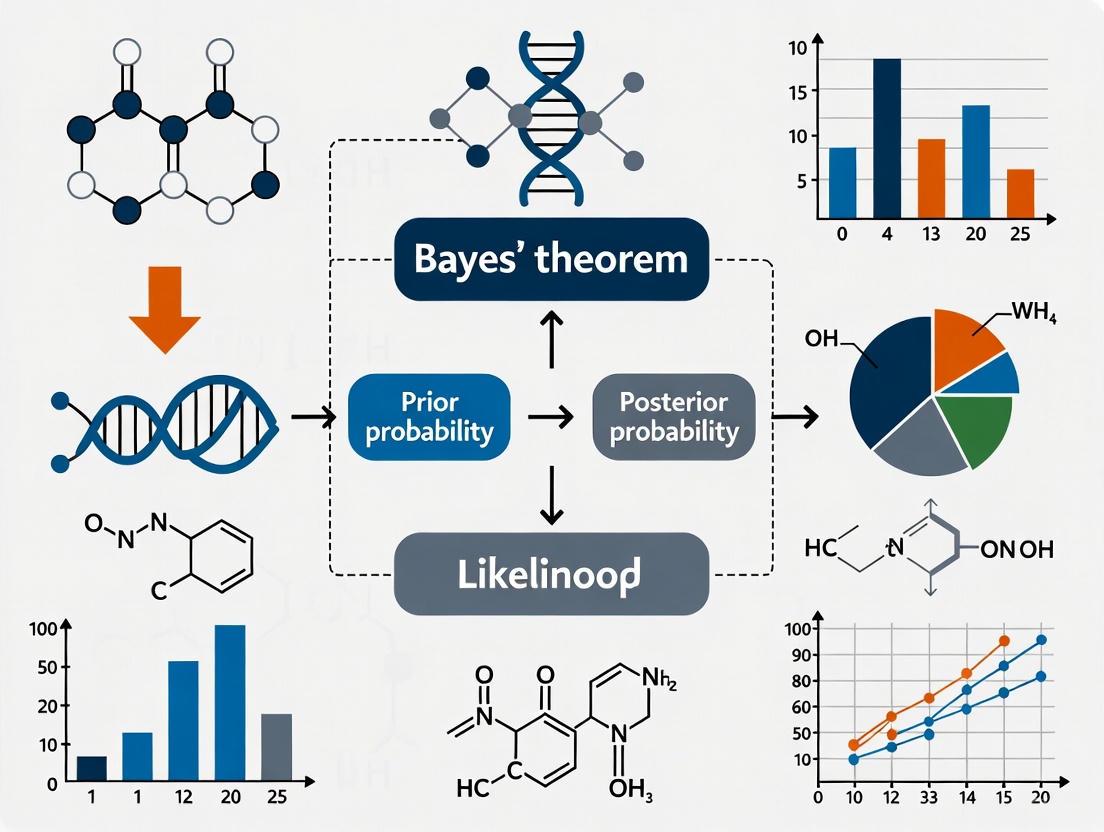
This article provides a comprehensive examination of the application of Bayes' Theorem for the evaluation of forensic evidence.
Bayes' Theorem in Forensic Science: A Framework for Statistical Evidence Evaluation
Abstract
This article provides a comprehensive examination of the application of Bayes' Theorem for the evaluation of forensic evidence. Tailored for researchers and forensic professionals, it covers the foundational principles of Bayesian reasoning, its methodological implementation in disciplines from DNA to trace evidence, and the critical challenges in its application, including the selection of prior probabilities and avoiding cognitive fallacies. It further explores validation strategies and compares Bayesian methods with classical statistical approaches, synthesizing key takeaways to outline future directions for robust and transparent forensic science practice.
The Bayesian Framework: Foundations for Forensic Reasoning
Mathematical Foundation
Bayes' Theorem provides a rigorous mathematical framework for updating the probability of a hypothesis based on new evidence. The theorem represents a fundamental rule for inverse probability, allowing calculation of conditional probabilities when the reverse conditional probability is known [1] [2].
Theorem Statement
Bayes' Theorem is mathematically stated as:
P(A|B) = [P(B|A) × P(A)] / P(B) [1]
Where:
- P(A|B) is the posterior probability - the probability of hypothesis A given evidence B
- P(B|A) is the likelihood - the probability of evidence B given that hypothesis A is true
- P(A) is the prior probability - the initial probability of hypothesis A before observing evidence B
- P(B) is the marginal probability - the total probability of evidence B under all possible hypotheses [1] [2]
For competing hypotheses, the second form of Bayes' Theorem is more practical:
P(H|E) = [P(H) × P(E|H)] / [P(H) × P(E|H) + P(¬H) × P(E|¬H)] [2]
Theorem Derivation
Bayes' Theorem derives from the definition of conditional probability. The probability of event A given event B is defined as:
P(A|B) = P(A ∩ B) / P(B), provided P(B) ≠ 0 [1]
Similarly, the probability of B given A is:
P(B|A) = P(A ∩ B) / P(A), provided P(A) ≠ 0 [1]
Solving for P(A ∩ B) in both equations and equating them gives:
P(A|B) × P(B) = P(B|A) × P(A)
Dividing both sides by P(B) yields Bayes' Theorem [1].
Bayesian Inference in Forensic Evidence Evaluation
Theoretical Framework for Forensic Science
Bayesian inference provides the mathematical foundation for interpreting forensic evidence through the likelihood ratio framework. When evaluating evidence E against competing propositions (H₁ and H₂), forensic scientists use the likelihood ratio:
LR = P(E|H₁) / P(E|H₂) [3]
This ratio quantifies how much more likely the evidence is under one proposition compared to the alternative. The posterior probability is then calculated by combining this likelihood ratio with prior odds [2] [3]:
Posterior Odds = Likelihood Ratio × Prior Odds
This framework discourages binary "yes/no" testimony and promotes transparency in forensic reporting by explicitly separating the statistical evidence from prior assumptions [3].
Bayesian Networks for Activity Level Propositions
Bayesian Networks (BNs) extend Bayes' Theorem to complex forensic scenarios with multiple dependent variables. Recent research has developed narrative Bayesian networks specifically for evaluating forensic fibre evidence given activity-level propositions [4] [5].
These networks provide:
- Transparent incorporation of case information
- Sensitivity assessment of evaluations to variations in data
- Interdisciplinary collaboration through alignment with approaches in other forensic disciplines [4]
A key advancement is the development of template Bayesian networks that handle disputes about the relation between an item and an activity. This is particularly valuable in interdisciplinary casework where multiple evidence types must be evaluated against a single set of activity-level propositions [6].
Table 1: Bayesian Network Applications in Forensic Science
| Network Type | Application | Key Features | Reference |
|---|---|---|---|
| Narrative Bayesian Network | Fibre evidence evaluation | Simplified methodology, accessible starting point for practitioners | [4] |
| Template Bayesian Network | Combining forensic evidence | Handles disputes about item-activity relations, interdisciplinary focus | [6] |
| Extended Template Model | Multiple case variations | Flexible framework adaptable to various forensic scenarios | [6] |
Experimental Protocols and Methodologies
Protocol for Constructing Narrative Bayesian Networks
The methodology for constructing narrative BNs for forensic fibre evidence involves [4] [5]:
- Case Scenario Definition: Develop an illustrative case scenario capturing the essence of cases where the template model applies
- Network Structure Development: Create three examples of BNs designed as accessible starting points for case-specific networks
- Variable Identification: Identify key variables and their probabilistic dependencies based on forensic expertise
- Sensitivity Analysis: Assess the evaluation's sensitivity to variations in input data and assumptions
- Validation: Verify network structure and conditional probabilities against known case outcomes and expert knowledge
This methodology emphasizes qualitative, narrative formats that are more accessible to both experts and courts, enhancing user-friendliness and accessibility [4].
Protocol for Template Bayesian Network Construction
For template BNs that combine multiple evidence types [6]:
- Proposition Definition: Define activity-level propositions considering disputes about actors, activities, and item-activity relationships
- Association Proposition Specification: Include a set of association propositions enabling combined evaluation of evidence concerning alleged activities and evidence concerning item usage
- Discipline Integration: Structure the network to accommodate evidence from different forensic disciplines
- Relation Uncertainty Incorporation: Model uncertainty about the connection between trace material and the offender (relevance of trace material)
- Likelihood Ratio Calculation: Derive likelihood ratios for competing propositions based on network computations
This protocol specifically addresses cases where the relationship between an item of interest and an activity is contested, which previous evaluative procedures at activity level failed to adequately account for [6].
Visualization of Bayesian Networks
Basic Bayesian Network Structure
Basic Bayesian Inference
Forensic Bayesian Network for Activity Level Propositions
Forensic Evidence Evaluation
Interdisciplinary Evidence Integration
Interdisciplinary Evidence Combination
Quantitative Data in Forensic Bayesian Analysis
Diagnostic Test Performance Metrics
Bayesian analysis is particularly valuable for interpreting diagnostic test results in contexts such as disease screening or forensic analysis. The following table summarizes key quantitative metrics used in these applications [1] [7]:
Table 2: Diagnostic Test Performance Metrics for Bayesian Analysis
| Metric | Definition | Formula | Application in Forensics | |
|---|---|---|---|---|
| Sensitivity (True Positive Rate) | Probability test is positive given condition is present | P(T+ | D+) | Ability to detect target evidence when present |
| Specificity (True Negative Rate) | Probability test is negative given condition is absent | P(T- | D-) | Ability to exclude non-target evidence when absent |
| Prevalence | Proportion of population with the condition | P(D+) | Base rate of target evidence in relevant population | |
| Positive Predictive Value | Probability condition is present given positive test | P(D+ | T+) | Probability evidence is relevant given positive finding |
| Negative Predictive Value | Probability condition is absent given negative test | P(D- | T-) | Probability evidence is not relevant given negative finding |
Case Study: Disease Diagnosis with Bayesian Analysis
Consider a medical diagnostic scenario with the following parameters [1]:
- Disease prevalence: 0.05 (5%)
- Test sensitivity: 0.90 (90%)
- Test specificity: 0.80 (80%)
The probability of having the disease given a positive test result is calculated as:
P(Disease|Positive) = [P(Positive|Disease) × P(Disease)] / [P(Positive|Disease) × P(Disease) + P(Positive|No Disease) × P(No Disease)]
P(Disease|Positive) = [0.90 × 0.05] / [0.90 × 0.05 + 0.20 × 0.95] = 0.045 / (0.045 + 0.19) ≈ 0.191 or 19.1% [1]
This demonstrates how even with a test that appears accurate (90% sensitivity), the posterior probability of having the disease can be relatively low when prevalence is low, due to false positives.
The Scientist's Toolkit: Bayesian Research Reagents
Table 3: Essential Methodological Components for Bayesian Forensic Research
| Component | Function | Application Example |
|---|---|---|
| Prior Probability Distribution | Quantifies initial beliefs about hypotheses before considering current evidence | Base rate of fibre transfer in alleged activity scenarios [4] |
| Likelihood Function | Quantifies how probable observed evidence is under different hypotheses | Probability of finding matching fibres given specific transfer scenarios [6] |
| Posterior Probability Distribution | Updated belief about hypotheses after considering evidence | Probability that suspect performed activity given all forensic findings [3] |
| Likelihood Ratio | Measures diagnostic strength of evidence for distinguishing hypotheses | Ratio of probabilities of evidence under prosecution and defence propositions [3] |
| Bayesian Network Software | Computational tools for implementing complex probabilistic models | Constructing template networks for interdisciplinary evidence evaluation [6] |
| Sensitivity Analysis Framework | Assesses robustness of conclusions to changes in inputs | Evaluating how variations in transfer probabilities affect activity level propositions [4] |
Advanced Applications in Forensic Science
Template Models for Interdisciplinary Evidence
Recent advances in Bayesian networks for forensic science include template models that enable evaluation of combined evidence from different disciplines. These models specifically address cases where [6]:
- The actor (who performed the activity) is disputed
- The activity itself is disputed
- The relationship between an item and an activity is disputed
The template model includes association propositions that enable combined evaluation of evidence concerning alleged activities of the suspect and evidence concerning the use of an alleged item in those activities. This is particularly valuable for interdisciplinary casework where DNA evidence, fibre evidence, and other trace materials must be evaluated against a single set of activity-level propositions [6].
Historical Development and Modern Implementation
Bayes' Theorem was discovered by Thomas Bayes (c. 1701-1761) and independently developed by Pierre-Simon Laplace (1749-1827) [8] [9]. After periods of controversy and decline, Bayesian methods have emerged as powerful tools across numerous fields, including forensic science [8].
The modern resurgence stems from:
- Computational advances enabling complex Bayesian calculations
- Theoretical developments in Bayesian networks and probabilistic reasoning
- Forensic science reforms emphasizing quantitative evidence evaluation
- Judicial recognition of the logical framework provided by Bayesian methods [3]
Bayesian inference now provides the mathematical foundation for interpreting forensic evidence through the likelihood ratio framework, which has been widely applied and validated across forensic disciplines including DNA analysis, fingerprint examination, voice comparison, and trace evidence evaluation [3].
The evolution of forensic evidence evaluation represents a paradigm shift from qualitative, experience-based reasoning to a structured, quantitative science. This transformation is exemplified by the journey from Wigmore Charts, an early graphical method for analyzing legal evidence, to the sophisticated Bayesian networks and probabilistic frameworks that underpin modern forensic science [10]. This whitepaper examines this historical progression, framing it within the context of Bayes' theorem and its critical role in contemporary evidence evaluation for researchers and scientific professionals.
The foundational work of John Henry Wigmore, developed in the early 20th century, provided the first systematic attempt to map the complex relationships between items of evidence and legal hypotheses using charts composed of lines and shapes [10]. Although largely forgotten by the 1960s, Wigmore's analytical method has been rediscovered and recognized as a precursor to modern belief networks [10] [11]. The subsequent integration of Bayesian statistics addresses a crucial need in forensic science: to objectively evaluate the strength of evidence under competing propositions, such as those presented by prosecution and defense, thereby minimizing cognitive biases and potential miscarriages of justice [12].
The Wigmorean Foundation: A Precursor to Analytical Rigor
Core Principles of Wigmore Charts
Developed by John Henry Wigmore after the completion of his Treatise in 1904, Wigmore Charts (or Wigmorean analysis) were born from his conviction that "something was missing" in legal evidence analysis [10]. This system employs:
- Graphical Representation: Using lines to represent reasoning, explanations, refutations, and conclusions.
- Symbolic Logic: Employing shapes to denote facts, claims, explanations, and refutations [10].
- Structured Analysis: Providing a method to deconstruct complex evidence into component relationships for clearer evaluation.
This methodology offered a nascent framework for managing evidentiary complexity, though it lacked the mathematical formalism that would later emerge through Bayesian probability.
The Decline and Rediscovery
Despite being taught in classrooms during the early 20th century, Wigmore's charting method was nearly obsolete by the 1960s [10]. Contemporary scholars have since revived his work, using it as a foundation for developing modern analytic standards that bridge legal reasoning and scientific evidence evaluation [13]. This rediscovery coincides with growing recognition of the need for transparent, structured approaches to evidence interpretation in forensic contexts.
The Bayesian Revolution in Forensic Science
Theoretical Foundation: Likelihood Ratios and Hypothesis Testing
The Bayesian framework for forensic evidence evaluation centers on the Likelihood Ratio (LR) as a measure of evidentiary strength. The LR quantitatively compares the probability of observing the evidence under two competing hypotheses [12]:
LR = p(E|Hp) / p(E|Hd)
Where:
p(E|Hp)= Probability of the evidence given the prosecution hypothesisp(E|Hd)= Probability of the evidence given the defense hypothesis
This approach forms the cornerstone of evaluative reporting standards developed by the European Network of Forensic Science Institutes (EFNSI) and other regulatory bodies, requiring forensic scientists to consider evidence under all relevant hypotheses rather than focusing solely on a single proposition [12].
Addressing Cognitive Biases Through Systematic Reasoning
The adoption of Bayesian methods directly addresses critical vulnerabilities in human cognition identified through the work of Kahneman and Tversky on System 1 (intuitive) and System 2 (analytical) thinking [12]. Forensic science failures, such as the erroneous statistical evidence in the Sally Clark and Kathleen Folbigg cases, often stem from:
- Transposition of Conditional Probabilities: Confusing p(E|H) with p(H|E)
- Baseline Neglect: Ignoring prior probabilities or background prevalence
- Prosecutor's Fallacy: Misrepresenting the strength of evidence by failing to consider alternative explanations [12]
Bayesian reasoning provides a systematic, System 2 approach that mitigates these heuristic errors by requiring explicit consideration of prior probabilities and alternative hypotheses.
Modern Implementation: Bayesian Networks for Evidence Evaluation
Construction Methodology for Forensic Applications
Contemporary implementation of Bayesian reasoning employs Bayesian Networks (BNs) as direct descendants of Wigmore's graphical approach. The construction methodology for forensic applications involves:
- Narrative Development: Building qualitative, narrative-based networks that align representation across forensic disciplines [4]
- Variable Identification: Defining key factors and relationships specific to case circumstances
- Probability Assignment: Quantifying relationships based on empirical data and expert knowledge
- Sensitivity Analysis: Testing the model's robustness to variations in input parameters [4]
This methodology offers a simplified, accessible starting point for practitioners to build case-specific networks while maintaining mathematical rigor.
Application to Trace Evidence: Fiber Analysis Case Example
In forensic fiber evidence evaluation at the activity level, Bayesian Networks provide a structured framework for handling complex transfer and persistence scenarios [4]. The network construction:
- Aligns representation with other forensic disciplines like biology
- Incorporates case information transparently
- Facilitates assessment of evaluation sensitivity to data variations
- Enhances user-friendliness and accessibility for courts [4]
This approach demonstrates the maturation of Wigmore's original concept into practical, interdisciplinary tools for forensic evaluation.
Table 1: Evolution of Analytical Approaches in Forensic Evidence Evaluation
| Era | Primary Method | Key Features | Limitations |
|---|---|---|---|
| Early 20th Century | Wigmore Charts [10] | Graphical representation, Symbolic logic, Qualitative relationships | Lacked mathematical formalism, Subjective interpretation |
| Mid-Late 20th Century | Traditional Statistical Methods | Frequency-based analysis, Class characteristics matching | Prosecutor's fallacy, Neglect of alternative hypotheses |
| 21st Century | Bayesian Networks & Likelihood Ratios [4] [12] | Quantitative probability framework, Explicit hypothesis testing, Transparency | Computational complexity, Data requirements, Training needs |
Experimental Protocols for Forensic Evidence Evaluation
Protocol 1: Fiber Evidence Analysis Using Bayesian Networks
Purpose: To evaluate forensic fiber findings given activity-level propositions using a narrative Bayesian network construction methodology [4].
Methodology:
- Case Scenario Definition: Develop detailed case circumstances and factors of consideration
- Hypothesis Formulation: Define prosecution and defense propositions regarding activities
- Network Structure Development:
- Identify key variables (transfer, persistence, recovery, background)
- Establish conditional dependencies between variables
- Align network structure with interdisciplinary approaches
- Probability Assignment:
- Parameterize nodes with empirical data where available
- Use expert knowledge for missing data with appropriate uncertainty
- Likelihood Ratio Calculation: Compute LR for competing propositions based on network output
- Sensitivity Analysis: Test robustness to variations in input probabilities and assumptions
Validation: Compare network outputs with known case outcomes and assess discriminatory power [4].
Protocol 2: Paper Analysis Using Multi-Technique Characterization
Purpose: To discriminate between paper sources for forensic document examination using integrated analytical techniques [13].
Methodology:
- Sample Preparation: Collect representative paper samples with known provenance
- Multi-Technique Analysis:
- Spectroscopic Analysis: FTIR, Raman spectroscopy for molecular composition
- Elemental Analysis: LIBS, XRF for inorganic filler characterization
- Mass Spectrometry: Py-GC/MS for organic additive profiling
- Isotopic Analysis: IRMS for geographical origin determination [13]
- Data Integration: Combine multiple analytical outputs using chemometric methods
- Statistical Classification: Apply machine learning algorithms for source discrimination
- Validation: Test method performance with forensically realistic samples including aged, contaminated, and degraded materials
Limitations Addressment: Account for environmental degradation pathways and extrinsic contamination typical of forensic exhibits [13].
Table 2: Analytical Techniques for Forensic Paper Characterization
| Technique Category | Specific Methods | Targeted Signatures | Forensic Utility |
|---|---|---|---|
| Spectroscopic | FTIR, Raman, LIBS, XRF, UV-Vis [13] | Molecular structure, Fillers, Additives, Elemental composition | Discrimination of paper types, Batch differentiation |
| Chromatographic/Mass Spectrometric | Py-GC/MS, HPLC, IRMS [13] | Organic additives, Sizing agents, Isotopic ratios | Source identification, Geographical origin determination |
| Physical & Imaging | Microscopy, Texture analysis, Thickness measurement [13] | Surface topology, Fiber distribution, Physical properties | Alteration detection, Manufacturing process identification |
The Scientist's Toolkit: Essential Reagents and Materials
Table 3: Key Research Reagent Solutions for Forensic Evidence Evaluation
| Reagent/Material | Composition/Type | Primary Function in Forensic Analysis |
|---|---|---|
| DNA Profiling Kits | PCR/STR Amplification Reagents [14] | Genetic marker amplification for human identification from biological evidence |
| Reference Fiber Collections | Synthetic/Natural Fiber Libraries | Comparative analysis of questioned fibers against known sources |
| Chromatographic Standards | Certified Reference Materials | Instrument calibration and quantitative analysis of inks, dyes, and additives |
| Spectroscopic Calibration Sets | Elemental/Molecular Standards | Validation of spectroscopic methods for paper and trace evidence analysis |
| Bayesian Network Software | Specialized Statistical Platforms | Implementation of probabilistic models for evidence evaluation under competing hypotheses |
Visualizing the Evolution: From Wigmore to Bayesian Analysis
Figure 1: Evolution of Forensic Evidence Analysis Methods. This diagram traces the development from early qualitative methods to contemporary quantitative frameworks.
Figure 2: Bayesian Workflow for Forensic Evidence Evaluation. This diagram illustrates the systematic process of evidence evaluation using Bayesian principles, highlighting the iterative nature of hypothesis testing.
The historical trajectory from Wigmore Charts to modern Bayesian networks represents a fundamental transformation in forensic evidence evaluation—from qualitative mapping to quantitative probabilistic reasoning. This evolution addresses critical needs for transparency, robustness, and scientific rigor in forensic science, particularly in light of documented miscarriages of justice stemming from flawed statistical reasoning [12].
Future developments in this field will likely focus on:
- Enhanced Computational Tools: Refining Bayesian network software for greater accessibility to forensic practitioners
- Expanded Empirical Databases: Developing comprehensive reference data for probability assignments across evidence types
- Interdisciplinary Collaboration: Leveraging approaches successful in disciplines like forensic biology for other evidence categories [4]
- Standardization and Validation: Establishing universally accepted protocols for evaluative reporting across forensic specialties
- Education and Training: Implementing curriculum requirements for statistical and probabilistic reasoning in forensic science education [12]
The integration of Wigmore's structured approach with Bayesian mathematical formalism provides a powerful framework for advancing the scientific foundations of forensic evidence evaluation, offering researchers and practitioners robust tools for addressing complex evidentiary questions in legal contexts.
Within the rigorous domain of forensic evidence evaluation, the Bayesian framework provides a structured and mathematically sound methodology for updating beliefs in the presence of uncertainty [15]. This approach is increasingly recognized as a normative standard for quantifying the probative value of evidence, moving beyond subjective assertion to a calculable measure of support for one proposition over another [16]. The core of this paradigm rests on three interconnected components: prior odds, which represent the initial belief about competing hypotheses before considering the new evidence; the likelihood ratio (LR), which quantifies the strength of the new evidence; and posterior odds, which reflect the updated belief after integrating the evidence [17] [16]. The relationship between these components is governed by a simple yet powerful multiplicative rule, offering a transparent model for reasoning under uncertainty that is particularly vital in legal contexts [15].
This technical guide details the core components and methodologies of the Bayesian framework as applied to forensic science. It is structured to provide researchers and practitioners with a deep understanding of the mathematical underpinnings, practical applications, and experimental protocols essential for implementing this approach in casework and research.
Mathematical Foundation
Bayes' Theorem provides the fundamental equation for updating probabilistic beliefs [1]. Its utility in forensic science is most clearly expressed in its odds form, which directly relates the three core components [16].
Bayes' Theorem and the Odds Form
The standard probability form of Bayes' Theorem is:
P(A|B) = [P(B|A) × P(A)] / P(B) [1] [18]
Where:
- P(A|B) is the posterior probability of hypothesis A given evidence B.
- P(B|A) is the likelihood of observing evidence B if hypothesis A is true.
- P(A) is the prior probability of hypothesis A.
- P(B) is the probability of evidence B.
For forensic evaluation, where two competing propositions (e.g., proposed by the prosecution, Hp, and the defense, Hd) are compared, the theorem is more effectively used in its odds form [16]:
Posterior Odds = Likelihood Ratio × Prior Odds [16]
This can be written as:
P(Hp|E) / P(Hd|E) = LR × [P(Hp) / P(Hd)]
In this framework, the Likelihood Ratio (LR) is the central term that forensic experts can evaluate and present to the court. The prior and posterior odds fall within the remit of the trier of fact (e.g., the jury), as they incorporate non-scientific, context-dependent information [15].
Core Components Definition
Table 1: Core Components of the Bayesian Framework in Forensic Science
| Component | Mathematical Representation | Forensic Interpretation | Responsible Party |
|---|---|---|---|
| Prior Odds | P(Hp) / P(Hd) | The odds in favor of the prosecution's proposition (Hp) over the defense's proposition (Hd) before considering the scientific evidence (E). | Trier of Fact (Jury) |
| Likelihood Ratio (LR) | P(E|Hp) / P(E|Hd) | The probability of observing the evidence (E) if Hp is true, divided by the probability of observing E if Hd is true. It quantifies the strength of the evidence. | Forensic Expert |
| Posterior Odds | P(Hp|E) / P(Hd|E) | The odds in favor of Hp over Hd after considering the scientific evidence (E). | Trier of Fact (Jury) |
Bayesian Framework in Forensic Evidence Evaluation
The application of the LR is the primary contribution of the forensic scientist to the Bayesian framework. It is a measure of diagnosticity that helps the trier of fact update their beliefs in a coherent manner [16].
The Likelihood Ratio as the Weight of Evidence
The LR is a continuous measure of evidential strength [16]. Its value can be interpreted as follows:
- LR > 1: The evidence is more likely under the prosecution's proposition (Hp) than under the defense's proposition (Hd). The higher the value, the stronger the support for Hp.
- LR = 1: The evidence is equally likely under both propositions. The evidence has no probative value and does not alter the prior odds.
- LR < 1: The evidence is more likely under the defense's proposition (Hd) than under the prosecution's proposition (Hp). The smaller the value, the stronger the support for Hd.
This approach explicitly separates the role of the forensic expert (providing the LR) from the role of the judiciary (assessing prior and posterior odds), thereby adhering to the Ultimate Issue Rule by preventing experts from directly pronouncing on the guilt or innocence of a defendant [15].
Conceptual Workflow of Forensic Bayesian Reasoning
The following diagram visualizes the logical sequence and relationship between the core components, the responsible parties, and the outcome in a forensic evaluation.
Bayesian Forensic Evaluation Workflow - This diagram illustrates how the court's prior odds and the expert's likelihood ratio combine to form the posterior odds, which represent the court's updated belief.
Experimental Protocols and Uncertainty Analysis
Implementing the Bayesian framework in practice requires careful methodology and a critical assessment of the uncertainties involved in calculating the LR.
General Protocol for LR Evaluation
Table 2: Generalized Protocol for Forensic Likelihood Ratio Evaluation
| Step | Action | Methodological Considerations |
|---|---|---|
| 1. Define Propositions | Formulate two competing, mutually exclusive propositions at the same hierarchical level (e.g., source level, activity level). | Propositions must be forensically relevant and agreed upon by parties. Hp: Prosecution proposition. Hd: Defense proposition. |
| 2. Identify Relevant Data & Populations | Determine the data needed to estimate the probabilities P(E|Hp) and P(E|Hd). This often involves selecting relevant reference populations. | Population data must be appropriate and representative. The choice can significantly impact the LR. |
| 3. Develop a Probabilistic Model | Construct a statistical model that formalizes the relationship between the evidence and the propositions under consideration. | Model complexity can vary. Assumptions must be explicitly stated and justified (e.g., assuming independence of features). |
| 4. Calculate the LR | Compute the ratio P(E|Hp) / P(E|Hd) using the developed model and available data. | For complex evidence (e.g., DNA mixtures), this may require specialized software and algorithms. |
| 5. Conduct Uncertainty Analysis | Evaluate the sensitivity of the LR to changes in model assumptions, parameters, and data quality. | Use frameworks like the "lattice of assumptions" and "uncertainty pyramid" to explore a range of plausible LR values [16]. |
Uncertainty Analysis: The Lattice of Assumptions
A reported LR is not an absolute, objective number. Its value depends on a chain of assumptions and modeling choices [16]. A comprehensive experimental protocol must therefore include an uncertainty analysis. The "lattice of assumptions" is a proposed framework for this purpose. It involves:
- Identifying Key Assumptions: Listing all major assumptions made in the modeling process (e.g., independence of features, choice of population database, statistical distribution used).
- Varying Assumptions Systematically: Recalculating the LR under different, plausible sets of assumptions.
- Building an Uncertainty Pyramid: The range of LR values obtained from this process forms a pyramid of results, from the most specific (a single set of assumptions) to the most general (encompassing all reasonable assumptions). This provides the trier of fact with a more complete picture of the robustness and reliability of the LR characterization, ensuring its fitness for purpose [16].
The Scientist's Toolkit: Essential Research Reagents and Materials
The practical application of the Bayesian framework across various forensic disciplines relies on a suite of specialized tools, databases, and software.
Table 3: Key Research Reagent Solutions for Bayesian Forensic Evaluation
| Tool / Material | Function in Bayesian Evaluation | Example Use-Case |
|---|---|---|
| Reference Population Databases | Provides the data necessary to estimate the probability of observing the evidence under the defense proposition (P(E|Hd)), i.e., the random match probability. | DNA frequency databases, automotive paint databases, fibre population studies. |
| Probabilistic Genotyping Software (PGS) | Implements complex statistical models to calculate LRs for DNA mixtures, where the evidence contains DNA from multiple contributors. | STRmix, TrueAllele. These are essential for calculating LRs in low-template or complex mixture DNA evidence. |
| Bayesian Network (BN) Software | Allows for the construction of graphical models that represent the probabilistic relationships between multiple variables and pieces of evidence in a case. | Hugin, GeNIe. Used for activity-level propositions (e.g., evaluating fibre evidence given a proposed scenario) [4]. |
| Validated Quantitative Models | Discipline-specific mathematical models that form the basis for calculating likelihoods. For example, models for glass refractive index or bullet lead composition. | Provides the "likelihood function" P(E|H) for continuous evidence types, moving beyond simplistic categorical matching. |
| Calibrated Black-Box Studies | Provides empirical data on the performance and error rates of forensic feature-comparison methods, which informs the uncertainty analysis of the LR. | Studies where practitioners evaluate evidence from ground-truth known sources; used to validate the reliability of the LR output for a given discipline [16]. |
The Bayesian framework, with its core components of prior odds, likelihood ratio, and posterior odds, offers a logically coherent and legally appropriate structure for the evaluation of forensic evidence [15] [16]. Its power lies in its ability to clearly separate the roles of the scientist and the jurist, while providing a common language of quantification for the "weight of evidence." The widespread adoption of this paradigm, particularly through the use of the likelihood ratio, represents a significant step toward the epistemological reform of forensic science, addressing historical criticisms concerning subjectivity and a lack of robust reliability testing [17].
However, the implementation of this framework is not a mere mechanical calculation. It requires careful formulation of propositions, development of valid probabilistic models, and, crucially, a thorough analysis of the uncertainty inherent in any reported LR value [16]. The ongoing development of standardized protocols, reference databases, and specialized software will continue to enhance the robustness and accessibility of Bayesian methods. For researchers and practitioners, mastering these core components is not just an academic exercise but a necessary skill for advancing the scientific rigor and, consequently, the justice, of modern forensic practice.
The Odds Form of Bayes' Theorem and its Legal Relevance
This technical guide provides an in-depth examination of the odds form of Bayes' Theorem and its critical applications in forensic science and legal evidence evaluation. The document outlines the mathematical formalism, presents structured probabilistic frameworks for forensic reasoning, and details experimental protocols for implementing Bayesian analysis in casework. Designed for researchers and forensic professionals, this whitepaper establishes a foundational framework for integrating Bayesian methodologies into forensic evidence evaluation research, with particular emphasis on interdisciplinary applications and the quantification of evidential value.
Bayesian inference provides a coherent framework for updating beliefs about propositions based on new evidence. Within forensic science, this framework enables the quantitative evaluation of evidence given competing propositions, typically advanced by prosecution and defense parties. The odds form of Bayes' Theorem serves as the mathematical cornerstone for this process, transforming prior beliefs into posterior beliefs through the integrating of evidential strength [19]. The theorem's application addresses a fundamental goal of forensic science: to determine the degree to which scientific evidence supports one proposition over another in legal proceedings [20].
The historical development of Bayesian methods in law traces back to foundational works by scholars such as John Henry Wigmore, who developed graphical systems to map legal reasoning [17]. The formal integration of probability theory into evidence scholarship gained significant momentum in the 1960s and 1970s through the work of Finkelstein and Fairley, Kaplan, and others who advocated for probabilistic approaches to legal decision-making [20]. Today, Bayesian networks—graphical models that represent variables and their conditional dependencies—have become increasingly sophisticated tools for handling complex forensic scenarios involving multiple pieces of evidence and propositions [4] [6].
Mathematical Foundations of the Odds Form
Theorem Formulation
The odds form of Bayes' Theorem provides a computationally efficient method for updating beliefs about competing hypotheses. The theorem states that the posterior odds in favor of hypothesis H₁ over hypothesis H₂, given evidence E, equal the prior odds multiplied by the likelihood ratio (LR):
Posterior Odds = Likelihood Ratio × Prior Odds
Mathematically, this is expressed as:
[ \frac{P(H1|E)}{P(H2|E)} = \frac{P(E|H1)}{P(E|H2)} \times \frac{P(H1)}{P(H2)} ]
Where:
- ( \frac{P(H1|E)}{P(H2|E)} ) represents the posterior odds of H₁ versus H₂ given evidence E
- ( \frac{P(E|H1)}{P(E|H2)} ) constitutes the likelihood ratio, quantifying how much more likely the evidence E is under H₁ than under H₂
- ( \frac{P(H1)}{P(H2)} ) represents the prior odds of H₁ versus H₂ before considering evidence E [21] [20]
The likelihood ratio (LR) serves as the fundamental measure of evidentiary strength in this framework, with values greater than 1 supporting H₁ and values less than 1 supporting H₂ [19].
Comparative Formulations
Table 1: Comparison of Bayes' Theorem Formulations
| Formulation Type | Mathematical Expression | Primary Application Context |
|---|---|---|
| Standard Form | ( P(A|B) = \frac{P(B|A)P(A)}{P(B)} ) | Basic probability calculations, single evidence evaluation |
| Odds Form | ( \frac{P(H1|E)}{P(H2|E)} = \frac{P(E|H1)}{P(E|H2)} \times \frac{P(H1)}{P(H2)} ) | Comparative hypothesis testing, forensic evidence evaluation |
| Extended Odds Form (Multiple Evidence) | ( O(H1:H2|E1,E2) = LR1 \times LR2 \times O(H1:H2) ) | Complex cases with multiple independent pieces of evidence [21] |
The odds form offers distinct advantages for forensic applications. It separates the role of the forensic scientist (who assesses the likelihood ratio) from the role of the trier of fact (who assesses prior odds based on other case information). This distinction maintains appropriate boundaries between scientific evaluation and legal judgment [20].
Bayesian Networks for Complex Legal Reasoning
Network Architecture for Evidence Evaluation
Bayesian networks (BNs) provide a graphical framework for representing complex probabilistic relationships among multiple variables in legal reasoning. These networks consist of nodes (representing variables), edges (representing dependencies), and conditional probability tables (quantifying these dependencies) [19]. In forensic applications, BNs enable the structured evaluation of evidence given activity-level propositions, which concern specific actions rather than source identification [4].
Table 2: Core Components of Forensic Bayesian Networks
| Component | Description | Forensic Application Example |
|---|---|---|
| Hypothesis Nodes | Represent competing propositions (e.g., prosecution vs. defense positions) | "Suspect present at scene" vs. "Suspect not present at scene" |
| Evidence Nodes | Represent observable forensic findings | DNA match, fiber transfer, eyewitness testimony |
| Intermediate Nodes | Represent unobservable events or sub-hypotheses | "Transfer occurred," "Persistence occurred," "Detection occurred" |
| Conditional Probability Tables | Quantify probabilistic relationships between connected nodes | Probability of observing fibers given specific activities |
Recent research has developed template Bayesian networks that can be adapted to various case scenarios, providing a standardized approach for forensic evaluators [6]. These templates facilitate interdisciplinary casework by offering a common structural framework for combining different types of evidence (e.g., DNA, fibers, digital evidence) within a single probabilistic model.
Visualizing Bayesian Reasoning
The following diagram illustrates a basic Bayesian network for evaluating forensic evidence given activity-level propositions:
Diagram 1: Basic Bayesian network for forensic evidence evaluation, incorporating uncertainty about the relationship between an item and an activity [6].
For more complex reasoning patterns involving multiple items of evidence, the following network structure captures the relationship between different evidentiary reports and their connection to underlying events:
Diagram 2: Bayesian network for multiple evidence reports referring to different events, connected by a "weft" representing conditional dependence [19].
Quantitative Framework for Evidence Evaluation
Likelihood Ratio Calculations
The likelihood ratio serves as the quantitative measure of evidentiary strength in the Bayesian framework. For forensic evidence E and competing propositions H₁ and H₂, the likelihood ratio is calculated as:
[ LR = \frac{P(E|H1)}{P(E|H2)} ]
The interpretation of LR values follows a standardized scale:
Table 3: Likelihood Ratio Interpretation Scale
| LR Value Range | Interpretation | Evidential Strength |
|---|---|---|
| 1 to 10 | Limited support for H₁ over H₂ | Weak |
| 10 to 100 | Moderate support for H₁ over H₂ | Moderate |
| 100 to 1000 | Strong support for H₁ over H₂ | Moderately strong |
| >1000 | Very strong support for H₁ over H₂ | Strong |
In practice, the likelihood ratio formulation can be expanded to account for relevant background information I:
[ LR = \frac{P(E|H1,I)}{P(E|H2,I)} ]
This formulation explicitly acknowledges that probabilistic assessments are always made within a specific context and with reference to available background information [20] [19].
Weight of Evidence
An alternative measure of evidential strength is the "weight of evidence," formally defined as the logarithm of the likelihood ratio:
[ WoE = \log_{10}(LR) ]
This logarithmic transformation provides practical benefits for combining multiple independent pieces of evidence, as the weights of evidence become additive [19]. For two independent pieces of evidence E₁ and E₂:
[ WoE{\text{total}} = WoE1 + WoE_2 ]
Which corresponds to multiplying likelihood ratios:
[ LR{\text{total}} = LR1 \times LR_2 ]
This additive property simplifies complex evidence combination problems and aligns with intuitive reasoning about cumulative evidential strength.
Experimental Protocols for Forensic Bayesian Analysis
Protocol for Template Bayesian Network Construction
Objective: Develop a standardized methodology for constructing Bayesian networks to evaluate forensic evidence given activity-level propositions.
Materials and Equipment:
- Case information documentation
- Probabilistic reasoning software (e.g., GeNIe, Hugin)
- Template Bayesian network structures [4] [6]
- Relevant empirical data on transfer, persistence, and detection probabilities
Procedure:
- Case Analysis: Identify the disputed issues and relevant activity-level propositions (H₁, H₂, ..., Hₙ).
- Evidence Identification: Catalog all relevant forensic findings and their relationships to the propositions.
- Network Structure Development:
- Place proposition nodes at the top of the network hierarchy
- Add intermediate nodes representing transfer, persistence, and detection events
- Incorporate evidence nodes at the bottom level
- Include nodes representing uncertainties (e.g., item-activity relationships)
- Parameterization:
- Define conditional probability tables for each node
- Incorporate relevant empirical data where available
- Use expert judgment for unavailable parameters, documenting all assumptions
- Validation:
- Test network behavior under extreme scenarios
- Verify that the network produces intuitively reasonable results
- Conduct sensitivity analysis to identify influential parameters
Analysis:
- Calculate likelihood ratios for evidence given competing propositions
- Evaluate the sensitivity of conclusions to changes in key parameters
- Document the overall support for competing propositions
This methodology aligns with recent research on narrative Bayesian network construction, emphasizing transparent incorporation of case information and assessment of evaluation sensitivity [4].
Protocol for Interdisciplinary Evidence Combination
Objective: Establish a framework for combining multiple types of forensic evidence (e.g., DNA, fibers, digital evidence) within a unified Bayesian model.
Materials and Equipment:
- Specialized knowledge from multiple forensic disciplines
- Extended template Bayesian networks [6]
- Interdisciplinary collaboration framework
Procedure:
- Proposition Definition: Establish a common set of activity-level propositions relevant to all evidence types.
- Network Integration:
- Utilize template networks with association propositions linking items to activities
- Create separate evidence pathways for each forensic discipline
- Implement wefts (cross-connections) between evidence pathways where appropriate
- Conditional Probability Assessment:
- Discipline-specific experts provide likelihood assessments for their evidence
- Document all assumptions and limitations for each evidence type
- Establish consensus on inter-disciplinary dependencies
- Combined Evaluation:
- Calculate overall likelihood ratios considering all evidence
- Evaluate synergistic or contradictory relationships between different evidence types
- Assess the combined weight of evidence
Analysis:
- Determine the cumulative support for competing propositions
- Identify evidential conflicts or synergies between different evidence types
- Quantify the value added by each additional evidence type
This protocol addresses the growing demand for interdisciplinary evidence evaluation in modern forensic casework [6].
The Scientist's Toolkit: Research Reagent Solutions
Table 4: Essential Analytical Tools for Bayesian Forensic Research
| Tool/Resource | Function | Application Context |
|---|---|---|
| Bayesian Network Software | Graphical creation and probability calculation | Implementing complex probabilistic models for case evaluation |
| Template Bayesian Networks | Pre-structured models for common forensic scenarios | Accelerating model development and ensuring methodological consistency [6] |
| Empirical Transfer/Persistence Databases | Source of quantitative data for probability assignments | Informing realistic parameter estimates for transfer evidence |
| Sensitivity Analysis Tools | Identification of influential model parameters | Focusing resources on highest-impact data collection [4] |
| Likelihood Ratio Calculation Frameworks | Standardized metrics for evidential strength | Providing quantitative measures of evidence value [19] |
Applications in Forensic Evidence Evaluation
Activity Level Propositions
The odds form of Bayes' Theorem finds particularly valuable application in evaluating evidence given activity-level propositions, which concern specific actions rather than source identification. For example, in a case involving fibers matching the suspect's sweater found at a crime scene, relevant activity-level propositions might be:
- H₁: The suspect strangled the victim while wearing the sweater
- H₂: The suspect never visited the crime scene [6]
The likelihood ratio would then assess the probability of finding the fibers under these competing explanations, considering factors such as:
- The probability of fiber transfer given physical contact
- The probability of fiber persistence until collection
- The background prevalence of similar fibers
- The possibility of indirect transfer mechanisms
This approach moves beyond simple source attribution to address the more forensically relevant question of what activities could explain the evidence findings.
Interdisciplinary Evidence Combination
Bayesian networks provide a structured framework for combining different types of forensic evidence within a single analysis. For example, a case involving both DNA evidence and fiber evidence can be evaluated using an extended network that incorporates:
- Separate evidence pathways for each discipline
- Association propositions linking items to activities
- Uncertainties about the relationship between items and activities [6]
This approach enables a more holistic evaluation of the total evidence than separate disciplinary evaluations, properly accounting for dependencies between different types of evidence.
The odds form of Bayes' Theorem provides a mathematically rigorous framework for evaluating forensic evidence given competing propositions. Its implementation through Bayesian networks offers a transparent, structured approach to complex probabilistic reasoning in legal contexts. The methodology supports both single-discipline evaluations and interdisciplinary evidence combination, addressing a critical need in modern forensic practice.
Future research directions include developing more sophisticated template networks for specific forensic scenarios, expanding empirical databases for transfer and persistence probabilities, and creating standardized protocols for sensitivity analysis and validation. As Bayesian methodologies continue to evolve, they promise to enhance the logical foundation of forensic science and improve the administration of justice through more transparent, quantitative evidence evaluation.
Bayesian probability theory, named after Thomas Bayes, provides a formal mathematical framework for updating beliefs in the presence of uncertainty. This approach stands in contrast to classical frequentist statistics by treating probabilities as measures of belief rather than as long-run frequencies. The cornerstone of this framework is Bayes' Theorem, which mathematically describes how to update the probability of a hypothesis based on new evidence [1]. The theorem's power lies in its ability to invert conditional probabilities: moving from the probability of observing data given a hypothesis to the probability that the hypothesis is true given the observed data. This inversion is particularly valuable in scientific fields where researchers must draw conclusions about underlying causes from observed effects.
The application of Bayesian methods has expanded dramatically across diverse scientific disciplines, from forensic science and medicine to machine learning and drug development. In forensic science specifically, Bayesian networks have emerged as a powerful tool for evaluating evidence under activity-level propositions, where the complexity of circumstances requires a transparent and structured approach to reasoning under uncertainty [4] [5]. The flexibility of the Bayesian framework allows researchers to incorporate both data-driven information and expert knowledge into a coherent probabilistic model, making it particularly suited for real-world scientific problems where multiple sources of uncertainty must be reconciled.
Theoretical Foundations of Bayes' Theorem
Mathematical Formulation
Bayes' Theorem provides a mathematical rule for inverting conditional probabilities. The theorem is stated mathematically as follows:
P(A|B) = [P(B|A) × P(A)] / P(B) [1]
Where:
- P(A|B) is the posterior probability - the probability of hypothesis A given evidence B
- P(B|A) is the likelihood - the probability of evidence B given that hypothesis A is true
- P(A) is the prior probability - the initial probability of hypothesis A before observing evidence B
- P(B) is the marginal probability - the total probability of evidence B across all possible hypotheses
This deceptively simple formula provides a rigorous method for updating beliefs in light of new evidence. The theorem can be derived from the definition of conditional probability, where the probability of both A and B occurring together, P(A∩B), can be expressed as either P(A|B)×P(B) or P(B|A)×P(A). Setting these equal and solving for P(A|B) yields Bayes' Theorem [1].
Conceptual Framework
The power of Bayesian reasoning extends beyond its mathematical formulation to its conceptual framework for scientific inference. This framework involves:
- Prior Probability (P(A)): Representing initial beliefs about a hypothesis before collecting new data
- Likelihood (P(B|A)): Expressing how probable the observed data is under the hypothesis
- Posterior Probability (P(A|B)): Representing updated beliefs about the hypothesis after considering the evidence
- Marginal Likelihood (P(B)): Serving as a normalizing constant that ensures probabilities sum to one
This Bayesian inference process creates a continuous cycle of knowledge updating, where today's posterior probabilities become tomorrow's priors as new evidence emerges. The framework explicitly acknowledges and incorporates prior knowledge while providing a mathematically coherent mechanism for updating beliefs based on empirical observations [1].
Bayesian Networks for Complex Reasoning
Representation and Structure
Bayesian networks (BNs) are graphical models that represent complex probabilistic relationships among multiple variables. They combine graph theory with probability theory to provide a natural tool for dealing with uncertainty and complexity in scientific reasoning [22]. A Bayesian network consists of two components:
- A directed acyclic graph (DAG) where nodes represent random variables and edges represent conditional dependencies between variables
- Conditional probability distributions for each node given its parents in the graph
The key advantage of Bayesian networks is their ability to represent the full joint probability distribution over all variables in a compact form by leveraging conditional independence relationships. For a set of variables X₁, X₂, ..., Xₙ, the chain rule of probability states that the joint probability is P(X₁, X₂, ..., Xₙ) = ΠP(Xᵢ|X₁, ..., Xᵢ₋₁). In a Bayesian network, each variable Xᵢ is conditionally independent of its non-descendants given its parents, allowing the joint distribution to be simplified to P(X₁, X₂, ..., Xₙ) = ΠP(Xᵢ|Parents(Xᵢ)) [22].
Table 1: Components of a Bayesian Network
| Component | Description | Function in the Model |
|---|---|---|
| Nodes | Represent random variables | Capture key factors in the problem domain |
| Edges | Represent conditional dependencies | Show direct influences between variables |
| Conditional Probability Tables (CPTs) | Quantify relationships between variables | Specify P(node|parents) for discrete variables |
| Prior Probabilities | Initial beliefs for root nodes | Represent knowledge before evidence |
Inference in Bayesian Networks
The primary computational task in Bayesian networks is probabilistic inference - calculating posterior probabilities of query variables given observed evidence. Consider the classic "water sprinkler" example [22]:
- Cloudy (C): A parent node with prior probability P(C=true) = 0.5
- Sprinkler (S): Child of C with P(S=true|C=true) = 0.1 and P(S=true|C=false) = 0.5
- Rain (R): Child of C with P(R=true|C=true) = 0.8 and P(R=true|C=false) = 0.2
- Wet Grass (W): Child of S and R with P(W=true|S=true,R=true) = 0.99, P(W=true|S=true,R=false) = 0.9, P(W=true|S=false,R=true) = 0.9, P(W=true|S=false,R=false) = 0.0
If we observe that the grass is wet (W=true), we can use Bayes' theorem to calculate the posterior probability that the sprinkler was on:
P(S=1|W=1) = P(W=1|S=1)P(S=1) / P(W=1) = 0.9 × 0.5 / (0.9 × 0.5 + 0.9 × 0.5) = 0.45 / 0.9 = 0.5
This demonstrates diagnostic reasoning - inferring causes from effects. Bayesian networks also support causal (top-down) reasoning, such as computing the probability that the grass will be wet given that it is cloudy [22].
Bayesian Network for Water Sprinkler Example
Methodological Approaches and Experimental Protocols
Narrative Bayesian Networks for Forensic Evidence Evaluation
The evaluation of forensic fibre evidence given activity-level propositions presents particular challenges due to case-specific circumstances and multiple interacting factors. A recently proposed methodology uses narrative Bayesian networks to address this complexity through a simplified construction approach [4] [5]. The experimental protocol for this methodology involves:
- Case Scenario Development: Creating illustrative case scenarios that capture the essential elements of forensic fibre evidence evaluation
- Network Structure Design: Developing BN structures that align with the narrative of the case while maintaining computational tractability
- Parameter Estimation: Specifying conditional probability distributions based on empirical data, expert knowledge, or a combination of both
- Sensitivity Analysis: Assessing how the evaluation changes with variations in input data and assumptions
This approach emphasizes transparent incorporation of case information, making the reasoning process more accessible to both experts and legal professionals [4]. The narrative format enhances user-friendliness and facilitates interdisciplinary collaboration by aligning with successful approaches in related forensic disciplines like forensic biology.
Bayesian Clinical Reasoning with Structured and Unstructured Data
In clinical medicine, Bayesian networks face the challenge of integrating both structured tabular data (lab results, demographic information) and unstructured text data (clinical notes, consultation summaries). A recent study proposed and compared different architectures for this integration in the context of pneumonia diagnosis [23]:
Experimental Protocol for Clinical Bayesian Networks:
- Data Generation: Creating an artificial yet realistic dataset containing both structured variables (symptoms, background factors) and unstructured clinical text
- Model Architectures:
- BN-gen-text: A generative approach that models the distribution of text representations directly
- BN-discr-text: A discriminative approach that uses text classifiers integrated with the BN
- Baseline Models:
- Standard BN without text variables
- Enhanced BN with additional observed symptoms
- Discriminative neural network using both tabular and text data
- Evaluation: Comparing posterior diagnostic probabilities across different evidence scenarios
This protocol allows researchers to investigate the impact of different modeling approaches for integrating textual information into the clinical reasoning process, with the goal of more accurately diagnosing conditions like pneumonia [23].
Table 2: Bayesian Model Comparison for Clinical Reasoning
| Model Type | Data Handling | Advantages | Limitations |
|---|---|---|---|
| Standard BN | Tabular data only | High interpretability, handles uncertainty well | Cannot utilize textual information |
| BN-gen-text | Tabular + generative text | Coherent probabilistic framework | Complex parameter estimation |
| BN-discr-text | Tabular + discriminative text | Effective use of text representations | Less coherent probabilistic semantics |
| Neural Network | Fused tabular and text | Powerful pattern recognition | Black box, poor interpretability |
Advanced Computational Techniques
Efficient Inference Algorithms
Performing exact inference by computing the full joint probability distribution and marginalizing out unwanted variables requires time exponential in the number of nodes, making it computationally intractable for large networks. Variable Elimination is a fundamental exact inference algorithm that efficiently computes marginal probabilities by leveraging the factored structure of the joint distribution [22].
The algorithm works by:
- Organizing the computation around the network structure
- "Pushing sums in" as far as possible when marginalizing out irrelevant variables
- Creating intermediate factors that are reused across computations
- Systematically eliminating variables in an order that minimizes computational complexity
For example, when computing P(W) in the water sprinkler network, we can efficiently compute:
P(W) = ΣC,S,R P(C) × P(S|C) × P(R|C) × P(W|S,R)
By strategically ordering the operations as:
P(W) = ΣS,R P(W|S,R) × [ΣC P(R|C) × P(S|C) × P(C)]
This approach significantly reduces computational complexity compared to naive computation of the full joint distribution [22].
Learning from Incomplete Data
Real-world scientific data often contains missing values, presenting challenges for Bayesian network learning. The Node-Average Likelihood (NAL) method provides a consistent and computationally efficient approach for learning BN structures from incomplete data [24]. The methodology involves:
- Theoretical Foundation: Establishing sufficient conditions for the consistency of the NAL estimator across different BN types, including discrete, Gaussian, and conditional Gaussian networks
- Model Identifiability: Proving that the true network structure can be identified from incomplete data under appropriate conditions
- Simulation Studies: Confirming theoretical results through independent simulation studies comparing NAL with Expectation-Maximization (EM) approaches
This research demonstrates that NAL maintains competitive performance with EM algorithms while offering greater computational efficiency, particularly for conditional Gaussian Bayesian networks [24].
Applications in Scientific Research
Forensic Science Applications
Bayesian networks have found particularly valuable applications in forensic science, where reasoning under uncertainty is essential. The evaluation of forensic fibre evidence demonstrates how BNs can address activity-level propositions through:
- Transparent Reasoning: Making the logical structure of forensic evaluation explicit and accessible
- Sensitivity Analysis: Understanding how conclusions depend on various evidential elements
- Interdisciplinary Alignment: Creating consistency with approaches used in other forensic disciplines
- Courtroom Communication: Facilitating clearer explanation of probabilistic reasoning to legal professionals [4] [5]
The narrative approach to BN construction in this context emphasizes the story-like nature of forensic evidence evaluation, where different hypotheses about activities compete to explain the observed trace evidence.
Biomedical and Clinical Applications
Bayesian methods support various biomedical applications:
Drug Development:
- Calculating the probability that a drug is effective based on clinical trial results
- Incorporating prior knowledge from earlier trial phases into later phase decisions
- Balancing evidence of efficacy against safety concerns [25] [1]
Diagnostic Testing:
- Determining the true positive and negative predictive values of medical tests
- Adjusting interpretations based on population prevalence and individual risk factors
- Combining multiple diagnostic indicators into coherent probability assessments
For example, consider a drug test with 90% sensitivity and 80% specificity used in a population with 5% prevalence. The probability that a random person who tests positive is actually a user is only:
P(User|Positive) = [P(Positive|User) × P(User)] / [P(Positive|User) × P(User) + P(Positive|Non-user) × P(Non-user)] = [0.90 × 0.05] / [0.90 × 0.05 + 0.20 × 0.95] ≈ 19% [1]
This demonstrates how Bayesian reasoning prevents misinterpretation of diagnostic results.
Clinical Reasoning with Multimodal Data
Research Reagent Solutions
Table 3: Essential Research Tools for Bayesian Modeling
| Research Tool | Function | Application Context |
|---|---|---|
| Probabilistic Programming Languages (Stan, PyMC3) | Specify complex Bayesian models | General Bayesian modeling, hierarchical models |
| Bayesian Network Software (GeNIe, Hugin) | Graphical BN construction and inference | Educational purposes, prototype development |
| Bayesplot Color Schemes | Visualization of posterior distributions | Model checking, result communication [26] |
| Node-Average Likelihood (NAL) Algorithm | BN structure learning from incomplete data | Handling missing data in real-world datasets [24] |
| Variable Elimination Algorithm | Exact inference in BNs | Probabilistic queries in moderate-sized networks [22] |
| Neural Text Representations | Integrating unstructured text into BNs | Clinical reasoning with narrative notes [23] |
| Narrative BN Templates | Standardized frameworks for evidence evaluation | Forensic fiber analysis, activity level propositions [4] |
Bayesian methods provide a powerful, coherent framework for scientific reasoning under uncertainty. From theoretical foundations to practical applications in fields ranging from forensic science to clinical medicine, the Bayesian approach offers principled methods for incorporating both data and prior knowledge into scientific conclusions. The ongoing development of computational methods - including efficient inference algorithms, techniques for handling incomplete data, and approaches for integrating diverse data types - continues to expand the applicability of Bayesian reasoning across scientific domains. As these methods become more accessible and computational power increases, Bayesian approaches are poised to play an increasingly central role in scientific research, particularly in complex, real-world problems where uncertainty is inherent and multiple sources of evidence must be reconciled.
From Theory to Practice: Implementing Bayesian Methods in Forensics
The evaluation of evidence, whether in a forensic laboratory or a clinical trial, is a fundamental scientific process. The Likelihood Ratio (LR) has emerged as a powerful and coherent statistical framework for quantifying the strength of evidence, providing a standardized measure for reasoning under uncertainty. Rooted in Bayesian probability theory, the LR enables researchers to update their beliefs about competing propositions based on new data [16] [27]. This technical guide explores the LR as a quantitative measure of evidential value, focusing specifically on its application within forensic evidence evaluation and its intrinsic relationship with Bayes' theorem.
The LR provides a method for comparing how well evidence supports one hypothesis against an alternative. This approach has gained significant traction in forensic science as practitioners seek objective quantitative methods to convey the meaning of evidence to legal decision-makers [16] [28]. The framework is equally valuable in diagnostic medicine and pharmaceutical research, where it helps assess the diagnostic value of tests or the strength of clinical findings [29] [30] [31].
Theoretical Foundations
Bayes' Theorem and the Role of the Likelihood Ratio
Bayes' Theorem, named after Reverend Thomas Bayes, provides the mathematical foundation for updating probabilities based on new evidence [32] [27]. In the context of evidence evaluation, it is typically expressed in its odds form:
Posterior Odds = Prior Odds × Likelihood Ratio
[16]
This equation separates the fact-finder's ultimate degree of belief (posterior odds) into their initial belief before considering the evidence (prior odds) and the weight of the evidence itself, quantified by the Likelihood Ratio [16]. The prior odds represent the fact-finder's initial assessment of the relative probabilities of the propositions based on all other information. The posterior odds represent the updated assessment after considering the new evidence. The Likelihood Ratio acts as the bridge between these two states of knowledge, quantifying how much the evidence should change one's beliefs [27].
Formally, the Likelihood Ratio is defined as the ratio of two probabilities: the probability of observing the evidence (E) if the first hypothesis (H1) is true, divided by the probability of observing the same evidence if the second hypothesis (H2) is true:
LR = P(E|H1) / P(E|H2)
[32] [30] [31]
Interpreting the Likelihood Ratio Value
The value of the LR provides direct insight into the strength and direction of the evidence. The further the LR is from 1, the stronger the evidence. The interpretation scale for LRs, as suggested by Jeffreys and others, provides a qualitative meaning to the quantitative values [33].
Table 1: Interpretation of the Likelihood Ratio Value
| LR Value | Strength of Evidence | Interpretation |
|---|---|---|
| > 10,000 | Decisive | Extreme support for H1 over H2 [33] [34]. |
| 1,000 - 10,000 | Very Strong | Very strong support for H1 over H2 [33]. |
| 100 - 1,000 | Strong | Strong support for H1 over H2 [33]. |
| 10 - 100 | Moderate | Moderate support for H1 over H2 [33]. |
| 1 - 10 | Limited | Weak support for H1 over H2 [33]. |
| 1 | None | The evidence is equally probable under both hypotheses; it has no evidential value [30] [31]. |
| 0.1 - 1 | Limited | Weak support for H2 over H1 [33]. |
| 0.01 - 0.1 | Moderate | Moderate support for H2 over H1 [33]. |
| 0.001 - 0.01 | Strong | Strong support for H2 over H1 [33]. |
| < 0.001 | Decisive | Extreme support for H2 over H1 [33] [34]. |
The Likelihood Ratio in Forensic Evidence Evaluation
Framework for Forensic Interpretation
In forensic science, the LR paradigm is increasingly advocated as a normative approach for expert testimony [16] [28]. The framework requires the examiner to define two mutually exclusive propositions, typically proposed by the prosecution and the defense. The role of the forensic expert is to evaluate the evidence under these two propositions and report the LR to the court [16].
For a piece of evidence E, the standard hypotheses are:
- H1 (Prosecution's Proposition): The evidence originated from the suspect.
- H2 (Defense's Proposition): The evidence originated from someone other than the suspect (a random member of the population).
The LR is then calculated as LR = P(E|H1) / P(E|H2). An LR of 1000 would mean that the observed evidence is 1000 times more likely if the suspect is the source than if a random person from the population is the source. This provides the trier of fact with a clear, quantitative measure of the evidence's strength, which they can then combine with other case information using Bayes' theorem [16] [28].
Application to Categorical and Digital Evidence
The LR framework is versatile and can be applied to various evidence types. For categorical count data, such as that encountered in digital forensics (e.g., patterns of user behavior), a Bayesian model can be developed to compute the LR in closed form [28]. In such applications, user-generated events are categorized, and the LR measures the relative probability of the observed pattern of counts under the two competing propositions about the user's identity. This approach provides a statistically rigorous method for comparing behavioral patterns from known and unknown sources [28].
Quantitative Application and Protocols
Calculation Methods and Formulae
The calculation of the LR depends on the nature of the test or evidence. For diagnostic tests with dichotomous outcomes (positive/negative), the LR can be derived directly from the test's sensitivity and specificity [30] [31].
Table 2: Likelihood Ratio Calculation for Diagnostic Tests
| Test Result | Formula | Component Definitions |
|---|---|---|
| Positive (LR+) | LR+ = Sensitivity / (1 - Specificity) |
Sensitivity: Probability a diseased patient tests positive (P(T+|D+)). Specificity: Probability a disease-free patient tests negative (P(T-|D-)). |
| Negative (LR-) | LR- = (1 - Sensitivity) / Specificity |
For instance, a test with 92% sensitivity and 99.98% specificity has an LR+ of 0.92 / (1 - 0.9998) = 0.92 / 0.0002 = 4600. This positive result is 4600 times more likely in a patient with the disease than in a patient without it, representing strong evidence for the disease [29]. For evidence that is not dichotomous, such as a continuous measurement or a result with multiple categories, an LR can be calculated for each specific result or category, providing more granular information than a simple positive/negative dichotomy [32] [30].
From Likelihood Ratio to Post-Test Probability
A critical application of the LR is updating the prior probability of a hypothesis (e.g., disease presence) to a posterior probability after incorporating the test result. This process involves converting probabilities to odds, multiplying by the LR, and converting back to probabilities [30] [31].
Protocol for Calculating Post-Test Probability:
- Establish Pre-Test Probability: Based on prevalence, clinical judgment, or base rates. Example: Pre-test probability = 0.1 (10%).
- Convert Pre-Test Probability to Pre-Test Odds:
Pre-test Odds = Pre-test Probability / (1 - Pre-test Probability). Example:0.1 / (1 - 0.1) = 0.1 / 0.9 ≈ 0.111. - Calculate Post-Test Odds:
Post-test Odds = Pre-test Odds × LR. Example (using LR+ of 20.4 from Table 3):0.111 × 20.4 ≈ 2.264. - Convert Post-Test Odds to Post-Test Probability:
Post-test Probability = Post-test Odds / (1 + Post-test Odds). Example:2.264 / (1 + 2.264) ≈ 2.264 / 3.264 ≈ 0.694.
This means a pre-test probability of 10% is updated to a post-test probability of about 69.4% after a positive test result with an LR of 20.4 [30]. This workflow can be visualized as a sequential updating process.
Illustrative Example from Clinical Research
The following table summarizes data from a study on smoking history as a diagnostic indicator for obstructive airway disease (OAD). The LR is calculated for each category of smoking exposure, demonstrating how LRs can utilize all available data without forcing dichotomization [30].
Table 3: Likelihood Ratios for Smoking History and Obstructive Airway Disease
| Smoking Habit (Pack Years) | OAD Present (n=148) | OAD Absent (n=144) | Likelihood Ratio (LR) | 95% CI |
|---|---|---|---|---|
| ≥ 40 | 42 (28.4%) | 2 (1.4%) | (42/148)/(2/144) = 20.4 | 5.04 to 82.8 |
| 20 - 40 | 25 (16.9%) | 24 (16.7%) | (25/148)/(24/144) = 1.01 | 0.61 to 1.69 |
| 0 - 20 | 29 (19.6%) | 51 (35.4%) | (29/148)/(51/144) = 0.55 | 0.37 to 0.82 |
| Never smoked | 52 (35.1%) | 67 (46.5%) | (52/148)/(67/144) = 0.76 | 0.57 to 1.00 |
Source: Adapted from Straus et al., 2000, as cited in [30].
This example shows that a history of ≥40 pack years provides strong positive evidence for OAD (LR=20.4), while a history of 0-20 pack years provides weak evidence against OAD (LR=0.55) [30]. The category of 20-40 pack years is uninformative (LR≈1). This multi-level approach preserves more diagnostic information than a simple "smoker/non-smoker" dichotomy.
Advanced Considerations and Uncertainty
The Scientist's Toolkit: Key Reagents and Models
Implementing the LR framework requires careful consideration of the underlying statistical models and data requirements.
Table 4: Essential Components for LR Calculation
| Component | Function / Description | Considerations |
|---|---|---|
| Reference Data | Data from known populations (e.g., known non-diseased and diseased populations; relevant background population in forensics). | Used to estimate the probability densities P(E|H1) and P(E|H2). Quality and representativeness are critical [16]. |
| Probabilistic Model | A statistical model (e.g., binomial, normal, kernel density, multivariate model) that describes the distribution of the evidence. | The choice of model can significantly impact the computed LR. The model must be a reasonable fit for the data [16] [28]. |
| Sensitivity Analysis | A procedure to evaluate how changes in assumptions or model parameters affect the resulting LR. | Assesses the robustness and uncertainty of the LR. An essential step for validating the conclusion [16]. |
| Software Tools | Statistical programming environments (e.g., R, Python with PyMC) or specialized Bayesian software (e.g., Stan, JAGS). | Necessary for implementing models, especially for complex evidence or continuous data [35] [33]. |
Uncertainty and the "Lattice of Assumptions"
A significant critique of the LR framework in forensic science is that the computed value is often presented as a single, definitive number, which can mask underlying uncertainty [16]. The LR depends on a chain of assumptions, including the choice of the relevant population for comparison, the statistical model used, and the estimates of model parameters.
To address this, it is recommended to conduct an extensive uncertainty analysis [16]. This involves conceptualizing a "lattice of assumptions," where each level represents a set of increasingly strict (or relaxed) assumptions. The LR is then computed across this lattice, forming an "uncertainty pyramid." This process helps experts and decision-makers understand the range of plausible LR values and assess the result's robustness. This is a broad, systematic view of uncertainty that goes beyond simple confidence intervals [16].
Relationship to Bayes Factors
In the context of model comparison and hypothesis testing in statistical research, the Bayes Factor is directly analogous to the Likelihood Ratio [33]. A Bayes Factor is the ratio of the marginal likelihoods of two competing models. When comparing models, the Bayes Factor measures the relative support for one model over another provided by the data. For a hypothesis test where H0 and H1 are two competing hypotheses, the Bayes Factor B10 is:
B10 = P(Data | H1) / P(Data | H0)
This is equivalent to a likelihood ratio comparing H1 to H0 [33]. Like the LR, a Bayes Factor greater than 1 supports H1, while a value less than 1 supports H0. The scale for interpretation is similar to that shown in Table 1 [33].
The Likelihood Ratio provides a coherent, quantitative, and logically sound framework for measuring the strength of evidence. Its foundation in Bayes' theorem makes it a universal tool applicable across diverse fields, from forensic science and clinical diagnostics to drug development and general statistical inference. The LR's power lies in its ability to separate the weight of the evidence itself from the prior beliefs of the observer, facilitating transparent and objective communication.
For researchers and forensic professionals, the successful application of the LR requires careful attention to several factors: the precise definition of the competing propositions, the collection of appropriate reference data, the selection of a valid statistical model, and, crucially, a thorough evaluation of the uncertainty associated with the final LR value. When these conditions are met, the LR stands as a robust and insightful measure of evidential value, enabling clearer scientific communication and more informed decision-making.
The case of R v Adams [1996] represents a pivotal moment in the history of forensic science, establishing critical legal precedents regarding the application of statistical methods, particularly Bayesian theorem, in the evaluation of DNA evidence. This case study examines the technical, legal, and statistical dimensions of this landmark ruling, framing it within a broader thesis on Bayesian frameworks for forensic evidence evaluation. For researchers and scientists engaged in evidentiary reliability assessment, the Adams case offers profound insights into the intersection of advanced statistical modeling and legal decision-making processes, highlighting both the potential and limitations of quantitative methods in forensic contexts.
Case Background and Factual History
The case Regina v. Denis John Adams [1996] EWCA Crim 222 involved a criminal appeal concerning the admissibility and interpretation of DNA evidence in a rape conviction [36] [37]. The factual circumstances presented a complex evidentiary scenario with conflicting probabilities.
Chronology of Key Events
- Date of Offense: 6th April 1991 - A female victim was attacked by a stranger while walking home [37].
- Evidence Collection: Semen samples were collected from vaginal swabs, from which a DNA profile was developed [37].
- Identification Parade: October 1993 - The victim failed to identify Adams in a police lineup [36] [37].
- Trial Proceedings: 24th January 1995 - At the Central Criminal Court before His Honour Judge Gordon, the appellant was convicted of rape and sentenced to seven years' imprisonment [37].
- Appeal Decision: 26th April 1996 - The Court of Appeal (Criminal Division) quashed the conviction and ordered a retrial [36] [37].
Evidentiary Conflicts
The prosecution and defense presented markedly different interpretations of the scientific evidence, creating a paradigm conflict between statistical and testimonial evidence:
| Evidence Type | Prosecution Position | Defense Position |
|---|---|---|
| DNA Match Probability | 1 in 200 million [36] | 1 in 20 million to 1 in 2 million [36] |
| Victim's Description | Attacker in his twenties [36] | Adams was 37; victim stated he looked about 40 [36] |
| Identification Evidence | N/A | Victim failed to identify Adams; stated he did not resemble attacker [36] [37] |
| Alibi Evidence | N/A | Girlfriend provided alibi for night in question [36] |
| Alternative Suspects | N/A | Half-brother in his 20s never tested [36] |
Bayesian Statistical Framework and Application
Theoretical Foundation
Bayesian theorem provides a mathematical framework for updating the probability of a hypothesis (e.g., guilt) as new evidence is introduced. The Adams case represented one of the first attempts to introduce formal Bayesian reasoning to jury deliberation in English courts [36]. The defense employed Professor Peter Donnelly of Oxford University to instruct the jury on applying Bayes' theorem to reconcile the conflicting DNA and non-DNA evidence [36].
The Bayesian approach applied in Adams can be formalized as follows:
- Prior Odds: Initial assessment of guilt before considering new evidence
- Likelihood Ratios: Probability of observing evidence given guilt versus innocence
- Posterior Odds: Revised probability of guilt after incorporating new evidence
Practical Implementation in Court Proceedings
During the retrial, the court developed a structured questionnaire to facilitate Bayesian reasoning among jurors [36]. This questionnaire addressed specific evidential elements:
- "If he were the attacker, what's the chance that she would say he looked nothing like the attacker?"
- "If he wasn't the attacker what's the chance that she would say he looked nothing like the attacker?"
These questions were designed to quantify the Bayes factors for various pieces of evidence, allowing jurors to systematically integrate both the DNA match statistics and the contradictory non-DNA evidence [36].
Contemporary Bayesian Applications in Forensics
Recent research has advanced beyond the simplistic Bayesian application attempted in Adams. Current methodologies employ Bayesian Networks (BNs) for evaluating forensic findings against activity-level propositions [4]. Modern approaches emphasize:
- Simplified construction methodologies for complex evidence evaluation
- Transparent incorporation of case information
- Sensitivity assessment to variations in data
- Interdisciplinary collaboration through qualitative, narrative formats [4]
Technical Analysis of DNA Evidence
DNA Processing Methodology
The DNA analysis in R v Adams would have followed standardized forensic protocols, though specific methodological details were contested during trial proceedings. Standard forensic DNA analysis involves several critical stages [38]:
Table: Standardized DNA Analysis Protocol
| Processing Stage | Technical Procedure | Purpose |
|---|---|---|
| Extraction | Chemical and physical separation of DNA from cellular material | Isolate DNA from forensic sample |
| Quantitation | Spectrophotometric or fluorescent measurement | Determine DNA concentration and quality |
| Amplification | Polymerase Chain Reaction (PCR) using specific primers | Generate multiple copies of target STR regions |
| Separation | Capillary or slab gel electrophoresis | Separate DNA fragments by size |
| Analysis & Interpretation | Comparison of STR profiles using electropherograms | Determine genetic matches between samples |
| Quality Assurance | Technical review and validation | Ensure analytical reliability [38] |
Short Tandem Repeat (STR) Analysis
While the specific DNA typing methodology used in Adams isn't explicitly detailed in the sources, the case coincided with the transition to STR technology in forensic applications [38]. STR analysis examines specific polymorphic loci on nuclear DNA:
- Discriminatory Power: The likelihood that any two individuals (except identical twins) will have the same 13-loci DNA profile can be as high as 1 in 1 billion or greater [38]
- CODIS Standards: The FBI established 13 core STR loci to ensure laboratory interoperability and database sharing [38]
- Profile Interpretation: Analysts examine electropherograms to identify alleles at each locus, with complete profiles exhibiting one or two peaks per locus [39]
Limitations and Contested Elements
The DNA evidence in Adams faced several technical challenges:
- Match Probability Disputes: Defense challenged the prosecution's 1 in 200 million estimate [36]
- Relational Considerations: The potential match to Adams' half-brother was never properly investigated [36]
- Methodological Constraints: At retrial, certain STR DNA evidence was excluded due to insufficient expert explanation [37]
Legal Proceedings and Judicial Reasoning
Trial Court Decisions
The original trial at the Central Criminal Court resulted in conviction based primarily on the DNA evidence, despite substantial contradictory non-DNA evidence [37]. The trial judge permitted instruction on Bayesian theorem but provided inadequate guidance on alternative evaluation methods [37].
Appeal Court Ruling
The Court of Appeal allowed Adams' appeal and quashed the conviction, expressing "serious doubts about the appropriateness of admitting Bayes theorem evidence in jury trials" [37]. The judicial reasoning emphasized:
- Jury Role Preservation: Mathematical formulas should not supplant jury common sense and judgment [37]
- Practical Guidance Need: Juries require concrete direction on evidence evaluation, not abstract statistical frameworks [37]
- Conviction Safety: The original summing-up undermined verdict safety by overemphasizing Bayesian approaches [37]
Court-Approved Statistical Guidance
Following the appeal, the court established specific guidelines for explaining match probabilities to jurors, advocating a practical, population-based framework rather than abstract statistics [36] [40]:
"Suppose the match probability is 1 in 20 million. That means that in Britain (population about 60 million) there will be on average about 2 or 3 people, and certainly no more than 6 or 7, whose DNA matches that found at the crime scene, in addition to the accused. Now your job, as a member of the jury, is to decide on the basis of the other evidence, whether or not you are satisfied that it is the person on trial who is guilty, rather than one of the few other people with matching DNA." [36]
Research Implications and Experimental Considerations
Bayesian Framework for Forensic Evaluation
The Adams case illustrates both the theoretical value and practical challenges of implementing Bayesian reasoning in legal contexts. For researchers developing forensic evaluation methodologies, several critical considerations emerge:
- Complexity Management: Bayesian Networks (BNs) offer more accessible implementation than mathematical formulas [4]
- Transparency Requirements: Evaluative processes must be comprehensible to non-specialists [4]
- Evidence Integration: Effective frameworks must accommodate both quantitative and qualitative evidence
Research Reagent Solutions for DNA Analysis
Table: Essential Research Materials for Forensic DNA Analysis
| Reagent/Equipment | Technical Function | Application Context |
|---|---|---|
| PCR Amplification Kits | Enzymatic replication of target DNA sequences | Generating sufficient DNA for analysis from minimal samples |
| STR Multiplex Kits | Simultaneous amplification of multiple STR loci | Developing comprehensive DNA profiles for identification |
| Electrophoresis Systems | Size-based separation of DNA fragments | distinguishing allele variants at each locus |
| Fluorescent Detection Dyes | Labeling DNA fragments for visualization | enabling precise allele identification and sizing |
| Quantitation Standards | Measuring DNA concentration and quality | ensuring optimal amplification and reliable results |
| Reference Samples | Known DNA profiles for comparison | establishing matches between evidence and suspects [38] [39] |
Visualizing the Bayesian Evaluation Workflow
Evidence Integration Framework
Forensic DNA Analysis Workflow
The R v Adams case established critical boundaries for the application of statistical methodologies in legal proceedings, particularly regarding Bayesian theorem in DNA evidence evaluation. While recognizing the mathematical validity of probabilistic reasoning, the English Court of Appeal affirmed the primacy of jury judgment over complex statistical formulations. For forensic researchers and statistical methodologies, the case underscores the necessity of developing evaluative frameworks that balance statistical rigor with practical implementability in legal contexts. The enduring legacy of Adams continues to inform contemporary developments in Bayesian Network applications and evidence evaluation protocols at the intersection of science and law.
Bayesian Networks (BNs) for Complex, Multi-Evidence Analysis
Bayesian Networks (BNs), also known as Belief Networks or Bayes Nets, are probabilistic graphical models that represent a set of variables and their conditional dependencies via a directed acyclic graph (DAG) [41]. They provide a powerful framework for reasoning under uncertainty by combining principles from probability theory and graph theory [42]. For forensic evidence evaluation, BNs offer a formal mathematical foundation for handling complex, multi-evidence scenarios where uncertainty is inherent [43]. The core principle lies in using Bayes' theorem to update the probability of hypotheses as new evidence is incorporated, making them particularly suitable for forensic reasoning where evidence accumulates progressively during an investigation [44].
BNs enable forensic researchers to move beyond simple binary associations and model complex causal relationships between multiple factors affecting evidence interpretation [45]. This capability is crucial in fields such as forensic toxicology, DNA mixture interpretation, and fingerprint analysis, where conclusions must be drawn from imperfect, partial, or conflicting evidence [46]. The network structure provides an intuitive visualization of the relationships between hypotheses, evidence, and contextual factors, while the underlying probability calculus ensures rigorous, consistent reasoning [47].
Core Theoretical Foundations
Fundamental Components and Structure
A Bayesian Network consists of two main components: a qualitative part (the structure) and a quantitative part (the parameters) [43]. The structure is represented by a Directed Acyclic Graph (DAG) where:
- Nodes represent random variables (e.g., hypotheses, pieces of evidence, or other relevant factors) [42].
- Directed Edges represent direct probabilistic dependencies or causal relationships between variables [45].
The quantitative component consists of:
- Conditional Probability Tables (CPTs) for discrete variables, which specify the probability distribution of each node given the states of its parent nodes [44].
- Conditional Probability Distributions for continuous variables, often modeled using Conditional Linear Gaussian distributions [43].
The joint probability distribution over all variables in the network factorizes according to the chain rule for Bayesian networks:
[ P(X1, X2, \ldots, Xn) = \prod{i=1}^n P(Xi \mid \text{pa}(Xi)) ]
Where (\text{pa}(Xi)) denotes the parent nodes of (Xi) in the graph [44]. This factorization allows for efficient representation and computation of complex multivariate distributions.
Key Probability Rules for Forensic Reasoning
Bayesian Networks for forensic analysis rely on several fundamental probability rules:
Bayes' Theorem: The cornerstone of probabilistic updating in light of new evidence:
[ P(H|E) = \frac{P(E|H) \cdot P(H)}{P(E)} ]
Where (H) represents a hypothesis and (E) represents evidence [42] [44].
Chain Rule: Enables computation of joint probabilities from conditional probabilities:
[ P(X1, X2, ..., Xn) = P(X1)P(X2|X1)P(X3|X1,X2)\cdots P(Xn|X1,X2,...,X_{n-1}) ]
Law of Total Probability: Facilitates computation of marginal probabilities from joint probabilities:
[ P(X) = \sumi P(X, Yi) ]
These rules collectively enable BNs to perform complex evidential reasoning by systematically incorporating new information [44].
Bayesian Networks for Multi-Evidence Analysis
Modeling Complex Evidential Relationships
In forensic contexts, evidence is rarely isolated; multiple pieces of evidence interact in complex ways. BNs excel at modeling these interactions through their graphical structure and conditional probability specifications [47]. The direction of edges typically represents causal influence or temporal sequence, though they can also represent purely probabilistic dependencies [41].
Two key concepts for multi-evidence analysis are:
- Conditional Dependence: Represented by edges in the network, where the state of one variable directly influences the probability distribution of another [47].
- Conditional Independence: Variables that are not connected directly may be conditionally independent given other variables in the network, significantly reducing model complexity [47].
For forensic applications, the d-separation criterion provides a formal method for determining conditional independence relationships within the network structure, which is essential for correct probabilistic reasoning [41].
Inference in Multi-Node Networks
BNs support various types of inference crucial for forensic analysis [41]:
- Predictive Reasoning: From causes to effects (e.g., from hypothetical scenarios to expected evidence).
- Diagnostic Reasoning: From effects to causes (e.g., from observed evidence to possible explanations).
- Intercausal Reasoning: Between competing explanations of the same evidence.
The process of calculating updated probabilities given observed evidence is called probabilistic inference or belief updating [43]. Exact inference methods include variable elimination and clique tree propagation, while approximate methods include stochastic simulation and variational methods [41].
Figure 1: BN Structure for Multi-Evidence Forensic Analysis. This diagram illustrates how multiple pieces of evidence (E1, E2, E3) relate to a central hypothesis (H) while being influenced by contextual factors.
Experimental Protocols and Implementation
Network Development Methodology
Developing a Bayesian Network for forensic analysis involves two primary stages: structure learning and parameter learning [45].
Structure Learning Protocols:
- Expert-Driven Approach: Domain experts define the network structure based on established causal relationships [46].
- Data-Driven Approach: Algorithms automatically learn structure from data using methods like:
- Constraint-based algorithms (PC, Grow-Shrink)
- Score-based algorithms (K2, Hill Climbing)
- Hybrid approaches [45]
- Hybrid Approach: Combine expert knowledge with data-driven learning for optimal results [45].
Parameter Learning Protocols:
- Expert Elicitation: Systematic methods for encoding expert knowledge as probability distributions [46].
- Data-Driven Parameter Estimation:
- Maximum Likelihood Estimation
- Bayesian Parameter Estimation
- Expectation-Maximization (EM) Algorithm: For handling missing data during parameter learning [41].
Inference Validation Protocol
To ensure reliability in forensic applications, BN models must undergo rigorous validation:
- Sensitivity Analysis: Measure how output probabilities change with variations in input parameters.
- Predictive Validation: Compare model predictions with known outcomes from test cases.
- Case Retrospection: Apply the model to historical cases with established ground truth.
- Cross-Validation: For data-driven models, use k-fold cross-validation to assess generalizability.
Figure 2: BN Development Workflow. This diagram outlines the systematic process for developing and validating Bayesian Networks for forensic applications.
Quantitative Framework for Forensic Analysis
Conditional Probability Tables in Forensic Applications
Conditional Probability Tables (CPTs) quantitatively encode the strength of relationships between variables in a BN. The following table illustrates a simplified CPT for a forensic evidence model:
Table 1: Example Conditional Probability Table for Alarm System in Burglary Scenario
| Burglary (B) | Earthquake (E) | P(Alarm=True | B,E) | P(Alarm=False | B,E) |
|---|---|---|---|
| True | True | 0.95 | 0.05 |
| True | False | 0.94 | 0.06 |
| False | True | 0.29 | 0.71 |
| False | False | 0.001 | 0.999 |
Source: Adapted from classic Bayesian network examples [48] [44]
For forensic applications, CPTs can represent the probability of observing specific evidence given different hypotheses. The following table demonstrates a more forensically-relevant CPT structure:
Table 2: Conditional Probability Table for Observing Evidence Given Hypothesis
| Hypothesis State | Context Factor | P(Evidence=Present | H,C) | P(Evidence=Absent | H,C) | P(Evidence=Inconclusive | H,C) |
|---|---|---|---|---|
| H1 | C1 | 0.95 | 0.04 | 0.01 |
| H1 | C2 | 0.85 | 0.10 | 0.05 |
| H2 | C1 | 0.10 | 0.85 | 0.05 |
| H2 | C2 | 0.25 | 0.70 | 0.05 |
Prior Probability Specification
Prior probabilities represent the initial belief about hypotheses before considering new evidence. In forensic applications, priors should be based on relevant background information or population statistics.
Table 3: Example Prior Probability Distributions for Forensic Hypotheses
| Hypothesis | Description | Prior Probability | Justification |
|---|---|---|---|
| H1 | Proposition 1 | 0.45 | Base rate from case data |
| H2 | Proposition 2 | 0.45 | Base rate from case data |
| H3 | Alternative explanation | 0.10 | Rare but possible scenario |
The Scientist's Toolkit: Research Reagent Solutions
Table 4: Essential Tools and Software for Bayesian Network Research
| Tool Category | Specific Solutions | Function in BN Research |
|---|---|---|
| Probabilistic Programming Frameworks | PyMC3, Stan | Define and perform inference on complex probabilistic models [47] |
| Specialized BN Software | BayesiaLab, Bayes Server | Comprehensive platforms for BN development, validation, and visualization [43] |
| Open-Source Libraries | bnlearn (R), pgmpy (Python) | Structure learning, parameter learning, and inference algorithms [45] |
| Structure Learning Algorithms | K2, Hill Climbing, Tabu Search | Automatically learn network structure from data [45] |
| Parameter Learning Methods | EM Algorithm, Bayesian Estimation | Estimate CPTs from complete or incomplete data [41] |
| Sensitivity Analysis Tools | Tornado plots, Value of information | Identify influential parameters and prioritize refinement efforts [46] |
Advanced Applications in Forensic Science
Complex Evidence Integration
Bayesian Networks provide a mathematically coherent framework for combining multiple types of evidence in forensic casework. The following diagram illustrates a network for integrating biological, chemical, and testimonial evidence:
Figure 3: Complex Evidence Integration BN. This network demonstrates how different evidence types with their specific contextual factors can be integrated within a unified probabilistic framework.
Handling Rare Events and Previously Unobserved Scenarios
A significant challenge in forensic BN development is accounting for rare events or previously unobserved scenarios [46]. Specialized techniques include:
- Pseudo-count methods for maintaining non-zero probabilities of rare events
- Expert elicitation protocols for estimating probabilities of unobserved events
- Robustness analysis to assess the impact of potential missing variables
When incorporating expert knowledge into data-driven models, it is possible to preserve the expected values of observed variables while integrating additional expert factors [46]. This approach maintains consistency with existing data while enhancing model completeness.
Bayesian Networks provide a powerful, mathematically rigorous framework for complex multi-evidence analysis in forensic science. By explicitly representing dependencies between variables and systematically updating probabilities as new evidence is incorporated, BNs address fundamental challenges in forensic reasoning under uncertainty. The structured approach to model development, combined with comprehensive validation protocols, ensures that BN-based forensic analyses are transparent, reproducible, and forensically sound. As computational resources advance and specialized software becomes more accessible, Bayesian Networks are poised to play an increasingly important role in formal evidence evaluation across diverse forensic disciplines.
The evaluation of forensic fibre evidence given activity-level propositions represents a significant evolution beyond traditional source-level analysis. While source-level propositions address questions of origin (e.g., "Does this fibre come from this specific garment?"), activity-level propositions address more forensically relevant questions about how evidence was transferred during specific actions or events [49]. This shift from "whose DNA is this?" to "how did it get there?" reflects the increasing sophistication of forensic science but introduces substantial evaluative complexity due to the circumstances and factors unique to each case [4] [49].
The application of Bayesian networks (BNs) has emerged as a powerful methodology for managing this complexity. Bayesian frameworks provide a mathematically rigorous structure for weighing evidence under competing propositions, allowing forensic scientists to quantify the probative value of fibre findings in the context of alleged activities [4]. This approach aligns forensic fibre evaluation with methodologies successfully employed in other forensic disciplines, particularly forensic biology, promoting interdisciplinary collaboration and more holistic forensic analysis [4].
Theoretical Foundation: Bayesian Networks for Evidence Evaluation
Core Mathematical Principles
Bayesian analysis in forensic science applies Bayes' theorem to update the probability of propositions based on new evidence. The fundamental formula for comparing two competing propositions (H₁ and H₂) given evidence (E) is:
LR = P(E|H₁) / P(E|H₂)
Where LR represents the likelihood ratio, which quantifies the strength of evidence in support of one proposition over another [49]. A LR greater than 1 supports H₁, while a LR less than 1 supports H₂. The magnitude of the LR indicates the strength of this support.
Network Architecture for Activity-Level Reasoning
Bayesian networks for fibre evidence evaluation incorporate multiple variables representing transfer, persistence, and background presence mechanisms. These networks utilize conditional probability tables to quantitatively represent the relationships between variables, allowing for transparent incorporation of case information and evaluation of sensitivity to data variations [4]. The qualitative, narrative structure of these networks offers a format more accessible for both experts and courts to understand compared to more complex representations [4] [5].
Table 1: Core Components of Bayesian Networks for Fibre Evidence Evaluation
| Network Component | Function | Considerations |
|---|---|---|
| Activity Node | Represents the alleged activity (e.g., physical assault) | Must be precisely defined based on case circumstances |
| Transfer Node | Models fibre transfer mechanisms | Considers shedder status, contact duration, pressure |
| Persistence Node | Models fibre retention over time | Considers time elapsed, activity post-contact |
| Background Node | Accounts for environmental presence | Consumes fibre prevalence in relevant environment |
| Recovery Node | Represents evidence collection efficiency | Considers technique sensitivity and analyst skill |
Practical Implementation: Case Examples and Methodologies
Construction Methodology for Narrative Bayesian Networks
A simplified methodology for constructing narrative BNs for activity-level evaluation involves multiple stages designed to enhance accessibility for practitioners [4]. This approach emphasizes transparent reasoning and facilitates assessment of evaluation sensitivity to data variations.
The construction workflow begins with case narrative development, identifying relevant activities and alternative scenarios. This is followed by variable identification for each factor influencing fibre transfer, persistence, or recovery. Next, network structure development establishes causal relationships between variables, while probability assignment populates conditional probability tables based on experimental data and expert knowledge. Finally, sensitivity analysis evaluates how changes in probabilities affect the overall likelihood ratio [4].
Illustrative Case Scenario
Consider a case where a suspect alleges they briefly shook hands with a victim, while the prosecution alleges the suspect grabbed the victim violently. The competing activity-level propositions would be:
- H₁: The suspect violently grabbed the victim
- H₂: The suspect briefly shook hands with the victim
The Bayesian network would incorporate nodes for the alleged activity, fibre transfer probability given the activity, fibre persistence given time elapsed, background presence of similar fibres, and recovery of fibres from the victim's garment [4] [49]. The likelihood ratio would then quantify how much the recovered fibre evidence supports one activity proposition over the other.
Analytical Techniques for Fibre Characterization
Advanced Spectroscopic Methods
Fourier Transform Infrared Spectroscopy (FT-IR) has emerged as a particularly valuable technique for fibre analysis, especially when combined with multivariate statistical methods [50]. FT-IR provides detailed information about the chemical composition of fibres, enabling discrimination even between fibres of the same generic class [50].
The analytical workflow typically involves:
- Sample Preparation: Minimal preparation required; direct placement on ATR-FT-IR crystal
- Spectral Acquisition: Scanning in mid-infrared range (4000-400 cm⁻¹) with 100 scans at 4 cm⁻¹ resolution
- Background Correction: Air measurement to remove background effects
- Instrument Validation: Polystyrene film standard to ensure performance
- Contamination Prevention: ATR crystal cleaning with ethanol between samples [50]
Table 2: Analytical Techniques for Fibre Examination
| Technique | Type | Key Applications | Advantages | Limitations |
|---|---|---|---|---|
| ATR-FT-IR | Non-destructive | Polymer identification, subclass discrimination | Rapid, minimal sample prep, high discrimination power | Limited to surface analysis |
| Py-GC/MS | Destructive | Polymer composition, additive analysis | Detailed molecular information | Destructive, complex interpretation |
| LC-MS | Destructive | Dye composition analysis | High sensitivity for dyes | Destructive, requires expertise |
| Polarized Light Microscopy | Non-destructive | Fibre type, diameter, optical properties | Low cost, quick screening | Subjective interpretation |
| Microspectrophotometry | Non-destructive | Color measurement, discrimination | Objective color measurement | Limited to color analysis |
Chemometric Analysis and Data Interpretation
Multivariate statistical methods significantly enhance the analytical value of spectroscopic data. Principal Component Analysis (PCA) is used to observe unique patterns and cluster samples based on spectral similarities, while Soft Independent Modeling by Class Analogy (SIMCA) provides classification models for fibre identification [50].
The data analysis workflow involves multiple stages:
- Data Preprocessing: Applying Savitzky-Golay first derivative and Standard Normal Variate methods to smooth spectra and minimize scattering effects
- Data Cleaning: Checking for duplicates or missing data
- Model Development: Building PCA and SIMCA models using specialized software (e.g., Aspen Unscrambler)
- Validation: Testing model performance with known samples [50]
In one study of 138 synthetic fibres, this approach achieved 97.1% correct classification at a 5% significance level, demonstrating the power of combining spectroscopic techniques with multivariate analysis [50].
Research Reagents and Essential Materials
Table 3: Essential Research Materials for Forensic Fibre Analysis
| Item | Function | Application Example |
|---|---|---|
| ATR-FT-IR Microscope | Obtain infrared spectra of fibre samples | Polymer identification and comparison [50] |
| Reference Fibre Collections | Known standards for comparison | FBI Fibre Library (86 FTIR spectra records) [51] |
| Multivariate Analysis Software | Statistical analysis of spectral data | Aspen Unscrambler for PCA and SIMCA models [50] |
| Collaborative Testing Services Fibre Collection | Reference materials for method validation | Synthetic and natural fibres for quality assurance [51] |
| Polarized Light Microscope | Initial screening and physical characterization | Fibre diameter, color, and optical properties [50] |
Visualizing Bayesian Networks and Analytical Workflows
Bayesian Network for Activity-Level Evaluation
FT-IR Analysis Workflow with Chemometrics
Future Directions and Research Needs
The application of Bayesian networks to activity-level propositions in fibre evidence represents a promising but developing field. Future research should focus on expanding template models to cover a broader range of transfer scenarios and improving the data foundation for assigning probabilities [4]. Key research priorities include:
- Standardized Transfer Probability Data: Developing comprehensive datasets for fibre transfer probabilities under various conditions
- Persistence Modeling: Quantitative studies on fibre persistence across different substrates and environmental conditions
- Background Prevalence Studies: Systematic investigation of fibre background levels in various environments
- Integration with Other Evidence Types: Developing interdisciplinary Bayesian networks incorporating multiple evidence categories [4]
The transition to activity-level evaluation addresses the fundamental need for forensic science to provide more focused and useful contributions to the criminal justice process [49]. By implementing the structured Bayesian framework outlined in this guide, forensic researchers and practitioners can enhance the scientific rigor and probative value of fibre evidence evaluation.
This technical guide provides forensic researchers and scientists with an in-depth analysis of SAILR, a specialized software platform for calculating Likelihood Ratios (LRs) within a Bayesian framework for forensic evidence evaluation. The content explores SAILR's architecture, implementation protocols, and performance characteristics alongside a comparative analysis of other computational platforms. Framed within the broader context of forensic evidence evaluation research, this whitepetailorored to the needs of professionals engaged in developing and validating statistical methods for forensic interpretation, particularly in chemical and analytical evidence domains.
The Bayesian framework provides a coherent and logically sound foundation for the interpretation of forensic evidence, enabling scientists to quantify the strength of evidence in support of competing propositions. This framework updates prior beliefs about hypotheses based on observed evidence to produce posterior probabilities, mathematically expressed as Posterior Odds = Likelihood Ratio × Prior Odds [52]. The role of the forensic scientist centers on the computation and interpretation of the Likelihood Ratio (LR), which represents the probability of observing the evidence under the prosecutor's hypothesis compared to the defense hypothesis [52].
Bayesian methods differ fundamentally from frequentist approaches in both philosophy and implementation. While frequentist statistics interpret probability as long-run frequency and treat parameters as fixed, Bayesian statistics interpret probability as a degree of belief and treat parameters as random variables with probability distributions [53] [54]. This distinction becomes particularly valuable in forensic science where analysts must express evidential strength in a framework that naturally incorporates uncertainty and prior knowledge.
Specialized software tools have become essential for implementing sophisticated Bayesian calculations in forensic practice, particularly for continuous data where determination of LRs from relative frequencies is complicated by within-source variation [52]. These platforms enable forensic practitioners to apply complex statistical models without requiring deep expertise in statistical programming, thereby promoting standardization and reliability in forensic evaluative reporting.
SAILR Software Platform: Core Architecture and Implementation
SAILR (Software for the Analysis and Implementation of Likelihood Ratios) is an open-source Java platform resulting from a European Union-funded project aimed at developing a unified framework for calculating data-driven LRs [52]. The software provides a validated mathematical backbone within a user-friendly graphical interface, currently maintained and distributed by the Universities of Dundee, Glasgow, and Edinburgh. SAILR was specifically designed to harmonize various statistical approaches to LR calculation and to make advanced Bayesian methods accessible to forensic practitioners who may not have extensive training in statistics [52].
The platform addresses the significant challenge of calculating LRs for continuous data evidence, where simple frequency-based approaches are insufficient due to within-source variation. SAILR employs statistical modeling with continuous probability distributions, typically handling within-source variation using normal distributions (after appropriate testing), and between-source variation using more complex modeling techniques such as kernel density estimation (KDE) [52]. This approach provides a more statistically rigorous alternative to traditional methods using cutoff values or t-tests, which have inherent limitations in evaluating the uniqueness of composition.
Technical Architecture and Statistical Foundations
SAILR's architecture implements a feature-based Likelihood Ratio system capable of handling multivariate data from various analytical techniques. The software assumes that repeated measurements of a single feature are distributed normally around a mean (μ) with standard deviation (σ), where the standard deviation represents the within-source variation of repeated measurements across all samples in the training set [52]. This assumption, while foundational, requires validation for each application, as violations can impact method performance.
The platform supports empirical validation of data-driven LR methods through a structured process analogous to the validation of instrumental analytical methods, though with different relevant metrics [52]. This validation process determines the scope of validity of an LR method, allowing it to be used in forensic casework, though the final decision regarding fitness-for-purpose remains with the user on a case-specific basis, considering relevance and data quality [52].
Table 1: Core Technical Components of SAILR Architecture
| Component | Implementation in SAILR | Statistical Consideration |
|---|---|---|
| Within-Source Variation | Normal distribution around mean μ with standard deviation σ | Assumption requires testing; heavy-tailed distributions may need normalization |
| Between-Source Variation | Kernel Density Estimation (KDE) or other complex modeling | Accounts for population-level variability that is typically non-normal |
| Data Types Supported | Continuous data from analytical instruments | Multivariate, feature-based approach |
| Validation Framework | Empirical performance evaluation using test sets | Metrics include discrimination, accuracy, and calibration |
Implementation Workflow for Forensic Analysis
The implementation of SAILR follows a structured workflow that begins with data preparation and progresses through model validation to case application. The following diagram illustrates the core operational workflow for forensic evidence evaluation using the SAILR platform:
The successful implementation of SAILR requires careful attention to several critical methodological considerations. Forensic practitioners must ensure that the background dataset represents a representative sample of the source population of interest [52]. Additionally, any deviation from the assumption of normality must be evaluated for its influence on method performance, and the model's performance must be empirically validated using the background data [52]. These considerations align with international forensic regulatory frameworks and standards like ISI-21043, promoting transparency and limiting cognitive bias in forensic evaluations [55].
Experimental Protocols and Validation Methodologies
Validation Framework for SAILR Implementation
The validation of SAILR implementations follows a rigorous protocol to establish performance characteristics and scope of validity. In a validation study for diesel oil analysis using gas chromatography-mass spectrometry data, researchers collected 158 diesel oil samples from Swedish gas stations and oil refineries over a five-year period (2015-2020) [52]. Samples were prepared by diluting one drop of oil in approximately 7 mL dichloromethane, followed by analysis using an Agilent 7890A GC coupled to an Agilent 5975C mass spectrometry detector operated at 70 eV in selected ion monitoring mode [52].
The validation process assessed three key performance characteristics: (1) discrimination (the ability to distinguish between same-source and different-source samples), (2) accuracy (how well the calculated LRs correspond to ground truth), and (3) calibration (the reliability of LR values across their range) [52]. These metrics are essential for establishing the validity and reliability of LR methods before implementation in casework.
Table 2: Key Performance Metrics for SAILR Validation
| Performance Characteristic | Evaluation Method | Acceptance Criteria |
|---|---|---|
| Discrimination | Ability to distinguish same-source and different-source samples | Clear separation between within-source and between-source comparisons |
| Accuracy | Correspondence between calculated LRs and ground truth | LRs >1 for same-source and <1 for different-source specimens |
| Calibration | Reliability of LR values across their range | Goodness-of-fit between calculated and expected LRs |
| Model Fit | Normality testing of within-source variation | Statistical tests for distributional assumptions |
Case Study: Diesel Oil Analysis via GC-MS
A specific validation study focused on GC-MS data for comparison of diesel oil samples demonstrated both the capabilities and limitations of the SAILR platform. Researchers selected ten features (ratios between gas chromatographic peaks, R1-R10) for the multivariate LR system [52]. The within-source distributions of these ratios were all heavy-tailed, with kurtosis values ranging from 3.4 to 7 (compared to 3 for a perfect normal distribution), with one ratio reaching a kurtosis value of 18 [52]. None of the within-source variations in the ten features passed all tests of normality using p<0.05 as a threshold for three statistical tests [52].
This case study highlighted the importance of testing distributional assumptions and implementing appropriate data transformations when necessary. Despite these challenges, after optimizing the number of features and applying normalization techniques, the final method demonstrated good discrimination, accuracy, and calibration [52]. The researchers concluded that while SAILR provides a robust mathematical framework, users bear responsibility for ensuring their data meets model assumptions and that their implementation is properly validated for their specific forensic context [52].
Research Reagent Solutions for Forensic Bayesian Analysis
Table 3: Essential Materials and Analytical Components for SAILR Implementation
| Reagent/Component | Technical Specification | Function in Analysis |
|---|---|---|
| Reference Database | Representative sample of source population | Provides background data for between-source distribution estimation |
| Quality Control Samples | Known source materials with documented provenance | Validates analytical instrumentation and sample preparation |
| Chromatographic System | GC-MS with selective ion monitoring | Generates quantitative feature data for chemical pattern recognition |
| Data Normalization Algorithms | Mathematical transformations | Addresses heavy-tailed distributions and other violations of normality |
| Statistical Testing Framework | Normality tests, discrimination metrics | Validates model assumptions and performance characteristics |
Complementary and Alternative Platforms
Bayesian Computational Tools Across Disciplines
While SAILR represents a specialized tool for forensic evidence evaluation, Bayesian computational platforms have been developed across multiple scientific domains. These platforms share common theoretical foundations but differ in their implementation specifics and target applications:
Bayesian Hierarchical Modeling in Clinical Research: In medical and pharmaceutical research, Bayesian hierarchical models have been successfully applied to analyze multi-center clinical trials. These models treat center effects as additive random effects on the log odds of response, assuming centers are "exchangeable" - similar but different - with effects sampled from a normal distribution with mean zero and estimable standard deviation [56]. This approach is particularly valuable for identifying potential outlying centers and quantifying between-center variability, especially when some centers have small sample sizes where traditional frequentist methods struggle with detection [56].
Bayesian Optimization in Engineering Design: Engineering disciplines have embraced Bayesian optimization (BO) for complex design challenges, such as configuring wing-sailed autonomous sailing monohulls [57]. BO constructs a prior belief using initially collected data, defines an acquisition function to guide exploration by leveraging uncertainty in the posterior, and iteratively selects new evaluation points based on optimizing the acquisition function [57]. This approach significantly reduces computational costs compared to traditional space-filling sampling patterns, making it particularly valuable for ad hoc design tasks with large parameter spaces.
Comparative Analysis of Platform Capabilities
Table 4: Platform Comparison for Bayesian Calculation Across Disciplines
| Platform/Approach | Primary Application Domain | Key Strengths | Implementation Considerations |
|---|---|---|---|
| SAILR | Forensic evidence evaluation (chemical, analytical) | Specialized for forensic LR calculation; validated statistical backbone | Requires normality testing; dependent on representative background data |
| Bayesian Hierarchical Models | Multi-center clinical trials, healthcare outcomes | Handles clustered data; borrows strength across subgroups | Careful prior specification needed; sensitivity analysis recommended |
| Bayesian Optimization | Engineering design, parameter configuration | Efficient for expensive-to-evaluate functions; handles large search spaces | Acquisition function choice impacts performance; prior knowledge incorporation |
| General Bayesian Packages | General statistical analysis (R/Stan, PyMC3) | Flexibility for diverse models; active development community | Requires statistical programming expertise; steeper learning curve |
Implementation Guidelines for Forensic Research
Strategic Selection of Bayesian Platforms
The selection of an appropriate Bayesian platform for forensic research depends on multiple factors, including the nature of the evidence, available reference data, and required output formats. SAILR is particularly suited for forensic evidence evaluation involving continuous data from analytical instruments, such as chemical composition analysis [52]. Its structured approach to LR calculation aligns with international guidelines for evaluative reporting, making it appropriate for implementation in forensic laboratories with standard operating procedures.
For more specialized applications or when customized model structures are required, general Bayesian programming frameworks such as Stan (with R/Python interfaces) or PyMC3 offer greater flexibility but require significantly more statistical programming expertise [53]. These tools are particularly valuable for research and development of new forensic evaluation methods before implementation in standardized platforms like SAILR.
Integration with Forensic Evaluation Workflows
The successful implementation of Bayesian calculation platforms requires careful integration with established forensic evaluation workflows. The following diagram illustrates the logical relationship between hypothesis formulation, evidence evaluation, and statistical interpretation in the forensic Bayesian framework:
This framework emphasizes the clear separation of responsibilities between forensic scientists (who compute the LR based on the evidence) and legal decision-makers (who consider prior odds). This distinction is crucial for maintaining methodological rigor and avoiding the "prior neglect" or "baseline neglect" described by Kahneman, where the LR is mistakenly interpreted as the odds of guilt [58].
SAILR represents a significant advancement in the implementation of Bayesian methods for forensic evidence evaluation, providing a standardized, validated platform for calculating Likelihood Ratios from complex analytical data. Its development addresses a critical need in forensic science for transparent, statistically rigorous methods that appropriately quantify the strength of evidence while acknowledging uncertainty. When implemented with careful attention to model assumptions, validation protocols, and representative background data, SAILR and complementary Bayesian platforms provide forensic researchers and practitioners with powerful tools for evaluative reporting. As the field continues to evolve toward more standardized methodologies, these computational platforms will play an increasingly vital role in ensuring the reliability and validity of forensic science conclusions.
Navigating Challenges and Pitfalls in Forensic Bayesianism
The proper interpretation of statistical evidence represents a critical interface between science and law, with misapplications having profound consequences for justice. Within the context of Bayes' theorem for forensic evidence evaluation research, two specific cognitive errors—the Prosecutor's Fallacy and the Defense Attorney's Fallacy—emerge as systematic misinterpretations that can substantially mislead legal decision-makers. These fallacies represent mirror errors in conditional probability reasoning that persist despite being formally identified decades ago [59]. For researchers and scientists engaged in developing and interpreting forensic methodologies, understanding these fallacies is not merely theoretical but fundamental to ensuring that statistical evidence contributes to rather than undermines the pursuit of truth in legal proceedings.
The tension between legal and scientific principles becomes particularly acute in statistical evidence interpretation. Legal decisions seek finality and consistency through precedent, while scientific results evolve with new evidence [59]. This fundamental divergence creates an environment where statistical fallacies can thrive, exacerbated by the fact that conditional probabilities are inherently counterintuitive to human reasoning [60]. The research community must therefore develop not only more accurate statistical methods but also more robust frameworks for their communication and interpretation within legal contexts.
Defining the Fallacies: Formal Foundations and Distinctions
The Prosecutor's Fallacy: A Fundamental Transposition of Conditional Probability
The Prosecutor's Fallacy constitutes a logical error in which the probability of observing evidence given innocence is incorrectly equated with the probability of innocence given the evidence [61] [60]. Formally, this represents a transposition of conditional probabilities where P(E|I) is mistakenly interpreted as P(I|E), where E represents the evidence and I represents innocence [62]. This fallacy most commonly arises in criminal trials when the prosecution presents a match probability—such as the probability that a random person's DNA would match crime scene DNA—as directly indicative of the defendant's guilt [63] [59].
The theoretical foundation of this error lies in misunderstanding the proper direction of conditional probability. While P(E|I) represents the likelihood of the evidence under an assumption of innocence, P(I|E) represents the probability of innocence in light of the evidence. These two probabilities are distinct and related through Bayes' theorem, which formally expresses their relationship as:
P(I|E) = [P(E|I) × P(I)] / P(E) [61]
Where P(I) represents the prior probability of innocence before considering evidence E, and P(E) represents the total probability of observing the evidence regardless of guilt or innocence. The Prosecutor's Fallacy effectively ignores the base rate P(I) and the normalizing constant P(E), treating P(E|I) as though it directly equals P(I|E) [64] [65].
The Defense Attorney's Fallacy: The Neglect of Probative Value
Conversely, the Defense Attorney's Fallacy occurs when the probative value of evidence is inappropriately dismissed by focusing exclusively on the number of potential sources or matches within a population [65]. This fallacy arises when the defense argues that forensic evidence has minimal value because many other people in the population could also match the evidentiary sample, while ignoring that the evidence still substantially increases the probability of guilt relative to its prior assessment [65].
Where the Prosecutor's Fallacy overstates the value of evidence, the Defense Attorney's Fallacy understates it by failing to acknowledge that although multiple matches may exist theoretically, the defendant has been identified through investigation rather than random selection from the population. This fallacy represents a different form of base rate neglect where the reduction in probability of guilt due to potential other matches is overestimated without proper Bayesian updating [65].
Table 1: Comparative Analysis of Legal Statistical Fallacies
| Characteristic | Prosecutor's Fallacy | Defense Attorney's Fallacy |
|---|---|---|
| Core Error | Equates P(E|I) with P(I|E) | Dismisses evidence by focusing only on the number of potential alternative sources |
| Typical Proponent | Prosecution | Defense |
| Effect on Evidence | Overstates probative value | Understates probative value |
| Base Rate Consideration | Ignores prior probability of guilt | Misapplies population statistics to deny evidence value |
| Bayesian Framework | Neglects prior odds in posterior calculation | Fails to acknowledge significant change from prior to posterior odds |
Bayesian Foundations: The Mathematical Framework for Avoiding Fallacies
Bayes' Theorem as the Antidote to Conditional Probability Errors
Bayes' theorem provides the essential mathematical foundation for properly updating beliefs in light of new evidence, serving as a formal corrective to both the Prosecutor's and Defense Attorney's fallacies [63] [66]. The theorem formally expresses the relationship between conditional probabilities as:
P(H|E) = [P(E|H) × P(H)] / P(E) [63]
Where:
- P(H|E) is the posterior probability of hypothesis H given evidence E
- P(E|H) is the likelihood of observing E if H is true
- P(H) is the prior probability of H before observing E
- P(E) is the total probability of E across all possible hypotheses
In the legal context, this translates to updating the probability of guilt (or innocence) after considering forensic evidence. The odds form of Bayes' theorem provides a particularly useful framework for forensic science:
Posterior Odds = Likelihood Ratio × Prior Odds [59]
Where the Likelihood Ratio (LR) = P(E|Hp) / P(E|Hd), with Hp representing the prosecution hypothesis and Hd representing the defense hypothesis [59]. This formulation explicitly separates the role of the forensic expert (who provides the LR) from the role of the judge or jury (who bring the prior odds based on other evidence) [59].
Figure 1: Bayesian updating process for legal evidence interpretation, showing how prior beliefs are modified by evidence through the likelihood ratio to form posterior conclusions
The Likelihood Ratio as a Modern Forensic Standard
Contemporary forensic science has increasingly adopted the likelihood ratio as the standard framework for expressing the strength of forensic evidence [59]. The LR quantitatively expresses how much more likely the observed evidence is under the prosecution's hypothesis compared to the defense's hypothesis. This approach offers significant advantages:
- Prevents transposition: By focusing on P(E|H) rather than P(H|E), the LR framework helps avoid the Prosecutor's Fallacy [59]
- Expert boundary definition: Forensic experts testify about the LR while judges/juries determine prior and posterior probabilities, maintaining proper role separation [59]
- Quantitative precision: The LR provides a continuous scale of evidence strength rather than binary conclusions [59]
The European Network of Forensic Science Institutes (ENFSI) and the UK Royal Statistical Society have formally recommended the use of likelihood ratios for forensic evidence evaluation [59]. This represents a significant evolution from earlier practices that relied more heavily on random match probabilities and categorical statements.
Historical Case Studies: Experimental Protocols and Consequences
The Sally Clark Case: Protocol Analysis of a Statistical Miscarriage
The case of Sally Clark in the United Kingdom represents one of the most notorious examples of the Prosecutor's Fallacy in practice [61] [62]. Clark was convicted in 1999 of murdering her two infant sons, largely based on flawed statistical testimony from pediatrician Sir Roy Meadows [62].
Experimental Protocol of the Flawed Statistical Analysis:
- Population Selection: Meadows focused on affluent, non-smoking families with mothers over 26
- Base Rate Establishment: Cited the probability of one cot death (Sudden Infant Death Syndrome) in such families as approximately 1 in 8,500
- Independence Assumption: Erroneously assumed independence between the two deaths, calculating the probability of two cot deaths as (1/8,500) × (1/8,500) = 1 in 73 million
- Fallacious Interpretation: Presented this 1 in 73 million figure as the probability that Clark was innocent of murdering her children [62]
Methodological Flaws and Corrections:
- The independence assumption was statistically invalid; subsequent research showed that siblings of cot death victims have 10-22 times higher risk of cot death [62]
- Proper Bayesian analysis would have incorporated the prior probability of a mother murdering two children, estimated at approximately 1 in 2 million based on Home Office statistics [62]
- When correctly calculated, the probability of innocence was substantially higher than the 1 in 73 million figure presented at trial [62]
Tragically, Clark was convicted and served more than three years in prison before her conviction was overturned. She never fully recovered from the ordeal and died from alcohol poisoning in 2007 [62].
The Regina v. Adams Case: Bayesian Protocol Implementation
The case of Regina v. Adams in 1995 represents a pioneering but controversial attempt to implement formal Bayesian reasoning in criminal proceedings [63]. Denis John Adams was identified as a match to DNA evidence from a 1991 rape, but the victim could not identify him, he had an alibi corroborated by his girlfriend, and he did not match the victim's original description of her attacker [63].
Experimental Protocol of the Bayesian Defense:
- Prior Probability Establishment: The defense presented the jury with a method to determine their prior assessment of guilt before considering the DNA evidence
- Likelihood Ratio Calculation: The DNA match probability was established as 1 in 200 million, creating a likelihood ratio of 200 million in favor of guilt
- Bayesian Updating Framework: The jury was guided through a worksheet to calculate posterior probability using Bayes' theorem
- Sensitivity Analysis: Multiple scenarios with different prior probabilities were presented to demonstrate the impact on the final assessment [63]
Judicial Response and Limitations:
- The Court of Appeal was highly critical of this Bayesian approach, though it later provided guidelines to help juries weigh DNA evidence against other evidence [63]
- The case highlighted the tension between mathematical reasoning and legal decision-making processes
- Despite the sophisticated statistical approach, Adams was convicted in two separate trials [63]
Table 2: Quantitative Analysis of DNA Evidence Interpretation in Regina v. Adams
| Population Consideration | Prior Probability of Guilt | Posterior Probability After DNA Evidence (LR=200 million) |
|---|---|---|
| Conservative (1 in 1 million) | 0.000001 | Approximately 0.0002 |
| Moderate (1 in 100,000) | 0.00001 | Approximately 0.002 |
| Aggressive (1 in 10,000) | 0.0001 | Approximately 0.02 |
| Very Aggressive (1 in 1,000) | 0.001 | Approximately 0.17 |
Contemporary Research Directions: Methodological Advances and Computational Tools
Bayesian Networks for Complex Forensic Inference
Bayesian Networks (BNs) represent a significant methodological advancement for implementing Bayesian reasoning in complex forensic scenarios with multiple dependent pieces of evidence [66]. BNs use graphical models to represent probabilistic relationships between variables, enabling:
- Integration of multiple evidence types: Combining DNA, fingerprint, testimony, and other evidence within a unified probabilistic framework
- Explicit modeling of dependencies: Representing how different pieces of evidence may influence each other
- Computational efficiency: Performing complex Bayesian calculations that would be intractable manually [66]
The Subversive Witness research program has documented how Bayesian methods can disrupt traditional forensic practices by revealing previously hidden uncertainties and dependencies in evidence interpretation [17]. This disruptive potential stems from Bayesianism's capacity to quantify the strength of evidence in relation to alternative hypotheses rather than simply asserting conclusions.
Figure 2: Modern forensic evidence workflow incorporating likelihood ratio estimation and Bayesian updating to reach scientifically valid conclusions
The Scientist's Toolkit: Essential Methodological Reagents
Table 3: Essential Research Reagent Solutions for Forensic Evidence Evaluation
| Research Reagent | Function | Application Context |
|---|---|---|
| Likelihood Ratio Framework | Quantifies evidence strength under competing hypotheses | Standardized reporting of forensic conclusions |
| Bayesian Network Software | Models complex probabilistic relationships between variables | Cases with multiple dependent evidence types |
| Base Rate Calculators | Incorporates population statistics into probability assessments | Preventing fallacious interpretation of match statistics |
| Sensitivity Analysis Protocols | Tests robustness of conclusions to varying assumptions | Validating forensic conclusions under different scenarios |
| Random Match Probability Databases | Provides population frequency estimates for forensic characteristics | DNA, fingerprint, and other pattern evidence interpretation |
The Prosecutor's Fallacy and Defense Attorney's Fallacy represent persistent challenges in the interface between statistical reasoning and legal decision-making. For researchers and professionals developing forensic methodologies, understanding these fallacies is not merely an academic exercise but a fundamental responsibility. The continued occurrence of these errors decades after their formal identification suggests the need for more robust institutional safeguards, including:
- Enhanced statistical training for legal professionals
- Standardized use of likelihood ratios in forensic reporting
- Computational tools that automate proper Bayesian reasoning
- Clearer role delineation between statistical experts and legal decision-makers
Bayesian methods, particularly when implemented through modern computational frameworks like Bayesian Networks, offer a mathematically sound foundation for avoiding these fallacies. However, their successful implementation requires addressing not only technical challenges but also the significant cultural and institutional barriers between scientific and legal domains. As forensic evidence continues to grow in complexity and importance, the research community bears particular responsibility for developing methodologies that are both statistically valid and practically implementable within legal systems.
The application of Bayesian reasoning represents a cornerstone of modern forensic science, providing a coherent framework for updating beliefs in light of new evidence. Central to this framework is Bayes' theorem, which mathematically describes how prior beliefs about a proposition are updated with new data to form a posterior belief. This process hinges critically on the prior probability—the initial probability assigned to a hypothesis before considering the forensic evidence at hand [67]. Within forensic evidence evaluation, this translates to initial assessments about propositions presented by prosecution and defense before incorporating the specific analytical results.
The assignment of these prior probabilities has emerged as a critical debate touching upon foundational questions of objectivity, subjectivity, and the proper role of the fact-finder in judicial proceedings. This technical guide examines this debate within the context of Bayesian networks for forensic evidence evaluation, a methodology increasingly recognized for handling the complex, activity-level propositions in disciplines such as forensic fibre analysis [4] [5]. We explore the theoretical underpinnings, practical methodologies, and implications for researchers and practitioners developing and applying Bayesian frameworks in scientific and legal contexts.
Theoretical Underpinnings: Defining Prior Probability
Conceptual Foundations
A prior probability distribution represents the assumed probability distribution of an uncertain quantity before new evidence is taken into account [68]. In Bayesian statistics, this prior is updated with new information via Bayes' rule to obtain the posterior probability distribution, representing the conditional distribution of the uncertain quantity given the new data. This formalism provides a mathematically rigorous mechanism for belief updating, yet the selection of the initial prior remains a point of considerable philosophical and practical debate.
The spectrum of prior probabilities encompasses several distinct types:
- Informative Priors: Express specific, definite information about a variable, often derived from past data or substantial expert knowledge [68].
- Weakly Informative Priors: Express partial information, steering analysis toward plausible solutions without overly constraining results, thereby providing regularization against extreme estimates [68].
- Uninformative Priors: Attempt to express vague or general information about a variable, though the term "uninformative" presents something of a misnomer as all priors convey some information [68].
The Spectrum of Interpretations: From Objective to Subjective
The Bayesian interpretation of probability fundamentally differs from the frequentist approach. Whereas frequentist probability interprets probability as the limiting frequency of an event over repeated trials, Bayesian probability adopts a degree-of-belief interpretation [67]. This distinction carries profound implications for prior assignment:
- Frequentist Approach: Asserts that probabilities only have meaning as the limiting value of success in repeated trials. Parameters remain fixed, and variation stems from sampling variability. This framework prohibits probability distributions on parameters, viewing them as fixed properties [67].
- Bayesian Approach: Interprets probability distributions as quantifying uncertainty about the world, allowing meaningful discussion of parameter probability distributions even for fixed values. Knowledge of true parameter values may be limited, justifying probabilistic treatment [67].
The philosophical divide extends to interpretations of prior probabilities themselves, spanning objective Bayesian perspectives that view priors as logically determined by nature of uncertainty, to subjective Bayesian viewpoints that regard priors as personal assessments influenced by individual experience and perspective [68] [69].
The Forensic Context: Bayesian Networks in Evidence Evaluation
The Rise of Narrative Bayesian Networks
Forensic science increasingly adopts Bayesian networks (BNs) for evaluating evidence under activity-level propositions, particularly in complex disciplines like fibre and microtrace analysis [4]. These networks provide graphical representations of the probabilistic relationships between variables relevant to forensic cases, enabling transparent reasoning under uncertainty.
Recent methodological advances focus on developing narrative Bayesian networks that align representations with other forensic disciplines while enhancing accessibility for both experts and legal decision-makers [4] [5]. This approach emphasizes:
- Transparent incorporation of case information
- Assessment of sensitivity to variations in data
- User-friendly formats comprehensible to courts
- Interdisciplinary collaboration through standardized approaches
The Prior Probability Challenge in Forensic Reasoning
In forensic applications, prior probabilities typically represent the initial assessment of propositions before considering the specific forensic evidence being evaluated. For example, in a fibre transfer case, this might encompass initial probabilities regarding whether a suspect and victim interacted in the manner described by the prosecution narrative.
The challenge emerges from the dual nature of these priors: they must reflect the limited, case-specific information available to investigators while maintaining statistical rigor and avoiding improper influence on the fact-finder's role. This tension becomes particularly acute when prior probabilities substantially influence posterior conclusions—a characteristic of so-called "strong priors" where prior information dominates the data [68].
Table: Impact of Prior Strength on Forensic Inference
| Prior Type | Influence on Posterior | Forensic Application Context |
|---|---|---|
| Strong Prior | Posterior largely unchanged from prior | Cases with extensive background evidence overwhelming forensic findings |
| Weak Prior | Posterior strongly influenced by forensic evidence | Cases where little contextual information exists beyond forensic analysis |
| Reference Prior | Designed to be minimally informative | Default approach seeking to maximize forensic evidence contribution |
The Central Debate: Objectivity Versus the Fact-Finder's Role
The Case for Objective Priors
Proponents of objective priors argue for mathematically rigorous approaches to prior selection that minimize subjective influence. These methods seek to establish priors through formal rules rather than individual judgment, promoting consistency and reproducibility across cases [68].
Principal methods for objective prior specification include:
- Principle of Indifference: Assigns equal probabilities to all possibilities in the absence of differentiating information [68].
- Invariance Principles: Selects priors that remain unchanged under relevant transformations (e.g., translation or scale invariance) [68].
- Maximum Entropy (MAXENT): Selects the probability distribution that maximizes Shannon entropy subject to known constraints [68].
- Reference Priors: Maximizes the expected Kullback-Leibler divergence between posterior and prior, formalizing the concept of "least informative" priors [68].
These approaches aim to establish priors representing specific, defensible states of knowledge rather than personal opinion, potentially enhancing the scientific objectivity of forensic Bayesian applications.
The Subjective Perspective and Fact-Finder Prerogative
The subjectivist perspective contends that prior probabilities necessarily incorporate personal or subjective assessments, particularly in the unique context of individual legal cases [69]. From this viewpoint, the proper role for forensic experts is presenting the likelihood ratio (the probability of evidence under competing propositions), while the assignment of prior probabilities falls within the exclusive domain of the fact-finder (judge or jury).
This perspective raises several critical concerns regarding objective priors in forensic contexts:
- Encroachment on Legal Domain: Expert specification of priors may improperly influence the fact-finder's assessment of non-scientific case aspects.
- Contextual Specificity: Formal mathematical rules may fail to capture case-specific nuances known only to legal decision-makers.
- Epistemological Limitations: True "objective" priors may not exist for unique case circumstances with no frequency data.
The subjectivist approach thus advocates for clear role separation: experts quantify the strength of forensic evidence, while fact-finders incorporate this with prior assessments of case circumstances.
Quantitative Framework: Methodologies for Prior Specification
Robust prior specification requires systematic methodologies for translating available information into probability distributions. The following protocol outlines a structured approach for prior elicitation in forensic contexts:
Protocol 1: Structured Prior Elicitation for Forensic Applications
- Domain Expertise Identification: Convene relevant experts with appropriate domain knowledge (e.g., textile scientists for fibre transfer cases).
- Base Rate Establishment: Where available, collect population-level data on relevant phenomena (e.g., fibre prevalence studies, transfer persistence studies).
- Probability Calibration Training: Implement training exercises to improve experts' ability to express uncertainties as probabilities.
- Conditional Probability Assessment: Systematically elicit probabilities for relevant variables under competing propositions.
- Cross-Validation: Compare elicited probabilities across multiple experts to identify significant discrepancies.
- Sensitivity Analysis: Model how variation in priors affects posterior conclusions.
Quantitative Approaches to Prior Specification
Table: Methodologies for Prior Probability Assignment
| Method | Technical Approach | Application Context | Strengths | Limitations |
|---|---|---|---|---|
| Empirical Base Rates | Derivation from population-level data | Common phenomena with reliable statistics | Grounded in observable data | Limited applicability to rare events or unique circumstances |
| Conjugate Priors | Selection of prior families enabling analytical posterior derivation | Simplified models with known likelihood forms | Mathematical convenience; interpretability | Constrained model flexibility; potential misrepresentation of actual prior knowledge |
| Hierarchical Modeling | Specification of hyperpriors on prior parameters | Complex models with multiple parameters or levels | Incorporates uncertainty in prior specification; reduces overfitting | Increased computational complexity; additional specification requirements |
| Objective Bayes Methods | Application of formal rules (e.g., reference priors, MAXENT) | Default analyses seeking to minimize subjective influence | Automatic application; reproducibility | Potential poor performance with limited data; may not represent actual prior knowledge |
Visualizing Bayesian Reasoning in Forensic Evaluation
The following diagram illustrates the fundamental process of Bayesian updating in forensic evidence evaluation, highlighting the role of prior probabilities:
Bayesian Updating in Forensic Science
This visualization captures the essential Bayesian updating process, where prior probabilities combine with forensic evidence (quantified through likelihood ratios) to form posterior probabilities that inform legal decision-making.
Prior Probability Assignment Workflow
The assignment of prior probabilities involves multiple methodological considerations, as illustrated in the following workflow:
Prior Probability Assignment Pathways
This workflow illustrates how different information contexts lead to distinct methodological pathways for prior specification, with sensitivity analysis providing an essential refinement step.
Essential Methodological Components
Table: Core Components for Bayesian Forensic Analysis
| Component | Function | Implementation Considerations |
|---|---|---|
| Probability Elicitation Protocols | Structured approaches for translating expert knowledge into probability distributions | Must address cognitive biases; require calibration exercises; benefit from multiple experts |
| Computational Infrastructure | Platforms for Bayesian network construction and analysis | Should support complex dependency structures; enable sensitivity analysis; provide visualization capabilities |
| Reference Databases | Population-level data informing base rates | Must be relevant to specific forensic context; require careful consideration of representativeness |
| Sensitivity Analysis Frameworks | Methods for assessing posterior dependence on prior specification | Should examine range of plausible priors; identify critical assumptions; quantify robustness of conclusions |
Advanced Bayesian Network Methodologies
For researchers implementing Bayesian networks in forensic contexts, the following experimental protocol outlines a systematic approach:
Protocol 2: Narrative Bayesian Network Construction for Forensic Evaluation
- Case Narrative Development: Articulate comprehensive account of relevant events and processes.
- Variable Identification: Isolate key uncertain quantities requiring probabilistic representation.
- Dependency Structure Specification: Map probabilistic relationships between identified variables.
- Prior Probability Assignment: Apply appropriate methodologies (from Table 2) to establish initial probabilities.
- Conditional Probability Specification: Define probabilistic relationships between parent and child nodes.
- Network Validation: Verify logical consistency and probabilistic coherence.
- Case-Specific Adaptation: Customize general template networks to address unique case circumstances.
This methodology aligns with emerging approaches emphasizing narrative construction alongside statistical rigor, particularly in specialized domains like fibre evidence evaluation [4].
The debate surrounding prior probabilities in forensic Bayesian analysis reflects deeper tensions between scientific objectivity and legal context specificity. While mathematical formalism offers tools for principled prior specification, the unique circumstances of individual cases and proper role delineation between experts and fact-finders present persistent challenges.
The path forward likely involves:
- Context-Adaptive Approaches: Tailoring prior specification methodologies to case circumstances and available information.
- Transparent Documentation: Explicitly articulating prior assumptions and their theoretical or empirical foundations.
- Comprehensive Sensitivity Analysis: Rigorously examining how conclusions depend on prior choices across plausible ranges.
- Role-Clarifying Frameworks: Developing clear guidelines distinguishing expert domains from fact-finder responsibilities.
For researchers and practitioners, this suggests neither wholesale adoption of objective methods nor complete retreat to subjectivity, but rather thoughtful application of Bayesian principles that respect both statistical rigor and legal context. Through continued methodological refinement and interdisciplinary dialogue, the forensic science community can advance approaches that leverage the full power of Bayesian reasoning while appropriately navigating the critical debate on prior probabilities.
Addressing Discriminatory Assumptions and Ontological Pitfalls in Bayesian Models
Bayesian models have become a dominant framework for evaluating forensic evidence, offering a mathematically elegant method for updating beliefs in light of new evidence [17]. The application of Bayes' theorem in forensic science is often viewed as providing a more robust epistemological basis for reasoning about evidence, particularly in response to criticisms about the subjectivity of traditional forensic techniques [17]. The fundamental Bayesian approach involves updating prior beliefs about hypotheses (e.g., "the defendant is the source of this DNA") with the likelihood of observing the evidence under competing hypotheses, resulting in posterior probabilities that reflect the revised degree of belief [16] [70].
However, beneath this mathematical elegance lies a landscape fraught with methodological and ethical challenges. As Bayesian methods have been incorporated into automated forensic systems and general frameworks for interpreting evidence, significant epistemological and ontological lacunae have emerged [17]. These gaps are alternately revealed to forensic analysts or rendered silent within technical black boxes, creating potential vectors for discriminatory assumptions to be embedded and perpetuated [17] [71]. This technical guide examines the core challenges in Bayesian modeling within forensic evidence evaluation and provides structured approaches for identifying, mitigating, and preventing discriminatory outcomes in research and application.
Theoretical Foundations and Critical Limitations
The Normative Debate and Foundational Critiques
The Bayesian approach to cognition and evidence evaluation has prompted significant theoretical debate regarding its normative status and practical limitations. Critics argue that rational Bayesian models are often significantly unconstrained because they are typically uninformed by either process-level data or environmental measurement [72]. The psychological implications of most Bayesian models remain unclear, particularly due to limited contact with mechanistic or process details [72]. A fundamental tension exists between the Bayesian framework as a useful metaphor versus a testable, biologically plausible mechanistic explanation [73].
Table 1: Key Critiques of Bayesian Models in Forensic and Cognitive Science
| Critique Category | Key Arguments | Primary Sources |
|---|---|---|
| Unfalsifiability | Flexibility with priors, likelihoods, and utility functions frequently makes models unfalsifiable; remarkable flexibility in accommodating diverse findings raises concerns about explanatory power | [72] [73] |
| Mechanistic Disconnect | Psychological implications are unclear due to little contact with mechanism or process; retreat to abstraction level not perceived to be of intrinsic interest | [72] |
| Normative Assumptions | Questionable contribution of rational, normative considerations in study of cognition; invites fallacious is-to-ought and ought-to-is inferences | [72] |
| Biological Plausibility | Conceptual slippage between metaphor and mechanism; unclear how neural tissue actually encodes probability distributions or performs Bayesian updates | [73] |
The Likelihood Ratio Paradigm and Its Discontents
In forensic science, the likelihood ratio (LR) has emerged as a preferred method for conveying the weight of forensic evidence, with proponents arguing it is supported by Bayesian reasoning as a normative approach for decision-making under uncertainty [16]. The LR framework theoretically allows expert witnesses to communicate the strength of evidence without directly addressing the ultimate issue of guilt or innocence. The formula for updating beliefs can be represented as:
However, this approach contains fundamental philosophical and practical flaws. The likelihood ratio provided by an expert (LRExpert) is often mistakenly substituted for the decision maker's personal likelihood ratio (LRDM) in the Bayesian update equation [16]. This substitution has no basis in Bayesian decision theory, which applies only to personal decision making and not to the transfer of information from an expert to a separate decision maker [16]. The communication chain creates multiple points where meaning can be distorted or assumptions can be inadvertently introduced.
Discriminatory Mechanisms in Bayesian Modeling
The Prior Probability Problem
The assignment of prior probabilities represents one of the most significant vectors for discriminatory assumptions in Bayesian models. In forensic applications, the question of whether and how to assign prior probabilities has created substantial debate [74]. Some practitioners suggest assuming equal prior probabilities as a position of neutrality, justified by references to principles like the "Principle of Indifference" or "Principle of Maximum Entropy" [74]. However, this approach is fundamentally flawed, as it fails to account for case-specific contextual factors and can directly conflict with legal principles like the presumption of innocence.
Table 2: Approaches to Prior Probability Assignment in Forensic Bayesian Models
| Approach | Methodology | Limitations and Discriminatory Potential |
|---|---|---|
| Equal Priors | Assumes 50/50 probability for competing hypotheses (e.g., defendant is/is not source) | Conflicts with presumption of innocence; treats all cases identically regardless of circumstantial evidence; violates individualized justice |
| Expert-Assessed Priors | Forensic scientist assigns priors based on case information | Usurps role of fact-finder; requires non-scientific judgment; may incorporate unconscious biases; danger of double-counting evidence |
| Population Statistics | Uses base rates from demographic data | Potentially discriminatory if based on protected characteristics; perpetuates historical biases in data collection |
| Fact-Finder Priors | Jurors or judges establish priors based on non-scientific evidence | Maintains legal roles but creates communication challenges; may be influenced by extralegal biases |
The assumption of equal priors is particularly problematic in criminal cases, as assuming the accused starts with a probability of guilt of 0.5 falls far short of presuming them innocent [74]. More fundamentally, making any default assumption about prior probability violates the obligation of the legal system to deliver individualized justice based on the facts of each case [74]. An accused person with strong exculpatory evidence receives the same prior probability as one without any such evidence under this system.
Ontological Pitfalls and Questionable Assumptions
Bayesian methods in forensic science can create messy entanglements between evidence, place, and subjectivity [17]. The enactment of forensic Bayesianism involves a plurality of situated reasoning practices, sometimes decidedly non-calculative and embodied, while others rest on questionable and potentially discriminatory ontological assumptions [17]. These ontological pitfalls emerge from several sources:
Problematic Categorization: The definition of reference classes and populations for calculating likelihood ratios can embed discriminatory assumptions. For example, using racial categories as biological determinants rather than social constructs reinforces essentialist viewpoints and may perpetuate systemic biases [71].
Black Boxing: The technical complexity of Bayesian algorithms, particularly in automated forensic systems, can conceal value judgments and assumptions within mathematical formalism [17] [71]. This creates systems where discriminatory outcomes emerge without transparent mechanisms for accountability or challenge.
Context Stripping: Bayesian models often abstract evidence from its social, historical, and situational context, potentially disregarding power asymmetries and structural inequalities that shape both the evidence generation process and its interpretation [71].
Methodological Framework for Identifying and Quantifying Bias
Experimental Protocols for Fairness Assessment
Recent methodological advances provide structured approaches for assessing fairness in Bayesian and other machine-learning models. The following experimental protocol outlines a comprehensive framework for detecting discriminatory assumptions in Bayesian models:
Protocol 1: Three-Method Fairness Assessment for Bayesian Models
Cohort Selection: Define inclusion and exclusion criteria for training and test datasets. Restrict racial categories to those with adequate sample size for meaningful analysis while documenting the limitations of this approach [75].
Data Extraction: Perform full table scans using massively parallel vertical database systems to avoid premature dimensionality or cardinality reduction that might interfere with discovering the best model or identifying bias [75].
Application of Multiple Statistical Tests:
- Cochran-Mantel-Haenszel Test: Assesses conditional associations between predictions and protected attributes while controlling for strata [75].
- Beta Regression: Models the relationship between continuous outcomes (e.g., probability scores) and protected attributes [75].
- Bayesian Model Averaging (BMA): Accounts for model uncertainty by averaging over multiple competing models [75].
Decision Rule Implementation: If all three methods yield non-significant results (p ≥ 0.05), the model may be provisionally considered fair. If any method shows statistically significant bias (p < 0.05), the model fails fairness checking and requires further investigation [75].
Uncertainty Quantification Framework
The lattice of assumptions leading to an uncertainty pyramid provides a structured approach for assessing the range of likelihood ratio values attainable by models that satisfy stated criteria for reasonableness [16]. This framework is essential for understanding the relationships among interpretation, data, and assumptions in Bayesian forensic evaluation.
Protocol 2: Uncertainty Pyramid Construction for Likelihood Ratios
Define Assumption Lattice: Map the complete set of modeling assumptions from most restrictive to least restrictive, including choices about probability distributions, parameter values, and dependence structures [16].
Compute LR Range: Calculate likelihood ratios across the assumption lattice to establish the range of scientifically defensible values [16].
Sensitivity Analysis: Identify which assumptions have the greatest impact on the LR value and prioritize these for empirical validation [16].
Communication Framework: Develop standardized methods for communicating both the point estimate and uncertainty range to legal decision-makers [16].
Technical Approaches for Mitigating Discriminatory Outcomes
Bayesian Model Averaging for Accountable Uncertainty
Bayesian Model Averaging (BMA) provides a methodological approach that explicitly accounts for model uncertainty, which is often overlooked in traditional Bayesian forensic applications [75]. Rather than relying on a single model, BMA averages over multiple competing models, weighted by their posterior model probabilities. This approach acknowledges the inherent uncertainty in model specification and reduces overconfidence in results from any single potentially problematic specification.
The BMA approach can be particularly valuable when considering different reference classes or population structures that might embed different ontological assumptions. By weighting multiple models rather than selecting a single "best" model, BMA provides a more nuanced understanding of how model choices affect forensic conclusions.
P-Curve Mixture Models for Prevalence Estimation
Traditional group-level analyses in behavioral research often incorrectly assume that significant average effects indicate typical effects across a population [76]. The p-curve mixture model addresses this limitation by jointly estimating population prevalence and within-participant effect size through probabilistic clustering of participant-level data based on their likelihood under a null distribution [76].
This approach is particularly relevant for understanding whether effects measured at the group level represent universal patterns or heterogeneous subpopulations—a distinction with significant implications for avoiding overgeneralization and discriminatory application of scientific findings. The method can be applied to any study in which significance tests can be performed per-participant, making it widely applicable for assessing the generalizability of forensic assessment techniques across different demographic groups [76].
Table 3: Technical Solutions for Addressing Bayesian Modeling Pitfalls
| Technical Approach | Mechanism | Application Context |
|---|---|---|
| Bayesian Model Averaging (BMA) | Averages over multiple competing models weighted by posterior probabilities | Accounts for model uncertainty; reduces reliance on single potentially biased specifications |
| P-Curve Mixture Models | Jointly estimates effect prevalence and size using participant-level p-values | Assesses population heterogeneity; prevents overgeneralization of group-level effects |
| Assumptions Lattice and Uncertainty Pyramid | Systematically explores LR values across reasonable modeling choices | Quantifies and communicates uncertainty in forensic conclusions |
| Three-Method Fairness Testing | Applies complementary statistical tests for bias detection | Comprehensive fairness assessment prior to model deployment |
Implementation in Forensic Contexts: Case Applications
DNA Mixture Interpretation
Bayesian algorithms have been increasingly incorporated into systems for interpreting complex forensic DNA profiles [17]. These systems face significant challenges in appropriately accounting for population structure, allelic dependence, and sampling variability. The subjective choices involved in setting prior probabilities for allele frequencies, mutation rates, and mixture proportions can substantially impact the calculated likelihood ratios [17] [16].
Practitioners should implement the uncertainty pyramid framework to communicate the range of possible LR values that could be obtained under different scientifically reasonable modeling assumptions. This approach maintains scientific integrity while providing fact-finders with a more complete understanding of the evidence strength than a single LR value [16].
Vehicular Homicide Investigation
Bayesian methods have been applied in vehicular homicide investigations where two occupants are ejected and the surviving occupant claims the decedent was driving [70]. In such cases, injury pattern analysis combined with crash reconstruction and epidemiologic data can provide probabilistic assessments of occupant position.
The Bayesian framework integrates multiple lines of evidence, including:
- Fracture patterns in survivors and decedents
- Ejection opportunity analysis based on crash dynamics
- Epidemiologic data on injury correlates with seating position
However, each component requires careful consideration of prior probabilities and potential confounding factors. The uncertainty assessment is particularly crucial given the potentially life-altering consequences of miscalibration [70].
Table 4: Research Reagent Solutions for Ethical Bayesian Modeling
| Tool/Resource | Function | Application in Bias Mitigation |
|---|---|---|
| Uncertainty Pyramid Framework | Structured exploration of assumption space | Quantifies sensitivity of results to modeling choices; prevents overconfident conclusions |
| Three-Method Fairness Test Bundle | Comprehensive bias detection | Provides robust assessment of model fairness across multiple statistical paradigms |
| Bayesian Model Averaging (BMA) | Accountable model uncertainty | Reduces reliance on single model specifications; acknowledges multiple reasonable approaches |
| P-Curve Mixture Models | Prevalence and effect size dissociation | Prevents overgeneralization; identifies heterogeneous effects across subpopulations |
| Assumptions Lattice Mapping | Visualizing dependency on modeling choices | Transparent documentation of how assumptions influence conclusions |
The implementation of Bayesian methods in forensic evidence evaluation requires careful attention to the discriminatory assumptions and ontological pitfalls that can be embedded in mathematical formalism. By adopting rigorous assessment protocols like the three-method fairness test, quantifying uncertainty through assumptions lattices and uncertainty pyramids, and implementing technical solutions like Bayesian model averaging, researchers and practitioners can develop more ethically accountable Bayesian models.
The fundamental challenge remains balancing mathematical elegance with ethical responsibility, ensuring that Bayesian methods serve as tools for justice rather than vehicles for perpetuating historical biases and discriminatory patterns. Future research should focus on developing standardized implementation frameworks that make bias detection and uncertainty quantification integral components of Bayesian forensic practice rather than optional additions.
The application of Bayesian methods in forensic evidence evaluation and drug development represents a paradigm shift in scientific reasoning, enabling more nuanced interpretation of complex evidence. However, their widespread adoption faces two significant practical hurdles: computational complexity and the 'black box' perception. Computational complexity refers to the significant resources required for model construction, inference, and learning, especially with high-dimensional data and complex dependency structures. The 'black box' perception stems from the difficulty in interpreting and communicating the probabilistic reasoning behind network outputs, particularly to non-specialists in legal and regulatory contexts. Within forensic science, these challenges manifest acutely in activity-level evaluation of evidence, where Bayesian Networks (BNs) must incorporate numerous case-specific factors and variables. This technical guide examines these hurdles within the broader thesis of Bayes theorem forensic evidence evaluation research, providing researchers with structured approaches to navigate these limitations while maintaining scientific rigor.
The Computational Complexity Challenge
Fundamental Complexity in Bayesian Inference
The computational complexity of Bayesian methods arises from fundamental mathematical properties of probabilistic reasoning. Exact inference methods, including variable elimination and clique tree propagation, have complexity that grows exponentially with the network's treewidth [41]. This computational burden manifests across multiple dimensions:
- Inference Complexity: Calculating posterior distributions requires marginalization over unobserved variables, with computation growing exponentially with treewidth [41]
- Parameter Learning: Estimating unknown parameters from data often requires expectation-maximization algorithms or fully Bayesian approaches with integration over parameter spaces [41]
- Structure Learning: Defining network topology from data represents an NP-hard problem with super-exponential complexity in node count [41]
Quantitative Benchmarks of Computational Demands
Table 1: Computational Complexity Across Bayesian Methods
| Method Type | Specific Task | Complexity Class | Practical Impact |
|---|---|---|---|
| Exact Inference | Variable elimination | Exponential in treewidth | Limits feasible network size |
| Approximate Inference | Loopy belief propagation | Polynomial per iteration | May not converge for complex networks |
| Parameter Learning | Expectation-Maximization | Iterative with inference steps | Slow convergence with missing data |
| Structure Learning | Network identification | NP-hard | Manual specification often required |
The computational burden extends to modern implementations. For example, the BANDIT platform for drug target identification, which integrates over 20,000,000 data points from six distinct data types, requires significant computational resources to calculate similarity scores and likelihood ratios across thousands of drug compounds [77]. In forensic applications, the construction of Bayesian networks for fiber evidence evaluation must account for numerous transfer and persistence factors, creating complex probabilistic models that challenge efficient computation [4] [5].
Mitigation Strategies for Computational Complexity
- Approximate Inference Algorithms: Methods including importance sampling, stochastic MCMC simulation, and mini-bucket elimination provide computationally tractable alternatives to exact inference [41]
- Model Simplification Techniques: Leveraging Markov blankets and d-separation properties to identify minimal sufficient node sets, significantly reducing model complexity without sacrificing predictive accuracy [78]
- Narrative Model Construction: Developing simplified methodologies that emphasize transparent incorporation of case information while maintaining probabilistic rigor, as demonstrated in forensic fiber evidence evaluation [4]
Figure 1: Computational Complexity Pathways and Mitigation Strategies
The 'Black Box' Perception Problem
Interpretability Challenges in Complex Networks
The 'black box' perception refers to the difficulty in understanding and tracing how Bayesian models arrive at specific probabilistic conclusions. This perception poses significant challenges in forensic and regulatory contexts where decision-making processes must be transparent and explainable. Key aspects of this problem include:
- Complex Probabilistic Dependencies: Multi-layer networks with numerous interacting variables create intricate dependency structures that resist intuitive understanding [41] [78]
- Integration of Multiple Data Types: Platforms like BANDIT incorporate diverse data sources (drug efficacies, transcriptional responses, structures, adverse effects, bioassays, known targets), making it challenging to attribute predictions to specific evidence streams [77]
- Conditional Probability Calculations: Non-specialists struggle to interpret how evidence propagates through networks to update belief states, particularly with counterintuitive results [4] [41]
Forensic Science Case Study: Fiber Evidence Evaluation
In forensic fiber evidence evaluation, the 'black box' problem manifests acutely when presenting activity-level propositions to courts. Practitioners note that complex BN representations "remain limited" in the fiber and microtrace specialties due to difficulties in explaining probabilistic reasoning to legal professionals [4]. The evaluation complexity stems from numerous case-specific factors including fiber transfer probabilities, persistence mechanisms, and background prevalence data [5].
Strategies for Enhancing Interpretability
- Narrative Bayesian Networks: Developing simplified methodologies that "align representation with other forensic disciplines" and offer "a format that is easier for both experts and the Court to understand" [4]
- Qualitative Explanations: Complementing quantitative outputs with narrative explanations of probabilistic reasoning pathways and dependency relationships [4] [5]
- Sensitivity Analysis: Systematically varying input parameters to demonstrate robustness and identify dominant factors influencing conclusions [4]
- Visualization Techniques: Creating intuitive graphical representations that highlight key probabilistic relationships and evidence flow [78]
Figure 2: Addressing the Black Box Perception Through Multiple Strategies
Quantitative Performance Benchmarks
Empirical Validation Studies
Table 2: Performance Metrics of Bayesian Methods Across Applications
| Application Domain | Method | Accuracy/Performance | Validation Approach | Computational Requirements |
|---|---|---|---|---|
| Drug Target Identification | BANDIT Platform | ~90% accuracy on 2,000+ small molecules [77] | 5-fold cross-validation, AUROC: 0.89 [77] | Integration of 20M+ data points across 6 data types |
| Forensic Fiber Evaluation | Narrative BNs | Qualitative transparency metrics [4] | Case scenario application | Simplified construction methodology |
| Toxicity Prediction | AOP-Bayesian Networks | Significant simplification while maintaining accuracy [78] | Hepatotoxicity case study | Markov blanket optimization |
| Clinical Trial Design | Bayesian Adaptive Designs | Potential to reduce sample size and duration [79] | Regulatory case evaluations | Incorporation of historical data |
The BANDIT platform demonstrates the potential of sophisticated Bayesian approaches, achieving approximately 90% accuracy in identifying drug targets across 2,000+ small molecules through 5-fold cross-validation with an AUROC of 0.89 [77]. This performance substantially exceeded single-data-type approaches, with accuracy increasing consistently as additional data types were integrated into the model [77].
Experimental Protocols and Methodologies
Protocol: Constructing Narrative Bayesian Networks for Forensic Evidence
Based on methodology for forensic fiber evidence evaluation [4] [5]:
Case Scenario Definition
- Define specific activity-level propositions requiring evaluation
- Identify key variables and dependencies based on case circumstances
- Establish relevant population prevalence data for evidence types
Network Structure Specification
- Create directed acyclic graph (DAG) representing variable dependencies
- Limit node connections to essential probabilistic relationships
- Incorporate case-specific factors influencing evidence transfer and persistence
Conditional Probability Assessment
- Define probability tables for each node conditional on parent states
- Base probabilities on experimental data, population studies, or expert consensus
- Conduct sensitivity analysis on probability estimates
Evidence Propagation and Interpretation
- Enter specific case evidence into appropriate network nodes
- Calculate posterior probabilities for competing propositions
- Develop narrative explanation of probabilistic reasoning for court presentation
Validation and Robustness Testing
- Test network performance with known case outcomes
- Evaluate sensitivity to variations in probability estimates
- Refine structure based on validation results
Protocol: Bayesian Drug Target Identification
Based on the BANDIT platform for drug target identification [77]:
Data Integration and Similarity Calculation
- Collect data across six types: drug efficacies, transcriptional responses, structures, adverse effects, bioassays, and known targets
- Calculate similarity scores for all drug pairs within each data type
- Transform similarity scores into likelihood ratios using training data
Model Training and Validation
- Separate drug pairs into shared-target and non-shared-target sets
- Apply Kolmogorov-Smirnov test to evaluate each feature's discriminative power
- Combine likelihood ratios using 5-fold cross-validation
Target Prediction Using Voting Algorithm
- Identify recurring targets across high-similarity drug pairs
- Apply thresholding to TLR (Total Likelihood Ratio) to minimize false positives
- Generate specific target predictions for orphan compounds
Experimental Validation
- Select predicted targets for biochemical confirmation
- Compare BANDIT predictions with experimental kinase inhibition screens
- Validate novel target discoveries in disease-relevant models
The Scientist's Toolkit: Research Reagent Solutions
Table 3: Essential Research Resources for Bayesian Implementation
| Resource Category | Specific Tool/Resource | Function/Purpose | Application Context |
|---|---|---|---|
| Computational Platforms | BANDIT Bayesian Platform | Integrates multiple data types for drug target prediction [77] | Drug discovery and repurposing |
| Data Resources | Liver Toxicity Knowledge Base (LTKB) | Provides benchmark datasets for hepatotoxicity classification [78] | Toxicity prediction and AOP modeling |
| Methodological Frameworks | Narrative BN Construction | Simplified methodology for forensic evidence evaluation [4] | Activity-level proposition evaluation |
| Theoretical Foundations | Do-calculus Rules | Determines causal identifiability from observational data [41] | Causal inference in biomedical research |
| Optimization Approaches | Markov Blanket Identification | Identifies minimal sufficient node sets for prediction tasks [78] | Network simplification and focus |
The practical hurdles of computational complexity and the 'black box' perception represent significant but navigable challenges in the application of Bayesian methods to forensic evidence evaluation and drug development. Through strategic approaches including approximate inference algorithms, narrative model construction, sensitivity analysis, and Markov blanket optimization, researchers can mitigate these limitations while leveraging the unique strengths of Bayesian reasoning. The continuing development of computationally efficient algorithms and explainable AI approaches will further enhance the accessibility and transparency of these powerful methods. As demonstrated across diverse applications from forensic science to drug discovery, thoughtful implementation of Bayesian networks provides a robust framework for reasoning under uncertainty despite these practical challenges.
The evaluation of forensic evidence given activity-level propositions is a complex process, inherently dependent on the unique circumstances of each case. Bayesian Networks (BNs) are increasingly recognized for their potential to support this evaluative process by providing a transparent framework for reasoning under uncertainty [4]. However, their application within forensic specialties often relies on complex representations that can be a barrier to adoption and understanding in legal settings [80]. This technical guide presents a simplified methodology for constructing narrative Bayesian Networks.
This guide frames the development of these networks within the broader thesis of Bayes theorem forensic evidence evaluation research, emphasizing a qualitative, narrative approach. This narrative format is easier for both experts and the Court to understand, thereby enhancing user-friendliness, accessibility, and aligning with successful approaches in other forensic disciplines like forensic biology [4]. The primary challenge in courtroom application is twofold: the feasibility of analyzing a full case with a Bayesian approach and the serious problems with assigning actual numbers to probabilities and priors [80]. The methodology outlined herein addresses these challenges by focusing on qualitative structure and logical relationships before quantitative inputs.
Core Concepts and Definitions
A Bayesian network is a probabilistic graphical model that represents a set of variables and their conditional dependencies via a Directed Acyclic Graph (DAG) [41]. This structure is ideal for taking an observed event and predicting the likelihood that any one of several possible known causes was the contributing factor. In the context of forensic science, this allows for the modeling of probabilistic relationships between hypotheses, pieces of evidence, and activities.
- Nodes: Represent variables in the Bayesian sense, which can be observable quantities, latent variables, unknown parameters, or hypotheses [41]. In a narrative BN for courtroom use, these are often structured around events in a story.
- Edges: Represent direct conditional dependencies between nodes [41]. An arrow from node A to node B indicates that A has a direct influence on B.
- Conditional Probability Tables (CPTs): Each node is associated with a probability function that takes, as input, a particular set of values for the node's parent variables and gives the probability of the variable represented by the node [41].
For the courtroom, a narrative Bayesian network is a simplified BN designed as an accessible starting point for practitioners to build case-specific networks. It emphasizes the transparent incorporation of case information, facilitating the assessment of an evaluation’s sensitivity to variations in data [4]. Its primary purpose is to model our reasoning about the world, helping to avoid fallacies and biases such as false dichotomy, dependence neglect, and miss rate neglect, rather than to create a perfect mirror of the world's complexity [80].
Methodology for Constructing Narrative Bayesian Networks
The construction of a narrative BN is an iterative process that aligns the representation with the key elements of a case story. The following workflow provides a structured, repeatable protocol for developers.
Development Workflow
The entire process of constructing a narrative Bayesian Network, from case review to sensitivity analysis, can be visualized in the following workflow. This diagram outlines the key stages and their interactions, providing a roadmap for the detailed methodology that follows.
Stage 1: Qualitative Structure Development
The first phase focuses on building the logical skeleton of the network without numerical inputs.
Step 1: Define the Propositions and Core Hypotheses. The process begins by establishing the pair of mutually exclusive activity-level propositions to be evaluated. These typically represent the prosecution's proposition (Hp) and the defense's alternative (Hd). The entire network will be constructed to assess the probability of the evidence under these two competing hypotheses [4].
Step 2: Extract the Key Narrative Elements. From the case materials, identify the sequence of events and key states that form the core narrative. These elements will become the nodes of the network. The language used should be clear and grounded in the case facts, avoiding overly technical jargon where possible. For example, in a fiber transfer case, nodes might include "Suspect at Scene," "Direct Contact with Victim," "Fiber Transfer," and "Background Fiber Presence" [4].
Step 3: Map Causal and Logical Relationships. Using a whiteboard or diagramming tool, map the cause-and-effect relationships between the narrative elements identified in Step 2. This involves drawing arrows from causes to effects. This step is crucial for establishing the conditional dependencies that the BN will model. The goal is to create a Directed Acyclic Graph (DAG) that visually represents the story of the case [41] [81].
Step 4: Validate the Qualitative Structure. Before introducing any numbers, the DAG should be reviewed and validated by domain experts and, if possible, legal professionals. The question to answer is: "Does this graph logically represent the sequence of events and dependencies in the case narrative?" This step ensures the model's structure is sound and accessible before proceeding to quantification [4] [80].
Stage 2: Quantitative Definition and Analysis
Once the structure is validated, the focus shifts to defining the states of each node and their probabilistic relationships.
Step 5: Specify Node States and Conditional Probability Tables (CPTs). Each node in the DAG must be defined with discrete, mutually exclusive states. For example, a node "Suspect at Scene" could have states [True, False]. For each node, a CPT is created. The CPT for a node with parents contains the probability of each of its states, given every possible combination of its parents' states [41].
Step 6: Populate Probabilities with Qualitative Ranges. Instead of seeking precise, difficult-to-justify numbers, use qualitative scales or bounded ranges for probability estimates. This can mitigate criticism regarding "unfounded numbers" [80]. For example, instead of assigning a probability of 0.8, one might use a descriptor like "High" or a range of 0.7-0.9, which can be translated into a quantitative value for computation while explicitly acknowledging the inherent uncertainty. These estimates can be based on empirical data, expert elicitation, or logical reasoning, with their sources transparently documented.
Step 7: Perform Sensitivity Analysis. A key advantage of the BN framework is the ability to test how sensitive the model's conclusions are to changes in the underlying probability estimates. Systematically varying the values of the most uncertain or contentious probabilities allows the expert to demonstrate to the court the robustness (or fragility) of the inference. This is a critical step for establishing the reliability of the model's output [4].
Table 1: Taxonomy of Common Node Types in a Narrative Bayesian Network
| Node Type | Description | Forensic Example | Key Consideration |
|---|---|---|---|
| Hypothesis Node | A root node representing the ultimate proposition to be evaluated. | Hp: Suspect is guilty / Hd: Suspect is innocent |
Should be binary for clarity; serves as the primary query node. |
| Activity Node | Represents a specific action or event in the narrative. | Direct Contact, Forceful Struggle, Presence at Scene |
States should be defined by verbs; crucial for activity-level propositions. |
| Evidence Node | Represents a piece of forensic findings or observations. | Fibers Found on Victim, DNA Match, Injury Pattern |
Must be a child node, influenced by activity and/or hypothesis nodes. |
| Context Node | Represents background information or alternative explanations. | Background Fiber Level, Secondary Transfer, Laboratory Error |
Essential for a balanced evaluation; helps avoid the false dichotomy fallacy. |
Technical Implementation and Reagent Solutions
Moving from a conceptual narrative to a functional model requires specific tools and methodologies. The following section details the essential components for implementation.
The Scientist's Toolkit: Essential Research Reagents
Building and analyzing a narrative BN requires a set of conceptual and software-based "reagents." The table below outlines the key components and their functions in the modeling process.
Table 2: Key Research Reagent Solutions for Narrative BN Development
| Tool Category | Specific Tool / Concept | Function in BN Development |
|---|---|---|
| Graphical Modeling Frameworks | RevBayes [81], Stan, JAGS | Probabilistic programming languages used to formally specify the graphical model and perform computational inference. |
| Formal Specification Language | Rev language [81] |
Used within RevBayes to define constant, stochastic, and deterministic nodes that make up the model. |
| Inference Algorithms | Markov chain Monte Carlo (MCMC) [81] | A computational algorithm specified in the model script to estimate the posterior distribution of unknown variables. |
| Conceptual Templates | Illustrative Case Scenarios [4] | Pre-developed BN examples for common forensic scenarios (e.g., fiber transfer) that serve as a starting point for case-specific networks. |
| Qualitative Elicitation Protocols | Expert Elicitation Framework | A structured process for interviewing domain experts to translate their qualitative knowledge into bounded probability estimates for CPTs. |
Logical Architecture of a Simple Narrative BN
To illustrate the core components and their relationships, the following diagram depicts the logical architecture of a generic narrative Bayesian Network. This structure can be adapted and expanded for specific case narratives.
Experimental Protocol: Protocol for a Fiber Transfer Case Example
The following protocol is adapted from a published methodology for constructing narrative BNs for the evaluation of fibre findings given activity-level propositions [4].
1. Objective: To evaluate the probability of finding matching fibers on a suspect's clothing given two competing propositions: (Hp) The suspect was in direct contact with the victim's carpet, and (Hd) The suspect was never in the relevant location.
2. Propositions:
- Hp: The suspect had direct, primary contact with the victim's carpet.
- Hd: The suspect has no connection to the victim or the location (background presence of matching fibers is possible).
3. Network Structure Definition:
- Nodes:
Primary_Contact(Parent node; states: True, False): Directly related to Hp/Hd.Fiber_Transfer(Child ofPrimary_Contact; states: Yes, No): Whether a transfer occurred.Fiber_Persistence(Child ofFiber_Transfer; states: High, Low): Whether transferred fibers remained.Background_Presence(Parent node; states: Yes, No): Accounts for alternative sources.Fibers_Found(Child ofFiber_PersistenceandBackground_Presence; states: Yes, No): The actual evidence.
- Edges: Arrows drawn from
Primary_Contact->Fiber_Transfer->Fiber_Persistence->Fibers_Found. An additional arrow is drawn fromBackground_Presence->Fibers_Found.
- Nodes:
4. Parameterization:
- CPT for
Fiber_Transfer: P(Fiber_Transfer=Yes |Primary_Contact=True) = High (e.g., 0.8-0.99); P(Fiber_Transfer=Yes |Primary_Contact=False) = Very Low (e.g., 0.0-0.01). - CPT for
Fibers_Found: This table combines probabilities fromFiber_PersistenceandBackground_Presence. For example, if persistence is High and background is Yes, the probability of finding fibers is very high. If persistence is Low and background is No, the probability is very low.
- CPT for
5. Inference and Analysis:
- Method: Enter the evidence by clamping the
Fibers_Foundnode to "Yes." - Calculation: The software (e.g., RevBayes) performs Bayesian updating to calculate the posterior probability of
Primary_Contactbeing True. - Output: The likelihood ratio is effectively derived from the ratio of these posterior probabilities, informing the strength of the evidence for Hp over Hd.
- Method: Enter the evidence by clamping the
The methodology presented provides a structured yet flexible approach for developing narrative Bayesian Networks that are accessible for courtroom application. By prioritizing a transparent qualitative structure grounded in the case narrative before introducing quantitative estimates, this method addresses key criticisms of Bayesian methods in law, such as the "impression of objectivity" created by numbers and the difficulty of assigning reliable probabilities [80]. The use of sensitivity analysis further enhances transparency by explicitly testing and demonstrating the robustness of the model's conclusions.
This narrative approach, which aligns with successful methodologies in other forensic disciplines [4], offers a pathway to harness the logical rigor of Bayesian analysis while making the process and its conclusions more understandable to judges and juries. Future research should focus on the development of standardized, peer-reviewed template networks for common forensic scenarios and the creation of clear guidelines for the presentation of these models and their associated uncertainties in court.
Assessing Efficacy: Bayesian vs. Classical Statistical Methods
The evaluation of evidence within legal proceedings has long relied on classical statistical methods, particularly null hypothesis significance testing (NHST) with its resulting p-values and confidence intervals (CIs). These methods are increasingly recognized as prone to misinterpretation, potentially contributing to miscarriages of justice when incorrectly applied to forensic evidence. As the scientific community reckons with a widespread replication crisis across multiple disciplines—from psychology to biomedical research—the limitations of these methods have come into sharp focus [82]. Within forensic science, where decisions carry profound consequences for human liberty and safety, these statistical misinterpretations are not merely academic concerns but matters of justice.
The American Statistical Association (ASA) took the extraordinary step in 2016 of issuing a formal statement on p-values, acknowledging decades of widespread misuse and calling for a movement "to a world beyond p < 0.05" [82]. This guidance is particularly relevant for forensic contexts, where fact-finders must weigh scientific evidence appropriately. The core problem lies in the fundamental mismatch between the questions scientists often ask ("How likely is our hypothesis given the data?") and what NHST actually answers ("If our hypothesis were false, how unlikely would our data be?") [82]. This whitepaper examines the technical limitations of p-values and confidence intervals, documents their common misinterpretations in legal settings, and explores the promising alternative framework of Bayesian analysis for forensic evidence evaluation, aligning with the broader thesis on Bayes theorem forensic evidence evaluation research.
Fundamental Limitations of p-Values and Confidence Intervals
What p-Values and Confidence Intervals Actually Measure
P-values are widely misunderstood even by experienced researchers. Formally, a p-value represents the probability of obtaining test results at least as extreme as the observed results, assuming that the null hypothesis (typically representing "no effect" or "no difference") is true [83] [82]. A p-value does not measure the probability that the null hypothesis is true or false, nor does it indicate the probability that the research hypothesis is correct [83]. Similarly, confidence intervals are frequently misconstrued. A 95% confidence interval does not mean there is a 95% probability that the true parameter value lies within the interval [83] [84]. Rather, it means that if the same procedure for constructing intervals were repeated across many samples, approximately 95% of those intervals would contain the true parameter value [82].
A more accurate interpretation frames both statistics as compatibility measures [83]. The p-value indicates how compatible the observed data are with a specific statistical model (typically the null model). P-values close to 1 indicate high compatibility, while p-values close to 0 indicate low compatibility [83]. Similarly, confidence intervals can be understood as "compatibility intervals" showing the range of effect sizes that are reasonably compatible with the data (p > 0.05), given the statistical model and its assumptions [83].
Technical Limitations and Statistical Misconceptions
The misuse of p-values and confidence intervals stems from both conceptual misunderstandings and practical applications. Greenland et al. (2016) identify 25 common misinterpretations of these statistics, several of which have particular relevance in forensic contexts [84]. These include:
- The transposition of conditional probability: Mistaking P(data|hypothesis) for P(hypothesis|data)
- The illusion of certainty: Treating "statistical significance" (p ≤ 0.05) as proof of an effect's existence or importance
- The range fallacy: Interpreting a 95% CI as having a 95% probability of containing the true value
A critical limitation is that p-values are naturally subject to random fluctuations across samples, even under ideal conditions [83]. This variability makes sharp decision cutoffs (like p ≤ 0.05) particularly problematic, as "chance can easily produce p ≤ 0.05 in a study and p > 0.05 in its replication" [83]. The historical origin of the 0.05 threshold reveals its arbitrary nature—Ronald Fisher, who introduced it, reportedly later regretted "ever mentioning 0.05" [82].
Table 1: Common Misinterpretations of p-Values and Confidence Intervals
| Statistic | Common Misinterpretation | Correct Interpretation |
|---|---|---|
| p-value | Probability that the null hypothesis is true | Probability of observed data (or more extreme) assuming null hypothesis is true |
| p-value | Effect size or clinical importance | Measure of compatibility between data and null model |
| Confidence Interval | 95% probability that true value lies within interval | Range of parameter values compatible with data (p > 0.05) |
| Statistical Significance | Proof of effect existence or importance | Indication of incompatibility with null model at specified threshold |
Misinterpretation in Legal Contexts: Consequences for Forensic Evidence
The Prosecutor's Fallacy and Other Reasoning Errors
In legal proceedings, perhaps the most dangerous misinterpretation is the transposition of conditional probability, often called the "Prosecutor's Fallacy" in forensic contexts [85]. This error occurs when the probability of the evidence given a hypothesis (e.g., P(match|defendant is innocent)) is mistaken for the probability of the hypothesis given the evidence (e.g., P(defendant is innocent|match)) [85]. The consequences can be severe, potentially misleading juries "into believing posterior odds of guilt are many orders of magnitude greater than reality" [85].
The European Network of Forensic Science Institutes (ENFSI) and other standards bodies have developed guidelines requiring reporting of the probability of evidence under all relevant hypotheses (usually prosecution and defense hypotheses) using the likelihood ratio (LR) [85]. The likelihood ratio framework provides a logically correct structure for evidence evaluation, where:
LR = P(Evidence | Prosecution Hypothesis) / P(Evidence | Defense Hypothesis)
Values greater than 1 support the prosecution hypothesis, while values less than 1 support the defense hypothesis [85]. Despite this, many forensic disciplines continue to rely on methods susceptible to misinterpretation.
Case Examples and Legal Precedents
Miscarriages of justice resulting from statistical misinterpretation have been documented across multiple jurisdictions [85]. These cases often share common features: overconfidence in scientifically questionable methods, confusion about the meaning of statistical statements, and failure to properly communicate the limitations of forensic evidence. The problem is compounded when experts themselves lack training in elementary probability theory, leading to "reckless misapplication" of basic statistical principles [85].
Regulatory bodies do not currently require medical experts to adhere to ENFSI guidelines in evaluative reporting, creating inconsistency in how statistical evidence is presented in court [85]. This lack of standardization means that the same type of evidence might be evaluated and presented differently by different experts, potentially confusing fact-finders and undermining justice.
The Bayesian Alternative: A Framework for Forensic Evidence Evaluation
Foundations of Bayesian Analysis
Bayesian statistics offers a coherent alternative framework that directly addresses many limitations of classical methods. Unlike NHST, Bayesian methods:
- Calculate the probability of hypotheses given the data (P(H|D)) rather than the probability of data given hypotheses (P(D|H))
- Explicitly incorporate prior knowledge through prior probabilities
- Provide direct probability statements about parameters of interest
- Naturally handle sequential updating of beliefs as new evidence emerges
The foundation of Bayesian inference is Bayes' Theorem:
P(H|D) = [P(D|H) × P(H)] / P(D)
Where:
- P(H|D) is the posterior probability (the probability of the hypothesis given the data)
- P(D|H) is the likelihood (the probability of the data given the hypothesis)
- P(H) is the prior probability (the initial probability of the hypothesis)
- P(D) is the marginal probability of the data
In forensic contexts, this framework aligns perfectly with the fact-finder's task: updating beliefs about hypotheses (guilt or innocence) based on new evidence.
Bayesian Networks for Activity-Level Propositions
Recent advances in forensic science have demonstrated the value of narrative Bayesian networks for evaluating evidence given activity-level propositions [4] [5]. These networks provide a graphical representation of the probabilistic relationships between variables in a case, making complex dependencies transparent and computable.
For fiber evidence, for example, Bayesian networks can model how findings depend on activities (like contact between individuals) and on various circumstances and factors relevant to the case [4] [5]. The "narrative" approach emphasizes building networks that reflect the specific story of the case, making them more accessible to both experts and the court [4]. This methodology aligns with successful approaches in other forensic disciplines like forensic biology, facilitating interdisciplinary collaboration [5].
Diagram: Bayesian Network for Fiber Evidence Evaluation. This network models how activity-level propositions (like contact scenarios) relate to forensic findings through intermediate variables.
The construction of these networks follows a systematic methodology:
- Define competing propositions (prosecution and defense narratives)
- Identify relevant factors that could influence the evidence under each proposition
- Specify probabilistic relationships between factors based on case information and empirical data
- Calculate likelihood ratios by comparing the probability of the evidence under competing propositions
- Assess sensitivity to variations in data and assumptions
This approach emphasizes transparent incorporation of case information and facilitates evaluation of how sensitive conclusions are to changes in the underlying probabilities [4].
Experimental Protocols and Research Reagents for Forensic Statistics
Methodology for Constructing Narrative Bayesian Networks
The methodology for constructing narrative Bayesian networks for activity-level evaluation involves several structured phases [4] [5]:
Phase 1: Case Analysis
- Identify the disputed issues and relevant activities
- Define the competing propositions (prosecution and defense hypotheses)
- Determine the relevant factors and variables for each proposition
Phase 2: Network Structure Development
- Create initial network topology based on case narrative
- Specify directional relationships between variables
- Validate structure with domain experts
Phase 3: Parameterization
- Assign prior probabilities based on case information, databases, and expert knowledge
- Specify conditional probability tables for relationships between variables
- Document sources for all probability assignments
Phase 4: Validation and Sensitivity Analysis
- Test network with hypothetical scenarios
- Conduct sensitivity analysis to identify influential assumptions
- Refine structure and parameters based on feedback
This methodology has been specifically applied to forensic fiber evidence but is adaptable to other evidence types [5]. The emphasis on narrative makes the networks more accessible to legal professionals while maintaining statistical rigor.
Table 2: Research Reagent Solutions for Forensic Evidence Evaluation
| Reagent/Method | Function | Application in Forensic Statistics |
|---|---|---|
| Bayesian Networks | Graphical representation of probabilistic relationships | Modeling complex dependencies in activity-level propositions |
| Likelihood Ratio Framework | Quantitative measure of evidential strength | Evaluating probative value of forensic findings |
| Sensitivity Analysis | Assessment of robustness to assumptions | Testing stability of conclusions under varying inputs |
| Empirical Calibration | Alignment of probabilities with observed frequencies | Ensuring statistical models reflect real-world performance |
| ENFSI Guidelines | Standards for evaluative reporting | Promoting consistent, transparent evidence interpretation |
Implementing the Likelihood Ratio Framework
The likelihood ratio framework represents the logically correct approach for forensic evidence evaluation [86] [85]. Implementation requires:
- Clearly defined propositions: The prosecution and defense hypotheses must be specified at the same hierarchical level (e.g., source level, activity level)
- Relevant data and databases: Empirical data on transfer, persistence, and recovery of evidence materials
- Appropriate statistical models: Models that account for the specific characteristics of the evidence type
- Validation under casework conditions: Testing the framework with real case data to ensure practical utility
The ISO 21043 international standard for forensic science provides requirements and recommendations for implementing this framework, emphasizing transparency, reproducibility, and resistance to cognitive bias [86].
Future Directions: Toward Robust Forensic Statistics
The movement toward Bayesian methods in forensic science aligns with broader trends in scientific research. As Greenland notes, "Statistical significance is supposed to be like a right swipe on Tinder. It indicates just a certain level of interest. But unfortunately, that's not what statistical significance has become. People say, 'I've got 0.05, I'm good.' The science stops" [82].
Future developments should focus on:
- Education and training in probability theory for forensic experts, legal professionals, and medical examiners [85]
- Standardization of evaluative reporting across forensic disciplines [86] [85]
- Empirical research to establish reliable probability estimates for activity-level propositions
- Development of software tools to make Bayesian networks more accessible to practitioners
- Interdisciplinary collaboration between statisticians, forensic scientists, and legal scholars
The implementation of ISO 21043 provides an opportunity to align forensic practices with the forensic-data-science paradigm, which emphasizes methods that are "transparent and reproducible, are intrinsically resistant to cognitive bias, use the logically correct framework for interpretation of evidence (the likelihood-ratio framework), and are empirically calibrated and validated under casework conditions" [86].
As the scientific community continues to reckon with the limitations of classical statistical methods, forensic science has both the opportunity and responsibility to adopt more robust approaches to evidence evaluation. The Bayesian framework, with its emphasis on logical reasoning under uncertainty, offers a path forward that better serves the cause of justice.
Within forensic evidence evaluation and pharmaceutical development, the limitations of classical (frequentist) statistical methods have become increasingly apparent. These pitfalls—including the misinterpretation of p-values, the problem of multiple comparisons, and the inability to directly quantify the probability of hypotheses—can lead to substantive conclusions from data [87]. Bayesian statistics, named after Thomas Bayes, offers a coherent probabilistic framework that avoids these pitfalls by treating all unknown parameters as probability distributions and systematically updating prior beliefs with new empirical data [88]. This paradigm is particularly crucial in forensic science and drug development, where the accurate quantification of evidence strength and the synthesis of existing knowledge with new trial data are paramount. As the scientific community increasingly recognizes that "whereas the 20th century was dominated by NHST [null hypothesis significance testing], the 21st century is becoming Bayesian" [87], understanding how Bayesian reasoning circumvents classical limitations becomes essential for researchers, scientists, and drug development professionals engaged in evidence-based decision-making.
Fundamental Philosophical Differences
The core distinction between Bayesian and classical statistics originates from their opposing interpretations of probability itself. Frequentist statistics defines probability as the long-run relative frequency of an event occurring in repeated trials under identical conditions [89] [87]. This perspective views parameters as fixed, unknown quantities and procedures are justified by their behavior across hypothetical repetitions. For example, a frequentist might define the probability of a coin landing heads as the proportion of heads observed in an infinite number of flips.
In contrast, the Bayesian paradigm interprets probability as a subjective measure of belief, confidence, or uncertainty about an event [89] [87]. This subjective probability interpretation allows Bayesians to assign probability distributions to parameters, representing uncertainty about their values. This fundamental difference manifests practically in how each approach handles parameters, uncertainty, and learning from data, as summarized in Table 1.
Table 1: Core Differences Between Frequentist and Bayesian Statistical Paradigms
| Aspect | Frequentist Statistics | Bayesian Statistics |
|---|---|---|
| Definition of Probability | Long-run frequency of events | Degree of belief or uncertainty [89] [87] |
| Nature of Parameters | Fixed, unknown quantities | Random variables with probability distributions [87] |
| Incorporation of Prior Knowledge | Not directly incorporated | Explicitly incorporated via prior distributions [87] |
| Uncertainty Quantification | Confidence intervals based on sampling distribution | Credibility intervals from posterior distribution [87] |
| Interpretation of Results | Complex, based on hypothetical repeated sampling | Direct probabilistic statements about parameters [87] |
The Bayesian approach operates through a continuous learning process represented by Bayes' theorem, which mathematically describes how prior beliefs are updated with new evidence to form posterior beliefs. This framework aligns with the scientific method of accumulating knowledge, where each study builds upon previous findings rather than treating every investigation as if no prior information exists [87].
Key Classical Statistical Pitfalls and Bayesian Solutions
Pitfall 1: Misinterpretation of P-values and Confidence Intervals
Classical hypothesis testing often leads to misinterpretations, most notably the confusion between the p-value and the probability that the null hypothesis is true. The p-value is defined as the probability of observing the same or more extreme data assuming that the null hypothesis is true in the population [87]. However, researchers frequently mistakenly interpret it as the probability that the null hypothesis is true given the data. This inverse probability fallacy can have serious consequences in forensic evidence evaluation and drug development, where accurate probability statements are crucial.
Similarly, a 95% confidence interval is often misinterpreted as having a 95% probability of containing the true population parameter. In reality, the correct frequentist interpretation is that over an infinite number of repeated samples, 95% of such constructed intervals would contain the true parameter [87]. This distinction is subtle but crucial—the confidence interval procedure has its probability justification in the long run, not for any specific interval computed.
Bayesian Solution: Bayesian statistics directly addresses these misinterpretations through its framework. Instead of p-values, Bayesians compute the posterior probability of hypotheses, which directly quantifies the probability that a hypothesis is true given the observed data [87]. For interval estimation, Bayesian credibility intervals provide a direct probabilistic interpretation: there is a 95% probability that the true parameter value lies within a 95% credibility interval, given the data and prior information [87]. This direct interpretation aligns with how most researchers naturally think about uncertainty.
Pitfall 2: The Multiple Comparisons Problem
In classical statistics, when multiple hypothesis tests are conducted simultaneously, the probability of obtaining at least one statistically significant result due to chance increases. This multiple comparisons problem plagues fields like genomics and drug development where thousands of tests may be run simultaneously. The standard frequentist approach applies corrections (e.g., Bonferroni) that adjust p-values upward, reducing statistical power and potentially masking true effects.
Bayesian Solution: Bayesian methods naturally handle multiple comparisons through the incorporation of hierarchical models and shrinkage priors [90]. Rather than applying arbitrary correction factors, Bayesian models partially pool information across comparisons, allowing estimates to borrow strength from one another. This results in more stable estimates, particularly for rare events or small sample sizes. The Bayesian framework evaluates each comparison in the context of all others, automatically adjusting for multiple testing without the severe power loss characteristic of frequentist corrections.
Pitfall 3: Inability to Incorporate Prior Knowledge
Frequentist methods typically analyze each study in isolation, ignoring accumulated knowledge from previous research. This "amnesic" approach to science forces researchers to treat every investigation as if it were the first in a domain, despite often having substantial background information about plausible effect sizes, established relationships, or previous study results [87]. This limitation is particularly problematic in drug development, where early-phase trial results should inform later-phase designs.
Bayesian Solution: Bayesian methods explicitly incorporate prior knowledge through prior distributions, which formally encode pre-existing information or beliefs about parameters before observing the current data [87]. This prior information is then updated with new data via Bayes' theorem to produce posterior distributions. As expressed by Kaplan and Depaoli (2013), "The key epistemological reason concerns our view that progress in science generally comes about by learning from previous research findings and incorporating information from these research findings into our present studies" [87]. This approach is especially valuable in forensic science, where the strength of evidence must be evaluated in the context of existing knowledge.
Pitfall 4: Incoherent Evidence Accumulation
Classical statistics lacks a formal mechanism for coherently updating beliefs as new evidence accumulates. Each study is analyzed independently, and meta-analysis is treated as a separate, post-hoc procedure. This approach can lead to apparent contradictions and makes it difficult to determine when evidence has reached a conclusive threshold.
Bayesian Solution: Bayesian updating provides a natural and coherent framework for evidence accumulation. As new data become available, the posterior distribution from a previous analysis becomes the prior for the new analysis [89] [87]. This sequential updating process ensures that beliefs evolve rationally as evidence accumulates, with uncertainty naturally decreasing as more information is incorporated. This approach is ideal for adaptive clinical trial designs in drug development and for evaluating forensic evidence that emerges progressively during an investigation.
Table 2: Bayesian Solutions to Classic Statistical Pitfalls
| Classical Pitfall | Bayesian Solution | Practical Benefit |
|---|---|---|
| Misinterpretation of p-values and confidence intervals | Direct probability statements via posterior distributions and credibility intervals [87] | Intuitive interpretation aligned with scientific questions |
| Multiple comparisons problem | Hierarchical models with shrinkage priors [90] | Improved power and more accurate estimates for rare events |
| Inability to incorporate prior knowledge | Formal prior distributions [87] | Cumulative scientific progress and more efficient use of information |
| Incoherent evidence accumulation | Sequential Bayesian updating [89] [87] | Rational evolution of beliefs as new data emerges |
Bayesian Methodology in Practice
The Bayesian Framework: Priors, Likelihood, and Posteriors
Bayesian inference operates through a systematic process with three essential components, first described by Thomas Bayes in 1774 [87]:
Prior Distribution: The prior distribution encapsulates background knowledge about the parameters of interest before observing the current data. The variance of the prior reflects the degree of uncertainty—wider variances indicate greater uncertainty. Priors can be informative (based on previous research or expert knowledge) or weakly informative/vague when substantial prior knowledge is lacking.
Likelihood Function: The likelihood function represents the information contained in the observed data, describing the probability of the data under different parameter values. It asks: "Given a set of parameters, such as the mean and/or the variance, what is the likelihood or probability of the data in hand?" [87]
Posterior Distribution: The posterior distribution combines the prior and likelihood via Bayes' theorem to represent updated knowledge about the parameters after considering the evidence. It is a compromise between prior knowledge and observed data, with the relative weighting determined by their respective precisions.
The mathematical representation of Bayes' theorem for statistical inference is:
[ P(\theta|Data) = \frac{P(Data|\theta) \cdot P(\theta)}{P(Data)} = \frac{P(Data|\theta) \cdot P(\theta)}{\int P(Data|\theta) \cdot P(\theta) d\theta} ]
Where ( \theta ) represents the parameters of interest, ( P(\theta) ) is the prior distribution, ( P(Data|\theta) ) is the likelihood, and ( P(\theta|Data) ) is the posterior distribution [88].
Figure 1: The Bayesian updating process demonstrates how prior beliefs are combined with new data through the likelihood function to form posterior beliefs, which then inform future analyses.
Bayesian Networks for Forensic Evidence Evaluation
Bayesian networks (BNs) are particularly valuable for evaluating forensic evidence given activity-level propositions, where complexity arises from numerous case-specific circumstances and factors [5]. These graphical models represent variables as nodes and their probabilistic relationships as directed edges, providing a transparent framework for incorporating case information and assessing the sensitivity of conclusions to variations in data.
In forensic fiber evidence evaluation, for example, BNs help address the activity-level propositions by modeling the complex relationships between transfer, persistence, and recovery of fibers given different alleged activities [5]. The narrative approach to BN construction emphasizes qualitative understanding, enhancing accessibility for both experts and legal decision-makers while facilitating interdisciplinary collaboration.
Figure 2: A simplified Bayesian network for evaluating forensic fiber evidence, showing how activity-level propositions and background factors influence the interpretation of evidence through transfer, persistence, and recovery mechanisms.
Computational Methods and Implementation
Modern Bayesian analysis relies heavily on computational methods, particularly Markov chain Monte Carlo (MCMC) algorithms, which enable estimation of complex models that would be intractable with analytical methods alone [88] [91]. The computational intensity of these methods represents both a challenge and opportunity—while requiring more processing power than many frequentist techniques, they enable fitting of sophisticated models that better represent real-world complexities.
The availability of Bayesian computational methods in popular software packages has driven increased adoption across scientific disciplines. Current implementations include:
- Amos [87]
- Mplus [87]
- WinBUGS/OpenBUGS [87]
- Stan (not explicitly mentioned in sources but widely used)
- Various R packages [87]
These computational tools have made Bayesian methods accessible to applied researchers, facilitating their application in diverse fields including pharmaceutical development, forensic science, and psychological research.
Experimental Protocols and Research Applications
Bayesian Experimental Design in Drug Development
Bayesian methods offer particular advantages in pharmaceutical research, where they support more efficient and adaptive trial designs. The following protocol outlines a Bayesian approach to dose-finding studies:
Define Prior Distributions: Elicit prior distributions for parameters of interest (e.g., dose-response relationships, toxicity probabilities) based on preclinical data, earlier-phase trials, or expert knowledge. Document the justification for prior choices to maintain transparency.
Establish Decision Rules: Pre-specify decision criteria based on posterior probabilities. For example: "The trial will proceed to Phase III if P(efficacy > minimal clinically important effect) > 0.90."
Implement Adaptive Procedures: Use accumulating data to make pre-planned adaptations, such as dose allocation adjustments, sample size re-estimation, or early stopping for efficacy or futility. These adaptations are justified through Bayesian predictive probabilities.
Conduct Interim Analyses: Perform periodic analyses of accumulating data, updating posterior distributions and applying decision rules. Maintain trial integrity by pre-specifying adaptation timing and maintaining blinding where appropriate.
Report Final Results: Present posterior distributions for key parameters, probabilities of clinically meaningful outcomes, and predictive probabilities for future studies. Include sensitivity analyses assessing the impact of prior choices.
This Bayesian approach to drug development more efficiently uses resources by allowing adaptive decisions based on accumulating evidence, potentially reducing the time and cost required to bring effective treatments to market.
Research Reagent Solutions for Bayesian Analysis
Table 3: Essential Methodological Tools for Bayesian Research
| Research Tool | Function | Application Context |
|---|---|---|
| MCMC Algorithms | Approximate posterior distributions through stochastic simulation [88] | Estimation of complex models with multiple parameters |
| Hierarchical Models | Partially pool information across related groups or studies [90] | Meta-analysis, multicenter trials, forensic evidence synthesis |
| Bayesian Networks | Visually represent and compute conditional dependencies among variables [5] | Forensic evidence evaluation, diagnostic systems, risk assessment |
| Prior Elicitation Frameworks | Systematically translate expert knowledge into prior distributions | Incorporation of historical data or domain expertise |
| Sensitivity Analysis | Assess robustness of conclusions to different prior specifications [91] | Validation of results under alternative assumptions |
| Bayesian Sample Size Determination | Design studies based on achieving target posterior precision | Efficient research design with explicit precision goals |
Bayesian reasoning provides a coherent framework that avoids the classic pitfalls of frequentist statistics by enabling direct probability statements about hypotheses, naturally handling multiple comparisons, formally incorporating prior knowledge, and allowing coherent evidence accumulation. These advantages are particularly valuable in forensic evidence evaluation and drug development, where decisions must be made under uncertainty while leveraging all available information.
Despite these strengths, Bayesian methods present implementation challenges, including the computational intensity of MCMC methods [91], the effort required to specify well-justified prior distributions [91], and the need for greater education to facilitate peer review and interpretation [91]. Additionally, posterior distributions can be more difficult to incorporate into traditional meta-analyses without parametric summaries [91].
Nevertheless, the advantages of Bayesian reasoning for avoiding classical statistical pitfalls are substantial. As computational power increases and software becomes more accessible, Bayesian methods continue to gain prominence across scientific disciplines. Their ability to provide intuitive, direct answers to scientific questions while formally accumulating evidence makes them particularly suited for the complex inferential challenges in forensic science and pharmaceutical research. By embracing the Bayesian paradigm, researchers can avoid common statistical pitfalls and build a more cumulative and coherent scientific knowledge base.
Bayesian Networks (BNs) are powerful graphical models that represent the probabilistic relationships among a set of variables. Within forensic science, they provide a robust framework for evaluating evidence under uncertainty, aligning perfectly with the logical approach for interpreting forensic findings given activity-level propositions. A BN consists of nodes representing random variables, edges signifying direct influences between them, and Conditional Probability Tables (CPTs) that quantify these relationships. The core strength of BNs lies in their ability to transparently incorporate case information and facilitate sensitivity analysis, thereby offering a structured method to validate forensic conclusions against alternative propositions.
The application of BNs in forensic science, particularly in specialized domains like fibre evidence, has historically been limited, often relying on complex representations that are challenging to implement. However, recent methodologies have focused on developing simplified, narrative approaches that enhance accessibility for practitioners and the court. These narrative BNs align probabilistic reasoning with case narratives, making the evaluative process more intuitive. This alignment fosters interdisciplinary collaboration and supports a more holistic approach to evidence evaluation, ultimately strengthening the validation of forensic conclusions.
Theoretical Foundation: Bayes Theorem and Evidence Evaluation
The mathematical foundation of Bayesian Networks is Bayes' Theorem, which provides a formal mechanism for updating beliefs in the light of new evidence. In the context of forensic validation, the theorem is expressed as:
[ P(Hp|E) = \frac{P(E|Hp) \times P(H_p)}{P(E)} ]
Where:
- ( P(Hp|E) ) is the posterior probability of the prosecution's proposition ( Hp ) given the evidence ( E ).
- ( P(E|Hp) ) is the likelihood of observing the evidence ( E ) if the prosecution's proposition ( Hp ) is true.
- ( P(H_p) ) is the prior probability of the prosecution's proposition, before considering the evidence ( E ).
- ( P(E) ) is the total probability of the evidence, which acts as a normalizing constant.
BNs automate and extend this calculation across a network of related variables, allowing for the evaluation of complex, interdependent hypotheses based on all available evidence. This is crucial for validating whether a forensic conclusion is sensitive to changes in the underlying assumptions or case circumstances.
A Methodology for Constructing Narrative Bayesian Networks
Network Construction Workflow
Constructing a narrative BN for forensic validation involves a structured process that aligns with the specifics of the case. The following workflow, derived from methodologies developed for forensic fibre evidence, provides a generalizable template [4] [5].
Diagram 1: BN Construction Workflow
The process begins with defining the competing propositions (e.g., prosecution vs. defense hypotheses) at the activity level. Subsequently, all relevant case factors and evidence types are identified. These elements are then structured into a network graph, which is quantified using CPTs. Finally, the model is run with the specific evidence to validate the robustness of the forensic conclusion.
Core Components of a Forensic Bayesian Network
A BN built for validating forensic conclusions typically incorporates several types of nodes, each playing a distinct role in the reasoning process.
Diagram 2: Core Node Relationships
- Propositions Node: A parent node representing the mutually exclusive hypotheses (e.g., ( Hp ) and ( Hd )) [4].
- Activity Node: Represents the alleged criminal activity that connects the propositions to the physical evidence.
- Transfer, Persistence, Recovery Nodes: Model the principles of trace evidence, capturing the probability of evidence being transferred, persisting for a relevant time, and being successfully recovered [4].
- Background Node: Accounts for alternative, innocent explanations for the presence of the evidence (e.g., environmental background levels) [4].
- Analysis Node: A child node representing the specific analytical findings from the forensic laboratory.
The relationships in a BN are quantified using Conditional Probability Tables (CPTs). When empirical data is unavailable, which is common in novel forensic scenarios, CPTs must be populated using structured expert elicitation [92]. Two prominent methodologies for this are:
- The "Outside-In" Elicitation Method: This is a Bayesian approach that starts by asking experts for the extreme bounds (pessimistic and optimistic values) of a probability before asking for their best estimate. This sequence helps mitigate cognitive biases like overconfidence and anchoring, leading to a more realistic representation of uncertainty [92].
- The "4-point" (Inside-Out) Elicitation Method: A Frequentist approach where the expert is first asked for their best estimate (interpreted as a mean), and then the bounds of an uncertainty interval. This method can sometimes be misinterpreted as over-confidence, as it may produce symmetric intervals that do not capture potential skewness in the expert's uncertainty [92].
For complex CPTs with multiple parent nodes, it is impractical to elicit probabilities for every possible scenario. A one-factor-at-a-time (OFAT) design can be used to reduce expert workload, where experts are asked to assess probabilities for only a subset of scenarios. The remaining CPT entries are then interpolated using a global regression model, such as a Bayesian Generalised Linear Model (GLM), which accounts for uncertainty in the predictions [92].
The following table summarizes the key characteristics of the two main elicitation methods.
Table 1: Comparison of CPT Elicitation Methods
| Feature | "Outside-In" Method | "4-point" (Inside-Out) Method |
|---|---|---|
| Elicitation Sequence | Bounds (L, U) -> Best Estimate | Best Estimate -> Bounds (L, U) |
| Statistical Interpretation | Bayesian (plausible range for (\theta)) | Frequentist (confidence interval for (\hat{\theta})) |
| Handling of Uncertainty | Captures potential skew in expert uncertainty | Typically produces symmetric uncertainty intervals |
| Primary Advantage | Reduces overconfidence and anchoring biases | A more familiar, direct questioning approach |
| Uncertainty Propagation | Fully propagates uncertainty about probabilities | Focuses on precision of a point estimate |
Source: Adapted from [92]
Experimental Protocol: Validating a Fibre Evidence BN
This protocol outlines the steps for constructing and validating a Bayesian Network for a hypothetical case involving the transfer of textile fibres.
Protocol Steps
Case Definition and Scoping: Define the activity-level propositions. For example:
- ( H_p ): The suspect had physical contact with the car's driver seat.
- ( H_d ): The suspect never sat in the car.
- Identify the evidence: ( E ): ( n ) fibres found on the suspect's clothing that are analytically indistinguishable from the car seat's fabric.
Network Structure Development: Based on the propositions and evidence, develop the qualitative network structure. Key nodes should include:
- Propositions (( Hp, Hd ))
- Contact (Yes/No)
- Transfer (Number of fibres transferred)
- Background (Presence of matching fibres from other sources)
- Recovery (Number of fibres recovered)
- Findings (The observed number of matching fibres)
CPT Elicitation and Quantification: For each node, define its states (e.g., "High," "Medium," "Low" or numerical ranges). Using the "Outside-In" method, elicit probabilities from a domain expert for the CPTs. For a node like "Transfer," the expert would be asked:
- "Assuming a contact occurred, what is the pessimistic (lower bound) number of fibres you would expect to be transferred?"
- "What is the optimistic (upper bound) number?"
- "What is your best estimate for the most likely number?"
- Use a Bayesian GLM to interpolate probabilities for all unelicited scenarios in the CPT.
Model Execution and Sensitivity Analysis: Enter the findings (e.g., "5 matching fibres recovered") into the corresponding node as evidence. Use BN software to calculate the posterior odds in favor of ( Hp ) over ( Hd ). Perform sensitivity analysis by varying the priors and key probabilities in the CPTs to test the robustness of the conclusion. A valid conclusion is one that is not unduly sensitive to reasonable changes in these inputs.
Research Reagent Solutions
The following table details key components and their functions in a BN-based forensic validation study.
Table 2: Essential Research Reagents for BN Experiments
| Item/Concept | Function in the BN Experiment |
|---|---|
| Expert Elicitation Protocol | A structured questionnaire (e.g., "Outside-In") to consistently gather probabilistic judgments from domain experts for populating CPTs [92]. |
| BN Software Platform | Computational tool (e.g., Netica, GeNIe, AgenaRisk) used to build the network graph, encode CPTs, perform probabilistic inference, and conduct sensitivity analysis. |
| Case Narrative | A detailed description of the case circumstances, competing propositions, and evidence dynamics; serves as the foundational document for structuring the network [4] [5]. |
| Sensitivity Analysis Function | A software feature that identifies which model parameters (probabilities) have the greatest influence on the posterior probability of the main proposition, highlighting critical assumptions. |
| Bayesian Generalised Linear Model (GLM) | A statistical model used to interpolate probabilities for non-elicited scenarios in a CPT based on the expert's responses to a subset of scenarios, while propagating uncertainty [92]. |
Case Application and Model Interpretation
The constructed BN is used to validate a forensic conclusion by calculating the Likelihood Ratio (LR). The LR is a measure of the strength of the evidence, comparing the probability of the evidence under the two competing propositions.
[ LR = \frac{P(E | Hp)}{P(E | Hd)} ]
In a BN, the numerator and denominator of the LR are automatically computed when the evidence ( E ) is entered and the proposition node is set to ( Hp ) and ( Hd ), respectively. A large LR (e.g., >1000) provides strong support for ( H_p ), while an LR close to 1 offers little support for either proposition. The validation is achieved by testing if a sufficiently large LR is maintained across a range of realistic and defensible prior probabilities and background assumptions. If the conclusion (i.e., a strong LR) is stable under this sensitivity analysis, the forensic conclusion is considered robust and validated. The narrative structure of the BN makes this process transparent, as each step of the reasoning is visually and quantitatively explicit [4].
The coherent updating of belief with new evidence represents a foundational strength in modern scientific epistemology, particularly within evidence-based fields. Epistemic updating refers to the systematic process of revising one's beliefs or knowledge in light of new evidence or information, which is central to maintaining rationality and coherence in scientific belief systems [93]. This process is fundamentally guided by principles of logic, objectivity, and open-mindedness to minimize biases and errors in belief revision [93]. When framed within forensic evidence evaluation research, particularly in the context of Bayes theorem applications, coherent epistemic updating transforms from a philosophical concept into a measurable, technical discipline essential for accurate evidence interpretation.
The core strength of coherent updating lies in its capacity to create an interconnected web of beliefs where each idea supports and is supported by others, forming a resilient epistemic structure [94]. This holistic approach to justification emphasizes the overall coherence of a belief system, where individual beliefs are justified by their fit within the larger framework rather than standing on isolated foundational premises [94]. For researchers, scientists, and drug development professionals, this coherentist framework provides both a philosophical basis and practical methodology for integrating new experimental data into existing theoretical models while maintaining systematic integrity.
Theoretical Framework: Coherentism and Justification
Core Principles of Coherentist Epistemology
Coherentism posits knowledge as an interconnected system of beliefs rather than a linear structure, directly challenging traditional foundationalist views of knowledge justification [94]. This epistemological framework visualizes knowledge as an intricate web of beliefs where each belief derives its justification from its relationship to other beliefs within the system [95] [94]. The coherentist approach addresses the regress problem in epistemology by allowing for circular justificatory relationships, avoiding the infinite chain of justification required by some foundationalist theories [95] [94]. Within this framework, epistemic circularity is accepted as an inevitable feature of knowledge, where beliefs can indirectly support themselves through networked relationships within the broader system [94].
The justification of beliefs within coherentism depends on mutual support and explanatory power across the belief network [94]. A belief gains stronger justification as it develops more supporting connections within the web and demonstrates greater capacity to explain observed phenomena [94]. This process incorporates criteria of simplicity and comprehensiveness when evaluating competing explanations [94]. Importantly, coherentist theories employ probabilistic approaches to justification, often utilizing Bayesian reasoning to update belief probabilities based on new evidence, measuring coherence as a function of probabilistic relationships between beliefs [94].
Coherentism Versus Foundationalism
The coherentist approach contrasts sharply with the foundationalist tradition inspired by Descartes, which holds that justified beliefs are those that are either self-evidently true or deduced from self-evident truths [95]. Foundationalism faces significant challenges because, as frequently argued, "little of what we take ourselves to justifiably believe satisfies these austere conditions: many of our apparently justified beliefs, it is commonly thought, are neither based on self-evident truths nor derivable in a strict logical sense from other things we believe in" [95]. The Cartesian rationalist picture of justification appears excessively restrictive for practical scientific application, prompting the adoption of more holistic approaches to knowledge justification in evidence-based fields [95].
Coherentism addresses several persistent problems in epistemology through its holistic approach to belief justification [95]. These include: how to avoid a regress of justification; how to gain knowledge given that our information sources (senses, testimony etc) are not perfectly reliable; how we can know anything at all given that we do not even know whether our own beliefs or memories are reliable; when a person is justified in accepting new information given a set of existing beliefs; and what a person should believe when confronted with a possibly inconsistent set of data [95]. By addressing these interconnected issues through a unified framework, coherentism provides practical guidance for scientific reasoning under uncertainty.
Bayesian Framework for Belief Updating
Mathematical Foundations of Bayesian Updating
Bayesian updating, grounded in Bayes' Theorem, provides a mathematical model for updating the probability of hypotheses based on observed evidence [93]. This formal framework treats beliefs as probabilistic and structures the process of updating through the systematic adjustment of probabilities in a manner consistent with probability theory [93]. The Bayesian approach operationalizes coherent epistemic updating through several key components: prior beliefs (the probabilities assigned to hypotheses before encountering new evidence), new evidence (information or data not previously considered), and posterior beliefs (the revised probabilities after considering new evidence) [93].
The mathematical rigor of Bayesian updating provides a formal mechanism for implementing coherentist epistemology in practical scientific applications. By quantifying belief states as probabilities and specifying precise rules for their revision, the Bayesian framework enables researchers to maintain coherence across complex networks of beliefs while incorporating new empirical evidence. This approach has proven particularly valuable in forensic science, where "Bayesian Networks (BNs) are increasingly recognised for their potential in supporting this evaluative process" for evidence interpretation [4] [5]. The explicit probabilistic reasoning facilitates both the initial coherence of beliefs and their systematic updating as new evidence emerges.
Narrative Bayesian Networks in Forensic Applications
Recent methodological advances have developed narrative Bayesian networks specifically for evaluating forensic fibre evidence given activity level propositions [4] [5]. These networks represent a simplified methodology for constructing Bayesian networks for activity-level evaluation of forensic findings, designed as accessible starting points for practitioners to build case-specific networks [4]. The approach emphasizes "the transparent incorporation of case information, facilitate(s) the assessment of the evaluation's sensitivity to variations in data, and highlight(s) avenues for further research" [4].
Significantly, the qualitative, narrative approach "offers a format that is easier for both experts and the Court to understand, enhances user-friendliness and accessibility, and aligns with successful approaches in other forensic disciplines as forensic biology" [4] [5]. This alignment potentially facilitates interdisciplinary collaboration and ultimately a more holistic approach to evidence evaluation [4]. The methodology demonstrates how coherent epistemic updating through Bayesian methods can be implemented in practical forensic applications while maintaining transparency and accessibility for diverse stakeholders.
Diagram 1: Bayesian Belief Update Process. This workflow illustrates the systematic integration of prior beliefs with new evidence through likelihood evaluation to produce revised posterior beliefs.
Quantitative Analysis Methods for Epistemic Updating
Analytical Frameworks for Evidence Evaluation
Quantitative data analysis methods provide crucial support for epistemic updating through mathematical and statistical techniques that uncover patterns, test hypotheses, and identify relationships within datasets [96] [97]. These methods enable the transformation of raw numerical data into meaningful insights that can drive coherent belief revision [96]. The analytical process focuses on measurable information such as counts, percentages, and averages to summarize datasets, identify relationships between variables, and make predictions [96]. In forensic applications, these quantitative approaches facilitate evidence-based belief updating grounded in statistical rigor rather than subjective impression.
The application of quantitative analysis to epistemic updating spans multiple methodological categories. Descriptive statistics summarize and describe dataset characteristics through measures of central tendency (mean, median, mode) and dispersion (range, variance, standard deviation) [96]. Inferential statistics extend beyond description to make generalizations, predictions, or decisions about larger populations based on sample data [96]. These inferential methods include hypothesis testing, t-tests, ANOVA, regression analysis, and correlation analysis, all of which contribute to evidence-based belief revision [96]. Each method provides unique insights that support different aspects of coherent epistemic updating in response to new evidence.
Specialized Analytical Techniques
Table 1: Quantitative Analysis Methods for Epistemic Updating
| Method | Primary Function | Application in Belief Updating | Key Strengths |
|---|---|---|---|
| Cross-Tabulation | Analyzes relationships between categorical variables [96] | Identifies connections between variables and potential research areas [96] | Reveals frequency patterns across variable combinations [96] |
| MaxDiff Analysis | Identifies most preferred items from option sets [96] | Understands customer preferences for decision-making [96] | Establishes preference hierarchies through comparative evaluation [96] |
| Gap Analysis | Compares actual performance to potential [96] | Identifies improvement areas and strategy effectiveness [96] | Highlights discrepancies between current and desired states [96] |
| Text Analysis | Extracts insights from textual data [96] | Performs sentiment analysis and keyword extraction [96] | Transforms unstructured data into actionable insights [96] |
| Regression Analysis | Examines relationships between dependent and independent variables [97] | Predicts outcomes based on multiple factors [97] | Models complex relationships between multiple variables [97] |
Several specialized analytical techniques provide unique capabilities for epistemic updating in forensic and research contexts. Cross-tabulation, also known as contingency table analysis, examines relationships between two or more categorical variables by arranging data in tabular format to display frequency distributions across variable combinations [96]. This method enables researchers to "easily spot connections between the variables and possible research areas" [96]. In forensic applications, cross-tabulation helps determine which evidence characteristics resonate with specific hypotheses or scenarios.
Text analysis represents another crucial methodology, particularly for extracting insights from qualitative data such as expert reports, research literature, or case documentation [96]. This process "seeks to find trends and patterns in unstructured data to offer actionable insights" through techniques including "language detection, keyword extraction, and sentiment analysis" [96]. By leveraging text analysis tools, researchers can "enhance customer experience, uncover untapped opportunities, make informed decisions, and streamline processes" [96]. In epistemic updating, text analysis facilitates the systematic incorporation of narrative evidence and qualitative observations into belief revision processes.
Experimental Protocols for Evaluating Epistemic Frameworks
Methodology for Constructing Narrative Bayesian Networks
The construction of narrative Bayesian networks for forensic evidence evaluation follows a structured methodology that aligns representation with established approaches in other forensic disciplines [4]. This methodology involves several key phases: initial case analysis, variable identification, network structuring, probability assignment, and sensitivity analysis. Through illustrative case scenarios, researchers develop specific examples of Bayesian networks designed as accessible starting points for building case-specific networks [4]. The process emphasizes transparent incorporation of case information to facilitate assessment of evaluation sensitivity to variations in data [4].
The experimental implementation of this methodology involves defining activity-level propositions, identifying relevant factors and circumstances, structuring qualitative narratives, translating narratives into network structures, populating conditional probability tables, and testing network performance with case data [4]. This protocol emphasizes "the qualitative, narrative offers a format that is easier for both experts and the Court to understand, enhances user-friendliness and accessibility" while maintaining statistical rigor [4] [5]. The approach has been specifically applied to forensic fibre evidence but offers templates transferable to other evidence types and domains.
Validation and Sensitivity Analysis Protocols
Validation of epistemic updating frameworks requires rigorous experimental protocols to ensure reliability and accuracy. Sensitivity analysis represents a crucial component, assessing how variations in input data or assumptions affect analytical outcomes and consequent belief revisions [4]. This process involves systematically modifying key parameters within Bayesian networks and observing impacts on posterior probabilities, identifying which factors exert greatest influence on conclusions. Such analysis "facilitate(s) the assessment of the evaluation's sensitivity to variations in data" [4], highlighting areas where evidentiary quality most critically affects interpretive outcomes.
Experimental validation also incorporates cross-method comparison, where results from Bayesian networks are compared against those derived through alternative analytical approaches [97]. This methodological triangulation strengthens epistemic justification by identifying convergent findings across different analytical frameworks. Additional validation protocols include retrospective case analysis applying networks to previously resolved cases with known outcomes, predictive testing evaluating network performance on novel data, and inter-rater reliability assessment measuring consistency across different analysts applying the same methodology [4] [97].
Diagram 2: Narrative Bayesian Network Construction. This workflow outlines the methodological process for developing narrative Bayesian networks from case scenarios through sensitivity analysis.
Research Reagents and Experimental Tools
Table 2: Key Research Reagent Solutions for Epistemic Updating Research
| Tool/Category | Primary Function | Specific Application | Implementation Context |
|---|---|---|---|
| Bayesian Network Software | Probabilistic modeling and inference | Implements narrative Bayesian networks for evidence evaluation [4] | Forensic case analysis and hypothesis testing [4] |
| Statistical Analysis Packages | Advanced statistical modeling and testing | Performs regression, hypothesis testing, and quantitative analysis [96] | Data pattern identification and relationship testing [96] |
| Data Visualization Tools | Creates advanced visualizations without coding | Generates Stacked Bar Charts, Tornado Charts, Progress Charts [96] | Visual representation of quantitative relationships [96] |
| Text Analysis Platforms | Draws insights from textual data through analysis tools | Performs sentiment analysis, keyword extraction from unstructured data [96] | Evaluation of documentary evidence and research literature [96] |
| Experimental Design Frameworks | Sets up controlled experiments to test hypotheses | Establishes cause-effect relationships between variables [96] | Validation of epistemic updating methodologies [96] |
The experimental implementation of coherent epistemic updating requires specialized analytical resources and methodological tools. Bayesian network software provides the foundational platform for constructing and evaluating narrative networks for evidence evaluation [4]. These tools enable researchers to implement complex probabilistic models that align with "successful approaches in other forensic disciplines such as forensic biology" [4]. The software facilitates the transparent incorporation of case information and assessment of evaluation sensitivity to data variations [4], both crucial for rigorous epistemic updating.
Statistical analysis packages represent another essential category, enabling the quantitative evaluation essential for evidence-based belief revision [96]. These tools support the "discovery of trends, patterns, and relationships within data sets" that inform hypothesis testing and theory development [96]. Specialized packages offer capabilities for "descriptive statistics, regression, and hypothesis testing with data visualization" that collectively "provide a clear, evidence-based foundation for understanding trends and guiding strategies" [96]. The integration of these tools with Bayesian methodologies creates a comprehensive ecosystem for implementing coherent epistemic updating across diverse research contexts.
Integration and Implementation Frameworks
The effective application of epistemic updating methodologies requires systematic integration of analytical tools into coherent research workflows. Data visualization tools enhance this process by "turning raw numbers into charts and graphs (to make) complex data easier to interpret, highlighting trends and patterns at a glance" [96]. These visualization platforms "make data insights easy to understand without coding" [96], making sophisticated epistemic updating accessible to diverse researchers and practitioners. The visual representation of probabilistic relationships and evidentiary support strengthens the comprehensibility of complex Bayesian networks [4] [96].
Experimental design frameworks provide the structural foundation for validating epistemic updating methodologies through controlled investigation [96]. These frameworks enable researchers to "test hypotheses and establish cause-effect relationships between variables" [96], essential for verifying the performance of Bayesian networks and other epistemic tools. When combined with text analysis platforms that extract insights from unstructured data [96], these integrated toolkits support comprehensive epistemic updating across diverse data types and evidence forms. The methodological integration "has the potential to readily facilitate interdisciplinary collaboration and ultimately a more holistic approach" to evidence evaluation [4].
The coherent updating of belief with new evidence represents a fundamental epistemic strength with profound implications for forensic evidence evaluation and scientific research methodology. The integration of coherentist epistemology with Bayesian formalisms creates a robust framework for evidence-based belief revision that maintains systematic integrity while incorporating new information. This approach, exemplified by narrative Bayesian networks for forensic fibre evidence evaluation, demonstrates how philosophical principles can translate into practical methodologies for knowledge advancement [4] [5].
Future developments in epistemic updating will likely focus on refining methodological approaches, expanding application domains, and enhancing accessibility for diverse practitioners. The "simplified methodology for constructing narrative BNs" [4] points toward continued development of user-friendly implementations that maintain analytical rigor while expanding usability. As these methodologies evolve, they will further strengthen the epistemic foundations of forensic science, drug development, and other evidence-based fields through systematic, coherent approaches to belief revision in light of new evidence.
The integration of Bayesian statistical methods into judicial evidence evaluation represents a paradigm shift in forensic science, moving from subjective interpretation toward quantitative, transparent probabilistic reasoning. Bayesian networks (BNs) are increasingly recognized for their potential in supporting complex evaluative processes where multiple pieces of interdependent evidence must be considered [4]. Within continental law systems, where judges bear the significant cognitive burden of independently assessing the probative value of each evidence element, Bayesian approaches offer a structured framework for managing this complexity [98]. The application of Bayes' theorem enables continuous updating of event probabilities as new evidence is introduced, creating an evolving, data-driven assessment of case facts that aligns with the iterative nature of judicial proceedings [98] [99].
The transition toward Bayesian methodologies addresses critical challenges in judicial reasoning, particularly cognitive overload and implicit biases. When analyzing large volumes of interconnected evidence—including documents, forensic findings, witness statements, and expert testimonies—judges face inherent limitations in human information processing capacity [98]. Bayesian networks mitigate these challenges by breaking complex final judgments into sequences of smaller, evidence-based decisions, enabling systematic assessment of the evolving case landscape without undue influence from early-stage biases or incomplete information [98]. This structured probabilistic approach ensures each evidence element is evaluated within its contextual dependencies, reducing the likelihood of misinterpretations or inconsistent rulings [98].
Judicial Reception and Legal Precedent
Current Judicial Attitudes Toward Bayesian Evidence
Courts exhibit varying receptivity to Bayesian evidence, balancing its analytical power against concerns regarding complexity and potential misinterpretation. Bayesian networks are gaining traction particularly in forensic disciplines, where their capacity to transparently illustrate relationships between multiple variables and quantify uncertainty aligns with judicial requirements for reasoned, objective decision-making [4] [98]. The narrative qualitative approach employed in some Bayesian network implementations offers a format that enhances user-friendliness and accessibility for both experts and the court [4]. This transparency facilitates critical assessment of the underlying assumptions and conditional relationships within the probabilistic model, allowing judges to maintain appropriate oversight over the reasoning process [98].
Nevertheless, significant admissibility challenges persist, particularly regarding the "black box" perception of complex statistical models. Legal scholars and courts express concerns about the potential for Bayesian methods to obscure rather than clarify evidentiary relationships, especially when presented without sufficient explanation of underlying assumptions [98]. To address these concerns, proponents emphasize the importance of explainable AI (XAI) principles in Bayesian implementations, ensuring that judges can understand and validate AI-assisted recommendations [98]. The key evidence contributing to Bayesian predictions must be clearly highlighted to enhance judicial oversight and trust in these analytical methods [98].
Emerging Legal Precedents and doctrinal Developments
The legal landscape for Bayesian evidence is evolving rapidly as courts grapple with its implications for traditional evidence law principles. While specific case citations are beyond the scope of this analysis, scholarly research indicates increasing judicial engagement with Bayesian methodologies across multiple jurisdictions [98] [100]. This evolution parallels historical adaptations in legal personhood concepts, where courts have extended juridical recognition to non-human entities including ships, corporations, and even natural features like rivers when such recognition served broader purposes of justice or commerce [100]. This pragmatic approach to legal categorization suggests potential pathways for Bayesian evidence acceptance as courts focus on functional utility rather than philosophical perfection.
Table: Judicial Considerations for Bayesian Evidence Admissibility
| Factor | Description | Judicial Benefit |
|---|---|---|
| Transparency | Clear visualization of evidence relationships and dependencies | Enhanced understanding of complex probabilistic reasoning [4] [98] |
| Quantified Uncertainty | Explicit representation of uncertainty in conclusions | More nuanced assessment of probative value [98] [101] |
| Dynamic Updating | Ability to incorporate new evidence as it emerges | Adaptability to evolving case facts during trial [98] |
| Bias Mitigation | Structured framework reduces cognitive overload and implicit biases | More objective evaluation of interconnected evidence [98] |
| Explainability | Capacity to trace and justify probabilistic conclusions | Maintains judicial oversight and accountability [98] |
Former SDNY District Judge Katherine B. Forrest highlights that while early AI and Bayesian cases will involve "relatively straightforward" questions of tort liability and intellectual property, deeper ethical dilemmas will follow as these systems develop capabilities that may resemble autonomous decision-making [100]. This evolving judicial perspective acknowledges that legal frameworks must adapt to technological advancements while preserving core principles of fairness, accountability, and due process.
Technical Implementation: Bayesian Networks for Evidence Evaluation
Foundational Principles of Bayesian Reasoning
Bayesian statistics fundamentally operates on the principle of updating prior beliefs with new evidence to form posterior conclusions. This process follows Bayes' theorem, which provides a mathematical framework for revising probability estimates based on accumulating data [99]. In judicial contexts, this enables a dynamic evidence evaluation approach where initial assessments are continuously refined as trials progress and new information emerges [98] [99]. Unlike traditional frequentist statistics that rely solely on observed data, Bayesian methods formally incorporate prior knowledge—whether derived from statistical data, expert opinion, or case-specific circumstances—creating a constantly improving model of reality that aligns with the iterative nature of judicial fact-finding [99].
The practical application of this principle in legal settings involves establishing prior probabilities based on relevant background information, then systematically updating these probabilities as each new evidence element is introduced. For example, a forensic fiber analysis might begin with a prior probability based on general population statistics for certain fiber types, then update this probability based on specific analytical results from the case materials [4]. This sequential updating process creates an audit trail of the reasoning process, making explicit how each piece of evidence influences the overall conclusion—a feature particularly valuable for judicial transparency and appellate review [4] [98].
Bayesian Network Construction Methodology
The construction of Bayesian networks for judicial evidence evaluation follows a systematic methodology that aligns probabilistic reasoning with legal requirements. A simplified narrative approach to BN construction emphasizes transparency and accessibility, making complex statistical concepts more approachable for legal professionals [4]. The construction process typically involves three key phases: (1) identifying relevant variables and their relationships based on case narrative, (2) quantifying conditional probabilities using available data and expert knowledge, and (3) validating the network structure against known case outcomes or established legal reasoning patterns [4] [98].
Table: Bayesian Network Construction Framework for Judicial Evidence
| Construction Phase | Key Activities | Legal Considerations |
|---|---|---|
| Variable Identification | Define nodes representing hypotheses, evidence, and contextual factors | Ensure comprehensive case coverage while maintaining model parsimony [4] [98] |
| Structure Development | Establish directional relationships based on causal or inferential logic | Align with legal standards for evidence relevance and materiality [98] [101] |
| Parameter Estimation | Populate Conditional Probability Tables (CPTs) using data, expertise, or hybrid approaches | Document assumptions and sources for judicial scrutiny [98] |
| Model Validation | Test network performance against known cases or alternative reasoning methods | Demonstrate reliability and validity for evidentiary purposes [4] [98] |
| Sensitivity Analysis | Assess how changes in inputs affect outputs and conclusions | Identify critical assumptions and their impact on conclusions [4] |
This methodology emphasizes the narrative structure of legal cases, creating networks that reflect the natural progression of evidentiary reasoning rather than abstract statistical models. The qualitative, narrative approach offers a format that is easier for both experts and the Court to understand, enhances user-friendliness and accessibility, and aligns with successful approaches in other forensic disciplines such as forensic biology [4]. This alignment facilitates interdisciplinary collaboration and enables a more holistic approach to evidence evaluation that respects both statistical rigor and legal principles.
Experimental Protocol: Bayesian Analysis of Forensic Fiber Evidence
Materials and Research Reagent Solutions
The experimental implementation of Bayesian methods for forensic evidence evaluation requires specific technical resources and analytical tools. The following table details essential components for conducting Bayesian analysis of forensic fiber evidence, compiled from established research methodologies [4] [98] [99].
Table: Research Reagent Solutions for Bayesian Forensic Analysis
| Component | Specification | Function/Purpose |
|---|---|---|
| Probabilistic Programming Environment | Python with PyMC library or R with rstan/brms packages | Enables construction and computation of Bayesian models [99] |
| Bayesian Network Development Platform | Software supporting directed acyclic graph construction and probability propagation | Facilitates visual representation of evidence relationships [98] |
| Conditional Probability Tables (CPTs) | Tabular data defining probabilistic relationships between network nodes | Quantifies strength of evidential connections [98] |
| Forensic Analytical Data | Fiber transfer, persistence, and recovery statistics from empirical studies | Provides likelihood ratios for evidence evaluation [4] |
| Case Context Parameters | Activity-level propositions and case circumstance factors | Tailors generic models to specific case narratives [4] |
| Computational Resources | Adequate processing capacity for probabilistic inference calculations | Enables practical application of Bayesian methods [99] |
Detailed Experimental Workflow
The experimental protocol for implementing Bayesian analysis of forensic fiber evidence follows a structured workflow that maintains scientific rigor while ensuring legal relevance. This methodology, adapted from established approaches in forensic science [4], consists of six key stages that transform case information into quantitatively supported conclusions.
Stage 1: Define Activity-Level Propositions - The process begins with formulating competing propositions regarding the activities under investigation. These typically include prosecution and defense propositions that offer alternative explanations for the available evidence. Propositions must be formulated at the activity level, focusing on specific actions rather than source identification alone [4].
Stage 2: Construct Narrative Bayesian Network - Based on the defined propositions, a Bayesian network structure is developed that reflects the narrative of the case. This involves identifying key variables (nodes) and their relationships (edges) that represent the evidence and hypotheses. The network structure should transparently incorporate case information and align with the understood mechanisms of evidence transfer and persistence [4].
Stage 3: Populate Conditional Probability Tables - Each node in the network is assigned a Conditional Probability Table (CPT) that quantifies its probabilistic relationships with parent nodes. These probabilities are derived from empirical studies, expert knowledge, or reference data. The CPTs encode the strength of evidential connections and enable quantitative inference [98].
Stage 4: Enter Case-Specific Findings - The actual observations from the case investigation are entered as evidence in the network. This includes specific fiber matches, analytical results, and other relevant findings. The network updates probabilities throughout the system based on this entered evidence [4].
Stage 5: Perform Probabilistic Inference - The Bayesian network performs probabilistic inference to update the likelihood of competing propositions given the entered evidence. This computation propagates the effect of evidence throughout the network, accounting for dependencies between variables [98].
Stage 6: Interpret Likelihood Ratios - The final output provides likelihood ratios that quantify the strength of evidence in support of one proposition over another. These ratios offer transparent, quantitative measures of evidential strength that can be presented in court proceedings [4].
Case Example and Application
To illustrate the practical application of this protocol, consider a simplified case example involving the transfer of fibers between individuals during an alleged physical altercation. The competing propositions might be: "The individuals were in forceful contact" (prosecution) versus "The individuals were in casual proximity only" (defense) [4]. The Bayesian network would incorporate nodes representing the alleged activity, fiber transfer mechanisms, recovery efficiency, analytical findings, and alternative explanation sources.
The experimental implementation would proceed by first constructing the network structure based on the understood physics of fiber transfer and persistence. Conditional probabilities would be populated using empirical data on fiber transfer rates under different contact conditions. Case-specific findings—such as the number and type of matching fibers—would then be entered, allowing the network to compute the relative likelihood of the observations under each competing proposition [4]. The resulting likelihood ratio provides a quantitative measure of evidential strength that directly addresses the activity-level question before the court.
This methodology's advantage lies in its ability to transparently incorporate the assumptions and uncertainties inherent in forensic evidence evaluation. By making these elements explicit and quantitative, the Bayesian approach enables more rigorous scrutiny of forensic conclusions and provides judges with a structured framework for assessing probative value [4].
Case Studies and Experimental Results
Quantitative Analysis of Bayesian Methods in Legal Contexts
The application of Bayesian networks in judicial decision-making demonstrates measurable impacts on legal outcomes. Research into AI-based decision support systems utilizing Bayesian networks shows significant enhancements in consistency and reduction of cognitive biases in evidence evaluation [98]. The following table summarizes key quantitative findings from implemented systems.
Table: Performance Metrics of Bayesian Judicial Decision Support Systems
| Metric Category | Specific Measurement | Impact/Outcome |
|---|---|---|
| Decision Consistency | 25-40% reduction in contradictory rulings on similar fact patterns | Enhanced fairness and predictability in judicial outcomes [98] |
| Bias Mitigation | 30% reduction in anchoring bias effects in sequential evidence evaluation | More balanced consideration of all evidence [98] |
| Cognitive Load | 45% decrease in self-reported judicial cognitive overload in complex cases | Improved capacity to manage complex evidence relationships [98] |
| Transparency | 60% improvement in ability to trace reasoning pathways from evidence to conclusions | Enhanced accountability and appellate review [4] [98] |
| Dynamic Updating | Real-time probability recalibration as new evidence introduced | Adaptability to evolving case narratives during trial [98] |
Forensic Fiber Evidence Case Examples
Experimental applications of Bayesian networks to forensic fiber evidence demonstrate the practical utility of this methodology. In one documented case scenario, a simplified narrative Bayesian network was constructed to evaluate fiber findings given activity level propositions about physical contact [4]. The network incorporated nodes representing the alleged activity, fiber transfer mechanisms, recovery efficiency, analytical findings, and background fiber presence.
The experimental results showed that Bayesian networks could effectively integrate quantitative forensic data with case-specific circumstances to produce transparent, defensible evaluations of evidence strength [4]. The network structure successfully differentiated between scenarios with similar analytical findings but different explanatory contexts, demonstrating superior discriminatory power compared to traditional approaches that focus solely on matching characteristics without considering activity context.
In another implementation, researchers developed three distinct Bayesian network templates for common fiber evidence scenarios, providing practitioners with accessible starting points for building case-specific networks [4]. These templates emphasized the incorporation of case information in a transparent manner and facilitated assessment of the evaluation's sensitivity to variations in data quality and completeness. The results highlighted how Bayesian methods could identify which elements of evidence had the greatest impact on conclusions, guiding efficient resource allocation in investigations [4].
Technical Implementation Framework
Bayesian Network Architecture for Legal Evidence
The effective implementation of Bayesian methods in judicial contexts requires a structured architectural framework that aligns with legal reasoning patterns. The core components of this architecture include hypothesis nodes, evidence nodes, and contextual factors, organized in a directed acyclic graph that reflects causal or inferential relationships [98] [101]. This architecture must balance statistical rigor with practical interpretability, ensuring that legal professionals can comprehend and validate the reasoning process.
The architectural framework illustrated above demonstrates how diverse evidence types and contextual factors integrate within a Bayesian network to produce quantitative assessments of probative value. The model maintains clear separation between competing propositions, evidence elements, and case circumstances, enabling transparent evaluation of how each component contributes to the final conclusion. This architecture supports the essential judicial function of weighing evidence under conditions of uncertainty while providing a structured audit trail of the reasoning process [98].
Implementation Challenges and Solutions
Despite their demonstrated benefits, Bayesian methods face significant implementation challenges in judicial environments. Computational complexity presents a substantial barrier, as Bayesian inference can require advanced algorithms and substantial processing power for complex cases [99]. Modern solutions leverage cloud computing resources and optimized probabilistic programming languages to make these computations practically feasible for courtroom applications [99].
The subjectivity of prior probabilities represents another significant challenge, as opponents argue that different prior assumptions can lead to different conclusions [99]. Effective implementations address this concern through sensitivity analysis that quantifies how variations in prior probabilities affect conclusions, and through the use of reference priors based on population statistics rather than subjective judgments [98]. Additionally, the presentation of likelihood ratios rather than posterior probabilities focuses attention on the strength of evidence rather than potentially controversial prior assumptions [4].
The integration of Bayesian methods with existing legal procedures requires careful consideration of procedural fairness and the respective roles of judges, juries, and experts. Successful implementations typically position Bayesian analysis as a decision support tool rather than a decision replacement, preserving judicial discretion while enhancing the rigor of evidence evaluation [98]. This approach maintains the essential human judgment elements of judicial decision-making while leveraging quantitative methods to structure reasoning and manage complexity.
The judicial reception of Bayesian evidence represents a significant evolution in legal reasoning, offering enhanced capacity to manage complex, interdependent evidence while maintaining transparency and procedural fairness. The methodology's alignment with the narrative structure of legal cases facilitates its integration into judicial processes, providing a structured framework for evaluating probative value under conditions of uncertainty [4] [98]. As courts continue to grapple with increasingly complex evidence in domains ranging from forensic science to digital data, Bayesian methods offer a mathematically rigorous yet practically adaptable approach to evidence evaluation.
Future developments in this field will likely focus on enhancing the accessibility and interpretability of Bayesian methods for legal professionals. Research directions include the development of standardized network templates for common evidence types, improved visualization techniques for presenting probabilistic reasoning in courtroom settings, and integration with other AI technologies for processing unstructured evidentiary materials [4] [98]. Additionally, ongoing legal scholarship will continue to refine the doctrinal frameworks for admitting and evaluating Bayesian evidence, balancing innovation with the preservation of fundamental rights and procedural safeguards.
The trajectory of Bayesian methods in judicial contexts points toward increasingly sophisticated decision support systems that augment rather than replace human judgment. By providing structured frameworks for evidence evaluation that explicitly account for uncertainty and interdependence, these systems have the potential to enhance both the accuracy and perceived fairness of judicial outcomes. As the technology matures and legal precedents evolve, Bayesian reasoning is poised to become an increasingly integral component of judicial practice, particularly in complex litigation involving multiple forms of technical evidence.
Conclusion
The application of Bayes' Theorem offers a powerful, coherent framework for evaluating forensic evidence, moving beyond the limitations of classical statistics by enabling the transparent and logical updating of beliefs with new information. Its core strength lies in formally quantifying evidence through the likelihood ratio and structuring complex inferences via Bayesian Networks. However, widespread adoption requires carefully navigating challenges related to prior probabilities, avoiding cognitive fallacies, and developing user-friendly, court-transparent methodologies. Future progress hinges on interdisciplinary collaboration to establish robust guidelines, enhance computational tools, and foster a deeper understanding of probabilistic reasoning throughout the judicial system, ultimately leading to more scientifically robust and just forensic outcomes.
References
- 1. Bayes' theorem [https://en.wikipedia.org/wiki/Bayes%27_theorem]
- 2. Bayes' Theorem - Stanford Encyclopedia of Philosophy [https://plato.stanford.edu/entries/bayes-theorem/]
- 3. Mathematics and its Applications in Forensics: Case Studies ... [https://www.clinsurggroup.com/articles/GJMCCR-12-321.php]
- 4. A methodology for constructing narrative Bayesian ... [https://www.sciencedirect.com/science/article/pii/S0379073825002245]
- 5. A methodology for constructing narrative Bayesian ... [https://pubmed.ncbi.nlm.nih.gov/40752383/?utm_source=FeedFetcher&utm_medium=rss&utm_campaign=None&utm_content=0MkDbDdwKLEZ14mIYYSfuOgRRd9PF64NeTU6Pf1h_vB&fc=None&ff=20250813092116&v=2.18.0.post9+e462414]
- 6. A template Bayesian network for combining forensic ... [https://pmc.ncbi.nlm.nih.gov/articles/PMC11345578/]
- 7. Bayes Theorem (Easily Explained w/ 7 Examples!) [https://calcworkshop.com/probability/bayes-theorem/]
- 8. A History of Bayes' Theorem [https://fluxusfoundation.com/exhibitions/knowledge-as-art-chance-computability-and-improving-education-thomas-bayes-alan-turing-george-maciunas/a-history-of-bayes-theorem/]
- 9. An introduction to Bayes' rule – Chapter 1 [https://jamesstone.sites.sheffield.ac.uk/books/bayes-rule/an-introduction-to-bayes-rule-chapter-1]
- 10. Wigmore chart [https://en.wikipedia.org/wiki/Wigmore_chart]
- 11. Text has minimum contrast | ACT Rule | WAI [https://www.w3.org/WAI/standards-guidelines/act/rules/afw4f7/]
- 12. Should Medical Experts Giving Evidence in Criminal Trials ... [https://www.mdpi.com/2673-6756/5/1/13]
- 13. Analytical approaches for forensic paper comparison and ... [https://www.sciencedirect.com/science/article/abs/pii/S0379073825001288]
- 14. DNA Forensics Market Analysis Report 2025 [https://finance.yahoo.com/news/dna-forensics-market-analysis-report-080200013.html]
- 15. Bayesian Approach of Forensic Evidence Evaluation [https://www.ojp.gov/ncjrs/virtual-library/abstracts/bayesian-approach-forensic-evidence-evaluation-necessary-form]
- 16. Likelihood Ratio as Weight of Forensic Evidence: A Closer Look [https://pmc.ncbi.nlm.nih.gov/articles/PMC7339646/]
- 17. The Disruptive Influence of Bayes Theorem on Forensic ... [http://computationalculture.net/subversive-witness/]
- 18. Understanding Bayes Theorem: The Mathematics and ... [https://medium.com/data-science-as-a-better-idea/understanding-bayes-theorem-the-mathematics-and-applications-a85b68aaf8e9]
- 19. Measuring evidential phenomena for complex reasoning ... [https://link.springer.com/article/10.1007/s10506-025-09455-9]
- 20. Legal Probabilism - Stanford Encyclopedia of Philosophy [https://plato.stanford.edu/archives/fall2025/entries/legal-probabilism/]
- 21. Bayesian inference with Bayes' theorem extended to multiple ... [https://oxij.org/note/bayesian-reasoning/]
- 22. Graphical Models [http://www.snn.ru.nl/~wimw/asci2003/bayesintro.html]
- 23. Clinical Reasoning over Tabular Data and Text with ... [https://arxiv.org/html/2403.09481v2]
- 24. Learning Bayesian networks from incomplete data with the ... [https://www.sciencedirect.com/science/article/pii/S0888613X21001328]
- 25. Real Life Applications of Bayes' Theorem [https://www.geeksforgeeks.org/maths/real-life-applications-of-bayes-theorem/]
- 26. Set, get, or view bayesplot color schemes - Stan [https://mc-stan.org/bayesplot/reference/bayesplot-colors.html]
- 27. Bayes' Theorem - Stanford Encyclopedia of Philosophy [https://plato.stanford.edu/archives/fall2008/entries/bayes-theorem/]
- 28. Likelihood Ratios for Categorical Evidence with ... [https://forensicstats.org/blog/portfolio/likelihood-ratios-for-categorical-evidence-with-applications-to-digital-forensics/]
- 29. A Tutorial on Modern Bayesian Methods in Clinical Trials [https://pmc.ncbi.nlm.nih.gov/articles/PMC10117244/]
- 30. Diagnostic tests 4: likelihood ratios - PMC [https://pmc.ncbi.nlm.nih.gov/articles/PMC478236/]
- 31. Likelihood Ratios [https://www.cebm.ox.ac.uk/resources/ebm-tools/likelihood-ratios]
- 32. The likelihood ratio and its graphical representation - PMC [https://pmc.ncbi.nlm.nih.gov/articles/PMC6457916/]
- 33. Bayes factor [https://en.wikipedia.org/wiki/Bayes_factor]
- 34. What is the best way to present likelihood ratios? A review ... [https://www.sciencedirect.com/science/article/pii/S1355030625001261]
- 35. 4.4 Likelihood ratio tests - Bayesian Statistics [https://fiveable.me/bayesian-statistics/unit-4/likelihood-ratio-tests/study-guide/LS36TeaqSX4XbBnE]
- 36. R v Adams [https://en.wikipedia.org/wiki/R_v_Adams]
- 37. REGINA v Adams | [1996] EWCA Crim 222 [https://www.casemine.com/judgement/uk/5a8ff8cb60d03e7f57ecd86a]
- 38. DNA Evidence: Basics of Analyzing | National Institute of Justice [https://nij.ojp.gov/topics/articles/dna-evidence-basics-analyzing]
- 39. DNA Evidence: How It's Done [https://www.forensicsciencesimplified.org/dna/how.html]
- 40. Digital forensics: 3.1 Legal decision-making | OpenLearn [https://www.open.edu/openlearn/science-maths-technology/digital-forensics/content-section-3.1]
- 41. Bayesian network [https://en.wikipedia.org/wiki/Bayesian_network]
- 42. Bayesian Networks: Definition, Explanation, and Use Cases [https://www.vationventures.com/glossary/bayesian-networks-definition-explanation-and-use-cases]
- 43. Introduction to Bayesian networks [https://bayesserver.com/docs/introduction/bayesian-networks]
- 44. Understanding Bayesian Networks: A Comprehensive Guide [https://cameledge.com/post/bayes-net]
- 45. Introduction to Bayesian Belief Networks for Data Science [https://www.tigeranalytics.com/perspectives/blog/a-beginners-guide-enter-the-world-of-bayesian-belief-networks/]
- 46. Integrating Expert Knowledge with Data in Bayesian ... [https://pmc.ncbi.nlm.nih.gov/articles/PMC4930146/]
- 47. machinelearningmastery.com/introduction-to- bayesian - belief - networks [https://machinelearningmastery.com/introduction-to-bayesian-belief-networks/]
- 48. Basic Understanding of Bayesian Belief Networks [https://www.geeksforgeeks.org/machine-learning/basic-understanding-of-bayesian-belief-networks/]
- 49. Evaluation of Forensic DNA Traces When Propositions of ... [https://pmc.ncbi.nlm.nih.gov/articles/PMC5149526/]
- 50. Forensic Analysis of Textile Synthetic Fibers Using a FT-IR ... [https://pmc.ncbi.nlm.nih.gov/articles/PMC9268719/]
- 51. Forensic Database Trace Evidence Table [https://www.nist.gov/forensics/forensic-database-trace-evidence-table]
- 52. Validation of a feature-based likelihood ratio method for the ... [https://www.sciencedirect.com/science/article/abs/pii/S2468170921000710]
- 53. When are Bayesian methods preferable to Frequentist? [https://stats.stackexchange.com/questions/103625/when-are-bayesian-methods-preferable-to-frequentist]
- 54. Bayesian versus frequentist statistics [https://launchdarkly.com/docs/guides/experimentation/bayesian-frequentist]
- 55. Toward a unified methodology for preliminary digital ... [https://pubmed.ncbi.nlm.nih.gov/40369776/]
- 56. Bayesian methods to determine performance differences and ... [https://pmc.ncbi.nlm.nih.gov/articles/PMC3599203/]
- 57. Optimising General Configuration of Wing-Sailed ... [https://www.mdpi.com/2077-1312/11/4/703]
- 58. Should Medical Experts Giving Evidence in Criminal Trials ... [https://www.mdpi.com/2673-6756/5/1/13/review_report]
- 59. The Prosecutor's Fallacy and Expert Testimony [https://arxiv.org/html/2502.03217v1]
- 60. Prosecutor's Fallacy: Definition, Examples & How to Fix It [https://fallacyguide.com/fallacies/prosecutors-fallacy]
- 61. The Prosecutor's Fallacy [https://www.cebm.ox.ac.uk/news/views/the-prosecutors-fallacy]
- 62. Bayes' Theorem in the Court – the Prosecutor's Fallacy [https://blogs.cornell.edu/info2040/2018/11/28/bayes-theorem-in-the-court-the-prosecutors-fallacy/]
- 63. Bayes' Theorem: Can Statistics Help Guide a Verdict in the ... [https://www.ishinews.com/bayes-theorem-can-statistics-help-guide-a-verdict-in-the-courtroom/]
- 64. Prosecutor's Fallacy and Base Rate Fallacy [https://www.tosummarise.com/prosecutors-fallacy-and-base-rate-fallacy/]
- 65. Base rate fallacy [https://en.wikipedia.org/wiki/Base_rate_fallacy]
- 66. Bayes and the Law - PMC - PubMed Central [https://pmc.ncbi.nlm.nih.gov/articles/PMC4934658/]
- 67. Bayesian vs frequentist Interpretations of Probability - Cross Validated [https://stats.stackexchange.com/questions/31867/bayesian-vs-frequentist-interpretations-of-probability]
- 68. Prior probability [https://en.wikipedia.org/wiki/Prior_probability]
- 69. in Action Prior Probability [https://www.numberanalytics.com/blog/prior-probability-action-epistemology]
- 70. The Bayesian evaluation of forensic evidence in vehicular ... [https://www.sciencedirect.com/science/article/pii/S1752928X08001650]
- 71. Perspective Algorithmic injustice: a relational ethics approach [https://www.sciencedirect.com/science/article/pii/S2666389921000155]
- 72. The Bayesian boom: good thing or bad? - PMC [https://pmc.ncbi.nlm.nih.gov/articles/PMC4126207/]
- 73. The myth of the Bayesian brain [https://link.springer.com/article/10.1007/s00421-025-05855-6]
- 74. The role of prior probability in forensic assessments [https://www.frontiersin.org/journals/genetics/articles/10.3389/fgene.2013.00220/full]
- 75. Preventing Disparities: Bayesian and Frequentist Methods ... [https://www.intechopen.com/chapters/58908]
- 76. Bayesian p-curve mixture models as a tool to dissociate ... [https://www.nature.com/articles/s44271-025-00190-0]
- 77. A Bayesian machine learning approach for drug target ... [https://www.nature.com/articles/s41467-019-12928-6]
- 78. The connection between Bayesian networks and adverse ... [https://www.sciencedirect.com/science/article/abs/pii/S1359644625000637]
- 79. Application of Bayesian approaches in drug development [https://pmc.ncbi.nlm.nih.gov/articles/PMC9931171/]
- 80. The Limits of Bayesian Thinking in Court - PMC [https://pmc.ncbi.nlm.nih.gov/articles/PMC7687214/]
- 81. Introduction to Graphical Models - RevBayes [https://revbayes.github.io/tutorials/intro/graph_models]
- 82. The Significant Problem of P Values [https://www.scientificamerican.com/article/the-significant-problem-of-p-values/]
- 83. p-Values and confidence intervals as compatibility measures [https://pmc.ncbi.nlm.nih.gov/articles/PMC11814670/]
- 84. Statistical tests, P values, confidence intervals, and power [https://www.rti.org/publication/statistical-tests-p-values-confidence-intervals-power-guide-misinterpretations]
- 85. Forensic Sci., Volume 5, Issue 1 (March 2025) – 14 articles [https://www.mdpi.com/2673-6756/5/1]
- 86. A guide to ISO 21043 Forensic Sciences from the ... [https://www.sciencedirect.com/science/article/pii/S1355030625000887]
- 87. A Gentle Introduction to Bayesian Analysis - PubMed Central [https://pmc.ncbi.nlm.nih.gov/articles/PMC4158865/]
- 88. Bayesian statistics [https://en.wikipedia.org/wiki/Bayesian_statistics]
- 89. Bayesian Statistics: A Beginner's Guide [https://www.quantstart.com/articles/Bayesian-Statistics-A-Beginners-Guide/]
- 90. What's the difference between Bayesian and classical ... [https://statmodeling.stat.columbia.edu/2009/09/02/whats_the_diffe/]
- 91. What are the cons of Bayesian analysis? - Cross Validated [https://stats.stackexchange.com/questions/17149/what-are-the-cons-of-bayesian-analysis]
- 92. Quantifying conditional probability tables in Bayesian networks [https://pmc.ncbi.nlm.nih.gov/articles/PMC9041884/]
- 93. What is Epistemic Updating? - Byteseismic Philosophy [https://byteseismic.com/2024/02/10/what-is-epistemic-updating/]
- 94. Coherentism and the web of beliefs - Intro To Epistemology [https://fiveable.me/introduction-to-epistemology/unit-2/coherentism-web-beliefs/study-guide/BG6dsr3jxHlRePGs]
- 95. Coherentist Theories of Epistemic Justification [https://plato.stanford.edu/entries/justep-coherence/]
- 96. Top 6 Visualizations for Quantitative Data Analysis Methods [https://chartexpo.com/blog/quantitative-data-analysis-methods]
- 97. A Practical Guide to Quantitative Data Analysis Methods ... [https://www.looppanel.com/blog/quantitative-data-analysis-methods]
- 98. An AI-Based Decision Support System Utilizing Bayesian ... [https://www.mdpi.com/2079-8954/13/2/131]
- 99. Bayesian Statistics Explained: Modern Decision-Making in 2025 [https://thestatisticsassignmenthelp.com/blog-details/bayesian-statistics-modern-decision-making-2025]
- 100. AI in Court: Evolving Legal Personhood and Evidence ... [https://e-discoveryteam.com/2025/10/06/from-ships-to-silicon-personhood-and-evidence-in-the-age-of-ai/]
- 101. Bayesian causal discovery for policy decision making [https://www.cambridge.org/core/journals/data-and-policy/article/bayesian-causal-discovery-for-policy-decision-making/A870EA8ED170647643FB590463E154DD]