Atomic Absorption Spectroscopy in Gunshot Residue Analysis: A Foundational Technique in Modern Forensic Chemistry
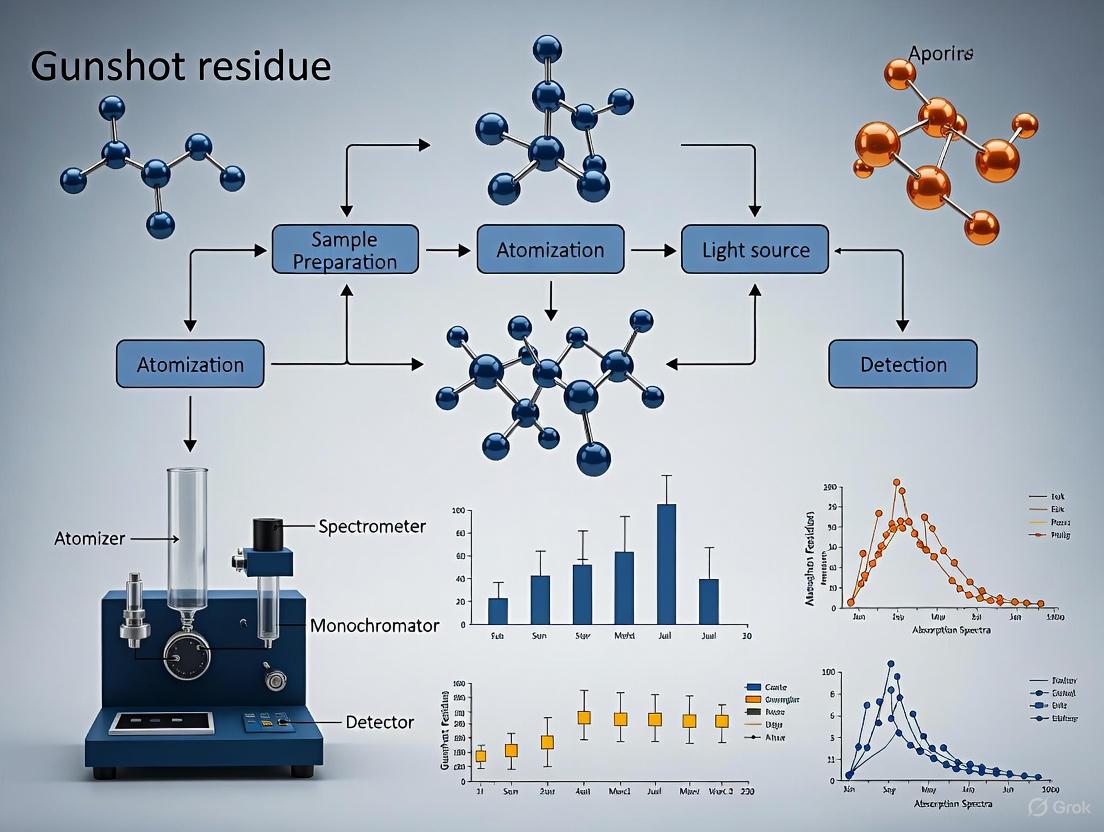
This article provides a comprehensive examination of Atomic Absorption Spectroscopy (AAS) as a pivotal analytical technique for gunshot residue (GSR) analysis.
Atomic Absorption Spectroscopy in Gunshot Residue Analysis: A Foundational Technique in Modern Forensic Chemistry
Abstract
This article provides a comprehensive examination of Atomic Absorption Spectroscopy (AAS) as a pivotal analytical technique for gunshot residue (GSR) analysis. Tailored for researchers and forensic science professionals, it explores the foundational principles of AAS, detailing its specific methodological applications for detecting characteristic inorganic GSR elements like lead (Pb), barium (Ba), and antimony (Sb). The scope extends to troubleshooting analytical challenges, optimizing protocols for sensitivity and accuracy, and a critical validation of AAS against contemporary techniques such as SEM-EDX and ICP-MS. By synthesizing historical context with current limitations and future potential, this review serves as a definitive resource for understanding the role of AAS in the evolving landscape of forensic chemistry.
The Role of AAS in GSR Analysis: Principles and Historical Significance
Fundamental Principles of Atomic Absorption Spectroscopy for Elemental Analysis
Atomic Absorption Spectroscopy (AAS) stands as a powerful analytical technique for quantitative elemental analysis, with particular significance in forensic applications such as gunshot residue (GSR) examination. This application note details the fundamental principles, instrumental configurations, and detailed protocols for implementing AAS, with a specific focus on detecting and quantifying characteristic metallic components in GSR samples. The content is structured to provide researchers and forensic scientists with practical methodologies to enhance analytical precision in metal detection.
Atomic Absorption Spectroscopy (AAS) is an analytical technique used to determine the concentration of metal atoms/ions in a sample. The fundamental principle relies on the fact that all atoms or ions can absorb light at specific, unique wavelengths [1]. When a sample containing metal atoms is exposed to light at its characteristic wavelength, the atoms absorb this light, and the amount of light absorbed is directly proportional to the concentration of the absorbing atoms [1].
The historical development of AAS began with the work of Bunsen and Kirchoff, who demonstrated that each chemical element possesses a characteristic spectrum when heated to incandescence [1]. However, the modern analytical technique was revolutionized by Alan Walsh in the 1950s, who advocated measuring absorption rather than emission for more accurate quantitative analysis of metallic elements [1] [2]. This breakthrough enabled the development of AAS as a cornerstone technique in analytical chemistry laboratories worldwide.
Theoretical Foundations
The Beer-Lambert Law
The quantitative basis of AAS is governed by the Beer-Lambert Law, which states a linear relationship between absorbance and the concentration of the absorbing species [3]. The law is mathematically expressed as:
A = ε · l · c
Where:
- A is the measured absorbance (dimensionless)
- ε is the molar absorptivity coefficient (L·mol⁻¹·cm⁻¹)
- l is the optical path length (cm)
- c is the concentration of the absorbing species (mol·L⁻¹) [4] [3]
This relationship enables the conversion of measured absorbance values into quantitative concentration data through calibration with standard solutions.
Atomic Transitions and Quantization
In AAS, the electrons within an atom exist at various energy levels [1]. When an atom is exposed to its own unique wavelength, it absorbs energy (photons), causing electrons to move from ground states to excited states [1]. The radiant energy absorbed by the electrons is directly related to the electronic transition occurring during this process [1]. Since the electronic structure of every element is unique, the radiation absorbed represents a unique property of each individual element [1].
A typical atomic absorption spectrometer consists of four main components: the light source, the atomization system, the monochromator, and the detection system [1]. The fundamental configuration is illustrated below:
- Hollow Cathode Lamps: These line sources emit element-specific radiation, typically produced from a cathode made of the element being determined [1].
- Continuum Sources: Modern high-resolution systems may use xenon short-arc lamps, which allow simultaneous multi-analyte detection [1].
Atomization Systems
Atomization is the process of converting the analyte into free gaseous atoms, which is essential for atomic absorption measurements [5]. The main atomization techniques include:
Flame Atomization (FAAS)
- Sample is nebulized as a fine spray into a high-temperature flame [1]
- Typically uses air-acetylene or nitrous oxide-acetylene flames
- Limited sensitivity due to spectral noise from the flame [1]
- Up to 90% of sample may be lost in the flame [1]
Graphite Furnace Atomization (GFAAS)
- Sample is placed in a hollow graphite tube heated by electrical resistance [1]
- Can detect very low concentrations (less than 1 ppb) in smaller samples [1]
- Greater sensitivity than FAAS as complete vaporization occurs [1]
Specialized Atomization Techniques
- Hydride-Generation: Used for heavy metals like arsenic and selenium [1]
- Cold-Vapor Atomization: Specifically for mercury analysis [1]
AAS in Gunshot Residue Analysis
Relevance to Forensic Science
Gunshot residue (GSR) contains inorganic components (IGSR) that derive mainly from the primer, which traditionally contains antimony sulphide, barium nitrate, and lead styphnate [6]. The detection and quantification of these characteristic elements—antimony (Sb), barium (Ba), and lead (Pb)—forms the basis of GSR analysis using AAS [6]. This analysis assists in forensic investigations by providing evidence that can link a suspect to a shooting incident [6].
Comparative Techniques for GSR Analysis
Table 1: Analytical Techniques for Gunshot Residue Analysis
| Technique | Target Elements | Detection Limit | Key Advantages | Key Limitations |
|---|---|---|---|---|
| Flame AAS | Pb, Ba, Sb | ppm to ppb range [1] | Robust for routine metal determinations [1] | Limited sensitivity; measures one metal at a time [1] |
| Graphite Furnace AAS | Pb, Ba, Sb | <1 ppb [1] | High sensitivity; small sample volumes [1] | Slower than FAAS; more complex operation |
| SEM-EDS | Pb, Ba, Sb | N/A | Morphological and elemental data; non-destructive [6] | Time-consuming; costly equipment [7] [6] |
| LIBS | Multiple elements simultaneously | N/A | Rapid analysis (minutes); portable systems available [7] [8] | Less established for GSR compared to SEM-EDS [7] |
Experimental Protocols
Sample Collection and Preparation for GSR Analysis
Materials Required:
- 3M double-sided adhesive tape or alternative GSR collection stubs [7]
- Plastic tweezers and storage containers
- Ultrapure nitric acid (HNO₃) and hydrogen peroxide (H₂O₂)
- Microwave digestion system or hotplate
- Volumetric flasks and pipettes
- Certified standard solutions of Pb, Ba, and Sb
Procedure:
- Sample Collection: Using plastic tweezers, apply double-sided adhesive tape to the hands of suspects or relevant surfaces. Follow standardized protocols such as SOP No. 1.4 from the National Secretary of Public Security (SENASP) in Brazil [7].
- Sample Transportation: Place collected samples in clean, sealed containers to prevent contamination.
- Digestion Process:
- Transfer the sample to a digestion vessel.
- Add 5 mL ultrapure HNO₃ and 1 mL H₂O₂.
- Heat using microwave digestion (180°C for 15 minutes) or on a hotplate (85°C for 60 minutes).
- Cool to room temperature and dilute to 25 mL with deionized water.
- Blank Preparation: Prepare method blanks following identical procedures without the sample.
Instrument Calibration and Quantification
Calibration Standards Preparation:
- Prepare stock solutions (1000 mg/L) of Pb, Ba, and Sb from certified reference materials.
- Dilute to working standards covering the expected concentration range (typically 0.1-5 mg/L for FAAS, 0.5-50 μg/L for GFAAS).
- Include at least five concentration levels plus blank.
Quality Control:
- Analyze certified reference material (CRM) with each batch of samples
- Prepare duplicate samples for every batch
- Spike recovery samples (should yield 85-115% recovery)
Instrument Operating Parameters
Table 2: Typical AAS Operating Parameters for GSR Analysis
| Parameter | Flame AAS | Graphite Furnace AAS |
|---|---|---|
| Wavelength (nm) | Pb: 283.3; Ba: 553.6; Sb: 217.6 | Pb: 283.3; Ba: 553.6; Sb: 217.6 |
| Slit Width (nm) | 0.5-0.7 | 0.5-0.7 |
| Light Source | Element-specific hollow cathode lamp | Element-specific hollow cathode lamp |
| Flame Type | Air-Acetylene | N/A |
| Atomization Temperature | N/A | 2000-2500°C |
| Sample Volume | 2-5 mL | 10-50 μL |
Analysis Workflow
The complete analytical procedure for GSR analysis using AAS follows a systematic workflow:
Research Reagent Solutions
Table 3: Essential Materials for AAS Analysis of Gunshot Residue
| Reagent/Material | Function/Purpose | Specifications |
|---|---|---|
| Hollow Cathode Lamps | Element-specific light source | Pb, Ba, and Sb specific lamps |
| Certified Standard Solutions | Calibration reference | 1000 mg/L in 2% nitric acid |
| Ultrapure Nitric Acid | Sample digestion | Trace metal grade, ≤5 ppb impurities |
| Hydrogen Peroxide | Oxidizing agent for digestion | 30%, TraceSELECT grade |
| Argon Gas | Inert atmosphere for GFAA | High purity (99.995%+) |
| Acetylene Gas | Fuel for flame AAS | High purity with proper regulator |
| Graphite Tubes | Atomization platform for GFAA | Pyrolytically coated |
Data Interpretation and Limitations
Concentration Calculations
Element concentrations are calculated using the calibration curve method. The absorbance values of samples are compared against the calibration curve, and concentrations are determined using the linear regression equation. For GSR samples, the simultaneous presence of Pb, Ba, and Sb in characteristic ratios provides strong evidence of gunshot residue [6].
Limitations and Considerations
- Matrix Effects: Complex sample matrices can interfere with atomization
- Spectral Interferences: May occur when absorption lines overlap
- Environmental Shifts: Movement toward lead-free ammunition reduces the applicability of traditional AAS for GSR analysis [6]
- Single-Element Analysis: Conventional AAS typically measures one element at a time [1]
Atomic Absorption Spectroscopy provides a reliable, sensitive approach for detecting and quantifying metallic elements in gunshot residue. While newer techniques like LIBS offer advantages in speed and portability [7] [8], AAS remains a validated quantitative method for forensic laboratories. The protocols detailed in this application note provide researchers with a framework for implementing AAS in GSR analysis, though analysts should remain aware of evolving ammunition formulations that may necessitate adaptation of these methods.
The investigation and reconstruction of firearm-related crimes often hinge on the analysis of gunshot residue (GSR) [9]. This residue, a complex mixture of burnt, unburnt, and partially burnt materials, is expelled through the apertures of a firearm upon discharge and can be deposited on the shooter’s hands, clothes, the victim, or the surrounding environment [9] [10]. The inorganic components of GSR, particularly the trio of lead (Pb), barium (Ba), and antimony (Sb), have long been considered characteristic and pathognomonic for resolving critical forensic questions [11] [6]. These elements primarily originate from the primer mixture lodged at the base of the cartridge case [9]. A typical primer composition often includes lead styphnate as a primary explosive initiator, barium nitrate as an oxidizer, and antimony trisulfide as a fuel [9] [6]. The simultaneous presence of these three elements in a single particle is highly indicative of GSR, as this combination is rare from other environmental or occupational sources [11]. This application note details the role of these key components and provides standardized protocols for their analysis within a research framework focused on atomic absorption spectroscopy (AAS).
The Triad of Characteristic Inorganic GSR
The probative value of inorganic GSR (IGSR) lies in the detection of the particulate residue containing lead, barium, and antimony. The following table summarizes the specific roles and origins of these key elements.
Table 1: Key Inorganic Components of Gunshot Residue and Their Roles
| Element | Typical Chemical Form in Primer | Primary Function | Relative Concentration in Primer |
|---|---|---|---|
| Lead (Pb) | Lead Styphnate, Lead Dioxide | Primary Explosive / Initiator [9] | ~50% of primer components [11] |
| Barium (Ba) | Barium Nitrate | Oxidizer [9] | Varies 0.4% - 25% (Avg. 7.6%) [11] |
| Antimony (Sb) | Antimony Trisulfide | Fuel [9] | 0% - 10% [11] |
The dominance of lead in traditional primer formulations means it is the most frequently detected element, often in such high concentrations that it can mask the presence of other elements during analysis [11]. Barium, while the second most significant element, and antimony are present in much lower and more variable concentrations, which can complicate their consistent detection [11]. The analysis of these IGSR markers is crucial for determining the shooting distance, time since discharge, and for linking a suspect to a shooting incident [9] [10].
Analytical Techniques and Research Context
A variety of analytical techniques are employed for the detection and quantification of Pb, Ba, and Sb in GSR. While scanning electron microscopy with energy-dispersive X-ray spectroscopy (SEM-EDX) is considered the gold standard for its combined morphological and elemental analysis [11] [6], atomic absorption spectroscopy (AAS) has been a proven tool for quantitative elemental analysis [9] [10] [6]. Other techniques include neutron activation analysis (NAA), inductively coupled plasma mass spectrometry (ICP-MS), and laser-induced breakdown spectroscopy (LIBS) [9] [12] [10]. It is important to note that the evolution toward "non-toxic" or "lead-free" ammunition, which replaces heavy metals with alternatives like zinc, titanium, copper, or strontium, presents a significant challenge to traditional IGSR analysis [9] [6]. This shift increases the potential for false-negative results and underscores the growing importance of complementary analysis of organic GSR (OGSR) components [9] [6].
Table 2: Overview of Analytical Techniques for IGSR Detection
| Technique | Principle | Key Application in GSR Analysis | Advantages | Limitations |
|---|---|---|---|---|
| SEM-EDX | Electron beam excitation with X-ray analysis | Morphological & elemental analysis of single particles [10] [6] | Non-destructive; specific to Pb, Ba, Sb triad [10] | Expensive instrumentation; time-consuming [9] |
| AAS | Absorption of light by free atoms | Quantitative analysis of specific elements [10] | High sensitivity for target elements [10] | Destructive; requires sample digestion [10] |
| ICP-MS | Ionization in plasma & mass separation | Highly sensitive multi-element analysis [12] [6] | Rapid screening; detects smaller particles [12] | Complex sample introduction; high cost |
| Colorimetric Tests | Chemical reaction producing a color change | Presumptive, on-site testing [10] [11] | Low-cost; simple to perform [10] | Destructive; limited sensitivity & specificity [9] [10] |
Experimental Protocol: AAS-Based Analysis of GSR
This protocol provides a detailed methodology for the quantitative determination of lead, barium, and antimony in GSR samples using atomic absorption spectroscopy.
Research Reagent Solutions and Materials
Table 3: Essential Research Reagents and Materials for GSR Analysis
| Item | Specification / Function |
|---|---|
| Atomic Absorption Spectrometer | Equipped with hollow cathode lamps for Pb, Ba, and Sb. |
| Sampling Kits | Adhesive stubs or swabs for non-destructive collection [9]. |
| Digestion Acids | High-purity concentrated nitric acid (HNO₃) and hydrochloric acid (HCl) for sample digestion. |
| Standard Solutions | Certified single-element and multi-element standard solutions for calibration (1000 mg/L). |
| Sodium Rhodizonate (0.2%) | Colorimetric reagent for the presumptive detection of barium [11]. |
| Sodium Rhodizonate (0.3%) | Colorimetric reagent for the presumptive detection of lead, forming a scarlet red complex [11]. |
Step-by-Step Workflow
- Sample Collection: GSR samples should be collected from the hands of a suspect, the skin or clothing of a victim, or other relevant surfaces using adhesive stubs or swabs. For AAS analysis, the sample must be recovered from the collection medium into a solution [10].
- Sample Digestion:
- Transfer the collected sample to a clean digestion vessel.
- Add a mixture of 5 mL concentrated HNO₃ and 2 mL concentrated HCl.
- Heat gently on a hot plate or microwave digester until the sample is completely dissolved and a clear digestate is obtained.
- Allow to cool, then filter the solution if necessary. Make up to a known volume (e.g., 25 mL) with deionized water.
- Instrumental Calibration:
- Prepare a series of calibration standards (e.g., 0.5, 1.0, 2.0, 5.0 mg/L) for Pb, Ba, and Sb by appropriate dilution of the certified stock solutions in a matrix-matched acid solution (e.g., 2% HNO₃).
- Optimize AAS parameters (wavelength, lamp current, slit width, fuel-to-oxidant ratio) for each element according to the manufacturer's guidelines.
- Aspirate the calibration standards and record the absorbance. Construct a calibration curve (Absorbance vs. Concentration) for each element.
- Sample Analysis:
- Aspirate the digested and diluted sample solution into the AAS.
- Measure the absorbance for each target element.
- Use the calibration curve to determine the concentration of Pb, Ba, and Sb in the sample solution.
- Data Analysis and Reporting:
- Calculate the absolute amount of each element in the original sample, accounting for all dilution factors.
- Report the quantitative results for lead, barium, and antimony, along with the method's limit of detection (LOD) and limit of quantification (LOQ).
Complementary Colorimetric Protocol for Barium and Lead
For a preliminary, presumptive analysis on biological tissues like skin, colorimetric tests can be applied [11].
- Barium Detection:
- Apply a 0.2% sodium rhodizonate solution in an alcoholic environment (Na-R-Ba OH 0.2%) to the sample.
- The appearance of an orange-red color indicates the potential presence of barium from GSR [11].
- Lead Detection and Confirmation:
Experimental Workflow Visualization
The following diagram illustrates the logical workflow for the analysis of GSR, from sample collection to final reporting, integrating both colorimetric and AAS techniques.
The targeted analysis of lead, barium, and antimony remains a cornerstone of forensic gunshot residue investigation. The protocols outlined here, centered on atomic absorption spectroscopy for precise quantification and supported by colorimetric tests for rapid screening, provide a robust framework for researchers. The consistent application of these methodologies is vital for generating reliable and legally defensible data. However, the forensic community must adapt to the changing landscape of ammunition manufacturing by developing and validating methods for both traditional IGSR and the emerging compositions of lead-free and non-toxic ammunition.
Atomic Absorption Spectroscopy (AAS) represents a foundational methodology in the evolution of forensic gunshot residue (GSR) analysis. During the 1960s-1970s, AAS emerged as a significant advancement over earlier colorimetric tests, providing forensic scientists with a more reliable and sensitive technique for detecting the inorganic components of GSR [13]. This technology played a pivotal role in transitioning GSR analysis from presumptive chemical tests to instrumental methods capable of producing quantitative data for legal proceedings. AAS offered the forensic community one of the first instrumental techniques that could effectively differentiate between individuals who had discharged firearms and those who had not, achieving approximately 90% positive identification rates for GSR presence [13]. Its introduction marked a critical step in the historical development of robust forensic firearms evidence analysis.
Technical Principles of AAS in GSR Context
AAS functions on the principle that free atoms in the ground state can absorb light at specific wavelengths, enabling the quantitative detection of metallic elements [13]. In forensic GSR analysis, this technique targets characteristic primer elements—primarily lead (Pb), barium (Ba), and antimony (Sb)—which constitute the inorganic fingerprint of discharged ammunition [13] [9].
The analytical process involves aspirating a liquid sample into a flame where thermal energy converts the metallic components into free atoms. A hollow cathode lamp emits element-specific radiation through the flame, and a detector measures the attenuation of this radiation, which correlates directly to element concentration in the sample [13]. This capability to provide quantitative bulk analysis of GSR elements represented a substantial improvement over previous methods, offering both enhanced sensitivity and empirical data suitable for courtroom presentation.
Table 1: Key Metallic Components Detectable by AAS in GSR Analysis
| Element | Source in Ammunition | Role in Primer Composition | AAS Detection Capability |
|---|---|---|---|
| Lead (Pb) | Lead styphnate | Primary explosive initiator | High sensitivity for trace amounts |
| Barium (Ba) | Barium nitrate | Oxidizing agent | Reliable detection in digested samples |
| Antimony (Sb) | Antimony trisulfide | Fuel component | Distinct spectral signature |
| Other metals | Cartridge case, bullet jacket | Structural components | Variable based on ammunition type |
Experimental Protocols and Methodologies
Sample Collection for AAS Analysis
The validity of AAS analysis depends fundamentally on proper evidence collection. Historical protocols emphasized swabbing as the primary collection method for subsequent AAS analysis [13]. The standard procedure involved:
- Surface Selection: Focus on hands (particularly the thumb, forefinger, and web space), clothing, or other surfaces potentially exposed to GSR [13]
- Swab Material: Cotton-tipped applicators moistened with 5% nitric acid solution to enhance metal recovery [13]
- Technique: Firm, rotational swabbing over approximately 20-25 cm² area using controlled pressure
- Control Samples: Collection of control swabs from non-exposed adjacent areas for background correction
- Packaging: Immediate sealing in clean containers to prevent contamination
Sample integrity was maintained through a documented chain of custody, with analysis preferably conducted within 12 hours of collection due to the recognized degradation of GSR evidence over time [13].
Sample Preparation and Digestion
The conversion of collected GSR particles into a form suitable for AAS analysis required careful sample preparation:
- Acid Extraction: Swabs were transferred to sterile containers with 5-10 mL of 5% nitric acid solution
- Ultrasonic Agitation: Samples underwent 15-30 minutes of ultrasonic treatment to dislodge and dissolve particulate matter
- Centrifugation: Clarification at 3000 rpm for 10 minutes to separate insoluble debris
- Filtration: Passage through 0.45 μm membrane filters to remove particulate matter
- Dilution: Adjustment to appropriate concentration ranges for the specific AAS instrumentation
Instrumental Analysis Parameters
Standard AAS operational conditions for GSR analysis included:
- Flame Configuration: Air-acetylene flame for Pb and Ba; nitrous oxide-acetylene for enhanced Sb sensitivity
- Wavelengths: 283.3 nm (Pb), 553.5 nm (Ba), 217.6 nm (Sb)
- Calibration Standards: Matrix-matched solutions containing 0.1-5.0 ppm of target elements
- Quality Controls: Inclusion of blanks, duplicates, and certified reference materials with each analytical batch
Diagram 1: AAS GSR Analysis Workflow
Comparative Analytical Performance
Detection Capabilities and Limitations
AAS established itself as a workhorse technique in forensic laboratories during its peak adoption period, offering specific analytical advantages while facing notable limitations:
Table 2: Performance Comparison of AAS with Contemporary GSR Methods
| Analytical Parameter | AAS Performance | Colorimetric Methods | SEM-EDX |
|---|---|---|---|
| Detection Limit | ~0.1 ppm for Pb, Ba, Sb | Semi-quantitative only | Single particle detection |
| Sample Throughput | Moderate (minutes per sample) | Fast | Slow (hours per sample) |
| Sample Preservation | Destructive | Destructive | Non-destructive |
| Elemental Specificity | Excellent for target metals | Poor, numerous interferences | Comprehensive elemental data |
| Morphological Data | None | None | Detailed particle structure |
| Quantitative Capability | Excellent | Poor | Semi-quantitative |
Research by Gagliano-Candela, Colucci, and Napoli demonstrated that AAS could effectively estimate shooting distances up to 100 cm from targets, though subsequent studies by Gradaščević et al. suggested more conservative effective ranges of approximately 10 cm for reliable distance determination [10]. This variability highlighted the technique's dependence on specific instrumental configurations and ammunition types.
Advantages Over Preceding Methods
AAS offered transformative advantages compared to the colorimetric tests that preceded it:
- Specificity: Elimination of false positives from environmental contaminants that plagued dermal nitrate tests [13]
- Sensitivity: Detection of trace metal concentrations as low as 0.1 ppm, far surpassing visual methods [13]
- Quantification: Generation of numerical data suitable for statistical analysis and expert testimony
- Sample Efficiency: Requirement of smaller sample volumes while obtaining superior analytical information
The Scientist's Toolkit: Essential Research Reagents and Materials
Table 3: Essential Research Reagents for AAS-Based GSR Analysis
| Reagent/Material | Specification | Functional Role |
|---|---|---|
| Nitric Acid | Trace metal grade, 5% solution | Sample collection and digestion medium |
| Deionized Water | 18 MΩ-cm resistivity | Diluent and rinsing agent |
| Elemental Standards | Certified Reference Materials (Pb, Ba, Sb) | Calibration curve generation |
| Hollow Cathode Lamps | Element-specific (Pb, Ba, Sb) | Source of characteristic radiation |
| Membrane Filters | 0.45 μm pore size | Sample clarification |
| Cotton Swabs | Plastic-handled, acid-washed | Evidence collection from surfaces |
| Calibration Verification | Standard Reference Materials | Quality assurance and method validation |
Transition to Advanced Methodologies
The dominance of AAS in GSR analysis gradually diminished with the emergence of more sophisticated instrumental techniques. While AAS provided excellent bulk quantitative data, it could not characterize individual particle morphology or multi-element composition within single particles—capabilities that became essential with the introduction of "lead-free" and "non-toxic" ammunition formulations [9].
Scanning Electron Microscopy with Energy Dispersive X-ray Spectroscopy (SEM-EDX) eventually supplanted AAS as the gold standard for GSR analysis, offering simultaneous morphological and chemical characterization of individual particles without sample destruction [13] [14]. Additionally, Inductively Coupled Plasma Mass Spectrometry (ICP-MS) demonstrated superior sensitivity and multi-element capabilities for bulk analysis [15] [14].
Despite this technological progression, AAS remains historically significant as the technique that established instrumental analysis as essential for robust GSR evidence and provided the foundational methodology that informed subsequent developments in forensic trace metal analysis.
Diagram 2: Evolution of GSR Analytical Techniques
Atomic Absorption Spectroscopy (AAS) stands as a proven and reliable analytical technique within the field of forensic science, particularly for the bulk analysis of gunshot residue (GSR) [13]. In the investigation of firearm-related crimes, the quantitative determination of metallic elements is crucial for reconstructing events and linking suspects to a shooting incident [10]. AAS offers researchers and forensic professionals a powerful tool for this task, characterized by its high sensitivity for trace metal detection and robust quantitative capabilities [16]. This application note details the specific advantages of AAS in the context of GSR analysis, provides a structured experimental protocol, and summarizes key performance data to guide method implementation. The content is framed within a broader research context exploring the role of elemental analysis in advancing forensic ballistics.
Key Advantages in GSR Analysis
The utility of AAS in analyzing gunshot residue (GSR) stems from its specific analytical performance characteristics, which align well with the evidentiary requirements of forensic science.
High Sensitivity for Trace Metal Detection: AAS, particularly in its electrothermal or graphite furnace mode (GFAAS), is renowned for its high sensitivity, enabling the determination of metal concentrations at parts per billion (ppb or µg/L) levels with very low sample volumes [17]. This is critical for GSR analysis, as the amount of residue collected from a shooter's hands or clothing can be minimal and often exists only in trace quantities [13]. The technique can reliably detect the characteristic inorganic elements of GSR, such as lead (Pb), barium (Ba), and antimony (Sb), even when present in nanogram amounts [16] [13].
Robust Quantitative Capabilities: AAS is primarily a quantitative technique, capable of sequentially determining the concentration of specific elements in a sample solution [16]. Through calibration with certified standard solutions, it provides accurate and precise data on the total amount of target metals present in a bulk GSR sample [18]. This quantitative data is essential for making objective comparisons, such as distinguishing between individuals who have discharged a firearm and those who have not, with one study reporting a 90% positive identification rate in GSR detection using AAS [13].
Effectiveness in Bulk Analysis: While techniques like SEM-EDX analyze individual GSR particles, AAS performs bulk analysis, meaning it determines the total concentration of an element within the entire digested sample [13]. This approach provides a complementary perspective, offering an overall measure of elemental abundance that can be crucial for estimating parameters like firing distance or corroborating other findings.
Relative Freedom from Interferences: When properly calibrated and with appropriate background correction, AAS is considered a relatively interference-free technique for the determination of most metals and metalloids [16] [19]. Methodologies are well-established to correct for non-specific absorption and matrix effects, ensuring the accuracy of quantitative results for complex samples like GSR [18].
Table 1: Comparison of AAS with Other Common Techniques for GSR Analysis
| Analytical Technique | Detection Mode | Key Advantages | Primary Limitations in GSR Context |
|---|---|---|---|
| Flame AAS (FAAS) | Bulk Analysis | Rapid, simple to use, low operational cost [16]. | Less sensitive than GFAAS [16]. |
| Graphite Furnace AAS (GFAAS) | Bulk Analysis | Extremely high sensitivity (ppb), low sample volume [16] [17]. | Slower analysis than FAAS, requires more operator skill [16]. |
| SEM-EDX | Particle Analysis | Morphological & elemental data on single particles; standard method for characteristic GSR particles [10] [6]. | Higher instrument cost, does not provide bulk concentration [13]. |
| ICP-MS | Bulk / Particle | Excellent detection limits, multi-element capability [12] [19]. | High instrument cost, potential for mercury memory effects [19]. |
Experimental Protocol for GSR Analysis by Graphite Furnace AAS
The following protocol outlines a detailed methodology for the determination of lead, antimony, and barium in GSR samples collected using swabs.
Research Reagent Solutions and Materials
Table 2: Essential Materials and Reagents for GSR Analysis by AAS
| Item | Function / Specification |
|---|---|
| AAS Instrument | Equipped with graphite furnace (HGA) and autosampler. |
| Hollow Cathode Lamps | Specific for Pb, Sb, and Ba. |
| Collection Swabs | Cotton swabs with plastic stems, moistened with 5% nitric acid. |
| Ultrapure Water | Resistivity ≥ 18 MΩ·cm. |
| High-Purity Nitric Acid | For sample digestion and preparation. |
| Certified Stock Standards | 1000 mg/L solutions of Pb, Sb, and Ba for calibration. |
| Matrix Modifiers | e.g., Palladium or Ammonium Phosphate (for Pb stabilization). |
| Laboratory Microwave Digester | For closed-vessel sample digestion. |
Step-by-Step Procedure
Sample Collection:
- Moisten a cotton swab with a few drops of 5% v/v nitric acid.
- Vigorously swab the back of the suspect's hands, focusing on the thumb-web and index finger. Collect a control sample from a non-exposed area.
- Allow the swab to air-dry and store in a clean, sealed container.
Sample Digestion:
- Transfer the collection swab head into a dedicated microwave digestion vessel.
- Add 5 mL of high-purity concentrated nitric acid.
- Carry out microwave-assisted digestion using a stepped program (e.g., ramp to 180°C over 10 minutes, hold for 15 minutes).
- After cooling, carefully decant the digestate into a volumetric flask. Rinse the vessel and swab residue with ultrapure water and combine the rinses. Make up to a final volume of 25 mL with ultrapure water.
Calibration Standard Preparation:
- Prepare a multi-element intermediate standard from certified stock solutions.
- Serially dilute with 2% v/v nitric acid to create a calibration curve spanning the expected concentration range (e.g., 0, 5, 10, 20, 50 µg/L). Include a matrix-matched blank.
Instrumental Analysis by GFAAS:
- Install the appropriate hollow cathode lamp and set the wavelength for the target element (e.g., 283.3 nm for Pb).
- Optimize the graphite furnace temperature program. A typical program includes:
- Drying Stage: Ramp to 130°C to remove solvent.
- Pyrolysis Stage: Hold at 500-800°C (element dependent) to remove organic matrix.
- Atomization Stage: Rapidly heat to 1800-2200°C to atomize the analyte and record the absorption signal.
- Cleaning Stage: Heat to a high temperature (>2500°C) to remove any residue.
- Inject a predefined volume (e.g., 20 µL) of the sample digestate and standards into the graphite tube.
- Run the analysis in duplicate or triplicate.
Data Analysis and Quantification:
- The instrument software will generate a calibration curve (absorbance vs. concentration).
- The concentrations of Pb, Sb, and Ba in the sample solutions are calculated by interpolating the sample absorbance against the calibration curve.
- Report the final results, accounting for dilution factors, as mass per sample (e.g., micrograms per swab).
Diagram 1: AAS GSR Analysis Workflow. This diagram outlines the three main phases of gunshot residue analysis using Graphite Furnace Atomic Absorption Spectroscopy, from sample preparation to final reporting.
Atomic Absorption Spectroscopy remains a potent tool for the quantitative bulk analysis of gunshot residues. Its principal strengths lie in its high sensitivity, enabling the detection of trace levels of characteristic primer elements, and its robust quantitative capabilities, which provide objective data critical for forensic interpretation [16] [13]. While advanced techniques like ICP-MS offer lower detection limits and SEM-EDX provides valuable particle-specific information, AAS presents a compelling balance of performance, operational cost, and reliability [13] [19]. For forensic laboratories engaged in research and casework involving firearm discharge events, AAS provides a dependable methodology for determining the presence and concentration of key metallic constituents, thereby contributing significantly to the reconstruction of events and the pursuit of justice.
Practical Protocols: From Sample Collection to AAS Analysis of GSR
Standardized Procedures for GSR Sample Collection and Preparation
Gunshot Residue (GSR) analysis is a critical forensic technique for investigating incidents involving firearms. The evidentiary value of the analysis is fundamentally dependent on the integrity of the initial sample collection and preparation phases. This document outlines standardized procedures for GSR sample collection and preparation, specifically framed within research utilizing atomic absorption spectroscopy (AAS) for inorganic GSR (IGSR) analysis. Adherence to these protocols is essential for generating reliable, reproducible, and forensically defensible data.
Gunshot Residue Fundamentals and Composition
Gunshot residue is a complex mixture of particulate matter originating from the discharge of a firearm. Understanding its composition is crucial for targeting analytical methods like AAS.
- Primer GSR vs. Gunpowder: Gunshot residue and gunpowder are related but distinct. Gunpowder is the propellant substance, while GSR encompasses all particles from firearm discharge. Standard IGSR analysis, including AAS, primarily targets primer gunshot residue, which is the inorganic material from the cartridge's primer cap [20].
- Key Inorganic Elements: Traditional primer formulations contain a characteristic combination of heavy metals. AAS is particularly effective for detecting lead (Pb), barium (Ba), and antimony (Sb), which have been the main targets for IGSR analysis due to their co-occurrence and low natural abundance [6].
- Evolution of Formulations: A significant shift towards "heavy metal-free" and "lead-free" ammunition is underway. In these, traditional elements are replaced by compounds of copper, zinc, titanium, strontium, or iron, which an AAS method must be adapted to detect [6].
Materials and Equipment
Research Reagent Solutions and Essential Materials
The following table details key materials required for GSR sample collection and subsequent AAS analysis.
Table 1: Essential Materials for GSR Collection and AAS Analysis
| Item | Function/Description |
|---|---|
| GSR Collection Kits | Commercial kits containing adhesive stubs (e.g., carbon tape or SEM stubs) designed for the efficient collection of particulate matter from surfaces [20]. |
| Sample Swabs & Solvents | Cotton swabs or filter paper, used with dilute nitric acid (HNO₃) to dissolve and recover IGSR particles from surfaces for liquid-based AAS analysis. |
| Atomic Absorption Spectrometer | The core analytical instrument used to quantify specific metallic elements (e.g., Pb, Ba, Sb) in the collected samples based on their absorption of light at characteristic wavelengths. |
| Dilute Nitric Acid (HNO₃) | A high-purity reagent used to digest and dissolve metallic GSR particles from collection swabs or stubs, creating a solution suitable for aspiration into the AAS. |
| Standard Reference Solutions | Certified solutions with known concentrations of the target elements (Pb, Ba, Sb, etc.) used to calibrate the AAS and ensure quantitative accuracy. |
Experimental Protocols
Sample Collection Procedures
Proper collection is the most critical step for a meaningful analysis.
- Recommended Collection Method: The use of adhesive stubs from Scanning Electron Microscopy (SEM) kits is the recommended method for GSR collection. These stubs can be applied to hands, clothing, vehicles, and other surfaces of interest to pick up particulate matter [20].
- Alternative Swab-Based Collection for AAS: For AAS analysis, which typically requires samples in a liquid state, the swabbing method is appropriate.
- Swab Preparation: Moisten a cotton swab or piece of filter paper with a few drops of dilute nitric acid (e.g., 5% v/v). The acid aids in dissolving and retaining the metallic particles.
- Sample Collection: Firmly and systematically swab the target area (e.g., the back of the hands, particularly the thumb-web and index finger, or clothing surfaces). Use a rotating motion to maximize particle pickup.
- Sample Storage: Place the used swab into a clean, sealed container, such as a plastic vial or evidence bag. Properly label the container with all relevant case information.
- Critical Considerations for Collection:
- Time Since Discharge: GSR particles are easily lost. The more time that passes, the greater the opportunity for activities like hand-washing, running, or putting hands in pockets to remove particles [20].
- Environmental Factors: Wind, rain, or laundering of clothing will remove GSR particles, potentially leading to false-negative results [20].
- Sample Stability: Once collected, primer GSR particles, being metallic, are stable and do not degrade over time. Analysis of a sample collected years prior will yield the same results as immediate analysis [20].
Sample Preparation for Atomic Absorption Spectroscopy
The following workflow details the steps to prepare a collected GSR sample for analysis by AAS.
Diagram 1: GSR sample preparation workflow for AAS.
Step 1: Sample Elution/Digestion
- Transfer the collection swab or a section of the adhesive stub to a clean test tube.
- Add a known volume (e.g., 5-10 mL) of dilute high-purity nitric acid to the tube. The acid digests and dissolves the metallic particulates into solution.
- Agitate the mixture vigorously using a vortex mixer or by shaking for a set period (e.g., 2-5 minutes) to ensure complete elution of the target elements from the collection medium.
Step 2: Solution Filtration
- Filter the resulting acid solution using a syringe filter (e.g., 0.45 µm pore size) to remove any undissolved organic debris, cotton fibers, or other particulates that could clog the AAS nebulizer.
- The filtrate, now a clear solution containing the dissolved metallic ions, is collected in a clean vial and is ready for instrumental analysis.
AAS Analysis and Data Interpretation
- Instrument Calibration: Prepare a series of standard solutions of the target elements (Pb, Ba, Sb) at known concentrations. Use these to construct a calibration curve (absorbance vs. concentration) on the AAS.
- Sample Analysis: Aspirate the prepared sample filtrates into the AAS and measure the absorbance for each target element. The instrument software interpolates the concentration from the calibration curve.
- Data Interpretation:
- The presence of a characteristic combination of Pb, Ba, and Sb above background levels is a strong indicator of GSR.
- It is critical to note that the presence of GSR does not conclusively prove that an individual fired a weapon. The particles could also be from being in close proximity to a discharging firearm or from contact with a contaminated surface [20].
- Conversely, the absence of GSR does not prove that an individual did not fire a weapon, as particles can be easily removed by activity prior to sample collection [20].
The table below consolidates critical quantitative and categorical information relevant to GSR analysis.
Table 2: Key Data and Limitations in GSR Analysis
| Aspect | Key Data / Limitation |
|---|---|
| Sample Stability | GSR particles are metallic and do not degrade over time; a 10-year-old sample is as valid as a fresh one [20]. |
| Primary IGSR Elements | Lead (Pb), Barium (Ba), Antimony (Sb) [6]. |
| Common Interferences | Fireworks (may contain Pb, Ba, Sb, but with high Magnesium), and brake pads (may contain Pb, Ba, Sb, and Iron) [20]. |
| Evidentiary Limitation (Positive) | GSR on a person can indicate: 1) Fired a firearm, 2) Was in close proximity, or 3) Came into contact with a contaminated surface. These are equally probable based on GSR analysis alone [20]. |
| Evidentiary Limitation (Negative) | Lack of GSR does not mean a person did not fire a firearm, as particles are easily removed [20]. |
| Ammunition Trend | Movement towards "heavy metal-free" primers, replacing Pb, Ba, Sb with Cu, Zn, Ti, Sr, Fe, etc. [6]. |
Optimizing AAS Instrument Parameters for GSR Element Detection
Within forensic ballistics, the chemical analysis of gunshot residue (GSR) is crucial for reconstructing shooting incidents [6]. The detection of characteristic inorganic elements—primarily lead (Pb), barium (Ba), and antimony (Sb)—from the cartridge primer remains a foundational approach for confirming a discharge [10] [6]. While Scanning Electron Microscopy coupled with Energy Dispersive X-ray Spectroscopy (SEM-EDS) is the established standard for this analysis, Atomic Absorption Spectroscopy (AAS) offers a valuable, quantitative alternative and complementary technique [9] [6].
This application note provides detailed protocols for optimizing AAS instrument parameters specifically for the detection of Pb, Ba, and Sb in GSR samples. The content is framed within a broader research context exploring the evolution of spectroscopic methods in forensic science, acknowledging both the utility and the challenges of AAS in this field [10].
The Role of AAS in GSR Analysis: Context and Challenges
Atomic Absorption Spectroscopy (AAS) is a well-established technique for elemental analysis. Its application in GSR detection is supported by literature, though its use has specific limitations compared to other methods [9] [6]. AAS is recognized for providing quantitative and elemental information on the metallic components of GSR [6]. However, research has highlighted inconsistencies in its application; for instance, different studies have reported varying effectiveness for shooting distance estimation, with one finding AAS effective up to 100 cm and another only up to 10 cm [10]. This underscores the critical importance of method optimization and validation for obtaining reliable, reproducible results.
A significant trend in ammunition manufacturing directly impacts GSR analysis: the move toward "non-toxic" or "lead-free" ammunition [9] [6]. This shift, driven by environmental and health concerns, replaces the traditional heavy metals (Pb, Ba, Sb) with alternatives like copper, zinc, titanium, strontium, and aluminum [6]. Consequently, the probative value of detecting only traditional inorganic GSR (IGSR) markers is diminishing, pushing research towards analyzing organic GSR (OGSR) compounds or adopting a combined approach [6].
Comparative Analytical Techniques for GSR
Table 1: Common Analytical Techniques for Gunshot Residue Analysis
| Technique | Key Principle | Primary Application in GSR | Key Advantages | Key Limitations |
|---|---|---|---|---|
| SEM-EDS | Electron beam excitation with X-ray analysis for elemental composition and morphology [10]. | Standard method for identifying characteristic Pb, Ba, Sb particles [21] [6]. | Non-destructive; provides morphological data; high specificity for traditional GSR particles [10]. | Time-consuming; expensive equipment; lower throughput [21] [8]. |
| AAS | Absorption of optical radiation by free atoms in the gas phase [9]. | Quantitative determination of Pb, Ba, and Sb concentrations [6]. | Cost-effective; high sensitivity for targeted metals; well-established methodology. | Destructive; requires sample digestion; analyzes one element at a time [6]. |
| ICP-MS | Ionization of sample in plasma and mass-to-charge separation for detection [12] [6]. | Highly sensitive multi-element analysis, including for non-toxic ammunition markers [12]. | Extremely high sensitivity; multi-element capability; can analyze single particles (sp-ICP-TOF-MS) [12]. | Higher operational cost; complex instrumentation; susceptible to spectral interferences [22]. |
| LIBS | Analysis of atomic emission from laser-induced plasma [9] [8]. | Rapid screening and elemental fingerprinting of GSR particles. | Very fast analysis (minutes); minimal sample preparation; potential for portability [8]. | Less established for GSR; requires robust spectral libraries; can be less specific. |
The following workflow outlines the general process for GSR analysis using AAS, from sample collection to data interpretation.
The Scientist's Toolkit: Essential Reagents and Materials
The following table details key reagents and materials required for the sample preparation and analysis of GSR via AAS.
Table 2: Essential Research Reagent Solutions for GSR Analysis by AAS
| Item Name | Function / Application | Specific Example / Note |
|---|---|---|
| High-Purity Nitric Acid (HNO₃) | Primary reagent for sample digestion and dissolution of metallic GSR particles [22]. | Trace metal grade is essential to minimize background contamination. |
| Hydrogen Peroxide (H₂O₂) | Oxidizing agent used in combination with HNO₃ in microwave-assisted acid digestion [22]. | Aids in complete breakdown of organic matrices. |
| Certified Single-Element Standard Solutions | Used for preparation of calibration standards for Pb, Ba, and Sb [22]. | 1000 mg/L stock solutions are typical for preparing working standards. |
| Laboratory Pure Water | Diluent for standards and samples [22]. | Type I water (18.2 MΩ·cm resistivity) is required to avoid contamination. |
| Sample Collection Kits | Swabs and stubs for collecting GSR evidence from hands, clothing, or surfaces [21]. | Carbon stubs are commonly used for SEM-EDS and can be compatible with subsequent digestion [21]. |
Experimental Protocol: AAS Analysis of GSR
Sample Preparation and Digestion
A critical step for accurate AAS analysis is the complete dissolution of GSR particles into a liquid matrix.
- Transfer: Place the GSR-collected swab or stub into a clean, dedicated vessel for microwave-assisted digestion.
- Acid Addition: Add 5-8 mL of high-purity concentrated nitric acid (HNO₃) to the vessel. Note: The use of ultrasound-assisted extraction with alternative solvents like Natural Deep Eutectic Solvents (NADES) is an emerging, greener area of research, but traditional acid digestion remains the standard for complex matrices like GSR [22].
- Digestion: Follow a stepped temperature program in a closed-vessel microwave digestion system. A typical program may involve ramping to 180°C over 15 minutes and holding for 10 minutes.
- Cooling and Dilution: After digestion and cooling, carefully release pressure and open vessels. Transfer the digestate to a volumetric flask and dilute to mark (e.g., 25 mL or 50 mL) with pure water.
- Blank Preparation: Process a blank sample (a clean swab/stub) simultaneously through the entire procedure to correct for any background contamination.
AAS Instrument Optimization and Operation
Optimal instrument parameters vary by spectrometer model and element. The values below are recommended starting points for optimization.
Table 3: Recommended AAS Instrument Parameters for GSR Element Detection
| Parameter | Lead (Pb) | Barium (Ba) | Antimony (Sb) | Rationale |
|---|---|---|---|---|
| Wavelength (nm) | 283.3 [10] | 553.5 [10] | 217.6 [10] | Primary resonance line for maximum sensitivity. |
| Slit Width (nm) | 0.7 | 0.5 | 0.2 | To isolate the primary line and minimize spectral interference. |
| Lamp Type | Hollow Cathode Lamp (HCL) or Electrodeless Discharge Lamp (EDL) | HCL | HCL or EDL | EDLs can provide higher intensity and better signal-to-noise for some elements. |
| Lamp Current (mA) | As per manufacturer's recommendation (e.g., 75-80% of max) | As per manufacturer's recommendation | As per manufacturer's recommendation | Higher current increases intensity but can reduce lamp lifetime. |
| Flame Type (F AAS) | Air-Acetylene | Nitrous Oxide-Acetylene | Air-Acetylene | Nitrous Oxide-Acetylene flame is required for Ba to achieve sufficient atomization energy. |
| Furnace Program (GF AAS) | Drying, Ashing (~500°C), Atomizing (~1800°C) | Drying, Ashing (~1200°C), Atomizing (~2600°C) | Drying, Ashing (~800°C), Atomizing (~2000°C) | Graphite Furnace (GF AAS) offers lower detection limits. Ashing temperatures are element-specific to volatilize matrix without analyte loss. |
General Operation Procedure:
- Warm-up: Allow the instrument and lamp to stabilize for at least 30 minutes.
- Alignment: Align the lamp and optimize the beam path for maximum energy.
- Calibration: Prepare a blank and at least 3-5 standard solutions across a linear range (e.g., 1-10 mg/L for Pb). Establish a calibration curve.
- Analysis: Analyze digested samples, blanks, and quality control (QC) standards. Use the method of standard additions if matrix effects are suspected.
- Calculation: Use the instrument software to calculate the concentration of each element in the digested solution, applying blank correction. Back-calculate to determine the total mass of each element on the original sample.
The optimization of AAS for GSR analysis, as detailed in these protocols, provides a robust framework for the quantitative detection of key elemental markers. While the forensic community is actively addressing challenges posed by new ammunition types through advanced techniques like ICP-MS and LIBS [12] [8], AAS remains a valid and accessible tool for specific research and casework applications. Future work in this area will inevitably focus on integrating data from multiple analytical techniques to strengthen the evidential value of GSR findings in legal contexts.
Within the framework of this thesis on gunshot residue (GSR) analysis, the accurate quantification of the inorganic primer-derived elements lead (Pb), barium (Ba), and antimony (Sb) is a cornerstone for reliable forensic interpretation. Atomic absorption spectroscopy (AAS), particularly graphite furnace AAS (GFAAS), is a pivotal technique for this determination due to its exceptional sensitivity and ability to handle complex sample matrices [13]. This application note provides detailed protocols and data for establishing calibration curves and determining detection limits for Pb, Ba, and Sb, with direct application to GSR analysis from hand swab samples. The methodology outlined here was validated and applied in a forensic context, demonstrating its suitability for routine casework [23].
Experimental Protocols
Reagents and Materials
- Nitric Acid (HNO₃): 65% (w/w), analytical grade. Used for sample extraction and digestion.
- Standard Solutions: Single-element certified standard solutions of Pb, Ba, and Sb at a concentration of 1000 mg L⁻¹.
- GSR Collection Swabs: Commercially available hand-swabbing kits.
- Certified Reference Materials (CRMs): For method validation and ensuring accuracy.
- Matrix Modifier: A palladium-magnesium nitrate mixture (e.g., 0.005 mg Pd + 0.003 mg Mg(NO₃)₂) is recommended to minimize volatility losses and improve signal stability during GFAAS analysis [24].
Sample Collection and Preparation
The following protocol is adapted from a validated method for GSR analysis from hand swabs [23].
- Collection: Using a swab moistened with a 5% (v/v) nitric acid solution, thoroughly swab the back and palms of the hands of a suspect. Pay particular attention to the webbing between fingers and the back of the thumb and forefinger.
- Extraction: Place the collected swab into a clean sample vial. Add 5 mL of 8% (v/v) nitric acid to the vial.
- Shaking: Secure the vial on a mechanical shaker and agitate at 200 rpm for 30 minutes to extract the metallic residues from the swab.
- Analysis: The resulting solution is directly analyzed using GFAAS. For samples with complex matrices, a microwave-assisted acid digestion step may be incorporated prior to analysis to ensure complete dissolution of particles and breakdown of organic material [24].
Instrumentation and GFAAS Conditions
A GFAAS instrument equipped with Zeeman background correction is essential to compensate for non-specific absorption and light scattering effects from the sample matrix. The operating conditions, including the furnace temperature program, should be optimized for each element. A representative furnace program is shown below [23].
Table 1: Exemplary GFAAS Operating Conditions [23].
| Parameter | Details |
|---|---|
| Instrument | GFAAS with Zeeman Background Correction |
| Signal Processing | Peak Area |
| Sample Volume | 20 µL |
| Chemical Modifier | 5 µL of Pd/Mg(NO₃)₂ |
| Wavelengths | Pb: 242.80 nm; Ba: 553.55 nm; Sb: 217.58 nm |
Table 2: Exemplary Graphite Furnace Temperature Program [24] [23].
| Step | Temperature (°C) | Ramp (s) | Hold (s) | Argon Flow (mL min⁻¹) |
|---|---|---|---|---|
| Drying 1 | 110 | 1 | 30 | 250 |
| Drying 2 | 130 | 15 | 30 | 250 |
| Ashing | 700 - 800 | 10 | 20 | 250 |
| Atomization | 1800 - 2200 | 0 | 5 | 0 (Read) |
| Cleaning | 2450 | 1 | 2 | 250 |
Calibration Procedure
- Stock and Working Standards: Prepare intermediate multi-element working standards from the single-element stock solutions (1000 mg L⁻¹) by serial dilution with 8% (v/v) nitric acid.
- Calibration Curve: Construct a multi-point calibration curve using at least five standard solutions. The following linear ranges have been successfully applied for GSR analysis [23]:
- Antimony (Sb): 0 - 200 µg/L
- Barium (Ba): 0 - 200 µg/L
- Lead (Pb): 0 - 100 µg/L
- Quality Control: Include a reagent blank and a continuing calibration verification (CCV) standard in each run. The correlation coefficient (R²) of the calibration curve should be ≥ 0.995.
The calibration strategy is critical for accuracy, especially at low concentrations near the detection limit. It is recommended to use calibration standards whose concentrations are close to the expected levels in the samples. Using high-concentration standards can dominate the regression fit and lead to significant inaccuracies at low concentrations [18].
Results and Discussion
Analytical Figures of Merit
The validated method for GSR analysis demonstrates excellent performance characteristics for the quantification of Pb, Ba, and Sb, as summarized in Table 3.
Table 3: Quantitative Data for GFAAS Analysis of GSR Elements [23].
| Element | Linear Range (µg/L) | Limit of Detection (LOD, µg/L) | Limit of Quantification (LOQ, µg/L) | Recovery (%) | Precision (RSD%) |
|---|---|---|---|---|---|
| Antimony (Sb) | 0 - 200 | 3.30 | 9.90 | 103.21 | 1.27 |
| Barium (Ba) | 0 - 200 | 11.94 | 35.85 | 101.36 | 3.24 |
| Lead (Pb) | 0 - 100 | 56.22 | 168.82 | 99.22 | 2.30 |
The limits of detection (LOD) and quantification (LOQ) were calculated as 3.3 and 10 times the standard deviation of the blank signal, respectively, divided by the slope of the calibration curve [23]. The high recovery rates (99-103%) and low relative standard deviations (RSD < 5%) confirm the method's high accuracy and precision.
Temporal Persistence of GSR on Hands
A key application of this quantitative method is studying the lifetime of GSR on a shooter's hands. Research using this protocol analyzed hand swabs collected at 0, 1, 2, 3, and 4 hours after firing a 9mm pistol. The results indicate a significant decrease in the concentrations of Pb, Ba, and Sb over time, with the most substantial loss occurring within the first few hours post-discharge [23]. This quantitative data is crucial for informing the sampling strategy in real-world investigations.
The Scientist's Toolkit
Table 4: Essential Research Reagent Solutions for GSR Analysis via GFAAS.
| Item | Function/Brief Explanation |
|---|---|
| High-Purity Nitric Acid | Extraction and digestion of GSR particles from swabs and tissue; minimizes contamination. |
| Certified Single-Element Standards | Foundation for creating accurate calibration curves for Pb, Ba, and Sb quantification. |
| Palladium-Magnesium Modifier | Chemical modifier in GFAAS to stabilize volatile analytes like Pb and Sb during ashing. |
| Certified Reference Materials (CRMs) | Verification of method accuracy and precision for quality control purposes. |
| Zeeman-Background GFAAS | Essential instrument feature to correct for matrix interferences in complex samples. |
Workflow Diagram
The following diagram illustrates the complete analytical workflow for the quantitative analysis of GSR, from sample collection to data interpretation.
Application in Shooting Distance Estimation and Casework Examples
The estimation of shooting distance is a fundamental aspect of forensic investigations, providing critical insight for the reconstruction of firearm-related incidents. This process involves determining the muzzle-to-target distance at the moment of discharge by analyzing the spatial distribution and composition of gunshot residue (GSR) deposited on a target surface [10]. While the broader thesis context focuses on atomic absorption spectroscopy (AAS) research, modern forensic practice has evolved to incorporate a suite of analytical techniques that offer enhanced sensitivity, selectivity, and non-destructive capabilities. AAS, while foundational in early GSR research for quantifying metallic components like lead (Pb), barium (Ba), and antimony (Sb), presented limitations including its destructive nature and limited spatial resolution for pattern analysis [10] [25]. Contemporary methods now provide comprehensive solutions for distance estimation across diverse ammunition types and complex casework scenarios.
Analytical Techniques for Shooting Distance Estimation
A variety of analytical techniques are employed for GSR-based distance estimation, each with distinct operational principles, advantages, and limitations. The following table summarizes the key methodologies.
Table 1: Analytical Techniques for Shooting Distance Estimation
| Technique | Fundamental Principle | Key Measured Parameters | Typical Effective Range | Primary Advantages | Main Limitations |
|---|---|---|---|---|---|
| Chemographic Color Tests [10] [26] | Chemical reaction producing a color change with specific metal ions (e.g., Pb, Ba, Cu) or nitrites. | Pattern size and density of color formation. | Close range (varies by ammunition) | Low cost, rapid, simple to perform. | Destructive, subjective interpretation, limited sensitivity and selectivity, interference from background. |
| Scanning Electron Microscopy with Energy Dispersive X-ray Spectroscopy (SEM-EDS) [10] [25] | High-resolution imaging with elemental microanalysis via X-ray emission. | Quantity, spatial distribution, and morphology of characteristic Pb-Ba-Sb particles. | Varies widely; can be used for a broad range. | Non-destructive, high specificity, automated analysis possible, provides morphological data. | Expensive equipment, time-consuming, requires trained personnel. |
| Laser-Induced Breakdown Spectroscopy (LIBS) [27] [28] | Atomic emission spectroscopy from a laser-generated micro-plasma. | Elemental distribution maps (e.g., Pb, Cu, Ba) around the bullet hole. | Short to medium range (up to 200 cm demonstrated) [28]. | Rapid, high sensitivity, minimal sample preparation, can create 3D elemental maps. | Semi-destructive (micro-ablation), requires standardized protocols. |
| X-Ray Diffraction (XRD) with Multivariate Analysis [29] | Diffraction of X-rays by crystalline materials to identify specific phases. | Intensity of metallic lead (Pb) peaks. | 5 to 300 cm [29]. | Non-destructive, provides crystalline phase information, objective via chemometrics. | Less sensitive than other techniques, detects only crystalline components. |
| Atomic Absorption Spectroscopy (AAS) [10] | Absorption of light by free metallic atoms in a gaseous state. | Concentration of specific elements (e.g., Sb, Pb, Ba) extracted from the target. | Reported ranges vary significantly (e.g., 10 cm to 100 cm) [10]. | High sensitivity for trace metal quantification. | Destructive, requires sample digestion, no spatial distribution information, slower. |
Experimental Protocols
Protocol for Shooting Distance Estimation via XRD and Multivariate Analysis
This protocol outlines a non-destructive method for creating a calibration model to predict shooting distance [29].
Objective: To establish a predictive model for shooting distance estimation based on the X-ray diffraction analysis of GSR patterns on fabric, combined with chemometric data processing.
Materials and Reagents:
- Firearm and ammunition of interest (e.g., .38 Special).
- Cotton-polyester fabric targets (e.g., 20 cm x 20 cm), pre-mounted on cardboard backing.
- X-ray Diffractometer.
- Software for chemometric analysis (e.g., capable of Partial Least Squares (PLS) and Orthogonal PLS (OPLS) regression).
Procedure:
- Test Firing and Sample Collection: Using the specific firearm and ammunition, perform a series of test fires at a known, wide range of distances (e.g., from 5 cm to 300 cm) onto the fabric targets. A minimum of three replicates per distance is recommended. Ensure a 90° angle of incidence and control for environmental conditions.
- XRD Analysis: Mount the shot targets directly in the XRD instrument. Acquire diffractograms under consistent operational parameters (e.g., X-ray wavelength, scan range, step size).
- Spectral Pre-processing: Process the resulting diffractograms using a correlation optimized warping (COW) function to align the spectra and correct for any shifts.
- Multivariate Model Development:
- Input the pre-processed spectral data (X-matrix) and the known shooting distances (Y-vector) into a PLS or OPLS algorithm.
- The software will calculate a model that correlates spectral features (intensity of metallic Pb peaks) with the firing distance.
- Validate the model using cross-validation techniques to determine its accuracy and prediction error (reported to be as low as 3-7% with a single firearm) [29].
Casework Application: To estimate an unknown distance from casework, the GSR pattern from the evidence item is analyzed via XRD, the spectrum is pre-processed identically, and then projected onto the pre-calibrated model to obtain a predicted distance.
Protocol for Shooting Distance Estimation of Lead-Free Ammunition via LIBS
This protocol addresses the growing challenge of analyzing "green" ammunition, utilizing the copper component often present in the projectile jacket [28].
Objective: To determine the shooting distance of lead-free ammunition by mapping the distribution of copper residues on a target fabric using Laser-Induced Breakdown Spectroscopy.
Materials and Reagents:
- Firearm and lead-free ammunition (e.g., Sellier & Bellot, Ruag SWISS P SeCa, Fiocchi Munizioni).
- White cotton fabric targets.
- LIBS system with an automated scanning stage (e.g., iForenLIBS system).
- Adhesive stubs (e.g., aluminum stubs with carbon adhesive) for alternative sample collection, if required.
Procedure:
- Reference Shooting: Fire the lead-free ammunition at a series of known distances (e.g., 8 cm to 200 cm) onto white cotton fabric targets. Fire in sequence from longest to shortest distance to minimize contamination.
- LIBS Scanning: Place the target fabric in the LIBS system. Define a scan area surrounding the bullet hole. The system automatically moves the sample, firing laser pulses at predefined points to ablate material and generate a plasma.
- Data Acquisition and Mapping: At each point, the emitted light is collected, and the spectrum is analyzed for the characteristic emission line of copper (Cu). The system software records the location and intensity of the Cu signal.
- Density Map Generation: The software compiles all data points to generate a 2D or 3D density map visualizing the spatial distribution and relative concentration of copper around the entry hole.
- Calibration Curve: For each known distance, the total signal intensity, pattern diameter, or particle density is measured from the map. These values are plotted against the shooting distance to create a calibration curve.
Casework Application: The evidence item (e.g., victim's clothing) is scanned using the same LIBS parameters. The resulting copper distribution pattern is compared to the calibration curve from reference shots to estimate the most probable firing distance.
Visual Workflows
GSR Analysis Decision Workflow
The following diagram outlines the logical decision process for selecting an analytical path in a GSR distance estimation case, based on the available evidence and ammunition type.
LIBS for Lead-Free Ammunition Analysis
This diagram details the specific experimental workflow for estimating the shooting distance of lead-free ammunition using the LIBS technique.
The Scientist's Toolkit: Research Reagent Solutions
The following table details key materials and reagents essential for conducting experiments in GSR-based shooting distance estimation.
Table 2: Essential Research Reagents and Materials for GSR Distance Estimation
| Item | Function/Application | Specific Example / Note |
|---|---|---|
| Sodium Rhodizonate [10] [26] | Colorimetric reagent for the detection of lead (Pb) and barium (Ba) residues on targets. | Part of the optimized sodium rhodizonate method; produces a pink color upon reaction. |
| Modified Griess Test (MGT) Reagents [10] | Colorimetric test for detecting nitrite residues from burned and unburned propellant particles. | Involves reaction with potassium hydroxide and MGT reagent; used for visualizing GSR patterns. |
| Dithiooxamide (DTO) [27] | Colorimetric reagent specific for the detection of copper (Cu) residues from jacketed bullets. | Critical for identifying copper in GSR patterns, especially with certain ammunition types. |
| White Cotton/Polyester Fabric [29] [28] | Standardized target material for collecting GSR patterns during test firings. | Provides a consistent background for chemical tests and instrumental analysis (e.g., XRD, LIBS). |
| Adhesive Sampling Stubs [25] | Collection of GSR particles from surfaces like hands, clothing, or skin for SEM-EDS analysis. | Typically, aluminum stubs with a carbon adhesive tab; used in the tape-lift method. |
| Skin Simulants [30] [26] | Mimic human skin for test firing experiments when the victim was shot on bare skin. | Materials like stratified leather or synthetic products (e.g., Strat-M) can be used. |
| Lead-Free Ammunition [28] | Essential reference material for developing and validating methods for "green" ammo analysis. | Examples include Sellier & Bellot NONTOX, GFL NOTOX, and RUAG SWISS P SeCa. |
Casework Examples
Case Example 1: Birdshot to the Head with Complex Buffering
- Scenario: A victim was shot in the back of the head with a 9 mm Flobert birdshot. Her statement indicated a distance of approximately 1.5 meters. Only five pellets were retrieved from her scalp and hair, making pattern analysis challenging [26].
- Methodology: Investigators performed a meticulous reconstruction using a dummy, a skin simulant (leather), and a wig arranged identically to the victim's ponytail. Test shots were performed with the alleged weapon and ammunition at various distances. The equivalent circle diameter method was used to analyze pellet distribution patterns. Additionally, chemical testing using the sodium rhodizonate test and IR photography was conducted on the victim's clothing and the test targets to visualize GSR patterns [26].
- Outcome: The pellet distribution and the extremely dense GSR pattern on the victim's clothing were most consistent with a closer range of approximately 0.75 meters. The study highlighted the significant absorbing effect of hair, which drastically reduced the number of pellets and GSR reaching the skin simulant. The final estimated range was 0.75 m, with an uncertainty up to 1.75 m, which included the victim's stated distance [26].
Case Example 2: The Limitations of GSR Evidence in a Homicide Trial
- Scenario: In the case of R v Dwaine George (2002), a murder conviction was secured based partly on the finding of a small number of GSR particles (two characteristic and two consistent) on a jacket associated with the defendant [31].
- Methodology & Review: A post-conviction review by the Criminal Cases Review Commission (CCRC) focused on a re-interpretation of the GSR evidence. The review applied a Bayesian framework to assess the probability of finding the GSR given the prosecution's proposition (Mr. George fired the gun) versus the defense's proposition (he was innocent). The review emphasized that the prevalence of GSR in the general environment and the potential for transfer from other sources meant that no significance could be attached to the finding of a low level (1–3 particles) of GSR [31].
- Outcome: The Court of Appeal quashed the conviction in 2014. The court ruled that the weight of the GSR evidence was not appropriately conveyed to the original trial jury, and had they been aware of the potential alternative sources and the limited significance of the finding, it could have affected their verdict. This case underscores the critical importance of total transparency and probabilistic interpretation in reporting GSR evidence [31].
Overcoming Analytical Challenges in AAS-based GSR Detection
Addressing Spectral and Non-Spectral Interferences in Complex Matrices
Atomic Absorption Spectroscopy (AAS) is a powerful analytical technique for detecting metals and metalloids in various samples, offering reliability and ease of use [32]. In the specific context of gunshot residue (GSR) analysis, AAS plays a crucial role in ballistic reconstruction, helping to determine critical information such as shooting distance and linking individuals to firearm use [10]. However, the analysis of GSR presents particular challenges due to its complex and variable matrix, which can lead to significant spectral and non-spectral interferences [10] [32]. These interferences cause systematic errors by enhancing or diminishing the analytical signal or the background, potentially compromising the accuracy of results [33]. This application note provides detailed protocols for identifying and correcting these interferences, ensuring reliable data in forensic GSR analysis.
Background
Gunshot Residue Composition and Analytical Challenges
Gunshot residue is a complex mixture comprising burnt, unburnt, and partially burnt propellant charge, smoke, vapor clouds, and metal particles from the ammunition and the firearm itself [10]. The dispersion and deposition of GSR on targets are influenced by environmental conditions and the shooter's physical activities, adding to the matrix complexity [10]. For AAS analysis, the characteristic primer components of interest are often lead (Pb), barium (Ba), and antimony (Sb) [10]. The determination of low levels of these precious metals in the presence of large concentrations of major matrix elements presents difficulties, including signal drift, matrix suppression, and severe spectral interferences [34].
Classification of Interferences in AAS
Interferences in AAS systematically alter the intensity of the analyte signal and are broadly categorized into two groups [32]:
- Non-Spectral Interferences: These affect the formation of analyte atoms and include matrix, chemical, and ionization interferences.
- Spectral Interferences: These involve the absorption of light by species other than the analyte atom, including background absorption and direct overlap of spectral lines.
Spectral Interferences and Correction Protocols
Spectral interference occurs when a signal from an interferent or the atomization flame overlaps with the analyte's signal, falsely elevating or masking the analyte's absorbance [33]. In GSR analysis, this can arise from molecular species formed by matrix components or from scattering by particulates [35].
Background Absorption and Correction Methods
Background absorption extends over a broad wavelength band and is caused by light absorption from un-vaporized solvent droplets or molecular species in the flame [32]. This is especially problematic at wavelengths below 350 nm [35] [32]. The following automated instrumental techniques are commonly used for background correction.
Deuterium (D₂) Background Correction
Protocol:
- Principle: A rotating mirror alternates between the narrow-line hollow cathode lamp (HCL) and a broad-spectrum deuterium (D₂) lamp [35] [33].
- Measurement:
- Calculation: The background absorbance is subtracted from the combined absorbance to yield the corrected analyte absorbance [33].
Considerations: This method is inexpensive but can lack precision in high-accuracy measurements, as it assumes the background is constant over the monochromator's bandwidth [35] [33].
Zeeman Background Correction
Protocol:
- Principle: A magnetic field is applied to the atomizer, which splits the analyte's absorption line into three polarized components: a π-component at the original wavelength and two σ-components at shifted wavelengths [35] [33].
- Measurement:
- With the magnetic field off, the instrument measures absorption from both the analyte and the background.
- With the magnetic field on, a polarizer is used to measure absorption only from the background at the analyte's wavelength, as the π-component is absorbed only by the background, while the σ-components are shifted [35] [33].
- Calculation: The difference between the two measurements yields the corrected analyte signal [33].
Considerations: This method is highly effective for complex matrices and offers superior accuracy compared to the D₂ method [35] [33].
Smith-Hieftje Background Correction
Protocol:
- Principle: A hollow cathode lamp is pulsed between low and high currents. At high current, the emission line broadens and undergoes self-reversal, diminishing the central analytical line [33].
- Measurement:
- Under normal low-current operation, the lamp measures combined analyte and background absorption.
- Under high-current self-reversal, the central wavelength is greatly reduced, and the emission is strong on either side of the line, which is absorbed primarily by the background [33].
- Calculation: The background signal measured during the high-current pulse is subtracted from the total signal measured during the low-current pulse.
Considerations: This method requires only a single light source but can suffer from reduced sensitivity if self-reversal is incomplete or lamp recovery is too slow [33].
Quantitative Comparison of Background Correction Methods
Table 1: Comparison of Background Correction Techniques for AAS
| Method | Principle | Advantages | Limitations | Suitability for GSR Matrix |
|---|---|---|---|---|
| Deuterium (D₂) [33] | Measures background with a continuum source. | Inexpensive; simple design. | Less precise; assumes flat background. | Moderate for well-characterized samples. |
| Zeeman Effect [35] [33] | Splits absorption lines with a magnetic field. | High accuracy; effective for structured background. | Instrument complexity and cost. | High for complex, variable GSR matrices. |
| Smith-Hieftje [33] | Uses self-reversal of HCL emission line. | Single light source. | Reduced sensitivity; potential for slow lamp recovery. | Moderate. |
The following workflow outlines the decision process for selecting the appropriate background correction method in GSR analysis:
Diagram 1: Background correction method selection workflow.
Non-Spectral Interferences and Correction Protocols
Non-spectral interferences affect the formation of the population of free ground-state analyte atoms, thus influencing the signal before the absorption of light occurs [32].
Chemical Interference
Chemical interference occurs when a component in the sample matrix forms a thermally stable compound with the analyte, reducing its atomization efficiency [32]. A classic example is the interference of phosphate on calcium analysis, which can form a refractory calcium pyrophosphate compound in the flame [32].
Protocol for Correction:
- Use of Releasing Agents: Add an excess of a releasing agent, such as lanthanum or strontium, which preferentially reacts with the interferent (e.g., phosphate), freeing the analyte for atomization [33] [32].
- Use of Protective Complexing Agents: Add a complexing agent like EDTA (Ethylenediaminetetraacetic acid) to form a stable, volatile complex with the analyte, preventing its reaction with the interferent [33].
- Elevated Atomization Temperature: Use a higher-temperature flame (e.g., nitrous oxide-acetylene instead of air-acetylene) to provide sufficient energy to dissociate the refractory compounds [35] [32]. This is particularly relevant for GSR analysis, where increasing the temperature helps prevent the formation of interfering oxides and hydroxides [35].
Ionization Interference
This interference is more common in hot flames and occurs when the energy of the flame causes the ground-state analyte atoms to ionize, thereby depleting the population of neutral atoms available for absorption [32].
Protocol for Correction:
- Addition of an Ionization Suppressor: Add a large excess (e.g., 1000-2000 ppm) of an element that ionizes more easily than the analyte, such as potassium or cesium [33] [32].
- Mechanism: The easily ionized element increases the concentration of free electrons in the flame, suppressing the ionization of the analyte by the law of mass action (Le Chatelier's principle) and shifting the equilibrium back towards the formation of neutral atoms [32].
Physical (Matrix) Interference
Physical interferences arise from differences in sample transport and nebulization efficiency due to variations in physical properties like viscosity, surface tension, and density between the sample and standard solutions [32].
Protocol for Correction:
- Matrix Matching: Prepare calibration standards in a solution that closely approximates the composition and acid concentration of the sample solution [33] [32].
- Sample Dilution: Dilute the sample to minimize the matrix effect, provided the analyte concentration remains within the detectable range [33].
- Standard Addition Method: Spike the sample with known concentrations of the analyte standard. This method is highly effective for compensating for a wide range of interferences in complex matrices like GSR [33].
Table 2: Protocols for Correcting Non-Spectral Interferences in AAS
| Interference Type | Cause | Correction Protocol | Example Application |
|---|---|---|---|
| Chemical [32] | Formation of thermally stable/refractory compounds. | - Add releasing agent (e.g., La, Sr).- Add protective agent (e.g., EDTA).- Use higher temperature flame. | Analysis of calcium in the presence of phosphate. |
| Ionization [32] | Ionization of analyte atoms in the flame. | - Add ionization suppressor (e.g., Cs, K). | Analysis of alkali metals in a nitrous oxide-acetylene flame. |
| Physical (Matrix) [32] | Differences in viscosity/surface tension affecting nebulization. | - Matrix matching of standards.- Sample dilution.- Use of standard addition method. | Analysis of GSR extracts in organic solvents. |
The Scientist's Toolkit: Reagents and Materials
The following reagents are essential for implementing the interference correction protocols described in this note.
Table 3: Key Research Reagent Solutions for Interference Correction
| Reagent/Material | Function | Specific Application Protocol |
|---|---|---|
| Lanthanum Chloride (LaCl₃) [32] | Releasing Agent | Added to samples and standards (typically 0.1-1% w/v) to prevent phosphate interference in calcium determination. |
| Cesium Chloride (CsCl) [32] | Ionization Suppressor | Added in excess (1000-2000 ppm) to suppress ionization of analytes in high-temperature flames. |
| Potassium Chloride (KCl) [32] | Ionization Suppressor | A more economical alternative to CsCl for suppressing ionization of less easily ionized elements. |
| EDTA (Disodium Salt) [33] | Protective Chelating Agent | Added to form stable complexes with analytes, protecting them from chemical interferents. |
| Deuterium Lamp [35] [33] | Continuum Source for Background Correction | Integrated into the AAS optical system for measuring broad-band background absorption. |
| Nitrous Oxide Gas [32] | Oxidant for High-Temperature Flame | Used with acetylene to create a hotter flame (~2700°C) to dissociate refractory compounds. |
| Matrix-Matched Standards [33] [32] | Calibration Reference | Custom-prepared calibration standards with a high-purity acid and matrix composition similar to the sample digest. |
The accurate analysis of gunshot residues using Atomic Absorption Spectroscopy is fraught with challenges from spectral and non-spectral interferences arising from its complex and variable matrix. Success hinges on a systematic approach to identifying and correcting these interferences. This application note has detailed robust protocols, including the use of Zeeman or D₂ background correction for spectral effects, and the application of releasing agents, ionization suppressors, and matrix-matched standards for non-spectral effects. By integrating these methodologies, forensic scientists and researchers can significantly enhance the reliability and admissibility of their analytical data in firearm-related crime investigations, thereby strengthening the chain of evidence from the crime scene to the courtroom.
Atomic Absorption Spectroscopy (AAS) stands as a well-established technique for the quantitative elemental analysis of gunshot residue (GSR), capable of detecting characteristic components like lead, barium, and antimony with high sensitivity. However, its fundamental design provides exclusively elemental composition data while yielding no morphological information about the particles analyzed. This application note details how this critical limitation impacts the forensic analysis of GSR, explores experimental protocols for AAS in this context, and discusses advanced analytical strategies that overcome this shortcoming by integrating complementary techniques to provide a more comprehensive evidential picture.
The investigation of firearm-related crimes often hinges on the analysis of gunshot residue (GSR), which comprises microscopic particles originating from the primer, propellant, projectile, and firearm itself upon discharge [36]. These particles contain inorganic constituents, notably the elements lead (Pb), barium (Ba), and antimony (Sb), which form the characteristic triplet sought in forensic analysis [10].
AAS is a quantitative spectro-analytical technique that measures the concentration of specific metal atoms by absorbing optical radiation at element-specific wavelengths [37]. Its principle of operation is based on the absorption of light by free atoms in the gaseous state, with the amount of absorption being directly proportional to the concentration of the element in the sample [38]. In the context of GSR analysis, AAS can be used to detect and measure the levels of Pb, Ba, and Sb collected from a suspect's hands, clothing, or other surfaces near a discharged firearm [36].
The Core Limitation: Absence of Morphological Data
While AAS provides excellent elemental specificity and good quantitative sensitivity, its most significant limitation in GSR analysis is its inability to provide morphological information about the particles being analyzed.
The Nature of the Limitation
- Bulk Analysis Technique: AAS operates by atomizing the entire sample, whether via flame or graphite furnace, and measuring the total elemental content [38]. This process destroys the original sample structure and any distinctive physical characteristics of the particles.
- No Particle Characterization: The technique cannot distinguish between GSR particles and environmental contaminants with similar elemental composition, as it cannot assess particle size, shape, or surface texture [10].
- Single-Element Focus: Conventional AAS analyzes one element at a time, making it difficult to establish the co-location of multiple elements within the same particle, which is a crucial characteristic of primer-derived GSR [1].
Impact on Forensic Analysis
The lack of morphological information has direct consequences for the evidential value of GSR analysis:
- Reduced Specificity: Without morphological data, it is impossible to confirm that the detected elements originate from spherical GSR particles rather than environmental contaminants such as brake dust or industrial particles that may contain the same elements [36].
- Inability to Confirm Characteristic GSR: The unique spherical morphology of primer GSR particles, often with smooth or spheroidal surfaces, cannot be verified using AAS alone [10].
- Challenges in Shooting Distance Estimation: Research has shown inconsistent effectiveness of AAS for shooting distance estimation, with studies reporting varying effective ranges from 10 cm to 100 cm, partly due to this analytical limitation [10].
Experimental Protocols for GSR Analysis Using AAS
Sample Collection Protocol
Principle: GSR particles are collected from the hands of a suspect using adhesive stubs or swabs.
Materials:
- GSR collection kit containing adhesive stubs
- Plastic evidence bags
- Chain of custody forms
- Powder-free gloves
Procedure:
- Don clean gloves to prevent contamination.
- Remove the protective cover from the adhesive stub.
- Firmly press the adhesive surface onto the back of the suspect's right hand, focusing on the thumb-web area and back of the hand.
- Repeat the process with a new stub for the palm of the same hand.
- Repeat steps 2-4 for the left hand.
- Place each stub in a separate evidence bag and seal.
- Complete the chain of custody documentation.
Sample Preparation and Analysis via Graphite Furnace AAS
Principle: Collected samples are digested to extract metallic components into solution for highly sensitive analysis using electrothermal atomization.
Materials:
- Graphite furnace AAS system with autosampler
- Hollow cathode lamps for Pb, Ba, and Sb
- High-purity nitric acid
- Matrix modifiers (e.g., Pd-Mg)
- Certified standard solutions for calibration
Procedure:
- Transfer the adhesive stub to a digestion vessel containing 5 mL of high-purity nitric acid.
- Heat the vessel at 80°C for 30 minutes to digest the GSR particles.
- Cool and dilute the digestate with deionized water to a final volume of 10 mL.
- Prepare a series of calibration standards (0, 5, 10, 20, 50 μg/L) for each element.
- Optimize the graphite furnace temperature program:
- Drying Stage: 100-130°C to remove solvent
- Pyrolysis Stage: 400-700°C to remove matrix components
- Atomization Stage: 1800-2400°C to produce free atoms
- Cleaning Stage: 2500°C to remove residual material
- Inject 10-20 μL of sample and standards into the graphite tube.
- Measure absorbance at characteristic wavelengths for each element sequentially.
Table 1: Optimal GF-AAS Parameters for GSR Element Detection
| Parameter | Lead (Pb) | Barium (Ba) | Antimony (Sb) |
|---|---|---|---|
| Wavelength (nm) | 283.3 | 553.5 | 217.6 |
| Pyrolysis Temperature (°C) | 600 | 700 | 600 |
| Atomization Temperature (°C) | 1800 | 2400 | 2000 |
| Characteristic Mass (pg) | 10 | 8 | 20 |
| Detection Limit (μg/L) | 0.5 | 1.0 | 0.8 |
Data Interpretation
Quantitative Analysis:
- Calculate element concentrations from calibration curves
- Report results as mass of each element per sample (ng/stub)
Qualitative Assessment:
- Identify samples as positive if all three characteristic elements (Pb, Ba, Sb) are detected above the limit of detection
- Note that environmental sources may cause false positives due to lack of morphological confirmation
Comparative Analytical Techniques
The critical limitation of AAS becomes evident when compared to microscopy-based techniques that preserve and characterize particle morphology.
Scanning Electron Microscopy with Energy Dispersive X-Ray Spectroscopy (SEM-EDS)
SEM-EDS is considered the gold standard for GSR analysis as it combines morphological characterization with elemental analysis [36] [10].
Advantages over AAS:
- Simultaneous elemental and morphological analysis
- Non-destructive technique preserving sample integrity
- Ability to identify characteristic spherical and spheroidal GSR particles
- High specificity with minimal false positives
Experimental Workflow:
- GSR collection on adhesive stubs
- Direct analysis without sample preparation
- Automated particle search and characterization
- Classification based on both composition and morphology
Table 2: Technique Comparison for GSR Analysis
| Parameter | Flame AAS | Graphite Furnace AAS | SEM-EDS |
|---|---|---|---|
| Elemental Information | Quantitative | Quantitative | Semi-quantitative |
| Morphological Information | None | None | Comprehensive |
| Sample Integrity | Destroyed | Destroyed | Preserved |
| Analysis Time | Minutes per element | Minutes per element | Hours per sample |
| Sensitivity | ppm-ppb | ppb-ppt | Single particles |
| Characteristic GSR Confirmation | Indirect | Indirect | Direct |
| Multi-element Capability | Sequential | Sequential | Simultaneous |
Analytical Pathways for GSR Analysis
Advanced and Emerging Techniques
Laser-Induced Breakdown Spectroscopy (LIBS)
LIBS has emerged as a promising alternative that addresses some limitations of AAS while offering rapid analysis. Recent developments include portable LIBS systems designed specifically for GSR analysis at crime scenes [8].
Advantages over AAS:
- Minimal to no sample preparation
- Rapid analysis (minutes versus hours)
- Potential for in-field deployment
- Elemental mapping capability
Performance: Recent studies show accuracy rates exceeding 98.8% for GSR identification with properly configured LIBS instruments [8].
Inductively Coupled Plasma Mass Spectrometry (ICP-MS)
ICP-MS has largely superseded AAS in many analytical laboratories due to its superior sensitivity and multi-element capability [37] [39].
Advantages over AAS:
- Simultaneous multi-element analysis
- Exceptional sensitivity (ppt levels)
- Isotopic analysis capability
- Wider dynamic range
The Scientist's Toolkit: Essential Research Reagents and Materials
Table 3: Essential Materials for GSR Analysis Research
| Item | Function | Application Notes |
|---|---|---|
| GSR Collection Stubs | Sample acquisition from surfaces | Carbon-based adhesives minimize elemental background |
| Hollow Cathode Lamps | Element-specific light source for AAS | Required for each target element (Pb, Ba, Sb) |
| Graphite Tubes | Electrothermal atomization for GF-AAS | Platform tubes improve temperature homogeneity |
| Certified Reference Materials | Quality control and method validation | NIST Standard Reference Materials recommended |
| Matrix Modifiers | Reduce interferences in GF-AAS | Pd-Mg modifier effective for volatile GSR elements |
| High-Purity Acids | Sample digestion and preparation | Trace metal grade minimizes contamination |
| SEM Calibration Standards | Instrument calibration for SEM-EDS | Required for accurate size and composition measurements |
Atomic Absorption Spectroscopy provides valuable quantitative data on the elemental composition of gunshot residue but suffers from the critical limitation of being unable to provide morphological information about the particles analyzed. This deficiency reduces the evidential value of GSR findings in forensic investigations, as the technique cannot distinguish between characteristic spherical GSR particles and environmental contaminants with similar elemental profiles.
For definitive GSR identification, AAS should be supplemented with microscopy-based techniques like SEM-EDS that can confirm both elemental composition and characteristic morphology. Emerging techniques such as LIBS show promise for bridging this analytical gap, particularly with advances in portability and speed. Nevertheless, understanding the inherent limitations of AAS remains crucial for forensic scientists, researchers, and legal professionals involved in the interpretation of GSR evidence.
Challenges with 'Lead-Free' Ammunition and Evolving Primer Compositions
The transition toward lead-free ammunition represents a significant shift driven by environmental concerns and health regulations. However, this evolution introduces substantial complexities for forensic science, particularly in the domain of gunshot residue (GSR) analysis. Traditional analytical methods, including atomic absorption spectroscopy (AAS), have been optimized for conventional primer compositions containing lead (Pb), barium (Ba), and antimony (Sb). The emergence of non-toxic ammunition (NTA) with highly variable and proprietary primer formulations challenges the foundational principles of GSR analysis, necessitating a reevaluation of existing protocols and the adoption of more versatile analytical techniques [10] [28]. This application note details these challenges and outlines modernized methodologies to ensure accurate and reliable results.
Analytical Challenges and Evolving Compositions
The core challenge in analyzing lead-free GSR stems from the lack of a standardized elemental signature. Unlike conventional ammunition, where the presence of Pb, Ba, and Sb in a single particle is highly characteristic of GSR, lead-free primers employ a diverse array of alternative elements.
Table 1: Comparison of Conventional and Lead-Free Gunshot Residue Compositions
| Ammunition Type | Characteristic Elements | Common Particle Compositions | Key Analytical Challenges |
|---|---|---|---|
| Conventional | Lead (Pb), Barium (Ba), Antimony (Sb) | Pb-Ba-Sb, Pb-Ba, Sb-Ba [10] | Well-defined; established AAS methods exist for Pb detection [40]. |
| Lead-Free (NTA) | Variable; may include Gadolinium (Gd), Titanium (Ti), Zinc (Zn), Copper (Cu), Tin (Sn), Aluminum (Al), Silicon (Si), Potassium (K) [28] [41] | Ti-Zn-K, Cu-Zn, Al-Si-K-S-Cu-Zn, Gd-Ti-Zn, Sm-K-Si-Ti-Ca-Al [42] [28] [41] | No single characteristic triad; compositions vary by manufacturer; higher risk of false positives from environmental sources [42] [28]. |
This compositional shift directly impacts techniques like AAS, which are typically configured to detect specific, expected metals. The analysis of a unknown GSR sample now requires methods capable of a broader elemental survey to first identify the relevant target elements present. Furthermore, particles from sources like fireworks, brake pads, or certain industries can contain elements now common in NTA (e.g., Ba, Cu, Zn), increasing the potential for environmental interference and complicating the interpretation of results [42].
Modern Analytical Techniques for GSR Analysis
To address the limitations of single-element techniques, the field is moving toward more comprehensive spectroscopic methods. The following techniques offer superior capabilities for the analysis of both conventional and lead-free GSR.
Table 2: Advanced Spectroscopic Techniques for GSR Analysis
| Technique | Key Features | Throughput | Applicability to Lead-Free GSR |
|---|---|---|---|
| SEM-EDS | Morphological + elemental analysis; "characteristic particle" identification [10] [42] | Low (hours per sample) [8] | Effective but requires prior knowledge of new compositions; time-consuming [28]. |
| LA-ICP-MS | Highly sensitive, multi-elemental; provides spatial distribution maps [42] [41] | Medium (2-10 min for 25 regions) [41] | Excellent; high sensitivity for a wide range of elements (e.g., Gd, Sm, Ti) [41] [43]. |
| LIBS | Rapid, multi-elemental; can be portable for field use [28] [41] [8] | High (minutes per sample) [8] | Very good; successfully used for Cu detection in NTA and shooter classification [28] [41]. |
Experimental Protocol: Laser-Induced Breakdown Spectroscopy (LIBS) for Shooting Distance Estimation
1. Principle: LIBS determines the elemental composition of a sample by creating a micro-plasma on the surface with a pulsed laser and analyzing the emitted atomic light. The intensity of element-specific emission lines is used to create distribution maps of GSR particles on a target surface [28] [8].
2. Materials and Reagents:
- Firearms and Ammunition: Use the specific firearm and lead-free ammunition in question. Clean the firearm thoroughly before testing to avoid contamination from previous use with conventional ammunition ("memory effect") [28].
- Target Material: White 100% cotton fabric, mounted on cardboard backing [28].
- Sample Collection: Standard aluminum collection stubs (e.g., 12.7 mm diameter) with carbon adhesive tape [28] [8].
- Instrumentation: LIBS system (e.g., iForenLIBS system). Key components include a pulsed laser, a spectrometer, and a charge-coupled device (CCD) detector. The system should be optimized for argon gas flow to enhance analyte signals [28] [8].
3. Procedure:
- Test Firing: Using a shooting bench for stability, fire a single shot at the cotton fabric target at a 90° angle of incidence. Repeat for a range of known distances (e.g., from 8 cm to 200 cm) [28].
- Sample Collection: Press an aluminum stub with adhesive firmly onto the fabric surface surrounding the bullet hole to collect residues.
- LIBS Analysis:
- Mount the stub in the LIBS sample chamber.
- The system automatically scans a predefined grid on the sample surface.
- At each point, a laser pulse ablates the material, and the emitted light is collected and spectrally resolved.
- For lead-free ammunition, monitor the emission line for Copper (Cu) at 324.7 nm or 327.4 nm, which often originates from the projectile jacket and casing, providing a consistent marker [28].
- Data Analysis: Software generates a 2D density map of the selected element's signal intensity. The density and spread of Cu signals around the bullet hole are correlated with the firing distance. Closer ranges show a higher density and more concentrated pattern of Cu particles [28].
Experimental Protocol: Laser Ablation Inductively Coupled Plasma Mass Spectrometry (LA-ICP-MS)
1. Principle: A focused laser beam ablates (vaporizes) microscopic particles from a solid sample surface. The ablated material is transported to an ICP-MS, which ionizes the atoms and separates them by their mass-to-charge ratio, providing highly sensitive, simultaneous multi-elemental analysis [42] [41] [43].
2. Materials and Reagents:
- Sample Collection: As per the LIBS protocol (tape lifts on aluminum stubs) [42].
- Instrumentation: LA-ICP-MS system equipped with a time-of-flight (TOF) mass analyzer is preferred for its ability to simultaneously detect all elements and provide isotopic information [43].
- Calibration Standards: Matrix-matched standards are required for quantitative analysis [41].
3. Procedure:
- Ablation Pattern: The laser is programmed to raster across the sample surface in a series of parallel lines, effectively imaging the entire collection area.
- Data Acquisition: The ICP-TOF-MS acquires a full mass spectrum continuously, creating a data cube where each pixel (laser shot location) has an associated elemental fingerprint [43].
- Data Processing: Use software (e.g., MATLAB) to process the data and reconstruct 2D images showing the spatial distribution of target elements (e.g., Cu, Zn, Ti, Gd) [42].
- Particle Finding: Algorithms can identify individual GSR particles by detecting simultaneous signal spikes for specific combinations of elements (e.g., Cu-Zn, Ti-Zn) at identical ablation times [42] [41].
Diagram 1: Analytical workflow for GSR analysis, integrating modern spectroscopic techniques.
The Scientist's Toolkit: Key Research Reagent Solutions
Table 3: Essential Materials and Reagents for GSR Analysis
| Item | Function/Application |
|---|---|
| Adhesive Carbon Tabs | Mounted on aluminum stubs for efficient collection and retention of GSR particles from surfaces like hands and clothing [42] [28]. |
| Lead-Free Primer Standards | Matrix-matched standards with characterized elemental profiles (e.g., containing Gd, Ti, Zn, Cu) are crucial for calibrating instruments like LA-ICP-MS and validating methods for NTA [41]. |
| EDTA Solution | Used as a complexing agent in swab-based collection procedures. Helps solubilize and stabilize metallic ions from GSR for subsequent analysis by techniques like HR-ICP-MS [42]. |
| White Cotton Fabric | A standardized, controlled target material for test-firing experiments in shooting distance estimation studies [28]. |
| Rhodizonate & Dithiooxamide Reagents | Traditional chemographic tests for detecting lead/copper, respectively. Useful as presumptive tests but are subjective and destructive compared to instrumental methods [28]. |
The forensic analysis of gunshot residue is undergoing a necessary transformation. The challenges posed by lead-free ammunition and evolving primer compositions require a paradigm shift from targeted elemental analysis to untargeted, multi-elemental screening. While atomic absorption spectroscopy retains its value for specific, known analytes, its utility in the initial investigation of unknown GSR samples has diminished. The future of robust GSR analysis lies in the adoption of advanced spectroscopic techniques like LIBS and LA-ICP-MS. These methods provide the speed, sensitivity, and elemental breadth required to keep pace with ammunition innovation, ensuring that forensic science can continue to deliver reliable evidence for the judicial system.
Strategies for Contamination Control and Enhancing Analytical Sensitivity
In the forensic analysis of gunshot residue (GSR) using atomic absorption spectroscopy (AAS), the reliability of results is fundamentally dependent on stringent contamination control and optimized analytical sensitivity [10] [44]. GSR evidence often consists of trace amounts of metallic components, such as lead (Pb), barium (Ba), and antimony (Sb), which can be easily compromised during collection, handling, and analysis [9]. Furthermore, the evolution towards lead-free ammunition introduces new elemental markers and increases the potential for environmental interference, making robust analytical protocols more critical than ever [6]. This document outlines practical strategies for forensic laboratories to minimize contamination and enhance the sensitivity of AAS techniques, thereby strengthening the evidentiary value of GSR analysis in criminal investigations.
Contamination Control in GSR Analysis
Contamination control is a multi-stage process, essential for maintaining the integrity of GSR evidence from the crime scene to the laboratory.
Pre-Analytical Considerations
- Sample Collection Personnel: Personnel collecting samples must wear powder-free nitrile gloves and change them between each sample collection. The use of latex gloves is discouraged due to the potential presence of bismuth, which can interfere with analysis [44].
- Collection Materials: The use of SEM aluminum stubs with carbon adhesive tabs is the standard for sample collection. These materials are selected for their low background levels of heavy metals, thereby reducing the introduction of exogenous contaminants [25].
- Work Environment: Sample collection and preparation should be performed in a controlled, clean environment. Laboratories should implement regular monitoring of airborne particulates to assess and control environmental contamination levels [9].
Procedural Controls
- Blank Samples: The routine inclusion of procedural blanks is mandatory. These blanks, which undergo the entire collection and preparation process without exposure to a suspect sample, are crucial for identifying contamination introduced during laboratory procedures [45].
- Cross-Contamination Prevention: Dedicated, pre-cleaned tools must be used for each sample. Automated SEM-EDX systems, often used in conjunction with AAS for initial particle screening, should undergo regular decontamination cycles, especially when analyzing samples with high particle loads [25] [45].
Table 1: Key Contamination Vectors and Control Measures in GSR Analysis
| Contamination Vector | Potential Interference | Recommended Control Measure |
|---|---|---|
| Personnel (Hands, Clothing) | Introduction of Sb, Ba, Pb from skin, cosmetics, or soiled lab coats [9] | Wear cleanroom garments and powder-free nitrile gloves; establish personal hygiene protocols. |
| Collection Materials | High background levels of target elements from adhesives or stubs [25] | Use certified SEM stubs with carbon adhesive tabs; pre-test material batches. |
| Laboratory Environment | Airborne particulates from construction, soil, or industrial activities [9] | Conduct analysis in HEPA-filtered clean rooms or laminar flow hoods. |
| Analytical Instruments | Carryover from previous high-concentration samples [45] | Implement rigorous cleaning and validation protocols between samples; use synthetic standards for verification. |
Enhancing Analytical Sensitivity in AAS
While AAS is recognized for its capability in trace metal analysis, its effectiveness for GSR depends on meticulous method optimization to overcome challenges related to low analyte concentrations and complex matrices [10].
- Acidic Digestion: GSR samples collected on swabs or stubs typically require microwave-assisted acid digestion with high-purity nitric acid to completely solubilize metallic particles into a form suitable for AAS analysis [44].
- Analyte Pre-concentration: Techniques such as solid-phase extraction (SPE) can be employed to pre-concentrate target analytes from a digested sample solution, thereby lowering the method's detection limit and improving sensitivity for ultra-trace analysis [44].
Instrument Optimization
- Wavelength Selection: Utilize the most sensitive absorption line for each target element (e.g., 217.0 nm for Pb, 553.6 nm for Ba, 206.8 nm for Sb) while ensuring the monochromator is correctly aligned for maximum light throughput [44].
- Flame and Burner Conditions: For flame AAS, carefully optimize fuel-to-oxidant ratios and burner height to achieve a stable flame with maximum atomization efficiency. The use of nitrous oxide-acetylene flames is often necessary for refractory elements like barium [10].
- Furnace Program (GF-AAS): For graphite furnace AAS, develop a tailored temperature program that ensures efficient drying, ashing, and atomization while minimizing matrix effects and background absorption. Chemical modifiers (e.g., palladium salts) can be used to stabilize volatile analytes during the ashing stage [44].
Table 2: Optimization Parameters for Enhanced AAS Sensitivity in GSR Analysis
| Parameter | Influence on Sensitivity | Optimization Strategy |
|---|---|---|
| Slit Width | Affects spectral bandwidth and signal-to-noise ratio [44] | Use the widest slit width that does not cause spectral interference. |
| Lamp Current | Impacts intensity and stability of the light source [44] | Operate the hollow cathode lamp at the manufacturer's recommended current, or lower if stability allows, to prolong lamp life and reduce spectral broadening. |
| Gas Flow Rates (Flame AAS) | Determines flame chemistry and temperature [10] | Adjust acetylene and nitrous oxide/air flows to produce a stoichiometric flame for the target element. |
| Furnace Ramp Rates (GF-AAS) | Controls sample drying and pyrolysis to prevent spattering [44] | Use slow, controlled ramp rates during the drying and ashing stages to ensure a stable baseline. |
Experimental Protocol: AAS Analysis of GSR for Lead, Barium, and Antimony
Scope and Application
This protocol describes a detailed procedure for the quantitative analysis of lead (Pb), barium (Ba), and antimony (Sb) in GSR samples collected from hands or clothing using acid digestion and atomic absorption spectroscopy.
Reagents and Materials
- High-Purity Acids: Trace metal grade nitric acid (HNO₃, 65-70%)
- Calibration Standards: Certified single-element stock solutions (1000 mg/L) of Pb, Ba, and Sb
- Ultrapure Water: Type I water (18.2 MΩ·cm resistivity)
- Sample Collection Kits: SEM stubs with carbon adhesive tabs or acid-washed synthetic swabs
- Digestion Vessels: Pre-cleaned polytetrafluoroethylene (PTFE) microwave digestion vessels
Sample Preparation Procedure
- Digestion: Transfer the GSR sample (swab or adhesive tab) into a PTFE microwave digestion vessel. Add 5 mL of trace metal grade HNO₃.
- Microwave Program: Digest using a stepped program: ramp to 180°C over 15 minutes and hold for 20 minutes. Allow vessels to cool to room temperature before opening.
- Dilution: Carefully transfer the digestate to a 25 mL volumetric flask. Rinse the digestion vessel several times with ultrapure water and combine the rinsates. Make up to the mark with ultrapure water.
- Blank Preparation: Prepare a procedural blank following the same steps without a GSR sample.
Instrumental Analysis
- Calibration: Prepare a series of calibration standards (e.g., 0.5, 1.0, 2.0, 5.0 mg/L) for each element by diluting stock solutions in 2% (v/v) HNO₃.
- AAS Measurement:
- Spectrometer Setup: Configure the AAS according to the manufacturer's instructions and the optimal parameters listed in Table 2.
- Analysis: Aspirate the procedural blank, calibration standards, and prepared samples. Measure the absorbance for each element at their respective primary wavelengths.
- Quantification: Construct a calibration curve for each element and determine the concentration in the sample solutions, subtracting the blank value.
Quality Assurance
- Analyze a certified reference material (CRM) with a known matrix similar to the sample with each batch to verify accuracy.
- The coefficient of determination (R²) for all calibration curves must be ≥ 0.995.
- The concentration of analytes in the procedural blank must be below the method's detection limit.
Workflow and Reagent Toolkit
GSR Analysis Workflow
The following diagram illustrates the end-to-end process for the control and analysis of GSR evidence, from collection to final reporting.
The Scientist's Toolkit: Essential Reagents and Materials
Table 3: Key Research Reagent Solutions for GSR Analysis via AAS
| Reagent/Material | Function | Key Considerations |
|---|---|---|
| Trace Metal Grade Nitric Acid (HNO₃) | Digestant for solubilizing metallic GSR particles [44] | High purity is critical to minimize background levels of Pb, Ba, and Sb. |
| Certified Single-Element Stock Solutions | Preparation of calibration standards for quantitative analysis [44] | Sourced from accredited providers to ensure accuracy and traceability. |
| SEM Stubs with Carbon Adhesive | Standard substrate for collecting inorganic GSR particles [25] | Low in elemental background; compatible with initial SEM-EDS screening and subsequent digestion. |
| Chemical Modifiers (e.g., Pd salts) | Used in GF-AAS to stabilize volatile analytes during ashing [44] | Reduces analyte loss prior to atomization, improving sensitivity and accuracy. |
| Certified Reference Material (CRM) | Quality control to verify method accuracy and precision [45] | Should mimic the sample matrix (e.g., on a synthetic stub or filter). |
AAS in the Modern Lab: Validation and Comparison with Advanced Techniques
Benchmarking AAS Performance Against SEM-EDX and ICP-MS
Atomic Absorption Spectroscopy (AAS) has historically been a fundamental technique in forensic laboratories for the detection of heavy metals in gunshot residue (GSR). As analytical technologies have advanced, techniques such as Scanning Electron Microscopy with Energy Dispersive X-ray Spectroscopy (SEM-EDX) and Inductively Coupled Plasma Mass Spectrometry (ICP-MS) have emerged with complementary or superior capabilities for specific applications. This application note provides a systematic benchmarking of AAS performance against SEM-EDX and ICP-MS within the context of gunshot residue analysis, supporting research and method validation in forensic chemistry.
GSR consists of both organic and inorganic components, with the inorganic portion (IGSR) containing characteristic elements from the primer mixture, predominantly lead (Pb), barium (Ba), and antimony (Sb) [13] [46]. The reliable detection and quantification of these elements is crucial for connecting suspects to firearm discharge events. With the increasing availability of lead-free ammunition, which utilizes alternative metallic components such as zinc, copper, titanium, and strontium, analytical methods must adapt to maintain forensic relevance [14] [46]. This evaluation focuses on the technical capabilities, operational requirements, and forensic applicability of AAS, SEM-EDX, and ICP-MS to guide researchers in selecting the optimal technique for their specific GSR analysis objectives.
Technical Performance Benchmarking
Comparative Analytical Figures of Merit
Table 1: Key Analytical Performance Metrics for GSR Analysis Techniques
| Performance Parameter | AAS | SEM-EDX | ICP-MS |
|---|---|---|---|
| Typical Detection Limits | Flame: ~hundreds of ppb; Furnace: mid-ppt range [47] | ~0.1-0.5 weight % (1000-5000 ppm) [48] | Parts-per-trillion (ppt) to parts-per-quadrillion (ppq) range [48] [47] |
| Quantitative Accuracy | 1-3% RSD (GFAA) [48] | 5-15% relative error [48] | 1-3% RSD [48] |
| Elemental Coverage | Single element per run | Elements with atomic number >11 (Na) [48] | Comprehensive periodic table coverage |
| Analysis Speed | Several minutes per element [47] | Minutes for automated particle screening [25] | Rapid multi-element (minutes per sample) [13] |
| Sample Throughput | Moderate | High (automated) [25] | High |
| Spatial Information | None (bulk analysis) | Excellent (μm resolution) [48] | None (bulk analysis) |
Operational and Economic Considerations
Table 2: Practical Implementation Factors
| Operational Factor | AAS | SEM-EDX | ICP-MS |
|---|---|---|---|
| Capital Investment | Low to moderate [47] | High [27] | Highest ($150,000-$500,000+) [48] |
| Sample Preparation | Extensive (digestion required) [48] | Minimal (non-destructive) [25] | Extensive (digestion required) [48] |
| Sample Consumption | Destructive [13] [25] | Non-destructive [25] | Destructive [13] [25] |
| Operational Complexity | Moderate | High (requires trained personnel) [13] | High (requires trained personnel) [13] |
| Consumables Cost | Lamps, gases, graphite tubes [47] | Limited | Argon gas, torches, cones, nebulizers [48] [47] |
| Technique Versatility | Limited to elemental analysis | Morphological + elemental analysis [25] | Ultra-trace elemental analysis |
Experimental Protocols for GSR Analysis
Sample Collection and Preparation
GSR Collection Protocol:
- Tape Lifting Method: Use aluminum stubs with carbon adhesive tabs to collect GSR from hands, clothing, or surfaces. This method is particularly suitable for subsequent SEM-EDX analysis [25].
- Swabbing Method: Moisten swabs with diluted nitric acid (5%) and thoroughly swab the back of the hands, particularly the thumb and index finger. Extract swabs with solvent for analysis [13].
- Storage: Store collected samples in sealed containers to prevent contamination and particle loss. Analysis should be performed as soon as possible after collection, as GSR particles can be lost rapidly within the first 2-12 hours post-discharge [13].
Sample Digestion for AAS/ICP-MS:
- Transfer collected samples to Teflon digestion vessels
- Add 6 mL concentrated HNO₃ (suprapure grade)
- Digest using microwave-assisted digestion system (e.g., Milestone MLS-1200)
- Dilute digested samples to 50 mL with deionized water [49]
- Analyze appropriate dilutions against matrix-matched calibration standards
Instrument-Specific Methodologies
AAS Operational Protocol (Graphite Furnace):
- Install appropriate hollow cathode lamp (Pb, Ba, or Sb)
- Set wavelength to element-specific absorption line (e.g., 283.3 nm for Pb)
- Program temperature parameters: drying (100-150°C), pyrolysis (400-700°C), atomization (1500-2400°C)
- Inject 10-20 μL of sample digest into graphite tube
- Measure absorbance and quantify against calibration curve [47]
- Run quality control standards every 10-15 samples
SEM-EDX Operational Protocol:
- Mount tape-lifted samples on SEM stubs
- Sputter-coat with carbon or gold to enhance conductivity
- Load samples into SEM chamber and evacuate
- Set accelerating voltage to 15-20 kV for optimal X-ray excitation
- Use backscattered electron detector to identify high-atomic number particles
- Perform automated particle screening per ASTM E1588 standard [25]
- Acquire EDX spectra for particles of interest (characteristic Pb-Sb-Ba composition) [25]
- Classify particles based on morphological and elemental criteria
ICP-MS Operational Protocol:
- Prepare sample introduction system with appropriate nebulizer and spray chamber
- Establish argon plasma at 6000-8000K
- Introduce sample solution via peristaltic pump
- Monitor relevant isotopes (²⁰⁸Pb, ¹³⁷Ba, ¹²¹Sb)
- Use internal standards (e.g., ¹¹⁵In, ¹⁰³Rh) to correct for matrix effects
- Employ collision/reaction cell technology if necessary to overcome polyatomic interferences [48]
- Quantify using external calibration curve with standard addition method
Diagram 1: GSR Analysis Workflow Decision Tree illustrating the methodological pathways from sample collection to data interpretation across the three analytical techniques.
Research Reagent Solutions and Essential Materials
Table 3: Essential Research Materials for GSR Analysis
| Material/Reagent | Function/Application | Technical Specifications |
|---|---|---|
| Heavy Metal-Free Swabs | GSR collection from hands and surfaces | Synthetic tip, acid-washed for minimal metal background |
| Carbon Adhesive Tabs | Particle immobilization for SEM-EDX | High-purity carbon, SEM-compatible [25] |
| Certified Reference Materials | Quality assurance and method validation | NIST Standard Reference Materials for metals in relevant matrices |
| High-Purity Acids | Sample digestion for AAS/ICP-MS | Trace metal grade HNO₃, HCl [49] |
| Multi-element Standard Solutions | Calibration curve preparation | Certified concentrations of Pb, Ba, Sb in dilute acid |
| Hollow Cathode Lamps | Element-specific light source for AAS | Pb, Ba, Sb-specific lamps with specified wavelengths [47] |
| Graphite Furnace Tubes | Atomization platform for GFAAS | Pyrolytically coated for extended lifetime [47] |
Discussion and Application Guidance
The benchmarking data reveals distinct advantages and limitations for each technique in GSR analysis. AAS provides reliable quantitative data for specific target elements with moderate equipment investment, making it suitable for laboratories with focused analytical needs and budget constraints [47]. However, its single-element capability and destructive nature limit its efficiency for comprehensive GSR characterization.
SEM-EDX excels in forensic applications due to its ability to simultaneously provide morphological and elemental information from individual particles without sample destruction [25]. This technique remains the "gold standard" for forensic GSR identification as it can characterize the unique spherical morphology and elemental composition (Pb-Sb-Ba) of definitive GSR particles [14] [25]. The non-destructive nature preserves evidence for re-examination, which is crucial in legal proceedings.
ICP-MS offers unparallelled sensitivity for trace element detection, capable of identifying GSR signatures even when particle counts are extremely low [48]. This makes it particularly valuable for analyzing samples collected hours after firearm discharge or from heavily washed surfaces. Its multi-element capability also positions it as ideal for analyzing lead-free ammunition formulations that contain alternative metallic markers [14] [46].
For comprehensive GSR analysis in research settings, a complementary approach utilizing both SEM-EDX and ICP-MS provides the most robust analytical capability. SEM-EDX delivers definitive particle identification, while ICP-MS offers ultra-sensitive detection of traditional and emerging GSR markers. AAS serves as a cost-effective alternative for laboratories with specific, limited analytical requirements.
This benchmarking analysis demonstrates that technique selection for GSR analysis depends heavily on research objectives, available resources, and specific forensic questions. While SEM-EDX remains the definitive method for forensic GSR identification due to its combined morphological and elemental characterization capabilities, ICP-MS provides superior sensitivity for trace element detection, and AAS offers an accessible alternative for targeted elemental quantification. Researchers should consider these performance characteristics, operational requirements, and application-specific needs when designing GSR analysis protocols. The ongoing transition toward lead-free ammunition further emphasizes the importance of technique selection, with ICP-MS particularly well-positioned to address the evolving landscape of inorganic gunshot residue analysis.
Gunshot residue (GSR) analysis is a critical discipline in forensic science, providing pivotal evidence in the investigation of firearm-related incidents. The analysis targets a complex mixture of organic and inorganic components originating from the primer, propellant, and ammunition, which deposit on the shooter's hands, clothing, and surrounding surfaces following a firearm discharge [9] [50]. The "characteristic" inorganic GSR particles are typically composed of lead (Pb), barium (Ba), and antimony (Sb), a combination that arises from common primer compositions containing lead styphnate, barium nitrate, and antimony sulfide [50] [44]. Atomic Absorption Spectroscopy (AAS) has historically been a prominent technique for the quantitative analysis of these metallic components. This application note provides a detailed comparative analysis of the sensitivity, specificity, and operational workflow of AAS against other established and emerging analytical techniques in GSR analysis, contextualized within modern forensic research and practice.
Analytical Techniques for GSR: A Technical Comparison
The evolution of GSR analysis has seen a progression from presumptive color tests to sophisticated instrumental techniques. The following section and table provide a comparative overview of the key analytical methods, highlighting their respective strengths and limitations.
Table 1: Comparative Analysis of Primary GSR Analytical Techniques
| Analytical Technique | Target GSR Components | Sensitivity | Specificity | Operational Workflow & Key Characteristics |
|---|---|---|---|---|
| Atomic Absorption Spectroscopy (AAS) | Inorganic (Pb, Ba, Sb) | High (parts-per-billion for GF-AAS) [51] | Moderate (element-specific,但不能区分来源) [51] | Destructive [25]; Requires sample digestion; Moderate throughput; Low to moderate operational cost [44] |
| Scanning Electron Microscopy/Energy Dispersive X-ray (SEM-EDS) | Inorganic (Pb, Ba, Sb + morphology) | High (single particle) | High (based on elemental composition AND particulate morphology) [7] [25] | Non-destructive [25]; Automated analysis possible (ASTM E1588) [25]; High capital cost; Time-consuming [7] |
| Laser-Induced Breakdown Spectroscopy (LIBS) | Inorganic (Multi-element) | High | Moderate to High (尤其是结合机器学习时) [7] | Minimal sample preparation; Rapid analysis [7]; Portable systems feasible; Can be combined with machine learning for probabilistic classification (e.g., Shooter/Non-Shooter) [7] |
| Raman Spectroscopy | Organic (Nitrocellulose, Nitroglycerin) & Inorganic | Lower for inorganic components | High (provokes a molecular "fingerprint") [52] | Non-destructive [52]; Preserves sample for further testing; Potential for portable crime scene analysis [52] |
| Inductively Coupled Plasma Mass Spectrometry (ICP-MS) | Inorganic (Multi-element, trace metals) | Very High (parts-per-trillion) | High (elemental and isotopic) | Destructive [25]; Requires sample digestion; Expensive instrumentation [25] |
| Colorimetric Tests (e.g., Sodium Rhodizonate) | Inorganic (Pb, Ba) | Low | Low (susceptible to environmental interference) [10] [9] | Rapid and simple; Presumptive only; Destructive; Lacks sensitivity and selectivity for modern, lead-free ammunition [10] [44] |
Detailed Experimental Protocols
Gunshot Residue Collection Protocol
The integrity of GSR analysis is fundamentally dependent on proper sample collection. The following protocol is standardized for collection from a suspect's hands.
Research Reagent Solutions & Essential Materials:
- Adhesive Stubs: 3M-brand double-sided transparent adhesive tape mounted on SEM aluminum stubs [7] [25].
- Sterile Tweezers: For handling collection stubs without contamination.
- Evidence Bags and Containers: Paper bags or rigid containers to store stubs post-collection, preventing particle loss and cross-contamination.
- Chain of Custody Forms: To document the handling and transfer of evidence.
Procedure:
- Don clean gloves to prevent examiner contamination.
- Remove a single collection stub from its protective container using sterile tweezers.
- Firmly press the adhesive surface onto the targeted area of the subject's hand. The standard areas include the thumb, index finger, and the webbing between the thumb and index finger (thenar region) [7].
- Use a rolling motion to ensure complete contact and effective particle transfer.
- Carefully peel the stub from the skin and place it directly into a labeled evidence container.
- Seal the container and complete the chain of custody documentation.
GSR Analysis via Graphite Furnace Atomic Absorption Spectroscopy (GF-AAS)
This protocol details the quantitative analysis of lead (Pb), barium (Ba), and antimony (Sb) in GSR samples using GF-AAS, which offers superior sensitivity compared to flame AAS (FAAS) [51].
Research Reagent Solutions & Essential Materials:
- High-Purity Acids: Nitric acid (HNO₃) and hydrochloric acid (HCl) for sample digestion.
- Standard Solutions: Certified single-element and multi-element standard solutions for Pb, Ba, and Sb for calibration.
- Matrix Modifiers: Chemical modifiers like palladium or magnesium nitrate to stabilize volatile analytes (e.g., Pb) during the high-temperature ashing stage [51].
- High-Purity Water: Deionized water (18.2 MΩ·cm).
- Graphite Tubes: Pyrolytically coated tubes for the graphite furnace.
Sample Preparation (Acid Digestion):
- Transfer the adhesive stub or a section of tape containing the GSR sample into a clean, microwave-assisted digestion vessel.
- Add a mixture of 5 mL concentrated HNO₃ and 1 mL HCl.
- Perform microwave digestion according to the manufacturer's protocol (e.g., ramp to 180°C over 15 minutes, hold for 10 minutes).
- After cooling, carefully transfer the digestate to a volumetric flask and dilute to volume (e.g., 25 mL) with deionized water.
- Prepare procedural blanks and certified reference materials simultaneously to ensure quality control.
GF-AAS Instrumental Analysis:
- Instrument Setup:
- Install the appropriate Hollow Cathode Lamp (HCL) or Electrodeless Discharge Lamp (EDL) for the target element (e.g., Pb at 283.3 nm, Sb at 217.6 nm, Ba at 553.5 nm).
- Align the lamp and optimize the wavelength slit.
- Purge the graphite furnace with an inert gas (argon).
- Furnace Temperature Program: Develop a multi-stage temperature program for each element. A representative program for lead is shown below.
- Drying Stage: Ramp to 110°C over 30 seconds to evaporate the solvent.
- Ashing Stage: Ramp to 500°C (with matrix modifier) over 45 seconds to remove organic matrix without losing analyte.
- Atomization Stage: Rapidly heat to 1800°C for 5 seconds to produce a cloud of ground-state atoms.
- Cleaning Stage: Heat to 2400°C for 3 seconds to remove any residual material.
- Calibration and Analysis:
- Prepare a calibration curve using a series of standard solutions (e.g., 0, 5, 10, 20, 50 µg/L).
- Inject a precise volume (e.g., 20 µL) of the sample digestate, blank, and standards into the graphite tube.
- Run the temperature program and measure the atomic absorption.
- Quantify the concentration of each element in the sample solution based on the calibration curve.
- Instrument Setup:
The Scientist's Toolkit: Essential Research Reagents and Materials
Table 2: Key Reagents and Materials for GSR Analysis via AAS
| Item | Function/Application in GSR Analysis |
|---|---|
| Double-Sided Adhesive Tape (e.g., 3M) | Standardized medium for the non-destructive collection of GSR particles from hands, clothing, and surfaces [7] [25]. |
| High-Purity Nitric Acid (HNO₃) | Primary digesting acid for the dissolution of metallic GSR particles (Pb, Ba, Sb) into aqueous solution for analysis by AAS or ICP-MS. |
| Certified Multi-Element Standard Solutions | Used for calibration curve generation in spectroscopic techniques (AAS, ICP-MS) to ensure accurate quantification of target elements. |
| Graphite Furnace Tubes (Pyrolytically Coated) | The atomization cell in GF-AAS where the sample is heated to extreme temperatures to produce free ground-state atoms; coating enhances durability and performance [51]. |
| Matrix Modifiers (e.g., Pd salts) | Chemical additives used in GF-AAS to stabilize volatile analytes like lead during the ashing stage, preventing premature loss and improving accuracy [51]. |
| Hollow Cathode Lamps (HCLs) | Light source in AAS that emits element-specific wavelengths, enabling the selective detection of Pb, Ba, and Sb [51]. |
Discussion and Concluding Remarks
The comparative analysis underscores that while AAS, particularly GF-AAS, offers excellent sensitivity for quantifying characteristic metals in GSR, its operational workflow is hampered by destructive sample preparation and lower specificity compared to morphological techniques like SEM-EDS [51] [25]. The forensic landscape is evolving with trends leaning towards faster, non-destructive techniques such as LIBS and Raman Spectroscopy, which can be deployed in the field and are increasingly combined with machine learning algorithms for enhanced probabilistic classification [7] [52]. Furthermore, the growing use of "non-toxic" or heavy-metal-free ammunition challenges the relevance of traditional IGSR analysis, shifting research focus towards organic GSR (OGSR) components [9] [6]. Therefore, the choice of analytical technique must be guided by a balanced consideration of required sensitivity, specificity, operational efficiency, cost, and the specific demands of the casework and ammunition type.
The analysis of gunshot residue (GSR) has long been a critical component of forensic investigations, providing invaluable insights into events surrounding firearm discharges. The presence of GSR can help identify shooters, corroborate or refute witness testimonies, aid in crime scene reconstruction, and potentially exonerate innocent individuals [53]. For decades, forensic scientists relied on various techniques for GSR analysis, including atomic absorption spectroscopy (AAS), neutron activation analysis (NAA), and colorimetric tests [9] [13]. These methods, while useful in their time, suffered from significant limitations including low speed, lack of spatial specificity, destructive sample analysis, and difficulty in interpreting results [53].
The evolution toward scanning electron microscopy with energy dispersive X-ray spectroscopy (SEM-EDX) represents a fundamental shift in forensic analytical capabilities. This technological transition has moved GSR analysis from bulk elemental assessment to precise particle characterization, combining morphological examination with elemental composition analysis in a non-destructive manner [53] [13]. The following document explores the technical foundations of this evidentiary shift, detailing why SEM-EDX has become the established standard for GSR particle analysis in modern forensic science.
Comparative Analysis: SEM-EDX Versus Traditional Techniques
Limitations of Preceding Methodologies
Traditional GSR analysis techniques each presented significant constraints for forensic applications. Colorimetric or spot tests, including the paraffin test, dermal nitrate test, and Walker's test, were notoriously unreliable. These tests degraded forensic samples and frequently produced false-positive results due to interference with environmental contaminants [9] [13]. While instrumental methods like AAS and NAA improved detection capabilities for elements like antimony and barium, they remained bulk analysis techniques that could only measure total elemental content without providing critical morphological information about individual particles [13]. These methods also destroyed samples during analysis, preventing re-examination or confirmation [9].
The SEM-EDX Advantage
SEM-EDX addressed these limitations through a dual-capability approach that combines high-resolution imaging with elemental analysis. The scanning electron microscope provides nanometric resolution, enabling forensic experts to examine the size, shape, and surface features of GSR particles, while EDX facilitates the elemental identification of residue components, including lead, barium, and antimony [53]. This simultaneous morphological and chemical analysis is particularly crucial for differentiating characteristic GSR particles from environmental contaminants that may share similar elemental compositions but differ in structure [53].
Table 1: Comparison of GSR Analysis Techniques
| Analytical Technique | Detection Principle | Key Advantages | Principal Limitations | GSR Elements Detected |
|---|---|---|---|---|
| Colorimetric Tests | Chemical color change | Simple, rapid, low cost | Poor specificity, false positives, destructive | Nitrates, nitrites |
| Atomic Absorption Spectroscopy (AAS) | Atomic absorption of light | Good sensitivity for metals | Bulk analysis only, destructive | Pb, Ba, Sb |
| Neutron Activation Analysis (NAA) | Radioactivity measurement | High sensitivity | Requires nuclear reactor, complex, destructive | Ba, Sb |
| Inductively Coupled Plasma Mass Spectrometry (ICP-MS) | Ionization and mass detection | Excellent sensitivity, multi-element | Bulk analysis, destructive, complex sample prep | Multiple elements |
| SEM-EDX | Electron interaction & X-ray emission | Particle-specific, morphological + elemental, non-destructive | Equipment cost, specialized training | Pb, Ba, Sb + particle morphology |
The non-destructive nature of SEM-EDX analysis preserves evidence for reanalysis if required, a critical advantage in forensic casework where evidence is often limited [53]. Additionally, the implementation of automated SEM systems has revolutionized forensic laboratory efficiency by integrating automated particle detection, classification, and reporting aligned with globally recognized standards like ASTM E1588 [53] [45].
Technical Foundations of SEM-EDX for GSR Analysis
GSR Composition and Particle Characteristics
Gunshot residue consists of a complex mixture of burnt, unburnt, and partially burnt organic and inorganic materials expelled through firearm apertures during discharge [9]. The inorganic components primarily originate from the primer mixture, which traditionally contains lead styphnate (primary explosive), barium nitrate (oxidizer), and antimony trisulfide (fuel) [9]. These vapor-formed particles condense into spherical shapes ranging from 0.5 to 50 μm in diameter, with their distinctive composition and morphology forming the basis of SEM-EDX identification [9] [45].
The growing use of "non-toxic" or "lead-free" ammunition has introduced new analytical challenges, as these formulations replace traditional heavy metals with alternative compounds including zinc, titanium, aluminum, and other metals [9] [54]. This evolution in ammunition chemistry has further reinforced the value of SEM-EDX's flexible elemental detection capabilities compared to technique-specific methods like AAS that target specific elements.
Automated SEM-EDX Workflow and Protocol
Modern forensic laboratories implement automated SEM-EDX systems following standardized protocols to ensure reliable, reproducible results. The general workflow for GSR analysis consists of several critical stages:
Table 2: Standardized SEM-EDX Parameters for GSR Analysis Based on ASTM E1588-20
| Parameter | Setting | Purpose/Rationale |
|---|---|---|
| Accelerating Voltage | 20 kV | Optimal X-ray excitation for GSR elements |
| Magnification | 120× - 250× | Balances particle detection and analysis time |
| Beam Current | 1 nA - 10 nA | Sufficient X-ray signal without sample damage |
| Working Distance | 10 mm - 25 mm | Standard for secondary electron and BSE detection |
| BSE Threshold | Optimized using cobalt/rhodium standard | Distinguishes heavy metal particles from substrate |
| Particle Size Detection | 0.5 μm - 50 μm | Covers typical GSR particle size range |
| Frame Size | Adjustable based on stub area | Ensures complete sample coverage |
| X-ray Acquisition Time | 5-10 seconds per particle | Sufficient for elemental identification |
The automated screening process utilizes backscattered electron (BSE) detection to identify particles containing heavy elements, followed by automated X-ray spectrum acquisition for each candidate particle [45]. The INCA Feature/GSR software or equivalent systems then classify particles according to predefined chemical classes based on elemental composition [45]. This automated approach significantly reduces analysis time and minimizes operator bias while ensuring comprehensive particle characterization.
Applications and Validation in Forensic Casework
GSR Particle Classification and Interpretation
SEM-EDX analysis enables precise categorization of GSR particles based on their elemental composition. The ASTM E1588 standard establishes classification criteria that differentiate characteristic particles (containing all three primary elements: Pb, Sb, and Ba), consistent particles (containing two of the three elements), and indicative particles (containing unique combinations of other elements) [45] [54]. This systematic classification provides a framework for interpreting the significance of analytical findings within investigation contexts.
Recent research analyzing GSR from both traditional and non-toxic ammunition employed by Dubai Police demonstrated that SEM-EDX successfully characterized particle compositions across different ammunition types, though limitations in the ASTM E1588-20 classification scheme were noted for heavy-metal-free (HMF) ammunition [54]. This highlights both the technique's versatility and the ongoing need for methodological refinement as ammunition formulations evolve.
Quality Assurance and Proficiency Testing
The implementation of synthetic GSR specimens has been a critical development in quality assurance for forensic laboratories [45]. These reference samples contain precisely manufactured particles with known composition, size, and location, enabling proficiency testing and validation of SEM-EDX system performance [45]. Accreditation under ISO 17025 standards now requires successful participation in such proficiency testing programs, ensuring analytical reliability across forensic laboratories [45].
Table 3: GSR Particle Classification Based on Elemental Composition
| Particle Category | Elemental Composition | Interpretative Significance | Notes on Ammunition Type |
|---|---|---|---|
| Characteristic | Pb-Sb-Ba | Strongly associated with discharge of traditionally primed ammunition | Considered definitive for GSR identification |
| Consistent | Pb-Sb, Pb-Ba, Sb-Ba | Consistent with GSR but may require additional contextual assessment | Requires correlation with other case facts |
| Unique | Ba-Ca-Si, Ba-Ca, Ba-Si | May originate from specific "lead-free" primer formulations | Ammunition-specific signature |
| Indicative | Single element (Pb, Sb, Ba) | Could originate from GSR or other environmental sources | Consider environmental background |
| HMF Characteristic | Zn-Ti, Zn-Al, Other combinations | Associated with heavy-metal-free ammunition | Not currently in ASTM E1588 |
Optimization of analytical procedures must balance detection capability for synthetic specimens with practical efficiency for casework samples. Research indicates that while high magnification (250×) enables detection of 0.5 μm particles in proficiency testing specimens, moderate magnification (120×) targeting 1 μm or larger particles may provide more time-efficient analysis for actual case samples while maintaining evidentiary value [45].
The Scientist's Toolkit: Essential Materials for SEM-EDX GSR Analysis
Table 4: Essential Research Reagent Solutions for GSR Analysis
| Material/Reagent | Function/Application | Technical Specifications |
|---|---|---|
| Carbon Adhesive Tabs | Sample mounting on SEM stubs | Electrically conductive, minimal elemental interference |
| Synthetic GSR Specimen | System validation and proficiency testing | Precisely located Pb-Sb-Ba particles of known size (Quodata GmbH) |
| BSECalibration Standard | Backscattered electron signal optimization | Cobalt or rhodium standard on carbon tab |
| ASTM E1588-20 Protocol | Standardized analytical procedure | Defines classification criteria and reporting standards |
| Automated SEM-EDX Software | Particle detection and classification | INCA Feature/GSR or equivalent automated system |
| Conductive Sample Storage | Evidence preservation and integrity | Static-dissipative containers, environmental control |
The evidentiary shift from traditional analytical techniques to SEM-EDX for gunshot residue analysis represents a significant advancement in forensic science capabilities. This transition has addressed fundamental limitations of preceding methods by combining morphological characterization with elemental analysis in a non-destructive, automated framework. The standardized implementation of SEM-EDX aligned with ASTM E1588 protocols and supported by synthetic reference materials has established a new benchmark for reliability, efficiency, and scientific rigor in GSR analysis. As ammunition formulations continue to evolve with increasing use of heavy-metal-free alternatives, the flexibility and analytical power of SEM-EDX position it as an indispensable tool for modern forensic investigations, capable of adapting to changing technologies while maintaining the evidentiary standards required for judicial proceedings.
Defining the Enduring Niche for AAS in Contemporary Forensic Toxicology
Within the multifaceted discipline of forensic science, the analysis of gunshot residue (GSR) is a critical function for reconstructing firearm-related incidents. While modern instrumentation like scanning electron microscopy with energy-dispersive X-ray spectroscopy (SEM-EDX) has become the standard for GSR particle analysis, Atomic Absorption Spectroscopy (AAS) maintains a defined, enduring role in the contemporary forensic toxicology laboratory [9] [6]. This application note delineates the specific quantitative niche for AAS in GSR analysis, providing detailed protocols and data to support its use in a modern analytical framework focused on the detection of inorganic heavy metals such as lead (Pb), barium (Ba), and antimony (Sb) [6].
The evolution of ammunition formulations towards "lead-free" or "non-toxic" variants, which replace heavy metals with compounds like zinc, copper, aluminum, and titanium, presents a significant challenge to traditional GSR analysis [6] [9]. Despite this shift, the vast quantity of legacy ammunition and its use in criminal acts ensures the ongoing relevance of techniques capable of quantifying classic IGSR markers. AAS provides a robust, cost-effective, and highly sensitive method for the precise quantification of these metallic elements, particularly in bulk sample analysis [1] [9].
Principles and Instrumentation of AAS
Atomic Absorption Spectroscopy operates on the principle that free atoms in the ground state can absorb light at specific characteristic wavelengths. The amount of light absorbed is directly proportional to the concentration of the analyte in the sample, enabling precise quantification [1].
A typical atomic absorption spectrometer consists of four main components:
- A light source, typically a hollow-cathode lamp, that emits the characteristic spectrum of the element to be determined.
- An atomization system, which converts the sample into a cloud of free ground-state atoms.
- A monochromator, to select the specific wavelength of light for the measurement and exclude other wavelengths.
- A detection system, which measures the intensity of the light beam and converts it to an absorption signal [1].
Atomization Techniques in GSR Analysis
The choice of atomization technique directly impacts the sensitivity and sample requirements for GSR analysis. The following table compares the two primary atomization methods.
Table 1: Comparison of AAS Atomization Techniques for GSR Analysis
| Feature | Flame Atomic Absorption Spectroscopy (FAAS) | Graphite Furnace Atomic Absorption Spectroscopy (GFAAS) |
|---|---|---|
| Principle | Sample solution is nebulized into a high-temperature flame (e.g., air-acetylene) [1]. | Sample is placed in a graphite tube heated electrically to high temperatures in a programmed sequence [1]. |
| Detection Limits | Parts per million (ppm) to parts per billion (ppb) range [1]. | Less than 1 part per billion (ppb); significantly more sensitive than FAAS [1]. |
| Sample Volume | Relatively large (mL) [1]. | Small (µL), ideal for trace evidence [1]. |
| Analysis Speed | Faster (seconds per sample) [1]. | Slower (several minutes per sample) [1]. |
| Ideal for GSR | Bulk analysis of samples with higher metal concentrations. | Trace analysis of swabs or samples with very low GSR particle counts. |
AAS Workflow in Gunshot Residue Analysis
The following diagram illustrates the logical workflow for processing GSR evidence using AAS, from sample collection to data interpretation.
Experimental Protocols for GSR Analysis by AAS
Sample Collection and Preparation
Materials:
- Cotton swabs moistened with 5% nitric acid (HNO₃) for sample collection.
- Ultrapure nitric acid (HNO₃) and hydrogen peroxide (H₂O₂) for digestion.
- Programmable heating block or hotplate.
- Volumetric flasks and pipettes.
- Certified reference materials for quality control.
Acid Digestion Protocol:
- Transfer the GSR-collected swab into a clean, temperature-resistant digestion vessel.
- Add 5 mL of concentrated, ultrapure nitric acid (HNO₃).
- Heat gently on a hotplate (approx. 80-90°C) for 60 minutes or until the sample is fully digested and the solution appears clear.
- Allow the sample to cool, then add 2 mL of 30% hydrogen peroxide (H₂O₂) and continue heating until no further effervescence occurs.
- Dilute the cooled digestate to a final volume (e.g., 25 mL) with deionized water.
- Include a procedural blank (a clean swab taken through the same process) with each batch of samples.
Quantitative Analysis by Graphite Furnace AAS (GFAAS)
This protocol is optimized for the high sensitivity required to detect trace levels of GSR elements.
Instrument Parameters:
- Instrument: GFAAS system with autosampler.
- Hollow Cathode Lamps: Pb, Ba, Sb.
- Wavelengths: Pb: 283.3 nm; Ba: 553.5 nm; Sb: 217.6 nm.
- Background Correction: Zeeman or Deuterium [55].
Graphite Furnace Temperature Program:
Table 2: Exemplary GFAAS Temperature Program for Lead (Pb) Analysis
Step Temperature (°C) Ramp Time (s) Hold Time (s) Gas Flow (mL/min) Purpose Drying 1 110 5 20 250 Remove solvent Drying 2 130 15 30 250 Remove solvent Pyrolysis 600 10 20 250 Remove matrix Atomization 1800 0 5 0 Signal reading Cleaning 2450 1 3 250 Clean tube Calibration and Data Analysis:
- Prepare a calibration curve using multi-element standard solutions at a minimum of four concentration levels (e.g., 0, 5, 10, 20 µg/L).
- Use the method of standard additions to the sample solution to correct for potential matrix effects, a critical step for complex forensic samples [55].
- Analyze the procedural blank to confirm the absence of contamination.
- Calculate the concentration of each element in the original sample based on the calibration curve and dilution factor.
The Scientist's Toolkit: Essential Reagents and Materials
Table 3: Key Research Reagent Solutions for AAS-based GSR Analysis
| Item | Function / Description |
|---|---|
| Ultrapure Nitric Acid (HNO₃) | Primary digestion acid for dissolving metallic GSR particles from swabs and evidence substrates [6]. |
| Matrix Modifiers (e.g., Pd, Mg, NH₄H₂PO₄) | Added to samples in GFAAS to stabilize volatile analytes (like Pb) during the pyrolysis stage, allowing for higher pyrolysis temperatures and better matrix removal [1]. |
| Certified Elemental Standards | High-purity single- or multi-element solutions for accurate calibration curve preparation and quality control. |
| Hollow Cathode Lamps (Pb, Ba, Sb) | Light source that emits element-specific wavelengths required for atomic absorption measurements [1]. |
| Quality Control Materials | Certified Reference Materials (CRMs) with known concentrations of GSR elements to validate method accuracy and precision. |
Data Interpretation and Forensic Context
The quantitative data generated by AAS must be interpreted within the context of the case. The presence of the characteristic triad of Pb, Ba, and Sb is highly suggestive of GSR. However, their concentrations can be influenced by factors such as the number of shots fired, the time elapsed between shooting and sample collection, and the individual's activities post-discharge that may remove residue [9].
The following diagram outlines the logical decision process for interpreting AAS results in a forensic context, highlighting the technique's role alongside other analytical methods.
The development of lead-free ammunition, which utilizes primers containing elements like zinc, titanium, or copper, directly impacts the utility of AAS [6] [9]. While AAS can detect these alternative elements, their common presence in environmental sources (e.g., tire dust, brake pads) reduces their evidential value as unique GSR markers. In such cases, the analysis must pivot towards organic GSR (OGSR) components or rely on techniques like SEM-EDS for particulate characterization.
Atomic Absorption Spectroscopy maintains a definitive, albeit specialized, position in the contemporary forensic toxicology laboratory for GSR analysis. Its strengths lie in its high sensitivity for quantitative bulk analysis of the classic inorganic GSR triad, particularly when using GFAAS. While it cannot provide the morphological information of SEM-EDS and may be challenged by newer ammunition types, its role in providing robust, cost-effective, and legally defensible quantitative data ensures its enduring niche. AAS serves as a powerful tool within a complementary analytical framework, where its results can be corroborated and enhanced by other spectroscopic and microscopic techniques to build a conclusive forensic narrative.
Conclusion
Atomic Absorption Spectroscopy has played a foundational role in the evolution of gunshot residue analysis, providing highly sensitive and quantitative data on key inorganic elements. However, its limitations—particularly the inability to provide morphological data on particles and its status as a bulk analysis technique—have led to its supplementation and eventual replacement by SEM-EDX for definitive GSR identification in modern forensic laboratories. Despite this, the principles of elemental detection it pioneered remain relevant. The future of GSR analysis lies in the continued development of complementary, rapid, and non-destructive methods like Laser-Induced Breakdown Spectroscopy (LIBS) and advanced spectroscopic techniques that can address the challenges posed by new, heavy-metal-free ammunition. For researchers, understanding the journey of AAS provides critical insights into method validation, the importance of particle morphology, and the ongoing need for adaptable analytical strategies in forensic science and toxicology.
References
- 1. Atomic Absorption Spectroscopy, Principles and Applications [https://www.technologynetworks.com/analysis/articles/atomic-absorption-spectroscopy-principles-and-applications-356829]
- 2. 1.4: Introduction to Atomic Absorption Spectroscopy [https://chem.libretexts.org/Bookshelves/Analytical_Chemistry/Physical_Methods_in_Chemistry_and_Nano_Science_(Barron)/01%3A_Elemental_Analysis/1.04%3A_Introduction_to_Atomic_Absorption_Spectroscopy]
- 3. Beer-Lambert Law | Transmittance & Absorbance [https://www.edinst.com/resource/the-beer-lambert-law/]
- 4. Beer–Lambert law [https://en.wikipedia.org/wiki/Beer%E2%80%93Lambert_law]
- 5. 10.4: Atomic Absorption Spectroscopy [https://chem.libretexts.org/Bookshelves/Analytical_Chemistry/Analytical_Chemistry_2.1_(Harvey)/10%3A_Spectroscopic_Methods/10.04%3A_Atomic_Absorption_Spectroscopy]
- 6. Chemical Analysis of Gunpowder and Gunshot Residues [https://pmc.ncbi.nlm.nih.gov/articles/PMC10386329/]
- 7. Probabilistic-based identification of gunshot residues (GSR ... [https://www.sciencedirect.com/science/article/abs/pii/S0026265X24022549]
- 8. Portable LIBS Paves the Way for More Effective Gunshot ... [https://www.spectroscopyonline.com/view/portable-libs-paves-the-way-for-more-effective-gunshot-residue-testing]
- 9. A chronological study of gunshot residue (GSR) detection ... [https://ejfs.springeropen.com/articles/10.1186/s41935-023-00369-8]
- 10. Spectroscopic (analytical) approach to gunshot residue ... [https://ejfs.springeropen.com/articles/10.1186/s41935-021-00253-3]
- 11. Colorimetric Barium Detection of Gunshot Residues on ... [https://pmc.ncbi.nlm.nih.gov/articles/PMC11107433/]
- 12. Rapid analysis of gunshot residues with single-particle ... [https://www.sciencedirect.com/science/article/pii/S0379073822000329]
- 13. Gunshot residue detection technologies—a review [https://ejfs.springeropen.com/articles/10.1186/s41935-021-00223-9]
- 14. Detection of Gunshot Residues Using Mass Spectrometry [https://pmc.ncbi.nlm.nih.gov/articles/PMC4055073/]
- 15. Analytical and quantitative concentration of gunshot ... [https://www.sciencedirect.com/science/article/abs/pii/S0379073813002272]
- 16. Atomic Absorption Spectroscopy - an overview [https://www.sciencedirect.com/topics/neuroscience/atomic-absorption-spectroscopy]
- 17. Atomic Absorption Spectrometry (AAS) Information [https://www.thermofisher.com/us/en/home/industrial/spectroscopy-elemental-isotope-analysis/spectroscopy-elemental-isotope-analysis-learning-center/trace-elemental-analysis-tea-information/atomic-absorption-aa-information.html]
- 18. Calibration: Effects on Accuracy and Detection Limits in ... [https://www.spectroscopyonline.com/view/calibration-effects-on-accuracy-and-detection-limits-in-atomic-spectroscopy]
- 19. Critical evaluation of analytical performance of atomic ... [https://www.sciencedirect.com/science/article/abs/pii/S0584854704003179]
- 20. GSR FAQs: Understanding Gunshot Residue Testing and ... [https://www.rjleegroup.com/blog/gsr-faq]
- 21. (Re-)positionning forensic research & development for ... [https://www.sciencedirect.com/science/article/pii/S0379073825001987]
- 22. A multivariate optimization of a green ultrasound-assisted ... [https://www.sciencedirect.com/science/article/abs/pii/S0308814625025221]
- 23. GFAAS Determination of Antimony, Barium, and Lead Levels ... [https://www.at-spectrosc.com/as/article/abstract/201604006]
- 24. Analytical Performance and Validation of a Reliable Method ... [https://pmc.ncbi.nlm.nih.gov/articles/PMC8708685/]
- 25. Gunshot Residue Analysis | GSR | Automated SEM [https://www.nanoscience.com/applications/automated-gunshot-residue-analysis-using-scanning-electron-microscopy/]
- 26. Estimation of Shooting Distance: Birdshot to the Head [https://www.heraldopenaccess.us/openaccess/estimation-of-shooting-distance-birdshot-to-the-head]
- 27. Preliminary study of gunshot residues in entry holes at ... [https://www.sciencedirect.com/science/article/abs/pii/S0379073824004316]
- 28. Assessing the shooting distance of lead-free ammunition ... [https://pmc.ncbi.nlm.nih.gov/articles/PMC10785574/]
- 29. Shooting distance estimation based on gunshot residues ... [https://www.sciencedirect.com/science/article/abs/pii/S0169743919302497]
- 30. WVU forensics lab cracks case on newer, 'greener' gunshot ... [https://wvutoday.wvu.edu/stories/2023/07/06/wvu-forensics-lab-cracks-case-on-newer-greener-gunshot-residue]
- 31. The role of the gunshot residue expert in case review [https://www.sciencedirect.com/science/article/abs/pii/S0379073819301550]
- 32. Interference In Atomic Absorption Spectroscopy. | PPTX [https://www.slideshare.net/slideshow/interference-in-atomic-absorption-spectroscopy/248371068]
- 33. Video: Atomic Absorption Spectroscopy: Interference [https://www.jove.com/science-education/v/14819/atomic-absorption-spectroscopy-interference]
- 34. Reducing the Impact of Spectral Interferences on ... [https://www.spectroscopyonline.com/view/reducing-impact-spectral-interferences-determination-precious-metals-complex-geological-matrices-usi]
- 35. 9.3: Interferences in Absorption Spectroscopy [https://chem.libretexts.org/Bookshelves/Analytical_Chemistry/Instrumental_Analysis_(LibreTexts)/09%3A_Atomic_Absorption_and_Atomic_Fluorescence_Spectrometry/9.03%3A_Interferences_in_Absorption_Spectroscopy]
- 36. What Are Gunshot Residue Kits and How Are They Used ... [https://www.ike-law.com/blog/2025/february/what-are-gunshot-residue-kits-and-how-are-they-u/]
- 37. Atomic Absorption Spectroscopy - an overview [https://www.sciencedirect.com/topics/biochemistry-genetics-and-molecular-biology/atomic-absorption-spectroscopy]
- 38. How Does Atomic Absorption Spectroscopy Work? [https://westairgases.com/blog/how-atomic-absorption-spectroscopy-works/]
- 39. Atomic Spectroscopy: Is the End Near? [https://www.spectroscopyonline.com/view/atomic-spectroscopy-end-near-0]
- 40. A forensic study: Lead determination in gunshot residues [https://www.sciencedirect.com/science/article/pii/S0026265X11001883]
- 41. Analysis of primer gunshot residue particles by laser ... [https://pubs.rsc.org/en/content/articlelanding/2021/an/d1an00689d]
- 42. Gunshot residue and gunshot residue-like material ... [https://www.sciencedirect.com/science/article/abs/pii/S0584854721000318]
- 43. High-Speed Laser MS for Precise, Prep-Free ... [https://www.spectroscopyonline.com/view/high-speed-laser-ms-for-precise-prep-free-environmental-particle-tracking]
- 44. Gunshot Residues-Forensic Spectrometric and ... [https://juniperpublishers.com/jfsci/JFSCI.MS.ID.555990.php]
- 45. Optimizing the Automated Analysis of Inorganic Gunshot ... [https://www.mdpi.com/2412-382X/8/4/28]
- 46. Chemical Analysis of Gunpowder and Gunshot Residues [https://www.mdpi.com/1420-3049/28/14/5550]
- 47. Comparison of Atomic Spectroscopy Techniques and the ... [https://csanalytical.com/comparison-atomic-spectroscopy-techniques-advantages-icp-ms-vs-aa-icp-oes/]
- 48. ICP-MS vs EDX: Which Detects Metals in Alloys Better? [https://eureka.patsnap.com/report-icp-ms-vs-edx-which-detects-metals-in-alloys-better]
- 49. Using ICP-OES and SEM-EDX in biosorption studies - PMC [https://pmc.ncbi.nlm.nih.gov/articles/PMC3029800/]
- 50. A pilot study on review of GSR with a case study [https://ijfcm.org/archive/volume/9/issue/3/article/14644]
- 51. Atomic Absorption Spectroscopy - an overview [https://www.sciencedirect.com/topics/chemistry/atomic-absorption-spectroscopy]
- 52. Forensic Chemist Receives DOJ Support for Gunshot ... [https://www.albany.edu/news-center/news/2025-forensic-chemist-receives-doj-support-gunshot-residue-detection-tool]
- 53. GSR Analysis | Gunshot | Residue EDS | SEM Particle Analysis [https://www.thermofisher.com/kr/en/home/materials-science/learning-center/particle-analysis/sem-gsr-analysis.html]
- 54. Frontiers | Comparative SEM /EDS Analysis of Gunshot ... Residues [https://www.frontiersin.org/journals/chemistry/articles/10.3389/fchem.2025.1670901/abstract]
- 55. Atomic Absorption Spectrometry (AAS) Data Analysis [https://www.thermofisher.com/us/en/home/industrial/spectroscopy-elemental-isotope-analysis/spectroscopy-elemental-isotope-analysis-learning-center/trace-elemental-analysis-tea-information/atomic-absorption-aa-information/aa-data-analysis.html]