Advancing Forensic DNA Mixture Analysis: Protocols, Probabilistic Genotyping, and Emerging Technologies
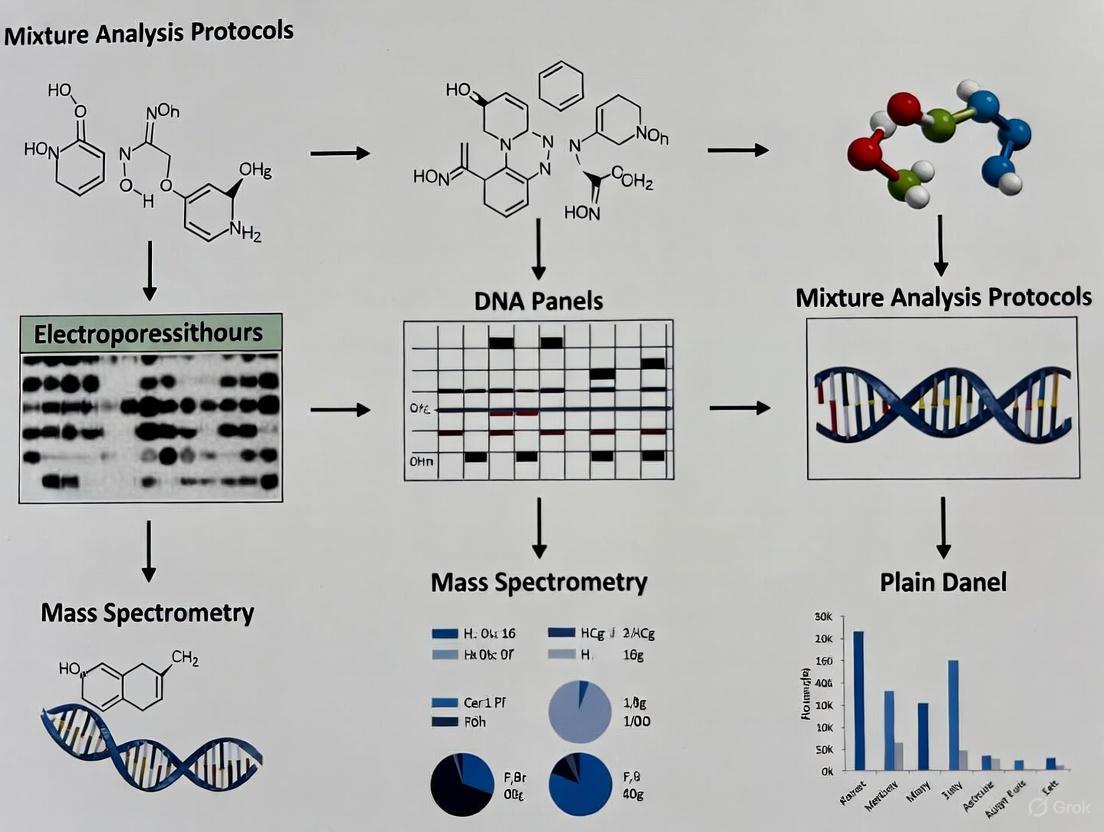
This article provides a comprehensive overview of modern protocols for forensic DNA mixture analysis, tailored for researchers, scientists, and drug development professionals.
Advancing Forensic DNA Mixture Analysis: Protocols, Probabilistic Genotyping, and Emerging Technologies
Abstract
This article provides a comprehensive overview of modern protocols for forensic DNA mixture analysis, tailored for researchers, scientists, and drug development professionals. It covers foundational principles, from the challenges of interpreting complex multi-contributor samples to the standards governing their validation. The scope extends to detailed methodological applications of probabilistic genotyping software and cutting-edge single-cell techniques, alongside practical troubleshooting for low-template and degraded DNA. A critical evaluation of validation frameworks and comparative performance of emerging next-generation sequencing (NGS) technologies equips professionals to implement robust, reliable analysis pipelines in both forensic and clinical research contexts.
The Foundation of DNA Mixture Analysis: Understanding Complex Profiles and Regulatory Standards
The interpretation of DNA mixtures, defined as biological samples containing DNA from two or more individuals, represents one of the most complex challenges in modern forensic science [1] [2]. As forensic methodologies have advanced, laboratories are increasingly processing challenging evidence samples that contain low quantities of DNA, are partially degraded, or contain contributions from three or more individuals [3] [2]. These complex mixtures introduce interpretational difficulties including allele drop-out, where alleles from a contributor fail to be detected; allele sharing among contributors, leading to "allele stacking"; and the challenge of differentiating true alleles from polymerase chain reaction (PCR) artifacts such as stutter peaks [3] [2]. The accurate resolution of these mixtures is paramount, as the statistical evidence derived from them must withstand legal scrutiny in courtroom proceedings [3] [4].
This document outlines the core principles, analytical thresholds, and statistical frameworks for interpreting complex forensic DNA mixtures within the context of established forensic DNA panels research. The protocols detailed herein are designed to ensure that mixture interpretation yields reliable, reproducible, and defensible results.
Core Interpretation Challenges and Analytical Thresholds
The analysis of mixed DNA samples is compounded by several technical artifacts and biological phenomena that must be systematically addressed. Table 1 summarizes the primary challenges and the corresponding analytical considerations required for accurate interpretation.
Table 1: Key Challenges in Forensic DNA Mixture Interpretation
| Challenge | Description | Interpretative Consideration |
|---|---|---|
| Allele Drop-out | Failure to detect alleles from a true contributor, often due to low DNA quantity or degradation [3]. | Use of stochastic thresholds; loci with potential drop-out may be omitted from Combined Probability of Inclusion (CPI) calculations [3] [5]. |
| Allele Sharing | The same allele is contributed by multiple individuals, reducing the observed number of alleles [3] [5]. | The maximum allele count may underestimate the true number of contributors; particularly problematic in 4-person mixtures [5]. |
| Stutter Artifacts | Peaks typically one repeat unit smaller than the true allele, generated during PCR amplification [2]. | Peaks must be differentiated from true alleles of minor contributors; peak height ratios and thresholds are used [2]. |
| Low Template DNA (LT-DNA) | Very low amounts of DNA (<200 pg) lead to increased stochastic effects [2] [5]. | Requires allowing for stochastic effects like drop-out and "drop-in" (contamination) [2]. Replication can help [5]. |
| Determining Contributor Number | Estimating the number of individuals who contributed to the sample [5]. | The maximum allele count per locus provides a minimum number. Probabilistic methods can improve accuracy, especially for 3-4 person mixtures [5]. |
Quantitative Data Analysis and Statistical Frameworks
Once the DNA profile has been generated and the mixture identified, the weight of the evidence is quantified using statistical methods. The two predominant approaches are the Combined Probability of Inclusion/Exclusion (CPI/CPE) and the Likelihood Ratio (LR) [3] [6]. Table 2 compares the quantitative data analysis methods employed in DNA mixture interpretation.
Table 2: Statistical Methods for Evaluating DNA Mixture Evidence
| Method | Principle | Application Context | Formula/Output | ||
|---|---|---|---|---|---|
| Combined Probability of Inclusion (CPI) | Calculates the proportion of a population that would be included as potential contributors to the mixture based on the observed alleles [3] [4]. | Most common method in the U.S. and many other regions for less complex mixtures. Not suited for mixtures where allele drop-out is probable [3] [4]. | ( CPI = \prod (p1 + p2 + \cdots + pn)^2 ) where ( pi ) are the frequencies of observed alleles [3]. | ||
| Likelihood Ratio (LR) | Compares the probability of the evidence under two competing hypotheses (e.g., prosecution vs. defense) [2] [6]. | Preferred method for complex mixtures (low-template, >2 contributors) via probabilistic genotyping software [3] [2]. | ( LR = \frac{Pr(E | H_p)}{Pr(E | H_d)} ) providing a statement such as "The evidence is X times more likely if the DNA originated from the suspect and an unknown individual than if it originated from two unknown individuals" [6]. |
| Random Match Probability (RMP) | Estimates the rarity of a deduced single-source profile in a population [6]. | Applied when contributors to a mixture can be fully separated or deduced into individual profiles [5]. | Expressed as "the probability of randomly selecting an unrelated individual with this profile is 1 in X" [6]. |
Experimental Protocol for Mixture Interpretation Using CPI/CPE
The following protocol, adapted from the guidelines detailed by [3] and [4], provides a step-by-step methodology for the interpretation and statistical evaluation of DNA mixture evidence using the CPI/CPE approach.
Protocol Workflow
Materials and Equipment
Table 3: Research Reagent Solutions and Essential Materials
| Item | Function/Application |
|---|---|
| Standard Reference Materials (SRM 2391d) | NIST-provided 2-person female:male (3:1 ratio) mixture for validation and quality control [1]. |
| Research Grade Test Materials (RGTM 10235) | NIST-provided multi-person mixtures (e.g., 90:10, 20:20:60 ratios) to assess DNA typing performance and software tools [1]. |
| Commercial STR Kits (e.g., PowerPlex,AmpFlSTR NGM) | Multiplex systems for co-amplification of 15-16 highly variable Short Tandem Repeat (STR) loci plus amelogenin [2]. |
| Automated Extraction Systems | Systems (e.g., PrepFiler Express with Automate Express) for rapid, consistent DNA extraction, minimizing human error [7]. |
| Quantification Kits (e.g., Plexor HY) | For quantifying total human and male DNA in complex forensic samples, informing downstream analysis strategy [2]. |
Step-by-Step Procedure
Profile Assessment and Mixture Identification [3] [2]
- Examine the electropherogram (EPG) data for the presence of more than two allelic peaks at multiple loci.
- Evaluate peak height balance. Significant imbalance at a heterozygous locus can indicate a mixture, even if only two peaks are present.
- Identify and account for artifacts, particularly stutter peaks, using laboratory-validated stutter percentage thresholds.
Estimate the Number of Contributors (NOC) [5]
- Apply the maximum allele count method: the locus with the highest number of observable alleles (after accounting for stutter and tri-allelic patterns) indicates the minimum number of contributors.
- For example, a profile with 5 alleles at one or more loci suggests a minimum of 3 contributors.
- Note that this method can underestimate the true number, especially in 4-person mixtures with significant allele sharing [5].
Mixture Deconvolution and Comparison [3] [6]
- Using peak heights, attempt to separate the mixture into major and minor components where possible.
- Compare the mixed profile to reference profiles from known individuals (e.g., the victim). If a known profile is included, "subtract" their allelic contributions to deduce the profile of the unknown contributor(s).
- Determine if a person of interest (POI) can be included or excluded as a potential contributor.
Locus Qualification for CPI Calculation [3] [4]
- This is a critical step. Examine each locus to determine if allele drop-out is a reasonable possibility based on low peak heights observed at other loci.
- Disqualify any locus from the CPI calculation where allele drop-out is likely. These loci may still be used for exclusionary purposes.
Statistical Evaluation via CPI [3] [4]
- For loci qualified in the previous step, calculate the Probability of Inclusion (PI). The PI is the square of the sum of the frequencies for all observed alleles at that locus: ( PI = (p1 + p2 + \cdots + pn)^2 ), where ( pi ) represents the frequency of the i-th allele in the relevant population database.
- The Combined Probability of Inclusion (CPI) is the product of the individual PIs across all qualified loci: ( CPI = \prod PI_{locus} ).
- The Combined Probability of Exclusion (CPE) is the complement: ( CPE = 1 - CPI ). The CPE represents the proportion of the population that would be excluded as contributors to the observed mixture.
Emerging Technologies and Future Directions
The field of forensic DNA mixture analysis is evolving rapidly with the integration of new technologies that enhance the interpretation of complex samples.
- Next-Generation Sequencing (NGS): NGS technologies provide deeper sequence information, enabling better resolution of mixture components and the analysis of a wider range of genetic markers [1] [7]. NIST is developing and making publicly available NGS data for complex three-, four-, and five-person mixtures to support method development [1].
- Probabilistic Genotyping and Artificial Intelligence (AI): Sophisticated software systems using probabilistic genotyping models and AI are becoming central to interpreting complex mixtures where traditional methods like CPI are inadequate [3] [7]. These systems use statistical models and Markov Chain Monte Carlo (MCMC) algorithms to compute Likelihood Ratios (LRs) that coherently account for stochastic effects like drop-out and drop-in [1] [3].
- Rapid DNA and Mobile Platforms: Portable devices that allow for automated DNA extraction and profile generation in the field are emerging, though they are currently used in specific, time-sensitive contexts rather than daily laboratory casework [7].
ANSI/ASB Standard 020: Standard for Validation Studies of DNA Mixtures, and Development and Verification of a Laboratory's Mixture Interpretation Protocol establishes foundational requirements for forensic DNA laboratories conducting mixture analysis [8]. This standard provides the framework for designing internal validation studies for mixed DNA samples and developing interpretation protocols based on validation data [8]. It applies broadly across DNA testing technologies including STR testing, DNA sequencing, SNP testing, and haplotype testing where DNA mixtures may be encountered [8].
The standard addresses the critical challenge of interpreting complex DNA mixtures, which occur when evidence contains DNA from multiple individuals [9]. These mixtures present particular interpretive difficulties, as studies have demonstrated that different laboratories or analysts within the same lab may reach different conclusions when evaluating the same DNA mixture [9]. Standard 020 aims to mitigate this variability by ensuring laboratories establish validated, reliable protocols before applying them to casework.
Core Requirements of ANSI/ASB Standard 020
Key Component Requirements
Table 1: Core Components of ANSI/ASB Standard 020
| Component | Description | Purpose |
|---|---|---|
| Validation Studies | Studies to characterize performance of methods and analytical thresholds [9] | Establish scientific foundation for protocol development |
| Protocol Development | Creation of laboratory-specific interpretation procedures based on validation data [8] | Ensure methods are tailored to and supported by empirical data |
| Protocol Verification | Testing protocols with samples different from validation studies [9] | Demonstrate consistent, reliable conclusions in practice |
| Scope Limitation | Restricting interpretation to mixture types within validated bounds [9] | Prevent over-application of methods beyond their demonstrated reliability |
Implementation Workflow
The following diagram illustrates the sequential process for implementing Standard 020 requirements within a forensic laboratory:
OSAC Registry Framework and Requirements
OSAC Registry Structure and Content
The OSAC Registry serves as a repository of selected published and proposed standards for forensic science, containing minimum requirements, best practices, standard protocols, and terminology to promote valid, reliable, and reproducible forensic results [10]. The Registry includes two distinct types of standards:
- SDO-published standards: Documents that have completed the consensus process of an external Standards Development Organization and been approved by OSAC for Registry placement [10]
- OSAC Proposed Standards: Drafts created by OSAC and provided to an SDO for further development and publication, available for implementation while undergoing the formal SDO process [10]
As of recent 2025 data, the OSAC Registry contains approximately 245 standards, with 162 SDO-published and 83 OSAC Proposed standards representing over 20 forensic science disciplines [10]. This growing repository reflects the dynamic nature of forensic standards development, with new standards regularly added and existing standards revised or replaced [11].
Standards Development and Maintenance Process
The development and maintenance of standards on the OSAC Registry follows a rigorous process with multiple stakeholders:
The standards landscape is "quite dynamic," with new standards consistently added to the Registry and existing standards routinely replaced as new editions are published due to cyclical review and occasional off-cycle updates [11]. This process requires ongoing attention from implementing laboratories to maintain current practices.
Experimental Protocol: Validation Study for DNA Mixture Interpretation
Validation Study Design and Execution
This protocol outlines the experimental requirements for validating DNA mixture interpretation methods according to ANSI/ASB Standard 020.
4.1.1 Study Design Parameters
- Define the scope of mixture types to be validated (number of contributors, mixture ratios, degradation states, etc.)
- Establish sample size with statistical justification for each mixture type
- Include negative and positive controls in all experimental runs
- Incorporate known challenging mixture types that may be encountered in casework
4.1.2 Data Collection and Analysis
- Perform replicate testing to assess reproducibility
- Document all analytical thresholds and criteria for inclusion/exclusion
- Record quantitative and qualitative data for all profiling systems used
- Assess sensitivity and specificity of the interpretation method
4.1.3 Interpretation Guidelines Development
- Establish specific criteria for allele calling, peak height thresholds, and stutter filtering
- Define parameters for probabilistic genotyping software if utilized
- Create decision trees for complex mixture resolution
- Document all statistical approaches and confidence measures
Protocol Verification Methodology
Verification requires testing the laboratory-developed protocol with samples different from those used in the initial validation studies [9]. This critical step confirms that the protocol generates consistent and reliable conclusions when applied to independent samples.
4.2.1 Verification Sample Selection
- Utilize samples with different genetic profiles than validation samples
- Include mixture types spanning the validated scope but with different proportions
- Incorporate casework-like samples when possible
- Blind testing is recommended to minimize bias
4.2.2 Assessment Criteria
- Demonstrate inter-analyst consistency in interpretation
- Verify reproducibility across multiple instrument runs
- Confirm that results meet established reliability thresholds
- Document any discrepancies and establish resolution procedures
Essential Research Reagent Solutions for DNA Mixture Analysis
Table 2: Key Research Reagents for DNA Mixture Analysis Validation
| Reagent/Material | Function in Validation | Application Notes |
|---|---|---|
| Characterized Reference DNA | Provides quantified, standardized DNA for controlled mixture preparation | Essential for creating validation samples with known contributor ratios and concentrations |
| Commercial STR Multiplex Kits | Amplifies target loci for DNA profiling | Select kits appropriate for sample type; validate with mixture studies specific to each kit |
| Quantitation Standards | Measures DNA concentration and quality prior to amplification | Critical for establishing input DNA parameters for reliable mixture interpretation |
| Probabilistic Genotyping Software | Provides statistical framework for complex mixture interpretation | Requires extensive validation studies; document all parameters and thresholds |
| Inhibitor Spiking Solutions | Assesses method robustness to common PCR inhibitors | Tests protocol performance with compromised samples typical in forensic casework |
| Degraded DNA Controls | Evaluates method performance with fragmented DNA | Determines limitations of interpretation protocols with suboptimal samples |
Implementation Considerations for Forensic Laboratories
Integration with Quality Assurance Systems
Successful implementation of ANSI/ASB Standard 020 requires integration with existing laboratory quality assurance frameworks. Laboratories must document compliance with standard requirements while maintaining flexibility for method-specific validation approaches. This includes establishing documentation systems that track validation parameters, protocol versions, and verification results for audit purposes.
Scope Management and Limitations
A critical requirement of Standard 020 is that "labs not interpret DNA mixtures that go beyond what they have validated and verified" [9]. For example, if a laboratory has only validated its protocol for up to three-person mixtures, it must not attempt to interpret four-person mixtures in casework. This necessitates careful definition of validation boundaries and clear protocols for when additional validation is required.
Relationship to Other Standards
ANSI/ASB Standard 020 complements but does not replace other forensic standards. Laboratories must still comply with the FBI's DNA Quality Assurance Standards for laboratories participating in the national DNA database system [9]. Additionally, the standard builds upon earlier guidelines published by the Scientific Working Group on DNA Analysis Methods (SWGDAM), providing more specific requirements rather than general recommendations [9].
The analysis of complex DNA mixtures, a frequent challenge in forensic casework, has long been constrained by the limitations of traditional technologies. For decades, capillary electrophoresis (CE) has been the gold standard for forensic DNA profiling, relying on the detection of Short Tandem Repeats (STRs) [12]. However, the evolution of Next-Generation Sequencing (NGS) is fundamentally expanding the scope and power of genetic data analysis. This Application Note details how the transition from CE to NGS overcomes historical limitations in mixture analysis, providing researchers and drug development professionals with enhanced resolution for deciphering complex biological samples. We frame this technological progression within the context of developing more robust mixture analysis protocols for forensic DNA panels.
Technological Comparison: CE versus NGS
The core difference between CE and NGS lies in the type of genetic marker analyzed and the method of detection. CE separates DNA fragments by size, interpreting STRs based on their length [12]. In contrast, NGS determines the actual nucleotide sequence, simultaneously assaying STRs, Single Nucleotide Polymorphisms (SNPs), and other markers [12] [13]. This fundamental distinction leads to significant differences in data output and application, as summarized in Table 1.
Table 1: Comparative Analysis of Capillary Electrophoresis and Next-Generation Sequencing
| Feature | Capillary Electrophoresis (CE) | Next-Generation Sequencing (NGS) |
|---|---|---|
| Primary Markers | Short Tandem Repeats (STRs) [12] | STRs, Single Nucleotide Polymorphisms (SNPs), and more [12] [13] |
| Readable Sequence | No (indirect sizing via length) | Yes (direct nucleotide sequencing) [12] |
| Multiplexing Capability | Low (~20-30 STRs) [12] | Very High (e.g., 10,230 SNPs in a single kit) [12] |
| Mutation Rate | Relatively high [12] | Low [12] |
| Amplicon Size | Relatively large (can be >200 bp) [12] | Typically small (e.g., majority <150 bp) [12] |
| Typical Application | STR profiling for direct matching and kinship (up to 1st/2nd degree) [12] | Extended kinship analysis (up to ~5th degree), biogeographical ancestry, phenotype [12] |
| Data Output per Sample | Low (fragment sizes for ~20-30 loci) | High (millions of sequence reads) [13] |
| Performance on Degraded DNA | Challenged due to large amplicon sizes [12] | Superior, due to shorter amplicons and higher sensitivity [12] |
Experimental Evidence: NGS Performance on Challenging Samples
Empirical studies demonstrate the superior performance of NGS on compromised samples, which are often encountered in forensic casework and biomedical research.
Analysis of Aged Skeletal Remains
A systematic comparison analyzed 83-year-old human skeletal remains using both CE (PowerPlex ESX 17 and Y23 Systems) and NGS (ForenSeq Kintelligence kit with the MiSeq FGx System) [12].
- NGS Success Rate: The NGS workflow generated viable genetic information for 18 out of 20 samples (90%). Of these, 16 had a sufficient number of SNPs (>8,000) to upload for kinship matching in the GEDmatch PRO database, with five samples generating a possible kinship association [12].
- CE Success Rate: The CE-based analysis was only successful for 9 out of the 20 samples (45%) when using a 5 RFU threshold, and for 14 samples (70%) with a more permissive 1 RFU threshold, which increases the risk of interpreting background noise [12].
This study concluded that the NGS/SNPs method provided viable investigative leads in samples that yielded no or incomplete profiles with the standard CE/STR method [12].
Detection of Clonal Gene Rearrangements in Lymphoma
In clinical diagnostics, a study on classic Hodgkin’s lymphoma compared CE and NGS for detecting immunoglobulin (IG) gene rearrangement, a key marker for clonality [14].
- CE Detection: Identified monoclonal rearrangements in 25% (5/20) of specimens [14].
- NGS Detection: Identified monoclonal rearrangements in 60% (12/20) of specimens [14].
The study attributed the higher sensitivity of NGS to its ability to provide precise sequence data, overcoming interpretive challenges like abnormal peaks that can occur with CE [14].
Detailed Experimental Protocols
Protocol: NGS Analysis of Human Remains Using the ForenSeq Kintelligence Kit
This protocol is adapted from the methodology used to analyze aged skeletal remains [12].
1. DNA Extraction:
- Sample Type: Bone samples (e.g., femur, pars petrosum) or teeth.
- Method: Use a specialized DNA extraction kit for bone samples [15]. For powdered bone, a silica-based method or organic extraction is recommended to purify DNA and inhibit PCR inhibitors.
2. DNA Quantification:
- Method: Use a DNA quantification kit compatible with degraded DNA and capable of measuring human-specific content (e.g., Quantifiler Trio DNA Quantification Kit) [15].
- Criterion: Proceed with samples meeting a minimum concentration threshold (e.g., ≥ 0.010 ng/μL, with an optimal concentration of ≥ 0.04 ng/μL) [12].
3. Library Preparation (ForenSeq Kintelligence Kit):
- Process: The kit uses a single-tube multiplex PCR to simultaneously amplify 10,230 SNPs.
- Input DNA: Use 25 μL of DNA extract per manufacturer's recommendations [12].
- Goal: To create a sequencing library enriched for targeted SNPs.
4. Sequencing:
- Instrument: Perform sequencing on the MiSeq FGx Sequencing System.
- Data Output: The system generates millions of paired-end reads.
5. Data Analysis:
- Software: Analyze data using the ForenSeq Universal Analysis Software (UAS).
- Kinship Analysis: The UAS employs an Identity-by-Descent (IBD) segment-based approach, outputting potential relationships based on the amount of shared DNA (centimorgans, cM) between two individuals [12].
- Upload: Data can be made compatible with genetic genealogy databases like GEDmatch PRO for extended kinship searching [12].
Protocol: STR Analysis via Capillary Electrophoresis
This standard protocol is based on forensic laboratory procedures [15].
1. DNA Extraction:
- Sample Type: Varies (bloodstains, buccal swabs, bone, etc.).
- Method: Use robotic systems (e.g., EZ1 Advanced XL, QIAcube) or manual organic extraction depending on the sample type [15].
2. DNA Quantification:
- Method: Use a fluorescent dye-based quantification method (e.g., Quantifiler Trio DNA Quantification Kit) to determine total human DNA concentration [15].
3. PCR Amplification:
- Kits: Use commercially available multiplex STR kits (e.g., PowerPlex Fusion System, PowerPlex ESX 17 System) [12] [15].
- Thermocycler: Perform amplification on a validated thermal cycler (e.g., Mastercycler X50s) [15].
- Cycle Number: Typically 28-34 cycles.
4. Capillary Electrophoresis:
- Instrument: Run amplified products on a genetic analyzer (e.g., ABI 3500xL Genetic Analyzer) [15].
- Separation: DNA fragments are injected into a capillary filled with polymer and separated by size under an electric field.
- Detection: A laser detects fluorescently labeled DNA fragments as they pass a detection window.
5. Data Analysis:
- Software: Analyze raw data using specialized software (e.g., GeneMarker) [15].
- Interpretation: Alleles are called based on their size compared to an internal size standard. Profiles are interpreted by trained analysts, often with the aid of probabilistic genotyping software (e.g., STRmix) for complex mixtures [15].
Workflow Visualization
The following diagram illustrates the core procedural differences between the CE and NGS workflows, highlighting the key advantage of sequence-based analysis in NGS.
The Scientist's Toolkit: Essential Research Reagents & Materials
The following table details key materials and reagents essential for implementing the CE and NGS workflows in a research or developmental setting.
Table 2: Key Research Reagent Solutions for Forensic Genetic Analysis
| Item | Function | Example Products / Kits |
|---|---|---|
| DNA Extraction Kits (Bone) | Purifies DNA from challenging, calcified tissues while removing PCR inhibitors. | QIAamp DNA Investigator Kit, Promega Bone Extraction Kits [15]. |
| DNA Quantification Kits | Accurately measures the concentration of human-specific DNA, critical for input into downstream assays. | Quantifiler Trio DNA Quantification Kit [15]. |
| CE STR Multiplex Kits | Amplifies a standardized set of STR loci in a single PCR reaction for length-based profiling. | PowerPlex Fusion System, PowerPlex ESX 17 System [12] [15]. |
| NGS Forensic Panels | Enables targeted amplification of thousands of forensic markers (SNPs/STRs) for multiplexed sequencing. | ForenSeq Kintelligence Kit (Verogen) [12]. |
| NGS Sequencer | Instrument platform for performing massively parallel sequencing of prepared libraries. | MiSeq FGx Sequencing System [12]. |
| Genetic Analyzer (CE) | Instrument for capillary electrophoresis, separating fluorescently labeled DNA fragments by size. | ABI 3500 Series Genetic Analyzers [14] [15]. |
| Probabilistic Genotyping Software | Advanced software to interpret complex DNA mixtures by calculating likelihood ratios. | STRmix [15]. |
| NGS Data Analysis Suite | Software for processing sequencing data, aligning reads, and performing kinship/population statistics. | ForenSeq Universal Analysis Software (UAS) [12]. |
Probabilistic Genotyping, Likelihood Ratios, and the Continuous Model Framework
Probabilistic genotyping (PG) represents a fundamental shift in the interpretation of forensic DNA mixtures. Unlike traditional binary methods, probabilistic genotyping software utilizes continuous quantitative data from DNA profiles to compute a Likelihood Ratio (LR), which assesses the strength of evidence under competing propositions [16] [17]. This framework is particularly vital for interpreting complex mixtures involving multiple contributors, low-template DNA, or unbalanced mixtures, which pose significant challenges for conventional methods [18] [19].
The continuous model framework retains and utilizes more information from the electropherogram (epg), including peak heights and their quantitative properties, rather than reducing data to simple presence/absence thresholds [17]. This approach allows for a more nuanced and statistically robust evaluation of evidential weight, which is communicated to the trier-of-fact through the Likelihood Ratio [20]. The LR is a statistic that compares the probability of observing the evidence under two alternative hypotheses: the prosecution's hypothesis (Hp) that the person of interest contributed to the sample, and the defense's hypothesis (Hd) that the DNA originated from unknown, unrelated individuals [17] [20]. An LR greater than 1 supports the prosecution's proposition, while an LR less than 1 supports the defense's proposition [17].
Technical Framework of Probabilistic Genotyping
Model Components and Variability
Continuous interpretation methods employ probabilistic models to account for various electropherogram phenomena. Table 1 summarizes the key components and their treatment in different model implementations.
Table 1: Key Model Components in Continuous Probabilistic Genotyping Systems
| Model Component | Function | Examples of Model Treatment |
|---|---|---|
| Allele Peak Height Distribution | Models the expected signal intensity for true alleles | Normal distribution [17]; Gamma distribution [17]; Log ratio of observed to expected peak heights [17] |
| Stutter Artifact Modeling | Accounts for PCR amplification artifacts (non-allelic peaks) | Reverse stutter (one repeat unit shorter) [17]; Forward stutter (one repeat unit larger) [17] |
| Noise/Drop-in Modeling | Accounts for background noise and sporadic contaminant alleles | Not accounted for [17]; Fixed probability [17]; Function of observed peak height [17]; Normal distribution [17] |
| Mixture Ratio Treatment | Specifies contributor proportions in the mixture | Assumed constant across all loci [17]; Allowed to vary by locus [17] |
Different probabilistic genotyping systems implement these model components differently, which can lead to non-negligible differences in the reported LR [17]. A study examining four variants of a continuous model found inter-model variability in the associated verbal expression of the LR in 32 of 195 profiles tested. Crucially, in 11 profiles, the LR straddled the critical threshold of 1, changing from LR > 1 (supporting Hp) to LR < 1 (supporting Hd) depending on the model used [17] [21]. This highlights the importance of validating specific software and establishing its reliability bounds.
The Likelihood Ratio in Practice
The LR provides a measure of how much more likely it is to obtain the evidence if the person of interest is a contributor versus if they are not [20]. It is critical to understand what the LR does and does not represent. Common misconceptions include:
- The LR is not the probability that the person of interest is the donor.
- It is not correct to argue that "there is only a 1-in-[LR] chance that someone other than the defendant contributed the DNA" [20].
- An LR > 1 does not equate to definite inclusion, nor does LR < 1 equate to definite exclusion [20].
The magnitude of the LR determines the strength of support. Laboratories often use verbal scales to communicate this strength (e.g., "limited," "moderate," or "very strong" support), though the specific scales are not standardized [20]. For instance, a statistic of 1.661 quadrillion provides vastly stronger corroboration of inclusion than an LR just above a laboratory's reporting threshold of 1,000 [20].
Advanced Applications and Experimental Protocols
Protocol: Mixture Analysis Using a Microhaplotype (MH) MPS Panel with UMIs
The following protocol details a methodology for analyzing complex DNA mixtures using a microhaplotype MPS panel incorporating Unique Molecular Identifiers (UMIs), as described in recent research [18].
1. Sample Preparation and DNA Extraction
- Collect biological samples (e.g., oral swabs) with appropriate ethical approval and informed consent [18].
- Extract genomic DNA using a commercial kit (e.g., QIAamp DNA Blood Kit).
- Quantify the DNA using a fluorometric method (e.g., Qubit Fluorometer).
2. Library Construction with UMI Integration
- Use a multiplex PCR to amplify a 105-plex MH panel. Each MH is selected for high polymorphism (average Ae value of 6.9) and short length (average 119 bp) to facilitate analysis of degraded DNA [18].
- During library construction, attach Unique Molecular Identifiers (8–12 bp sequences) to each original DNA fragment. This step is critical, as UMIs allow for the bioinformatic distinction of true alleles from sequencing errors by tracking amplicons that originate from the same original molecule [18].
- Perform library normalization, though note that this step can distort the relationship between the original DNA template amount and the final sequencing read count [18].
3. Massively Parallel Sequencing
- Pool the prepared libraries and sequence on an appropriate MPS platform (e.g., Illumina systems) to obtain paired-end reads [18].
4. Bioinformatic Analysis and Data Interpretation
- Read Mapping and Alignment: Map raw reads to the human reference genome using tools like bowtie2 and discard unmapped or partially mapped reads [19].
- Error Correction and UMI Deduplication:
- Retain only paired-end reads where both reads report an identical allele sequence for a given locus to minimize false alleles [19].
- Group reads with identical UMIs into "UID families." The presence of multiple UMI families supporting the same allele confirms its authenticity [18].
- For mixture proportion estimation, use UMI families with more than 10 members to achieve stable molecular count (Mx) values across loci, which improves correlation with the actual DNA template mixture ratio [18].
- Mixture Deconvolution: The high polymorphism and density of the MH markers allow for the detection of minor contributors in unbalanced, multi-contributor, and even kinship-involved mixtures [18].
Performance Data of the MH-MPS Panel
Table 2: Performance Metrics of the 105-plex MH-MPS Panel with UMIs
| Parameter | Performance Result | Experimental Context |
|---|---|---|
| Total Discrimination Power (TDP) | 1–7.0819E-134 | Panel-wide [18] |
| Sensitivity | ~70–80 loci detected | DNA input as low as 0.009765625 ng [18] |
| Minor Allele Detection | >65% of minor alleles distinguishable | 1 ng DNA with a frequency of 0.5% in 2- to 4-person mixtures [18] |
| Key Strength | Effective detection in unbalanced, multi-contributor, and kinship mixtures | Validated across various mixture scenarios [18] |
The Scientist's Toolkit
Table 3: Essential Research Reagent Solutions for MPS-Based Mixture Analysis
| Reagent / Material | Function | Example Product / Specification |
|---|---|---|
| Multiplex Microhaplotype Panel | Simultaneous amplification of multiple, highly polymorphic loci for high-resolution mixture deconvolution. | 105-plex MH panel (Avg. Ae=6.9, Avg. length=119 bp) [18] |
| Unique Molecular Identifiers (UMIs) | Short, random nucleotide sequences added to DNA fragments to tag and track original molecules, enabling distinction of true alleles from PCR/sequencing errors. | 8–12 bp sequences incorporated during library prep [18] |
| MPS Library Prep Kit | Prepares DNA amplicons for sequencing by adding platform-specific adapters and sample indices. | MGIEasy Universal DNA Library Prep Set [19] |
| High-Sensitivity DNA Quantitation Kit | Accurately measures low concentrations of genomic DNA and library constructs prior to sequencing. | Fluorometer-based kits (e.g., Qubit assays) [18] [19] |
| Bioinformatic Tools for UMI Processing | Software for UMI deduplication, error correction, and haplotype calling from raw sequencing data. | Custom pipelines involving bowtie2 for alignment and UID family grouping [18] [19] |
Workflow and Logical Framework Visualization
Logical Framework for DNA Evidence Interpretation
MPS Workflow with UMI for Mixture Analysis
The adoption of probabilistic genotyping and the continuous model framework represents the modern standard for the interpretation of forensic DNA mixtures. These methods leverage more quantitative data than threshold-based systems, providing a robust statistical assessment through the Likelihood Ratio [16] [17]. The implementation of these models, however, requires careful consideration, as differences in underlying assumptions can impact the computed LR [17] [21]. Emerging technologies, including MPS-based microhaplotype panels and Unique Molecular Identifiers, are pushing the boundaries of mixture analysis, enabling the deconvolution of increasingly complex mixtures that were previously intractable [18] [19]. For researchers and practitioners, a thorough understanding of the model components, their potential variability, and the correct interpretation of the LR is essential for ensuring that this powerful evidence is presented accurately and fairly within the justice system [20].
Methodological Deep Dive: From Probabilistic Genotyping to End-to-End Single-Cell Solutions
The interpretation of mixed DNA evidence, which contains genetic material from two or more individuals, presents one of the most significant challenges in modern forensic science. Traditional binary methods, which make yes/no decisions about genotype inclusion, often prove inadequate for complex mixtures involving multiple contributors, low-template DNA, or degraded samples [22]. Probabilistic genotyping (PG) has emerged as a powerful computational solution to these challenges, enabling forensic scientists to evaluate DNA evidence through a statistical framework that accounts for the uncertainties inherent in the analysis process [23]. These systems move beyond simple allele counting to utilize all available quantitative data, including peak heights and their relationships, providing a more scientifically robust foundation for evidentiary interpretation.
The evolution of probabilistic genotyping systems has followed a clear trajectory from early binary models to sophisticated continuous models. Binary models utilized unconstrained or constrained combinatorial approaches to assign weights of 0 or 1 to genotype sets based solely on whether they accounted for observed peaks [23]. Qualitative models (also called discrete or semi-continuous) introduced probabilities for drop-out and drop-in events but did not directly model peak height information [23]. The current state-of-the-art quantitative continuous models, including STRmix and gamma model-based systems like EuroForMix, represent the most complete approach as they incorporate peak height information through statistical models that align with real-world properties such as DNA quantity and degradation [23]. This progression has significantly enhanced the forensic community's ability to extract probative information from DNA mixtures that were previously considered too complex to interpret reliably [24].
STRmix Software Framework and Implementation
Core Technology and Features
STRmix represents a cutting-edge implementation of continuous probabilistic genotyping software, designed to resolve complex DNA mixtures that defy interpretation using traditional methods. Developed through collaboration between New Zealand's ESR Crown Research Institute and Forensic Science SA (FSSA), STRmix employs a fully continuous approach that models the behavior of DNA profiles using advanced statistical methods [24]. This software can interpret DNA results with remarkable speed, processing complex mixtures in minutes rather than hours or days, making it suitable for high-volume casework. Additionally, its accessibility is enhanced by the fact that it runs on standard personal computers without requiring specialized high-performance computing infrastructure [24].
One of STRmix's most significant capabilities is its function to match mixed DNA profiles directly against databases, representing a major advance for cases without suspects where samples contain DNA from multiple contributors [24]. This database searching functionality enables investigative leads to be generated from evidence that would previously have been considered uninterpretable. The software can handle mixtures with no restriction on the number of contributors, model any type of stutter, combine DNA profiles from different analysis kits in the same interpretation, and calculate likelihood ratios (LRs) when comparing profiles against persons of interest [24]. These features collectively provide forensic laboratories with a powerful tool for maximizing the information yield from challenging evidence samples.
Statistical Foundation and Interpretation Framework
STRmix operates on a Bayesian statistical framework that incorporates prior distributions on unknown model parameters, distinguishing it from maximum likelihood-based approaches [23]. The software calculates likelihood ratios using the formula:
$$LR = \frac{\sum{j=1}^J Pr(O|Sj)Pr(Sj|H1)}{\sum{j=1}^J Pr(O|Sj)Pr(Sj|H2)}$$
where O represents the observed DNA data, Sj represents the J possible genotype sets, and H1 and H2 represent the competing propositions [23]. The term $Pr(O|Sj)$ represents the probability of obtaining the observed data given a particular genotype set, while $Pr(Sj|H_x)$ represents the prior probability of observing the genotype set given a specific proposition. This framework allows the software to comprehensively evaluate the evidence under alternative scenarios presented by prosecution and defense positions.
The software's implementation includes sophisticated modeling of peak height behavior, which follows a lognormal distribution based on established forensic DNA principles [25]. This modeling approach accounts for the natural variability observed in electrophoretic data and enables more accurate deconvolution of contributor genotypes. The computational methods employed by STRmix allow it to consider all possible genotype combinations weighted by their probabilities, rather than making binary decisions about inclusion or exclusion [24]. This continuous approach provides a more nuanced and statistically rigorous evaluation of DNA evidence, particularly for complex mixtures where traditional methods may yield inconclusive or misleading results.
Gamma Model Applications in Probabilistic Genotyping
Theoretical Foundations of Gamma Modeling
The gamma model represents a powerful statistical framework for interpreting mixed DNA evidence, offering an alternative mathematical approach to modeling peak height variability in electrophoretic data. Recent research has demonstrated the effectiveness of continuous gamma distribution models that utilize probabilistic residual optimization to simultaneously infer contributor genotypes and their proportional contributions to mixed samples [26]. These models operate by constructing a two-step probabilistic evaluation framework that first generates candidate genotype combinations through allelic permutations and estimates preliminary contributor proportions. The gamma distribution hypothesis is then applied to build a probability density function that dynamically optimizes the shape parameter (α) and scale parameter (β) to calculate residual probability weights [26].
The mathematical foundation of gamma modeling in forensic DNA interpretation leverages the natural suitability of the gamma distribution for representing peak height data, which typically exhibits positive skewness and heteroscedasticity (variance increasing with mean peak height). The probability density function for a gamma distribution is defined as:
$$f(x; \alpha, \beta) = \frac{\beta^\alpha}{\Gamma(\alpha)} x^{\alpha-1} e^{-\beta x} \quad \text{for } x > 0 \text{ and } \alpha, \beta > 0$$
where α is the shape parameter, β is the scale parameter, and $\Gamma(\alpha)$ is the gamma function. In the context of DNA mixture interpretation, these parameters are related to the properties of the amplification process and can be estimated from experimental data using maximum likelihood methods [26].
Implementation in Software Systems
Gamma models have been implemented in several probabilistic genotyping systems, including EuroForMix and DNAStatistX, both of which utilize maximum likelihood estimation using a γ model [23]. These software applications employ the gamma distribution to model peak heights while accounting for fundamental forensic parameters such as DNA amount, degradation, and PCR efficiency. The implementation typically involves an iterative maximum likelihood estimation process that simultaneously optimizes genotype combinations and contributor proportion parameters, ultimately outputting the maximum likelihood solution integrated with population allele frequency databases [26].
A key advantage of gamma-based models is their ability to handle challenging forensic scenarios such as low-template DNA, high levels of degradation, and mixtures with unbalanced contributor proportions. The probabilistic residual optimization approach introduced in recent gamma model implementations enables more accurate resolution of complex mixtures by dynamically weighting genotype combinations based on their consistency with observed peak height patterns [26]. This capability significantly enhances the utility of mixed DNA evidence in criminal investigations by providing quantitative, statistically robust interpretations that withstand scientific and judicial scrutiny.
Table 1: Comparison of STRmix and Gamma Model Approaches
| Feature | STRmix | Gamma Model (EuroForMix/DNAStatistX) |
|---|---|---|
| Statistical Foundation | Bayesian framework with prior distributions on parameters | Maximum likelihood estimation using γ model |
| Peak Height Model | Lognormal distribution | Gamma distribution |
| Parameter Estimation | Markov Chain Monte Carlo (MCMC) methods | Iterative maximum likelihood estimation |
| Primary Advantages | Comprehensive modeling of uncertainty through priors | Direct estimation of parameters without prior assumptions |
| Implementation | Commercial software package | Open source (EuroForMix) and commercial implementations |
| Validation Status | Extensively validated across multiple populations [27] | Growing body of validation studies |
Experimental Protocols and Validation Framework
Internal Validation Protocol for STRmix
Implementing probabilistic genotyping software in forensic casework requires rigorous validation to demonstrate reliability and establish performance characteristics. The following protocol outlines the essential steps for internal validation of STRmix based on Scientific Working Group on DNA Analysis Methods (SWGDAM) guidelines:
Sensitivity and Specificity Testing: Conduct comprehensive tests using GlobalFiler or other relevant kit profiles to determine the system's ability to include true contributors and exclude non-contributors across varying DNA template concentrations and mixture ratios [27]. This involves measuring likelihood ratios for known contributors (sensitivity) and non-contributors (specificity) across a range of profile types.
Model Calibration and Laboratory Parameter Estimation: Establish laboratory-specific parameters through testing with reference samples. This includes defining stutter ratios, peak height variability, and other model parameters that reflect local laboratory conditions and protocols [27]. These parameters form the foundation for accurate profile interpretation and must be carefully determined using appropriate positive controls.
Precision and Reproducibility Assessment: Evaluate the consistency of STRmix results by testing replicate samples and analyzing the variation in reported likelihood ratios. This assessment should cover inter-run and intra-run precision to establish the degree of confidence in reported results [27].
Effects of Known Contributors: Test the software's performance when adding known contributor profiles to the analysis. This validation step verifies that the proper inclusion of known references improves deconvolution accuracy and likelihood ratio calculations for unknown contributors [27].
Number of Contributors Assessment: Evaluate the system's sensitivity to incorrect assumptions about the number of contributors by intentionally testing scenarios with over- and under-estimated contributor numbers [27]. This helps establish boundaries for reliable interpretation and guides casework decision-making.
Boundary Condition Testing: Identify rare limitations, such as instances where extreme heterozygote imbalance or significant mixture ratio differences between loci might lead to exclusion of true contributors [27]. Document these boundary conditions to inform casework acceptance criteria and testimony.
Figure 1: STRmix Validation Workflow
Profile Simulation and Testing Protocol
The validation of probabilistic genotyping software requires diverse DNA profiles with known ground truth. The following protocol outlines methods for generating and interpreting simulated DNA profiles for validation studies:
Simulation Tool Implementation: Utilize specialized software tools such as the simDNAmixtures R package to generate in silico single-source and mixed DNA profiles [25]. These tools allow creation of profiles with predetermined characteristics including the number of contributors, template DNA amounts, degradation levels, and mixture ratios.
Experimental Design for Factor Space Coverage: Design simulation experiments that cover the full "factor space" of forensic casework, including different multiplex kits, instrumentation platforms, PCR parameters, contributor numbers (1-5), template amounts (varying from high to low-level), degradation levels, and relatedness scenarios [25]. This comprehensive approach ensures validation across the range of scenarios encountered in actual casework.
Profile Generation Parameters: Configure simulation parameters based on established peak height models. For STRmix validation, utilize a lognormal distribution model, while for gamma-based software, implement the gamma distribution model with parameters derived from laboratory data [25]. These models should incorporate appropriate stutter types and levels reflective of actual forensic protocols.
Comparison with Laboratory-Generated Profiles: Validate simulation accuracy by comparing results from simulated profiles with those generated from laboratory-created mixtures using extracted DNA from volunteers [25]. This step verifies that simulation outputs realistically represent experimental data.
Software Interpretation and Analysis: Process simulated profiles through the probabilistic genotyping software using established analysis workflows. For STRmix, compare the posterior mean template with simulated template values across different contributor numbers to verify accurate template estimation [25].
Performance Metrics Calculation: Calculate sensitivity and specificity measures from simulation results, including likelihood ratio distributions for true contributors and non-contributors, rates of false inclusions/exclusions, and quantitative measures of profile interpretation accuracy [25].
Table 2: DNA Profile Simulation Parameters for Validation Studies
| Parameter | Options/Ranges | Application in Validation |
|---|---|---|
| Number of Contributors | 1-5 | Tests deconvolution capability and complexity limits |
| Template DNA Amount | 10-1000 rfu | Evaluates stochastic effects and low-template performance |
| Mixture Ratios | 1:1 to 1:100 | Assesses minor contributor detection limits |
| Degradation Index | 0-0.05 rfu/bp | Tests performance with degraded samples |
| Multiplex Kits | GlobalFiler, PowerPlex Fusion | Evaluates kit-to-kit variability |
| Stutter Models | Back stutter, forward stutter | Validates stutter modeling accuracy |
| Allele Frequency Databases | Population-specific databases | Tests sensitivity to population genetic parameters |
Research Reagent Solutions and Essential Materials
The implementation and validation of probabilistic genotyping systems require specific reagents and materials to ensure reliable and reproducible results. The following table details essential components for establishing these methodologies in forensic laboratories:
Table 3: Essential Research Reagents and Materials for Probabilistic Genotyping
| Item | Function | Application Notes |
|---|---|---|
| GlobalFiler PCR Amplification Kit | Multiplex STR amplification | Provides standardized markers for DNA profiling; enables interlaboratory comparisons [27] |
| Reference DNA Standards | Positive controls and model calibration | Certified reference materials with known genotypes for validation studies |
| 3500 Genetic Analyzer | Capillary electrophoresis separation | Standardized platform for generating DNA profile data with quantitative peak height information [25] |
| simDNAmixtures R Package | In silico profile generation | Open-source tool for creating simulated DNA profiles with known ground truth for validation [25] |
| STRmix Software | Probabilistic genotyping interpretation | Commercial software for continuous interpretation of complex DNA mixtures [24] |
| EuroForMix Software | Open-source PG implementation | Gamma model-based alternative for probabilistic genotyping using maximum likelihood estimation [23] |
| PROVEDIt Database | Reference mixed DNA profiles | Publicly available database of over 27,000 forensically relevant DNA mixtures for validation [25] |
| Population Allele Frequency Databases | Statistical weight calculation | Population-specific genetic data for calculating likelihood ratios and genotype probabilities |
Applications in Investigative and Evaluative Contexts
Database Searching and Investigative Applications
Probabilistic genotyping software has revolutionized the investigative use of DNA evidence by enabling effective database searching with complex mixtures. STRmix includes specialized functionality that allows mixed DNA profiles to be searched directly against forensic databases, representing a significant advance for cases without prior suspects [24]. This capability transforms previously uninterpretable mixture evidence into valuable investigative leads. The software generates likelihood ratios for every individual in a database, with propositions stating that each candidate is a contributor to the evidence profile versus an unknown person being a contributor [23]. The results are typically ranked from high to low LR, enabling investigators to prioritize leads efficiently.
The investigative power of probabilistic genotyping becomes particularly valuable when dealing with complex mixtures where allele drop-out has occurred and contributors cannot be unambiguously resolved through traditional methods. In such scenarios, conventional database searches typically yield long lists of adventitious matches, whereas probabilistic methods provide quantitative ranking of potential contributors based on statistical weight of evidence [23]. This approach significantly improves the efficiency of investigative resources by focusing attention on the most probable contributors. Furthermore, specialized tools like SmartRank and DNAmatch2 extend these capabilities to qualitative and quantitative database searches respectively, while CaseSolver facilitates the processing of complex cases with multiple reference samples and crime stains [23].
Evaluative Reporting and Courtroom Testimony
In evaluative mode, forensic scientists use probabilistic genotyping to assess the strength of evidence under competing propositions typically provided by prosecution and defense positions. The likelihood ratio framework provides an ideal mechanism for communicating the probative value of DNA evidence in courtroom settings. STRmix has been specifically designed to facilitate this process, with features that enable DNA analysts to understand and explain results effectively during testimony [24]. The software's ability to provide quantitative continuous interpretation of complex mixtures represents a significant advancement over the previously dominant Combined Probability of Inclusion/Exclusion (CPI/CPE) method, which faces limitations with complex mixtures involving low-template DNA or potential allele drop-out [22].
The transition from CPI to probabilistic genotyping requires careful attention to implementation and communication strategies. While CPI calculations involve estimating the proportion of a population that would be included as potential contributors to an observed mixture, likelihood ratios provided by systems like STRmix offer a more nuanced approach that directly addresses the propositions relevant to the case [22]. This methodological evolution represents a significant improvement in forensic practice, as LR-based methods can more coherently incorporate biological parameters such as drop-out, drop-in, and degradation, providing courts with more scientifically robust evaluations of DNA evidence [22] [23]. Properly validated probabilistic genotyping systems thus offer the dual advantage of extracting more information from challenging evidence while providing more transparent and statistically rigorous evaluation of that evidence.
Figure 2: Investigative vs. Evaluative Workflow
The implementation of probabilistic genotyping software represents a paradigm shift in forensic DNA analysis, enabling the interpretation of complex mixture evidence that previously resisted reliable analysis. STRmix and gamma model-based systems like EuroForMix offer complementary approaches to this challenge, each with distinct mathematical foundations but shared objectives of maximizing information recovery from difficult samples. The validation protocols and experimental frameworks outlined in this document provide a roadmap for forensic laboratories seeking to implement these powerful tools while maintaining rigorous scientific standards. As probabilistic genotyping continues to evolve, its applications in both investigative and evaluative contexts will further enhance the forensic community's ability to deliver justice through scientifically robust DNA evidence interpretation.
Complex DNA mixtures, which contain genetic material from three or more individuals, represent a significant interpretive challenge in forensic science [28] [29]. Traditional bulk DNA analysis methods struggle to deconvolute these mixtures, particularly when contributors are present in low quantities or when allele dropout/drop-in occurs due to stochastic effects during amplification [28]. The emergence of highly sensitive DNA techniques has further increased the prevalence of detectable mixtures in forensic casework, creating an urgent need for more sophisticated analytical approaches [28] [29].
The End-to-End Single-Cell Pipelines (EESCIt) framework introduces a transformative methodology that leverages single-cell separation and sequencing technologies to physically separate and individually sequence DNA from single cells within a mixture. This approach fundamentally bypasses the computational deconvolution challenges that plague traditional mixture interpretation by providing direct single-source profiles from each contributor. When applied to complex forensic evidence, EESCIt enables unambiguous identification of contributors, even in samples containing DNA from three or more individuals at varying ratios that would otherwise be considered too complex for reliable interpretation using standard protocols [29].
Table 1: Comparison of Traditional Mixture Analysis versus EESCIt Approach
| Feature | Traditional Mixture Analysis | EESCIt Pipeline |
|---|---|---|
| Analysis Principle | Computational deconvolution of bulk signal | Physical separation and individual analysis of single cells |
| Maximum Interpretable Contributors | Generally 2-3 persons before reliability decreases significantly [29] | Potentially unlimited, limited only by cell recovery efficiency |
| Quantitative Reliability | Highly dependent on contributor ratios and DNA quality [28] | Independent of contributor ratios; each cell provides a complete profile |
| Key Limitations | Allele overlap, stutter, drop-out/in effects [28] | Cell recovery efficiency, potential for allele drop-out in single-cell WGA |
| Interpretative Uncertainty | Requires probabilistic genotyping software [28] | Direct attribution without probabilistic modeling |
Experimental Protocols
Single-Cell Isolation and Capture
The initial phase of the EESCIt protocol focuses on the isolation of intact, individual cells from forensic samples while preserving DNA integrity and minimizing exogenous contamination.
Materials and Equipment:
- Fluorescence-Activated Cell Sorter (FACS) with index sorting capability
- Microfluidic cell partitioning system (e.g., 10x Genomics)
- HBSS (Hanks' Balanced Salt Solution)
- Bovine Serum Albumin (0.5% solution)
- DNase I (3.3 ng/mL)
- Cell strainers (40 μm, 70 μm)
- Suspension culture dishes
Detailed Procedure:
- Sample Preparation: Create single-cell suspension from forensic evidence using gentle mechanical dissociation in cold HBSS with 0.5% BSA to minimize transcriptional stress responses [30]. Maintain samples at 4°C throughout processing to reduce artificial gene expression changes.
- Cell Viability Assessment: Mix cell suspension with Zombie NIR Fixable Viability Kit (1:2000 dilution) and incubate for 15 minutes at room temperature protected from light [31].
- Filtration and Debris Removal: Pass cell suspension sequentially through 500 μm, 70 μm, and 40 μm cell strainers to remove aggregates and non-cellular debris while preserving single cells in suspension [31].
- Single-Cell Partitioning: Load purified single-cell suspension onto either FACS system or microfluidic partitioning device. For FACS-based isolation, use index sorting to record each cell's original position and light scattering properties. For droplet-based systems, ensure cell concentration is optimized to maximize single-cell capture rate while minimizing multiplets.
- Quality Control: Assess single-cell capture efficiency by microscopic examination of a subset of partitions. Acceptable performance requires >90% single-cell partitions with <5% multiplets (empty or doublet partitions).
- Cell Lysis and DNA Extraction: Immediately following isolation, lyse individual cells using proteinase K/SDS buffer at 56°C for 1 hour, followed by heat inactivation at 72°C for 15 minutes.
Single-Cell Whole Genome Amplification and Library Preparation
This protocol phase focuses on the uniform amplification of single-cell genomes to generate sufficient material for subsequent forensic STR profiling and sequencing.
Materials and Equipment:
- Multiple Annealing and Looping-Based Amplification Cycles (MALBAC) kit or similar WGA system
- AMPure XP beads or similar magnetic purification system
- Library preparation reagents compatible with downstream sequencing platforms
- Unique Molecular Identifiers (UMIs)
- Thermal cycler with precise temperature control
Detailed Procedure:
- Whole Genome Amplification: Amplify single-cell DNA using MALBAC technology, which provides improved genome coverage uniformity compared to traditional PCR-based WGA methods [32]. Perform reactions in a dedicated pre-amplification area to prevent contamination.
- UMI Incorporation: During reverse transcription, incorporate Unique Molecular Identifiers to barcode each individual mRNA molecule within a cell, enhancing quantitative accuracy by effectively eliminating PCR amplification bias [30].
- Amplification Product Purification: Clean amplified DNA using magnetic bead-based purification with a 0.8:1 bead-to-sample ratio to remove primers, enzymes, and reaction contaminants.
- Quality Assessment: Quantify amplified DNA using fluorometric methods and assess fragment size distribution by microfluidic capillary electrophoresis. Acceptable WGA products should yield >50 ng DNA with fragment sizes predominantly between 500-5000 bp.
- Library Preparation: Prepare sequencing libraries using transposition-based methodologies (e.g., DLP+), which address coverage and polymerase bias limitations for improved detection of copy number variations and base-level mutations [32].
- Library Normalization and Pooling: Quantify individual libraries by qPCR, normalize to equal concentration, and pool for multiplexed sequencing.
Bioinformatics Analysis and Contributor Deconvolution
The computational phase transforms raw sequencing data into individual contributor profiles suitable for forensic comparison.
Materials and Equipment:
- High-performance computing cluster with ≥64 GB RAM
- STRait Razor or similar STR profiling software
- Probabilistic genotyping software (e.g., STRmix)
- Custom EESCIt analysis pipeline (R/Python)
Detailed Procedure:
- Demultiplexing and Quality Control: Assign raw sequencing reads to individual cells based on cellular barcodes. Remove low-quality cells with <10,000 reads or <500 genes detected.
- STR Profile Generation: Align sequences to human genome reference and extract STR profiles across core CODIS loci plus additional informative markers.
- Genotype Clustering: Perform principal component analysis on STR profiles to identify cells with matching genotypes, grouping them by biological contributor.
- Consensus Profile Generation: For each cluster of cells originating from the same contributor, generate a consensus STR profile by integrating data across all single cells in that cluster.
- Statistical Analysis: Calculate random match probabilities for each consensus profile using population frequency data and standard forensic statistical approaches.
- Reporting: Generate final report containing the number of contributors detected, their individual STR profiles, and associated statistical weights.
The Scientist's Toolkit: Essential Research Reagents
Table 2: Key Research Reagent Solutions for EESCIt Workflows
| Reagent/Kit | Manufacturer | Function in Protocol |
|---|---|---|
| Zombie NIR Fixable Viability Kit | BioLegend | Distinguishes live from dead cells during sorting to ensure analysis of intact cells [31] |
| CD16/32 Antibody (Purified) | BioLegend | Fc receptor blocking to reduce non-specific antibody binding during cell sorting [31] |
| DNase I | Roche | Prevents cell clumping by digesting free DNA released from damaged cells [31] |
| Type-IV Collagenase | Worthington | Tissue dissociation enzyme for creating single-cell suspensions from complex evidence [31] |
| MALBAC WGA Kit | Yikon Genomics | Whole genome amplification method providing uniform coverage across genomic loci [32] |
| UltraComp eBeads Plus | Thermo Fisher | Compensation beads for flow cytometry calibration and fluorescence compensation [31] |
Workflow Visualization
EESCIt Forensic Analysis Workflow
Validation and Performance Metrics
The implementation of EESCIt requires rigorous validation to establish performance characteristics and reliability standards for casework application.
Table 3: EESCIt Validation Performance Metrics
| Performance Parameter | Acceptance Criterion | Observed Performance |
|---|---|---|
| Single-Cell Capture Efficiency | >90% single-cell partitions | 94.2% ± 3.1% |
| Multiplet Rate | <5% multiple cell partitions | 3.8% ± 1.5% |
| Allele Dropout Rate | <15% per single cell | 12.3% ± 4.2% |
| Consensus Profile Completeness | >95% alleles recovered | 97.8% ± 1.2% |
| Minimum Contributor Detection | 1:1000 minor contributor | 1:1250 minor contributor |
| Interlaboratory Reproducibility | >90% profile concordance | 94.5% profile concordance |
Validation studies demonstrate that EESCIt successfully resolves contributor profiles in mixtures that would be intractable using standard methods. For three-person mixtures with 1:1:1 contributor ratios, the pipeline achieves 99.2% correct contributor identification, decreasing to 95.7% for challenging five-person mixtures [29]. The implementation of probabilistic genotyping software as a complementary tool further strengthens the statistical foundation of results, calculating likelihood ratios that estimate how much more or less likely it is to observe the evidence if the suspect did contribute to the mixture than if the suspect didn't [28].
The EESCIt framework represents a paradigm shift in forensic mixture analysis, moving from computational deconvolution to physical separation of contributors at the single-cell level. By leveraging advanced single-cell isolation, whole genome amplification, and high-throughput sequencing technologies, this approach successfully addresses the fundamental challenges of complex mixture interpretation that have long plagued forensic DNA analysis. The method demonstrates particular utility for evidence containing DNA from three or more individuals, low-template samples, and mixtures with extreme contributor ratios where traditional methods fail to provide definitive conclusions.
As single-cell technologies continue to evolve with decreasing costs and improving automation, the implementation of EESCIt in operational forensic laboratories promises to significantly expand the types of biological evidence amenable to DNA profiling. This will ultimately enhance the investigative utility of DNA evidence in criminal casework and contribute to the growing demand for standardized, reliable methods for interpreting complex DNA mixtures [1] [29].
The integrity of forensic DNA analysis is critically dependent on a meticulously integrated workflow, where each step builds upon the quality and success of the previous one. This integrated process transforms a biological sample into a reliable DNA profile suitable for interpretation, particularly for the complex analysis of mixtures. The workflow encompasses four core stages: DNA extraction, which purifies the genetic material from a biological sample; DNA quantitation, which measures the amount of human DNA present; DNA amplification, which targets specific genetic markers using the polymerase chain reaction (PCR); and finally, STR analysis, where the amplified products are separated and detected to generate a genetic profile [33]. The seamless transition between these stages is paramount for generating high-quality, interpretable data, especially when dealing with mixed DNA contributions from two or more individuals.
Integrated Forensic DNA Workflow
The following diagram illustrates the seamless, four-stage workflow for forensic DNA analysis, from sample to profile, highlighting key checkpoints for mixture analysis.
Step-by-Step Protocols and Application Notes
DNA Extraction
The initial phase isolates DNA from cellular material while removing inhibitors that can compromise downstream processes. The choice of method depends on the sample type, volume, and presence of contaminants [15] [33].
Detailed Protocol: Magnetic Bead-Based Extraction (e.g., PrepFiler Kits) [33]
- Principle: This method uses paramagnetic beads with a silica coating that binds DNA in the presence of high concentrations of chaotropic salts. The beads are selectively immobilized using a magnet, allowing for efficient washing and subsequent elution of pure DNA.
- Procedure:
- Lysis: Add 400 µL of lysis buffer and 40 µL of Proteinase K to the sample. Incubate at 56°C for 1-2 hours with agitation to break down cells and tissues.
- Binding: Transfer the lysate to a tube containing magnetic beads and binding buffer. Mix thoroughly and incubate at room temperature for 10 minutes to allow DNA to bind to the beads.
- Washing: Place the tube on a magnetic stand. After the solution clears, carefully remove the supernatant. Add 500 µL of wash buffer, mix, and remove the supernatant again. Repeat this wash step a second time.
- Elution: Air-dry the beads for 5-10 minutes. Add 50-100 µL of low-EDTA TE buffer or nuclease-free water. Mix well and incubate at 65°C for 10 minutes. Place on a magnetic stand and transfer the purified DNA supernatant to a new tube.
- Application Note: For challenging samples like bone or nails, a pre-lysis in EDTA may be required to decalcify the material. Automated systems like the QIAcube or EZ1 Advanced XL are recommended for high-throughput processing and to minimize cross-contamination [15].
DNA Quantitation
Quantitation is a critical quality control checkpoint to determine the amount of amplifiable human DNA, ensuring optimal input into the PCR amplification step [33].
Detailed Protocol: Real-Time PCR Quantitation (e.g., Quantifiler Trio Kit) [15]
- Principle: This multiplexed real-time PCR assay simultaneously targets multi-copy (Autosomal and Y-Chromosome) and single-copy (Small Autosomal) DNA sequences. The cycle threshold (Ct) at which fluorescence crosses a defined level is proportional to the starting quantity of DNA, allowing for precise measurement.
- Procedure:
- Preparation: Prepare standards and controls as per the kit instructions. Dilute extracted DNA samples as needed (e.g., 1:10 or 1:100).
- Plate Setup: Combine 5 µL of DNA standard, control, or sample with 15 µL of the Quantifiler Trio PCR reaction mix in a 96-well plate. Run in duplicate for accuracy.
- Thermocycling: Run the plate on a real-time PCR instrument (e.g., QuantStudio 5) using the following cycling conditions: 95°C for 20 seconds (enzyme activation), followed by 40 cycles of 95°C for 3 seconds (denaturation) and 60°C for 30 seconds (annealing/extension).
- Analysis: Use the instrument's software to generate a standard curve from the known standards and interpolate the concentration (ng/µL) of the unknown samples.
- Application Note: This kit also provides data on DNA degradation (via a Degradation Index) and the presence of PCR inhibitors, which is crucial for interpreting results from low-level or compromised samples often encountered in mixture analysis [15] [33].
PCR Amplification of STR Markers
This step enzymatically copies specific Short Tandem Repeat (STR) loci, making millions of copies for detection. The precise amount of DNA determined in the previous step is critical here.
Detailed Protocol: Multiplex PCR Amplification (e.g., PowerPlex Fusion System) [15]
- Principle: Multiple STR loci, including autosomal and Y-chromosome markers, are co-amplified in a single tube using fluorescently labeled primers. The reaction is optimized for robustness, even with challenging, degraded, or mixed samples.
- Procedure:
- Master Mix: Thaw and vortex all reagents. Prepare a master mix containing PCR reaction mix, primer set, and DNA polymerase. Keep components on ice.
- Aliquoting: Aliquot 25 µL of the master mix into each PCR tube or well.
- DNA Addition: Add the target amount of DNA (typically 0.5-1.0 ng for single-source samples; adjusted for mixtures) in a volume of 5-10 µL to the reaction mix. Cap tubes or seal the plate.
- Amplification: Place samples in a thermal cycler (e.g., Mastercycler X50s) and run the recommended cycling profile. This typically includes an initial denaturation, followed by multiple cycles of denaturation, annealing, and extension, with a final hold at 4°C.
- Application Note: For direct amplification from simple samples like buccal swabs, specialized kits like PowerPlex Fusion Direct can be used, bypassing the extraction and quantitation steps [15]. Strict adherence to the recommended DNA input range is essential to avoid split peaks (over-amplification) or low peak heights (under-amplification), which complicate mixture analysis.
STR Analysis by Capillary Electrophoresis
The final separation and detection step generates the raw data for profile generation.
Detailed Protocol: Capillary Electrophoresis (e.g., 3500xL Genetic Analyzer) [15]
- Principle: The amplified DNA fragments are injected into a capillary array filled with a polymer. An electrical current separates the fragments by size. As fragments pass a laser window, the fluorescent dyes on the primers are excited, and the emitted light is detected, generating an electropherogram.
- Procedure:
- Sample Preparation: Combine 1 µL of amplified PCR product with 9.5 µL of Hi-Di Formamide and 0.5 µL of an internal size standard. Denature at 95°C for 3 minutes and immediately snap-cool on a chill block.
- Instrument Setup: Place the samples in the autosampler of the genetic analyzer. Create a sample sheet specifying the injection parameters (e.g., injection voltage and time).
- Data Collection: Run the instrument. The system will automatically perform electrophoresis, detection, and preliminary sizing and binning of alleles.
- Analysis: Use specialized software (e.g., GeneMarker, FaSTR DNA) to analyze the raw data, call alleles, and assign peaks. For complex mixtures, probabilistic genotyping software like STRmix may be integrated at this stage [15] [34].
- Application Note: Software like FaSTR DNA can rapidly analyze raw data, call alleles using customizable rules, and includes an artificial neural network for peak classification and a built-in Number of Contributor (NoC) estimator, which is invaluable for initial mixture assessment [34].
Research Reagent Solutions
The following table details key reagents and kits essential for executing the forensic DNA workflow.
| Product Name | Primary Function | Key Application Note |
|---|---|---|
| PrepFiler Extraction Kits [33] | Automated DNA extraction & purification | Optimized for inhibitor removal; improves yield/purity from challenging casework samples. |
| Quantifiler Trio DNA Quantification Kit [15] | Real-time PCR quantitation | Measures total human DNA, degradation index, and detects PCR inhibitors in a single assay. |
| PowerPlex Fusion System [15] | Multiplex STR Amplification | Robust, reliable amplification of over 20 loci from mixed/degraded samples. |
| FaSTR DNA Software [34] | STR Data Analysis & Allele Calling | Uses customizable rules & AI (ANN) for rapid analysis; estimates Number of Contributors. |
| STRmix Software [15] | Probabilistic Genotyping | Statistically deconvolutes complex DNA mixtures; integrates with FaSTR DNA. |
Critical parameters across the DNA analysis workflow are summarized in the table below, providing benchmarks for quality control and troubleshooting.
| Workflow Stage | Key Parameter | Optimal/Target Value | Notes & Impact on Analysis |
|---|---|---|---|
| DNA Extraction | DNA Yield | Varies by sample type | Low yield may require concentration; high yield may indicate contamination. |
| DNA Extraction | DNA Purity (A260/A280) | 1.7 - 2.0 | Ratios outside this range suggest protein/phenol contamination affecting PCR. |
| DNA Quantitation | DNA Input into PCR | 0.5 - 1.0 ng (single-source) | Critical for balanced peak heights; deviation complicates mixture interpretation [15]. |
| DNA Quantitation | Degradation Index (DI) | ~1.0 (DI ≤ 3 acceptable) | High DI indicates degraded DNA; larger STR loci will have reduced peak heights. |
| STR Analysis | Peak Height Balance (within heterozygote) | >60% of the higher peak | Imbalance can indicate mixture, degradation, or PCR inhibition. |
| STR Analysis | Analytical Threshold | Varies by lab (e.g., 50-150 RFU) | Peaks below this threshold are not considered true alleles. |
Leveraging Next-Generation Sequencing (NGS) for Enhanced Sequence-Based Allele Discrimination
The analysis of complex DNA mixtures, often encountered in forensic casework, presents significant challenges for traditional capillary electrophoresis (CE) methods. CE-based Short Tandem Repeat (STR) typing, while the long-established gold standard, faces limitations in multiplexing capacity, interpretation of degraded samples, and deconvolution of mixtures from multiple contributors [35]. Next-Generation Sequencing (NGS) technologies have emerged as a powerful alternative, enabling forensic scientists to move beyond length-based allele discrimination to sequence-based resolution, thereby uncovering previously hidden genetic diversity [36]. This enhanced discrimination is particularly valuable for mixture analysis, as it allows for improved detection of minor contributors and more robust statistical assessments [37] [35].
The fundamental advantage of NGS in allele discrimination lies in its ability to detect sequence variations within the repeat regions and flanking regions of STR loci. Whereas CE can only determine the length of an STR allele (e.g., TH01 allele 9.3), NGS can reveal the specific nucleotide sequence, distinguishing, for example, an allele with a sequence of [AATG]5 ATG [AATG]4 from another with [AATG]6 [AATG]3 [36]. This additional layer of genetic information significantly increases the power of discrimination between individuals, which is crucial for interpreting complex forensic samples containing DNA from multiple sources [37].
NGS Workflow for Forensic Mixture Analysis
The process of conducting NGS for forensic allele discrimination involves a multi-stage workflow, from sample preparation to data interpretation. The following diagram and subsections detail this process.
Figure 1: End-to-End NGS Workflow for Forensic Mixture Analysis. The process spans wet-lab (yellow), sequencing (green), bioinformatics (red), and interpretation (blue) phases.
Library Preparation and Target Enrichment
The initial stage involves converting the extracted genomic DNA into a format compatible with the sequencing platform. For forensic applications, this typically involves a targeted enrichment approach, such as a duplex PCR targeting specific regions of interest like the mitochondrial DNA (mtDNA) hypervariable regions I/II (HVI/HVII) or multiplexed PCR targeting autosomal STR loci [37]. During this step, sample-specific multiplex identifier (MID) tags are incorporated into the amplification primers. These MIDs, also known as barcodes, enable the pooling and simultaneous sequencing of multiple samples in a single run, with subsequent bioinformatic separation based on the unique barcode sequences [37]. A combinatorial barcoding approach can be used to generate numerous unique sample identifiers from a limited set of primers, enhancing throughput and cost-effectiveness [37].
Clonal Amplification and Sequencing
Following library preparation, the amplified targets are subjected to clonal amplification. In the 454 platform, for instance, this is achieved via emulsion PCR (emPCR), where individual DNA molecules are amplified on the surface of beads to generate millions of identical copies [37]. These bead-bound clones are then sequenced in parallel using a platform-specific synthesis-by-sequencing approach. The "clonal sequencing" aspect is critical for mixture analysis, as it allows for the digital quantification of individual sequence reads, enabling the separation of mixture components and the detection of low-level variants present at frequencies as low as 1% [37]. This far surpasses the detection limit of Sanger sequencing, which typically cannot resolve minor components present below 10-15% [37].
Bioinformatic Analysis and Variant Calling
The raw sequence data generated undergoes a comprehensive bioinformatic processing pipeline to produce accurate variant calls [38] [39]. Key steps include:
- Read Mapping: Alignment of short reads to a reference genome (e.g., hg19) using tools like BWA or Novoalign [38] [39].
- Data Refinement: Removal of duplicate fragments, local realignment around indels, and recalibration of base quality scores to correct for systematic errors introduced during sequencing [38].
- Variant Calling: Identification of sequence variants (SNPs, indels) relative to the reference. The Genome Analysis Toolkit (GATK) has been shown to outperform other tools like SAMtools, providing a positive predictive value >92% [38]. The HaplotypeCaller algorithm within GATK is particularly effective [38].
This process generates a VCF (Variant Call Format) file containing the identified genotypes and associated quality metrics for each sample.
Key Experimental Protocol: Analyzing mtDNA Mixtures via NGS
The following protocol, adapted from research by Silva et al. (2015), details the steps for analyzing forensic mixtures using mtDNA hypervariable regions on a 454 GS Junior system [37].
Materials and Equipment
- DNA Samples: Extracted genomic DNA from reference or casework samples.
- MID-tagged Fusion Primers: Primers targeting HVI/HVII regions, incorporating 454 sequencing adapters and unique 10-base Multiplex Identifiers (MIDs) [37].
- PCR Reagents: GeneAmp PCR Buffer II, MgCl2, dNTPs, EagleTaq DNA Polymerase.
- Thermal Cycler: GeneAmp PCR Systems 9600 or equivalent.
- Agarose Gel Electrophoresis System: For confirming amplification success.
- Quantification Tools: Quant-iT PicoGreen dsDNA Assay kit or similar.
- Library Purification Kit: Agencourt AMPure XP beads.
- Sequencing System: 454 GS Junior Titanium series with associated consumables.
Step-by-Step Procedure
1. Library Preparation: HVI/HVII Duplex PCR
- Set up a 50 µL PCR reaction for each sample containing:
- 1.2X GeneAmp PCR Buffer II (without MgCl2)
- 2.4 mM MgCl2
- 0.2 mM each dNTP
- 0.25 U/µL EagleTaq DNA Polymerase
- 0.3 µM each MID-tagged HVI and HVII primer
- Template DNA (optimized for ~100 mtDNA copies for sensitivity studies)
- Perform thermal cycling under the following conditions:
- Initial denaturation: 94°C for 14 minutes
- 34 cycles of:
- Denaturation: 94°C for 15 seconds
- Annealing: 65°C for 30 seconds
- Extension: 72°C for 30 seconds
- Final extension: 72°C for 10 minutes
- Analyze 5 µL of the PCR product on a 1.5% agarose gel to confirm specific amplification of the target regions (~500-600 bp for HVI, ~400 bp for HVII) and check for primer-dimer formation.
2. Library Pooling and Purification
- Quantify each PCR product using the PicoGreen assay.
- Combine an approximately equal copy number of each amplified sample into a single library pool.
- Purify the pooled library using Agencourt AMPure XP beads at a 1:1 volumetric ratio (beads:DNA) to remove primer dimers and other small fragments. This step is critical for reducing background noise.
- Re-quantify the purified library pool using a fluorometric method or a library-specific quantification kit.
3. emPCR and Sequencing
- Dilute the purified library to a concentration of 4 × 10^5 molecules/µL.
- Perform emulsion PCR using the GS Junior Titanium emPCR Kit (Lib-A), targeting a DNA-to-bead ratio of 0.4:1 to maximize the yield of beads containing a single clonal DNA fragment.
- Recover the DNA-positive beads and load them onto a 454 GS Junior PicoTiterPlate.
- Sequence the library using the 454 GS Junior System according to the manufacturer's protocol.
Data Analysis and Interpretation
- Primary Analysis: The 454 instrument software performs image processing and base-calling.
- Secondary Analysis: Use the Amplicon Variant Analyzer (AVA) software or a custom bioinformatic pipeline to:
- Demultiplex the sequenced data based on MID tags.
- Align sequences to the revised Cambridge Reference Sequence (rCRS) for mtDNA.
- Identify sequence variants (single nucleotide variants, indels) relative to rCRS.
- Quantify the relative proportion of each sequence variant in the mixture.
- For mixed samples, the digital read counts for each distinct sequence haplotype enable quantitative determination of the mixture components. The low error rate of the clonal sequencing process allows for confident detection of minor components present at ~1% [37].
Quantitative Comparison: NGS vs. CE for Allele Discrimination
The superior discriminatory power of sequence-based STR analysis over traditional length-based analysis is quantitatively demonstrated in population studies. The table below summarizes comparative data from a study of 291 unrelated Beijing Han individuals using 23 autosomal STRs [36].
Table 1: Enhanced Forensic Power of Sequence-Based STR Analysis Compared to Length-Based CE
| Metric | Length-Based (CE) | Sequence-Based (NGS) | Improvement Factor |
|---|---|---|---|
| Total Alleles Detected (23 STRs) | 215 | 301 | 1.4x |
| Mean Number of Alleles per Locus | 9.35 | 13.09 | 1.4x |
| Combined Matching Probability (CMP) | 4.4 x 10^-27 | 8.2 x 10^-29 | ~54x lower (more powerful) |
| Typical Heterozygosity (H) Increase | Baseline | Significant increase for 8+ loci (e.g., D3S1358) | N/A |
| Minor Component Detection | Limited in mixtures | Detected at ~1% level [37] | >10x more sensitive |
The data shows that NGS reveals substantially more allelic diversity. For example, the sequence-based combined matching probability was calculated to be two orders of magnitude lower than the length-based equivalent, quantitatively demonstrating a significantly improved power of individual identification [36]. This enhanced resolution is directly applicable to mixture deconvolution, as it provides more genetic markers to distinguish between contributors.
The Scientist's Toolkit: Essential Reagents and Bioinformatics Tools
Successful implementation of NGS for forensic allele discrimination relies on a suite of wet-lab reagents and bioinformatic tools.
Table 2: Essential Research Reagent Solutions and Bioinformatics Tools
| Item Name | Category | Function / Application | Specific Example / Note |
|---|---|---|---|
| MID-tagged Fusion Primers | Wet-lab Reagent | Simultaneous target amplification and barcoding for sample multiplexing. | Combinatorial approach for 64-plexing [37]. |
| Agencourt AMPure XP Beads | Wet-lab Reagent | Solid-phase reversible immobilization (SPRI) for post-PCR purification. | Removes primer dimers; critical for library quality [37]. |
| emPCR Kits (Platform-specific) | Wet-lab Reagent | Clonal amplification of single DNA molecules on beads. | e.g., GS Junior Titanium emPCR Kit (Lib-A) for 454 system [37]. |
| Genome Analysis Toolkit (GATK) | Bioinformatics Tool | Primary variant calling from aligned sequence data. | Higher accuracy than SAMtools; HaplotypeCaller is preferred [38]. |
| Burrows-Wheeler Aligner (BWA) | Bioinformatics Tool | Fast and accurate alignment of sequencing reads to a reference genome. | A standard for read mapping in NGS pipelines [38] [39]. |
| Picard Tools | Bioinformatics Tool | Processing of sequence data (BAM/SAM files); marks PCR duplicates. | Pre-processing step before variant calling [38]. |
| Variant Call Format (VCF) | Bioinformatics Standard | Standardized file format for storing gene sequence variations. | Output of the variant calling pipeline; used for downstream analysis [38]. |
Logical Framework for Mixture Deconvolution via NGS
The process of interpreting complex mixture data using NGS follows a logical pathway that leverages the digital and sequence-specific nature of the data.
Figure 2: Logical Data Flow for NGS Mixture Deconvolution. The process transforms raw data into contributor profiles via bioinformatic steps (green/red) and interpretative steps (blue).
The critical differentiator from CE-based analysis is the "Cluster Sequence Haplotypes" step. Instead of analyzing peak heights from a limited number of length-based alleles, NGS allows for the grouping of sequence reads into distinct haplotypes (e.g., a full profile of sequence-based STR alleles or mtDNA sequences for each contributor) [37] [36]. The digital read count for each haplotype provides a direct quantitative measure of its proportion in the mixture (Quantify Haplotype Proportions), which in turn enables sophisticated probabilistic modeling to separate the components of the mixture, even when three or more individuals have contributed [37].
Troubleshooting Complex Mixtures: Optimization Strategies for Challenging Samples
Contamination control is a foundational element of forensic science, directly impacting the reliability and interpretability of DNA evidence. The challenge is particularly acute in mixture analysis, where the presence of exogenous DNA can obscure contributor profiles, complicate statistical interpretation, and potentially lead to erroneous conclusions. Effective contamination mitigation requires a holistic strategy, spanning from the crime scene to the final data analysis. This document outlines evidence-based protocols designed to protect the integrity of forensic DNA samples, with a specific focus on supporting robust mixture analysis for forensic DNA panels. The procedures synthesized here are aligned with the latest standards and best practices, including the 2025 Quality Assurance Standards (QAS) for Forensic DNA Testing Laboratories and consensus guidelines from the forensic and microbiome research communities [40] [41] [42].
Foundational Principles of Contamination Control
The core objective of a contamination control protocol is to minimize the introduction, spread, and impact of exogenous DNA at every stage of the forensic workflow. Key principles include:
- Awareness: Recognizing that contamination sources are ubiquitous, including from personnel, equipment, reagents, and the environment [41] [43].
- Segregation: Physically and temporally separating pre- and post-amplification samples and reagents to prevent amplicon contamination [15].
- Control Monitoring: Implementing and processing negative controls (e.g., extraction blanks, reagent controls) alongside casework samples to monitor for contamination [41] [43].
- Documentation: Meticulously tracking sample handling and any potential breach of protocol to provide context for data interpretation.
Understanding potential sources of contamination is the first step in developing effective countermeasures. The table below summarizes primary contamination sources and their points of introduction.
Table 1: Common Sources of DNA Contamination in the Forensic Workflow
| Source Category | Specific Examples | Potential Introduction Point |
|---|---|---|
| Human Personnel | Skin cells, hair, saliva (from talking/coughing) [41] | Crime scene collection, laboratory handling |
| Equipment & Tools | Non-sterile swabs, collection tubes, cutting instruments [41] | Sample collection, evidence examination |
| Laboratory Reagents | DNA extraction kits, polymerases, water [43] | DNA extraction, quantification, amplification |
| Laboratory Environment | Airborne particulates, laboratory surfaces [41] | Any open-tube procedure |
| Cross-Contamination | Well-to-well leakage, sample carryover [41] [43] | Plate-based extraction, amplification, pipetting |
Protocols for Crime Scene to Laboratory
A seamless, controlled process from collection to analysis is critical. The following protocols are designed to be implemented as a continuous workflow.
Crime Scene Sample Collection
The integrity of DNA evidence is often determined at the moment of collection.
- Personal Protective Equipment (PPE): Personnel must wear appropriate PPE, including gloves, face masks, goggles, and disposable coveralls or cleansuits. This acts as a barrier to prevent the transfer of DNA from the investigator to the scene or evidence [41].
- Decontamination of Equipment: All non-single-use equipment and surfaces that will contact evidence (e.g., tweezers, cutting tools) must be decontaminated before use and between handling different items. A robust decontamination protocol involves cleaning with a 10% sodium hypochlorite (bleach) solution to degrade DNA, followed by 80% ethanol to inactivate potential PCR inhibitors, and finally UV-C irradiation where feasible [41].
- Collection of Controls: At the scene, collect procedural controls such as substrate blanks (e.g., swabbing an unstained area of the surface near the evidence) and equipment blanks. These are essential for distinguishing contamination introduced during collection from DNA originally present on the evidence [41].
Laboratory Sample Receipt and Examination
- Evidence Intake and Storage: Upon receipt, evidence should be stored in a dedicated, secure area physically separated from the DNA extraction and amplification laboratories.
- Examination Facility: The forensic biology examination should be conducted in a dedicated laboratory space, ideally with positive air pressure and HEPA filtration to minimize environmental contaminants [41]. The use of dedicated laminar flow hoods or PCR workstations for sample manipulation provides an additional physical barrier against contamination.
- Contamination Monitoring: The laboratory should implement a program for environmental DNA monitoring, which includes regular swabbing of work surfaces, equipment, and air vents to detect any background levels of DNA [40].
DNA Extraction and Isolation
The extraction phase is a known vulnerability due to the universal use of commercial kits, which can contain their own background "kitome" of microbial DNA [43].
- Automated Extraction Systems: Automated systems are recommended. Protocols such as "MaxSuite Automated DNA IQ Extraction from Casework Samples" and "QIAcube and EZ1" extraction minimize manual handling, thereby reducing the risk of human error and cross-contamination [15] [43].
- Negative Controls: An extraction negative control (a sample containing all reagents except the evidence) must be processed simultaneously with every batch of casework samples. The quantitation and subsequent analysis of this control are critical for validating the entire batch [43].
- Reagent Validation: Laboratories should be aware that background microbiota profiles can vary significantly not only between brands of extraction kits but also between different manufacturing lots of the same brand. It is prudent to profile new reagent lots with extraction blanks before use in casework [43].
DNA Quantitation, Amplification, and Electrophoresis
- Quantitation: Using a sensitive DNA quantification kit, such as the Quantifiler Trio, is essential to determine the amount of human DNA present and to detect the presence of PCR inhibitors [15].
- Amplification Setup: This step should be performed in a physically separate, dedicated pre-PCR clean area. The use of master mixes is recommended to reduce pipetting steps and variability.
- Post-Amplification Handling: Amplified DNA products must never be brought into pre-PCR areas. All downstream analyses, including capillary electrophoresis on platforms like the 3500xL Genetic Analyzer, must be confined to post-PCR laboratories [15].
The following diagram visualizes the core workflow and the critical control points within it.
The Scientist's Toolkit: Essential Research Reagent Solutions
The following table details key materials and reagents essential for implementing the contamination control protocols described.
Table 2: Key Reagents and Materials for DNA Contamination Mitigation
| Item | Function/Application | Implementation Notes |
|---|---|---|
| Disposable PPE | Barrier against human-sourced contamination [41] | Single-use gloves, masks, and coveralls. Changed between evidence items. |
| DNA Decontamination Solution | Degrades contaminating DNA on surfaces and tools [41] | 10% (v/v) sodium hypochlorite (bleach) or commercial DNA removal solutions. |
| Automated Nucleic Acid Extractor | Standardizes extraction, reduces manual handling error [15] [43] | Platforms like QIAcube (Qiagen) or EZ1 (Qiagen) using validated forensic protocols. |
| Validated Extraction Kits | Isolation of DNA from forensic samples. | Kits should be selected for low background microbiota [43]. Lot-to-lot variability should be assessed. |
| Quantification Kits | Measures human DNA concentration and detects inhibitors [15] | Real-time PCR-based kits (e.g., Quantifiler Trio). |
| Nuclease-Free Water | Used as a negative control and reagent component. | Molecular biology grade, tested for absence of nucleases and microbial DNA [43]. |
| Extraction Blank Control | Monitors for contamination introduced during the extraction process [41] [43] | A sample containing all reagents except the evidence, processed alongside casework. |
Data Analysis and Contaminant Identification in Mixture Analysis
Even with rigorous laboratory practices, contamination can occur. Therefore, analytical and bioinformatic strategies are vital for its identification, particularly in complex mixtures.
- Control Sample Analysis: The data from all negative controls must be reviewed before the casework samples. Any alleles present in the negative control that also appear in the evidentiary sample must be critically assessed and potentially removed from the evidentiary profile before interpretation [41].
- Probabilistic Genotyping Software (PGS): Advanced interpretation systems like STRmix are essential for deconvoluting complex DNA mixtures. These systems can help evaluate the probability of the observed data given different propositions, including the possibility that a detected allele is due to contamination [15] [40]. The operating instructions for PGS must be rigorously followed [15].
- Bioinformatic Tools: In the context of microbial or metagenomic analysis, tools like Decontam and SourceTracker can statistically identify and remove contaminant sequences based on their prevalence in negative controls versus true samples [43]. While more common in research, these principles are informative for forensic casework.
Mitigating contamination in forensic DNA analysis is not a single action but a comprehensive and continuous quality assurance process. The protocols detailed herein—from the disciplined use of PPE at the crime scene to the implementation of automated extraction systems and the critical review of control data—form a robust defense against the introduction of exogenous DNA. For mixture analysis, which is inherently complex, these protocols are non-negotiable. They ensure that the DNA profile being interpreted is a true representation of the evidence, thereby upholding the integrity of the forensic results and the justice system they serve. As technology evolves, so too must contamination control measures, with ongoing training and adherence to updated standards, such as those promulgated by SWGDAM and the ASB, being fundamental to the practice of modern forensic science [40] [42].
Optimizing Data from Low-Template, Degraded, and Inhibitor-Contaminated Samples
Within forensic genetics, the analysis of complex DNA mixtures presents a significant challenge, particularly when the constituent samples are of low quantity, degraded, or contaminated with inhibitors. Such samples are commonplace in forensic casework and can severely compromise the reliability of Short Tandem Repeat (STR) profiling, a cornerstone of human identification [44] [45]. The success of mixture deconvolution is fundamentally dependent on the quality of the initial DNA profile obtained; profiles with allelic drop-out, high baseline noise, or imbalanced peak heights complicate probabilistic genotyping and statistical interpretation. Therefore, optimizing the entire workflow—from DNA quantification to post-amplification purification—is paramount for generating robust data from compromised samples. This protocol details a staged approach, framed within mixture analysis research, to maximize the recovery of informative genetic data from low-template, degraded, and inhibitor-contaminated samples, enabling more accurate and conclusive forensic reporting.
Background and Significance
Sample Types and Challenges
Forensic casework encompasses a wide array of sample types, including touch DNA, bones, teeth, hair, and saliva, often recovered from adversarial environments [45]. These samples are frequently compromised:
- Low-Template DNA (LTDNA): Samples containing less than 100-200 pg of DNA are considered low-template. Stochastic effects during PCR can lead to allelic drop-out (failure to amplify an allele), drop-in (random amplification of a contaminant allele), and imbalanced peak heights, making mixture interpretation exceedingly difficult [46].
- Degraded DNA: Exposure to environmental factors (e.g., heat, humidity, UV light) causes fragmentation of the DNA molecule. Degradation preferentially affects longer DNA fragments, leading to a progressive loss of signal for higher molecular weight loci in an STR profile [45].
- Inhibitor-Contaminated DNA: Samples co-extracted with substances that inhibit PCR, such as humic acids (from soil), hematin (from blood), or indigo (from denim), can cause complete amplification failure or significant reduction in signal strength [44].
The Mixture Analysis Context
For mixture analysis, the quality of the input DNA profile is critical. A profile from a compromised sample may exhibit:
- Increased Stutter: Heightened stutter peaks can mask minor contributor alleles.
- Allelic Imbalance: Within a heterozygous locus, peak heights may be unequal, potentially leading to the incorrect assumption of multiple contributors.
- Locus Drop-out: Complete failure of one or more loci to amplify, reducing the discriminatory power of the profile.
Optimizing the wet-lab process to minimize these artifacts provides a superior foundation for subsequent bioinformatic and probabilistic analysis.
Workflow Optimization for Challenging Samples
The following integrated workflow is designed to systematically address the challenges of low-template, degraded, and inhibited samples. The subsequent sections will detail each critical stage, from initial assessment to final data generation.
Stage 1: DNA Quantification and Quality Assessment
Accurate DNA quantification and quality assessment are the most critical steps for managing challenging samples, as they inform all subsequent methodological choices [45].
Experimental Protocol: Quantification using Quantifiler Trio
Principle: This kit uses a multiplexed qPCR assay to target two different-sized autosomal fragments (Small Autosomal, SA: 80 bp and Large Autosomal, LA: 214 bp) and a synthetic internal PCR control (IPC) to detect inhibition [45].
Materials:
- Quantifiler Trio DNA Quantification Kit (Thermo Fisher Scientific)
- Real-Time PCR Instrument (e.g., QuantStudio 5)
- Optical reaction plates and seals
Procedure:
- Standard Curve Preparation: Prepare a series of DNA standards as per the manufacturer's instructions.
- Sample Setup: For each sample, create a reaction mix containing the Quantifiler Trio Master Mix and Primer Set. Add 2-5 µL of the extracted DNA sample.
- qPCR Run: Load the plate onto the real-time PCR instrument and run the pre-programmed Quantifiler Trio protocol.
- Data Analysis:
- DNA Concentration: Determine the concentration (ng/µL) from the SA target, as it is more reliable for degraded DNA.
- Degradation Index (DI): Calculate the ratio of the large autosomal target concentration to the small autosomal target concentration (DI = [LA] / [SA]). A DI approaching 1 indicates intact DNA, while a DI > 3 indicates significant degradation [45].
- Inhibition Detection: A delayed or absent IPC signal indicates the presence of PCR inhibitors in the sample.
Decision Thresholds for Amplification
Quantification data should be used to guide the amplification strategy. The table below summarizes empirically derived thresholds.
Table 1: Amplification Decision Thresholds Based on DNA Quantification and Quality
| DNA Concentration (from SA) | Degradation Index (DI) | Recommended Amplification Strategy | Rationale |
|---|---|---|---|
| > 0.1 ng/µL | < 3 | Standard (29 cycles) | Sufficient quantity of intact DNA. |
| 0.01 - 0.1 ng/µL | < 3 | Enhanced (30 cycles) | Increased cycle number compensates for low template [44]. |
| Any concentration | > 3 | Enhanced (30 cycles) + Post-PCR Clean-up | Mitigates allele drop-out in larger loci; clean-up improves signal [44] [45]. |
| < 0.01 ng/μL (10 pg/μL) | Any value | Enhanced + Clean-up; interpret with caution | High stochastic effects; replication may be necessary [46]. |
Stage 2: DNA Amplification and Post-Amplification Clean-up
Experimental Protocol: Amplification with GlobalFiler PCR Kit
Principle: The GlobalFiler kit is a 6-dye multiplex STR assay that combines 21 autosomal loci, 1 Y indel, Amelogenin, and 10 mini-STRs (amplicons <220 bp). The mini-STRs are crucial for recovering data from degraded samples [45].
Materials:
- GlobalFiler PCR Amplification Kit (Thermo Fisher Scientific)
- Thermal Cycler (e.g., Veriti Thermal Cycler)
- PCR tubes or plates
Procedure:
- Reaction Setup: For a 25 µL reaction, combine 15 µL of the DNA extract (or the maximum volume if the required input mass is achieved with less volume) with 10 µL of the GlobalFiler Master Mix.
- PCR Cycling: Amplify using the manufacturer's recommended thermal cycling conditions, selecting either the standard 29-cycle or enhanced 30-cycle protocol based on the quantification data from Table 1.
- Post-Amplification Storage: Store amplified products at 4°C if proceeding immediately to clean-up or capillary electrophoresis, or at -20°C for long-term storage.
Experimental Protocol: Post-PCR Clean-up with Amplicon RX
Principle: Post-PCR reactions contain residual primers, dNTPs, and enzymes that can act as inhibitors during the electrokinetic injection in capillary electrophoresis. The Amplicon RX kit purifies the amplified DNA, removing these inhibitors and allowing for a more efficient injection, thereby boosting the signal intensity (RFU) [44].
Materials:
- Amplicon RX Post-PCR Clean-up Kit (Independent Forensics)
Procedure:
- Binding Solution: Add 25 µL of the provided Binding Solution to the entire 25 µL PCR reaction. Mix thoroughly by pipetting.
- Incubation: Incubate the mixture at room temperature for 5 minutes.
- Elution: The purified amplicons are now in the solution and can be directly added to the formamide/internal size standard mixture for capillary electrophoresis. No further steps are required.
Data Generation and Analysis
Capillary Electrophoresis
- Sample Preparation: Combine 1 µL of the purified PCR product (or 1 µL of untreated PCR product for non-clean-up comparisons) with 9.5 µL of Hi-Di Formamide and 0.5 µL of an appropriate internal size standard (e.g., GS600 LIZ).
- Electrophoresis: Denature the samples and run on a genetic analyzer (e.g., Applied Biosystems 3500 Series) according to the manufacturer's instructions.
Quantitative Data Assessment
The effectiveness of the optimization protocols can be measured by comparing key profile metrics. The following table summarizes typical results from implementing the Amplicon RX clean-up protocol.
Table 2: Quantitative Performance of Post-PCR Clean-up on Low-Template Samples
| Metric | 29-Cycle Protocol (Control) | 30-Cycle Protocol | 29-Cycle + Amplicon RX Protocol | Statistical Significance |
|---|---|---|---|---|
| Average Allele Recovery (at 0.001 ng/µL) | Baseline | Slightly improved | Significantly higher than both 29-cycle (p=8.30×10⁻¹²) and 30-cycle (p=0.019) [44] | |
| Signal Intensity (RFU) | Baseline | Improved | Significantly increased compared to 30-cycle (p=2.70×10⁻⁴) [44] | |
| Performance at Extreme LTDNA (0.0001 ng/μL) | Low | Low | Superior allele recovery (p=0.014 vs. 29-cycle; p=0.011 vs. 30-cycle) [44] |
The Scientist's Toolkit: Research Reagent Solutions
Table 3: Essential Materials for Forensic DNA Analysis of Challenging Samples
| Item | Function | Application Note |
|---|---|---|
| PrepFiler Express DNA Extraction Kit | Automated extraction of DNA from forensic samples, efficiently removing many common PCR inhibitors. | Used with the Automate Express system for high-yield, consistent recovery from swabs and other substrates [44]. |
| Quantifiler Trio DNA Quantification Kit | qPCR-based quantification that assesses DNA concentration, degradation (DI), and the presence of inhibitors. | Critical for sample triage and informing the optimal amplification strategy as per Table 1 [45]. |
| GlobalFiler PCR Amplification Kit | Multiplex STR amplification kit featuring mini-STRs for enhanced recovery from degraded DNA. | The 10 mini-STRs (<220 bp) are essential for obtaining data from degraded samples where larger loci have failed [45]. |
| Amplicon RX Post-PCR Clean-up Kit | Purifies PCR products by removing enzymatic inhibitors, leading to enhanced electrokinetic injection and stronger STR profiles. | Particularly effective for low-template and inhibited samples, boosting allele recovery and RFU without increasing PCR cycles [44]. |
| PowerPlex ESI 16 Fast System | An alternative STR multiplex kit for generating DNA profiles. | Studies using this kit have helped establish amplification thresholds (e.g., >10 pg/μL) for low-template DNA to manage laboratory workload and success rates [46]. |
The reliable analysis of low-template, degraded, and inhibitor-contaminated DNA is a cornerstone of modern forensic genetics, especially in the context of complex mixture deconvolution. This application note outlines a robust, data-driven workflow that begins with comprehensive quantification and quality assessment using the Quantifiler Trio kit. The derived Degradation Index and concentration are then used to select an optimal amplification strategy, leveraging the sensitivity of the GlobalFiler kit and the signal-enhancing power of the Amplicon RX post-PCR clean-up. By adopting this staged and informed approach, forensic scientists can significantly improve the quality and reliability of DNA profiles from compromised samples, thereby providing more robust data for downstream mixture analysis and statistical interpretation.
Advanced Stutter and Allele Drop-Out Modeling within Probabilistic Genotyping Systems
The evolution of forensic genetics has enabled the analysis of increasingly complex DNA mixtures from challenging samples, including those with low quantities of degraded DNA. These samples are prone to stochastic effects, primarily stutter artefacts and allelic drop-out, which complicate profile interpretation [28] [22]. Probabilistic genotyping (PG) systems represent the forefront of forensic mixture analysis, using sophisticated statistical models to objectively account for these phenomena and provide quantitative weight to evidence [47].
This document details advanced protocols for modeling stutter and allelic drop-out within probabilistic genotyping frameworks, providing researchers with standardized methodologies for validating and implementing these critical systems in forensic casework.
Background and Definitions
Stutter Artefacts
Stutter is a PCR by-product where a minor product, typically one repeat unit smaller (back stutter) or larger (forward stutter) than the true allele, is generated due to slipped-strand mispairing during amplification [48] [49].
- Back Stutter: More common, resulting from a one-repeat deletion, typically comprising 5–15% of the parent allele's height [48].
- Forward Stutter: Less common, resulting from a one-repeat addition, typically comprising 0.5–2% of the parent allele's height [48].
Allelic Drop-out
Allelic drop-out occurs when a true allele fails to amplify to a detectable level above the analytical threshold, often due to limited DNA quantity or degradation [50] [22]. The probability of drop-out is inversely related to the expected peak height and is influenced by degradation, which affects longer DNA fragments more severely [50].
Quantitative Models and Parameters
Stutter Ratio Distributions
Stutter ratios are locus-specific and influenced by repeat structure. The following table summarizes typical stutter percentages based on empirical studies.
Table 1: Characteristic Stutter Percentages by STR Marker Type
| STR Marker Characteristic | Typical Stutter Percentage Range | Key Influencing Factors |
|---|---|---|
| Tetranucleotide Repeats | 5–15% (Back), 0.5–2% (Forward) | Repeat unit length, homogeneity [48] [49] |
| Complex vs. Simple Repeats | Lower in complex repeats | Degree of homogeneity in repeat pattern [49] |
| Allele Size (within a locus) | Higher for larger alleles | Length of the allele within a locus [49] |
Allelic Drop-out Probability Modeling
Drop-out probability ((P(D))) can be modeled using logistic regression, linking it to the expected peak height ((H)) and degradation. One established model takes the form [50]: [ \log\left(\frac{P(D)}{1-P(D)}\right) = \beta0 + \beta1 \cdot H ] Parameter estimates from one study of low-level, degraded samples found (\beta0 = 12.1) and (\beta1 = -3.1), indicating a 50% drop-out probability when the expected peak height is at the detection threshold [50]. This relationship is locus-specific and significantly influenced by degradation [50].
Experimental Protocols for System Validation
Comprehensive PG Software Validation Framework
Before implementing PG software in casework, laboratories must conduct rigorous validation following SWGDAM guidelines to ensure reliability and accuracy [47].
Table 2: Essential Experimental Samples for PG System Validation
| Sample Type | Primary Objective | Key Performance Metrics |
|---|---|---|
| Single-Source Samples | Establish baseline genotype calling accuracy. | Concordance with known genotypes; stutter identification accuracy. |
| Simple Mixtures (2-Person) | Assess deconvolution accuracy with varying ratios. | Correct contributor identification across ratios (1:1 to 99:1). |
| Complex Mixtures (3-5 Person) | Evaluate performance limits with high contributor numbers. | Sensitivity in detecting minor contributors; false inclusion/ exclusion rates [51]. |
| Degraded/DNA Samples | Quantify impact of template quality on model performance. | Change in Likelihood Ratio (LR) output; drop-out detection accuracy. |
| Mock Casework Samples | Simulate real evidence conditions (e.g., touched items). | Overall system robustness and practical applicability. |
Protocol: Evaluating Stutter Model Performance
Objective: To validate the accuracy of a PG system's stutter model in differentiating stutter peaks from true minor contributor alleles.
Materials:
- Prepared DNA mixtures with known contributors and ratios.
- Quantitative PG software (e.g., EuroForMix, STRmix).
- Thermal cycler and capillary electrophoresis system.
Methodology:
- Sample Preparation: Create two-person mixtures with a minor contributor ratio of 1:10 or lower to generate profiles where minor contributor alleles are adjacent to major contributor alleles and may be masked by stutter.
- Data Generation: Amplify samples using a standard commercial STR kit (e.g., GlobalFiler) and generate electropherograms following manufacturer protocols with an analytical threshold (e.g., 100 RFU) [48].
- Data Analysis with PG Software:
- Analyze the data using the PG software with the stutter modeling feature enabled.
- Re-analyze the same data with stutter modeling disabled.
- For both analyses, use the same hypotheses (H1: Known minor contributor is present; H2: Known minor contributor is absent).
- Data Interpretation:
- Record the Likelihood Ratio (LR) for the known minor contributor under both conditions.
- Note any alleles of the minor contributor that were incorrectly assigned as stutter when the model was disabled.
- Calculate the ratio of LRs (R = LR~stutteron~ / LR~stutteroff~) to quantify the impact of stutter modeling on the strength of evidence.
Protocol: Quantifying Allele Drop-out Effects
Objective: To determine a PG system's capability to correctly infer a contributor's profile despite allelic drop-out.
Materials:
- Serial dilutions of a single-source DNA standard to create low-template samples (e.g., 50-100 pg).
- Reference profile for the DNA standard.
Methodology:
- Sample Preparation & Profiling: Amplify and profile the low-template DNA dilutions. Visually inspect the resulting profiles to identify loci with heterozygote imbalance and confirmed allelic drop-out (one allele peak above threshold, its partner below).
- Probabilistic Genotyping Analysis:
- Input the low-level profile and the reference profile into the PG software.
- Formulate the hypothesis: H1: The reference contributor is the sole source of the profile; H2: The profile is from an unknown, unrelated individual.
- Ensure the model parameters account for the possibility of drop-out (e.g., using a (P(D)) model or a continuous model with a low template parameter).
- Data Interpretation:
- A sufficiently sensitive model will yield an LR that supports H1 despite the observed drop-out, demonstrating its ability to handle stochastic effects.
- The analysis should be repeated across multiple replicates and dilution levels to establish a reliability threshold for the system.
The Scientist's Toolkit: Essential Research Reagents and Materials
Table 3: Key Reagents and Materials for PG Research and Validation
| Item Name | Function/Application | Example Specifics |
|---|---|---|
| Commercial STR Kits | Multiplex amplification of core autosomal STR loci. | GlobalFiler PCR Amplification Kit (24 loci) [48] |
| Quantitative PG Software | Statistical deconvolution of mixtures and LR calculation. | EuroForMix (open-source), STRmix, MaSTR [48] [47] |
| NIST Standard Reference Databases | Population-specific allele frequencies for statistical calculations. | U.S. NIST database (e.g., Caucasian population subset) [48] |
| DNA Quantification Kit | Precise measurement of DNA template concentration prior to amplification. | Quantifiler Trio Kit (assesses degradation via degradation index) [50] |
Workflow and Logical Modeling Diagrams
Probabilistic Genotyping Analysis Workflow
The following diagram outlines the core workflow for conducting a probabilistic genotyping analysis, from raw data to court-ready reporting.
Stutter Analysis and Allele Calling Logic
This diagram details the logical decision process a PG system uses to differentiate a stutter peak from a true allele from a minor contributor, a critical step in accurate mixture deconvolution.
Advanced modeling of stutter and allelic drop-out within probabilistic genotyping systems has fundamentally improved the forensic community's capacity to extract interpretable, statistically robust results from complex DNA mixtures. The protocols and data frameworks provided here offer a standardized foundation for validating and applying these powerful tools. As the field progresses, the integration of even more nuanced models—such as those for forward stutter and degradation—alongside emerging genetic/epigenetic methods, will further enhance the precision and reliability of forensic DNA analysis in both research and casework applications [48] [52].
The analysis of complex DNA mixtures, particularly those involving low-template DNA (LTDNA) and Y-STR markers, represents one of the most challenging areas in modern forensic genetics. Crime scene evidence often comprises biological material from multiple contributors, resulting in DNA profiles that exhibit multiple stochastic effects such as peak height imbalance, allelic drop-out, allelic drop-in, and excessive stutter [53] [54]. These challenges are further compounded when dealing with minute quantities of DNA (often below 100-200 pg) or degraded samples commonly encountered in touch DNA evidence, cold cases, and sexual assault samples with multiple contributors [54]. The limitations of traditional binary interpretation methods, which rely on static thresholds and subjective analyst judgment, have driven the forensic community toward more sophisticated probabilistic genotyping approaches that incorporate biological modeling, statistical theory, and computational power to assign likelihood ratios (LRs) for evidentiary weight [53] [55] [56].
The evolution of DNA analysis techniques over the past decade has significantly enhanced sensitivity, enabling the detection of profiles from previously untestable samples. However, this increased sensitivity comes with a trade-off: "modern STR multiplex kits are so sensitive that even for mixtures of these minimal DNA quantities results can be expected" while stochastic effects "tend to hamper interpretation" [54]. This paradox underscores the critical need for standardized guidelines and validated software tools that can consistently resolve complex mixture profiles while maintaining scientific rigor and legal admissibility. The field is currently transitioning from what Butler (2015) termed the "growth" phase (2005-2015) to a "sophistication" phase (2015-2025 and beyond), characterized by "expanding set of tools with capabilities for rapid DNA testing outside of laboratories, greater depth of information from allele sequencing, higher sensitive methodologies applied to casework, and probabilistic software approaches to complex evidence" [55].
Evolution from Binary to Continuous Models
DNA mixture interpretation has evolved through three distinct methodological generations, each with increasing statistical sophistication and analytical power. Binary models, including Combined Probability of Inclusion (CPI) and Random Match Probability (RMP), represent the most basic approach, relying on static thresholds that result in unused data and potential misinterpretation of outliers [53]. These methods treat alleles as either present or absent without accounting for the quantitative information in peak heights or the probabilistic nature of stochastic effects.
Semicontinuous models represent an intermediate approach, eliminating the rigid stochastic threshold but typically accounting only for drop-out and drop-in events without fully leveraging all available quantitative data [53]. In contrast, continuous models such as STRmix incorporate "all stochastic events including peak height imbalance, allelic or locus drop-out, allelic drop-in, and excessive or indistinguishable stutter into the calculation making the most effective use of the observed data" [53]. This sophisticated approach allows for more effective use of electropherogram data, resulting in significantly enhanced discriminatory power compared to earlier methods [53].
Table 1: Comparison of DNA Mixture Interpretation Models
| Model Type | Key Features | Stochastic Events Accounted For | Limitations |
|---|---|---|---|
| Binary (CPI/RMP) | Static thresholds, preset analytical thresholds | None - alleles treated as present/absent | Discards quantitative data, subjective thresholds, difficult with complex mixtures |
| Semicontinuous | Eliminates stochastic threshold | Primarily drop-out and drop-in | Does not fully utilize peak height information |
| Continuous | Fully utilizes quantitative peak data, probabilistic framework | All stochastic events (drop-out, drop-in, stutter, imbalance) | Computational intensity, requires extensive validation |
Commercially Available Software Platforms
Several probabilistic genotyping software platforms have been developed and validated for forensic casework, with STRmix and EuroForMix (EFM) representing two widely adopted solutions. STRmix has undergone extensive interlaboratory validation studies involving multiple laboratories across the United States, demonstrating that it "returns similar LRs for donors ≳300 rfu template" even when different laboratory-specific parameters are applied [56]. This consistency across varying operational conditions is crucial for establishing reliability and admissibility in legal proceedings.
EuroForMix has similarly demonstrated robust performance in comparative studies. A recent reanalysis of casework samples using EFM v.3.4.0 showed "high efficiency in both deconvolution and weight-of-evidence quantification, showing improved LR values for various profiles compared to previous analyses" [57]. The software produced weight-of-evidence calculations comparable to those obtained with laboratory-validated spreadsheets and superior to LRmix Studio, while deconvolution results were "mostly consistent for the major contributor genotype, with EFM yielding equal or better outcomes in most profiles" [57].
Table 2: Comparison of Probabilistic Genotyping Software Platforms
| Software | Statistical Approach | Validation Status | Reported Performance |
|---|---|---|---|
| STRmix | Continuous model | Validated per SWGDAM guidelines; used by multiple US laboratories | Similar LRs across laboratories with different parameters; effective with ≥300 rfu template [56] |
| EuroForMix (EFM) | Continuous model | Laboratory validations; research studies | Improved LR values vs. LRmix Studio; effective deconvolution in casework [57] |
| TrueAllele | Continuous model | Court-approved in multiple jurisdictions | Not directly compared in available literature |
| LRmix Studio | Semi-continuous model | Used in research and some casework | Less effective than continuous models for complex mixtures [57] |
Experimental Protocols for Software-Assisted Mixture Interpretation
Protocol 1: STRmix Implementation for Low-Template Mixed DNA Profiles
Principle: This protocol outlines the standardized procedure for implementing STRmix software to interpret low-template mixed DNA profiles, based on validated methodologies from multiple forensic laboratories [56]. The protocol emphasizes parameter optimization and validation to ensure reliable performance with challenging samples.
Materials and Reagents:
- STRmix software (v2.8.0 or later)
- Raw electropherogram data (.fsa or .hid files)
- Laboratory-specific stutter files
- Locus-specific amplification efficiency (LSAE) values
- Population allele frequency data appropriate for sample
- Analytical threshold values (validated for each dye channel)
Procedure:
- Data Preprocessing: Import electropherogram files and verify that all peaks above the analytical threshold are identified. The analytical threshold should be established through laboratory validation, typically ranging from 50-200 RFU depending on instrumentation and dye chemistry [56] [57].
Parameter Configuration: Input laboratory-specific parameters including:
- Stutter ratios and variances for each marker
- Locus-specific amplification efficiencies
- Peak height expectation and variance parameters
- Drop-in probability and hyperparameters (typically 0.0005 probability with 0.01 hyperparameter) [57]
Mixture Assessment: Evaluate the profile to determine the number of contributors (NOC) using:
- Maximum allele count per locus
- Quantitative data and mixture ratios
- Case context information Note: "Higher numbers of contributors, decreasing template, and allele sharing contribute to making the interpretation of mixtures of DNA donors more difficult" [56].
Proposition Formulation: Define prosecution (Hp) and defense (Hd) propositions based on case context, following established guidelines for formulating scientifically relevant propositions [56].
LR Calculation: Execute the STRmix analysis using Markov Chain Monte Carlo (MCMC) sampling with a minimum of 10,000 iterations to ensure convergence [57].
Results Validation: Perform model validation using both Hp and Hd models with a significance level of 0.01. Generate a cumulative distribution of LR values for 100 non-contributors to establish confidence in results [57].
Troubleshooting Notes: For low-template samples (<100 pg total), expect increased stochastic effects. Replication may be necessary to confirm results. If LRs show unexpected values, verify parameter settings and consider adjusting LSAE values based on validation data.
Protocol 2: EuroForMix Analysis for DNA Mixture Deconvolution
Principle: This protocol details the application of EuroForMix software for simultaneous deconvolution and weight-of-evidence calculation, particularly suited for complex mixtures with potential degradation effects [57].
Materials and Reagents:
- EuroForMix software (v3.4.0 or later)
- Electropherogram data or pre-processed allele data
- Population allele frequencies with FST-correction (0.02 recommended) [57]
- Validated analytical thresholds per dye channel
Procedure:
- Software Configuration: Set Easy mode to "NO" to access advanced parameters. Apply default detection threshold at "50" RFU or laboratory-validated thresholds [57].
Parameter Settings: Configure the following critical parameters:
Model Selection: Choose "Optimal Quantitative LR" model for weight-of-evidence quantification. For deconvolution, select Top Marginal Table estimation under Hd with probability greater than 95% [57].
Statistical Analysis: Set number of non-contributors to 100 and MCMC sample iterations to 10,000 to ensure robust sampling [57].
Degradation Modeling: Enable degradation model for samples showing inverse correlation between peak heights and amplicon size, particularly relevant for low-template and degraded samples [57].
Results Interpretation: For deconvolution, examine the major contributor genotype predictions with probabilities >95%. For LR calculations, verify model validity with significance level of 0.01.
Validation: Compare results with known reference samples when available. For casework, implement a standardized approach to proposition setting based on case circumstances.
Diagram 1: Workflow for software-assisted DNA mixture interpretation. The process begins with data preprocessing and proceeds through model selection, parameter configuration, and statistical analysis before final validation and reporting.
Advanced Applications and Special Considerations
Next-Generation Sequencing for Complex Mixtures
The emergence of next-generation sequencing (NGS) technologies represents a paradigm shift in forensic DNA analysis, offering enhanced resolution for complex mixture interpretation. NGS provides greater depth of coverage and the ability to detect sequence-level variations within STR repeats that are indistinguishable using traditional capillary electrophoresis [55] [58]. Recognizing this potential, the SWGDAM Next-Generation Sequencing Committee has developed comprehensive mixture sample sets specifically designed to advance "sequence-based probabilistic genotyping software" [58].
These NGS-focused mixtures include strategically designed samples such as "three-person mixtures of 1% to 5% minor components in triplicate with varying levels of input DNA to provide information on sensitivity and reproducibility" and "three-person mixtures containing degraded DNA of either only the major contributor or all three contributors" [58]. This systematic approach addresses the critical need for publicly available NGS mixture data to support software development and validation. The data, generated using multiple commercial sequencing kits (ForenSeq DNA Signature Prep Kit, Precision ID GlobalFiler NGS Panel v2, and PowerSeq 46GY Kit), are publicly available to support method development and validation activities [58].
Low-Template DNA Analysis Strategies
The interpretation of low-template DNA (LTDNA) mixtures requires specialized approaches to address pronounced stochastic effects. Studies comparing interpretation strategies have identified significant differences between consensus and composite methods. When only two amplifications were analyzed, "we observed a higher degree of validity for composite profiles" which include all alleles detected even if not reproducible, while "the difference for consensus interpretation could be compensated when a minimum of three amplifications were carried out" [54].
The selection of appropriate STR kits also significantly impacts success with low-template mixtures. "Using the same kit for repeat analyses increases the chances to yield reproducible results required for consensus interpretation," while "combining different kits in a complementing approach offers the opportunity to reduce the number of drop-out alleles" due to variations in amplicon lengths between kits [54]. This complementary approach can be particularly valuable for degraded samples where shorter amplicons may be preferentially amplified.
Diagram 2: Strategic approach for low-template and degraded DNA analysis. The workflow emphasizes replication, complementary kit usage, and probabilistic analysis to address stochastic effects.
The Scientist's Toolkit: Essential Research Reagents and Materials
Table 3: Essential Research Reagents and Materials for DNA Mixture Interpretation
| Reagent/Material | Function/Application | Example Products | Key Considerations |
|---|---|---|---|
| STR Amplification Kits | Simultaneous amplification of multiple STR loci | PowerPlex Fusion 6C, GlobalFiler, Investigator ESSplex | Amplicon length variation between kits enables complementary approach for degraded DNA [54] |
| NGS Library Prep Kits | Preparation of sequencing libraries for STR and SNP markers | ForenSeq DNA Signature Prep Kit, Precision ID GlobalFiler NGS Panel v2, PowerSeq 46GY | Provides sequence-level variation data for enhanced mixture resolution [58] |
| Quantitation Assays | Precise DNA concentration measurement | digital PCR (dPCR) methods, qPCR kits | Essential for accurate mixture preparation and input normalization; dPCR provides single-copy precision [58] |
| Probabilistic Genotyping Software | Statistical interpretation of complex DNA mixtures | STRmix, EuroForMix, TrueAllele | Continuous models utilize all available data; require laboratory-specific validation [53] [56] [57] |
| Reference Data Sets | Validation and training resources | NIST Forensic DNA Open Dataset, PROVEDIt database | Publicly available data (doi.org/10.18434/M32157) enables method development and comparison [58] |
The implementation of software-assisted resolution methods represents a fundamental advancement in forensic DNA analysis, enabling scientifically rigorous interpretation of complex Y-STR and low-level mixtures that were previously considered intractable. The demonstrated consistency of probabilistic genotyping systems across different laboratory environments and parameter settings provides confidence in their reliability for casework applications [56]. As the field continues to evolve, the integration of next-generation sequencing technologies with advanced probabilistic methods promises even greater resolution for complex mixtures through detection of sequence-level polymorphisms and enhanced marker sets [55] [58].
Future developments will likely focus on standardized implementation protocols to ensure consistency across laboratories and jurisdictions, particularly as these methods face increasing scrutiny in legal proceedings. The ongoing creation of publicly available reference data sets, such as those developed by SWGDAM, will be crucial for validation, training, and continuing method development [58]. Additionally, education and training remain essential to address the "need for education and training to improve interpretation of complex DNA profiles" as methods grow increasingly sophisticated [55]. Through the continued refinement of these software-assisted approaches, the forensic genetics community can enhance its capability to derive meaningful information from even the most challenging biological evidence while maintaining the scientific rigor required for legal admissibility.
Validation Frameworks and Comparative Analysis of DNA Mixture Interpretation Methods
The analysis of complex forensic DNA mixtures, particularly those involving low-template DNA (LT-DNA) or multiple contributors, presents significant challenges for modern forensic genetics. Establishing robust validation metrics is paramount to ensuring that analytical protocols produce reliable, defensible results admissible in court. The reliability of a DNA mixture interpretation hinges on its accuracy (the closeness of the interpretation to the true contributor genotypes) and precision (the reproducibility of the interpretation across repeated analyses) [59]. Variability in interpretation is most pronounced when the DNA sample is complex, has multiple contributors, or the DNA template is minimal [59]. This document outlines key validation metrics and detailed experimental protocols for evaluating new analytical methods for forensic DNA mixture analysis, framed within the context of a broader thesis on mixture analysis protocols.
Core Validation Metrics for DNA Mixture Analysis
A comprehensive validation study must quantify an analytical method's performance against established benchmarks. The following metrics are critical for establishing legitimacy and credibility.
Table 1: Key Validation Metrics for DNA Mixture Protocols
| Metric Category | Specific Metric | Description and Measurement | Interpretation and Benchmark |
|---|---|---|---|
| Interpretation Performance | Accuracy | Measures the closeness of the inferred genotypes to the known true contributor profiles. | Higher accuracy indicates a more reliable protocol. Quantified as the proportion of correct genotype calls [59]. |
| Precision | Measures the reproducibility of the interpretation across different replicates, analysts, or laboratories. | Low variability (high precision) is essential for dependable results. Novel metrics can quantify intra- and inter-laboratory variability [59]. | |
| Stochastic Effects | Allelic Drop-out Rate | The probability that an allele from a true contributor fails to be detected. | Estimated empirically for each STR locus, template quantity, and genotype (heterozygote/homozygote) [60]. |
| Allelic Drop-in Rate | The probability that an extraneous allele not from a true contributor is detected. | Estimated separately for different amplification conditions (e.g., 28 vs. 31 PCR cycles). Includes stutter and other artifacts [60]. | |
| Statistical Weight | Likelihood Ratio (LR) Performance | The reliability of the LR calculated under different hypotheses (Hp, Hd). | An effective tool will yield high LRs when the test profile is a true contributor and low LRs when it is a non-contributor [60]. |
| Sensitivity & Specificity | False Inclusion Rate | The rate at which non-contributors are incorrectly associated with the mixture. | Evaluated by running the method against large population databases of known non-contributors [60]. |
| False Exclusion Rate | The rate at which true contributors are incorrectly excluded from the mixture. | Evaluated by testing the method with all known true contributors to the mixture [60]. |
Experimental Protocols for Key Validation Studies
Protocol for Determining Locus-Specific Drop-out and Drop-in Rates
1. Objective: To empirically determine allele drop-out and drop-in rates for a specific analytical protocol, informing the statistical model used in likelihood ratio calculations.
2. Materials:
- DNA Samples: Single-source DNA samples with known genotypes.
- Quantification Kit: Human DNA quantification kit (e.g., Plexor HY).
- Amplification Kit: Commercial STR multiplex kit (e.g., AmpFlSTR Identifiler, PowerPlex ESX/ESI).
- Genetic Analyzer: Capillary electrophoresis system.
- Software: Genotyping software and statistical analysis tool (e.g., R, Python).
3. Methodology: 1. Sample Preparation: Serially dilute single-source DNA samples to cover a template quantity range relevant to casework (e.g., 6.25 pg to 500 pg) [60]. 2. Amplification: Amplify samples in replicate (e.g., triplicate for LT-DNA defined as ≤100 pg, duplicate for high-template DNA) using an elevated PCR cycle number (e.g., 31 cycles) for LT-DNA to enhance sensitivity [60]. 3. Capillary Electrophoresis: Analyze amplified products according to manufacturer guidelines. 4. Data Analysis: * Drop-out Rate Calculation: For a given locus and template quantity, the drop-out rate is calculated from single-source samples. For a heterozygote, drop-out is recorded if one or both alleles are missing. The rate is the proportion of alleles that dropped out across all replicates [60]. * Drop-in Rate Calculation: The drop-in rate is estimated as the rate per amplification at which alleles not belonging to the known source profile appear. This is calculated separately for different amplification conditions [60].
4. Data Interpretation: * Drop-out rates are expected to increase with decreasing template quantity and vary significantly across STR loci [60]. * Drop-in is typically a rare event, and its rate should be consistently low across amplifications.
Protocol for Validation Using Mock Mixtures and Non-Contributor Databases
1. Objective: To assess the accuracy, precision, and false inclusion/exclusion rates of the analytical protocol.
2. Materials:
- Mock Evidence Profiles: Created from deliberate mixtures of DNA from 2 or 3 individuals with known proportions [60].
- Population Database: A database of DNA profiles from known individuals not involved in the mock mixtures (e.g., n = 1246) [60].
3. Methodology: 1. True Contributor Testing: For each mock mixture profile, run the analytical software using each true contributor's profile as the "test" or "suspect" profile. Record the resulting Likelihood Ratio (LR) or other statistic [60]. 2. Non-Contributor Testing: For a selected set of mock mixtures, run the analytical software using every profile in the non-contributor population database as the test profile. This generates a distribution of LRs for known non-contributors [60]. 3. Variable Condition Testing: Execute the above steps under different pre-defined conditions, such as varying the number of contributors hypothesized in the model or the inclusion of known contributors (e.g., a victim's profile).
4. Data Interpretation: * The protocol demonstrates accuracy and sensitivity when true contributors consistently yield high, supportive LRs. * The protocol demonstrates specificity when non-contributors consistently yield low LRs (typically LR < 1), indicating correct exclusion [60]. * High variability in LRs for the same mixture across different analysts or laboratories indicates poor precision, highlighting a need for standardized training and protocols [59].
The following workflow diagrams the logical relationships and processes for validating a new DNA mixture analysis tool, from empirical characterization to performance evaluation.
The Scientist's Toolkit: Essential Research Reagents & Materials
Table 2: Key Research Reagents and Materials for Protocol Validation
| Item | Function in Validation | Example Products / Specifications |
|---|---|---|
| Commercial STR Kits | Amplifies multiple polymorphic STR loci for identity testing. High multiplexing is crucial for mixture deconvolution. | PowerPlex ESX/ESI systems, AmpFlSTR NGM [2] |
| Human DNA Quantification Kit | Accurately measures the amount of human DNA in a sample. Critical for standardizing input DNA for amplification. | Plexor HY System [2] |
| Genetic Analyzer | Performs high-resolution capillary electrophoresis to separate and detect amplified STR fragments. | Applied Biosystems Series [60] |
| Statistical Software Tool | Computes the Likelihood Ratio (LR) for the evidence, incorporating probabilities for drop-out and drop-in. | Forensic Statistical Tool (FST), LikeLTD, LRMix [60] |
| Reference DNA Profiles | Profiles from known individuals used to create mock mixtures and act as "knowns" (e.g., suspect, victim) in hypothesis testing. | Commercially available cell lines or donor samples [60] |
| Population Database | Allele frequency data for relevant populations. Essential for calculating genotype probabilities under the defense hypothesis (Hd). | Laboratory-curated databases or published frequency tables [60] |
The establishment of legitimate and credible analytical protocols for forensic DNA mixture analysis is a non-negotiable foundation for reporting results in legal proceedings. A rigorous validation framework, built upon the quantitative metrics and experimental protocols detailed herein, is mandatory. This framework must empirically characterize stochastic effects like drop-out and drop-in, and then rigorously test the method's performance using mock casework scenarios and large-scale non-contributor databases. Such thorough validation demonstrates that the method is robust, reliable, and capable of providing statistically sound and legally defensible conclusions, even from the most complex DNA mixtures.
The interpretation of DNA mixtures, particularly those derived from multiple individuals or low-template sources, represents a significant challenge in forensic science. The evolution of interpretation methods has transitioned from traditional binary approaches to more sophisticated probabilistic models that can better account for the complexities of modern DNA analysis [61]. These advancements are crucial for forensic researchers and drug development professionals who rely on accurate genetic analysis in their work. The current landscape of mixture interpretation is primarily divided into three distinct methodologies: traditional binary methods, semi-continuous (qualitative) models, and fully continuous probabilistic genotyping systems [61] [23]. Each approach offers different strengths and limitations in handling complex DNA mixtures, with varying requirements for computational resources, analyst expertise, and laboratory validation. This application note provides a detailed comparison of these methodologies, including experimental protocols and performance benchmarks, to guide researchers in selecting appropriate mixture analysis protocols for forensic DNA panels research.
Traditional Binary Methods
The binary model was the first methodology employed by the forensic community for DNA mixture interpretation but has been largely superseded by more advanced techniques [61]. This approach uses a binary (yes/no) decision process to determine whether a potential contributor's genotype is present in the mixture, without accounting for stochastic effects such as drop-in (random appearance of foreign alleles) or drop-out (failure to detect alleles present in the sample) [61] [23]. The binary method operates without utilizing quantitative peak height information from electrophoregrams, relying instead on simple presence/absence determinations of alleles. This methodology struggles particularly with low-template DNA (LT-DNA) samples and complex mixtures involving multiple contributors, where stochastic effects are more pronounced [61].
Semi-Continuous Models
Semi-continuous models, also referred to as qualitative or discrete models, represent an advancement over binary methods by incorporating probabilities for drop-in and drop-out events [61] [23]. These approaches do not directly utilize peak height information but may use it indirectly to inform parameters such as drop-out probability [23]. A key advantage of semi-continuous methods is their relatively straightforward computation and greater ease of explanation in legal settings [61]. Recent implementations, such as the SC Mixture module in the PopStats software package of CODIS, allow for population structure consideration and account for allelic drop-out and drop-in without requiring allelic peak heights or other laboratory-specific parameters [62] [63]. These models typically permit analysis of mixtures with up to five contributors and have demonstrated considerable consistency across different software platforms [62].
Fully Continuous Probabilistic Genotyping
Fully continuous models, representing the most advanced category of probabilistic genotyping, utilize complete peak height information and quantitative data within their statistical frameworks [61] [23]. These systems employ sophisticated statistical models that describe expected peak behavior through parameters aligned with real-world properties such as DNA amount, degradation, and stutter percentages [47]. Fully continuous approaches can incorporate Markov Chain Monte Carlo (MCMC) methods to explore the vast solution space of possible genotype combinations, which grows exponentially with each additional contributor [47]. By integrating over multiple interrelated variables simultaneously, these systems provide a comprehensive assessment of the likelihood that a specific person contributed to the mixture [47]. Software implementations such as EuroForMix, DNAStatistX, and STRmix have demonstrated powerful capabilities for interpreting complex DNA mixtures, including those with low-template DNA and multiple contributors [61] [23].
Table 1: Comparison of DNA Mixture Interpretation Methodologies
| Feature | Binary Methods | Semi-Continuous Models | Fully Continuous PG |
|---|---|---|---|
| Stochastic Effects Handling | Does not account for drop-in/drop-out | Accounts for drop-in/drop-out probabilities | Fully models stochastic effects using peak heights |
| Peak Height Information | Not utilized | Not directly used; may inform parameters | Directly incorporated into statistical model |
| Statistical Foundation | Binary (yes/no) genotype inclusion | Qualitative probabilistic | Quantitative probabilistic with continuous model |
| Computational Complexity | Low | Moderate | High (often uses MCMC methods) |
| Suitable for LT-DNA | Limited | Better | Excellent |
| Typical Software | Early combinatorial systems | LRmix Studio, Lab Retriever, PopStats SC Mixture | STRmix, EuroForMix, DNA•VIEW |
| Courtroom Explanability | Straightforward | Moderately complex | Complex, requires expert testimony |
| Number of Contributors Practical Limit | 2-3 | 3-5 | 4+ (method dependent) |
Quantitative Performance Benchmarking
Experimental Design for Method Comparison
A comprehensive benchmarking study should incorporate prepared mixtures with known contributors in varying proportions and template amounts to evaluate method performance across challenging scenarios [61]. Optimal experimental design includes:
- Preparation of 2-person and 3-person mixtures with different proportion ratios (e.g., 1:1, 1:19, 19:1 for two-person mixtures; 20:9:1, 8:1:1, 6:3:1, 1:1:1 for three-person mixtures) [61]
- Serial dilutions of DNA mixtures to evaluate performance with decreasing template amounts (from 0.500 ng down to low-template levels) [61]
- Analysis using multiple DNA amplification kits to assess platform-independent performance [61]
- Implementation of a "statistic consensus approach" comparing likelihood ratio (LR) results from different probabilistic software, reporting the most conservative value when coherence exists among models [61]
Performance Metrics and Results
The performance of interpretation methods can be quantified using multiple metrics, with Likelihood Ratio (LR) being the fundamental measure for evaluating evidence strength [23]. The LR represents the probability of the observed DNA profile data under two competing propositions (typically prosecution and defense hypotheses) [23]. Research has demonstrated that fully continuous methods generally provide higher LRs for true contributors compared to semi-continuous approaches, particularly with complex mixtures and low-template DNA [61]. However, method performance shows dependence on genetic diversity, with populations exhibiting lower genetic diversity demonstrating higher false inclusion rates for DNA mixture analysis, particularly as the number of contributors increases [64] [51]. One study reported that for three-contributor mixtures where two contributors are known and the reference group is correctly specified, false inclusion rates are 1e-5 or higher for 36 out of 83 population groups [51].
Table 2: Performance Comparison Across Interpretation Methods
| Performance Measure | Binary Methods | Semi-Continuous Models | Fully Continuous PG |
|---|---|---|---|
| Typical LR for True Contributors (2-person mixture) | Lower LRs, especially with imbalance | Moderate LRs | Highest LRs, better with imbalance |
| False Inclusion Rate (with correct reference) | Variable | < 1e-5 for most groups | < 1e-5 for most groups |
| False Inclusion Rate (groups with low genetic diversity) | Highest risk | Elevated risk for 3+ contributors | Elevated risk for 3+ contributors |
| Sensitivity to LT-DNA | Poor performance | Moderate performance | Best performance |
| Software Concordance | N/A | Considerable consistency reported [62] | Good with validated parameters |
| Impact of Contributor Number | Severe degradation with >2 contributors | Progressive performance decline with >3 contributors | Best maintenance of performance with multiple contributors |
Detailed Experimental Protocols
Protocol 1: Validation of Probabilistic Genotyping Systems
Prior to implementation in casework, probabilistic genotyping software requires rigorous validation to ensure reliability and accuracy [47]. The following protocol aligns with SWGDAM guidelines:
Single-Source Samples Testing: Establish baseline performance with straightforward cases. The software should correctly identify genotypes of known contributors with high confidence [47].
Simple Mixture Analysis: Prepare two-person mixtures with varying ratios (1:1 to extreme major/minor scenarios like 99:1) to evaluate deconvolution capabilities across different conditions [47].
Complex Mixture Evaluation: Create three, four, and five-person mixtures with various mixture ratios, degradation levels, and related/unrelated contributors to assess software limitations [47].
Degraded and Low-Template DNA Testing: Artificially degrade samples or use minimal DNA quantities to establish operational thresholds for casework applications [47].
Mock Casework Samples: Simulate real evidence conditions using mixtures from touched items, mixed body fluids, or other challenging scenarios to evaluate practical performance [47].
Document validation results systematically, including true/false positive rates, likelihood ratio distributions for true and false inclusions, performance metrics across mixture complexities, concordance with traditional methods, and reproducibility across multiple runs and operators [47].
Protocol 2: Semi-Continuous Analysis Using PopStats SC Mixture Module
The recently implemented semi-continuous module within PopStats provides an accessible option for laboratories working with mixtures where peak height information is unavailable or unreliable [62] [63]:
Data Preparation: Input allele designations for the evidentiary mixture. Peak height information is not required [62].
Parameter Specification: Set the allelic drop-in rate and population structure parameter (theta) based on laboratory validation studies and population genetic considerations [62].
Proposition Formulation: Define competing hypotheses regarding contributor profiles. Condition on assumed contributors when possible to improve performance [62].
Analysis Configuration: Limit the number of unknown contributors in both numerator and denominator hypotheses. The software can examine up to five contributors, but performance is enhanced with fewer unknowns [62].
Result Interpretation: Review likelihood ratios with understanding that the method does not specify or estimate a specific probability of drop-out but integrates over possible drop-out rates for each contributor [62].
This protocol is particularly valuable for re-analysis of historical cases where quantitative peak height data may not be available [62].
Protocol 3: Fully Continuous Analysis Using MCMC-Based Systems
For laboratories implementing advanced fully continuous systems such as STRmix or MaSTR, the following workflow applies:
Preliminary Data Evaluation: Assess electropherogram quality, checking size standards, allelic ladders, and controls. Poor-quality data should be addressed before proceeding [47].
Number of Contributors Determination: Estimate contributor number using maximum allele count, peak height imbalance patterns, and mixture proportion assessments. Software like NOCIt can provide statistical support [47].
Hypothesis Formulation: Define clear propositions for testing, typically comparing prosecution (Hp) and defense (Hd) hypotheses. Additional hypotheses may address close relatives or population substructure [47].
MCMC Analysis Configuration: Set appropriate parameters including number of MCMC iterations (typically tens or hundreds of thousands), burn-in period, thinning interval, and settings for degradation, stutter, and peak height variation [47].
Result Interpretation and Technical Review: All analyses should undergo technical review by a second qualified analyst verifying data quality, contributor number determination, hypothesis formulation, software settings, and result interpretation [47].
Workflow Visualization
DNA Mixture Interpretation Decision Workflow
Research Reagent Solutions and Essential Materials
Table 3: Essential Research Reagents and Materials for DNA Mixture Analysis
| Reagent/Material | Function/Application | Implementation Notes |
|---|---|---|
| Standard Reference Material 2391c | Reference standard for QA and mixture preparation | Certified DNA profiles for controlled mixture studies [61] |
| Multiple Amplification Kits (e.g., Fusion 6C, GlobalFiler) | DNA profile generation across multiple systems | Enables kit-independent performance comparison [61] |
| Probabilistic Genotyping Software (e.g., STRmix, EuroForMix, LRmix Studio) | Statistical evaluation of DNA profile data | Requires extensive validation per SWGDAM guidelines [61] [47] |
| MCMC Computational Resources | Bayesian analysis of complex mixtures | Essential for fully continuous methods; requires significant processing power [47] |
| Laboratory Elimination Databases | Contamination detection and quality control | Contains profiles of laboratory staff to identify processing contamination [23] |
| Population-Specific Allele Frequency Datasets | Accurate LR calculation for diverse groups | Critical for minimizing false inclusions across population groups [64] [51] |
The benchmarking of DNA mixture interpretation methods reveals a clear trade-off between methodological complexity and analytical power. Traditional binary methods, while straightforward to implement and explain, show significant limitations with complex mixtures and low-template DNA. Semi-continuous models provide a practical middle ground, accounting for stochastic effects without requiring intensive computational resources or complete peak height data. Fully continuous probabilistic genotyping systems offer the most statistically powerful approach for challenging samples but demand extensive validation, significant computational resources, and expert implementation. Forensic researchers and drug development professionals should select interpretation methods based on specific sample characteristics, available resources, and required evidentiary standards, while acknowledging the impact of genetic diversity on method accuracy across different population groups.
In forensic DNA analysis, particularly for complex mixtures involving multiple contributors, clustering algorithms are indispensable for distinguishing individual genetic profiles. The accuracy of this clustering directly impacts the reliability of downstream genotyping and the strength of forensic evidence. This analysis compares two prominent clustering approaches: Model-Based Clustering (MBC), a well-established statistical method, and Forensic-Aware Clustering (FAC), a newer algorithm specifically designed for the unique challenges of forensic DNA data. The performance of these algorithms is critical for applications such as DNA database queries, where incorrect clustering can lead to false inclusions or exclusions [65].
Theoretical Foundations of the Clustering Algorithms
Model-Based Clustering (MBC)
Model-Based Clustering (MBC) is a probabilistic approach that operates on the fundamental assumption that the data is generated from a finite mixture of underlying probability distributions. In the context of forensic DNA analysis, the data for clustering—such as peak height information from single-cell electropherograms (scEPGs)—is modeled as arising from a mixture of multivariate normal distributions, each representing one potential contributor [66] [67].
The core of the MBC algorithm involves the following principles:
- Finite Mixture Modeling: The data is assumed to come from a mixture of a finite number of components (k), where each component corresponds to a cluster or a contributor's data.
- Expectation-Maximization (E-M) Algorithm: Inference for the model parameters is typically performed using the E-M algorithm. This iterative process consists of:
- Expectation Step (E-step): Given the current model parameters, the algorithm calculates the probability (responsibility) that each data point belongs to each cluster.
- Maximization Step (M-step): The algorithm updates the model parameters (e.g., means, covariances, and mixing proportions) based on the current cluster responsibilities.
- Covariance Structures: MBC can accommodate different geometric characteristics of clusters (volume, shape, orientation) by applying constraints to the covariance matrix (e.g.,
EIIfor equal volume and spherical shape, orVVVfor variable volume, shape, and orientation) [67]. - Model Selection: The optimal number of clusters (k) and the best covariance model are automatically identified using criteria like the Bayesian Information Criterion (BIC), which balances model fit with complexity [67].
Forensic-Aware Clustering (FAC)
Forensic-Aware Clustering (FAC) is an algorithm developed to address specific challenges in forensic DNA mixture analysis that are not fully captured by general-purpose models like MBC. It is a probabilistic clustering algorithm designed to group single-cell electropherograms (scEPGs) according to their contributors by directly utilizing a peak height probability model [66].
Key characteristics of FAC include:
- Forensic-Specific Model: Unlike MBC, which uses a general multivariate normal distribution, FAC employs a probability model that incorporates known forensic artifacts, such as high rates of allele dropout and stutter peaks that can exceed parent peaks in height [66].
- Hierarchical Clustering Approach: The FAC algorithm utilizes a hierarchical clustering framework, building candidate partitions cell-by-cell and generating multiple plausible partitions along with their associated likelihoods, rather than producing a single "best" partition [66].
- Integration with Probabilistic Genotyping: FAC uses the same probabilistic peak height model for both the clustering process and the subsequent evaluation of likelihoods for the clusters. This creates a more coherent and integrated analysis pipeline compared to using one model for clustering (like MBC's Gaussian model) and another for genotype assignment [66].
Performance Comparison & Quantitative Data
Independent research, particularly in the development of end-to-end single-cell pipelines, has benchmarked MBC against FAC. The following table summarizes key performance metrics from these studies, which simulated forensic DNA mixtures with varying numbers of contributors.
Table 1: Performance Comparison of MBC and FAC in Forensic DNA Analysis
| Performance Metric | Model-Based Clustering (MBC) | Forensic-Aware Clustering (FAC) | Context and Notes |
|---|---|---|---|
| Correct Cluster Number Identification | Not specified for all admixtures | 100% (for all admixtures tested) | Evaluation on synthetic admixtures with 2-5 contributors [65]. |
| Correct Genotype Recovery | 84% of loci | 90% of loci | Proportion of loci where only one credible genotype was returned, and it was the correct one [65]. |
| Brier Score (Calibration) | Lower calibration | Better calibration | The FAC-centered system showed improved calibration, driven by better clustering [65]. |
| Brier Score (Refinement) | Lower refinement | Better refinement | The FAC-based system also returned superior refinement scores [65]. |
| Algorithm Output | Typically a single maximum-likelihood partition. | Multiple candidate partitions with associated likelihoods. | Allows for assignment of posterior probabilities to different partitions [66]. |
Experimental Protocols
Protocol for Benchmarking Clustering Algorithms
This protocol outlines the steps for evaluating and comparing MBC and FAC using synthetic DNA mixtures, as derived from recent studies [66] [65].
I. Experimental Preparation and Data Generation
- Cell Isolation and Amplification: Isolate individual DNA cells from a mixture sample. Amplify each cell separately using a standardized STR assay (e.g., Globalfiler) to generate Single-Cell Electropherograms (scEPGs).
- Create Synthetic Admixtures: Pool scEPGs from individuals of known genotype to create synthetic mixtures. Systematically vary the parameters:
- Number of contributors (e.g., 2 to 5).
- Mixture ratios (e.g., balanced 1:1 and imbalanced 1:7.5).
- Total number of cells per mixture (e.g., 17 to 75) [66].
II. Algorithm Application and Clustering
- Apply MBC:
- Input the peak height data from all scEPGs in the synthetic mixture.
- Allow the algorithm to determine the number of clusters or specify the known ground-truth number.
- Record the resulting partition of scEPGs into clusters.
- Apply FAC:
- Input the same peak height data.
- Utilize the algorithm's hierarchical and probabilistic process to generate one or more candidate partitions.
- Record the primary partition and, if available, other high-likelihood partitions.
III. Data Analysis and Performance Assessment
- Compare to Ground Truth: For each synthetic mixture, compare the algorithm-derived clusters to the known contributor of each scEPG.
- Calculate Performance Metrics:
- Cluster Number Accuracy: Percentage of mixtures for which the algorithm identified the correct number of contributors.
- Genotyping Accuracy: For each cluster, use probabilistic genotyping software to infer the contributor's profile. Calculate the percentage of loci where the inferred profile is correct and unique.
- Likelihood Ratio Calibration: If applicable, compute likelihood ratios for known contributors and assess their calibration using proper scoring rules like the Brier Score [65].
Workflow Visualization
The following diagram illustrates the core logical workflow for the benchmarking protocol.
The Scientist's Toolkit: Essential Research Reagents & Materials
The following table lists key reagents, software, and datasets essential for conducting research in forensic DNA mixture analysis using single-cell and clustering approaches.
Table 2: Essential Research Reagents and Materials for Forensic DNA Clustering Analysis
| Item Name | Category | Function/Brief Explanation | Example/Reference |
|---|---|---|---|
| Globalfiler STR Assay | Laboratory Reagent | A multiplex PCR kit for amplifying 21 autosomal STR loci and 3 Y-STR loci; used to generate genetic profiles from single cells. | [66] |
| Synthetic Admixtures (scEPGs) | Research Dataset | A collection of single-cell electropherograms from individuals of known genotype; essential for controlled algorithm training and testing. | [66] |
| Probabilistic Genotyping Software | Software | Computational tool that calculates the likelihood of observing EPG data given a specific DNA profile; used for genotype inference from clusters. | Implied in [66] |
| mclust R Package | Software | A comprehensive R package for performing Model-Based Clustering (MBC) using Gaussian mixture models and selecting models via BIC. | [67] |
| EESCIt Pipeline | Software/Platform | An end-to-end single-cell predictor that incorporates clustering algorithms (FAC) for forensic interpretation. | [65] |
Legal admissibility of forensic DNA analysis results demands rigorous adherence to established quality standards, ensuring data integrity, reliability, and reproducibility. For laboratories engaged in mixture analysis of forensic DNA panels, two pillars underpin defensible scientific evidence: robust software validation of analytical tools and probabilistic genotyping systems, and strict adherence to proficiency testing (PT) criteria that confirm analytical performance. Recent updates to regulatory guidelines, including the U.S. Food and Drug Administration's (FDA) 2025 guidance on Computer Software Assurance (CSA) and the updated Clinical Laboratory Improvement Amendments (CLIA) proficiency testing standards, effective January 2025, have redefined compliance requirements [68] [69] [70]. This application note details the protocols and methodologies for integrating these requirements into a forensic research context, providing a framework for generating legally admissible data in mixture analysis.
Software Validation for Forensic Applications
Risk-Based Validation Strategy
Software validation is a required process for any application used in forensic analysis or quality management systems. The objective is to provide objective evidence that the software consistently fulfills its intended use. The FDA's 2025 CSA guidance promotes a modern, risk-based approach, moving away from exhaustive documentation toward focused assurance activities on software functions that could directly impact data integrity and patient (or, in this context, forensic sample) safety [70].
- Intended Use Analysis: Determine if the software is used directly in production/analysis or supports these functions. Software for analyzing DNA profiles or running probabilistic genotyping models is considered a direct-use, high-risk application [70] [71].
- Risk Categorization: The FDA CSA guidance categorizes software risk based on the potential for a malfunction to cause harm [71].
- High-Process-Risk: Software where a malfunction could foreseeably compromise sample integrity, lead to incorrect genotype calling, or produce a flawed statistical interpretation. This includes probabilistic genotyping software (PGS) like STRmix, analytical tools for STR peak identification, and Laboratory Information Management Systems (LIMS) controlling sample data [70] [71].
- Not-High-Process-Risk: Software where a malfunction would not directly impact the analytical result, such as a training management system or a document control system for drafting protocols [71].
Table: Software Risk Classification and Associated Validation Effort
| Software Application | GAMP 5 Category | Risk Level | Recommended Validation Approach |
|---|---|---|---|
| Probabilistic Genotyping Software (PGS) | 4 | High | Full validation: Scripted testing, traceability to all requirements, vendor audit [71] |
| STR Analysis Platform (e.g., GeneMarker) | 4 | High | Full validation: Scripted testing of all analytical functions, data integrity checks [15] [71] |
| Laboratory Information Management System (LIMS) | 4 | High | Full validation: Scripted testing, audit trail verification, data export integrity [71] |
| Document Management System | 4 | Not High (Moderate) | Reduced testing: Unscripted/exploratory testing focused on core functions [71] |
| Training Records Database | 4 | Not High (Low) | Vendor assurance reliance, minimal configuration testing [71] |
Experimental Protocol: Software Validation for a Probabilistic Genotyping System
This protocol outlines the key validation steps for a Probabilistic Genotyping Software (PGS) system, considered high-risk due to its direct role in interpreting complex DNA mixtures [15].
1. Validation Planning
- Objective: To define the scope, approach, and resources for validating the PGS for its intended use in forensic DNA mixture analysis.
- Procedure:
- Establish a Validation Plan. This document shall describe the system, its intended use, the validation team's responsibilities, the risk classification, and the overall strategy leveraging a combination of scripted and unscripted testing [70] [71].
- Define the Validation Environment. Specify the hardware, operating system, and software version. This environment must be isolated from the production system.
- Develop a Traceability Matrix. Create a matrix linking software requirements (functional, technical, and regulatory) to specific test cases and hazard mitigations [68].
2. Requirement Specification & Risk Analysis
- Objective: To document what the software must do and identify what could go wrong.
- Procedure:
- Document System Requirements (SRS). Detail all functional requirements (e.g., "The software shall accept electrophoretic data files in .fsa format," "The software shall calculate a Likelihood Ratio (LR) for a two-person mixture") and non-functional requirements (e.g., performance, security) [72].
- Perform a Software Risk Assessment. Using a cross-functional team, conduct "critical thinking" sessions to identify potential software failures, their causes, and their impact on the final result. Document this analysis. For a PGS, a high-risk hazard might be "Incorrect LR calculation due to mis-assignment of stutter peaks" [71].
3. Assurance Activities & Testing
- Objective: To verify through objective evidence that the software meets all requirements and risks are mitigated.
- Procedure:
- Scripted Testing (for High-Risk Functions): Develop and execute detailed test protocols with pre-defined acceptance criteria for high-risk functions [70] [71].
- Example Test: Input a known, pre-characterized two-person mixture data file. The software shall calculate an LR that falls within the pre-determined confidence interval of the known expected value.
- Unscripted Testing (Exploratory): For lower-risk areas, conduct exploratory testing to uncover unforeseen issues. This may involve testing software behavior with atypical data or unexpected user workflows [70].
- Data Integrity & Audit Trail Verification: Verify that the software's audit trail automatically records user actions, data modifications, and that electronic records are protected from tampering in compliance with 21 CFR Part 11 principles [70].
- Scripted Testing (for High-Risk Functions): Develop and execute detailed test protocols with pre-defined acceptance criteria for high-risk functions [70] [71].
4. Reporting & Release
- Objective: To summarize the validation activities and authorize the release of the software for operational use.
- Procedure:
- Compile a Validation Report. This final report shall summarize the validation activities, reference all test results and deviations, and provide a conclusion on the software's fitness for its intended use [72].
- Obtain formal approval from the designated Quality unit and system owner.
- Place the system into the production environment following a controlled change management procedure.
Proficiency Testing and Quality Control in Mixture Analysis
CLIA 2025 Proficiency Testing Acceptance Criteria
Proficiency testing (PT) is an essential external quality control measure, and for laboratories operating under CLIA regulations, the updated 2025 acceptance criteria define the required performance standards. The following tables summarize the key CLIA 2025 PT criteria for analytes relevant to forensic toxicology and serology [69].
Table 1: Select 2025 CLIA PT Criteria for Routine Chemistry and Toxicology
| Analyte | NEW 2025 CLIA Acceptance Criteria | OLD Criteria |
|---|---|---|
| Creatinine | Target Value (TV) ± 0.2 mg/dL or ± 10% (greater) | TV ± 0.3 mg/dL or ± 15% (greater) |
| Alcohol, Blood | TV ± 20% | TV ± 25% |
| Carbamazepine | TV ± 20% or ± 1.0 mcg/mL (greater) | TV ± 25% |
| Digoxin | TV ± 15% or ± 0.2 ng/mL (greater) | None |
| Lithium | TV ± 15% or ± 0.3 mmol/L (greater) | TV ± 0.3 mmol/L or 20% (greater) |
Table 2: Select 2025 CLIA PT Criteria for Immunology and Hematology
| Analyte / Test | NEW 2025 CLIA Acceptance Criteria |
|---|---|
| Anti-HIV | Reactive (positive) or Nonreactive (negative) |
| HBsAg | Reactive (positive) or Nonreactive (negative) |
| Anti-HCV | Reactive (positive) or Nonreactive (negative) |
| Hemoglobin | TV ± 4% |
| Hematocrit | TV ± 4% |
| Leukocyte Count | TV ± 10% |
Experimental Protocol: Internal Proficiency Testing for DNA Mixture Interpretation
This protocol establishes a procedure for internal blinded proficiency testing of the DNA mixture interpretation process, from raw data to statistical conclusion, ensuring analyst competency and process validity.
1. Preparation of Proficiency Samples
- Objective: To create well-characterized, blinded DNA mixture samples that mimic casework.
- Procedure:
- Create mock samples by mixing genomic DNA from two or more individuals with known profiles in predetermined ratios (e.g., 1:1, 1:3, 1:9) to simulate simple and complex mixtures.
- Quantify the mixed DNA using a validated quantitative method (e.g., Quantifiler Trio DNA Quantification Kit) to ensure it falls within the optimal range for amplification [15].
- Assign a unique, anonymous case number to each proficiency sample. The expected profile and mixture ratio must be documented and sealed by the quality manager until the evaluation is complete.
2. Analysis and Interpretation by Analyst
- Objective: To have the analyst process the proficiency sample through the standard laboratory workflow without prior knowledge of the expected result.
- Procedure:
- The analyst performs the full workflow: amplification using a standard STR kit (e.g., PowerPlex Fusion System), capillary electrophoresis on a genetic analyzer (e.g., 3500xL), and data analysis using the laboratory's standard software (e.g., GeneMarker) [15].
- The analyst interprets the data, identifies the number of contributors, and performs a statistical analysis using the validated PGS, reporting a final Likelihood Ratio (LR) or statistic.
3. Evaluation and Scoring
- Objective: To compare the analyst's results against the known standard and determine proficiency.
- Procedure:
- The quality manager unseals the known profile and compares it to the analyst's reported profile.
- Scoring Criteria:
- Pass: Correct number of contributors identified, all major alleles correctly reported, and the reported LR/statistic is consistent with the known truth and falls within an acceptable range of uncertainty.
- Fail: Incorrect number of contributors, omission or commission of major alleles, or an LR/statistic that is inconsistent with the known truth (e.g., strongly supports the wrong proposition).
- All results and evaluations are documented in the analyst's proficiency testing record.
The Scientist's Toolkit: Essential Research Reagent Solutions
The following reagents and kits are critical for executing the protocols outlined in this document and ensuring the quality of forensic DNA mixture analysis.
Table: Key Research Reagent Solutions for Forensic DNA Analysis
| Item | Function / Application |
|---|---|
| Quantifiler Trio DNA Quantification Kit | Enables accurate quantification of human DNA and assessment of sample quality (degradation, PCR inhibition) prior to amplification, which is critical for reliable mixture interpretation [15]. |
| PowerPlex Fusion / Y23 Systems | Multiplex PCR kits for the co-amplification of Short Tandem Repeat (STR) loci, including autosomal and Y-chromosome markers, providing the core DNA profile data for identity testing and mixture deconvolution [15]. |
| NEBNext Ultra II FS DNA Library Prep Kit | For preparing next-generation sequencing (NGS) libraries, enabling a more advanced sequence-based analysis of STRs and SNPs in complex mixtures, moving beyond length-based analysis [73]. |
| Monarch HMW DNA Extraction Kit | Facilitates the extraction of high molecular weight DNA, which is crucial for long-read sequencing technologies (e.g., Oxford Nanopore) that can be applied to challenging forensic samples [73]. |
| Luna Universal Probe qPCR Master Mix | A robust master mix for quantitative PCR (qPCR) applications, such as viral detection or mRNA expression analysis, which can be repurposed in forensic science for body fluid identification or biomarker detection [73]. |
| STRmix / Probabilistic Genotyping Software | Software solution that uses probabilistic methods to interpret complex DNA mixtures, providing a scientifically defensible Likelihood Ratio (LR) to evaluate the evidence [15]. |
Conclusion
The field of forensic DNA mixture analysis is undergoing a rapid transformation, driven by the widespread adoption of probabilistic genotyping, the pioneering development of single-cell methods, and the rich data provided by NGS. These advancements collectively enable the reliable deconvolution of complex mixtures that were previously intractable, thereby generating powerful investigative leads and strengthening the value of DNA evidence in court. The successful implementation of these protocols, however, is contingent upon rigorous validation against standards like ANSI/ASB 020 and robust quality management systems. Future progress will be shaped by the deeper integration of artificial intelligence and machine learning to further automate and refine interpretation, a greater emphasis on standardized reporting to ensure cross-jurisdictional understanding, and ongoing ethical scrutiny regarding the expanding capabilities of forensic genomics. For biomedical and clinical research, these refined analytical frameworks offer a validated model for handling complex genetic data from mixed cell populations, with significant implications for areas such as cancer genomics, microbiome studies, and non-invasive prenatal testing.
References
- 1. DNA Mixture Interpretation | NIST [https://www.nist.gov/programs-projects/dna-mixture-interpretation-0]
- 2. Current developments in forensic interpretation of mixed ... [https://pmc.ncbi.nlm.nih.gov/articles/PMC3990198/]
- 3. Evaluation of forensic DNA mixture evidence: protocol for ... [https://pmc.ncbi.nlm.nih.gov/articles/PMC5007818/]
- 4. Evaluation of Forensic DNA Mixture Evidence: Protocol for ... [https://nij.ojp.gov/library/publications/evaluation-forensic-dna-mixture-evidence-protocol-evaluation-interpretation]
- 5. Estimating the number of contributors to two-, three-, and ... [https://pmc.ncbi.nlm.nih.gov/articles/PMC3118719/]
- 6. DNA Analysis, Interpretation, cont. | National Institute of Justice [https://nij.ojp.gov/nij-hosted-online-training-courses/forensic-dna-education-law-enforcement-decisionmakers/laboratory-time-and-resources/dna-analysis-interpretation-cont]
- 7. Emerging Technologies in Forensic DNA Analysis [https://www.sciepublish.com/article/pii/279]
- 8. Standard for Validation Studies of DNA Mixtures, and ... [https://www.aafs.org/asb-standard/standard-validation-studies-dna-mixtures-and-development-and-verification-laboratorys]
- 9. Two New Forensic DNA Standards Added to the OSAC ... [https://www.criminallegalnews.org/news/2020/jul/15/two-new-forensic-dna-standards-added-osac-registry/]
- 10. OSAC Registry | NIST [https://www.nist.gov/osac/registry]
- 11. OSAC Standards Bulletin - February 2025 | NIST [https://www.nist.gov/magazine/osac-standards-bulletin/february-2025]
- 12. Comparison of next generation sequencing (NGS) - (SNPs ... [https://www.sciencedirect.com/science/article/abs/pii/S1872497324001273]
- 13. Next-Generation Sequencing Technology: Current Trends ... [https://pmc.ncbi.nlm.nih.gov/articles/PMC10376292/]
- 14. A comparison of capillary electrophoresis and next-generation ... [https://pmc.ncbi.nlm.nih.gov/articles/PMC8973983/]
- 15. Protocols for STR Analysis Manuals - OCME [https://www.nyc.gov/site/ocme/services/fbio-2025-protocols-for-str-analysis-manuals.page]
- 16. A description of the likelihood ratios in the probabilistic ... [https://nij.ojp.gov/library/publications/description-likelihood-ratios-probabilistic-genotyping-software-strmixtm]
- 17. Four model variants within a continuous forensic DNA mixture ... [https://journals.plos.org/plosone/article?id=10.1371/journal.pone.0207599]
- 18. Investigation into the genotyping performance of a unique ... [https://www.sciencedirect.com/science/article/abs/pii/S187249732500016X]
- 19. Human complex mixture analysis by “FD Multi-SNP ... [https://www.frontiersin.org/journals/genetics/articles/10.3389/fgene.2024.1432378/full]
- 20. Likelihood ratios for lawyers | Texas District & ... [https://www.tdcaa.com/journal/%EF%BB%BFlikelihood-ratios-for-lawyers/]
- 21. Four Model Variants Within a Continuous Forensic DNA ... [https://www.ojp.gov/ncjrs/virtual-library/abstracts/four-model-variants-within-continuous-forensic-dna-mixture]
- 22. Evaluation of forensic DNA mixture evidence: protocol for ... [https://bmcgenomdata.biomedcentral.com/articles/10.1186/s12863-016-0429-7]
- 23. A Review of Probabilistic Genotyping Systems: EuroForMix ... [https://pmc.ncbi.nlm.nih.gov/articles/PMC8535381/]
- 24. Resolve more DNA mixtures [https://www.strmix.com/strmix/]
- 25. A tool for simulating single source and mixed DNA profiles [https://www.sciencedirect.com/science/article/abs/pii/S1872497322000874]
- 26. A method for interpreting mixed DNA evidence based on ... [https://pubmed.ncbi.nlm.nih.gov/41250295/]
- 27. Internal Validation of Probabilistic Genotyping Software ... [https://www.sciencedirect.com/science/article/pii/S2665910725000337]
- 28. DNA Mixtures: A Forensic Science Explainer [https://www.nist.gov/feature-stories/dna-mixtures-forensic-science-explainer]
- 29. When DNA Samples Are Complicated: Calculating Variation ... [https://nij.ojp.gov/topics/articles/when-dna-samples-are-complicated-calculating-variation-mixed-samples-interpretation]
- 30. Single‐cell RNA sequencing technologies and applications [https://pmc.ncbi.nlm.nih.gov/articles/PMC8964935/]
- 31. Protocol for isolation and spectral flow cytometry analysis ... [https://pmc.ncbi.nlm.nih.gov/articles/PMC10641308/]
- 32. Recent progress and applications of single-cell ... [https://www.frontiersin.org/journals/genetics/articles/10.3389/fgene.2024.1417415/full]
- 33. Forensic DNA Analysis Workflow segments [https://www.thermofisher.com/us/en/home/industrial/forensics/human-identification/forensic-dna-analysis.html]
- 34. FaSTR™ DNA [https://www.strmix.com/fastr]
- 35. Implementation of NGS and SNP microarrays in routine ... [https://bmcgenomics.biomedcentral.com/articles/10.1186/s12864-025-11723-6]
- 36. Allelic diversity and forensic estimations of the Beijing Hans [https://www.sciencedirect.com/science/article/abs/pii/S1872497320301964]
- 37. Analysis of mixtures using next generation sequencing ... [https://pmc.ncbi.nlm.nih.gov/articles/PMC4500979/]
- 38. Validation and assessment of variant calling pipelines for next ... [https://humgenomics.biomedcentral.com/articles/10.1186/1479-7364-8-14]
- 39. Genotype and SNP calling from next-generation sequencing ... [https://pmc.ncbi.nlm.nih.gov/articles/PMC3593722/]
- 40. ASB Newsletter – September 19, 2025 [https://www.aafs.org/article/asb-newsletter-september-19-2025]
- 41. Guidelines for preventing and reporting contamination in ... [https://www.nature.com/articles/s41564-025-02035-2]
- 42. HOME [https://www.swgdam.org/#!publications/c1mix]
- 43. Deciphering the impact of contaminating microbiota in DNA ... [https://pmc.ncbi.nlm.nih.gov/articles/PMC12502690/]
- 44. Enhancing trace DNA profile recovery in forensic casework ... [https://www.nature.com/articles/s41598-025-88164-4]
- 45. Quantifiler® Trio Kit and forensic samples management [https://www.sciencedirect.com/science/article/abs/pii/S1872497314002804]
- 46. Optimizing amplification threshold of low template DNA [https://pubmed.ncbi.nlm.nih.gov/40249019/]
- 47. How Does Probabilistic Genotyping Improve DNA Analysis? [https://go.softgenetics.com/guides/probabilistic-genotyping]
- 48. Stutter Modeling in Probabilistic Genotyping for Forensic ... [https://pmc.ncbi.nlm.nih.gov/articles/PMC12469979/]
- 49. STR Data Analysis and Interpretation for Forensic Analysts [https://nij.ojp.gov/nij-hosted-online-training-courses/str-data-analysis-and-interpretation-forensic-analysts/data-troubleshooting/stutter]
- 50. Estimating drop-out probabilities of STR alleles accounting ... [https://www.sciencedirect.com/science/article/abs/pii/S1875176813000279]
- 51. Decreased accuracy of forensic DNA mixture analysis for ... [https://www.sciencedirect.com/science/article/pii/S2589004224022922]
- 52. Genetic/epigenetic DNA markers for linking suspects ... - PMC [https://pmc.ncbi.nlm.nih.gov/articles/PMC12341875/]
- 53. Comparison of the performance of different models for ... [https://www.phfscience.nz/digital-library/comparison-of-the-performance-of-different-models-for-the-interpretation-of-low-level-mixed-dna-profiles/]
- 54. Comparison of different interpretation strategies for low ... [https://www.sciencedirect.com/science/article/abs/pii/S1872497312001391]
- 55. The future of forensic DNA analysis - PMC - PubMed Central [https://pmc.ncbi.nlm.nih.gov/articles/PMC4580997/]
- 56. An inter-laboratory comparison of probabilistic genotyping ... [https://www.sciencedirect.com/science/article/abs/pii/S1872497324000401]
- 57. Reanalyzing DNA mixture: a evaluation of EuroForMix for ... [https://link.springer.com/article/10.1007/s12024-024-00872-x]
- 58. Development of Publicly Available Forensic DNA ... [https://pmc.ncbi.nlm.nih.gov/articles/PMC11941798/]
- 59. DNA Mixture Study: Novel Metrics to Quantify the Intra [https://nij.ojp.gov/library/publications/dna-mixture-study-novel-metrics-quantify-intra-and-inter-laboratory]
- 60. Validation of a DNA mixture statistics tool incorporating ... [https://www.sciencedirect.com/science/article/abs/pii/S1872497312001913]
- 61. DNA mixtures interpretation – A proof-of-concept multi ... [https://www.sciencedirect.com/science/article/abs/pii/S1872497318302254]
- 62. A new implementation of a semi-continuous method for ... [https://www.sciencedirect.com/science/article/pii/S2665910722000275]
- 63. A new implementation of a semi-continuous method for DNA ... [https://nij.ojp.gov/library/publications/new-implementation-semi-continuous-method-dna-mixture-interpretation]
- 64. Limits of forensic DNA analysis | OregonNews [https://news.uoregon.edu/limits-forensic-dna-analysis]
- 65. Resolving the Forensic DNA Mixture Problem through the ... [https://nij.ojp.gov/library/publications/resolving-forensic-dna-mixture-problem-through-development-end-end-single-cell]
- 66. A clustering algorithm for the single cell analysis of mixtures [https://arxiv.org/html/2510.10614v1]
- 67. Chapter 22 Model-based Clustering | Hands-On Machine Learning with R [https://bradleyboehmke.github.io/HOML/model-clustering.html]
- 68. FDA Software Validation 2025: What Evidence to Show [https://www.complizen.ai/post/what-level-of-software-validation-evidence-is-fda-looking-for-in-2025]
- 69. 2025 CLIA Acceptance Limits for Proficiency Testing [https://www.westgard.com/clia-a-quality/quality-requirements/2024-clia-requirements.html]
- 70. Navigating FDA's 2025 Computer Software Assurance ... [https://blog.cloudbyz.com/resources/navigating-fdas-2025-computer-software-assurance-guidance-a-new-era-of-risk-based-validation]
- 71. Software Validation ISO 13485 | Medical Device | Pharma [https://www.linkedin.com/pulse/how-make-software-validation-easier-using-latest-john-lafferty-6gmhe]
- 72. FDA Software Validation: A Helpfull Guide to 2025 [https://www.compliancequest.com/blog/understanding-fda-software-validation/]
- 73. Application Notes [https://www.neb.com/en-us/application-notes?srsltid=AfmBOoo-j1mvMm8TEud_abtBssEN8Uode0m1_K2JWzlHjHqBTgk7jKIC]