Advanced Strategies for Sensitivity Testing of Degraded DNA in Forensic Panels
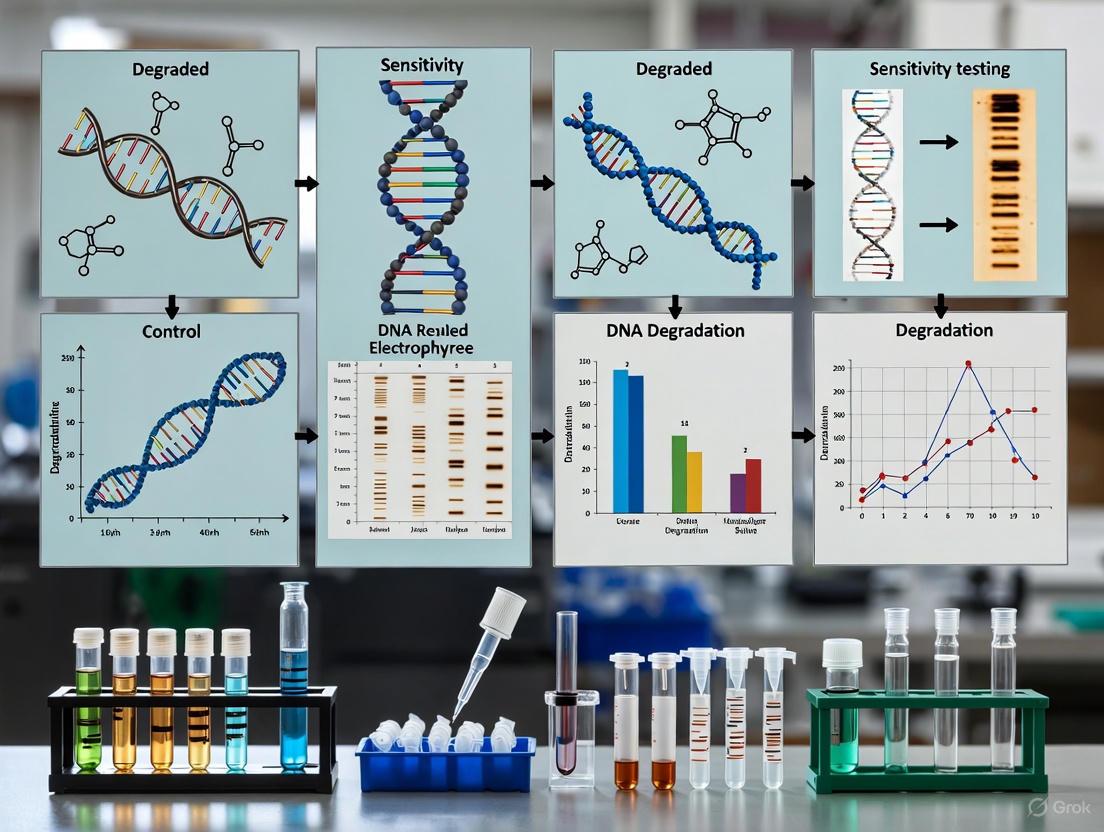
This article provides a comprehensive guide for researchers and scientists on navigating the challenges of sensitivity testing with degraded DNA in forensic panels.
Advanced Strategies for Sensitivity Testing of Degraded DNA in Forensic Panels
Abstract
This article provides a comprehensive guide for researchers and scientists on navigating the challenges of sensitivity testing with degraded DNA in forensic panels. It covers the foundational science of DNA degradation, explores established and emerging methodological approaches—from optimized Short Tandem Repeat (STR) analysis to dense Single Nucleotide Polymorphism (SNP) profiling and mass spectrometry. The content delivers practical troubleshooting protocols for sample purification and inhibition removal, and concludes with rigorous validation frameworks and comparative analyses of forensic techniques to ensure reliable, reproducible results in biomedical and clinical research.
Understanding DNA Degradation: Mechanisms, Challenges, and Impact on Forensic Assays
In forensic genetic applications, the integrity of DNA is paramount for successful analysis. Degraded DNA samples, frequently encountered in forensic casework, present significant challenges for profiling and interpretation due to the reduced size of DNA fragments, which can hamper the performance of genetic tests like Short Tandem Repeat (STR) analysis [1]. DNA degradation is a natural process that impacts the quality of genetic material, making it difficult to analyze or amplify. This occurs through several primary mechanisms: oxidation, hydrolysis, and enzymatic activity [2]. Understanding these pathways is crucial for developing effective strategies to minimize damage, preserve sample integrity, and validate forensic genotyping applications. Each mechanism contributes to DNA fragmentation, creating breaks in the sequence that interfere with polymerase chain reaction (PCR), sequencing, and other downstream forensic analyses [2]. Consequently, sample handling, preservation, and extraction techniques must be meticulously optimized to maintain DNA integrity for sensitivity testing in forensic panels.
Primary DNA Degradation Pathways
Oxidative DNA Damage
Oxidative damage is one of the most common causes of DNA degradation, particularly in samples exposed to environmental stressors. Reactive oxygen species (ROS), heat, and UV radiation modify nucleotide bases, leading to strand breaks and structural changes that interfere with replication and sequencing [2]. These modifications can cause mutations and stall polymerases during amplification. To mitigate oxidative damage, the use of antioxidants and proper storage conditions—such as freezing samples at -80°C or maintaining them in oxygen-free environments—is recommended [2]. In forensic contexts, exposure to environmental elements can exacerbate oxidative damage, making samples recalcitrant to standard analysis.
Hydrolytic DNA Damage
Hydrolysis involves the breakdown of DNA through the cleavage of chemical bonds by water molecules. This process can lead to depurination, where purine bases (adenine and guanine) are removed, resulting in abasic sites that can halt polymerase activity during amplification [2]. If extensive, hydrolytic damage fragments DNA into unusable pieces. Key strategies to reduce hydrolysis include using buffered solutions that maintain a stable pH and storing samples in dry or frozen conditions [2]. The susceptibility of DNA to hydrolysis is a critical consideration for the long-term storage of forensic samples.
Enzymatic DNA Degradation
Enzymatic breakdown, primarily driven by nucleases, represents a significant challenge in biological samples such as blood, tissue, or saliva. These enzymes are designed to degrade nucleic acids and can rapidly dismantle DNA if not properly inactivated during collection or initial processing [2]. Standard countermeasures include heat treatment during extraction, the use of chelating agents like EDTA to inhibit nuclease activity, and the application of nuclease inhibitors [2]. In forensic workflows, rapid inactivation of nucleases is essential to preserve the DNA template from moment of collection.
Table 1: Primary DNA Degradation Pathways and Their Characteristics
| Degradation Pathway | Primary Causes | Resultant DNA Lesions | Common Protective Measures |
|---|---|---|---|
| Oxidation | Reactive oxygen species (ROS), heat, UV radiation [2] | Base modifications, single and double-strand breaks [2] | Antioxidants, storage at -80°C, oxygen-free environments [2] |
| Hydrolysis | Water molecules, acidic or basic conditions [2] | Depurination (loss of A/G), abasic sites, deamination [2] | Buffered solutions, controlled pH, dry or frozen storage [2] |
| Enzymatic Breakdown | Endogenous and exogenous nucleases (DNases, RNases) [2] | Strand scission, fragmentation [2] | Heat treatment, chelating agents (EDTA), nuclease inhibitors [2] |
Protocols for Simulating and Analyzing DNA Degradation
Rapid UV-C Irradiation Protocol for Artificially Degrading DNA
This protocol describes a method to reproducibly generate degraded DNA in only five minutes using UV-C light irradiation, suitable for developmental evaluation and validation of new forensic markers and technologies [1].
- Principle: Ultraviolet radiation, particularly UV-C light, induces cyclobutane pyrimidine dimers and other photolesions in DNA, leading to strand breaks and fragmentation. This mimics the degradation state observed in biological samples exposed to environmental factors [1].
- Materials and Equipment:
- DNA extracted from blood (or other sources)
- UV-C light source (e.g., germicidal lamp, 254 nm)
- Microcentrifuge tubes
- Pipettes and tips
- Spectrophotometer or fluorometer for DNA quantification
- Procedure:
- Sample Preparation: Dilute the extracted DNA to different concentrations (e.g., 1 ng/μL, 10 ng/μL, 100 ng/μL) in low-EDTA TE buffer or nuclease-free water. Aliquot different volumes (e.g., 20 μL, 50 μL, 100 μL) into microcentrifuge tubes.
- UV-C Exposure: Place the open tubes containing DNA aliquots directly under the UV-C light source. Expose samples for varying durations (e.g., 1, 3, 5 minutes) at a fixed distance to create a gradient of degradation. A longer exposure time results in a higher degree of fragmentation.
- Post-Irradiation Handling: Close tubes and store at 4°C if used immediately, or -20°C for long-term storage.
- Assessment of Degradation:
- Quantitative Real-Time PCR (qPCR): Use a multiplex qPCR assay that targets both long and short DNA fragments. A decreasing large-to-small target ratio indicates successful degradation [1].
- Fragment Analyzer/Capillary Electrophoresis: Analyze the DNA to visualize the size distribution profile. Degraded samples will show a smear of low-molecular-weight fragments compared to a tight, high-molecular-weight band in intact DNA [1].
- STR Analysis: Amplify the degraded DNA using your standard forensic STR panel. Compare the profile to that of intact DNA; degraded samples typically show a progressive drop-in peak height with increasing amplicon size (peak height imbalance) and allele dropout [1].
Table 2: Key Research Reagent Solutions for DNA Degradation Studies
| Reagent/Equipment | Primary Function | Application Note |
|---|---|---|
| EDTA (Ethylenediaminetetraacetic acid) | Chelates magnesium ions, inhibiting nuclease activity (enzymatic breakdown) [2]. | Balance is critical; excess EDTA can inhibit downstream PCR [2]. |
| UV-C Light Source (254 nm) | Induces DNA strand breaks and pyrimidine dimers to create artificially degraded DNA for validation [1]. | Allows for reproducible generation of degradation patterns in minutes [1]. |
| Bead Ruptor Elite Homogenizer | Mechanical homogenization for efficient lysis of tough samples while minimizing DNA shearing [2]. | Precise control over speed and cycle duration preserves DNA integrity [2]. |
| Antioxidants (e.g., DTT) | Protects DNA from oxidative damage by neutralizing reactive oxygen species (ROS) [2]. | Useful in storage buffers for precious or low-copy-number samples. |
| Short Amplicon qPCR Assay | Quantifies and assesses the degree of DNA degradation by targeting amplicons of varying lengths [3]. | A decreased long/short amplicon ratio is a key indicator of degradation [1]. |
DNA Purification and Quality Control for Degraded Samples
Specialized DNA analysis techniques adapted from oligonucleotide workflows offer high-resolution solutions for analyzing degraded DNA [3].
- Reversed-Phase High Performance Liquid Chromatography (RP-HPLC): This technique is effective for purifying fragmented DNA, removing inhibitors, and separating degradation products from intact DNA. It is critical for maximizing recovery and minimizing interference in downstream forensic analysis [3].
- Liquid Chromatography-Mass Spectrometry (LC-MS): LC-MS reveals chemical modifications, sequence variations, and degradation patterns—even in harsh sample conditions. Optimization of ionization conditions improves detection sensitivity and confidence for trace forensic samples [3].
- Capillary Electrophoresis (CE): CE provides high-resolution separation of DNA fragments by size, which is ideal for the complex mixture of fragments in a degraded forensic sample. It is the standard method for assessing DNA fragment size distribution and for STR fragment analysis [3].
Data Presentation and Analysis in Degradation Studies
Effective presentation of quantitative data from degradation experiments, such as qPCR results and fragment size distributions, is essential for accurate communication in forensic science [4].
- Frequency Tables for Fragment Size Distribution: When analyzing fragment sizes via capillary electrophoresis, data should be organized into a frequency table with class intervals [4]. The class intervals (size bins) should be equal in size, and the number of intervals should typically be between 5 and 16 for clarity [5]. The table should include absolute frequencies (count of fragments in each bin) and relative frequencies (percentage of the total) [4].
- Histograms for Visualizing Size Distribution: A histogram is the appropriate graphical representation for the frequency distribution of DNA fragment sizes [6]. The horizontal axis is a number line representing fragment size (in base pairs), and the vertical axis represents the frequency (absolute or relative) of fragments in each size class. The bars are contiguous, touching each other without space, because the data (fragment size) is continuous [5].
Table 3: Simulated Data Table: DNA Fragment Size Distribution After UV-C Exposure
| Fragment Size Class (bp) | Absolute Frequency (0 min) | Absolute Frequency (3 min UV-C) | Absolute Frequency (5 min UV-C) | Relative Frequency % (5 min UV-C) |
|---|---|---|---|---|
| > 500 | 850 | 150 | 25 | 2.5% |
| 300 - 500 | 120 | 280 | 100 | 10.0% |
| 200 - 299 | 25 | 320 | 225 | 22.5% |
| 100 - 199 | 5 | 200 | 450 | 45.0% |
| < 100 | 0 | 50 | 200 | 20.0% |
| Total Yield (ng) | 1000 | 800 | 500 | - |
The analysis of degraded DNA remains a significant challenge in forensic genetics, impacting the success of human identification from compromised samples such as skeletal remains, aged evidence, and forensic casework. DNA degradation involves the fragmentation of DNA strands into shorter pieces through enzymatic, chemical, and environmental processes, which directly affects the amplification efficiency of forensic markers [7]. The extent of degradation determines the maximum achievable amplicon length, making marker selection critical for analytical success. This application note examines the differential impacts of degradation on Short Tandem Repeats (STRs) and Single Nucleotide Polymorphisms (SNPs), and outlines optimized protocols for their analysis within the context of sensitivity testing for forensic panels.
Technical Background: Degradation Mechanisms and Marker Selection
DNA Degradation Processes
Upon cell death, endogenous nucleases become activated and begin fragmenting the DNA backbone. This is followed by exogenous enzymatic attack from microorganisms and chemical processes including hydrolytic and oxidative damage [7]. Hydrolytic attacks cause depurination and base deamination, while oxidative damage leads to base modifications and strand breaks. Environmental factors—particularly temperature, humidity, UV radiation, and pH—significantly accelerate these processes, resulting in DNA fragments typically ranging from 100-500 base pairs [7]. The fragmentation pattern is non-random, with longer fragments being disproportionately affected.
Key Forensic Genetic Markers
Forensic genetics employs several marker types with distinct characteristics and degradation tolerance:
- Short Tandem Repeats (STRs): Highly polymorphic length-based polymorphisms (1-6 bp repeats) requiring longer intact DNA templates (typically 100-450 bp) for successful amplification [8].
- Single Nucleotide Polymorphisms (SNPs): Biallelic base substitutions distributed throughout the genome with minimal amplicon requirements (often <150 bp) [7].
- Microhaplotypes: Novel compound markers containing multiple closely linked SNPs within 200 bp, combining high polymorphism with minimal stutter artifacts [9].
Table 1: Comparative Characteristics of Forensic Genetic Markers
| Characteristic | STRs | SNPs | Microhaplotypes |
|---|---|---|---|
| Marker Type | Length polymorphism | Sequence polymorphism | Multi-SNP haplotype |
| Amplicon Size | 100-450 bp [8] | Typically <150 bp [7] | 60-150 bp [9] |
| Degradation Resistance | Low | High | High |
| Multiplex Capacity | Moderate (CE limited by dyes) | High (NGS/Microarrays) [8] | High |
| Stutter Artifacts | Present | Absent | Absent [9] |
| Mixture Deconvolution | Challenging | Moderate | Enhanced |
Figure 1: Impact of DNA Degradation on Forensic Marker Analysis. Environmental factors accelerate DNA fragmentation, disproportionately affecting STR analysis due to longer amplicon requirements compared to SNP and microhaplotype markers.
Experimental Approaches for Degraded DNA Analysis
Quantitative Assessment of DNA Degradation
Accurate quantification of DNA quality and quantity is essential before STR amplification. Traditional real-time quantitative PCR (qPCR) methods often fail with highly degraded samples where fragments are <150 bp [10]. A novel triplex droplet digital PCR (ddPCR) system has been developed to precisely quantify DNA degradation by targeting three autosomal conserved regions of 75 bp, 145 bp, and 235 bp fragment sizes [10]. This approach introduces a Degradation Rate (DR) indicator that combines absolute quantification of copy numbers for DNA fragments of varying sizes, enabling comprehensive evaluation of degradation severity.
Table 2: Performance Characteristics of Degradation Assessment Methods
| Method | Principle | Effective Range | Limitations | Advantages |
|---|---|---|---|---|
| Agarose Gel Electrophoresis | Visual fragment size distribution | High DNA concentrations [10] | Low precision, qualitative | Simple, inexpensive |
| qPCR with Degradation Index | Ratio of long:short amplicons | Mild-moderate degradation [10] | Fails with severe degradation (<150 bp) | Quantitative, established workflow |
| Triplex ddPCR System | Absolute quantification of 75/145/235 bp targets | All degradation levels [10] | Requires specialized equipment | High precision, inhibitor tolerant, absolute quantification |
Protocol: Triplex ddPCR Degradation Assessment
Principle: Simultaneous quantification of three target lengths (75 bp, 145 bp, 235 bp) using a ddPCR system to determine fragment length distribution and degradation rate [10].
Materials:
- QX200 Droplet Digital PCR System (Bio-Rad)
- Triplex ddPCR assay (75 bp, 145 bp, 235 bp targets)
- HiPure Universal DNA Kit (Magen Biotechnology)
- Degraded DNA samples (formalin-fixed paraffin-embedded tissues, aged blood samples)
Procedure:
- DNA Extraction: Extract DNA using HiPure Universal DNA Kit according to manufacturer's protocols.
- Reaction Setup:
- Prepare 20 μL reaction mixture containing:
- 10 μL of 2× ddPCR Supermix
- 1 μL of triplex primer-probe mix (optimized concentrations)
- 5 μL of template DNA
- 4 μL of nuclease-free water
- Include no-template controls for contamination assessment.
- Prepare 20 μL reaction mixture containing:
- Droplet Generation:
- Transfer 20 μL reaction mixture to DG8 cartridge.
- Add 70 μL of droplet generation oil.
- Place in QX200 Droplet Generator.
- PCR Amplification:
- Transfer emulsified samples to 96-well plate.
- Seal plate and run PCR with optimized thermal cycling conditions:
- 95°C for 10 min (initial denaturation)
- 40 cycles of: 94°C for 30 s, 60°C for 60 s
- 98°C for 10 min (enzyme deactivation)
- 4°C hold
- Droplet Reading and Analysis:
- Place plate in QX200 Droplet Reader.
- Analyze using QuantaSoft software to determine target copy numbers.
- Calculate Degradation Rate (DR) using the formula:
Interpretation: Lower DR values indicate more severe degradation, with negative values suggesting preferential loss of longer fragments.
Protocol: SNP-Based Analysis of Degraded DNA Using Microhaplotypes
Principle: Microhaplotypes (SNP-SNP markers) enable analysis of highly degraded DNA through short amplicons (60-150 bp) and absence of stutter artifacts, making them ideal for unbalanced degraded mixtures [9].
Materials:
- Amplification Refractory Mutation System (ARMS) PCR primers
- SNaPshot Multiplex Kit (Thermo Fisher Scientific)
- ABI 3500 Genetic Analyzer (Applied Biosystems)
- 15 SNP-SNP marker panel [9]
Procedure:
- ARMS-PCR Amplification:
- Design allele-specific primers for each SNP-SNP marker with amplicons <150 bp.
- Prepare 10 μL reaction mixture containing:
- 1× PCR buffer
- 2.5 mM MgCl₂
- 200 μM dNTPs
- 0.5 U DNA polymerase
- 1 μL template DNA (0.025-0.05 ng for sensitivity testing)
- Primer mix (optimized concentrations)
- Thermal cycling:
- 95°C for 5 min
- 32 cycles of: 95°C for 30 s, optimized annealing temperature for 30 s, 72°C for 30 s
- 72°C for 7 min
- SNaPshot Multiplex Reaction:
- Purify PCR products with shrimp alkaline phosphatase (SAP) and exonuclease I (Exo I)
- Prepare SNaPshot reaction:
- 3 μL purified PCR product
- 2 μL SNaPshot Multiplex Ready Reaction Mix
- 1 μL primer mix (0.5-1.0 μM each)
- Thermal cycling:
- 25 cycles of: 96°C for 10 s, 50°C for 5 s, 60°C for 30 s
- Capillary Electrophoresis:
- Purify SNaPshot products with SAP
- Mix 1 μL purified product with 8.7 μL Hi-Di formamide and 0.3 μL GeneScan-120 LIZ size standard
- Denature at 95°C for 5 min, snap-cool on ice
- Analyze on ABI 3500 Genetic Analyzer using POP-7 polymer
- Analyze data with GeneMapper ID-X v1.2 software
Validation: Test sensitivity with dilution series (1:1 to 1:1000 mixtures) and artificially degraded DNA (heat treatment at 98°C for 35-45 min) [9].
Figure 2: Decision Workflow for Analysis of Degraded Forensic Samples. The analytical pathway is determined by DNA quality assessment, with SNP-based methods preferred for severely degraded samples.
Advanced Applications and Emerging Technologies
Next-Generation Sequencing for Degraded DNA
Massively Parallel Sequencing (MPS) technologies enable simultaneous analysis of multiple marker types (STRs, SNPs, microhaplotypes) from degraded samples by leveraging short amplicon designs [11] [8]. MPS provides enhanced mixture deconvolution through linked SNP analysis and enables parallel investigation of biogeographical ancestry, phenotypic traits, and identity from minimal DNA [11]. For severely compromised samples, whole genome sequencing using ancient DNA (aDNA) techniques—originally developed for archaeological specimens—can recover genetic information from fragments as short as 50-70 bp [11].
Genetic Record-Matching Between SNP and STR Profiles
When degradation prevents STR profiling, genetic record-matching enables comparison between SNP profiles from degraded samples and existing STR databases [12]. This approach leverages linkage disequilibrium between STRs and neighboring SNPs to establish matches despite non-overlapping markers. The method shows promise even with low-coverage genome data (5-10% coverage), significantly expanding investigative possibilities for cold cases and unidentified remains [12].
The Scientist's Toolkit: Essential Research Reagents
Table 3: Essential Research Reagents for Degraded DNA Analysis
| Reagent/Kit | Application | Key Features | Reference |
|---|---|---|---|
| HiPure Universal DNA Kit | DNA extraction from challenging samples | Optimized for degraded samples, inhibitor removal | [10] |
| QX200 Droplet Digital PCR System | Absolute quantification of degraded DNA | High precision, tolerant to PCR inhibitors | [10] |
| PowerPlex 35GY System | STR analysis with mini-STRs | Includes 15 mini-STRs (<250 bp) for degraded DNA | [8] |
| SNaPshot Multiplex Kit | SNP/microhaplotype multiplexing | CE-based, minimal amplicon requirements | [9] |
| MagMAX cfDNA Isolation Kit | Cell-free DNA extraction | Optimized for short fragments (e.g., cffDNA) | [9] |
| GlobalFiler PCR Amplification Kit | Conventional STR analysis | 21+ markers, requires high DNA quality | [8] |
DNA degradation presents significant challenges for traditional STR analysis due to the preferential amplification of shorter fragments in compromised samples. SNPs and microhaplotypes offer superior performance with degraded DNA through their minimal amplicon requirements and absence of stutter artifacts. The triplex ddPCR system provides a precise method for quantifying degradation severity and predicting STR amplification success. For forensic laboratories handling challenging samples, implementing a tiered approach—beginning with DNA quality assessment, followed by marker selection appropriate for the degradation level—maximizes the likelihood of obtaining usable genetic profiles. Emerging technologies including MPS and genetic record-matching further expand the possibilities for extracting investigative leads from even the most severely degraded forensic evidence.
Deoxyribonucleic acid (DNA) is a fundamental molecule in forensic science, providing unique genetic information that enables the identification of individuals from biological evidence [13]. However, the integrity of DNA is often compromised between the time of deposition at a crime scene and its analysis in the laboratory. DNA degradation is a dynamic process that fragments the DNA molecule into progressively smaller pieces, presenting significant challenges for forensic genetic analysis [13] [7]. Despite these challenges, advanced extraction and analytical methods now enable the study of poorly preserved and degraded DNA, making it a potent tool in forensic investigations [13] [7].
Understanding the sources, types, and degradation mechanisms of forensic samples is crucial for selecting appropriate analytical strategies. This knowledge forms the essential context for sensitivity testing of forensic DNA panels, as the performance of genetic markers is directly influenced by the preservation state of the DNA template [7]. The extent of DNA preservation in biological evidence depends on numerous factors, with environmental variables being among the most influential [7]. This article provides a comprehensive overview of degraded forensic samples, from cold cases to ancient DNA, and presents detailed protocols for their analysis within the framework of sensitivity testing for forensic DNA panels.
Mechanisms and Impact of DNA Degradation
Biochemical Mechanisms of DNA Degradation
Upon an organism's death, or when biological material is separated from its source, enzymatic DNA repair mechanisms cease, exposing the genome to destructive factors [7]. The degradation process occurs through several biochemical mechanisms:
- Hydrolytic damage: Water molecules attack the DNA, leading to depurination (loss of nitrogenous bases) and deamination of cytosine to uracil [7]. These lesions can cause strand breaks and miscoding during polymerase chain reaction (PCR) amplification.
- Oxidative damage: Free radicals and reactive oxygen species cause base modifications, sugar alterations, and strand breaks [13] [7].
- Enzymatic cleavage: Endogenous nucleases become activated and begin cleaving the DNA backbone, followed by exogenous enzymatic attack from microbes that colonize decomposing remains [7].
- UV radiation: Exposure to ultraviolet light induces the formation of cyclobutane pyrimidine dimers between neighboring pyrimidines, which distort the DNA helix and block polymerase activity [14] [7].
The most visible outcome of these processes is fragmentation, where long, continuous DNA strands are cleaved into shorter pieces, typically ranging from 50 to 500 base pairs [7]. This fragmentation directly impacts the success of subsequent genetic analysis, as the reduced size of DNA fragments may hamper the performance of standard genetic tests [14].
Impact on Genetic Analysis
The effectiveness of forensic DNA profiling, particularly short tandem repeat (STR) analysis, depends on how well the DNA in the biological sample has been preserved [7]. STR markers typically display fragment sizes between 100 to 450 base pairs, and their successful analysis primarily depends on the availability of intact target molecules within that size range [14]. With increasing degradation of nuclear DNA, STR profiles become incomplete due to preferential amplification of shorter fragments, resulting in loss of discriminatory power [14] [7].
Table 1: Impact of DNA Degradation on Genetic Markers
| Genetic Marker | Typical Amplicon Size | Impact of Degradation | Suitable for Degraded DNA? |
|---|---|---|---|
| Standard STRs | 100-450 bp [14] | Significant dropout of larger loci [7] | Limited |
| Mini-STRs | <100-150 bp | Reduced dropout compared to standard STRs | Yes [15] |
| Autosomal SNPs | 50-150 bp [7] | Minimal impact due to short length | Yes [7] [16] |
| Mitochondrial DNA | Variable (can target <50 bp) [14] | Minimal impact due to high copy number and circular structure | Yes [7] |
| Identity SNPs | ~100 bp [16] | Minimal impact with optimized panels | Yes [16] |
Forensic scientists encounter degraded DNA across diverse sample types, each with characteristic preservation challenges and degradation patterns. Understanding these sources is crucial for selecting appropriate analytical approaches.
Sample Typology and Degradation Characteristics
Table 2: Forensic Sample Types and Their Degradation Characteristics
| Sample Type | Common Sources | Degradation Factors | Typical DNA Fragment Size | Recommended Analysis Methods |
|---|---|---|---|---|
| Skeletal Remains | Cold cases, mass disasters, ancient DNA [7] | Environmental exposure, microbial activity, time [7] | 50-200 bp [7] | NGS, mtDNA, targeted SNPs [7] |
| Formalin-Fixed Paraffin-Embedded (FFPE) Tissues | Medical archives, pathological specimens [7] | Protein-DNA crosslinking, nucleic acid fragmentation [7] | <100-300 bp [17] | Specialized extraction, RC-PCR [16] |
| Touch DNA | Crime scene evidence [16] | Low quantity, environmental exposure, inhibitor presence [16] | Variable (often fragmented) [16] | Enhanced amplification, mini-STRs [15] |
| Ancient DNA | Archaeological specimens, historical remains [13] | Extreme age, hydrolytic damage, oxidative damage [7] | 30-100 bp [7] | NGS, specialized authentication [13] |
| Burned/Charred Remains | Arson cases, fire scenes [13] | Thermal degradation, oxidation [13] | Highly fragmented (<100 bp) [13] | Mini-STRs, SNPs, mtDNA [7] |
| Hair Shafts | Crime scene evidence, missing persons cases [18] | Keratinization, low nuclear DNA content | Primarily mtDNA [7] | mtDNA sequencing, NGS [7] |
Environmental Factors Influencing DNA Degradation
The preservation of DNA postmortem is determined by a complex interplay of environmental conditions that collectively influence degradation rates [7]:
Temperature: Considered the most influential factor, temperature controls the kinetic energy of all atoms and molecules, dictating the rate of every chemical reaction, including hydrolysis and oxidation [7]. A 10°C rise can double or triple the rate of destructive chemical processes [7]. Constant cold environments like permafrost show exceptional DNA preservation, while high heat conditions accelerate degradation [7].
Humidity and Water Activity: Moisture acts as both a necessary reactant in hydrolysis and a prerequisite for microbial life [7]. Environments with high water activity are extremely detrimental to DNA preservation.
Ultraviolet Radiation: UV exposure, particularly UV-C light at 254 nm, causes photochemical changes in DNA, including cyclobutane pyrimidine dimers and 6-4-photoproducts [14]. These lesions reduce the amount of intact, amplifiable DNA available for PCR-based genetic analysis [14].
pH: Highly acidic or alkaline conditions catalyze chemical degradation, while neutral to slightly alkaline pH is generally most favorable for preservation [7]. Soil pH profoundly affects preservation, with decomposition proceeding up to three times faster in acidic soils compared to alkaline counterparts [7].
Microbial Activity: Microorganisms colonize decomposing remains and biological traces, releasing nucleases that further fragment genetic material [7]. Microbial activity is heavily influenced by temperature, moisture, and oxygen availability.
Time: The duration of exposure to environmental conditions is a critical variable, with prolonged intervals generally leading to accelerated and more comprehensive degradation [7].
Experimental Protocols for Degraded DNA Analysis
Artificial DNA Degradation Protocol
For sensitivity testing of forensic DNA panels, generating artificially degraded DNA with predictable fragment sizes is essential for method validation and optimization [14]. The following protocol uses UV-C irradiation to produce controlled DNA degradation.
Protocol Title: Rapid, Reproducible Generation of Artificially Degraded DNA Using UV-C Irradiation [14]
Principle: UV-C light at 254 nm induces photochemical changes in DNA, including cyclobutane pyrimidine dimers and 6-4-photoproducts, leading to predictable fragmentation patterns suitable for mimicking naturally degraded forensic samples [14].
Materials and Equipment:
- DNA extracts (1 ng/μL, 7 ng/μL, 14 ng/μL concentrations)
- UV-C irradiation unit equipped with three 30 W G13 germicidal lamps (main spectral line at 254 nm)
- 0.6 mL microtubes (Axygen, Corning Life Sciences)
- Real-time quantitative PCR system (e.g., QuantStudio 5)
- SD quants real-time PCR assay [14]
- STR typing kit (e.g., AmpFLSTR NGM SElect PCR Amplification Kit)
Procedure:
- Sample Preparation: Extract DNA from whole blood using standardized methods (e.g., QIAamp DNA Blood Maxi Kit). Quantify DNA via real-time quantitative PCR targeting both nuclear and mitochondrial DNA regions (69 bp and 143 bp) [14].
- Dilution and Aliquoting: Dilute DNA with low TE buffer (10 mM Tris, 0.1 mM EDTA, pH 8) to prepare stock solutions of 1 ng/μL, 7 ng/μL, and 14 ng/μL. Prepare aliquots of 10 μL or 20 μL in 0.6 mL microtubes [14].
- UV-C Exposure: Place sample aliquots in microtubes laid on their side on the laboratory bench under the UV-C light source at a distance of approximately 11 cm from the lamps. Expose aliquots to UV-C radiation for timed intervals (0-5 minutes), removing replicates at 30-second intervals [14].
- Post-Irradiation Analysis: Quantify degraded DNA aliquots using SD quants on a real-time PCR system. Analyze by STR typing on a genetic analyzer. Calculate degradation index (DI) by dividing DNA quantity of long target (mt143bp) by that of short target size (mt69bp) [14].
Quality Control: Include non-irradiated controls in each experiment. Monitor degradation pattern reproducibility across technical replicates. Validate fragmentation patterns using capillary electrophoresis.
Analysis of Degraded DNA Using Modified PCR Methods
For analyzing highly degraded DNA samples where conventional STR typing fails, alternative approaches targeting shorter fragments are necessary.
Protocol Title: Reverse Complement PCR (RC-PCR) for Analysis of Highly Degraded DNA [16]
Principle: RC-PCR is a novel target enrichment and library preparation method for next generation sequencing that uses two reverse-complement, target-specific primer probes and a universal primer to generate target-specific index primers capable of multiplex amplification of target regions [16].
Materials and Equipment:
- RC-PCR 85-plex SNP panel (e.g., IDseek SNP85 panel)
- Reverse complement PCR reagents
- Next generation sequencing platform
- DNA quantification system (e.g., qPCR)
- Fragmented DNA samples (50-100 bp fragment size)
Procedure:
- DNA Quantification: Quantify input DNA using sensitive qPCR methods. For highly degraded samples, use assays targeting short fragments (50-100 bp) to accurately assess amplifiable DNA content [16].
- RC-PCR Reaction Setup: Set up reactions according to manufacturer specifications. The closed-tube system combines target enrichment and indexing in a single reaction, reducing handling steps and contamination risk [16].
- Library Preparation: The RC-PCR method automatically generates sequencing-ready libraries through the hybridization and extension processes.
- Sequencing and Analysis: Perform sequencing on appropriate NGS platform. Analyze data using specialized software to call SNP genotypes.
Performance Characteristics: Preliminary tests of the RC-PCR 85-plex demonstrate sensitivity with 78% of SNP loci recovered at 31 pg input DNA and over 99% recovery at 62 pg input. Allele dropout rates of 6-8% have been observed at low DNA inputs [16].
The Scientist's Toolkit: Essential Reagents and Materials
Table 3: Essential Research Reagents for Degraded DNA Analysis
| Reagent/Material | Function | Application Notes | References |
|---|---|---|---|
| UV-C Irradiation Unit | Artificial degradation of DNA for validation studies | Custom-built unit with three 30 W G13 germicidal lamps (254 nm) at ~11 cm distance | [14] |
| SD Quants Real-Time PCR Assay | DNA quantification and degradation assessment | Targets one nuclear and two differently sized mtDNA regions (69 bp and 143 bp) | [14] |
| Reverse Complement PCR (RC-PCR) Kit | Target enrichment and library preparation for degraded DNA | Enables analysis of DNA fragmented to 50-100 bp; 85-plex SNP panel available | [16] |
| Magnetic Bead-Based Extraction Kits | DNA extraction from challenging samples | Effective for bone, teeth, and formalin-fixed tissues; enables inhibitor removal | [7] [17] |
| Next-Generation Sequencing Kits | Comprehensive analysis of fragmented DNA | ForenSeq DNA Signature Prep Kit includes STRs, SNPs; suitable for degraded samples | [15] |
| Mini-STR Amplification Kits | STR analysis of degraded DNA | Shorter amplicons (typically <200 bp) reduce dropout in degraded samples | [15] |
| Quantifiler Trio DNA Quantification Kit | DNA quantification and degradation assessment | Simultaneously targets long and short genomic targets to calculate degradation index | [15] |
The analysis of degraded DNA samples presents significant challenges in forensic genetics, but ongoing technological advancements continue to expand the limits of what is possible. Understanding the sources, types, and degradation mechanisms of forensic samples provides the essential foundation for developing and validating sensitive DNA analysis panels. The protocols and methodologies described herein, from artificial degradation models to advanced amplification techniques, offer forensic researchers comprehensive tools for sensitivity testing of forensic DNA panels. As the field evolves with emerging technologies like NGS, microfluidic platforms, and advanced bioinformatics, the ability to extract meaningful genetic information from even the most compromised samples will continue to improve, enhancing the power of forensic science to deliver justice in increasingly challenging cases.
In forensic genetic casework, the analysis of compromised deoxyribonucleic acid (DNA) from challenging samples—such as ancient bones, formalin-fixed tissues, or environmentally exposed crime scene evidence—is a routine challenge. DNA degradation is a dynamic process that progressively fragments the DNA molecule, directly impacting the analytical sensitivity of forensic DNA panels and the reliability of generated profiles [13]. Defining sensitivity benchmarks for these compromised samples is therefore not merely an academic exercise but a fundamental laboratory requirement. It ensures that the data presented in court are both scientifically robust and reproducible, forming the core of a reliable forensic service. This document outlines standardized protocols and metrics for establishing laboratory-specific sensitivity thresholds for degraded DNA samples, framed within the broader context of validation requirements for forensic DNA testing laboratories [19] [20].
The integrity of DNA is compromised by factors including hydrolysis, oxidation, and ultraviolet radiation, which break the sugar-phosphate backbone and nitrogenous base bonds [13]. This fragmentation process results in a reduction of amplifiable template, particularly affecting larger polymerase chain reaction (PCR) amplicons. Consequently, establishing sensitivity benchmarks requires quantifying not just the amount of human DNA present, but also its quality. These benchmarks are critical for making informed decisions during the analytical process, such as selecting the most appropriate short tandem repeat (STR) amplification kit or interpreting partial DNA profiles with confidence [21].
Quantitative Assessment of DNA Degradation
The precise determination of human DNA concentration and integrity is a critical first step in the analytical workflow. Modern forensic quantitative PCR (qPCR) assays enable simultaneous quantification of total human DNA, determination of the presence of male DNA, assessment of PCR inhibitors, and, crucially, evaluation of the DNA degradation status [21].
The Principle of Differential Quantification
DNA degradation is quantitatively assessed using multi-target qPCR assays. These assays target genomic regions of differing lengths; in a pristine DNA sample, the concentration ratio between these targets is approximately 1:1. However, in a degraded sample, the longer target is more susceptible to fragmentation, leading to a reduced apparent concentration compared to the shorter target [21]. The ratio between the concentrations of the small and large targets provides a Degradation Index (DI), a quantitative measure of DNA fragmentation.
- PowerQuant System (Promega): This system uses an 84 bp (Auto) target and a 294 bp (D) target, both autosomal, to calculate an [Auto]/[D] ratio [21].
- Plexor HY System (Promega): A study demonstrated that the ratio between the estimated concentrations of a 99 bp autosomal target and a 133 bp Y-chromosomal target ([Auto]/[Y]) can serve as a proxy for degradation in male samples. This ratio showed a statistically significant inverse correlation (R = -0.65, p < 0.001) with STR profile quality scores [21].
- Quantifiler Trio (Thermo Fisher Scientific): This and other similar kits operate on the same fundamental principle of differential amplification efficiency based on template length.
Key Quantitative Metrics and Correlations
The quantitative data derived from qPCR is used to establish key sensitivity benchmarks. The following table summarizes the core metrics and their implications for downstream STR analysis.
Table 1: Key Quantitative Metrics for Assessing Degraded DNA
| Metric | Typical Calculation | Interpretation | Correlation with STR Data |
|---|---|---|---|
| Human DNA Concentration | ng/μL (from small target, e.g., 84 bp) | The effective quantity of amplifiable DNA; used for normalizing input into STR amplification. | Directly impacts peak heights; low concentration (<0.1 ng/μL) increases stochastic effects [21]. |
| Degradation Index (DI) | [Small Target]/[Large Target] (e.g., [Auto]/[D]) | A ratio >1 indicates degradation; higher values signify greater fragmentation. | Statistically significant inverse correlation with profile quality scores (e.g., average peak height) [21]. |
| Male DNA Concentration | ng/μL (Y-chromosomal target, e.g., 133 bp) | Quantity of male DNA in a sample; critical for analyzing mixtures. | In degraded male samples, the [Auto]/[Y] ratio increases as the longer Y-target fails to amplify efficiently [21]. |
| Inhibition Indicator | Cycle threshold (CT) shift of Internal PCR Control (IPC) | A CT shift ≥2 cycles (or ≥0.3 Cq) indicates presence of PCR inhibitors. | Can cause peak height imbalance, locus-to-locus drop-out, or complete amplification failure [21]. |
Experimental Protocol for Establishing Sensitivity Benchmarks
This protocol provides a detailed methodology for conducting a degradation sensitivity study, a critical component of the validation process for implementing a new forensic DNA testing method [20].
Sample Preparation and Artificial Degradation
Objective: To create a calibrated series of degraded DNA samples for testing. Materials:
- Commercially available human genomic DNA (e.g., from cell lines).
- DNase I (e.g., from Qiagen or Thermo Fisher Scientific).
- DNase I reaction buffer.
- Thermonixer or water bath.
- EDTA for reaction termination.
Procedure:
- Dilution: Dilute the human genomic DNA to a working concentration of 50 ng/μL in nuclease-free water or TE buffer.
- Degradation Series Setup: Set up a series of 0.5 mL microcentrifuge tubes. To each tube, add 1 μg (20 μL of 50 ng/μL) of DNA and the appropriate volume of 10X DNase I buffer.
- Enzymatic Digestion: Add varying amounts of DNase I (e.g., 0, 0.5, 1, 2, 4 mU) to each tube. Adjust the final volume to 50 μL with nuclease-free water.
- Incubation: Incubate the reactions at 25°C for 10 minutes. To control the degree of degradation, use a gradient of incubation times (e.g., 5, 10, 20 minutes) with a fixed enzyme concentration.
- Reaction Termination: Stop the digestion by adding 5 μL of 50 mM EDTA to each tube and heating at 65°C for 10 minutes.
- Purification (Optional): Purify the degraded DNA using a commercial clean-up kit (e.g., QIAamp DNA Mini Kit) to remove enzymes and salts. Elute in a final volume of 50 μL.
- Verification: Verify the success of the degradation by running an aliquot (e.g., 50 ng) of each sample on a 1.5% agarose gel. A successful degradation series will show a progressive smearing of DNA from high to low molecular weight.
qPCR Quantification and STR Profiling
Objective: To correlate quantitative DNA metrics with STR profiling success. Materials:
- PowerQuant or Quantifiler Trio qPCR kit.
- Real-Time PCR instrument (e.g., CFX96 Touch, 7500 Real-Time PCR System).
- STR amplification kit (e.g., GlobalFiler, Identifier).
- Genetic Analyzer for capillary electrophoresis.
Procedure:
- Quantification: Quantify all samples in the degradation series, including the non-degraded control, in duplicate using the selected qPCR kit according to the manufacturer's instructions [21].
- Data Analysis: Calculate the Human DNA Concentration (from small target), Degradation Index ([Auto]/[D] or equivalent), and assess inhibition for each sample.
- STR Amplification: Normalize all samples to the same input concentration (e.g., 0.5 ng based on the small target concentration) for STR amplification. Perform PCR amplification following the kit's standard protocol.
- Capillary Electrophoresis: Analyze the PCR products on a genetic analyzer according to established laboratory protocols.
- STR Data Analysis: Generate STR profiles and record key quality metrics, including:
- Average Peak Height (RFU)
- Profile Completeness (% of alleles called)
- Heterozygote Peak Height Ratio
- Intra-locus Peak Height Balance
Data Analysis and Benchmark Definition
Objective: To define laboratory-specific sensitivity thresholds for degraded DNA. Procedure:
- Correlation Analysis: Plot the Degradation Index (DI) against STR profile quality metrics (e.g., Average Peak Height, Profile Completeness). Perform linear or non-linear regression analysis to determine the correlation coefficient (R value), as demonstrated in studies showing an inverse correlation (R = -0.65) between [Auto]/[Y] and quality score [21].
- Threshold Establishment: Define the maximum acceptable DI value for obtaining a "usable" or "interpretable" profile based on your laboratory's internal data interpretation guidelines. For instance, a laboratory may set a benchmark that a DI ≤ 5 is required to achieve a profile with ≥70% completeness and average peak heights ≥200 RFU.
- Decision Matrix: Develop a standard operating procedure based on the established benchmarks. The workflow below outlines a logical decision process for analyzing a casework sample based on qPCR data.
The Scientist's Toolkit: Research Reagent Solutions
Successful analysis of compromised DNA requires a suite of specialized reagents and kits. The following table details essential materials and their functions in the workflow.
Table 2: Essential Research Reagents for Degraded DNA Analysis
| Reagent / Kit | Primary Function | Key Features for Degraded DNA |
|---|---|---|
| PowerQuant System (Promega) | Simultaneous DNA quantification, degradation, and inhibition assessment. | Contains an 84 bp (small autosomal) and a 294 bp (large autosomal) target for calculating a Degradation Index ([Auto]/[D]) [21]. |
| Quantifiler Trio (Thermo Fisher) | Simultaneous DNA quantification, degradation, and inhibition assessment. | Provides a multi-copy target for human DNA quantification and a synthetic IPC for robust inhibition detection. |
| QIAamp DNA FFPE Tissue Kit (Qiagen) | DNA extraction from formalin-fixed, paraffin-embedded (FFPE) tissues. | Specialized buffers reverse formalin-induced crosslinks, maximizing recovery of fragmented DNA [21]. |
| DNase I (RQ1 RNase-Free DNase, Promega) | Enzymatic digestion of DNA for creating controlled degradation. | Used in validation studies to artificially degrade high-quality DNA for establishing sensitivity thresholds (see Protocol 3.1). |
| Mini-STR Amplification Kits | PCR amplification of highly degraded DNA. | Amplify shorter STR amplicons (<200 bp) to overcome the drop-out of larger loci in degraded samples [13]. |
| Next-Generation Sequencing (NGS) Systems | Massively parallel sequencing of DNA fragments. | Enables sequencing of ultra-short amplicons, providing data from severely degraded samples where CE methods fail [13]. |
Implementation and Compliance
Integrating these sensitivity benchmarks into laboratory practice is mandated by quality assurance standards. The FBI's Quality Assurance Standards (QAS) for Forensic DNA Testing Laboratories, which take effect on July 1, 2025, require laboratories to define and validate the performance characteristics of their methodologies [19]. The data generated from the protocols described herein directly fulfill the validation requirements outlined in Section 8 of these standards, providing objective evidence of a method's reliability with compromised samples [20]. Furthermore, the Scientific Working Group on DNA Analysis Methods (SWGDAM) revised validation guidelines recommend examining at least 50 samples as part of a comprehensive validation study, a sample size that can be effectively achieved using the artificial degradation series described [20].
Laboratories must document all validation data, including the established sensitivity benchmarks and decision matrices, in their standard operating procedures. This documentation is critical for demonstrating technical competency during audits and for ensuring the admissibility of DNA evidence in legal proceedings. The workflow for analyzing a casework sample, once validated, provides a defensible and standardized approach for handling the complex samples frequently encountered in forensic casework.
Methodological Arsenal: Techniques for Profiling and Sequencing Degraded DNA
Optimizing Short Tandem Repeat (STR) Analysis for Fragmented DNA
In forensic genetics, the analysis of degraded DNA remains a significant challenge, often compromising the effectiveness of conventional Short Tandem Repeat (STR) typing. DNA degradation initiates immediately after an organism's death, driven by enzymatic breakdown, hydrolytic processes, and oxidative damage [7]. These processes fragment the DNA molecule into progressively shorter pieces, directly impacting the success of PCR-based methods that require intact template DNA for amplification of longer target sequences [7]. Environmental factors such as temperature, humidity, ultraviolet radiation, pH, and microbial activity significantly influence the rate and extent of DNA degradation [7]. When DNA becomes fragmented, the maximum achievable amplicon length through polymerase chain reaction (PCR) is inherently limited, leading to allele dropout, incomplete profiles, and reduced overall success of STR analysis [7] [22].
The limitations of traditional STR analysis have prompted the development of optimized methodologies for recovering genetic information from compromised samples. This document outlines advanced protocols and application notes for optimizing STR analysis specifically for fragmented DNA, providing forensic researchers and scientists with structured approaches to overcome these challenges. The strategies discussed here include procedural refinements from extraction through interpretation, the implementation of alternative genetic markers, and the adoption of novel sequencing technologies that collectively enhance the recovery of informative data from degraded forensic specimens.
Methodological Approaches for Degraded DNA Analysis
Strategic Framework for Fragment Analysis
Optimizing STR analysis for degraded DNA requires a comprehensive strategy that addresses each stage of the forensic workflow. The fundamental principle involves targeting shorter DNA fragments that are more likely to persist in compromised samples [7]. This can be achieved through multiple complementary approaches:
- Reduced Amplicon Size Strategies: Implementing mini-STR primers that target smaller regions flanking the standard STR loci increases the probability of amplifying degraded templates [7] [22].
- Enhanced Sensitivity Protocols: Modifying amplification conditions, such as increasing cycle numbers or adjusting reaction components, can improve signal recovery from low-template DNA [23].
- Advanced Sequencing Technologies: Utilizing next-generation sequencing (NGS) enables simultaneous analysis of multiple marker types (STRs, SNPs) with shorter amplicon requirements, providing a more comprehensive genetic profile from degraded samples [11] [24].
The following table summarizes the primary genetic markers used in forensic analysis and their comparative performance with degraded DNA:
Table 1: Comparison of Forensic Genetic Markers for Degraded DNA Analysis
| Marker Type | Average Amplicon Size | Degraded DNA Performance | Primary Advantages | Key Limitations |
|---|---|---|---|---|
| Standard STRs | 200-500 bp | Poor for heavily degraded samples | High discrimination power, standardized databases | Large amplicon size susceptible to dropout |
| miniSTRs | 70-250 bp | Good | Maintains STR discrimination with smaller targets | Requires separate amplification systems |
| iiSNPs | <150 bp | Excellent | Very short amplicons, suitable for highly degraded DNA | Biallelic nature requires more loci for discrimination |
| X-STRs | Varies (NGS provides sequence data) | Good with NGS | Specialized kinship applications, sequence polymorphism | More complex interpretation, population data limited |
| mtDNA | Variable (can target hypervariable regions) | Excellent | High copy number per cell, more persistent | Maternal inheritance only, lower discrimination power |
DNA Extraction and Quantitation Optimization
Effective recovery of degraded DNA begins with optimized extraction protocols specifically designed for compromised samples. The Organic Extraction method and QIAcube/EZ1 systems have demonstrated particular efficacy for challenging forensic samples [25]. For skeletal remains, specialized bone DNA extraction protocols incorporate extended digestion times and demineralization steps to recover DNA from the mineral matrix [25] [2]. A critical consideration is balancing effective sample disruption with DNA preservation, as overly aggressive mechanical processing can cause excessive shearing and further degrade already fragmented DNA [2].
For formalin-fixed paraffin-embedded (FFPE) tissues, which present unique challenges due to formalin-induced fragmentation and cross-linking, specialized kits like the Maxwell RSC Xcelerate DNA FFPE Kit have shown improved DNA recovery, though STR profile completeness may remain limited even with optimized extraction [22]. Successful extraction from these challenging samples often requires:
- Strategic use of protein-degrading enzymes (e.g., proteinase K) with extended incubation [22]
- Chemical demineralization for skeletal elements using EDTA, with careful optimization to avoid PCR inhibition [2]
- Mechanical homogenization with controlled parameters (speed, cycle duration, temperature) to minimize additional DNA fragmentation [2]
- Combined chemical and mechanical methods for particularly resistant samples like bone [2]
Following extraction, accurate DNA quantification is essential for determining the appropriate input for downstream STR analysis. The Quantifiler Trio DNA Quantification Kit provides valuable quality metrics, including degradation indices, that guide protocol selection and interpretation strategies for compromised samples [25].
Amplification and Analysis Enhancements
For low-template and degraded DNA, conventional PCR amplification often produces suboptimal results characterized by stochastic effects. The abasic-site-mediated semi-linear preamplification (abSLA PCR) method represents a significant advancement for these challenging samples [23]. This innovative approach utilizes primers containing abasic sites that prevent nascent strands from serving as templates in subsequent cycles, thereby minimizing error accumulation and achieving high-fidelity amplification [23].
The abSLA PCR method has demonstrated improved sensitivity and allele recovery from trace DNA samples when coupled with standard STR kits like the Identifiler Plus system [23]. Implementation requires careful optimization of abasic site positioning, with locations at the 8th to 10th bases from the 3' end of primers proving most effective for facilitating PCR amplification [23]. This method significantly enhances the recovery of STR loci in low-template genomic DNA and single-cell analyses, making it particularly valuable for the most challenging forensic evidence.
For capillary electrophoresis analysis of degraded samples, analytical thresholds may require adjustment to account for increased baseline noise and stochastic effects. The New York City Office of Chief Medical Examiner protocols recommend specific GeneMarker Quality Reasons Index parameters and ReRun Codes for samples producing partial or complex profiles [25]. Additionally, probabilistic genotyping software such as STRmix v2.7 provides advanced interpretation capabilities for complex mixtures and partial profiles derived from degraded samples [25].
Advanced Technologies and Future Directions
Next-Generation Sequencing Applications
Next-generation sequencing (NGS) technologies have revolutionized forensic analysis of degraded DNA by enabling simultaneous sequencing of multiple genetic markers with significantly enhanced resolution. Unlike capillary electrophoresis, which detects only length-based polymorphisms, NGS identifies sequence-level variations within STR repeats, substantially increasing discriminatory power and providing more genetic information from compromised samples [11] [24].
The implementation of NGS panels specifically designed for forensic applications, such as the 55-plex X-STR NGS panel, demonstrates the technology's capacity to overcome limitations of traditional methods [24]. This comprehensive system captures both length and sequence polymorphisms across 55 X-chromosomal STR loci, providing enhanced discrimination power particularly valuable for complex kinship cases involving degraded samples [24]. The technology has shown robust performance with low-template DNA, degraded samples, and mixtures—all common challenges in forensic casework with compromised evidence [24].
Massively parallel sequencing also facilitates the simultaneous analysis of multiple marker types (autosomal STRs, Y-STRs, X-STRs, and SNPs) in a single workflow, maximizing information recovery from limited or degraded samples [11]. This multi-marker approach is particularly beneficial when sample quantity is insufficient for multiple separate analyses. The integration of NGS into forensic workflows represents a significant advancement in degraded DNA analysis, with continuing improvements in sequencing chemistry and bioinformatics promising further enhancements.
Single Nucleotide Polymorphisms and Forensic Genetic Genealogy
For severely degraded DNA where STR analysis fails entirely, single nucleotide polymorphisms (SNPs) offer a powerful alternative approach. SNPs possess several advantages for degraded DNA analysis: their shorter amplicon requirements (typically under 150 base pairs) align well with the fragment sizes preserved in degraded samples, and their genome-wide distribution provides abundant targets for analysis [11] [7].
The implementation of forensic genetic genealogy (FGG) represents a paradigm shift in analyzing compromised samples from cold cases and unidentified remains [11]. This approach leverages dense SNP testing (hundreds of thousands of markers) to establish familial connections well beyond first-degree relationships, generating investigative leads through pedigree development [11]. While FGG typically utilizes different markers than traditional STR analysis, the underlying principle of adapting genetic analysis to the limitations of degraded DNA remains consistent.
Beyond kinship analysis, SNP testing enables biogeographical ancestry inference and forensic DNA phenotyping, which can provide investigative leads in cases where no reference samples are available for comparison [11]. These complementary applications further enhance the utility of genetic analysis from degraded samples when conventional STR typing fails to produce actionable results.
Research Reagent Solutions
Table 2: Essential Research Reagents for STR Analysis of Fragmented DNA
| Reagent/Kit | Primary Function | Application in Degraded DNA Analysis |
|---|---|---|
| QIAamp DNA Investigator Kit | DNA extraction from challenging forensic samples | Optimized protocol for recovery of fragmented DNA from various substrate types [23] |
| Maxwell RSC Xcelerate DNA FFPE Kit | DNA extraction from formalin-fixed tissues | Specialized formulation for reversing formalin-induced cross-links and recovering fragmented DNA [22] |
| Quantifiler Trio DNA Quantification Kit | DNA quantification and quality assessment | Provides degradation index (DI) to guide optimal input amount for STR amplification [25] |
| PowerPlex Fusion System | Multiplex STR amplification | Commercial kit with optimized chemistry for challenging samples, compatible with CE platforms [25] |
| ForenSeq DNA Signature Prep Kit | NGS library preparation for forensic samples | En simultaneous analysis of STRs and SNPs with sequence-level resolution from degraded templates [11] [26] |
| Phusion Plus DNA Polymerase | High-fidelity PCR amplification | Used in specialized methods like abSLA PCR for improved allele recovery from low-template DNA [23] |
| Proteinase K | Enzymatic digestion of proteins | Critical for breaking down cellular structures and nucleases that would otherwise degrade DNA further during extraction [22] |
Experimental Protocols
abSLA PCR Preamplification for Low-Template DNA
The following protocol describes the abasic-site-mediated semi-linear preamplification method for enhancing STR recovery from low-template and degraded DNA samples [23]:
Principle: This method utilizes primer pairs consisting of one normal primer and one primer containing an abasic site. The abasic site prevents nascent strands from serving as templates in subsequent cycles by eliminating primer-binding sites, ensuring only the original template and its primary products are replicated, thereby minimizing error accumulation.
Reagents:
- Phusion Plus DNA Polymerase (2× Master Mix)
- Custom abasic primers (positioned 8th-10th base from 3' end)
- Normal primers for STR loci of interest
- Template DNA (degraded or low-template)
- dNTP mix
- Molecular biology grade water
Procedure:
- Prepare reaction mix in a total volume of 10 μL containing:
- 5 μL 2× Phusion Plus PCR Master Mix
- 1 μL primer mix (containing both abasic and normal primers)
- 1-3 μL DNA template
- Molecular biology grade water to volume
Perform thermal cycling with the following parameters:
- Initial denaturation: 98°C for 30 seconds
- 10-15 cycles of:
- Denaturation: 98°C for 10 seconds
- Annealing: 60°C for 30 seconds
- Extension: 72°C for 30 seconds
- Final extension: 72°C for 5 minutes
- Hold at 4°C
Use 1-2 μL of the abSLA product as template for subsequent standard STR amplification using commercial kits (e.g., Identifiler Plus).
Analyze PCR products using capillary electrophoresis according to manufacturer recommendations.
Validation: The efficiency of abSLA preamplification should be assessed using absolute quantitative real-time PCR with serial dilutions of control DNA to create a standard calibration curve. Allelic balance and stutter ratios should be evaluated compared to standard amplification without preamplification [23].
Mini-STR Amplification for Degraded DNA
This protocol adapts standard STR amplification for degraded DNA by targeting reduced amplicon sizes:
Principle: Redesigning primers to bind closer to the STR repeat region generates shorter amplicons that are more likely to amplify successfully from fragmented DNA templates.
Reagents:
- Commercial STR kit or custom mini-STR primer sets
- DNA polymerase optimized for amplification efficiency
- Template DNA (degraded)
- Appropriate buffer systems
- Capillary electrophoresis materials
Procedure:
- Select or design mini-STR primers that produce amplicons 70-250 bp in length for standard STR loci.
Prepare amplification reactions according to kit specifications or standard PCR protocols, with potential modifications:
- Increased cycle number (30-34 cycles)
- Extended extension time
- Potential adjustment of annealing temperature based on primer design
Perform thermal cycling using conditions optimized for the specific primer set.
Analyze products using capillary electrophoresis with appropriate size standards.
Interpret results with consideration for potential increased stutter and allelic imbalance inherent to degraded samples.
Validation: Compare mini-STR profiles with standard STR profiles from high-quality DNA samples to ensure concordance of genotype calls. Establish specific analytical thresholds and interpretation guidelines for mini-STR data from degraded samples.
Workflow and Pathway Diagrams
Diagram 1: Strategic workflow for STR analysis of degraded DNA, illustrating decision points for method selection based on sample quality assessment.
Diagram 2: abSLA PCR mechanism showing how abasic sites in primers enable semi-linear amplification to improve STR recovery from low-template DNA.
Optimizing STR analysis for fragmented DNA requires a multifaceted approach that addresses each stage of the forensic workflow. Through implementation of specialized extraction methods, reduced amplicon size strategies, advanced amplification techniques like abSLA PCR, and the integration of NGS technologies, forensic researchers can significantly enhance genetic information recovery from compromised samples. The continued development and validation of these methodologies will expand the boundaries of forensic identification capabilities, providing crucial investigative leads in challenging cases where biological evidence has undergone degradation. As the field progresses, the integration of artificial intelligence and machine learning into analytical workflows promises further enhancements in interpreting complex DNA profiles derived from degraded samples.
Leveraging Dense SNP Panels and MPS for Enhanced Sensitivity with Low-Input DNA
The analysis of low-input and degraded DNA represents a significant challenge in forensic genetics, often resulting in incomplete or uninformative profiles when using traditional Short Tandem Repeat (STR) typing methods [27]. The integration of Massively Parallel Sequencing (MPS) technologies with dense Single Nucleotide Polymorphism (SNP) panels has revolutionized forensic DNA analysis by enabling successful genotyping from minute amounts of degraded genetic material [11] [28]. This paradigm shift is primarily due to the fundamental advantages of SNPs over STRs, including their smaller amplicon size requirements, lower mutation rates, and higher genomic density, making them particularly suitable for compromised forensic samples [7] [28].
The limitations of conventional STR analysis become particularly apparent when working with highly degraded DNA, as the preferential amplification of shorter fragments in compromised samples often prevents the generation of complete profiles [7]. In contrast, SNP-based methods coupled with MPS technology can successfully generate usable genetic information from samples that would otherwise yield inconclusive results with standard forensic techniques [11] [29]. This technical advancement has profound implications for solving cold cases, identifying unidentified human remains, and generating investigative leads where biological evidence is minimal or severely compromised [11] [30].
Advantages of SNP-Based Analysis Over STR Typing
Technical Comparisons
The transition from STR to SNP-based analysis represents a significant advancement in forensic genetics, particularly for challenging samples. Table 1 summarizes the key differences between these approaches.
Table 1: Comparison of STR and SNP Markers for Forensic DNA Analysis
| Characteristic | STR Markers | SNP Markers |
|---|---|---|
| Marker size | Larger (typically 100-450 bp) | Smaller (can be <50 bp) |
| Mutation rate | High (~1 in 1000) | Low (~1 in 100 million) |
| Number of markers | Limited (typically 20-30 in commercial kits) | Extensive (hundreds to thousands) |
| Amplicon length | Longer fragments required | Short fragments sufficient |
| Performance with degraded DNA | Limited, especially for larger fragments | Excellent, due to small target size |
| Kinship analysis | Effective for first-degree relationships | Effective for distant relationships (up to 7th degree) |
| Multiplexing capacity | Limited by capillary electrophoresis | High with MPS technology |
| Additional information | Primarily identity only | Ancestry, phenotype, and kinship |
Practical Implications for Degraded DNA Analysis
The molecular characteristics of SNPs make them particularly advantageous for forensic applications involving degraded DNA compared with STRs [28]. One of the foremost benefits is their presence in smaller DNA fragments, making them especially suitable for analyzing highly degraded samples where DNA is fragmented into short pieces [28]. Additionally, SNPs exhibit a significantly lower mutation rate (approximately 1 in 100 million per replication) compared to STRs (about 1 in 1000), which reduces complications often encountered in kinship analysis [28].
The high genomic density of SNPs enables the analysis of hundreds of thousands of markers simultaneously, providing a vastly richer dataset than STR profiling [11]. This expanded marker set allows for kinship associations to be inferred well beyond first-degree relationships, which is particularly valuable in cases involving unknown suspects or unidentified human remains [11]. Furthermore, SNP testing enables biogeographical ancestry inference and forensic DNA phenotyping, which can provide additional investigative context about an unknown individual [11].
Performance Characteristics and Sensitivity Data
Quantitative Performance Metrics
Extensive validation studies have demonstrated the enhanced sensitivity of MPS-based SNP panels for low-input and degraded DNA analysis. Table 2 summarizes key performance characteristics from recent studies.
Table 2: Performance Characteristics of MPS-Based SNP Panels with Low-Input and Degraded DNA
| Parameter | Performance | Experimental Details |
|---|---|---|
| Minimum input DNA | Full profiles with 0.1-5 ng; reliable down to 50-125 pg | MPS multiplex assay targeting 41 HIrisPlex-S SNPs [29] |
| Degraded DNA performance | High success rate with artificially degraded and skeletal remains | Analysis of bones, teeth, and artificially degraded samples [29] |
| Genotype accuracy | >99% with UMI correction; >90% with coverage >10X without UMIs | FORCE panel with QIAseq UMI technology; benchmarking study [31] [32] |
| Coverage requirements | 10X coverage provides >90% genotyping accuracy | Simulation study with degraded DNA sequences [32] |
| PCR cycle optimization | Increased cycles (21-25) improve success with low-template DNA | Testing different PCR cycles for library preparation [29] |
| Fragment length | Successful with fragments as short as 40 bp | Simulation of degraded DNA with normal distribution around 40 bp [32] |
Impact of Unique Molecular Indices (UMIs)
The incorporation of Unique Molecular Indices represents a significant advancement for enhancing sensitivity and accuracy in low-input DNA analysis [31]. UMIs are short random nucleotide sequences (typically 8-12 base pairs) ligated to each template molecule prior to amplification, enabling bioinformatic detection of original template molecules and distinction from PCR-amplified copies [31].
Studies applying UMIs with the FORCE panel demonstrated substantial improvements in genotype accuracy and sensitivity when analyzing low-input DNA samples [31]. The UMI-based approach enabled very high genotype accuracies (>99%) for both reference DNA and challenging samples down to 125 pg input DNA [31]. By creating consensus reads from sequences sharing the same UMI, this technology effectively filters out artifacts resulting from amplification and sequencing errors, which is particularly valuable when analyzing low-copy-number DNA where stochastic effects are more pronounced [31].
Experimental Protocols
Workflow for MPS-Based SNP Analysis of Degraded DNA
The following diagram illustrates the comprehensive workflow for processing degraded DNA samples using MPS-based SNP panels:
Detailed Methodological Protocols
Library Preparation and UMI Incorporation
For the FORCE panel with QIAseq technology, library preparation follows a targeted approach with UMI incorporation [31]:
- DNA Input: 0.1-10 ng of DNA is recommended, with optimal results in the 1-5 ng range
- UMI Ligation: Unique Molecular Indices are ligated to each DNA template molecule prior to amplification using the QIAseq Targeted DNA Custom Panel (Qiagen)
- Library Amplification: PCR is performed with 21-25 cycles, with increased cycles improving success rates for low-template DNA [29]
- Pooling and Cleanup: Libraries are purified and normalized before sequencing
MPS Sequencing and Data Analysis
- Sequencing Platform: MiSeq FGx instrument (Verogen) or similar MPS platforms
- Coverage Target: Minimum 10X coverage for >90% genotyping accuracy [32]
- UMI Processing: Bioinformatic pipeline groups reads by UMI sequence and generates consensus sequences to eliminate PCR and sequencing errors
- Variant Calling: Specialized tools like ATLAS (developed for ancient DNA) outperform conventional methods for degraded samples, achieving over 90% genotyping accuracy at coverages greater than 10X [32]
Genotype Refinement and Imputation
For samples with lower coverage (<10X), genotype refinement and imputation using population reference panels can improve accuracy:
- Reference Panels: The 1000 Genomes Project provides a representative worldwide population reference
- Imputation Tools: Beagle and GLIMPSE are commonly used for genotype imputation
- Accuracy Improvement: Imputation can significantly enhance genotype calling for low-coverage samples by leveraging haplotype information from reference populations [32]
Research Reagent Solutions
Table 3: Essential Research Reagents and Platforms for MPS-Based SNP Analysis
| Reagent/Platform | Function | Application Notes |
|---|---|---|
| QIAseq Targeted DNA Custom Panel (Qiagen) | UMI-based library preparation | Enables accurate molecular counting and error correction; suitable for low-input DNA [31] |
| FORCE Panel | Comprehensive SNP marker set | ~5500 SNPs for ancestry, phenotype, identity, and kinship applications [31] |
| HIrisPlex-S System | Phenotype prediction SNP panel | 41 SNPs for eye, hair, and skin color prediction; adaptable to MPS [29] |
| Ion AmpliSeq Designer (Thermo Fisher) | Custom MPS panel design | Enables design of panels with amplicons <180 bp for degraded DNA [29] |
| Precision ID Library Kit (Thermo Fisher) | Library preparation for challenging samples | Optimized for low-input and degraded DNA [29] |
| MiSeq FGx Sequencing System (Verogen) | Forensic-grade MPS platform | Validated for forensic applications; integrated workflow [31] |
| ATLAS Variant Calling Tool | Genotyping for degraded DNA | Outperforms conventional tools (GATK, SAMtools) for degraded samples [32] |
The integration of dense SNP panels with MPS technology represents a transformative advancement in forensic genetics, particularly for analyzing low-input and degraded DNA samples. The technical advantages of SNPs—including their smaller amplicon size, genome-wide distribution, and lower mutation rate—make them ideally suited for challenging forensic evidence that would otherwise yield inconclusive results with traditional STR typing [11] [28].
Methodological enhancements such as UMI incorporation and specialized bioinformatic tools like ATLAS further improve genotype accuracy and sensitivity, enabling reliable analysis of samples with input quantities as low as 50-125 pg [32] [31]. Additionally, genotype imputation using comprehensive population reference panels can rescue data from low-coverage sequences, expanding the range of samples amenable to successful analysis [32].
As these technologies continue to evolve and sequencing costs decrease, MPS-based SNP analysis is poised to become an indispensable tool in forensic genetics, particularly for cold cases, unidentified human remains, and other challenging scenarios where biological evidence is minimal or severely compromised [11]. The implementation of standardized protocols, validation frameworks, and appropriate quality control measures will be essential for the widespread adoption of these powerful techniques in forensic practice.
The analysis of degraded DNA presents significant challenges in forensic science, where samples are often compromised by environmental factors such as heat, moisture, and ultraviolet radiation. These conditions break long DNA molecules into short, damaged fragments that resist analysis by standard genetic tools like polymerase chain reaction (PCR) and Sanger sequencing [3]. Advanced analytical techniques adapted from oligonucleotide research—including liquid chromatography-mass spectrometry (LC-MS), microarray analysis, and hybridization methods—are now enabling forensic researchers to recover meaningful genetic information from these compromised samples. This document outlines detailed application notes and protocols for these techniques, framed within sensitivity testing for degraded DNA in forensic panel research.
Core Analytical Techniques
Liquid Chromatography-Mass Spectrometry (LC-MS)
LC-MS has emerged as a powerful technique for detecting DNA adducts and modifications in degraded samples, providing both sensitive determination and structural information on formed adducts.
Protocol: LC-MS/MS Analysis of DNA Adducts from Cell Cultures
Sample Preparation and DNA Isolation
- Cell Culture: Seed HepG2 cells in 10 cm culture dishes at a density of 3 × 10⁶ cells/dish. After 24 hours, replace medium with serum-free medium containing 1-100 µM β-naphthoflavone (β-NF) to induce cytochrome P450 expression [33].
- Treatment: After 24 hours of induction, replace medium with Hank's Balanced Salt Solution (HBSS) containing 10 µM of the compound of interest (e.g., aflatoxin B1). Incubate for 24 hours [33].
- DNA Isolation:
- Wash cells twice with phosphate-buffered saline (PBS)
- Scrape cells with 500 µL lysis buffer (200 mM TRIS pH 8.5, 250 mM NaCl, 25 mM EDTA, 0.5% SDS)
- Add 5 µL ribonuclease (10 mg/mL) and shake for 5 minutes
- Add 20 µL proteinase K (2 mg/mL) and shake gently for 5 minutes
- Add 300 µL potassium acetate (5 M, pH 7) to precipitate proteins
- Centrifuge at 14,840 × g for 30 minutes at 4°C
- Transfer supernatant and mix with 1 mL pre-cooled isopropanol to precipitate DNA
- Centrifuge at 14,840 × g for 30 minutes at 4°C
- Wash DNA pellet with 500 µL 70% ethanol
- Centrifuge again, dry pellet under vacuum, and dissolve in digestion buffer [33]
DNA Digestion and LC-MS Analysis
- Enzymatic Digestion: Digest DNA using a buffer containing 2 U DNase, 100 mU phosphodiesterase, and 500 mU alkaline phosphatase [33].
- LC-MS Parameters:
- Chromatography: Utilize reversed-phase high performance liquid chromatography (RP-HPLC) for separation of DNA fragments and adducts
- Mass Detection: Employ tandem mass spectrometry (MS/MS) for sensitive detection of modified nucleosides
- Identification: Detect characteristic fragmentation patterns, including neutral loss of 116 Da (deoxyribose) and protonated purine or pyrimidine fragment ions [33]
Microarray Analysis
DNA microarrays provide a high-throughput platform for analyzing fragmented DNA, enabling the detection of specific sequences even in highly degraded samples.
Protocol: Microarray Profiling of Degraded Forensic DNA
Target Preparation Using Ribo-SPIA Amplification
- RNA/DNA Extraction: Isolate nucleic acids using silica-based purification methods under high-salt conditions [34] [3].
- Ribo-SPIA Amplification:
- Reverse transcribe RNA into cDNA using a DNA/RNA chimeric primer
- Degrade RNA by heating, using fragments as primers for second-strand synthesis
- Digest RNA portion of heteroduplex with RNase H
- Amplify using primer extension, strand displacement, and RNA degradation
- Fragment and label accumulated cDNA products for hybridization [35]
- Hybridization: Apply labeled targets to appropriate microarray chips (e.g., Affymetrix GeneChip arrays) and hybridize according to manufacturer protocols [35] [36].
Hybridization Techniques
Hybridization methods enable the detection of specific DNA sequences in complex mixtures, making them particularly valuable for forensic samples containing DNA from multiple sources.
Protocol: Oligonucleotide Hybridization for Mixed DNA Profiles
- Sample Preparation: Purify DNA samples using RP-HPLC or silica-based methods to remove inhibitors and degradation products [3].
- Probe Design: Design oligonucleotide probes complementary to target sequences of interest, focusing on short amplicons suitable for degraded DNA.
- Hybridization and Detection:
- Immobilize probes on solid support or microarray
- Apply labeled, fragmented DNA samples under appropriate stringency conditions
- Detect hybridization signals using fluorescence or chemiluminescence
- Analyze data using specialized software to resolve mixed profiles [3]
Comparative Technique Analysis
Table 1: Comparison of Advanced Techniques for Degraded DNA Analysis
| Technique | Key Applications | Sensitivity | Information Obtained | Sample Throughput | Limitations |
|---|---|---|---|---|---|
| LC-MS/MS | DNA adduct detection, structural characterization | High (can detect specific adducts) | Structural information on modifications, quantification | Moderate | Requires specialized instrumentation, complex data interpretation |
| Microarray Analysis | Microbial community profiling, gene expression, SNP detection | Moderate to High | Presence/absence of sequences, relative abundance | High | Limited to known sequences, cross-hybridization issues |
| Hybridization Techniques | Specific sequence detection, mixed sample deconvolution | High with amplification | Sequence-specific information, mixture resolution | High to Very High | Requires prior sequence knowledge, optimization needed |
Table 2: Performance Metrics for Degraded DNA Analysis Techniques
| Parameter | LC-MS | Microarrays | NGS | CE |
|---|---|---|---|---|
| Minimum Sample Input | 10-100 ng DNA | 0.3-10 ng RNA | 1-10 ng DNA | 0.1-1 ng DNA |
| Detection Limit | Attomole for specific adducts | Varies with probe design | Single molecule possible | Varies with amplification |
| Multiplexing Capacity | Moderate | High (thousands of targets) | Very High (millions of reads) | Low to Moderate |
| Quantitative Capability | Excellent | Good (relative quantification) | Good with spike-ins | Good |
| Handling of Severe Degradation | Good (targets small molecules) | Moderate | Good with library optimization | Poor for long fragments |
Research Reagent Solutions
Table 3: Essential Research Reagents for Degraded DNA Analysis
| Reagent/Chemical | Function | Application Examples |
|---|---|---|
| Silica Matrices | DNA binding under high-salt conditions | Genomic DNA purification, cleanup of degraded samples [34] |
| Chaotropic Salts | Disrupt cells, inactivate nucleases, enable nucleic acid binding to silica | Guanidine hydrochloride in DNA extraction protocols [34] |
| β-naphthoflavone | Cytochrome P450 inducer | Enhancing metabolic activation in HepG2 cells for DNA adduct studies [33] |
| Proteinase K | Protein digestion | Lysing cells and degrading nucleases during DNA extraction [33] |
| RNase A | RNA degradation | Removing contaminating RNA from DNA preparations [34] |
| MagneSil PMPs | Paramagnetic particles for nucleic acid binding | Automated DNA extraction, particularly from complex samples [34] |
| SceneSafe FAST Tape | Forensic sample collection | Tape-lifting method for efficient DNA recovery from crime scenes [37] |
Workflow Visualization
Figure 1: Degraded DNA Analysis Workflow. This diagram illustrates the integrated approach for analyzing degraded DNA samples, from purification through multiple analytical techniques to final data interpretation.
Figure 2: LC-MS DNA Adduct Analysis Workflow. Detailed workflow for sample preparation and LC-MS analysis specifically targeting DNA modifications in degraded samples.
The integration of LC-MS, microarray analysis, and hybridization techniques provides a powerful toolkit for advancing sensitivity testing of degraded DNA samples in forensic research. LC-MS offers unparalleled capability for structural characterization of DNA modifications, microarrays enable high-throughput profiling of even minimal samples, and hybridization techniques facilitate precise targeting of specific sequences in complex mixtures. As these technologies continue to evolve, they promise to enhance the recovery of informative genetic data from increasingly compromised forensic evidence, ultimately strengthening the scientific foundation of criminal investigations and advancing justice through evidence.
The analysis of compromised DNA samples remains a significant challenge in forensic genetics. Environmental exposure, sample age, and inhibitory substances can lead to DNA degradation, reducing the quantity and quality of genetic material available for analysis [13]. Within the broader context of sensitivity testing for degraded DNA samples in forensic panels research, this application note assesses the utility of two transformative technologies: Rapid DNA platforms and Direct PCR amplification.
Rapid DNA sequencing technologies have revolutionized forensic science by reducing processing times from days to hours through next-generation sequencing (NGS) and third-generation sequencing methods, including portable nanopore sequencing that enables real-time DNA analysis at crime scenes [38]. Simultaneously, Direct PCR protocols have emerged that eliminate DNA extraction and quantification steps, thereby reducing processing time by approximately 80% while minimizing DNA loss that typically occurs during conventional extraction processes [39]. This evaluation provides detailed protocols and comparative data to guide researchers in applying these methodologies to compromised forensic samples, including those affected by degradation inhibitors or limited template DNA.
Background: DNA Degradation in Forensic Samples
Mechanisms and Impact of DNA Degradation
DNA degradation is a dynamic process influenced by factors such as temperature, humidity, and ultraviolet radiation [13]. The primary mechanisms affecting DNA structural integrity include:
- Hydrolysis: Breaks chemical bonds in the DNA backbone, leading to depurination where purine bases are removed, creating abasic sites that can stall polymerases during amplification [2] [13]
- Oxidation: Modifies nucleotide bases through environmental stressors like heat, UV radiation, or reactive oxygen species, causing strand breaks and structural changes [2]
- Enzymatic activity: Nucleases rapidly break down DNA if not properly inactivated during collection or storage [2]
These degradation processes result in DNA fragmentation that particularly impacts the amplification of longer DNA segments, creating significant challenges for conventional STR analysis that depends on intact templates for reliable results [40] [21].
Assessment of DNA Degradation
The Degradation Index (DI) has emerged as a crucial metric for evaluating DNA quality in forensic samples. DI is calculated by comparing the quantitative PCR results of short versus long DNA targets, with higher values indicating greater degradation [40] [21]. Research demonstrates that "STR and Y-STR profiles and allele detection rates vary depending on the degradation pattern, such as fragmentation or UV irradiation, even when the DI remains the same" [40]. This underscores the importance of incorporating DI into forensic workflows to maximize allele recovery from limited degraded DNA.
Table 1: Quantitative PCR Targets for Degradation Assessment
| Assay Name | Short Target (bp) | Long Target (bp) | Degradation Ratio | Reference |
|---|---|---|---|---|
| PowerQuant | 84 bp (Auto) | 294 bp (D) | [Auto]/[D] | [21] |
| Quantifiler Trio | 80 bp (Small) | 214 bp (Large) | [Small]/[Large] | [41] |
| Plexor HY (Adapted) | 99 bp (Auto) | 133 bp (Y) | [Auto]/[Y] | [21] |
Rapid DNA Sequencing Technologies
Rapid DNA sequencing represents a paradigm shift in forensic DNA analysis, enabling real-time DNA profiling that cuts processing times from days to hours [38]. These systems leverage parallel processing capabilities of next-generation sequencing (NGS) platforms and the real-time analysis of third-generation technologies like nanopore sequencing, where DNA strands pass through tiny pores generating electrical signals corresponding to DNA sequences [38].
The portability of systems like nanopore sequencers makes them particularly valuable for on-site forensic investigations, allowing analysis to be conducted at crime scenes rather than requiring samples to be sent to centralized laboratories [38]. This capability is transformative for time-sensitive investigations where rapid identification can impact public safety.
Application to Compromised Samples
Rapid DNA platforms demonstrate particular utility with compromised samples through their ability to sequence smaller DNA fragments effectively. Unlike traditional STR analysis that requires amplification of longer DNA segments, NGS can target shorter genomic regions that remain intact in degraded samples [11]. Additionally, the rich data generated by dense single nucleotide polymorphism (SNP) testing provides a vastly richer dataset of hundreds of thousands of markers compared to traditional STR profiling [11].
The stability of SNPs and their ability to be detected in smaller DNA fragments makes them particularly useful for analyzing degraded forensic samples [11]. This feature allows for the recovery of genetic information from evidence that would otherwise yield incomplete or no STR data, effectively overcoming a fundamental limitation of conventional forensic DNA analysis.
Direct PCR Amplification
Principles and Advantages
Direct PCR amplification eliminates DNA extraction and quantification from the standard forensic workflow, allowing samples to be added directly to the PCR reaction [39]. This approach addresses the significant limitation of conventional DNA extraction methods, where "approximately 20–76% of DNA is lost from swab samples during the DNA extraction step" [39]. By minimizing sample handling and processing steps, Direct PCR not only reduces potential DNA loss but also decreases contamination risks and processing time.
The success of Direct PCR relies on the combination of robust polymerase enzymes and inhibitor-resistant chemistry that can withstand potential PCR inhibitors present in unprocessed samples. Modern master mixes have been specifically improved to "reduce the amplification time and to cope with the PCR inhibitors" commonly encountered in forensic samples [39].
Experimental Protocol for Direct PCR from Saliva Samples
The following protocol has been validated for direct amplification of saliva samples using non-direct multiplex STR kits [39]:
Table 2: Direct PCR Protocol for Saliva Samples
| Step | Parameter | Specification | Notes |
|---|---|---|---|
| Sample Collection | Sample Type | Saliva on swab | No pre-treatment required |
| PCR Setup | Reaction Volume | 10 µL | Reduced from standard 25 µL |
| Template | Direct swab eluent or small swab section | ||
| STR Kit | Standard non-direct multiplex kits | Validated with 4, 5, and 6-dye chemistry | |
| Amplification | Cycling Conditions | Manufacturer's standard protocol | No modifications required |
| Analysis | Capillary Electrophoresis | Standard manufacturer protocols |
This protocol has been successfully demonstrated with multiple commercial STR kits, including AMPFLSTR IDENTIFILER PLUS, GLOBALFILER, POWERPLEX 21 SYSTEM, and INVESTIGATOR IDPLEX PLUS, generating "complete DNA profiles matching all the essential quality parameters" from all tested samples [39].
Comparative Analysis of Traditional and Rapid Approaches
The selection of appropriate analytical methods for compromised samples requires careful consideration of technological capabilities and sample characteristics. The following workflow outlines the decision process for selecting the most appropriate analytical method based on sample quality and investigative requirements:
Figure 1: Decision Workflow for DNA Analysis Methods Based on Sample Quality
Performance Metrics for Compromised Samples
Table 3: Comparative Performance of DNA Analysis Methods for Compromised Samples
| Methodology | Sample Input Requirements | Degraded DNA Performance | Turnaround Time | Investigative Capabilities |
|---|---|---|---|---|
| Conventional STR with Extraction | 0.1-1.0 ng DNA | Limited (requires intact templates) | 2-5 days | Database searches (CODIS) |
| Direct PCR | Saliva swab, touched fabric | Moderate (works with fragmented DNA) | 1 day | Database searches (CODIS) |
| Rapid DNA Sequencing (NGS/SNP) | <0.1 ng DNA | High (optimized for short fragments) | 4-8 hours | Forensic genetic genealogy, ancestry inference, phenotype prediction |
The comparative analysis reveals that Rapid DNA sequencing platforms demonstrate superior performance with severely compromised samples, while Direct PCR offers a balanced approach for moderately degraded samples where rapid results are prioritized [38] [11] [39].
The Scientist's Toolkit: Essential Research Reagents and Materials
Table 4: Essential Research Reagents and Materials for Degraded DNA Analysis
| Reagent/Material | Function | Example Products | Application Notes |
|---|---|---|---|
| Quantitative PCR Kits with Degradation Assessment | Simultaneous DNA quantification and degradation measurement | Quantifiler Trio, PowerQuant | Provides Degradation Index (DI) for sample quality assessment [21] |
| Inhibitor-Resistant Polymerase Master Mixes | Enzymatic amplification of challenging samples | AmpliTaq Gold 360, Investigator 24plex QS | Withstands PCR inhibitors in direct amplification [41] [39] |
| Direct PCR STR Kits | STR profiling without DNA extraction | GlobalFiler Direct, PowerPlex 18D | Optimized for direct amplification from reference samples [39] |
| Next-Generation Sequencing Platforms | Massively parallel sequencing of degraded DNA | MiSeq FGx, Ion Torrent | Enables SNP analysis from fragmented templates [38] [11] |
| Mechanical Homogenization Systems | Efficient cell lysis while preserving DNA integrity | Bead Ruptor Elite | Optimized for tough samples (bone, tissue) with controlled parameters [2] |
Rapid DNA platforms and Direct PCR technologies offer complementary approaches for analyzing compromised forensic samples. Direct PCR provides a time-efficient and cost-effective solution for reference samples and moderately degraded evidence, while Rapid DNA sequencing enables comprehensive genetic analysis of severely compromised samples that would otherwise yield inconclusive results.
The integration of these methodologies into forensic workflows requires careful consideration of sample characteristics, analytical requirements, and available resources. By applying the appropriate technology based on sample degradation levels and investigative needs, forensic researchers can maximize the recovery of genetic information from challenging evidentiary materials. As these technologies continue to evolve, their utility for compromised samples is expected to expand, further enhancing capabilities for forensic human identification and advancing justice through improved analytical sensitivity for degraded DNA.
Degraded DNA is frequently encountered in forensic casework, archaeological investigations, and medical genetics, posing significant challenges for reliable genotyping. [42] [13] Environmental factors such as temperature, humidity, and ultraviolet radiation cause DNA fragmentation through mechanisms including hydrolysis and oxidation, compromising the integrity of genetic markers. [13] The development of reproducible artificial degradation protocols is therefore essential for validating the performance of new forensic DNA panels and genotyping technologies on compromised samples. [42] [32] This application note details a rapid, reliable protocol using UV-C light to generate artificially degraded DNA and provides a comparative analysis of alternative methods, facilitating robust sensitivity testing in forensic research.
Materials and Methods
UV-C Irradiation Protocol for Controlled DNA Degradation
This protocol, adapted from recent research, enables the production of artificially degraded DNA suitable for forensic validation studies in approximately five minutes. [42]
Equipment and Reagents
- DNA samples (extracted from whole blood using QIAamp DNA Blood Maxi Kit or similar)
- Low TE buffer (10 mM Tris, 0.1 mM EDTA, pH 8)
- UV-C irradiation unit equipped with 30W germicidal lamps (peak wavelength 254 nm)
- 0.6 mL microtubes (Axygen recommended)
- Real-time quantitative PCR system with degradation-sensitive assays
- Capillary electrophoresis system for STR analysis
Experimental Procedure
Sample Preparation:
- Dilute extracted DNA with low TE buffer to prepare stock solutions of desired concentrations (1 ng/μL, 7 ng/μL, and 14 ng/μL were used in validation studies). [42]
- Aliquot 10-20 μL volumes into 0.6 mL microtubes. For reproducibility, prepare multiple technical replicates.
UV-C Exposure:
- Place microtubes on their side under the UV-C light source at a fixed distance (approximately 11 cm from lamps). [42]
- Expose samples to UV-C radiation at a photometric power of 12 W for predetermined time intervals (30-second increments up to 5 minutes total). [42]
- Remove replicate aliquots at each time point during the degradation interval.
- For safety, perform all operations under a laboratory hood with a protective screen.
Post-Irradiation Analysis:
- Quantify degraded DNA using real-time quantitative PCR assays targeting different fragment lengths (e.g., SD quants assay with 69 bp and 143 bp mtDNA targets). [42]
- Calculate a Degradation Index (DI) by dividing the quantity of the long target (mt143bp) by that of the short target (mt69bp). [42]
- Perform STR profiling using commercial kits (e.g., AmpFLSTR NGM SElect PCR Amplification Kit) to assess genotyping performance. [42]
Alternative Degradation Methods
Researchers should be aware of other degradation approaches, though these may offer less reproducibility:
- Enzymatic Degradation: Turbo DNase treatment (0.1 U) can cause complete DNA digestion within 0.5 minutes, but does not produce gradual, reproducible degradation patterns. [42]
- Sonication: Extended sonication (up to 8 hours) did not produce considerable DNA fragmentation in validation studies. [42]
- Computational Simulation: In silico methods can simulate degraded sequences with specific fragment length distributions and deamination patterns for bioinformatic pipeline validation. [32]
Results and Discussion
Quantitative Assessment of UV-C Degradation
The UV-C irradiation protocol produces a time-dependent decrease in DNA quantity and fragment size. The following table summarizes key quantitative findings from validation experiments:
Table 1: Quantitative Effects of UV-C Exposure on DNA Degradation
| UV-C Exposure Time (minutes) | Relative DNA Quantity (%) | Degradation Index (DI) | STR Profile Completeness |
|---|---|---|---|
| 0 (Control) | 100% | ~1.0 | 100% |
| 1.0 | 70-80% | ~0.8 | 90-95% |
| 2.5 | 40-50% | ~0.5 | 70-80% |
| 5.0 | 10-20% | ~0.2 | 40-50% |
Data derived from validation experiments using 10 μL aliquots of DNA at 7 ng/μL. [42]
The degradation process demonstrated minimal dependence on starting DNA volume and only slight variation with different initial DNA concentrations. [42] ANOVA testing confirmed highly significant dependence of relative quantity loss on UV-C exposure time while showing no significant differences between experimental series, supporting the method's reproducibility. [42]
Comparative Method Performance
Table 2: Comparison of Artificial DNA Degradation Methods
| Method | Processing Time | Reproducibility | Gradual Degradation | Primary Applications |
|---|---|---|---|---|
| UV-C Irradiation | 5 minutes | High | Yes | Forensic validation, STR testing |
| Turbo DNase | <0.5 minutes | Low | No | Rapid complete digestion |
| Sonication | Up to 8 hours | Low | Minimal | Physical shearing studies |
| Computational Simulation | Variable | High | Customizable | Bioinformatic pipeline testing |
UV-C irradiation shows superior performance characteristics for forensic validation applications requiring gradual, reproducible degradation. [42]
Mechanisms of UV-C Induced DNA Damage
UV-C radiation at 254 nm primarily induces two types of photochemical lesions in DNA: cyclobutane pyrimidine dimers between neighboring pyrimidines and 6-4-photoproducts resulting from covalent linkage of pyrimidines. [42] These lesions disrupt the DNA backbone integrity, leading to fragmentation patterns that mimic natural degradation processes. Oxidative lesions and strand break formation occur at lower rates at this wavelength. [42]
The Scientist's Toolkit: Essential Research Reagents
Table 3: Key Reagents and Equipment for DNA Degradation Studies
| Item | Function/Application | Example Products/Specifications |
|---|---|---|
| UV-C Irradiation Unit | Controlled DNA fragmentation via UV-induced photochemical damage | Custom units with 30W G13 germicidal lamps (254 nm) |
| DNA Extraction Kits | High-quality DNA isolation from biological samples | QIAamp DNA Blood Maxi Kit |
| Quantitative PCR Assays | Degradation-sensitive quantification using multiple target sizes | SD quants (69 bp and 143 bp mtDNA targets) |
| STR Amplification Kits | Genotyping performance assessment on degraded templates | AmpFLSTR NGM SElect PCR Amplification Kit |
| TE Buffer | Optimal DNA storage medium maintaining stability during freezing and thawing | IDTE (1X TE Solution, pH 7.5-8.0) |
| Low-Adsorption Tubes | Minimize DNA loss during processing and storage | Corning Eppendorf tubes |
Proper storage of oligonucleotides in TE buffer at -20°C is recommended for maintaining stability, with studies showing minimal functional loss even after 30 freeze-thaw cycles. [43] For prepared qPCR plates containing master mix and DNA template, storage at 4°C for up to three days before thermocycling does not significantly affect results. [44]
Implementation Considerations for Forensic Validation
When implementing artificial degradation models for forensic panel validation, consider these critical factors:
Sample Characteristics: The UV-C degradation pattern shows minimal dependence on DNA extract volume but is slightly influenced by starting DNA concentration. [42] Validate protocols using concentration ranges relevant to your intended applications.
Analysis Method Selection: For highly degraded samples, target smaller genetic markers. Mitochondrial DNA analysis often succeeds where nuclear STRs fail due to higher copy number and increased resistance to degradation. [42] [13]
Computational Approaches: When working with sequencing data from degraded DNA, specialized tools like ATLAS (developed for ancient DNA analysis) outperform conventional genotyping methods, achieving over 90% accuracy at coverages greater than 10X. [32]
Quality Metrics: Implement a Degradation Index (DI) based on differential amplification of long versus short targets as a standardized metric for quantifying degradation levels. [42]
The UV-C irradiation protocol presented here provides forensic researchers with a rapid, reproducible method for generating artificially degraded DNA suitable for validating the performance of DNA typing systems on compromised samples. This approach addresses a critical need in forensic genetics, where understanding analytical limitations with degraded templates is essential for reliable casework analysis. By implementing this standardized degradation model alongside appropriate quantification metrics and analytical tools, laboratories can more effectively validate the sensitivity and reliability of forensic DNA panels across diverse degradation states encountered in real-world evidence.
Troubleshooting and Optimization: Protocols for Maximizing Data Recovery
DNA Extraction and Purification Optimizations for Tough Samples like Bone and Tissue
Within forensic panel research, the success of sensitivity testing for degraded DNA samples is fundamentally dependent on the initial extraction and purification steps. Hard tissues, such as bone and tooth, present a significant challenge due to their dense mineralized matrix, which strongly protects and binds DNA [45] [46]. This document details optimized protocols and application notes for the molecular genetic identification of human remains, providing a framework for researchers to maximize DNA yield and quality from the most challenging forensic samples.
Key Challenges in DNA Extraction from Hard Tissues
The optimization of DNA extraction from hard tissues must account for several intrinsic and environmental factors to ensure successful downstream STR analysis.
- DNA Preservation and Binding: Postmortem DNA preservation in bone is primarily attributed to its adsorption to hydroxyapatite and, to a lesser extent, encapsulation within the collagenous organic matrix [46]. This protective binding, however, necessitates a demineralization step for efficient DNA release [46] [47].
- Influential Factors on DNA Yield: The quality and quantity of recoverable DNA are influenced by bone type (with dense cortical bones like femurs and teeth generally preferred), environmental conditions (temperature, moisture, pH, and microbial activity), and postmortem interval [45] [46]. Softer, more porous bones are more prone to decay and typically yield less DNA [45] [46].
- Inhibition and Degradation: Co-extracted environmental contaminants, such as humic acids and metal ions, can act as potent PCR inhibitors [45]. Furthermore, DNA from aged skeletal remains is typically highly fragmented, requiring methods optimized for the recovery of short DNA molecules [45] [2].
Optimized DNA Extraction Protocols
This section outlines two optimized methodologies: a manual, high-yield protocol based on ancient DNA (aDNA) techniques and a rapid, semi-automated protocol suitable for high-throughput scenarios.
FADE Method: Forensic-Ancient DNA Extraction
The FADE method is a refined, manual protocol that enhances the recovery of degraded DNA from challenging samples like aged femoral diaphyses and heat-treated teeth [45].
- Sample Preparation: Pulverize bone or tooth samples to a fine powder using a sterile hammer or a freezer mill. The use of fine bone powder is critical for maximizing surface area [45] [46].
- Lysis and Demineralization: Incubate the bone powder in a lysis buffer (e.g., containing EDTA, NaCl, SDS, and Proteinase K). A key optimization is the use of a higher lysis temperature of 56°C, which has been shown to significantly increase DNA yield compared to 37°C [45]. Complete demineralization via EDTA is essential for maximal DNA recovery [46].
- Purification (Silica Magnetic Beads): Transfer the supernatant post-lysis to a silica-based magnetic bead suspension. Using a binding buffer with a pH of 5.5-6.0 optimizes the binding of short, fragmented DNA molecules to the silica matrix [45].
- Wash and Elution: Perform two washes with a ethanol-based buffer, followed by elution in a low-salt elution buffer (e.g., 10 mM Tris-HCl, pH 8.0-8.5) [45].
Rapid Semi-Automated Partial Demineralization Protocol
For situations requiring faster processing, such as disaster victim identification (DVI), a rapid, semi-automated method can be employed [48].
- Sample Preparation: Finely grind the bone sample. The efficiency of this step is crucial for the protocol's success [48].
- Rapid Lysis and Partial Demineralization: Incubate the bone powder in a specialized lysis/partially demineralizing buffer for a short duration (minutes instead of hours). This step does not fully dissolve the bone matrix but releases a sufficient amount of DNA for profiling [48].
- Clarification and Automation: Transfer the lysate to special filtration tubes (e.g., Hamilton AutoLys tubes) to achieve full separation of the DNA-containing supernatant from the bone powder remnants [48].
- Automated Purification: Load the clarified supernatant onto an automated system, such as a Promega Maxwell FSC instrument, which completes the DNA purification using pre-programmed steps [48].
Quantitative Comparison of Extraction Methods
Table 1: Comparative Analysis of DNA Extraction Methods for Bone
| Method | Key Feature | Optimal Sample Type | Processing Time | Relative STR Profile Completeness | Cost Considerations |
|---|---|---|---|---|---|
| FADE Method [45] | High-yield, manual silica magnetic beads | Highly degraded bone, heat-treated teeth | ~24 hours (including incubation) | Higher | Moderate (cost of reagents) |
| Rapid Semi-Automated [48] | Partial demineralization, automated purification | Bones with reasonable quality (e.g., up to 44 burial years) | < 1 hour | Good (for suitable samples) | Higher (initial instrument investment) |
| Traditional Organic [49] | Phenol-chloroform extraction | Various | ~12-24 hours | Variable | Low (but uses toxic reagents) |
| MNP-based (NiFe2O4) [49] | Magnetic nanoparticle isolation | Bacterial plasmid & genomic DNA | Variable | N/A | Cost-effective (€17.76 per 96 isolations) |
Supporting Workflows and Material Selection
Optimized Bone Sample Selection Workflow
Strategic selection of skeletal elements is a critical first step for successful DNA analysis. The following workflow prioritizes sampling sites based on empirical data from forensic and ancient DNA studies [46].
DNA Extraction Optimization Workflow
The following diagram outlines the key decision points and optimization strategies for developing an effective DNA extraction protocol for hard tissues, based on the FADE method and related research [45] [2].
The Scientist's Toolkit: Essential Research Reagents and Materials
Table 2: Key Reagents and Materials for DNA Extraction from Tough Samples
| Item | Function/Application | Key Characteristics & Optimizations |
|---|---|---|
| Ethylenediaminetetraacetic Acid (EDTA) [46] [2] | Demineralization agent that chelates calcium, breaking down the hydroxyapatite matrix to release bound DNA. | Critical for complete DNA recovery from bone. Requires careful balancing as it can be a PCR inhibitor if carried over [2]. |
| Proteinase K [46] [47] | Serine protease that digests proteins and inactivates nucleases, facilitating the release of DNA from the organic matrix. | Essential for efficient lysis. Incubation is often performed overnight at 56°C for complete digestion [47]. |
| Silica-Magnetic Beads [45] [49] | Solid-phase support for DNA binding in the presence of chaotropic salts, enabling separation via a magnetic field. | Superior for recovering short, fragmented DNA. Bead-based methods are amenable to automation and reduce co-extraction of inhibitors [45] [49]. |
| Quantifiler HP/Trio Kits [50] | Real-time PCR-based kits for quantifying human DNA and assessing its quality (degradation index) and the presence of PCR inhibitors. | Informs the selection of downstream STR chemistry (autosomal or miniSTR) and helps predict the success of STR profiling [50]. |
| Magnetic Nanoparticles (e.g., NiFe2O4) [49] | Alternative solid-phase for DNA binding, used in cost-effective and automatable isolation protocols. | A cost-effective alternative to commercial kits. Surface chemistry (e.g., amine-functionalization) can be tuned for optimal binding [49]. |
| Phenol-Chloroform [45] [47] | Organic solvents used in traditional extraction to separate DNA from proteins and other cellular components. | Can yield high concentrations but involves toxic reagents and may leave inhibitory residues. Use requires careful safety measures [45]. |
Optimizing DNA extraction from tough samples like bone and tissue is a cornerstone of successful sensitivity testing in forensic DNA research. The protocols and data presented herein provide a clear pathway for researchers to enhance DNA recovery from degraded hard tissues. The choice between a high-yield, manual method like FADE and a rapid, semi-automated protocol depends on the sample's degradation level, the required throughput, and available resources. By integrating strategic bone selection, optimized demineralization, and purification techniques tailored to short DNA fragments, scientists can significantly improve the generation of reliable STR profiles from the most challenging forensic specimens.
Polymersse Chain Reaction (PCR) is a cornerstone technique in forensic genetics, enabling the analysis of minute quantities of DNA. However, the presence of PCR inhibitors in complex samples and the inherent challenges of amplifying degraded DNA frequently compromise assay sensitivity and reliability, potentially leading to false-negative results or significant underestimation of target molecules [51] [52]. This is particularly critical in forensic casework, where the integrity of DNA samples is often compromised due to environmental exposure. Overcoming these challenges is essential for generating robust and reproducible data.
This application note details standardized protocols for evaluating and implementing effective buffer compositions and PCR enhancers. These methods are designed to mitigate inhibition and improve amplification efficiency, specifically within the context of developing and validating sensitive forensic DNA profiling panels for challenged samples.
Understanding PCR Inhibition and Mechanisms
PCR inhibition occurs when substances interfere with the polymerase chain reaction, leading to reduced amplification efficiency, delayed quantification cycle (Cq) values, or complete amplification failure [52] [53]. Inhibitors can originate from the sample itself (e.g., hemoglobin from blood, humic acids from soil, or indigo from denim) or from laboratory reagents used during sample collection or extraction [51] [52] [54]. Their mechanisms of action are diverse, including direct inactivation of DNA polymerase, sequestration of essential co-factors like Mg²⁺ ions, or binding to nucleic acids, which prevents primer annealing and extension [51] [53].
The impact of inhibition is exacerbated in degraded DNA samples, which are characteried by fragmented DNA strands. This fragmentation reduces the number of intact template molecules available for amplification, making the reaction more susceptible to even low levels of inhibitors [51] [42]. Furthermore, the assessment of inhibition can be confounded by low DNA quantity; therefore, the use of an Internal Amplification Control (IAC) is highly recommended to distinguish true inhibition from simply low template DNA [52] [53].
Figure 1: Mechanisms of PCR Inhibition. Inhibitors disrupt the amplification process through multiple pathways, leading to unreliable results.
Key PCR Enhancers and Their Mechanisms
A range of additives can be incorporated into PCR master mixes to counteract inhibition. These enhancers operate through distinct biochemical mechanisms to stabilize the reaction, destabilize secondary structures, or bind directly to inhibitory compounds [55].
Table 1: Common PCR Enhancers and Their Properties
| Additive | Common Working Concentration | Primary Mechanism of Action | Key Applications in Forensic Context |
|---|---|---|---|
| Bovine Serum Albumin (BSA) | 0.1 - 1.0 μg/μL | Binds to inhibitors like humic acids and polyphenols, preventing their interaction with the DNA polymerase [51] [56]. | Soil samples, decomposed tissue [54]. |
| Dimethyl Sulfoxide (DMSO) | 1 - 10% (v/v) | Lowers the melting temperature (Tm) of DNA, destabilizes secondary structures, and facilitates denaturation of GC-rich templates [51] [55]. | Amplification of difficult, structured DNA targets. |
| Betaine | 0.5 - 1.5 M | Equalizes the contribution of GC and AT base pairs by neutralizing DNA base composition bias; aids in denaturing GC-rich regions [55] [57]. | High-GC content amplicons; long-range PCR. |
| Tween-20 | 0.1 - 1.0% (v/v) | A non-ionic detergent that counteracts inhibitory effects on Taq DNA polymerase, particularly in fecal and complex biological samples [51] [57]. | Wastewater, gut microbiome, fecal samples. |
| d-(+)-Trehalose | 0.2 - 0.6 M | Stabilizes DNA polymerases and other proteins, protecting them from heat-induced denaturation and destabilizing forces from inhibitors [57] [53]. | General stabilizer for master mixes; useful for inhibited samples. |
| Formamide | 1 - 5% (v/v) | Acts as a helix destabilizer, lowering DNA melting temperature and facilitating primer annealing, similar to DMSO [51] [55]. | Alternative to DMSO for specific applications. |
| Glycerol | 5 - 20% (v/v) | Stabilizes enzymes and reduces DNA melting temperature, improving the efficiency and specificity of PCR [51]. | General PCR enhancement and enzyme stabilization. |
| Protein-based (gp32) | 10 - 100 nM | Binds single-stranded DNA, preventing the formation of secondary structures and protecting against nucleases [51]. | Highly degraded DNA where ssDNA is exposed. |
Experimental Protocols for Evaluating PCR Enhancers
Protocol: Systematic Evaluation of Additives for Inhibited Forensic Samples
This protocol is designed to test the efficacy of various enhancers in restoring amplification from inhibited and/or degraded DNA extracts.
I. Materials and Reagents
- Template DNA: A characterized inhibited DNA sample (e.g., from soil, processed tissue) and a control, non-inhibited DNA sample of known concentration.
- Inhibitor-Resistant Master Mix: e.g., GoTaq Endure qPCR Master Mix or equivalent [52].
- PCR Enhancers: Prepare stock solutions of BSA, DMSO, Betaine, Tween-20, etc., as listed in Table 1.
- qPCR Assay: Primers and probe for a relevant target (e.g., a human STR or SNP locus) and an Internal Amplification Control (IAC) system [52] [53].
- qPCR Instrument.
II. Experimental Workflow
Figure 2: Workflow for Evaluating PCR Enhancers.
- Sample Preparation: Dilute the characterized inhibited DNA extract to a concentration that yields a partially suppressed amplification signal (e.g., a Cq delay of 2-5 cycles compared to the non-inhibited control).
- Master Mix Formulation: For each enhancer to be tested, prepare a separate master mix containing the inhibitor-resistant polymerase, dNTPs, reaction buffer, primers/probe, IAC, and the additive at its starting concentration (refer to Table 1). Include a negative control (no additive) and a positive control (non-inhibited DNA).
- qPCR Setup: Dispense the master mixes into a qPCR plate and add the standardized inhibited DNA template. Run reactions in triplicate.
- Instrument Run: Use the following standard cycling conditions, optimized for your assay:
- Initial Denaturation: 95°C for 2-10 min
- 40-45 Cycles: Denaturation at 95°C for 15 sec, Annealing/Extension at 60°C for 1 min.
- Data Analysis:
- Cq Value: Compare the mean Cq values for the target and IAC between enhancer-treated and untreated reactions. A significant reduction (e.g., > 1 cycle) in Cq indicates successful inhibition relief [51] [52].
- Amplification Efficiency: Calculate PCR efficiency from a standard curve. Optimal efficiency is 90-110%. Enhancers that restore efficiency to this range are effective [52].
- Degradation Index (DI): If using a multiplex qPCR assay that targets different fragment lengths (e.g., 69 bp and 143 bp), calculate the DI (long/short target ratio). An effective enhancer should not adversely affect the DI, which is crucial for accurately quantifying degraded DNA [42] [40].
Quantitative Data from Enhancer Evaluation
The following table summarizes exemplary data from a systematic evaluation of different inhibitor removal strategies, including enhancers, in wastewater samples [51].
Table 2: Performance Comparison of Inhibition-Reduction Strategies [51]
| Strategy | Key Finding | Impact on Viral Load Measurement | Considerations for Forensic Use |
|---|---|---|---|
| 10-fold Dilution | Common method; dilutes inhibitors. | Can lead to misleading underestimation of low-concentration targets. | Reduces sensitivity; may drop low-copy targets below detection. |
| Bovine Serum Albumin (BSA) | Showed positive effects in reducing inhibition. | Improved recovery and final copy number estimation. | Simple, cost-effective; requires concentration optimization. |
| Tween-20 | Counteracted inhibitory effects on polymerase. | Enhanced viral load measurements in inhibited samples. | Useful for inhibitors common in fecal and biological waste. |
| DMSO & Formamide | Act as helix destabilizers. | Performance varies significantly with concentration and sample type. | Can be beneficial for structured templates; requires careful titration. |
| Commercial Inhibitor Removal Kit | Not adequate for removing all PCR inhibitors. | Did not consistently improve viral load measurements. | May add cost and processing time without guaranteed benefit. |
| Polymeric Adsorbent (DAX-8) | Outperformed other methods in environmental water samples [56]. | Permanently eliminated humic acids; significantly improved accuracy. | Highly effective for humic acid inhibition; potential for soil-based evidence. |
The Scientist's Toolkit: Essential Research Reagents
Table 3: Key Reagent Solutions for Overcoming PCR Inhibition
| Reagent / Kit | Function | Specific Example / Component |
|---|---|---|
| Inhibitor-Resistant Polymerase | Engineered DNA polymerases that maintain activity in the presence of common inhibitors. | OmniTaq, Omni Klentaq [57]; GoTaq Endure [52]. |
| PCR Enhancer Cocktails | Pre-mixed combinations of additives that synergistically overcome multiple inhibition mechanisms. | GC-Rich Solution, Q-Solution [55]; Custom PEC with NP-40, l-carnitine, trehalose [57]. |
| Nucleic Acid Clean-up Kits | Post-extraction purification to remove residual inhibitors. | Column-based kits with Inhibitor Removal Technology (IRT) [54]; DAX-8/PVP treatment [56]. |
| Internal Amplification Control (IAC) | Non-target DNA sequence co-amplified to distinguish true target negativity from PCR inhibition. | Synthetic DNA fragment, plasmid, or exogenous organism [52] [53] [54]. |
| Quantification Kit with DI | qPCR assay that measures DNA quantity and degradation state simultaneously. | Quantifiler HP Kit (provides Degradation Index) [40]. |
Within forensic DNA analysis, optimizing capillary electrophoresis (CE) parameters is fundamental for generating reliable, interpretable, and legally admissible genetic profiles. This process becomes critically important when analyzing challenging samples, such as degraded DNA, where the genetic signal is weak and obscured by background noise and analytical artifacts. This application note details established and advanced protocols for setting analytical thresholds (AT) and stutter filters, two cornerstone parameters that directly impact data quality. These protocols are framed within the context of sensitivity testing for degraded DNA samples, providing researchers with a rigorous framework to validate their forensic panels for the most demanding casework.
Determining the Analytical Threshold (AT)
The analytical threshold is a critical data processing parameter that differentiates true allelic peaks from background instrument noise. Setting a statistically robust AT is a prerequisite for any sensitive forensic analysis, particularly when working with low-copy number or degraded DNA where allele peak heights are substantially reduced [58].
Theoretical Basis and Quantitative Data
The AT represents the minimum peak height, in Relative Fluorescence Units (RFU), at which a signal can be distinguished from background noise with statistical confidence. The Organization of Scientific Area Committees (OSAC) guidelines reference multiple statistical methods for determining AT, moving away from older, non-statistical methods like the peak-to-trough difference, which can be easily skewed by outlier data [58]. A common and recommended method involves calculating the AT for each dye channel as the average noise plus three times the standard deviation of the noise (Avg. Noise + 3σ) [58]. Dye-specific thresholds are often necessary due to variations in fluorescence intensity and noise levels across different channels.
Table 1: Methods for Establishing the Analytical Threshold
| Method Type | Description | Key Advantage | Key Limitation |
|---|---|---|---|
| Negative Control-Based | Analyzes signal in negative controls (no template, reagent blanks) to characterize baseline noise [58]. | Directly measures background noise specific to the laboratory's process and reagents. | Requires careful manual curation to remove any true amplicons or known artifacts. |
| Sample with Amplicons | Utilizes samples with known genotypes, isolating and analyzing noise between allelic peaks [58]. | Provides a robust noise estimate from data-rich regions of the electropherogram. | Complex to implement as it requires precise identification and exclusion of all non-noise signals. |
Experimental Protocol for AT Establishment
The following protocol provides a step-by-step methodology for empirically determining a laboratory-specific AT.
Protocol 1: Establishing a Dye-Specific Analytical Threshold
- Sample Amplification: Amplify a set of negative control samples (e.g., no-DNA template, reagent blanks) following your laboratory's standard operating procedure (SOP) for the relevant forensic STR panel.
- Capillary Electrophoresis: Inject and run the amplified negative controls on the CE instrument. Collect the resulting .FSA or raw data files.
- Data Analysis with Minimal Filtering: Analyze the collected data files with the instrument's software, setting the RFU threshold to 1 RFU (or the lowest possible value) and applying no other data filters.
- Noise Isolation: Manually review the electropherograms and delete all true amplicons, stutter peaks, and known artifacts (e.g., pull-up). The remaining peaks constitute the background noise for the experiment.
- Data Export and Calculation: Export the peak height data for the isolated noise peaks to a spreadsheet application.
- Statistical Analysis:
- For each dye channel, calculate the average (mean) noise level and the standard deviation (σ) of the noise.
- Calculate the preliminary AT for each dye channel using the formula:
AT = Average Noise + (3 × Standard Deviation).
- Validation: The preliminary AT must be validated using a separate set of positive control samples and known low-template samples to ensure it does not filter out true low-level alleles while effectively suppressing background noise. This process should be repeated periodically to ensure the established thresholds remain appropriate as instrument and reagent conditions change.
Figure 1: Workflow for establishing an analytical threshold. This protocol outlines the key steps for empirically determining a statistically robust, dye-specific AT.
Implementing Stutter Filters
Stutter products are polymerase slippage artifacts during PCR that manifest as smaller peaks, typically one repeat unit shorter than the true allele. Proper stutter filtering is essential for accurate genotype calling, especially in complex DNA mixtures where stutter peaks can be mistaken for minor contributor alleles [58] [59].
From Marker-Specific to Allele-Specific Filters
Traditional stutter filters apply a single, locus-specific stutter percentage (e.g., average + 3 standard deviations for that marker). However, this approach fails to account for intra-locus variability. Stutter rates are influenced by the length of the repeat, the complexity of the repeat sequence, the size of the marker, and the longest uninterrupted stretch (LUS) of repeats [58] [59].
Allele-specific stutter filters represent a significant advancement. They assign a stutter percentage based on the characteristics of the individual parental allele, leading to more accurate artifact identification. Research has demonstrated that allele-specific filters outperform locus-specific filters, resulting in fewer missed minor contributor alleles and fewer incorrectly filtered true alleles in mixture samples [58].
Advanced Stutter Characterization Using BLMM
With the advent of Massively Parallel Sequencing (MPS), even more precise stutter prediction is possible. The Block Length of the Missing Motif (BLMM) model has been shown to be a superior predictor of stutter ratio compared to LUS alone [59]. The BLMM considers the length of the specific repetitive block from which a motif was lost during the stuttering event, leveraging the sequence-level data provided by MPS.
Table 2: Comparison of Stutter Filter Models
| Model | Description | Data Requirement | Advantage |
|---|---|---|---|
| Locus-Specific | Applies a single, fixed stutter percentage filter for an entire STR locus [58]. | CE data (fragment size). | Simple to implement; requires minimal validation data. |
| Allele-Specific (LUS-based) | Stutter percentage is based on the allele's longest uninterrupted stretch of repeats [58]. | CE data (fragment size). | Accounts for intra-locus variability in stutter rates. |
| Allele-Specific (BLMM) | Stutter percentage is based on the length of the specific block from which the motif is lost [59]. | MPS data (sequence). | Highest precision; differentiates between stutters from different sequence blocks. |
Experimental Protocol for Stutter Filter Determination
This protocol outlines the process for building a dataset to establish laboratory-defined stutter filters, which can be based on allele size or the more advanced LUS/BLMM.
Protocol 2: Determining Allele-Specific Stutter Filters
- Dataset Curation: Compile electropherogram or sequence data from a large set (>100) of single-source, high-quality DNA samples with known genotypes.
- Data Collection: For each allele at every marker, record:
- The allele designation (and sequence, if using MPS).
- The peak height/coverage of the allelic peak (A).
- The peak height/coverage of its associated stutter peak(s) (S), typically the -1 repeat stutter.
- Stutter Ratio Calculation: For each allele-stutter pair, calculate the stutter ratio (SR) using the formula:
SR = S / A. - Data Analysis and Modeling:
- For CE data: Plot the stutter ratios against the allele sizes or the calculated LUS for each marker. Perform linear regression to model the relationship.
- For MPS data: Utilize the BLMM model, grouping stutter ratios by the specific motif and the length of the block from which it was lost [59].
- Threshold Setting: Calculate the mean and standard deviation of the stutter ratios for each grouping (e.g., per allele, per LUS value, per BLMM value). Set the stutter filter threshold as the mean SR + 3 standard deviations.
- Validation: Validate the established filters using a separate set of single-source samples and known mixture samples to ensure they effectively filter stutter without removing true minor contributor alleles.
Figure 2: Workflow for determining stutter filters. This process involves collecting data from single-source samples to build a predictive model for stutter, which is then used to set robust filtering thresholds.
The Scientist's Toolkit: Research Reagent Solutions
The following table lists key reagents, software, and consumables essential for implementing the protocols described in this application note.
Table 3: Essential Materials for CE Parameter Optimization
| Item | Function/Application | Specific Example(s) |
|---|---|---|
| Commercial STR Kits | Multiplex PCR amplification of core STR loci. Provides primers, master mix, and buffers. | PowerPlex Fusion System (Promega) [15]. |
| Positive Control DNA | Validated, high-quality human genomic DNA used as a positive control for amplification and CE runs. | 2800 M Control DNA (used in ForenSeq system) [15]. |
| Silica-Based/Magnetic Bead Extraction Kits | Isolation and purification of DNA from various biological samples for downstream analysis. | MagAttract (Qiagen), PrepFiler Express (Thermo Fisher) [18] [17]. |
| Capillary Electrophoresis Instrument | Platform for size-based separation and fluorescence detection of amplified DNA fragments. | Genetic Analyzers (e.g., from Applied Biosystems). |
| Genetic Analysis Software | Software for genotyping, setting analytical thresholds, applying stutter filters, and managing data. | GeneMarker HID (SoftGenetics) [58]. |
| Laboratory Information Management System (LIMS) | Software for tracking samples, storing results, managing chain of custody, and generating CODIS-compatible reports. | Integrated systems for forensic laboratory data management [58]. |
Concluding Remarks
The refinement of analytical thresholds and stutter filters is not a one-time exercise but a fundamental component of a quality-assured forensic DNA workflow. The empirical, data-driven protocols outlined here provide a pathway for laboratories to establish parameters that enhance the sensitivity and specificity of their analyses. This is particularly vital for pushing the boundaries of degraded DNA analysis, where optimal CE settings can mean the difference between obtaining a partial, informative profile and no profile at all. By adopting advanced models like allele-specific and BLMM-based filters, and by grounding analytical thresholds in robust statistical methods, researchers and forensic scientists can ensure their data is of the highest integrity, capable of supporting conclusive findings in both research and casework.
Quality Control for Low-Input and Challenging Genomic Samples
The analysis of degraded DNA samples presents significant challenges in forensic genetics, impacting the reliability of downstream applications such as short tandem repeat (STR) analysis and next-generation sequencing (NGS) panels. DNA degradation is a natural process that occurs in both living and deceased organisms, driven by mechanisms including hydrolysis, oxidation, and enzymatic activity [13]. In forensic casework, samples are often exposed to environmental stressors that accelerate these processes, resulting in fragmented DNA that is difficult to amplify and sequence [13]. Understanding these challenges and implementing robust quality control (QC) measures is essential for generating reliable data from low-input and compromised samples, directly supporting sensitivity testing for degraded DNA in forensic panel research.
Understanding DNA Degradation and Its Impact on Forensic Analysis
Mechanisms of DNA Degradation
DNA degradation occurs through several distinct biochemical pathways, each with implications for sample integrity:
- Hydrolysis: This process involves the cleavage of chemical bonds in the DNA backbone by water molecules. A common manifestation is depurination, where purine bases (adenine and guanine) are removed, creating abasic sites that can stall polymerase activity during amplification. Extensive hydrolytic damage fragments DNA into unusable pieces [2].
- Oxidation: Caused by exposure to environmental stressors such as heat, UV radiation, or reactive oxygen species (ROS), oxidation modifies nucleotide bases and causes strand breaks. These structural changes interfere with replication and sequencing processes [2].
- Enzymatic Breakdown: Nucleases, naturally present in biological samples like blood, tissue, or saliva, rapidly break down DNA if not properly inactivated during collection or storage. Heat treatment, chelating agents (e.g., EDTA), and nuclease inhibitors are commonly used for protection [2].
Implications for Forensic Genomic Analysis
Degradation directly impacts the success of forensic genetic analysis. Standard forensic STR analysis is particularly limited when encounterin highly degraded material, as longer amplicons fail to amplify efficiently. This has driven the adoption of shorter markers (mini STRs) and Single Nucleotide Polymorphisms (SNPs), which can be amplified from smaller fragment sizes [60]. The integration of NGS in forensic genetics, while improving capabilities for degraded DNA, introduces additional sensitivity to sample quality, particularly for technically challenging variants [61].
Quality Control Metrics and Analytical Thresholds
Implementing rigorous QC is fundamental for assessing the suitability of degraded DNA samples for forensic panel sequencing. The following parameters must be evaluated prior to library preparation.
Table 1: Quality Control Metrics for DNA Samples Prior to Library Preparation
| Parameter | Recommended Measurement Method | Optimal Values / Acceptance Criteria | Implications of Deviation |
|---|---|---|---|
| DNA Mass | Qubit fluorometer with dsDNA BR Assay Kit | Varies by input requirement; ensure sufficient mass for library prep | Overestimation by UV spec leads to failed libraries; RNA contamination affects accuracy |
| Purity | NanoDrop spectrophotometer | OD 260/280: ~1.8; OD 260/230: 2.0-2.2 | Low 260/230 indicates contaminants; low 260/280 suggests protein/phenol contamination |
| Size Distribution | Agarose gel electrophoresis, Bioanalyzer, pulsed-field gel electrophoresis | High molecular weight DNA for long-read sequencing; verify fragment size | Sheared/degraded DNA appears as smears; affects sequencing library yields |
| Degradation Assessment | Fragment Analyzer systems or qPCR | DIN (DNA Integrity Number) >7 for intact DNA | Degraded samples show reduced amplification efficiency and coverage gaps |
Accurate quantification using fluorescence-based methods (e.g., Qubit) is critical, as UV spectrophotometry can overestimate concentration due to contaminants or RNA co-purification [62]. Purity assessments should confirm the absence of common inhibitors such as salts, EDTA, detergents, or phenolic compounds that interfere with enzymatic steps in library preparation [62]. For samples with a wide range of fragment sizes, such as degraded forensic evidence, molar quantification becomes challenging, and mass-based measurements are recommended [62].
Experimental Workflow for Quality Control
The following workflow outlines a comprehensive quality control process for challenging genomic samples, from initial assessment to preparation for sequencing.
Diagram 1: Sample QC and Library Preparation Workflow
This workflow emphasizes critical checkpoints where samples may fail QC standards. For forensic samples showing significant degradation, alternative library preparation approaches—such as those employing specialized enzymes designed for damaged DNA—may be required.
Specialized Protocols for Challenging Sample Types
Optimized DNA Extraction Protocol for Difficult Samples
Challenging substrates such as bone, formalin-fixed paraffin-embedded (FFPE) tissue, or environmentally exposed samples require specialized extraction methods to maximize DNA recovery while minimizing further degradation.
- Sample Lysis Optimization: Combine mechanical homogenization with optimized chemical lysis. For mineralized tissues like bone, initial demineralization using 0.5 M EDTA (pH 8.0) for 24-48 hours with agitation precedes proteinase K digestion. Mechanical disruption using instruments like the Bead Ruptor Elite with ceramic or stainless steel beads improves recovery without excessive DNA shearing. Fine-tuning parameters such as speed, cycle duration, and temperature control preserves DNA integrity [2].
- Environmental Control: Maintain digestion temperatures between 55°C and 65°C to balance efficient lysis with DNA preservation. Avoid temperatures above 70°C to prevent accelerated hydrolytic damage. pH stability throughout extraction is crucial; use buffered solutions (e.g., TE buffer) to maintain neutral pH and prevent acid- or base-catalyzed degradation [2].
- Post-Extraction Purification: Implement silica membrane-based purification systems specifically designed to remove common inhibitors (humic acids, hematin, melanin) while recovering short DNA fragments. Add carrier RNA during purification to improve yields from low-concentration samples [2].
Library Preparation for Degraded DNA
When working with degraded forensic samples, specific adjustments to standard library preparation protocols can significantly improve outcomes:
- Input DNA Normalization: For severely degraded samples with fragment sizes primarily below 200 bp, increase mass input to compensate for the reduced number of intact molecules. While 1 µg is standard for high-quality DNA, degraded samples may require 2-3 µg to ensure sufficient library complexity [62].
- Enzymatic Repair Treatments: Consider pre-library repair enzymes that address common damage types in degraded DNA, such as single-strand nicks and abasic sites. Uracil-DNA glycosylase treatment may be beneficial for ancient or formalin-treated samples exhibiting cytosine deamination [32].
- Size Selection Strategy: For NGS applications, implement double-sided size selection to remove very short fragments (<50 bp) that contribute to sequencing artifacts while retaining the middle range of degraded fragments most likely to contain analyzable sequence data.
Table 2: Research Reagent Solutions for Challenging Genomic Samples
| Reagent/Kit | Primary Function | Application Notes |
|---|---|---|
| Qubit dsDNA BR Assay | Fluorometric DNA quantification | Selective for double-stranded DNA; unaffected by RNA contamination |
| Agilent Bioanalyzer/TapeStation | Fragment size distribution analysis | Provides DNA Integrity Number (DIN); critical for degraded sample assessment |
| Bead Ruptor Elite Homogenizer | Mechanical cell lysis | Enables processing of tough samples (bone, plant); customizable speed/bead types |
| Silica-based Purification Kits | DNA clean-up and concentration | Removes PCR inhibitors; optimized for recovery of short fragments |
| Library Prep Kits for FFPE/Degraded DNA | NGS library construction | Incorporates repair enzymes; optimized for low-input, fragmented DNA |
Sensitivity Testing for Forensic DNA Panels
Addressing Technically Challenging Variants
Research demonstrates that approximately one in seven pathogenic variants falls into categories considered technically challenging for NGS detection, including large indels, small copy-number variants, and variants in low-complexity regions [61]. In clinical testing of over 450,000 patients, 13.8% of pathogenic variants were classified as technically challenging, affecting 556 different genes across various disease areas [61]. These variants are frequently missed by standard NGS bioinformatics pipelines, highlighting the need for enhanced sensitivity testing in forensic panel development.
Genotyping and Imputation for Degraded DNA
Advanced computational methods can partially compensate for limitations in data generated from degraded samples. Studies comparing genotyping tools (SAMtools, GATK, ATLAS) found that methods specifically developed for ancient DNA analysis, like ATLAS, significantly outperform conventional tools when processing degraded samples [32]. With coverages greater than 10X, ATLAS achieves over 90% genotyping accuracy across multiple SNP panels. For lower coverages, genotype refinement and imputation using comprehensive population reference panels (e.g., 1000 Genomes Project) improve accuracy across diverse genetic ancestries [32].
Implementing comprehensive quality control measures for low-input and challenging genomic samples is essential for reliable forensic DNA analysis. Through systematic assessment of DNA quantity, quality, and integrity, coupled with specialized extraction and library preparation methods, researchers can overcome the limitations imposed by sample degradation. The protocols and QC thresholds outlined here provide a framework for optimizing sensitivity testing of degraded DNA in forensic panel research, ultimately enhancing the reliability of genotyping and variant detection in challenging evidentiary samples.
Forensic genetics often involves the analysis of biological evidence that has been exposed to environmental insults, leading to DNA degradation. This degradation results in fragmented DNA molecules, which pose a significant challenge for polymerase chain reaction (PCR)-based methods, as they fail to amplify large DNA targets efficiently [13] [63]. This application note details the strategic redesign of forensic DNA panels, focusing on the core principles of reducing amplicon size and incorporating stable genetic markers to enhance the recovery of information from compromised samples. This framework is essential for sensitivity testing with degraded DNA, a critical aspect of modern forensic panel research.
The Scientific Rationale: Overcoming Degradation with Shorter Amplicons
Mechanisms of DNA Degradation
DNA degradation is a dynamic process initiated by various environmental factors such as heat, humidity, UV radiation, and microbial activity [13]. These factors cause several types of damage:
- Hydrolysis: Breaks the sugar-phosphate backbone, causing single and double-strand breaks.
- Oxidation: Damages nucleotide bases, making them unrecognizable to DNA polymerase.
- Depurination: Leads to the loss of purine bases, creating apurinic sites that can block polymerase extension [13] [63].
The cumulative effect of these processes is the fragmentation of high-molecular-weight DNA into smaller pieces. In a degraded sample, the probability of a DNA target region remaining intact decreases as the required amplicon length increases. Consequently, traditional STR markers with large amplicon sizes experience allele drop-out (failure to amplify) or produce unbalanced peaks, yielding partial or uninterpretable profiles [63].
The Mini-STR Solution
The solution involves redesigning assays to target shorter regions of the genome. Mini-STRs are compact versions of traditional STR loci, characterized by shorter repeat units and, crucially, smaller overall amplicon sizes [63]. By moving the PCR primers closer to the repeat region, scientists create shorter amplification products that are more likely to remain intact in a degraded DNA sample. This significantly increases the probability of successfully amplifying the marker and obtaining a reliable genotype [64] [63].
Table 1: Comparison of Traditional STRs and Mini-STRs
| Feature | Traditional STRs | Mini-STRs |
|---|---|---|
| Amplicon Size | Larger (often >200 bp) | Smaller (often <150 bp) |
| Performance with Degraded DNA | Poor, high allele drop-out | Excellent, higher success rate |
| Discriminatory Power | High per locus | High per locus |
| Multiplexing Potential | Standard in commercial kits | Integrated into next-gen STR kits |
Experimental Protocols for Assay Validation
The following protocols outline key experiments for validating the performance of redesigned panels with shorter amplicons against degraded DNA samples.
Protocol: Controlled DNA Degradation and Panel Comparison
This protocol assesses the performance of mini-STR panels versus standard panels using artificially degraded DNA.
Materials:
- Research Reagent Solutions:
- DNase I: Enzyme used to create controlled, time-dependent DNA fragmentation.
- Quantifiler Trio DNA Quantification Kit: For measuring DNA concentration and degradation index.
- AmpFLSTR Identifiler Plus / GlobalFiler PCR Kits: Examples of commercial kits containing standard and mini-STR loci.
- Thermal Cycler: Instrument for PCR amplification.
- Genetic Analyzer: Capillary electrophoresis instrument for fragment separation and detection.
Methodology:
- Sample Preparation: Aliquot high-quality, control DNA into multiple tubes.
- Controlled Degradation: Treat aliquots with DNase I for varying durations (e.g., 0, 1, 2, 5 minutes) to generate a degradation series. Stop the reaction with EDTA and heat inactivation.
- Quantification: Use the quantification kit to determine the DNA concentration and degradation index for each sample.
- Amplification: Amplify each degraded sample in parallel with both the standard and mini-STR panels according to manufacturer protocols.
- Analysis: Run amplified products on the genetic analyzer.
- Data Analysis: Compare the percentage of reportable alleles, peak heights, and intra-locus balance between the two panels across the degradation series.
Protocol: Sensitivity and Stochastic Threshold Testing
This experiment determines the lowest input quantity of degraded DNA from which a full, reliable profile can be obtained.
Methodology:
- Sample Preparation: Serially dilute a degraded DNA sample (or DNase I-treated DNA) to concentrations such as 100 pg, 50 pg, 25 pg, 10 pg, and 5 pg.
- Amplification: Amplify each dilution using the mini-STR panel. Perform at least 3-5 replicates per dilution to account for stochastic effects.
- Analysis: Analyze the resulting profiles for:
- Allele Drop-In/Drop-Out: Note any random amplification failures or contamination.
- Peak Height Imbalance: Measure the balance between heterozygous alleles and across different loci.
- Stochastic Threshold: Establish the minimum peak height below which allelic drop-out becomes common. This threshold is critical for interpreting low-template DNA results [63] [65].
Diagram 1: Degraded DNA Analysis Workflow
Advanced Reagent Solutions for Enhanced Assay Performance
Beyond amplicon size reduction, incorporating advanced biochemical reagents can further improve the robustness of assays for challenging samples.
Locked Nucleic Acids (LNA) in Primer Design
Locked Nucleic Acids (LNA) are synthetic nucleotide analogs that, when incorporated into PCR primers, increase binding strength and thermal stability [65]. This enhanced binding is particularly beneficial for primers targeting regions with high AT content or imperfect repeats, which are common in STR flanking sequences and can lead to inefficient priming.
Experimental Application: A study incorporating LNA bases into miniSTR primers for loci like FGA, D7S820, and D13S317 demonstrated a significant increase in peak heights and amplification success rates for a range of forensic samples, including hair, bone, and touched items. The LNA-modified primers showed improved tolerance to common PCR inhibitors and produced more balanced profiles from low-template and degraded DNA [65].
Table 2: Research Reagent Solutions for Degraded DNA Analysis
| Reagent / Technology | Function & Mechanism | Application in Degraded DNA Workflows |
|---|---|---|
| Mini-STR Primers | Targets shorter DNA fragments; reduces amplicon size. | Primary assay redesign for increased amplification success from fragmented DNA. |
| Locked Nucleic Acid (LNA) | Increases primer binding affinity and duplex stability. | Improves amplification efficiency and specificity, especially in suboptimal priming sites. |
| Magnetic Bead / Silica-Based Kits | Selective binding of DNA for purification and concentration. | Maximizes recovery of low-yield, fragmented DNA while removing PCR inhibitors. |
| Next-Gen DNA Polymerases | Engineered enzymes with higher processivity and inhibitor tolerance. | Reduces amplification bias and improves success from compromised samples. |
Diagram 2: Challenges and Solutions in Degraded DNA Analysis
The strategic shift in forensic panel design towards shorter amplicons and stable markers is a cornerstone of modern forensic genetics. The integration of mini-STRs and advanced chemistries like LNA into multiplex PCR kits directly addresses the fundamental challenge of DNA fragmentation. For researchers conducting sensitivity testing on degraded DNA, validating panels based on these principles is paramount. This approach ensures that forensic science can continue to extract conclusive genetic information from even the most compromised biological evidence, thereby strengthening the integrity of criminal investigations and judicial outcomes.
Validation and Comparative Analysis: Ensuring Forensic Rigor
Validation Frameworks for Degraded DNA Testing Protocols
The analysis of degraded DNA presents a significant challenge in forensic genetics, impacting the reliability of results in criminal investigations, missing persons identification, and historical research. DNA degradation, characterized by fragmentation and chemical damage, compromises the efficiency of polymerase chain reaction (PCR) and the generation of complete genetic profiles from challenging samples such as skeletal remains, formalin-fixed tissues, and aged evidence [2] [7]. Establishing robust validation frameworks is therefore paramount to ensure the sensitivity, reproducibility, and reliability of DNA testing protocols applied to degraded samples. This document outlines standardized validation approaches, provides detailed experimental protocols for assessing protocol performance, and defines critical quality metrics, framed within the context of sensitivity testing for degraded DNA in forensic panel research.
Assessing DNA Degradation: Principles and Quantitative Measures
Mechanisms of DNA Degradation
Upon an organism's death, cellular repair mechanisms cease, and DNA becomes susceptible to destructive forces. The primary mechanisms include:
- Hydrolytic damage: Causes depurination and strand breaks through the action of water [2] [7].
- Oxidative damage: Reactive oxygen species modify nucleotide bases and cause strand breaks [2] [7].
- Enzymatic breakdown: Endogenous and microbial nucleases fragment the DNA backbone [2] [7].
- UV radiation: Induces pyrimidine dimers, blocking polymerase activity [7].
Environmental factors such as temperature, humidity, pH, and microbial activity significantly influence the rate of these processes, with higher temperatures accelerating degradation [7].
Quantitative Assessment of Degradation
Accurate quantification of DNA degradation is a critical first step in validation. Traditional real-time quantitative PCR (qPCR) methods calculate a Degradation Index (DI) by comparing the concentration of a long amplicon target to a short amplicon target [10]. However, in severely degraded samples where long fragments are absent, the DI becomes inaccurate.
A novel approach using Droplet Digital PCR (ddPCR) offers superior quantification by providing absolute copy number measurement without a standard curve, higher sensitivity, and greater tolerance to PCR inhibitors [10]. A proposed triplex ddPCR system targets three fragment sizes (e.g., 75 bp, 145 bp, 235 bp) to precisely characterize the fragment length distribution in a sample.
Table 1: Comparison of DNA Quantification and Degradation Assessment Methods
| Method | Principle | Key Metric | Advantages | Limitations |
|---|---|---|---|---|
| qPCR | Relative quantification based on standard curve | Degradation Index (DI) = [Small Target]/[Large Target] | Well-established; widely used | Inaccurate for severe degradation; susceptible to inhibitors [10] |
| ddPCR | Absolute quantification by partitioning reaction | Degradation Rate (DR) based on copy numbers of multiple fragment sizes | Absolute quantification; inhibitor-tolerant; precise for trace DNA [10] | Higher cost; requires specialized equipment [10] |
The Degradation Rate (DR) can be calculated from ddPCR data to provide a more nuanced understanding of the degradation state, helping to guide the selection of appropriate downstream analytical methods [10].
Experimental Protocol: Validation of Analytical Sensitivity for Degraded DNA
This protocol describes a systematic approach to validate the sensitivity of forensic DNA testing panels using artificially degraded DNA samples.
Reagents and Equipment
- DNA Quantification System: qPCR platform (e.g., Quantifiler Trio) or ddPCR system (e.g., Bio-Rad QX200) [10]
- STR/MPS Typing Kit: Commercial STR kit (e.g., GlobalFiler, PowerPlex) or MPS kit (e.g., ForenSeq, Precision ID) [66]
- Thermocycler
- Genetic Analyzer: Capillary Electrophoresis or MPS platform (e.g., MiSeq FGx) [66]
- Artificially Degraded DNA Control: Commercially available or prepared in-house via heat/UV exposure [2]
Procedure
Step 1: Sample Preparation and Degradation Assessment
- Obtain Control DNA: Use high-quality, high molecular weight human genomic DNA from cell lines or blood.
- Generate Degradation Series: Create a series of artificially degraded DNA samples. Methods can include:
- Heat Treatment: Incubate DNA samples in a thermal cycler at 95°C for varying durations (e.g., 0, 15, 30, 60 minutes) to induce controlled fragmentation [2].
- UV Exposure: Expose DNA samples to UV-C light (254 nm) for set time periods.
- Quantify and Assess Degradation: For each sample in the series, determine the DNA concentration and degradation state using both qPCR (to calculate DI) and the triplex ddPCR assay (to calculate DR) as described in Section 2.2 [10].
Step 2: Analytical Sensitivity Testing
- Serial Dilution: Prepare a serial dilution of each degradation-level sample, covering a range expected in casework (e.g., from 1 ng/μL down to 0.01 ng/μL).
- Amplification: Amplify each dilution in triplicate using the selected STR or MPS kit, strictly following the manufacturer's protocol. Include a positive control (non-degraded DNA) and negative control.
- Capillary Electrophoresis/MPS: Run the amplified products on the genetic analyzer according to the platform's standard workflow.
Step 3: Data Analysis and Metric Calculation
- Profile Analysis: For each sample, record the following:
- Average RFU: Average peak height for capillary electrophoresis or read depth for MPS.
- Heterozygous Balance (Hb): For heterozygotes, calculated as (lower peak height / higher peak height).
- Allele Drop-Out (ADO): The failure to amplify one allele of a heterozygous genotype.
- Number of Reportable Loci: The number of loci that meet laboratory reporting thresholds.
- Establish Sensitivity Thresholds: Determine the minimum input DNA quantity required to generate a full, reportable profile for each level of degradation. Define the point at which performance becomes unreliable (e.g., >10% ADO, Hb < 0.5).
Workflow Diagram
The following diagram illustrates the key steps in the validation of analytical sensitivity for degraded DNA.
Key Validation Studies and Performance Metrics
A comprehensive validation framework must include several core studies to establish the performance characteristics of a method when applied to degraded DNA.
Table 2: Essential Validation Studies for Degraded DNA Testing Protocols
| Validation Study | Objective | Key Performance Metrics | Acceptance Criteria |
|---|---|---|---|
| Analytical Sensitivity | Determine minimum input for reliable results | Allele Drop-Out (ADO), Heterozygous Balance, Peak Height/RFU | ADO < 5-10%; Heterozygous Balance > 0.6 [2] |
| Reproducibility and Precision | Assess result consistency across replicates | Profile completeness, allele call consistency, stutter ratios | >95% allele concordance between replicates [67] |
| Inhibition Tolerance | Evaluate resistance to common PCR inhibitors | IPC cycle threshold (Ct) shift, peak height imbalance | Delta Ct < 1-2 cycles; maintained profile quality [66] |
| Matrix Studies | Test performance on forensically relevant substrates | DNA yield, profile completeness, presence of inhibitors | Successful profiling from bone, tissue, etc. [67] |
| Mock Casework | Simulate real-world forensic conditions | Overall success rate, profile quality, mixture detection | Comparable performance to validation data [66] |
Advanced Methods for Degraded DNA Analysis
When conventional STR profiling fails, advanced methods can recover genetic information from highly degraded templates.
Next-Generation Sequencing (NGS)
Massively Parallel Sequencing (MPS) offers significant advantages for degraded DNA:
- Shorter Amplicons: NGS panels can target amplicons as short as 60-150 bp, which are more likely to amplify from fragmented DNA [66] [7].
- Sequence Variation: MPS detects single nucleotide polymorphisms (SNPs) and sequence variation within STRs, increasing discriminatory power from limited genetic information [66].
- Multiplexing: Ability to simultaneously sequence hundreds of markers (STRs, SNPs, mtDNA) from a single, low-quantity sample [66].
Alternative Genetic Markers
- Single Nucleotide Polymorphisms (SNPs): Their biallelic nature and very short amplicon requirements (can be <100 bp) make them ideal for severely degraded DNA where STRs fail [7].
- Mini-STRs: These are primers designed to bind closer to the STR repeat region, generating shorter PCR products than conventional STRs [10].
Probabilistic Genotyping and Data Interpretation
For partial, low-level, or mixed profiles resulting from degraded DNA, probabilistic genotyping methods provide a statistical framework for interpretation. These continuous models use peak height information, stutter models, and probabilities of drop-in/drop-out to calculate a Likelihood Ratio (LR), evaluating the strength of evidence [66]. Validation of these software systems is crucial and must demonstrate validity and reliability [68].
The Scientist's Toolkit: Research Reagent Solutions
Table 3: Essential Reagents and Kits for Degraded DNA Analysis
| Reagent / Kit | Function | Application in Degraded DNA Research |
|---|---|---|
| PrepFiler BTA / AutoMate Express (Thermo Fisher) | Automated DNA extraction from difficult substrates | Efficient recovery of DNA from bone and teeth; high-throughput [67] |
| InnoXtract Bone (InnoGenomics) | Optimized chemistry for bone DNA extraction | Demineralization and lysis for challenging skeletal samples [67] |
| Phenol/Chloroform/Isoamyl Alcohol | Organic DNA extraction | Effective for removing PCR inhibitors co-extracted from degraded samples [67] |
| ForenSeq DNA Signature Prep Kit (Verogen) | MPS library preparation for forensic markers | Simultaneous analysis of STRs/SNPs; benefits low-level/degraded DNA [66] |
| Precision ID NGS STR Panel (Thermo Fisher) | MPS-based STR sequencing | Enhanced allele resolution for degraded samples via sequencing [66] |
| Quantifiler Trio (Thermo Fisher) | qPCR DNA Quantification | Determines human DNA quantity, degradation index (DI), and detects inhibitors [10] |
| ddPCR Degradation Assay | Absolute quantification of multiple fragment sizes | Precisely assesses degradation severity; guides method selection [10] |
The validation of testing protocols for degraded DNA is a foundational component of reliable forensic genetics. A robust framework must incorporate systematic degradation assessment, rigorous sensitivity and reproducibility testing, and the integration of advanced methods like MPS and probabilistic genotyping. By implementing the detailed protocols and metrics outlined in this document, researchers and forensic scientists can ensure the generation of reliable, interpretable, and court-defensible results from the most challenging biological samples, thereby advancing the capabilities of forensic DNA analysis in research and casework.
Forensic genetics is defined by its analytical techniques. For decades, the field has relied on short tandem repeat (STR) profiling analyzed via capillary electrophoresis (CE) as the gold standard for human identification [69] [11]. However, the analysis of degraded DNA samples presents significant challenges for this established methodology, driving the adoption of single nucleotide polymorphism (SNP) profiling and massively parallel sequencing (MPS) [40] [11] [10]. This application note provides a comparative analysis of these core technologies, focusing on their performance characteristics, particularly for compromised forensic samples, and details experimental protocols for their implementation in forensic research.
Fundamental Genetic Marker Comparison
STRs and SNPs represent distinct types of genetic variations, each with unique properties that determine their applicability in forensic science.
Short Tandem Repeats (STRs) are regions of DNA where a short sequence (typically 2-6 base pairs) is repeated in tandem. For example, a sequence might contain [GATA] repeated 8 times, which would be designated as an allele value of 8 [70]. STR analysis typically examines 20-30 of these highly polymorphic loci, providing a DNA fingerprint that is ideal for direct comparison and database matching, as used in the FBI's Combined DNA Index System (CODIS) [69]. However, STRs have a relatively high mutation rate and require longer, intact DNA fragments for successful amplification, making them susceptible to failure in degraded samples [40] [11].
Single Nucleotide Polymorphisms (SNPs), in contrast, are variations at a single base position in the DNA sequence. A standard reference sequence of ...ACTG... might have a variant ...ATTG... in some individuals, where the C has mutated to a T [70]. SNPs are characterized by their low mutation rates and are considered stable genetic markers. Critically, they can be typed from much shorter DNA fragments, which is a decisive advantage for degraded samples [11]. While individually less informative than STRs, SNPs are analyzed in panels of hundreds of thousands to millions, providing immense discriminatory power [69] [11].
Table 1: Comparative Analysis of STR and SNP Genetic Markers
| Characteristic | STRs (Short Tandem Repeats) | SNPs (Single Nucleotide Polymorphisms) |
|---|---|---|
| Molecular Nature | Variations in the number of repeating units (e.g., [GATA]n) [70] |
Single base pair changes (e.g., A → T) [70] |
| Typical Markers Analyzed | ~20-30 loci [69] | Hundreds of thousands to millions of loci [69] [11] |
| Mutation Rate | Relatively high (10-3 to 10-5 per generation) [70] |
Very low (10-8 per generation); considered unique event polymorphisms [70] |
| Required Amplicon Size | Longer (up to 500 bp), making them prone to dropout in degraded DNA [40] | Can be very short (<100 bp), ideal for fragmented DNA [11] [10] |
| Primary Forensic Applications | Direct matching, database searches (CODIS), and first-degree kinship [69] | Forensic Genetic Genealogy (FGG), distant kinship, biogeographical ancestry, phenotyping [69] [11] |
Analytical Platform Comparison: CE vs. MPS
The choice of analytical platform is as critical as the choice of genetic marker. CE and MPS represent different generations of technology with distinct capabilities.
Capillary Electrophoresis (CE) is the established platform for STR analysis. It separates DNA fragments by size, detecting the length of STR alleles. Its primary limitation is that it cannot discern nucleotide sequence variations; it only measures fragment length [71]. This means two STR alleles of the same length but with different internal sequences are indistinguishable by CE.
Massively Parallel Sequencing (MPS), also known as next-generation sequencing (NGS), represents a paradigm shift. MPS sequences millions of DNA fragments simultaneously, providing both the length and the base-by-base sequence of each allele [72] [11]. This reveals additional sequence variation within STRs, increasing discriminatory power. Furthermore, MPS enables the concurrent analysis of STRs, SNPs, and other markers in a single, multiplexed assay, maximizing information from minimal sample [72] [71].
Table 2: Comparison of Capillary Electrophoresis and Massively Parallel Sequencing Platforms
| Characteristic | Capillary Electrophoresis (CE) | Massively Parallel Sequencing (MPS) |
|---|---|---|
| Core Technology | Fragment size separation via electrophoresis [72] | Simultaneous sequencing of millions of DNA fragments [72] [11] |
| Data Output | Fragment length (allele size, in base pairs) [71] | Full nucleotide sequence for each read [11] |
| Multiplexing Capability | Limited; typically requires separate amplifications for different marker types (e.g., STRs, Y-STRs) [71] | High; can target STRs, SNPs, and other markers in a single assay [11] [71] |
| Throughput | Lower; processes one sample at a time per capillary [72] | Very high; processes thousands to millions of sequences in parallel [72] |
| Cost Considerations | Lower per-sample reagent cost for routine STR typing [11] | Higher per-sample reagent cost, but more data per run; costs are decreasing [11] |
| Best Suited For | Routine casework with sufficient DNA quality, database matching [69] | Complex cases: degraded DNA, mixture deconvolution, kinship, FGG [72] [11] |
Performance with Degraded and Trace DNA
The performance gap between traditional STR-CE and emerging SNP-MPS approaches is most evident when analyzing challenging forensic samples.
DNA degradation, caused by environmental exposure, results in strand breakage, producing shorter fragments. Standard STR assays with long amplicons fail to amplify these fragments, leading to allelic dropout and partial profiles [40] [73]. The Degradation Index (DI), calculated from quantitative PCR (qPCR) that measures the ratio of concentrations of a long versus a short target amplicon, is a critical metric for predicting STR success [40] [73]. A high DI indicates significant fragmentation and predicts poor STR performance.
SNPs and MPS offer inherent advantages. The ability to design MPS assays around very short amplicons (<100 bp) means that even highly fragmented DNA can be successfully typed [11] [10]. This principle is borrowed from ancient DNA (aDNA) research, where techniques to recover DNA from thousand-year-old samples are now applied to forensic evidence [11]. For trace DNA, where quantity is the primary challenge, post-PCR clean-up methods like the Amplicon Rx Kit can significantly improve STR profile recovery from low-template samples by purifying and concentrating PCR products before CE, leading to increased signal intensity [74].
Table 3: Sensitivity and Degradation Performance Data
| Technique / Metric | Performance with Degraded DNA | Detection Sensitivity | Key Limiting Factor |
|---|---|---|---|
| CE-STR | Poor; allele dropout increases with longer amplicon sizes. DI is a key predictor of success [40] [73]. | Standard protocols work down to ~100-200 pg. Enhanced protocols (more cycles, clean-up) can improve sensitivity [74]. | Length of the largest STR amplicon in the panel. |
| MPS-STR | Improved; shorter amplicon designs are possible, but the STR targets themselves can still be long [72]. | MPS genotypes can show higher concordance to reference genotypes from low-template samples than CE [72]. | Library preparation efficiency and sequencing adapter ligation. |
| MPS-SNP | Excellent; can be designed with ultra-short amplicons (<100 bp) to target the most preserved parts of the genome [11] [10]. | High; can generate usable profiles from samples that fail STR typing entirely [11]. | The need for large, population-specific reference databases for interpretation. |
Experimental Protocols for Sensitivity Testing
Protocol: Assessing DNA Degradation for STR Workflows
This protocol uses qPCR to determine the Degradation Index (DI) to pre-emptively evaluate sample quality for STR-CE analysis [40] [73].
- DNA Quantification and DI Calculation:
- Quantify the extracted DNA using a commercial kit (e.g., Quantifiler HP).
- The kit will provide two concentration values: one for a long target amplicon (e.g., >200 bp) and one for a short target amplicon (e.g., <100 bp).
- Calculate the Degradation Index (DI) using the formula: DI = [Concentration of Short Target] / [Concentration of Long Target].
- Interpretation and Sample Triage:
- A DI ≈ 1.0 indicates high-quality, non-degraded DNA. Proceed with standard STR-CE.
- A DI > 1.0 indicates degradation. The higher the DI, the more severe the degradation.
- For samples with a high DI, consider:
- Using a post-PCR clean-up kit (e.g., Amplicon Rx) to improve the CE signal [74].
- Switching to an MPS-based STR or SNP assay that utilizes shorter amplicons.
Protocol: ddPCR for Fragment Distribution Analysis in Severely Degraded DNA
For highly degraded samples where standard qPCR fails, Droplet Digital PCR (ddPCR) provides a more precise assessment [10].
- Assay Design:
- Design a triplex ddPCR assay targeting three autosomal conserved regions with different fragment sizes (e.g., 75 bp, 145 bp, and 235 bp).
- DNA Partitioning and Amplification:
- Partition the DNA sample into thousands of nanoliter-sized droplets, each containing 0 or 1-2 target molecules.
- Perform PCR amplification on the droplet emulsion.
- Absolute Quantification and Degradation Rate (DR) Calculation:
- Count the positive and negative droplets for each target to obtain an absolute copy number for each fragment size without a standard curve.
- Calculate a Degradation Rate (DR). One proposed formula is: DR = ([75 bp copy number] - [235 bp copy number]) / [75 bp copy number].
- A higher DR indicates a greater proportion of small fragments, confirming severe degradation and guiding the choice towards MPS-SNP assays.
Protocol: MPS-Based SNP Typing for Compromised Samples
This protocol outlines the steps for utilizing MPS to recover genetic information from samples unsuitable for STR analysis [11].
- Library Preparation:
- Use a commercial forensic MPS kit (e.g., ForenSeq DNA Signature Prep Kit) that targets both STRs and SNPs.
- Fragment the DNA (if not already degraded) and ligate platform-specific sequencing adapters. This step often includes an amplification to enrich the targeted loci.
- Massively Parallel Sequencing:
- Load the prepared library onto an MPS platform (e.g., Illumina MiSeq/FGx).
- The system performs cyclic sequencing, generating millions of short reads simultaneously.
- Bioinformatic Analysis:
- Align the generated sequences to the human reference genome.
- Call genotypes for the hundreds to thousands of targeted SNPs (and STRs).
- Data Interpretation:
Workflow Visualization
The following diagram illustrates the logical decision-making process for selecting the appropriate analytical technique based on the quality and quantity of the DNA sample.
The Scientist's Toolkit: Essential Research Reagents and Kits
Table 4: Key Reagents and Kits for Forensic DNA Analysis
| Kit/Reagent Name | Primary Function | Key Application in Research |
|---|---|---|
| Quantifiler HP DNA Quantification Kit | qPCR-based DNA quantification and degradation assessment [40] [73]. | Determines DNA concentration and Degradation Index (DI) for sample triage and protocol selection. |
| GlobalFiler PCR Amplification Kit | Multiplex PCR amplification of 21 autosomal STR loci, 1 Y-STR, and 1 SNP [74]. | Standard STR profiling for human identification; baseline for comparing new methods. |
| Amplicon Rx Post-PCR Clean-up Kit | Purification and concentration of PCR products prior to CE [74]. | Enhances signal intensity and allele recovery from low-template and trace DNA samples. |
| ForenSeq DNA Signature Prep Kit | MPS library preparation targeting STRs and SNPs for the MiSeq FGx system [11]. | Enables concurrent analysis of multiple marker types from a single sample, ideal for compromised evidence. |
| PrepFiler Express DNA Extraction Kit | Automated DNA extraction from forensic samples [74]. | Provides high-quality, inhibitor-free DNA extracts from a variety of challenging sample types. |
| Droplet Digital PCR (ddPCR) Systems | Absolute quantification of nucleic acids without a standard curve [10]. | Precisely assesses fragment length distribution in severely degraded DNA to guide analytical choices. |
Assessing the Impact of Common Forensic Presumptive Tests on Downstream DNA Analysis
Forensic presumptive tests are vital tools for crime scene investigators, enabling the rapid detection and identification of biological stains such as blood, saliva, and semen at crime scenes. These tests guide the prioritization of evidence for subsequent DNA analysis. However, their chemical components may potentially inhibit downstream DNA profiling processes. This application note systematically evaluates the impact of common presumptive tests on the success of forensic DNA analysis, providing validated protocols for integrated forensic workflows.
The integrity of DNA evidence throughout the forensic workflow is paramount, as the chemical reagents used in presumptive tests may compromise DNA recovery, quantification, and amplification. Research indicates that certain fingerprint enhancement techniques and chemical tests can affect DNA analysis, necessitating careful validation of combined processes [75]. This study provides a framework for assessing these impacts, with particular relevance to sensitivity testing for degraded DNA samples in forensic panels research.
Background
The Role of Presumptive Tests in Forensic Investigations
Presumptive tests serve as preliminary screening tools that provide investigative direction at crime scenes. Common tests include:
- Kastle-Meyer for blood detection
- Luminol/Bluestar for latent bloodstains
- Acid Phosphatase for semen identification
- Saliva tests using amylase detection
- Fingerprint enhancement techniques including aluminum powder and cyanoacrylate fuming
These tests demonstrate high sensitivity but variable specificity, occasionally producing false positives from non-biological substances [75]. Their primary advantage lies in enabling targeted sample collection for DNA analysis from items with visible or latent biological material.
Potential Mechanisms of DNA Analysis Interference
The chemicals in presumptive tests may impact downstream DNA analysis through several mechanisms:
- Direct DNA degradation: Harsh chemicals may fragment DNA molecules
- PCR inhibition: Chemical residues may inhibit polymerase activity
- Sample consumption: Tests may deplete limited biological material
- Surface alteration: Substrate changes may reduce DNA recovery efficiency
The move toward rapid DNA systems that combine multiple processing steps increases the importance of understanding these interactions, as the boundaries between forensic processes begin to merge [75].
Impact Assessment: Experimental Design
Systematic Testing Framework
A robust experimental design enables comprehensive assessment of how presumptive tests affect DNA analysis. The protocol evaluates multiple variables across the forensic workflow.
Research Reagent Solutions
Table 1: Essential Research Reagents for Presumptive Test Impact Studies
| Reagent Category | Specific Product Examples | Primary Function | Key Considerations |
|---|---|---|---|
| DNA Extraction Kits | PrepFiler Express BTA (Thermo Fisher) | Robust DNA purification from challenging samples | Specifically designed for bone, tooth, adhesive substrates; removes PCR inhibitors [76] |
| Quantification Kits | Quantifiler HP, Quantifiler Trio (Thermo Fisher) | Accurate DNA quantification with quality assessment | Simultaneously obtains quantitative and qualitative assessment of total human DNA; detects inhibitors [76] |
| STR Amplification Kits | GlobalFiler, NGM Detect (Thermo Fisher) | Multi-locus PCR amplification | Contains mini-STR markers for degraded DNA; improved inhibitor resistance [76] |
| Rapid DNA Systems | ParaDNA System (LGC) | Field-based DNA screening | Direct PCR approach; minimal sample processing; robust to many presumptive tests [75] |
| Inhibition Detection | Internal Quality Control (IQC) System | PCR inhibition monitoring | Provides positive confirmation of sample amplification; indicates adverse conditions [76] |
Methodologies and Protocols
Sample Preparation and Treatment Protocol
Materials and Equipment
- Various substrates (cotton fabric, wood, glass)
- Biological samples (blood, saliva, semen) from consented donors
- Commercial presumptive test kits (Kastle-Meyer, Phadebas, etc.)
- Fingerprint powder (aluminum-based)
- Cyanoacrylate fuming equipment
- Sterile swabs and collection materials
Procedure
- Substrate Preparation: Cut substrates into standardized sizes (2×2 cm)
- Biological Sample Application: Apply 50μL of each biological fluid to designated substrates
- Drying Phase: Allow samples to air-dry completely at room temperature for 2 hours
- Presumptive Test Application:
- Apply presumptive tests according to manufacturer instructions
- Document reaction results and timing
- Control Samples: Prepare untreated controls for each biological fluid/substrate combination
- Storage: Store all samples at room temperature for 24 hours before DNA extraction
DNA Extraction and Analysis Protocol
DNA Extraction
- Sample Collection: Swab each treated area using moistened sterile swabs
- Automated Extraction:
- Use PrepFiler Express Forensic DNA Extraction System
- Employ specially formulated wash solution to maximize inhibitor removal
- Elute in 50μL of elution buffer [76]
- Manual Extraction Option: Perform phenol-chloroform extraction for comparison
DNA Quantification
- Quantification Method: Use Quantifiler HP or Trio DNA Quantification Kits
- Quality Assessment:
- Evaluate DNA concentration
- Assess degradation indices
- Detect potential PCR inhibitors [76]
- Data Analysis: Use HID Real-Time PCR Analysis Software for interpretation
STR Amplification and Analysis
- Amplification Setup:
- Use GlobalFiler PCR Amplification Kit
- Utilize 29-30 PCR cycles for sensitivity
- Include internal quality control systems [76]
- Capillary Electrophoresis:
- Perform on Applied Biosystems 3500 Series Genetic Analyzer
- Use recommended injection parameters
- Data Interpretation:
- Analyze using GeneMapper ID-X Software
- Assess peak heights, balance, and allelic drop-out
Results and Data Analysis
Quantitative Impact Assessment
Table 2: Impact of Presumptive Tests on DNA Analysis Success Rates
| Presumptive Test | Average DNA Yield (% of Control) | PCR Inhibition Detected | STR Profile Success Rate | Notes |
|---|---|---|---|---|
| Kastle-Meyer | 85.2% | None | 92.5% | Minimal impact on downstream processes |
| Luminol/Bluestar | 78.6% | None | 88.3% | Slight reduction in DNA yield but profiles maintained |
| Acid Phosphatase | 91.4% | None | 95.1% | No significant adverse effects observed |
| Saliva Test (Phadebas) | 82.7% | None | 90.2% | Compatible with DNA analysis |
| Aluminum Powder | 45.3% | Moderate | 62.8% | Significant inhibition with ParaDNA Screening Test [75] |
| Cyanoacrylate Fuming | 88.9% | None | 93.7% | No substantial impact on DNA profiling |
| Control (Untreated) | 100% | None | 97.5% | Baseline for comparison |
Statistical Analysis Framework
Statistical evaluation should include:
- Paired t-tests: Compare DNA yields between treated and control samples
- ANOVA: Assess multiple treatment effects across different substrates
- Correlation analysis: Examine relationship between DNA quantification metrics and STR success
- Error rate calculation: Determine false positive/negative rates for presumptive tests
Advanced Applications for Degraded DNA
Next-Generation Sequencing for Compromised Samples
For samples potentially degraded by presumptive tests, next-generation sequencing (NGS) offers enhanced recovery of genetic information:
- ForenSeq DNA Signature Prep Kit: Simultaneously sequences STRs and SNPs for maximal information recovery
- Small Amplicon Advantage: NGS panels target shorter fragments (<200 bp), ideal for degraded DNA [11]
- Sequence-Based Analysis: Provides additional SNP data for enhanced discrimination of complex mixtures
Bioinformatics and Data Interpretation
Advanced interpretation methods address challenges with low-quantity or compromised DNA:
- Probabilistic Genotyping: Software solutions (STRmix, EuroForMix) statistically weight evidence from complex mixtures [77]
- Likelihood Ratios: Quantitative assessment of genetic evidence comparing alternative hypotheses [77]
- Quality Metrics: Establish thresholds for reliable data interpretation from treated samples
This systematic assessment demonstrates that most common forensic presumptive tests do not significantly impact downstream DNA analysis when performed following standardized protocols. Notable exceptions include aluminum powder-based fingerprint treatments, which show substantial inhibition in rapid DNA systems.
Based on our findings, we recommend:
- Test Validation: Laboratories should validate their specific presumptive test protocols with downstream DNA analysis
- Sample Prioritization: Evidence treated with inhibitory substances should receive modified extraction or amplification protocols
- Method Selection: When possible, select presumptive tests with demonstrated compatibility with DNA analysis
- Rapid DNA Systems: Exercise caution with rapid DNA platforms when evidence has been treated with certain fingerprint powders
- Degraded Samples: Employ NGS and specialized extraction methods for samples potentially compromised by chemical treatments
The ParaDNA System and similar rapid platforms demonstrate robustness to most common crime scene presumptive tests, except aluminum powder, allowing crime scene investigators to use existing presumptive tests with confidence in most operational scenarios [75]. This research provides a framework for forensic laboratories to implement integrated workflows that maximize both biological evidence detection and DNA analysis success.
Statistical Approaches for Bias-Corrected Sensitivity and Specificity Estimates
In forensic DNA analysis, accurately estimating the sensitivity and specificity of diagnostic tests is paramount, particularly when dealing with degraded samples that introduce unique analytical challenges. The inherent imperfections in reference standards and the complex nature of degraded DNA can significantly bias accuracy estimates, potentially leading to erroneous conclusions in both research and casework. Statistical bias correction provides essential methodologies to address these limitations, enhancing the reliability of forensic evaluations. Within the context of sensitivity testing for degraded DNA samples, these approaches enable researchers to discern true biological relationships from chance associations, thereby improving the validity of forensic panels research. As expert panels are often used as reference standards when no gold standard exists in diagnostic test accuracy research, understanding the sources and corrections for bias becomes fundamental to robust forensic science practice [78].
Statistical Foundations of Bias in Diagnostic Accuracy
The estimation of sensitivity and specificity in forensic DNA analysis encounters several potential sources of bias that researchers must acknowledge and address. Verification bias represents a particularly prevalent concern, occurring when only a subset of samples receives verification with the reference standard, potentially skewing accuracy estimates. Studies have revealed that this bias remains frequently underrecognized in scientific literature, with only approximately 17.1% of radiology authors acknowledging it as a limitation in their studies—much lower than rates reported in non-radiology literature [79]. This systematic error arises when patients with negative index test results are less likely to receive verification by the reference standard, creating an incomplete assessment of true accuracy.
Selection bias represents another significant challenge, particularly in retrospective biomarker studies that carry the "typical baggage inherent to retrospective observational studies" [80]. In degraded DNA research, this may manifest through the selective inclusion of samples based on preservation quality or amplification success, rather than true representation of casework materials. Multiplicity issues further complicate accuracy estimation when multiple potential biomarkers or endpoints are investigated simultaneously without appropriate statistical correction, increasing the probability of false discoveries [80]. The intraclass correlation within subjects, occurring when multiple observations are collected from the same source, can also inflate type I error rates and produce spurious findings of significance if not properly accounted for in analytical models [80].
Impact of Study Design on Accuracy Estimates
Recent simulation studies have quantified how design factors influence bias in sensitivity and specificity estimates. When expert panels serve as reference standards, specific study characteristics significantly impact the validity of accuracy estimates for index tests [78]. The prevalence of the target condition demonstrates particularly pronounced effects on bias. For tests with true 80% sensitivity and 70% specificity, scenarios with 0.5 prevalence estimated sensitivity between 63.3% and 76.7% and specificity between 56.1% and 68.7%. In contrast, scenarios with 0.2 prevalence estimated sensitivity between 48.5% and 73.3% and specificity between 65.5% and 68.7%, demonstrating the substantial variability introduced by prevalence differences [78].
The accuracy of component reference tests within expert panels also critically influences bias. Simulations revealed that scenarios with four component tests of 80% sensitivity and specificity estimated index test sensitivity between 60.1% and 77.4% and specificity between 62.9% and 69.1%. When component test accuracy decreased to 70% sensitivity and specificity, estimates deteriorated substantially, with sensitivity between 48.5% and 73.4% and specificity between 56.1% and 67.0% [78]. Interestingly, study population size and the number of experts showed minimal impact on bias in these simulations, suggesting that resource allocation might be better directed toward improving component test accuracy rather than simply increasing sample sizes or panel sizes [78].
Table 1: Impact of Study Characteristics on Bias in Accuracy Estimates
| Study Characteristic | Impact Level | Effect on Sensitivity Estimates | Effect on Specificity Estimates |
|---|---|---|---|
| Target Condition Prevalence | High | 48.5%-73.3% (prev=0.2) vs 63.3%-76.7% (prev=0.5) | 65.5%-68.7% (prev=0.2) vs 56.1%-68.7% (prev=0.5) |
| Component Test Accuracy | High | 48.5%-73.4% (70% acc) vs 60.1%-77.4% (80% acc) | 56.1%-67.0% (70% acc) vs 62.9%-69.1% (80% acc) |
| Study Population Size | Low | Minimal impact | Minimal impact |
| Number of Experts | Low | Minimal impact | Minimal impact |
Signal Detection Theory Framework
Core Principles for Forensic Applications
Signal detection theory (SDT) provides a robust statistical framework for evaluating diagnostic performance while distinguishing between accuracy and response bias—a crucial consideration in forensic decision-making. The fundamental strength of SDT lies in its ability to separate discriminability (the ability to distinguish signal from noise) from response bias (the tendency to favor one outcome over another) [81]. In forensic pattern-matching disciplines, including DNA analysis, "signal" represents instances where trace evidence and reference samples truly originate from the same source, while "noise" represents different-source comparisons [81]. This theoretical framework helps resolve the confounding of accuracy and bias that occurs in simple proportion correct measures, where a system can achieve high accuracy through extreme response biases without demonstrating genuine discriminative ability.
The application of SDT in forensic science has gained substantial support following landmark reports from the National Research Council (2009), the President's Council of Advisors on Science and Technology (2016), and the American Association for the Advancement of Science (2017), which highlighted concerns about forensic decision errors [81]. Within degraded DNA analysis, SDT offers particular value by quantifying how degradation affects not just overall accuracy, but the fundamental ability to distinguish true matches from non-matches. When DNA degradation reduces signal strength, both sensitivity and specificity may be compromised in ways that SDT can precisely characterize, enabling more nuanced interpretations of analytical results.
Key Metrics and Their Interpretation
Several performance metrics derived from signal detection theory provide valuable insights for forensic DNA analysis. The diagnosticity ratio represents one such measure, offering an indicator of discriminative power. Parametric measures like d-prime (d') estimate the distance between signal and noise distributions in standard deviation units, with higher values indicating better discrimination. Non-parametric measures including A-prime (A') and the empirical area under the curve (AUC) provide similar insights without distributional assumptions [81]. For degraded DNA studies, these metrics can quantify how fragmentation and chemical damage impact discrimination performance, offering advantages over simple proportion correct measures that confound true discriminability with response tendencies.
Research recommendations for applying SDT in forensic assessment include: (1) including an equal number of same-source and different-source trials; (2) recording inconclusive responses separately from forced choices; (3) including a control comparison group; (4) counterbalancing or randomly sampling trials for each participant; and (5) presenting as many trials to participants as practical [81]. These design considerations help ensure that SDT metrics provide valid and reliable estimates of true discriminative performance rather than artifacts of study design.
Table 2: Signal Detection Theory Metrics for Forensic DNA Analysis
| Metric | Type | Interpretation | Application in Degraded DNA |
|---|---|---|---|
| d-prime (d') | Parametric | Distance between signal and noise distributions | Measures effect of degradation on match vs. non-match discrimination |
| A-prime (A') | Non-parametric | Overall discriminability regardless of distribution | Useful when degradation creates non-normal response distributions |
| Empirical AUC | Non-parametric | Probability that a random signal trial ranks above a noise trial | Quantifies overall discrimination performance across degradation levels |
| Diagnosticity Ratio | Likelihood-based | Ratio of true positive to false positive rates | Assesses evidentiary value of tests with degraded samples |
| Criterion Location | Response bias | Tendency toward "match" or "non-match" responses | Identifies conservative/liberal shifts due to degradation concerns |
Experimental Protocols for Bias-Corrected Estimation
Reference Standard Development for Degraded DNA
The development of robust reference standards represents a critical foundation for accurate sensitivity and specificity estimation in degraded DNA analysis. When perfect reference standards are unavailable, expert panels frequently serve as composite references, combining several imperfect tests through predetermined decision rules [78]. For degradation studies, this approach might incorporate multiple quantification technologies (e.g., ddPCR, qPCR, fluorometry) alongside fragment analysis systems to create a more comprehensive assessment of DNA quality and quantity. The probabilistic integration of these component test results, potentially using Bayesian methods, provides a more nuanced reference standard than dichotomous classifications that discard uncertainty information [78].
Protocol implementation should explicitly address the accuracy of component tests included in the reference standard, as simulation studies demonstrate this factor significantly impacts bias in final accuracy estimates [78]. For degradation studies, component tests should include methods specifically validated for degraded DNA analysis, such as the triplex ddPCR system that simultaneously quantifies 75 bp, 145 bp, and 235 bp fragments to calculate degradation ratios (DRs) [10] [82]. This multi-fragment approach provides direct measurement of degradation severity through size distribution patterns, offering a more objective basis for reference standard development than single-metric quantification methods. The protocol should document the sensitivity and specificity of each component test through validation studies using samples with known degradation states, enabling appropriate weighting in composite reference standards.
Study Design Optimization
Effective study design significantly reduces bias in accuracy estimates for degraded DNA analysis. The prevalence of the target condition (e.g., sufficient DNA for profiling) should be carefully considered, as simulation studies demonstrate its substantial impact on bias [78]. While natural prevalence depends on casework samples, stratified sampling can ensure sufficient representation across degradation levels, from mild to extreme degradation. For validation studies, balanced designs with approximately equal numbers of samples with and without the target condition (e.g., adequate DNA for successful STR profiling) provide more stable accuracy estimates than unbalanced designs reflecting natural prevalence [81].
The number of experts in panels and study population size show minimal impact on bias in simulation studies, suggesting efficient resource allocation might prioritize improved component tests over larger scales [78]. However, sufficient sample sizes remain necessary for precise estimation, particularly when evaluating tests across multiple degradation levels. For comprehensive degradation studies, protocols should include samples representing a spectrum of degradation states, potentially classified using the tiered framework of mildly to moderately degraded, highly degraded, and extremely degraded based on degradation ratios from multi-target ddPCR systems [10] [82]. This stratification enables evaluation of how accuracy varies with degradation severity, providing more informative results than binary degraded/non-degraded classifications.
Degraded DNA Accuracy Assessment Workflow
Advanced Statistical Correction Methods
Latent Class Approaches for Imperfect Reference Standards
When no gold standard reference exists for degraded DNA samples, latent class analysis (LCA) provides a powerful statistical approach for bias-corrected accuracy estimation. This method models the unobserved ("latent") true condition status based on results from multiple imperfect tests, simultaneously estimating the accuracy of all tests included in the analysis without requiring a perfect reference standard. For degradation studies, LCA can incorporate results from the index test alongside multiple component tests (e.g., different quantification methods, fragment size assessments) to estimate the true degradation state and each test's accuracy parameters. This approach directly addresses the fundamental limitation of composite reference standards, which themselves remain imperfect due to the combination of fallible component tests [78].
Implementation of latent class models requires careful consideration of the conditional independence assumption—that test errors are independent given the true condition status. In degraded DNA analysis, this assumption may be violated when different tests share similar methodological limitations. Advanced latent class implementations can incorporate known dependencies through random effects or covariance structures, providing more valid estimates when conditional independence proves untenable. The Bayesian framework offers particular advantages for latent class modeling, enabling incorporation of prior information about test accuracy from validation studies or expert opinion, which can improve estimation precision especially with limited samples [78].
Methods for Verification Bias Correction
Verification bias arises when only a subset of samples receives verification with the reference standard, creating systematically incomplete data for accuracy estimation. In degraded DNA studies, this occurs when only samples with sufficient DNA quantity proceed to full STR profiling, while highly degraded samples with low quantification results may not receive complete verification. Statistical correction methods address this bias by modeling the verification process alongside the test accuracy relationship. The inverse probability weighting approach weights verified cases by the inverse of their probability of verification, effectively creating a pseudo-population that represents both verified and unverified cases [79].
Alternative approaches include maximum likelihood estimation and multiple imputation methods that model the missing reference standard results based on observed data. These methods assume that the missingness mechanism is "missing at random" (MAR), where the probability of verification depends only on observed variables (e.g., quantification results, degradation metrics) rather than unobserved true status. Implementation requires careful measurement and inclusion of all variables influencing the verification process in degradation studies. Simulation studies suggest these correction methods can substantially reduce bias when properly applied, though they require larger sample sizes than complete verification designs and rely on correct model specification [79].
The Scientist's Toolkit: Research Reagent Solutions
Table 3: Essential Research Reagents for Degraded DNA Studies
| Reagent/Category | Primary Function | Specific Application in Degradation Research |
|---|---|---|
| Triplex ddPCR Assay System | Absolute quantification of multiple fragment sizes | Simultaneous detection of 75bp, 145bp, and 235bp fragments for degradation ratio calculation [10] [82] |
| Specialized Extraction Buffers | DNA recovery with minimal fragmentation | Optimized chemical composition (e.g., EDTA concentration) to balance demineralization and PCR inhibition [2] |
| Nuclease Inhibitors | Prevention of enzymatic DNA degradation | Protection against nucleases during extraction and storage of compromised samples [2] |
| Antioxidant Additives | Reduction of oxidative DNA damage | Minimization of base modifications and strand breaks during sample processing [2] |
| Digital PCR Reagents | Ultra-sensitive quantification | Absolute quantification without standard curves for trace degraded DNA [10] |
| Size Standards | Fragment size determination | Precise sizing of degraded DNA fragments for quality assessment [3] |
| PCR Inhibitor Removal Resins | Purification from co-extracted contaminants | Elimination of humic acids, hematin, and other inhibitors common in degraded samples [3] |
Bias Sources and Statistical Solutions
Statistical approaches for bias-corrected sensitivity and specificity estimates provide essential methodologies for advancing degraded DNA analysis in forensic research. The integration of signal detection theory, appropriate study designs, and advanced statistical corrections enables researchers to obtain more valid accuracy estimates for diagnostic tests used with compromised samples. As forensic science continues to confront the challenges of increasingly degraded and limited DNA evidence, these bias-aware statistical frameworks will play a crucial role in ensuring the validity and reliability of forensic evaluations. The protocols and methodologies outlined provide a foundation for robust accuracy assessment that properly accounts for the multiple sources of bias inherent in degradation studies, ultimately supporting more scientifically sound conclusions in both research and casework applications.
The success of forensic DNA typing is fundamentally dependent on both the quantity and quality of DNA recovered from evidence samples [10]. In forensic casework, technological advances have led to a growing number of degraded samples processed by laboratories, presenting significant challenges to traditional analytical methods [10]. These challenges are particularly acute in the context of a broader thesis on sensitivity testing for degraded DNA samples in forensic panels research, where environmental exposure or natural contaminants cause DNA deterioration, rendering conventional STR typing ineffective [10] [7]. The implementation of robust standardized workflows incorporating advanced contamination control measures and precise quantification methodologies becomes paramount for generating reliable, reproducible results that withstand scientific and judicial scrutiny.
DNA preservation in biological evidence depends on numerous environmental factors, with temperature, humidity, ultraviolet radiation, pH, chemical agents, and microbial activity representing the most influential variables [7]. Upon an organism's death, enzymatic DNA repair ceases, exposing the genome to destructive factors including free cellular nucleases and proliferating microorganisms that cause DNA fragmentation and loss [7]. In samples with degraded DNA, the maximum amplicon length achievable through polymerase chain reaction (PCR) is inherently limited, necessitating specialized approaches for successful analysis [7]. This application note establishes comprehensive protocols for maintaining evidence integrity through contamination control and implementing standardized workflows for analyzing challenging forensic samples, with particular emphasis on degraded DNA analysis within forensic panels research.
Contamination Control Framework
Principles and Planning
Contamination control represents a critical aspect of forensic laboratory operations to ensure the integrity of biological evidence and the reliability of analysis results [83]. The consequences of contamination can be severe, leading to false or misleading results that may contribute to miscarriages of justice [83]. A study published in the Journal of Forensic Sciences reported that contamination was a contributing factor in 25% of DNA profiling errors, highlighting the critical need for robust contamination control measures [83].
A comprehensive contamination control plan must include identification of potential contamination sources, implementation of controls to mitigate contamination risks, training of personnel in contamination control practices, and regular monitoring and auditing of lab processes [83]. The risk of contamination can be represented mathematically using the following equation:
[ P(C) = 1 - (1 - P(S)) \times (1 - P(E)) \times (1 - P(L)) ]
where ( P(C) ) is the probability of contamination, ( P(S) ) is the probability of contamination from the sample, ( P(E) ) is the probability of contamination from the environment, and ( P(L) ) is the probability of contamination from laboratory personnel [83]. This equation highlights the importance of minimizing contamination risk from multiple sources through systematic controls.
Laboratory Protocols for Contamination Mitigation
Use of Sterile Equipment and Supplies: The use of sterile equipment and supplies is critical for preventing contamination in forensic analyses [83]. This includes using sterile gloves and lab coats, sterilizing equipment and supplies before use, and using disposable equipment and supplies whenever possible [83]. Proper segregation of evidence and waste is equally important for preventing cross-contamination, which involves separating evidence from waste, using separate storage containers, and clearly labeling all containers [83].
Decontamination Procedures: Regular decontamination of surfaces and equipment using validated protocols is essential for removing contaminants [83]. Common decontamination methods include UV light for inactivating microorganisms, chemical disinfection using appropriate antimicrobial agents, and autoclaving for sterilization of equipment using high pressure and temperature [83]. The selection of decontamination method should be based on the specific laboratory context and validated for effectiveness.
Table 1: Decontamination Methods for Forensic Laboratories
| Decontamination Method | Description | Application Context |
|---|---|---|
| UV Light | Uses ultraviolet light to inactivate microorganisms | Surfaces, equipment, and air in laboratory spaces |
| Chemical Disinfection | Uses chemicals to kill or inactivate microorganisms | Benches, tools, and non-autoclavable equipment |
| Autoclaving | Uses high pressure and temperature to sterilize equipment | Reusable tools, glassware, and media |
Quality Control and Assurance
Quality control and assurance measures are essential for ensuring that contamination control measures remain effective over time [83]. These measures include regular monitoring and auditing of lab processes, validation of decontamination procedures, and continuous training and competency assessment for lab personnel [83]. Regular reviews of laboratory protocols and procedures, combined with systematic audits of laboratory practices and contamination rate monitoring, provide the foundation for maintaining rigorous quality standards [83].
Contamination Control Flow
Quantitative Assessment of Degraded DNA
Advanced Quantification Methods
Accurate DNA quantification is essential for optimizing template input for PCR, avoiding genotyping errors due to over- or under-loading, and preserving limited samples and reagents [10]. Traditional methods for evaluating DNA degradation, including real-time quantitative PCR (qPCR) and agarose gel electrophoresis, present significant limitations for analyzing severely degraded samples [10]. Gel electrophoresis provides visual indication of fragment size distribution but lacks precision and requires relatively high DNA concentrations, while qPCR degradation indices become inaccurate or unusable when large-fragment amplification fails in highly degraded samples [10].
Droplet Digital PCR (ddPCR) technology offers significant advantages for detecting highly degraded DNA through absolute quantification, high sensitivity, and improved tolerance to PCR inhibitors [10]. In ddPCR, all components of the system are uniformly distributed across a large number of independent reaction units, which reduces the influence of PCR inhibitors and amplification efficiency on detection results through relative enrichment of target DNA and endpoint detection [10]. This characteristic makes ddPCR particularly advantageous for detecting highly degraded DNA [10].
Triplex ddPCR Assay for Degradation Assessment
A novel triplex ddPCR assay system targeting three autosomal conserved regions of 75 bp, 145 bp, and 235 bp fragment sizes has been developed specifically for assessing highly degraded DNA samples [10]. This system enables precise quantification of trace DNA in highly degraded samples and introduces a novel degradation rate (DR) indicator that combines absolute quantification of copy numbers for DNA fragments of varying sizes [10]. The DR indicator provides a more direct and comprehensive evaluation of DNA degradation severity compared to traditional degradation indices, particularly for samples where traditional large-fragment amplification fails [10].
Table 2: Triplex ddPCR Assay Characteristics for Degraded DNA Assessment
| Target Fragment Size | Conserved Region | Utility in Degradation Assessment |
|---|---|---|
| 75 bp | Chromosome 3 | Optimal for severely degraded DNA with fragments <150 bp |
| 145 bp | Chromosome 3 | Medium target for comprehensive degradation rate calculation |
| 235 bp | Chromosome 3 | Assessment of longer fragment preservation |
| Degradation Rate (DR) | Calculated from all three targets | Comprehensive evaluation of DNA degradation severity |
The ddPCR system was optimized according to the dMIQE guidelines, with optimal annealing temperature and primer/probe concentrations established to ensure clear differentiation between positive and negative droplets [10]. This approach enables forensic laboratories to rapidly evaluate DNA degradation severity, guide subsequent analytical workflows, inform optimal processing strategies, and support both evidence interpretation and the development of new techniques for evaluating degraded DNA [10].
Analytical Strategies for Degraded DNA Samples
Marker Selection for Suboptimal Samples
In samples with degraded DNA, successful identification requires targeting short DNA fragments that are more likely to persist [7]. Single-nucleotide polymorphisms (SNPs) represent a valuable alternative to traditional STR markers, as their high allelic variability and short amplicon requirements make them more amenable to amplification from fragmented templates [7]. Advances in next-generation sequencing (NGS) technologies have further enhanced this capacity by enabling high-resolution SNP profiling, thereby improving outcomes in challenging forensic cases [7].
The power of SNP testing lies in the stability of SNPs, their genome-wide distribution, and their ability to be detected in smaller DNA fragments, making them particularly useful for analyzing degraded forensic samples [11]. This capability allows for recovery of genetic information from evidence that would otherwise yield incomplete or no STR data [11]. Unlike STR profiling, which relies on a relatively small number of preselected genetic markers, SNP testing provides a vastly richer dataset of hundreds of thousands of markers, which expands capabilities to analyze forensic biological evidence to provide investigative leads far beyond those of STR typing [11].
Table 3: Comparison of Genetic Markers for Degraded DNA Analysis
| Marker Type | Amplicon Size | Advantages for Degraded DNA | Limitations |
|---|---|---|---|
| Conventional STRs | Typically 100-400 bp | High discrimination power; standardized protocols | Poor performance with fragmented DNA |
| miniSTRs | Reduced sizes | Better amplification efficiency | Limited multiplex capabilities |
| SNPs | Typically <100 bp | Optimal for highly fragmented DNA; low mutation rate | Lower discrimination per marker |
| mtDNA | Variable | High copy number per cell | Maternal inheritance only |
Forensic Genetic Genealogy and Kinship Analysis
Forensic Genetic Genealogy (FGG) represents a transformative approach that combines SNP-based DNA profiling with genealogical databases to identify unknown individuals and sources of forensic evidence [11]. This method has led to a surge in resolutions involving unsolved violent crimes and unidentified human remains cases, particularly for samples that have proven resistant to traditional STR analysis [11]. While STR-based familial searches are typically limited to parent-child or full-sibling comparisons due to analysis of a small number of loci and relatively high mutation rates, SNP-based kinship associations can be inferred well beyond first-degree relationships due to access to a very large number of markers [11].
FGG provides a genomic solution to the limits of STR typing, particularly in cases where database searches require that the actual donor of crime scene evidence is already in the database [11]. By leveraging SNPs distributed throughout the human genome, investigators can establish familial connections across multiple generations, generating investigative leads to determine the source of crime scene evidence through pedigree development and location of most likely common ancestors [11].
Experimental Protocols for Degraded DNA Analysis
Sample Collection and DNA Extraction Protocol
Principles: Biological evidence exposed to unfavorable environmental conditions often suffers extensive DNA damage through hydrolytic, oxidative, and enzymatic processes [7]. Such damage results in low quantities of heavily degraded DNA that prevent complete STR profile generation due to the preferential amplification of shorter fragments in compromised samples [7]. Proper sample collection and DNA extraction are therefore critical for maximizing recovery of viable DNA from degraded samples.
Protocol Steps:
- Sample Collection: Collect biological material using sterile instruments. For skeletal remains, select weight-bearing bones (femur, tibia) or teeth for optimal DNA preservation [7].
- Surface Decontamination: For bone samples, remove external surface layer using a sterile scalpel or sanding device to eliminate potential contaminants [83].
- Pulverization: For bone or tooth samples, pulverize to fine powder using sterile freezer mill or similar equipment to increase surface area for extraction.
- DNA Extraction: Use specialized kits designed for degraded DNA recovery, such as those employing silica-based methods with optimized binding buffers for short fragments [10].
- Inhibitor Removal: Include additional purification steps or inhibitor removal reagents to address co-extracted substances that may interfere with downstream analysis [10].
- Elution Volume: Elute DNA in appropriate buffer (TE or equivalent) using minimal volume (30-50 μL) to maximize concentration.
Quality Assessment: Quantify extracted DNA using triplex ddPCR method described in Section 3.2 to assess both quantity and degradation state [10].
Triplex ddPCR Quantification Protocol
Principles: Traditional quantification methods often fail to accurately assess highly degraded DNA samples, particularly when fragments are shorter than 150 bp where large-fragment amplification fails [10]. The triplex ddPCR system enables precise quantification of trace DNA in highly degraded samples by targeting multiple fragment sizes simultaneously [10].
Protocol Steps:
- Reaction Preparation: Prepare ddPCR reaction mix containing primers and probes for 75 bp, 145 bp, and 235 bp targets with distinct fluorophores [10].
- Droplet Generation: Generate droplets using automated droplet generator according to manufacturer's specifications.
- PCR Amplification: Perform amplification with optimized thermal cycling conditions:
- Initial denaturation: 95°C for 10 minutes
- 40 cycles of: 94°C for 30 seconds and 60°C for 60 seconds
- Enzyme deactivation: 98°C for 10 minutes
- Signal stabilization: 4°C hold [10]
- Droplet Reading: Read plates using droplet reader to quantify positive and negative droplets for each target.
- Data Analysis: Calculate copy numbers for each target based on ratio of negative to positive droplets using Poisson distribution analysis [10].
- Degradation Rate Calculation: Determine Degradation Rate (DR) using formula incorporating copy numbers from all three targets to comprehensively evaluate DNA degradation severity [10].
Quality Control: Include positive controls with known DNA quantities and negative controls to monitor for contamination in each run [10].
ddPCR Workflow
Research Reagent Solutions
Table 4: Essential Research Reagents for Degraded DNA Analysis
| Reagent/Category | Specific Examples | Function in Workflow |
|---|---|---|
| DNA Extraction Kits | HiPure Universal DNA Kit; Silica-based kits | Optimal recovery of short DNA fragments from challenging samples |
| Quantification Assays | Triplex ddPCR assays (75bp, 145bp, 235bp) | Precise quantification and degradation assessment |
| PCR Amplification Kits | Multiplex SNP amplification panels; MiniSTR kits | Enhanced amplification efficiency from degraded templates |
| Library Preparation | NGS library prep kits with shortened protocols | Construction of sequencing libraries from fragmented DNA |
| Inhibitor Removal | PCR inhibitor removal resins; additional purification columns | Removal of co-extracted substances that interfere with analysis |
| Positive Controls | Degraded DNA standards with known fragment sizes | Quality control and assay validation |
The implementation of robust forensic workflows incorporating rigorous contamination control measures and standardized protocols for degraded DNA assessment is essential for generating reliable, reproducible results in forensic genetic analysis. The integration of advanced quantification technologies like triplex ddPCR with targeted analytical approaches for short fragments enables successful analysis of compromised samples that would otherwise yield inconclusive or incomplete genetic profiles. As forensic genetics continues to evolve, embracing innovations from fields such as ancient DNA analysis and genomic medicine will further enhance capabilities to deliver justice through scientific rigor and methodological excellence.
Conclusion
Sensitivity testing for degraded DNA requires a multifaceted strategy that combines foundational knowledge of degradation mechanisms with a sophisticated methodological toolkit. The convergence of established forensic techniques with innovations from ancient DNA research and clinical genomics—particularly dense SNP testing via Massively Parallel Sequencing (MPS)—is revolutionizing the field. Success hinges on rigorous optimization of extraction and amplification protocols, coupled with robust validation frameworks that account for real-world sample variability. Future directions will be shaped by increased automation, AI-assisted data interpretation, and the development of even more sensitive, standardized assays, ultimately delivering greater investigative power for forensic science and broader biomedical research.
References
- 1. A Rapid, Reliable and Reproducible Protocol for DNA ... [https://pubmed.ncbi.nlm.nih.gov/41227329/]
- 2. How to Work with Challenging or Limited Genomic ... [https://blog.omni-inc.com/blog/how-to-work-with-challenging-or-limited-genomic-samples-updated-for-2025]
- 3. Degraded DNA Analysis Techniques: Purification, ... [https://www.sepscience.com/degraded-dna-analysis-techniques-purification-characterization-and-forensic-workflows-12020]
- 4. Presenting data in tables and charts - PMC [https://pmc.ncbi.nlm.nih.gov/articles/PMC4008059/]
- 5. Presentation of Quantitative Data [https://ihatepsm.com/blog/presentation-quantitative-data]
- 6. Presenting Quantitative Data Graphically [https://courses.lumenlearning.com/waymakermath4libarts/chapter/presenting-quantitative-data-graphically/]
- 7. Analysis of Human Degraded DNA in Forensic Genetics [https://www.mdpi.com/2073-4425/16/11/1375]
- 8. Implementation of NGS and SNP microarrays in routine ... [https://pmc.ncbi.nlm.nih.gov/articles/PMC12117683/]
- 9. Set of 15 SNP-SNP Markers for Detection of Unbalanced ... [https://www.frontiersin.org/journals/genetics/articles/10.3389/fgene.2021.800598/full]
- 10. A novel Droplet Digital PCR method for assessing ... [https://www.sciencedirect.com/science/article/abs/pii/S0379073825003627]
- 11. Genomics will forever reshape forensic science and ... [https://pmc.ncbi.nlm.nih.gov/articles/PMC12455754/]
- 12. Record-matching of STR profiles with fragmentary genomic ... [https://www.nature.com/articles/s41431-023-01430-9]
- 13. An overview of DNA degradation and its implications in ... [https://ejfs.springeropen.com/articles/10.1186/s41935-024-00389-y]
- 14. A Rapid, Reliable and Reproducible Protocol for DNA ... [https://pmc.ncbi.nlm.nih.gov/articles/PMC12610460/]
- 15. Analyzing degraded DNA and challenging samples using ... [https://www.sciencedirect.com/science/article/abs/pii/S1355030619301534]
- 16. PCR Method Enables Better Analysis of Degraded ... [https://www.forensicmag.com/578903-PCR-Method-Enables-Better-Analysis-of-Degraded-Challenging-DNA-Samples/]
- 17. Emerging Technologies in Forensic DNA Analysis [https://www.sciepublish.com/article/pii/279]
- 18. DNA Profiling in Forensic Science: A Review - PMC [https://pmc.ncbi.nlm.nih.gov/articles/PMC8635824/]
- 19. 2025 FBI Quality Assurance Standards [https://a2la.org/2025-fbi-quality-assurance-standards/]
- 20. What Is Validation? | Thermo Fisher Scientific - US [https://www.thermofisher.com/us/en/home/industrial/forensics/human-identification/forensic-dna-analysis/forensic-dna-data-interpretation/valid-validation-software/what-is-validation.html]
- 21. Assessing DNA Degradation through Differential ... [https://pmc.ncbi.nlm.nih.gov/articles/PMC11120943/]
- 22. Forensic DNA Recovery from FFPE Tissue Using the ... [https://pmc.ncbi.nlm.nih.gov/articles/PMC12469798/]
- 23. Improving STR typing for low template DNA by abasic-site- ... [https://www.nature.com/articles/s41598-025-19847-1]
- 24. Development and Validation of a 55-Plex X-STR NGS ... [https://www.sciencedirect.com/science/article/abs/pii/S1872497325001656]
- 25. Protocols for STR Analysis Manuals - OCME [https://www.nyc.gov/site/ocme/services/fbio-2025-protocols-for-str-analysis-manuals.page]
- 26. STRSeq: A catalog of sequence diversity at human ... [https://pmc.ncbi.nlm.nih.gov/articles/PMC7304526/]
- 27. Implementation of NGS and SNP microarrays in routine ... [https://bmcgenomics.biomedcentral.com/articles/10.1186/s12864-025-11723-6]
- 28. Dense single nucleotide polymorphism testing revolutionizes ... [https://pmc.ncbi.nlm.nih.gov/articles/PMC11157251/]
- 29. Development and Validation of MPS-Based System for ... [https://pmc.ncbi.nlm.nih.gov/articles/PMC9601425/]
- 30. Dense SNP-based analyses complement forensic ... [https://www.sciencedirect.com/science/article/pii/S1872497324001431]
- 31. Applying Unique Molecular Indices with an Extensive All-in ... [https://pmc.ncbi.nlm.nih.gov/articles/PMC10137749/]
- 32. Benchmarking for genotyping and imputation using ... [https://pmc.ncbi.nlm.nih.gov/articles/PMC12056732/]
- 33. A simplified LC–MS-based method for sensitive analysis of ... [https://pmc.ncbi.nlm.nih.gov/articles/PMC12454591/]
- 34. DNA Purification | DNA Extraction Methods [https://www.promega.com/resources/guides/nucleic-acid-analysis/dna-purification/]
- 35. Microarray-based comparison of three amplification ... [https://pmc.ncbi.nlm.nih.gov/articles/PMC2020524/]
- 36. Comparing microarrays and next-generation sequencing ... [https://www.sciencedirect.com/science/article/pii/S0167779910000491]
- 37. High-throughput DNA extraction of forensic adhesive tapes [https://www.sciencedirect.com/science/article/pii/S1872497316301053]
- 38. The Impact of Rapid DNA Sequencing on Modern Forensic ... [https://www.intechopen.com/chapters/1213623]
- 39. Direct PCR amplification from saliva sample using non- ... [https://www.nature.com/articles/s41598-021-86633-0]
- 40. Effective use of the degradation index from human DNA ... [https://www.sciencedirect.com/science/article/pii/S187249732500122X]
- 41. PCR in Forensic Science: A Critical Review - PMC [https://pmc.ncbi.nlm.nih.gov/articles/PMC11049589/]
- 42. A Rapid, Reliable and Reproducible Protocol for DNA ... [https://www.mdpi.com/2073-4409/14/21/1683]
- 43. How to store oligonucleotides for greatest stability | IDT [https://www.idtdna.com/page/support-and-education/decoded-plus/storing-oligos-7-things-you-should-know/]
- 44. Effects of storage conditions on the stability of qPCR reagents [https://pmc.ncbi.nlm.nih.gov/articles/PMC11264737/]
- 45. Development and evaluation of an optimized Ancient DNA ... [https://www.sciencedirect.com/science/article/abs/pii/S1872497325001516]
- 46. Bone Type Selection for Human Molecular Genetic ... [https://pmc.ncbi.nlm.nih.gov/articles/PMC12385241/]
- 47. A method for extracting DNA from hard tissues for use in ... [https://pmc.ncbi.nlm.nih.gov/articles/PMC6200996/]
- 48. A rapid and efficient method for DNA extraction from bone ... [https://www.sciencedirect.com/science/article/pii/S2665910720300487]
- 49. Investigation and optimization of DNA isolation efficiency ... [https://pmc.ncbi.nlm.nih.gov/articles/PMC12274735/]
- 50. DNA Quantification Kits [https://www.thermofisher.com/us/en/home/industrial/forensics/human-identification/forensic-dna-analysis/dna-quantification-solutions/dna-quantification-kits.html]
- 51. Evaluation of PCR-enhancing approaches to reduce ... [https://www.sciencedirect.com/science/article/abs/pii/S0048969724069250]
- 52. Overcoming qPCR Inhibitors: Strategies for Reliable ... [https://www.promegaconnections.com/overcoming-qpcr-inhibitors-strategies-for-reliable-quantification/]
- 53. Strategies for Overcoming PCR Inhibition in Diagnostic ... [https://www.amerigoscientific.com/resource-strategies-for-overcoming-pcr-inhibition-in-diagnostic-analysis.html?srsltid=AfmBOor7xDeh96xby_UWVTFMHxxokud0dA0lxc4JyVMOoOG_13jm4Io3]
- 54. Tips for coping with PCR inhibitors [https://www.npdn.org/newsletter/2020/12/article/3]
- 55. Types, mechanisms, and applications in long-range PCR [https://www.sciencedirect.com/science/article/abs/pii/S0300908422000499]
- 56. Assessment of PCR Inhibitor Removal Methods to Monitor ... [https://link.springer.com/article/10.1007/s11270-023-06821-8]
- 57. Direct DNA Amplification from Crude Clinical Samples ... [https://pmc.ncbi.nlm.nih.gov/articles/PMC2871721/]
- 58. How to Optimize Forensic Genotyping Settings for Accurate ... [https://go.softgenetics.com/guides/establishing-forensic-genotyping-settings]
- 59. Stutter analysis of complex STR MPS data [https://www.sciencedirect.com/science/article/abs/pii/S1872497318302229]
- 60. Degradation in forensic trace DNA samples explored by ... [https://www.sciencedirect.com/science/article/abs/pii/S1872497317300029]
- 61. One in seven pathogenic variants can be challenging to ... [https://www.nature.com/articles/s41436-021-01187-w]
- 62. Input DNA/RNA QC [https://nanoporetech.com/document/input-dna-rna-qc]
- 63. Challenges and Solutions in the Analysis of Degraded ... [https://www.forensicmag.com/Forensic-Tips/608727-Challenges-and-Solutions-in-the-Analysis-of-Degraded-DNA-Samples/]
- 64. Forensic DNA Profiling: Autosomal Short Tandem Repeat ... [https://pmc.ncbi.nlm.nih.gov/articles/PMC7444828/]
- 65. Increased amplification success from forensic samples with ... [https://www.sciencedirect.com/science/article/abs/pii/S187249731000075X]
- 66. Developments in forensic DNA analysis - PMC [https://pmc.ncbi.nlm.nih.gov/articles/PMC8457771/]
- 67. A comparison of five DNA extraction methods from ... [https://www.sciencedirect.com/science/article/pii/S0379073823001809]
- 68. Measuring the validity and reliability of forensic likelihood- ... [https://pubmed.ncbi.nlm.nih.gov/21889105/]
- 69. STR vs. SNP: Why Genetic Genealogy Relies on ... [https://bodetech.com/str-vs-snp-why-genetic-genealogy-relies-on-snp-testing/]
- 70. STRs vs SNPs, Multiple DNA Personalities [https://dna-explained.com/2014/02/10/strs-vs-snps-multiple-dna-personalities/]
- 71. Challenges in using massively parallel sequencing ... [https://pmc.ncbi.nlm.nih.gov/articles/PMC12409974/]
- 72. Comparison of massively parallel sequencing to capillary ... [https://pubmed.ncbi.nlm.nih.gov/38085164/]
- 73. Effective use of the degradation index from human DNA ... [https://pubmed.ncbi.nlm.nih.gov/40882458/]
- 74. Enhancing trace DNA profile recovery in forensic casework ... [https://www.nature.com/articles/s41598-025-88164-4]
- 75. Assessing the impact of common forensic presumptive ... [https://www.sciencedirect.com/science/article/abs/pii/S1872497315000733]
- 76. Forensic DNA Analysis of Challenging Samples [https://www.thermofisher.com/us/en/home/industrial/forensics/human-identification/forensic-dna-analysis/dna-analysis/challenging-samples.html]
- 77. Quantification of forensic genetic evidence: Comparison ... [https://www.sciencedirect.com/science/article/pii/S1872497322000564]
- 78. Drivers of bias in diagnostic test accuracy estimates when ... [https://pmc.ncbi.nlm.nih.gov/articles/PMC12016307/]
- 79. Verification Bias: An Underrecognized Source of Error in ... [https://www.sciencedirect.com/science/article/abs/pii/S1076633210005726]
- 80. Biomarker Validation: Common Data Analysis Concerns [https://pmc.ncbi.nlm.nih.gov/articles/PMC4122484/]
- 81. A guide to measuring expert performance in forensic ... [https://link.springer.com/article/10.3758/s13428-024-02354-y]
- 82. A novel droplet digital PCR method for assessing ... [https://pubmed.ncbi.nlm.nih.gov/41237531/]
- 83. Contamination Control in Forensic Labs [https://www.numberanalytics.com/blog/contamination-control-forensic-labs]